Papal Homilies Leo XIV, Pope Francis, Benedict XVI, Sunday Readings
Papal Homilies Leo XIV, Pope Francis, Benedict XVI, Sunday Readings
Papal Homilies Leo XIV, Pope Francis, Benedict XVI, Sunday Readings
September 28, 2025
September 28, 2025
Advent | Christmas | Lent | Easter | Solemnities | Ordinary Time | Luke's Gospel




Click infographics to enlarge

Time and eternity are two extremes that can help us to organize the texts of this Sunday’s liturgy. This is evident in the Gospel text, which casts the rich man and Lazarus, first in this world and then in eternity. This theme is implicitly found also in the first reading, in which the rich Samaritans live amid orgies and luxury, forgetting God’s judgment which awaits them in the future. The living faith in Christ offers a sure guarantee which will enable us to live with dignity in time and win eternal life with God (Second Reading).
© 2000 Dicastery for the Clergy A | B | C
Doctrinal Messages
To strive for eternity in time. For those who believe in eternity, time is a treasure, because in time we determine our situation in the world to come. The parable of the rich man and the poor man, Lazarus, is not emphasizing the difference between the rich and the poor. Rather, it highlights the manner in which God will judge our attitude towards riches and poverty.
- The rich man who in this world dedicated his time to feasting and having a good time, while not showing any concern for the poor, will experience a sad change in his future life. This is what happened to the rich man of the Gospel.
- The poor man who in this life accepts his condition with serenity, without complaints or hatred, will be rewarded in eternity with true Richness, God himself. This is what happened to the poor man, Lazarus.
The former, unfortunately for him, lives as if eternity did not exist, whereas the latter is a poor man of Yahweh, who places his trust in God. The rich man is not condemned for being rich, but for being unmerciful, for not having pity for the man who lies at his gate. Lazarus is not rewarded for his poverty, but for his patience and forgiveness, like Job.The rich man puts his riches at the service of his sensuality and intemperance, while Lazarus places his poverty at the service of hope.
In the parable, Jesus Christ teaches us that in eternity – and perhaps even in the time of one’s earthly life – God will justly reward each person according to his deeds. This teaching should also enlighten our present life, so that we too may speak about living the present in light of eternity. In other words, the thought of a future life should spur us to be just and express solidarity in our present life. The opposite happens to the vulgar rich men of Samaria who, unconcerned with the future and oblivious to the fate of their country, live "lying on ivory beds and sprawling on their divans, they dine on lambs from the flock, and stall-fattened veal; they drink wine by the bowlfull, and lard themselves with the finest oils" (First Reading).
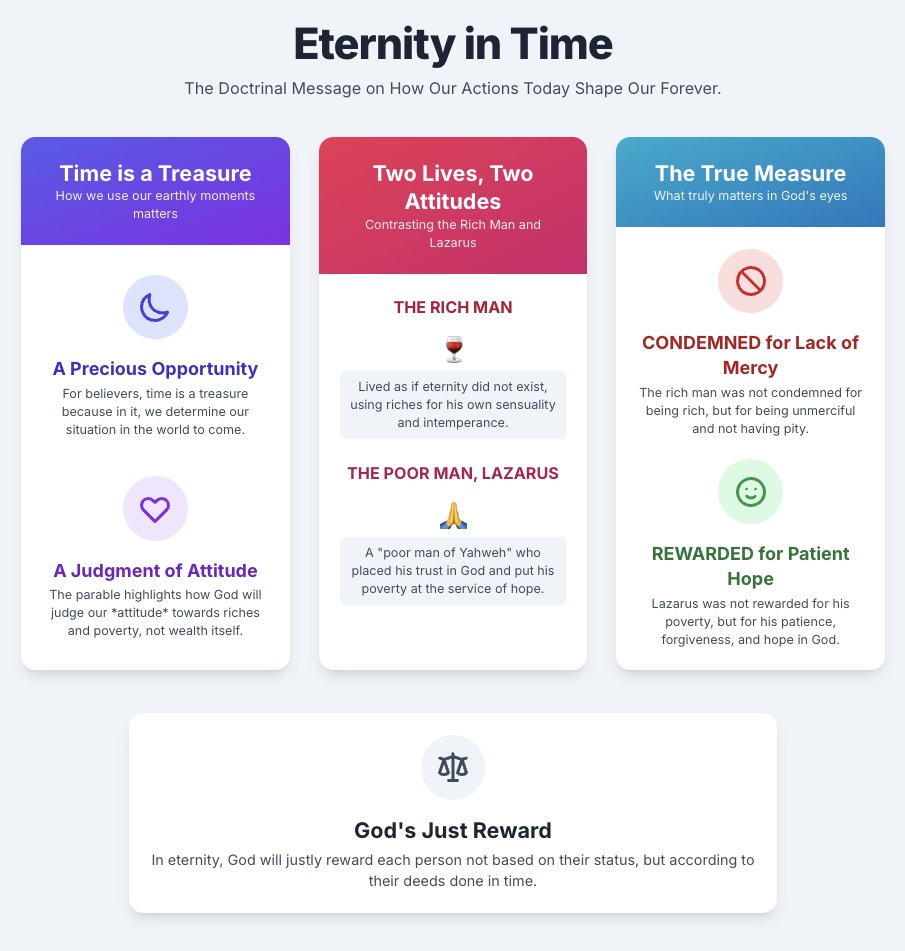
To strive for eternity in time. For those who believe in eternity, time is a treasure, because in time we determine our situation in the world to come. The parable of the rich man and the poor man, Lazarus, is not emphasizing the difference between the rich and the poor. Rather, it highlights the manner in which God will judge our attitude towards riches and poverty.
- The rich man who in this world dedicated his time to feasting and having a good time, while not showing any concern for the poor, will experience a sad change in his future life. This is what happened to the rich man of the Gospel.
- The poor man who in this life accepts his condition with serenity, without complaints or hatred, will be rewarded in eternity with true Richness, God himself. This is what happened to the poor man, Lazarus.
The former, unfortunately for him, lives as if eternity did not exist, whereas the latter is a poor man of Yahweh, who places his trust in God. The rich man is not condemned for being rich, but for being unmerciful, for not having pity for the man who lies at his gate. Lazarus is not rewarded for his poverty, but for his patience and forgiveness, like Job.The rich man puts his riches at the service of his sensuality and intemperance, while Lazarus places his poverty at the service of hope.
In the parable, Jesus Christ teaches us that in eternity – and perhaps even in the time of one’s earthly life – God will justly reward each person according to his deeds. This teaching should also enlighten our present life, so that we too may speak about living the present in light of eternity. In other words, the thought of a future life should spur us to be just and express solidarity in our present life. The opposite happens to the vulgar rich men of Samaria who, unconcerned with the future and oblivious to the fate of their country, live "lying on ivory beds and sprawling on their divans, they dine on lambs from the flock, and stall-fattened veal; they drink wine by the bowlfull, and lard themselves with the finest oils" (First Reading).
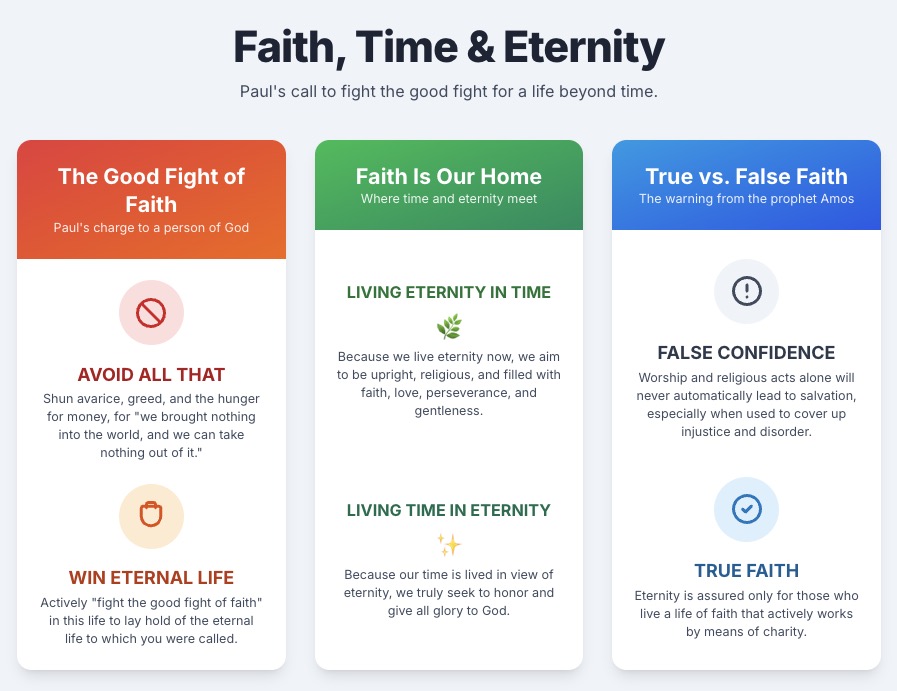
Faith – time – eternity. Paul urges Timothy, a man of God, a believer and a true Christian, to "avoid all that." Avoid all what? Avarice, greed, the hunger for money. He must avoid them because "we brought nothing into the world, and we can take nothing out of it" (Cf 1 Tm 6:7). He then urges Timothy to "fight the fight of faith" in this life, so as to win eternal life where Jesus Christ rules, the King of kings and the Lord of lords.
Faith is like the home in which the Christian already lives eternity in time and time in eternity. Because he lives eternity in time, he "must aim to be upright and religious, filled with faith and love, perseverance and gentleness" (Second Reading). Because he lives time in eternity, he truly seeks to honor and give glory to God.
Amos, in turn, teaches us that there is such a thing as a wrong faith, a false confidence in worship and religion, the symbols of which are Mount Garizin and Mount Sion, as if worship on its own were enough to attain salvation. Religious faith alone will never automatically lead to salvation, when it is used to cover up all despicable forms of injustice and disorder in one’s life. In essence, eternity is assured only to those who live a life of faith, which acts by means of charity.this world and present ourselves before God’s judgment.
Click to enlarge
Pastoral Suggestions
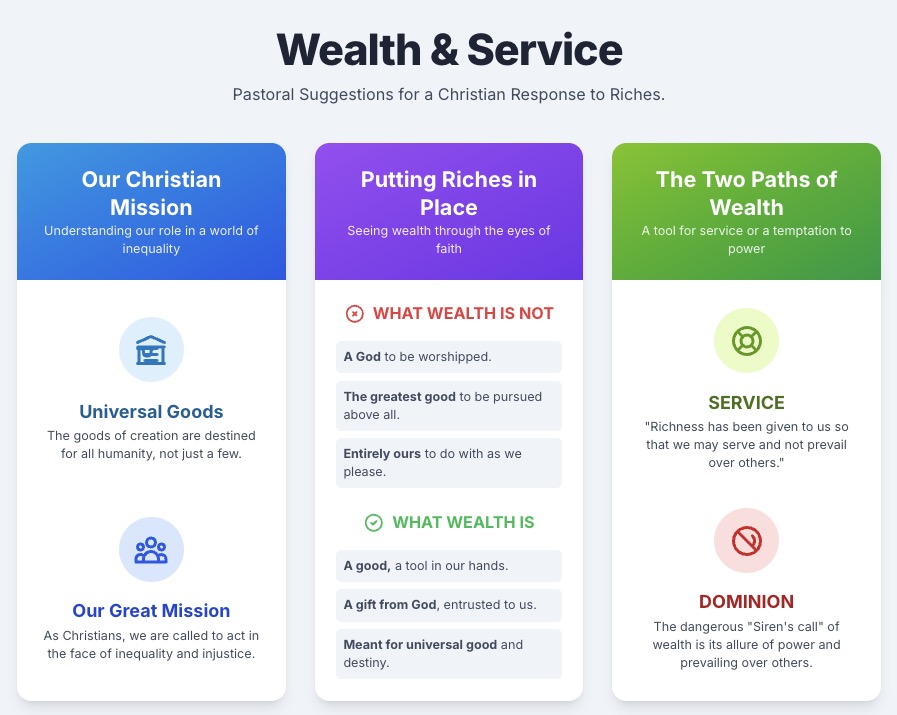
Riches, the object of service. In the catechism we read, "The goods of creation are destined to all of the human genre." This statement is absolute, and is not subjected to changes in historical eras or mentality, to technical progress, or economic globalization. On the other hand, throughout history there have always been differences in the amounts of goods and resources available to different people; there have always been and there will always be rich and poor people. Finally, these differences are often due to great forms of injustice that have plagued all the corners of our planet.
In the face of these three factors, as Christians we have a great mission to carry our among our brothers and sisters.
- The first task, undoubtedly, is to give the proper importance to wealth. It is not a god, which we must worship at the expense of the poor and needy. It is a good, but it is not the only or the greatest good. It is a good that is in our hands, given to each one of us by God, but not entirely ours. In other words, we cannot do whatever we want with it, because its destiny is universal.
- This leads us to the second task: "richness has been given to us so that we may serve and not prevail over others," this means that those who lack riches are less obliged than those who posses them. Man’s tendency to prevail over others is ancestral and extremely powerful. It is for this reason that wealth, among many other things, may be dangerous, because it is like a Siren that has the allure of dominion and power.
As Christians, we should be the first to live the poverty preached in the Gospel. We shall be an example for all and proclaim the truth that money either serves man or it serves no purpose at all, at least in the eyes of faith, in the eyes of God.
Greed, a sin against eternity. The greedy person only has eyes for the present, which he imagines to be never-ending. He would like to put eternity in time, but he realizes that it is impossible. And so, he reacts by ignoring it, holding on even more tightly to the hollow rock of the present. It may be said that without a doubt greediness is a passion that is harbored in every human heart. Hoarding riches, desiring more, the hunger for goods and means, and living in greater comfort are desires not unknown to mortal men, whether Christian or non-Christian, believers or atheists, priests, religious or lay. Not that this is a sin in itself, but when this tendency becomes an absorbing passion and one’s life is devoted to hoarding, owning and living comfortably, then one has become enslaved by the sin of greed.
Indeed, by taking on a greedy attitude, man sins against poverty because instead of placing his heart in God, his supreme Good, man has subjected it to the insatiable and ephemeral god of money. He sins against poverty because he does not use his riches to serve others but to satisfy his passions. He sins against the plan of God, Who gave all the goods in this world a universal destiny.
God has left it up to the men of each era and generation to achieve such a destiny. Shouldn’t many of us Christians truly convert to evangelical poverty?Shouldn’t we free ourselves of many bonds and monetary chains, which take away from us the freedom to live the authenticity of the Gospel? Will I be able to convince myself that the poverty of the heart is the heart of poverty, and that it is the crystalline spring of peace and fraternity? Poor in heart and in life, like Mother Theresa of Calcutta, so as to be a blessing of God for people!

Click to enlarge
Non-profit ministries have permission to copy/paste any infographics on this website into bulletins, presentations, or class/home school worksheets. A link and/or shoutout to THE WORD THIS WEEK and respective contributors would be greatly appreciated.
The Rich Man, Lazarus
and the Eucharist
25 September 2022- XXI Settembre Municipal Stadium, Matera, Italy

VATICAN NEWS (19:05) — From the XXI September Municipal Stadium in Matera, Holy Mass presided over by Pope Francis concluding the 27th National Eucharistic Congress. At the end recitation of the Angelus Prayer
Click on infographics to enlarge
Click on infographics to enlarge

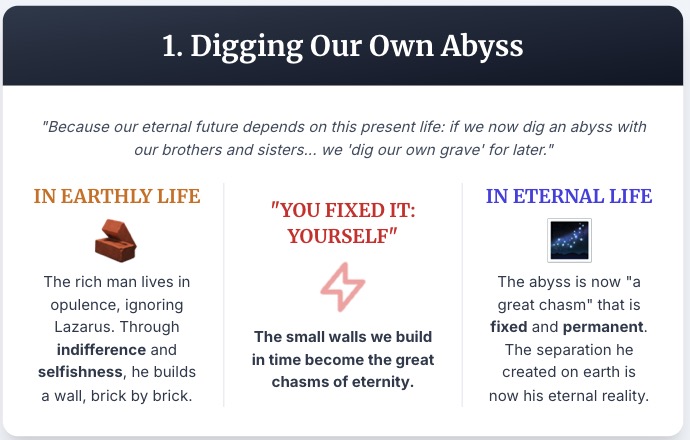
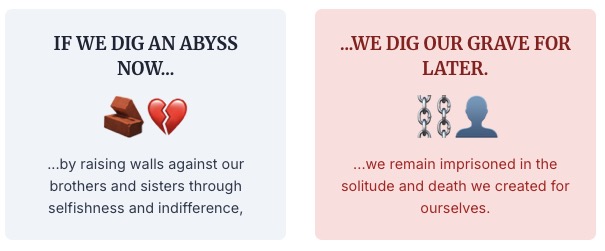
Digging Our Own Abyss
- Pope Francis says the rich man “fixed” the chasm between himself and Lazarus. In what ways do we, in our daily lives, create small or large "abysses" between ourselves and others through selfishness or indifference?
- The rich man wasn't condemned for his wealth, but for his inability to see Lazarus. Who are the "Lazaruses" at our own doors (in our communities, workplaces, or families) that we might fail to notice?
- Reflect on the idea that "our eternal future depends on this present life." How does this teaching challenge a modern tendency to separate our daily actions from our spiritual life?
- The Pope lists modern injustices: unequal resource distribution, abuses of power, indifference. Where do you see these "abysses" most clearly in the world or in your own country today?
Reflection Questions and Infographics were generated using Google Gemini 2.5 AI tools (w/ Chart.js and Tailwind CSS). Feel free to use them in any non-profit ministry. A Link or shoutout to https://thewordthisweek.net/ would be appreciated.
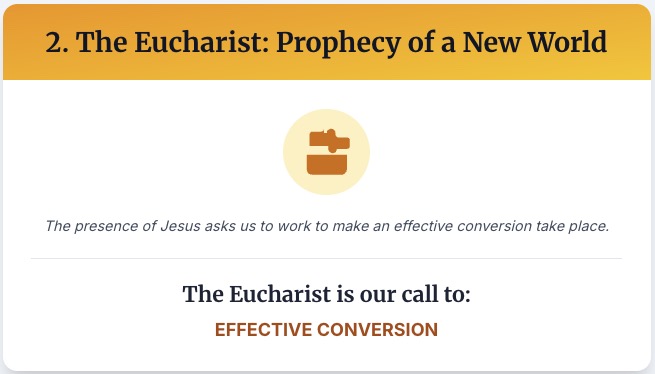

The Eucharist & Our Conversion
- What does it mean to convert from "indifference to compassion"? Can you share an example of when you've seen this conversion happen, either in your own life or in someone else's?
- The homily speaks of converting from "waste to sharing." Beyond just money, what resources (time, talent, attention) can we be more intentional about sharing?
Reflection Questions and Infographics were generated using Google Gemini 2.5 AI tools (w/ Chart.js and Tailwind CSS). Feel free to use them in any non-profit ministry. A Link or shoutout to https://thewordthisweek.net/ would be appreciated.
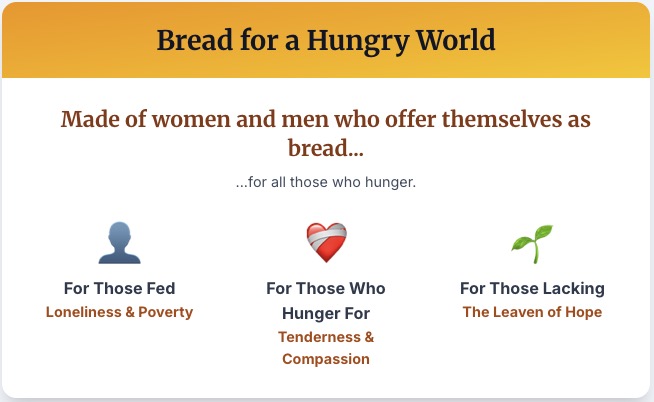

Dreaming of a Eucharistic Church
- Pope Francis dreams of a Church that "kneels before the Eucharist" but also "knows how to bend with compassion." Why are both of these actions—worship and service—essential? How do they strengthen each other?
- What does it mean for us, as individuals and as a community, to become "bread for others"? In what practical ways can we offer ourselves to those hungry for hope, tenderness, or compassion?
- The Pope states there is "no true Eucharistic worship without compassion for the many ‘Lazaruses’ who even today walk beside us." How can our experience of the Mass move us to greater action and compassion during the week?
Reflection Questions and Infographics were generated using Google Gemini 2.5 AI tools (w/ Chart.js and Tailwind CSS). Feel free to use them in any non-profit ministry. A Link or shoutout to https://thewordthisweek.net/ would be appreciated.
Saint Pope Paul VI’s
Social Perspective
30 September 2007 | Castel Gandolfo
Click infographics to enlarge
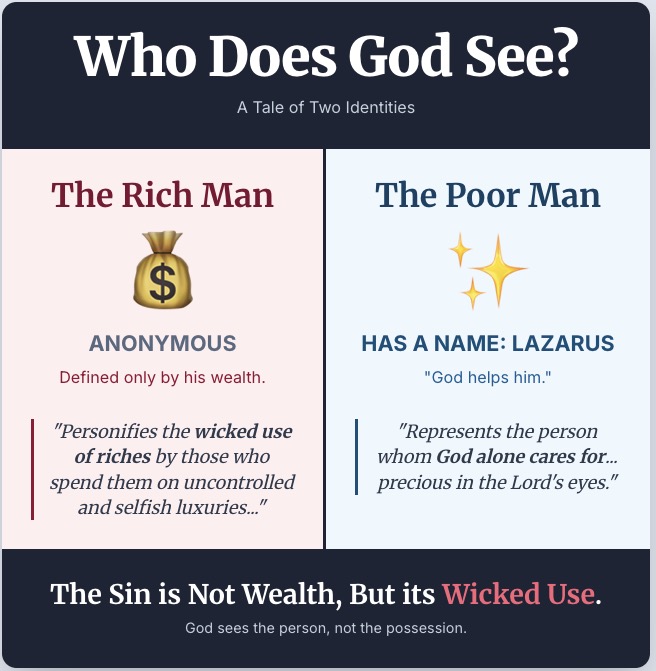
The Characters and Their Meaning
In his homily, Pope Benedict begins by examining the two central figures.
Key Text:
"The rich man personifies the wicked use of riches by those who spend them on uncontrolled and selfish luxuries... The poor man, on the contrary, represents the person whom God alone cares for: unlike the rich man he has a name: 'Lazarus'... which means, precisely, 'God helps him'."
Points for Reflection:
- The rich man is defined only by his wealth; he is anonymous. Lazarus, though worthless in the world's eyes, has a name and an identity before God. What does this contrast teach us about how God sees people versus how the world often does?
- The name "Lazarus" means "God helps him." In what ways does God's help become most evident in the lives of those who have little else to rely on?
- The rich man's sin wasn't his wealth, but the "wicked use" of it—spending it selfishly while ignoring the need at his door. How can we discern the line between rightly enjoying God's gifts and a "wicked use" of them in our own lives?
Discussion Questions:
- Who are the nameless people in our society today? Who are the ones we might see but fail to truly notice?
- Can you think of a time when you felt like Lazarus, forgotten by others but aware of God's care?
Reflection Questions and Infographics were generated using Google Gemini 2.5 AI tools (w/ Chart.js and Tailwind CSS). Feel free to use them in any non-profit ministry. A Link or shoutout to https://thewordthisweek.net/ would be appreciated.

The Great Reversal and Divine Justice
The parable reveals a dramatic shift in fortunes after death, a core theme of the homily.
Key Text:
"The story shows how earthly wickedeness is overturned by divine justice... This is a new and definitive state of affairs against which no appeal can be made, which is why one must mend one's ways during one's life; to do so after serves no purpose."
Points for Reflection:
- Pope Benedict emphasizes that the separation between the rich man and Lazarus in eternity is "definitive." This highlights the urgency of our choices in the present moment.
- The justice of God isn't arbitrary; it solidifies the state we have chosen for ourselves on earth. The rich man chose a life separated from Lazarus, and that separation became permanent.
- This isn't meant to be a scare tactic, but a call to freedom: we have the power now to change our eternal trajectory by changing how we live and love.
Discussion Questions:
- How does the reality of a "definitive" judgment challenge the modern idea that there are always second chances?
- What small choices can we make today to "mend our ways" and close the gaps between ourselves and the needy around us?
Reflection Questions and Infographics were generated using Google Gemini 2.5 AI tools (w/ Chart.js and Tailwind CSS). Feel free to use them in any non-profit ministry. A Link or shoutout to https://thewordthisweek.net/ would be appreciated.

The Social Interpretation
The Pope expands the parable's meaning from the individual to the global community, drawing on the wisdom of Pope Paul VI.
Key Text:
"Speaking of the campaign against hunger he [Paul VI] wrote: 'It is a question... of building a world where every man... can live a fully human life... where the poor man Lazarus can sit down at the same table with the rich man'."
Points for Reflection:
- The parable is not just about two individuals, but about "peoples blessed with abundance" and "peoples in hunger." The "table" is our world, and the banquet is access to the earth's resources.
- Pope Benedict identifies two causes of destitution: human-imposed servitude (injustice, conflict, exploitation) and uncontrolled natural forces (floods, disasters). Often, these two factors overlap.
- The call for "authentic solidarity" means recognizing that the dramatic appeal of the hungry is just as pressing today as it was 40 years ago.
Discussion Questions:
- Where do we see a global "rich man" and a global "Lazarus" today?
- How do political and economic conflicts often worsen the suffering caused by natural disasters?
- What does it mean to help build a world where Lazarus can "sit down at the same table"? What would that look like in practice?
Reflection Questions and Infographics were generated using Google Gemini 2.5 AI tools (w/ Chart.js and Tailwind CSS). Feel free to use them in any non-profit ministry. A Link or shoutout to https://thewordthisweek.net/ would be appreciated.
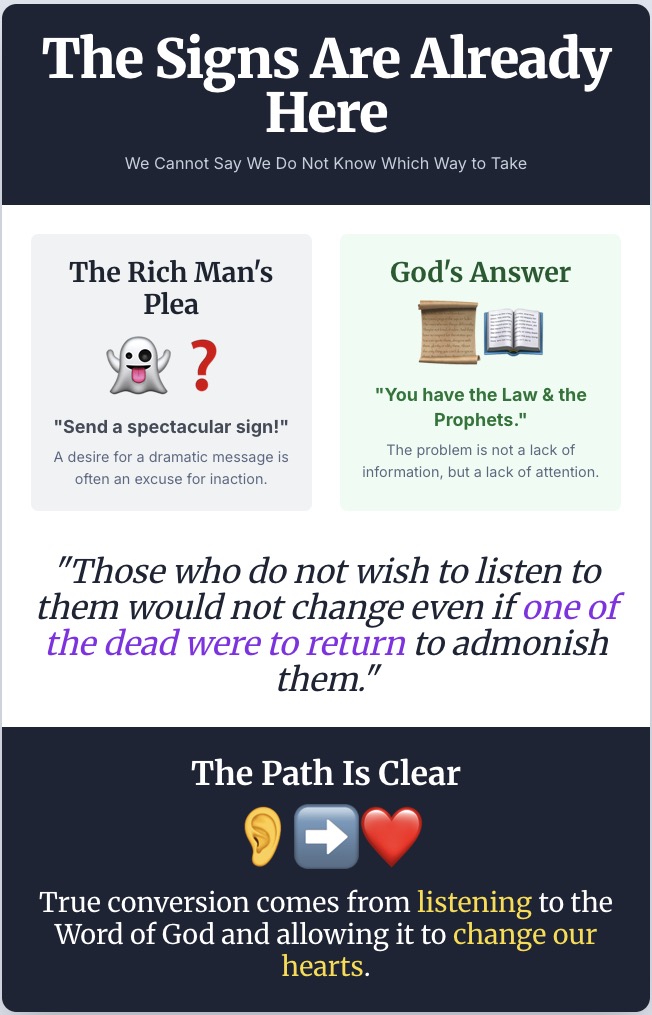
The Call to Listen and Act Now
The homily concludes by answering the rich man's plea to send a sign. The answer is clear: the signs are already here.
Key Text:
"We cannot say that we do not know which way to take: we have the Law and the Prophets, Jesus tells us in the Gospel. Those who do not wish to listen to them would not change even if one of the dead were to return to admonish them."
Points for Reflection:
- Our problem is not a lack of information, but a lack of attention. God has already spoken clearly through Scripture and the teachings of the Church about our duty to the poor.
- The desire for a spectacular sign is often an excuse for inaction. True conversion comes from listening to the Word of God that is already present and allowing it to change our hearts.
- The "Law and the Prophets" call us to justice and mercy. This is the path we already know we must take.
Discussion Questions:
- What are the "Law and the Prophets" for us today? (e.g., Scripture, Catholic Social Teaching, the voice of the Pope).
- What distractions or desires in our own lives can make us "not wish to listen" to God's clear message?
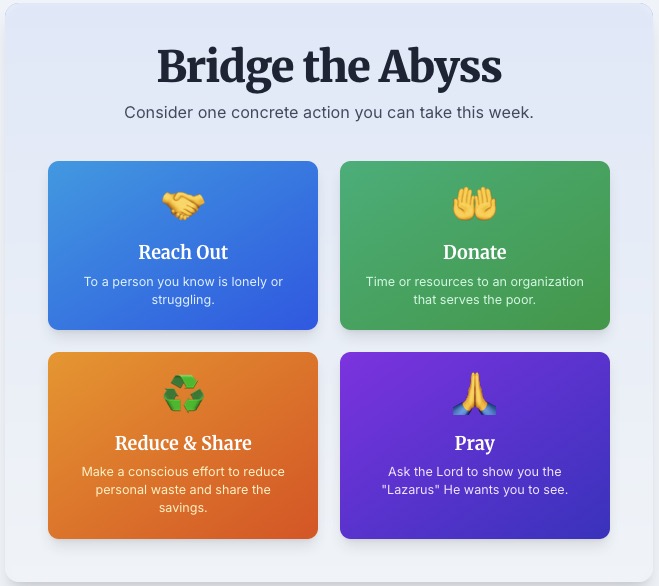
Actionable Steps:
- Listen: This week, spend time reading a passage from "the Prophets" (like Isaiah 58 or Amos 5) or a section of a social encyclical.
- See: Make a conscious effort to notice the "Lazarus" in your community. This could be a homeless person, an elderly neighbor, or a struggling family.
- Act: Choose one concrete way to "share the much or the little that we have." This could be a direct act of service, a donation, or a commitment to pray daily for a specific person or situation of need.
Reflection Questions and Infographics were generated using Google Gemini 2.5 AI tools (w/ Chart.js and Tailwind CSS). Feel free to use them in any non-profit ministry. A Link or shoutout to https://thewordthisweek.net/ would be appreciated.
