
Featured
Videos


Commentary
Highlights


Fr. George
Corrigan
OFM

Michal E.
Hunt

Catena
Aurea
Compiled by
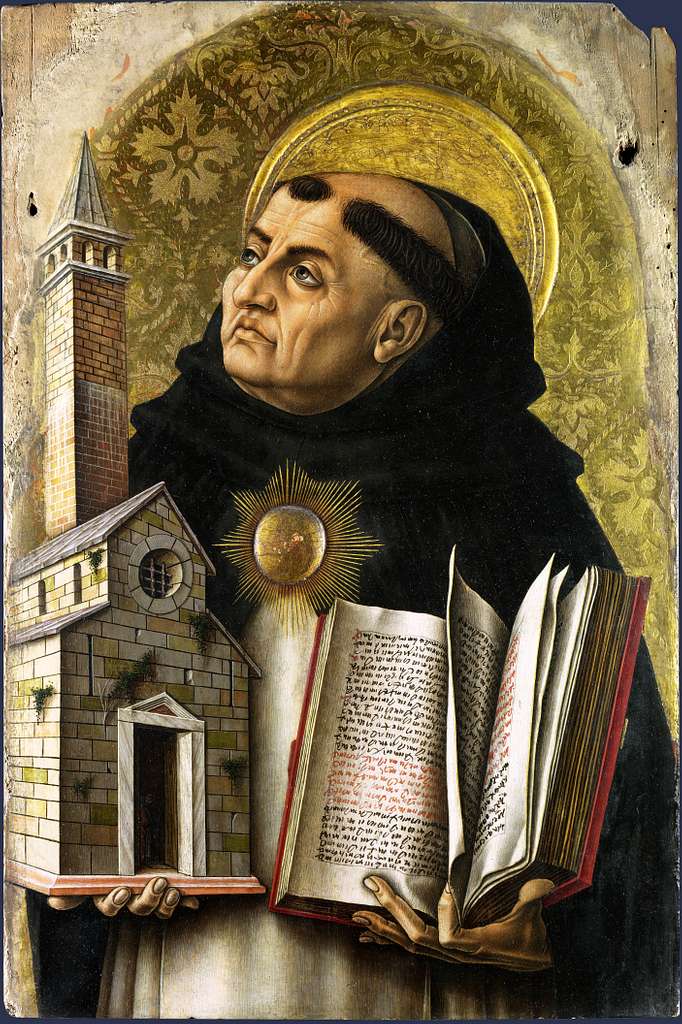
St. Thomas
Aquinas
Thomas Aquinas compiled this opus from sermons and commentaries on the Gospels written by the early Church Fathers, arranging their thoughts in such a way that they form a continuous commentary on each Gospel.
John 1:35–36
35. Again the next day after John stood, and two of his disciples;
36. And looking upon Jesus as he walked, he saith, Behold the Lamb of God!
CHRYSOSTOM. (Hom. xviii. [al. xvii.] 1) Many not having attended to John’s words at first, he rouses them a second time: Again the next day after John stood, and two of his disciples.
BEDE. (Hom. in Vigil. S. And.) John stood, because he had ascended that citadel of all excellences, from which no temptations could cast him down: his disciples stood with him, as stout-hearted followers of their master.
CHRYSOSTOM. (Hom. xviii. [al. xvii.] c. 2) But wherefore went he not all about, preaching in every place of Judæa; instead of standing near the river, waiting for His coming, that he might point Him out? Because he wished this to be done by the works of Christ Himself. And observe how much greater an effort was produced; He struck a small spark, and suddenly it rose into a flame. Again, if John had gone about and preached, it would have seemed like human partiality, and great suspicion would have been excited. Now the Prophets and Apostles all preached Christ absent; the former before His appearance in the flesh, the latter after His assumption. But He was to be pointed out by the eye, not by the voice only; and therefore it follows: And looking upon Jesus us He walked, he saith, Behold the Lamb of God!
THEOPHYLACT. Looking he saith, as if signifying by his looks his love and admiration for Christ.
AUGUSTINE. (Tr. vii. c. 8) John was the friend of the Bridegroom; he sought not his own glory, but bare witness to the truth. And therefore he wished not his disciples to remain with him, to the hindrance of their duty to follow the Lord; but rather shewed them whom they should follow, saying, Behold the Lamb of God.
CHRYSOSTOM. (Hom. xviii. 1. in Joan) He makes not a long discourse, having only one object before him, to bring them and join them to Christ; knowing that they would not any further need his witness. (c. 2.). John does not however speak to his disciples alone, but publicly in the presence of all. And so, undertaking to follow Christ, through this instruction common to all, they remained thenceforth firm, following Christ for their own advantage, not as an act of favour to their masterx. John does not exhort: he simply gazes in admiration on Christ, pointing out the gifty He came to bestow, the cleansing from sin: and the mode in which this would be accomplished: both of which the word Lamb testifies to. Lamb has the article affixed to it, as a sign of preeminence.
AUGUSTINE. (Tr. vii. c. 5) For He alone and singly is the Lamb without spot, without sin; not because His spots are wiped off, but because He never had a spot. He alone is the Lamb of God, for by His blood alone can men be redeemed. (c. 6). This is the Lamb whom the wolves fear; even the slain Lamb, by whom the lion was slain.
BEDE. (Hom. 1) The Lamb therefore he calls Him; for that He was about to give us freely His fleece, that we might make of it a wedding garment; i. e. would leave us an example of life, by which we should be warmed into love.
ALCUIN. John stands in a mystical sense, the Law having ceased, and Jesus comes, bringing the grace of the Gospel, to which that same Law bears testimony. Jesus walks, to collect disciples.
BEDE. (Hom. in Vigil. S. And.) The walking of Jesus has a reference to the economy of the Incarnation, by means of which He has condescended to come to us, and give us a pattern of life.
John 1:37–40
37. And the two disciples heard him speak, and they followed Jesus.
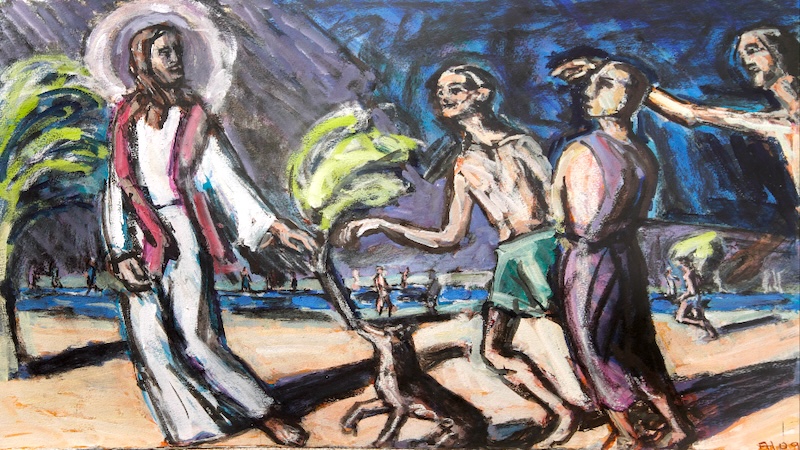
38. Then Jesus turned, and saw them following, and saith unto them, What seek ye? They said unto Him, Rabbi, (which is to say, being interpreted, Master,) where dwellest thou?
39. He saith unto them, Come and see. They came and saw where he dwelt, and abode with him that day: for it was about the tenth hour.
40. One of the two which heard John speak, and followed him, was Andrew, Simon Peter’s brother.
ALCUIN. John having borne witness that Jesus was the Lamb of God, the disciples who had been hitherto with him, in obedience to his command, followed Jesus: And the two disciples heard him speak, and they followed Jesus.
CHRYSOSTOM. (Hom. xviii. 1 et sq.) Observe; when he said, He that cometh after me is made before me, and, Whose shoe’s latchet I am not worthy to unloose, he gained over none; but when he made mention of the economy, and gave his discourse a humbler turn, saying, Behold the Lamb of God, then his disciples followed Christ. For many persons are less influenced by the thoughts of God’s greatness and majesty, than when they hear of His being man’s Helper and Friend; or any thing pertaining to the salvation of men. Observe too, when John says, Behold the Lamb of God, Christ says nothing. The Bridegroom stands by in silence; others introduce Him, and deliver the Bride into His hands; He receives her, and so treats her that she no longer remembers those who gave her in marriage. Thus Christ came to unite to Himself the Church; He said nothing Himself; but John, the friend of the Bridegroom, came forth, and put the Bride’s right hand in His; i. e. by his preaching delivered into His hands men’s souls, whom receiving He so disposed of, that they returned no more to John. And observe farther; As at a marriage the maiden goes not to meet the bridegroom, (even though it be a king’s son who weds a humble handmaid,) but he hastens to her; so is it here. For human nature ascended not into heaven, but the Son of God came down to human nature, and took her to His Father’s house. Again; There were disciples of John who not only did not follow Christ, but were even enviously disposed toward Him; but the better part heard, and followed; not from contempt of their former master, but by his persuasion; because he promised them that Christ would baptize with the Holy Ghost. And see with what modesty their zeal was accompanied. They did not straight way go and interrogate Jesus on great and necessary doctrines, nor in public, but sought private converse with Him; for we are told that Jesus turned, and saw them following, and saith unto them, What seek ye? Hence we learn, that when we once begin to form good resolutions, God gives us opportunities enough of improvement. Christ asks the question, not because He needed to be told, but in order to encourage familiarity and confidence, and shew that He thought them worthy of His instructions.
THEOPHYLACT. (in loc.) Observe then, that it was upon those who followed Him, that our Lord turned His face and looked upon them. Unless thou by thy good works follow Him, thou shalt never be permitted to see His face, or enter into His dwelling.
ALCUIN. The disciples followed behind His back, in order to see Him, and did not see His face. So He turns round, and, as it were, lowers His majesty, that they might be enabled to behold His face.
ORIGEN. (tom. ii. c. 29) Perhaps it is not without a reason, that after six testimonies John ceases to bear witness, and Jesus asks seventhly, What seek ye?
CHRYSOSTOM. (Hom. xviii. in Joan. sparsim) And besides following Him, their questions shewed their love for Christ; They said unto Him, Rabbi, (which is, being interpreted, Master,) where dwellest Thou? They call Him, Master, before they have learnt any thing from Him; thus encouraging themselves in their resolution to become disciples, and to shew the reason why they followed.
ORIGEN. An avowal, befitting persons who came from hearing John’s testimony. They put themselves under Christ’s teaching, and express their desire to see the dwelling of the Son of God.
ALCUIN. They do not wish to be under His teaching for a time only, but enquire where He abides; wishing an immediate initiation in the secrets of His word, and afterwards meaning often to visit Him, and obtain fuller instruction. And, in a mystical sense too, they wish to know in whom Christ dwells, that profiting by their example they may themselves become fit to be His dwelling. Or, their seeing Jesus walking, and straightway enquiring where He resides, is an intimation to us, that we should, remembering His Incarnation, earnestly entreat Him to shew us our eternal habitation. The request being so good a one, Christ promises a free and full disclosure. He saith unto them, Come and see: that is to say, My dwelling is not to be understood by words, but by works; come, therefore, by believing and working, and then see by understanding.
ORIGEN. (tom. ii. c. 29) Or perhaps come, is an invitation to action; see, to contemplation.
CHRYSOSTOM. (Hom. xviii. [al. xvii.] 3) Christ does not describe His house and situation, but brings them after Him, shewing that he had already accepted them as His own. He says not, It is not the time now, to-morrow ye shall hear if ye wish to learn; but addresses them familiarly, as friends who had lived with him a long time. But how is it that He saith in another place, The Son of man hath not where to lay His head? (Matt. 8:20) when here He says, Come and see where I live? His not having where to lay His head, could only have meant that He had no dwelling of His own, not that He did not live in a house at all: for the next words arc, They came and saw where He dwelt, and abode with Him that day. Why they stayed the Evangelist does not say: it being obviously for the sake of His teaching.
AUGUSTINE. (Tr. vii. c. 9) What a blessed day and night was that! Let us too build up in our hearts within, and make Him an house, whither He may come and teach us.
THEOPHYLACT. And it was about the tenth hour. The Evangelist mentions the time of day purposely, as a hint both to teachers and learners, not to let time interfere with their work.
CHRYSOSTOM. (Hom. xviii. 3) It shewed a strong desire to hear Him, since even at sunset they did not turn from Him. To sensual persons the time after meals is unsuitable for any grave employment, their bodies being overloaded with food. But John, whose disciples these were, was not such an one. His evening was a more abstemious one than our mornings.
AUGUSTINE. (Tr. vii. c. 10) The number here signifies the law, which was composed of ten commandments. The time had come when the law was to be fulfilled by love, the Jews, who acted from fear, having been unable to fulfil it, and therefore was it at the tenth hour that our Lord heard Himself called, Rabbi; none but the giver of the law is the teacher1 of the law.
CHRYSOSTOM. (Hom. xviii. 3) One of the two which heard John speak and followed Him was Andrew, Simon Peter’s brother. Why is the other name left out? Some say, because this Evangelist himself was that other. Others, that it was a disciple of no eminence, and that there was no use in telling his name any more than those of the seventy-two, which are omitted.
ALCUIN. Or it would seem that the two disciples who followed Jesus were Andrew and Philip.
John 1:41–42
41. He first findeth his own brother Simon, and saith unto him, We have found the Messias, which is, being interpreted, the Christ.
42. And he brought him to Jesus. And when Jesus beheld him, he said, Thou art Simon the son of Jona: thou shalt be called Cephas, which is by interpretation, A stone.
CHRYSOSTOM. (Chrys. Hom. xix. 1) Andrew kept not our Lord’s words to himself; but ran in haste to his brother, to report the good tidings: He first findeth his own brother Simon, and saith unto him, We have found the Messias, which is, being interpreted, the Christ.
BEDE. (Hom. in Vig. St. Andr.) This is truly to find the Lord; viz. to have fervent love for Him, together with a care for our brother’s salvation.
CHRYSOSTOM. (Hom. xix. [al. xviii.] 1) The Evangelist docs not mention what Christ said to those who followed Him; but we may infer it from what follows. Andrew declares in few words what he had learnt, discloses the power of that Master Who had persuaded them, and his own previous longings after Him. For this exclamation, We have found, expresses a longing for His coming, turned to exultation, now that He was really come.
AUGUSTINE. (Tr. vii. c. 13) Messias in Hebrew, Christus in Greek, Unctus in Latin. Chrism is unction, and He had a special unction, which from Him extended to all Christians, as appears in the Psalm, God, even Thy God, hath anointed Thee with the oil of gladness above Thy fellows1. (Ps. 44, [45]) All holy persons arc partakers with Him; but He is specially the Holy of Holies, specially anointed.
CHRYSOSTOM. (Hom. xix. 1, 2) And therefore he said not Messias, but the Messias. Mark the obedience of Peter from the very first; ho went immediately without delay, as appears from the next words: And he brought him to Jesus. Nor let us blame him as too yielding, because he did not ask many questions, before he received the word. It is reasonable to suppose that his brother had told him all, and sufficiently fully; but the Evangelists often make omissions for the sake of brevity. But, besides this, it is not absolutely said that he did believe, but only, He took him to Jesus; i. e. to learn from the mouth of Jesus Himself, what Andrew had reported. Our Lord begins now Himself to reveal the things of His Divinity, and to exhibit them gradually by prophecy. For prophecies are no less persuasive than miracles; inasmuch as they are preeminently God’s work, and are beyond the power of devils to imitate, while miracles may be phantasy or appearance: the foretelling future events with certainty is an attribute of the incorruptible nature alone: And when Jesus beheld him, He said, Thou art Simon the son of Jonas; thou shall be called Cephas, which is by interpretation, A stone.
BEDE. (Hom. i. Temp. Hier. in Vig. S. Andr.) He beheld him not with His natural eye only, but by the insight of His Godhead discerned from eternity the simplicity and greatness of his soul, for which he was to be elevated above the whole Church. In the word Peter, we must not look for any additional meaning, as though it were of Hebrew or Syriac derivation; for the Greek and Latin word Peter, has the same meaning as Cephas; being in both languages derived from petra. He is called Peter on account of the firmness of his faith, in cleaving to that Rock, of which the Apostle speaks, And that Rock was Christ; (1 Cor. 10:4) which secures those who trust in it from the snares of the enemy, and dispenses streams of spiritual gifts.
AUGUSTINE. (Tr. vii. c. 14) There was nothing very great in our Lord saying whose son he was, for our Lord knew the names of all His saints, having predestinated them before the foundation of the world. But it was a great thing for our Lord to change his name from Simon to Peter. Peter is from petra, rock, which rock is the Church: so that the name of Peter represents the Church. And who is safe, unless he build upon a rock? Our Lord here rouses our attention: for had he been called Peter before, we should not have seen the mystery of the Rock, and should have thought that he was called so by chance, and not providentially. God therefore made him to be called by another name before, that the change of that name might give vividness to the mystery.
CHRYSOSTOM. (Hom. xix. [al. xviii. 2]) He changed the name too to shew that He was the same who done so before in the Old Testament; who had called Abram Abraham, Sarai Sarah, Jacob Israel. Many He had named from their birth, as Isaac and Samson; others again after being named by their parents, as were Peter, and the sons of Zebedee. Those whose virtue was to be eminent from the first, have names given them from the first; those who were to be exalted afterwards, are named afterwards.
AUGUSTINE. (de Con. Evang. l. ii. c. 17) The account here of the two disciples on the Jordan, who follow Christ (before he had gone into Galilee) in obedience to John’s testimony; viz. of Andrew bringing his brother Simon to Jesus, who gave him, on this occasion, the name of Peter; disagrees considerably with the account of the other Evangelists, viz. that our Lord found these two, Simon and Andrew, fishing in Galilee, and then bid them follow Him: unless we understand that they did not regularly join our Lord when they saw Him on the Jordan; but only discovered who He was, and full of wonder, then returned to their occupations. Nor must we think that Peter first received his name on the occasion mentioned in Matthew, when our Lord says, Thou art Peter, and upon this rock will I build My Church; (Mat. 16:18) but rather when our Lord says, Thou shall be called Cephas, which is by interpretation, A stone.
ALCUIN. Or perhaps He does not actually give him the name now, but only fixes beforehand what He afterwards gave him when He said, Thou art Peter, and upon this rock will I build My Church. And while about to change his name, Christ wishes to shew that even that which his parents had given him, was not without a meaning. For Simon signifies obedience, Joanna grace, Jona a dove: as if the meaning was; Thou art an obedient son of grace, or of the dove, i. e. the Holy Spirit; for thou hast received of the Holy Spirit the humility, to desire, at Andrew’s call, to see Me. The elder disdained not to follow the younger; for where there is meritorious faith, there is no order of seniority.
John 1:43–46
43. The day following Jesus would go forth into Galilee, and findeth Philip, and saith unto him, Follow me.
44. Now Philip was of Bethsaida, the city of Andrew and Peter.
45. Philip findeth Nathanael, and saith unto him, We have found him, of whom Moses in the law, and the prophets, did write, Jesus of Nazareth, the son of Joseph.
46. And Nathanael said unto him, Can there any good thing come out of Nazareth? Philip saith unto him, Come and see.
CHRYSOSTOM. (Hom. xix) After gaining these disciples, Christ proceeded to convert others, viz. Philip and Nathanael: The day following, Jesus would go forth into Galilee.
ALCUIN. Leaving, that is, Judæa, where John was baptizing, out of respect to the Baptist, and not to appear to lower his office, so long as it continued. He was going too to call a disciple, and wished to go forth into Galilee, i. e. to a place of “transition” or “revelation,” that is to say, that as He Himself increased in wisdom or stature, and in favour with God and man, and as He suffered and rose again, and entered into His glory: so He would teach His followers to go forth, and increase in virtue, and pass through suffering to joy. He findeth Philip, and saith unto him, Follow Me. Every one follows Jesus who imitates His humility and suffering, in order to be partaker of His resurrection and ascension.
CHRYSOSTOM. (Hom. xx. 1) Observe, He did not call them, before some had of their own accord joined Him: for had He invited them, before any had joined Him, perhaps they would have started back: but now having determined to follow of their own free choice, they remain firm ever after. He calls Philip, however, because he would be known to him, from living in Galilee. But what made Philip follow Christ? Andrew heard from John the Baptist, and Peter from Andrew; he had heard from no one; and yet on Christ saying, Follow Me, was persuaded instantly. It is not improbable that Philip may have heard John: and yet it may have been the mere voice of Christ which produced this effect.
THEOPHYLACT. For the voice of Christ sounded not like a common voice to some, that is, the faithful, but kindled in their inmost soul the love of Him. Philip having been continually meditating on Christ, and reading the books of Moses, so confidently expected Him, that the instant he saw, he believed. Perhaps too he had heard of Him from Andrew and Peter, coming from the same district; an explanation which the Evangelist seems to hint at, when he adds, Now Philip was of Bethsaida, the city of Andrew and Peter.
CHRYSOSTOM. (Hom. xx. 1) The power of Christ appears by His gathering fruit out of a barren country. For from that Galilee, out of which there ariseth no prophet, He takes His most distinguished disciples.
ALCUIN. Bethsaida means house of hunters. The Evangelist introduces the name of this place by way of allusion to the characters of Philip, Peter, and Andrew, and their future office, i. e. catching and saving souls.
CHRYSOSTOM. (Hom. xx. 1) Philip is not persuaded himself, but begins preaching to others: Philip findeth Nathanael, and saith unto him, We have found Him of whom Moses in the Law, and the Prophets, did write, Jesus of Nazareth, the Son of Joseph. See how zealous he is, and how constantly he is meditating on the books of Moses, and looking for Christ’s coming. That Christ was coming he had known before; but he did not know that this was the Christ, of whom Moses and the Prophets did write: He says this to give credibility to his preaching, and to shew his zeal for the Law and the Prophets, and how that he had examined them attentively. Be not disturbed at his calling our Lord the Son of Joseph; this was what He was supposed to be.
AUGUSTINE. (Tr. vii. c. 15) The person to whom our Lord’s mother had been betrothed. The Christians know from the Gospel, that He was conceived and born of an undefiled mother. He adds the place too, of Nazareth.
THEOPHYLACT. He was bred up there: the place of His birth could not have been known generally, but all knew that He was bred up in Nazareth.
And Nathanael said unto him, Can there any good thing come out of Nazareth.
AUGUSTINE. (Tr. vii. c. 15, 16, 17) However you may understand these words, Philip’s answer will suit. You may read it either as affirmatory, Something good can come out of Nazareth; to which the other says, Come and see: or you may read it as a question, implying doubt on Nathanael’s part, Can any good thing come out of Nazareth? Come and see. Since either way of reading agrees equally with what follows, we must inquire the meaning of the passage. Nathanael was well read in the Law, and therefore the word Nazareth (Philip having said that he had found Jesus of Nazareth) immediately raises his hopes, and he exclaims, Something good can come out of Nazareth. He had searched the Scriptures, and knew, what the Scribes and Pharisees could not, that the Saviour was to be expected thence.
ALCUIN. He who alone is absolutely holy, harmless, undefiled; of whom the prophet saith, There shall come forth a rod out of the stem of Jesse, and a branch (Nazaræus) shall grow out of his roots. (Isaiah 11:1) Or the words may be taken as expressing doubt, and asking the question.
CHRYSOSTOM. (Hom. xx. 1, 2) Nathanael knew from the Scriptures, that Christ was to come from Bethlehem, according to the prophecy of Micah, And thou, Bethlehem, in the land of Judah,—out of thee shall come a Governor, that shall rule my people Israel. (Micah 5:2) On hearing of Nazareth, then, he doubted, and was not able to reconcile Philip’s tidings with prophecy. For the Prophets call Him a Nazarene, only in reference to His education and mode of life. Observe, however, the discretion and gentleness with which he communicates his doubts. He does not say, Thou deceivest me, Philip; but simply asks the question, Can any good thing come out of Nazareth? Philip too in turn is equally discrete. He is not confounded by the question, but dwells upon it, and lingers in the hope of bringing him to Christ: Philip saith unto him, Come and see. He takes him to Christ, knowing that when he had once tasted of His words and doctrine, he will make no more resistance.
SOURCE: e-Catholic 2000
STCB Notes


Sermon
Writer


John 1:29-42 Exegesis
“They said to him, ‘Rabbi’ (which is to say, being interpreted, Teacher), ‘where are you staying?’” (meneis—from meno) (John 1:38b). This Greek verb, meno, which is repeated three times in verses John 1:38-39, has special meaning in this Gospel. Jesus says, “He who eats my flesh and drinks my blood lives (menei) in me, and I in him” (John 6:56)—and “Remain (meinate) in me, and I in you. Just as the branch can’t bear fruit by itself unless it remains (mene) in the vine, so neither can you unless you remain (menete) in me” (John 15:4)—and “As the Father has loved me, I also have loved you. Remain (meinate) in my love. If you keep my commandments, you will remain (meneite) in my love; even as I have kept my Father’s commandments and remain (meno) in his love” (John 15:9-10).
Abiding (staying with, remaining with) Jesus, then, clearly has deeply spiritual significance.