DEC 29, 2024


Sunday Readings Commentary
Sunday Readings Commentary
- HERMENEUTICAL SCHOLARS
- NOTES / SLIDES
- CHURCH FATHERS

⬇️ A Walk in the Word
Hector
Molina
Family is where Jesus’ experience in the temple at age 12 highlights his divine mission and identity, emphasizing the importance of obedience, worship, and the Christian family’s role as a domestic church centered on God.
Holy Family - YEAR C

⬇️ Encountering the Word
Jeff
Cavins
At the heart of the Christian family lies the story of the Holy Family’s faithfulness and commitment to worship, serving as a model for nurturing spiritual growth, unity, and love within our own families. This is crucial for parents in cultivating a holy family through regular attendance at Mass.
Holy Family - YEAR C


⬇️ Bishop Robert Barron
Bishop Robert
Barron
Memories of Bishop Barron’s uncle Tommy’s struggles after World War II highlight the lasting impact of trauma and the importance of compassion and love for the diverse and flawed individuals in our lives. His story exemplifies the enduring importance of showing mercy to those facing personal challenges.
Holy Family - YEAR C

⬇️ Catholic Sunday Scriptures in Context
Fr. Paul
Galetto, OSA
Introducing the readings for the Feast of the Holy Family, Fr. Galetto acknowledges their significance in advocating familial love, respect, and spiritual principles as essential elements for establishing societal harmony and individual satisfaction. Furthermore, the event underscores Jesus’ crucial role in accomplishing the divine law and providing humanity with the prospect of salvation.
Holy Family - YEAR C


⬇️ Mass Readings Explained
Brant
Pitre
Lauded for his teachings in his letter to the Colossians, St. Paul highlights the importance of compassion, kindness, humility, patience, forgiveness, and gratitude as essential virtues for fostering harmony and peace within Christian family life.
Holy Family - YEAR C
⬇️ The Word Proclaimed
Fr. Francis
Martin
Yearning for independence, the story of Jesus at twelve years old illustrates the balance between parental guidance and the child’s journey towards responsibility, emphasizing the importance of faith and identity within the family.
Holy Family - YEAR C


WORD MADE FLESH (Theology of the Body)
TRANSFORMING JUSTICE, and
LIFE RECOVERY BIBLE
have been relocated to PREACHING TOPICS.
To further explore the ideas presented in the excerpts and encourage personal application, discussion questions for small groups are provided. They are not directly connected to the commentary but aim to delve deeper into the concepts presented in order to promote personal reflection.
⬇️ Scott Hahn
Catholic Bible Dictionary
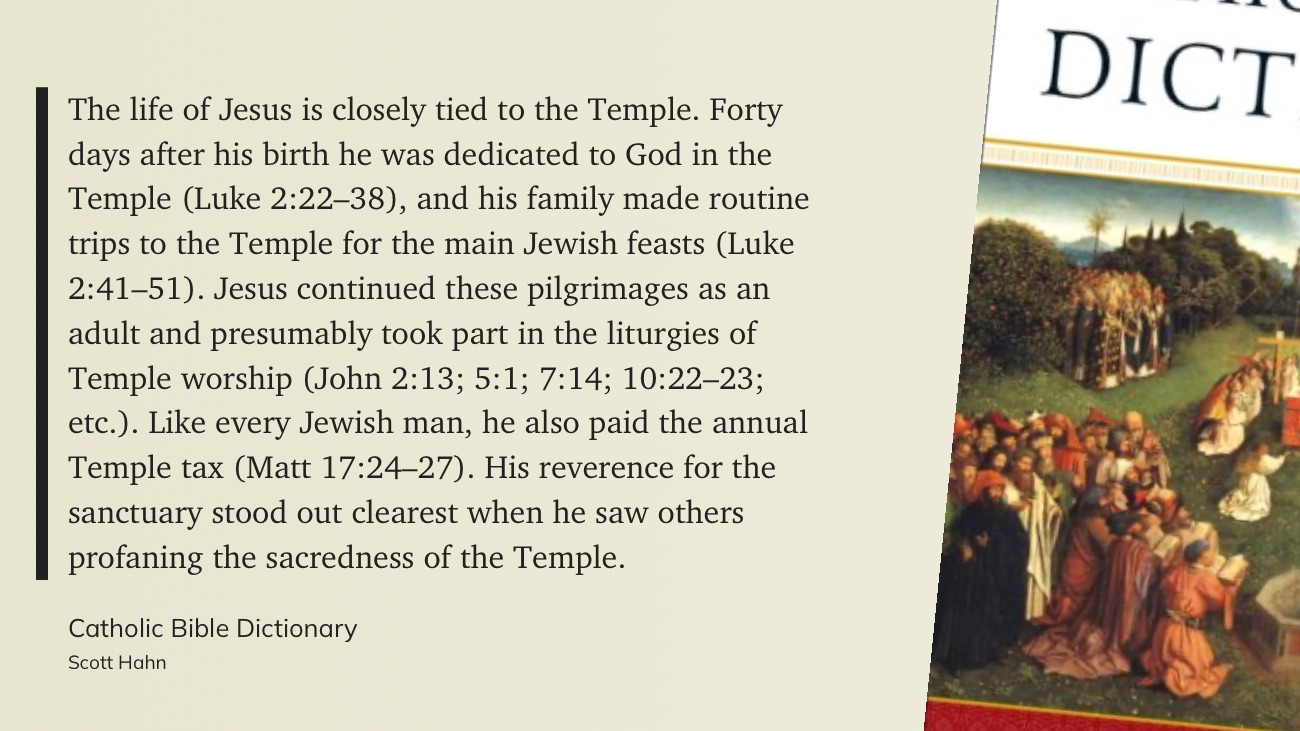
Hahn, Scott. Catholic Bible Dictionary. New York: Doubleday, 2009.
Holy Family - YEAR C
Click on slide to view full screen
⬇️ Luke Timothy Johnson
Sacra Pagina:
Luke
Johnson, L. T.. Sacra Pagina: The Gospel of Luke. Daniel J. Harrington, S.J., General Editor Liturgical Press, 1991.
Holy Family - YEAR C

Click on slide to view full screen
⬇️ Pablo Gadenz
The Gospel of Luke
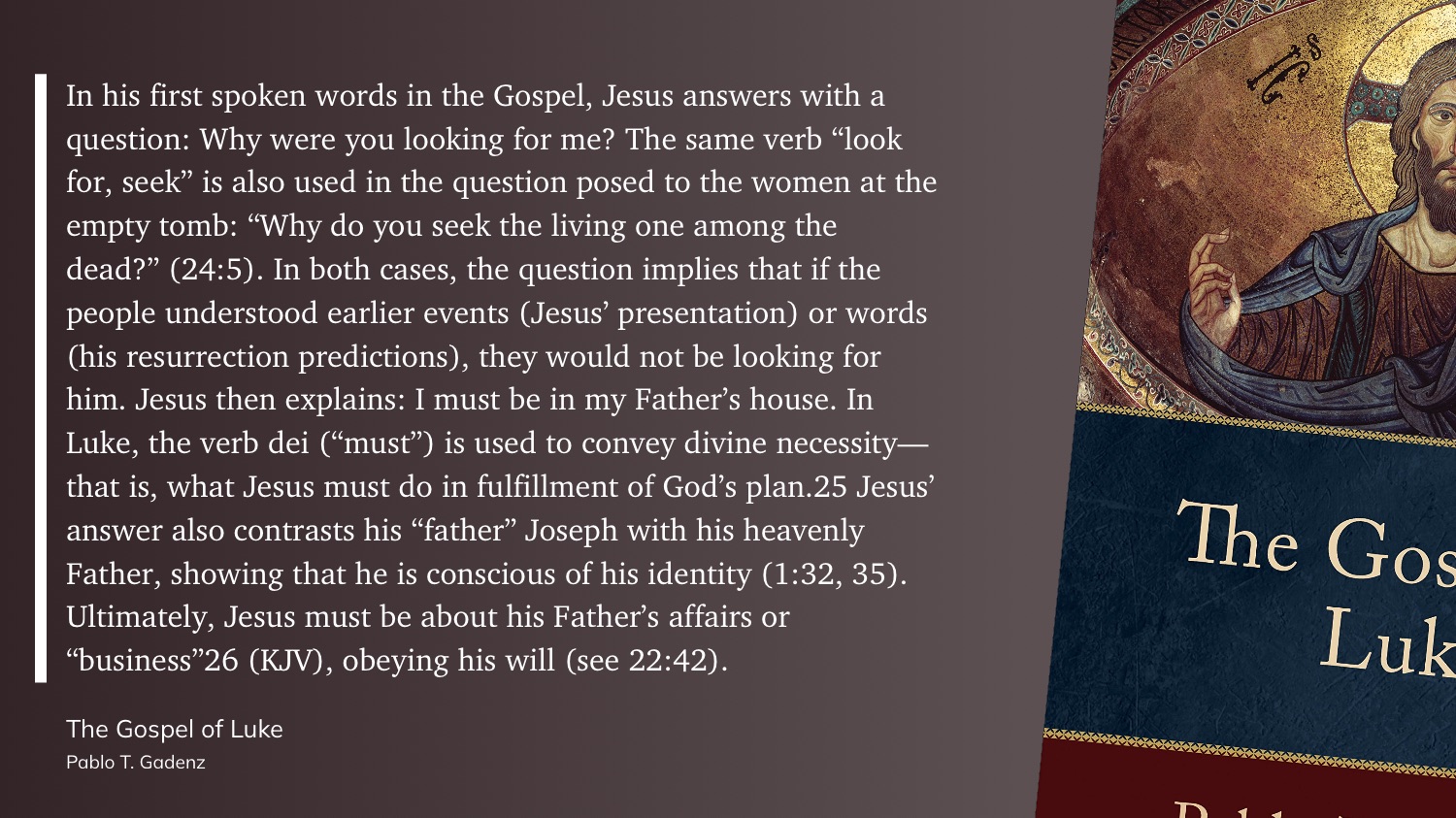
Gadenz, Pablo T.. The Gospel of Luke The Catholic Commentary on Sacred Scripture. Grand Rapids, MI: Baker Academic, 2008.
Holy Family - YEAR C
Click on slide to view full screen
⬇️ Richard Rohr
The Good News
According to Luke
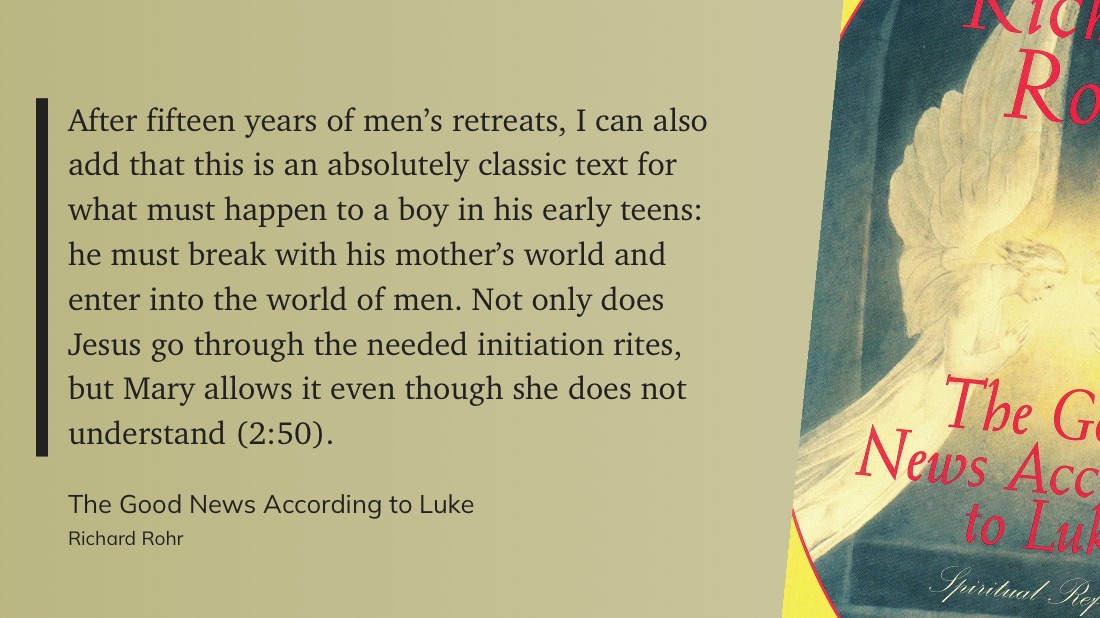
Rohr, Richard. The Good News According to Luke. New York: Crossroad, 1997.
Holy Family - YEAR C
Click on slide to view full screen
⬇️ John Bergsma
The Word of
the Lord
Bergsma, John. The Word of the Lord: Reflections on the Sunday Mass Readings for Year B. Steubenville, OH: Emmaus Road Publishing, 2020.
Holy Family - YEAR C

Click on slide to view full screen
⬇️ Ignatius Catholic Study Bible
Ignatius Press
Hahn, Scott. The Ignatius Catholic Study Bible New Testament (Ignatius Press), 2010.
Holy Family - YEAR C

Click on slide to view full screen
⬇️ Africa Bible Commentary
Zondervan
Adeyemo, Tokunboh, ed. Africa Bible Commentary. Grand Rapids, MI: Zondervan, 2010.
Holy Family - YEAR C

Click on slide to view full screen

SCRIPTURE
SEARCH
FIRST READING (1)
SECOND READING (41)
GOSPEL (59)
This tool created by Jeff Pinyan uses the CCEL Early Church Fathers digital edition of the Philip Schaff collection.
Holy Family - YEAR C

Just Jr., A., Oden, T. C., Carson, D. A., & Oden, E. (Eds.). (2003). Ancient Christian Commentary on Scripture: New Testament III, Luke (Vol. 3). IVP Academic.
IN BRIEF
The Church Fathers collectively narrate Jesus’ formative years, emphasizing His wisdom, obedience, divinity, and the significance of seeking Him in spiritual realms. The themes of humility, diligence, and spiritual growth are central to these narratives, enlightening believers on the multifaceted nature of Jesus’ identity and teachings from a young age.
Cyril of Alexandria: Affirms Jesus’ growth and recounts his visit to Jerusalem at twelve with the Virgin Mary.
Greek Expositor (Geometer): Christ’s wisdom aligns with His age, showcasing wisdom at the right time.
Ambrose: Views the age of twelve as significant for Jesus’ interactions with the teachers.
Bede: Symbolizes numerical significance within Jesus’ growth, universal reach, and the commencement of Christ’s glory.
Bede (Homily after Epiphany): Emphasizes Christ’s humility as a man by observing the customs at Jerusalem.
Greek Expositor (Metaphrastes or Geometer): Jesus stayed behind to engage with scholars and avoid parental hindrance.
Origen: Explains the confusion around Jesus being separated due to customary travel practices.
Gloss (Ordinary): Highlights the search process over three days and the eventual discovery in the temple.
Origen (continued): Discusses Jesus’ presence in the temple and the significance of seeking Him there.
Ambrose (continued): Relates the temple incident to Jesus’ future resurrection after three days.
Epiphanius: Counteracts beliefs that Jesus gained divinity at a later age and analyzes His childhood characteristics.
Bede: Details the misunderstanding and subsequent clarification from Jesus about His true Father.
Origen (continued): Points to the necessity for seeking Jesus diligently and moving beyond earthly relationships.
Greek Expositor (Metaphrastes and Geometer): Jesus’ instruction clarifies His Heavenly Father and the need to focus on higher matters.
Bede (continued): Encourages a proper acknowledgment of Jesus’ divine nature despite being raised by human parents.
Ambrose (continued): Explores the divine and human lineage of Jesus for the benefit of believers.
Cyril of Alexandria (continued): Validates Christ’s divinity from His youth and negates delayed divine transformation post-baptism.
A Modern Adaptation of
Catena Aurea
The Catena Aurea, which means “Golden Chain” in Latin, is a comprehensive biblical commentary comb is a 13th-century biblical commentary compiled by St. Thomas Aquinas. This anthology features insights from over eighty Church Fathers on the four Gospels.
THE WORD THIS WEEK has used AI generative technology to create this modern translation, outline and study notes, enhancing accessibility and comprehension of the text for contemporary audiences.
Luke 2:41-52
CYRIL OF ALEXANDRIA: The Evangelist previously mentioned that the Child grew and became strong, and now he confirms his own words by telling the story of Jesus, at twelve years old, going up to Jerusalem with the holy Virgin.
GREEK EXPOSITOR (Geometer): Christ’s wisdom was not beyond His age, but when our ability to understand things usually develops, Christ’s wisdom started to show.
AMBROSE: Alternatively, the twelfth year marks the beginning of our Lord’s discussions with the religious teachers because twelve is the number of evangelists needed to spread the faith.
BEDE: Similar to the number seven, the number twelve symbolizes universality and perfection. It’s fitting that Christ’s glory begins with twelve since His glory will fill all places and times.
BEDE (Homily after Epiphany): That the Lord went to Jerusalem every year at Passover shows His humility as a human. It’s our duty as humans to gather, offer sacrifices, and pray to God. As a man among men, the Lord did what God commanded men to do through angels. This is why it’s called “the custom of the feast day.” Let’s follow the example of Christ’s life on earth if we want to see the glory of His divine nature.
GREEK EXPOSITOR (Metaphrastes or Geometer): After celebrating the feast for seven days, everyone went back home, but Jesus secretly stayed behind in Jerusalem. His parents didn’t know this. Jesus stayed behind to have discussions with religious teachers without His parents getting in the way. He also didn’t want to seem disrespectful by disobeying them. So, He stayed secretly to avoid being stopped or disobedient.
ORIGEN: It’s not surprising that they’re called His parents because they both played a role in raising Him: Mary through giving birth and Joseph through caring for Him.
BEDE: Some may wonder how the Son of God, raised with such care, could be accidentally left behind. It was customary for Israelites traveling to Jerusalem for feasts or going back home to have women and men travel separately. Children could go with either parent. Mary and Joseph each thought that Jesus, whom they didn’t see with them, was with the other parent. That’s why it says, “supposing Him to have been in the company.”
ORIGEN: Just like when the Jews plotted against Him, and He escaped unnoticed, now the Child Jesus stayed behind without His parents knowing where He was. The text continues, “And not finding Him, they returned to Jerusalem, seeking for Him.”
GLOSS (Ordinary): They were a day’s journey from Jerusalem when they started looking for Him among relatives and friends. On the second day, they searched for Him, and on the third day, they returned to Jerusalem and found Him there. It says, “And it came to pass, after three days they found Him.”
ORIGEN: He wasn’t found immediately because Jesus wasn’t with His relatives or those who knew Him by flesh. Nor was He among the crowds. Instead, learn where those seeking Him can find Him: in the temple. Seek Jesus in the Church and among the teachers in the temple. When you search for Him this way, you’ll find Him. They didn’t find Him among His relatives because human relationships can’t fully understand the Son of God. They didn’t find Him among acquaintances because He’s beyond human knowledge and understanding. Where did they find Him? In the temple! When you seek the Son of God, first search for Him in the temple. Go there, and you’ll indeed find Christ, the Word, and Wisdom.
AMBROSE: After three days, they found Him in the temple, symbolizing that after three days of victorious suffering, He would rise again. This manifestation of faith shows Him seated in heaven with divine glory, even though He was believed to be dead.
GLOSS: The coming of Christ, which the Patriarchs sought before the Law and the prophets and just men looked for during the Law, wasn’t found. Only the search by Gentiles during grace yielded results.
ORIGEN: As the Son of God, Jesus is found among the teachers, enlightening and instructing them. But as a child, He’s found asking questions rather than teaching. He sets an example for children, even wise and learned ones, to listen to their masters instead of boasting. He asked not to learn but to teach through His questions. Wisdom comes from both asking and answering well, as stated: “All who heard Him were astonished at His wisdom.”
BEDE: Jesus humbly listened to the teachers to show He was a man. Yet, He answered them divinely to prove He was God.
GREEK EXPOSITOR (Metaphrastes or Geometer): He asks wisely, listens with wisdom, and answers more wisely, causing astonishment. As it says, “And they who saw it were astonished.”
CHRYSOSTOM: The Lord didn’t perform any miracles as a child, but St. Luke mentions this event, which made people admire Him.
BEDE: Divine wisdom came from His tongue, but His age showed man’s limitations. Thus, the Jews were confused and amazed by the contrast. However, it’s not surprising because the Prophet said, “A Child is born unto us, abiding as the mighty God.”
GREEK EXPOSITOR: Moved by a mother’s feelings, the ever-wondrous Mother of God sorrowfully asks her mournful question. She acts like a mother, with confidence, humility, and affection. As it says, “His mother said unto Him, Son, what hast thou done?”
ORIGEN: The Holy Virgin knew Joseph wasn’t Jesus’ biological father but called him so according to Jewish belief. Generally, the Holy Spirit honored Joseph with the title “father” for raising Jesus. More specifically, St. Luke mentions Joseph in the genealogy from David for a reason. They searched for Jesus sorrowfully, fearing He’d returned to heaven, not thinking He was lost. Those seeking Jesus shouldn’t do so carelessly or lazily. They should labor and sorrow to find Him, unlike those who search and never find Him.
GLOSS (Ordinary): Jesus’ parents feared King Herod, who sought to kill Him in infancy, might find an opportunity now that He was older.
GREEK EXPOSITOR (Metaphrastes and Geometer): Jesus sets things right, correcting the notion about His reputed father and revealing His true Father. He teaches us not to focus on earthly matters but raise our minds to heavenly things. As stated: “He said unto them, What is it that you ask of me?”
BEDE: He doesn’t blame them for seeking Him as their son but urges them to acknowledge Him as the Son of His heavenly Father.
AMBROSE: Christ has two lineages: a divine one from His Father and a human one from His mother. The Father’s lineage is more divine, while the mother’s serves our benefit.
CYRIL OF ALEXANDRIA: Jesus showing His divine nature at twelve years old refutes the belief that Christ only became divine after baptism. He recognized both the temple and His Father from childhood.
EPIPHANIUS: Let those who believe Christ became divine at thirty know that He displayed wisdom and power at twelve. Accounts of His childhood miracles don’t align with the Gospel or prophecies and seem misleading. Jesus was distinguished in appearance, obedient, kind, eloquent, and filled with wisdom, power, and energy. His meekness and unshaven head were notable. From this passage, we learn about giving up earthly ties and focusing on spiritual perfection, as affection for relatives can hinder this.
BEDE: “And they understood Him not” refers to His words about His divinity, which they couldn’t comprehend.
ORIGEN: Alternatively, they didn’t understand if He referred to the temple or something higher when He mentioned His Father’s business. Every good person becomes a dwelling for God the Father, and whoever is a dwelling for God the Father has Christ within them.
GREEK EXPOSITOR: The time between Jesus’ manifestation in the temple and His baptism, lacking public miracles and teaching, is summed up as “He went down with them.”
ORIGEN: Jesus often descended to meet people who couldn’t ascend the mountain due to their difficulties. Similarly, He came down for those struggling with various issues. “He was subject to them” exemplifies love for God, honor for parents, and prioritizing God over parents. When blamed by His parents, Jesus prioritized God, yet remained obedient to them.
BEDE: A virtue teacher must fulfill their duty to their parents. Jesus set an example for us to follow.
ORIGEN: Let’s be subject to our parents. If our biological fathers aren’t present, let’s obey those who act as our fathers. Jesus, the Son of God, obeyed Joseph and Mary. Similarly, we should obey our spiritual leaders. Joseph recognized Jesus’ superiority and moderated his authority. Sometimes, the subject is greater than their authority figure. Understanding this, those in authority should remain humble, knowing their superior is subject to them.
GREGORY OF NYSSA: At twelve, Jesus demonstrated obedience to His parents. Obedience is essential for growth towards perfection.
BASIL: From a young age, Jesus obeyed His parents and endured physical labor with humility and reverence. Despite their poverty, Joseph and Mary were honest and just. Their daily struggles are evidenced by the stable where Jesus was born. Jesus’ obedience to His parents is an example of submission.
AMBROSE: Is it surprising that Jesus, who obeyed His mother, submitted to His Father? Obedience reflects filial duty, not weakness. Although the heretic argues that the sent one needs help, why would Jesus need human assistance to obey His mother’s authority? He obeyed a handmaid, His earthly father, and God. Obedience to man shows duty, while obedience to God demonstrates reverence.
BEDE: Mary, whether she understood or not, carefully stored everything in her heart for reflection and examination. As the mother of true wisdom, she became a disciple of the Child, not yielding to Him as a boy or man, but as God. She contemplated His divine words and actions, ensuring nothing was lost on her. As she pondered one thing, she sought clarity on another. This was her approach throughout her life. “Jesus increased in wisdom” not by making progress, but by gradually revealing His wisdom. His discussions with the Scribes exemplify His wisdom, astonishing all who heard Him. His increase in wisdom refers to becoming known to many and causing wonder. The mention of growth in stature equates age to wisdom.
CYRIL OF ALEXANDRIA: Eunomian heretics question Christ’s equality with the Father due to His increase, implying previous imperfection. However, this increase refers to His incarnation, not His divinity. He humbled Himself and increased for our sake. His increase enabled us to increase in Him, restoring us from our fallen state. Jesus (the Word made flesh) increased, not the pure Word. His human nature, perfect from the beginning, was gradually manifested. The Word, being the power and wisdom of the Father, was perfect but adapted to human nature to avoid appearing strange. He grew in His human nature, not due to imperfection but as a natural aspect of human development, concealing His divinity from those around Him.
GREEK EXPOSITOR (Amphilochius): Jesus increased in age as His body grew, in wisdom through teaching divine truths, and in grace by bringing joy and trust in God’s promises. His growth occurred before God as He fulfilled His Father’s work in the flesh and before men by converting them from idolatry to the knowledge of the Trinity.
THEOPHYLACT: The order “before God and men” emphasizes the importance of pleasing God first, then man.
GREGORY OF NYSSA: The Word’s increase varies among recipients, reflecting their spiritual maturity. Depending on the extent of this growth, one may be seen as an infant, grown-up, or a perfect man in faith.