JAN 5, 2025


Each week THE WORD THIS WEEK features popular video series and other media which focus on the Sunday’s Mass readings.
Click on links above to view respective videos.

Jeff Cavins / Encountering the Word
(3:37 minutes)

Brant Pitre / Mass Readings Explained
(8:26 minutes)

Fr. Geoffrey Plant
(33:37 minutes)
Larry Broding / Word-Sunday
(3:42 minutes)
Three Great Things:
Study, Pray and Serve
Fr. Andrew Ricci, ordained in 1997, is a priest for the Diocese of Superior. He is the Rector of the Cathedral of Christ the King.
Epiphany - YEAR C


Social Media /
Bulletin Inserts
“Arise, shine, for your light has come.” (Isaiah 60:1 NAB)
Caption: Let your inner light illuminate the world around you. Embrace the dawn of new opportunities and possibilities.
Question for reflection: How can you shine brighter in your community today?
“Rise up in splendor, Jerusalem! Your light has come, the glory of the Lord shines upon you.” (Isaiah 60:1 NAB)
Caption: Embrace the divine radiance within you, and let it guide your path toward greatness.
Question for reflection: What area of your life needs God’s glory to shine today?
“Nations shall walk by your light, kings by the splendor of your radiance.” (Isaiah 60:3 NAB)
Caption: Your influence is more powerful than you think. Be a beacon of hope and watch as it draws others toward you.
Question for reflection: Who can you inspire with your light and positivity today?
“Lift up your eyes and look about you.” (Isaiah 60:4 NAB)
Caption: Open your eyes to the beauty and abundance around you. Appreciate the blessings that are yet to unfold.
Question for reflection: What new perspectives can you adopt to see the world differently?
Isaiah 60:1-6

I. Introduction (Isaiah 60:1-2)
- The call for Jerusalem to arise and shine
- The coming of God's glory and light
II. Nations Drawn to Jerusalem (Isaiah 60:3)
- Kings walking in the light of Jerusalem
- Nations coming with gifts
III. Reclamation and Restoration (Isaiah 60:4)
- Jerusalem's abandoned and forsaken past
- Returning of sons and daughters
IV. Wealth and Abundance (Isaiah 60:5-6)
- The gathering of wealth from foreign lands
- The abundance of camels and treasures
- The proclamation of Jerusalem's wealth
Clipart by Fr. Richard Lonsdale
Fr. Paul Galeto, OSA
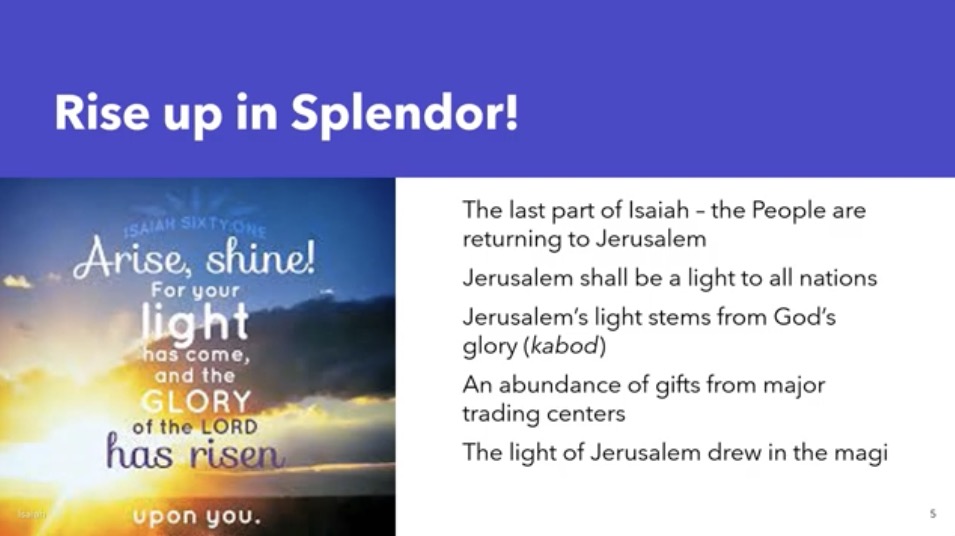
Click on slide to watch short commentary by Fr. Paul Galetto, OSA
Catholic Sunday Scriptures in Context
The Word of the Lord

Click on slide for larger image.
NLT Chronological Life Application

Click on slide for larger image.
Bible Commentary Notes (PDF)
- The Jerome Biblical Commentary,
- The New Jerome Biblical Commentary, and
- The Navarre Bible.
SOURCE: St. Charles Borromeo Catholic Church (Picayune, MS)
Contextual Background
HISTORY
Isaiah 60:1-6 is a prophetic passage emphasizing the restoration and prosperity of Jerusalem following a tumultuous period of exile and despair. During the time of the prophet Isaiah, the Israelites were under constant threat from powerful neighboring nations, ultimately leading to their capture and exile by the Babylonians in 586 BCE. The passage reflects the historical and political context by offering hope to the despondent Israelites, providing a vision of a brighter future.
In this passage, Isaiah speaks of Jerusalem’s transformation into a vibrant, illuminated city, symbolizing God’s renewed favor upon the city. He urges Jerusalem to “rise” and “shine,” anticipating the return of its people from exile and subsequent restoration of their homeland (Isaiah 60:1). The Prophet’s words served as a beacon of hope for a nation in need of encouragement and direction.
The context of Isaiah 60:1-6 reflects the political and cultural landscape of the Ancient Near East. Isaiah was well-versed in Israel’s history and intimately familiar with its political and social atmosphere. By addressing Jerusalem directly, Isaiah emphasizes the city’s critical role in the nation’s spiritual and cultural life.
The passage also indicates a significant shift in Israel’s global status as the prophet describes the influx of wealth and power into Jerusalem. Isaiah’s prophecy details the arrival of camels and the gathering of gold and frankincense, showcasing Jerusalem’s newfound prestige and wealth (Isaiah 60:6). Such imagery provided comfort to the Israelites, assuring them that their nation would not only survive but thrive.
SOCIETY
Isaiah 60:1-6 carries profound sociological and cultural significance within its historical context. Isaiah’s prophecy portrays Jerusalem as a symbol of hope and restoration, reflecting Israel’s evolving identity amidst political turmoil and social change. During this time, the Israelites faced religious syncretism and assimilation, resulting in a weakening of their national identity.
The passage emphasizes the significance of Jerusalem as a central cultural and religious hub, illustrating the importance of preserving Israel’s unique heritage and faith in the face of adversity. By envisioning a radiant and prosperous Jerusalem, Isaiah calls for the city’s resurgence as the spiritual center of the nation, reinforcing the Israelites’ distinct identity and values.
Moreover, the passage’s references to camels, gold, and frankincense reflect the broader cultural landscape of the Ancient Near East, symbolizing wealth and power (Isaiah 60:6). These luxurious items were highly valued in contemporary societies, and their presence in the text signifies Jerusalem’s rise to prominence within the region. The Israelites would have understood these symbols as signs of renewed favor and protection.
Isaiah 60:1-6 also highlights the role of family and community in Israelite society, underscoring the importance of social connections and shared history. The return of Jerusalem’s children from exile is a testament to the strength of these bonds, reinforcing the communal nature of Israelite culture and the responsibility of its members to protect and nurture their collective identity (Isaiah 60:4).
THEOLOGY
Isaiah 60:1-6 offers a prophetic vision of hope and restoration that resonates within the Roman Catholic theological context. The passage highlights themes of redemption, renewal, and the enduring presence of God’s light, which align with core Catholic beliefs and teachings.
In Catholic theology, the prophet Isaiah’s words foreshadow the coming of Christ, who illuminates the world with his divine presence. The passage’s emphasis on the glory and radiance of Jerusalem symbolizes the Church as a beacon of salvation, illuminating the path for believers (Isaiah 60:1-2). This imagery is particularly significant in the context of Advent, when Catholics await the coming of Christ, the light of the world.
Isaiah’s prophecy also accentuates the importance of unity and harmony, which are fundamental values within the Catholic Church. The image of Jerusalem as a city embracing its returning children represents the Church’s commitment to uniting and healing its members, fostering a sense of community and belonging (Isaiah 60:4).
In a contemporary setting, Isaiah 60:1-6 offers a message of hope for modern Catholics facing various challenges. The passage encourages perseverance in times of darkness and reminds believers that the light of God will ultimately prevail. It urges Catholics to maintain their faith and trust in God’s divine plan, even in the midst of adversity.

The Glory of God’s Church
EXCERPT:
The prophecies in Isaiah 60:1-64:11 focus on the restoration of Jerusalem. In its renewal, Jerusalem will become the dwelling place of the glory of the Lord from which all nations will hear the news of God’s universal gift of salvation. The most remarkable feature of the restored Jerusalem will be her radiance, mentioned in verses 1-3 at the beginning of the poem and repeated at the end (verses 19-22). The radiance comes from the glory of God.
The Church sees the symbols of her universality in Isaiah’s prophecy. The nations of the earth will come on pilgrimage to the Church from the east and west. They will bring frankincense for worshipping the One True God and gold as a gift for Christ the King and His Kingdom of the Church that carries on His earthly mission of mercy, comfort, and forgiveness until His return.
There are also eschatological overtones in the First Reading that point to the heavenly Jerusalem at the end of time, which St. John described in the Book of Revelation (see Rev 21:9-27 and Rev22:5). Some of the wording is virtually the same; for example, from our reading, compare Isaiah 60:3 with Revelation 21:24.
SOURCE: Agape Bible Study Copyright © 2015; revised 2024 (Used with permission.)
Social Media /
Bulletin Inserts
“That the Gentiles are coheirs, members of the same body, and copartners in the promise in Christ Jesus through the gospel” (Ephesians 3:6 NAB).
Caption: In God’s kingdom, unity transcends all boundaries. Remember, we are one body, bound by His love.
Reflection Question: In what ways can you promote unity and understanding in your community, parish and/or family?
“The mystery was made known to me by revelation, as I have written briefly earlier” (Ephesians 3:3 NAB).
Caption: The sacred mysteries of God are made known to us through His Spirit. Seek Him, and uncover the divine truths waiting for you.
Reflection Question: How can you create more space for the Holy Spirit to reveal divine truths to you?
“Which was not made known to human beings in other generations as it has now been revealed to his holy apostles and prophets by the Spirit” (Ephesians 3:5 NAB).
Caption: We live in a time of revelation and understanding. Cherish the privilege of knowing and sharing the truth.
Reflection Question: What revelations today do you think God God is trying to make known in the Church and in your life?
Ephesians 3:2-3a, 5-6

I. Paul's Divine Commission (Ephesians 3:2-3a)
- Paul's stewardship by God's grace
- The revelation of God's mystery to Paul
II. The Mystery Revealed (Ephesians 3:5-6)
- The hidden mystery in previous generations
- The revelation of the mystery to the holy apostles and prophets
- The inclusion of the Gentiles in the mystery
III. Unity in Christ (Ephesians 3:6)
- Gentiles as co-heirs and members of the same body
- The promise of Christ Jesus fulfilled in the Gospel
Clipart by Fr. Richard Lonsdale
Fr. Paul Galeto, OSA
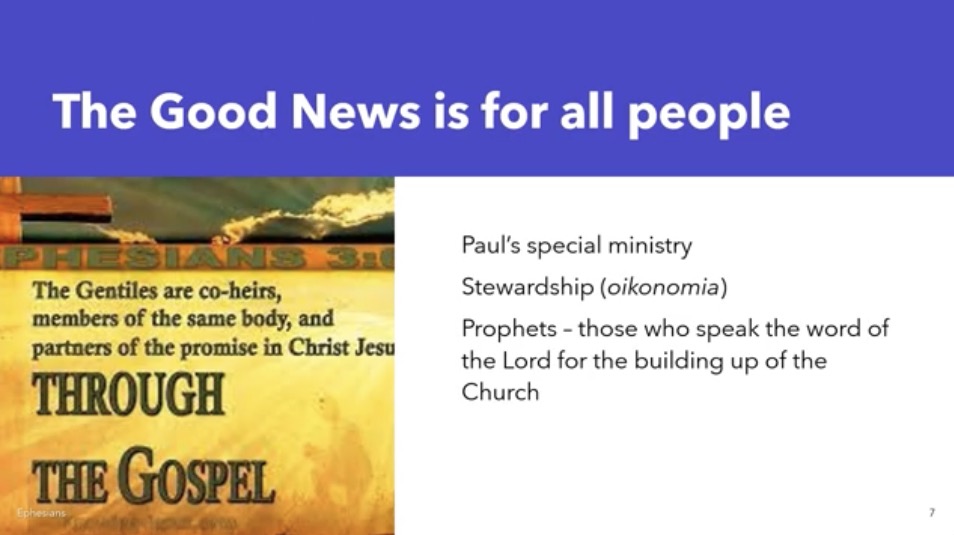
Click on slide to watch short commentary by Fr. Paul Galetto, OSA
Catholic Sunday Scriptures in Context
New Collegeville Bible Commentary
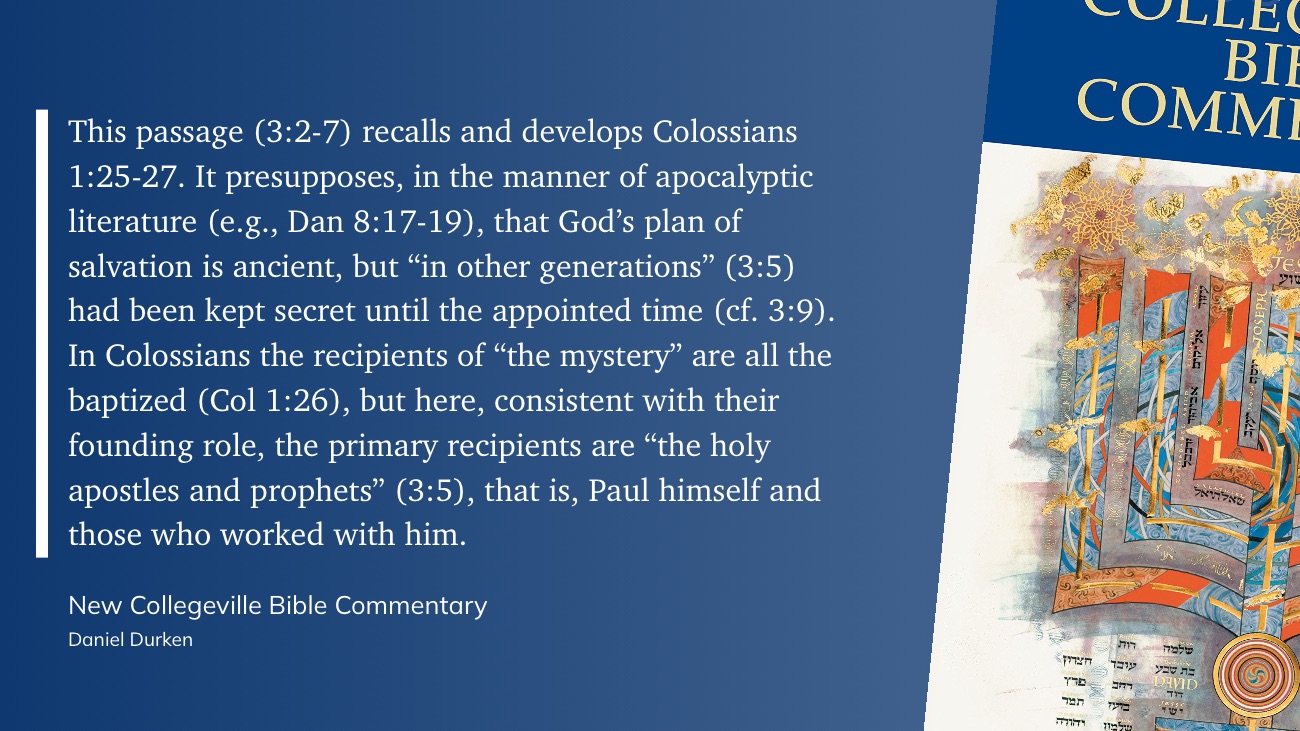
Click on slide for larger image.
African Bible Commentary
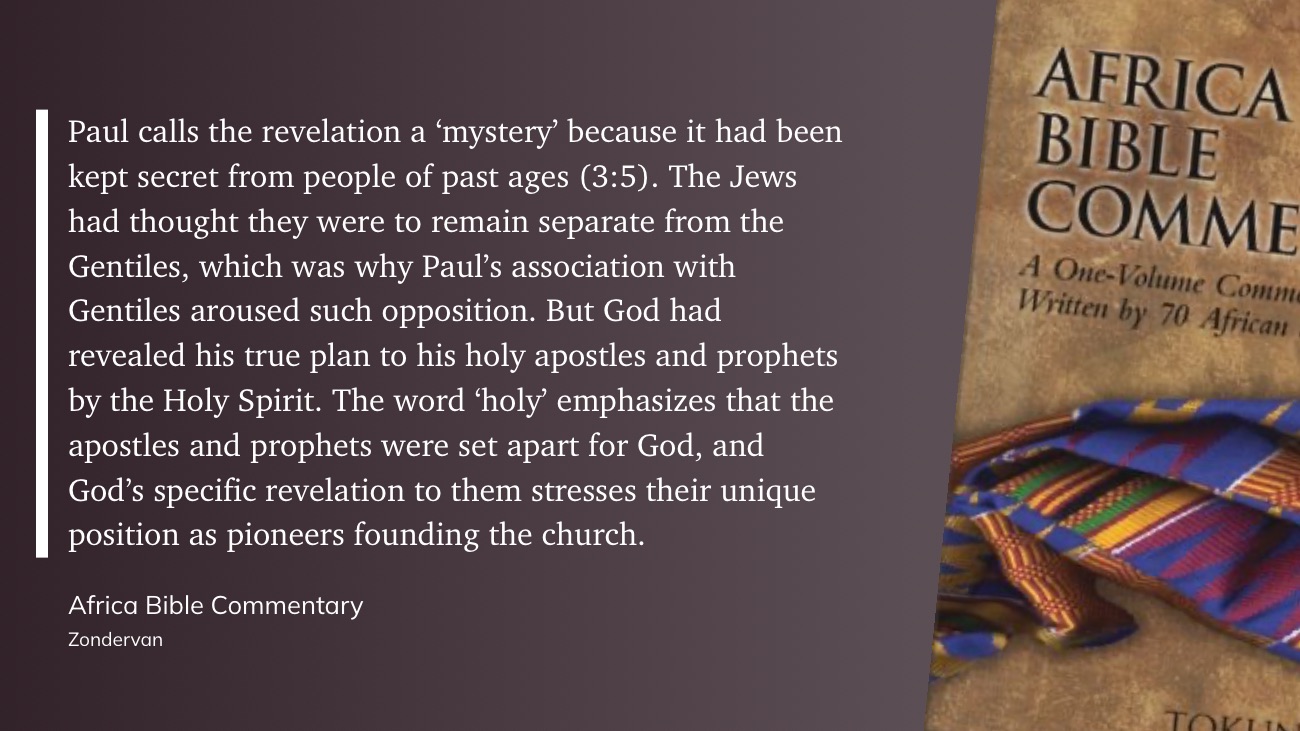
Click on slide for larger image.
Bible Commentary Notes (PDF)
- The Jerome Biblical Commentary,
- The New Jerome Biblical Commentary, and
- The Navarre Bible.
SOURCE: St. Charles Borromeo Catholic Church (Picayune, MS)
Contextual Background
HISTORY
Ephesians 3:2-3a, 5-6 provides valuable insights into the historical and political context of the early Christian community. Authored by the Apostle Paul, the epistle addresses a primarily Gentile audience in Ephesus, a significant cultural and political center in the Roman Empire.
During this time, the Roman Empire exercised substantial control over the Mediterranean region, imposing its political, social, and cultural values. The Ephesian community lived amidst this imperial context, which often led to tensions between Roman authorities and early Christians.
As a Roman citizen, Paul leverages his privileged status to advocate for the Gentiles and spread the Gospel, despite the challenges posed by Rome’s oppressive rule (Ephesians 3:2-3a). By revealing the “mystery of Christ,” Paul aims to unite Jews and Gentiles in faith, challenging the traditional boundaries that separated them.
SOCIETY
Ephesians 3:2-3a, 5-6 sheds light on the cultural and sociological dynamics of the early Christian community. The Apostle Paul, a Jewish convert and Roman citizen, addresses the primarily Gentile audience in Ephesus, acknowledging the cultural divide between Jews and Gentiles.
During this time, Jewish identity was deeply rooted in their covenant with God and adherence to the Mosaic Law. Gentiles, however, were not part of this covenant and were often perceived as outsiders. Paul’s teachings in Ephesians challenge these long-standing cultural norms by revealing that the “mystery of Christ” extends beyond Jewish boundaries to include Gentiles (Ephesians 3:6).
In the Greco-Roman world, citizenship was highly valued and granted privileges within society. Paul draws on this concept, asserting that Gentiles become “fellow citizens” and “members of the household of God” through their faith in Christ (Ephesians 3:6). This metaphorical use of citizenship emphasizes unity among Christians, regardless of their cultural background.
Moreover, Paul’s reference to the “mystery of Christ” being revealed to the apostles and prophets highlights the authority and divine inspiration of early Church leaders (Ephesians 3:5). This assertion challenges prevailing cultural assumptions about religious authority, affirming the unique role of Christian leaders in shaping the faith community.
THEOLOGY
Ephesians 3:2-3a, 5-6 emphasizes the revelation of God’s mystery through the Church, highlighting the role of grace and the unity between Jews and Gentiles in Christ. This passage holds significant relevance for Roman Catholic theology and contemporary Catholic life.
The Catholic Church teaches that God’s grace is essential for salvation and is received through faith and sacraments. Ephesians 3:2-3a affirms this by acknowledging that the mystery of Christ was revealed through God’s grace. In the Catholic context, this emphasizes the role of the Church in dispensing grace and promoting understanding of divine truths.
Moreover, the passage underscores the unity between Jews and Gentiles in Christ, stating that they are “members of the same body” (Ephesians 3:6). This unity aligns with the Roman Catholic understanding of the Church as the Body of Christ, comprising diverse members united in faith and purpose. This message of unity has significant implications for contemporary Catholics, challenging them to embrace diversity and foster ecumenical dialogue.
For instance, in recent decades, the Catholic Church has made strides in improving relations with other Christian denominations and religions. Pope Francis has stressed the importance of ecumenism and interfaith dialogue, affirming that unity in Christ transcends human differences. The application of Ephesians 3:2-3a, 5-6 in modern Catholic life encourages a commitment to unity, understanding, and cooperation with those of different backgrounds.
The Good News of God’s Universal Gift of Salvation
EXCERPT: The mystery (verse 3) was God’s divine plan to deliver Gentiles, along with old covenant Israel, through Christ’s redemptive work, a divine plan hidden from old covenant Israel. The resurrected Christ specifically gave St. Paul the mission to implement the plan to bring salvation to the Gentiles at his conversion (Acts 9:15). Later, it was confirmed by St. Peter and the Apostles (Gal 2:7-9).
5b it has now been revealed to his holy apostles and prophets by the Spirit 6 that the Gentiles are coheirs, members of the same body, and copartners in the promise in Christ Jesus through the Gospel.
The Church affirmed the equality of the Gentiles as coheirs with Jewish Christians at the Council of Jerusalem in Acts chapter 15. St. Peter addressed the council and said of the Gentiles:
“My brothers, you are well aware that from early days God made his choice among you that through my mouth the Gentiles would hear the word of the Gospel and believe. And God, who knows the heart, bore witness by granting them the Holy Spirit just as he did us. He made no distinction between us and them, for by faith, he purified their hearts” (Acts 15:7b-9).
At the Council of Jerusalem, the Apostles and early leaders of the Church recognized the fulfillment of God’s promised gift of universal salvation, prophesied by the prophets like Isaiah in our first reading, and carried out in the work of the earthly Kingdom of Jesus Christ.
SOURCE: Agape Bible Study Copyright © 2015; revised 2024 (Used with permission.)
Social Media /
Bulletin Inserts
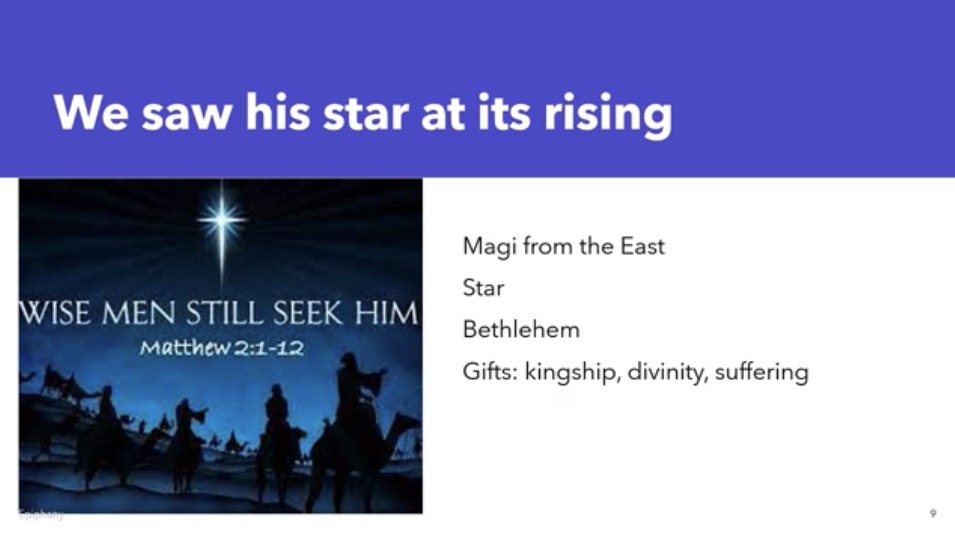
“We saw his star at its rising and have come to do him homage.” (Matthew 2:2 NAB)
Caption: The Wise Men followed the star with unwavering faith and purpose. May we also be guided by the light that leads us to true fulfillment.
Reflection Question: What guiding light are you following in your life right now, and is it leading you towards what truly matters?
“They opened their treasures and offered him gifts of gold, frankincense, and myrrh.” (Matthew 2:11 NAB)
Caption: The act of giving is a powerful gesture of love and gratitude. Let us open our hearts and share our treasures with those in need.
Reflection Question: What gifts—whether tangible or intangible—can you offer to others to brighten their lives?
“They were warned in a dream not to return to Herod, so they departed for their country by another way.” (Matthew 2:12 NAB)
Caption: Sometimes, life will direct us to make unexpected changes. Embrace divine guidance and trust the journey.
Reflection Question: Are there any signs or messages prompting you to change direction in your life? How can you respond to them with faith?
Matthew 2:1-12

The Magi's Journey (Matthew 2:1-2)
- The arrival of the Magi from the East
- Their quest to find the newborn King of the Jews
II. King Herod's Inquiry (Matthew 2:3-6)
- Herod's fear upon hearing about the birth of the Messiah
- His meeting with the chief priests and scribes
- The prophecy of the Messiah's birthplace in Bethlehem
III. The Star's Guidance (Matthew 2:7-9)
- Herod's secret meeting with the Magi
- The Magi's journey to Bethlehem guided by the star
- The star stopping over the place where Jesus lay
IV. The Magi's Visit and Gifts (Matthew 2:10-11)
- The Magi's overwhelming joy upon seeing the star
- Their visit to Jesus and Mary
- The offering of gold, frankincense, and myrrh
V. The Magi's Departure (Matthew 2:12)
- The Magi's warning in a dream to avoid Herod
- Their return to their country by another route
Clipart by Fr. Richard Lonsdale
Fr. Paul Galeto, OSA
Click on slide to watch short commentary by Fr. Paul Galetto, OSA
Catholic Sunday Scriptures in Context
Catholic Bible Dictionary

Click on slide for larger image.
Ignatius Catholic Study Bible

Click on slide for larger image.
African Bible Commentary

Click on slide for larger image.
Bible Commentary Notes (PDF)
- The Jerome Biblical Commentary,
- The New Jerome Biblical Commentary, and
- The Navarre Bible.
SOURCE: St. Charles Borromeo Catholic Church (Picayune, MS)
Contextual Background
HISTORY
Matthew 2:1-12 recounts the story of the Magi’s visit to the newborn Jesus and Herod’s subsequent attempt to eliminate him. This narrative is set within the broader context of Roman imperial rule and Jewish political turmoil during the 1st century CE.
The author, traditionally believed to be Matthew, was a Jewish Christian writing for a Jewish Christian audience. His Gospel seeks to portray Jesus as the long-awaited Jewish Messiah while emphasizing his significance for the wider Gentile world. This dual focus mirrors the sociopolitical situation of the early Christian community, as it navigated its Jewish roots and increasing Gentile influence.
Herod the Great, mentioned in the passage, was a Roman client king who ruled Judea from 37 to 4 BCE. His reign was characterized by political intrigue, violence, and efforts to consolidate power. The Massacre of the Innocents (Matthew 2:16) exemplifies Herod’s ruthless response to perceived threats, reflecting the precarious political climate in which Jesus was born.
The Magi’s visit highlights the intersection of Jewish messianic expectations with the political and cultural influences of the broader Roman world. The arrival of these foreign dignitaries symbolizes the universal significance of Jesus’ birth, transcending Jewish national boundaries.
SOCIETY
Matthew 2:1-12 reflects the sociocultural context of the early Christian community, particularly the intersection of Jewish and Gentile cultures in the Roman world. The story of the Magi’s visit highlights the significance of Jesus’ birth for both Jewish and non-Jewish audiences.
During this period, magi were respected figures in the ancient Near East, known for their wisdom and knowledge of astronomy. Their inclusion in the narrative signifies the recognition of Jesus’ birth by Gentile nations and emphasizes the universal appeal of the Christian message. This aspect would have been particularly relevant to the early Christian community, which grappled with its Jewish roots and increasing Gentile membership.
The story also highlights the Jewish messianic expectation, with references to Old Testament prophecies and symbols. The Magi’s homage to Jesus as the “King of the Jews” (Matthew 2:2) and the fulfillment of Micah’s prophecy concerning Bethlehem (Matthew 2:6) underscore Jesus’ role as the long-awaited Jewish Messiah.
Furthermore, the passage reflects the sociocultural reality of Roman imperial power and its impact on the lives of ordinary people. Herod’s brutal response to the Magi’s inquiry reveals the precarious position of subjects living under oppressive rulers. In this context, the narrative offers hope by portraying Jesus as a compassionate and righteous ruler.
THEOLOGY
Matthew 2:1-12 narrates the visit of the Magi to the newborn Jesus, reflecting the sociocultural context of the early Christian community. The story is set within the backdrop of Herod’s oppressive reign in Judea and the Roman Empire’s control over the region.
During this time, magi were esteemed figures, often associated with wisdom, astrology, and the interpretation of dreams. Their arrival in Jerusalem highlights the intersection of different cultures and belief systems, as these foreign dignitaries seek the Jewish Messiah. The star they follow symbolizes divine guidance and affirmation of Jesus’ significance (Matthew 2:2).
The narrative also sheds light on the sociopolitical climate of the era, as Herod’s fear of a rival king leads him to orchestrate the Massacre of the Innocents (Matthew 2:16). This event exposes the cruelty and tyranny of Herod’s rule, contrasting it with the hope and promise embodied by the newborn Christ.
Additionally, the gifts offered by the Magi—gold, frankincense, and myrrh—have symbolic and cultural significance. Gold represents Jesus’ royal status, frankincense symbolizes his divinity, and myrrh foreshadows his sacrificial death. These gifts illustrate the intersection of Jewish and Gentile cultures in recognizing and honoring the Messiah.
Event | Type | Matthew | Mark | Luke | John | |
1 | misc | John 01:01–18 | ||||
2 | nativity | Matthew 01:01–17 | Luke 03:23–38 | |||
3 | nativity | Luke 01:05–25 | ||||
4 | nativity | Luke 01:26–38 | ||||
5 | nativity | Luke 01:39–56 | ||||
6 | nativity | Matthew 01:18–25 | Luke 02:01–07 | |||
7 | nativity | Luke 02:08–15 | ||||
8 | nativity | Luke 02:16–20 | ||||
9 | nativity | Luke 02:21 | ||||
10 | nativity | Luke 02:22–38 | ||||
11 | nativity | Matthew 02:01–02 | ||||
12 | nativity | Matthew 02:01–12 | ||||
13 | nativity | Matthew 02:13–15 | ||||
14 | nativity | Matthew 02:16–18 | ||||
15 | Herod the Great's death | misc | Matthew 02:19–20 | |||
16 | youth | Matthew 02:21–23 | Luke 02:39–39 | |||
17 | youth | Luke 02:41–51 | ||||
18 | misc | Matthew 03:01–12 | Mark 01:01–08 | Luke 03:01–20 | John 01:19–34 | |
19 | misc | Matthew 03:13–17 | Mark 01:09–11 | Luke 03:21–22 | John 01:29–39 | |
20 | misc | Matthew 04:01–11 | Mark 01:12–13 | Luke 04:01–13 | ||
21 | miracle | John 02:01–11 | ||||
22 | ministry | John 02:13–25 | ||||
23 | ministry | John 03:01–21 | ||||
24 | ministry | Matthew 04:12–12 | Mark 01:14–14 | John 04:01–03 | ||
25 | miracle | Mark 01:21–28 | Luke 04:31–37 | |||
26 | parable | Mark 04:26–29 | ||||
27 | ministry | Matthew 13:53–58 | Mark 06:01–06 | Luke 04:16–30 | ||
28 | ministry | Matthew 04:18–22 | Mark 01:16–20 | Luke 05:1-11 | John 01:35–51 | |
29 | miracle | Luke 05:01–11 | ||||
30 | sermon | Matthew 05:02–12 | Luke 06:20–23 | |||
31 | miracle | Luke 07:11–17 | ||||
32 | parable | Luke 07:41–43 | ||||
33 | parable | Matthew 05:14–15 | Mark 04:21–25 | Luke 08:16–18 | ||
34 | sermon | Matthew 05:17–48 | Luke 06:29–42 | |||
35 | ministry | Luke 10:01–24 | ||||
36 | sermon | Matthew 06:01–18 | ||||
37 | parable | Luke 10:30–37 | ||||
38 | ministry | Luke 10:38–42 | ||||
39 | ministry | Matthew 06:09–13 | Luke 11:02–04 | |||
40 | parable | Luke 11:05–08 | ||||
41 | parable | Luke 12:16–21 | ||||
42 | ministry | John 04:04–26 | ||||
43 | ministry | Matthew 06:25–34 | Luke 12:22–34 | |||
44 | sermon | Matthew 07:01–05 | Luke 06:41–42 | |||
45 | sermon | Matthew 07:13–27 | ||||
46 | sermon | Matthew 07:15–20 | Luke 06:43-45 | |||
47 | parable | Matthew 07:24–27 | Luke 06:46–49 | |||
48 | miracle | Matthew 08:01–04 | Mark 01:40–45 | Luke 05:12–16 | ||
49 | miracle | Matthew 08:05–13 | Luke 07:01–10 | John 04:46–54 | ||
50 | miracle | Matthew 08:14–17 | Mark 01:29–34 | Luke 04:38–41 | ||
51 | miracle | Matthew 08:16–17 | Mark 01:32–34 | Luke 04:40–41 | ||
52 | miracle | Matthew 08:23–27 | Mark 04:35–41 | Luke 08:22–25 | ||
53 | miracle | Matthew 08:28–34 | Mark 05:01–20 | Luke 08:26–39 | ||
54 | miracle | Matthew 09:01–08 | Mark 02:01–12 | Luke 05:17–26 | ||
55 | ministry | Matthew 09:09 | Mark 02:13–14 | Luke 05:27–28 | ||
56 | parable | Matthew 09:17–17 | Mark 02:22–22 | Luke 05:37–39 | ||
57 | miracle | Matthew 09:18–26 | Mark 05:21–43 | Luke 08:40–56 | ||
58 | miracle | Matthew 09:20–22 | Mark 05:24–34 | Luke 08:43–48 | ||
59 | miracle | Matthew 09:27–31 | ||||
60 | miracle | Matthew 09:32–34 | ||||
61 | ministry | Matthew 10:02–04 | Mark 03:13–19 | Luke 06:12–16 | ||
62 | ministry | Matthew 10:34–36 | Luke 12:49–53 | |||
63 | ministry | Matthew 11:02–06 | Luke 07:18–23 | |||
64 | miracle | John 05:01–18 | ||||
65 | ministry | Matthew 12:01–08 | Mark 02:23–28 | Luke 06:01–05 | ||
66 | miracle | Matthew 12:09–13 | Mark 03:01–06 | Luke 06:06–11 | ||
67 | miracle | Matthew 12:22–28 | Mark 03:20–30 | Luke 11:14–23 | ||
68 | parable | Matthew 12:29–29 | Mark 03:27–27 | Luke 11:21–22 | ||
69 | ministry | Matthew 12:30–32 | Mark 03:28–29 | Luke 12:08–10 | ||
70 | ministry | Matthew 12:46–50 | Mark 03:31–35 | Luke 08:19–21 | ||
71 | parable | Matthew 13:03–09 | Mark 04:03–09 | Luke 08:05–08 | ||
72 | parable | Matthew 13:24–30 | ||||
73 | parable | Luke 13:06–09 | ||||
74 | miracle | Luke 13:10–17 | ||||
75 | parable | Matthew 13:31–32 | Mark 04:30–32 | Luke 13:18–19 | ||
76 | parable | Matthew 13:33–33 | Luke 13:20–21 | |||
77 | parable | Matthew 13:44–46 | ||||
78 | parable | Matthew 13:47–50 | ||||
79 | parable | Matthew 13:52–52 | ||||
80 | ministry | Matthew 14:06–12 | Mark 06:21–29 | Luke 09:07–09 | ||
81 | miracle | Matthew 14:13–21 | Mark 06:31–44 | Luke 09:10–17 | John 06:05–15 | |
82 | miracle | Matthew 14:22–33 | Mark 06:45–52 | John 06:16–21 | ||
83 | miracle | Matthew 14:34–36 | Mark 06:53–56 | |||
84 | sermon | Matthew 15:01–11 | Mark 07:01–23 | |||
85 | miracle | Matthew 15:21–28 | Mark 07:24–30 | |||
86 | miracle | Mark 07:31–37 | ||||
87 | miracle | Matthew 15:32–39 | Mark 08:01–09 | |||
88 | miracle | Mark 08:22–26 | ||||
89 | ministry | Matthew 16:13–20 | Mark 08:27–30 | Luke 09:18–21 | ||
90 | miracle | Matthew 17:01–13 | Mark 09:02–13 | Luke 09:28–36 | ||
91 | miracle | Matthew 17:14–21 | Mark 09:14–29 | Luke 09:37–49 | ||
92 | miracle | Matthew 17:24–27 | ||||
93 | sermon | John 06:22–59 | ||||
94 | ministry | Matthew 18:01–06 | Mark 09:33–37 | Luke 09:46–48 | ||
95 | miracle | Luke 14:01–06 | ||||
96 | parable | Luke 14:25–33 | ||||
97 | parable | Matthew 18:10–14 | Luke 15:04–06 | |||
98 | parable | Matthew 18:23–35 | ||||
99 | ministry | Matthew 18:01–06 | Mark 09:33–37 | Luke 09:46–48 | ||
100 | parable | Luke 15:08–09 | ||||
101 | parable | Luke 15:11–32 | ||||
102 | parable | Luke 16:01–13 | ||||
103 | parable | Luke 16:19–31 | ||||
104 | parable | Luke 17:07–10 | ||||
105 | miracle | Luke 17:11–19 | ||||
106 | parable | Luke 18:01–08 | ||||
107 | parable | Luke 18:09–14 | ||||
108 | ministry | Matthew 19:1-15 | ||||
109 | ministry | Matthew 19:16–30 | Mark 10:17–31 | Luke 18:18–30 | ||
110 | ministry | John 08:02–11 | ||||
111 | parable | Matthew 20:01–16 | ||||
112 | ministry | Matthew 20:17–19 | Mark 10:32–34 Mark 08:31 Mark 09:31 | Luke 18:31–34 | ||
113 | miracle | John 09:01–12 | ||||
114 | ministry | Matthew 20:20–28 | Mark 10:35–45 | |||
115 | ministry | John 10:01–21 | ||||
116 | miracle | Matthew 20:29–34 | Mark 10:46–52 | Luke 18:35–43 | ||
117 | miracle | John 11:01–44 | ||||
118 | ministry | Luke 19:02–28 | ||||
119 | ministry | Matthew 21:01–11 | Mark 11:01–11 | Luke 19:29–44 | John 12:12–19 | |
120 | ministry | Matthew 21:12–13 | Mark 11:15–18 | Luke 19:45–48 | ||
121 | miracle | Matthew 21:18–22 | Mark 11:12–14 | |||
122 | ministry | Matthew 21:23–27 | Mark 11:27–33 | Luke 20:01–08 | ||
123 | parable | Matthew 21:28–32 | ||||
124 | parable | Matthew 21:33–41 | Mark 12:01–09 | Luke 20:09–16 | ||
125 | parable | Matthew 22:01–14 | Luke 14:16–24 | |||
126 | ministry | Matthew 22:15–22 | Mark 12:13–17 | Luke 20:20–26 | ||
127 | ministry | Matthew 23:01–39 | Mark 12:35–37 | Luke 20:45–47 | ||
128 | sermon | Mark 12:41–44 | Luke 21:01-04 | |||
129 | ministry | Matthew 24:01–31 | Mark 13:01–27 | Luke 21:05–36 | ||
130 | parable | Matthew 24:32–35 | Mark 13:28–31 | Luke 21:29–33 | ||
131 | parable | Matthew 24:42–51 | Mark 13:34–37 | Luke 12:35–48 | ||
132 | parable | Matthew 25:01–13 | ||||
133 | parable | Matthew 25:14–30 | Luke 19:12–27 | |||
134 | parable | Matthew 25:31–46 | ||||
135 | ministry | Matthew 26:01–13 | Mark 14:03-09 | Luke 07:36–50 | John 12:02-08 | |
136 | misc | Matthew 26:14–16 | Mark 14:10–11 | Luke 22:01-06 | ||
137 | ministry | John 12:24–26 | ||||
138 | ministry | Matthew 26:26–29 | Mark 14:18–21 | Luke 22:17–20 | John 13:01–31 | |
139 | ministry | John 16:05–15 | ||||
140 | misc | Matthew 26:36–46 | Mark 14:32–42 | Luke 22:39–46 | ||
141 | passion | Matthew 26:47–49 | Mark 14:43–45 | Luke 22:47–48 | John 18:02-09 | |
142 | miracle | Luke 22:49–51 | ||||
143 | passion | Matthew 26:50–56 | Mark 14:46–49 | Luke 22:52–54 | John 18:10–12 | |
144 | passion | Matthew 26:57–68 | Mark 14:53–65 | Luke 22:63–71 | John 18:12–24 | |
145 | passion | Matthew 27:24–25 | ||||
146 | passion | Matthew 27:27–33 | Mark 15:20–22 | Luke 23:26–32 | John 19:16–17 | |
147 | passion | Matthew 27:34–61 | Mark 15:23–47 | Luke 23:33–54 | John 19:18–38 | |
148 | res app | Matthew 28:01 | Mark 16:01 | Luke 24:01 | ||
149 | res app | Matthew 28:02-08 | Mark 16:02-08 | Luke 24:02–12 | John 20:01–13 | |
150 | res app | Matthew 28:09–10 | Mark 16:09-13 | Luke 24:01-08 | John 20:14–16 | |
151 | res app | John 20:17–17 | ||||
152 | res app | Luke 24:13–32 | ||||
153 | res app | Luke 24:36–43 | John 20:19–20 | |||
154 | res app | Matthew 28:16–20 | Mark 16:14-18 | Luke 24:44–49 | John 20:21–23 | |
155 | res app | John 20:24–29 | ||||
156 | miracle | John 21:01–24 | ||||
157 | res app | Mark 16:19 | Luke 24:50–53 | |||
158 | misc | Matthew 28:19-20 | Mark 16:19-20 |
The Gentiles Come Bearing Gifts to Christ the King
EXCERPT: The Magi believed the new star they observed fulfilled a Jewish prophecy foretelling a king's birth. The Jews lived in exile in Persia for 70 years after the Babylonian conquest (2 Chron 36:21-22; Jer 25:11-13; 29:10). During that time, the prophecies concerning the promise of the Davidic Messiah may have become known to them. They must have connected those prophecies of a star/ruler advancing over Jacob/Israel to the new star they followed to Judea. The star the Magi followed could not have been a natural star or planet because it did not rise and set like ordinary stars and planets. Instead, it led them on their journey to a specific destination.
Matthew's telling of the story of the Magi recalls several Old Testament prophecies:
- The "star" is the ruler foretold to rise from Jacob (referring to Israel) in Numbers 24:17.
- The coming of a ruler from Judah recalls Jacob's deathbed prophecy of kingship for Judah in Genesis 49:10.
- Micah 5:1-3 prophesized the birth of the Davidic Messiah in Bethlehem.
- The tribute and worship of the Gentile Magi recall the prophecy of homage and gifts of the Gentile rulers to a future Davidic king in Psalm 72:10, Isaiah 49:23, and 60:6.
SOURCE: Agape Bible Study Copyright © 2015; revised 2024 (Used with permission.)

SCRIPTURE
SEARCH
FIRST READING (12)
SECOND READING (23)
GOSPEL (50)
This tool created by Jeff Pinyan uses the CCEL Early Church Fathers digital edition of the Philip Schaff collection.
Epiphany - YEAR C
Catena Aurea
The Catena Aurea, which means “Golden Chain” in Latin, is a comprehensive biblical commentary comb is a 13th-century biblical commentary compiled by St. Thomas Aquinas. This anthology features insights from over eighty Church Fathers on the four Gospels.