JAN 12, 2025


Each week THE WORD THIS WEEK features popular video series and other media which focus on the Sunday’s Mass readings.
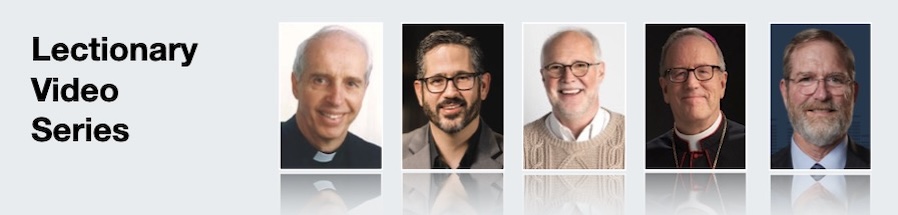
Click on links above to view respective videos.

Jeff Cavins / Encountering the Word
(4:53 minutes)

Brant Pitre / Mass Readings Explained
(8:42 minutes)

Fr. Geoffrey Plant
(29:55 minutes)
Larry Broding / Word-Sunday
(5:12 minutes)
Baptism of the Lord - YEAR C
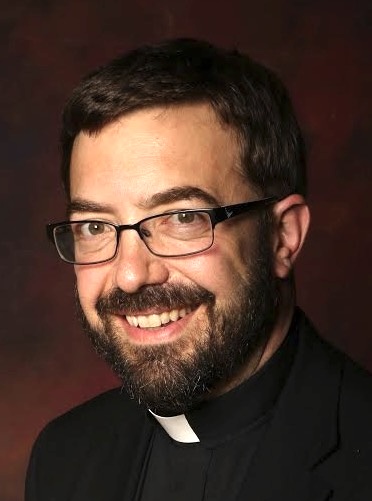
Three Great Things:
Study, Pray and Serve
Fr. Andrew Ricci, ordained in 1997, is a priest for the Diocese of Superior. He is the Rector of the Cathedral of Christ the King.
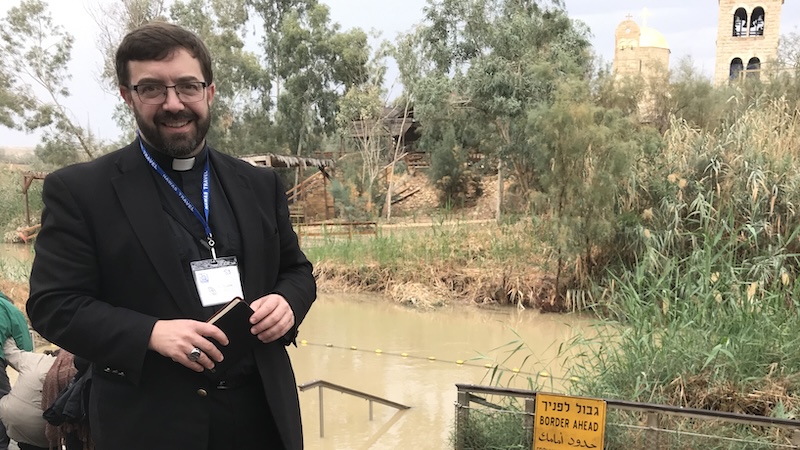
Baptism of the Lord - YEAR C
Baptism of the Lord - YEAR C

Commentary, Questions & Prayer
Titus was a Gentile who converted to Christianity and worked closely with Paul. At one point Paul sent Titus to Corinth to take up a collection for the Christian community at Jerusalem. Later Paul sent Titus to lead the Christian community on Crete, an island in the Mediterranean Sea.
Baptism of the Lord - YEAR C

Scripture Study
by Vince Contreras*
Lectionary Commentary
by Fr. Tobin*
Echoing God’s Word
by Fr. Thibodeau*
Hearers of the Word
by Kieran J. O’Mahony*
Carmelite Lectio Divina
Reflections and Prayers
74 page PDF with refections and prayers for each day of the month.
Lectio Divina January 2025 (PDF)
Lectio Divina January 2025 [Mobi]
Lectio Divina January 2025 [ePub]
“Lectio divina is an authentic source of Christian spirituality recommended by our Rule. We therefore practise it every day, so that we may develop a deep and genuine love for it, and so that we may grow in the surpassing knowledge of Christ. In this way we shall put into practice the Apostle Paul’s commandment, which is mentioned in our Rule: “The sword of the Spirit, too, which is the word of God, is to dwell abundantly in your mouth and in your hearts; and whatever things you have to do, let them be done in the word of the Lord.” (Carmelite Constitutions (2019), n. 85.)
Source: Carmelites

Social Media /
Bulletin Inserts
“Here is my servant whom I uphold, my chosen one with whom I am pleased.” (Isaiah 42:1)
Caption: In moments when you feel unsupported, remember that you are held and strengthened by a higher power.
Reflection Question:How can you anchor yourself in assurance that support is always available?
“Upon him I have put my spirit; he shall bring forth justice to the nations.”
Caption: You are a vessel of justice and compassion. Let your actions today set a ripple of change in motion.
Reflection Question: What acts of justice can you contribute to your community this week?
“A bruised reed he will not break, and a dimly burning wick he will not quench.”
Caption: Even in your weakest moments, there is gentleness and care that seeks to heal and restore you.
Reflection Question: Where can you extend this gentleness and care to others today?
“I, the LORD, have called you for justice, I have grasped you by the hand;”
Caption: As you move forward, know that you are guided and held. Walk boldly in your purpose.
Reflection Question: How can this assurance embolden you to pursue your goals with confidence?
“To open the eyes of the blind, to bring out prisoners from confinement, and from the dungeon, those who live in darkness.”
Caption: Embrace your calling to illuminate and liberate, making this world brighter and freer for others.
Reflection Question: What steps can you take this week to spread light and unlock freedom around you?
Isaiah 42:1-4,6-7

The Servant’s calling and mission
I. Description of the Servant (42:1-4)
A. The Lord’s pleasure in the Servant (42:1)
- Chosen servant
- Upheld with divine support
- The Lord’s delight
B. The Servant’s mission to the nations (42:1)
- Bringing forth justice
- Establishing justice on earth
C. The Servant’s demeanor and approach (42:2-3)
- Gentle and unassuming
- Careful and persevering
- Bringing hope and guidance
D. The Servant’s role in God’s Law and justice (42:4)
- Teaching the true way
- The coastlands awaiting the Lord’s teaching
II. The Servant’s Mission and Role (42:6-7)
A. The Servant as a covenant to the people (42:6)
- God’s promise and chosen one
- Light for the nations
- Salvation to the ends of the earth
B. The Servant’s role in restoring sight and releasing prisoners (42:7)
- Bringing freedom
- Healing and liberation
- God’s power manifested through the Servant
Clipart by Fr. Richard Lonsdale
Fr. Paul Galeto, OSA

Click on slide to watch short commentary by Fr. Paul Galetto, OSA
Catholic Sunday Scriptures in Context
Commentary Highlights
Peace and Restoration
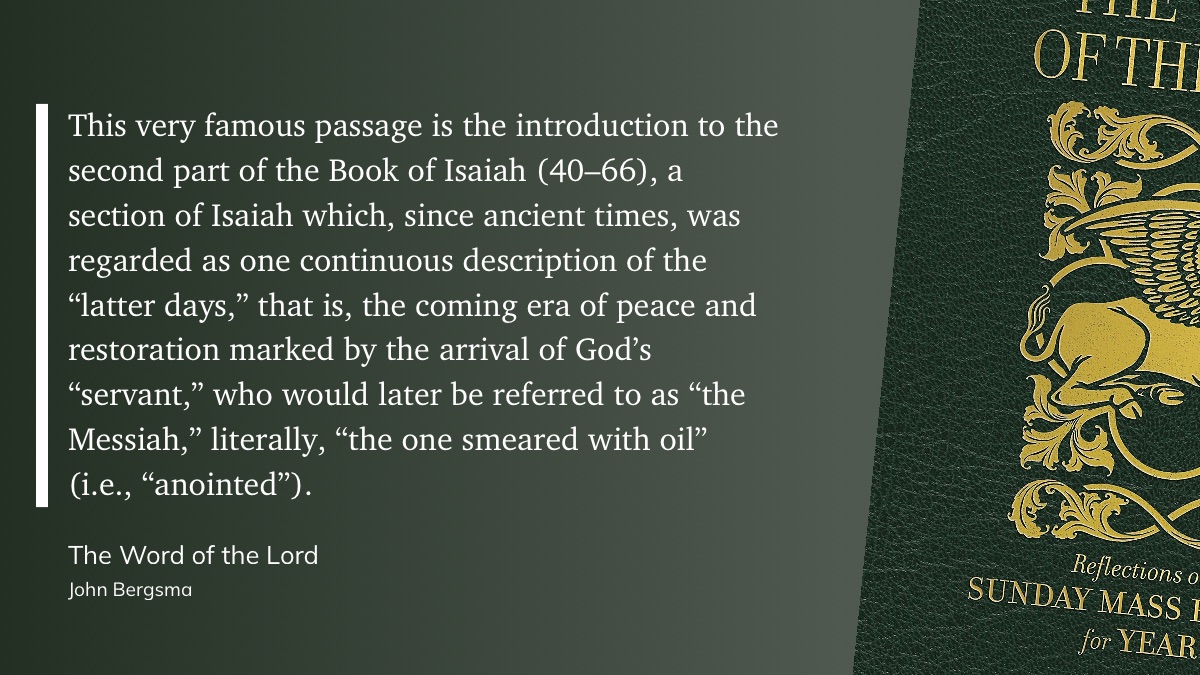
Click on slide for larger image.
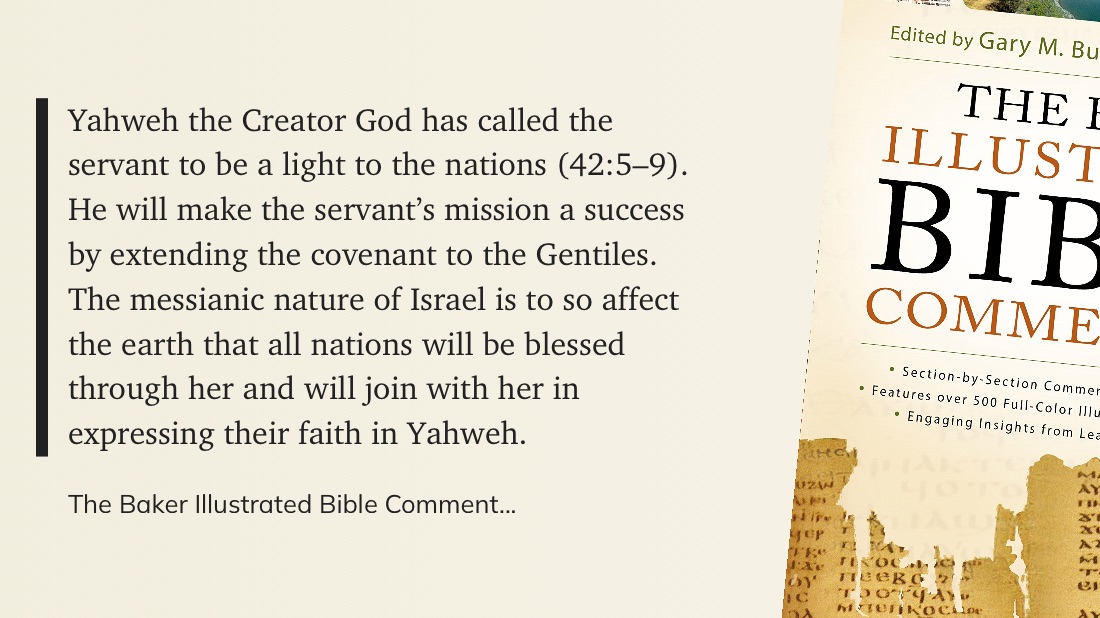
A Light to the Nations
Click on slide for larger image.
Servant to the World

Click on slide for larger image.
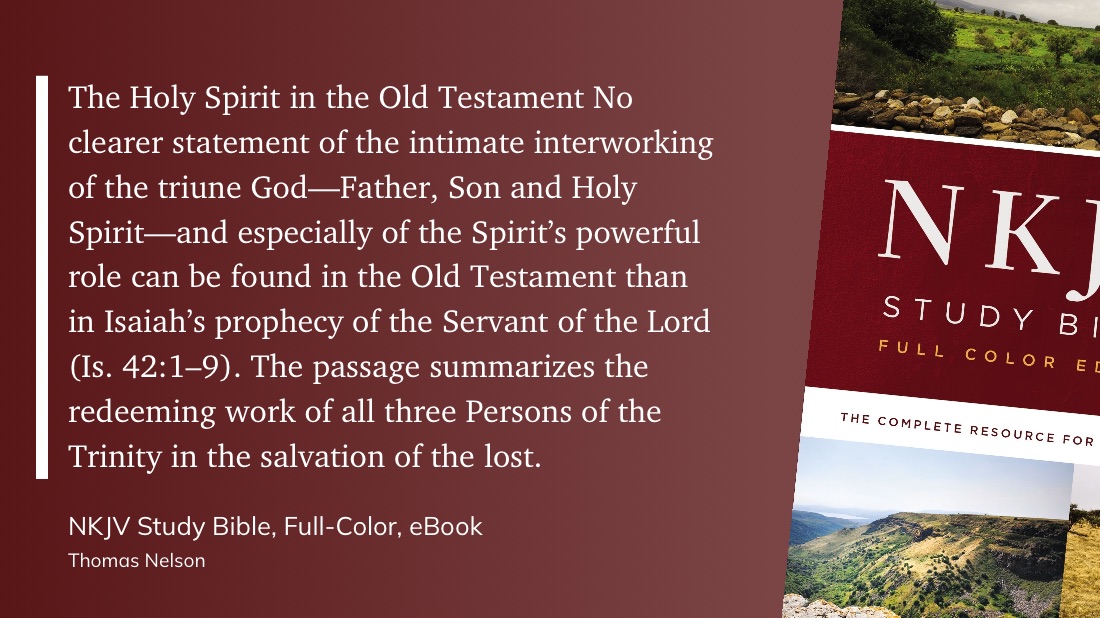
Redeeming Work of Trinity
Click on slide for larger image.
Bible Commentary Notes (PDF)
- The Jerome Biblical Commentary,
- The New Jerome Biblical Commentary, and
- The Navarre Bible.
SOURCE: St. Charles Borromeo Catholic Church (Picayune, MS)

The Chosen Servant
EXCERPT: Jesus is the Servant-Son that the 8th-century BC prophet Isaiah describes in our First Reading. An outpouring of God's Spirit accompanies the selection of Yahweh's Servant, who He will anoint as His chosen Servant like God's other holy agents, the prophets, priests, and Davidic kings of Israel. God's Servant will be a man sent to serve others and bless the people with peace. However, this divine blessing is not only for the covenant people of Israel but is the universal salvation God promised through the prophets. In the New Testament, Simeon was the first to announce this universal blessing as he held baby Jesus in his arms at His Temple dedication, saying: "for my eyes have seen your salvation, which you prepared in sight of all the peoples, a light for revelation to the Gentiles and glory for your people Israel" (Luke 2:30-32).
SOURCE: Agape Bible Study Copyright © 2015; revised 2024 (Used with permission.)
Social Media /
Bulletin Inserts
“In truth, I see that God shows no partiality.” – Acts 10:34 NAB).
Caption: God embraces all of us, regardless of our backgrounds. How can we follow His example and show genuine love to everyone we meet?
Reflection Question: Who in your life do you need to see through God’s eyes of impartial love?
“Anyone who fears Him and acts uprightly is acceptable to Him.” – Acts 10:35 NAB).
Caption: Our actions and hearts should reflect our love for God. What steps can you take today to live a life more pleasing to Him?
Reflection Question: What habit or action can you cultivate to align more closely with God’s will?
“The good news of peace through Jesus Christ, who is Lord of all.” -NAB).
Caption: The peace that Jesus brings is for everyone. How can we be peacemakers in our communities today?
Reflection Question: In what ways can you share the peace of Christ with those around you?
Acts 10:34-38

Peter’s speech to Cornelius and his household
I. God’s Impartiality (10:34-35)
A. God’s unbiased treatment of people
- Acceptance based on righteousness and fear of God
- Relevance to people of all nations
II. God’s Message of Peace (10:36)
A. The proclamation of peace through Jesus Christ
- The Israelites as the initial recipients
- Jesus Christ as Lord of all
III. Jesus’ Ministry and Resurrection (10:37-38)
A. Events following John the Baptist’s preaching (10:37)
- Jesus’ ministry in Judea and Galilee
- Eyewitness accounts of Jesus’ actions
B. God’s anointing of Jesus (10:38)
- Empowerment with the Holy Spirit
- Jesus’ deeds of kindness and healing
- Overcoming the devil’s oppression
C. God’s presence with Jesus (10:38)
- Divine support in Jesus’ mission
- The role of witnesses in testifying to Jesus’ actions
Clipart by Fr. Richard Lonsdale
Fr. Paul Galeto, OSA

Click on slide to watch short commentary by Fr. Paul Galetto, OSA
Catholic Sunday Scriptures in Context
Commentary Highlights
Candidates for God’s Blessing

Click on slide for larger image.
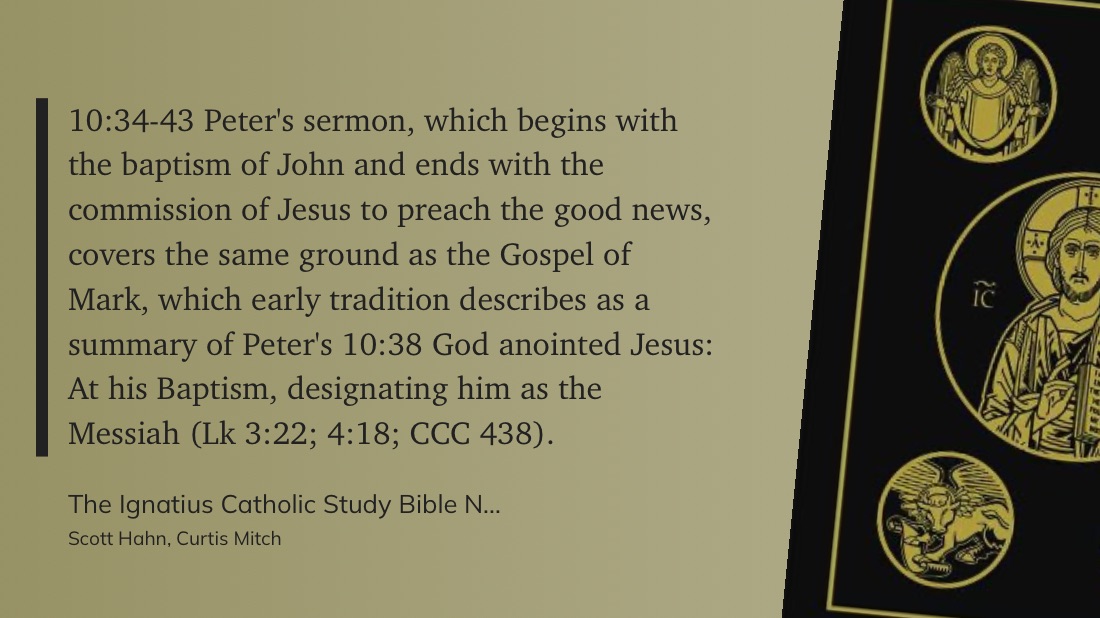
Peter’s Sermon
Click on slide for larger image.
Bible Commentary Notes (PDF)
- The Jerome Biblical Commentary,
- The New Jerome Biblical Commentary, and
- The Navarre Bible.
SOURCE: St. Charles Borromeo Catholic Church (Picayune, MS)
God's gift of universal salvation
EXCERPT: St. Peter testified to God's gift of universal salvation through the Sacrament of Christian baptism (Second Reading first selection). In Acts Chapter 10, St. Peter spoke of God's gift of salvation to the Gentiles as he prepared to baptize the men, women, and children gathered in the house of Cornelius, a Roman centurion who accepted Jesus as Savior and Lord. This event fulfilled Simeon's prophecy when he held the Christ-child in his arms at Jesus's Temple dedication and prophesied a universal blessing and the promise of the gift of salvation for Jews and Gentiles (Lk 2:30-32).
SOURCE: Agape Bible Study Copyright © 2015; revised 2024 (Used with permission.)
Social Media /
Bulletin Inserts
“The people were filled with expectation.” (Luke 3:15 NAB)
Caption: Let us live with a heart full of expectation and hope, trusting in the promises that God has in store for us.
Question for Reflection: In what areas of your life are you eagerly expecting God’s work?
“I am baptizing you with water, but one mightier than I is coming.” (Luke 3:16)
Caption: Remember that in life’s journey, we receive strength and grace beyond our own abilities.
Question for Reflection: How can you rely more on God’s strength instead of your own?
“He will baptize you with the Holy Spirit and fire.” (Luke 3:16)
Caption: Allow the Holy Spirit to ignite a fire within you, empowering you to pursue your purpose.
Question for Reflection: How can you invite the Holy Spirit to lead and guide you today?
“When Jesus also had been baptized and was praying, heaven was opened.” (Luke 3:21))
Caption: In prayer, we find connection and communion, opening the doors to heavenly grace and guidance.
Question for Reflection: How can you incorporate more meaningful prayer into your daily routine?
“You are my beloved Son; with you I am well pleased.” (Luke 3:22)
Caption: Embrace the truth that you are God’s beloved. Let this affirm your value and purpose.
Question for Reflection: How does knowing you are beloved by God change the way you see yourself?
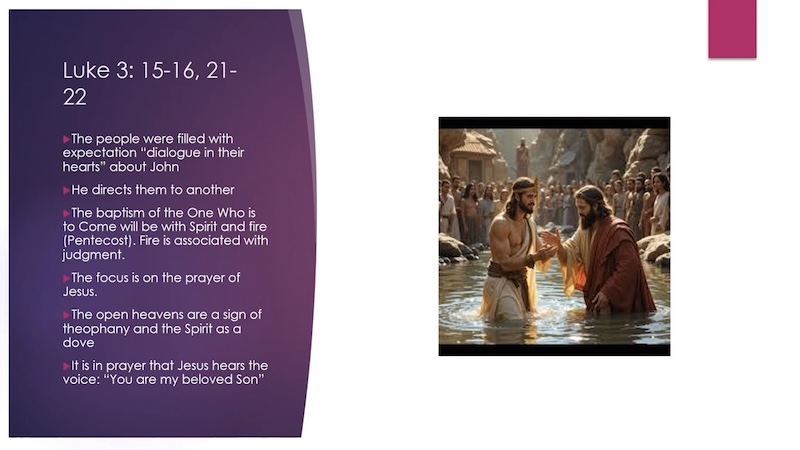
Luke 3:15-16,21-22

John’s ministry and the baptism of Jesus
I. John’s Testimony about the Coming Messiah (3:15-16)
A. The people’s expectation and speculation (3:15)
- John’s role in igniting spiritual curiosity
- The search for the Messiah
B. John’s clarification of his role (3:16)
- John’s baptism with water
- The coming of a mightier figure
- John’s unworthiness compared to the Messiah
C. The Messiah’s baptism (3:16)
- Baptism with the Holy Spirit and fire
- The transformative power of the Holy Spirit
II. Jesus’ Baptism and Divine Affirmation (3:21-22)
A. The baptism of Jesus (3:21)
- Jesus’ participation in the baptism ritual
- Prayer as a central component
B. Heavenly acknowledgement (3:21-22)
- The opening of heaven
- The descent of the Holy Spirit
- The dove-like appearance of the Holy Spirit
C. God’s declaration (3:22)
- Jesus as God’s beloved Son
- God’s pleasure and approval of Jesus
Clipart by Fr. Richard Lonsdale
Fr. Paul Galeto, OSA
Click on slide to watch short commentary by Fr. Paul Galetto, OSA
Catholic Sunday Scriptures in Context
Commentary Highlights
Jesus’ Union with Sinful Humanity
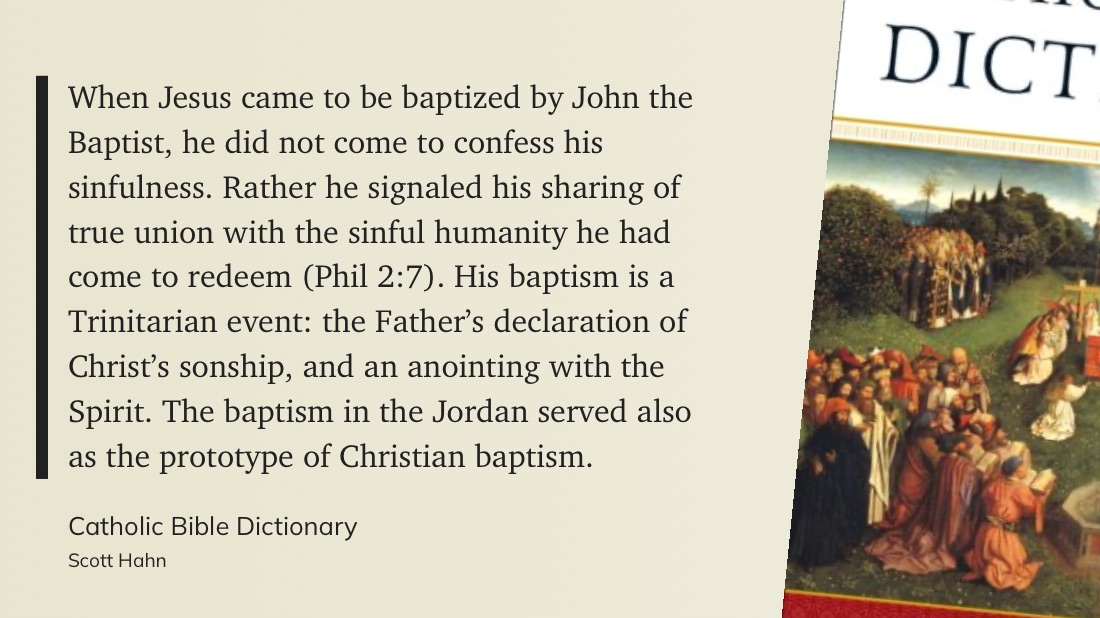
Click on slide for larger image.
Gift of the Spirit in Our Baptism

Click on slide for larger image.
“Heavenly” and “Earthly” Genealogy
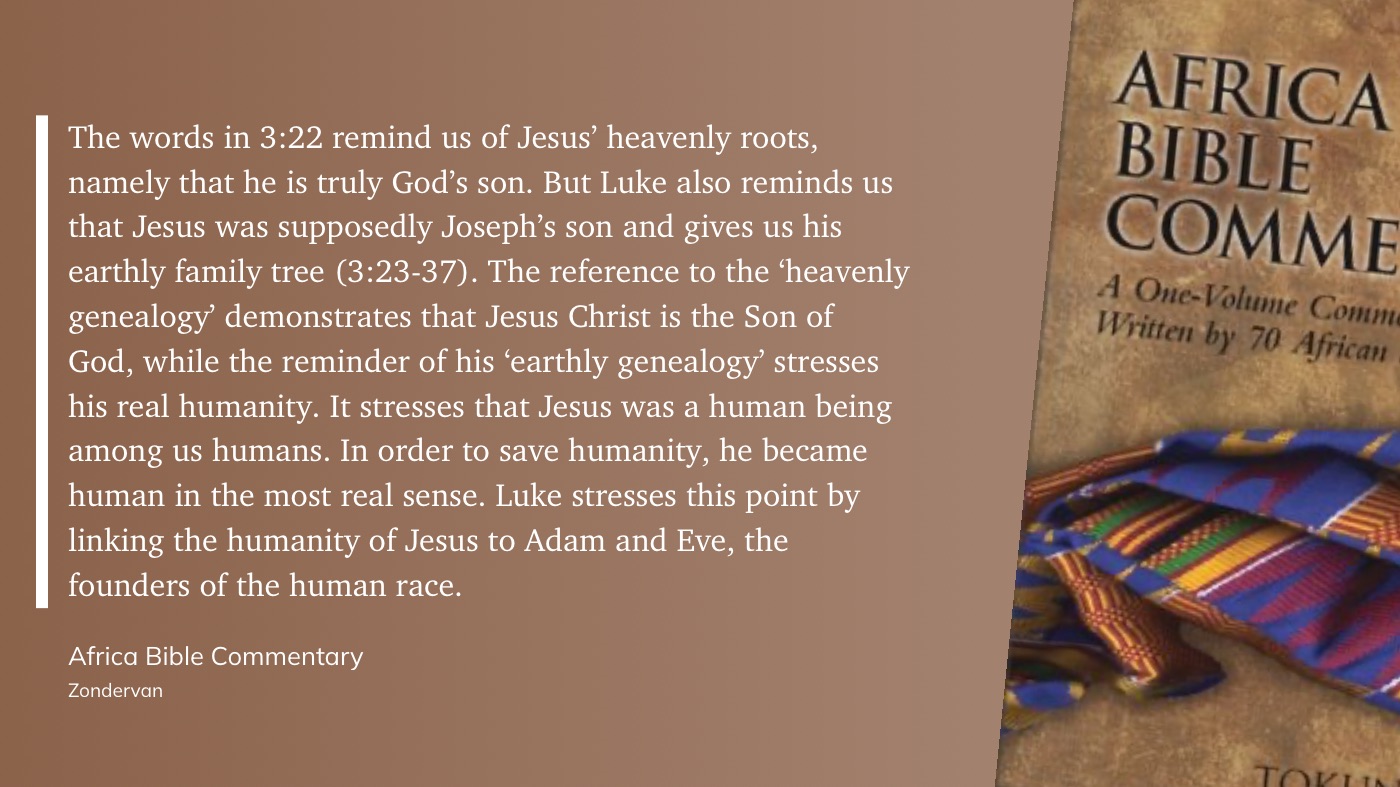
Click on slide for larger image.
The Hovering Dove

Click on slide for larger image.
Bible Commentary Notes (PDF)
- The Jerome Biblical Commentary,
- The New Jerome Biblical Commentary, and
- The Navarre Bible.
SOURCE: St. Charles Borromeo Catholic Church (Picayune, MS)
Event | Type | Matthew | Mark | Luke | John | |
1 | misc | John 01:01–18 | ||||
2 | nativity | Matthew 01:01–17 | Luke 03:23–38 | |||
3 | nativity | Luke 01:05–25 | ||||
4 | nativity | Luke 01:26–38 | ||||
5 | nativity | Luke 01:39–56 | ||||
6 | nativity | Matthew 01:18–25 | Luke 02:01–07 | |||
7 | nativity | Luke 02:08–15 | ||||
8 | nativity | Luke 02:16–20 | ||||
9 | nativity | Luke 02:21 | ||||
10 | nativity | Luke 02:22–38 | ||||
11 | nativity | Matthew 02:01–02 | ||||
12 | nativity | Matthew 02:01–12 | ||||
13 | nativity | Matthew 02:13–15 | ||||
14 | nativity | Matthew 02:16–18 | ||||
15 | Herod the Great's death | misc | Matthew 02:19–20 | |||
16 | youth | Matthew 02:21–23 | Luke 02:39–39 | |||
17 | youth | Luke 02:41–51 | ||||
18 | misc | Matthew 03:01–12 | Mark 01:01–08 | Luke 03:01–20 | John 01:19–34 | |
19 | misc | Matthew 03:13–17 | Mark 01:09–11 | Luke 03:21–22 | John 01:29–39 | |
20 | misc | Matthew 04:01–11 | Mark 01:12–13 | Luke 04:01–13 | ||
21 | miracle | John 02:01–11 | ||||
22 | ministry | John 02:13–25 | ||||
23 | ministry | John 03:01–21 | ||||
24 | ministry | Matthew 04:12–12 | Mark 01:14–14 | John 04:01–03 | ||
25 | miracle | Mark 01:21–28 | Luke 04:31–37 | |||
26 | parable | Mark 04:26–29 | ||||
27 | ministry | Matthew 13:53–58 | Mark 06:01–06 | Luke 04:16–30 | ||
28 | ministry | Matthew 04:18–22 | Mark 01:16–20 | Luke 05:1-11 | John 01:35–51 | |
29 | miracle | Luke 05:01–11 | ||||
30 | sermon | Matthew 05:02–12 | Luke 06:20–23 | |||
31 | miracle | Luke 07:11–17 | ||||
32 | parable | Luke 07:41–43 | ||||
33 | parable | Matthew 05:14–15 | Mark 04:21–25 | Luke 08:16–18 | ||
34 | sermon | Matthew 05:17–48 | Luke 06:29–42 | |||
35 | ministry | Luke 10:01–24 | ||||
36 | sermon | Matthew 06:01–18 | ||||
37 | parable | Luke 10:30–37 | ||||
38 | ministry | Luke 10:38–42 | ||||
39 | ministry | Matthew 06:09–13 | Luke 11:02–04 | |||
40 | parable | Luke 11:05–08 | ||||
41 | parable | Luke 12:16–21 | ||||
42 | ministry | John 04:04–26 | ||||
43 | ministry | Matthew 06:25–34 | Luke 12:22–34 | |||
44 | sermon | Matthew 07:01–05 | Luke 06:41–42 | |||
45 | sermon | Matthew 07:13–27 | ||||
46 | sermon | Matthew 07:15–20 | Luke 06:43-45 | |||
47 | parable | Matthew 07:24–27 | Luke 06:46–49 | |||
48 | miracle | Matthew 08:01–04 | Mark 01:40–45 | Luke 05:12–16 | ||
49 | miracle | Matthew 08:05–13 | Luke 07:01–10 | John 04:46–54 | ||
50 | miracle | Matthew 08:14–17 | Mark 01:29–34 | Luke 04:38–41 | ||
51 | miracle | Matthew 08:16–17 | Mark 01:32–34 | Luke 04:40–41 | ||
52 | miracle | Matthew 08:23–27 | Mark 04:35–41 | Luke 08:22–25 | ||
53 | miracle | Matthew 08:28–34 | Mark 05:01–20 | Luke 08:26–39 | ||
54 | miracle | Matthew 09:01–08 | Mark 02:01–12 | Luke 05:17–26 | ||
55 | ministry | Matthew 09:09 | Mark 02:13–14 | Luke 05:27–28 | ||
56 | parable | Matthew 09:17–17 | Mark 02:22–22 | Luke 05:37–39 | ||
57 | miracle | Matthew 09:18–26 | Mark 05:21–43 | Luke 08:40–56 | ||
58 | miracle | Matthew 09:20–22 | Mark 05:24–34 | Luke 08:43–48 | ||
59 | miracle | Matthew 09:27–31 | ||||
60 | miracle | Matthew 09:32–34 | ||||
61 | ministry | Matthew 10:02–04 | Mark 03:13–19 | Luke 06:12–16 | ||
62 | ministry | Matthew 10:34–36 | Luke 12:49–53 | |||
63 | ministry | Matthew 11:02–06 | Luke 07:18–23 | |||
64 | miracle | John 05:01–18 | ||||
65 | ministry | Matthew 12:01–08 | Mark 02:23–28 | Luke 06:01–05 | ||
66 | miracle | Matthew 12:09–13 | Mark 03:01–06 | Luke 06:06–11 | ||
67 | miracle | Matthew 12:22–28 | Mark 03:20–30 | Luke 11:14–23 | ||
68 | parable | Matthew 12:29–29 | Mark 03:27–27 | Luke 11:21–22 | ||
69 | ministry | Matthew 12:30–32 | Mark 03:28–29 | Luke 12:08–10 | ||
70 | ministry | Matthew 12:46–50 | Mark 03:31–35 | Luke 08:19–21 | ||
71 | parable | Matthew 13:03–09 | Mark 04:03–09 | Luke 08:05–08 | ||
72 | parable | Matthew 13:24–30 | ||||
73 | parable | Luke 13:06–09 | ||||
74 | miracle | Luke 13:10–17 | ||||
75 | parable | Matthew 13:31–32 | Mark 04:30–32 | Luke 13:18–19 | ||
76 | parable | Matthew 13:33–33 | Luke 13:20–21 | |||
77 | parable | Matthew 13:44–46 | ||||
78 | parable | Matthew 13:47–50 | ||||
79 | parable | Matthew 13:52–52 | ||||
80 | ministry | Matthew 14:06–12 | Mark 06:21–29 | Luke 09:07–09 | ||
81 | miracle | Matthew 14:13–21 | Mark 06:31–44 | Luke 09:10–17 | John 06:05–15 | |
82 | miracle | Matthew 14:22–33 | Mark 06:45–52 | John 06:16–21 | ||
83 | miracle | Matthew 14:34–36 | Mark 06:53–56 | |||
84 | sermon | Matthew 15:01–11 | Mark 07:01–23 | |||
85 | miracle | Matthew 15:21–28 | Mark 07:24–30 | |||
86 | miracle | Mark 07:31–37 | ||||
87 | miracle | Matthew 15:32–39 | Mark 08:01–09 | |||
88 | miracle | Mark 08:22–26 | ||||
89 | ministry | Matthew 16:13–20 | Mark 08:27–30 | Luke 09:18–21 | ||
90 | miracle | Matthew 17:01–13 | Mark 09:02–13 | Luke 09:28–36 | ||
91 | miracle | Matthew 17:14–21 | Mark 09:14–29 | Luke 09:37–49 | ||
92 | miracle | Matthew 17:24–27 | ||||
93 | sermon | John 06:22–59 | ||||
94 | ministry | Matthew 18:01–06 | Mark 09:33–37 | Luke 09:46–48 | ||
95 | miracle | Luke 14:01–06 | ||||
96 | parable | Luke 14:25–33 | ||||
97 | parable | Matthew 18:10–14 | Luke 15:04–06 | |||
98 | parable | Matthew 18:23–35 | ||||
99 | ministry | Matthew 18:01–06 | Mark 09:33–37 | Luke 09:46–48 | ||
100 | parable | Luke 15:08–09 | ||||
101 | parable | Luke 15:11–32 | ||||
102 | parable | Luke 16:01–13 | ||||
103 | parable | Luke 16:19–31 | ||||
104 | parable | Luke 17:07–10 | ||||
105 | miracle | Luke 17:11–19 | ||||
106 | parable | Luke 18:01–08 | ||||
107 | parable | Luke 18:09–14 | ||||
108 | ministry | Matthew 19:1-15 | ||||
109 | ministry | Matthew 19:16–30 | Mark 10:17–31 | Luke 18:18–30 | ||
110 | ministry | John 08:02–11 | ||||
111 | parable | Matthew 20:01–16 | ||||
112 | ministry | Matthew 20:17–19 | Mark 10:32–34 Mark 08:31 Mark 09:31 | Luke 18:31–34 | ||
113 | miracle | John 09:01–12 | ||||
114 | ministry | Matthew 20:20–28 | Mark 10:35–45 | |||
115 | ministry | John 10:01–21 | ||||
116 | miracle | Matthew 20:29–34 | Mark 10:46–52 | Luke 18:35–43 | ||
117 | miracle | John 11:01–44 | ||||
118 | ministry | Luke 19:02–28 | ||||
119 | ministry | Matthew 21:01–11 | Mark 11:01–11 | Luke 19:29–44 | John 12:12–19 | |
120 | ministry | Matthew 21:12–13 | Mark 11:15–18 | Luke 19:45–48 | ||
121 | miracle | Matthew 21:18–22 | Mark 11:12–14 | |||
122 | ministry | Matthew 21:23–27 | Mark 11:27–33 | Luke 20:01–08 | ||
123 | parable | Matthew 21:28–32 | ||||
124 | parable | Matthew 21:33–41 | Mark 12:01–09 | Luke 20:09–16 | ||
125 | parable | Matthew 22:01–14 | Luke 14:16–24 | |||
126 | ministry | Matthew 22:15–22 | Mark 12:13–17 | Luke 20:20–26 | ||
127 | ministry | Matthew 23:01–39 | Mark 12:35–37 | Luke 20:45–47 | ||
128 | sermon | Mark 12:41–44 | Luke 21:01-04 | |||
129 | ministry | Matthew 24:01–31 | Mark 13:01–27 | Luke 21:05–36 | ||
130 | parable | Matthew 24:32–35 | Mark 13:28–31 | Luke 21:29–33 | ||
131 | parable | Matthew 24:42–51 | Mark 13:34–37 | Luke 12:35–48 | ||
132 | parable | Matthew 25:01–13 | ||||
133 | parable | Matthew 25:14–30 | Luke 19:12–27 | |||
134 | parable | Matthew 25:31–46 | ||||
135 | ministry | Matthew 26:01–13 | Mark 14:03-09 | Luke 07:36–50 | John 12:02-08 | |
136 | misc | Matthew 26:14–16 | Mark 14:10–11 | Luke 22:01-06 | ||
137 | ministry | John 12:24–26 | ||||
138 | ministry | Matthew 26:26–29 | Mark 14:18–21 | Luke 22:17–20 | John 13:01–31 | |
139 | ministry | John 16:05–15 | ||||
140 | misc | Matthew 26:36–46 | Mark 14:32–42 | Luke 22:39–46 | ||
141 | passion | Matthew 26:47–49 | Mark 14:43–45 | Luke 22:47–48 | John 18:02-09 | |
142 | miracle | Luke 22:49–51 | ||||
143 | passion | Matthew 26:50–56 | Mark 14:46–49 | Luke 22:52–54 | John 18:10–12 | |
144 | passion | Matthew 26:57–68 | Mark 14:53–65 | Luke 22:63–71 | John 18:12–24 | |
145 | passion | Matthew 27:24–25 | ||||
146 | passion | Matthew 27:27–33 | Mark 15:20–22 | Luke 23:26–32 | John 19:16–17 | |
147 | passion | Matthew 27:34–61 | Mark 15:23–47 | Luke 23:33–54 | John 19:18–38 | |
148 | res app | Matthew 28:01 | Mark 16:01 | Luke 24:01 | ||
149 | res app | Matthew 28:02-08 | Mark 16:02-08 | Luke 24:02–12 | John 20:01–13 | |
150 | res app | Matthew 28:09–10 | Mark 16:09-13 | Luke 24:01-08 | John 20:14–16 | |
151 | res app | John 20:17–17 | ||||
152 | res app | Luke 24:13–32 | ||||
153 | res app | Luke 24:36–43 | John 20:19–20 | |||
154 | res app | Matthew 28:16–20 | Mark 16:14-18 | Luke 24:44–49 | John 20:21–23 | |
155 | res app | John 20:24–29 | ||||
156 | miracle | John 21:01–24 | ||||
157 | res app | Mark 16:19 | Luke 24:50–53 | |||
158 | misc | Matthew 28:19-20 | Mark 16:19-20 |
Contextual Background
HISTORY
The passage Luke 3:15-16, 21-22 provides insight into the historical and political context of the time, particularly through its reference to the Roman Empire and the Jewish expectation of a messiah.
Luke wrote his Gospel account to provide an orderly narrative of Jesus' life, ministry, and the events that unfolded after his resurrection. His intended audience was primarily Gentiles and Greek-speaking Jews who were interested in learning about the life and teachings of Jesus Christ.
During this time, the Roman Empire maintained political control over Palestine, often imposing heavy taxation and exerting influence over Jewish religious leaders. This created a climate of tension and unrest among the Jewish people, who longed for the coming of a messiah to deliver them from oppression and establish God's kingdom on earth.
In this passage, Luke recounts the baptism of Jesus and the divine affirmation of his identity as the Son of God. The reference to the Holy Spirit descending upon Jesus is significant, as it highlights the spiritual dimension of Jesus' mission and the fulfillment of Jewish messianic expectations.
Additionally, the baptism narrative highlights John the Baptist's role in preparing the way for Jesus, challenging the political and religious authorities of the time. John's message of repentance and his critique of the religious elite contributed to the tension between the Jewish leadership and the emerging Christian movement.
In conclusion, Luke 3:15-16, 21-22 provides a glimpse into the historical and political context of the early Christian community. The baptism narrative underscores the Jewish expectation of a messiah and challenges the prevailing political and religious structures of the time, emphasizing the transformative power of Jesus' message and the hope it brings to a world in need of salvation.
SOCIETY
The sociological and cultural context of Luke 3:15-16, 21-22 is deeply rooted in Jewish customs, beliefs, and practices, particularly the role of baptism and the expectation of a messiah.
During this time, baptism was a significant cultural practice among Jews, symbolizing purification and the commitment to follow God's commandments. The passage describes Jesus' baptism by John the Baptist, an event that would have resonated with the Jewish audience, as it marked a significant spiritual turning point in Jesus' life and his public ministry.
Moreover, the Jewish people had long awaited the coming of a messiah, who would deliver them from oppression and establish God's kingdom on earth. The voice from heaven proclaiming Jesus as God's beloved Son affirms his messianic identity, fulfilling the long-held Jewish expectation and shaping the passage's message of hope and salvation.
The passage's reference to John the Baptist's arrest highlights the sociological context of the early Christian community and its relationship with the Jewish leadership. John's criticism of the religious elite likely contributed to his arrest, reflecting the tension between the emerging Christian movement and the established religious authorities.
In conclusion, the sociological and cultural context of Luke 3:15-16, 21-22 significantly influenced the passage's meaning and interpretation, as well as its relevance to the original audience. By addressing the Jewish customs and beliefs surrounding baptism and the messiah, this passage emphasizes the transformative power of Jesus' ministry and its challenge to the prevailing religious and social structures of the time.
THEOLOGY
From a Roman Catholic theological perspective, Luke 3:15-16, 21-22 carries profound significance, as it emphasizes the divine affirmation of Jesus' identity as the Son of God and the beginning of his public ministry.
The passage highlights the Catholic belief in the Holy Trinity, with the Holy Spirit descending upon Jesus and the voice from heaven declaring him as the Son of God. This event marks the manifestation of the Trinity and reveals the unity of the Father, Son, and Holy Spirit.
Moreover, the baptism narrative reflects the sacrament of baptism in the Catholic Church, which signifies spiritual rebirth and the washing away of sin. The passage serves as a reminder of the transformative power of baptism and the call to live a life of holiness in imitation of Christ.
In modern-day application, this passage has significant relevance for contemporary Catholics. It emphasizes the importance of recognizing Jesus as the Son of God and acknowledging the role of the Holy Spirit in the lives of believers. Catholics are called to embrace their baptismal identity and follow Christ's example by serving others, promoting justice, and proclaiming the Gospel.
For instance, Catholics can apply the passage's message by participating in social justice initiatives, engaging in charitable works, and sharing their faith with others. By living out the values of the Gospel, contemporary Catholics can deepen their understanding of the passage and its relevance to their daily lives.
In conclusion, Luke 3:15-16, 21-22 holds profound theological significance for Catholics, emphasizing the divine affirmation of Jesus' identity and the transformative power of baptism. By applying the passage's message to their lives, contemporary Catholics can strengthen their faith and contribute to the Church's mission of spreading the Gospel and serving the world.
The Baptism of Jesus
EXCERPT: In today's Gospel reading, we remember Jesus's baptism by St. John the Baptist in the waters of the Jordan River. The Gospels relate His baptism as another epiphany (manifestation) of Jesus as the promised Messiah, the "Chosen One" and "Servant" Son of God promised by the prophets. Jesus's baptism is the event in Scripture that presents for the first time the revelation of the Most Holy Trinity: the Holy Spirit descending from Heaven in the form of a dove, the voice of God the Father heard from Heaven, and Jesus identified by the divine voice as God the Son (Mt 3:16-17; Mk 1:12-13; Lk 4:21-22).
Jesus gave us the Sacrament of Baptism to renew our souls by imparting to the baptized a new life in a covenant relationship as reborn sons and daughters in the family of the Almighty (Mt 28:19-20; Jn 3:3-5). In Mark 16:16, Jesus commanded that baptism was necessary for this spiritual transformation and the promise of eternal salvation. For those baptized by water and the Holy Spirit in the Trinitarian formula Christ gave us (Mt 28:19), the waters of Christian baptism become the "the springs of salvation" that the prophet Isaiah promised (Is 12:3). It is the water that will "cleanse you of all your filth ... and give you a new heart and a new spirit" as Ezekiel prophesied (Ezek 36:24-27). The waters of Christian baptism are God's invitation to all humanity to receive the promises made through God's Son and the heir of the eternal Davidic covenant, Christ Jesus: Come to me heedfully, listen, that you may have life. I will renew with you the everlasting covenant, the benefits assured to David (Is 55:5).
SOURCE: Agape Bible Study Copyright © 2015; revised 2024 (Used with permission.)

SCRIPTURE
SEARCH
FIRST READING (42)
SECOND READING (41)
GOSPEL (47)
This tool created by Jeff Pinyan uses the CCEL Early Church Fathers digital edition of the Philip Schaff collection.
Baptism of the Lord - YEAR C
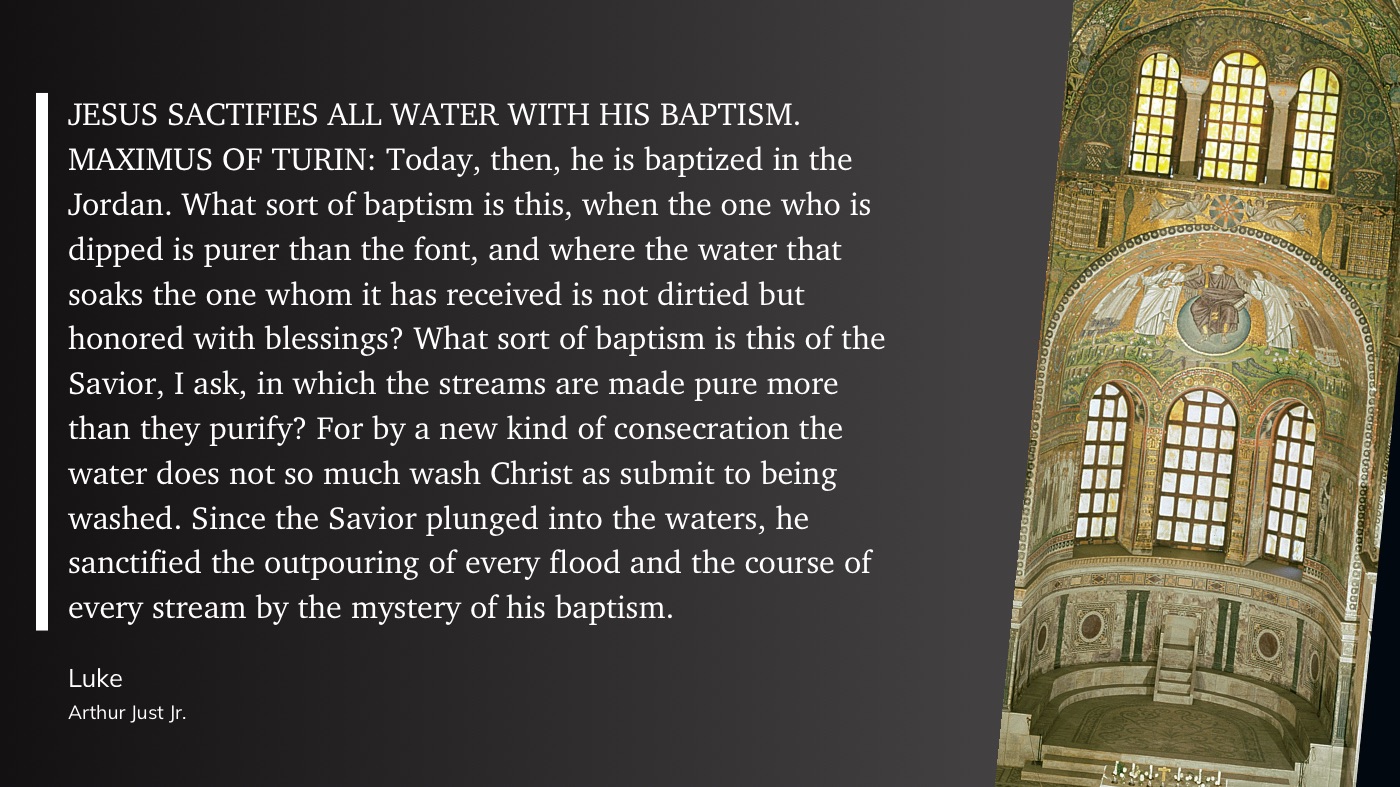
Just Jr., A., Oden, T. C., Carson, D. A., & Oden, E. (Eds.). (2003). Ancient Christian Commentary on Scripture: New Testament III, Luke (Vol. 3). IVP Academic.
Catena Aurea
The Catena Aurea, which means “Golden Chain” in Latin, is a comprehensive biblical commentary comb is a 13th-century biblical commentary compiled by St. Thomas Aquinas. This anthology features insights from over eighty Church Fathers on the four Gospels.