JAN 19, 2025


Each week THE WORD THIS WEEK features popular video series and other media which focus on the Sunday’s Mass readings.
Click on links above to view respective videos.

Jeff Cavins / Encountering the Word
(4:50 minutes)

Brant Pitre / Mass Readings Explained
(5:59 minutes)
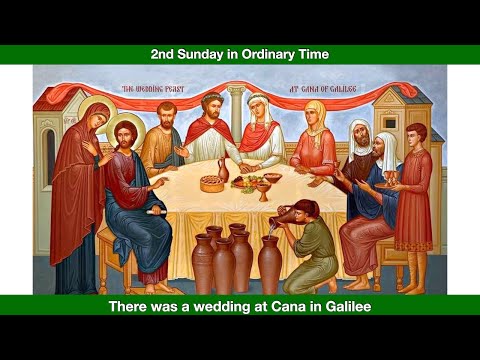
Fr. Geoffrey Plant
(32:17 minutes)
Larry Broding / Word-Sunday
(3:41 minutes)
2nd Sunday of Year C
Father
Andrew
Ricci
Three Great Things:
Study, Pray and Serve
Fr. Andrew Ricci, ordained in 1997, is a priest for the Diocese of Superior. He is the Rector of the Cathedral of Christ the King.

PREACHING NOTES
HOMILY: Do Whatever He Tells You
Mary’s command to the servants is our command as well. For us to “do whatever he tells you” requires that we are receptive to God’s prompting in our hearts. May we be open to the command of Christ as we follow him today.
2nd Sunday of Year C
2nd Sunday of Year C


Commentary, Questions & Prayer
Titus was a Gentile who converted to Christianity and worked closely with Paul. At one point Paul sent Titus to Corinth to take up a collection for the Christian community at Jerusalem. Later Paul sent Titus to lead the Christian community on Crete, an island in the Mediterranean Sea.
2nd Sunday of Year C

Scripture Study
by Vince Contreras*
Lectionary Commentary
by Fr. Tobin*
Echoing God’s Word
by Fr. Thibodeau*
Hearers of the Word
by Kieran J. O’Mahony*
Carmelite Lectio Divina
Reflections and Prayers
74 page PDF with refections and prayers for each day of the month.
Lectio Divina January 2025 (PDF)
Lectio Divina January 2025 [Mobi]
Lectio Divina January 2025 [ePub]
“Lectio divina is an authentic source of Christian spirituality recommended by our Rule. We therefore practise it every day, so that we may develop a deep and genuine love for it, and so that we may grow in the surpassing knowledge of Christ. In this way we shall put into practice the Apostle Paul’s commandment, which is mentioned in our Rule: “The sword of the Spirit, too, which is the word of God, is to dwell abundantly in your mouth and in your hearts; and whatever things you have to do, let them be done in the word of the Lord.” (Carmelite Constitutions (2019), n. 85.)
Source: Carmelites

Social Media /
Bulletin Inserts
“For Zion’s sake I will not be silent, for Jerusalem’s sake I will not keep still, Until her vindication shines forth like the dawn and her salvation like a burning torch.”
Let the light within you shine brightly, illuminating the path for others to find hope and salvation.
Reflection Question: What steps can you take today to be a beacon of hope and encouragement in someone else’s life?
“You shall be a glorious crown in the hand of the LORD, a royal diadem held by your God.”
Remember, your worth is determined by God, and you are cherished like a royal diadem in His hands.
Reflection Question: How can embracing your true worth change your perspective on daily challenges?
“No more shall you be called ‘Forsaken,’ nor your land called ‘Desolate,’ But you shall be called ‘My Delight,’ and your land ‘Espoused.'”
Transform the labels you wear and reclaim your true identity as God’s beloved.
Reflection Question: What labels have you placed on yourself that you need to let go of to embrace God’s vision for you?
“As a young man marries a virgin, your Builder shall marry you; And as a bridegroom rejoices in his bride so shall your God rejoice in you.”
Celebrate the unending joy and commitment God has for you, as a bridegroom rejoices in his bride.
Reflection Question: In what ways can you actively rejoice in your relationship with God today?

From Third Isaiah, this passage was written in the time of “post celebration blues.” After fifty years in exile, Jewish leadership had returned from Babylon to rebuild Jerusalem. After several years of rejoicing the reality of hard work set in; the people’s resolve began to slacken and dejection reared it ugly head. The people were home, but did not care about the task at hand.
In the midst of the city’s depression, God declared his intent; he would speak until the city’s glory (reputation) returns. [1] The city was being rebuilt because God wanted it, not through the mere efforts of the people. As the spokesperson of the divine, the prophet, too, would not be silent; he would praise, shame, and pester the people until the city was rebuilt to its glory. In this way, God really spoke through the prophet.
Once the city was rebuilt, non-Jews (i.e., the “nations” and kings) would witness its glory. God would pronounce the rebuilding by giving the city a new name and a crown, both reflecting the marriage of a young maiden to a king. [2-3] The virgin maiden has only the promise of adding to the kingdom with royal heirs; in this sense, she was “barren” or “desolate.” In the same way, a city partially rebuilt was not truly whole; to some, it was barren and desolate, like some of our inner city neighborhoods. But only the cynic could not see potential; through God’s eyes, even the barren and desolate had in them the seeds of joy and intimate relationship. Once the maiden married the king, she took a new name and a crown as queen. The city, too, would have a new reputation (name and crown) because of its close relationship with God. And like the joy at a marriage feast, the glory of the city would be a joy to God and its inhabitants [3-4].
Permission for use. All materials found in word-sunday.com are the property of Larry Broding (Copyright 1999-2025). Viewers may copy any material found in these pages for their personal use or for use in any non-profit ministry.

Isaiah 62:1-5

The Promise of Restoration and Redemption
I. Israel’s New Identity and Honor
- The nation’s new name (v. 2)
- The Lord’s delight in His people (v. 3)
II. The Promise of Restoration
- The transformation of desolate land into a possession (v. 4)
- The recognition of Israel by other nations (v. 2)
III. The Blessings of Redemption
- The marriage metaphor: a united people and their God (v. 5)
- The delight and rejoicing of the Lord (v. 5)
Clipart by Fr. Richard Lonsdale
Sunday Scriptures
in Context
Fr. Paul Galeto, OSA
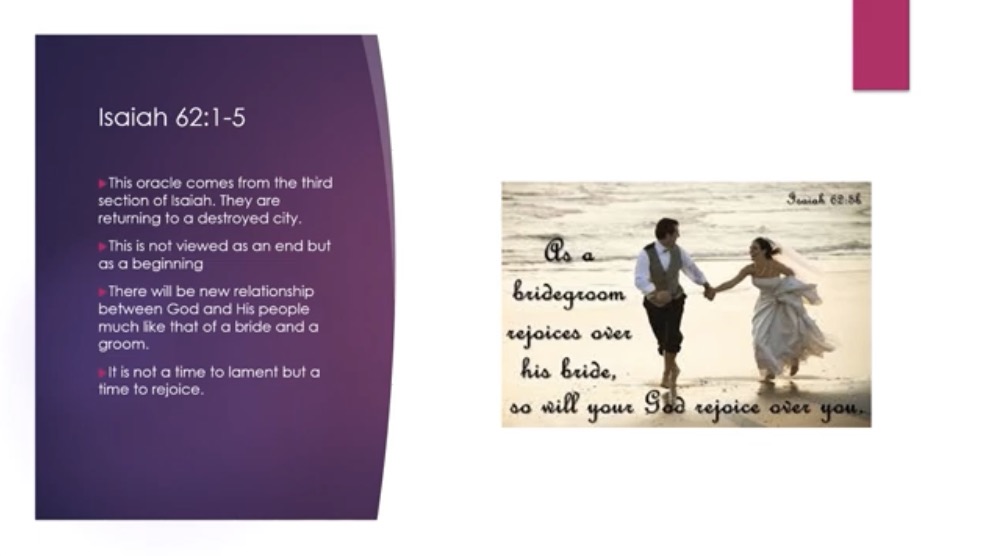
Click on slide to watch short commentary by Fr. Paul Galetto, OSA
Catholic Sunday Scriptures in Context
The Marriage Metaphor
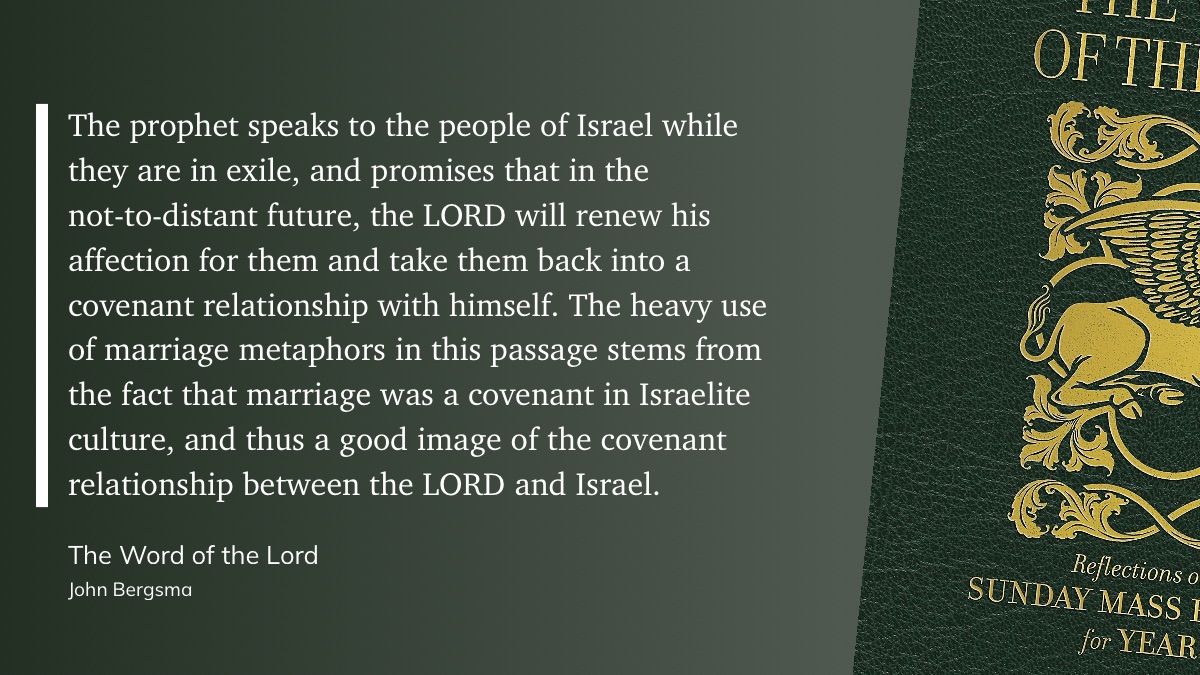
Click on slide for larger image.
Era of God’s Victorious Kingship
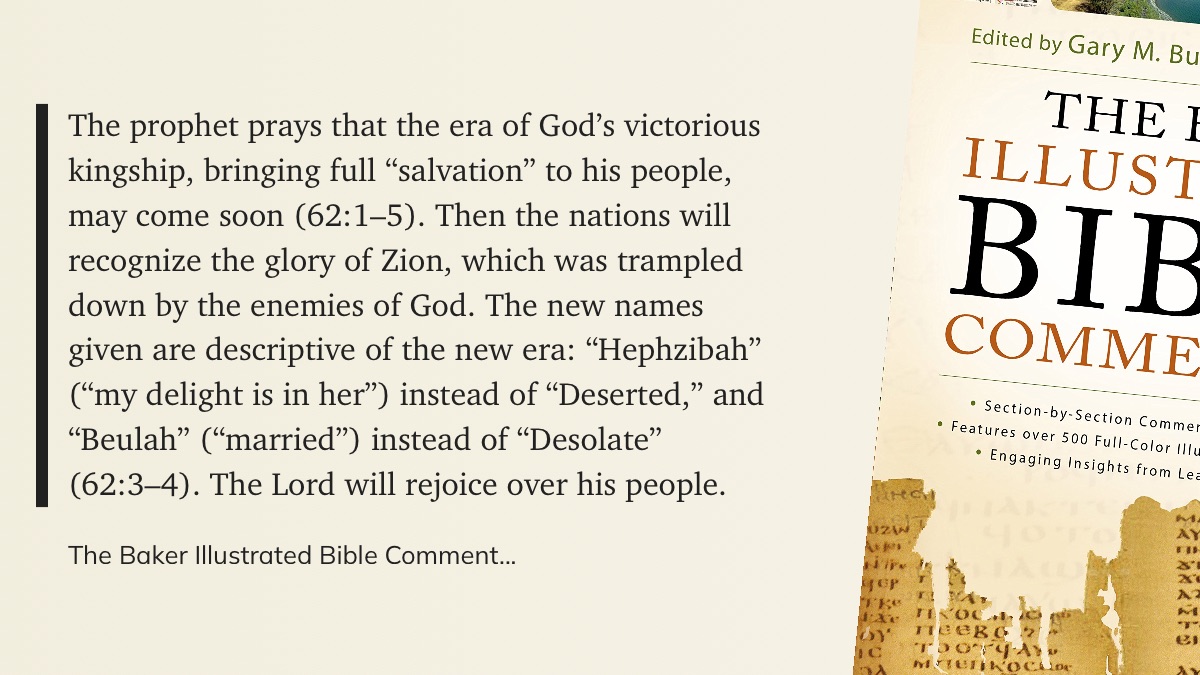
Click on slide for larger image.
Symbolic Names for Jerusalem

Click on slide for larger image.
Bible Study Notes (PDF)
4c-For the LORD delights in you, and makes your land his spouse.

Adulterous Israel is restored to that joyful, innocent age of long ago when she was God’s virgin spouse. This marriage theme evokes thoughts of the marriage feast at Cana (our Gospel reading for today) and the marriage feast of the Lamb (Revelation 21:1-4). The Church, the new Israel, is the bride of Christ as foretold in Hosea 2:16-20 (Hosea 2:18-22 in the New American Bible and New Jerusalem Bible).
- The Jerome Biblical Commentary,
- The New Jerome Biblical Commentary, and
- The Navarre Bible.
SOURCE: St. Charles Borromeo Catholic Church (Picayune, MS)

The Splendor of God's Bride
EXCERPT: In the books of the Old Testament prophets, marriage was one of the four recurring symbolic images of Yahweh in covenant with His chosen people (see the chart the Symbolic Images of the Old Testament Prophets). Marital imagery is an aspect of covenant unity with the Divine first mentioned in salvation history at the marriage initiated by God between Adam and Eve in Eden (Gen 2:23-24) and then reaches its fulfillment at the climax of the Bible in the Book of Revelation at the Wedding of the Lamb and His Bride (Rev 19:9; 21:9; and 22:17). When the chosen people are in covenant union with God, Scripture often expresses the wholeness of that relationship as a marriage covenant between God the Bridegroom and the covenant people as His beloved Bride (Ez 16:1-6-14; Hos 2:18-22). But when the people apostatize from their vows of faithfulness to the covenant, the once pure Bride falls into the sin of adultery and becomes an unfaithful spouse (see Jer 2:20-36; 3:1-13; Ez 16:15-63; Hos 2:4/2-7). Despite the failures of the covenant people, the love of God for His Bride (His covenant people) never ceases. He is always willing to reclaim the Church as His Bride, as in our First Reading. The Fathers of the Church saw the passage from our First Reading as a prophecy of the wedding banquet of the Lamb and His Bride, the New Covenant Church, and the prophesied "new name" of "the Bride of Christ" (Rev 2:17; 3:12).
SOURCE: Agape Bible Study Copyright © 2015; revised 2024 (Used with permission.)
Social Media /
Bulletin Inserts
“There are different kinds of spiritual gifts, but the same Spirit.”
Discover the unique gift within you and let it shine for the world to see. Embrace your God-given talents with joy!
Reflection Question: What special gift do you possess that can serve others today?
“To each person the manifestation of the Spirit is given for the common good.”
Your unique gift is a blessing not just for yourself but for the whole community. Share it with love!
Reflection Question: In what ways can you use your gifts to benefit not just yourself, but others around you?
“But one and the same Spirit produces all of these, distributing them individually to each person as he wishes.”
Celebrate the diversity of talents God has bestowed upon us, and remember that each plays a crucial role.
Reflection Question: How can you appreciate the gifts of others and ensure everyone’s contribution is valued?
The discussion of the spiritual gifts took place in the context of scandal among the Corinthian faithful. This was a “charismatic” community, defined by the exercise of various gifts: speaking in tongues, healing, prophecy, etc. The Corinthians took pride in their gifts to the point of braggadocio and one-upmanship. The leadership of the community must have felt threatened, for the Corinthians were splintering into groups with their own rivaling leaders.
Paul argued against the notion of their narrow notion of “grassroots” leadership. Instead, he argued for the big picture. He began with the leadership of the Spirit. For Paul, God was in charge. And Paul saw the leadership of the Spirit in the context of God”s plan. This was Paul’s cultural presumption. The Jewish notion of creation (and prayer) could be simply stated that all things came from God, so they would return to God. Therefore, in the end times, all things would return to God. In his Christian view, all things would return through Christ.
Paul’s emphasis on Trinity began with the situation at present (the gifts of the Spirit) and then proceeded to the end times (return of Christ, then to God). But he also used the Trinity to explain the notion of the Church. The Church had various types of spiritual gifts, but there was only one Spirit. It had various types of ministries, but there was only one Lord Jesus upon whom the ministries were modeled and rooted… Beneath his argument that the Trinity defined the Church was the notion that the Church should be based on harmony, just as the Father, Son, and Spirit worked harmoniously.
Permission for use. All materials found in word-sunday.com are the property of Larry Broding (Copyright 1999-2025). Viewers may copy any material found in these pages for their personal use or for use in any non-profit ministry.

1 Corinthians 12:4-11

Gifts of the Holy Spirit in the Church
I. Introduction (1 Corinthians 12:4-6)
- Diversity of gifts (v. 4)
- Unity of the Spirit (v. 4)
- Varieties of service and activities (v. 5)
- Same God at work in all (v. 6)
II. Manifestations of the Spirit (1 Corinthians 12:7-10)
- Listing of various gifts (vv. 7-10)
- Wisdom
- Knowledge
- Faith
- Healing
- Miracles
- Prophecy
- Discernment
- Tongues
- Interpretation of tongues
III. One Spirit, Many Gifts (1 Corinthians 12:11)
- The Holy Spirit distributing gifts (v. 11)
- Gifts given according to the will of the Spirit (v. 11)
Clipart by Fr. Richard Lonsdale
Sunday Scriptures
in Context
Fr. Paul Galeto, OSA
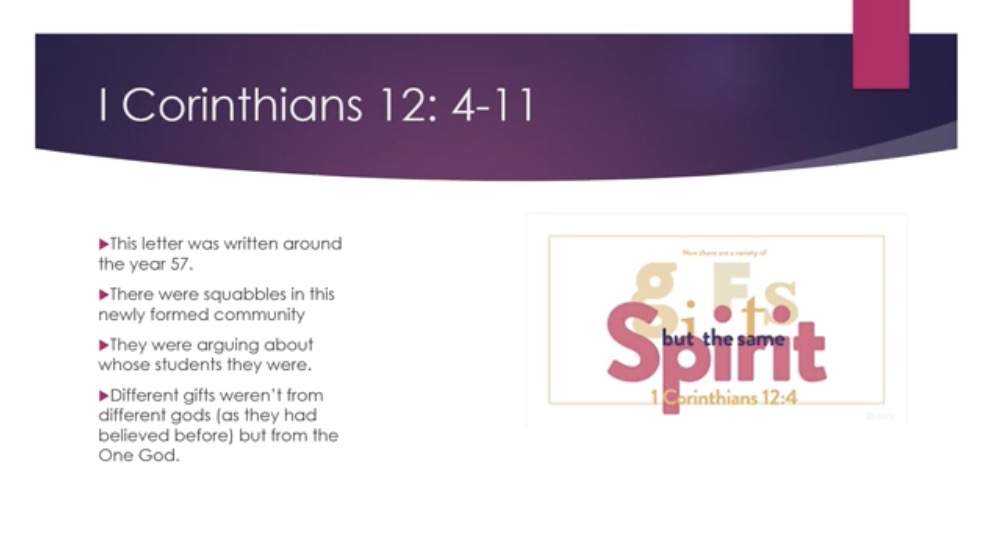
Click on slide to watch short commentary by Fr. Paul Galetto, OSA
Catholic Sunday Scriptures in Context
Common Good
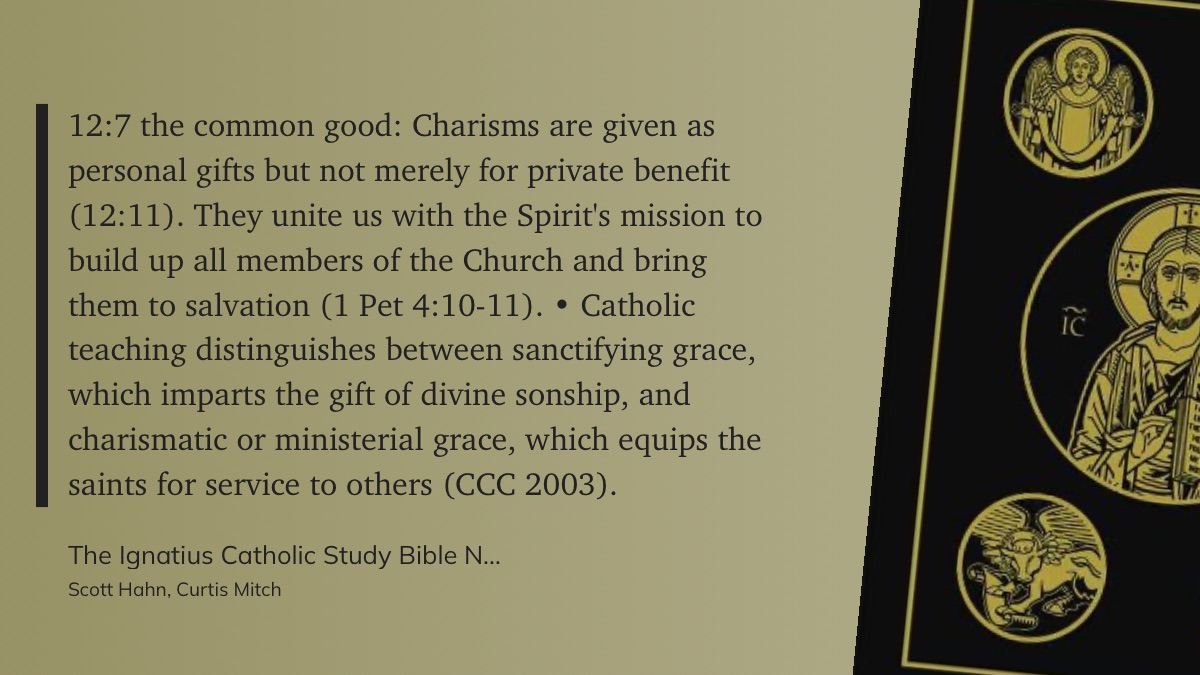
Click on slide for larger image.
For the Benefit of Others
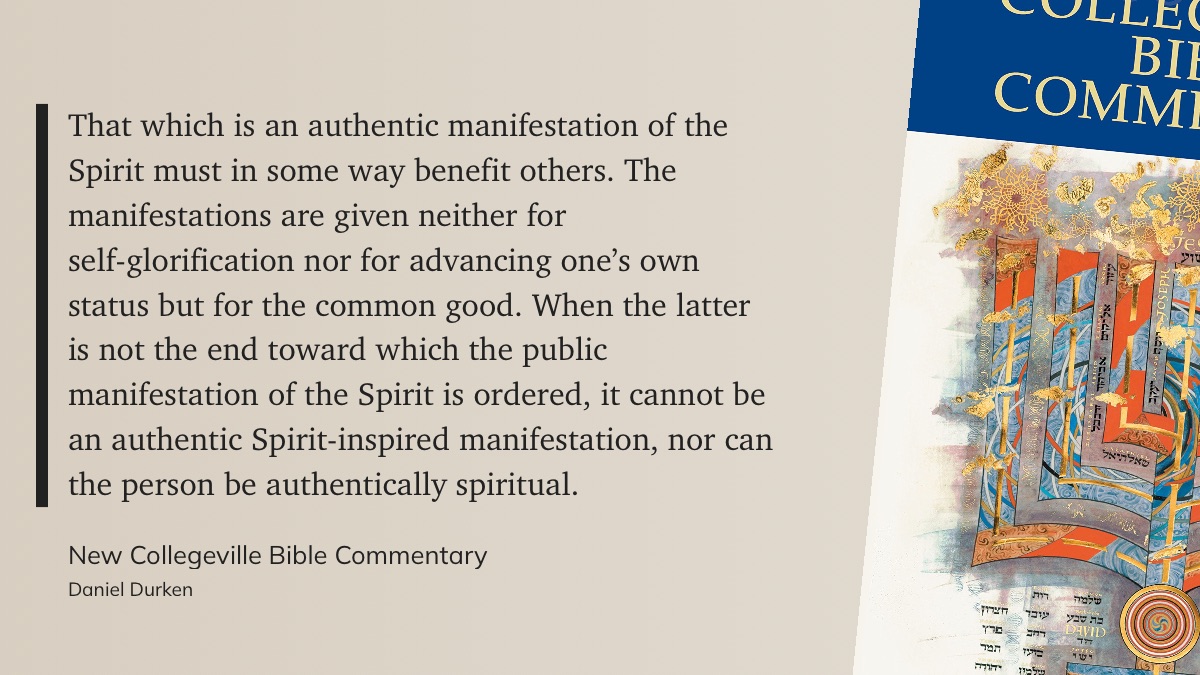
Click on slide for larger image.
Bible Study Notes (PDF)
8-But one and the same Spirit produces all of these, distributing them individually to each person as he wishes.
Since the same Spirit distributes (gives) and produces (makes them operate), no one should be puffed up with pride – all is given for the common good. One who possesses a gift and does not share it not only deprives themselves of its benefits, they deprive the entire community and the gift is lost.
- The Jerome Biblical Commentary,
- The New Jerome Biblical Commentary, and
- The Navarre Bible.
SOURCE: St. Charles Borromeo Catholic Church (Picayune, MS)
Gifts of the Holy Spirit
EXCERPT: In the Second Reading, St. Paul reminds us that God loves us and gives His Spirit of love to all the members of His Church family. At the same time, God recognizes that we are all different, and He reveals His response to our differences in the different kinds of gifts of the Holy Spirit that He gives us. To make his point, St. Paul names nine types of spiritual gifts. Even though these are "different workings" or ministries, it is the same God who produces those works in us to advance the Kingdom of the Church.
SOURCE: Agape Bible Study Copyright © 2015; revised 2024 (Used with permission.)
Social Media /
Bulletin Inserts
“Do whatever He tells you.” – John 2:5
Obedience to God often leads to unexpected blessings. Are you listening closely?
Reflection Question: In what area of your life is God asking you to be obedient?
“Fill the jars with water.” – John 2:7
Jesus can transform the ordinary into the extraordinary. Are you ready to see your life change in His hands
Reflection Question: What parts of your life do you wish for Jesus to transform today?
“The water… had been turned into wine.” – John 2:9
When God is involved, the impossible becomes possible. What miracles are you praying for?
Reflection Question: How can you invite Jesus into the situations that seem impossible in your life?
“You have saved the best till now.” – John 2:10
God’s timing is perfect. Trust that your best is yet to come.
Reflection Question: How can you demonstrate trust in God’s timing in your current situation?
2:2 “JESUS, (along with a small number of) his disciples, was also invited” While Jesus is the subject of this sentence (with its singular verb), the literal phrase “and his disciples” indicated Jesus’ followers were also invited. The context of the wedding celebration argued for a small number of followers.
2:4 “What (is this problem between) me and you, Woman?” This statement has two Semitic phrases. “What to me and to you?” is a rebuke. Another way to translate it would be “Why is this my problem?”
“Woman,” however, was not a rebuke or a sign of disrespect. In a culture that segregated the genders, the fact that his mother would address Jesus in public showed initiative. Jesus responded with deference. Indeed, the Semitic title “Woman” showed respect.
The combination of rebuke and respect was like the tension between the hidden glory (pre-ministry) and revealed glory (ministry) of Jesus. This tension was a theme of John when he wrote of Jesus’ “hour.”
2:6 “two or three measures” Each Semitic measure contained approximately 10 gallons or 40 liters.
2:8 “Draw (some) out now and carry (it) to the steward in charge.” There were two issues stated in this sentence. First, when did the miracle happen? When Jesus instructed the stewards to pour the water into the jars? Or, when Jesus instructed the stewards to draw the liquid from the jars and take it to the steward? John does not indicate the time frame. His point is not the time of the miracle, but its realization.
The second issue lies in the chief steward. Some scholars insist the chief steward was a slave chosen to serve the tables. More likely, however, the chief steward was either a close friend of the family or the family’s patron, who acted as a “master of ceremonies.” Such a position carried great honor. See the commentary for more information.
2:10 “best wine” is literally “good wine” The comparative “good” in this context actually meant the superlative “best.” The comparison between the good and the lesser is not a mere matter of quality. The “good” wine was a festival quality, reserved for celebrations like a wedding. The “lesser” was everyday drinking wine. The water-turned-wine drawn from the stone jars tasted like an expensive vintage.
2:11 “first of signs” The word “first” meant more than the beginning of a sequence. This sign was the paradigm that threw light on all other Jesus performed. This sign revealed the person of Jesus and his mission.
“he revealed his glory” The term “glory” referred to the reputation of the person (Jesus was a man of mighty signs). And it referred to the inner character (in this case, the divinity of Jesus). Here, image and substance met.
Permission for use. All materials found in word-sunday.com are the property of Larry Broding (Copyright 1999-2025). Viewers may copy any material found in these pages for their personal use or for use in any non-profit ministry.

John 2:1-11

The Wedding at Cana: Jesus’ First Miracle
I. The Wedding Celebration
- Invitation to the wedding (v. 2)
- Jesus, Mary, and the disciples’ presence (v. 2)
II. The Request for Help
- Concern about the shortage of wine (v. 3)
- Mary’s intercession with Jesus (v. 4)
- Jesus’ response to Mary (v. 5)
III. The Transformation of Water into Wine
- Obedience of the servants (v. 7)
- Miraculous changing of water into wine (vv. 7-8)
IV. The Response to the Miracle
- The amazement of the headwaiter (v. 9)
- The impact on the disciples’ belief in Jesus (v. 11)
Clipart by Fr. Richard Lonsdale
Sunday Scriptures
in Context
Fr. Paul Galeto, OSA

Click on slide to watch short commentary by Fr. Paul Galetto, OSA
Catholic Sunday Scriptures in Context
Miracles as Signs
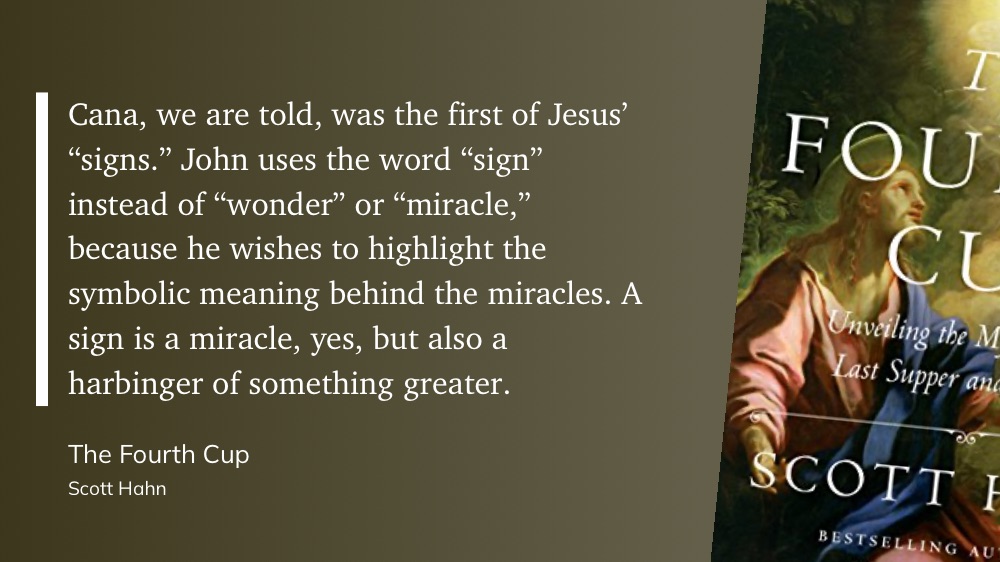
Click on slide for larger image.
Contrast of Jars of Water with Wine
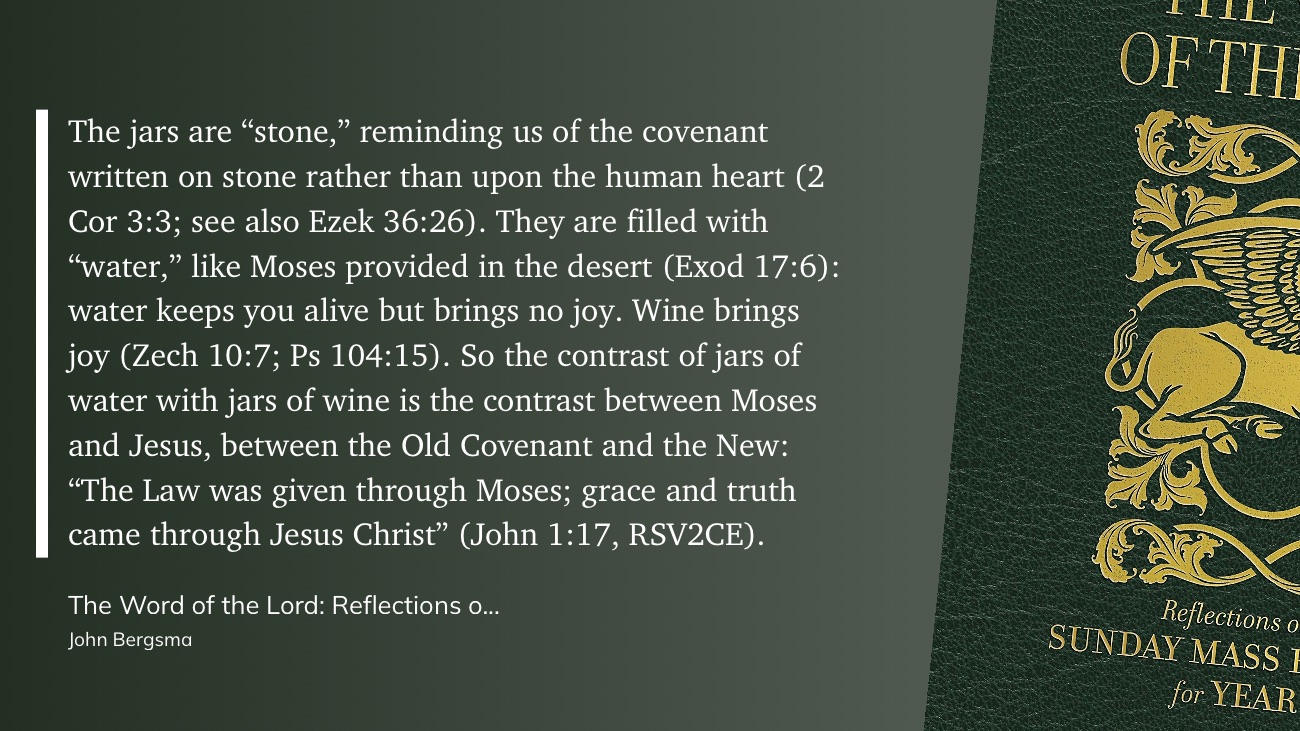
Click on slide for larger image.
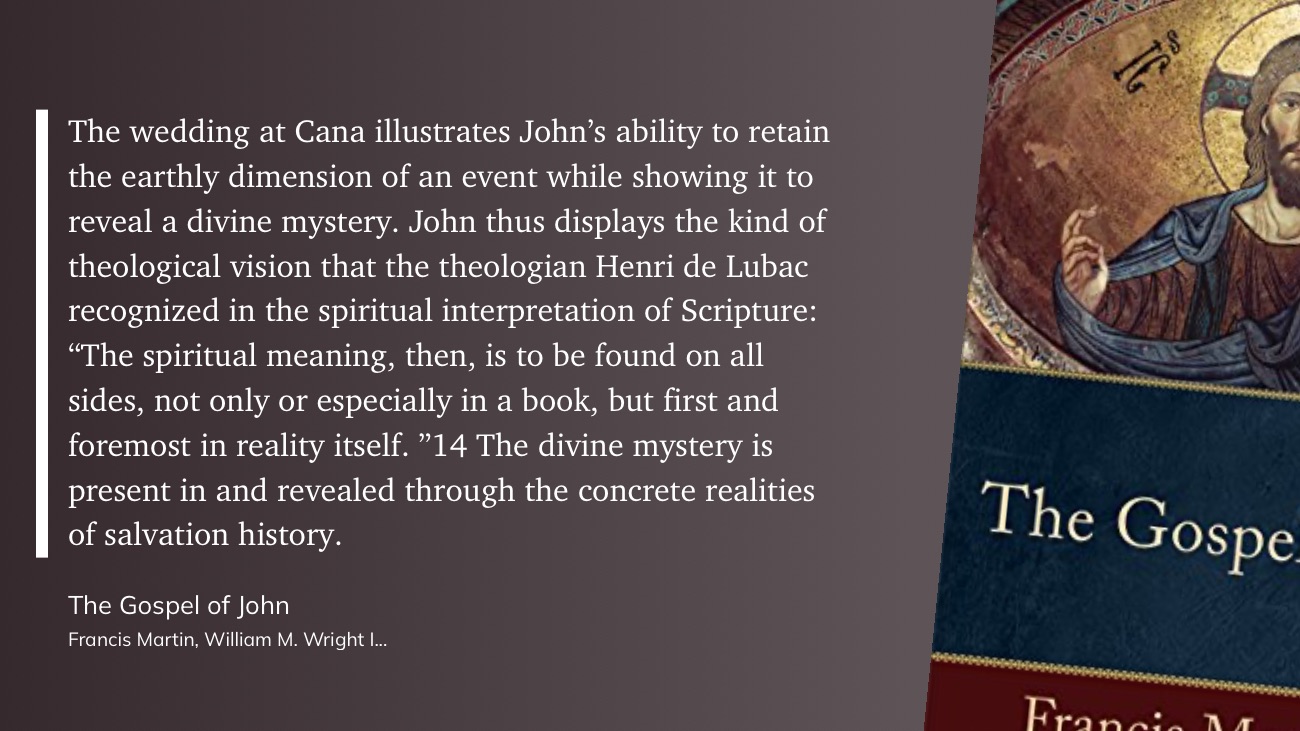
Spiritual Meaning of Miracle
Click on slide for larger image.
Fulton Sheen

Click on slide for larger image.
Bible Study Notes (PDF)
4-Jesus said to her, “Woman,
Nowhere in any of the Gospels does Jesus address Mary as “mother.” To address someone as “woman” is not disrespectful, it would be like calling her “madam” in a formal setting. In Genesis imagery however, this is the name given to Eve before the fall when she was still sinless and pure in God’s eyes. Mary is the New Eve, conceived sinless and sinless throughout her life.
- The Jerome Biblical Commentary,
- The New Jerome Biblical Commentary, and
- The Navarre Bible.
SOURCE: St. Charles Borromeo Catholic Church (Picayune, MS)
Event | Type | Matthew | Mark | Luke | John | |
1 | misc | John 01:01–18 | ||||
2 | nativity | Matthew 01:01–17 | Luke 03:23–38 | |||
3 | nativity | Luke 01:05–25 | ||||
4 | nativity | Luke 01:26–38 | ||||
5 | nativity | Luke 01:39–56 | ||||
6 | nativity | Matthew 01:18–25 | Luke 02:01–07 | |||
7 | nativity | Luke 02:08–15 | ||||
8 | nativity | Luke 02:16–20 | ||||
9 | nativity | Luke 02:21 | ||||
10 | nativity | Luke 02:22–38 | ||||
11 | nativity | Matthew 02:01–02 | ||||
12 | nativity | Matthew 02:01–12 | ||||
13 | nativity | Matthew 02:13–15 | ||||
14 | nativity | Matthew 02:16–18 | ||||
15 | Herod the Great's death | misc | Matthew 02:19–20 | |||
16 | youth | Matthew 02:21–23 | Luke 02:39–39 | |||
17 | youth | Luke 02:41–51 | ||||
18 | misc | Matthew 03:01–12 | Mark 01:01–08 | Luke 03:01–20 | John 01:19–34 | |
19 | misc | Matthew 03:13–17 | Mark 01:09–11 | Luke 03:21–22 | John 01:29–39 | |
20 | misc | Matthew 04:01–11 | Mark 01:12–13 | Luke 04:01–13 | ||
21 | miracle | John 02:01–11 | ||||
22 | ministry | John 02:13–25 | ||||
23 | ministry | John 03:01–21 | ||||
24 | ministry | Matthew 04:12–12 | Mark 01:14–14 | John 04:01–03 | ||
25 | miracle | Mark 01:21–28 | Luke 04:31–37 | |||
26 | parable | Mark 04:26–29 | ||||
27 | ministry | Matthew 13:53–58 | Mark 06:01–06 | Luke 04:16–30 | ||
28 | ministry | Matthew 04:18–22 | Mark 01:16–20 | Luke 05:1-11 | John 01:35–51 | |
29 | miracle | Luke 05:01–11 | ||||
30 | sermon | Matthew 05:02–12 | Luke 06:20–23 | |||
31 | miracle | Luke 07:11–17 | ||||
32 | parable | Luke 07:41–43 | ||||
33 | parable | Matthew 05:14–15 | Mark 04:21–25 | Luke 08:16–18 | ||
34 | sermon | Matthew 05:17–48 | Luke 06:29–42 | |||
35 | ministry | Luke 10:01–24 | ||||
36 | sermon | Matthew 06:01–18 | ||||
37 | parable | Luke 10:30–37 | ||||
38 | ministry | Luke 10:38–42 | ||||
39 | ministry | Matthew 06:09–13 | Luke 11:02–04 | |||
40 | parable | Luke 11:05–08 | ||||
41 | parable | Luke 12:16–21 | ||||
42 | ministry | John 04:04–26 | ||||
43 | ministry | Matthew 06:25–34 | Luke 12:22–34 | |||
44 | sermon | Matthew 07:01–05 | Luke 06:41–42 | |||
45 | sermon | Matthew 07:13–27 | ||||
46 | sermon | Matthew 07:15–20 | Luke 06:43-45 | |||
47 | parable | Matthew 07:24–27 | Luke 06:46–49 | |||
48 | miracle | Matthew 08:01–04 | Mark 01:40–45 | Luke 05:12–16 | ||
49 | miracle | Matthew 08:05–13 | Luke 07:01–10 | John 04:46–54 | ||
50 | miracle | Matthew 08:14–17 | Mark 01:29–34 | Luke 04:38–41 | ||
51 | miracle | Matthew 08:16–17 | Mark 01:32–34 | Luke 04:40–41 | ||
52 | miracle | Matthew 08:23–27 | Mark 04:35–41 | Luke 08:22–25 | ||
53 | miracle | Matthew 08:28–34 | Mark 05:01–20 | Luke 08:26–39 | ||
54 | miracle | Matthew 09:01–08 | Mark 02:01–12 | Luke 05:17–26 | ||
55 | ministry | Matthew 09:09 | Mark 02:13–14 | Luke 05:27–28 | ||
56 | parable | Matthew 09:17–17 | Mark 02:22–22 | Luke 05:37–39 | ||
57 | miracle | Matthew 09:18–26 | Mark 05:21–43 | Luke 08:40–56 | ||
58 | miracle | Matthew 09:20–22 | Mark 05:24–34 | Luke 08:43–48 | ||
59 | miracle | Matthew 09:27–31 | ||||
60 | miracle | Matthew 09:32–34 | ||||
61 | ministry | Matthew 10:02–04 | Mark 03:13–19 | Luke 06:12–16 | ||
62 | ministry | Matthew 10:34–36 | Luke 12:49–53 | |||
63 | ministry | Matthew 11:02–06 | Luke 07:18–23 | |||
64 | miracle | John 05:01–18 | ||||
65 | ministry | Matthew 12:01–08 | Mark 02:23–28 | Luke 06:01–05 | ||
66 | miracle | Matthew 12:09–13 | Mark 03:01–06 | Luke 06:06–11 | ||
67 | miracle | Matthew 12:22–28 | Mark 03:20–30 | Luke 11:14–23 | ||
68 | parable | Matthew 12:29–29 | Mark 03:27–27 | Luke 11:21–22 | ||
69 | ministry | Matthew 12:30–32 | Mark 03:28–29 | Luke 12:08–10 | ||
70 | ministry | Matthew 12:46–50 | Mark 03:31–35 | Luke 08:19–21 | ||
71 | parable | Matthew 13:03–09 | Mark 04:03–09 | Luke 08:05–08 | ||
72 | parable | Matthew 13:24–30 | ||||
73 | parable | Luke 13:06–09 | ||||
74 | miracle | Luke 13:10–17 | ||||
75 | parable | Matthew 13:31–32 | Mark 04:30–32 | Luke 13:18–19 | ||
76 | parable | Matthew 13:33–33 | Luke 13:20–21 | |||
77 | parable | Matthew 13:44–46 | ||||
78 | parable | Matthew 13:47–50 | ||||
79 | parable | Matthew 13:52–52 | ||||
80 | ministry | Matthew 14:06–12 | Mark 06:21–29 | Luke 09:07–09 | ||
81 | miracle | Matthew 14:13–21 | Mark 06:31–44 | Luke 09:10–17 | John 06:05–15 | |
82 | miracle | Matthew 14:22–33 | Mark 06:45–52 | John 06:16–21 | ||
83 | miracle | Matthew 14:34–36 | Mark 06:53–56 | |||
84 | sermon | Matthew 15:01–11 | Mark 07:01–23 | |||
85 | miracle | Matthew 15:21–28 | Mark 07:24–30 | |||
86 | miracle | Mark 07:31–37 | ||||
87 | miracle | Matthew 15:32–39 | Mark 08:01–09 | |||
88 | miracle | Mark 08:22–26 | ||||
89 | ministry | Matthew 16:13–20 | Mark 08:27–30 | Luke 09:18–21 | ||
90 | miracle | Matthew 17:01–13 | Mark 09:02–13 | Luke 09:28–36 | ||
91 | miracle | Matthew 17:14–21 | Mark 09:14–29 | Luke 09:37–49 | ||
92 | miracle | Matthew 17:24–27 | ||||
93 | sermon | John 06:22–59 | ||||
94 | ministry | Matthew 18:01–06 | Mark 09:33–37 | Luke 09:46–48 | ||
95 | miracle | Luke 14:01–06 | ||||
96 | parable | Luke 14:25–33 | ||||
97 | parable | Matthew 18:10–14 | Luke 15:04–06 | |||
98 | parable | Matthew 18:23–35 | ||||
99 | ministry | Matthew 18:01–06 | Mark 09:33–37 | Luke 09:46–48 | ||
100 | parable | Luke 15:08–09 | ||||
101 | parable | Luke 15:11–32 | ||||
102 | parable | Luke 16:01–13 | ||||
103 | parable | Luke 16:19–31 | ||||
104 | parable | Luke 17:07–10 | ||||
105 | miracle | Luke 17:11–19 | ||||
106 | parable | Luke 18:01–08 | ||||
107 | parable | Luke 18:09–14 | ||||
108 | ministry | Matthew 19:1-15 | ||||
109 | ministry | Matthew 19:16–30 | Mark 10:17–31 | Luke 18:18–30 | ||
110 | ministry | John 08:02–11 | ||||
111 | parable | Matthew 20:01–16 | ||||
112 | ministry | Matthew 20:17–19 | Mark 10:32–34 Mark 08:31 Mark 09:31 | Luke 18:31–34 | ||
113 | miracle | John 09:01–12 | ||||
114 | ministry | Matthew 20:20–28 | Mark 10:35–45 | |||
115 | ministry | John 10:01–21 | ||||
116 | miracle | Matthew 20:29–34 | Mark 10:46–52 | Luke 18:35–43 | ||
117 | miracle | John 11:01–44 | ||||
118 | ministry | Luke 19:02–28 | ||||
119 | ministry | Matthew 21:01–11 | Mark 11:01–11 | Luke 19:29–44 | John 12:12–19 | |
120 | ministry | Matthew 21:12–13 | Mark 11:15–18 | Luke 19:45–48 | ||
121 | miracle | Matthew 21:18–22 | Mark 11:12–14 | |||
122 | ministry | Matthew 21:23–27 | Mark 11:27–33 | Luke 20:01–08 | ||
123 | parable | Matthew 21:28–32 | ||||
124 | parable | Matthew 21:33–41 | Mark 12:01–09 | Luke 20:09–16 | ||
125 | parable | Matthew 22:01–14 | Luke 14:16–24 | |||
126 | ministry | Matthew 22:15–22 | Mark 12:13–17 | Luke 20:20–26 | ||
127 | ministry | Matthew 23:01–39 | Mark 12:35–37 | Luke 20:45–47 | ||
128 | sermon | Mark 12:41–44 | Luke 21:01-04 | |||
129 | ministry | Matthew 24:01–31 | Mark 13:01–27 | Luke 21:05–36 | ||
130 | parable | Matthew 24:32–35 | Mark 13:28–31 | Luke 21:29–33 | ||
131 | parable | Matthew 24:42–51 | Mark 13:34–37 | Luke 12:35–48 | ||
132 | parable | Matthew 25:01–13 | ||||
133 | parable | Matthew 25:14–30 | Luke 19:12–27 | |||
134 | parable | Matthew 25:31–46 | ||||
135 | ministry | Matthew 26:01–13 | Mark 14:03-09 | Luke 07:36–50 | John 12:02-08 | |
136 | misc | Matthew 26:14–16 | Mark 14:10–11 | Luke 22:01-06 | ||
137 | ministry | John 12:24–26 | ||||
138 | ministry | Matthew 26:26–29 | Mark 14:18–21 | Luke 22:17–20 | John 13:01–31 | |
139 | ministry | John 16:05–15 | ||||
140 | misc | Matthew 26:36–46 | Mark 14:32–42 | Luke 22:39–46 | ||
141 | passion | Matthew 26:47–49 | Mark 14:43–45 | Luke 22:47–48 | John 18:02-09 | |
142 | miracle | Luke 22:49–51 | ||||
143 | passion | Matthew 26:50–56 | Mark 14:46–49 | Luke 22:52–54 | John 18:10–12 | |
144 | passion | Matthew 26:57–68 | Mark 14:53–65 | Luke 22:63–71 | John 18:12–24 | |
145 | passion | Matthew 27:24–25 | ||||
146 | passion | Matthew 27:27–33 | Mark 15:20–22 | Luke 23:26–32 | John 19:16–17 | |
147 | passion | Matthew 27:34–61 | Mark 15:23–47 | Luke 23:33–54 | John 19:18–38 | |
148 | res app | Matthew 28:01 | Mark 16:01 | Luke 24:01 | ||
149 | res app | Matthew 28:02-08 | Mark 16:02-08 | Luke 24:02–12 | John 20:01–13 | |
150 | res app | Matthew 28:09–10 | Mark 16:09-13 | Luke 24:01-08 | John 20:14–16 | |
151 | res app | John 20:17–17 | ||||
152 | res app | Luke 24:13–32 | ||||
153 | res app | Luke 24:36–43 | John 20:19–20 | |||
154 | res app | Matthew 28:16–20 | Mark 16:14-18 | Luke 24:44–49 | John 20:21–23 | |
155 | res app | John 20:24–29 | ||||
156 | miracle | John 21:01–24 | ||||
157 | res app | Mark 16:19 | Luke 24:50–53 | |||
158 | misc | Matthew 28:19-20 | Mark 16:19-20 |
Contextual Background
HISTORY
John 2:1-11, the account of Jesus turning water into wine at a wedding in Cana, is set in the broader historical and political context of first-century Palestine under Roman rule. This period was characterized by social, religious, and political tensions, with various Jewish factions grappling with questions of identity and responses to Roman oppression.
The author, traditionally identified as John the Apostle, was part of Jesus' inner circle and wrote his Gospel to address specific needs within the early Christian community. The intended audience was likely a mix of Jewish and Gentile believers, both within and outside of Palestine.
At the time of Jesus' ministry, weddings were significant social events, often lasting several days and involving the entire community. The context of this passage highlights the importance of these gatherings and the social expectations surrounding them. The miracle at Cana is a public demonstration of Jesus' power and a sign of the new reality he brings.
The abundance of wine at the wedding symbolizes the abundant life Jesus offers and is a foretaste of the messianic banquet in the Kingdom of God. This passage also reveals aspects of Jesus' character and mission, emphasizing his compassion, power, and the dawning of a new era in which the old is transformed and made new.
In conclusion, John 2:1-11 is deeply rooted in the historical and political context of first-century Palestine. The account of the wedding at Cana serves as a powerful symbol of the abundant life and transformation offered by Jesus, highlighting key aspects of his character and mission in a way that would have resonated with the original audience and continues to resonate with readers today.
SOCIETY
John 2:1-11, set in the sociological and cultural context of first-century Palestine, provides valuable insights into prevailing customs, beliefs, and practices of the time. The passage recounts Jesus' first miracle at a wedding in Cana, transforming water into wine to address the social embarrassment of running out of wine during a celebration.
Weddings in ancient Palestinian culture were significant communal events that often lasted several days. They involved elaborate feasts, symbolic rituals, and joyful celebrations, embodying the values of hospitality, honor, and communal solidarity. Running out of wine during such an event would have been considered a social disgrace for the hosts.
In this context, Jesus' intervention not only addresses an immediate practical need but also carries symbolic significance. The abundant provision of wine symbolizes the abundant life and blessings that Jesus brings, transcending the limitations and expectations of the prevailing culture. This passage also highlights the importance of communal celebrations and the values of hospitality and honor, reflecting the broader cultural context in which Jesus' ministry unfolded.
The original audience would have recognized the significance of this event within their own cultural framework, understanding the deeper implications of Jesus' miraculous intervention. The account of the wedding at Cana serves as a powerful expression of Jesus' mission to bring transformation and abundance in the midst of everyday human experiences and social interactions.
In conclusion, John 2:1-11 is shaped by the sociological and cultural context of first-century Palestine, reflecting prevailing customs, beliefs, and practices surrounding weddings and communal celebrations. This passage offers a glimpse into the transformative power of Jesus' ministry and its relevance to the everyday lives of people within their own cultural settings.
THEOLOGY
John 2:1-11, within the Roman Catholic theological context, illuminates several key themes and offers valuable insights for contemporary Catholics. The passage recounts Jesus' first miracle at the wedding in Cana, transforming water into wine, which serves as a rich source of theological reflection and inspiration for modern-day believers.
The miracle at Cana is often interpreted in Roman Catholic theology as a foreshadowing of the Eucharistic transformation of wine into the blood of Christ. This connection highlights the centrality of the Eucharist in Catholic worship and the ongoing presence of Christ in the lives of believers. Furthermore, the abundance of wine symbolizes the abundant life and blessings offered through faith in Jesus, a theme that continues to resonate with Catholics today.
In contemporary Catholic life, the passage offers insights into the importance of communal celebrations, hospitality, and the role of the Church in addressing practical and spiritual needs. Catholics can draw inspiration from Jesus' compassion and concern for the wedding hosts, extending this example to their own lives and communities.
Moreover, the miracle at Cana exemplifies the transformative power of faith and the potential for God's grace to bring abundance and renewal in times of need. Contemporary Catholics can draw strength and hope from this message, trusting in God's providence and transformative presence in their own lives and circumstances.
In conclusion, John 2:1-11 offers rich theological insights and practical applications for contemporary Catholics, highlighting the ongoing relevance of Jesus' ministry in the context of the Roman Catholic tradition. The passage serves as a powerful reminder of the abundant life and transformation available through faith in Christ and the importance of living out these values within the community of believers.
Jesus's First Public Sign at the Wedding at Cana
EXCERPT: St. John the Baptist announced that Jesus is the divine Bridegroom (Jn 3:29). When Jesus began His ministry, it is significant that His first public sign took place at a wedding where He changed water into wine (our Gospel Reading). His miracle prepared us to take part in His royal wedding feast as He neared the climax of His mission at the Last Supper. In the parable of the Wedding Feast (Mt 22:1-14) and the announcement of His New Covenant at the Last Supper (Mt 26:27-28; Lk 22:19-20), Jesus calls all the faithful of humanity to become betrothed to Him. Through the power of the Holy Spirit in the Sacrament of Baptism, we are reborn to become "one flesh" with Him in the Sacrament of the Eucharist (Eph 5:21-33; 2 Cor 11:2). Through the Sacrament of Baptism, Jesus, our divine Bridegroom offers the gift of universal salvation. The reason we sing a "new song" is to acknowledge our joy in that gift, to declare God's "glory among the nations" and "His marvels to every people" in today's Psalm (Ps 96:2b-3).
The Seen Public Signs of Jesus in St. John's Gospel
#1 2:1-11 | The sign of water turned to wine at the wedding at Cana |
#2 4:46-54 | The healing of the official's son |
#3 5:1-9 | The healing of the paralytic |
#4 6:1-14 | The multiplication of the loaves to feed the 5,000 |
#5 9:1-41 | The healing of the man who was born blind |
#6 11:17-44 | The raising of Lazarus from the dead |
#7 2:18-20* | The Resurrection of Jesus that will be fulfilled in 20:1-10 |
SOURCE: Agape Bible Study Copyright © 2015; revised 2024 (Used with permission.)

SCRIPTURE
SEARCH
FIRST READING (5)
SECOND READING (100)
GOSPEL (56)
This tool created by Jeff Pinyan uses the CCEL Early Church Fathers digital edition of the Philip Schaff collection.
2nd Sunday of Year C
Catena Aurea
The Catena Aurea, which means “Golden Chain” in Latin, is a comprehensive biblical commentary comb is a 13th-century biblical commentary compiled by St. Thomas Aquinas. This anthology features insights from over eighty Church Fathers on the four Gospels.