JAN 26, 2025


Each week THE WORD THIS WEEK features popular video series and other media which focus on the Sunday’s Mass readings.
Click on links above to view respective videos.

Jeff Cavins / Encountering the Word
(4:50 minutes)

Brant Pitre / Mass Readings Explained
(5:59 minutes)

Fr. Geoffrey Plant
(34:00 minutes)
Larry Broding / Word-Sunday
(2:54 minutes)
3rd Sunday of Year C
Three Great Things:
Study, Pray and Serve
Fr. Andrew Ricci, ordained in 1997, is a priest for the Diocese of Superior. He is the Rector of the Cathedral of Christ the King.

3rd Sunday of Year C
3rd Sunday of Year C


Commentary, Questions & Prayer
FIRST READING
Ezra & Nehemiah
What Ezra read
Responding to God’s word
GOSPEL
Luke, a competent author
A trustworthy account
Theophilus
In the synagogue
Summing up Jesus’ ministry
3rd Sunday of Year C

Scripture Study
by Vince Contreras*
Lectionary Commentary
by Fr. Tobin*
Echoing God’s Word
by Fr. Thibodeau*
Hearers of the Word
by Kieran J. O’Mahony*
Carmelite Lectio Divina
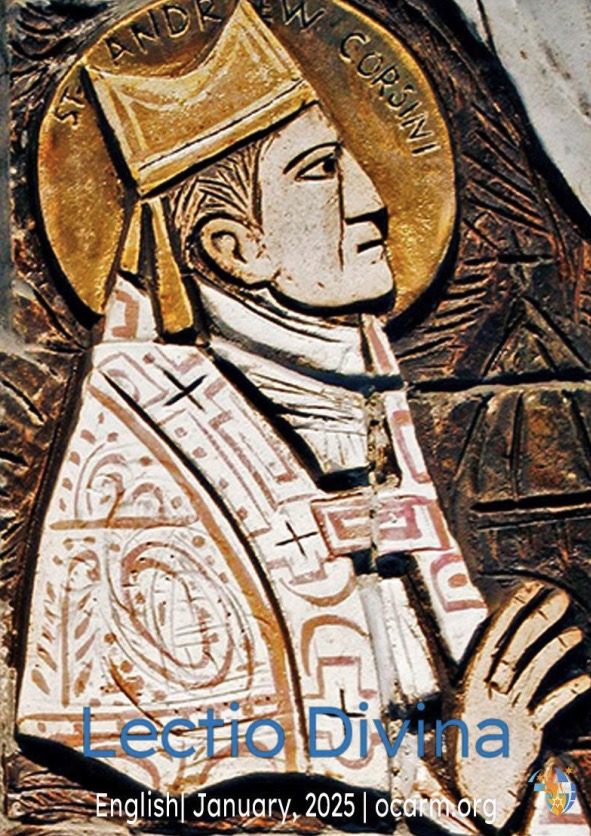
Reflections and Prayers
74 page PDF with refections and prayers for each day of the month.
Lectio Divina January 2025 (PDF)
Lectio Divina January 2025 [Mobi]
Lectio Divina January 2025 [ePub]
“Lectio divina is an authentic source of Christian spirituality recommended by our Rule. We therefore practise it every day, so that we may develop a deep and genuine love for it, and so that we may grow in the surpassing knowledge of Christ. In this way we shall put into practice the Apostle Paul’s commandment, which is mentioned in our Rule: “The sword of the Spirit, too, which is the word of God, is to dwell abundantly in your mouth and in your hearts; and whatever things you have to do, let them be done in the word of the Lord.” (Carmelite Constitutions (2019), n. 85.)
Source: Carmelites

Social Media /
Bulletin Inserts
“Ezra the scribe stood on a wooden platform that had been made for the occasion.”
In moments when we are called to lead, remember the stand that Ezra took. Seek wisdom and courage to lift up others with truth and love.
Reflection: What platforms in your life could you use to speak positivity and encouragement?
“Then all the people answered, ‘Amen, Amen,’ lifting up their hands.”
Unity in purpose is powerful. When we agree together on what truly matters, we can create meaningful change.
Reflection: How can you foster unity and collective agreement in your community today?
“They read from the book, from the law of God, clearly, and they gave the sense, so that the people understood the reading.”
Understanding is key. When we take time to truly understand, we find clarity and purpose in God’s words.
Reflection: What steps can you take to deepen your understanding of what matters most in your life?

Sometimes our sadness turns to joy when people celebrate the good news of freedom.
This edited version of the passage celebrates the re-institution of the religious and civil life in Jerusalem after the return of the exiles from Babylon and the rebuilding of the city walls. (Rebuilding of the walls was the first order of business, since the top priority of the city was defense.) Standing at an official height and surrounded by the city officials (edited out of the passage), Ezra addressed the people. [2-5] After Ezra’s blessing, the people responded with approval in voice and posture. [6] Then Ezra read and commented on the Law; it is possible he translated the Law for those returning descendants who did not speak Hebrew, but Aramaic, the language of the Babylonians. [7]
At hearing the Law, the people wept. [8] This is a social response to the devastation the city endured. It was seen as God’s punishment for the nation’s infidelity; weeping was a means of sorrow and repentance.
But the city leaders declare a day of rejoicing, for the city is secure and the people are now free to practice their religion and way of life. [9-10]
As Americans, we cherish our freedom and our way of life. Let us not forget they are gifts from God. We should not take them for granted or presume they are the fruit of our own hands. For many people in the world, they are good news!
Permission for use. All materials found in word-sunday.com are the property of Larry Broding (Copyright 1999-2025). Viewers may copy any material found in these pages for their personal use or for use in any non-profit ministry.
Nehemiah 8:2-4a, 5-6, 8-10

The Public Reading of the Law by Ezra
I. Introduction
- Gathered assembly at the square before the Water Gate
- Request for Ezra to bring the book of the law of Moses
II. Ezra’s Reading of the Law
- Reading from the book of the law from early morning until midday
- Listening attentively and standing in the presence of both men and women
III. Response to the Reading
- Collective response of “Amen, amen” while lifting hands
- Bowing down to prostrate themselves before God
IV. Understanding and Interpreting the Law
- Levites’ role in interpreting the law to provide clarity
- A call not to weep, as the day was sacred to the Lord
V. Conclusion
- Eating and drinking while sharing portions with those who had none
- Rejoicing and feasting to celebrate the day’s significance
Clipart by Fr. Richard Lonsdale
Sunday Scriptures
in Context
Fr. Paul Galeto, OSA
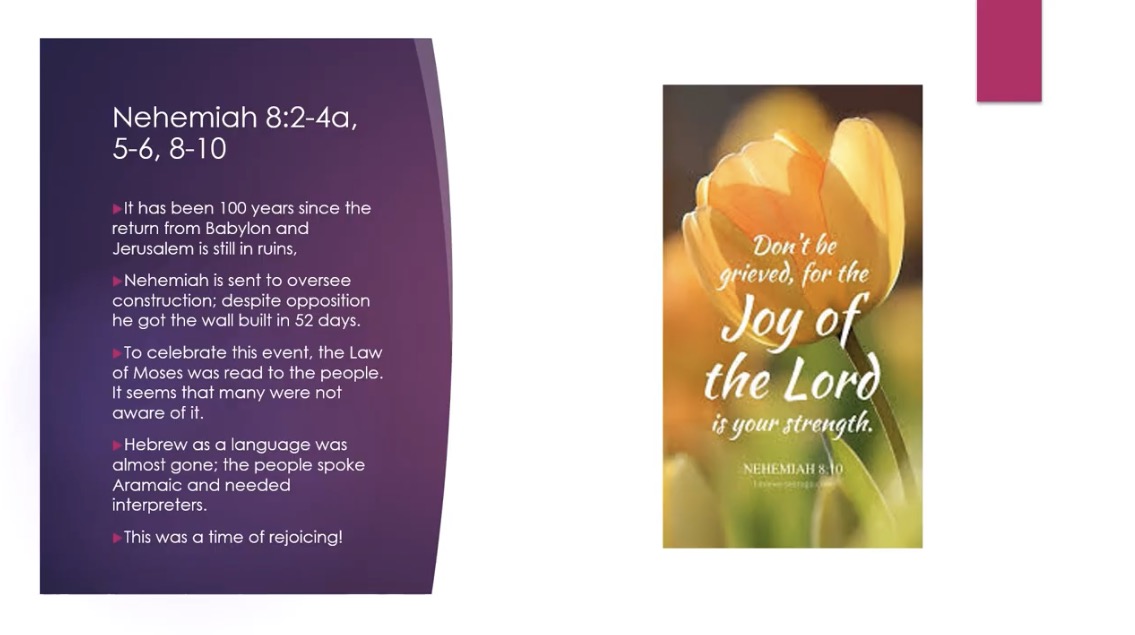
Click on slide to watch short commentary by Fr. Paul Galetto, OSA
Catholic Sunday Scriptures in Context
Finding Identity in Worship
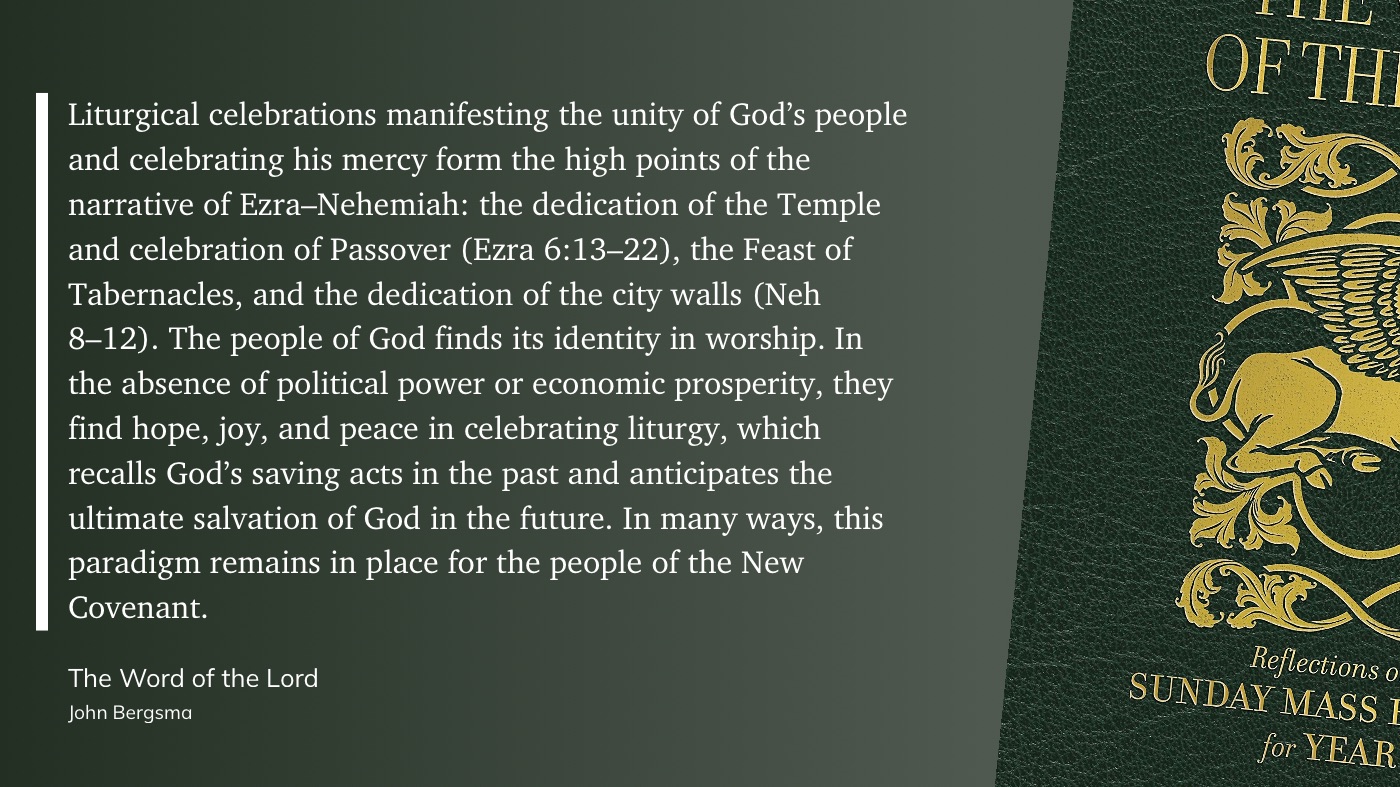
Click on slide for larger image.
Amen! Amen!

Click on slide for larger image.
Bible Study Notes (PDF)
Book of Nehemiah

PDF NOTES—The book of Nehemiah is one of the historical books of the Bible and continues to chronicle the history of the Jewish people. The books of Kings and Chronicles leave
Jerusalem and the temple a heap of ruins, and the people of Judah exiles and captives in Babylon (587 B.C.). But, the exiles never forgot Zion and the glories of Solomon’s temple. In 539 B.C. (48 years later)
- The Jerome Biblical Commentary,
- The New Jerome Biblical Commentary, and
- The Navarre Bible.
SOURCE: St. Charles Borromeo Catholic Church (Picayune, MS)

Listening to the Word of the Law
EXCERPT: In the First Reading, the people of Judah were liberated from the Babylonian captivity and returned to the Promised Land and the holy city of Jerusalem. They assembled to listen to Ezra, the priest, read from the Book of the Law and explain what it meant to live in obedience to God's commandments. They rebuilt Jerusalem, its protective walls, and the Temple where, as a "body" of one people in covenant with God, they again offered the twice-daily Tamid sacrifice for their atonement and sanctification. They celebrated their sacred feasts, gave praise and worship to Yahweh, their God, and made the commitment to live in obedience to His holy word.
Scholars disagree on what is meant by the "Book of the Law." Was it the Torah (Pentateuch) , the first five book of the Bible? The books of Exodus, Leviticus, Numbers, and Deuteronomy contained parts of the Law in three sections: the Covenant Code in Exodus, Holiness Code in Leviticus, and Deuteronomic Code in Deuteronomy. Or, did he only read from the laws in the Book of Deuteronomy from Moses's last homilies to the new generation of the children of Israel before they crossed the Jordan River to begin the conquest of Canaan? That he read for six hours from dawn to noon (as we count but seven hours as the ancients counted) suggests that he may have read all of the laws contained in the three books.
SOURCE: Agape Bible Study Copyright © 2015; revised 2024 (Used with permission.)
Social Media /
Bulletin Inserts
“If one part suffers, all the parts suffer with it; if one part is honored, all the parts share its joy.” — 1 Corinthians 12:26
Together we rise and fall, learn to support each other in times of both sorrow and joy.
Reflection: How can you show compassion to someone who is struggling or celebrate someone’s achievements today?
“Indeed, the parts of the body that seem to be weaker are all the more necessary.” — 1 Corinthians 12:22
Every part, no matter how small, matters. Never underestimate the value you or someone else brings to the table.
Reflection: What overlooked strength or characteristic do you possess that you can start valuing more?
“You are Christ’s body, and individually parts of it.” — 1 Corinthians 12:27
Each of us has a place and purpose in the larger picture, intricately connected through our shared faith.
Reflection: What role can you play today to foster a greater sense of unity within your group or community?
Last week we briefly explored the spiritual gifts. Cliques among the Corinthian faithful used these gifts to support their claims of leadership within the community. Their struggles were tearing the community apart.
In response, Paul implied a hierarchy of gifts that began with wisdom and spiritual knowledge. Such charisms as miracles, healing, tongues, and interpretation were farther down the list. His list foreshadowed his discussion of order within the Church (presented here).
Before he listed the order of the Church, he had to argue for an order within the Church. His argument was simple. Underneath the diversity of people and activities in the Church, there was a real unity of believers in Christ. That unity was brought about by the Spirit. The Spirit brought different people together (Jew and Gentile) from different strata of society (slave and free) into a single, living reality.
12:15, 16 “is it not (really) from the body” This clause has a double negative (‘not…not’) for emphasis. The use of “really” is an attempt to make this emphasis apparent in English.
Paul’s analogy could break down when the question of “weaker” members arose. The term ‘weaker’ could refer to the physically weak or the morally weak. How would the community care for the sick and discipline the sinner?
Paul stuck to his biological argument with language that reflected his culture: honor and shame. What could the community do with the shameful sinner? Honor him! In other words, the sinner who repented became the model for Christian living, not the righteous who never sinned. After all, Jesus called the shameful and dishonorable into his assembly. And, by the analogy, there was no reason to honor the righteous (12:24a). But, for those who did not repent, there were consequences (see 1 Corinthians 5).
Finally, like the body, the honorable and shameful were mixed together by God so they could care for each other. He would explain this spirit of charity in greater detail (see 1 Corinthians 13). But, for the meantime, the saint and sinner were in the same “boat” together. Their destinies were the same. They would celebrate their glories together. They would mourn their losses together.
Permission for use. All materials found in word-sunday.com are the property of Larry Broding (Copyright 1999-2025). Viewers may copy any material found in these pages for their personal use or for use in any non-profit ministry.
1 Corinthians 12:12-30

The Body of Christ and the Importance of Spiritual Gifts
I. The Unity and Diversity of the Body of Christ
- Many members, yet one body in Christ
- Unified by one Spirit through baptism
- Unique gifts bestowed upon each member
II. The Interdependence of the Body’s Members
- Illustration through parts of the human body
- Each part has a purpose and serves the whole
- Necessity for mutual concern and care
III. The Variety of Gifts within the Body of Christ
- Different gifts, services, and workings
- Emphasis on unity despite diversity
- God’s sovereign distribution of gifts
IV. The Significance of Weak and Unpresentable Parts
- Importance of seemingly less significant members
- Honor and care for weaker members
- Illustration through parts of the human body
V. Conclusion
- Aim for the greater gifts
- Affirmation of divine appointments
- A call for unity, love, and cooperation
Clipart by Fr. Richard Lonsdale
Sunday Scriptures
in Context
Fr. Paul Galeto, OSA

Click on slide to watch short commentary by Fr. Paul Galetto, OSA
Catholic Sunday Scriptures in Context
Allegory—St. Thomas Aquinas

Click on slide for larger image.
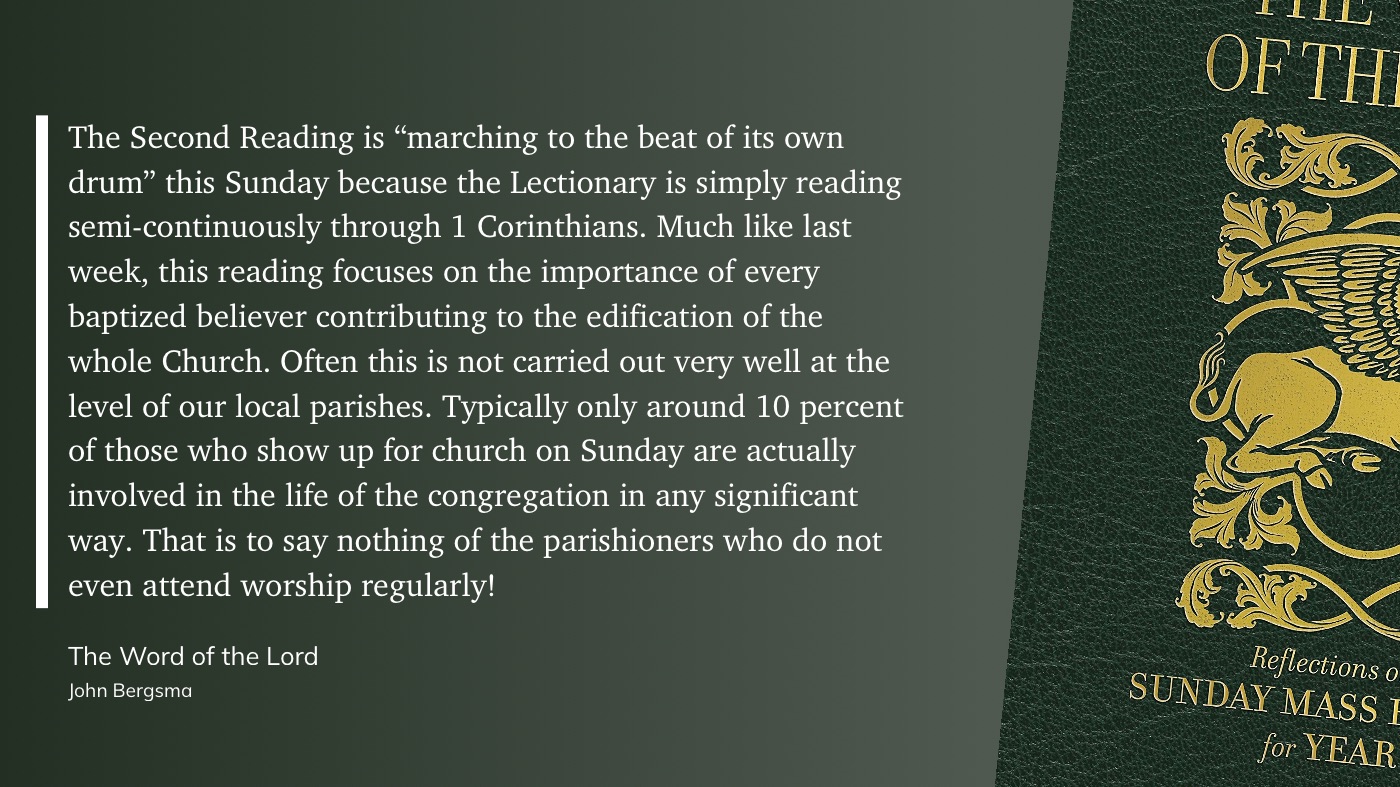
Importance of Every Baptized Believer
Click on slide for larger image.
Diversity and Unity

Click on slide for larger image.
Bible Study Notes (PDF)
14 Now the body is not a single part, but many.
PDF NOTES—This is the key phrase to this whole reading – Just as the human body needs different members (verses 14-20), so the Church needs a diversity of spiritual gifts, and each one makes a specific contribution to the common good; the health of the body.
- The Jerome Biblical Commentary,
- The New Jerome Biblical Commentary, and
- The Navarre Bible.
SOURCE: St. Charles Borromeo Catholic Church (Picayune, MS)
We Are One Body
EXCERPT: St. Paul uses the image of a body to explain Christ's relationship with believers (verse 12). In verse 13, he applies this image to the Church. Through the Sacrament of Baptism, all believers, despite their diversity of ethnic origin, social status, or male or female merge into one organism: the Body of Christ. This concept was not foreign to Jewish-Christians who, in the Old Covenant Church, understood that Israel was a unity of one people in covenant with Yahweh, their Lord God.
Then St. Paul discusses the gifts of the Holy Spirit that make each Christian unique within the unity of the Body of Christ (verses 27-29). All the various gifts he mentions can be categorized as charismata, unique gifts of grace from God to enable service (diakonial) to the Body, and all works (energemata) of God in the life of every believer. Just as different parts of the human body work together for a healthy and efficient body, so too do Christians work together through their various spiritual gifts for the health and benefit of the Body of Christ as they contribute to the unity of the Church.
SOURCE: Agape Bible Study Copyright © 2015; revised 2024 (Used with permission.)
Social Media /
Bulletin Inserts
“The Spirit of the Lord is upon me, because he has anointed me…” – Luke 4:18
You are chosen to bring light into the world. Let your unique gifts shine and make a positive impact.
Reflection: What gifts can you use today to serve and uplift those around you?
“He has sent me to proclaim liberty to captives and recovery of sight to the blind.” – Luke 4:18
Remember that freedom and healing are part of our calling. Be a vessel of hope and renewal in each encounter.
Reflection: How can you inspire others to find freedom and clarity in their lives?
“To set the oppressed free, to proclaim the year of the Lord’s favor.” – Luke 4:18-19
Step into roles that advocate for justice and mercy. Your acts of kindness can herald a new beginning for others.
Reflection: How can you participate in creating a more just and loving world today?
1:1 “a narrative about the things having happened among us and having fully convinced (us)” This is a vague phrase. The word for “things” is “pragma” (from which we get the word “pragmatic”). It can refer to events or items. The two verbs “having happened” and “having fully convinced” are actually one Greek verb that can have two meanings. Hence, the phrase can be translated as “a narrative about the events that have happened.” Or, it can be translated “a narrative about the things having fully convinced us.” The first possibility referred to a historical perspective, the second referred to a faith perspective. As a unique genre in literature, Gospel provides both perspectives.
1:2 “just as (the things) handed over to us” The things referred to the “pragmata” (events and faith items in 1:1. But, when the noun is added to the verb “handed over,” the understood subject takes on the sense of tradition or the entire group of events and faith items. So, Luke was trying to present the tradition he received from the apostolic generation (“the eye witnesses” and “the ministers of the word”) to the next generation of believers.
1:3 “it seemed to me, having investigated all things accurately from (their) beginning, to write in an orderly (manner) for you” Because of the shades of meaning in the verb “having investigated” (literally, “having followed”), the adverb “accurately” could shift to the infinitive “to write.” And, it could shift the meaning of “from before”; it would no longer indicate a point in time (“from their beginning” as used in the translation above) to a period of time (“for a long time”) The translation could then be: “it seemed to me, having followed all things for a long time, to write in an orderly and accurate way for you.” To translate the phrase in this way, however, would indicate that Luke was also some sort of witness, which he was not. He was not a bystander to the events as they unfolded, but a writer who compiled reports of the events and presented them. His perspective, then, was one of investigators who looked backward through the past.
1:3-4 “most excellent Theophilus, in order that you might know exactly about the reliability of the things which you have been taught.” “most excellent Theophilus” can also be translated “your excellence, Theophilus.” Was “most excellent” a title or a compliment? Indeed, was the name Theophilus (meaning “lover of God) a formal name or a nickname? The lack of supporting evidence will always leave this person shrouded in mystery. Combined with 1:4, we do know the person (or persons) was attracted to Christianity or was a neophyte.
This long sentence explained the reason for the Gospel. Why did it exist? Luke wrote his Gospel as a means to pass on the faith, especially to a new believer. Luke’s Gospel was meant to be a catechetical tool. He wrote to solidify what a new believer had already learned.
4:18-19 These verses can be found in Isaiah 61:1-2. The purpose of the Spirit anointing was the preaching of the Good News to the poor. In this case, the poor are not necessarily the economically needy. The poor are those who depend solely upon God, not upon their own abilities or the people/circumstances around them.
The three activities after 4:18a explained what Isaiah meant by preaching Good News. First, the preacher would proclaim freedom to prisoners and sight to blind. Next, he would lift oppression from the backs of the ordinary people. Finally, he would proclaim a Jubilee year, a year that would forgive debts both socially and economically. Hence, the Good News was meant for the outsider: the prisoner, the blind, the oppressed, and those heavily in debt. Of course, the message was more than literal. Those spiritually in prison, blinded, oppressed, and indebted were to hear the message.
Permission for use. All materials found in word-sunday.com are the property of Larry Broding (Copyright 1999-2025). Viewers may copy any material found in these pages for their personal use or for use in any non-profit ministry.
Luke 1:1-4; 4:14-21

Luke’s Introduction and Jesus’ Proclamation of the Good News
I. Luke’s Introduction
- Addressing Theophilus and referencing earlier accounts
- Compiling an orderly and accurate narrative of events
- Acknowledging the ministry of the eyewitnesses
II. Jesus’ Return to Galilee
- Filled with the Holy Spirit and strengthened by the Spirit
- Growing reputation in Galilee
- Teaching in the synagogues with praise from all
III. Jesus’ Visit to the Synagogue in Nazareth
- Reading from the scroll of Isaiah
- Proclaiming the Spirit of the Lord is upon him
- Anointed to bring glad tidings to the poor, liberty to captives, sight to the blind, and freedom for the oppressed
IV. The Response to Jesus’ Proclamation
- Amazement and admiration from the crowd
- Jesus’ acknowledgment of the fulfillment of Isaiah’s prophecy
- Affirmation of the present moment as the time for God’s favor
Clipart by Fr. Richard Lonsdale
Sunday Scriptures
in Context
Fr. Paul Galeto, OSA

Click on slide to watch short commentary by Fr. Paul Galetto, OSA
Catholic Sunday Scriptures in Context
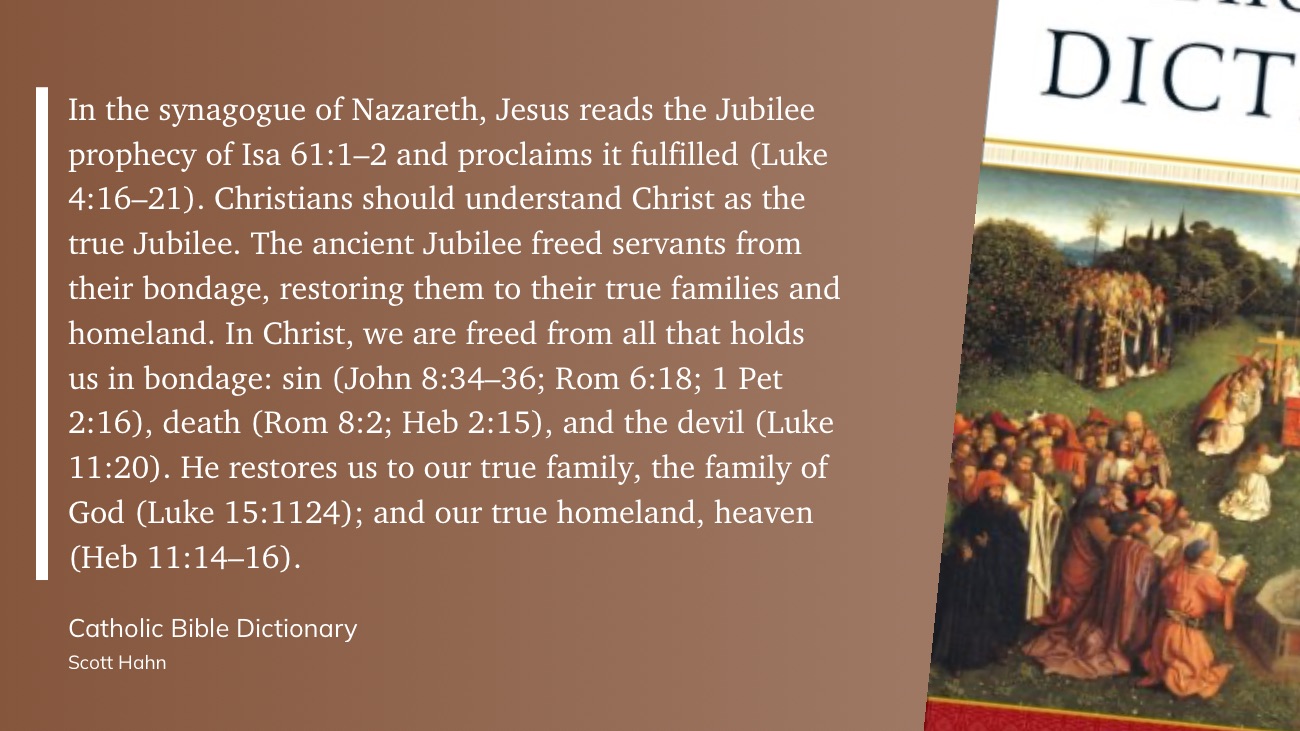
Christ as the True Jubilee
Click on slide for larger image.
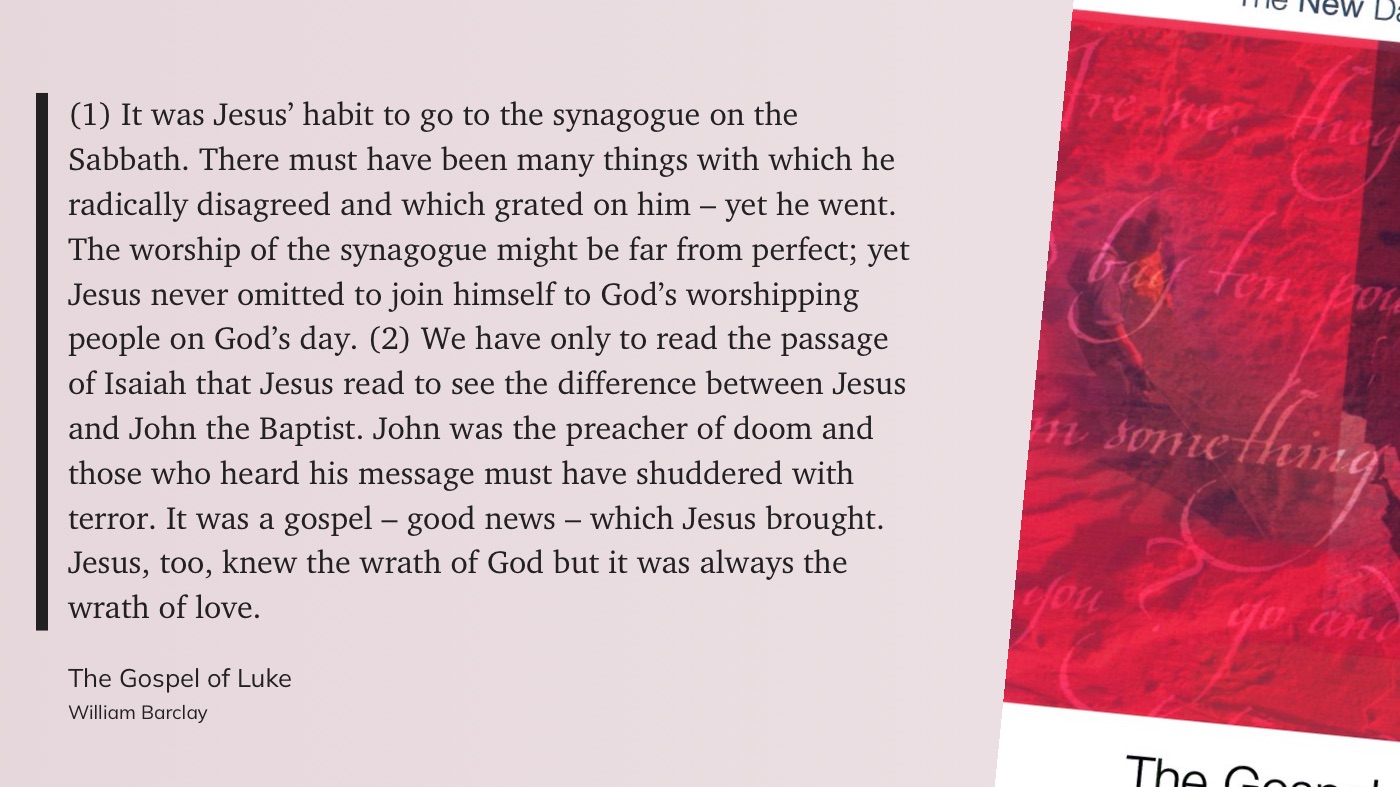
Jesus in the Synagogue
Click on slide for larger image.
Jesus Sits Down
Click on slide for larger image.
Liberty
Click on slide for larger image.
Fulton Sheen

Click on slide for larger image.
Bible Study Notes (PDF)
18 “The Spirit of the Lord is upon me, because he has anointed me to bring glad tidings to the poor. He has sent me to proclaim liberty…
The blessings God will send the people through the Messiah. “The poor” refers not so much to a social condition as to a very religious attitude of indigence and humility toward God; those who instead of relying on their possessions and merits, trust in God’s goodness and mercy. Likewise, “release” is seen to be a spiritual sense – freedom from the blindness and oppression of sin. This passage is also in line with Jesus’ special concern for those most in
need.
“Similarly, the Church encompasses with all her love all those who are afflicted by human misery and she recognizes in those who are poor and who suffer the image of her poor and suffering Founder. She does all in her power to receive their need and in them she strives to serve Christ” (Vatican II, Lumen Gentium 8)
- The Jerome Biblical Commentary,
- The New Jerome Biblical Commentary, and
- The Navarre Bible.
SOURCE: St. Charles Borromeo Catholic Church (Picayune, MS)
Event | Type | Matthew | Mark | Luke | John | |
1 | misc | John 01:01–18 | ||||
2 | nativity | Matthew 01:01–17 | Luke 03:23–38 | |||
3 | nativity | Luke 01:05–25 | ||||
4 | nativity | Luke 01:26–38 | ||||
5 | nativity | Luke 01:39–56 | ||||
6 | nativity | Matthew 01:18–25 | Luke 02:01–07 | |||
7 | nativity | Luke 02:08–15 | ||||
8 | nativity | Luke 02:16–20 | ||||
9 | nativity | Luke 02:21 | ||||
10 | nativity | Luke 02:22–38 | ||||
11 | nativity | Matthew 02:01–02 | ||||
12 | nativity | Matthew 02:01–12 | ||||
13 | nativity | Matthew 02:13–15 | ||||
14 | nativity | Matthew 02:16–18 | ||||
15 | Herod the Great's death | misc | Matthew 02:19–20 | |||
16 | youth | Matthew 02:21–23 | Luke 02:39–39 | |||
17 | youth | Luke 02:41–51 | ||||
18 | misc | Matthew 03:01–12 | Mark 01:01–08 | Luke 03:01–20 | John 01:19–34 | |
19 | misc | Matthew 03:13–17 | Mark 01:09–11 | Luke 03:21–22 | John 01:29–39 | |
20 | misc | Matthew 04:01–11 | Mark 01:12–13 | Luke 04:01–13 | ||
21 | miracle | John 02:01–11 | ||||
22 | ministry | John 02:13–25 | ||||
23 | ministry | John 03:01–21 | ||||
24 | ministry | Matthew 04:12–12 | Mark 01:14–14 | John 04:01–03 | ||
25 | miracle | Mark 01:21–28 | Luke 04:31–37 | |||
26 | parable | Mark 04:26–29 | ||||
27 | ministry | Matthew 13:53–58 | Mark 06:01–06 | Luke 04:16–30 | ||
28 | ministry | Matthew 04:18–22 | Mark 01:16–20 | Luke 05:1-11 | John 01:35–51 | |
29 | miracle | Luke 05:01–11 | ||||
30 | sermon | Matthew 05:02–12 | Luke 06:20–23 | |||
31 | miracle | Luke 07:11–17 | ||||
32 | parable | Luke 07:41–43 | ||||
33 | parable | Matthew 05:14–15 | Mark 04:21–25 | Luke 08:16–18 | ||
34 | sermon | Matthew 05:17–48 | Luke 06:29–42 | |||
35 | ministry | Luke 10:01–24 | ||||
36 | sermon | Matthew 06:01–18 | ||||
37 | parable | Luke 10:30–37 | ||||
38 | ministry | Luke 10:38–42 | ||||
39 | ministry | Matthew 06:09–13 | Luke 11:02–04 | |||
40 | parable | Luke 11:05–08 | ||||
41 | parable | Luke 12:16–21 | ||||
42 | ministry | John 04:04–26 | ||||
43 | ministry | Matthew 06:25–34 | Luke 12:22–34 | |||
44 | sermon | Matthew 07:01–05 | Luke 06:41–42 | |||
45 | sermon | Matthew 07:13–27 | ||||
46 | sermon | Matthew 07:15–20 | Luke 06:43-45 | |||
47 | parable | Matthew 07:24–27 | Luke 06:46–49 | |||
48 | miracle | Matthew 08:01–04 | Mark 01:40–45 | Luke 05:12–16 | ||
49 | miracle | Matthew 08:05–13 | Luke 07:01–10 | John 04:46–54 | ||
50 | miracle | Matthew 08:14–17 | Mark 01:29–34 | Luke 04:38–41 | ||
51 | miracle | Matthew 08:16–17 | Mark 01:32–34 | Luke 04:40–41 | ||
52 | miracle | Matthew 08:23–27 | Mark 04:35–41 | Luke 08:22–25 | ||
53 | miracle | Matthew 08:28–34 | Mark 05:01–20 | Luke 08:26–39 | ||
54 | miracle | Matthew 09:01–08 | Mark 02:01–12 | Luke 05:17–26 | ||
55 | ministry | Matthew 09:09 | Mark 02:13–14 | Luke 05:27–28 | ||
56 | parable | Matthew 09:17–17 | Mark 02:22–22 | Luke 05:37–39 | ||
57 | miracle | Matthew 09:18–26 | Mark 05:21–43 | Luke 08:40–56 | ||
58 | miracle | Matthew 09:20–22 | Mark 05:24–34 | Luke 08:43–48 | ||
59 | miracle | Matthew 09:27–31 | ||||
60 | miracle | Matthew 09:32–34 | ||||
61 | ministry | Matthew 10:02–04 | Mark 03:13–19 | Luke 06:12–16 | ||
62 | ministry | Matthew 10:34–36 | Luke 12:49–53 | |||
63 | ministry | Matthew 11:02–06 | Luke 07:18–23 | |||
64 | miracle | John 05:01–18 | ||||
65 | ministry | Matthew 12:01–08 | Mark 02:23–28 | Luke 06:01–05 | ||
66 | miracle | Matthew 12:09–13 | Mark 03:01–06 | Luke 06:06–11 | ||
67 | miracle | Matthew 12:22–28 | Mark 03:20–30 | Luke 11:14–23 | ||
68 | parable | Matthew 12:29–29 | Mark 03:27–27 | Luke 11:21–22 | ||
69 | ministry | Matthew 12:30–32 | Mark 03:28–29 | Luke 12:08–10 | ||
70 | ministry | Matthew 12:46–50 | Mark 03:31–35 | Luke 08:19–21 | ||
71 | parable | Matthew 13:03–09 | Mark 04:03–09 | Luke 08:05–08 | ||
72 | parable | Matthew 13:24–30 | ||||
73 | parable | Luke 13:06–09 | ||||
74 | miracle | Luke 13:10–17 | ||||
75 | parable | Matthew 13:31–32 | Mark 04:30–32 | Luke 13:18–19 | ||
76 | parable | Matthew 13:33–33 | Luke 13:20–21 | |||
77 | parable | Matthew 13:44–46 | ||||
78 | parable | Matthew 13:47–50 | ||||
79 | parable | Matthew 13:52–52 | ||||
80 | ministry | Matthew 14:06–12 | Mark 06:21–29 | Luke 09:07–09 | ||
81 | miracle | Matthew 14:13–21 | Mark 06:31–44 | Luke 09:10–17 | John 06:05–15 | |
82 | miracle | Matthew 14:22–33 | Mark 06:45–52 | John 06:16–21 | ||
83 | miracle | Matthew 14:34–36 | Mark 06:53–56 | |||
84 | sermon | Matthew 15:01–11 | Mark 07:01–23 | |||
85 | miracle | Matthew 15:21–28 | Mark 07:24–30 | |||
86 | miracle | Mark 07:31–37 | ||||
87 | miracle | Matthew 15:32–39 | Mark 08:01–09 | |||
88 | miracle | Mark 08:22–26 | ||||
89 | ministry | Matthew 16:13–20 | Mark 08:27–30 | Luke 09:18–21 | ||
90 | miracle | Matthew 17:01–13 | Mark 09:02–13 | Luke 09:28–36 | ||
91 | miracle | Matthew 17:14–21 | Mark 09:14–29 | Luke 09:37–49 | ||
92 | miracle | Matthew 17:24–27 | ||||
93 | sermon | John 06:22–59 | ||||
94 | ministry | Matthew 18:01–06 | Mark 09:33–37 | Luke 09:46–48 | ||
95 | miracle | Luke 14:01–06 | ||||
96 | parable | Luke 14:25–33 | ||||
97 | parable | Matthew 18:10–14 | Luke 15:04–06 | |||
98 | parable | Matthew 18:23–35 | ||||
99 | ministry | Matthew 18:01–06 | Mark 09:33–37 | Luke 09:46–48 | ||
100 | parable | Luke 15:08–09 | ||||
101 | parable | Luke 15:11–32 | ||||
102 | parable | Luke 16:01–13 | ||||
103 | parable | Luke 16:19–31 | ||||
104 | parable | Luke 17:07–10 | ||||
105 | miracle | Luke 17:11–19 | ||||
106 | parable | Luke 18:01–08 | ||||
107 | parable | Luke 18:09–14 | ||||
108 | ministry | Matthew 19:1-15 | ||||
109 | ministry | Matthew 19:16–30 | Mark 10:17–31 | Luke 18:18–30 | ||
110 | ministry | John 08:02–11 | ||||
111 | parable | Matthew 20:01–16 | ||||
112 | ministry | Matthew 20:17–19 | Mark 10:32–34 Mark 08:31 Mark 09:31 | Luke 18:31–34 | ||
113 | miracle | John 09:01–12 | ||||
114 | ministry | Matthew 20:20–28 | Mark 10:35–45 | |||
115 | ministry | John 10:01–21 | ||||
116 | miracle | Matthew 20:29–34 | Mark 10:46–52 | Luke 18:35–43 | ||
117 | miracle | John 11:01–44 | ||||
118 | ministry | Luke 19:02–28 | ||||
119 | ministry | Matthew 21:01–11 | Mark 11:01–11 | Luke 19:29–44 | John 12:12–19 | |
120 | ministry | Matthew 21:12–13 | Mark 11:15–18 | Luke 19:45–48 | ||
121 | miracle | Matthew 21:18–22 | Mark 11:12–14 | |||
122 | ministry | Matthew 21:23–27 | Mark 11:27–33 | Luke 20:01–08 | ||
123 | parable | Matthew 21:28–32 | ||||
124 | parable | Matthew 21:33–41 | Mark 12:01–09 | Luke 20:09–16 | ||
125 | parable | Matthew 22:01–14 | Luke 14:16–24 | |||
126 | ministry | Matthew 22:15–22 | Mark 12:13–17 | Luke 20:20–26 | ||
127 | ministry | Matthew 23:01–39 | Mark 12:35–37 | Luke 20:45–47 | ||
128 | sermon | Mark 12:41–44 | Luke 21:01-04 | |||
129 | ministry | Matthew 24:01–31 | Mark 13:01–27 | Luke 21:05–36 | ||
130 | parable | Matthew 24:32–35 | Mark 13:28–31 | Luke 21:29–33 | ||
131 | parable | Matthew 24:42–51 | Mark 13:34–37 | Luke 12:35–48 | ||
132 | parable | Matthew 25:01–13 | ||||
133 | parable | Matthew 25:14–30 | Luke 19:12–27 | |||
134 | parable | Matthew 25:31–46 | ||||
135 | ministry | Matthew 26:01–13 | Mark 14:03-09 | Luke 07:36–50 | John 12:02-08 | |
136 | misc | Matthew 26:14–16 | Mark 14:10–11 | Luke 22:01-06 | ||
137 | ministry | John 12:24–26 | ||||
138 | ministry | Matthew 26:26–29 | Mark 14:18–21 | Luke 22:17–20 | John 13:01–31 | |
139 | ministry | John 16:05–15 | ||||
140 | misc | Matthew 26:36–46 | Mark 14:32–42 | Luke 22:39–46 | ||
141 | passion | Matthew 26:47–49 | Mark 14:43–45 | Luke 22:47–48 | John 18:02-09 | |
142 | miracle | Luke 22:49–51 | ||||
143 | passion | Matthew 26:50–56 | Mark 14:46–49 | Luke 22:52–54 | John 18:10–12 | |
144 | passion | Matthew 26:57–68 | Mark 14:53–65 | Luke 22:63–71 | John 18:12–24 | |
145 | passion | Matthew 27:24–25 | ||||
146 | passion | Matthew 27:27–33 | Mark 15:20–22 | Luke 23:26–32 | John 19:16–17 | |
147 | passion | Matthew 27:34–61 | Mark 15:23–47 | Luke 23:33–54 | John 19:18–38 | |
148 | res app | Matthew 28:01 | Mark 16:01 | Luke 24:01 | ||
149 | res app | Matthew 28:02-08 | Mark 16:02-08 | Luke 24:02–12 | John 20:01–13 | |
150 | res app | Matthew 28:09–10 | Mark 16:09-13 | Luke 24:01-08 | John 20:14–16 | |
151 | res app | John 20:17–17 | ||||
152 | res app | Luke 24:13–32 | ||||
153 | res app | Luke 24:36–43 | John 20:19–20 | |||
154 | res app | Matthew 28:16–20 | Mark 16:14-18 | Luke 24:44–49 | John 20:21–23 | |
155 | res app | John 20:24–29 | ||||
156 | miracle | John 21:01–24 | ||||
157 | res app | Mark 16:19 | Luke 24:50–53 | |||
158 | misc | Matthew 28:19-20 | Mark 16:19-20 |
Contextual Background
HISTORY
Luke's Gospel, addressed to Theophilus, a Gentile of high social standing, aims to provide a reliable account of Jesus' life and ministry. Writing amidst the Roman Empire's political hegemony, Luke highlights Jesus' fulfillment of Old Testament prophecies, emphasizing the inclusivity of the Gospel for both Jews and Gentiles.
In Luke 4:14-21, Jesus publicly announces His messianic mission at the synagogue in Nazareth, quoting Isaiah's prophecy about the Spirit-anointed Servant. This passage situates Jesus within the context of Jewish history, affirming His continuity with Israel's prophetic tradition while unveiling His redemptive role.
Luke's account underscores the political tension between Roman rule and Jewish messianic expectations, which Jesus both challenges and transcends. By presenting Jesus as the fulfillment of Old Testament prophecies, Luke invites his Gentile audience to recognize the universal significance of Jesus' ministry and the new order He inaugurates.
SOCIETY
Luke's Gospel, including the account of Jesus' proclamation in Nazareth, engages with the sociocultural context of the Jewish people living under Roman rule. The expectations surrounding the coming Messiah were intertwined with Jewish identity and hope for liberation from foreign oppression.
In Luke 4:14-21, Jesus claims to be the fulfillment of Isaiah's prophecy, challenging traditional notions of the Messiah as a political liberator. Instead, Jesus emphasizes the spiritual dimensions of His mission, prioritizing the proclamation of good news to the poor, the release of captives, and the restoration of sight to the blind.
This announcement in the Nazareth synagogue reveals Jesus' countercultural message, which subverts societal norms and provokes reflection on the true nature of God's kingdom. The original audience, both Jewish and Gentile, would have recognized the radical implications of Jesus' words, challenging them to embrace a new understanding of God's redemptive plan.
THEOLOGY
Within the Roman Catholic tradition, Luke's account of Jesus' proclamation in Nazareth underscores the theological significance of Jesus as the Messiah and the embodiment of God's redemptive plan. The passage connects Jesus' ministry to the Old Testament prophecies, highlighting His fulfillment of God's promises to Israel and extending the scope of salvation to all nations.
Luke's focus on Jesus' concern for the marginalized and oppressed resonates with Catholic social teaching, emphasizing the importance of justice, compassion, and solidarity in the Christian life. This passage challenges contemporary Catholics to recognize and address the needs of those on the peripheries, sharing the good news of God's love through concrete acts of mercy and service.
Moreover, the account of Jesus' proclamation in the synagogue underscores the significance of the Eucharist in Catholic life. Just as Jesus read from the scroll of Isaiah, the Word of God is proclaimed during Mass, inviting Catholics to deepen their understanding of Scripture and apply its wisdom in their daily lives.
Proclaiming the Word
EXCERPT: Jesus visits His hometown at Nazareth to keep His Sabbath obligation in the local synagogue. He read the word of God from the book of the prophet Isaiah to the congregation. Then, He interpreted the passage by announcing to the assembled believers that He is the promised Messiah who has come to liberate His people from the curse of sin and death. It is the same announcement every Gospel Reading reveals to the Body of Christ of the Church from the Word of God in every generation.
According to Luke 9:31, the "exodus" and "liberation" that Jesus was bringing was not from the Roman occupation or to free Jewish slaves. Instead, his liberation was from slavery to sin and death, and His "exodus" would be from death to resurrection.
THE "NEW EXODUS" LIBERATION
FULFILLED IN JESUS CHRIST
Liberation | Fulfilled in Christ |
1. Jesus took upon Himself the debt of the curses incurred for failing to keep the Old Covenant Law (Lev 26:14-46; Dt 28:15-68). | Christ ransomed us from the curse of the law by becoming a curse for us, for it is written, "Cursed be every one who hangs on a tree" (Gal 3:13). |
2. He freed us from slavery to sin and death. | We know that our old self was crucified with him, so that our sinful body might be done away with, that we might no longer be in slavery to sin (Rom 6:6). |
3. Through Jesus's death, burial, and Resurrection, we received the promise of eternal life in the Promised Land of the Kingdom of Heaven. | Then he said, "Jesus, remember me when you come into your kingdom." He replied to him, "Amen, I say to you. Today you will be with me in Paradise" (Lk 23:42-43). |
Michal E. Hunt Copyright © 2019 |
Jesus came to fulfill the prophets' prophecies, restore the faithful remnant of Israel, and extend the gift of eternal salvation to all humanity. He came to undo the work of Satan in the fall of our original parents and bring about an exodus out of sin into a new and eternal covenant in which the indwelling of the Holy Spirit would bring about One Body in Christ in the Universal (Catholic) Church.
SOURCE: Agape Bible Study Copyright © 2015; revised 2024 (Used with permission.)

SCRIPTURE
SEARCH
FIRST READING (4)
SECOND READING (122)
GOSPEL (64)
This tool created by Jeff Pinyan uses the CCEL Early Church Fathers digital edition of the Philip Schaff collection.
3rd Sunday of Year C

Catena Aurea
The Catena Aurea, which means “Golden Chain” in Latin, is a comprehensive biblical commentary comb is a 13th-century biblical commentary compiled by St. Thomas Aquinas. This anthology features insights from over eighty Church Fathers on the four Gospels.