FEB 2, 2025


Each week THE WORD THIS WEEK features popular video series and other media which focus on the Sunday’s Mass readings.
RESOURCES ARE LIMITED FOR THE FEAST OF THE PRESENTATION OF THE LORD.
BISHOP BARRON
KIERAN O’MAHONY
JEFF CAVINS
Click on links above to view respective videos.
Jeff Cavins / Encountering the Word
(0:00 minutes)
Brant Pitre / Mass Readings Explained
(9:23 minutes)

Fr. Geoffrey Plant
(32:21 minutes)
Larry Broding / Word-Sunday
(3:54 minutes)
Presentation of the Lord
Three Great Things:
Study, Pray and Serve
Fr. Andrew Ricci, ordained in 1997, is a priest for the Diocese of Superior. He is the Rector of the Cathedral of Christ the King.

Presentation of the Lord
Presentation of the Lord


Commentary, Questions & Prayer
Presentation of the Lord

Scripture Study
by Vince Contreras*
Lectionary Commentary
by Fr. Tobin*
Echoing God’s Word
by Fr. Thibodeau*
Hearers of the Word
by Kieran J. O’Mahony*
Carmelite Lectio Divina
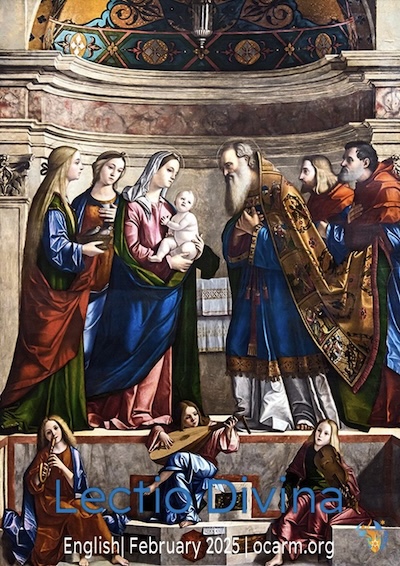
Reflections and Prayers
77 page PDF with refections and prayers for each day of the month.
Lectio Divina February 2025 (PDF)
Lectio Divina February 2025 [Mobi]
Lectio Divina February 2025 [ePub]
“Lectio divina is an authentic source of Christian spirituality recommended by our Rule. We therefore practise it every day, so that we may develop a deep and genuine love for it, and so that we may grow in the surpassing knowledge of Christ. In this way we shall put into practice the Apostle Paul’s commandment, which is mentioned in our Rule: “The sword of the Spirit, too, which is the word of God, is to dwell abundantly in your mouth and in your hearts; and whatever things you have to do, let them be done in the word of the Lord.” (Carmelite Constitutions (2019), n. 85.)
Source: Carmelites

Social Media /
Bulletin Inserts
Behold, I am sending my messenger to prepare the way before me.” (Malachi 3:1)
God is always preparing a way for us. Are we ready to embark on the journey He has planned for us?
Reflection Question: How can you prepare your heart to receive God’s guidance today?
“He will sit refining and purifying silver.” (Malachi 3:3)
Through life’s challenges, God is refining and purifying our hearts. Trust the process and embrace change.
Reflection Question: How has a recent challenge acted as a refining fire in your life?
“The sacrifice of Judah and Jerusalem will please the Lord, as in days of old.”
Returning to heartfelt devotion can rekindle a sense of peace and deeper connection. Reflect on past practices that brought you spiritual joy and fulfillment.
Reflection: What spiritual activities from your past would you like to rekindle?

The book titled “Malachi” was written by an anonymous writer in the fifth century B.C. Two generations after Exile, the populace in Jerusalem had become lax in their worship and their sense of kosher. They treated religion as a cultural reference point for their identity. Worship was not ritual, but rote. A marriage that might not be religiously acceptable was socially acceptable.
At this point, the unknown author presented a messenger from God (Malachi was Hebrew for “messenger;” the author’s image explained the title of the book). The messenger preached a diatribe against the populace and the established priesthood: “Return to the purity of the Law!” Sacrifice at the Temple required the worshiper’s best, not diseased or lame animals. To maintain the strength and identity of the community, Jews should only marry other Jews. Worship and duty to the Law were the bed rocks of Judaism. Both needed to be taken seriously!
The author implied an “or-else” to the message. Return to the purity of the Law, or face the wrath of God’s judgment. If the people won’t change for God, God will change the people. The experience of the Exile still rang in the ears of the populace, so the words of the author must have stung deeply.
In these verses from Malachi, the author saw the messenger as an instrument of God’s justice. He would reform the Levitical priesthood until they presented pure worship, like their ancestors did. The implication of violence was evident (“the terrible Day of the YHWH”); he would act just like a blacksmith refining precious metal. Beneath the task of the messenger and the threat of God’s wrath lay the power of the messenger. His might would come directly from God. For the author, the power of the messenger was the power of God. They were synonymous.
Permission for use. All materials found in word-sunday.com are the property of Larry Broding (Copyright 1999-2025). Viewers may copy any material found in these pages for their personal use or for use in any non-profit ministry.
Malachi 3:1-4

The Coming of God’s Messenger and the Refinement of his People
I. Introduction to God’s Messenger (v. 1)
- The Lord’s promise of sending a messenger
- Preparation of the way before Him
II. Description of God’s Messenger (v. 1)
- Sudden arrival at the Temple
- Purpose of His coming
III. Refinement of the People (vv. 2-3)
- Purification process: like a refiner’s fire
- Distinction between the wicked and the righteous
IV. Consequences of Refinement (v. 4)
- The offering of Judah and Jerusalem
- God’s pleasure in the offering
Clipart by Fr. Richard Lonsdale
Sunday Scriptures
in Context
Fr. Paul Galeto, OSA


Click on slide to watch short commentary by Fr. Paul Galetto, OSA
Catholic Sunday Scriptures in Context
Priestly Corruption
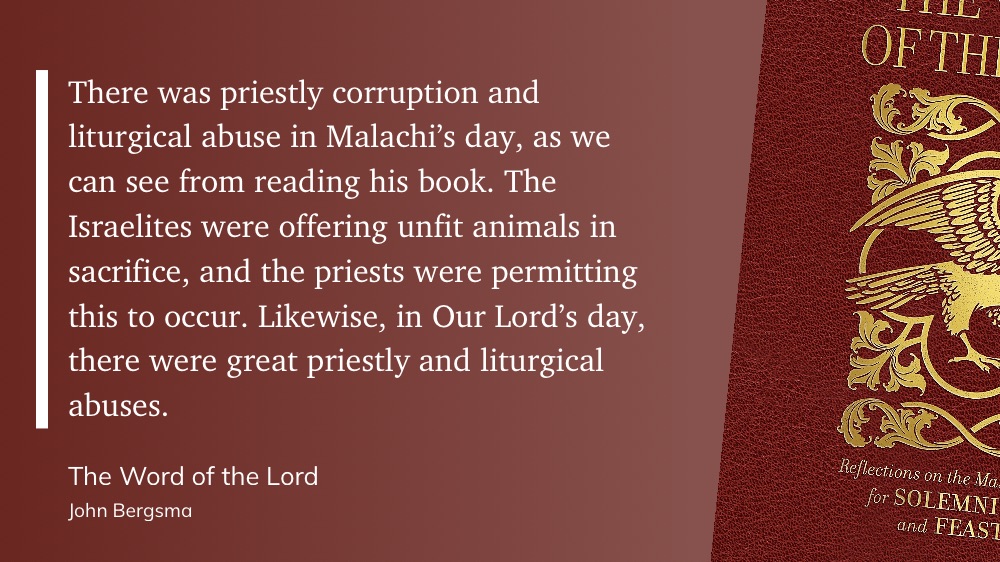
Click on slide for larger image.
Removal of Impurities
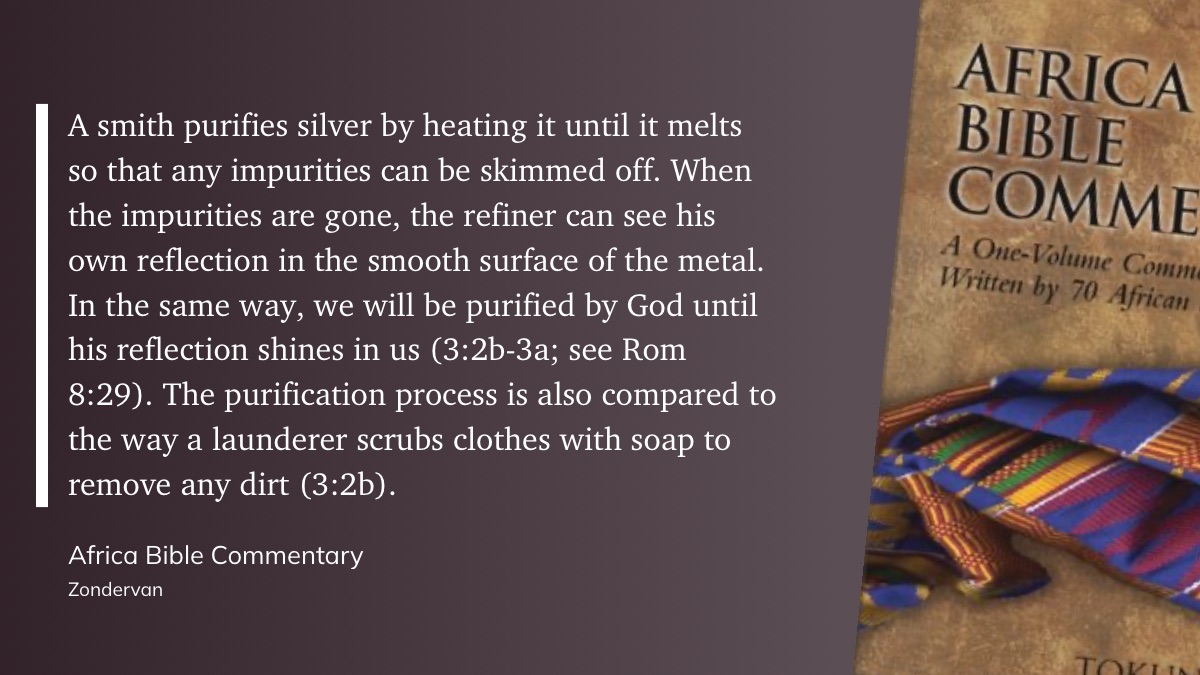
Click on slide for larger image.
Bible Study Notes (PDF)
Book of Malachi

PDF NOTES—The book is dated between the rebuilding of the Temple in 515 B.C. and before 458 B.C. Malachi is wholly concerned with the religious conditions of the Jewish community. With all his might he endeavors to stem the tide of religious indifference which must inevitably lead to ruin. He proclaims the approach of the day of Yahweh: His messenger is already on the way.
- The Jerome Biblical Commentary,
- The New Jerome Biblical Commentary, and
- The Navarre Bible.
SOURCE: St. Charles Borromeo Catholic Church (Picayune, MS)

Jesus Christ is God Present among His People
EXCERPT: Jesus of Nazareth fulfills Malachi's prophecy in the First Reading. Jesus will identify the first "messenger," the one who Malachi writes will prepare the way in the spirit of Elijah as St. John the Baptist. This identification makes Jesus the "Lord who you seek" who will "come to His Temple" to purify it and the people in preparation for the coming of His Kingdom. Jesus is also the "messenger" (or mediator) Malachi writes about who will come to establish a covenant and who offers the necessary sacrifice to the Lord, which Jesus will do on the altar of the Cross. His sacrifice will purify and restore the new Israel of the Kingdom of Jesus Christ and a new priesthood to offer His sacrifice and right worship that will please God.
SOURCE: Agape Bible Study Copyright © 2015; revised 2024 (Used with permission.)
Social Media /
Bulletin Inserts
“Since the children have flesh and blood, he too shared in their humanity so that by his death he might break the power of him who holds the power of death—that is, the devil.”
Each day is a victory over fear and darkness, for Christ has broken their chains. Live in the light of this powerful truth.
Reflection Question: What fears are you ready to surrender to God’s victorious power today?
“and free those who through fear of death
had been subject to slavery all their life.”
Live boldly, for Christ’s sacrifice frees us from all bondage. Walk in the freedom He has given you.
Reflection Question: How can you live out the freedom Christ has won for you in your daily life?
“He had to become like his brothers and sisters
in every way,
that he might be a merciful and faithful high priest…”
Relish in the unity of spirit with Christ as He made Himself like us to bring us closer to God.
Reflection Question: In what ways does the realization of Christ’s shared humanity impact your relationship with Him?
In Hebrews 2, the author tried to answer two questions of the doubters. What was the place of Jesus as the Messiah? And, what was the place of the believer? The first question implied the relationship between Jesus and God. The second question implied the relationship of the believer with God.
To answer the first question, we must investigate the world view of first century Jewish Christians. In ancient cultures, people saw the world as a hierarchy of powers. An all-powerful God sat at the top of this list. Then came different spirits (which Jews recognized as “angels”) which controlled forces of nature. Third came humanity. Animals and plants came last. Within each layer of the hierarchy (besides the top) were sublayers. For example, the spirit realm which controlled natural forces could be benevolent (God’s angels) or malevolent (demons), depending upon their relationship to humanity. Since humanity was beneath the layer of the spirit, men and women were subject to their whims. Misfortune, disease, and death were the results of evil spirits.
Where did Jesus the Christ stand in this hierarchy? Hebrews stated his place was above the angels. In this sense, Hebrews (like the Christian movement itself) had “spiritualized” the role of the Messiah. He was not a political “Son of David” or a reforming “High Priest.” These were earthly images. No, he was like the heavenly “Son of Man” figure in Daniel 7. Jesus came from the people in his ministry and death. Then God raised him up and seated him at his right, to come again in judgment…
How does the author of Hebrews answer the second question? What relationship does the believer have with God? Because the process of salvation began with the Messiah living with the people, as one of the people, he could become a “merciful and trustworthy” High Priest for the people. In other words, his intercession would be heard directly by God the Father, even before the angels’ petitions. In the minds of Hebrews’ readers, humanity rose above the level of the angels and demons. With Jesus as the only mediator, his followers were truly children of God.
Permission for use. All materials found in word-sunday.com are the property of Larry Broding (Copyright 1999-2025). Viewers may copy any material found in these pages for their personal use or for use in any non-profit ministry.
Hebrews 2:14-18

Jesus as the Merciful High Priest
I. Introduction to Jesus’ Role (v. 14)
- Jesus sharing in humanity’s flesh and blood
- His purpose: to destroy the power of death
II. Liberation from Slavery (v. 15)
- Fear of death and its enslaving nature
- The power of Jesus to liberate from this fear
III. The Necessity of Jesus’ Incarnation (v. 16)
- Jesus’ assistance to humanity as a merciful high priest
- His role in providing reconciliation with God
IV. Jesus’ Relationship to Humanity (vv. 17-18)
- Jesus’ faithful service as a high priest
- His ability to empathize with human weaknesses
- The importance of His temptation experience
Clipart by Fr. Richard Lonsdale
Sunday Scriptures
in Context
Fr. Paul Galeto, OSA

Click on slide to watch short commentary by Fr. Paul Galetto, OSA
Catholic Sunday Scriptures in Context
Christ as Warrior
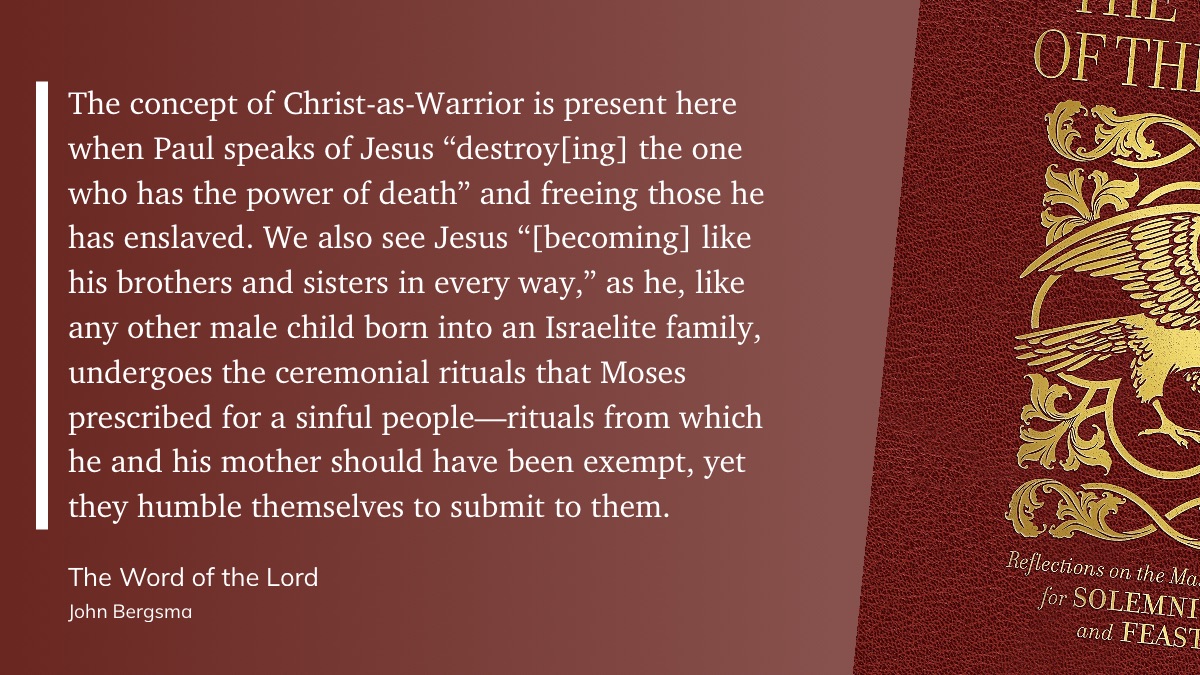
Click on slide for larger image.
Why Did Christ Become Human?
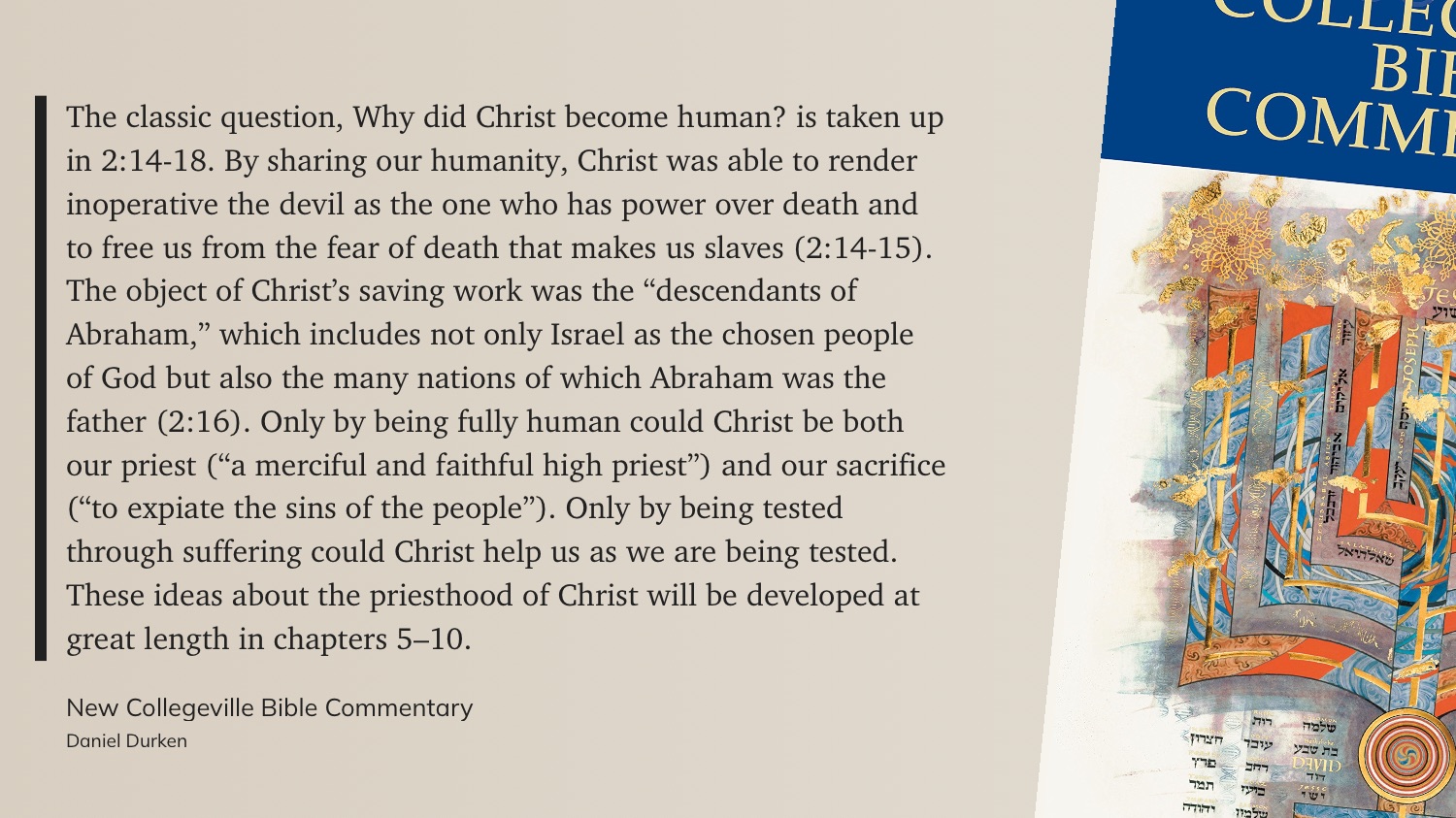
Click on slide for larger image.
Bible Study Notes (PDF)
14 Now since the children share in blood and flesh,
PDF NOTES—In the biblical sense, “flesh” means human nature considered in its weakness and frailty. As such, the “flesh” is contrasted with the “spirit” and God. The expression “flesh and blood” meaning “human being” occurs in the Old Testament only in Sirach (14:18; 17:26). When flesh and blood are separated, death occurs. Here, the sacred author speaks of human nature under the ban of death and sees death as associated with the devil. After all, death entered the world through the original sin of Adam and Eve.
- The Jerome Biblical Commentary,
- The New Jerome Biblical Commentary, and
- The Navarre Bible.
SOURCE: St. Charles Borromeo Catholic Church (Picayune, MS)
Perfection and Glory through Suffering and Resurrection
EXCERPT: In the Second Reading, the inspired writer (believed to be St. Paul) stresses Christ's union with humanity in His flesh and blood. He writes that it is in the offering the perfect sacrifice of His human flesh and blood that Jesus conquered the devil and set humanity free from the fear of death. The promised bodily resurrection of all Christians at the end of time is also intimately connected to the Resurrection of Jesus Christ. It is a guarantee He has given to all believers. As we await His Second Coming and the fulfillment of the promised resurrection, He has already prepared us to receive that promise by giving us a new life as sons and daughters of God through the Sacrament of Baptism and being incorporated into the Body of the risen Christ by faith and the Eucharist.
SOURCE: Agape Bible Study Copyright © 2015; revised 2024 (Used with permission.)
Social Media /
Bulletin Inserts
“For my eyes have seen your salvation, which you prepared in the sight of all the peoples.”
Like Simeon, may we be open to seeing the salvation and hope present in our everyday lives.
Reflection: Where have you seen glimpses of hope and salvation in your life recently?
“The child’s father and mother were amazed at what was said about him.”
Can we stand in awe at the wonders happening around us just like Mary and Joseph did?
Reflection: What amazes you in the life you’ve been given, and how can you cherish it more deeply?
An insightful moment to ponder: “And the child grew and became strong, filled with wisdom; and the favor of God was upon him.”
The journey of growth is both personal and spiritual. Let’s nurture our wisdom every day.
Reflection: How do you nurture growth and wisdom in your own life?
2:22-24 This long sentence has “led HIM up” as the main verb (with object) with two explanatory infinitives, “to present HIM” and “to give a sacrificial offering.” Luke connected the couples’ action, the Temple, and the Law to stress the Jewish roots of Jesus.
2:22 “They” refer to Joseph and Mary. The pronoun “HIM”(referring to Jesus) acted as the object of both the verb “led” and the infinitive “to present.” “…to present him to the Lord . . . ” was not part of the cleansing ritual; it meant bringing Jesus into the presence of the Lord who, according to Jewish belief, dwelt in the Temple.
2:23 ” . . . every male that opens the womb . . . “ from Exodus 13:2. It referred to the first born, both human and animal.
2:24 ” . . . to give a sacrificial offering . . . “ is literally “to give sacrifice . . . ” Since the couple could not offer sacrifice in the Temple (only the priest could perform the ritual), they could only provide the animals for sacrifice. “…a pair of turtle doves…” listed in Leviticus 12:8 as a poor person’s substitute for lambs in a purification sacrifice.
2:25 ” . . . the consolation of Israel . . . ” echoed Isaiah 40:1 and 61:2. This phrase referred to the comfort God would give Israel at the end of time when the Messiah would come. John the Evangelist used the word “comfort” (i.e., “paraklesis” in Greek) to describe the Spirit (the Paraclete); the Spirit was a gift the Messiah would give at his arrival.
2:29 “O Despot” is a literal translation meaning “Lord.” The word “despot” finds its root in the Greek. “Peace” means “Shalom,” a feeling of harmony with God, one’s neighbor, and nature. In this sense, peace is living God’s will, not a stress-free life or a life without violence.
2:31 ” . . . in the view of . . . ” is literally ” . . . in the face of . . . “
2:32 ” . . . for the revelation of the nations . . . ” is literally ” . . . toward the unveiling of the nations . . . “
Luke used two bible passages in 2:22-24. The first passage was: “Every male that opens (his mother’s) womb will be called holy to the Lord” (Exodus 13:2, 12, 15). As God was the giver of life, he was to be offered life. The first male (if human, the chief heir; if animal, the guarantee of a flock/herd’s strength) was to be returned to God. In the case of animals (except the ass, which was unclean), sacrifice was dictated. In the case of a male child, a substitute offering was to be made.
The second passage was: “A pair of turtledoves or two young pigeons” (Leviticus 12:8). Leviticus 12 described the circumcision of a male child and the unclean status of the new mother. The rite of purification for a mother was the burnt sacrifice of a lamb and the sacrifice of a turtledove as a sin offering. A pair of doves or pigeons could be substituted for the lamb/dove if the woman was poor.
Luke included the firstborn’s substitute sacrifice with that of the offering for a woman’s purification. Thematically, he presented a “two-for-one” offering. Why did he compress these traditions into one event? To focus upon the worship of God through offering.
Permission for use. All materials found in word-sunday.com are the property of Larry Broding (Copyright 1999-2025). Viewers may copy any material found in these pages for their personal use or for use in any non-profit ministry.
Luke 2:22-40
Presentation of Jesus at the Temple and Simeon’s Prophecy
I. The Purification Ceremony (vv. 22-24)
- Mary and Joseph’s obedience to Mosaic Law
- The offering of sacrifices
II. Simeon’s Prophecy (vv. 25-35)
- Simeon’s encounter with the Holy Spirit
- His recognition of the infant Jesus as the Messiah
- Simeon’s blessing and prediction of Mary’s sorrow
III. Anna’s Testimony (vv. 36-38)
- Anna’s devotion to fasting and prayer
- Her proclamation of redemption through Jesus
IV. Return to Nazareth (vv. 39-40)
- Mary and Joseph’s completion of purification rites
- Their return home to Nazareth
Clipart by Fr. Richard Lonsdale
Sunday Scriptures
in Context
Fr. Paul Galeto, OSA

Click on slide to watch short commentary by Fr. Paul Galetto, OSA
Catholic Sunday Scriptures in Context
Nunc Dimittis
Click on slide for larger image.
The Work and Fate of Jesus
Click on slide for larger image.
Christ’s Priesthood
Click on slide for larger image.
The Sword that Pierces Mary’s Heart
Click on slide for larger image.
Sign of Contradiction

Click on slide for larger image.
Fulton Sheen: The Magic Mirror
Click on slide for larger image.
Bible Study Notes (PDF)
33 The child’s father and mother were amazed at what was said about him; 34 and Simeon blessed them and said to Mary his mother, “Behold, this child is destined for
the fall and rise of many in Israel, and to be a sign that will be contradicted
The goals and goodness preached and practiced by the Messiah, will force men to face up to their great sinfulness (their fall). This knowledge can completely destroy, as it will the proud; or it can prompt the humble to turn to the Messiah and through Him to rise to a new life. The Greek word for “rise”, anastasis, is used by Luke elsewhere exclusively to denote resurrection from the dead.
- The Jerome Biblical Commentary,
- The New Jerome Biblical Commentary, and
- The Navarre Bible.
SOURCE: St. Charles Borromeo Catholic Church (Picayune, MS)
Event | Type | Matthew | Mark | Luke | John | |
1 | misc | John 01:01–18 | ||||
2 | nativity | Matthew 01:01–17 | Luke 03:23–38 | |||
3 | nativity | Luke 01:05–25 | ||||
4 | nativity | Luke 01:26–38 | ||||
5 | nativity | Luke 01:39–56 | ||||
6 | nativity | Matthew 01:18–25 | Luke 02:01–07 | |||
7 | nativity | Luke 02:08–15 | ||||
8 | nativity | Luke 02:16–20 | ||||
9 | nativity | Luke 02:21 | ||||
10 | nativity | Luke 02:22–38 | ||||
11 | nativity | Matthew 02:01–02 | ||||
12 | nativity | Matthew 02:01–12 | ||||
13 | nativity | Matthew 02:13–15 | ||||
14 | nativity | Matthew 02:16–18 | ||||
15 | Herod the Great's death | misc | Matthew 02:19–20 | |||
16 | youth | Matthew 02:21–23 | Luke 02:39–39 | |||
17 | youth | Luke 02:41–51 | ||||
18 | misc | Matthew 03:01–12 | Mark 01:01–08 | Luke 03:01–20 | John 01:19–34 | |
19 | misc | Matthew 03:13–17 | Mark 01:09–11 | Luke 03:21–22 | John 01:29–39 | |
20 | misc | Matthew 04:01–11 | Mark 01:12–13 | Luke 04:01–13 | ||
21 | miracle | John 02:01–11 | ||||
22 | ministry | John 02:13–25 | ||||
23 | ministry | John 03:01–21 | ||||
24 | ministry | Matthew 04:12–12 | Mark 01:14–14 | John 04:01–03 | ||
25 | miracle | Mark 01:21–28 | Luke 04:31–37 | |||
26 | parable | Mark 04:26–29 | ||||
27 | ministry | Matthew 13:53–58 | Mark 06:01–06 | Luke 04:16–30 | ||
28 | ministry | Matthew 04:18–22 | Mark 01:16–20 | Luke 05:1-11 | John 01:35–51 | |
29 | miracle | Luke 05:01–11 | ||||
30 | sermon | Matthew 05:02–12 | Luke 06:20–23 | |||
31 | miracle | Luke 07:11–17 | ||||
32 | parable | Luke 07:41–43 | ||||
33 | parable | Matthew 05:14–15 | Mark 04:21–25 | Luke 08:16–18 | ||
34 | sermon | Matthew 05:17–48 | Luke 06:29–42 | |||
35 | ministry | Luke 10:01–24 | ||||
36 | sermon | Matthew 06:01–18 | ||||
37 | parable | Luke 10:30–37 | ||||
38 | ministry | Luke 10:38–42 | ||||
39 | ministry | Matthew 06:09–13 | Luke 11:02–04 | |||
40 | parable | Luke 11:05–08 | ||||
41 | parable | Luke 12:16–21 | ||||
42 | ministry | John 04:04–26 | ||||
43 | ministry | Matthew 06:25–34 | Luke 12:22–34 | |||
44 | sermon | Matthew 07:01–05 | Luke 06:41–42 | |||
45 | sermon | Matthew 07:13–27 | ||||
46 | sermon | Matthew 07:15–20 | Luke 06:43-45 | |||
47 | parable | Matthew 07:24–27 | Luke 06:46–49 | |||
48 | miracle | Matthew 08:01–04 | Mark 01:40–45 | Luke 05:12–16 | ||
49 | miracle | Matthew 08:05–13 | Luke 07:01–10 | John 04:46–54 | ||
50 | miracle | Matthew 08:14–17 | Mark 01:29–34 | Luke 04:38–41 | ||
51 | miracle | Matthew 08:16–17 | Mark 01:32–34 | Luke 04:40–41 | ||
52 | miracle | Matthew 08:23–27 | Mark 04:35–41 | Luke 08:22–25 | ||
53 | miracle | Matthew 08:28–34 | Mark 05:01–20 | Luke 08:26–39 | ||
54 | miracle | Matthew 09:01–08 | Mark 02:01–12 | Luke 05:17–26 | ||
55 | ministry | Matthew 09:09 | Mark 02:13–14 | Luke 05:27–28 | ||
56 | parable | Matthew 09:17–17 | Mark 02:22–22 | Luke 05:37–39 | ||
57 | miracle | Matthew 09:18–26 | Mark 05:21–43 | Luke 08:40–56 | ||
58 | miracle | Matthew 09:20–22 | Mark 05:24–34 | Luke 08:43–48 | ||
59 | miracle | Matthew 09:27–31 | ||||
60 | miracle | Matthew 09:32–34 | ||||
61 | ministry | Matthew 10:02–04 | Mark 03:13–19 | Luke 06:12–16 | ||
62 | ministry | Matthew 10:34–36 | Luke 12:49–53 | |||
63 | ministry | Matthew 11:02–06 | Luke 07:18–23 | |||
64 | miracle | John 05:01–18 | ||||
65 | ministry | Matthew 12:01–08 | Mark 02:23–28 | Luke 06:01–05 | ||
66 | miracle | Matthew 12:09–13 | Mark 03:01–06 | Luke 06:06–11 | ||
67 | miracle | Matthew 12:22–28 | Mark 03:20–30 | Luke 11:14–23 | ||
68 | parable | Matthew 12:29–29 | Mark 03:27–27 | Luke 11:21–22 | ||
69 | ministry | Matthew 12:30–32 | Mark 03:28–29 | Luke 12:08–10 | ||
70 | ministry | Matthew 12:46–50 | Mark 03:31–35 | Luke 08:19–21 | ||
71 | parable | Matthew 13:03–09 | Mark 04:03–09 | Luke 08:05–08 | ||
72 | parable | Matthew 13:24–30 | ||||
73 | parable | Luke 13:06–09 | ||||
74 | miracle | Luke 13:10–17 | ||||
75 | parable | Matthew 13:31–32 | Mark 04:30–32 | Luke 13:18–19 | ||
76 | parable | Matthew 13:33–33 | Luke 13:20–21 | |||
77 | parable | Matthew 13:44–46 | ||||
78 | parable | Matthew 13:47–50 | ||||
79 | parable | Matthew 13:52–52 | ||||
80 | ministry | Matthew 14:06–12 | Mark 06:21–29 | Luke 09:07–09 | ||
81 | miracle | Matthew 14:13–21 | Mark 06:31–44 | Luke 09:10–17 | John 06:05–15 | |
82 | miracle | Matthew 14:22–33 | Mark 06:45–52 | John 06:16–21 | ||
83 | miracle | Matthew 14:34–36 | Mark 06:53–56 | |||
84 | sermon | Matthew 15:01–11 | Mark 07:01–23 | |||
85 | miracle | Matthew 15:21–28 | Mark 07:24–30 | |||
86 | miracle | Mark 07:31–37 | ||||
87 | miracle | Matthew 15:32–39 | Mark 08:01–09 | |||
88 | miracle | Mark 08:22–26 | ||||
89 | ministry | Matthew 16:13–20 | Mark 08:27–30 | Luke 09:18–21 | ||
90 | miracle | Matthew 17:01–13 | Mark 09:02–13 | Luke 09:28–36 | ||
91 | miracle | Matthew 17:14–21 | Mark 09:14–29 | Luke 09:37–49 | ||
92 | miracle | Matthew 17:24–27 | ||||
93 | sermon | John 06:22–59 | ||||
94 | ministry | Matthew 18:01–06 | Mark 09:33–37 | Luke 09:46–48 | ||
95 | miracle | Luke 14:01–06 | ||||
96 | parable | Luke 14:25–33 | ||||
97 | parable | Matthew 18:10–14 | Luke 15:04–06 | |||
98 | parable | Matthew 18:23–35 | ||||
99 | ministry | Matthew 18:01–06 | Mark 09:33–37 | Luke 09:46–48 | ||
100 | parable | Luke 15:08–09 | ||||
101 | parable | Luke 15:11–32 | ||||
102 | parable | Luke 16:01–13 | ||||
103 | parable | Luke 16:19–31 | ||||
104 | parable | Luke 17:07–10 | ||||
105 | miracle | Luke 17:11–19 | ||||
106 | parable | Luke 18:01–08 | ||||
107 | parable | Luke 18:09–14 | ||||
108 | ministry | Matthew 19:1-15 | ||||
109 | ministry | Matthew 19:16–30 | Mark 10:17–31 | Luke 18:18–30 | ||
110 | ministry | John 08:02–11 | ||||
111 | parable | Matthew 20:01–16 | ||||
112 | ministry | Matthew 20:17–19 | Mark 10:32–34 Mark 08:31 Mark 09:31 | Luke 18:31–34 | ||
113 | miracle | John 09:01–12 | ||||
114 | ministry | Matthew 20:20–28 | Mark 10:35–45 | |||
115 | ministry | John 10:01–21 | ||||
116 | miracle | Matthew 20:29–34 | Mark 10:46–52 | Luke 18:35–43 | ||
117 | miracle | John 11:01–44 | ||||
118 | ministry | Luke 19:02–28 | ||||
119 | ministry | Matthew 21:01–11 | Mark 11:01–11 | Luke 19:29–44 | John 12:12–19 | |
120 | ministry | Matthew 21:12–13 | Mark 11:15–18 | Luke 19:45–48 | ||
121 | miracle | Matthew 21:18–22 | Mark 11:12–14 | |||
122 | ministry | Matthew 21:23–27 | Mark 11:27–33 | Luke 20:01–08 | ||
123 | parable | Matthew 21:28–32 | ||||
124 | parable | Matthew 21:33–41 | Mark 12:01–09 | Luke 20:09–16 | ||
125 | parable | Matthew 22:01–14 | Luke 14:16–24 | |||
126 | ministry | Matthew 22:15–22 | Mark 12:13–17 | Luke 20:20–26 | ||
127 | ministry | Matthew 23:01–39 | Mark 12:35–37 | Luke 20:45–47 | ||
128 | sermon | Mark 12:41–44 | Luke 21:01-04 | |||
129 | ministry | Matthew 24:01–31 | Mark 13:01–27 | Luke 21:05–36 | ||
130 | parable | Matthew 24:32–35 | Mark 13:28–31 | Luke 21:29–33 | ||
131 | parable | Matthew 24:42–51 | Mark 13:34–37 | Luke 12:35–48 | ||
132 | parable | Matthew 25:01–13 | ||||
133 | parable | Matthew 25:14–30 | Luke 19:12–27 | |||
134 | parable | Matthew 25:31–46 | ||||
135 | ministry | Matthew 26:01–13 | Mark 14:03-09 | Luke 07:36–50 | John 12:02-08 | |
136 | misc | Matthew 26:14–16 | Mark 14:10–11 | Luke 22:01-06 | ||
137 | ministry | John 12:24–26 | ||||
138 | ministry | Matthew 26:26–29 | Mark 14:18–21 | Luke 22:17–20 | John 13:01–31 | |
139 | ministry | John 16:05–15 | ||||
140 | misc | Matthew 26:36–46 | Mark 14:32–42 | Luke 22:39–46 | ||
141 | passion | Matthew 26:47–49 | Mark 14:43–45 | Luke 22:47–48 | John 18:02-09 | |
142 | miracle | Luke 22:49–51 | ||||
143 | passion | Matthew 26:50–56 | Mark 14:46–49 | Luke 22:52–54 | John 18:10–12 | |
144 | passion | Matthew 26:57–68 | Mark 14:53–65 | Luke 22:63–71 | John 18:12–24 | |
145 | passion | Matthew 27:24–25 | ||||
146 | passion | Matthew 27:27–33 | Mark 15:20–22 | Luke 23:26–32 | John 19:16–17 | |
147 | passion | Matthew 27:34–61 | Mark 15:23–47 | Luke 23:33–54 | John 19:18–38 | |
148 | res app | Matthew 28:01 | Mark 16:01 | Luke 24:01 | ||
149 | res app | Matthew 28:02-08 | Mark 16:02-08 | Luke 24:02–12 | John 20:01–13 | |
150 | res app | Matthew 28:09–10 | Mark 16:09-13 | Luke 24:01-08 | John 20:14–16 | |
151 | res app | John 20:17–17 | ||||
152 | res app | Luke 24:13–32 | ||||
153 | res app | Luke 24:36–43 | John 20:19–20 | |||
154 | res app | Matthew 28:16–20 | Mark 16:14-18 | Luke 24:44–49 | John 20:21–23 | |
155 | res app | John 20:24–29 | ||||
156 | miracle | John 21:01–24 | ||||
157 | res app | Mark 16:19 | Luke 24:50–53 | |||
158 | misc | Matthew 28:19-20 | Mark 16:19-20 |
Contextual Background
HISTORY
Luke, a physician and companion of Paul, penned his Gospel account around 80-100 CE. Addressing a primarily Gentile audience, Luke emphasizes the universal scope of salvation and the role of the Holy Spirit in Jesus' life and ministry.
Luke 2:22-40 narrates the presentation of Jesus at the Temple in Jerusalem, along with the prophecies of Simeon and Anna. Set amidst the backdrop of Roman occupation and Jewish expectations of a Messiah, this account highlights Jesus' fulfillment of Jewish traditions and prophesies.
Simeon and Anna, representing pious Israelites awaiting redemption, recognize Jesus as the long-awaited Savior. Their declarations affirm Jesus' role in God's redemptive plan, connecting his arrival with Israel's history and hopes.
In conclusion, Luke 2:22-40 portrays Jesus' presentation at the Temple as a pivotal moment in salvation history, emphasizing his identity as the Messiah and his universal significance within God's redemptive narrative.
SOCIETY
Luke 2:22-40 highlights the presentation of Jesus at the Temple, underscoring his significance within the Jewish religious tradition and sociocultural context. By emphasizing Simeon and Anna's recognition of Jesus as the Messiah, the passage speaks directly to an audience grappling with questions of Jewish identity and the nature of God's redemptive work.
The references to Jewish customs, such as purification rites and Temple worship, ground the passage in the cultural realities of first-century Judaism, emphasizing Jesus' role in fulfilling Jewish expectations and bringing salvation to all people.
In conclusion, Luke 2:22-40 reflects the sociocultural context of first-century Judaism, affirming Jesus as the Messiah and emphasi
THEOLOGY
Luke 2:22-40 highlights the presentation of Jesus at the Temple and his recognition as the Messiah. This passage affirms Catholic teachings on Jesus' fulfillment of Jewish prophecy and his role as the light of revelation for all nations.
For contemporary Catholics, this passage underscores the importance of welcoming and sharing the light of Christ in their daily lives. Through evangelization, service, and participation in the sacraments, Catholics are called to embody Christ's love and extend his saving message to others. The Feast of the Presentation (Candlemas) offers an annual opportunity to reflect on and renew this commitment to sharing the light of Christ in the world.
The Presentation of Baby Jesus at the Jerusalem Temple
EXCERPT: St. Luke describes the role of God's Spirit in Simeon's life in verses 25-27):
- He has the Spirit upon him (verse 25)
- He receives revelations from the Spirit (verse 26)
- He comes to the Temple in the Spirit (verse 27)
The Holy Family was in the outer court of the Temple when Simeon approached them. St. Luke uses the Greek term hieron,which includes the whole of the outer Temple complex but not the inner courts and Sanctuary (naos = Holy Place and Holy of Holies) that is accessible only to the chief priests. Ritually pure covenant members, including women, could enter the inner courtyard (Court of the Priests), where the altar of sacrifice stood only if offering a sacrifice. Otherwise, a woman stood in the Court of Woman and a man in the Court of Israel during the liturgical worship services. Gentiles could only enter the outer "Court of the Gentiles" and could not pass beyond into the inner courts of the Temple." Simeon and Anna may have been in the outer "Porch of Solomon" where teaching usually took place (Acts 3:11; 5:12).
In verses 28-32, Simeon took Jesus into his arms, blessed God, and gave his Holy-Spirit-inspired testimony praying, "Now, Master, you may let your servant go in peace, according to your word, for my eyes have seen your salvation, which you prepared in sight of all the peoples, a light for revelation to the Gentiles, and glory for your people Israel." The Latin name for Simeon's prayer of praise in verses 29-35 is the Nunc Dimittis. Simeon's prayer divides into two parts, followed by a prophecy for Mary.
Part I: The fulfillment of God's promise to Simeon
Part II: The prophecy of a universal salvation
Knowing that he will live until he has seen the Messiah, Simeon now identifies Jesus as the promised Redeemer-Messiah not just for Israel but for all nations, proclaiming a universal message of salvation. Addressing God and using the prophetic language of Isaiah 42:6 and 49:6 from the "Song of the Servant" passages, it is the child Jesus who Simeon identifies as "your salvation." This declaration may also suggest wordplay on Jesus' Hebrew name: "Yahweh is salvation" (Mt 1:21).
SOURCE: Agape Bible Study Copyright © 2015; revised 2024 (Used with permission.)

SCRIPTURE
SEARCH
FIRST READING (36)
SECOND READING (41)
GOSPEL (93)
This tool created by Jeff Pinyan uses the CCEL Early Church Fathers digital edition of the Philip Schaff collection.
Presentation of the Lord
Catena Aurea
The Catena Aurea, which means “Golden Chain” in Latin, is a comprehensive biblical commentary comb is a 13th-century biblical commentary compiled by St. Thomas Aquinas. This anthology features insights from over eighty Church Fathers on the four Gospels.