FEB 9, 2025


Homilies
Homilies

5th Sunday of Year C
Hector Molina

Jeff Cavins

Encountering the Word


Sunday Podcast (USCCB)
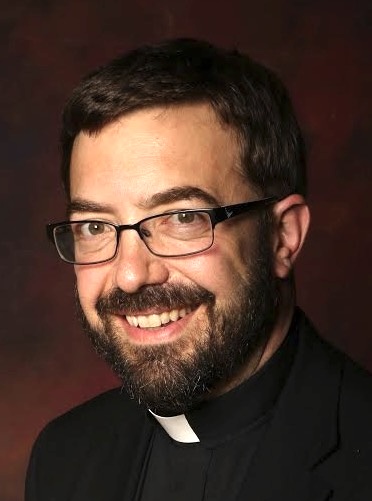
Fr. Andrew Ricci
1st Reading – Isaiah 6:1-2a,3-8
- The Seraphim cry out “Holy, holy, holy is the Lord of hosts!” as they worship the Lord upon the throne of heaven.
- When asked who will go, the prophet cries out, “Here I am, send me!”
Psalm – 138:1-5,7-8
- “In the sight of the angels I will sing your praises, Lord.”
- We praise and thank God who responds to us in kindness and truth.
2nd Reading – 1st Corinthians 15:1-11
- Paul hands on to the people what he has received, and he recounts the basic teaching about Jesus.
- Paul recognizes that he also has been called by God to preach the Good News.
Gospel – Luke 5:1-11
- Jesus gets into the boat of Simon and tells him to go back out into the water and lower his nets.
- After they caught a massive amount of fish, Peter tells Jesus to depart. The Lord, however, invites those present to cast off fear and follow him.
Fr. Andrew Ricci, ordained in 1997, is a priest for the Diocese of Superior. He is the Rector of the Cathedral of Christ the King.
SOURCE: Study, Pray, Serve


Bulletin Inserts




Christ in Our Neighborhood

Our Sunday Readings
Edrianne Ezell
Commentary, Questions & Prayer

Scripture Study

Lectionary Commentary
Fr. Tobin
Echoing God’s Word
Fr. Thibodeau
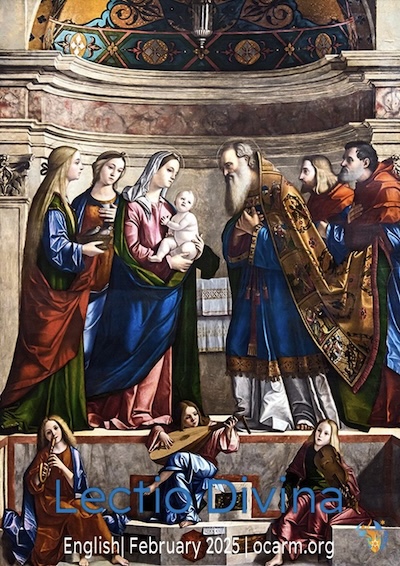
Carmelite Lectio Divina
Reflections and Prayers
77 page PDF with refections and prayers for each day of the month.
Lectio Divina February 2025 (PDF)
Lectio Divina February 2025 [Mobi]
Lectio Divina February 2025 [ePub]
“Lectio divina is an authentic source of Christian spirituality recommended by our Rule. We therefore practise it every day, so that we may develop a deep and genuine love for it, and so that we may grow in the surpassing knowledge of Christ. In this way we shall put into practice the Apostle Paul’s commandment, which is mentioned in our Rule: “The sword of the Spirit, too, which is the word of God, is to dwell abundantly in your mouth and in your hearts; and whatever things you have to do, let them be done in the word of the Lord.” (Carmelite Constitutions (2019), n. 85.)
Source: Carmelites


Social Media /
Bulletin Inserts
“Holy, holy, holy is the Lord of hosts! All the earth is filled with his glory!” (Isaiah 6:3)
Caption: Every moment in creation is a testimony to God’s holiness. Embrace the divine beauty around you.
Reflection Question: How can you find and celebrate God’s glory in your everyday life?
“Then I heard the voice of the Lord saying, ‘Whom shall I send? Who will go for us?’” (Isaiah 6:8)
Caption: God calls each of us by name with a purpose only we can fulfill. Are you ready to say, “Here I am, send me”?
Reflection Question: What is your response to God’s call in your life, and how can you act on it today?
“And I said, ‘Here I am, send me!'” (Isaiah 6:8)
Caption: Courage begins with a simple “yes” to God’s calling. Embrace your mission with faith and confidence.
Reflection Question: What mission do you feel called to undertake, and how can you begin your journey?

Unlike any other prophet, Isaiah receives his prophetic call in a vision during Temple worship. Jews believed that God “dwelled” on earth (i.e., the place they knew God was present) in the Temple. They also believed that the Temple itself was a mirrored image of God’s heavenly court. In Isaiah’s vision, the Temple does indeed become God’s Holy court.
As an observer, Isaiah does not see God directly, only the train of his garment (i.e, his glory). [1] Seraphim have six wings: two to hover with, two to cover their faces (so they would not see God’s glory and die), and two to cover their feet (i.e, their genital area for modesty’s sake). The angels cry out their worship; their words have been incorporated into our “Hosanna” at Mass. In response to their words, the doors shook (an earthquake?) and smoke filled the Temple; for the people of the time, an earthquake and smoke were both signs of divine presence. [2-5]
In the presence of God, Isaiah was anxious for his life because, in the face of such divine power, he could die. He was one of the sinful people who spoke with “unclean lips” (i.e., those who said one thing and did another). But his “sin” is removed by the touch of a burning coal to his lips; now Isaiah would only speak the truth and be single hearted. With this sin removed he could speak in the holy court. [6-7]
Permission for use. All materials found in word-sunday.com are the property of Larry Broding (Copyright 1999-2025). Viewers may copy any material found in these pages for their personal use or for use in any non-profit ministry.
Isaiah 6:1-2a, 3-8
Isaiah’s Commission

I. The Vision of God’s Majesty (Isaiah 6:1-4)
- In the year King Uzziah died, Isaiah sees the Lord seated on a high throne (v. 1).
- Seraphim attend to the Lord, calling out “Holy, holy, holy!” (v. 2-3).
- The foundations of the threshold shake, and the temple fills with smoke (v. 4).
II. Isaiah’s Sense of Unworthiness (Isaiah 6:5)
- Isaiah laments his unworthiness, as he belongs to a people with unclean lips (v. 5).
III. Isaiah’s Purification and Commissioning (Isaiah 6:6-8)
- A seraphim touches Isaiah’s lips with a burning ember, cleansing his sin (v. 6-7).
- Isaiah responds to God’s call, offering himself for service (v. 8).
IV. The Mission and Message (Isaiah 6:9-10)
- God commissions Isaiah to speak His message to the Israelites, yet warns that they will not heed the warning (v. 9-10).
- Despite this, Isaiah’s mission remains to proclaim the divine message, serving as a prophet and a witness for God.
Clipart by Fr. Richard Lonsdale
Scriptures in Context
Fr. Paul Galeto, OSA


Fr. Paul Galetto, OSA
Catholic Sunday Scriptures in Context
Unclean Lips

Click on slide for larger image.
The Burning Coal
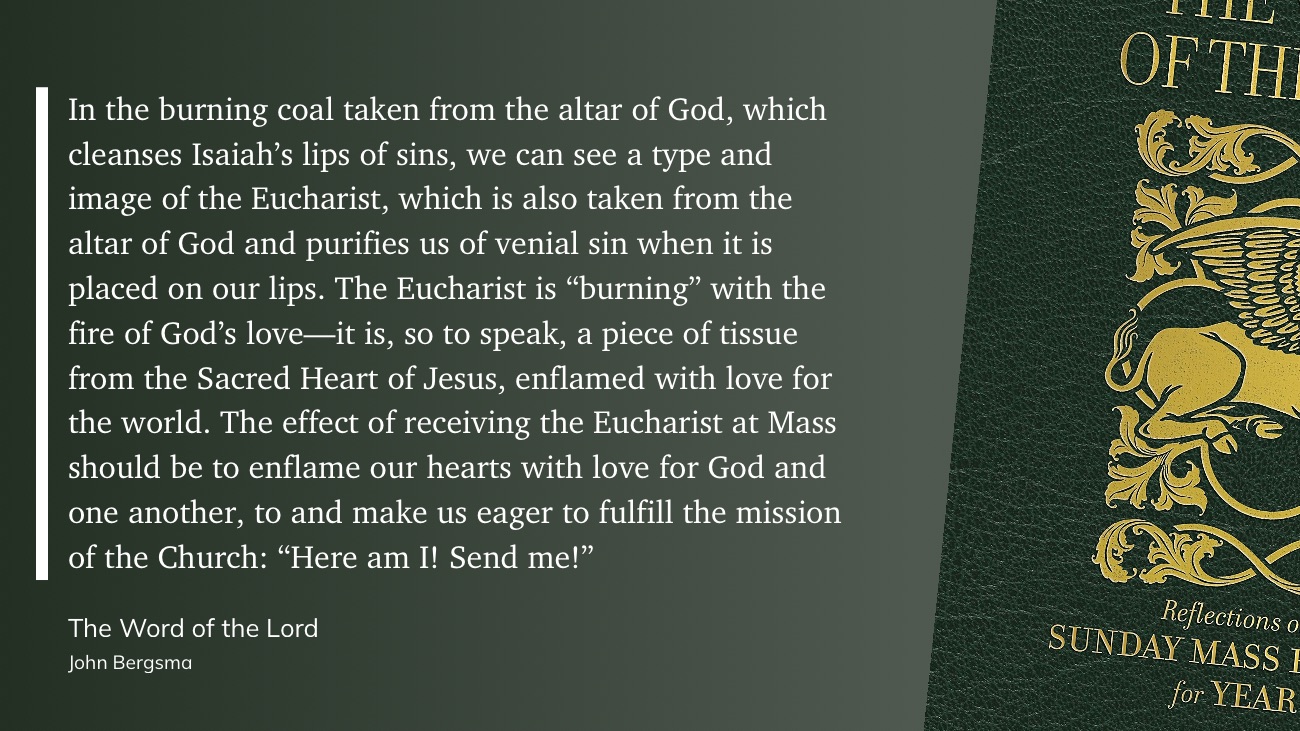
Click on slide for larger image.
Holy, Holy, Holy

Click on slide for larger image.
Bible Study Notes (PDF)
PDF Handout

- The Jerome Biblical Commentary,
- The New Jerome Biblical Commentary, and
- The Navarre Bible.
SOURCE: St. Charles Borromeo Catholic Church (Picayune, MS)

Isaiah's Vision of the Heavenly Court and his call to Divine Service
EXCERPT: In the First Reading, in the 8th-century BC, God transported Isaiah into His holy, heavenly Sanctuary to commission Isaiah to be His prophet and speak His words to the covenant people of Israel. The experience of coming into the presence of the holy and eternal God was overwhelming for Isaiah. He was immediately ashamed of his sinfulness and human inadequacy. In response to Isaiah's shame and repentance, God, in His grace, purified Isaiah and forgave his sins, spiritually preparing Isaiah to take up his mission. He immediately answered God's call to servanthood by responding, "Here I am...send me!" It is a response all professed Christians must be ready to make.
SOURCE: Agape Bible Study Copyright © 2015; revised 2024 (Used with permission.)
Add your own commentary.

Social Media /
Bulletin Inserts
“For I handed on to you as of first importance what I also received…” – 1 Cor 15:3
Caption: Pass on what truly matters. What are you passing on today—fear or faith, doubt or hope?
Question for Reflection: How can you ensure that the legacy you leave will inspire others to follow their faithful calling?
“…that Christ died for our sins in accordance with the scriptures.” – 1 Cor 15:3
Caption: Remembering the ultimate sacrifice fuels our lives with purpose and gratitude.
Question for Reflection: How does remembering Christ’s sacrifice change the way you face challenges today?
“…he appeared to Cephas, then to the Twelve.” – 1 Cor 15:5
Caption: Acknowledge the power of divine encounters. They remind us that we are never alone.
Question for Reflection: When have you felt like you were seen and understood in moments of struggle?
“…by the grace of God I am what I am…” – 1 Cor 15:10
Caption: Being yourself is a testament to His grace. Celebrate your unique journey of faith.
Question for Reflection: What aspects of your identity have been transformed through faith, and how can you share that transformation with others?
15:1 “Good News” is “evangelion” in Greek. So, the next phrase “that I evangelized among you” is redundant; the verb “evangelize” the verb form of the noun “evangelion.” Paul used this language for emphasis.
15:1-2 This sentence focused on Paul’s “evangelion” (i.e., Good News). After the main clause, he built an “A-B-A” structure. His preaching of the Good News (“evangelized”) forms the “A” that highlighted the origin of the community (“(that) which you received”), its reason for being (“in which having stood”), and its direction (“through which you are being saved”). In other words, the Good News Paul preached resulted in the establishment of the community at Corinth and the salvation of that community. If the members deviated from that Good News, their faith was in vain.
Permission for use. All materials found in word-sunday.com are the property of Larry Broding (Copyright 1999-2025). Viewers may copy any material found in these pages for their personal use or for use in any non-profit ministry.
1 Corinthians 15: 1-11
The Centrality of the Resurrection

I. The Gospel Paul Received and Proclaims (1 Corinthians 15:1-3)
- Reminding them of the gospel he preached to them (v. 1)
- The core message: Jesus died for our sins, was buried, and raised on the third day (v. 3-4)
II. Post-Resurrection Appearances of Christ (1 Corinthians 15:5-8)
- List of appearances to Cephas (Peter), the Twelve, and various other disciples (v. 5-7)
- Last appearance to Paul, as one “abnormally born” (v. 8)
III. Paul’s Self-Perception: Unworthy Yet Called (1 Corinthians 15:9-10)
- Paul declares himself the least of the apostles, not deserving the title (v. 9)
- Yet, by God’s grace, he worked harder than others (v. 10)
IV. Unity in Proclaiming the Risen Christ (1 Corinthians 15:11)
- Acknowledgement that the message is shared by all apostles, including Paul (v. 11)
- Emphasis on the collective mission to spread the Gospel and the central role of the resurrection
Clipart by Fr. Richard Lonsdale
Scriptures in Context
Fr. Paul Galeto, OSA

Fr. Paul Galetto, OSA
Catholic Sunday Scriptures in Context
Primacy of Peter

Click on slide for larger image.
Why Did Christ Become Human?
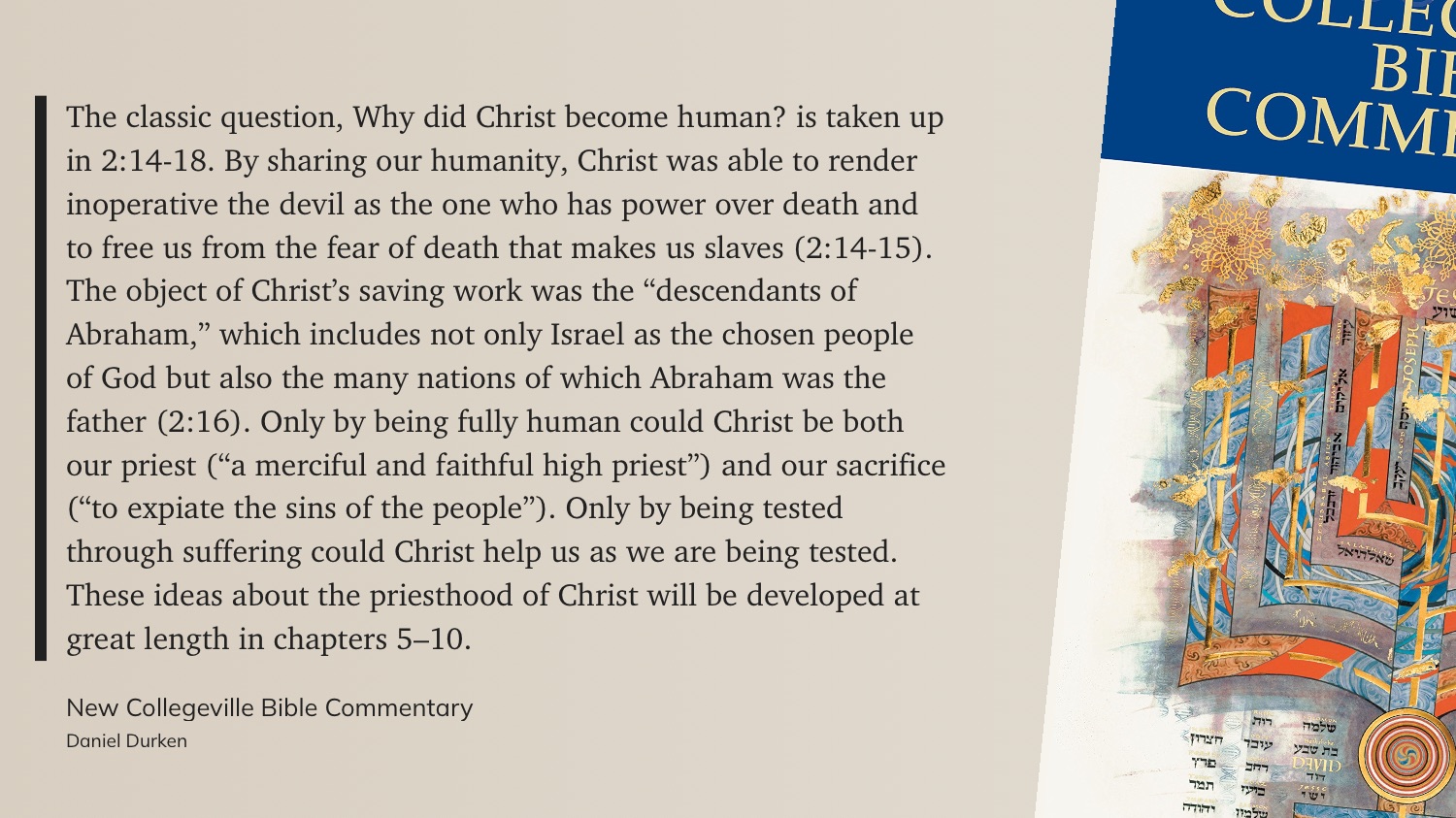
Click on slide for larger image.
Bible Study Notes (PDF)
PDF Handout
- The Jerome Biblical Commentary,
- The New Jerome Biblical Commentary, and
- The Navarre Bible.
SOURCE: St. Charles Borromeo Catholic Church (Picayune, MS)
Paul's Mission to Share the Gospel
EXCERPT: In the Second Reading, St. Paul recalls his experience when he encountered the Resurrected Christ who called him to discipleship. Paul admits his inadequacy to be called an apostle because he had persecuted the Church before his conversion. However, he says, Christ forgave him, and Paul testifies that he has effectively answered his divine calling because of God's grace.
SOURCE: Agape Bible Study Copyright © 2015; revised 2024 (Used with permission.)
Social Media /
Bulletin Inserts
“Put out into deep water and lower your nets for a catch.” – Luke 5:4
Caption: Sometimes, taking risks can lead to the most bountiful rewards. Trusting in guidance beyond your understanding may be the leap you need to uncover your potential.
Reflection Question: What ‘deep water’ in your life could use a leap of faith today?
“Master, we have worked hard all night and have caught nothing, but at your command, I will lower the nets.” – Luke 5:5
Caption: Persistence paired with faith can transform empty nets into overflowing blessings. Don’t let past disappointments deter you from trying once more.
Reflection Question: Where in your life are you being called to trust and try again?
“They caught such a great number of fish that their nets began to tear.” – Luke 5:6
Caption: When you align your efforts with faith and purpose, the outcomes can exceed your imagination. Remember, the biggest breakthroughs often come after you’ve given it your all.
Reflection Question: How can you align your efforts with your faith today?
“When they brought their boats to the shore, they left everything and followed him.” – Luke 5:11
Caption: Commitment to a higher purpose often requires sacrifice and trust. What you leave behind pales in comparison to the fulfilling journey ahead.
Reflection Question: What are you willing to surrender to follow your calling faithfully?
5:1 “As the crowd pressed around HIM to hear the word of God” is literally “It happened in the crowd’s pressing about him and hearing the word of God.” The phrase”It happened” introduced the action of the crowd as a subordinate clause to the main focus: the action of Jesus. The verb “to hear” depends upon the verb “to press on.” The crowd came to hear Jesus by the shore of Lake Gennesaret (also known as the “Sea of Galilee”), a freshwater lake that feeds the Jordan river.
5:2 “But the fisherman, having left (the boats) were washing the nets” The fishermen docked the boats, then washed their nets away from the boats. They were cleaning up after an early morning’s work and getting ready to go home.
5:8 “Simon Peter” Luke anticipated the name Jesus would give Simon later.
“Lord” The word “Lord” (“Kyrios” in Greek) is the standard title given to God (and, in Christianity, to Jesus). This title was different from the one Simon gave Jesus in 5:5. At the point of the great catch, Simon understood the source of Jesus’ power: God the Father.
“I am a sinner!” Simon did not reflect on his own sinfulness, but upon his lower class status. Only the holy could perform such miracles. Fishermen were a gruff lot, unworthy of such a godly man as Jesus.
5:10b “you will capture men alive” Using a fishing analogy, Jesus invited Simon to follow him. Evangelization is at the core of the discipleship.
Permission for use. All materials found in word-sunday.com are the property of Larry Broding (Copyright 1999-2025). Viewers may copy any material found in these pages for their personal use or for use in any non-profit ministry.
Luke 5:1-11
The Call of the First Disciples

I. Setting the Scene: Fishing at Lake Gennesaret (Luke 5:1-3)
- Jesus encounters a crowd by the lake, stepping into Simon Peter’s boat (v. 1-2)
- Jesus teaches from the boat, then instructs Peter to lower the nets for a catch (v. 3)
II. The Miraculous Catch and Peter’s Response (Luke 5:4-9)
- Despite initial hesitation, Peter follows Jesus’ command, resulting in an abundant catch (v. 4-6)
- Amazed, Peter realizes his own sinfulness in the presence of Jesus (v. 7-8)
- Jesus reassures Peter, commissioning him and his companions as fishers of men (v. 9-10)
III. Departing the Shore: Following the Call (Luke 5:11)
- Peter, James, and John leave everything behind and follow Jesus (v. 11)
- Their immediate response highlights their trust and obedience in answering the divine call
Clipart by Fr. Richard Lonsdale
Scriptures in Context
Fr. Paul Galeto, OSA

Fr. Paul Galetto, OSA
Catholic Sunday Scriptures in Context
“Numinous Awe”

Click on slide for larger image.
The Work and Fate of Jesus
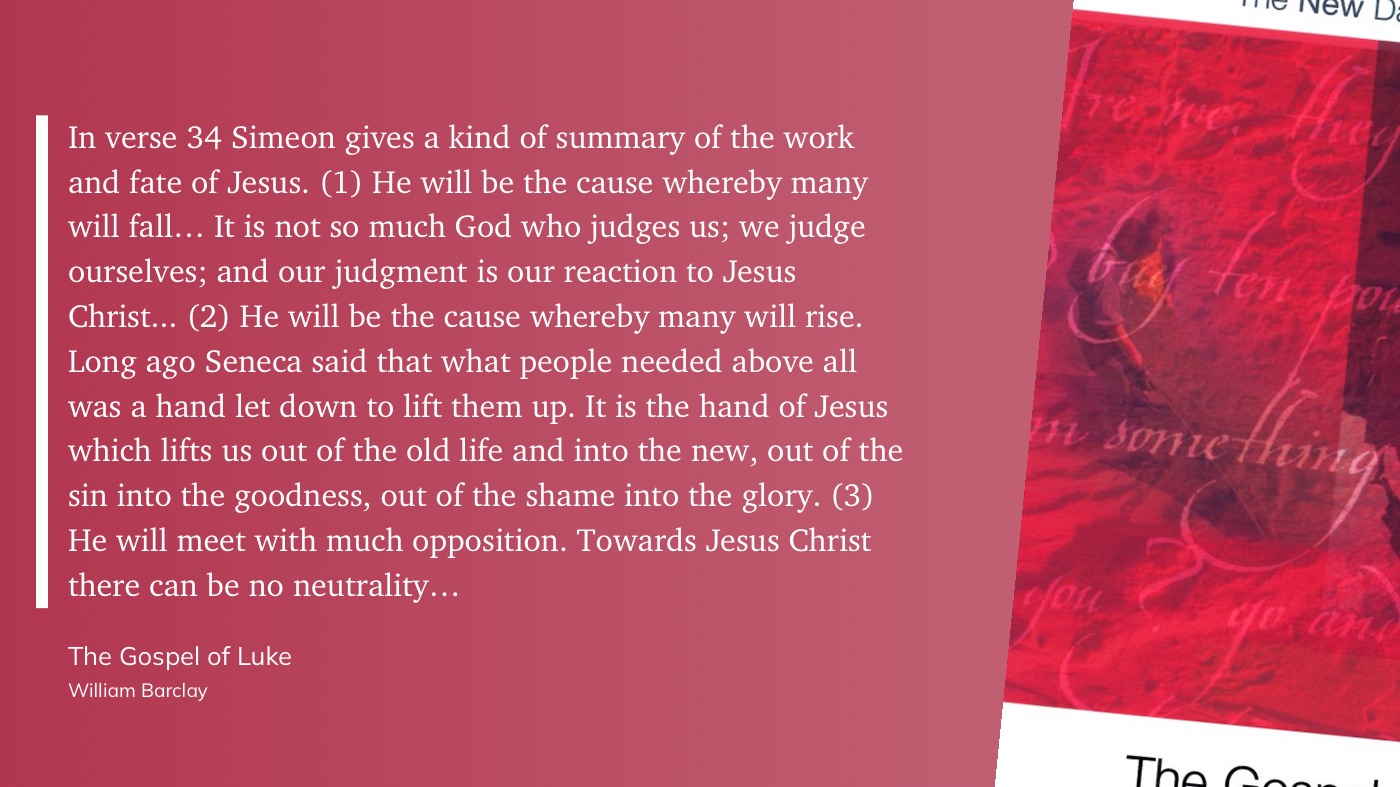
Click on slide for larger image.
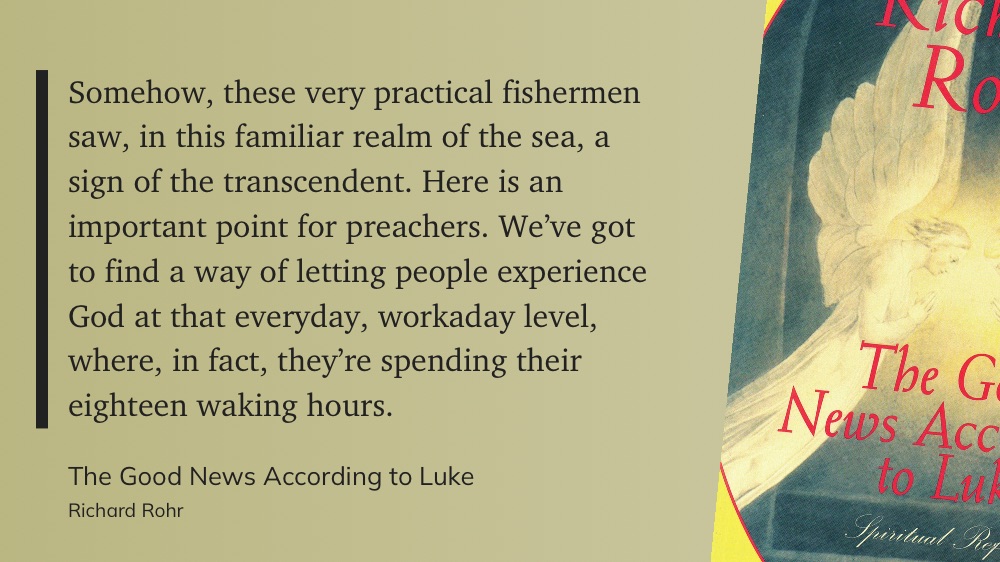
A Sign of the Transcendent
Click on slide for larger image.
“Duc in Altum”

Click on slide for larger image.
Double Changes of Name

Click on slide for larger image.
Bible Study Notes (PDF)
PDF Handout
- The Jerome Biblical Commentary,
- The New Jerome Biblical Commentary, and
- The Navarre Bible.
SOURCE: St. Charles Borromeo Catholic Church (Picayune, MS)
HISTORY
Luke 5:1-11 narrates the calling of Simon Peter and his companions as Jesus' first disciples. Set against the backdrop of the Roman occupation of Palestine, this event takes place in the region of Galilee, where Jesus began his public ministry.
As a Gospel writer, Luke addresses a primarily Gentile audience, emphasizing the universality of salvation and the inclusivity of God's kingdom. The calling of Simon Peter, a fisherman by trade, reflects Jesus' outreach to ordinary people, irrespective of their social or economic status.
The historical context of Roman rule and Jewish religious life provides a lens through which to understand the passage's significance. The calling of the first disciples symbolizes the beginnings of a movement that would challenge the political and religious establishment. In this sense, Luke's account of the calling of Simon Peter serves as a powerful reminder of the transformative potential of Jesus' message.
Furthermore, Luke's focus on Peter's confession of sinfulness (Luke 5:8) and the miraculous catch of fish (Luke 5:6) underscores the themes of repentance and discipleship that are central to the Gospel message. By contextualizing this event within the political and cultural landscape of the time, Luke emphasizes the relevance of Jesus' teachings for the diverse audience of his Gospel.
SOCIETY
Luke 5:1-11, which narrates the calling of Simon Peter and his companions as disciples, reflects the sociocultural context of the early Christian community. Set in a fishing village by the Sea of Galilee, the passage highlights the significance of fishing as a profession and its cultural connotations.
In the ancient Near East, fishing was often associated with subsistence living and lower social status. By calling Simon Peter, a fisherman, as his first disciple, Jesus challenges the prevailing social norms and affirms the value of all individuals, regardless of their occupation or status.
Luke's account also underscores the themes of repentance and transformation, which were central to the early Christian community. Simon Peter's confession of sinfulness (Luke 5:8) reflects the cultural understanding of sin and the need for spiritual purification. In this context, the passage emphasizes the importance of humility and openness to God's call, inviting the audience to examine their own lives and embrace the transformative power of faith.
Furthermore, the miraculous catch of fish (Luke 5:6) serves as a powerful symbol of God's abundant provision and the blessings that come with following Jesus. This theme would have resonated with Luke's original audience, offering encouragement and hope as they faced the challenges of their daily lives.
Overall, the sociocultural context of Luke 5:1-11 enhances our understanding of the passage's message, highlighting the importance of humility, repentance, and trust in God's provision as key aspects of Christian discipleship.
THEOLOGY
Luke 5:1-11, which recounts the calling of Simon Peter as a disciple, offers rich theological insights and relevance for contemporary Catholics. The passage emphasizes the centrality of discipleship and personal transformation in the life of faith.
In Catholic theology, discipleship involves following Jesus and embracing his teachings as a guiding principle for daily living. Simon Peter's response to Jesus' call (Luke 5:5) exemplifies the obedience and humility required of all who seek to follow Christ. By highlighting these virtues, the passage invites Catholics to reflect on their own commitment to discipleship and the ways in which they can grow in faith.
The passage also underscores the themes of repentance and forgiveness, which are central to Catholic sacramental life. Simon Peter's confession of sinfulness (Luke 5:8) reminds us of the ongoing need for conversion and spiritual renewal. In this context, contemporary Catholics are encouraged to participate in the Sacrament of Reconciliation, through which they can experience God's healing and mercy.
Moreover, the miraculous catch of fish (Luke 5:6) symbolizes the abundance and blessings that come with following Christ. This theme resonates with the Catholic understanding of grace, which enables individuals to live as faithful disciples and contribute to the building of God's kingdom.
In essence, Luke 5:1-11 offers a powerful message of discipleship and transformation that remains relevant for Catholics today. By embracing the virtues of humility, repentance, and trust in God's provision, we can deepen our faith and become instruments of hope and healing in the world.
Jesus Calls Simon-Peter to Discipleship
EXCERPT: In the Gospel Reading, St. Simon-Peter has an experience similar to the divine calls of Isaiah and St. Paul. As he stood on the shore of the Sea of Galilee, Peter was overwhelmed by his sinful human nature when confronted by the sinless Messiah, Jesus of Nazareth, who called Peter to "Follow Me!" Falling on his knees in repentance, Peter was embarrassed by his sins and asked the sinless Christ to depart from him. But Jesus extended His divine grace to Peter, calming his fears and answering that he would be successful in his mission to serve the Lord as "a fisher of men." Peter would call the men and women of his generation to faith in believing that Jesus is the promised Davidic Redeemer-Messiah bringing salvation not only to Israel but also extending His gift of salvation to all men and women in the human family.
What is so extraordinary concerning the call to discipleship to these three men is that they had the faith and courage to leave everything in their past life behind to follow God's divine invitation. However, their experience is not unique. Throughout salvation history, God continues to call faithful men and women to discipleship and take up the mission to carry the Gospel of salvation to the ends of the earth. Have you answered that same invitation to offer your life in service to the Lord God to share the good news of His Gospel of salvation in your family, your community, and the world? Have you been willing to leave behind what is temporal in this life to seek what is eternal in the next life?
SOURCE: Agape Bible Study Copyright © 2015; revised 2024 (Used with permission.)

SCRIPTURE
SEARCH
FIRST READING (88)
SECOND READING (118)
GOSPEL (21)
This tool created by Jeff Pinyan uses the CCEL Early Church Fathers digital edition of the Philip Schaff collection.
5th Sunday of Year C
Catena Aurea
The Catena Aurea, which means “Golden Chain” in Latin, is a comprehensive biblical commentary comb is a 13th-century biblical commentary compiled by St. Thomas Aquinas. This anthology features insights from over eighty Church Fathers on the four Gospels.