August 17, 2025
August 17, 2025


Homilies
Homilies
- BISHOP Barron
- 2-Min Homily
- FR. RUTTIG
- MSGR. Hahn
BISHOP
BARRON

20th Sunday of Year C

This discussion guide has been generated by GOOGLE'S AI Gemini 2.5 Flash LLM.

Opening Prayer
Heavenly Father, we thank you for the gift of your Word and for the wisdom of Bishop Barron. As we gather to discuss this sermon, we ask that you open our minds and hearts to your truth. Help us to embrace the challenging, disruptive, and cleansing fire of your love, that we may be more faithful disciples. Amen.
Sermon Summary
In this sermon, Bishop Barron reflects on the sometimes difficult and challenging nature of authentic religion. Drawing from the readings of Jeremiah and the Gospel, he explains that the truth of the Gospel can be disruptive, burning away what is false in our lives and in the world. He argues that this "cleansing fire" of faith is not meant to make us comfortable, but to call us to a deeper and more profound discipleship. The sermon highlights that those who speak and embody the truth will often face opposition, and that this is a sign of an authentic, living faith.
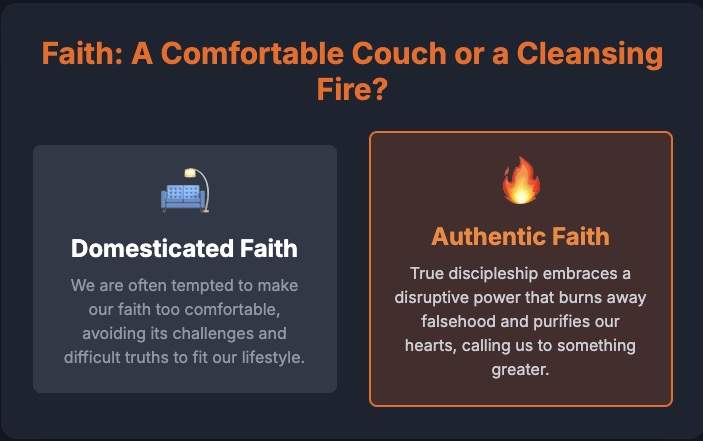
Key Themes & Scripture
- The Disruptive Nature of Truth: The idea that authentic religion isn't always easy or comforting; it challenges the status quo.
- The Cleansing Fire of God: Faith as a force that purges what is unholy and purifies our hearts.
- The Cost of Discipleship: The reality that following Christ often means facing opposition, as seen in the lives of the prophets and in Jesus' own life.
- Scripture: The sermon draws from the book of Jeremiah and a Gospel reading (likely from Luke, given the context), which both demonstrate the challenging nature of prophetic truth.
Discussion Questions
- What was your initial reaction to the sermon's main theme of faith as a "disruptive, burning, cleansing" force? Did this idea surprise or resonate with you?
- Bishop Barron mentions that those who embody the truth will often face opposition. Can you think of examples of this in the Bible, in history, or in your own life?
- The sermon suggests that religion is not meant to be "easy." In what ways do you think we are tempted to domesticate our faith and make it too comfortable?
- What does it mean to you, personally, to have Christ "light a fire in you"? What aspects of your life might need to be cleansed or purified by this fire?
- How can we, as individuals and as a community, embrace the challenging aspects of our faith and live out a more authentic and courageous discipleship?
- The sermon connects the prophetic message with Christ's own challenging words. How does understanding Jesus as a prophet-king change your perspective on his teachings?
Closing Prayer
Lord Jesus Christ, you are the fire that burns away our sin and the truth that challenges our comfort. We thank you for this time of reflection and discussion. Help us to go forth from this place with courage, ready to follow you and to be a light for others in the world. We ask this in your holy name. Amen.
Access guide and infographics by clicking on banner

In this homily, Bishop Robert Barron addresses Jesus's challenging words from Luke 12:49-53. He argues that Jesus's mission is not about bringing a cozy, gentle peace, but a dangerous, transformative fire that reveals the truth and causes division. This guide breaks down his key arguments for reflection and conversation.

Bishop Barron starts by clarifying that Jesus's fire is not a gentle flame but a force meant to set the world ablaze, leading to division. This clashes with a popular view of Jesus as a non-threatening, "Mr. Rogers-like" figure.
- Initial Reaction: What was your first reaction to Jesus's words: “I have not come to establish peace on the earth, but rather division”? How does this challenge or confirm your understanding of him as the Prince of Peace?
- The Nature of the Fire: Bishop Barron distinguishes between a "cozy campfire" and a fire that sets the world ablaze. What does he mean by this, and what kind of "fire" do you think Jesus's message has brought into the world?
The homily explains that the division Jesus brings is a direct result of him being the divine Light. To those in darkness, this light is not a comfort but a source of pain and discomfort, like a person in a cave being rescued into the sun.
- The Cave Analogy: How do you relate to the image of being pulled out of a dark cave into a bright light? In what ways has the truth of the Gospel felt like a difficult or painful light in your own life?
- Misery Loves Company: Bishop Barron says that a person having a bad day is bothered by happy people. How is this like a sinner’s reaction to Jesus? Where do you see this kind of discomfort or opposition to the Gospel today?
The homily connects Jesus's words to the prophet Jeremiah, who was hated and thrown into a muddy cistern for speaking God’s unpopular truth. This serves as a model for authentic Christian witness.
- Speaking Unpopular Truths: What is a time you have experienced or witnessed the "mud" being slung at someone for preaching the authentic Gospel? What makes it so difficult to speak a truth that others do not want to hear?
- The Real vs. "Fake" Gospel: Bishop Barron claims that preaching a "tickle-the-ears" message is easy, while preaching the real Gospel is hard. What are some examples of messages that might "tickle the ears" but don’t challenge people to live authentically?
Ultimately, Bishop Barron concludes that the fire and division are not the final goal but a necessary step. The fire is meant to purify, burning away our sin so we can live according to God's will and "run the race" of faith.
- A Necessary Cleansing: Why is a "cleansing fire" necessary for the soul? What does the homily suggest we need to "burn away" in our own lives?
- Good News as Bad News: The good news of Jesus's coming is initially heard as "bad news" by those running in the opposite direction. Can you give an example of how this might look in your own life or in the lives of those around you?
Access guide and infographics by clicking on banner
TWO MINUTE
HOMILY

20th Sunday of Year C

This discussion guide has been generated by GOOGLE'S AI Gemini 2.5 Flash LLM.
Opening Prayer
Gracious and loving God, we thank you for the gift of your Word and for the message we have just heard. As we begin our discussion, we ask that you open our hearts and minds to the difficult truths Fr. Brannelly has presented. Help us to embrace the challenging aspects of our faith and to live our lives in a way that truly reflects your love and justice. We ask this in the name of Jesus, your Son. Amen.
Homily Summary
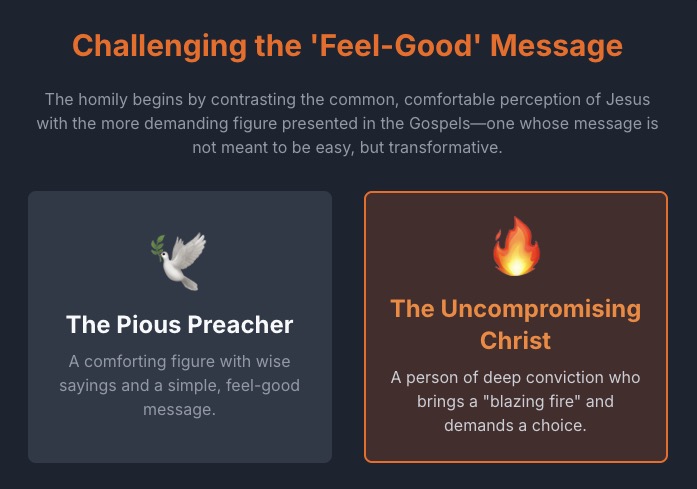
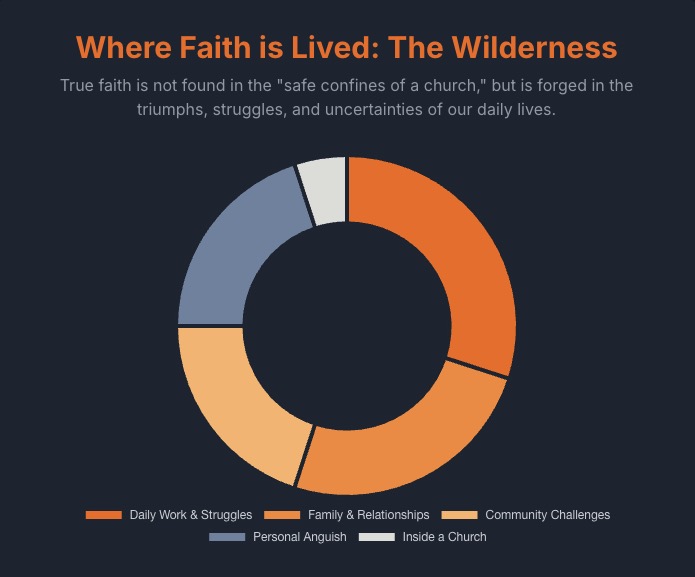
In this homily, Fr. Brannelly challenges the common perception of Jesus as a "pious itinerant preacher" with a feel-good message. He focuses on the Gospel readings which portray a more demanding and disruptive Jesus, who brings "a blazing fire upon the earth" and "discord" to families. Fr. Brannelly explains that this is because Jesus was a person of deep conviction who would not compromise on what truly mattered. He argues that authentic faith is not a safe, comfortable experience, but a transformative force that demands we make difficult choices, leading us to live justly and love as God loves, even if it causes conflict with others. True faith, he concludes, is found not in the "froth and bubble" of religion, but in the struggles and challenges of our daily lives, where God's unwavering love is our only constant.
Key Themes
- The Uncompromising Nature of Jesus: Jesus was not "just an inquiring neutral" but a person of deep convictions who would not compromise on essential truths.
- Discord vs. Peace: Jesus' teachings sometimes cause division, even within families, because they challenge worldly values and demand a choice.
- The Consequences of Authentic Faith: Living out our faith in the real world can "enrage those around us" when we refuse to go along with popular trends or unjust practices.
- The Choice We Face: We are called to choose between God's lasting providence and fleeting, worldly values and wealth.
- Faith in the Wilderness: Authentic faith is not found in the "safe confines of a Church" but is lived out in the daily "struggles, the triumphs, the uncertainties, and the anguish."

Discussion Questions
- Fr. Brannelly challenges the idea of Jesus as a "feel good" preacher. How has this more challenging image of Jesus impacted your understanding of faith?
- Jesus says he has come to bring not peace, but discord. Can you think of a time when living your faith authentically caused a disagreement or division with someone you know?
- The homily mentions that Jesus' teachings "enraged the religious and political power brokers of His day." How do you think a truly authentic faith might challenge our own society's power structures or cultural norms today?
- Fr. Brannelly gives examples of living out faith, like refusing to "condemn that person because he or she is different" or going out of your way to be inclusive. What are some other modern-day examples of living justly that might be difficult?
- What do you think is the difference between the "froth and bubble of faith" and the true "consequences of living out faith" that Fr. Brannelly describes?
- The homily concludes that God's unwavering love is the "one constant" that makes sense of our journey. How does this idea of a constant, guiding love help you navigate the struggles and disappointments of a challenging week?
Closing Prayer
Lord, we thank you for this time of sharing and for your challenging and uncompromising love. As we go forward into the coming week, help us to be courageous in our convictions. Give us the strength to live out our faith authentically, not as an easy habit, but as a living fire. We ask this through Christ our Lord. Amen.
Access guide and infographics by clicking on banner

This discussion guide has been generated by GOOGLE'S AI Gemini 2.5 Flash LLM.
Key Takeaways from the Homily:
- The Prophetic Voice: The homily draws a direct line from the Old Testament prophet Jeremiah, who was persecuted for speaking unpopular truths, to contemporary individuals who advocate for marginalized communities. The core idea is that a prophetic role involves speaking for those who have no voice, and that this act of truth-telling can be met with ridicule and resistance.
- The "Division" of the Gospel: Fr. Moloney reinterprets Jesus's statement about bringing "division" not as a call to strife, but as the inevitable consequence of a commitment to justice and human dignity. When one stands firm on the side of the vulnerable, it can create a separation from those who are comfortable with the status quo or who have a different set of priorities.
- The Humanity Behind the Slogan: A critical point is the homily's challenge to look beyond dehumanizing labels and political rhetoric. It argues that issues concerning indigenous peoples, refugees, asylum seekers, and victims of war are not abstract concepts but involve real people, families, and stories that demand our empathy and attention.
Deepening the Discussion:
1. The Courage to be a Prophet:
- Fr. Moloney connects speaking out for justice with the experience of the prophet Jeremiah. Can you think of historical or modern figures who you believe embody this "prophetic voice" in their advocacy for the marginalized?
- The homily suggests this act of truth-telling can be divisive. In your own life, what are some of the fears or hesitations you might have when considering speaking up for a cause you believe in, especially if it's unpopular?
- How can a community of faith support individuals who feel called to be a prophetic voice, and what are the challenges to doing so?
2. The Nature of "Division":
- Jesus says he has come to bring not peace but division. Fr. Moloney interprets this as a division between those who stand with the vulnerable and those who don't. Do you agree with this interpretation? How does it change your understanding of this challenging gospel passage?
- Can a person's silence be a form of taking a side in this "division"? In what situations might our silence be more than just neutrality?
- The homily calls us to be on the side of the marginalized. What does that mean in a practical sense, beyond simply agreeing with a cause? How can one's faith life be a source of strength for this commitment?
3. From Slogans to Humanity:
- The homily emphasizes the importance of seeing the humanity behind issues like refugees or asylum seekers. How do political slogans and media portrayals often strip these individuals of their humanity?
- Think about an issue that is often discussed in a polarized way. How can we, as individuals, work to "see the human story" in that issue and encourage others to do the same?
- What are some ways we can move from passive consumption of information about marginalized groups to actively listening to their stories and engaging with them on a human level?
4. Personal Reflection and Action:
- The homily implicitly asks us to examine our own level of comfort and how it might prevent us from taking action. What is a personal belief or comfort zone that you feel challenged to move beyond after hearing this homily?
- The homily suggests that our faith should lead us to care for the vulnerable. What is one specific, tangible action you can commit to this week to put this teaching into practice? This could be a prayer, a conversation, an act of charity, or an act of advocacy.
Access guide and infographics by clicking on banner
FR. KEVIN
RUTTIG
20th Sunday of Year C

This discussion guide has been generated by GOOGLE'S AI Gemini 2.5 Flash LLM.
Opening Prayer
Heavenly Father, we thank you for the gift of your Word and for the powerful message we've heard. As we begin our discussion, we ask you to open our hearts to the fire of your Holy Spirit. Help us to be lanterns that carry your love and hope into a world in need of healing. Grant us the courage to act in the face of fear and injustice. Amen.
Homily Summary
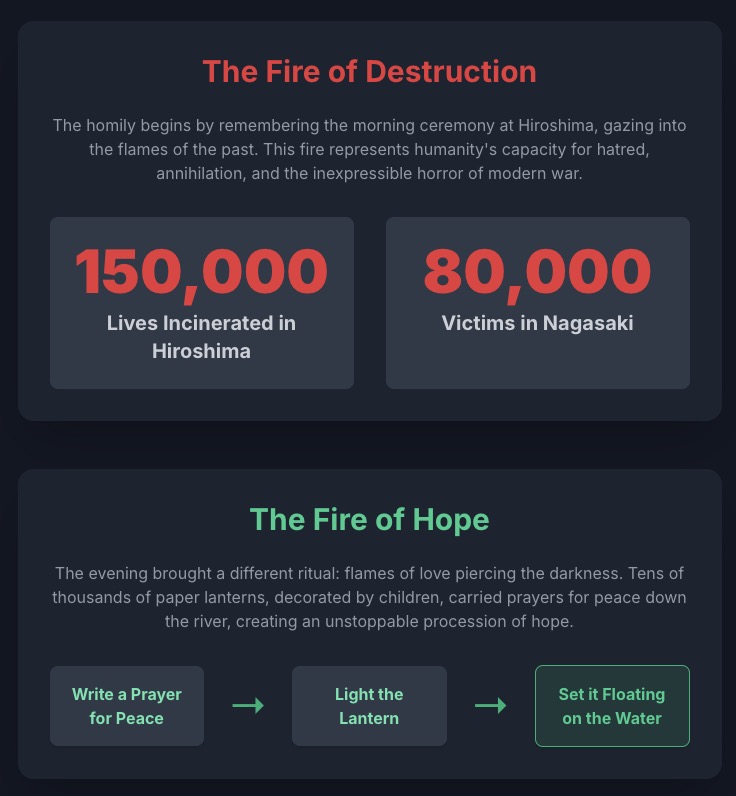
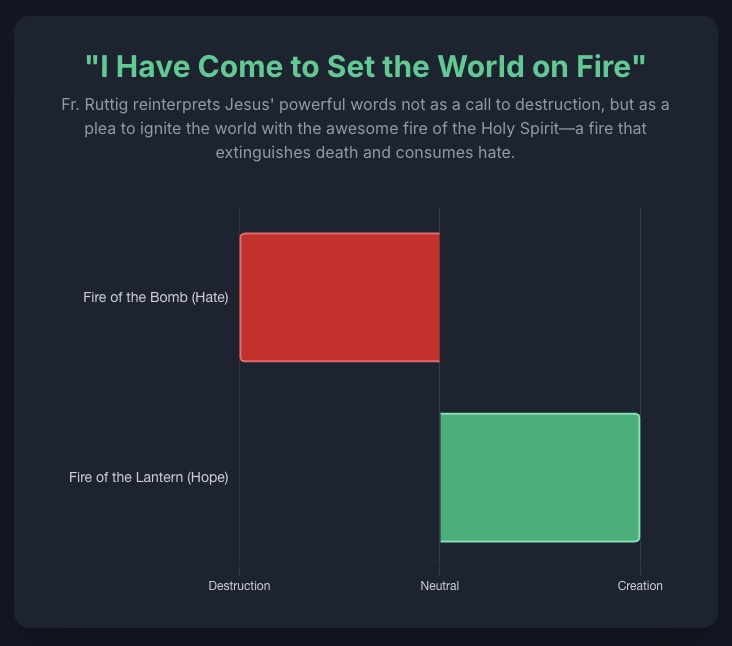
In his homily, Fr. Ruttig uses the moving commemoration of the atomic bombings of Hiroshima and Nagasaki as a powerful allegory for the state of our world and the call of the Gospel. He contrasts two "flames": the destructive, life-extinguishing fire of the bomb in the morning ceremony, which represents human hatred and the horror of war, with the life-giving, hope-filled fire of the lanterns in the evening ceremony. These lanterns, carrying personal prayers and pleas for peace, symbolize the awesome fire of God's love and hope. Drawing on the words of Jesus, "I have come to set the world on fire," Fr. Ruttig reinterprets this as a call not to destruction, but to an unstoppable, blazing fire of the Spirit that consumes hate and lights the way in the darkness. He concludes by challenging us to be the lanterns that carry this fire of peace and protest into a world that is perpetually at war with itself.
Key Themes & Scripture
- The Two Fires: The central metaphor contrasting the destructive fire of the bomb (hate, war, silence) and the creative fire of the lantern (love, hope, action).
- The Horror of War: A sober reflection on humanity's capacity for inexpressible evil and total self-destruction.
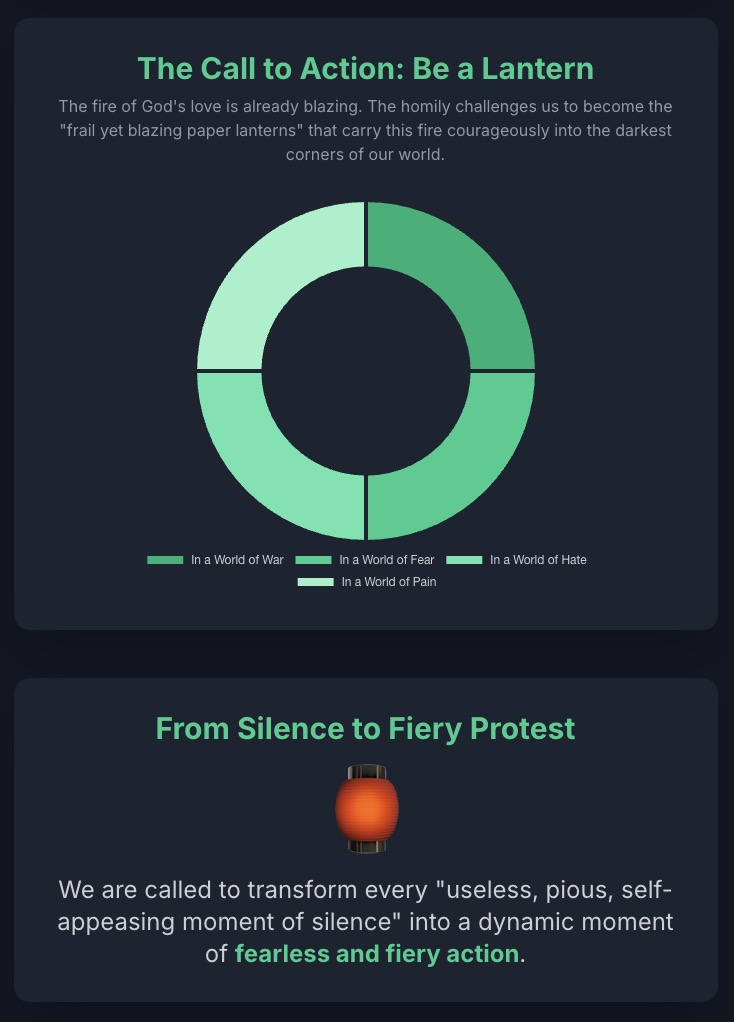
- Active vs. Passive Faith: The difference between a "useless, pious, self-appeasing moment of silence" and "fiery and passionate protest" and action.
- The Call to be a Lantern: The homily’s core challenge is that while the fire of God's love is already lit, we are the frail yet blazing paper lanterns meant to carry it.
- Scripture: The powerful, central phrase: "I have come to set the world on fire and how I wish it were already blazing."
Discussion Questions
- Fr. Ruttig describes two ceremonies: one gazing backward into the flames of destruction, and the other gazing at the peaceful procession of lanterns. How do these two images resonate with your own experience of both human conflict and divine hope?
- What does the phrase "I have come to set the world on fire" mean to you in the context of the two different "fires" described in the homily? How does this challenge a more comfortable or safe understanding of faith?
- The homily contrasts a passive "moment of silence" with a "dynamic moment of fiery and passionate protest." What are some ways we can move from silent observation to courageous, fiery action in our daily lives?
- Fr. Ruttig asks, "Who indeed will be its planters if not you and I?" What does it mean for you to be a "lantern" today, carrying a message of peace and hope to a self-destructing world?
- What are some of the "impenetrable darkness" and "skeletal relics" in our world or in our own hearts that the fire of the Holy Spirit needs to illuminate?
- The homily concludes with a call to set sail with the fire of love. What is one specific action you feel called to take this week to be a lantern in your community or your personal life?
Closing Prayer
Lord Jesus, you came to ignite the world with the fire of your love. We pray for the grace to be your instruments, your brave lanterns, in a world that so desperately needs your light. Strengthen us to carry your flame of hope into the darkness, and let it burn brightly in our hearts. We ask this in your holy name. Amen.shift their focus from external desires to internal fulfillment?
Access guide and infographics by clicking on banner

This discussion guide has been generated by GOOGLE'S AI Gemini 2.5 Flash LLM.
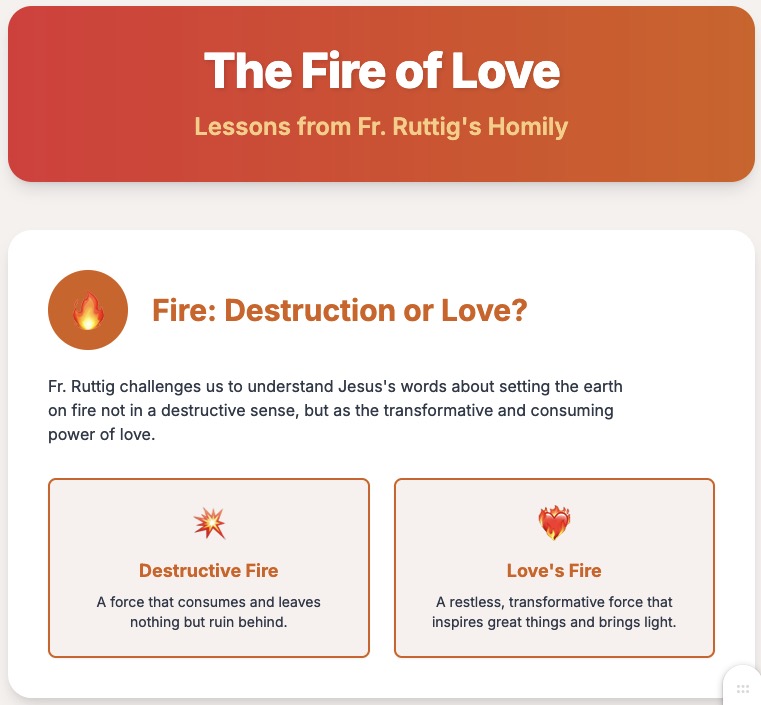
Part 1: Fire, Destruction, and Love
The homily opens with an anecdote about fire's destructive nature before shifting to Jesus's words about setting the earth ablaze. Fr. Ruttig suggests that only those who have been in love can truly understand this fire.
- Initial Thoughts: What was your first reaction to Jesus's words about setting the earth on fire? How does the homily's contrast of fire's destructive power and its transformative power of love resonate with you?
- A Restless Fire: Fr. Ruttig describes this fire of love as "not peaceful but restless." What do you think he means by this? How have you experienced the "restlessness" of a passionate love in your own life, whether for God or for others?
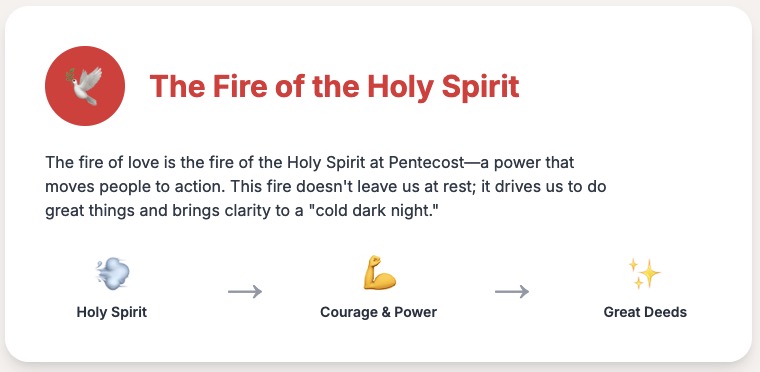
Part 2: The Fire of the Holy Spirit
The homily connects the fire of love to the fire of the Holy Spirit at Pentecost, describing it as a force that moves people and gives them courage.
- The Power of Pentecost: How does the image of the Holy Spirit's fire help you understand the power of God's love? How does this fire give us the courage to do great things?
- A Guiding Light: Fr. Ruttig mentions that this fire brings clarity in the "cold dark night of human existence." Can you recall a time when your faith gave you clarity or warmth in a difficult situation?
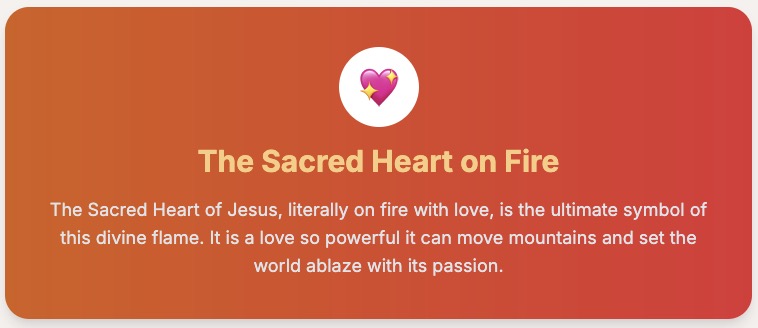
Part 3: The Sacred Heart on Fire
The homily concludes by reflecting on the image of the Sacred Heart of Jesus, which is literally on fire with love. Fr. Ruttig presents this as the ultimate symbol of a divine love that can move mountains and set the world ablaze.
- The Sacred Heart: What does the image of Jesus's heart on fire with love inspire you to do in your own life?
- Living with the Fire: How can we ensure that the "awesome flame of love" that Jesus desires to set in our hearts continues to blaze brightly in our daily lives?
Access guide and infographics by clicking on banner
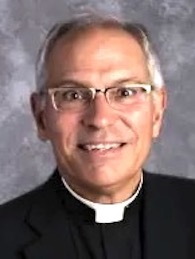
MSGR. PETER
HAHN
20th Sunday of Year C

This discussion guide has been generated by GOOGLE'S AI Gemini 2.5 Flash LLM.
Opening Prayer
Gracious God, we thank you for the gift of your Word and for the wisdom shared in this homily. As we reflect on the challenging path of faith, give us the grace to persevere. Help us to keep our eyes fixed on Jesus, our true source of peace, even amid the struggles and divisions we face. We ask this in your name. Amen.
Homily Summary
In this homily, Msgr. Hahn begins with a simple motivational saying from his youth: "The only place where success comes before work is in the dictionary." He applies this principle to the spiritual life, stressing that while God gives us "sufficient grace," we must be willing to work for our faith. He then tackles the perplexing Gospel reading where Jesus says he has come to bring not peace, but division. Fr. Hahn resolves this apparent contradiction by distinguishing between the goal of our Christian journey—eternal peace with Christ—and the journey itself, which is a path of trial, struggle, and suffering. He argues that like the prophet Jeremiah and Jesus himself, we are called to persevere and embrace the cross rather than succumbing to the temptation of complacency or compromise. The homily concludes by encouraging us to embrace the work of the cross, running the race of faith so that we may one day receive Christ's greatest gift of eternal life and peace.

Key Themes & Scripture
- Success and Work: The idea that success, especially spiritual success, requires determined and demanding work.
- Peace as the Goal, Division as the Path: While Christ is the Prince of Peace, the journey to that peace is full of hardship and division. This is an unavoidable step we must take.
- Perseverance as a Necessity: We are called to "persevere in running the race that lies before us," just as Jesus did, to reach the joy that lies ahead.
- Embracing the Cross vs. Complacency: The homily warns against the temptation to take an easy path of "complacency or compromise" that leads to an "illusory" peace.
- Scripture: The homily draws on the Gospel reading about Christ bringing division, the Letter to the Hebrews urging us to persevere and keep our eyes on Jesus, and the story of the prophet Jeremiah as an example of faithfulness amid suffering.

Discussion Questions
- Msgr. Hahn uses the quote, "The only place where success comes before work is in the dictionary." How do you feel this saying applies to the effort required in your spiritual life?
- The homily distinguishes between the goal of peace and the journey of division. Can you think of a time in your life when you experienced this firsthand—when a difficult choice for your faith ultimately led to a deeper sense of peace?
- We are urged to "persevere in running the race that lies before us." What does this "race" look like in your life right now, and what are some of the struggles that make you feel weary?
- Msgr. Hahn warns against the temptation to take a path of "complacency or compromise." In what areas of your life are you most tempted to take the easy path instead of embracing the "work of the cross"?
- What do you think is the difference between an "illusory peace" that comes from compromise and the true peace that is the ultimate goal of our journey?
- How does focusing on the ultimate "joy that lay before him," as Jesus did, change your perspective on the sufferings and struggles you face in your daily life?
Closing Prayer
Lord Jesus, you endured the cross for the joy that lay before you. We pray for your strength and your perseverance. Sustain us in the race of faith, and help us to never grow weary of doing your work. May we embrace the struggles of this life so that we may one day share in the eternal peace you have promised us. Amen.ur perspective on your own priorities and pursuits?
Access guide and infographics by clicking on banner

This discussion guide has been generated by GOOGLE'S AI Gemini 2.5 Flash LLM.
I. Opening Prayer (Optional)
- Begin with a brief prayer for wisdom to understand evil through the lens of faith, and for courage to live out our responsibilities.
II. Introduction: Secular Analysis vs. Spiritual Understanding of Tragedy
- Fr. Hahn begins by critiquing secular discussions of tragedies (like mass shootings), noting their lack of spiritual dimension, and the absence of terms like "sin," "evil," or "God" [00:40]. He argues that secular approaches cannot fully answer questions of evil.

CBS EVENING NEWS (01:13) - All over America six years ago, people prayed for the neighbors we lost in El Paso and in Dayton. And for the families we left behind.
- Discussion Questions:
- When tragic events occur in the world, what are some common secular explanations or analyses you hear?
- Why do you think Fr. Hahn suggests that these secular approaches cannot fully explain or answer questions of evil?
- What is the danger of discussing tragedy and evil without a spiritual dimension or reference to God?
III. Faith as the True Answer and Its Power
- Fr. Hahn asserts that true understanding of evil can only be found in faith, God's plan, and adherence to moral law (e.g., the Ten Commandments) [01:10].
- He defines faith (referencing Hebrews) as "the realization of what is hoped for and evidence of things not seen" [02:04], highlighting Abraham as an example of acting on faith without seeing promises fulfilled [02:50].
- Discussion Questions:
- How does "faith, God's plan, and adherence to moral law" provide a "true answer" to questions of evil that secular approaches miss?
- Reflect on the definition of faith: "the realization of what is hoped for and evidence of things not seen." How does this definition empower us to navigate difficult times?
- How does Abraham's story illustrate the power of faith to act even when the outcome or fulfillment is not yet visible?
IV. The Tragedy of Abandoning God and the Responsibility of Faith
- Fr. Hahn suggests that a greater tragedy than violence itself is the "hubris" of a culture that relies solely on intellect and policies, having abandoned trust in God [03:45].
- He stresses the great responsibility of those who have received the "immeasurable gift" of faith and the "fullness of truth in the Catholic Church" [04:47]. He warns against complacency, drawing parallels to disobedient servants [05:46].
- Discussion Questions:
- What does "cultural hubris" look like when addressing societal problems, particularly in its abandonment of trust in God?
- If faith is an "immeasurable gift," what "great responsibility" does this gift entail for us as individuals and as the Church?
- How does "complacency" manifest in our faith lives, especially when we feel secure or believe we have all the answers? What are the dangers of such complacency?
V. Faith for Proper Perspective and Rest in Christ
- Ultimately, faith helps maintain a proper perspective on life's events, ensuring that one's "treasure" remains in Christ so that hearts can find rest in Him, especially during times of sadness and tragedy [06:03]. He encourages growth in faith to avoid punishment and receive blessings [06:54].
- Discussion Questions:
- How does faith help us to maintain a "proper perspective" when confronted with confusing or tragic events?
- What does it mean to have our "treasure" in Christ so that our "hearts can find rest in Him" amidst sadness and tragedy?
- How does growing in faith lead to both avoiding "punishment" and receiving "blessings" (in a spiritual sense)?
VI. Personal Reflection and Application
- Discussion Questions:
- What is one specific challenge or call to action you received from Fr. Hahn's homily regarding your understanding of evil or your commitment to faith?
- In what areas of your life are you tempted to rely solely on your own intellect or worldly solutions, rather than trusting in God's plan?
- What is one practical step you can take this week to deepen your faith and live more responsibly as a disciple of Christ?
VII. Closing Prayer (Optional)
Conclude with a prayer for unwavering faith in the face of life's difficulties, for wisdom to discern God's will, and for the grace to find true rest in Christ.
Access guide and infographics by clicking on banner

This discussion guide has been generated by GOOGLE'S AI Gemini 2.5 Flash LLM.
Opening Prayer
Gracious God, we thank you for the gift of your Word and for the wisdom shared in this homily. As we reflect on the challenging path of faith, give us the grace to persevere. Help us to keep our eyes fixed on Jesus, our true source of peace, even amid the struggles and divisions we face. We ask this in your name. Amen.
Homily Summary
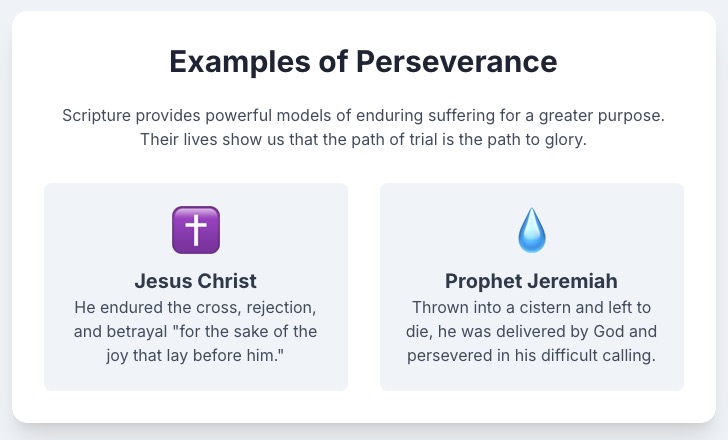
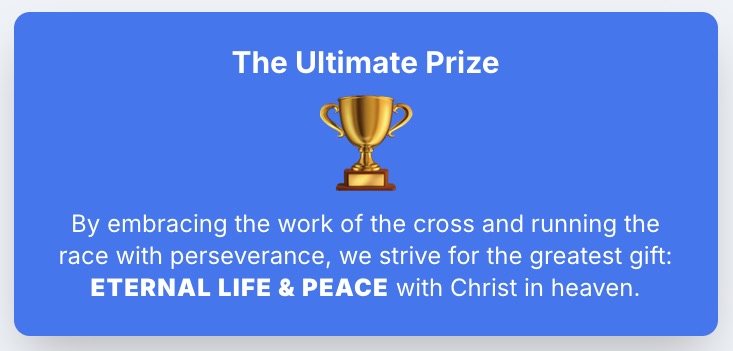
In this homily, Msgr. Hahn explores the perplexing words of Jesus, who states he has come to bring not peace, but division. He resolves this apparent contradiction by drawing a crucial distinction between the goal of our Christian journey—eternal peace with Christ—and the journey itself, which is a path of trial, struggle, and suffering. He emphasizes that the path to peace is not an easy one. By examining the life of Jesus, the prophet Jeremiah, and the words of the Letter to the Hebrews, Msgr. Hahn stresses the need for perseverance and the dangers of seeking a path of "complacency or compromise." The homily ultimately calls us to embrace the work of the cross, running the race of faith so that we may one day receive Christ's greatest gift of eternal life and peace.

Key Themes & Scripture
- Peace as the Goal, Division as the Path: The homily's central message is that while Christ is the Prince of Peace and his ultimate gift is eternal peace, the journey to that peace is full of hardship and division.
- The Grace of Perseverance: We are called to "persevere in running the race that lies before us," just as Jesus did, to reach the joy that lies ahead.
- The Work of the Cross: A call to embrace suffering and difficulty as a means of being united with Christ and his passion, rather than seeking an easy, comfortable faith.
- The Dangers of Compromise: The homily warns against the temptation to take a path of "complacency or compromise" and to fail to proclaim the truths of our faith, even to loved ones.
- Scripture: The homily draws on the Gospel reading about Christ bringing division, the Letter to the Hebrews urging us to persevere and keep our eyes on Jesus, and the story of the prophet Jeremiah as an example of faithfulness amid suffering.
Discussion Questions
- Msgr. Hahn calls Jesus's words about bringing division "some of the most perplexing in all of sacred scripture." How do you reconcile Jesus as the "Prince of Peace" with this idea of him bringing division?
- The homily distinguishes between the goal of peace and the journey of division. Can you think of a time in your life when you experienced this firsthand—when a difficult choice for your faith ultimately led to a deeper sense of peace?
- We are urged to "persevere in running the race that lies before us." What does this "race" look like in your life right now, and what are some of the struggles that make you feel weary?
- Msgr. Hahn warns against the temptation to take a path of "complacency or compromise." In what areas of your life are you most tempted to take the easy path instead of embracing the "work of the cross"?
- The homily specifically mentions the difficulty of proclaiming the truths of our faith "even to family or loved ones." What makes this so challenging, and what do you think it means to do so with both conviction and love?
- How does focusing on the ultimate "joy that lay before him," as Jesus did, change your perspective on the sufferings and struggles you face in your daily life?
Closing Prayer
Lord Jesus, you endured the cross for the joy that lay before you. We pray for your strength and your perseverance. Sustain us in the race of faith, and help us to never grow weary of doing your work. May we embrace the struggles of this life so that we may one day share in the eternal peace you have promised us. Amen.
Access guide and infographics by clicking on banner

This discussion guide has been generated by GOOGLE'S AI Gemini 2.5 Flash LLM.
Theme:
Access guide and infographics by clicking on banner
This page has over 70 Infographics
THE WORD THIS WEEK infographics / BETA were created using AI generative tools (i.e. Chart.js and Tailwind CSS). They may be copied for personal use or for any non-profit ministry. Graphics may not be sold or used for personal financial gain.
Papal Homilies
20th Sunday of Year C
The Fire of Decision
18 August 2019 – Saint Peter’s Square

This discussion guide has been generated by GOOGLE'S AI Gemini 2.5 Flash LLM.
Introduction: The Fire of God's Love
- Pope Francis explains that when Jesus speaks of bringing "fire upon the earth," he is talking about the fire of God's love. He says this fire is meant to help us abandon apathy, laziness, and indifference. How would you describe the difference between a Christian life that is "on fire" and one that is indifferent?
- The homily states that this fire is a "boundless" and "universal" fire that overcomes all divisions. What are some specific divisions in our world today that you believe this fire is meant to overcome?
The Two Pillars of a Life on Fire
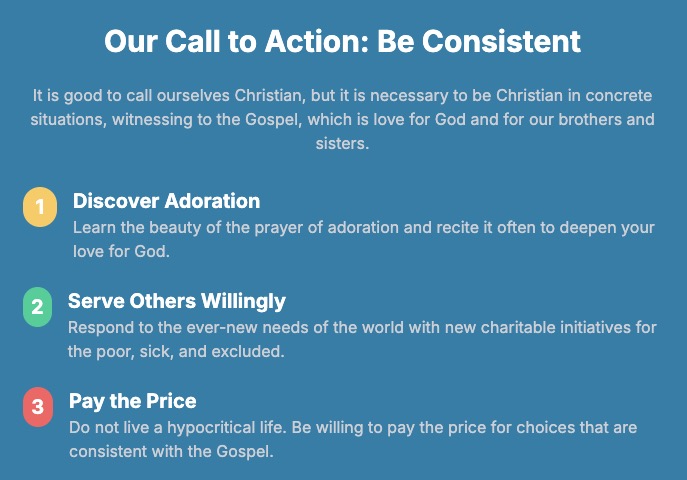
- Pope Francis identifies two core requirements for embracing this fire: adoration of God and a willingness to serve others. He then specifically mentions the prayer of adoration. Why do you think he emphasizes both of these practices together, rather than just one?
- The homily points to young people serving the sick and poor as an example of living according to the Gospel spirit. What are some new charitable initiatives you see happening today, or what are some that you believe are needed in your community?
The Healthy Uneasiness of Division
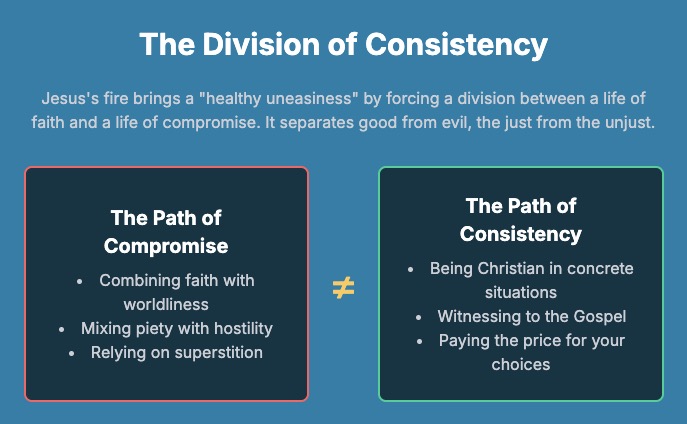
- Jesus's statement about bringing "division" can be difficult to understand. Pope Francis explains it as a separation between good and evil, between a committed Christian life and a life of compromise. Can you think of a situation where a choice you made to follow Christ caused this kind of "healthy uneasiness" or division?
- The homily warns against combining "true religiosity with superstitious practices" and Christian life with "compromises of all kinds." In what ways might Christians be tempted to do this today?
The Price of Consistency
- Pope Francis concludes by stressing that it's good to call ourselves Christian, but it is "necessary to be Christian in concrete situations." What is one area of your life where you feel challenged to be more consistent with the Gospel?
- The homily mentions "paying the price for being consistent." What do you think this "price" looks like in the modern world?
Homily Excerpt
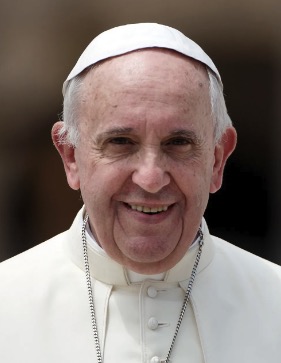
Adherence to the fire of love that Jesus brought to earth, envelopes our entire existence and requires the adoration of God as well as a willingness to serve others. Adoration of God and a willingness to serve others. First, the readiness to adore God, also means learning the prayer of adoration which we usually forget. This is why I invite everyone to discover the beauty of the prayer of adoration and to recite it often. And second, the willingness to serve others. I think with admiration of the many youth communities and groups, who during the summer, dedicate themselves to this service to the sick, the poor and people with disabilities.
A Misunderstood Mission
19 August 2007 | Castel Gandolfo

This discussion guide has been generated by GOOGLE'S AI Gemini 2.5 Flash LLM.
Introduction: The Apparent Contradiction
- The homily begins with Jesus's surprising statement: "Do you think that I have come to give peace on earth? No, I tell you, but rather division." How does this challenge your initial understanding of Jesus as the "Prince of Peace"?
- Pope Benedict XIV explains that this "peace" is not just the absence of conflict. In what ways has a passive or "inconsistent" idea of peace been presented in society or in your own life?
The Spiritual Battle
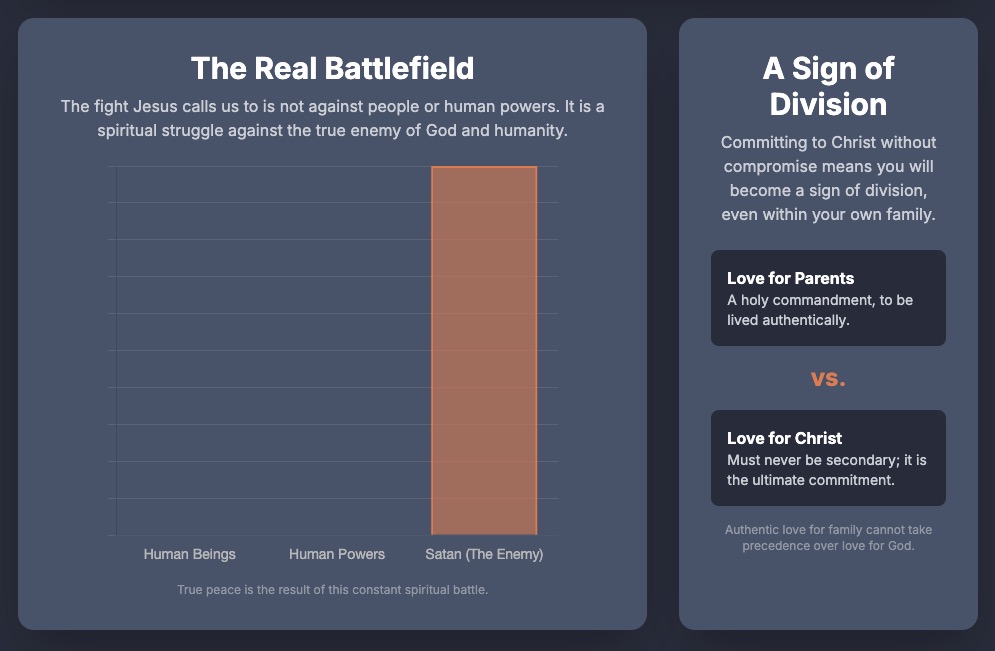
- Pope Benedict XIV clarifies that the fight Jesus supports is not against human beings, but "against Satan, the enemy of God and man." What does this distinction mean for how we approach conflicts in our daily lives?
- Can you think of examples where a person's commitment to "good" and "truth" has created misunderstandings or opposition? How can we discern if we are fighting against evil or simply engaging in a human conflict?
The Cost of Following Christ
- Pope Benedict XIV mentions that love for Christ "can never take precedence over love for God and love for Christ" even when it creates "division between people, even in their own families." How do you interpret this?
- Have you ever had to make a choice that caused friction with friends or family because you were trying to be consistent with your faith? What did that experience teach you about the cost of discipleship?

The Path to True Peace
- The homily concludes by calling Christians to be "instruments of peace," but a peace that is "real," pursued with "courage and tenacity." What is the difference between an "inconsistent and only apparent" peace and a "real" peace?
- St. Francis of Assisi's prayer asks to "make me an instrument of your peace." Based on this homily, what are some concrete, daily actions we can take to be a courageous instrument of peace in our families, workplaces, or communities?
Closing Prayer and Reflection
- Take a moment to reflect on the words from Romans 12:21: "overcome evil with good." What is one specific way you can apply this message in your life this week?
Homily Excerpt
Christ’s words mean that the peace he came to bring us is not synonymous with the mere absence of conflicts. On the contrary, Jesus’ peace is the result of a constant battle against evil. The fight that Jesus is determined to support is not against human beings or human powers, but against Satan, the enemy of God and man.
Anyone who desires to resist this enemy by remaining faithful to God and to good, must necessarily confront misunderstandings and sometimes real persecutions.
Discussion guides and Infographics on this page have been created using AI generative tools (i.e. GOOGLE’S AI Gemini 2.5 Flash LLM, Chart.js and Tailwind CSS). They are free to use for any non-profit ministry. THE WORD THIS WEEK kindly requests that you show your appreciation by sharing a link to the website.
────── ⋆⋅☆⋅⋆ ──────
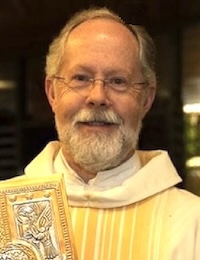
Deacon Peter McCulloch
20th Sunday of Year C
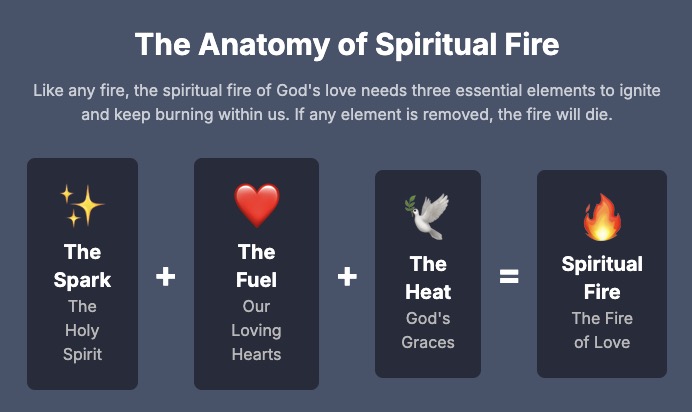
The Fire of Love

Introduction: The Spiritual Fire
- The homily opens with the image of Mount Wingen, a fire that has been burning for 6,000 years because it has a constant supply of fuel, oxygen, and heat. The author then connects this to spiritual fire, which requires a spark from the Holy Spirit, the fuel of our loving hearts, and the heat of God's graces. How do you think you can nurture these three elements in your own life?
- In the Bible, fire is used to represent God's presence, from the burning bush to the tongues of fire at Pentecost. When you think of God's presence in your life, what images or symbols come to mind?
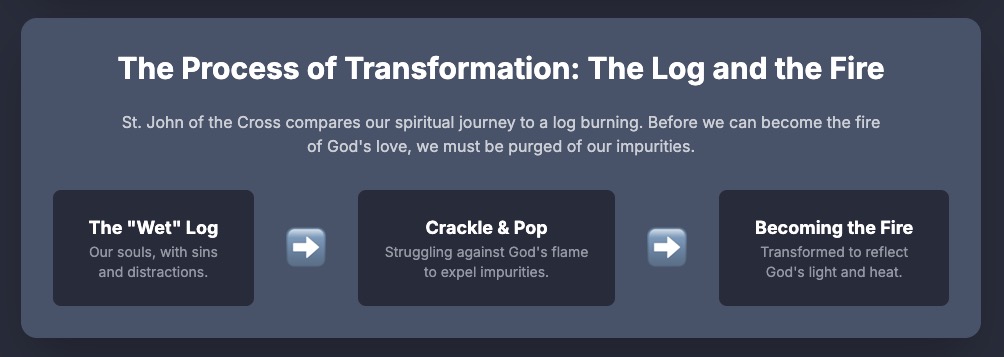
The Log and the Fire: A Journey of Purification
- The homily uses St. John of the Cross's powerful metaphor of a log burning in a fire. The log must first "crackle and pop" as its impurities are expelled before it can be fully transformed. What are some of the "impurities" (sins, distractions, unhealthy attachments) in your life that feel difficult to let go of?
- Have you ever felt this "crackle and pop" when you've tried to draw closer to God? What did that feel like, and how did you persevere through it?

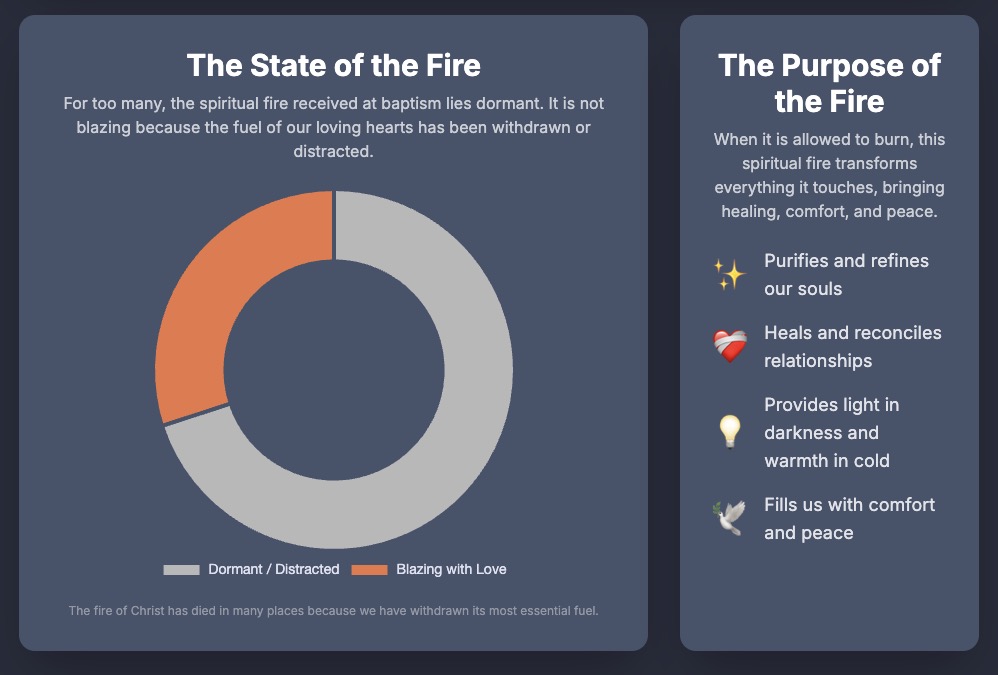
The Purpose of Spiritual Fire
- The homily states that spiritual fire can purify, heal, reconcile, and provide light and warmth. The sacraments are mentioned as a way this fire transforms ordinary gifts into the presence of Christ. How have you personally experienced the transformative power of the sacraments in your life?
- What are some ways you feel called to reflect the "light and heat" of God's love to help transform others in your community?
Our Call to Action: Provide the Fuel
- The homily suggests that in many places, the fire of Christ has died because we've withdrawn its fuel: the love of our hearts. What are some distractions in today's world that you think are most likely to take our hearts away from God and our spiritual fire?
- The discussion closes with a call to "ask Jesus to help us set the world on fire once again." What is one specific, practical step you can take this week to provide the fuel of your loving heart, so your spiritual fire can burn brighter?
Discussion guides and Infographics on this page have been created using AI generative tools (i.e. GOOGLE'S AI Gemini 2.5 Flash LLM, Chart.js and Tailwind CSS). They are free to use for any non-profit ministry. THE WORD THIS WEEK kindly requests that you show your appreciation by sharing a link to the website.
Homily Excerpt

Four hours’ drive north of Sydney is Mount Wingen. It’s often called ‘Burning Mountain’ because deep inside it is the world’s oldest fire…
6,000 years ago, the fire in Mount Wingen started to burn. It has never ever stopped because there’s been a constant supply of fuel, oxygen and heat.
2,000 years ago, the fire of Christ started spreading all over the world. But in too many places today, that fire has died. Why? It’s because too many of us have withdrawn its fuel: the love of our hearts. We’re too distracted.
Spiritual fire transforms lives. Its heat keeps us warm; its light helps us see in the darkness. It empowers us to do remarkable things, and it fills us with comfort and peace. We need all these things. Spiritual fire is our love united with God’s love. Let’s ask Jesus to help us set the world on fire once again.

THE MOVIE BUFFER (8:49) – Dead Man Walking (1993) is a work of non-fiction by Sister Helen Prejean, a Roman Catholic nun and one of the Sisters of Saint Joseph of Medaille based in New Orleans. Arising from her work as a spiritual adviser to two convicted murderers on death row, the book is set largely at the Louisiana State Penitentiary (Angola) in West Feliciana Parish, Louisiana. It examines moral issues related to the men’s acknowledgement of their crimes and to the state’s use of the death penalty.
Dead Man Walking
Opening Prayer
Lord, your word is a fire that challenges and purifies. Open our hearts and minds to the difficult truths in today's Gospel. Help us to understand what it means to stand for love and justice, even when it causes division. Grant us the courage to welcome your transforming fire into our lives. Amen.
Discussion Questions
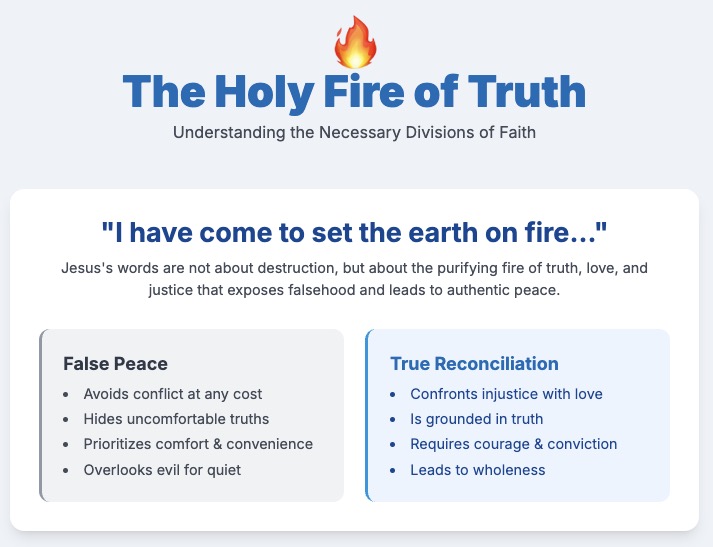
1. The Fire of Truth
- Jesus says, "I’ve come to bring fire to the earth, and how I wish it were blazing already!" What was your initial reaction to hearing these words? Do they make you uncomfortable?
- The reflection describes this fire as "the flame of conversion, justice, and mercy." How does Sister Helen's work with the death-row inmate embody this kind of fire? Where did she bring conversion, justice, or mercy?
- The prophet Jeremiah also brought a "fire" of truth to the leaders of his day, and it got him thrown into a pit. Why is the truth often so unwelcome?
2. Necessary Division
- The Gospel says Jesus came to cause division, even within families. The reflection notes, "some divisions are necessary and some are holy." Can you think of a time when standing for what is right created a necessary division in your life, your family, or your community?
- Sister Helen faced outrage from the victims' families, who felt she was "on the wrong side." Was she choosing a side? Or, as the reflection suggests, was she "choosing Christ"? What's the difference?
- When can "keeping the peace" actually be a bad thing? When does it become a "false peace" that allows injustice to continue?
3. Personal Reflection
- The reading from Hebrews encourages us to "persevere in running the race" and fix our eyes on Jesus. How did Sister Helen persevere in her difficult and unpopular ministry? What do you think gave her strength?
- Ask yourself honestly: Is there a situation in your life right now where you are "keeping the peace" by avoiding a difficult truth or an action you know you should take?
- Is Jesus calling you to bring a "holy fire" to a situation at work, in your family, or in your community, even if it makes you unpopular or uncomfortable? What would that look like?
Discussion guides and Infographics on this page have been created using AI generative tools (i.e. GOOGLE'S AI Gemini 2.5 Flash LLM, Chart.js and Tailwind CSS). They are free to use for any non-profit ministry. THE WORD THIS WEEK kindly requests that you show your appreciation by sharing a link to the website.
Homily Excerpt

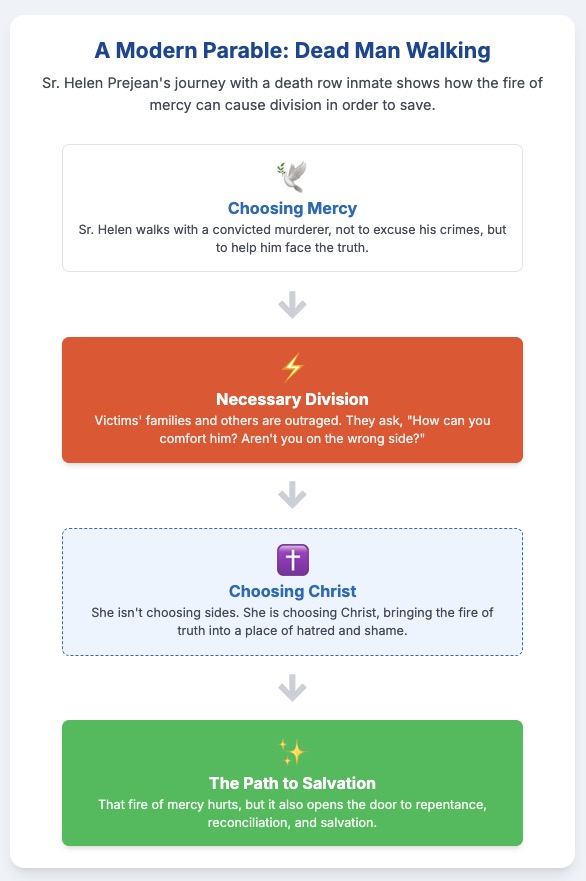
The fire Jesus came to bring is the fire of love, the fire of truth, and the fire that can divide but also purify and heal when it addresses an injustice.
There’s a good example of this fire at work in Tim Robbins’ movie Dead Man Walking. It’s based on the true story of Sister Helen Prejean… [who] accompanies one convicted murderer to his execution. She chooses to walk with him, not to excuse his crimes, but to help him face the truth, and to encounter the possibility of mercy.
This causes great division. The victims’ families and even some Church members are outraged that she gave him any support at all. ‘How can you comfort someone like him?’ they ask. ‘Aren’t you on the wrong side?’
────── ⋆⋅☆⋅⋆ ──────

20th Sunday of Year C

Photograph by Fr Lawrence Lew OP
Homily Summary
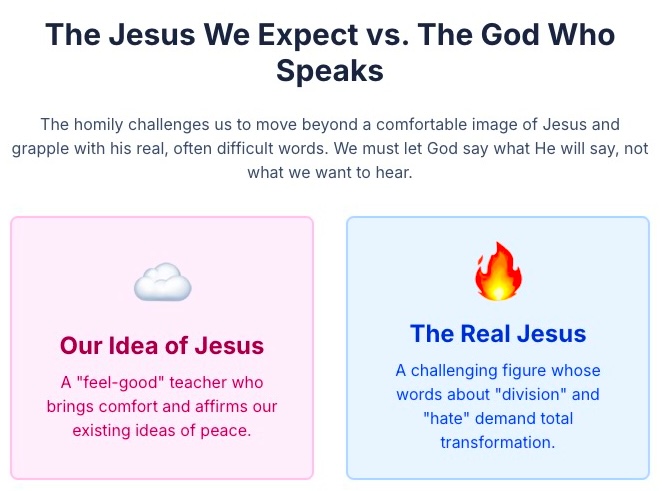
In this homily, Fr. Bruno Clifton challenges us to move beyond a comfortable, "feel-good" image of Jesus and grapple with his more difficult teachings, particularly his statement that he has come to bring not peace, but division. He explains that these words, along with others like "hate father and mother," are not what we expect to hear, but they are crucial to understanding the God who speaks.
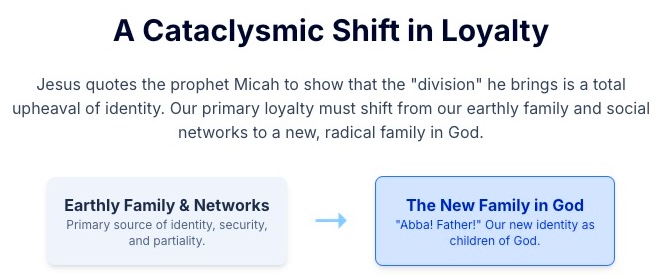
Fr. Bruno connects these sayings to the Old Testament prophecy of Micah, where a breakdown of family relationships signifies a complete societal desolation. Jesus quotes this prophecy to reveal that the division he brings is a profound, cataclysmic upheaval in our understanding of ourselves and our loyalty. This division is not for the sake of discord itself, but to break into our "closed networks of preferences and petty partiality" and our "bonds of sin."
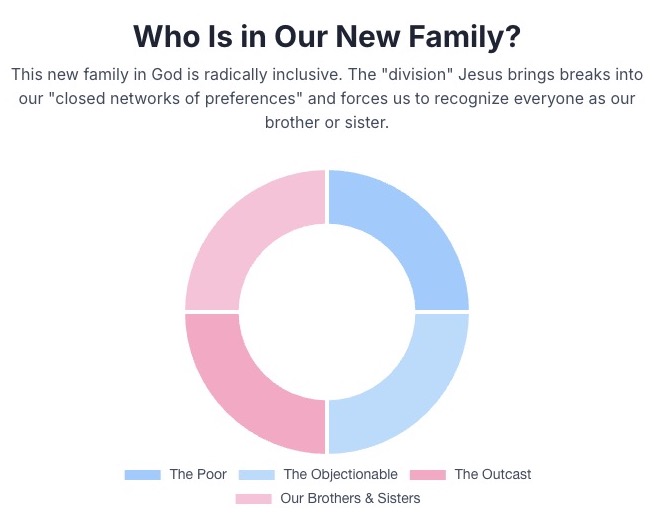
The deepest truth, he explains, is that through the Holy Spirit, we are brought into a new family where God is our Father. This new family includes everyone, especially the poor and the outcast, forcing a radical re-thinking and transformation of our identity. The homily concludes by encouraging us to trust in this God who reveals himself as a new family and to wait for the God of our salvation, just as the prophet Micah did.
Key Themes & Scripture
- The Difficult Jesus: The need to accept Jesus's challenging words as they are, rather than putting our own comfortable ideas in his mouth.
- Total Commitment: Discipleship is not easy; it demands a radical, total commitment to Christ that can cause upset and discord.
- The Deeper Meaning of Division: The division Jesus brings is not just manifest discord, but a profound shift in where our loyalty lies, moving from earthly family and social networks to a new, spiritual family in God.
- A New Family in God: Through the Spirit, God is revealed as our Father, making all of humanity—including the poor and outcast—our brothers and sisters.
- Trusting God: In the midst of this turmoil and transformation, we are called to trust in God's saving power, as the prophet Micah did.
Discussion Questions
- Fr. Bruno suggests that we can unconsciously create a "normative idea of who we would like Jesus to be." What are some common examples of this in our culture or in our own lives?
- The homily references Jesus's sayings about "hating" family or abandoning a dead father. What do you think Jesus means by these challenging words, and how do they make you feel about the demands of discipleship?
- The prophet Micah uses the breakdown of the family to illustrate Israel's desolation. How does connecting this prophecy to Jesus's words change your understanding of the "division" he brings?
- The homily states that the division Jesus brings is "into our closed networks of preferences and petty partiality." Can you think of examples of these "closed networks" in our world today, and how might a deeper faith challenge them?
- If our new family in God includes "the poor, the objectionable, the outcast," what practical steps could we take to live out this radical reality more fully in our daily lives?
- Fr. Bruno concludes with a call to trust in the God who reveals himself as family. What does this mean to you personally, and how can that trust help you navigate the "turmoil and pain" of spiritual transformation?

Closing Prayer
Lord Jesus, thank you for your real and challenging words. We pray for the courage to transform our ideas of who you are and who we are called to be. Give us the grace to let go of our old loyalties and embrace our new family in you. May we be truly and completely your disciples. Amen.
Discussion guides and Infographics on this page have been created using AI generative tools (i.e. GOOGLE'S AI Gemini 2.5 Flash LLM, Chart.js and Tailwind CSS). They are free to use for any non-profit ministry. THE WORD THIS WEEK kindly requests that you show your appreciation by sharing a link to the website.
Homily Excerpt

Twentieth Sunday in Ordinary Time (C) | Fr Bruno Clifton reflects on the difficult teachings of Christ that challenge us to re-think and transform our ideas about who God is.
The incarnation has brought this shift in family: we know that God is our Father, but this means that we are all brothers and sisters: the poor, the objectionable, the outcast are our family.
This is the division that Jesus brings: into our closed networks of preferences and petty partiality; into our bonds of sin that keep us from salvation.
And it is not peaceful: but brings turmoil and pain because our very idea of who God is and who we are must be challenged, re-thought and transformed.

Homily Excerpt
Nineteenth Sunday of the Year. Fr David Rocks finds hope in the face of mortality.
W.H. Auden’s most quoted poetry includes among it the short poem often entitled Funeral Blues. I’ve lost count of the number of funeral services during which it has been read. Thoughtfully crafted, the poet describes the funeral ritual about to take place before describing in stark tones the experience of grief being endured.
For me, this poem often didn’t sit well in the context of a liturgy for Christian burial or cremation. Faced with the grief that is inevitable on the death of those we love, should not our funeral liturgy emphasise and celebrate our Christian hope? There has been much reflection on hope as we have moved through this Jubilee Year 2025, and so I was moved to reflect on Auden’s poem once again, particularly in the context of the scripture proclaimed this Sunday.
────── ⋆⋅☆⋅⋆ ──────
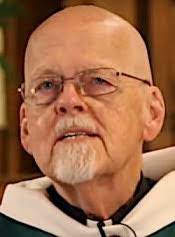
Fr. Austin Fleming
20th Sunday of Year C
Jesus Did Not Come
to Bring Peace

Homily Summary
In this homily, Fr. Fleming continues his series on "How to Vacation," moving from the idea of vacation as a reward or a gift to a time for spiritual growth. He contrasts the "feel-good" teachings of Jesus with the challenging words from today's Gospel: "I have come to set the earth on fire... not peace but rather - division."
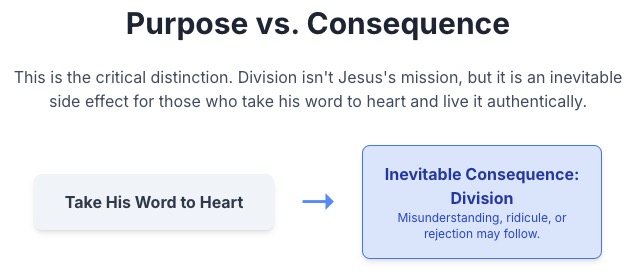
Fr. Fleming clarifies that division is not Jesus's purpose or mission, but an inevitable consequence for those who take his word to heart.
Fr. Fleming uses the modern-day example of family gatherings and political conversations to illustrate how we often become "quiet" about our beliefs to avoid conflict. He reminds us that in Jesus's time, this division was even more profound, as family was the sole source of safety and security. The homily challenges us to ask if we are living our faith openly or settling for an "artificial harmony" that is little more than the absence of conflict. He concludes by urging us to "get in the game," to persevere in the race of faith, and to use our vacation time to reflect on what truly brings us peace.
Key Themes & Scripture
- Vacation and Spiritual Growth: Vacation as a time to grow rich in what truly matters to God.
- Purpose vs. Consequence: The critical distinction that division is an unavoidable consequence of following Jesus, not his intended purpose.
- Artificial Harmony: The homily warns against settling for a false sense of peace by avoiding difficult conversations about our faith.
- The Cost of Discipleship: Following Jesus requires total commitment and may jeopardize our relationships, but it is a path that is "worth the hardship."
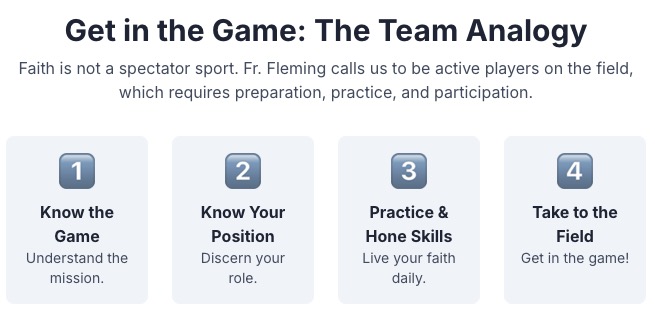
- The Team Analogy: The call to be an active player on a team, knowing our role, practicing our faith, and getting in the game.
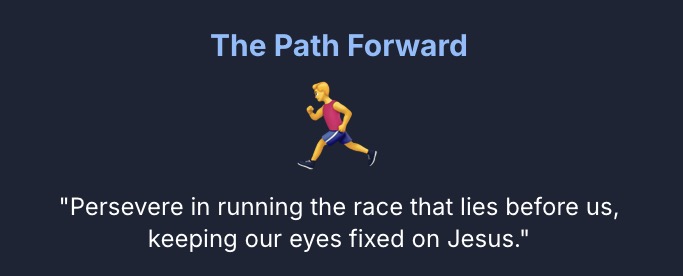
- Scripture: The homily is built around Luke 12:49-53, where Jesus speaks of bringing fire and division, and Hebrews 12:1-2, which calls us to "run the race... keeping our eyes fixed on Jesus."
Discussion Questions
- Fr. Fleming begins by discussing the hopes and expectations we place on a vacation. How can we use our time away to "grow rich in the things that really matter," as he suggests?
- The homily makes a crucial distinction between division as Jesus's purpose and division as a consequence. What does this distinction mean to you, and how does it change your understanding of his words?
- Fr. Fleming mentions that we are often "quiet" about our faith to avoid being misunderstood or rejected. Can you think of a time when you chose to keep quiet? What made it difficult to speak up?
- The homily talks about the "artificial harmony" that comes from avoiding conflict. What is the difference between this and the genuine peace that Jesus offers?
- Fr. Fleming uses the analogy of a team to describe our roles as disciples. What position do you feel you are called to play, and what skills do you need to "hone" to contribute to the team's effort?
- How can we be peaceful in our faith—not angry or arrogant—while also being clear and strong enough to cause the "consequence of division"?
Closing Prayer
Lord Jesus, you are the Prince of Peace, yet you showed us that the path to true peace is not always easy. Give us the wisdom to know when to speak and when to be silent, the courage to be faithful to you, and the strength to bear the burdens our faith may lay on us. We ask this in your holy name. Amen.
Discussion guides and Infographics on this page have been created using AI generative tools (i.e. GOOGLE'S AI Gemini 2.5 Flash LLM, Chart.js and Tailwind CSS). They are free to use for any non-profit ministry. THE WORD THIS WEEK kindly requests that you show your appreciation by sharing a link to the website.
Homily Excerpt
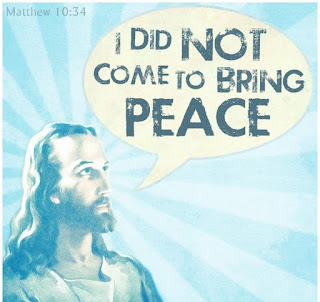
2019 HOMILY — What Jesus is saying here is that if we follow him we may jeopardize the ties that bind, the ties that ensure our safety and security, our connectedness with others, our acceptance by others.
So, here’s the important distinction for us to make: Division isn’t Jesus’ purpose or mission but it is an inevitable side effect, a consequence for those who take his word, his mission to heart.
This shouldn’t surprise us too much. We all know how voicing our strong beliefs about serious matters will join us to those who share our convictions but distance or even separates us, from those who don’t. Who among us hasn’t experienced precisely this dynamic? in the contemporary political climate? Jesus says: From now on a household of five will be divided, three against two and two against three… I think we know what he means!
────── ⋆⋅☆⋅⋆ ──────
Fr. Jude Siciliano, O.P.

20th Sunday of Year C
Homily Excerpt
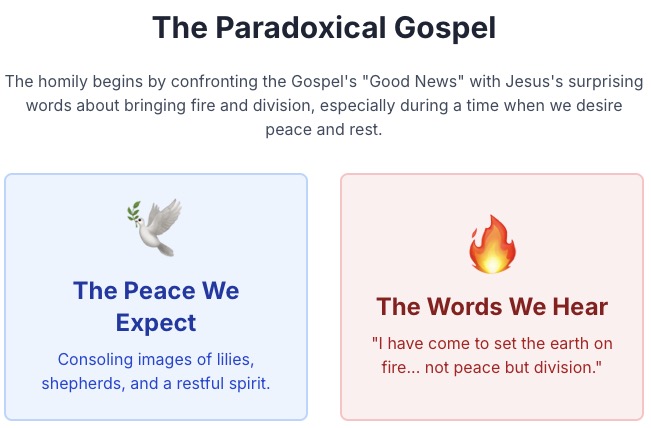
In the Catholic liturgy today the gospel minister will end this reading by announcing, “The Gospel (Good News) of the Lord.” And the congregation, without a moment’s pause, will respond, “Praise to you, Lord Jesus Christ.” I am thinking of starting my homily by asking them if they really want to praise Jesus in the light of what he just said to us… “I have come to set the earth on fire…. Do you think that I have come to establish peace on the earth? No, I tell you, but rather division.” (Strange punctuation in the English text, don’t you think? Shouldn’t there be an exclamation point? It sounds like it’s said with a loud voice and with plenty of heat!)…
Well he surely isn’t going to reinforce an artificial peace, the kind of comfort and rest those in the establishment have. For those who see no need for God in their lives, or no need to rethink the comfortable notion they have of God (the God they credit as “blessing” them with their possessions and securing their exalted position over the rest of humanity), for these, their illusionary peace will be shattered by Jesus’ coming into their holy city and by his preaching.
Discussion guides and Infographics on this page have been created using AI generative tools (i.e. AI Gemini Pro, Chart.js and Tailwind CSS). They are free to use for any non-profit ministry. THE WORD THIS WEEK kindly requests that you show your appreciation by sharing a link to the website.
────── ⋆⋅☆⋅⋆ ──────
Fr. Jude Langeh, CMF

20th Sunday of Year C

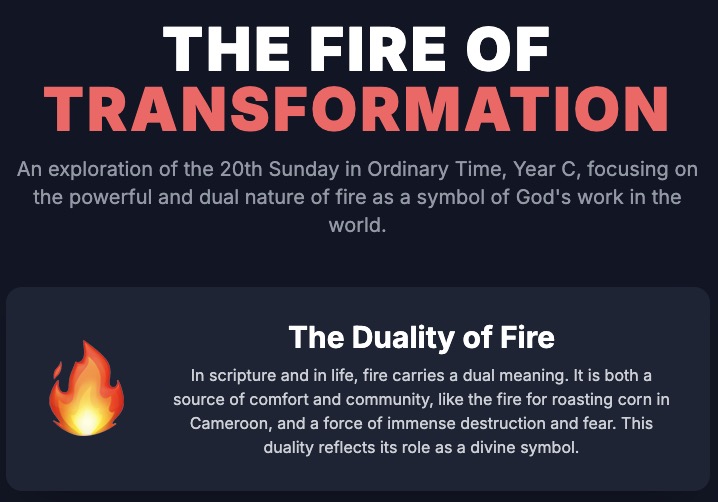
Introduction: The Dual Nature of Fire
- The speaker notes that fire can evoke both warmth and comfort (roasting corn in Cameroon) and fear and destruction. How have you personally experienced this dual nature of fire in your life?
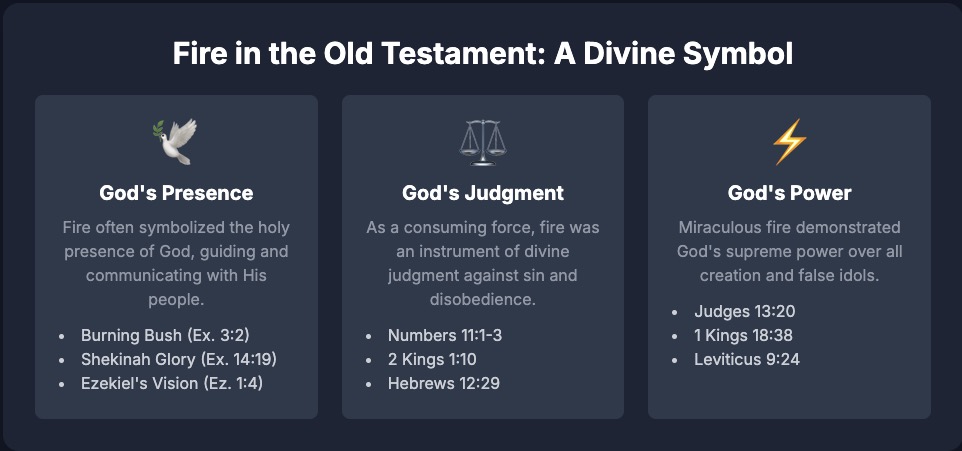
- The Old Testament uses fire to symbolize both God’s presence (the burning bush, the Shekinah glory) and his judgment (consuming fire). What are some other biblical examples of fire representing God’s power that come to mind?
The Fire of the Holy Spirit
- John the Baptist predicted Jesus would baptize with "the Holy Spirit and with fire." The speaker connects this to the tongues of fire at Pentecost. How does this image of fire help you understand the Holy Spirit’s work in the lives of believers?
- Jesus says he has come to bring fire to the earth. The speaker suggests this fire can burn away vices like injustice and faithlessness. What vices in our world or in our own lives do you think this "fire" needs to burn away today?

Persecution for the Fire
- The video draws a parallel between Jeremiah's persecution and the opposition Christians face today. Jeremiah's message was like a fire that people wanted to extinguish by throwing him into a pit. Have you ever felt discouraged or opposed because of your faith or actions? How did you respond?
- The speaker suggests that this opposition can sometimes come from surprising sources, including family members or fellow Christians. Why do you think people might try to "put off the fire" in others who are living out their faith?
Our Call to Be a Fire
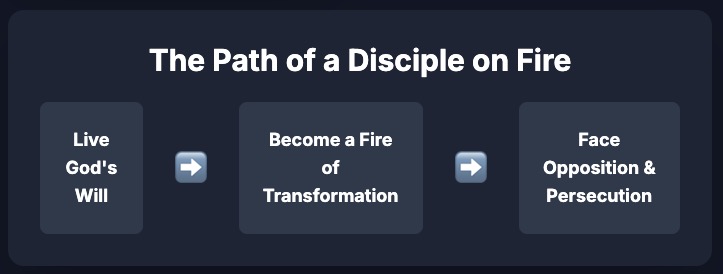
- The speaker encourages us to "be the fire of transformation." What does it mean for you to be a "man or woman on fire" for God in your daily life?
- The final message encourages us to fix our eyes on Christ, who endured the cross. How can looking to Christ give us the courage to fight sin and remain faithful, even when facing opposition?

Closing Prayer and Reflection
- The discussion closes with a blessing. Take a moment to reflect on the prayer: "May almighty God bless you, the Father, and the Son, and the Holy Spirit." What part of this week's message will you carry with you as you live out your faith?ser to God rather than away from Him?
Access guide and infographics by clicking on banner
────── ⋆⋅☆⋅⋆ ──────
Fr. Charles E. Irvin
20th Sunday of Year C


The events surrounding the birth of Jesus are presented to us in lovely words and beautiful images. We need to recall, however, that the Church remembers her first martyr, St. Stephen, the day after Christmas. And on the day after that we remember slaughter of the innocents, that horrific action on the part of King Herod when he ordered the massacre of all the baby boys in Bethlehem and its vicinity two years old and under in order that he might not be challenged by the King who is greater than all the other kings in the world put together.
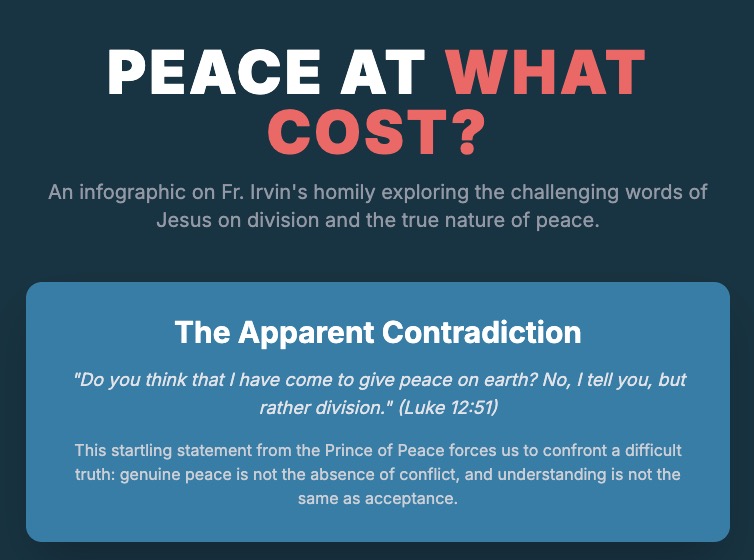
Who, then, brings division, hatred, strife, and conflict into our world? God, or humans? Love or jealousy? Good people or people who cannot stand goodness? You know the answers as well as I do. It’s all a question of what we will stand for.
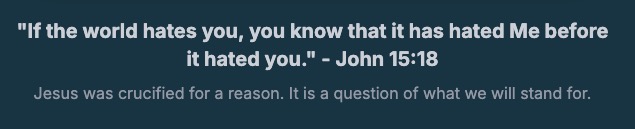
“If the world hates you, you know that it has hated Me before it hated you,” Jesus told us. (John 15:18) Jesus was crucified for a reason and we should always remember that.
Discussion Guide
- Fr. Irvin highlights the jarring contrast between Luke’s portrayal of a compassionate Jesus and the words we heard today about Him bringing “division and not peace.” How have you reconciled these two sides of Jesus’s message in your own faith journey?
- The homily suggests that understanding is not the same as acceptance. Can you share an example from your own life where you have had to distinguish between understanding someone’s perspective and accepting their actions or beliefs?

Peace as a Spiritual Battle
- The homily argues that true peace is not to be found at any price; it has a cost. He uses the examples of a Cold War and conflict avoidance within families. How have you seen the absence of conflict masquerade as peace in your own life or in society?
- The transcript states that being a “people pleaser” leads to internal strife and stress. Why do you think conflict avoidance, particularly when we know we should speak up, is so damaging to us spiritually and emotionally?
The Challenge of Consistency
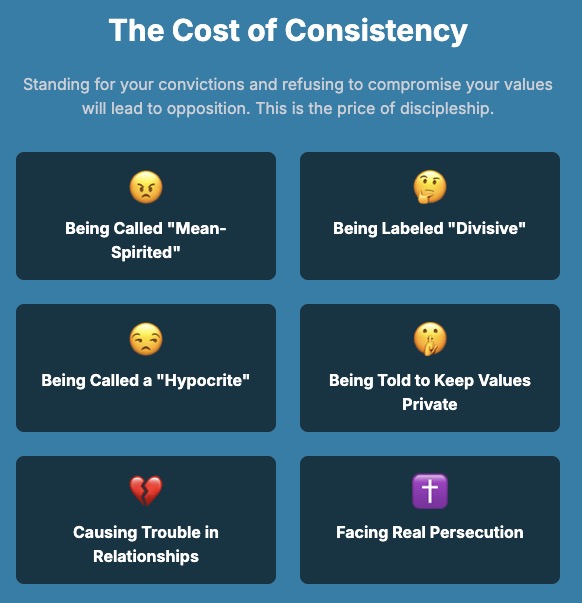
- When should we compromise our beliefs and values, and when should we not? The homily answers, “No, and certainly not in the culture of our day.” What are some specific examples in our culture where Christians are told to compromise their beliefs?
- Fr. Irvin references martyrs like St. Thomas More and St. Cecilia, who paid the ultimate price for their convictions. How can their stories inspire us when we are called “mean-spirited” or “divisive” for standing up for our faith in a public setting?
Standing for Our Convictions
- The homily asks, “Who, then, brings division, hatred, strife, and conflict into our world? God, or humans?” He concludes that it is humans who “cannot stand goodness.” What is a conviction of your faith that you believe is most challenged in the public forum today, and what can you do to stand for it?
Discussion guides and Infographics on this page have been created using AI generative tools (i.e. GOOGLE’S AI Gemini 2.5 Flash LLM, Chart.js and Tailwind CSS). They are free to use for any non-profit ministry. THE WORD THIS WEEK kindly requests that you show your appreciation by sharing a link to the website.
────── ⋆⋅☆⋅⋆ ──────
Fr. George Smiga
20th Sunday of Year C
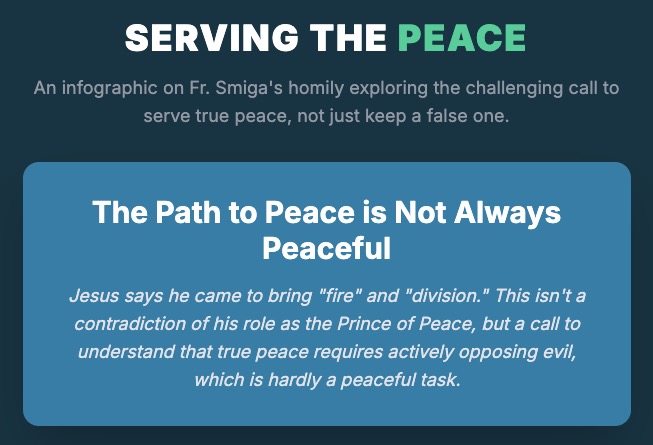

2007 HOMILY – We are not called to keep the peace. We are called to serve the peace. Now of course this does not mean that making people angry is somehow valuable in itself. Upsetting people is often unwise and counter productive. But in a world where evil exists, opposition and confrontation are sometimes necessary to serve the peace. We might be called to serve the peace by marching against an unjust law or an unjust war. We might be called to serve the peace by standing against someone in authority who ignores the rights of another. We might be called to serve the peace by speaking the truth in our family, in our workplace, or in our church–even if speaking the truth makes waves and risks division.
The Peaceful Prince of Division
- Fr. Smiga begins by highlighting the jarring contrast between our favorite peaceful images of Jesus and his words in today’s Gospel about bringing “fire” and “division.” How have you reconciled these two different images of Jesus in your own faith journey?
- The homily suggests that we haven’t misunderstood Jesus as the Prince of Peace, but that we need to understand that the path to peace is not always peaceful. What does this statement mean to you?
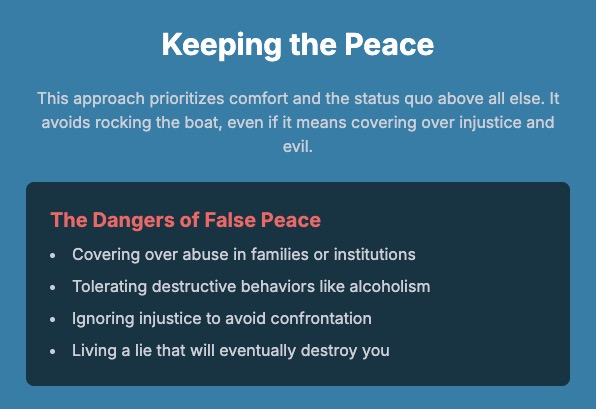

Keeping the Peace vs. Serving the Peace
- The homily draws a key distinction between keeping the peace and serving the peace. The former prioritizes the status quo and avoiding discomfort, while the latter is an active effort to establish a life built on goodness and justice.
- Fr. Smiga provides several examples of when keeping the peace can be dangerous or misguided, such as ignoring an abusive relationship, alcoholism in a family, or the sexual abuse of children in the Church. Can you think of a time when the pressure to keep the peace led to covering up a problem?
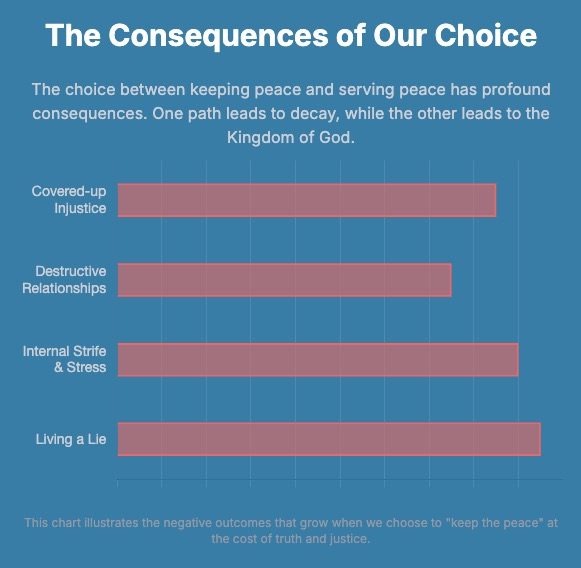
The Call to Prudent Confrontation
- The homily reminds us that “opposing evil and injustice is hardly peaceful,” and that this opposition and confrontation are sometimes necessary to serve the peace.
- Fr. Smiga cautions that upsetting people is not valuable in itself. What are some of the practical steps we can take to approach a difficult conversation or a call for justice with prudence and strength, rather than with anger or a misguided desire to simply “make waves”?
- The homily suggests that serving the peace might mean speaking the truth in our family, workplace, or church. What is a specific situation you have faced where you felt the need to speak a difficult truth?

Living a Lie
- The homily ends with a call to action, saying that when we oppose evil, Jesus would say, “Let it burn!” What is one area of your life or community where you feel called to light a fire of truth to serve the peace?
- The homily’s final, powerful point is that if we cover over evil in an effort to keep the peace, “we will in time be living a lie. And that lie will in the end destroy us.” How can living a lie for the sake of peace be so destructive?
Discussion guides and Infographics on this page have been created using AI generative tools (i.e. GOOGLE’S AI Gemini 2.5 Flash LLM, Chart.js and Tailwind CSS). They are free to use for any non-profit ministry. THE WORD THIS WEEK kindly requests that you show your appreciation by sharing a link to the website.
────── ⋆⋅☆⋅⋆ ──────
20th Sunday of Year C

Divided for the Right Reasons
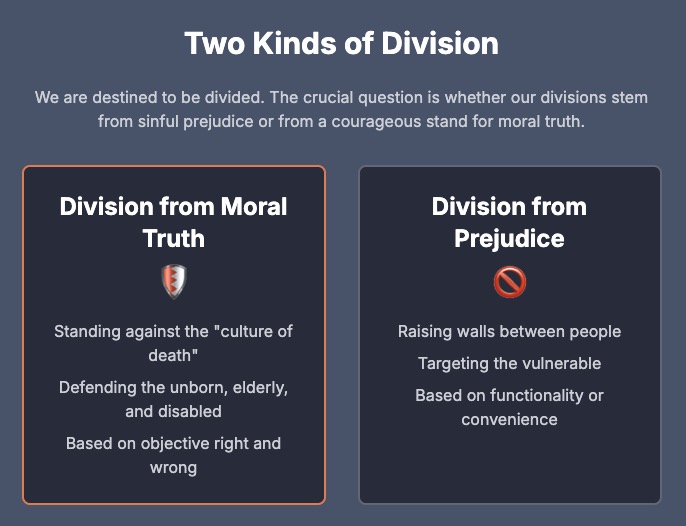
Two Kinds of Division
- The homily contrasts two types of division: division rooted in prejudice (e.g., against the unborn or elderly) and division that comes from standing for moral truth. The homily argues that the "culture of death" is largely a problem of prejudice.
- How do you distinguish between a division that is caused by simple prejudice and one that is caused by a courageous stand for moral truth?
- What are some of the ways you see the "culture of death" justifying its positions today?

The Echo of Jeremiah
- The homily draws a parallel between the prophet Jeremiah, who was accused of "demoralizing" people for speaking God's truth, and those who today are rejected or mocked for pointing out the moral problems behind societal ills.
- Have you ever felt accused of being "mean-spirited" or "divisive" simply for expressing a conviction rooted in your faith? What was that experience like?
- Why do you think people so often mischaracterize a moral argument as a personal attack?

The Cost of Conviction
- The homily connects Jesus's promise of division in families to issues like abortion. It then says the call to resist sin "to the point of shedding blood" means we must be willing to endure opposition ourselves, not inflict it on others.
- The homily states that if we don't foresee any opposition when we stand for what is right, that can be a good reason to question our stance. Why is that? What does this statement challenge you to do in your daily life?
- What is one conviction you hold that you feel challenged to stand up for in public? What is one practical step you can take this week to stand for it with courage and tenacity?
Discussion guides and Infographics on this page have been created using AI generative tools (i.e. GOOGLE'S AI Gemini 2.5 Flash LLM, Chart.js and Tailwind CSS). They are free to use for any non-profit ministry. THE WORD THIS WEEK kindly requests that you show your appreciation by sharing a link to the website.
Homily Excerpt
We are destined, in this life, to be divided from at least some people, and today’s readings urge us to be divided for the right reasons. Prejudice continues to raise walls between people. That is the division that happens all too naturally, and the conflict between the culture of life and the culture of death is largely a problem of prejudice against the unborn, the elderly, and the disabled. None of the reasons offered for abortion would be tolerated as reasons to kill the born; it is only because the victims are unborn that they become victims. Similarly, none of the reasons for killing the less functional people would be tolerated as reasons to kill the functioning; hence again, prejudice is revealed as the real problem.
────── ⋆⋅☆⋅⋆ ──────
20th Sunday of Year C

With Eyes Focused on Christ

Keeping Our Eyes Fixed on Jesus
- The homily opens with the image of a cross country runner who keeps their eyes on the runner in front of them, just as we are called to keep our eyes fixed on Jesus. What are some of the biggest distractions or "crises" in your life or in the world that make it difficult to maintain this focus?
- Have you ever had a moment of grace when you were able to recenter your focus on Jesus? What did that feel like, and how did it change your perspective on the things happening around you?
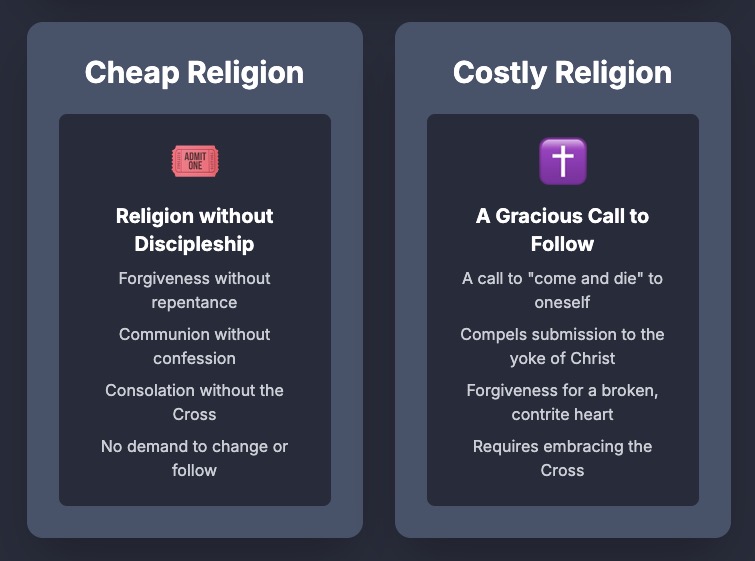
Cheap Religion vs. Costly Religion
- The homily introduces Dietrich Bonhoeffer’s distinction between cheap religion (forgiveness without repentance or discipleship) and costly religion (a gracious call to follow Jesus and die to oneself). What does "cheap religion" look like in our culture or in our own lives?
- The examples of St. Perpetua and St. Francis of Assisi show a personal, painful cost for their discipleship. Have you ever faced a decision where your commitment to Christ put you at odds with a loved one or a person of authority?

The Fire of Division
- Jesus's words about bringing "division" to families can be unsettling. The homily suggests this division comes when we are compelled to stand for the truth of our faith. Can you think of a specific example where you have seen this kind of principled division play out, whether in your own life or in the lives of others?
- The homily uses the pro-life stance as an example of a difficult conviction that can come with a personal cost, especially when it involves a loved one. What are some other convictions of our Catholic faith that you believe are most difficult to stand for in the modern world?
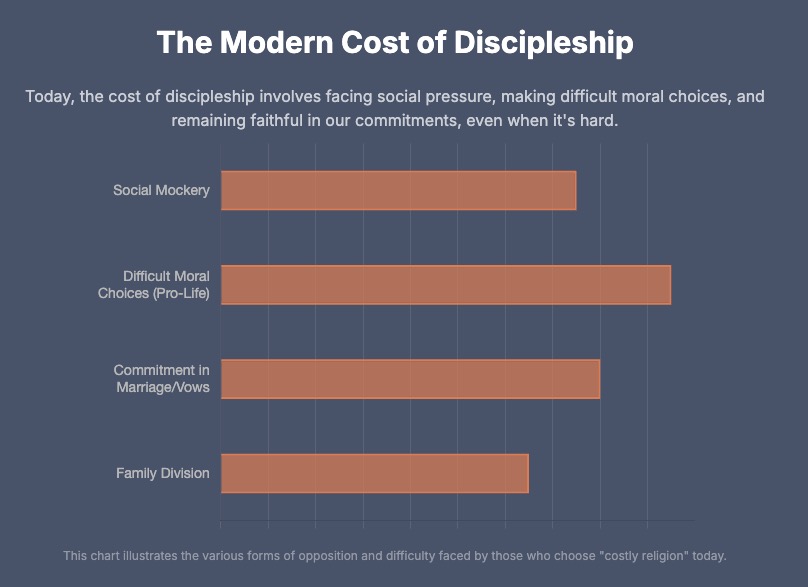
The Reward of Eternal Treasure
- The homily reminds us that we embrace the cost of discipleship because the treasure of God's love is forever. What does it mean for you to be "more concerned with others' eternal salvation than with anything they can do to us in this life"?
- The homily ends with a call to "happily join the Lord in setting the world on fire with love." What is one practical step you can take this week to embrace the cost of discipleship and share God's love with others?
Discussion guides and Infographics on this page have been created using AI generative tools (i.e. GOOGLE'S AI Gemini 2.5 Flash LLM, Chart.js and Tailwind CSS). They are free to use for any non-profit ministry. THE WORD THIS WEEK kindly requests that you show your appreciation by sharing a link to the website.
Homily Excerpt

Because we have chosen Christ, we are confronted with difficult decisions that we need to embrace to be whom we claim to be, People of God. For example: Catholics are pro-life and anti-abortion. What is missing from the media’s hysteria after Roe was overturned is the fact that the DNA of the child is different than that of the mother. The child needs to be treated as a separate person. That is our reason for opposing abortion. This position is easy for people to hold until their seventeen year old daughter or granddaughter becomes pregnant, or their best friend, or even themselves with a surprise baby on the way. Then it becomes a matter of loving that baby more than their plans for the future, or the plans they had for their daughter or granddaughter. The Catholic who says, “I will choose love rather than death,” is embracing the cost of discipleship.
────── ⋆⋅☆⋅⋆ ──────
20th Sunday of Year C

The Battle is Engaged…Choose Sides!

Passion to Purify: The Fire of Transformation
- The homily uses the image of fire to describe Jesus's mission, explaining that fire both purifies and consumes. The author states, "Nothing goes away from fire unchanged!" How have you experienced the "fiery purification" of God's grace in your life, even if it was difficult or painful?
- The homily warns against a faith that seeks only "enrichment and blessings." What is the difference between a faith that seeks only blessings and one that is willing to be purified by fire?
- The author says there is no "middle ground" in this battle. If you're not on the ark, you're not on the ark. Where do you see yourself being tempted to seek a "third way" or a neutral position in your faith?
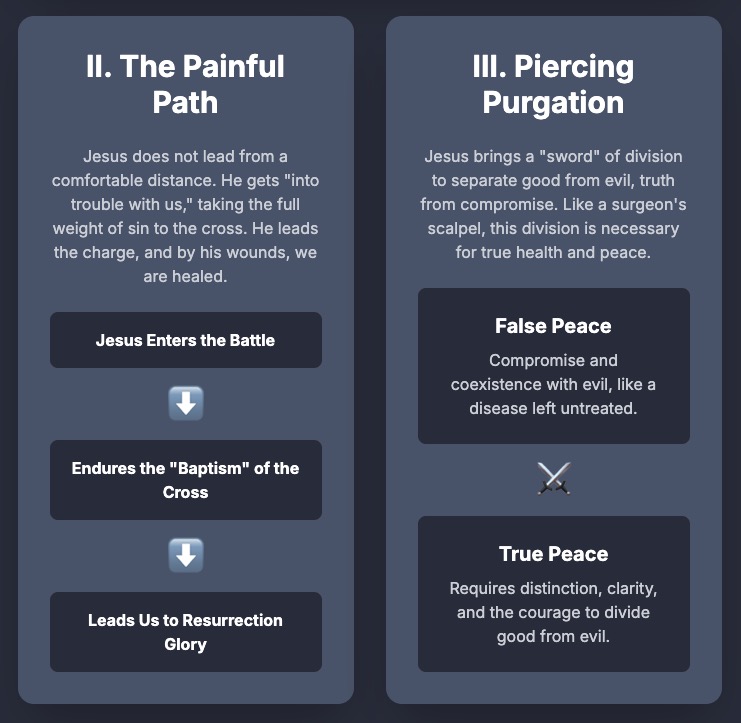
The Painful Path: A Baptism of Anguish
- The homily speaks of Jesus enduring a "baptism" in his own blood and taking on the full weight of human sinfulness. It says he didn't just come to get us out of trouble but to get into trouble with us. How does this image of Jesus as a soldier "on point" leading us into battle change your perception of his sacrifice on the cross?
- The homily uses the shocking analogy of a surgeon’s scalpel to describe the "division" Jesus brings, separating healthy from diseased flesh. How can we apply this analogy to our own lives and relationships? When is it necessary to wield this "sword" for the sake of true peace and holiness?

The Battle Plan: Four Prescriptions from Hebrews
- The homily provides four key points for a soldier in the "Army of the Lord." Let's take a look at each one:
- The PROOF of faith: The homily refers to a "great cloud of witnesses" who testify that God can move mountains. Who are the saints or personal heroes in your life whose testimony has strengthened your faith?
- The PRIORITY of faith: The homily compares our faith to a runner, focused on a single goal. What are some of the distractions or "extra baggage" in your life that are hindering you from running the race?
- The PERSPECTIVE of faith: We're reminded that Jesus endured the cross for the sake of the joy that lay ahead. How can we maintain this eternal perspective when we are facing discouragement or suffering in our daily lives?
- The PERSEVERANCE of faith: The homily emphasizes the importance of enduring to the end. What does it mean for you to "hold fast to the word" and not grow weary in this battle?
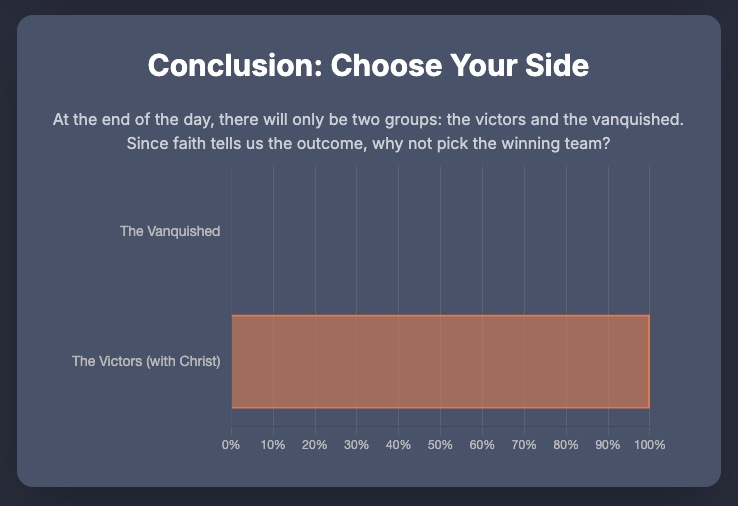
Conclusion: Choose Sides!
- In light of this, what is one practical step you can take this week to more definitively choose the Lord's side and fight alongside him in this cosmic battle?
- The homily concludes with a powerful challenge: "The Battle is Engaged, Choose sides!" The author states that there will be only two groups: the victors and the vanquished.
Discussion guides and Infographics on this page have been created using AI generative tools (i.e. GOOGLE'S AI Gemini 2.5 Flash LLM, Chart.js and Tailwind CSS). They are free to use for any non-profit ministry. THE WORD THIS WEEK kindly requests that you show your appreciation by sharing a link to the website.
Homily Excerpt
The readings today speak of a great cosmic battle that is taking place all around us. In the Gospel, Jesus speaks vividly of it, and of his own mission to engage our ancient foe and to gather God’s elect back from the enslaving clutches of Satan, who was a murder and a liar from the beginning (cf John 8:44).
I. Passion to Purify
II. Painful path
III. Piercing Purgation
- Lay Hold of the The PROOF of faith
- Live The PRIORITY of faith
- Learn the PERSPECTIVE of faith
- Last unto the end through the PERSEVERANCE of Faith
────── ⋆⋅☆⋅⋆ ──────
Fr. Michael Chua
20th Sunday of Year C

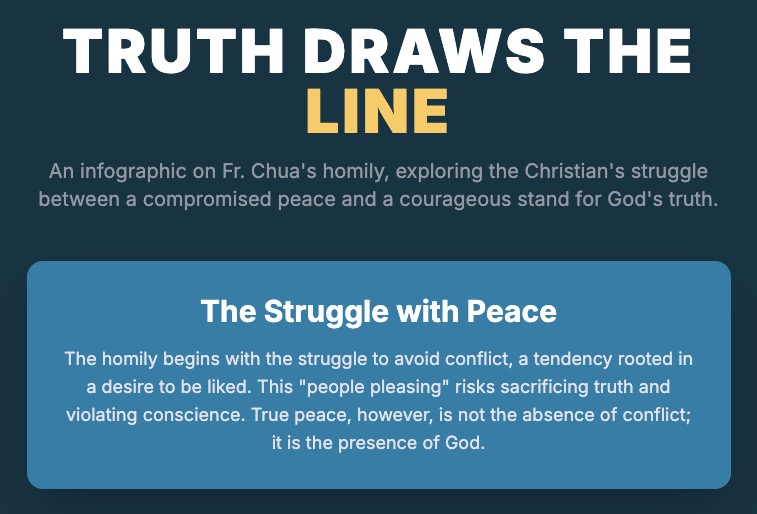
The Struggle with Peace
- Fr. Chua begins by confessing his personal struggle to avoid conflict, a tendency he now sees as a fault, not a virtue. He realizes his motivation was often selfish: avoiding the loss of friends or popularity. Do you relate to this? What motivates you to be a "people pleaser" or to avoid conflict?
- The homily states that true peace is not the absence of conflict but always entails the presence of God. What does this statement mean to you in a practical sense?

False Peace vs. True Peace
- The homily warns that "peace at any price" can descend into evil, especially when it covers over injustice and deceit. Can you think of an example in your own life, or in society, where the desire to avoid conflict led to the continuation of evil?
- Fr. Chua says that making peace is not the same as "making nice." What is the difference between these two actions, and why is one necessary for a Christian and the other potentially dangerous?
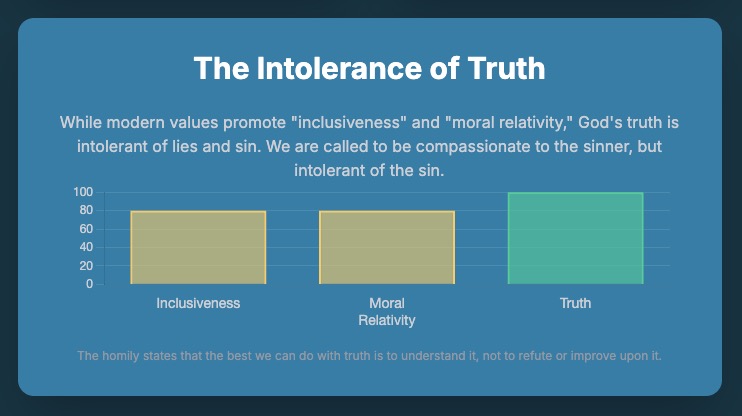
The Intolerance of Truth
- The homily suggests that modern values like "inclusiveness" and "moral relativity" often clash with God's truth. What are some of the areas where you feel this conflict most acutely in your daily life?
- Fr. Chua argues that Jesus was never tolerant of evil, but was always compassionate to the sinner. He says Jesus drew "sharp lines between what was good and what was evil." How can we, as followers of Christ, be compassionate to a person while simultaneously being intolerant of their sin?
The Battle for Our Hearts
- The final advice is to "not lose sight of Jesus." What is one practical step you can take this week to keep your eyes fixed on Jesus, especially when the battle feels confusing or difficult?
- The homily speaks of an ongoing battle between the "City of God" and the "City of the World." It also describes this battle as splitting apart the individual human heart, with the "flesh fights against the spirit." Where do you most often feel this battle raging in your own heart and mind?
- The homily warns against being an "unwitting Trojan horse" for the world's values. What does this metaphor mean, and how can we guard against compromising our faith in subtle ways?
Discussion guides and Infographics on this page have been created using AI generative tools (i.e. GOOGLE'S AI Gemini 2.5 Flash LLM, Chart.js and Tailwind CSS). They are free to use for any non-profit ministry. THE WORD THIS WEEK kindly requests that you show your appreciation by sharing a link to the website.
Homily Excerpt

The fiery message of this passage is equally crucial to our times. The challenge thrown by the Lord is contrary to many of the prevalent values of our age, the two principal ones being inclusiveness and moral relativity. As a result of this obsession with “inclusiveness,” we are told that we should accept “alternative lifestyles”, redefinitions of life, marriage and sex, normalise the abnormal. The catchword is “tolerance”. Some have almost made a god of tolerance. Yet we find these same people can be quite intolerant of any other viewpoint that disagrees with theirs. Closely related to this teaching of tolerance is the concept of moral relativity, which illogically argues that there are no moral absolutes, except its own claim to be absolute. We must, however, note that Truth is indeed intolerant but its intolerance is directed to lies and sin which seek to hide under the cover of euphemisms. We must remember that Jesus was never tolerant of evil. In the case of the woman caught in adultery (John 8:11), He reached out to the sinner in love, but He hated sin. Compassion and acceptance of the sinner have never meant tolerance of their behaviour. It meant exhorting them to cease that sort of behaviour. Our Lord drew very sharp lines between what was good and what was evil, what was moral and what was immoral. When we blur the line between good and evil, we call destruction upon ourselves.
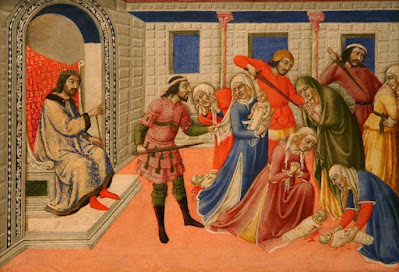
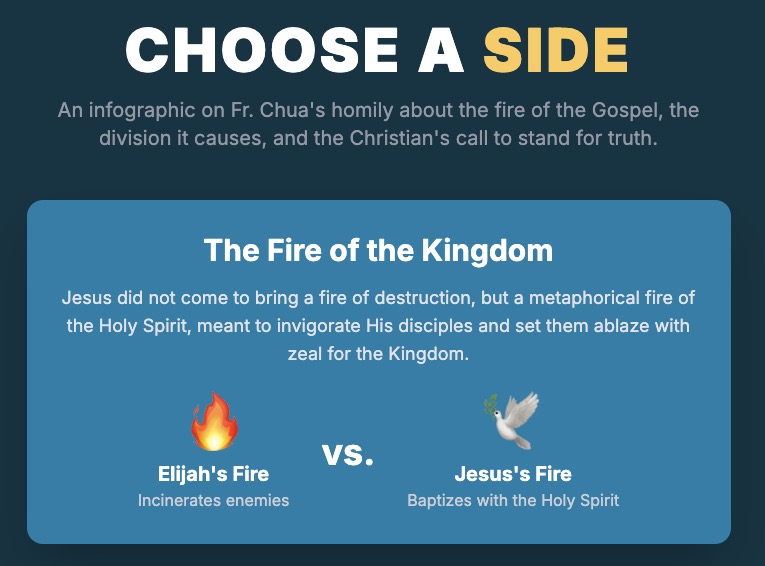
The Fire of the Kingdom
- The homily explains that Jesus's fire is not a destructive blaze but a metaphor for the Holy Spirit, meant to fill us with zeal for the Kingdom. What does it mean for you to be a disciple "on fire" with the Holy Spirit?
- Fr. Chua contrasts this with the prophet Elijah's fire, which incinerated his enemies. What are the key differences between the fire Jesus brings and the fire of judgment?

The Inevitable Division
- The homily states that Jesus is a "sign of contradiction" and that his message will necessarily cause division, even within families. The author connects this to the prophecy in Micah 7:6. Have you ever experienced a division or rift in a relationship because of your faith?
- The homily challenges the idea that something can be "objectively true for some but not for others." Why is it dangerous to accept the notion of "relativism" in our faith?
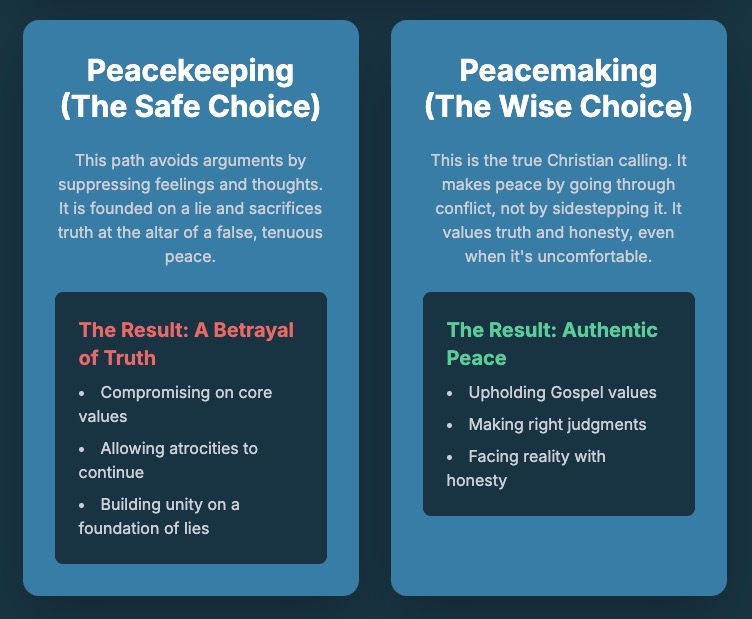
Peacekeeping vs. Peacemaking
- Fr. Chua makes a clear distinction between peacekeeping (avoiding conflict at all costs) and peacemaking (making peace, even if it requires conflict). What are some of the lies or compromises you have been tempted to make for the sake of peacekeeping?
- The homily says that compromise can be "the greatest betrayal to truth." Can you think of a time when you or someone you know had to stand up for a deep value, knowing it would cause conflict? How did that choice play out?

The Final Stand
- The homily concludes that we cannot remain neutral in the battle between good and evil. We must choose sides. What does it mean to you to stand "in the firing range of enemy territory" by refusing to witness to the values of the Kingdom?
- Fr. Chua reminds us that the stakes are high—rejection, persecution, and the cross—but that Jesus is our victor. What is one way you can prepare yourself to stand for Jesus, no matter the personal cost?
Discussion guides and Infographics on this page have been created using AI generative tools (i.e. GOOGLE'S AI Gemini 2.5 Flash LLM, Chart.js and Tailwind CSS). They are free to use for any non-profit ministry. THE WORD THIS WEEK kindly requests that you show your appreciation by sharing a link to the website.
Homily Excerpt
It is important to note that conflict in itself is not a sin, anger as an emotion is not evil, and making right judgments is not bad judgment. Such judgment is often the pathway to making peace. Truth is not painless, honesty is not easy, and facing reality does not come naturally. Therefore, peace is made; sometimes by going through conflict, not by sidestepping it. Conflict rises from differences in what persons value. Naturally, there will be conflict between those who subscribe to gospel values and those who don’t. To avoid conflict at all cost means that one must ultimately compromise our deepest values. That would be fine if we discover that these values are wrong or misplaced. But compromising values whilst knowing that they are right, is the greatest betrayal to truth. That is why peacekeeping is the safe choice but it is not the wise one. Peacekeeping is sacrificing truth at the altar of a false and tenuous peace. Many had stood by silently while atrocities have been committed.
It is inevitable that there will be conflict between good and evil, the Christ and the antichrist, light and darkness, truth and falsehood, the children of God and the children of the devil. In this conflict, we cannot remain neutral. We must choose sides. The stakes are exceedingly high if you choose to side with the Lord and with the Truth. It will entail rejection by family and friends, humiliation and persecution by the world. It will entail the cross.

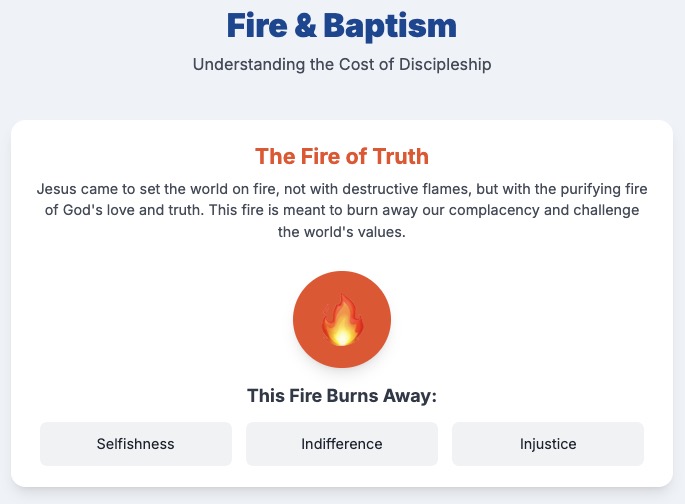
Opening Prayer
Lord, you came to set the world on fire with your truth and love. Open our hearts to receive this fire, even when it challenges us. Help us to understand the “baptism” you call us to, a daily dying to ourselves so that we might live more fully for you. Grant us the courage to face the divisions that truth can bring, and the wisdom to always choose your side. Amen.
Setting the Scene
Read the following summary aloud to frame the discussion:
In his homily, Fr. Chua explores Jesus' challenging words about bringing "fire" and "division" to the earth. He explains that this fire is not one of physical destruction, but the purifying fire of God's love and truth, meant to burn away our selfishness and indifference. The "baptism" Jesus must undergo is his passion and death, a total immersion into suffering for our sake.
Fr. Chua suggests that we, too, are called to undergo a daily "baptism"—a dying to our own self-interest, comfort, and desire for an easy peace. This commitment to Christ's truth is what causes division. When we choose to live with integrity, to stand for the poor, or to speak against injustice, we inevitably create a division between ourselves and a world that prefers comfort and compromise. This division isn't something to fear, but a sign that we are truly living out our faith.
Discussion Questions
1. The Fire of Truth
- Fr. Chua describes the fire Jesus brings as the "fire of God's love and truth." What does this fire burn away? (e.g., selfishness, indifference, injustice).
- Have you ever felt this "fire" in your own life? A moment when a powerful truth made you want to change or act differently?
- The prophet Jeremiah also brought a "fire" of truth and was punished for it. Why is truth often so difficult for people to hear?
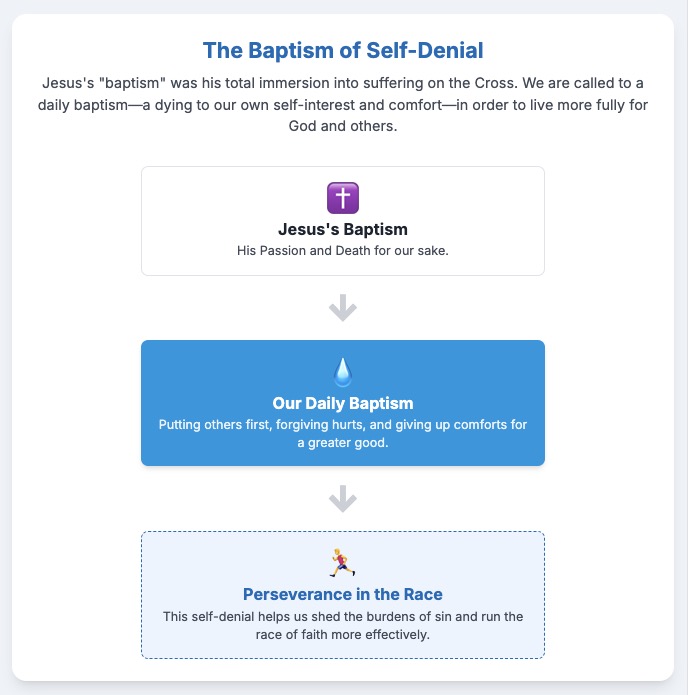
2. The Baptism of Self-Denial
- Jesus speaks of the "baptism" he must be baptized with, referring to his passion and death. Fr. Chua says we are also called to a daily baptism. What does it mean for us to be "baptized" in our daily lives?
- What are some practical ways we "die to ourselves"? (e.g., putting someone else's needs first, giving up a comfort for a greater good, forgiving someone who has hurt us).
- The Letter to the Hebrews encourages us to "persevere in running the race." How does this daily "baptism" or dying to self help us run the race of faith more effectively?

3. The Cost of Division
- Jesus says he came to bring division, not peace. Fr. Chua clarifies this is not about causing conflict for its own sake, but the natural result of living a life of integrity. When have you seen someone's choice to do the right thing cause tension or division in a family, workplace, or group of friends?
- Fr. Chua asks, "Are we ready to be a source of division for the sake of Christ?" What does this question mean to you? Is it a frightening thought? An inspiring one?
- Think of a time you chose to "keep the peace" instead of speaking up or acting on something you knew was right. What was the outcome? Looking back, would you do anything differently?
Discussion guides and Infographics on this page have been created using AI generative tools (i.e. GOOGLE'S AI Gemini 2.5 Flash LLM, Chart.js and Tailwind CSS). They are free to use for any non-profit ministry. THE WORD THIS WEEK kindly requests that you show your appreciation by sharing a link to the website.
Homily Excerpt
Most people who volunteer to serve in church are often moved by a sincere passion to do good, to make a difference and to contribute something to the building of the community. They would expect approval, appreciation, praise, and support for the time and energy that they dedicate or sacrifice for the Church. But unfortunately, that is an ideal very far from reality. They will soon have to deal with the adverse criticism, envy, and jealousy. Little do they realise that everything goes south pretty soon. The ease and speed with which opposition, skepticism, mockery, or hostility manage to douse the initial enthusiasm, dampen the ideals and render harmless the noblest teaching is surprising.
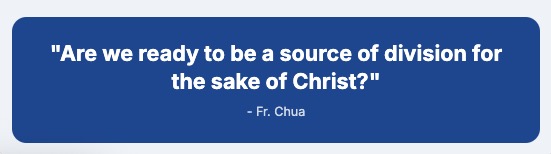
20th Sunday of Year C
Bringing Fire to the Earth

The Fire Jesus Brings
- The homily states that the fire Jesus came to bring is the fire of love and hope—the Kingdom of God. What does it mean for you personally to have this "fire" within you?
- Jesus’s desire that this fire be "blazing already" suggests a sense of urgency. What is one area in your life, or in the world, where you wish this fire of love and hope was burning more brightly?
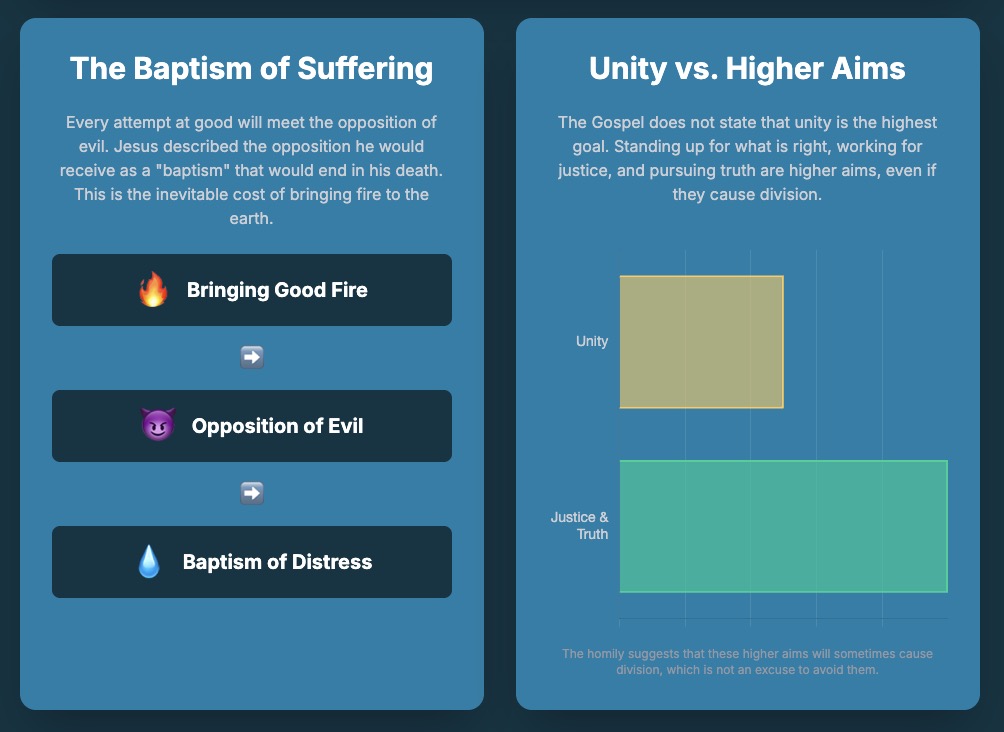
The Price of the Fire: A Baptism of Suffering
- Jesus describes the opposition to his good work as a "baptism of distress" that would end in his death. The homily uses this as a parallel for the suffering that comes from doing good. Can you think of an example, either from the homily or from your own life, where someone's attempt to do good was met with a "baptism of suffering"?
- The homily suggests that the devil exists to attack every attempt at good. Where do you see this opposition most clearly in your life or in the world today?
Unity vs. Truth: The Inevitable Division
- The homily makes the challenging statement that "unity is not the highest goal" and that standing for justice and truth are higher aims. Do you agree or disagree with this? Why?
- The Gospel today speaks of division within a household. Why do you think Jesus uses the family as an example to illustrate this point?

Finding Your Fire: An Everyday Call to Action
- The homily uses Archbishop Oscar Romero's story as an example of someone who found his fire later in life. If you feel your fire is dormant, what is one small, practical step you can take this week to start acting on it, even if it feels intimidating?
- The homily suggests that much of the good fire in the world goes to waste because people are afraid of the opposition or division it might cause. Are you a "pleaser" or "placatory" person? How has this tendency prevented you from acting on a fire within you?
Discussion guides and Infographics on this page have been created using AI generative tools (i.e. GOOGLE'S AI Gemini 2.5 Flash LLM, Chart.js and Tailwind CSS). They are free to use for any non-profit ministry. THE WORD THIS WEEK kindly requests that you show your appreciation by sharing a link to the website.
Homily Excerpt
We can think of many people who had fire in them to do good and they had to undergo a baptism of suffering as a result. For example, think of the ways in which these people who received the Nobel Peace Prize suffered: Nelson Mandela imprisoned; Simon Peres in Israel. Think of Pope John Paul II whose fire is standing up for the right to life of the unborn. We think of the fire in politicians in the North of Ireland to bring about a negotiated settlement to the northern problems. Those are dramatic examples of bringing fire and being baptized and experiencing division. But there are everyday examples closer to home. Think of the fire in parents to do the best for their families. Think of the fire in parents with children on drugs to make sure that the problem is solved. Think of the fire in parents whose child was abused to make sure that it doesn’t happen to any more children.
Twentieth Sunday (Year C)

────── ⋆⋅☆⋅⋆ ──────
20th Sunday of Year C
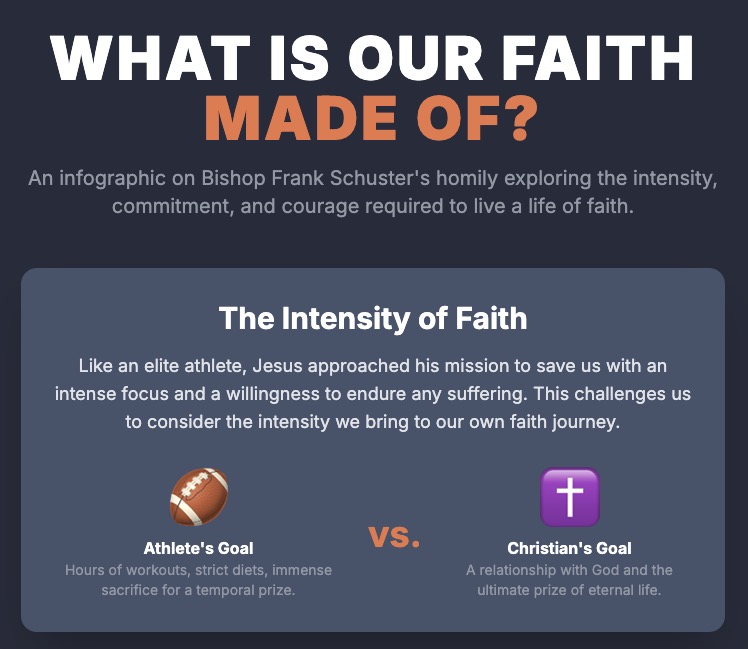
The Intensity of Faith
- Bishop Schuster opens by comparing Jesus’s intensity to that of an elite athlete training for the NFL. What's a goal you’ve pursued in your life—whether in sports, work, or a personal project—with that kind of fierce commitment? What sacrifices did you have to make?
- The homily states that Jesus was "ready to accomplish what he has set out to do no matter how much suffering he was going to endure." How does this level of intensity and commitment challenge your own approach to living out your faith?

The Cost of Division
- The homily discusses how in the early Church, proclaiming Jesus's divinity was a capital offense. It then draws a parallel to today's persecution, citing the attack on a Catholic church in Owo, Nigeria. In light of this, the homily asks us to consider, "What is my faith made of?" How do you respond to that question when you compare your situation with theirs?
- Jesus's words about bringing "division" to a household are highlighted as a painful reality. Have you ever experienced the rejection of your faith by a loved one? How did you deal with that pain and anguish?
The State of Our Faith
- The homily notes the painful irony of people in dangerous parts of the world risking their lives for Mass, while many in the US and Europe are abandoning religion. Why do you think this happens?
- Bishop Schuster acknowledges the failures of some clergy but also points to the vibrancy of new communities in Western Washington (Hispanics, Pacific Islanders, Vietnamese, Filipinos, and African) as a source of hope. What can we, as individuals and as a parish, learn from the "intensity, enthusiasm, and family values" of these communities?
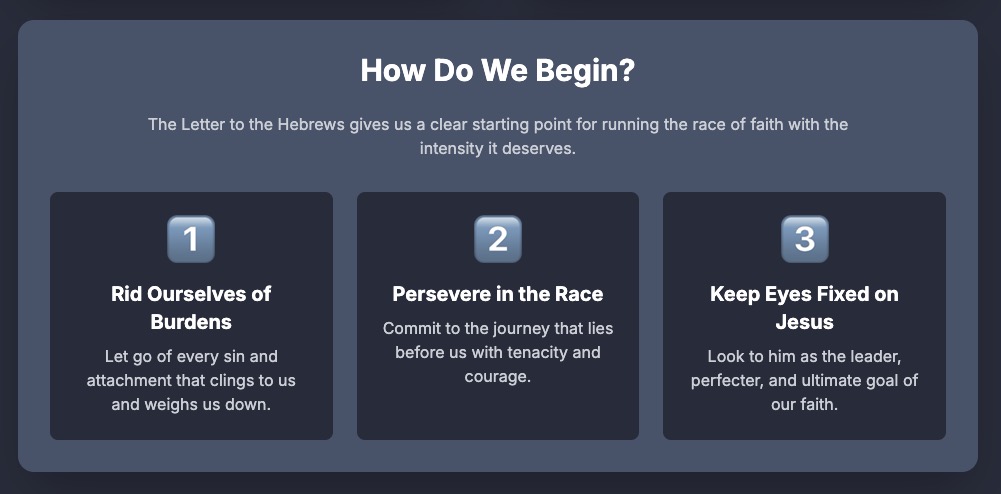
The Call to Share Our Story
- The homily concludes with a call to "rid ourselves of every burden and sin that clings to us and persevere in running the race that lies before us while keeping our eyes fixed on Jesus." What is one practical step you can take this week to live out this call with greater intensity and enthusiasm?
- The homily suggests that many of us can be "lukewarm and mediocre" when it comes to sharing our personal story of faith. Why do you think it is so difficult for us to share what our relationship with Jesus looks like, even with those we love the most?
Discussion guides and Infographics on this page have been created using AI generative tools (i.e. GOOGLE'S AI Gemini 2.5 Flash LLM, Chart.js and Tailwind CSS). They are free to use for any non-profit ministry. THE WORD THIS WEEK kindly requests that you show your appreciation by sharing a link to the website.
Homily Excerpt
I find it painfully ironic that there so many Catholics in dangerous areas of the world who are literally risking their lives just by coming to Sunday Mass while here in the United States, and many places in Europe, so many people are abandoning religion altogether. Parents work hard at passing on the faith to their children. It is a gift that often gets rejected and can be a cause of a great deal of pain and anguish in the hearts of parents. Houses get divided, three against two, two against three. Trust me, I understand that a great deal of blame rests squarely on the shoulders of how bishops and priests have at times failed egregiously in being good shepherds, to say the least. I am grateful for Pope Francis’ Synod on Synodality because I hope we bishops hear loud and clear how we can better serve our church. For a record, I have a list myself. However, when you see the witness of Catholics in dangerous places around the world and compare their faith with what we see in our culture. That should give us pause before we cast all the blame on bishops and priests. The good news is, from my experience at St. Vincent de Paul and my journeys up and down I-5, the Catholic Church is young in Western Washington and growing thanks to our Hispanics, Pacific Islanders, Vietnamese, Filipinos, and African Communities. Their intensity, enthusiasm, and family values give me great faith in the future.
Discussion guides and Infographics on this page have been created using AI generative tools (i.e. AI Gemini Pro, Chart.js and Tailwind CSS). They are free to use for any non-profit ministry. THE WORD THIS WEEK kindly requests that you show your appreciation by sharing a link to the website.
Video clips from YouTube which are added serve to complement the homily. They may not have a direct correlation with the contributor’s original content, however. Instead, they aim to inspire preachers to enrich their own homilies, drawing ideas and insights from both the written material and the visual content explored.