26th Sunday of Year B

September 29, 2024

Homilies

1 MINUTE HOMILYTWO MINUTE HOMILYFR. PETER HAHNFR. JUDE LANGEHFR. KEVIN RETTIGFR. GEOFFREY PLANT
YouTube player

SOURCE: The Jesuit Post

YouTube player

SOURCE: Fr. Peter Hahn Archive of Homilies

VIEWING GUIDE w/ Questions

KEY INSIGHTS OF THE READINGS

God's Love and Our Response

Q: How does God work in our lives?
A: God is constantly pouring out His boundless love upon us, working in and for us, but we must view this with the eyes of faith and keep our focus on Christ.

Q: What will God ask us at the moment of death?
A: According to St. James, God will ask if we tried our best to love Him with our heart, mind, soul, and strength, and to love others in His name, rather than about worldly troubles.

Sin and Temptation

Q: How does Satan try to deceive us?
A: Satan lies that God has abandoned us or tempts us to abandon Him through sin, but we must strive to avoid sin and focus on God's infinite mercy and forgiveness.

Q: What does Jesus teach about avoiding sin?
A: Jesus teaches that we should cut off anything that leads us away from God, even if it means losing a hand, eye, or foot, to avoid eternal suffering in hell.

Spiritual Focus

Q: What should we focus on in our spiritual lives?
A: We must focus on the unseen reality of God's infinite power and love, constantly being poured out to us, rather than the limited vision of what we can physically see.

Q: Why is the judgment at death significant?
A: The judgment at death is the most significant event in our lives, as all worldly concerns will pass quickly, and we'll be judged on how we used God's graces and loved Him and others.

PRACTICAL LIFE APPLICATIONS

Spiritual Growth

Q: How can I deepen my spiritual perspective?
A: Focus on Christ and view all things through the eyes of faith, striving to see beyond limited human vision and rejoice in God's boundless generosity and love.

Q: What should be my approach to God's grace?
A: Recognize and appreciate God's constant outpouring of His spirit, love, and grace to guide us, understanding that all good flows from Him as the source of all goodness.

Sin and Forgiveness

Q: How should I deal with sin in my life?
A: Strive to avoid all sin that leads away from God, and be willing to cut off anything that causes separation, recognizing it will cause pain but lead to ultimate joy and peace.

Q: How can I find forgiveness for my sins?
A: Rely on God's infinite mercy and forgiveness, seeking restoration through the eyes of faith that focus on the unseen spiritual reality rather than limited physical perception.

Divine Will and Judgment

Q: How does God's will work in relation to human freedom?
A: Understand that God's permissive will respects our freedom while still working to bring good from all things, even if not as originally intended, as part of His greater plan.

Q: What will God ask of us in the final judgment?
A: Be prepared to account for how we used the graces God gave us, whether we tried our best to love Him with our heart, mind, soul, and strength, and to love one another in His name.

CULTURAL/RELIGIOUS CRITIQUES

Controversial Church Teachings

Q: Does God allow evil to happen?
A: According to the Bible, God's "permissive will" allows all things to occur, including disturbing events, to respect human freedom and ultimately bring good from them.

Q: Is causing others to sin worse than suicide?
A: Jesus teaches that causing others to sin is worse than having a millstone tied around one's neck and being thrown into the sea.

Judgment and Afterlife

Q: What determines our eternal fate?
A: The Bible states that at the moment of death, God's judgment will determine if we spend eternity with Him or separate from Him, based on how we loved Him and others.

Q: Does sin really lead to separation from God?
A: The Bible warns that sin causes disconnection from God's love, leading to pain and separation from God's life.

Priorities in Faith

Q: What will God ask us about at death?
A: According to the Bible, God will ask if we tried our best to love Him with our heart, mind, soul, and strength, and to love others in His name, not about worldly troubles.

Q: Should we focus on avoiding sin or loving others?
A: The Bible teaches that striving to avoid sin and cutting off anything that leads us away from God will bring joy and peace, while our primary focus should be on loving God and others.

YouTube player

SOURCE: Fr. Kevin’s Homilies

The 1994 Rwandan genocide serves as a stark reminder of humanity’s capacity for hatred, while the teachings of figures like Moses, Jesus, and Lincoln advocate for inclusivity, unity, and the transformative power of love and forgiveness in overcoming divisions.

KEY INSIGHTS w/ Timestamps
  • 00:00 The 1994 Rwandan genocide, where over a million people were killed in just a hundred days, raises profound questions about the capacity for hatred and violence within humanity.
  • 01:09 Embracing unity, both Moses and Jesus challenge the exclusionary mindset by celebrating those outside their recognized groups.
  • 02:08 All are welcome in the universal church, transcending divisions and embracing everyone as part of God's people despite societal and political divides.
  • 03:16 Jesus reflects on sharing a meal with both his beloved disciple and those with faults, emphasizing inclusivity and love.
  • 03:41 Even in the face of betrayal and judgment, the gift of communion is freely given to all, highlighting the unconditional nature of love and grace.
  • 04:36 A ruthless prime minister claimed he had no enemies to forgive because he had them all executed, highlighting extreme measures in dealing with opposition.
  • 05:25 Emphasizing unity, Lincoln argued that making enemies into friends is a more effective way to address divisions than outright destruction.
  • 06:10 Embracing our shared humanity transcends divisions, highlighting the privilege of belonging to a diverse universal community.
YouTube player

SOURCE:  Fr. Geoffrey Plant Homily Presentations

True discipleship involves self-renunciation, servitude, and inclusivity, urging individuals to detach from material possessions and embrace a God-centered existence while sharing the burdens of faith.

KEY INSIGHTS w/ Timestamps
  • 00:00 Jesus' journey to Jerusalem reveals the disciples' struggle with true discipleship, emphasizing self-renunciation, servitude, and inclusivity in doing good.
  • 05:37 God calls us to inclusivity and humility while sharing the burdens of discipleship, urging us to detach from anything that threatens our life in His Kingdom.
    • The first reading from the Book of Numbers highlights the Israelites' complaints during the Exodus and God's solution to Moses by appointing seventy elders to share the burden.
    • Moses emphasizes the importance of inclusivity and humility in recognizing and celebrating the Spirit's presence and goodness among all people, regardless of their status or location.
    • God's call to discipleship requires us to vigorously detach from anything that jeopardizes our life in His Kingdom.
  • 10:20 John Climacus, at 75, wrote "The Ladder of Divine Ascent," illustrating the Christian journey of discipleship as a ladder requiring the renunciation of vices and the cultivation of virtues.
    • John Climacus, at 75, became abbot of St Catherineโ€™s monastery and wrote "The Ladder of Divine Ascent," a spiritual guide likening the Christian life to a ladder with thirty rungs, inspired by Jacob's dream in Genesis.
    • The journey of discipleship requires overcoming vices and acquiring essential virtues, particularly renunciation, detachment, and exile, to ascend higher.
  • 13:34 Affluenza blurs the line between wants and needs, causing a relentless pursuit of wealth that results in ongoing dissatisfaction.
    • Affluenza is a condition characterized by confusion between wants and needs, leading to an unhealthy obsession with wealth and materialism.
    • People often equate wealth with happiness, continually striving for more despite having enough, leading to a cycle of dissatisfaction.
  • 16:00 We often seek fulfillment through possessions, but true emptiness stems from our attachment to them and neglecting the needs of the poor.
    • To fill the emptiness in our lives, we often mistakenly believe that acquiring more possessions is the solution.
    • The true issue lies not in material possessions themselves, but in our attachment to them and the neglect of the needs of the poor, as highlighted by both St. John of the Cross and St. James.
  • 19:25 The mystic journey entails awakening, purification, and illumination, driven by a quest for deeper meaning and self-union.
    • The mystic journey involves awakening, purification, and illumination of the self, often beginning with a profound restlessness that leads to a transformative search for deeper meaning, as illustrated by St. Augustine and Dante.
    • Purification requires shedding illusions and ego to achieve true self-union with reality.
  • 22:28 The hero's journey mirrors our own, highlighting the challenges of heeding the Call to Adventure, as seen in Dante's struggles and Jonah's transformative experience.
    • The hero's journey, as illustrated in various stories, reflects our own experiences and begins with the Call to Adventure.
    • Dante the Pilgrim's journey illustrates the struggle against internal and external fears that can hinder one's willingness to embark on transformative adventures.
    • Jonah's journey illustrates the struggle of resisting God's call, culminating in a transformative experience within the belly of the whale that symbolizes the death of his rebellion.
  • 27:40 Life's journey of discipleship requires embracing necessary losses to shift from self-centeredness to a God-centered existence.
    • Life involves necessary losses that foster growth, requiring a shift from self-centeredness to a God-centered existence.
    • The journey of discipleship involves moving from a self-centered existence (Ego-drama) to a God-centered life (Theo-drama), as illustrated in Mark's gospel.

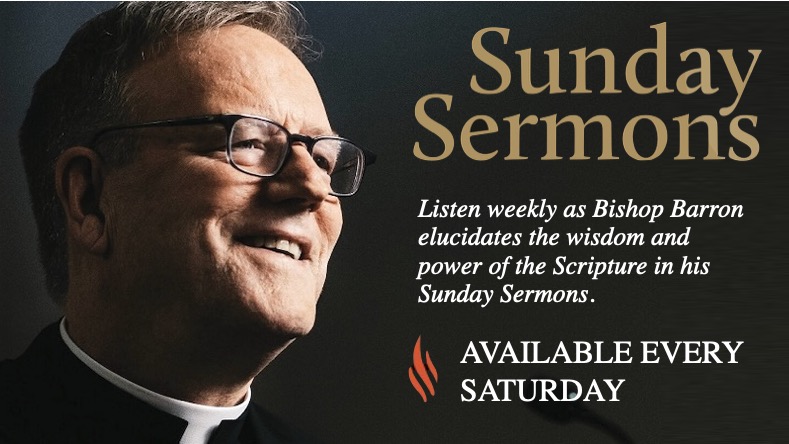
Bishop Robert Barron

2021 SERMON2024 SERMON
YouTube player

SOURCE: Word on Fire

VIEWING GUIDE w/ Questions

2021 SERMON – Friends, let us rejoice whenever the grace of God is on display. The point of the sacraments is so that Godโ€™s grace may flood the world, but the Lord can operate outside of our formal structures. He desires these gifts for us, but as the creator of these structures, he is never limited by them.
KEY INSIGHTS OF THE READINGS

Divine Ritual and Grace

Q: How does God view ritual and sacramental realities?
A: God is intensely interested in ritual and sacramental realities, as evidenced by detailed prescriptions for the tabernacle, priests, and animals in Exodus, Numbers, Leviticus, and Deuteronomy.

Q: Can God's grace operate outside formal structures?
A: God's grace can manifest outside formal ritual and sacramental structures, exemplified by Eldad and Medad prophesying despite not attending the appointed ceremony.

Spiritual Manifestations and Inclusivity

Q: What was Jesus' stance on those performing good deeds in his name?
A: Jesus instructed to prevent no one who performs good deeds in his name, even if they're not formally part of his disciples, as seen in the story of the demoniac.

Catholic Church and Divine Gifts

Q: What unique gifts does the Catholic Church possess?
A: The Catholic Church has the fullness of Christ's gifts, including the Word, liturgy, sacraments, Mass, Eucharist, apostolic succession, and papal authority.

Spiritual Envy and Its Consequences

Q: How can envy manifest in a religious context?
A: Clerical envy, as exemplified by Joshua's complaint about Eldad and Medad, is a form of the capital sin of envy that can lead to trouble in religious contexts.

Divine Grace Beyond Boundaries

Q: How does God's grace manifest beyond formal structures?
A: God's grace can operate through various individuals and contexts, even outside the formal Church, demonstrating its ability to transcend established boundaries.

PRACTICAL LIFE APPLICATIONS

Worship and Grace

How does God view formal worship structures? God desires detailed rituals and sacraments for worship as described in Exodus, Numbers, Leviticus, and Deuteronomy, but can also operate outside these formal structures as shown in the story of Eldad and Medad in Numbers.

Can God's grace work outside formal church structures? Yes, God's grace can be operative outside formal ritual and sacramental structures of the Church, as demonstrated in the story of Eldad and Medad, but these structures are meant to serve God's grace, not the other way around.

Leadership and Humility

How did Moses respond to Joshua's complaint about Eldad and Medad? Moses displayed humility and clarity of vision, expressing his desire for God's spirit to be on all people, indicating a wish for God's grace to be available everywhere.

Envy and Sin

What is the worst type of envy in a religious context? Invidia clericalis is considered the worst type of envy, occurring within religious contexts, as exemplified by Joshua's complaint against Moses in Numbers.

Ecumenical Perspectives

What did Cardinal George say about gifts in different Christian denominations? Cardinal George stated that while the Catholic Church has all the gifts Christ wants for his people, some gifts might be better exercised in other contexts, such as preaching in Protestant churches.

CULTURAL/RELIGIOUS CRITIQUES

Controversial Religious Authority

Q: Does God require strict adherence to formal religious structures?
A: While God prescribes detailed rituals and sacraments in biblical texts like Exodus and Leviticus, the story of Eldad and Medad in Numbers suggests He can operate outside formal structures when He chooses.

Q: Can God's grace work outside established religious institutions?
A: Yes, Cardinal George acknowledged that while the Catholic Church has all gifts Christ intended, certain gifts might be better exercised in other contexts, as illustrated by the Eldad and Medad narrative.

Religious Envy and Exclusivity

Q: What's the most dangerous form of envy in religious contexts?
A: "Invidia clericalis" is considered the worst type of envy, occurring within religious settings, as exemplified by Joshua's complaint against Moses in the book of Numbers.

Q: Should religious leaders prevent others from performing good deeds in God's name?
A: No, Jesus explicitly stated, "Do not prevent him" and "whoever is not against us is for us" when John complained about someone driving out demons in Jesus' name.

Religious Humility and Inclusivity

Q: How did Moses respond to challenges to his religious authority?
A: Moses displayed extraordinary humility, saying "Would that all the Lord's people were prophets", marveling at God's ability to work through unexpected channels.

Q: Should formal religious structures serve God's grace or vice versa?
A: The video suggests that formal structures should serve God's grace, not the other way around, emphasizing the primacy of divine action over human institutions.

YouTube player

SOURCE: Word on Fire

VIEWING GUIDE w/ Questions

2024 SERMON – The Church must prioritize unity, inclusivity, and collaboration over rigid structures and individual recognition to fulfill its mission and effectively spread grace.

KEY INSIGHTS w/ TIMESTAMPS

  • 00:00 The Church's internal divisions, fueled by jealousy and manipulation, hinder its mission and unity.
    • The Church faces internal division, often manipulated by the devil, which undermines its mission and unity.
    • Saul and David, despite being allies against a common enemy, allow jealousy to drive them apart, preventing the fulfillment of God's purposes.
  • 01:44 Moses emphasizes unity and inclusivity over social hierarchies in the community of God.
    • Moses defends Eldad and Medad's unexpected grace and prophesying, highlighting the importance of unity and inclusivity within the people of God.
    • Focusing on social hierarchies is a waste of time and distracts from more meaningful pursuits.
  • 03:34 Unity in serving God is vital, as Jesus affirms that all who do good in His name are allies, regardless of their affiliations.
    • Moses emphasizes the importance of unity in serving God over divisiveness and jealousy regarding spiritual gifts.
    • Unity in the Church is essential, as Jesus teaches that those who do good in His name, regardless of their group affiliation, are allies in the faith.
  • 05:37 Grace should flow freely through us to transform the world, regardless of rigid structures or regulations.
  • 07:41 Church structures are vital for grace, but prioritizing them over spiritual power can lead to jealousy and distraction from true grace.
    • Church structures are essential for facilitating grace, but there is a risk that individuals may prioritize the structures over spiritual power.
    • Jealousy and a focus on hierarchy can distract from the true spiritual power of grace.
  • 09:49 New ideas in the Church often face resistance and bureaucratic obstacles due to jealousy and a reluctance to embrace change.
  • 10:50 True progress occurs when we prioritize collective achievement over individual credit, fostering grace and unity.
  • 12:31 Embracing inclusivity and collaboration in faith can lead to remarkable spiritual achievements, regardless of who receives recognition.
PRACTICAL LIFE APPLICATIONS

Fostering Unity in the Church

Q: How can we prevent division within the Church?
A: Recognize that the devil divides the Church by turning members against each other, and focus on fighting the common enemy rather than internal conflicts.

Q: What attitude should we have towards others doing God's work?
A: Adopt Jesus' approach of "whoever is not against us is for us," allowing those performing mighty deeds in his name to speak well of him, even if they're not part of the inner circle.

Embracing Spiritual Growth

Q: How should we react to others receiving spiritual gifts?
A: Follow Moses' example of spiritual common sense by not being jealous of others receiving prophetic gifts and wishing for everyone to receive God's spirit.

Q: What should be our priority in Church structures?
A: Focus on facilitating the flow of God's grace as the ultimate goal, rather than getting caught up in perceived slights or hierarchies.

Overcoming Obstacles to Progress

Q: What can hinder progress in the Church?
A: Be aware that jealousy and resentment can kill beautiful ideas and hinder progress, as seen in the story of Eldad and Medad receiving the prophetic gift.

Q: How can we maintain focus on God's will?
A: Cut to the chase and prioritize the fulfillment of God's will, rather than worrying about who receives spiritual gifts or how they are distributed.

CULTURAL/RELIGIOUS CRITIQUES

Divisive Tactics in Religion

Q: Does the devil use division as a strategy against the Church?
A: Yes, the devil divides the Church by turning members against each other, making them "kill each other" like orcs in Tolkien stories, undermining the Church through internal conflict.

Q: Should religious leaders be jealous of others receiving spiritual gifts?
A: No, Moses demonstrated spiritual common sense by not being jealous of others receiving the prophetic gift, wishing everyone was a prophet and being happy if God bestowed His spirit on all.

Inclusivity in Faith

Q: How did Jesus respond to those performing miracles in his name without being followers?
A: Jesus stated that whoever performs mighty deeds in his name cannot speak ill of him, teaching that "whoever is not against us is for us" and rejecting divisive jealousy.

Q: What's the purpose of church structures according to the video?
A: Church structures are meant to facilitate the flow of grace, not hinder it, emphasizing that if grace is flowing, one shouldn't get in its way.

Overcoming Ego in Religious Service

Q: How does ego impact the Church's effectiveness?
A: The devil kills beautiful ideas through jealousy and resentment in the Church, limiting its potential, as there's no limit to what could be accomplished if nobody cared who got credit.

Q: What attitude did Moses and Jesus promote for a united Church?
A: Both Moses and Jesus promoted an attitude of inclusivity and selflessness, wishing for widespread spiritual gifts and allowing others to act in Jesus' name, showing that the Church would be more effective if everyone shared this mindset.

Deacon Peter McCulloch

Deacon of the
Diocese of Broken Bay, Australia

RECENT

2021 HOMILY2024 HOMILY
YouTube player

On the Four Chaplains

Num.11:25-29; Jas.5:1-6; Mk.9:38-43, 45, 47-48

2021 EXCERPT: So, what can we learn from this story? Well, it demonstrates what it truly means to have faith. It teaches us that regardless of our faith traditions, weโ€™re all essentially equal and only our attitudes separate us.

This story also reminds us that if our faith is genuine, then our first priority cannot be ourselves. As Jesus tells us, the two greatest commandments are that we love God and our neighbour (Mk.12:30-31).

Jesus also says that thereโ€™s no greater love than to lay down oneโ€™s life for oneโ€™s friends (Jn.15:13).

YouTube player

The Parable of the White Birds and Black Birds

Num.11:25-29; Jas.5:1-6; Mk.9:38-43, 45, 47-48

2024 EXCERPT: Why do I share this story with you? Itโ€™s because in Markโ€™s Gospel today, Jesus says that whoever thinks, says or does something nice for someone else โ€“ even as little as offering them a glass of water โ€“ will be rewarded.

Thatโ€™s because the good you do always comes back to you. But whoever does the opposite, whoever does something nasty towards someone else โ€“ even if itโ€™s only a bad thought โ€“ will suffer for it. Why? Itโ€™s because evil is like acid. It eats away at whatever it touches. And everything always returns to its source.

Fr. Andrew Ricci

Priest of the
Diocese of Superior,
Wisconsin

RECTOR OF CHRIST THE KING
CATHEDRAL

RECENT

We All Can Take Part to be Part of Something Great
2021 PODCAST: Both Moses and Jesus respond to division, encouraging us to look for ways that we can work togetherโ€ฆrather than being torn apart.

Fr. Austin Fleming

Priest of the
Archdiocese of
Boston

HOMILIES

VIDEOS

The Divided States of America

2018 EXCERPT: The story of Eldad and Medad in the first reading is basically a narrative about โ€œus and them,โ€ or even better, โ€œus VS them.โ€ Itโ€™s the tale of a power struggle to determine โ€œwhoโ€™s right and whoโ€™s wrongโ€  — โ€œwhoโ€™s in and whoโ€™s out?โ€ and who deserves the seal of authenticity and legitimacy in the work that needs to be done… Butโ€ฆ is Jesus seriously suggesting we pluck out an eye or cut off a hand or a foot?

  • Regardless of which side of the legislative aisle we take our seat, no good is achieved by our demonizing the other side. Ideology of that kind does not focus our vision, instead, it blinds us and keeps us from seeing the whole picture, the whole truth. And it needs to be cut out.
  • If the works of our hands fail the standards of honesty and fairness, if our hands take in for ourselves far more than we offer and give away to others, then we need to CUT OUT whatever injustice and selfishness keep us from standing in grace before God and our neighbor.
  • If the path our feet walk fails to follow in the Lordโ€™s footsteps, if we fail to go where God calls and leads us then we need to CUT UP the map weโ€™ve drawn for our own purposes and begin to walk at the Lordโ€™s side, with him as our guide and companion.

Dominican Blackfriars


Dominican Friars
of England & Wales,
Scotland

HOMILIES

ARCHIVE

2021 EXCERPT: Living the life of Christ involves a reconstruction not only of our life story, but also of our whole way of being in the world. The way we are involved in the world is through our bodies and the disorder of sin has a kind of physical effect on us. We do not function in the right way. The answer to this is not self-mutilation but understanding what our life is for. Jesus says we must have a broader and more generous vision of what life is about not a narrow vision such as John and the disciples seem to possess. He is saying that if certain aspects of our life seem to exceed our control. If we lose the harmony of the proper functioning of the whole of our existence then we have to undergo painful realignment. He uses the metaphor of amputation. Sometimes a diseased member of the body threatens the health of the whole and we have to do without it. Jesus is asking what is it to

Fr. Charles E. Irvin
Priest of the
Diocese of Lansing
(1933 – 2021) 

HOMILIES

Who’s “In” and Who’s “Out”

EXCERPT: Whoโ€™s in, and whoโ€™s out? Thatโ€™s a question that cuts through so many areas in our lives these days especially in this political season. Here are a few for instance:

  • What do the opinion polls tell us about the standings of those who are running for the presidency of the United States? Whoโ€™s in, and whoโ€™s out?
  • How should we treat undocumented aliens? What benefits of U.S. citizenship should they enjoy, and what should they not be entitled to in our legal system and governmental social service programs? Whoโ€™s in, and whoโ€™s out?
  • Which student applicants should be admitted and which should not be admitted to our public universities and what criteria should be applied to them?
  • Some Catholics are busily concerned with โ€œWho is a real Catholic and who is not?โ€
  • Some Fundamentalist Christians are busily concerned with โ€œWho is going to hell and whoโ€™s going to be saved?โ€

Fr. Leon Ngandu, SVD

Fr. Leon Ngandu, SVD

BIBLE TEACHER AT
SAINT AUGUSTINE CATHOLIC HIGH SCHOOL IN THE ARCHDIOCESE OF NEW ORLEANS

HOMILIES

โ€œDo you also want to leave?โ€

EXCERPT: Before we make this critical and personal decision, let us take the necessary time to review again all of Jesusโ€™ teachings in this Bread of Life Discourse. Here are the recapitulating points: Jesus cares for us when we follow him. He feeds us like he fed the five thousand people (the first Sunday of our meditation). He invites us to work, not for the food that perishes, but for the food that endures for eternal life, which is to unite with him in the sacrament of the Eucharist at Mass (second Sunday). We are on our earthly journey to heaven, where we will meet God. So, to not starve with hunger, we need Jesus, the bread of life, to sustain us spiritually (third Sunday). His Flesh and Blood we receive in the Holy Communion make us remain in him and he in us, and have eternal life (fourth Sunday). This union transforms our lives. We become one with Jesus, he, who is the head, and we are the members of his body, which is the Church that Saint Paul talks about when he uses the analogy of love between wife and husband in todayโ€™s second reading (fifth Sunday).

Fr. Joe Jagodensky, SDS

SOULFUL MUSE

RECENT

2021 EXCERPT: A friend of mine told me that he spends quiet time on a Sunday morning at Barnes and Noble.  I looked the two of them up in my Catholic saints book but couldnโ€™t seem to locate either one of them.  It was enlightening to be enlightened by a personal response from him to a divine call.  And itโ€™s only a book store.  One hour or three?  Doesnโ€™t matter when the quality is measured against evaluating the past week and renewing the new week to come.

Itโ€™s not the same as my rote ritual which was created to be such.  The repeating of repeating words are intended to bring about that necessary future salvation.

Fr. George Smiga

Homiletic Professor
at St. Mary Seminary

ARCHIVE

Valuing the Other

2009 EXCERPT:The attitude of intolerance flourishes whenever people adopt an โ€œUs vs. Themโ€ mentality. There are sure signs that this kind of thinking is growing among us.  Internationally we see more and more examples of one country vilifying another.  In our country politicians who disagree with one another are more frequently turning to personal attacks.  In our own family and relationship this attitude of โ€œUs vs. Themโ€ can also take a foothold and hurt us.  I found an effective description of this attitude in a passage called us โ€œUs Versus Them.โ€ I would like to read it to you.

  • Thereโ€™s us.  And then thereโ€™s them.
  • Weโ€™re all right.  Theyโ€™re not.
  • Weโ€™re justifiably concerned for our familyโ€™s livelihood. Theyโ€™re in it for the money.
  • Weโ€™re resting.  Theyโ€™re self-indulgent.
  • Weโ€™re pragmatic.  Theyโ€™re manipulative.
  • Weโ€™re teasing.  Theyโ€™re mean spirited.
  • We know the truth.  They donโ€™t understand.  Theyโ€™re ill-informed.
  • Weโ€™re concerned for the common good.  Theyโ€™re out to grab whatever they can get.
  • Donโ€™t ever question our good intentions, our values or our patriotism.
  • But watch out for them.
  • You can trust us.  But be afraid of them.
  • Weโ€™re all created equal.  But some of us are more equal than others.
  • We are all children of God.  But weโ€™re Godโ€™s favorites.
  • Weโ€™re the people of God.  We pray for them.

Fr. Anthony Ekpunobi, C.M.

Priest of the
Congregation of
the Mission Province
of Nigeria

HOMILIES

2021 EXCERPT: As Catholics, we are endowed with the gifts of the sacraments. They are revealed presence of Jesus Christ in the church. The catholic church through her institutions appreciate, celebrate and preserve the sacraments. The church is also aware that God is not confined to the sacraments. Divine wisdom can me manifested by any means it pleases God. Moses warned Joshua in the first reading โ€“ โ€˜Are you jealous on my account? If only the whole people of the Lord were prophets, and the Lord gave his Spirit to them all!โ€™ The wisdom to prophesy was taken from Moses and given to the two men โ€“ Eldad and Medad. It is the wisdom of God at work in them. While we preserve the exclusive rights to the sacraments, we should be open to the fact that divine wisdom can be manifested outside of the sacraments. This is the reality of a universal faith. The universality of faith does not diminish the power of the sacraments. It seizes to be divine wisdom when faith is manipulated against charity. Faith is found in good works! When we commend good works, we commend faith.

Msgr. Joseph Pellegrino

Priest of the Diocese
of St. Petersburg,
Florida

HOMILIES

The Grace of Our Eldads and Medads

2024 EXCERPT: Eldad and Medad may not have been in the tent. But the Spirit still empowered
them. Just as the Spirit empowers that husband who had been away from the Church for years, who mocked all things good and holy, but who, when he looked at his first born, said that he needed to change his life. He returned and returns daily. He continually asks forgiveness for the time he was away. Now, he is leading his children to God. The Spirit has given his life meaning and purpose. Like Augustine he grieves, “Late have I loved thee.” And like Augustine he has learned that God never stopped loving him.

Eldad and Medad may not be in the tent, but the Spirit still empowers them.
Just as the Spirit empowers that woman who had two babies by two different men, and an abortion due to another man, and now, through bitter tears and daily repentance, has chosen God. She works diligently caring for those who also tread the path of death she had been on, for those who have offended against the dignity of Christianity as she had offended against life.

Msgr. Charles Pope

Priest of the
Archdiocese of
Washington D.C.

HOMILIES

No Homily Available

Of Friends and Foes

2021 EXCERPT: In this Sundayโ€™s Gospel there is a certain tension between legitimate freedom and truths we must insist upon. We also have a lot to learn in sorting out friends and foes.

I. Foe or Friend? 
II. Friends are Fundamental 
III. Falsehood is the Fiercest Foe  

Bishop John Louis

Auxiliary Bishop of
Archdiocse of Accra,
Ghana

HOMILIES

2021 EXCERPT:  Whereas Godโ€™s Spirit freely chooses those He wishes to use as His instruments of blessings and salvation, we are to identify the true servants of God.  This may be a daunting task in our era which is full of โ€œmen/women of Godโ€ of all shapes and shades. However, with the grace of the same Holy Spirit, we can recognize the true servants of God. Supporting the ministry of such servants goes with a reward: โ€œI tell you the truth, anyone who gives you a cup of water in my name because you belong to Christ will certainly not lose his rewardโ€ (Mark 9:41). Let us, therefore, tap into the grace of God and make the effort to recognize them and support their ministry to the glory of God and for the building up of His Church. Amen!

Fr. Michael Chua

Priest of Archdiocese
of Kuala Lumpur,
Malaysia

HOMILIES

2021 EXCERPT: The opening and the concluding section of todayโ€™s passage reveals to us the nature of God – He is both merciful and just โ€“ one does not exclude the other. There is no contradiction. God welcomes and rewards acts of goodness wherever He finds it, and not just among those who claim to know Him or act in His name. As goodness can never be a companion to evil, so too God will not tolerate evil and sin within us. These have deep implications in our own spiritual lives – we too must welcome and celebrate the goodness done by others if in the end it is done for the sake of God who will see to their reward, but we must be constantly on guard against the scandal of evil and sin, and be prepared to take all necessary steps to remove them through sincere repentance, or be prepared to โ€œbe thrown into hell where their worm does not die nor their fire go outโ€.

2018 EXCERPT: Some have called it a schism (a sin that breaks the unity of the Church). Others have called it a civil war. Call it what you may, it is quite clear to many, both within and outside the Catholic Church, that she is deeply split and fragmented with not just a binary but a multifaceted factionalism, made out of various factions who often adopt irreconcilable positions that are diagonally opposed to each other.  Modern and secular commentators often see it as a rift between left and right, liberal and conservative. To those who believe that they are defending the Sacred Tradition of the Church and her Magisterium, it is a fight between orthodoxy and heresy, plain and simple. To progressives, it boils down to either supporting or opposing the reform of Vatican II. It is indeed painful and saddening to witness the Body of Christ wounded by this, a Body that has been further scarred by the sexual abuse scandal, with various camps blaming the other for the mess.

Fr. Vincent Hawkswell
Priest of the
Archdiocese of
Vancouver

RECENT HOMILIES
B.C. Catholic

2021 EXCERPT: If your hand, foot, or eye โ€œcauses you to stumble, cut it offโ€ or โ€œtear it out,โ€ Jesus said in this Sundayโ€™s Gospel Reading; โ€œit is better for you to enter life maimedโ€ than to have a whole body and end up in hell.

The Second Reading implies the same: if your wealth causes you to stumble, give it away; it is better for you to enter life poor than to be rich and to go to hell. As Jesus warned, โ€œit is easier for a camel to pass through a needleโ€™s eye than for a rich man to enter the kingdom of God.โ€

Jesus is not commanding self-mutilation. As the Catechism of the Catholic Church says, the Fifth Commandment forbids amputation and mutilation (including sterilization) except for strictly therapeutic reasons. To understand what Jesus said, recall that after baptism, we live with two kinds of life: natural and supernatural. Natural life is the kind we get from our parents by birth. Supernatural life is the kind God lives in the Holy Trinity. By birth, we have only natural life. To acquire supernatural life, we must be born again, this time with God as our Father and the Church as our mother, so that we become Jesusโ€™ siblings.

Fr. Denis J. Hanly

Father Denis J. Hanly (1932-2014) was a Maryknoll Missionary for over 55 years. 

HOMILIES

Fr. Tommy Lane

Priest of the
Diocese of Cloyne,
Ireland

HOMILIES

If your hand should cause you to sin cut it off: Avoiding occasions of sin and overcoming evil

EXCERPT: There is a battle going on in the lives of each of us, a battle going on for the lives of each of us, a battle between good and evil. At the end of that battle in the next life we will either hear Jesus say, โ€œyou are mineโ€ or hear Satan say, โ€œyou are mine.โ€ Through his cross Jesus has won the battle, but it is up to us now to accept his grace and live as those redeemed by Jesus. There are manifestations of grace and manifestations of evil all around us, but we can take the side of Jesus in the battle for our lives by overcoming sin and temptation.

Fr. John Kavanaugh, S.J.

Jesuit Homilist,
Scholar and Author
(1941-2012)

HOME

Perils of Wealth

EXCERPT: The problem of riches is one of the great secrets in capitalist Christianity. The truth would be too hard to bear. Popes and bishops might he padded in comfort, surrounded by silver and gold. And we ourselves are probably members of the wealthiest church in the most dazzling culture of the world.

Our television evangelizers are so intent on our money, they dare not condemn it. In fact, if you spend a month of Sundays listening to the preachers, it would seem as if Jesus never said a mumblinโ€™ word about money. Proclaimers of the gospel are easily trapped. As one very wealthy man once said to me: โ€œYou better not love the poor too much. If you do, whoโ€™s going to give you the money to keep going?โ€

Money may be our biggest difficulty. Marx called it our โ€œjealous god,โ€ who can tolerate no other deity. โ€œOnly in money will my soul be at rest, in cash is my hope and salvation. It alone is my rock of safety, my stronghold, my glory.โ€

Bishop Frank Schuster

Auxiliary Bishop of
Archdiocese of
Seattle

HOMILIES

YEAR B

We Are Called to Evangelize

2021 EXCERPT: One of my favorite evangelical tools some churches employ is the clever use of a billboard sign. Have you seen those? Here are a few I have discovered that I like. โ€œIf God is your copilot, swap seats!โ€ There is a deep thought, right? Another one was, โ€œForgive your enemies โ€“ it messes with their heads!โ€ That is as good a reason as any I think. Another one was, โ€œHonk if you love Jesus, text while driving if you want to meet him!โ€ That is a pretty good public safety announcement. Amen to that, but my very favorite one was, โ€œTweet others like you would like to be tweetedโ€.

Why have I given you today some pearls of wisdom from some of these outdoor signs of other churches? Both the first reading and the Gospel reading compel me to do so. You see, in the book of Numbers, the Lord commanded Moses to gather 70 elders into the tent for the blessing of the Holy Spirit. Eldad and Medad, although on the list, didnโ€™t go into the tent. The Holy Spirit, however, came to rest on Eldad and Medad outside the tent. Joshua, a very good rubricist, questioned the inclusion of Eldad and Medad, because they werenโ€™t in the tent. Moses responded, โ€œWould that all the people of the Lord were prophets! Would that the Lord might bestow his spirit on them all!โ€ These are very interesting words from Moses in the Book of Numbers! And we have the same thing going on in the Gospel.

Fr. Bob Warren, SA

Franciscan Friars of the Atonement

Diocese of Phoenix

HOMILIES

Mutilation?

2021 EXCERPT: What did the passage from Mark mean back then, when it fell from the lips of Jesus?

Jesus was not recommending mutilation. Mutilation is always and everywhere immoral. Of course, there are those times when doctors have to remove parts of the body because the health of the whole body demands it. Jesus is speaking in a typically Semitic way: graphic, vivid, and exaggerated. You are not meant to focus on the physical. If you do, you will miss the meaning of the message.

And what is the message? In your journeying to God you have to be ruthless against obstacles that keep you from God. Whatever supplants God in your life, get rid of it, let it go. If you want to be alive with Godโ€™s life now and forever, let no love so possess you that God and His Christ take second place in your life. Thatโ€™s the message.

HOME | BLOG UPDATES

Homilies

Homilies – Top Rated

Homilies – Top Rated

Homilies – Top Rated