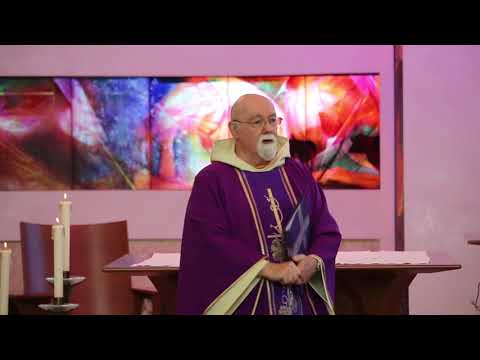
Fr. Austin Fleming
The Word This Week
5th Sunday of Lent B


“I will place my law within them, I will write it upon their hearts, says the Lord.”
EUCHARIST CONNECTION: In the sacrament of this altar the Lord gains access to our hearts when we open ourselves to receive his Body and Blood in the Eucharist. He enters our hearts to heal what’s wounded and to write upon them the law and the promise of his love.
Homiletic Pastoral Review
The Word This Week
5th Sunday of Lent B

Basilica of the National Shrine
The Word This Week
5th Sunday of Lent B

The Cross as a Symbol of Victory, Glory, Life and Love
When you walk into a Catholic Church, o of the first things that you see that your eyes are drawn to always in a very prominent place in the church is the crucifix and that is the scene of Jesus death. At the time of Jesus death the cross was a symbol of shame. That same symbol now has been transformed into a symbol of victory and glory and life and love. There’s no greater love than this than to lay down one’s life for one’s friends and so because Jesus embraced the cross.
Dominican Blackfriars
The Word This Week
5th Sunday of Lent B

Bishop Robert Barron
The Word This Week
5th Sunday of Lent B



Featured Podcasts
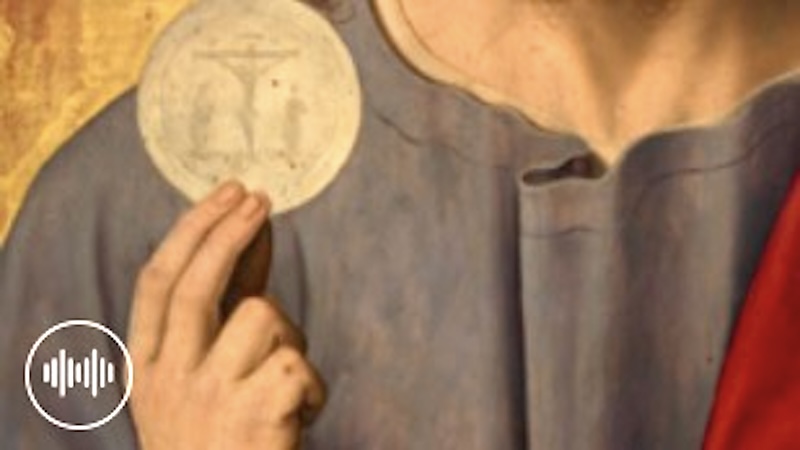
Writing the Law on Our Hearts
2021 – Friends, one of the most fundamental beliefs of the Biblical Israelites is that God is a covenant-maker. He formed his people through a series of agreements and contracts saying, “I will place my law within them and write it upon their hearts; I will be their God and they will be my people.” This law comes into our hearts precisely through the Eucharist, which is nothing other than a representation of the cross of Jesus.
The Hour has Come
2003 – As we approach the Passion, the celebration of Jesus’ death, we’re called to a new life, a new glory, and a new way of being. We allow our lives to break open so they become a new source of life for others.
The Word This Week
5th Sunday of Lent B

Faith in God and obedience to Him, even in difficult times, leads to fulfillment, eternal life, and salvation.
- 🤔”I’ll only believe it when I see it” reflects healthy skepticism, but faith is believing first and understanding later.
- 🤔”Whoever loves his life loses it and whoever hates his life in this world will preserve it for eternal life.”
- 🙏The greatest act of selflessness is the abandonment of our own will and desires.
- 🌱The Lenten season is a time for reflection and growth, for all of us.
- 🙏Jesus, as God, showed humility and obedience, setting an example for us to follow in faith.
- 🙏It’s the exact opposite of what we are called to do in faith: “I believe it so that I may come to see all things in the light of God’s truth.”
Fr. Charles E. Irvin
The Word This Week
5th Sunday of Lent B

Fr. Joe Jagodensky, SDS
The Word This Week
5th Sunday of Lent B


From Lent to “Living Color”
Sad to say but our grandmother needed to die first. We liked her a lot but her day arrived. It wasn’t long after that we got a color TV in our family home. A color TV. I thought we’d never get one.
Our black and white TV was okay until I saw a color TV through our living room window. You see, our neighbors, who were childless, got to purchase a precious color TV. Our home full of children could not. (You do the math.) “Ours is just fine,” was my mother’s dismissive answer to my plaguing requests.
The Word This Week
5th Sunday of Lent B


Lent, the Hour with Christ
Lent is the “hour”, the appointed time given to us by Church to follow Christ more closely. As Christians, we are to share in the suffering of Jesus Christ. During lent, we must deny ourselves of our comfort zones, we must die to sin, and then we can rejoice with Christ at his resurrection. That is the process we are invited to follow in this period of lent.
Fr. George Smiga
The Word This Week
5th Sunday of Lent B

The Danger of the Cross
We frequently say that we are saved through the cross of Jesus. But here is where we need to be very careful. It is important for us to understand how we are saved through the cross of Jesus. What is it about Jesus’ crucifixion that saves us? We know that Jesus’ crucifixion was unjust, brutal, and horrible. We are safe to say that there is nothing about the injustice, the brutality, and the horror that saves us. All of these things were evil things. Had we been present during Jesus’ life, we should have taken every step we could to prevent Jesus—or anyone else for that matter—from experiencing such an unjust and horrible death. So we are not saved by the injustice or brutality of the cross. What we are saved by is the love and service of Christ who embraces the cross and the power of God that raises Jesus from the dead. It is the love of Christ and the power of God that saves us. And that love is stronger than the evil of the cross. To say this in another way: There is nothing good in the cross itself. But good comes to us through the cross because what comes to us through the cross is the love of Christ and the power of God.
RELATED HOMILIES
A Realistic Disciple (April 6, 2003)
Life, Death, and Walnuts (April 2, 2006)
Planning Potatoes in the Kingdom (March 24, 2012)
Facing the Hour (March 22, 2015)
When Life Turns (March 18, 2018)
God Can Change Us (March 20, 2021)

Msgr. Joseph Pellegrino
The Word This Week
5th Sunday of Lent B

Our Hour

We have the choice to stand for Christ and live in peace with God and with ourselves, or to turn towards that which is popular and sinful and live in turmoil. See, that is what sin does to us. It puts us in turmoil. We make believe that we are OK with whatever is happening, but we aren’t. Sometimes we even have a hard time looking into the mirror. We can’t stand looking at ourselves because we can’t stand the person we are becoming when our actions contradict all that is within us.
Msgr. Charles Pope
The Word This Week
5th Sunday of Lent B

The Gospel today is, to the world and to those who are perishing, utter madness, utter foolishness. For Christ, in effect, declares that dying (to this world) is the only way to true life. While the world’s so-called wisdom declares to us that the way to life is power, prestige, possessions and popularity, Jesus says, die to all that and you’ll find true life.
Let’s examine the Lord’s Paradoxical Plan to save us and bring us to new life.
Bishop John Louis
The Word This Week
5th Sunday of Lent B

Fr. Michael Chua
The Word This Week
5th Sunday of Lent B

Life Issues
5th Sunday of Lent B
Whoever Loses His Life…
Fifth Sunday of Lent B
Frank Enderle
Our Christian faith shows us that if we want to dedicate ourselves totally to Christ, we have to make a firm commitment to follow Him no matter what the consequences. By dying to ourselves and our own petty selfishness and pride, we allow the grain of wheat that is our spiritual life to grow and give fruit.
Mortification
5th Sunday of Lent (B)
Antonio P. Pueyo
Lent is a special time for mortification and asceticism. We can begin such practices by focusing on the windows of the soul. These are our five senses.
Dying to Live
5th Sunday of Lent (B)
Antonio P. Pueyo
The way of Jesus goes beyond self-fulfilment. It is the way of self-transcendence. It is not about self-preoccupation. It is about self-donation. Jesus affirms the need for loving one’s self but it does not stop there. One has to love one’s neighbor as he loves himself, even to the point of giving up one’s life, “Those who love their life destroy it, and those who despise their life in this world keep it for everlasting life” (Jn. 12:25). Self-discovery and self-affirmation are only preludes to self-donation.
Today we move on
Tom Bartolomeo
We have completed the Office of Readings from Ash Wednesday to today and the covenant God made with the people of Israel recorded in the Books of the Old Testament, Exodus, Leviticus and Numbers, all inspired by God in the writings of Moses. Today we move into the Scriptural Readings of the New Testament and Covenant beginning with the Book of Hebrews whose perspective rests in Jesus Christ.
Jesus the Priest
Proclaim Sermons
According to Israel’s tradition, Jesus, from the tribe of Judah, couldn’t have been a priest. But our text is about his preparation to be a high priest “according to the order of Melchizedek,” as the preceding verses make clear. Through the trials and challenges of his ministry, he was able to make the perfect and final sacrifice, giving up his own life and rising again to reconcile sinners to God.
Expanding Our Vision of Jesus (Lent 5)
Proclaim Sermons
Philip and Andrew bring a group of Greeks who have requested to see Jesus. Jesus takes this opportunity to continue teaching the disciples and us about his death and resurrection, and about our need to remain faithful followers. We need to be continually expanding our vision of Christ, so we do not stagnate in our faith.
SOURCE: LifeIssues.net Homily Archive
Fr. Phil Bloom
The Word This Week
5th Sunday of Lent B

Finding Hope When Life Hurts: Stop Procrastinating
Bottom line: Meditating on what Jesus has done, we ask his help to rightly order our lives. Stop procrastinating!
RELATED HOMILIES:
2015: New Mind and Heart
2012: To Know the Lord
2009: A Matter of Life and Death
2006: Your Judgment on the World
2003: Now is the Time of Judgment
2000: We Would Like to See Jesus

The Word This Week
5th Sunday of Lent B

Jesus, the Grain of Wheat, who died to harvest Us
We can never forget that Jesus did all of this for love of us. We know that the risen Jesus appeared to the apostles in Galilee and asked Peter three times if he loved him (John 21:15-17). It was Jesus’ way of undoing Peter’s three denials of Jesus. But as we reflect on Jesus’ passion, his dying like a grain of wheat to harvest us for his kingdom, we cannot but help question our own love for Jesus. Do we love Jesus who died to harvest us?
Fr. John Kavanaugh, S.J.
The Word This Week
5th Sunday of Lent B

Repentance and Eucharist
I’ve come to see that the admission of sin is a constant theme of every Mass. I do not mean the implicit willingness to “repent and believe the Good News” when we hear the word of God, or the acknowledgment of our inadequacy when we offer our prayers of the faithful. I mean, rather, the continuing acknowledgment of our sinful condition at the height of the Communion rite.
Bishop Frank Schuster
The Word This Week
5th Sunday of Lent B
Memento Mori
For this week of Lent leading up to Palm Sunday, it may be helpful for all of us to begin meditating on how God incarnate became the grain of wheat, indeed has become food and drink for us, leading us to an eternal harvest. We are invited this week to reflect again on the words we heard on Ash Wednesday, remember you are dust and to dust you shall return. And then ask ourselves, how can I be like that grain of wheat? What are the weeds in my garden that I need to pull? How can I invest myself more into what really matters in this life? Who is that person in my life I need to stop taking for granted and love the way I am called to love? What are the ways that I can grow closer to the Lord as I make my pilgrimage to Holy Week? This is why I think a “memento mori” every so often is not all together bad. It can be in fact be very good ifit helps us reorient our focus to where it should be: our Easter hope
Fr. Michael Cummins
The Word This Week
5th Sunday of Lent B
Forgiveness and “Create in me a clean heart, O God”

We need to learn the way of forgiveness. Forgiveness brings life and it liberates from isolation and anger. The readings for this Sunday, the Gospel, the writings of the saints, the disciplines of Lent, the sacrament of reconciliation all help to teach us this healing truth.
The Word This Week
5th Sunday of Lent B