
Featured
Videos


SOURCE: A Word Proclaimed
The depth of God's love for us is revealed through Jesus' incarnation, life, and sacrifice, prompting us to respond with unstoppable love and to participate in the new evangelization.
- 00:00 📖 Jesus faces agony, promises to overcome judgment, raises Lazarus, enters Jerusalem, and is greeted with palm branches and approached by Greeks.
- The gospel of John discusses the agony in the garden and the promise of overcoming the judgment of the world, leading into the transition from the book of signs to the book of glory.
- Jesus raises Lazarus, leading to the decision to kill him, and then he enters Jerusalem where he is greeted with palm branches and approached by Greeks.
- 02:54 📖 Jesus is glorified through his impending suffering and death, and those who serve him will be honored by the Father.
- 04:49 📖 Jesus asks God to glorify his name through his suffering and death, showing the love between them, and declares that the judgment of the world has come.
- 06:57 💬 Jesus will cast out Satan and reveal the depth of love from the cross.
- 08:39 💭 Jesus will draw everyone to himself through his death, showing his love and making himself common to be loved, not feared.
- 10:26 💡 God came among us to heal, enlighten, and die for us, defeating Satan, and now we can be saved through love and share that love with others.
- 12:00 📖 Accept the gift of love and salvation from the Lord, or reject it and judge yourself.
- 13:52 📖 The crisis of choice and judgment has arrived, and it's time for the church to evangelize and be holy before reaching out to the world.

SOURCE: A Walk in the Word
Jesus declares that the hour has come for his glorification, emphasizing the significance of his death and resurrection, and the importance of loving God above all things.
- 00:00 📖 Jesus speaks about his glorification, the necessity of his death, and the judgment of the world, marking the transition to the book of glory in John's gospel, leading to a plot to put him to death and the unstoppable testimony of spreading the word.
- Jesus speaks about the hour of his glorification, the necessity of his death, and the judgment of the world.
- The fifth Sunday of Lent marks the transition from the book of signs to the book of glory in John's gospel, with Jesus completing his seven signs and leading up to his passion, death, and resurrection.
- Jesus's triumphal entry into Jerusalem upset the religious authorities who were actively conspiring against him, leading to a plot to put him to death.
- Many witnesses spread the word about Jesus raising Lazarus from the dead, leading to a large crowd converging on Jerusalem for the Feast of Passover.
- The testimony of spreading the word was unstoppable, as evidenced by the Pharisees' acknowledgment and the mention of Greeks in Jerusalem.
- 07:18 📖 Jesus drives out vendors from the temple's court of the Gentiles, Greeks seek to see Jesus, and disciples with Greek names raise questions about their background and potential Greek influence in Galilee.
- The court of the Gentiles in the temple was used for prayer and worship by non-Jews, but was turned into a marketplace, leading to Jesus driving out the vendors and money changers.
- Greeks seek to see Jesus and approach Phillip and Andrew instead of Simon Peter.
- Philip and Andrew, disciples with Greek names, stand out among the Hebrew-named disciples, raising questions about their background.
- The region of Galilee had a significant Greek influence, with many Jews being functionally bilingual and some scholars speculating that Philip and Andrew were Greek-speaking interpreters.
- 11:26 📖 Jesus declares that the hour has come for the son of man to be glorified, referencing his passion, death, and resurrection as the culmination of his mission, fulfilling Old Testament prophecies.
- The prophecy in Jeremiah 16:16 refers to the restoration of Israel and the 10 lost tribes, specifically the northern kingdom conquered by the Assyrians in 722 BC.
- The prophecy in Jeremiah 16 speaks of the restoration of the 10 lost tribes of Israel by the Messiah, who will send fishers and hunters to bring them back and restore them.
- Andrew and Philip, two of Jesus' first disciples, bring others to Jesus after recognizing him as the Messiah.
- Andrew and Phillip, two disciples of Jesus, bring Greeks to Jesus at the end of his public ministry.
- Jesus declares that the hour has come for the son of man to be glorified, referencing his passion, death, and resurrection as the culmination of his mission.
- The hour of the Lord had not yet come, but when Greeks sought an audience with Jesus, it signaled the fulfillment of Old Testament prophecies and the arrival of his hour of glory.
- 20:43 📖 Jesus references prophecies from Daniel, Zechariah, and Isaiah, declaring that the hour has come for the son of man to be glorified and for people from different nations to seek the favor of the Lord.
- The passage from the book of The Prophet Daniel describes a significant prophecy about the Messiah, referencing Jesus's favorite title "son of man" and his everlasting dominion and kingdom.
- Jesus declares that the hour has come for the son of man to be glorified, referencing Daniel chapter 7 and the prophecy of the son of man being given dominion and power over all nations.
- The Prophet Zechariah speaks of the coming of the Messiah and the gathering of peoples and nations to seek the favor of the Lord.
- Prophecy is fulfilled as people from different nations seek an audience with Jesus, just as it was foretold in Isaiah.
- 25:34 📖 Jesus acknowledges the time has come for his glorification, emphasizes the significance of his death and resurrection, and emphasizes the importance of loving God above all things.
- The prophecy of nations streaming to Jerusalem and seeking the Lord is being fulfilled in the Gospel with the Greeks seeking after Jesus.
- Jesus acknowledges that the time has come for him to be glorified, and he emphasizes the significance of his impending death and resurrection.
- Jesus refers to himself as a grain of wheat that falls into the Earth, dies, and is resurrected, symbolizing the connection between his passion, death, and resurrection and the glorification of believers.
- Those who prioritize their temporal lives over God and his kingdom will ultimately lose their lives, while those who prioritize eternal life will keep it.
- Jesus uses hyperbolic speech to emphasize the importance of loving God above all things and placing Him as our all in all.
- To serve Jesus, one must follow him to the cross and ultimately to glory, and in doing so, the father will honor them.
- 34:16 📖 Jesus expresses his agony and asks God to glorify his name in the face of his impending crucifixion, connecting his suffering to the glorification of God and highlighting the deafness of many people to the message of God.
- Jesus expresses his troubled soul and grief, representing the Agony he suffered, as he contemplates asking the Father to save him from his hour of suffering.
- Jesus acknowledges that his suffering and death are part of his mission, and he asks God to glorify his name in the face of his impending crucifixion.
- Jesus connects his upcoming passion, death, and resurrection to the glorification of God, referencing the theophanies at his baptism and the Transfiguration.
- The crowd mistook the voice of God for thunder or an angel, showing that many people are deaf to the message of God.
- 39:24 📖 Jesus declares the hour has come for judgment and Satan to be cast out, leading to his crucifixion, resurrection, and ascension drawing all nations to himself through the preaching of the Gospel.
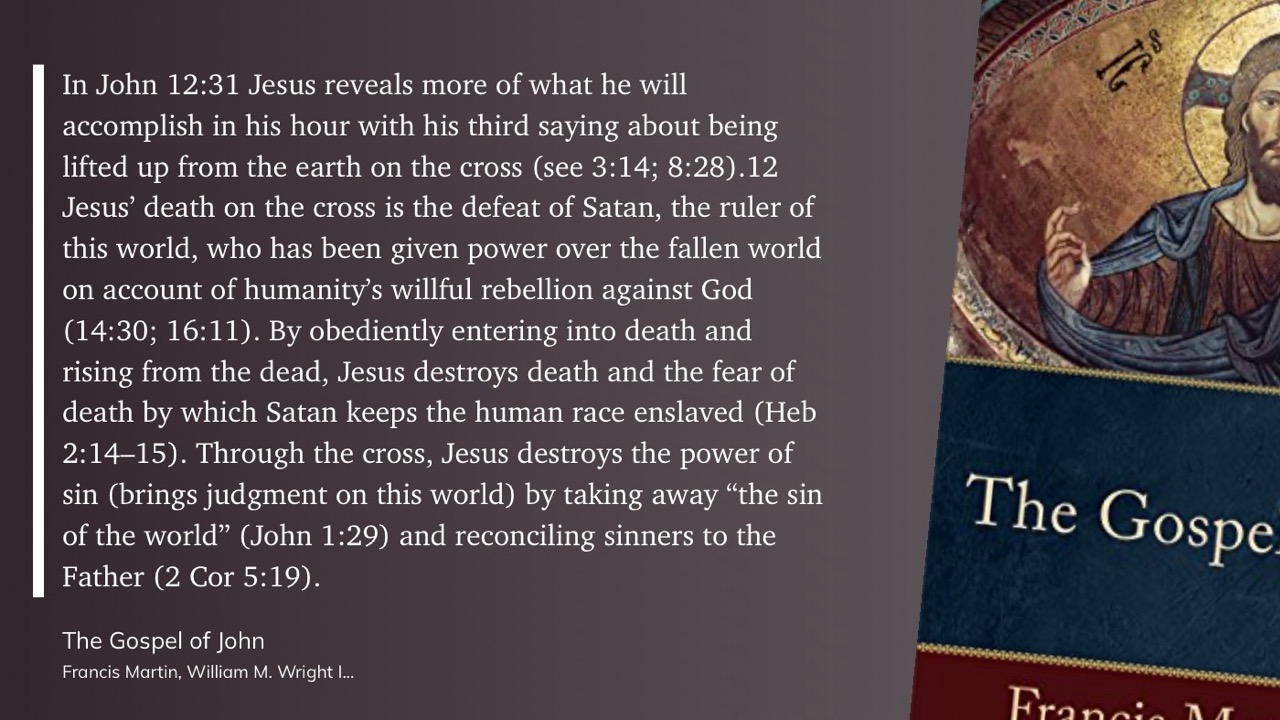
- Jesus declares that the hour has come for the Judgment of the world and for the ruler of this world, Satan, to be cast out when he is lifted up from the earth.
- Jesus' crucifixion, resurrection, and ascension, along with the pouring out of the Holy Spirit, will draw all nations to himself through the preaching of the Gospel.
- The Prophet Jeremiah prophesies about a New Covenant that God will establish with his people, where God will put his law within them, write it upon their hearts, and forgive their iniquity.
- Jesus will establish a New Covenant with the house of Israel and the house of Judah, including the Gentiles, by sending out his disciples to restore the northern kingdom.
- The passage chosen underscores the fact that Jesus' hour had come when the Greeks sought an audience with him in Jerusalem, and there is an interesting allusion to the Greeks in John chapter 7.
- The Jews misinterpret Jesus's statement about seeking him and not finding him, thinking he will go to the Greeks, but it is ironic because in chapter 12, Jesus does open up his teaching to the Gentiles.
- 48:46 📖 Confess sins, ask for clean heart, be reconciled with the Lord, fulfill mission of bringing others to Christ, minister to Jesus' thirst for souls, support the podcast, and let the word of God dwell in you.
- David's Psalm 50 expresses his sorrow and asks for God's mercy and forgiveness, emphasizing the restoration of joy and willingness to teach others.
- During the season of Lent, we are called to confess our sins, ask for a clean heart, and be reconciled with the Lord in order to fulfill our mission of bringing others to Christ.
- The desire of Jesus to embrace his father's plan of redeeming love inspired his whole life and was the very reason for his incarnation.
- Jesus declares "I thirst" from the cross, expressing his thirst for souls, and we are duty bound to minister to him and lead others to quench his thirst for their souls.
- Support the podcast by liking, commenting, subscribing, becoming a patron, or buying a coffee to help make Christ known.
- The speaker expresses gratitude for support and encouragement, and offers a prayer for the audience to have the word of God dwell in them.

SOURCE: Hearers of the Word
Jesus, through his obedience, suffering, and ultimate resurrection, is the source of eternal salvation and the importance of believing in him despite opposition and lack of belief among his contemporaries.
- 00:00 📖 Jesus talks about being lifted up, Jeremiah teaches about the new covenant, and the responsibility of Psalm 51, with Hebrews chapter 5 bridging the texts, and the speaker plans to discuss John chapter 12 in detail.
- The focus of the fifth Sunday of Lent is on the significant passage from John chapter 12, following the usual pattern of Lent sequence and spending most of the time on John chapter 12.
- Jesus talks about being lifted up, Jeremiah teaches about the new covenant, and the responsibility of Psalm 51, with Hebrews chapter 5 bridging the texts, and the speaker plans to discuss John chapter 12 in detail.
- The transcript discusses the structure and themes of the second part of the book of Jeremiah, focusing on the hope and optimism presented in chapters 30-33.
- 03:59 📖 God promises a new covenant with forgiveness and writes his law on the hearts and minds of the people, while Christ learned obedience through suffering and became the source of eternal salvation.
- The Lord will make a new covenant with the people of Israel and Judah, writing his law on their hearts and minds, so they will no longer need to be taught to know him.
- God promises forgiveness and a new covenant in Jeremiah, and Psalm 51 and 50 should be read together as they complement each other.
- The passage from Hebrews discusses how Christ learned obedience through suffering and became the source of eternal salvation.
- 08:35 📜 The letter of Saint Paul to the Hebrews emphasizes Jesus as a human and source of salvation, and Jesus is ultimately raised from death by resurrection.
- The letter of Saint Paul to the Hebrews is likely a sermon, not a letter, and was most likely written between 70 and 95 A.D., describing temple worship and emphasizing Jesus as a human being.
- Jesus prays to be saved from death, but ultimately, he is raised from death by resurrection, and through his suffering, he becomes the source of salvation for all who obey him.
- 11:42 🙏 Jesus learned obedience through suffering and became the source of eternal salvation, and by sacrificing oneself and serving Jesus, one can gain eternal life and draw all people to himself.
- Jesus offered requests and supplications with loud cries and tears, learning obedience through suffering and becoming the source of eternal salvation, designated as a high priest in the order of Melchizedek, and the gospel from John chapter 12 discusses the time for the son of man to be glorified.
- By sacrificing oneself, one can produce great results and gain eternal life, and by serving and following Jesus, one will be honored by the father and draw all people to himself.
- 14:39 📖 Jesus enters Jerusalem fulfilling prophecy, disciples understand significance after resurrection, crowd testifies about Lazarus causing panic among Pharisees.
- The last chapter of John's gospel is a point of arrival, with chapter 12 serving as a closing synthesis drawing in many themes and echoes.
- Jesus enters Jerusalem on a donkey, fulfilling a prophecy, and his disciples only understand the significance after his resurrection.
- The crowd continues to testify about Jesus raising Lazarus from the dead, causing panic among the Pharisees.
- 18:50 📖 Jesus is approached by Greeks through his disciples, emphasizing the importance of sacrifice and discipleship in following him.
- The synagogue was anxious about the expanding churches, and some Greeks wanted to see Jesus, so they approached Philip and Andrew who then told Jesus.
- Hellenized Jews approach Jesus through two disciples bearing Greek names, anticipating the later influx of Greek-speaking gentiles into the Christian movement, and Jesus talks about the time for the Son of Man to be glorified.
- To truly live and serve Jesus, one must be willing to sacrifice and prioritize discipleship over worldly desires, as the events of salvation and the importance of following Jesus are emphasized.
- 22:15 🙏 Jesus acknowledges his purpose and impending death, with the voice from heaven confirming and glorifying him, pointing to his victory over evil and emphasizing the importance of believing in the light.
- Jesus expresses distress but acknowledges the purpose of his hour, and the voice from heaven confirms and glorifies him, leading to the judgment and rule of the world being driven out, and his impending death.
- The passage in the fourth gospel points to Jesus' victory over evil, death, and destruction through his death and resurrection, with a strong echo of John 6:44.
- Jesus responds to the crowd's questions about the son of man and the lifting up, emphasizing the importance of believing in the light and hinting at his departure.
- 26:43 📖 Despite Jesus performing miraculous signs, people refused to believe in him, fulfilling Isaiah's prophecy, with the lecture emphasizing the lack of belief in Jesus among his contemporaries and the growth of faith despite opposition.
- Despite Jesus performing many miraculous signs, people still refused to believe in him, fulfilling the prophecy of Isaiah, who saw Christ's glory and spoke about him.
- The prophet acknowledges his sin, is forgiven, and is then called to deliver a message to a people who will not understand or perceive it.
- People's hearts are calloused, making them deaf and blind, and this passage from Isaiah is used in the New Testament to explain why God's people did not recognize Christ when he came.
- People may look and listen but not understand, as seen in Matthew, Luke, and John, highlighting the lack of belief in Jesus among his contemporaries.
- Many rulers believed in Jesus but did not confess him to avoid being expelled from the synagogue, showing the growth of faith despite opposition and the hypocrisy of the Pharisees.
- The lecture discusses the synthesis of symbols used in the fourth gospel about salvation, emphasizing healing, liberation, love, service, new creation, and forgiveness, and encourages reflection on the deep meaning of the readings.

SOURCE: The Mass Readings Explained
Jesus' final hour has come for the son of man to be glorified, and by detaching from worldly attachments and prioritizing love for him, we can gain eternal life.
- 00:00 📖 Jesus' hour has come for the son of man to be glorified, and the father will honor those who serve him.
- 01:44 🕰️ Jesus' final hour is marked by glorification, judgment, and the drawing of all men to himself, as non-Jews seek to see him during the feast of Passover.
- The father's final word in John's gospel is a declaration of glorification and judgment, with Jesus being lifted up to draw all men to himself.
- During the feast of Passover, some Greeks, who were non-Jews but believed in the God of the Jews, wanted to see Jesus, so they approached Philip and Andrew to make their request known to Jesus.
- 03:29 📜 Greeks went to Jesus' disciples with Greek names, showing the strong Hellenistic influence in Galilee and suggesting that Andrew and Philip spoke Greek.
- 05:00 🕰️ Jesus declares that the hour has come for the son of man to be glorified when the Greeks start looking for him, marking the beginning of his passion, last supper, and redemption of the world.
- 06:18 🕊 Jesus saw the Greeks seeking him as a sign of the age of salvation and the conversion of the gentiles, pointing forward to his glorification.
- 07:28 🌱 Jesus explains that his passion and death will bring glory to God, using a parable to illustrate the necessity of his own death for everlasting life.
- Jesus uses the term "glorify" as a technical term for his passion and death, which will be the ultimate act of praise and glory to God the Father, illustrated through a mysterious parable about the seed.
- Jesus compares his own death and resurrection to a grain of wheat being buried in the earth in order to bear fruit, emphasizing the need for his own death in order to bring everlasting life.
- 09:04 📖 Jesus explains that hating one's life means detaching from worldly attachments and prioritizing love for him.
- 09:53 💡 Detach from earthly attachments and prioritize Jesus to gain eternal life, as he willingly laid down his life as an example for us to follow.
Commentary
Highlights



Fr. George
Corrigan
OFM

Fr. Corrigan, OFM

Commentaries are arranged by Liturgical Year B order.
You are free to download and use for Bible Study, to evangelize, or anything that gives Glory to God. Enjoy.” — Fr. Corrigan
Catena
Aurea

Compiled by
St. Thomas
Aquinas
Thomas Aquinas compiled this opus from sermons and commentaries on the Gospels written by the early Church Fathers, arranging their thoughts in such a way that they form a continuous commentary on each Gospel.
John 12:20-26
20. And there were certain Greeks among them that came up to worship at the feast.
21. The same came therefore to Philip, which was of Bethsaida of Galilee, and desired him, saying, Sir, we would see Jesus.
22. Philip cometh and telleth Andrew: and again Andrew and Philip tell Jesus.
23. And Jesus answered them, saying, The hour is come, that the Son of man should be glorified.
24. Verily, verily, I say unto you, Except a corn of wheat fall into the ground and die, it abideth alone: but if it die, it bringeth forth much fruit.
25. He that loveth his life shall lose it, and he that hateth his life in this world shall keep it unto life eternal.
26. If any man serve me, let him follow me; and where I am, there shall also my servant be: if any man serve me, him will my Father honour.
BEDE. The temple at Jerusalem was so famous, that on the feast days, not only the people near, but many Gentiles from distant countries came to worship in it; as that eunuch of Candace, Queen of the Ethiopians, mentioned in the Acts. The Gentiles who were at Jerusalem now, had come up for this purpose: And there were certain Gentiles among them who came to worship at the feast.
CHRYSOSTOM. (Hom. lxvi. 2) The time being now near, when they would be made proselytes. They hear Christ talked of, and wish to see Him: The same came therefore to Philip, which was of Bethsaida of Galilee, and desired him, saying, Sir, we would see Jesus.
AUGUSTINE. (Tr. li. 8) Lo! the Jews wish to kill Him, the Gentiles to see Him. But they also were of the Jews who cried, Blessed is He that cometh in the name of the Lord. So behold them of the circumcision, and them of the uncircumcision, once so wide apart, coming together like two walls, and meeting in one faith of Christ by the kiss of peace.
Philip cometh and telleth Andrew.
CHRYSOSTOM. (Hom. lxvii. 2) As being the elder disciple. He had heard our Saviour say, Go not into the way of the Gentiles; (Matt. 10:5) and therefore he communicates with his fellow-disciple, and they refer the matter to their Lord: And again Andrew and Philip tell Jesus.
AUGUSTINE. (Tr. li. 8) Listen we to the voice of the corner stone: And Jesus answered them, saying, The hour is come, that the Son of man should be glorified. Did He think Himself glorified, because the Gentiles wished to see? No. But He saw that after His passion and resurrection, the Gentiles in all lands would believe on Him; and took occasion from this request of some Gentiles to see Him, to announce the approaching fulness of the Gentiles, for that the hour of His being glorified was now at hand, and that after He was glorified in the heavens, the Gentiles would believe; according to the passage in the Psalm, Set up Thyself, O God, above the heavens, and Thy glory above all the earth. (Ps. 56, and 107) But it was necessary that His exaltation and glory should be preceded by His humiliation and passion; wherefore He says, Verily, verily, I say unto you, Except a corn of wheat fall into they round and die, it abideth alone: but if it die, it bringeth forth much fruit. That corn was He; to be mortified in the unbelief of the Jews, to be multiplied in the faith of the Gentiles.
BEDE. He Himself, of the seed of the Patriarchs, was sown in the field of this world, that by dying, He might rise again with increase. He died alone; He rose again with many.
CHRYSOSTOM. (Hom. lxvi. 2) He illustrates His discourse by an example from nature. A grain of corn produces fruit, after it has died. How much more then must the Son of God? The Gentiles were to be called after the Jews had finally offended; i. e. after His crucifixion. Now then that the Gentiles of their own accord offered their faith, He saw that His crucifixion could not be far off. And to console the sorrow of His disciples, which He foresaw would arise, He tells them that to bear patiently not only His death, but their own too, is the only way to good: He that loveth his life shall lose it.
AUGUSTINE. (Tr. li. 10) This may be understood in two ways: 1. If thou lovest it, lose it: if thou wouldest preserve thy life in Christ, fear not death for Christ. 2. Do not love thy life here, lest thou lose it hereafter. The latter seems to be the more evangelical (evangelicus) sense; for it follows, And he that hateth his life in this world, shall keep it unto life eternal.
CHRYSOSTOM. (Hom. lxvii. 1) He loveth his life in this world, who indulges its inordinate desires; he hateth it, who resists them. It is not, who doth not yield to, but, who hateth. For as we cannot bear to hear the voice or see the face of them whom we hate; so when the soul invites us to things contrary to God, we should turn her away from them with all our might.
THEOPHYLACT. It were harsh to say that a man should hate his soul; so He adds, in this world: i. e. for a particular time, not for ever. And we shall gain in the end by so doing: shall keep it unto life eternal.
AUGUSTINE. (Tr. li. 10) But think not for an instant, that by hating thy soul, is meant that thou mayest kill thyself. For wicked and perverse men have sometimes so mistaken it, and have burnt and strangled themselves, thrown themselves from precipices, and in other ways put an end to themselves. This did not Christ teach; nay, when the devil tempted Him to cast Himself down, He said, Get thee hence, Satanb. But when no other choice is given thee; when the persecutor threatens death, and thou must either disobey God’s law, or depart out of this life, then hate thy life in this world, that thou mayest keep it unto life eternal.
CHRYSOSTOM. (Hom. lxvii. 1) This present life is sweet to them who are given up to it. But he who looks heavenwards, and sees what good things are there, soon despises this life. When the better life appears, the worse is despised. This is Christ’s meaning, when He says, If any man serve Me, let him follow Me, i. e. imitate Me, both in My death, and life. For he who serves, should follow him whom he serves.
AUGUSTINE. (Tr. li) But what is it to serve Christ? The very words explain. They serve Christ who seek not their own things, but the things of Jesus Christ, i. e. who follow Him, walk in His, not their own, ways, do all good works for Christ’s sake, not only works of mercy to men’s bodies, but all others, till at length they fulfil that great work of love, and lay down their lives for the brethren. But what fruit, what reward? you ask. The next words tell you: And where I am, there shall also My servant be. Love Him for His own sake, and think it a rich reward for thy service, to be with Him.
CHRYSOSTOM. (Hom. lxvii) So then death will be followed by resurrection. Where I am, He says; for Christ was in heaven before His resurrection. Thither let us ascend in heart and in mind.
If any man serve Me, him will My Father honour. This must be understood as an explanation of the preceding. There also shall My servant be. For what greater honour can an adopted son receive than to be where the Only Son is?
CHRYSOSTOM. (Hom. lxvii) He says, My Father will honour him, not, I will honour him; because they had not yet proper notions of His nature, and thought Him inferior to the Father.
ORIGINAL: e-Catholic 2000
John 12:27–33
27. Now is my soul troubled; and what shall I say? Father, save me from this hour: but for this cause came I unto this hour.
28. Father, glorify thy name. Then came there a voice from heaven, saying, I have both glorified it, and will glorify it again.
29. The people therefore, that stood by, and heard it, said that it thundered: others said, An angel spake to him.
30. Jesus answered and said, This voice came not because of me, but for your sakes.
31. Now is the judgment of this world: now shall the prince of this world be cast out.
32. And I, if I be lifted up from the earth, will draw all men unto me.
33. This he said, signifying what death he should die.
CHRYSOSTOM. (Hom. lxvi) To our Lord’s exhortation to His disciples to endurance, they might have replied that it was easy for Him, Who was out of the reach of human pain, to talk philosophically about death, and to recommend others to bear what He is in no danger of having to bear Himself. So He lets them see that He is Himself in an agony, but that He does not intend to decline death, merely for the sake of relieving Himself: Now is My soul troubled.
AUGUSTINE. (Tr. lii. 2) I hear Him say, He that hateth his life in this world, shall keep it unto life eternal; and I am ravished, I despise the world; the whole of this life, however long, is but a vapour in My sight; all temporal things are vile, in comparison with eternal. And again I hear Him say, Now is My soul troubled. Thou biddest my soul follow Thee; but I see Thy soul troubled. What foundation shall I seek, if the Rock gives way? Lord, I acknowledge Thy mercy. Thou of Thy love wast of Thine own will troubled, to console those who are troubled through the infirmity of nature; that the members of Thy body perish not in despair. The Head took upon Himself the affections of His members. He was not troubled by any thing, but, as was said above, He troubled Himself. (c. 11:33)
CHRYSOSTOM. (Hom. lxvii) As He draws near to the Cross, His human nature appears, a nature that did not wish to die, but cleaved to this present life. He shews that He is not quite without human feelings. For the desire of this present life is not necessarily wrong, any more than hunger. Christ had a body free from sin, but not from natural infirmities. But these attach solely to the dispensation of His humanity, not to His divinity.
AUGUSTINE. (Tr. lii) Lastly, let the man who would follow Him, hear at what hour he should follow. A fearful hour has perhaps come: a choice is offered, either to do wrong, or suffer: the weak soul is troubled. Hear our Lord. What shall I say?
BEDE. i. e. What but something to confirm My followers? Father, save Me from this hour.
AUGUSTINE. (Tr. lii. 3) He teaches thee Whom thou shouldest call on, whose will prefer to thine own. Let Him not seem to fall from His greatness, because He wishes thee to rise from thy meanness. He took upon Him man’s infirmity, that He might teach the afflicted to say, Not what I will, but what Thou wilt. Wherefore He adds, But for this cause came I unto this hour. Father, glorify Thy name: i. e. in My passion and resurrection.
CHRYSOSTOM. (Hom. lxvii. 2) As if He said, I cannot say why I should ask to be saved from it; For for this cause came I unto this hour. However ye may be troubled and dejected at the thought of dying, do not run away from death. I am troubled, yet I ask not to be spared. I do not say, Save Me from this hour, but the contrary, Glorify Thy name. To die for the truth was to glorify God, as the event shewed; for after His crucifixion the whole world was to be converted to the knowledge and worship of God, both the Father and the Son. But this He is silent about.
Then came there a voice from heaven, saying, I have both glorified it, and will glorify it again.
GREGORY. (Moral. xxviii.) When God speaks audibly, as He does here, but no visible appearance is seen, He speaks through the medium of a rational creature: i. e. by the voice of an Angel.
AUGUSTINE. (Tr. lii. 4) I have glorified it, i. e. before I made the world; and will glorify it again, i. e. when Thou shalt rise from the dead. Or, I have glorified it, when Thou wast born of a Virgin, didst work miracles, wast made manifest by the Holy Ghost descending in the shape of a dove; and will glorify it again, when Thou shalt rise from the dead, and, as God, be exalted above the heavens, and Thy glory above all the earth.
The people therefore that stood by and heard it, said that it thundered.
CHRYSOSTOM. (Hom. lxvii. 2) The voice though loud and distinct, soon passed off from their gross, carnal, and sluggish minds; only the sound remaining. Others perceived an articulate voice, but did not catch what it said: Others said, An Angel spake to Him.
Jesus answered and said, This voice came not because of Me, but for your sakes.
AUGUSTINE. (Tr. lii. 5) i. e. It did not come to tell Him what He knew already, but them what they ought to know. And as that voice did not come for His sake, but for theirs, so His soul was not troubled for His sake, but for theirs.
CHRYSOSTOM. (Hom. lxvii. 2) The voice of the Father proved what they were so fond of denying, that He was from God. For He must be from God, if He was glorified by God. It was not that He needed encouragement of such a voice Himself, but He condescended to receive it for the sake of those who were by. Now is the judgment of this world: this fits on to the preceding, as shewing the mode of His being glorified.
AUGUSTINE. (Tr. lii. 6) The judgment at the end of the world will be of eternal rewards and punishments. But there is another judgment, not of condemnation, but of selection, which is the one meant here; the selection of His own redeemed, and their deliverance from the power of the devil: Now shall the prince of this world be cast out. The devil is not called the prince of this world, in the sense of being lord over heaven and earth; God forbid. The world here stands for the wicked dispersed over all the world. In this sense the devil is the prince of the world, i. e. of all the wicked men who live in the world. The world also sometimes stands for the good dispersed throughout the world: God was in Christ reconciling the world unto Himself. (2 Cor. 5:19) These are they from whose hearts the prince of this world shall be cast out. Our Lord foresaw that after His passion and glorifying, great nations all over the world would be converted, in whom the devil was then, but from whose hearts, on their truly renouncing him1, he would be cast out. But was he not cast out of the hearts of righteous men of old? Why is it, Now shall be cast out? Because that which once took place in a very few persons, was now to take place in whole nations. What then, does the devil not tempt at all the minds of believers? Yea, he never ceases to tempt them. But it is one thing to reign within, another to lay siege from without.
CHRYSOSTOM. (Hom. lxvii. 2) What kind of judgment it is by which the devil is cast out, I will explain by an example. A man demands payment from his debtors, beats them, and sends them to prison. He treats with the same insolence one who owes him nothing. The latter will take vengeance both for himself and the others too. This Christ does. He revenges what He has suffered at the devil’s hands, and with Himself He revenges us too. But that none may say, How will he be cast out, if he overcome thee? He adds, And I, if I be lifted up from the earth, will draw all men unto Me. How can He be overcome, who draws others unto Him? This is more than saying, I shall rise again. Had He said this, it would not have proved that He would draw all things unto Him; but, I shall draw, includes the resurrection, and this besides.
AUGUSTINE. (Tr. lii. 11) What is this all that He draweth, but that from which the devil is cast out? He does not say, All men, but, All things; for all men have not faith. He does not mean then all mankind, but the whole of a man, i. e. spirit, soul, and body; by which respectively we understand, and live, and are visible. Or, if all means all men, it means those who are predestined to salvation: or all kinds of men, all varieties of character, excepting in the article of sin.
CHRYSOSTOM. (Hom. lxvii. 3.) Why then did He say above, that the Father drew men? (c. 6:46.) Because the Father draws, by the Son who draws. I shall draw, He says, as if men were in the grasp of some tyrant, from which they could not extricate themselves.
AUGUSTINE. (Tr. lii. 11) If I be lifted up from the earth, He says, i. e. when I shall be lifted up. He does not doubt that the work will be accomplished which He came to do. By His being lifted up, He means His passion on the cross, as the Evangelist adds: This He said, signifying by what death He should die.
ORIGINAL: e-Catholic 2000
Michal E.
Hunt

Agape Bible Commentary
5th Sunday of Lent B
In the First Reading, God's sixth-century BC prophet, Jeremiah, promises a "New Covenant" that is more than a political or national restoration of Israel and Judah's divided kingdom. It will bring about a spiritual restoration of God's covenant people and the forgiveness of their sins (Jer 31:1, 3-4, 7-8, 34). Jesus' New Covenant is the fulfillment of Jeremiah's prophecy. His Passion and Resurrection will bring about a universal call to salvation, as prophesied by the prophet Simeon at baby Jesus' Temple dedication (John 2:32).
Michal E Hunt, Copyright © 2014; revised 2023 Agape Bible Study; used with permission
The Responsorial Psalm, attributed to King David, is the most famous of the seven Penitential Psalms. We join with the psalmist in his heartfelt contrition for his sins and his deeply felt desire to reconcile himself with the Lord as we call out, "Create a clean heart in me, O God."
Michal E Hunt, Copyright © 2014; revised 2023 Agape Bible Study; used with permission
The Second Reading, from the Letter to the Hebrews, contains a concise summary of Jesus' life on earth. St. Cyril of Alexandria wrote that Jesus "offered his life as a model of saintly existence to be used by earthly beings, he took on the weaknesses of humanity, and what was his purpose in doing this? That we might truly believe that he became man, although he remained what he was, namely God" (Letter to Euopitus, Anathema, 10).
Michal E Hunt, Copyright © 2014; revised 2023 Agape Bible Study; used with permission
n the Gospel Reading, Jesus prophesies His death in the Parable of The Seed that Dies. However, Jesus isn't only predicting His coming crucifixion (Jn 3:14-15). He is also prophesying His Ascension to God the Father. Then He will be "raised high and greatly exalted" (Is 52:3), just as it was the custom for the Davidic kings to be elevated above their subjects (1 Mac 8:13). In the inauguration of the New Covenant in the blood of Christ (Lk 22:20), the Lord God created in His spiritually reborn people a "clean heart" (Psalms Reading) in the Sacrament of Baptism. He welcomed them into a new and eternal Covenant through the One who became the source of eternal salvation for all who obey him (Second Reading). Jesus' submission to His Father's will to redeem humanity inspired His entire life. His mission was the focus of His life, from the Incarnation to His Passion, in fulfillment of His Father's divine plan of redemptive love (CCC 607).
Jesus refers to being "lifted up" on the Cross in His crucifixion, in His Resurrection, and later to Heaven in His Ascension where He takes His place as the true Davidic King (Jn 12:32). The Cross, Resurrection, and Ascension are all aspects of the same mystery. After Christ ascends to the Father's right hand in glory (Lk 22:69; Acts 2:33, 34; 7:55-56; Rom 8:34; Col 3:1; Heb 1:3, 13; 8:1; 10:12; 12:2; 1 Pt 3:22), He will send God the Holy Spirit to call all humanity to come in faith to Him, and His kingdom will spread across the face of the earth. But in the Gospel reading, Jesus may also be alluding to the prophecy of the 8th-century prophet Isaiah in the fourth Servant Song found in Isaiah 52:13-53:12. That passage is a prophetic vision of the suffering of the Messiah. St. John will begin his summation of Jesus' ministry at the end of this chapter with a quote from the Suffering Servant passages in Isaiah 12:38.
Michal E Hunt, Copyright © 2014; revised 2023 Agape Bible Study; used with permission
Scripture references to the "hour" in the Gospel of John | Scripture passages referring to the "hour" |
1. Jn 2:4 | Jesus to His mother: "My hour has not yet come" |
2. Jn 4:21 | Jesus to the Samaritan woman: "Believe me, woman, the hour is coming when you will worship the Father neither on this mountain nor in Jerusalem." |
3. Jn 4:23 | Jesus to the Samaritan woman: "But the hour is coming, and is now here when true worshipers will worship the Father in Spirit and truth..." |
4. Jn 5:25 | Jesus to the Jewish crowd: "Amen, amen I say to you, the hour is coming and is now here when the dead will hear the voice of the Son of God, and all who hear it will live." |
5. Jn 5:28 | Jesus to the Jewish crowd: "Do not be amazed at this, because the hour is coming in which all who are in the tombs will hear his voice and will come out ..." |
6. Jn 7:30 | So they tried to arrest him, but no one laid a hand upon him because his hour had not yet come. |
7. Jn 8:20 | He spoke these words while teaching in the Treasury in the Temple area. But no one arrested him because his hour had not yet come. |
8. Jn 12:23 | Jesus answered them: "The hour has come for the Son of Man to be glorified." |
9 & 10. Jn 12:27 | Jesus to His disciples: "I am troubled now. Yet what shall I say? 'Father, save me from this hour?' But it was for this purpose that I came to this hour." |
11. Jn 13:1 | Before the festival of the Passover, Jesus knew that his hour had come, to pass from this world to the Father. He loved his own in the world, and he loved them to the end. |
12. Jn 16:25 | Jesus to the disciples: "I have told you this in figures of speech. The hour is coming when I will no longer speak to you in figures, but I will tell you clearly about the Father." |
13. Jn 16:32 | Jesus at the Last Supper, linking His "hour" to the disciple's "hour": "Behold, the hour is coming and has arrived when each of you will be scattered to his own home and you will leave me alone." |
14. Jn 17:1 | When Jesus had said this, he raised his eyes to heaven and said: "Father, the hour has come. Give glory to your Son so that Your Son may glorify you..." |
Some scholars see the reference to the "hour" in the Synoptic Gospels as referring to Jesus' glorification. To others, it is the "hour" that marks His public ministry's beginning and His manifestation as the Messiah. However, all scholars agree that in John's Gospel, the reference to Jesus' "hour" points to the event of Christ's Passion and death on the Cross. It is an "hour" that humanity will not determine but an "hour" that is entirely in God's control. That interpretation fits in the context of the passage John 12:27.
The arrival of the group of Gentiles is significant because, for the first time, people outside the Sinai Covenant have come in search of Jesus. Their action makes them the "first fruits" of the spread of the Gospel among Gentiles! In this verse, Jesus refers to His "hour" of glorification in terms of His death and Resurrection. At times, Jesus has used the same term to refer to the "hour of judgment" as in Matthew 13:32 and John 5:25. However, in this case (as in Mark 14:41 and the passages in John 2:4; 4:23; 7:30; 8:20; 12:27; 13:1; and 17:1), He speaks of the hour of humanity's redemption through His sacrificial death and glorious Resurrection. This request of the Gentiles has now set the "countdown" to His glorification in motion. His sacrificial death will secure eternal blessings not only for the Jews as God's covenant people but for all people who become partakers of God's grace in the gift of eternal life. See John 1:29; 4:42; and 1 John 2:2 = He is the sacrifice to expiate our sins, and not only ours, but also those of the whole world.
Michal E Hunt, Copyright © 2014; revised 2023 Agape Bible Study; used with permission
STCB Notes


Sermon
Writer


Jeremiah 31:31-31 | Hebrews 5:7-9
John 12:20-33
“The time has come for the Son of Man to be glorified” (v. 23). There are three earlier references in this Gospel to Jesus’ hour:
• At Cana, Jesus said to his mother, “My hour has not yet come” (2:4).
• In Jerusalem, “They sought therefore to take him; but no one laid a hand on him, because his hour had not yet come.” (7:30).
• In the temple, “no one arrested him, because his hour had not yet come” (8:20).
Now, finally, Jesus announces that his hour has come. The turning point was the raising of Lazarus, in response to which the world (including these Greeks) comes seeking Jesus, causing the opposition to Jesus to harden (v. 19).
“to be glorified” (doxazo, from doxa) (v. 23). Glory is characteristic of God, and refers to God’s awe-inspiring majesty. God shared this glory with Jesus.
• We saw Jesus’ glory revealed at the Transfiguration (Luke 9:28-36) and through his death and resurrection (John 12:23; 13:31-32).
• He has given his glory to his disciples (John 17:22), and has been glorified in them (John 17:10).
• The Spirit of truth will glorify Jesus (John 16:13-14).
• Jesus prays, “Father, I desire that they also whom you have given me be with me where I am, that they may see my glory, which you have given me, for you loved me before the foundation of the world” (John 17:24).
• At the parousia (the Second Coming), Jesus will return “in a cloud with power and great glory” (Luke 21:27). Then “that at the name of Jesus every knee should bow, of those in heaven, those on earth, and those under the earth, and that every tongue should confess that Jesus Christ is Lord, to the glory of God the Father” (Philippians 2:10-11).
• There is an allusion here to Isaiah’s suffering servant, “Behold, my servant shall deal wisely, he shall be exalted and lifted up, and shall be very high” (Isaiah 52:13).
RICHARD NIELL DONOVAN was a Disciples of Christ clergyman who published SermonWriter, for a paid subscription, from 1997-2020. After he died, his family has generously provided his resources without subscription.