June 29, 2025
June 29, 2025


Homilies
Homilies
- Bp. Barron
- FR. RUTTIG
- 1-MIN HOMILY
- 2-Min Homily
- MSGR. Peter Hahn
- Fr. Jude Langeh
- FR. MCCARTHY, OSA
BISHOP
BARRON
Saints Peter and Paul


FR. KEVIN
RUTTIG
Saints Peter and Paul


ONE MINUTE
HOMILY

Saints Peter and Paul


TWO MINUTE
HOMILY

Saints Peter and Paul


MSGR. PETER
HAHN
Saints Peter and Paul


FR. JUDE
LANGEH, CMF

FR. TOM
McCARTHY, OSA

Saints Peter and Paul


CHECK OUT
The Word This Week’s
REDESIGNED MOBILE WEBSITE
Optimized for easy access
Deacon Greg’s blog has garnered some 20 million readers from around the world since its inception in 2007.
Saints Peter and Paul

Bringing Christ to Others: Reflections on Ministry and Service
This discussion guide has been generated by the WORD THIS WEEK'S Catholic AI Assistant based on Deacon Greg's homily.

Opening Reflection:
- Begin by considering the significance of the feast honoring Saint Peter and Saint Paul. How do these figures inspire you personally?
- Reflect on the readings that describe the challenges faced by early Christians. What emotions or thoughts do these readings evoke?
Understanding Sacrifice and Commitment:
1. Sacrificial Offering:
- Discuss Paul’s description of his life as being "poured out like a libation." What does this metaphor mean to you? How might it relate to modern acts of faith?
- Have you ever experienced a moment where you felt called to make a personal sacrifice for your beliefs?
2. The Example of Cardinal Francis Xavier Nguyen Van Thuan:
- Explore the story of his imprisonment. How did his methods of practicing faith despite adversity impact you?
- Discuss the symbolism of the makeshift altar and the significance of celebrating mass in such constrained circumstances.
Personal Faith and Listening to God:
- Reflect on Cardinal Nguyen Van Thuan’s prayer: “I speak no more. It’s Your turn to speak to me, Jesus; I am listening to You.” What does it mean to be open to listening to God in your own life?
- Consider the questions posed in the sermon: How holy, committed, or faithful is enough? Discuss how these questions impact your personal faith journey.
Ministry and Service:
1. Role of New Ministers:
- Reflect on the various ways ministers contribute to the presence of Christ through their roles (hospitality, lectors, Eucharistic ministers).
- How do these ministries enhance the experience of mass for the assembly and yourself personally?
2. Personal Reflection on Service:
- Have you served or felt called to serve in a faith community? Share your experiences and any challenges encountered.
- Discuss the idea mentioned in the sermon: being instruments to bring Christ to others. How do you see this playing out in your life?
Linking to Tradition and Legacy:
- Consider the continuum of faith from Saint Peter and Saint Paul to Cardinal Nguyen Van Thuan and finally, to contemporary roles in the church. How does this lineage of faith influence your personal commitments?
Homily Excerpt
2008 HOMILY— This is a homily for a mass in which Deacon Kandra’s parish was installing new ushers, EMHCs and lectors on the Solemnity of Saints Peter and Paul.
In the early 1970’s, during the Vietnam War, the Archbishop of Saigon was a man named Francis Xavier Nguyen Van Thuan. The Communists saw him as a threat. And on the feast of the Assumption, August 15, 1975, he was arrested and sent to prison. Without ever being tried, or sentenced, he was shipped off to a prison in North Vietnam. He stayed there for 13 years, nine of them in solitary confinement.
During his imprisonment, he couldn’t celebrate mass, or even receive the Eucharist.
But he held fast to his faith…
What a beautiful testimony. Surely, this is a man who followed in the footsteps of Peter and Paul. I think we could all imagine those apostles praying those same words.
But what about us?
Maybe you think, “I’m not that holy.” But how holy is holy enough? How committed is committed enough? How faithful is faithful enough?
Saints Peter and Paul

ST. AGATHA’S PARISH CLAYFIELD, BRISBANE (4:12) – This video was made for children to help them learn about the Sacrament of Eucharist.
The Power of a Good Meal
This discussion guide has been generated by the WORD THIS WEEK'S Catholic AI Assistant based on Deacon Peter's homily.
Opening Reflection
- Why do you think food is more than just sustenance for the body? Reflect on the roles food plays in our lives beyond mere nutrition.
1. Understanding Food’s Role
- Deacon Peter's homily begins by highlighting the nourishing, healing, and comforting aspects of food. Can you share a personal experience when a meal provided more than just physical sustenance for you?
- Food is seen as a form of expression and community building. How does sharing a meal create or strengthen bonds between people in your experience?
2. Jesus and Meals
- Reflect on the instances in the Gospels where Jesus shared meals with different types of people. Why do you think Jesus placed such importance on dining with others, including those viewed as outcasts?
- How does Jesus’s practice of sharing meals with diverse groups challenge or inspire us today in terms of inclusivity and breaking barriers?
3. The Institution of the Holy Eucharist
- Discuss St. John Vianney’s idea that our souls need nourishment just as our bodies do. How does this perspective change your view of the Eucharist?
- Reflect on the Last Supper and the connection made between it and the feeding of the 5,000. How do these events form the basis for the practice of Eucharist in Christian communities?
4. Eucharist as a Divine Meal
- Deacon Peter describes the Eucharist as more than a symbol; it is considered Jesus himself. How do you understand the concept of transubstantiation where bread and wine become the Body and Blood of Christ?
- Consider the setting of the Eucharist in Mass, often likened to a family meal. How does this view affect your participation in and perception of Mass?
5. Personal and Communal Transformation
- What does it mean to you that the Eucharist’s purpose is to change us and help us go out to nourish others?
- In what ways can the Eucharist influence your daily life and interactions with others?
Reflective Activity
- Spend a few moments in silent prayer or reflection considering how you can invite others to your "table," metaphorically or literally, as a form of inclusion and love.
Homily Excerpt

22nd Sunday in Ordinary Time (Year A)
What does food do for us?
Many people think that food simply fills us up, that it stops us feeling hungry. But it does so much more than that. Good food is nourishing; it helps us grow and be healthy. It can be healing, too, and it’s comforting in times of fear, uncertainty and sadness.
But food is also a wonderful way to express love, and it’s often used to seal business deals.
Indeed, food brings people together. We create a family when we share our table, and we create a community when we have a street barbecue!
In every culture, food is always meaningful. That’s because growing, preparing and serving food always involves both sacrifice and heart.
Jesus knows this. He knows how families and communities are formed, and that breaking bread brings people together. That’s why he so often eats with all sorts of people, including social outcasts.
Two Good Men
This discussion guide has been generated by the WORD THIS WEEK'S Catholic AI Assistant based on Deacon Peter's homily.
Discuss the joint feast day of Saints Peter and Paul: Why do these two figures share a celebration in the Christian calendar? Discuss their roles as pillars of the early Church, with Peter recognized as the Apostle to the Jews and Paul as the Apostle to the Gentiles
Reflect on their Personal Backgrounds and Traits: Highlight the differences in their backgrounds and temperaments. Peter was an 'uneducated and ordinary' fisherman from Bethsaida, while Paul was a well-educated Roman citizen from Tarsus. How did these differences shape their roles and contributions to the Church?
Section 1: Contributions to the Early Church
Peter's Role: Discuss his significance as Jesus’ first disciple and the first Pope. What did it mean for him to be the Apostle to the Jews?
Paul's Role: Explore how Paul, after his conversion, became a key figure in spreading Christianity among non-Jews. Discuss his literary contributions to the New Testament. Why were his letters significant?
Section 2: Relationship Dynamics
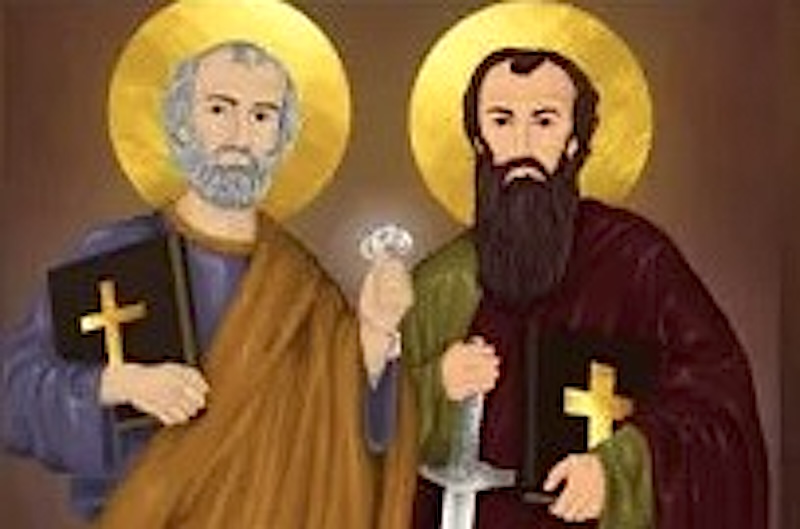
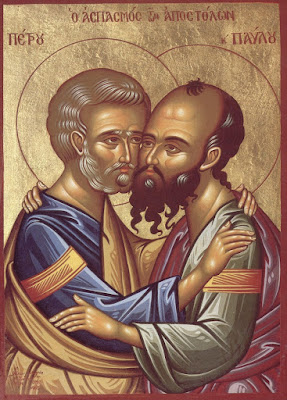
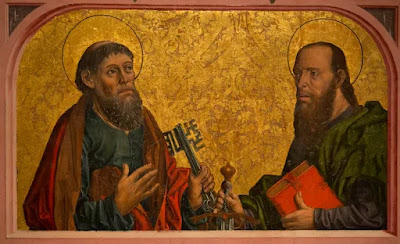
Iconography and Symbolism: What do the images and symbols associated with Peter and Paul (Peter with a key, Paul with a Bible) signify about their contributions to the Church?
Disagreements and Resolutions: Discuss the clash between Peter and Paul in Antioch regarding Jewish Law. Why was this disagreement significant? How did it reflect their personalities and theological perspectives?
Section 3: Their Legacy and Martyrdom
Martyrdom:** Explore the circumstances of their deaths. What can we learn from their willingness to die for their faith?
Reflections on their Differences and Unity: How did their diverse backgrounds and experiences strengthen the Church? What does their relationship teach us about unity and diversity within the Christian community?
Section 4: Lessons from Peter and Paul
Learning from Weaknesses and Mistakes: Discuss how their past mistakes did not disqualify them from serving God. How does this offer hope to believers today?
Unity in Diversity: Reflect on the lesson that what unites Christians is not their sameness, but their shared faith in Jesus. Why is a mix of backgrounds and talents beneficial for the Church?
The Value of Disagreement: How can disagreement be constructive in a faith community? Discuss the importance of handling differences with humility and honesty.
Courage in Faith: What lessons do Peter and Paul offer about living a courageous life of faith? How does Jesus' promise of support and guidance encourage believers today?
Homily Excerpt
What can we learn from these two good men? They teach us that our weaknesses and past mistakes don’t disqualify us from doing great things for God. Both men had done stupid things, and yet God still chose them to do his work. Clearly, no-one is beyond redemption.
Peter and Paul also teach us that what unites us in the Church isn’t our sameness. Rather, it’s our shared faith in Jesus that brings us together. Indeed, it is much better to have a mix of backgrounds and talents in the Church because it makes us stronger, not weaker.
As well, they teach us that disagreement can be healthy, especially when it’s handled with humility and honesty. As long as we keep Christ central in our lives, it’s always possible for us to meet in the middle.
And finally, St Peter and St Paul teach us that it takes courage to live a life of faith. Our world has never liked Jesus and his message.
────── ⋆⋅☆⋅⋆ ──────
Fr. Austin Fleming
Saints Peter and Paul
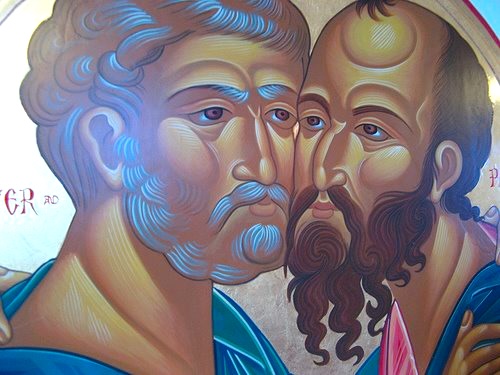
It’s a bit of a caricature but we might imagine two “faith types” here: the Peter Type and the Paul Type. Most of us, I think, probably fall into the Peter Type: those who try to do the right things – but who make mistakes; those who mean well – but often don’t follow through; those who try to understand but who don’t always get it and when they do get it, they sometimes don’t always get it right; those who fail, who repent, who get discouraged when they fail yet again, and who keep coming back, through God’s mercy, to try again.
I will never desert you, Lord…
Jesus? I don’t know the man…
Do you love me?
Oh, Lord you know that I love you…
Those who have the Paul faith type, on the other hand, are gung-ho!
They’re convinced! They say it out loud!
They make big demands on others – as well as on themselves.
The push the envelope. They aren’t satisfied with half-measures.
They say the hard saying – and aren’t afraid to say it.
They preach fearlessly and without reservation.
The “Paul types” fail, too. But when they do they admit it,
they do penance and they forge ahead stronger than ever.
(Paul Types can be very annoying!)
This discussion guide has been generated by the WORD THIS WEEK’S Catholic AI Assistant based on Father Austin’s homily. NEED HELP? Copy and paste a question into the chat bot in the lower right corner of the screen and have our Catholic Assistant help you.
1. Understanding St. Peter and St. Paul
– Reflect on the character and life journey of St. Peter as described. What are the significant moments that stand out to you?
– In contrast, how does St. Paul’s conversion and subsequent actions define his approach to discipleship?
– Consider how Peter and Paul would react if they encountered modern references to themselves (e.g., St. Peter’s Basilica, Paul’s letters being read). What does this tell you about their influence and legacy?
2. The Nature of Discipleship:
– Discuss how Peter’s mistakes and Christ’s continual forgiveness shaped his spiritual journey.
– Analyze the instantaneous nature of Paul’s conversion. How did this event propel him into a life of unwavering mission work?
– How do Peter and Paul’s stories influence your understanding of true discipleship and faith?
3. Comparing “Faith Types”:
– The sermon introduces “Peter Type” and “Paul Type” faith. Share where you see yourself on this spectrum and why.
– What are the strengths and challenges associated with each type of faith?
– How can these different approaches to faith complement each other within a community or church setting?
4. The Church’s Need for Diversity:
– How does the church benefit from having both “Peter” and “Paul” types within its community?
– Discuss the statement: “Paul is not greater than Peter, nor is Peter more repentant than Paul.” What does this equality reveal about the inclusivity of God’s grace?
– How do Peter’s and Paul’s stories encourage different members of the church to contribute uniquely to the body of Christ?
5. Lessons from Peter and Paul:
– Reflect on the different personal sacrifices both Peter and Paul made. How do these sacrifices inspire or challenge you in your spiritual journey?
– What practical steps can members of your group take to embrace the zeal of a “Paul” and the humility and perseverance of a “Peter”?
────── ⋆⋅☆⋅⋆ ──────

Dominican Friars
of England & Wales,
Scotland
- Human Words Become God's Word - 2001
- A Mystery We Must Become - 2004
- He Hungers to Love Us- 2007
- Whetting Our Appetites - 2010
- Taking Pleasure in the Things of God - 2013
- Corpus Christi - 2016
- Living Holy Communion - 2019
- The Acceptable Sacrifice - 2022
Saints Peter and Paul
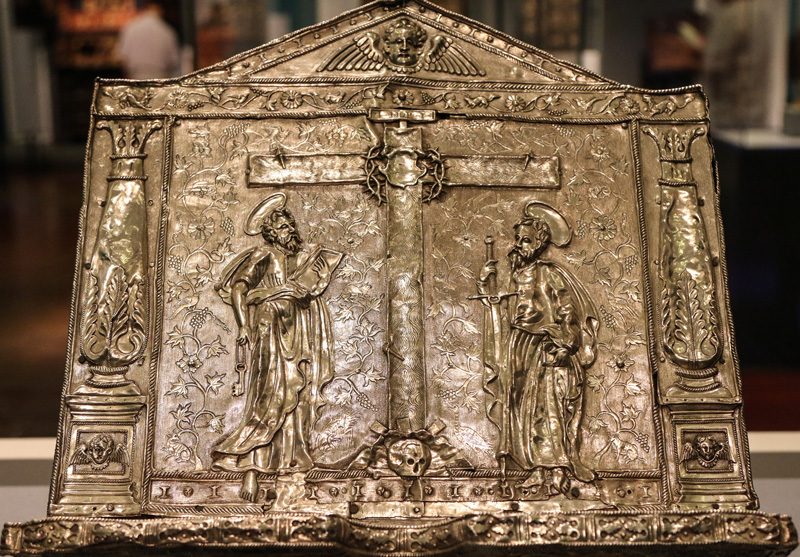
This discussion guide has been generated by the WORD THIS WEEK'S Catholic AI Assistant based on the Dominican Blackfriars' homily for this week.
1. The Role of Rome: Why is the See of Rome considered significant in the Western church?
- Discuss the importance of the shrines and tombs of Peter and Paul in underpinning the status of the Roman church.
2. An Odd Couple: How do Peter and Paul differ in personality and approach?
- Explore their respective character flaws and how these are depicted in the Biblical texts.
- Consider the nature of their relationship. How can confrontation lead to growth or consensus?
3. Paul’s Controversial Stance: What were the main controversies surrounding Paul’s teachings?
- Discuss Paul’s conflict with Jewish Christians regarding Gentile converts and Jewish Law.
Significance for the Church and Tradition
4. Organic Development: How does the shared feast of Peter and Paul emphasize the balance between tradition and innovation?
- Reflect on the importance of both creative freedom and institutional endorsement in the growth of the Church.
5. Catholic Interpretation: How do Catholics interpret Scripture through the lens of tradition?
- Discuss the idea that God's Word is living and how tradition adapts to current contexts.
6. Living Tradition: How does the evolution of tradition impact modern Christianity?
- Examine the change in the Church's stance on issues such as slavery and how this reflects the living nature of tradition.
Application to Modern Faith
7. Tradition vs. Present-Day Interpretation: How can we honor Saints Peter and Paul by balancing core truths with their application in contemporary contexts?
- Discuss potential challenges and benefits of adapting tradition to new contexts.
8. Role of Leadership: What can the current Church leadership learn from the relationship and individual roles of Peter and Paul?
- Reflect on the importance of both innovation and adherence to the faith's foundational truths.
Homily Excerpt

Saints Peter and Paul. Fr Gregory Murphy sees the Princes of the Apostles as examples for the Church today.
Saints Peter and Paul are not unique in being coupled in a celebration – in the calendar of the Western church several other saints, indeed apostles, are so linked – for example, Sts Simon and Jude. Nor in sharing a common place of martyrdom or birthday into heaven, and that within a year or so of each other – Rome, during the persecution of Christians by the emperor Nero – but by their feast being celebrated as of the highest rank, a solemnity. This is historically due to the importance of the leader of the Roman church as being the custodian of the shrines and tombs of the two greatest apostles, Peter and Paul. The precedence of the See of Rome in the Western church, and its claims to being a patriarchal See, first in dignity, rest on this.
Yet Peter and Paul are something of an odd couple. Granted both – at least as presented in Luke’s Acts – are central figures in the expansion of the church from Jerusalem into the Mediterranean world, yet both are quite flawed characters.
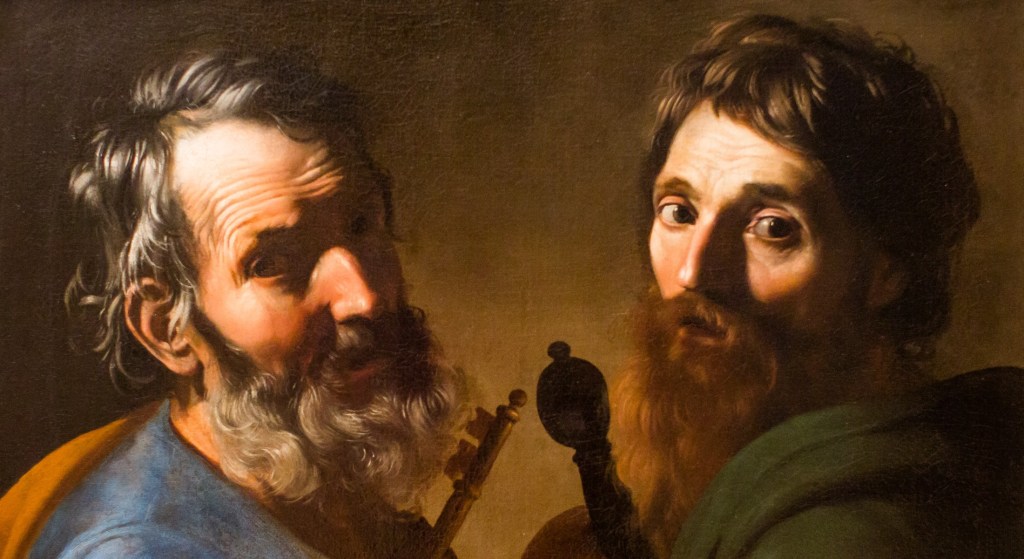
This discussion guide has been generated by the WORD THIS WEEK'S Catholic AI Assistant based on the Dominican Blackfriars' homily for this week. NEED HELP? Copy and paste a question into the chat bot in the lower right corner of the screen and have our Catholic Assistant help you.
Opening Questions
1. Can you think of any notable partnerships in your own life or in the lives of those around you?
2. How do these partnerships reflect the idea of being complementary rather than identical?
3. What do you already know about Saints Peter and Paul, and what intrigues you the most about their partnership?
Exploring the Sermon
1. Cultural Examples of Partnerships
- Discuss famous cultural duos mentioned (e.g., Cagney and Lacey, Holmes and Watson). How do these pairs complement each other?
- How does the dynamic between these pairs compare to religious partnerships in the Church?
2. Peter and Paul: A Complex Relationship
- How were Peter and Paul different in their approach to their faith and mission?
- What were the significant conflicts between Peter and Paul, and how were they resolved?
- Why do you think it's important to discuss the conflict and resolution between these saints?
3. The First Council Discussion
- What major issue did the first Council of the Church address, and what was the outcome?
- How does this event highlight the roles of Peter and Paul in shaping Church doctrine?
4. Complementarity and Unity
- What do Peter and Paul's interactions tell us about the importance of unity in diversity within the Church?
- Discuss the concept of charisms and their role in complementing the structured governance of the Church.
5. Modern Implications
- How does the principle of complementarity apply to the contemporary Church and its followers?
- What can modern Christians learn from Peter and Paul's ability to work through disagreements for a greater purpose?
Closing Reflection
- Reflect on a situation where disagreement led to a better understanding or outcome in your life.
- How can this sermon inspire you to embrace diversity and work towards unity within your community or church group?
Action Points
1. Identify an area in your life where you can apply the principle of complementarity.
2. Consider how you can use your unique gifts (charisms) to contribute to your community.
3. Seek out someone with a differing viewpoint and engage in a dialogue aimed at understanding and unity.
Homily Excerpt
Solemnity of Saint Peter and Saint Paul. Fr Dominic White considers the ecclesial complementarity of these two great saints.
Cagney and Lacey, Holmes and Watson, Laurel and Hardy. In culture and entertainment, some of the most enduring (and endearing) characters come not alone but in pairs. They are often as different as can be. They may be best friends or (and) rivals. There is at least sometimes tension and conflict between them, but they are complementary and, individually, would not be who they are or achieve what they achieved without the other.
Among the saints, we celebrate together Basil and Gregory (friends), Louis and Zélie Martin (married couple, parents of St Thérèse of Lisieux), and Perpetua and Felicity (fellow martyrs); and though separated separately, Francis and Clare of Assisi, Catherine of Siena and Raymond of Capua, Jordan and Diana, grew holy as friends. And thus Peter and Paul? Certainly saints, but in a strange way, they’re perhaps closer to the duos of culture and entertainment.
────── ⋆⋅☆⋅⋆ ──────
Fr. Jude Siciliano, O.P.

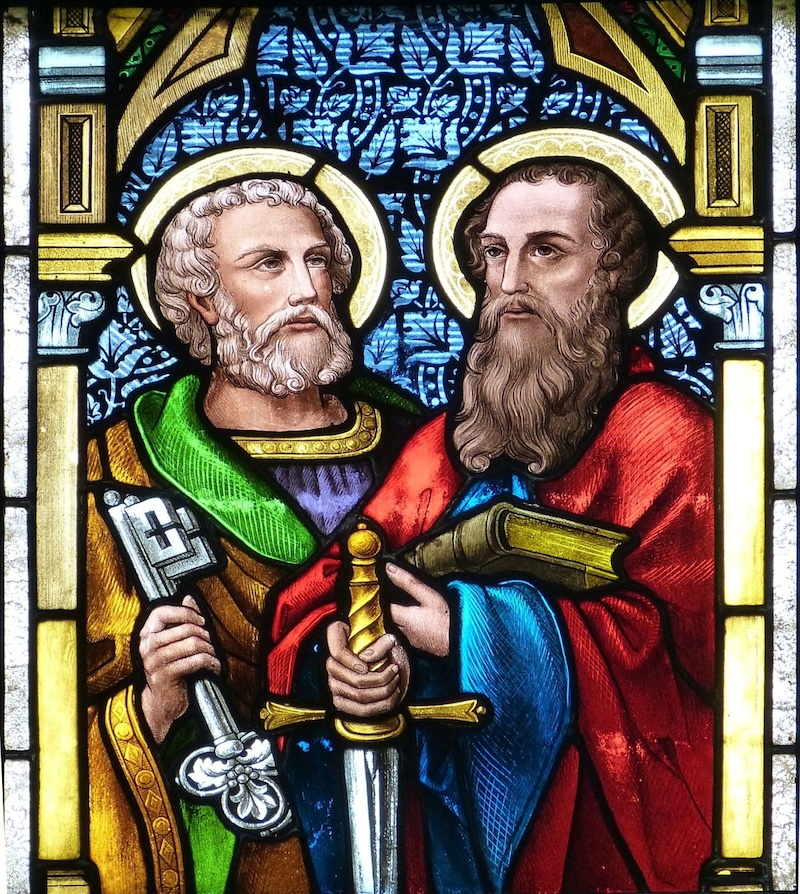
Saints Peter and Paul
An Unusual Feast
EXCERPT: Isn’t today’s feast unusual? Who but Christ could have brought together two more different people than Peter and Paul? Though they were very different, both believed in Christ and gave their lives in service to him. Their lives were transformed by Jesus. Had Peter not met him, he likely would have continued fishing for a living. Paul would have remained a devout Pharisee, intent on persecuting Christians. But on the road to Damascus, he had a profound spiritual encounter with Christ.
Peter and Paul—so different in background and temperament—each met Jesus and responded in faith. That encounter changed their lives completely. They surrendered in trust to God’s plan. Today, rather than just admiring them, we could pray for a deeper commitment to lives that reflect, as theirs did, the Messiah they served.
The Jews of Jesus’ time were not a free people. They lived under harsh Roman occupation. Yet they held fast to the belief that God would send a king to liberate them—a Messiah who would overthrow their oppressors and bring justice and peace to the world. They had waited a long time, trusting in God’s promise.
But no one knew exactly who the Messiah would be, what he would be like, or when he would come. Many expected a warrior-king who would lead a revolt against the Romans. Others hoped for a religious reformer who would purify the Temple and restore true worship. Some even claimed to be the Messiah, but the Romans quickly eliminated them, and their followers scattered.
────── ⋆⋅☆⋅⋆ ──────
Fr. Charles E. Irvin
Saints Peter and Paul
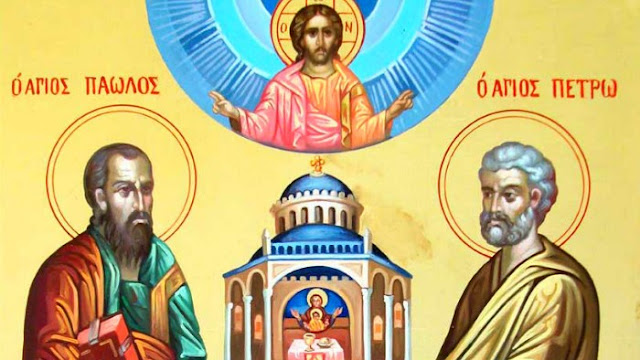

Individualism is stressed today, individual rights, individual freedom, and the assertion of the few over the many. Our common good and our care for the common good is very much a part of God’s plan. Caring for the well-being of others and caring for the good things we can share with others is very much a part to the great command to “love God and love our neighbor as ourselves.” If you want to identify your self and who you are as a person then that identity will be realized in what you actually do for others. I, a prisoner for the Lord, said St. Paul, urge you to live in a manner worthy of the call you have received, with all humility and gentleness, with patience, bearing with one another through love, striving to preserve the unity of the spirit through the bond of peace: one body and one Spirit, as you were also called to the one hope of your call; one Lord, one faith, one baptism; one God and Father of all, who is over all and through all and in all.
That’s what Peter eventually came to. But he couldn’t do it all by himself – he needed Jesus to draw it out, changing his name so that he could change his picture of himself. Remember that is what is involved when God gives us a name in our baptism, a name and an identity that comes from God our Father.
This discussion guide has been generated by the WORD THIS WEEK’S Catholic AI Assistant based on Fr. Irvin’s homily.
Recognizing Divine Qualities in Ourselves
– Explore the idea that Jesus introduces individuals to their true selves by seeing beyond appearances. Discuss how this concept applies to personal and spiritual growth.
– Analyze the transformation of the woman caught in adultery and how Jesus’ non-condemnation offers her a new identity.
– Discuss the challenge of internalizing God’s vision for us amid a world that offers negative self-perception.
Becoming Who God Meant Us to Be
– Examine the call to realize and bring forth God-given talents and qualities within us.
– Discuss the scriptural reference to Colossians 3:12-14. How do compassion, kindness, and love align with living out this purpose?
– Reflect on the importance of seeing yourself and others through the lens of divine love and acceptance.
Community and Identity
– Discuss the role of community and relationships in realizing and sustaining our God-given identity.
– Explore how St. Paul’s teachings promote unity and self-realization through communal love and support.
Practical Applications
– Reflect on St. Peter’s journey and transformation with Jesus’ guidance. Discuss how this relates to personal transformation through spiritual support and community.
– Identify practical ways to live out the qualities of compassion and love in the coming week, considering the challenges posed by the world.
Reflection Questions
1. How does recognizing God’s view of us impact the way we see ourselves?
2. Can you identify moments in your life where you felt God revealing your true potential to you?
3. What steps can you take to ensure you are nurturing the divine qualities within yourself and others?
4. How can the church community support individuals in discovering and living out their God-given identities?
────── ⋆⋅☆⋅⋆ ──────
Fr. George Smiga
- Doing the Eucharist - 2004
- The Four Eucharistic Verbs- 2010
- The Two SIdes of Bread- 2013
Saints Peter and Paul

2008 HOMILY – Today’s Feast of Sts. Peter and Paul is about discipleship and irony. It would be best if we examined each of these qualities in turn…
Both Peter and Paul were humble men, one a fisherman, the other a tent maker. Neither of them was adequately prepared to serve as the foundation for Christ’s Church. Moreover, they did not start out very well. Peter denied Christ. Paul persecuted the early Church. It is the highest irony that God would choose such weak and fallible people to begin the Church. But that irony is our hope. That irony reminds us that God does not choose us because we are so capable, but because God knows that we can become capable with God’s help. Our weaknesses can be overcome by God’s strength.
Discipleship is living according to a higher standard, being willing to be different because of the truth of the gospel. It is not easy to live in this way, but it is possible with God’s help. It is ironic that God would choose such weak people like Peter and Paul and us to be disciples, but that is what God does. In doing so, God removes any excuse. We cannot say, “It is impossible for me to live according to God’s standard.” God can make it possible. God will make it possible. With the same high expectation and irony that accompanied the call of Peter and Paul, God says to us, “Follow me.”
This discussion guide has been generated by the WORD THIS WEEK’S Catholic AI Assistant based on Fr. Smiga’s homily.
Introduction
1. Opening Question: What does discipleship mean to you, and how does it play a role in your life?
2. Purpose: This discussion guide explores the themes of discipleship and irony in the context of the lives and legacies of Saints Peter and Paul.
Discipleship: Understanding the Call
1. Peter and Paul’s Example: Reflect on how Peter and Paul exemplified discipleship. What were some key aspects of their lives that demonstrated faith and dedication?
2. Discussion Prompt: In what ways do you think their life choices impacted the growth of the early Church?
3. Personal Reflection: How do the lives of Peter and Paul challenge you to live your faith more boldly?
The Demands of Discipleship
1. Higher Standards: Discuss what it means to live to a higher standard as a disciple of Christ. How is this reflected in daily choices and actions?
2. Julio Diaz Story: Analyze the story of Julio Diaz. What elements of discipleship are evident in his response to the teenage mugger?
3. Group Activity: Share similar stories or experiences where you or someone you know acted out of faith in challenging situations.
Irony in God’s Choice
1. The Humble Beginnings of Peter and Paul: Discuss the irony in God choosing Peter, a fisherman, and Paul, a tent maker, to lead the Church. What does this tell us about God’s ways?
2. Overcoming Weakness: How do the weaknesses of Peter and Paul offer hope to us as contemporary disciples?
3. Personal Application: Share a personal weakness that you feel God has helped you overcome.
Living as Distinctive Disciples
1. Practical Implications: What are some practical ways you can live differently because of your beliefs? Consider aspects like love, forgiveness, and generosity.
2. Challenges and Supports: Discuss the challenges of living as a disciple in today’s world. What support systems (community, prayer, scripture) are necessary to uphold this way of life?
3. Action Plan: Identify one area in your life where you can actively work to live out your faith more fully. What steps will you take to implement this change?
────── ⋆⋅☆⋅⋆ ──────
Saints Peter and Paul

Rallying Cry
EXCERPT: We pray on this Feast that we will be faithful to the teaching and grace handed down from the apostles. At the heart of the faith that comes from Christ through them is the teaching on the sanctity of life. The fact that God cares for human life is the basis of all he does for us; the fact that he has entrusted us to the care of each other is the basis for all we do for each other.
Also strong in today’s themes is that of battle. Peter and Paul had to fight off many enemies and rely on the Lord’s power to rescue and sustain them, as today’s readings make clear. And what was true for them is true of the Church throughout the ages, which will endure many storms. Yet “the gates of hell will not prevail.” These words apply well to the battles to defend a culture of life against a culture of death.
────── ⋆⋅☆⋅⋆ ──────

Saints Peter and Paul

How Could They Keep From Singing?

Nothing could stop Peter and Paul from proclaiming Jesus Christ. Nothing should stop us. When we reflect on the call we have received, on the Presence of the Lord within us, on the Power of the Lord working through us, His Holy Spirit, how could
anything keep us from singing His Praise? This feast is not just about the Early Church of Rome. It
is not just about Peter and Paul. This feast is about our sharing the gifts we have received with others, gifts through which we can proclaim to the world the wonders and joys of the Gospel. Like Peter and Paul the cost of discipleship is negligible when compared to the joy of possessing Jesus Christ. In his first letter, our first Holy Father, St. Peter, says to us: (1 Peter 1:18-19) Although you have not seen him you love him; even though you do not see him now yet you believe in him, you rejoice with an indescribable and glorious joy, as you attain the goal of (your) faith, the salvation of your souls. May we sing the praises of the Lord with Saint Peter and Saint Paul.
This discussion guide has been generated by the WORD THIS WEEK’S Catholic AI Assistant based on Msgr. Pellegrino’s homily.
Pre-transformation Lives:
1. Reflect on what you know of Simon Peter and Saul of Tarsus before they dedicated themselves to Christ. How do their early struggles resonate with your own spiritual journey?
2. Why do you think it’s significant to understand their lives before they became apostles? How can their stories provide comfort or encouragement?
Commitment to Christ:
3. Discuss how Peter’s and Paul’s lives were transformed once they committed to Christ.
4. What aspects of their dedication to spreading the Gospel can inspire us today?
5. How did Peter and Paul overcome their fears, such as fear of death, and what role did their love for Christ play in this transformation?
Peter and Paul’s Mission in Rome:
6. Why was it important for Peter and Paul to establish the Church in Rome, and what challenges did they face in doing so?
7. Reflect on Peter’s role as the ‘Rock’ of the Church. How does this historical foundation affect the Church today?
8. Consider Paul’s scholarly approach to his faith. How did his background as a Roman citizen influence his missionary work?
Modern Applications:
9. How can the hymn by Robert Lowry help us understand the spirit and perseverance of Peter and Paul?
10. In what ways are we called to be like Peter and Paul in our own communities? What challenges do we face when proclaiming our faith?
11. Examine the statement: “The cost of discipleship is negligible compared to the joy of possessing Jesus Christ.” How can this viewpoint guide your personal mission and challenges?
Personal Reflection:
12. Reflect on the line from 1 Peter 1:18-19. What does it mean to love and believe in Christ, even without seeing Him? How do these verses inspire you to pursue a life of faith?
13. Discuss how you can “sing the praises of the Lord” through your daily actions and interactions.
14. What does it mean for you, personally, that nothing should stop us from proclaiming Jesus Christ? How can you overcome obstacles in your spiritual journey?
Conclusion:
As you conclude this discussion, reflect on how the lives and sacrifices of Saints Peter and Paul continue to influence us today. Consider the lasting impact of their dedication and how their joy in Christ can inspire us to share our gifts with the world. How can this feast reinforce our commitment to live lives dedicated to proclaiming the Gospel?
────── ⋆⋅☆⋅⋆ ──────
Saints Peter and Paul
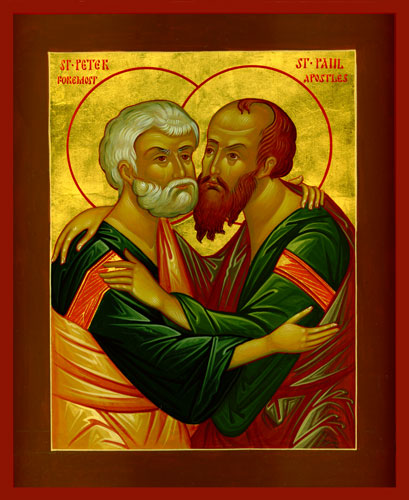
The Petrine and Pauline Charism Today
Often within religious institutions or Catholic organizations people speak of the birth of the organization reflecting the Pauline and Petrine charisms. For many, the founder of a religious order tends to be like Paul, charismatic, dynamic, a preacher with a vision who can attract followers. Perhaps Francis of Assisi or Mother Theresa come to mind. The person who succeeds the founder, very often is someone with the Petrine charism. This is the person responsible for taking the vision and creating a structure so that the work of the founder can grow and spread. The “second founder” as these men and women are sometimes called, are not always as well known as the founder, but their work is vital to the success of the mission.
As a church that is universal in scope, the office of the Pope–the Petrine Office –secures the institutional life of the Church. It both represents the unity of the Catholic Church and it insures our common identity and mission. At the same time, the church is at its core is missionary and so it insists that men and women, clergy, religious and lay are preaching and teaching the Gospel throughout the world–the Pauline charism.
────── ⋆⋅☆⋅⋆ ──────
Society of African Missions

Saints Peter and Paul
Sunday Homilies
As Christians – followers of Christ through our Baptism – we are called on to make Christ present in our own lives and in the lives of others. As we read the Sacred Scripture during the different seasons of the Liturgical Year may we pray in our hearts:
Come Holy Spirit, fill the hearts of your faithful and enkindle in them the fire of your love.
────── ⋆⋅☆⋅⋆ ──────
Bishop John Kobina Louis
Saints Peter and Paul
Sunday Homilies

Bishop John Kobina Louis, PhD, is an auxiliary bishop of the Archdiocese of Accra, Ghana. He was ordained as an auxiliary bishop on 19th April 2023.
────── ⋆⋅☆⋅⋆ ──────
Fr. Michael Chua
Saints Peter and Paul
Homily Excerpt
People who know me would know that I have an obsession with what seems to be Catholic trivia – small tiny details with regards to Catholic architecture, art, music and history all excite me, to say the least. One of the most exciting things which I have discovered over the years is this little publicised or known fact about the major basilicas in Rome dedicated to the two great apostolic princes, patron saints of Rome, we fete today. Now, you may have heard me mention that churches were traditionally built with a certain orientation, facing East, the position of the rising sun and the direction Christ ascended to heaven and is expected to return. Interestingly, the word “orientation” comes from the Latin “Orient,” which means “East”.
The two basilicas, the Basilica of St Peter in Vatican City and the Basilica of St Paul Outside the Walls, however, were not built with the above orientation in mind…

Homily Excerpt
The beauty of the miracle occurring at each Mass—that Jesus becomes really, truly and substantially present under the forms of mere bread and wine—grounds our faith and reflects the words our Lord spoke: “I am the Bread of Life. He who feeds on my Flesh and drinks my Blood has life eternal, and I will raise him up on the last day.” (Jn 6:35, 54-56) This is no small matter—what an incredible gift from God! We must, therefore, never forget that when we participate at Mass, we witness a miracle, and we participate in this very miracle through the reception of Holy Communion, we share in the Divine Life of our Saviour. Let our petition echo the words of the Sequence: “Come then, good shepherd, bread divine, still show to us thy mercy sign; Oh, feed us still, still keep us thine; So may we see thy glories shine in fields of immortality.”
Homily Excerpt
Today, the effigies of these two great Apostles stand as guardians to the entrances of the major Basilica of St Peter, as stone lions would in front of Chinese temples in the East. If the stone lions were meant to keep evil and inauspicious forces out, our two saints beckon to welcome pilgrims of the world to enter. A pillar must always have a partner, and so Peter and Paul are the twin pillars that hold up the doorway of the Church. So staunch are they that the rest of the faithful must celebrate their feast days together as one. They shared their life for the Faith, and so, to this day, they share it also in the observation of their glorious entrance into life eternal. As we celebrate the Solemnity of Saints Peter and Paul, let us look to their model of fraternal correction and mutual love as we work to spread the gospel message in our own lives.
────── ⋆⋅☆⋅⋆ ──────
Saints Peter and Paul

Homily Excerpt
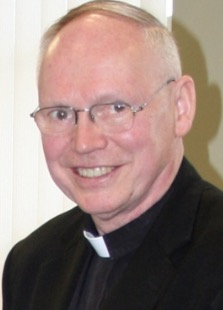
2025 HOMILY – This Sunday, the 44th anniversary of my priestly ordination, it seems appropriate to consider the sacraments: the “holy mysteries.”
People who like Latin in the Mass often explain that “it adds to the mystery.” Unfortunately, they confuse the word’s two meanings.
In Greek, a sacrament was called a mysterion (plural, mysteria): “something closed” or “secret.” Originally, for example, only the baptized could attend Mass; even catechumens were dismissed before the Offertory.
────── ⋆⋅☆⋅⋆ ──────
Fr. Tommy Lane
Saints Peter and Paul
Two Important Saints
Each of these two saints is important for different reasons. Peter was the first Pope and kept the Church united as it grew very rapidly in the years following Pentecost. In the first years after Pentecost, it was the Jewish people who accepted Jesus as the Savior and so the early Church was a very Jewish Church. But as time went on, Paul began to preach also to non-Jewish people, the Gentiles as they were called. All of us are Gentiles. His preaching was very successful, and he brought huge numbers of non-Jewish people into the Church, so much so that the number of Jewish people in the Church was greatly outnumbered by non-Jewish people. It is because of Paul that we are now in the Church. So both Peter and Paul had very important tasks in the early Church: Peter maintaining the unity in the Church which during his lifetime had already spread throughout the Middle East and Europe, and Paul who taught the Jewish people that Jesus is the fulfillment of their Old Testament hopes and taught the Gentiles that Jesus is the Savior. Whenever you see statues of Peter and Paul, usually Peter is holding a key symbolizing his duty as head of the Church, and Paul is holding the Bible symbolizing his preaching.
Related Homilies: on Saint Peter
- Peter grew to accept the Cross 2011
- Saint Peter healing scandal and strengthening the flock 2010
- You are Peter and on this rock I will build my Church 2008
- Cathedra of Saint Peter 2007
- Jesus forgives Peter and restores him
Related Homilies: on Saint Paul
────── ⋆⋅☆⋅⋆ ──────
Saints Peter and Paul

Our faith is not a guarantee that we will not go under. But it is a promise that, even if we nearly drown, Jesus will be with us. Not every storm of ours is miraculously silenced before his command, but all can be transformed by the abiding presence of love that disarms all fear.
This is not a mere human judgment, Paul warns us: “The love of Christ impels us. … He died for all so that those who live might no longer live for themselves, but for him who for their sakes died and was raised up.”
The love of Christ is the object of our faith. It is not reducible to rational or utilitarian calculus. And yet it recasts the greatest absurdities that batter our minds.
This discussion guide has been generated by the WORD THIS WEEK’S Catholic AI Assistant based on Fr. Kavanaugh’s homily.
Not Available
────── ⋆⋅☆⋅⋆ ──────


────── ⋆⋅☆⋅⋆ ──────
Fr. Jagodensky, S.D.S.
Saints Peter and Paul
Homily Excerpt
This isn’t the Monty Hall game show but it does have three doors. Our lives are not a game show but we all have three or more doors that need to be nearby but closed. Three doors in our present society are wide open. Wide open with a blind eye to the powerful working of the Holy Spirit.
Narcissism. Discouragement. Pessimism.
The martyrdoms of Peter and Paul were honored this week. One loved killing Christians before falling off a horse. The other tells Jesus to change his mind about this Messiah routine, almost drowns with his lack of faith and a crow is heard in the background after denying that he even knew the guy called Jesus. They’ve got to be the weirdest, unwiseist choices for the one who essentially wrote our whole Christian religion and the other, I believe, has a chair named after him somewhere in Rome.
Please note that the provided video clips serve as additional resources to complement the homily. They may not have a direct correlation with the contributor’s original content. They aim to inspire preachers to enrich their own homilies, drawing ideas and insights from both the written material and the visual content explored.
Do you have a link to a homily or an excerpt you would like to share for this Sunday? Add it below.
 Highlight text or double-click a paragraph anywhere on the site to ADD TO NOTES. You can also click ASK AI to copy your selection to the clipboard with a command prompt, ready for you to paste manually into the chat above.
Sunday
My Notes
Clear Workspace?
Are you sure you want to delete all your notes? This cannot be undone.