June 29, 2025
June 29, 2025


Papal Homilies

EWTN (2:49:00)

This livestream allows viewers to witness the Pope’s addresses during Papal Audiences, as well as other Vatican events and news. The livestream is part of the Vatican Media Center’s efforts to share the latest updates on Pope Leo XIV, the Holy See, and the Church worldwide with a global audience.


Francis
Featured Homilies
Pope Francis
Saints Peter and Paul

Saints Peter and Paul
29 June 2022 – Saint Peter’s Basilica
The testimony given by the two great Apostles Peter and Paul today comes to life once more in the Church’s liturgy. Peter, imprisoned by King Herod, is told by an angel of the Lord: “Get up quickly” (Acts 12:7), while Paul, looking back on his entire life and apostolate says: “I have fought the good fight” (2 Tim 4:7). Let us reflect on these two phrases – “get up quickly” and “fight the good fight” – and ask what they have to say to today’s Christian community, engaged in the synodal process.
First, the Acts of the Apostles tell us of the night that Peter was freed from the chains of prison. An angel of the Lord tapped him on the side as he was sleeping, “and woke him, saying, ‘get up quickly’” (Acts 12:7). The angel awakens Peter and tells him to get up. The scene reminds us of Easter, because it contains two verbs present in the accounts of the resurrection: awaken and get up. In effect, the angel awakens Peter from the sleep of death and urges him to get up, to rise and set out towards the light, letting himself be guided by the Lord in passing through all the closed doors along the way (cf. v. 10). This image has great meaning for the Church. We too, as disciples of the Lord and the Christian community, are called to get up quickly, to enter into the mystery of the resurrection, and to let the Lord guide us along the paths that he wishes to point out to us.
Still, we experience many inward forms of resistance that prevent us from setting out. At times, as Church, we are overcome by laziness; we prefer to sit and contemplate the few sure things that we possess, rather than getting up and looking to new horizons, towards the open sea. Often we are like Peter in chains, imprisoned by our habits, fearful of change and bound to the chains of our routine. This leads quietly to spiritual mediocrity: we run the risk of “taking it easy” and “getting by”, also in our pastoral work. Our enthusiasm for mission wanes, and instead of being a sign of vitality and creativity, ends up appearing tepid and listless. Then, the great current of newness and life that is the Gospel becomes in our hands – to use the words of Father de Lubac – a faith that “falls into formalism and habit…, a religion of ceremonies and devotions, of ornaments and vulgar consolations… a Christianity that is clerical, formalistic, anemic and callous” (The Drama of Atheist Humanism).
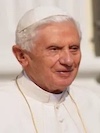
Benedict XVI
Pope Benedict XVI
Saints Peter and Paul
A Feast of Catholicity
29 June 2005 | St Peter’s Basilica
The Feast of the Holy Apostles Peter and Paul is at the same time a grateful memorial of the great witnesses of Jesus Christ and a solemn confession for the Church: one, holy, catholic and apostolic. It is first and foremost a feast of catholicity. The sign of Pentecost – the new community that speaks all languages and unites all peoples into one people, in one family of God -, this sign has become a reality. Our liturgical assembly, at which Bishops are gathered from all parts of the world, people of many cultures and nations, is an image of the family of the Church distributed throughout the earth.
Strangers have become friends; crossing every border, we recognize one another as brothers and sisters. This brings to fulfilment the mission of St Paul, who knew that he was the “minister of Christ Jesus among the Gentiles, with the priestly duty of preaching the Gospel of God so that the Gentiles [might] be offered up as a pleasing sacrifice, consecrated by the Holy Spirit” (Rom 15: 16).
The purpose of the mission is that humanity itself becomes a living glorification of God, the true worship that God expects: this is the deepest meaning of catholicity – a catholicity that has already been given to us, towards which we must constantly start out again. Catholicity does not only express a horizontal dimension, the gathering of many people in unity, but also a vertical dimension: it is only by raising our eyes to God, by opening ourselves to him, that we can truly become one.
Like Paul, Peter also came to Rome, to the city that was a centre where all the nations converged and, for this very reason, could become, before any other, the expression of the universal outreach of the Gospel. As he started out on his journey from Jerusalem to Rome, he must certainly have felt guided by the voices of the prophets, by faith and by the prayer of Israel.
The mission to the whole world is also part of the proclamation of the Old Covenant: the people of Israel were destined to be a light for the Gentiles. The great Psalm of the Passion, Psalm 22[21], whose first verse Jesus cried out on the Cross: “My God, my God, why have you forsaken me?”, ends with the vision: “All the ends of the earth shall remember and turn to the Lord; all the families of the nations shall bow down before him” (Ps 22[21]: 28). When Peter and Paul came to Rome, the Lord on the Cross who had uttered the first line of that Psalm was risen; God’s victory now had to be proclaimed to all the nations, thereby fulfilling the promise with which the Psalm concludes.
Catholicity means universality – a multiplicity that becomes unity; a unity that nevertheless remains multiplicity. From Paul’s words on the Church’s universality we have already seen that the ability of nations to get the better of themselves in order to look towards the one God, is part of this unity. In the second century, the founder of Catholic theology, St Irenaeus of Lyons, described very beautifully this bond between catholicity and unity and I quote him. He says: “The Church spread across the world diligently safeguards this doctrine and this faith, forming as it were one family: the same faith, with one mind and one heart, the same preaching, teaching and tradition as if she had but one mouth. Languages abound according to the region but the power of our tradition is one and the same. The Churches in Germany do not differ in faith or tradition, neither do those in Spain, Gaul, Egypt, Libya, the Orient, the centre of the earth; just as the sun, God’s creature, is one alone and identical throughout the world, so the light of true preaching shines everywhere and illuminates all who desire to attain knowledge of the truth” (Adv. Haer. I 10, 2). The unity of men and women in their multiplicity has become possible because God, this one God of heaven and earth, has shown himself to us; because the essential truth about our lives, our “where from?” and “where to?” became visible when he revealed himself to us and enabled us to see his face, himself, in Jesus Christ. This truth about the essence of our being, living and dying, a truth that God made visible, unites us and makes us brothers and sisters. Catholicity and unity go hand in hand. And unity has a content: the faith that the Apostles passed on to us in Christ’s name.
SOURCE: The Holy See Archive at the Vatican Website © Libreria Editrice Vaticana If you are unable to access the Vatican website, click here to check if it is down.

St. John Paul II
Saint Pope John Paul II
Saints Peter and Paul
On This Rock I Will Build My Church
29 June 1996 | Solemnity of Corpus Christi
1. “The Lord has … rescued me from the hand of Herod” (Acts 12:11).
On today’s solemnity we listen once again to Peter’s words and to similar words from Paul: “The Lord will rescue me from every evil and save me for his heavenly kingdom. To him be the glory for ever and ever” (2 Tm 4:18).
Today the whole Church and, in particular, the Church in Rome gives glory to God for the holy Apostles Peter and Paul: “The angel of the Lord will rescue those who fear him” (cf. Ps 34 [33]:5). The Apostles were delivered from all fear by the power that comes from God. Humanly speaking, like all human beings they too were weak creatures. Peter showed this weakness several times, especially when he was put to the test and denied his very Master (cf. Jn 18:15-27). Paul’s weakness shows up in the fury and almost boundless cruelty with which he persecuted Christ’s followers.
The Lord however acted in them as though he took no account of this human frailty, as if he ignored it, proceeding according to his own mysterious plan of salvation. He revealed to Peter that he was the “rock” on which he would build his Church (cf. Mt 16:18). He said of Paul that he was a “chosen instrument” to proclaim the Gospel to all peoples (cf. Acts 9:15). Both knew they were fulfilling the mission entrusted to them by the power of the Lord himself. Here in Rome they understood this in a special way, as they prepared to face the supreme trial of martyrdom.
Peter died a martyr in Rome during Nero’s persecution
2. In the Acts of the Apostles we read that King Herod “killed James the brother of John with the sword; and when he saw that it pleased the Jews he proceeded to arrest Peter also” (Acts 12:2-3), intending “after the Passover to bring him out to the people” (ibid., 12:4).
Then Peter, who was kept in prison during the feast of Passover, was able to meditate with particular intensity on the events of the Last Supper and the Passion of Jesus, arrested, condemned, scourged, laden with the cross and crucified on Golgotha. He was truly “obedient unto death, even death on a cross” (Phil 2:8). Several years had passed since that Passover and Peter now found himself in prison, awaiting in turn the death sentence which Herod, like Pilate, would pronounce. The reason for it would have been to elicit the crowd’s sympathy. The Apostle felt he did not have much time left but he did not forget Christ’s words: “You are Peter, and on this rock I will build my Church” (Mt 16:18).
3. Then something unexpected happened. He was released from prison in Jerusalem by God’s power, expressed through the angel’s intervention: the prison door opened of its own accord and he found himself free. “So my hour has not yet come”, the Apostle must have thought at that moment, and shortly afterwards he left Jerusalem for Antioch and then for Rome. In Rome, more than 20 years after the events of Christ’s Passover, Peter realized that his own hour had now come. It came at the time of the Emperor Nero’s persecutions, when so many of his brothers and sisters in the faith died as martyrs. With them Peter would die too.
As for Paul, who had been living in Rome for some time, he also sealed his witness to Christ with his blood. In his Letter to Timothy he writes: “For I am already on the point of being sacrificed; the time of my departure has come. I have fought the good fight, I have finished the race, I have kept the faith. Henceforth there is laid up for me the crown of righteousness which the Lord, the righteous judge, will award to me on that Day” (2 Tm 4:6-8).
Paul, a Roman citizen, was not subjected to the agony of crucifixion but to decapitation by the sword.
Peter might have had like thoughts on the day when, caught by his persecutor, he was condemned to death on the cross. A venerable tradition claims that he asked to die upside down, because he did not feel worthy to be crucified like his divine Master.
SOURCE: The Holy See Archive at the Vatican Website © Libreria Editrice Vaticana If you are unable to access the Vatican website, click here to check if it is down.

Saints Peter and Paul