June 22, 2025
June 22, 2025


Papal Homilies
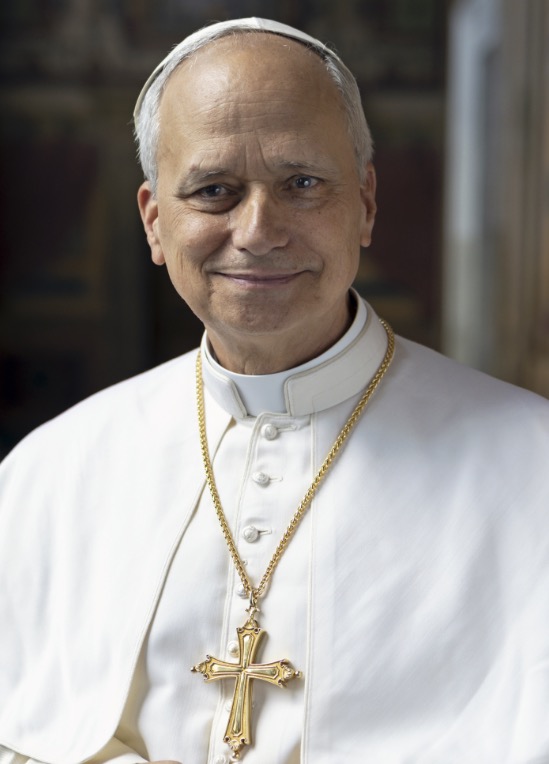

ABS-CBN NEWS (3:31) – Pope Leo XIV addressed the faithful with his thoughts about the “many armed conflicts” happening in the world during the traditional Angelus prayer he held on Sunday (June 15) in St Peter’s Square.

This livestream allows viewers to witness the Pope’s addresses during Papal Audiences, as well as other Vatican events and news. The livestream is part of the Vatican Media Center’s efforts to share the latest updates on Pope Leo XIV, the Holy See, and the Church worldwide with a global audience.
Vatican Calendar
TRANSCRIPTS – Pope’s Addresses
Recent Addresses
JUNE 16, 2025 – To pilgrims from the Democratic Republic of Congo, gathered for the Beatification of Floribert Bwana Chui
JUNE 16, 2025 – To the participants of the Summer School of Astrophysics promoted by the Vatican Observatory
JUNE 16, 2025 – To the Bishops of Madagascar
JUNE 15, 2025 – Angelus, 15 June 2025
JUNE 15, 2025 – Homily for the Jubilee of Sport on the Solemnity of the Holy Trinity


Homiletic Suggestions (2025)
edited by Father Gaetano Piccolo (SI)

Body & Blood of Christ (Year C)
Dicastery for the Clergy
Homily Notes
Bread
“Bread” is the term which all of the liturgical texts have in common. In the passage of the Gospel, Jesus “took the five loaves… raised his eyes to heaven, and said the blessing over them”. This gesture of Jesus, seen in retrospect, is prefigured in that of Melchizedek, the king-priest of Salem, who offers Abram “bread and wine” (first reading) as a sign of hospitality, generosity and friendship. This gesture anticipates the Last Supper with his disciples and the Eucharist celebrated by Christians in memory of Jesus: “The Lord Jesus took some bread, and after he had given thanks, he broke it, and he said, ‘This is my body, which is for you’” (second reading).
© Dicastery for the Clergy A | B | C
Doctrinal Messages
Pastoral Suggestions
Francis
Featured Homilies
Pope Francis
Body & Blood of Christ (Year C)

Lord, Satisfy Us
19 June 2022 – Saint Peter’s Square
Sometimes, there is the risk of confining the Eucharist to a vague, distant dimension, perhaps bright and perfumed with incense, but distant from the straits of everyday life. In reality, the Lord takes all our needs to heart, beginning with the most basic. And he wants to set the example for his disciples, by saying, “You give them something to eat” (v. 13), to those people who had listened to him during the day. Our Eucharistic adoration comes alive when we take care of our neighbour like Jesus does. There is hunger for food around us, but also for companionship; there is hunger for consolation, friendship, good humour; there is hunger for attention, there is hunger to be evangelized. We find this in the Eucharistic Bread — Christ’s attention to our needs and the invitation to do the same toward those who are beside us. We need to eat and feed others.
In addition to eating, however, we cannot forget being satisfied. The crowd is satisfied because of the abundance of food and also because of the joy and amazement of having received it from Jesus! We certainly need to nourish ourselves, but we also need to be satisfied, to know that the nourishment is given to us out of love. In the Body and Blood of Christ, we find his presence, his life given for each of us. He not only gives us help to go forward, but he gives us himself — he makes himself our travelling companion, he enters into our affairs, he visits us when we are lonely, giving us back a sense of enthusiasm. This satisfies us, when the Lord gives meaning to our life, to our darkness, our doubts. But he sees the meaning, and this meaning that the Lord gives satisfies us. This gives us that “more” that we all seek — namely, the presence of the Lord! For in the warmth of his presence, our lives change. Without him, everything would truly be grey. Adoring the Body and Blood of Christ, let us ask him with our heart: “Lord, give me the daily bread to go forward, Lord, satisfy me with your presence!”.
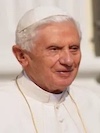
Benedict XVI
Pope Benedict XVI
Body & Blood of Christ (Year C)
Sacramentum Caritatis
7 June 2007 | Basilica of Saint John Lateran Square
We have just sung the Sequence: “Dogma datur christianis, / quod in carnem transit panis, / et vinum in sanguinem – this [is] the truth each Christian learns, / bread into his flesh he turns, to his precious blood the wine”.
Today we reaffirm with great joy our faith in the Eucharist, the Mystery that constitutes the heart of the Church. In the recent Post-Synodal Apostolic Exhortation Sacramentum Caritatis I recalled that the Eucharistic Mystery “is the gift that Jesus Christ makes of himself, thus revealing to us God’s infinite love for every man and woman” (n. 1).
Corpus Christi, therefore, is a unique feast and constitutes an important encounter of faith and praise for every Christian community. This feast originated in a specific historical and cultural context: it was born for the very precise purpose of openly reaffirming the faith of the People of God in Jesus Christ, alive and truly present in the Most Holy Sacrament of the Eucharist. It is a feast that was established in order to publicly adore, praise and thank the Lord, who continues “to love us “to the end’, even to offering us his body and his blood” (Sacramentum Caritatis,n. 1).
The Eucharistic celebration this evening takes us back to the spiritual atmosphere of Holy Thursday, the day on which in the Upper Room, on the eve of his Passion, Christ instituted the Most Holy Eucharist.
SOURCE: The Holy See Archive at the Vatican Website © Libreria Editrice Vaticana If you are unable to access the Vatican website, click here to check if it is down.

St. John Paul II
Saint Pope John Paul II
Body & Blood of Christ (Year C)
The Corpus Christi Sequence
14 June 2001 | Solemnity of Corpus Christi
1. “Ecce panis Angelorum, / factus cibus viatorum: / vere panis filiorum” “Behold the bread of angels, as pilgrims’ food inherited, it is the bread of all true heirs” (Sequence).
Today the Church shows the world the Corpus Christi – the Body of Christ. And she invites us to adore him: Venite adoremus – Come let us adore him.
The attention of believers is focused on the Sacrament in which Christ has left himself: Body, Blood, Soul and Divinity. It is the reason for considering it as the holiest reality: “the Blessed Sacrament”, living memorial of the redeeming Sacrifice.
On the Solemnity of Corpus Christi, we return to that “Thursday” which we call “Holy”, on which the Redeemer celebrated his last Passover with the disciples: it was the Last Supper, fulfilling the Jewish passover supper and inaugurating the Eucharistic rite.
For this reason, for centuries the Church has chosen Thursday for the Solemnity of Corpus Christi, feast of adoration, contemplation and exaltation. On the feast the People of God draw close to the most precious treasure left by Christ, the Sacrament of his own Presence, and they praise, celebrate and carry it in procession through the streets of our cities.
2. “Lauda, Sion, Salvatorem!” “Praise, O Sion, your Redeemer”. (Sequence).
The new Sion, the spiritual Jerusalem in which God’s children are gathered from every nation, language and culture, praises our Saviour with hymns and canticles. Indeed, wonder and gratitude for the gift received are inexhaustible. This gift “exceeds all praise, there is no hymn worthy of it” (ibid.).
It is a sublime and ineffable mystery, a mystery before which we remain astonished and silent, in a state of deep and ecstatic contemplation.
3. “Tantum ergo Sacramentum veneremur cernui” “Let us fall down in adoration of so great a sacrament”.
Christ who died and rose for us is really present in the Holy Eucharist.
In the consecrated Bread and Wine, the same Jesus of the Gospels remains with us whom the disciples met and followed, whom they saw crucified and risen, whose wounds Thomas touched, exclaiming prostrate in adoration: “My Lord and my God!” (Jn 20,28) (cf. ibid., 17-20).
In the Sacrament of the altar, there are offered for our contemplation the full depths of the mystery of Christ, the Word and the flesh, the divine glory and his tent among men. Before this Sacrament, we are sure that God is “with us”, that in Jesus Christ he assumed all the dimensions of our human nature, except sin, emptying himself of his glory to clothe us with it (cf. ibid., 21-23).
The invisible face of Christ, the Son of God, is manifest in his Body and Blood in the simplest and, at the same time, the most exalted way possible in this world.
The ecclesial community responds to people in every age who ask perplexed: “We wish to see Jesus” (Jn 12,21), by repeating what the Lord did for the disciples of Emmaus: He broke the bread. In the breaking of the bread, the eyes of those who seek him with a sincere heart are opened. In the Eucharist, the intuition of the heart recognizes Jesus and his unmistakable love lived “to the end” (Jn 13,1). And in him, in that gesture, it recognizes the Face of God!
SOURCE: The Holy See Archive at the Vatican Website © Libreria Editrice Vaticana If you are unable to access the Vatican website, click here to check if it is down.

Body & Blood of Christ (Year C)