June 22, 2025
June 22, 2025


Intro to Readings
Intro to Readings


Body & Blood of Christ (Year C)

Melchizedek
Outline of Word-Sunday Essay
by Larry Broding

EXCERPT: Melchizedek took on mythic proportions over the centuries. Since Melchizedek’s origin or destiny were not described in the scriptures (he neither was born nor died), he was seen in eternal dimensions. In Psalm 110:4, YHWH was invoked to anoint the king of Judah as a Melchizedek figure, a priest-king forever. In Hebrews 5-7, the author identified Jesus as the Melchizedek figure in the worship of heaven.
Melchizedek’s deity, “God Most High” (“El Elyon” in Hebrew) was identified with YHWH in Psalms 47:2; 57:2; 78:35, 56. The title was a generic phrase that described the ultimate concept of divinity (the creator of all things) and not a personal name.

The combination of the offering, communion meal with the persona of Melchizedek and his deity, “God Most High” had a tremendous impact on early Christian Christology and worship. That tradition influenced Paul’s writings and found its full development in the Letter to the Hebrews. These simple verses became a lens through which Christians see their relationship with their Savior.
Can you think of the Mass without the themes found in the Melchizedek narrative?
Reflect on the themes of this reading. How do these themes help your appreciation of the Eucharist?dom? Did you pray for the virtue? What happened?
Clipart by Fr. Richard Lonsdale
Fr. Timothy Peters has a doctorate in Biblical Theology (S.Th.D.) from the Angelicum University and a License in Biblical Theology (S.T.L.) from the Gregorian University in Rome. He teaches at Saint John’s Seminary in Camarillo, CA as an Assistant Professor of Biblical theology.
Catholic Bible Study
FIRST READING

THE WORD PROCLAIMED
First Reading/Psalm Commentary (Fr. Francis Martin)

- Kieren O’Mahony OSA
- Fr. Conley Bertrand
- Fr. George Corrigan OFM
- Fr. Thibodeau
- St. Charles Borromeo
- Edriann Ezell
- Vince Contreras
- Bp. John P. Dolan
- Fr. Eamon Tobin
- Carmelite Lectio Divina
The Bible Project offers valuable resources that cater to Christians from diverse denominations, including Catholics. It is essential to note that the core message of the Bible remains consistent across various Christian traditions, even though there might be some differences in theology and interpretation. The Bible Project aims to help people engage with the Bible more deeply and experience it as a unified story that leads to Jesus.
Body & Blood of Christ (Year C)
EXCERPT from Reflections on the Sunday Mass Readings for Year C
Bible Project
SOURCE: Bible Project
HISTORY
Genesis 14:18-20 recounts the encounter between Abraham and Melchizedek following Abraham’s victorious battle against the alliance of various kings. This passage holds significance in understanding the historical and political context of the time and the religious customs of the ancient Near East.
Abraham, the patriarch of the Israelites, was a figure of great significance during this period. His military victory further solidified his power and influence in the region. The passage highlights the political context by mentioning the various kings and their alliances, showcasing the complex dynamics and power struggles of the era.
Melchizedek, the king of Salem and a priest of God Most High, plays a vital role in the passage. His appearance as a priest-king serves as an early example of the unification of political and religious authority, a concept later echoed in the Israelite monarchy. The offering of bread and wine is an early example of what would later become significant elements in Christian liturgy.
The author of Genesis is traditionally believed to be Moses, who aimed to recount the early history of the Israelites and emphasize their covenantal relationship with God. The intended audience would have been the Israelites, particularly during their exodus and formation as a nation. Understanding this passage would have helped them trace their religious heritage and identity through the figure of Abraham.
Cultural and political influences of the ancient Near East are evident in the passage. The concept of a “priest-king” like Melchizedek, as well as the custom of paying tithes, highlight the broader cultural context and its impact on the Israelite religious and political structures.
Body & Blood of Christ (Year C)
SOCIETY
The sociological and cultural context of Genesis 14:18-20 offers valuable insights into the customs, beliefs, and practices of the ancient Near East that influenced the passage’s meaning and interpretation. The encounter between Abraham and Melchizedek reflects the prevailing social norms and power dynamics of the time.
Melchizedek’s role as both king and priest sheds light on the fusion of political and religious authority in ancient societies. This dual role highlights the close relationship between religious customs and political power, emphasizing the sociological context of the passage. The exchange between Abraham and Melchizedek showcases a mutual recognition of authority and respect, further solidifying the importance of social hierarchy and etiquette.
The offering of bread and wine by Melchizedek symbolizes the hospitality and generosity extended to guests, emphasizing the value placed on such customs in ancient cultures. Additionally, Abraham’s giving of a tithe to Melchizedek indicates the practice of paying tribute or acknowledging the authority of a superior figure, reflecting the societal norms regarding power and status.
Body & Blood of Christ (Year C)
THEOLOGY
The Roman Catholic theological context of Genesis 14:18-20 underscores the significance of Abraham’s encounter with Melchizedek, offering important insights into the Catholic understanding of Christ’s eternal priesthood and its relevance for contemporary Catholics.
In Catholicism, Melchizedek serves as a prefiguration of Christ’s eternal priesthood. Christ’s role as a priest in the order of Melchizedek (Hebrews 5:6) is seen as the fulfillment of the Old Testament priest-king model. This connection highlights the continuity between the Old and New Testaments, emphasizing the importance of Christ’s sacrifice and its ongoing significance for the faithful.
The modern-day application of this passage for contemporary Catholics lies in recognizing Christ’s role as the ultimate mediator between God and humanity. Just as Melchizedek offered bread and wine, Christ instituted the Eucharist, the central sacrament of the Catholic faith, during the Last Supper (Matthew 26:26-28). This parallel encourages Catholics to participate in the Eucharistic celebration and draw strength from Christ’s sacrificial love.
The concept of tithing, introduced in Genesis 14, remains relevant for Catholics today. While not a formal requirement, the idea of generously supporting the Church and those in need underscores the importance of stewardship and responsible use of one’s resources (2 Corinthians 9:6-7).
Connecting Faith and Life
A reading from the Book of Genesis
(Chapter 14:18-20)
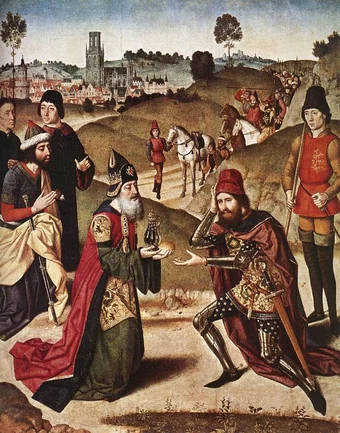
Abraham was the father of the Jewish people. Melchizedek is a shadowy character from the Book of Genesis who is mentioned only one more time in the Hebrew Scriptures—in Psalm 110. “You are a priest forever, in the line of Melchizedek.” In this reading Melchizedek is described as a king who “brought out bread and wine and, being a priest of God most high, he blessed Abram with these words: ‘Blessed be Abram by God most high, the creator of heaven and earth; and blessed be God most high, who delivered your foes into your hand.’” So, Melchizedek is a priest and a king, and he shares bread and wine with Abram even before Abram becomes Abraham—the name God gives him as “God’s chosen one.”
It is an odd story, but it is in this liturgy because it mentions the sharing of bread and wine which is what we do during at each Mass, with one major difference. We believe that Jesus is truly present in the form of bread and wine as he was at the Last Supper.

SOURCE: Branching Out Blog (2022) with Bill Ayres from RENEW International—Founded in 1978, RENEW is a not-for-profit organization based in Plainfield, NJ. Our mission is simple yet powerful: to connect faith and life. We use the RENEW process combined with a theme that meets the needs of your community to help parishes and dioceses build small groups to transform the Church so the Church can transform the world! / 2022 Archive
Painting, “Meeting of Abraham and Melchizedek,” Dieric Bouts the Elder, circa 1464-1467, Church of St. Peter, Leuven, Belgium. Public domain.

Body & Blood of Christ (Year C)
Words of Institution
Outline of Word-Sunday Essay
by Larry Broding
EXCERPT: When we gather to celebrate Mass, we “remember” the life-giving of Jesus with him. Jesus brings his life, death, and resurrection to us. Jesus meets us through our gathering as the Church, his body, through the reading of Scripture as God’s Word, through the priest who acts “in persona Christi” (in the person of Christ), and finally (and most importantly) through the bread and wine we consume. As we “remember” Jesus, we become one with him in the bread and wine. And, as we receive communion, we tell everyone through our actions that we are followers of Christ [26].
St. Paul banned the meal from the community gathering (see 11:33-34), so only the blessing of bread and wine remained. But the apostolic tradition continued and developed into the Liturgy of the Eucharist at Mass.
When was the last time you reflected on the Words of Institution? How does that reflection impact your reception of Communion?lationship with Christ give glory to the Father?
Clipart by Fr. Richard Lonsdale
Fr. Timothy Peters has a doctorate in Biblical Theology (S.Th.D.) from the Angelicum University and a License in Biblical Theology (S.T.L.) from the Gregorian University in Rome. He teaches at Saint John’s Seminary in Camarillo, CA as an Assistant Professor of Biblical theology.
Catholic Bible Study
SECOND READING

THE WORD PROCLAIMED
Second Reading Commentary (Fr. Francis Martin)
- Kieren O’Mahony OSA
- Fr. Conley Bertrand
- Fr. George Corrigan OFM
- Fr. Thibodeau
- St. Charles Borromeo
- Edriann Ezell
- Vince Contreras
- Bp. John P. Dolan
- Fr. Eamon Tobin
- Carmelite Lectio Divina

HISTORY
The historical and political context of 1 Corinthians 11:23-26 provides a backdrop to understand Paul’s teachings on the Eucharist, which continues to shape Christian belief and practice.
Paul, a well-educated and devout Jew, experienced a dramatic conversion to Christianity and became one of its most influential figures. Writing to the Corinthians, a community facing various challenges in faith and practice, Paul sought to address issues of division and correct misunderstandings.
The passage focuses on the institution of the Eucharist by Jesus during the Last Supper (Matthew 26:26-28), which took place amidst the tumultuous political climate of first-century Palestine. Jesus’ betrayal, arrest, and crucifixion at the hands of Roman authorities accentuate the reality of political oppression and religious conflict that shaped the early Christian community.
The intended audience of Corinthians would have been familiar with Jewish liturgical practices, which influenced the development of early Christian worship. Paul’s instruction on the Eucharist would have provided guidance and unity for this fledgling community amidst competing cultural and religious influences.
Culturally, the Greco-Roman context of Corinth would have impacted the way Christians understood and celebrated the Eucharist. Paul sought to communicate the centrality of this sacrament while addressing potential misconceptions and abuses within the Corinthian community.
Body & Blood of Christ (Year C)
SOCIETY
The sociological and cultural context of 1 Corinthians 11:23-26 sheds light on the significance of the Eucharist within the early Christian community, revealing how the social context influenced the interpretation and application of Paul’s teachings.
In the Greco-Roman society of Corinth, communal meals were essential for social cohesion and religious expression. The early Christians adopted this practice, transforming it into the celebration of the Eucharist. However, issues of social status and division threatened unity within the community.
Paul’s instruction on the Eucharist challenged prevailing customs by emphasizing the radical egalitarianism of the gospel. He reminded the Corinthians of Jesus’ self-giving love, exemplified in the sharing of bread and wine, symbols of his body and blood (1 Corinthians 11:24-25). This message served as a corrective to the existing social hierarchies that plagued the Corinthian community.
Furthermore, the Corinthian community faced the challenge of integrating Jewish and Gentile converts. Paul’s teaching on the Eucharist sought to unify these diverse groups under the banner of a shared identity in Christ (Galatians 3:28). The celebration of the Eucharist, therefore, served as a means to foster unity and inclusivity within this multicultural context.
The original audience would have recognized the sociological implications of Paul’s message, as it called for a new way of relating to one another in light of the gospel. By participating in the Eucharist, the Corinthian Christians proclaimed their shared commitment to Christ and his mission, transcending social divisions.
Body & Blood of Christ (Year C)
THEOLOGY
The Roman Catholic theological context of 1 Corinthians 11:23-26 highlights the sacrament of the Eucharist as a central aspect of the Church’s life and worship. Catholic theology emphasizes the real presence of Christ in the Eucharistic elements, a belief rooted in the passage’s reference to the bread and wine as Jesus’ body and blood (1 Corinthians 11:24-25).
According to Catholic teaching, the Eucharist is both a sacrifice and a sacrament, as it represents Christ’s sacrifice on the cross and serves as a channel of divine grace. The Eucharist is celebrated during the Mass, a liturgical practice that echoes the Last Supper and connects Catholics to the early Christian community.
In the modern day, this passage continues to hold great relevance for contemporary Catholics. The celebration of the Eucharist remains the source and summit of the Christian life (Vatican II, Lumen Gentium 11), emphasizing the importance of unity and reconciliation within the Church.
For instance, Catholic social teaching emphasizes the dignity of all people and the pursuit of the common good, reflecting the egalitarian ideals expressed in Paul’s teachings on the Eucharist. By participating in the Eucharistic celebration, contemporary Catholics are called to embody Christ’s self-giving love in their daily lives.
Connecting Faith and Life
A reading from St. Paul’s First Letter to the Corinthians
(Chapter 11:23-26)
The Eucharist is the center of our weekly worship, and the center of the Eucharist is our participation in sharing the body and blood of Jesus Christ in the form of bread and wine. In this reading, Paul tells the Corinthians, “Brothers and sisters: I received from the Lord what I also handed on to you, that the Lord Jesus, on the night he was handed over, took bread, and after he had given thanks, broke it and said, ‘This is my body that is for you. Do this in remembrance of me.’ In the same way also the cup, after supper, saying, ‘This cup is the new covenant in my blood. Do this, as often as you drink it, in remembrance of me.’ For as often as you eat this bread and drink the cup, you proclaim the death of the Lord until he comes.”
Remember, in the beginning, after the death and resurrection of Jesus, most Christians, including Paul and the other apostles, believed that Jesus would soon return. Until then, they were to share his presence by celebrating a meal together as Jesus did with the apostles the night before he died. As it gradually became clear that Jesus would not come back as soon as the early Christians had hoped, the celebration of the Eucharist became more and more important and central to their worship, and it kept the various communities together just as it does today with us.
SOURCE: Branching Out Blog (2022) with Bill Ayres from RENEW International—Founded in 1978, RENEW is a not-for-profit organization based in Plainfield, NJ. Our mission is simple yet powerful: to connect faith and life. We use the RENEW process combined with a theme that meets the needs of your community to help parishes and dioceses build small groups to transform the Church so the Church can transform the world! / 2022 Archive
Painting, “Meeting of Abraham and Melchizedek,” Dieric Bouts the Elder, circa 1464-1467, Church of St. Peter, Leuven, Belgium. Public domain.

Body & Blood of Christ (Year C)
So Much With So Little
Outline of Word-Sunday Essay
by Larry Broding
EXCERPT: 9:16 has many Eucharistic overtones. Taking the food in his hands, looking up to heaven, blessing, and breaking for distribution remind us of the Eucharist. The blessing, it must be noted, was not on the food itself; like a pious Jew, Jesus most likely blessed God for the food as a way of thanks for what he already had. When Jesus blessed the food, he acknowledged what the Father could do with so little.

And it was enough, enough to produce more food than what the disciples started with in the first place. [17] The number of baskets, not mere pieces of food, spoke of a new fullness. Twelve was a Jewish number that represented totality. So from the wholeness of a little came the wholeness of plenty.
Eucharist is a challenge of faith. How can so the little feed so many? How can the little I offer God do so much? Ponder that thought the next time you receive Eucharist.
Clipart by Fr. Richard Lonsdale
Fr. Timothy Peters has a doctorate in Biblical Theology (S.Th.D.) from the Angelicum University and a License in Biblical Theology (S.T.L.) from the Gregorian University in Rome. He teaches at Saint John’s Seminary in Camarillo, CA as an Assistant Professor of Biblical theology.

- Kieren O’Mahony OSA
- Fr. Conley Bertrand
- Fr. George Corrigan OFM
- Fr. Thibodeau
- St. Charles Borromeo
- Edriann Ezell
- Vince Contreras
- Bp. John P. Dolan
- Fr. Eamon Tobin
- Carmelite Lectio Divina

HISTORY
The historical and political context of Luke 9:11b-17 illuminates the significance of Jesus’ miraculous feeding of the five thousand, a story that highlights the intersection of faith, power, and messianic expectations in first-century Palestine.
Luke, a Gentile physician and companion of Paul, wrote his Gospel to present an orderly account of Jesus’ life and mission (Luke 1:1-4). He addressed both Jewish and Gentile Christians, seeking to demonstrate how Jesus fulfilled the Old Testament prophecies and offered salvation to all people.
This passage takes place within the broader context of Roman occupation and Jewish messianic hopes. Jesus’ ability to feed a large crowd with limited resources echoed the miraculous provision of manna during Israel’s wilderness wanderings (Exodus 16:1-36), hinting at his role as the anticipated Messiah.
In the political realm, the feeding of the five thousand symbolized a prophetic act of resistance against the backdrop of Roman oppression. Jesus demonstrated divine power that transcended the limitations of the current political order, thereby challenging the earthly rulers’ claims to authority.
The original audience would have recognized the story’s political and messianic implications, as it offered hope for a new era of justice and liberation. By presenting Jesus as the promised Messiah, Luke sought to cultivate faith and discipleship among his readers, especially in the face of political and social turmoil.
Body & Blood of Christ (Year C)
SOCIETY
The sociological and cultural context of Luke 9:11b-17 enriches our understanding of the feeding of the five thousand, offering insights into the social dynamics and practices that shaped the passage’s meaning for the original audience.
In first-century Palestine, communal meals held great significance, reflecting social bonds and religious identity. Sharing food was an expression of hospitality, unity, and mutual care within a community. The feeding of the five thousand mirrors these cultural values, as Jesus not only provided for the physical needs of the crowd but also created a sense of belonging and solidarity among his followers.
The passage also resonates with the socio-economic challenges of the time, as many people struggled with poverty and scarcity under Roman rule. Jesus’ provision of food for the multitudes demonstrated God’s concern for the marginalized and vulnerable, offering a vision of a just and compassionate society.
Moreover, the organization of people into groups of fifty (Luke 9:14) reflects the practice of organizing large gatherings according to smaller, manageable units. This detail would have resonated with the original audience, highlighting Jesus’ effective and orderly response to the practical needs of the people.
For the early Christian community, this story offered a powerful example of faith and solidarity in the face of adversity. By presenting Jesus as a compassionate provider who transcends cultural and socio-economic boundaries, Luke sought to inspire hope and commitment to the values of the Kingdom of God.
Body & Blood of Christ (Year C)
THEOLOGY
The Roman Catholic theological context of Luke 9:11b-17 emphasizes the Eucharistic significance of Jesus’ feeding miracle, connecting it to the central sacrament of the Church and offering valuable insights for contemporary Catholics.
In Catholic theology, the feeding of the five thousand foreshadows the institution of the Eucharist at the Last Supper (Luke 22:14-20). Just as Jesus multiplied the loaves and fishes to nourish the crowd, he transforms the bread and wine into his body and blood during the Eucharistic celebration. This parallel underscores the real presence of Christ in the Eucharist and highlights the sacrament’s role in sustaining and uniting the faithful.
Furthermore, the theme of hospitality and unity in the passage reflects the Church’s commitment to fostering a welcoming and inclusive community. Pope Francis has emphasized the importance of outreach to the marginalized, stating that “the Eucharist leads us to compassion and to sharing” (General Audience, March 5, 2014). By participating in the Eucharist, Catholics are called to emulate Jesus’ example of compassion and generosity, fostering solidarity within the Church and beyond.
In today’s world, the feeding miracle challenges Catholics to address hunger and poverty, both locally and globally. The Catholic Church supports various initiatives to provide food assistance and promote sustainable development, encouraging the faithful to put their faith into action.
Connecting Faith and Life
A reading from the holy Gospel according to John
(Chapter 16:12-15)
Remember that John lived for many years after the death of Jesus and had much time to pray and be inspired to share deep truths not recorded in the other Gospels. Here, he gives us more clues about our relationship with the Father, Son, and Holy Spirit. “But when he comes, the Spirit of truth, he will guide you to all truth. He will not speak on his own, but will speak what he hears, and will declare for you the things that are coming. . . . Everything that the Father has is mine. . . .”
All of this is a deep, enduring truth. God is a community of persons—Father, Son, and Holy Spirit. So, when we pray the Lord’s Prayer it is not just to the Father but also an entry prayer into the depths of the Holy Trinity. It is the Holy Spirit within us that carries forth the prayer, and it is Jesus our brother who is always with us in our prayer. Our prayer is not simply a series of words but a communication with the Holy Community of which we are a part, whether we pray silently by ourselves or as part of the Eucharistic Assembly.
SOURCE: Branching Out Blog (2022) with Bill Ayres from RENEW International—Founded in 1978, RENEW is a not-for-profit organization based in Plainfield, NJ. Our mission is simple yet powerful: to connect faith and life. We use the RENEW process combined with a theme that meets the needs of your community to help parishes and dioceses build small groups to transform the Church so the Church can transform the world! / 2022 Archive
Painting, “Meeting of Abraham and Melchizedek,” Dieric Bouts the Elder, circa 1464-1467, Church of St. Peter, Leuven, Belgium. Public domain.

Fr. Conley Bertrand
Body & Blood of Christ (Year C)

Cycle C (PDFs)
📖 Old Testament (43 pp.)
📖 Epistles (87 pp.)
📖 Gospels (182 pp.)
📖 Daily Gospels (208 pp.)
SOURCE: Come, Lord Jesus
Fr. George Corrigan, OFM
Body & Blood of Christ (Year C)





Small Group Discussion Guide


Carmelite Reflections and Prayers
Lectio Divina

91-page PDF with reflections and prayers for each day of the month
Lectio Divina JUNE 2025 (PDF)
Lectio Divina JUNE 2025 [Mobi]
Lectio Divina JUNE 2025 [ePub]
______________
“Lectio divina is an authentic source of Christian spirituality recommended by our Rule. We therefore practise it every day, so that we may develop a deep and genuine love for it, and so that we may grow in the surpassing knowledge of Christ. In this way we shall put into practice the Apostle Paul’s commandment, which is mentioned in our Rule: “The sword of the Spirit, too, which is the word of God, is to dwell abundantly in your mouth and in your hearts; and whatever things you have to do, let them be done in the word of the Lord.” (Carmelite Constitutions (2019), n. 85.)
Source: Carmelites
FIRST READING | SECOND READING | GOSPEL