June 15, 2025
June 15, 2025


Mass Readings
Mass Readings


Most Holy Trinity (Year C)

The Person of Wisdom
Outline of Word-Sunday Essay
by Larry Broding

EXCERPT: Scholars have fought over the meaning of wisdom’s source (“create” in 8:22) and its place in creation (“master craftsman” in verse 8:30). Did YHWH beget wisdom like a mother? Or did he acquire it as a personal virtue? And, did wisdom have an active part in creation itself? Or, is it the way God created? The argument raged between those who took the language of an independent “wisdom” literally (as a “person”) or figuratively (as a personal attribute).

Obviously, Christians have favored the more literal view. They have identified this person of wisdom at various times with the Word (Jesus) or with the Spirit. But, no matter how people interpret the author’s meaning of “wisdom,” there can be no doubt these passages (and those like them) were critical in the development of Christian view for God as three persons.
Have you sought wisdom? Did you pray for the virtue? What happened?
Clipart by Fr. Richard Lonsdale

- Kieren O’Mahony OSA
- Fr. Conley Bertrand
- Fr. George Corrigan OFM
- Fr. Thibodeau
- St. Charles Borromeo
- Edriann Ezell
- Vince Contreras
- Bp. John P. Dolan
- Fr. Eamon Tobin
- Carmelite Lectio Divina
Although the Bible Project’s founders are not Catholic, they strive to create content that is beneficial for people of different Christian denominations, including Catholics. It is essential to note that the core message of the Bible remains consistent across various Christian traditions, even though there might be some differences in theology and interpretation. The Bible Project aims to help people engage with the Bible more deeply and experience it as a unified story that leads to Jesus.
Most Holy Trinity (Year C)
John Bergsma

EXCERPT from Reflections on the Sunday Mass Readings for Year C
Bible Project
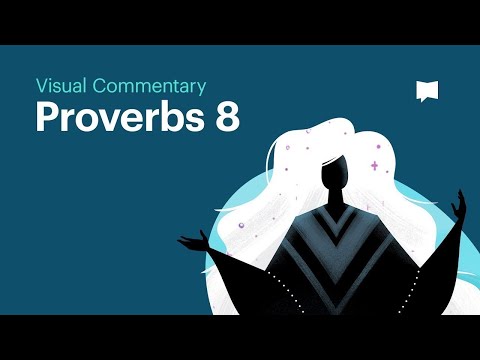
SOURCE: Bible Project
HISTORY
Proverbs 8:22-31 presents Wisdom’s role in creation and human life, reflecting the historical and political context of ancient Israel. The book of Proverbs, traditionally attributed to King Solomon (1 Kings 4:32), was likely compiled and edited over several centuries. This passage encapsulates the timeless nature of wisdom that transcends the political landscape, yet reflects the Israelite understanding of their place in God’s world.
During the monarchy period, Israel experienced political instability as it transitioned between divided and united kingdoms. This instability often resulted from turning away from God, emphasizing the need for wisdom in governing. Wisdom is personified as a skilled worker and joyful companion of God (Proverbs 8:30-31), highlighting the ideal for political leaders to embody such traits in their rule.
Wisdom’s role in creation also reflects the cosmology of ancient Israelites. The narrative emphasizes the divine order established by God through wisdom, as seen in the creation of heavens, earth, seas, and skies (Proverbs 8:27-29). This cosmic order served as a model for the political order sought by Israelite society.
Thus, Proverbs 8:22-31 speaks to the cultural and political milieu of ancient Israel. Its wisdom teachings provide guidance for leaders and offer a glimpse into the Israelites’ worldview, highlighting their efforts to establish political stability amidst turmoil and to comprehend the divine plan for creation.
Most Holy Trinity (Year C)
SOCIETY
Proverbs 8:22-31, highlighting Wisdom’s role in creation and human life, reflects the sociological and cultural context of ancient Israel. The passage reveals the importance of wisdom in Israelite society, as it shapes their understanding of the world and guides their everyday lives.
In ancient Israel, wisdom was highly valued and seen as essential for navigating life’s complexities. Wisdom’s portrayal as a skilled worker and joyful companion of God (Proverbs 8:30-31) underscores the Israelite belief that wisdom is divinely rooted and foundational to the created order. This perspective shapes the passage’s message, encouraging the original audience to seek wisdom in their lives.
The sociological context of family and kinship also plays a vital role in interpreting this passage. Israelite society emphasized the importance of familial relationships, with the father as the head of the household. In Proverbs, wisdom is often depicted as a parental figure offering guidance and counsel to children (Proverbs 1:8-9). This familial imagery resonates with the original audience, reinforcing the passage’s relevance and emphasizing the pursuit of wisdom as an essential aspect of their cultural values.
Furthermore, the personification of wisdom as a woman (Proverbs 8:1-2) reflects ancient Israel’s understanding of gender roles, portraying wisdom as nurturing and life-giving. This cultural context enriches the passage’s meaning and deepens its significance for the original audience, urging them to embrace wisdom as a guiding force in their lives.
Most Holy Trinity (Year C)
THEOLOGY
Proverbs 8:22-31 holds significant meaning within the Roman Catholic theological context, as it reveals Wisdom’s role in creation and human life. The Church views Wisdom as a prefigurement of Christ, who is the embodiment of divine wisdom (1 Corinthians 1:24). This passage underscores the integral role of Christ in the created order and the importance of seeking wisdom through Him.
For contemporary Catholics, this passage encourages the pursuit of wisdom through a relationship with Christ and the teachings of the Church. By drawing on the divine wisdom offered by Christ, modern-day Catholics can navigate life’s complexities with discernment and grace, fostering personal growth and strengthening their faith.
The call to seek wisdom also resonates with the Catholic practice of examining one’s conscience, as individuals are encouraged to reflect on their actions in light of divine wisdom. This passage emphasizes the importance of nurturing a spirit of discernment and introspection, enabling Catholics to align their lives with God’s will.
Moreover, the emphasis on wisdom’s role in creation (Proverbs 8:22-26) aligns with the Catholic understanding of environmental stewardship. Catholics are called to respect and care for God’s creation, as it is imbued with divine wisdom. This ecological awareness challenges contemporary Catholics to practice responsible stewardship and safeguard the Earth for future generations.
In conclusion, Proverbs 8:22-31 reinforces essential aspects of the Roman Catholic faith, urging believers to seek wisdom through Christ and apply it to their daily lives. By doing so, Catholics can navigate life’s challenges, foster personal growth, and promote the well-being of God’s creation.
Connecting Faith and Life
A reading from the Book of Proverbs
(Chapter 8:22-31)

“Thus says the wisdom of God: ‘The Lord possessed me, the beginning of his ways, the forerunner of his prodigies of long ago; from of old I was poured forth, at the first, before the earth.’” Who or what is this wisdom that seems to speak as a person? Is it God himself, or herself, because in the Hebrew Scriptures wisdom was often called Lady Wisdom? Later, in the Gospels, Jesus is called the Wisdom of God. Are you confused? Join the crowd that has been trying to determine this for two thousand years. We who are Christians or Jews refer to ourselves as monotheists, people who believe that there is only one God, and yet we Christians believe that Jesus is God and that the Holy Spirit that Jesus sent is also God. How does this all fit together? Welcome to the greatest mystery of our faith—the Holy Trinity, one God who is three Persons. This is not a mystery to be solved. It is the mystery that you and I live in every day, the mystery of God’s unconditional love.
Remember when you were taught as a child that you were created in the image and likeness of God? That God is not an isolated single being somewhere out there but rather a community of persons—the Father, Son, and Holy Spirit. And that God’s very Spirit lives within each of us even when we are off track, when we have seriously sinned or have disbelieved. God never abandons us.
It also means that we are not meant to be alone. We are communal beings created by our God who is a community of persons. That is why we long for the love and friendship of others, why we are willing to make great sacrifices for our families and friends and our larger communities. It is a major part of our spiritual DNA. Let us rejoice in who we truly are, not only created in the image and likeness of God but living our lives in that divine and human community.

SOURCE: Branching Out Blog (2022) with Bill Ayres from RENEW International—Founded in 1978, RENEW is a not-for-profit organization based in Plainfield, NJ. Our mission is simple yet powerful: to connect faith and life. We use the RENEW process combined with a theme that meets the needs of your community to help parishes and dioceses build small groups to transform the Church so the Church can transform the world! / 2022 Archive
Photograph by Sharon Santema on Unsplash.

Most Holy Trinity (Year C)
Life in
the Trinity
Outline of Word-Sunday Essay
by Larry Broding
EXCERPT: Paul’s comment in 5:5 might seem strange on the surface. Why would Christian hope shame us? Critics of the early Christians questioned the logic of faith in a crucified man. Why would this faith bring hope? Was this hope rational? Paul answered as a hard headed Jew. “Look at the results,” he seemed to say. “We have hope because we experience the love of God and the power of his Spirit!”

So, what is the source of Christian hope? The grace of the Triune God and a life lived in relationship with the Trinity. Could anything be better than that?
How does life in the Spirit lead you to Christ? How does your relationship with Christ give glory to the Father?
Clipart by Fr. Richard Lonsdale
- Kieren O’Mahony OSA
- Fr. Conley Bertrand
- Fr. George Corrigan OFM
- Fr. Thibodeau
- St. Charles Borromeo
- Edriann Ezell
- Vince Contreras
- Bp. John P. Dolan
- Fr. Eamon Tobin
- Carmelite Lectio Divina
Most Holy Trinity (Year C)
John Bergsma

EXCERPT from Reflections on the Sunday Mass Readings for Year C
HISTORY
Romans 5:1-5 explores themes of faith, hope, and perseverance within the context of early Christian communities in Rome. The author, the Apostle Paul, wrote this letter circa 55-57 AD to address tensions between Jewish and Gentile believers while articulating key doctrines of the Christian faith.
The historical context of this passage is marked by political turmoil in the Roman Empire, as well as the growing persecution of Christians under Emperor Nero. Paul, a Roman citizen and Pharisee-turned-Christian, sought to foster unity among believers and strengthen their faith in the face of adversity.
Addressing both Jewish and Gentile Christians, Paul highlights the universality of faith and hope in Christ, irrespective of one’s background. He emphasizes that all believers have access to God’s grace through faith, a message particularly relevant for Gentile converts who may have felt marginalized within the early Church.
The passage’s focus on perseverance through suffering also speaks to the political climate of persecution and uncertainty experienced by the original audience. Paul’s message encourages believers to find strength and hope in their faith, despite the challenges they face, and to trust in God’s divine plan.
Thus, Romans 5:1-5 reflects the historical and political context of the early Church, with its call for unity, faith, and perseverance offering both solace and guidance to believers in Rome during a tumultuous period.
Most Holy Trinity (Year C)
SOCIETY
Romans 5:1-5 resonates within the sociological and cultural context of the early Christian community in Rome. The passage highlights key values and beliefs that shaped the lives of believers, providing guidance and encouragement in the face of various societal challenges.
In the Roman society of the time, religion and politics were deeply intertwined, with the Emperor being deified and worshiped. Early Christians, however, professed allegiance to Christ alone, resulting in their persecution. Within this context, Paul’s emphasis on faith and hope in Christ (Romans 5:1-2) affirmed the distinctiveness of Christian identity and offered encouragement to the original audience.
Sociologically, the Roman Empire was marked by stark class divisions and a highly stratified society. Paul’s message of equality through faith (Romans 5:1) challenged these societal norms, unifying believers across various social strata. This emphasis on spiritual unity served as a countercultural force within Roman society, shaping the passage’s message and its relevance to the original audience.
Furthermore, the value of perseverance in the face of suffering (Romans 5:3-5) reflects the challenges experienced by early Christians in Rome, who often faced social ostracism and persecution. Paul’s words encouraged believers to remain steadfast, drawing strength from their shared faith and the hope offered by Christ.
In conclusion, Romans 5:1-5 resonates within the sociological and cultural context of the early Christian community in Rome, emphasizing faith, hope, and perseverance as essential components of Christian identity and offering guidance to believers navigating the challenges of Roman society.
Most Holy Trinity (Year C)
THEOLOGY
Romans 5:1-5 holds profound significance within the Roman Catholic theological context, offering insights into core doctrines and providing guidance for contemporary Catholics.
Catholic theology affirms the centrality of faith and hope in Christ, as emphasized in Romans 5:1-2. The passage underlines the belief that salvation comes through faith and that this gift of faith grants access to God’s grace. In the modern context, Catholics are called to embrace this message, recognizing that their relationship with Christ is the foundation of their faith and a source of hope amidst life’s challenges.
Perseverance through suffering, as discussed in Romans 5:3-5, also holds relevance for contemporary Catholics. The Catholic Church teaches that suffering can be redemptive when united with the sufferings of Christ, leading to spiritual growth and transformation. This teaching encourages Catholics to find meaning in their struggles and grow in faith, hope, and love even amidst adversity.
Moreover, the passage’s emphasis on unity in faith resonates with the Catholic commitment to ecumenism and interfaith dialogue. Catholics today are called to foster unity among believers, respecting diversity while upholding the centrality of faith in Christ.
In conclusion, Romans 5:1-5 serves as a rich source of theological reflection for contemporary Catholics, underscoring the importance of faith, hope, and unity in the face of adversity and the transformative power of perseverance inspired by the love of Christ.
Connecting Faith and Life
A reading from St. Paul’s Letter to the Romans
(Chapter 5:1-5)
Paul is writing at a time of great persecution and suffering, so he wants his people to have hope. “Brothers and sisters . . . since we have been justified by faith, we have peace with God through our Lord Jesus Christ, through whom we have gained access by faith to this grace in which we stand, and we boast in hope of the glory of God. Not only that but we boast of our afflictions, knowing that affliction produces endurance, and endurance, proven character, and proven character , hope, and hope does not disappoint, because the love of God has been poured out into our hearts through the Holy Spirit that has been given to us.”
Do you pray in the Spirit of hope, realizing that the answer to our prayers is often not what we may expect or when we expect it? Some prayers seem to be answered soon, others in time, and still others in ways we had not imagined. Yet, we pray in hope in the embrace of our God—all three Persons—in our Community of Divine Love.
SOURCE: Branching Out Blog (2022) with Bill Ayres from RENEW International—Founded in 1978, RENEW is a not-for-profit organization based in Plainfield, NJ. Our mission is simple yet powerful: to connect faith and life. We use the RENEW process combined with a theme that meets the needs of your community to help parishes and dioceses build small groups to transform the Church so the Church can transform the world! / 2022 Archive
Photograph by Sharon Santema on Unsplash.

Most Holy Trinity (Year C)
Power and Presence
Outline of Word-Sunday Essay
by Larry Broding
EXCERPT: As the instrument of God’s presence, Jesus is the Logos. We still experience Christ in Word and Sacrament, in private prayer and in community. Through Christ, we experience the intimacy that the Father offers. In Christ, God is present to us.
As the power of God, the Spirit is the Pneuma. In the Spirit, we are changed. We become more like the one who sent the Power. Our experience of the Spirit might be radical and overwhelming, or it might be barely perceptible and easily overlooked. But that experience shifts us away from the self toward the Source and toward others.

That, in nutshell, is the Christian experience. That, in a nutshell, is the source of our knowledge about the Trinity.
Obviously you cannot plan to have an experience of God. Such experiences are gifts. But you can be open to his power and presence. Take a few moments each day this week. And open yourself to God.
Clipart by Fr. Richard Lonsdale
- Kieren O’Mahony OSA
- Fr. Conley Bertrand
- Fr. George Corrigan OFM
- Fr. Thibodeau
- St. Charles Borromeo
- Edriann Ezell
- Vince Contreras
- Bp. John P. Dolan
- Fr. Eamon Tobin
- Carmelite Lectio Divina
Most Holy Trinity (Year C)
John Bergsma
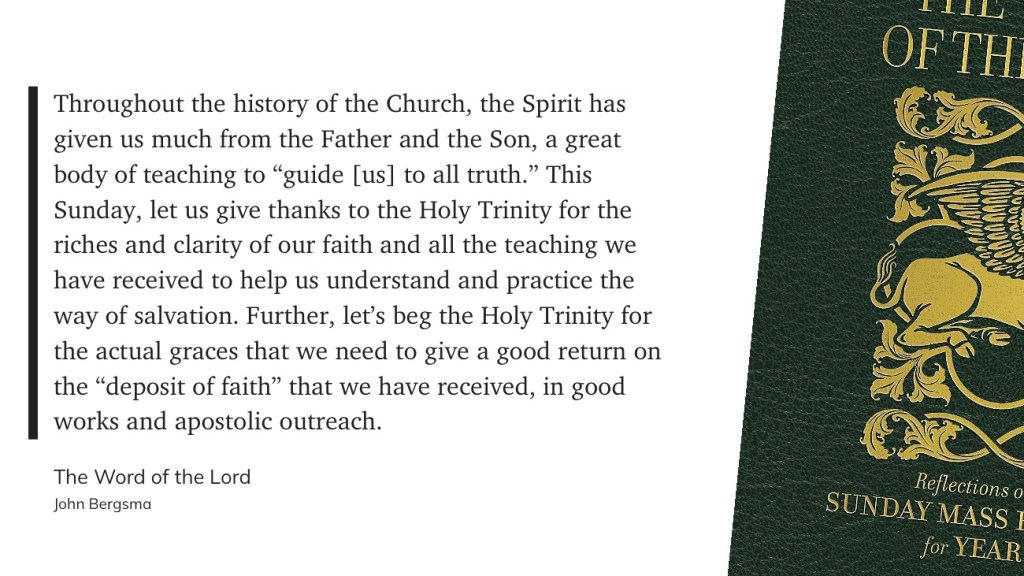
EXCERPT from Reflections on the Sunday Mass Readings for Year C
HISTORY
John 16:12-15 is part of Jesus’ farewell discourse to his disciples, offering reassurance and guidance in anticipation of his imminent departure. This passage holds significant historical and political implications within the context of the early Christian community and its relationship with the Jewish religious authorities and the Roman Empire.
The author, traditionally identified as the Apostle John, was writing for a Jewish-Christian audience facing persecution from Jewish authorities who opposed their belief in Jesus as the Messiah. The political climate was marked by Roman occupation and the growing tension between Jewish leaders and Jesus’ followers, who were seen as a threat to the established religious order.
Jesus’ promise of the Spirit of Truth (John 16:12-13) is set against this backdrop of persecution and uncertainty. This assurance would have been deeply meaningful to the early Christian community, offering guidance and support amidst the challenges they faced.
The passage also alludes to the Jewish understanding of the divine revelation, with the Spirit disclosing the truth from God to believers. This highlights the continuity between the Old Testament prophetic tradition and the new revelation brought forth by Christ, emphasizing the credibility of Jesus’ teachings and their relevance for the original audience.
In conclusion, John 16:12-15 reflects the historical and political context of the early Christian community, offering reassurance and guidance to believers navigating the challenges posed by religious persecution and political unrest. By emphasizing the role of the Spirit of Truth, the passage underscores the divine guidance and support available to believers in times of difficulty.
Most Holy Trinity (Year C)
SOCIETY
John 16:12-15 unfolds within a rich sociological and cultural context, reflecting the beliefs and practices that shaped the lives of the early Christian community. This passage speaks to the community’s understanding of divine revelation and their relationship with the world around them.
In the Jewish tradition, the concept of divine revelation was deeply rooted in the sociocultural fabric. The Spirit of Truth’s role in guiding believers into “all truth” (John 16:13) resonates with the Jewish belief in God’s continuous revelation and the value placed on scriptural interpretation. This emphasis on the Spirit’s guidance would have been particularly significant for the original audience, as they navigated the tension between their Jewish heritage and their newfound faith in Christ.
Furthermore, the sociocultural context of discipleship and communal identity plays a critical role in this passage. Jesus’ assurance that the Spirit will disclose his teachings to the disciples (John 16:15) underlines the importance of shared understanding and unity within the early Christian community. This message would have been particularly relevant to the original audience, who relied on mutual support and solidarity in the face of opposition from the surrounding society.
In conclusion, John 16:12-15 reflects the sociocultural context of the early Christian community, emphasizing the role of divine revelation and communal identity in shaping their understanding of faith. By highlighting the Spirit’s guidance and the importance of unity among believers, the passage speaks powerfully to the experiences and needs of the original audience, offering reassurance and hope in the face of adversity.
Most Holy Trinity (Year C)
THEOLOGY
John 16:12-15 holds profound theological significance within the Roman Catholic tradition, offering insights into the role of the Holy Spirit and the Church’s ongoing mission.
Catholic theology affirms the Holy Spirit as the divine guide and source of truth, echoing Jesus’ promise of the Spirit of Truth (John 16:12-13). This passage underscores the Catholic belief in the continuous revelation of God’s truth through the guidance of the Holy Spirit, highlighting the Church’s role in interpreting and transmitting divine wisdom to believers.
The message of the Spirit’s guidance in John 16:12-15 also resonates with the Catholic understanding of spiritual discernment and personal growth. Contemporary Catholics are called to listen attentively to the Spirit’s promptings in their daily lives, seeking wisdom and guidance as they navigate life’s challenges and opportunities.
Moreover, the passage speaks to the importance of ecclesial unity and the role of the Magisterium in safeguarding the deposit of faith. The Spirit’s role in disclosing the teachings of Christ (John 16:15) serves as a reminder of the Church’s responsibility to transmit the Gospel message faithfully, fostering unity among believers and ensuring the continuity of apostolic tradition.
In conclusion, John 16:12-15 offers rich theological insights for contemporary Catholics, emphasizing the role of the Holy Spirit in guiding the Church and nurturing personal growth. By attending to the Spirit’s promptings and upholding the unity of the Church, Catholics today can navigate life’s complexities with wisdom, discernment, and fidelity to the Gospel message.
Connecting Faith and Life
A reading from the holy Gospel according to John
(Chapter 16:12-15)
Remember that John lived for many years after the death of Jesus and had much time to pray and be inspired to share deep truths not recorded in the other Gospels. Here, he gives us more clues about our relationship with the Father, Son, and Holy Spirit. “But when he comes, the Spirit of truth, he will guide you to all truth. He will not speak on his own, but will speak what he hears, and will declare for you the things that are coming. . . . Everything that the Father has is mine. . . .”
All of this is a deep, enduring truth. God is a community of persons—Father, Son, and Holy Spirit. So, when we pray the Lord’s Prayer it is not just to the Father but also an entry prayer into the depths of the Holy Trinity. It is the Holy Spirit within us that carries forth the prayer, and it is Jesus our brother who is always with us in our prayer. Our prayer is not simply a series of words but a communication with the Holy Community of which we are a part, whether we pray silently by ourselves or as part of the Eucharistic Assembly.
SOURCE: Branching Out Blog (2022) with Bill Ayres from RENEW International—Founded in 1978, RENEW is a not-for-profit organization based in Plainfield, NJ. Our mission is simple yet powerful: to connect faith and life. We use the RENEW process combined with a theme that meets the needs of your community to help parishes and dioceses build small groups to transform the Church so the Church can transform the world! / 2022 Archive
Photograph by Sharon Santema on Unsplash.
FIRST READING | SECOND READING | GOSPEL