June 8, 2025
June 8, 2025


Mass Readings
Mass Readings


Larry Broding
Gift of the Spirit

At the first Christian Pentecost, God breathed his Spirit and changed the followers of Jesus. They were new creatures, for God’s very Spirit dwelt within them. With their words proclaiming God’s mighty acts, Jesus’ followers breathed out God’s Spirit on others. And God’s People were gathered together.
Descent of Holy Spirit

I. The Gathering of Believers (vv. 1-4)
- The Apostles are united in prayer with Mary and other disciples
- The sound of a strong wind fills the house, signaling the Holy Spirit’s arrival
- Tongues of fire rest on each person
- They are filled with the Holy Spirit and begin to speak in different languages
II. The Crowd’s Reaction (vv. 5-11)
- Jews from various nations gather, each hearing their language spoken
- Amazed and perplexed, they ask, “What does this mean?”
- Some mock the Apostles, accusing them of being drunk
- Peter addresses the crowd, explaining the significance of the event
- He quotes the prophet Joel, linking the outpouring of the Holy Spirit to God’s promise
SOURCE: AI Generated Outline; Clipart by Fr. Richard Lonsdale

- Kieren O’Mahony OSA
- Fr. Conley Bertrand
- Fr. George Corrigan OFM
- Fr. Thibodeau
- St. Charles Borromeo
- Edriann Ezell
- Vince Contreras
- Bp. John P. Dolan
- Fr. Eamon Tobin
- Carmelite Lectio Divina
HISTORY
The Pentecost event in Acts 2:1-11 occurred during a time of political and religious tension in the early Christian community. Set in Jerusalem, the narrative takes place following Jesus’ resurrection and ascension, when the Holy Spirit descends upon the disciples, empowering them to spread the Gospel.
The author, Luke, was a Gentile physician and companion of Paul. Writing for a primarily Gentile audience, he sought to emphasize the universal aspect of Christianity. During this era, Judaism was heavily influenced by the Temple and the Sanhedrin, the supreme Jewish council. The events of Pentecost occurred amidst religious leaders’ hostility towards the growing Christian movement.
At Pentecost, Jews from various nations gathered in Jerusalem for the festival. This diverse crowd experienced the Holy Spirit’s manifestation and heard the disciples speaking in their native tongues, as described in Acts 2:5-11. This event served as a powerful sign of the Gospel’s inclusive nature, transcending cultural and linguistic barriers.
Furthermore, the Holy Spirit’s descent united the disciples, strengthening their bond amidst external pressures. The outpouring of the Spirit also granted the disciples courage to testify about Jesus’ resurrection publicly. Peter quoted the prophet Joel in Acts 2:17-21, linking the Pentecost event to God’s promise to pour out His Spirit on all people.
Pentecost Sunday (Year C)
SOCIETY
The sociocultural context of Acts 2:1-11 is deeply rooted in Jewish traditions and customs. During the Pentecost festival, Jews from various nations gathered in Jerusalem, creating a diverse crowd that witnessed the Holy Spirit’s descent upon the disciples. This cultural practice of pilgrimage during religious feasts provided a unique opportunity for the Gospel to reach a wide audience, as described in Acts 2:5-11.
The Jews present at Pentecost were devout followers of Judaism and likely held strong beliefs in the coming of the Messiah. The Pentecost event signified the fulfillment of this messianic expectation, as Peter proclaimed in Acts 2:17-21. The disciples’ ability to speak in various languages demonstrated the inclusivity of the Christian message, challenging traditional Jewish beliefs that limited God’s chosen people to a single ethnicity.
The disciples’ experience with the Holy Spirit also reshaped their social dynamics. Filled with the Spirit, they no longer feared the religious authorities who opposed their movement. This newfound unity and courage marked a turning point for the early Christian community, as described in Acts 2:1-4.
Pentecost Sunday (Year C)
THEOLOGY
In Catholic theology, Acts 2:1-11 holds profound significance as it highlights the birth of the Church through the descent of the Holy Spirit at Pentecost. This event marks the fulfillment of Christ’s promise to send an Advocate (John 14:26) and signifies the beginning of the Church’s mission to proclaim the Gospel.
The Pentecost narrative emphasizes the unity and diversity of the early Christian community. As the Holy Spirit descended upon the disciples, they were empowered to communicate the Gospel to people of various languages and cultures (Acts 2:5-11). This diversity serves as a reminder of the Church’s call to embrace and celebrate the unique gifts of all its members (1 Corinthians 12:12-13).
The outpouring of the Holy Spirit also transformed the disciples, instilling in them courage and boldness to proclaim the Gospel. This transformation inspires modern-day Catholics to seek the guidance of the Holy Spirit in their daily lives and to courageously live out their faith.
The Catholic Church today celebrates the feast of Pentecost, commemorating the events of Acts 2:1-11. During Mass, the Sequence of Pentecost, “Veni, Sancte Spiritus,” is sung, invoking the Holy Spirit’s presence and guidance. This liturgical expression of faith connects contemporary Catholics to the early Church and its ongoing mission.
Connecting Faith and Life
A reading from the Acts of the Apostles
(Chapter 2:1-11)
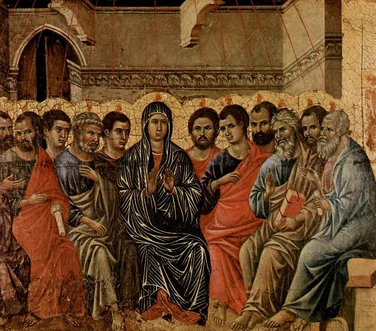
If you wonder why there were so many people from so many countries in Jerusalem at the time described in this reading, it is because Pentecost was first a Jewish feast and a time when pilgrims from all over the near world would come to Jerusalem to worship. Saint Luke tells us of strange happenings: “a noise like a strong wind” and “tongues of fire” similar to events at the time God established the original covenant with the Jewish people. Luke wanted his audience to believe that this was God confirming a new covenant with a new diverse people—thus, the diversity of languages, yet all understanding one another. Of course, Luke is writing all of this a few decades after the actual events, and he wants people to know that this was the beginning of something new that had its roots in a previous tradition and fulfilled that tradition. Today, we say that Pentecost is the birthday of the Church.

SOURCE: Branching Out Blog (2022) with Bill Ayres from RENEW International Founded in 1978, RENEW is a not-for-profit organization based in Plainfield, NJ. Our mission is simple yet powerful: to connect faith and life. We use the RENEW process combined with a theme that meets the needs of your community to help parishes and dioceses build small groups to transform the Church so the Church can transform the world! / 2022 Archive
Painting: Pentecost, Duccio di Buoninsegna (1255-1319), Museo dell’Opera del Duomo, Siena. Public domain.


Larry Broding
Spiritual Gifts
At the first Christian Pentecost, God breathed his Spirit and changed the followers of Jesus. They were new creatures, for God’s very Spirit dwelt within them. With their words proclaiming God’s mighty acts, Jesus’ followers breathed out God’s Spirit on others. And God’s People were gathered together.
Spiritual Gifts

I. The Source of Spiritual Gifts (vv. 3b-7)
- The Holy Spirit empowers believers with various gifts
- The same Spirit distributes these gifts for the common good
- Gifts include wisdom, knowledge, faith, healing, miracles, prophecy, discernment, and tongues
- The purpose is to serve and build up the Church, the Body of Christ
II. The Body of Christ: Interdependent Members (vv. 12-13)
- Just as a human body has many parts, so does the Church
- Baptized into one body, all members are united in Christ
- Each person’s unique gifts contribute to the well-being of the whole body
- Recognition of interdependence within the Body of Christ
SOURCE: AI Generated Outline; Clipart by Fr. Richard Lonsdale
- Kieren O’Mahony OSA
- Fr. Conley Bertrand
- Fr. George Corrigan OFM
- Fr. Thibodeau
- St. Charles Borromeo
- Edriann Ezell
- Vince Contreras
- Bp. John P. Dolan
- Fr. Eamon Tobin
- Carmelite Lectio Divina
HISTORY
1 Corinthians 12:3b-7, 12-13, written by the Apostle Paul, addresses the Christian community in Corinth, a city known for its cultural diversity and pagan influences. The passage focuses on the importance of unity amidst the diversity of spiritual gifts within the early Church.
Historically, this letter was written during a time of political stability under Roman rule. However, the Corinthian church faced internal divisions due to differing interpretations of Christian teachings and practices. Paul, a highly educated and well-traveled Apostle, sought to address these issues and provide guidance to the community.
Paul’s teachings in 1 Corinthians 12:3b-7, 12-13 emphasized that the Holy Spirit distributes various gifts for the common good of the Church. This message challenged the prevailing cultural belief that certain gifts or abilities were superior to others. By highlighting the interdependence of the Church’s members, Paul aimed to promote unity and cooperation among the Corinthians.
Paul’s teachings in 1 Corinthians continue to hold significance for contemporary Christians. In today’s world, where individualism and competition often take precedence, this passage serves as a reminder that each person’s unique gifts and talents contribute to the greater good when used in harmony with others.
Pentecost Sunday (Year C)
SOCIETY
In the sociocultural context of 1 Corinthians 12:3b-7, 12-13, the city of Corinth was a bustling hub of commerce and diverse cultural influences. With numerous temples dedicated to pagan gods and goddesses, Corinth had a deeply rooted polytheistic tradition that posed challenges to the Christian community.
Within this context, the Apostle Paul sought to address the divisions within the Corinthian church. The community struggled with power dynamics and spiritual elitism, where certain spiritual gifts were perceived as superior. This social hierarchy contradicted the core Christian belief in the equality of believers and the shared mission of the Church.
Paul’s message in 1 Corinthians 12:3b-7, 12-13 emphasized that the Holy Spirit distributes different gifts to each member of the Church, underscoring the importance of unity amidst diversity. He compared the Church to a human body, where each part has a unique function yet works in harmony with others (1 Corinthians 12:12-13).
By promoting the idea of unity in diversity, Paul encouraged the Corinthians to set aside their differences and embrace the unique gifts of each member. This approach not only addressed the social challenges within the community but also provided a strong foundation for the growth and development of the early Church.
Pentecost Sunday (Year C)
THEOLOGY
In Roman Catholic theology, 1 Corinthians 12:3b-7, 12-13 emphasizes the role of the Holy Spirit in distributing various gifts for the common good of the Church. This passage highlights the unity and diversity of the Church, comparing it to a body with many parts working together in harmony (1 Corinthians 12:12-13).
The concept of spiritual gifts is central to Catholic theology, where the Holy Spirit bestows unique talents and abilities upon each individual. This notion emphasizes the importance of discernment, as Catholics are called to recognize their gifts and use them to serve others and build the Church.
In modern-day application, contemporary Catholics can draw inspiration from Paul’s teachings to appreciate the diversity of talents and abilities within their communities. For example, lay Catholics may serve as lectors, musicians, or catechists, utilizing their unique gifts to enrich the liturgical experience and deepen the faith of others.
The Catholic Church also highlights the importance of spiritual gifts in various ministries, such as the Rite of Christian Initiation of Adults (RCIA) and youth ministry. These programs encourage participants to explore and develop their gifts in service of the Church and its mission.
Connecting Faith and Life
A reading from St. Paul’s first Letter to the Corinthians
(Chapter 12:3B-7, 12-13)
Saint Paul tells us that we may each have different gifts and forms of service, but what unites us all together is the one Spirit. And, “To each individual the manifestation of the Spirit is given for some benefit.”
You and I each have different gifts from the Spirit. Do you believe that? What are your spiritual gifts? How do you use them, share them? Can you appreciate the gifts of someone else even though you might disagree with that person on one or more issues? That is particularly important today when our country and even our Church are often divided in many ways.
As we read the Acts of the Apostles and the letters of Saint Paul, it becomes clear that there were a series of major differences within the early Church with so many groups coming in and out of focus, each believing that its version of the truth about Jesus was the right one. This has continued for some two thousand years and been the cause of wars and numerous unjust actions. It is only when we listen to the Spirit and act in the loving power of the Spirit that we have peace and true communion.
SOURCE: Branching Out Blog (2022) with Bill Ayres from RENEW International Founded in 1978, RENEW is a not-for-profit organization based in Plainfield, NJ. Our mission is simple yet powerful: to connect faith and life. We use the RENEW process combined with a theme that meets the needs of your community to help parishes and dioceses build small groups to transform the Church so the Church can transform the world! / 2022 Archive
Painting: Pentecost, Duccio di Buoninsegna (1255-1319), Museo dell’Opera del Duomo, Siena. Public domain.

Pentecost Sunday (Year C)
The Holy Spirit,
The Force of Forgiveness
Larry Broding
The Holy Spirit,
The Force of Forgiveness
Pentecost revealed the power of God’s forgiveness, his Spirit. Unlike the Force of Star Wars, the Spirit of God is personal. The Spirit establishes a link between the believer and the person of the Father through the person of the Son. And the Spirit makes that link personal. It is a link of love, hope, and joy based upon personal forgiveness.
The Holy Spirit,
The Force of Forgiveness
I. The Gathering of Believers (vv. 1-4)
- The Apostles are united in prayer with Mary and other disciples
- The sound of a strong wind fills the house, signaling the Holy Spirit’s arrival
- Tongues of fire rest on each person
- They are filled with the Holy Spirit and begin to speak in different languages
II. The Crowd’s Reaction (vv. 5-11)
- Jews from various nations gather, each hearing their language spoken
- Amazed and perplexed, they ask, “What does this mean?”
- Some mock the Apostles, accusing them of being drunk
- Peter addresses the crowd, explaining the significance of the event
- He quotes the prophet Joel, linking the outpouring of the Holy Spirit to God’s promise
SOURCE: AI Generated Outline; Clipart by Fr. Richard Lonsdale
- Kieren O’Mahony OSA
- Fr. Conley Bertrand
- Fr. George Corrigan OFM
- Fr. Thibodeau
- St. Charles Borromeo
- Edriann Ezell
- Vince Contreras
- Bp. John P. Dolan
- Fr. Eamon Tobin
- Carmelite Lectio Divina
HISTORY
John 20:19-23 narrates Jesus’ appearance to the disciples after His resurrection, emphasizing the themes of joy, peace, and mission. Set in first-century Palestine, the passage highlights the transformative impact of the resurrection on the disciples and the early Christian community.
The Gospel of John was written by the Apostle John, one of Jesus’ closest disciples. The intended audience likely included both Jewish and Gentile believers, with the purpose of affirming Jesus’ divinity and the significance of faith in Him.
During this period, the Jewish community faced political and religious challenges under Roman occupation. Jesus’ crucifixion, perceived as a political threat to both Jewish and Roman authorities, led to His disciples’ fear and uncertainty. However, the resurrection event in John 20:19-23 transformed their despair into joy and courage, spurring them to spread the Gospel.
This passage also highlights the disciples’ reception of the Holy Spirit, empowering them to forgive sins and continue Jesus’ mission (John 20:22-23). This event signifies the foundation of the Church’s sacramental life, particularly the Sacrament of Reconciliation.
Pentecost Sunday (Year C)
SOCIETY
John 20:19-23 unveils the sociocultural context of the early Christian community, focusing on the disciples’ gathering in a locked room after Jesus’ crucifixion. This passage highlights the fear and uncertainty that pervaded the disciples’ lives, reflecting the social and political tensions of the time.
The Jewish community in first-century Palestine faced various challenges, including the oppressive Roman rule and the religious authorities’ resistance to Jesus’ teachings. This environment instilled fear in Jesus’ followers, as they risked persecution for their beliefs. John 20:19 illustrates this atmosphere, as the disciples gathered behind closed doors, unsure of their future.
Amidst this turmoil, Jesus’ appearance and message of peace (John 20:19-21) brought hope and reassurance to His disciples, transforming their fear into joy. This passage emphasizes the importance of unity and faith amidst adversity, encouraging the early Christian community to remain steadfast in their beliefs.
The disciples’ reception of the Holy Spirit (John 20:22-23) also highlights the sociocultural context of the passage. This event represents the foundation of the Church’s mission, as the Apostles were empowered to continue Jesus’ work by preaching the Gospel and offering forgiveness of sins.
Pentecost Sunday (Year C)
THEOLOGY
John 20:19-23 holds significant theological implications within the Roman Catholic context, focusing on Jesus’ appearance to the disciples after His resurrection and the granting of the Holy Spirit. These events contribute to core Catholic beliefs and practices, highlighting the importance of Christ’s victory over death and the Church’s mission.
Jesus’ resurrection in John 20:19-23 signifies His triumph over sin and death, affirming His divinity and the promise of eternal life. This event forms the foundation of the Catholic belief in the resurrection of the body and the promise of salvation through faith in Jesus Christ.
The passage also highlights the role of the Holy Spirit in empowering the disciples to continue Jesus’ mission (John 20:22-23). This event forms the basis for the Sacrament of Confirmation in the Catholic Church, where believers receive the Holy Spirit to strengthen their faith and become witnesses of Christ in the world.
John 20:23 emphasizes the power of forgiveness, as Jesus grants the disciples the authority to forgive sins. This event underscores the Catholic belief in the Sacrament of Reconciliation, where individuals confess their sins and receive absolution through the Church’s ministerial priesthood.
Connecting Faith and Life
A reading from the holy Gospel according to John
(Chapter 17:20-26)
John wrote his Gospel long after the death of and resurrection of Jesus, and it includes not only the basic story that the other Gospels tell but also John’s accounts that are somewhat different from what the other evangelists recorded. This passage has a powerful theme: “so that they may all be one, as you Father, are in me and I in you, that they may also be in us.” The dual message here is that Jesus and the Father are one and that we are one with them. That is the basis of our faith. We do not believe in an isolated being up in the sky, as it were, but in a Trinity, a community of persons—the Father, Son, and Holy Spirit—and the best part is that we, in a way, are part of that community. God is our Father, too. Jesus is our brother, and the Holy Spirit lives within us. That is quite a community in which to share!
SOURCE: Branching Out Blog (2022) with Bill Ayres from RENEW International Founded in 1978, RENEW is a not-for-profit organization based in Plainfield, NJ. Our mission is simple yet powerful: to connect faith and life. We use the RENEW process combined with a theme that meets the needs of your community to help parishes and dioceses build small groups to transform the Church so the Church can transform the world! / 2022 Archive
Painting: Pentecost, Duccio di Buoninsegna (1255-1319), Museo dell’Opera del Duomo, Siena. Public domain.
FIRST READING | SECOND READING | GOSPEL