June 22, 2025
June 22, 2025


Liturgy Planning
Liturgy Planning
- SUNDAY’S MASS
- CATHOLIC PLANNER
- FR. LAWRENCE MICK
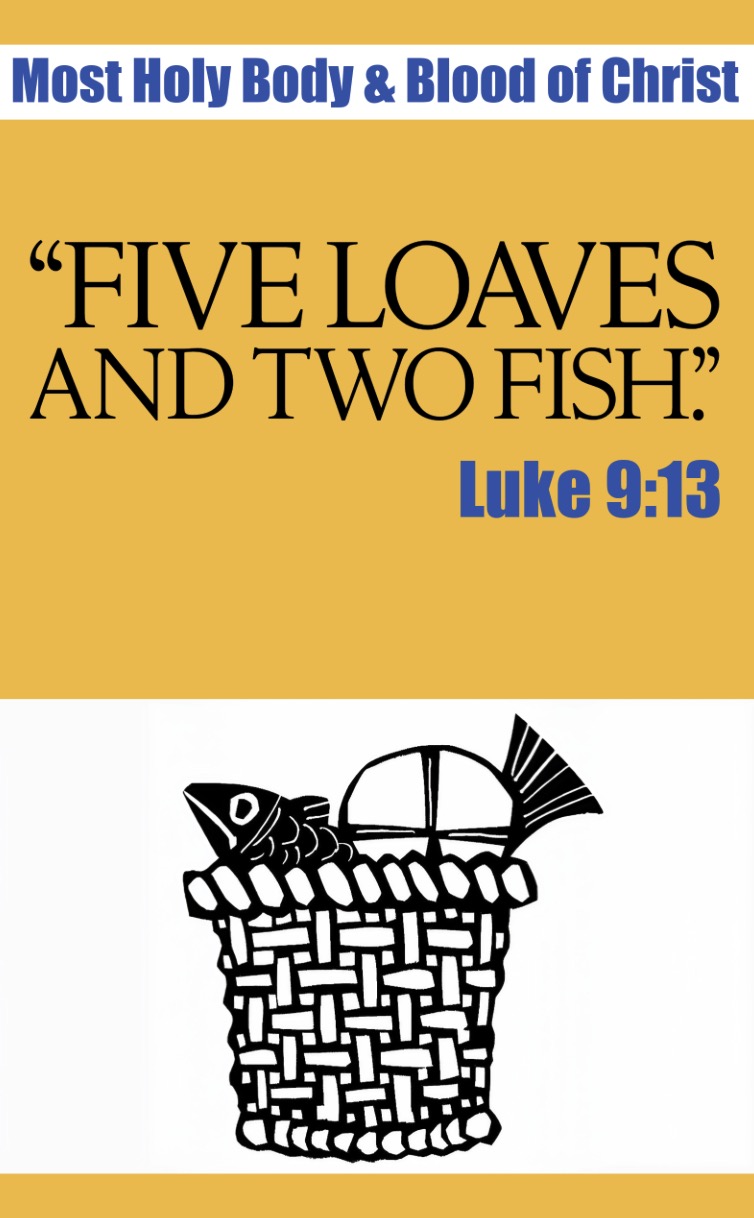


The Church proposes a liturgical Novena, of biblical derivation, before Pentecost. The Roman Calendar speaks of the days between Ascension and Pentecost as “a preparation for the coming of the Holy Spirit,” a time to prayerfully consider the role and power of the Holy Spirit in the Church. Click to view and download a copy of the 2025 Novena to the Holy Spirit.

SOURCE: Crypt Church (2019 | 2022)
The Basilica of the National Shrine – Crypt Church
Celebrant & Homilist: Rev. Patrick Smith
Guest Choir: Cantor and organist of the Basilica of the National Shrine of the Immaculate Conception, Washington, D.C.
Date: June 19, 2022
Body & Blood of Christ (Year C)
Featured Song

Body & Blood of Christ (Year C)
Greeting
Bread and wine were an ancient component in Israel’s ritual history. Jesus infused their sharing with new meaning that has sustained the church to this day. When we regularly participate in the Eucharist, we can become immune to its unifying power for the whole world. This annual feast reminds us that it is our central liturgical act as Christians. Unity is deeply needed more than ever, and the source of that unity is literally in our hands.
SOURCE: CELEBRATION (May 29, 2016)
Body & Blood of Christ (Year C)
Penitential Rite
- Lord Jesus, you blessed, broke and shared bread with the hungry crowd: Lord, have mercy.
- Christ Jesus, your simple offering was abundant and sustained them: Christ, have mercy.
- Lord Jesus, you continue to sustain us in bread that is blessed, broken and shared: Lord, have mercy.
SOURCE: CELEBRATION (May 29, 2016)
Body & Blood of Christ (Year C)
Collect

SOURCE: Julie Storr
Body & Blood of Christ (Year C)
Lector Prep

RELATED: Videos by Lisa M. Bellecci
Greg’s tips for the Sunday readings
focusing on the lector’s understanding and proclamation
LECTOR NOTES
Historical and Literary Background
Body & Blood of Christ (Year C)
Responsorial Psalm
Psalm 110

SOURCE: 2025 – Owen Alstott (OCP)

SOURCE: 2025 Spirit & Psalm(OCP)
Body & Blood of Christ (Year C)
Homily

Body & Blood of Christ (Year C)
Prayers of the Faithful
Discover a vast collection of over 100 petitions that are thoughtfully updated each week, ensuring a strong connection to the Sunday Readings.
OPENING: Let us pray now for those suffering from deep spiritual and physical hunger.
CHURCH – Pope, Bishops, Priests | Unity | Protection
WORLD – Peace | Environment | Nations
SPECIAL NEEDS – Pro-Life | Year of Hope
COMMUNITY – Families | Sacraments | Religious Education
CLOSING: Nourishing God, we thank you for feeding us with the body and blood of your beloved Son. Help us remember that receiving this sacred food calls us to actively reach out in generous love to all who are hungry in any way. We pray, in Jesus’ name, that the Eucharist may make us one. Amen.
SOURCE: CELEBRATION (May 29, 2016)

Miscellaneous

OPTIONAL PRAYER
Pope Leo XIII wrote the Saint Michael prayer in 1884, after seeing a frightening vision: evil spirits, trying to fulfill Satan’s boast to destroy our Lord’s Church within a century, were engaging in fierce attacks against it. Although the Pontiff also saw St. Michael casting Satan and his demons back into Hell in his vision, he was so horrified by what he had seen he felt compelled to help defend our faith in this struggle.
Pope Leo XIII saw to it that the Saint Michael prayer was recited after every low Mass throughout the world.
SOURCE: Saint Benedict Center
RESOURCES
General Instruction of the Roman Missal
A Simple Guide to Liturgical Enviornment (DIocese of New Ulm PDF)
Common Questions on Liturgical Norms – by Father Edward McNamara, professor of liturgy at the Regina Apostolorum Pontifical Athenaeum
DIRECTORY OF
POPULAR PIETY
AND THE LITURGY
Directory (Vatican)
GUIDELINES AND RESOURCES
JUBILEE 2025
The Jubilee Year begins on Christmas Eve in Rome. Here are 16 pages with Resources to help you understand and celebrate the Jubilee and Holy Year of 2025!

Laudate Deum Music (8:36)
RELATED: Corpus Christi Sequence: Laud O Zion English Rehearsal Video
Catholic Planner

ST. PETERSBURG DIOCESE (1:46) –
Do you know the story of Carlo Acutis, who created a website to document Eucharistic miracles throughout the world? Learn more on this latest episode! Find Blessed Carlo Acutis’ website here: http://www.miracolieucaristici.org.

Carlo Acutis’ Canonization
Set to have taken place in April 2025, it was postponed after the death of Pope Francis. The Vatican has announced that Carlo Acutis will be canonized with Pier Giorgio Grassati on September 7, 2025. The two young Italian laymen will be the first saints canonized by the new pope.
Liturgy Notes
The Solemnity of the Body and Blood of Christ
DIRECTORY OF POPULAR PIETY AND THE LITURGY
160. The Solemnity of the Body and Blood of Christ is observe on the Thursday following on the solemnity of the Most Blessed Trinity. This feast is both a doctrinal and cultic response to heretical teaching on the mystery of the real presence of Christ in the Eucharist, and the apogee of an ardent devotional movement concentrated on the Sacrament of the Altar. It was extended to the entire Latin Church by Urban IV in 1264.
Popular piety encouraged the process that led to the institution of the feast of Corpus Christi, which reciprocally inspired the development of new forms of Eucharistic piety among the people of God.
For centuries, the celebration of Corpus Christi remained the principal point of popular piety’s concentration on the Eucharist. In the sixteenth and seventeenth centuries, faith, in reaction to various forms of protestantism, and culture (art, folklore and literature) coalesced in developing lively and significant expressions Eucharistic devotion in popular piety.
Principles of Eucharistic Devotion
161. Eucharistic devotion, which is so deeply rooted in the Christian faithful, must integrate two basic principles:
- The supreme reference point for Eucharistic devotion is the Lord’s Passover; the Pasch as understood by the Fathers, is the feast of Easter, while the Eucharist is before all else the celebration of Paschal Mystery or of the Passion, Death and Resurrection of Christ;
- All forms of Eucharisit devotion must have an intrinsic reference to the Eucharistic Sacrifice, or dispose the faithful for its celebration, or prolong the worship which is essential to that Sacrifice.
Hence, the Rituale Romanum states “The faithful, when worshipping Christ present in the Sacrament of the Altar, should recall that this presence comes from the Sacrifice of the Eucharist, and tends towards sacramental and spiritual communion”(169).
Corpus Christi Procession
162. The Corpus Christi procession represents the typical form of an Eucharistic procession. It is a prolongation of the celebration of the Eucharist: immediately after Mass, the Sacred Host, consecrated during the Mass, is borne out of the Church for the Christian faithful “to make public profession of faith and worship of the Most Blessed Sacrament”(170).
The faithful understand and appreciate the values inherent in the procession: they are aware of being “the People of God”, journeying with the Lord, and proclaiming faith in him who has become truly “God-amongst-us”.
It is necessary however to ensure that the norms governing processions be observed(171), especially those ensuring respect for the dignity and reverence of the Blessed Sacrament(172). It is also necessary to ensure that the typical elements of popular piety accompanying the precession, such as the decoration of the streets and windows with flowers and the hymns and prayers used during the procession, truly “lead all to manifest their faith in Christ, and to give praise to the Lord”(173), and exclude any forms of competition.
163. The Eucharistic procession is normally concluded by a blessing with the Blessed Sacrament. In the specific case of the Corpus Christi procession, the solemn blessing with the Blessed Sacrament concludes the entire celebration: the usual blessing by the priest is replaced by the blessing with the Blessed Sacrament.
It is important that the faithful understand that this blessing is not an independent form of Eucharistic piety, but the end of a prolonged act of worship. Hence, liturgical norms prohibit “exposition of the Blessed Sacrament for the purpose of giving the blessing”(174).

How to Add the Catholic
Liturgical Calendar to Google Calendar

This video will show you how to add a simple Catholic Liturgical Calendar to your Google Calendar. You can even change the color of the display calendar to match the liturgical colors of the Church
RESOURCES
General Instruction of the Roman Missal
A Simple Guide to Liturgical Enviornment (DIocese of New Ulm PDF)
Common Questions on Liturgical Norms – by Father Edward McNamara, professor of liturgy at the Regina Apostolorum Pontifical Athenaeum
DIRECTORY OF
POPULAR PIETY
AND THE LITURGY
Directory (Vatican)
Eastertide (PDF)
GUIDELINES AND RESOURCES
JUBILEE 2025
The Jubilee Year begins on Christmas Eve in Rome. Here are 16 pages with Resources to help you understand and celebrate the Jubilee and Holy Year of 2025!
Body & Blood of Christ (Year C)
Unity in the Eucharist
NCR Online Celebration Archive

1923-2017
Today, we celebrate the gift and the feast of the Body and Blood of Christ.
The Sequence
There is a Sequence for today’s liturgy, but it is an optional one. Only the Easter and Pentecost Sequences are obligatory. If you choose to use the Sequence, note that there are both long and short forms. The Sequence is meant to be sung, but it may be a challenge to find musical settings in this instance. Since it is optional, you could perhaps substitute another eucharistic hymn in its place, but logically, it should address similar themes as the Sequence itself.
Unifying Nature of the Eucharist
Why do we have such a feast in our calendar? Without considering the history of the feast and the possible doctrinal purposes behind it, we might still ask what purpose it serves today…
Every meal tends to unite those who share it. We generally share meals with family or friends, but even sharing with strangers or enemies can break down walls and move us closer to unity. This is even more true in a ritual meal in a religious context. Jesus knew what he was doing when he chose a meal as the means of continuing to be with us bodily. He knew it would be the best way to keep us united to him and to one another.
When you choose hymns and write petitions today, keep a focus on unity. Pray for unity in the parish, in the larger church, and among all peoples around the world. Pray for the courage to sacrifice our personal desires for the good of the whole body of Christ. Presiders might choose the second preface for this feast of the Eucharist (which is the one printed with the other texts of the feast) because it highlights the unity focus.
Discussion Guide
Introduction and Preparation:
– Review the placement of the feast’s texts in the Missal and Lectionary. Ensure lectors and presiders are informed and that books are marked correctly to facilitate a smooth service.
– Consider whether or not to include the Sequence. Discuss the differences between the long and short forms of the Sequence. If choosing not to use it, consider selecting an alternative eucharistic hymn with similar themes.
Purpose and Significance of the Feast:
– Discuss why this feast is part of the liturgical calendar. Reflect on its purpose today, beyond historical and doctrinal reasons.
– Explore how the feast helps to prevent the sacrament from becoming routine and renews our appreciation of the Eucharist.
– Compare and contrast this feast with the reminder given on Holy Thursday.
Reflection on Unity and Initiation:
– Consider the timing of the feast following Easter and its emphasis on initiation.
– Discuss how the Eucharist is a culminating moment for new church members, symbolizing their full membership.
– Reflect on the unifying nature of the Eucharist, considering how shared meals, in general, create bonds.
– Examine how Jesus’ choice of a meal for his bodily presence helps maintain unity among believers.
Focus on Hymns and Prayers:
– Discuss the selection of hymns and prayers with a focus on unity within the parish, the broader church, and globally.
– Consider how music and petitions can underscore the theme of unity and encourage a spirit of sacrifice for the collective good.
Reflection and Prayer Activity:
– Engage in a group discussion about times when sharing meals has fostered unexpected connections or unity in your personal lives.
– Encourage participants to share personal experiences of transformation through participation in the Eucharist.
– Conclude with prayers for unity, drawing from insights gained in the discussion. Pray for the courage to prioritize the needs of the community over personal preferences.
Jubilee Holy Year 2025
The Jubilee Year begins on Christmas Eve in Rome. Be sure to download Fr. Hoerning’s 16 page e-book with Resources to help you understand and celebrate the Jubilee and Holy Year of 2025!

