June 15, 2025
June 15, 2025


Liturgy Planning
Liturgy Planning
- SUNDAY’S MASS
- CATHOLIC PLANNER
- FR. LAWRENCE MICK



The Church proposes a liturgical Novena, of biblical derivation, before Pentecost. The Roman Calendar speaks of the days between Ascension and Pentecost as “a preparation for the coming of the Holy Spirit,” a time to prayerfully consider the role and power of the Holy Spirit in the Church. Click to view and download a copy of the 2025 Novena to the Holy Spirit.
Most Holy Trinity (Year C)
Most Holy Trinity
MUSIC | GREETING | PENITENTIAL RITE | COLLECT
LECTOR PREP | RESPONSORIAL| HOMILY | PETITIONS

SOURCE: Crypt Church (2019 | 2022)
The Basilica of the National Shrine – Crypt Church
Celebrant & Homilist: Rev. William Byrne
Guest Choir: Saint Paul VI High School Choir, Fairfax, Virginia
Date: June 16, 2019
Most Holy Trinity (Year C)
Featured Song

Most Holy Trinity (Year C)
Greeting
Relationships — even genetic ones — are a mystifying reality, and the best efforts to explain them are often poetic. They are often described in terms of their results, as in today’s readings on this celebration of God as a community. God’s love, peace, truth and hope deepen our relationship to one another, the Earth, and all creatures. We don’t need to understand this, only to believe and live it.
SOURCE: CELEBRATION (May 22, 2016)
Most Holy Trinity (Year C)
Penitential Rite
- Lord Jesus, you spoke of the intimacy between you, the Spirit and the Father: Lord, have mercy.
- Christ Jesus, you shared this deep relationship with your disciples and with us: Lord, have mercy.
- Lord Jesus, you give us faith and love, hope and truth to share with others: Lord, have mercy.
SOURCE: CELEBRATION (May 22, 2016)
Most Holy Trinity (Year C)
Collect

SOURCE: Julie Storr
Most Holy Trinity (Year C)
Lector Prep

RELATED: Videos by Lisa M. Bellecci
Greg’s tips for the Sunday readings
focusing on the lector’s understanding and proclamation
LECTOR NOTES
Historical and Literary Background
Most Holy Trinity (Year C)
Responsorial Psalm
Psalm 8

SOURCE: 2025 – Owen Alstott (OCP)

SOURCE: 2025 Spirit & Psalm(OCP)
Most Holy Trinity (Year C)
Homily

Most Holy Trinity (Year C)
Prayers of the Faithful
Discover a vast collection of over 100 petitions that are thoughtfully updated each week, ensuring a strong connection to the Sunday Readings.
OPENING: Let us pray now for a world that is in need of loving relationships.
CHURCH – Pope, Bishops, Priests | Unity | Protection
WORLD – Peace | Environment | Nations
SPECIAL NEEDS – Pro-Life | Year of Hope
COMMUNITY – Families | Sacraments | Religious Education
CLOSING: Triune God, you show us what it means to be unique, yet united. Show us how we can contribute to a world in need of love, peace and hope through our individual actions and our efforts as a loving community. Make us signs of your mutual love shown through Jesus, in whose name we pray. Amen.
SOURCE: CELEBRATION (May 22, 2016)
Most Holy Trinity (Year C)
Father Day Blessing

CHRIST THE REDEEMER CATHOLIC CHURCH
Father’s Day is this Sunday June 15, 2025.
At End of Mass

OPTIONAL PRAYER
Pope Leo XIII wrote the Saint Michael prayer in 1884, after seeing a frightening vision: evil spirits, trying to fulfill Satan’s boast to destroy our Lord’s Church within a century, were engaging in fierce attacks against it. Although the Pontiff also saw St. Michael casting Satan and his demons back into Hell in his vision, he was so horrified by what he had seen he felt compelled to help defend our faith in this struggle.
Pope Leo XIII saw to it that the Saint Michael prayer was recited after every low Mass throughout the world.
SOURCE: Saint Benedict Center
RESOURCES
General Instruction of the Roman Missal
A Simple Guide to Liturgical Enviornment (DIocese of New Ulm PDF)
Common Questions on Liturgical Norms – by Father Edward McNamara, professor of liturgy at the Regina Apostolorum Pontifical Athenaeum
DIRECTORY OF
POPULAR PIETY
AND THE LITURGY
Directory (Vatican)
GUIDELINES AND RESOURCES
JUBILEE 2025
The Jubilee Year begins on Christmas Eve in Rome. Here are 16 pages with Resources to help you understand and celebrate the Jubilee and Holy Year of 2025!
Most Holy Trinity (Year C)
God is Love

ST. PETERSBURG DIOCESE (1:46) –
Pens down, heads up, Father Connor Penn is breaking out the whiteboard once again in this episode of Catholic Planner!
LITURGY NOTES
DIRECTORY OF POPULAR PIETY AND THE LITURGY
Solemnity of the Most Holy Trinity
157. The solemnity of the Most Holy Trinity is celebrated on the Sunday after Pentecost. With the growth of devotion to the mystery of God in His Unity and Trinity, John XXII extended the feast of the Holy Trinity to the entire Latin Church in 1334. During the middle ages, especially during the carolingian period, devotion to the Blessed Trinity was a highly important feature of private devotion and inspired several liturgical expressions. These events were influential in the development of certain pious exercises.
In the present context, it would not appear appropriate to mention specific pious exercises connected with popular devotion to the Blessed Trinity, “the central mystery of the faith and of the Christian life”(165). It sufficies to recall that every genuine form of popular piety must necessarily refer to God, “the all-powerful Father, His only begotten Son and the Holy Spirit”(166). Such is the mystery of God, as revealed in Christ and through him. Such have been his manifestations in salvation history. The history of salvation “is the history of the revelation of the one true God: Father, Son and Holy Spirit, who reconciles and unites to Himself those who have been freed from sin”(167).
Numerous pious exercises have a Trinitarian character or dimension. Most of them begin with the sign of the cross “in the name of the Father, and of the Son, and of the Holy Spirit”, the same formula with which the disciples of Jesus are baptized (cf. Mt 28, 19), thereby beginning a life of intimacy with the God, as sons of the Father, brothers of Jesus, and temples of the Holy Spirit. Other pious exercises use formulas similar to those found in the Liturgy of the Hours and begin by giving “Glory to the Father, Son, and Holy Spirit”. Some pious exercises end with a blessing given in the name of the three divine Persons. Many of the prayers used in these pious exercises follow the typical liturgical form and are addressed to the “Father, through Christ, in the Holy Spirit”, and conserve doxological formulas taken from the Liturgy.
158. Worship, as has been said in the first part of this Directory, is the dialogue of God with man through Christ in the Holy Spirit(168). A Trinitarian orientation is therefore an essential element in popular piety. It should be clear to the faithful that all pious exercises in honour of the Blessed Virgin May, and of the Angels and Saints have the Father as their final end, from Whom all thing come and to Whom all things return; the incarnate, dead and resurrected Son is the only mediator (1Tim 2,5) apart from whom access to the Father is impossible (cf. John 14,6); the Holy Spirit is the only source of grace and sanctification. It is important to avoid any concept of “divinity” which is abstract from the three Divine Persons.
159. Together with the little doxology (Glory be to the Father, and to the Son, and to the Holy Spirit….) and the great doxology (Glory be to God in the highest), pious exercises addressed directly to the Most Blessed Trinity often include formulas such as the biblical Trisagion (Holy, Holy, Holy) and also its liturgical form (Holy God, Holy Strong One, Holy Immortal One, have mercy on us), especially in the Eastern Churches, in some Western countries as well as among numerous religious orders and congregations.
The liturgical Trisagion is inspired by liturgical hymns and its biblical counterpart. Here mention could be made of the Sanctus used in the celebration of the Mass, the Te Deum, the improperia of Good Friday’s veneration of the Cross, all of which are derived from Isaiah 6, 3 and Apocalypses 4, 8. The Trisagion is a pious exercise in which the faithful, united with the Angels, continually glorify God, the Holy, Powerful and Immortal One, while using expressions of praise drawn from Scripture and the Liturgy.

BISHOP ROBERT BARRON (14:10) – Friends, Trinity Sunday has been called “the preacher’s nightmare.” But while the Trinity remains a supreme mystery, Thomas Aquinas used a basic principle that helps us to get at it: beings, at all levels, tend to make images of themselves. The higher you go in the hierarchy of being, the more interior and the more perfect this principle becomes.
How to Add the Catholic
Liturgical Calendar to Google Calendar

This video will show you how to add a simple Catholic Liturgical Calendar to your Google Calendar. You can even change the color of the display calendar to match the liturgical colors of the Church
RESOURCES
General Instruction of the Roman Missal
A Simple Guide to Liturgical Enviornment (DIocese of New Ulm PDF)
Common Questions on Liturgical Norms – by Father Edward McNamara, professor of liturgy at the Regina Apostolorum Pontifical Athenaeum
DIRECTORY OF
POPULAR PIETY
AND THE LITURGY
Directory (Vatican)
Eastertide (PDF)
GUIDELINES AND RESOURCES
JUBILEE 2025
The Jubilee Year begins on Christmas Eve in Rome. Here are 16 pages with Resources to help you understand and celebrate the Jubilee and Holy Year of 2025!
Most Holy Trinity (Year C)
Sharing God’s Life & Love
NCR Online Celebration Archive

1923-2017
Today brings us to a Sunday in Ordinary Time, but we don’t use green vestments this Sunday or next Sunday. The Easter season is followed by two doctrinal feasts: the Solemnity of the Most Holy Trinity and the Solemnity of the Body and Blood of Christ.
There has been some criticism of such feasts as “idea feasts,” but we can also see them as continued reflections of the Easter celebration. Those who were baptized at Easter were baptized into the life of the Trinity and initiated into the eucharistic meal that sustains us in living out our baptismal commitment.
The celebration of the Trinity has long seemed like a primary idea feast, focusing our attention on the mystery of three persons in one God. It is an idea that boggles the mind and has led to numerous frustrations among theologians and preachers trying to “explain” it. We really can’t explain such a mystery, but that is not the point of this belief anyway. What is important is that we realize that we are called to enter into the very life of the Trinity, to share in the eternal love that flows within this primary community of persons we call Father, Son and Holy Spirit.
In recent years, numerous theologians in the Western church have helped us to understand a perspective that has been maintained in the Eastern church throughout history — God became human so that humans could become divine. That does not mean that we actually become God, but it does mean that we share God’s life and love.
Planners and preachers need to study and reflect on this revived theology if they are to help the assembly to enter fully into this celebration and to enter more fully into divine life. Don’t let the logical conundrum of three-in-one keep you from mining the richness of this mystery. What is needed is less of an intellectual response and more of a response of love.
The first reading today also suggests another helpful insight. Wisdom speaks of being present at creation. Tradition has seen Christ as the wisdom of God. The Christ was present at creation and Paul says Christ will be “all in all” (1Corinthians 15: 28) at the end of time. The Christ is the pattern God had in mind. As Christ is both human and divine, so we humans are called to share divine life. Jesus is the incarnation of the Christ, the model for all of us to follow in order to share fully the divine life of love.
Because this solemnity falls in Ordinary Time, you will find the prayers in the Missal after the 34th week of Ordinary Time. The readings can be found in the Lectionary in a similar place, but they are preceded by Alleluia verses for Ordinary Time.
This is also Father’s Day in the U.S., so remember to offer a blessing for fathers during Masses this weekend.
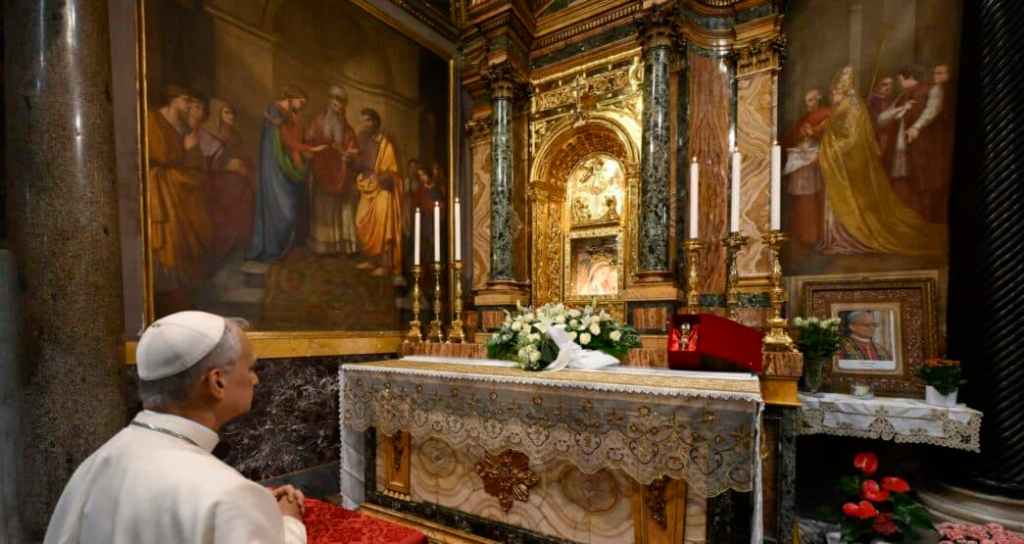
Jubilee Holy Year 2025
The Jubilee Year begins on Christmas Eve in Rome. Be sure to download Fr. Hoerning’s 16 page e-book with Resources to help you understand and celebrate the Jubilee and Holy Year of 2025!

