June 15, 2025
June 15, 2025


Homilies
Homilies
- Bp. Barron
- FR. RUTTIG
- 1-MIN HOMILY
- 2-Min Homily
- MSGR. Peter Hahn
- Fr. Jude Langeh
- FR. MCCARTHY, OSA
BISHOP
BARRON
Most Holy Trinity (Year C)


FR. KEVIN
RUTTIG
Most Holy Trinity (Year C)


ONE MINUTE
HOMILY

Most Holy Trinity (Year C)


TWO MINUTE
HOMILY
Most Holy Trinity (Year C)


MSGR. PETER
HAHN
Most Holy Trinity (Year C)


FR. JUDE
LANGEH, CMF


FR. TOM
McCARTHY, OSA

Most Holy Trinity (Year C)


CHECK OUT
The Word This Week’s
REDESIGNED MOBILE WEBSITE
Optimized for easy access
Deacon Greg’s blog has garnered some 20 million readers from around the world since its inception in 2007.
Most Holy Trinity (Year C)

Three Candles, One Light
This discussion guide has been generated by the WORD THIS WEEK'S Catholic AI Assistant based on Deacon Greg's homily.
Introduction to Trinity Sunday
- What is the significance of "Trinity Sunday"?
- Why is the Trinity often viewed as a complex theological concept?
Reframing the Trinity as Love
- How can we view the Trinity not just as a theological idea but as a celebration of love?
- How is God's love expressed in three persons according to the sermon?
The Role of Light in Understanding the Trinity
- Discuss the symbolism of light in the context of God the Father, God the Son, and God the Holy Spirit.
- How does the use of light explain the mission and unity of the Trinity?
Personal Reflection on Being Light
- How can we embody the light of the Trinity in our daily lives?
- Reflect on John Wesley's description: “In this room… there are three candles — and only one light.” How does this metaphor deepen your understanding of the Trinity?
Challenges to Being Light
- What are some of the challenges that prevent us from being the light? Consider societal issues like violence, bigotry, and hate.
- How can we combat these challenges and ensure the light does not go out?
Living Out the Trinity’s Mission
- According to St. John Paul and Thomas Merton, how do we see the image of God in every human being?
- Discuss practical ways to express God’s love: offering respect, welcoming the shunned, comforting those who mourn, etc.
Inspirational Takeaway
- How can the phrase "Let there be light" inspire us as individuals and as a community?
- What specific action can you take to be a source of light for others in your life?
Homily Excerpt
2019 HOMILY—This weekend, we mark “Trinity Sunday,” the celebration of one God in three persons.
Theologians have spent centuries writing about this, trying to explain the unexplainable, trying to solve this unsolvable mystery. I’m not going to try that here today. Smarter people than I have tried and failed. And if you try too hard, you can end up making the Trinity far more complex and convoluted. It becomes little more than an abstraction.
I’d like to propose another way of considering God the Father, God the Son and God the Holy Spirit on this solemnity. More than the celebration of a complicated theological idea, this feast is really a celebration of something profoundly simple: love.

THE WORD THIS WEEK invites you to check out the Catholic AI assistant (located at the bottom right-hand corner), a homily preparation resource you can use to clarify or develop the insights and themes of Deacon Greg’s homily.
Most Holy Trinity (Year C)

A Constant Flow of Love
This discussion guide has been generated by the WORD THIS WEEK'S Catholic AI Assistant based on Deacon Peter's homily.
Introduction
1. Begin by reflecting on your understanding of the Trinity: Father, Son, and Holy Spirit. How have you traditionally perceived this doctrine?
2. Why might the concept of the Trinity be puzzling to some people?
Exploring the Nature of God
1. Consider the quote by St. Thomas Aquinas: "Behaviour is determined by the nature of things." Discuss how this idea helps us understand the nature of God through His actions.
2. Reflect on God's roles as described:
- As the Creator and loving Father
- As Jesus, the self-giving Son
- As the Holy Spirit, the love that flows and empowers us
3. How do each of these roles help shape our image and understanding of God?
The Concept of Relationship
1. Discuss how the concept of God as a being might have been influenced by earlier philosophers like Aristotle and theologians like St. Augustine.
2. How does Thomas Aquinas' view of God as fundamentally relationship challenge our traditional perceptions of God?
3. Reflect on Richard Rohr's statement about salvation as "our readiness and capacity to stay in that relationship." What does this mean to you?
The Trinitarian Way
1. Explain what is meant by the "Trinitarian way of living" according to Richard Rohr. How does living in this way relate to Jesus’ life and teachings?
2. Discuss the significance of vulnerability in maintaining a relationship with God. How is this modeled by Jesus’ incarnation?
Love as the Foundation
1. Reflect on the idea that the “Flow” is love, and that standing outside this Flow is considered sin. How might this perspective shape our understanding of sin and holiness?
2. Discuss the presence of infinite love in creation. How do you see this attraction of life to life and love to love in the world today?
The Image of the Trinity
1. Evaluate the metaphor of the ‘fidget spinner’ used to represent the Trinity. How does this image convey the essence of the Trinitarian relationship?
2. Discuss the statement: "God is a verb more than a noun; a flow more than a substance, an experience more than a deity sitting on a throne." How does this influence your understanding of God?
Conclusion and Personal Reflection
1. Reflect on the challenge to "always go with the Flow." How can you allow God’s love to flow through you in your daily life?
2. Identify any personal barriers that might prevent you from experiencing this flow of love. Discuss strategies to overcome these barriers.
Homily Excerpt

Today puzzles many people. Why? It’s because this is Trinity Sunday. They can’t understand how three persons – Father, Son and Holy Spirit – can possibly be one God…
But what image should we use to represent the Trinity? Richard Rohr suggests the ‘fidget spinner’ toy. When it’s still, a fidget spinner has three different lobes. However, when it spins (which is its essential function), we can’t see the distinct wings; only an unbroken movement or flow, which is how God works.
This movement and flow between the three members of the Trinity is more significant than the qualities of each individual. That’s because God is a verb more than a noun; a flow more than a substance, an experience more than a deity sitting on a throne. And we live naturally inside that constant flow of love – if we don’t resist it.
Our challenge, then, is to always go with the Flow. To always allow God’s love to flow in and through us.

Andrei Rublev’s Trinity
This discussion guide has been generated by the WORD THIS WEEK'S Catholic AI Assistant based on Deacon Peter's homily.
Introduction
- Begin with a brief overview of the sermon, emphasizing the focus on Andrei Rublev’s icon, "Trinity", and its depiction of the Holy Trinity amidst the scriptural context provided: Proverbs 8:22-31, Romans 5:1-5, and John 16:12-15.
- Discuss the cultural and historical context of Rublev’s painting and its significance for the Cathedral of the Holy Trinity, which honors St. Sergius of Radonezh.
Exploration of the Icon
1. Genesis Inspiration
- Discuss the biblical scene from Genesis 18:1-8, where the Trinity is depicted as three angels visiting Abraham. How does this narrative influence your understanding of the icon?
2. Symbolism and Imagery
- Analyze the arrangement and posture of the three figures. Discuss the symbolism of the triangle formation, shared authority, and the significance of their garments and colors: blue for heaven, gold for royalty, green for life (Holy Spirit), dark red for Jesus, and the translucent cloak of God the Father.
3. Interconnected Themes
- Examine the symbolism of the table as a representation of time, space, and the altar. Discuss how Jesus’ two-finger gesture points to his dual nature and the role of the Holy Spirit.
4. Background Elements
- Discuss the significance of the elements in the background: the Oak of Mamre, the Tree of Life, the cross, the doorless church, and the mountain. How do these elements contribute to the overall narrative of the Trinity?
Theological Reflections
1. Eucharistic Imagery
- Explore the imagery of the Eucharist in the icon. How do the shapes formed by the figures’ bodies contribute to our understanding of Holy Communion?
2. Triune Relationship
- Reflect on Richard Rohr’s explanation of God as supreme joy and happiness through community. How does this interpretation help you understand the relationship within the Trinity? How do you see the roles of the Father, Son, and Holy Spirit as lover, beloved, and the fruit of love?
3. Invitation to the Divine
- Discuss the mirror and the invitation to join the divine communion. What does this mean for our personal relationship with God, and how can we apply this understanding to our daily lives?
Practical Application
1. Reflective Practice
- Encourage a moment of personal reflection. How can you embody the patterns of love and unity depicted in the holy communion of the Trinity in your relationships and community?
2. Contemporary Relevance
- Discuss how this depiction of the Holy Trinity can be a guiding principle in navigating today’s fragmented world. How can this image of God as a community inspire change in our lives and communities?
Homily Excerpt

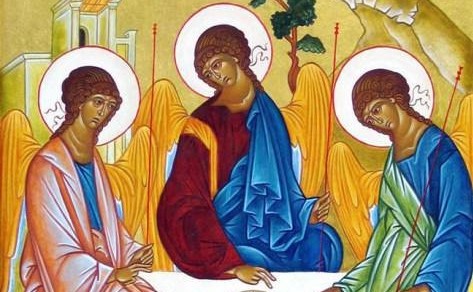
Today let’s explore God’s Holy Trinity through Andrei Rublev’s famous icon, Trinity, which he painted in 1410. It’s owned by Moscow’s Tretyakov Gallery.
Rublev painted it for the Cathedral of the Holy Trinity which holds the tomb of St. Sergius of Radonezh, who famously believed that ‘The contemplation of the Holy Trinity destroys all enmity.’
Rublev painted this icon to encourage this contemplation.
It depicts a scene from Genesis, in which three angels visit Abraham at the Oak of Mamre to tell him about the birth of Isaac (Gen.18:1-8). They’re sitting around Abraham’s table, enjoying his hospitality.
These visitors aren’t just angels, however. They’re the three persons of the Trinity. From left to right, they are God the Father, God the Son and God the Holy Spirit. They’re sitting in a balanced triangle, none more important than the other. Each holds a staff pointing towards both heaven and earth, indicating their shared authority, and their wings and haloes indicate their holiness.
THE WORD THIS WEEK invites you to check out the Catholic AI assistant (located at the bottom right-hand corner), a homily preparation resource you can use to clarify or develop the insights and themes of Deacon Peter’s homilies.
────── ⋆⋅☆⋅⋆ ──────
Fr. Austin Fleming
Most Holy Trinity (Year C)

LUTHERAN SATIRE (3:48) – Our Lutheran friends have produced a short, lighthearted and entertaining video that explains Trinity heresies.
2022 HOMILY—There’s a saying that “anyone who preaches on the Trinity for more than three minutes will likely lapse into heresy.” And this because the Trinity is a mystery we can name – but cannot fully comprehend. As soon as we begin speaking about the Trinity, human language, inadequate for revealing let alone explaining this mystery, opens us to making statements that are neither true nor reflective of more than 2,000 years of faith and Church teaching.
So I’ve decided not to risk writing an heretical prayer for Trinity Sunday! Instead, I offer you a prayer by theologian Karl Rahner. You’ll see that in his prayerful question he names neither the Trinity nor the Persons in it. You’ll recognize, nonetheless, the Father, Son and Spirit in his words.
This discussion guide has been generated by the WORD THIS WEEK’S Catholic AI Assistant based on Father Austin’s homily. NEED HELP? Copy and paste a question into the chat bot in the lower right corner of the screen and have our Catholic Assistant help you.
1. Introduction to the Trinity
– Fr. Austin’s homily mentions the risk of falling into heresy when discussing the Trinity.
– The Trinity includes three persons: the Father, the Son, and the Holy Spirit.
– Despite being distinct persons, there is only one God.
Why do you think the concept of the Trinity is so prone to misinterpretation?
– If possible, watch the Lutheran video together and discuss how it represents the Trinity. Which part of the explanation resonated most with the group?
2. Misleading Analogies and Their Heresies
– Analogy of Water: Explains the Trinity as liquid, ice, and vapor.
– Heresy: Moralism (Modalism)
– Describes God as not distinct in persons but merely different forms.
– Condemned in history, specifically at the First Council of Constantinople in 381 AD.
– Analogy of the Sun: Describes the Trinity like the star, its light, and heat.
– Heresy: Arianism
– Views Christ and the Holy Spirit as creations of the Father, not one in nature with Him.
– Analogy of the Three-Leaf Clover: Suggests three parts make up one God.
– Heresy: Partialism
– Suggests that the Father, Son, and Holy Spirit are parts of God rather than distinct persons.
3. Common Misunderstandings
– Analogy of a Man as Husband, Father, and Employer: Returns to moralism.
– Analogy of Three Layers: Revisiting partialism.
4. True Understanding of the Trinity
– The Trinity is described as a mystery beyond human comprehension.
– Best understood through faith and expressed in the Athanasian Creed.
– The creed states that we worship one God in the Triune nature, not confusing the persons nor dividing the substance.
– Each person is God and Lord, equal in glory and majesty.
5. Karl Rahner’s Prayer
In his homily, Fr. Fleming uses a prayer from Karl Rahner rather than risking their own prayer. Take a moment to read Karl Rahner’s prayer aloud as a group. Reflect on how it speaks to you personally.
– What stands out to you about his naming of God?
– Why might Rahner’s approach to addressing God be considered wise or effective?
– Discuss the significance of Rahner not naming the Trinity or its Persons explicitly, yet clearly referencing them in his prayer. How does this inform our understanding of Trinitarian theology?
– The prayer concludes by naming God as “Love,” aligning with 1 John 4. What implications does this have for our understanding of the relationship within the Trinity and with humanity?
– How can we, in our daily lives, reflect on and integrate the mystery of the Trinity into our spiritual practice?
6. Reflection and Application
– How do the misunderstandings about the Trinity affect your understanding of God?
– Discuss how the Trinity enriches your faith and relationship with God.
– Share personal insights on how the unity and distinctiveness of the Trinity inspire your spiritual journey.
– Creative Expression: As a group, write a collective prayer or poem that reflects your understanding of the Trinity without explicitly naming theological terms. Focus on attributes and relationships.
THE WORD THIS WEEK invites you to check out the Catholic AI assistant (located at the bottom right-hand corner), a homily preparation resource you can use to clarify or further develop the insights and themes of Fr. Fleming’s homily.
────── ⋆⋅☆⋅⋆ ──────

Dominican Friars
of England & Wales,
Scotland
- The Beauty of the Glory of the One God - 2001
- Relating to the Trinity - 2004
- It Takes More than Two- 2007
- Searching the Mystery of Love - 2010
- One God, Three Persons - 2013
- To Praise, to Bless and to Preach - 2016
- Be Lost in Wonder - 2019
- In the Heart of God - 2022
Most Holy Trinity (Year C)

Photograph by Fr Lawrence Lew OP of a stained glass window in Santo Domingo church, Mexico City.
This discussion guide has been generated by the WORD THIS WEEK'S Catholic AI Assistant based on the Dominican Blackfriars' homily for this week.
Introduction to the Topic:
- Begin by reflecting on the complexity and mystery of the Holy Trinity in Christian theology. Discuss why it is significant that the Trinity is challenging to fully understand.
- Consider the impact of increased scientific knowledge on our perception of other areas of knowledge, such as faith and love.
Understanding Knowledge and Wisdom:
- Contrast scientific knowledge with wisdom. How do reason and other paths of knowing help us understand our identity and purpose?
- Reflect on the reading from Proverbs 8:22-31, focusing on the portrayal of Wisdom as a companion of God and the joy and delight found in creation.
Celebrating Mystery:
- Discuss why it is important to celebrate the wonder and mystery of God, especially the relationship between the Father, Son, and Holy Spirit.
- Explore participants' initial reactions to the Holy Trinity. Compare scientific or mathematical analogies with approaches grounded in personal relationships and love.
Limits of Reason and Faith:
- Consider the strengths and limits of human reason, particularly in understanding divine mysteries.
- Discuss the idea of Christian faith as an "abundance of light" rather than a leap into darkness. How does faith allow us to glimpse the divine mystery?
The Trinity as a Relationship of Love:
- Reflect on the notion that the mystery of the Holy Trinity is fundamentally about a relationship of love between divine persons and with humanity.
- Encourage sharing personal experiences of love and relationships, linking these to the relationship within the Trinity.
Guidance from the Holy Spirit:
- Examine Jesus' words in John 16:12-15 about the Holy Spirit leading believers to complete truth. What does this promise mean for our lives today?
- Discuss the role of the Holy Spirit in deepening our understanding of God and ourselves.
Living the Mystery:
- Reflect on the idea that all human history, especially salvation history, involves God's revelation to us.
- How does recognizing this help us perceive our own role in God's plan and our relationship with the Trinity?
Embracing the Journey:
- Conclude by discussing the ongoing adventure of understanding God, emphasizing that this journey extends into eternal life.
- Invite participants to embrace the sense of wonder in their faith journeys, finding comfort in being part of a divine relationship of love and light.
Homily Excerpt

Solemnity of the Most Holy Trinity (C) | Fr Robert Ombres leads us to consider the wonder and mystery of God.
The Holy Trinity is difficult to understand, and that is how it should be. The phenomenal increase in scientific knowledge has perhaps made us over-confident about that sort of knowledge in other areas of our lives. Wisdom, not just knowledge, has always combined reason and calculation with other paths to knowing who we are and how we are to live and love. Today’s marvellous first reading from the book of Proverbs gives us a good starting point. The Wisdom of God cries aloud:
‘I was by his side, a master craftsman,
delighting him day after day,
ever at play in his presence,
at play everywhere in the world,
delighting to be with the sons of men’.
Today’s solemnity is chiefly a celebration of the wonder of God, and of our delight in having revealed to us some of the depths involved in the life of Father, Son, and Holy Spirit and our share in that divine life. Don’t neglect the notes of celebration, wonder and delight.

This discussion guide has been generated by the WORD THIS WEEK'S Catholic AI Assistant based on the Dominican Blackfriars' homily for this week. NEED HELP? Copy and paste a question into the chat bot in the lower right corner of the screen and have our Catholic Assistant help you.
1. Understanding Human Reason and Theology
- Reflect on Stephen Hawking's aspiration to find a "theory of everything" and how it parallels theological pursuits.
How can this reflect a desire to understand the universe or the mind of God?
Discuss how theology, specifically Catholic theology, views God as the fundamental principle of reality.
2. The Limits of Human Reason
- Delve into the sermon’s assertion that human reason cannot fully comprehend God, an uncreated principle.
What are the implications of reason's limitations in understanding God?
Why is it important that God is revealed as a Trinity, not as a product of reason alone?
3. The Revelation of the Trinity
- Explore the belief in the Trinity and its significance in Catholic faith.
Discuss how faith in the Trinity can help us perceive unity and plurality in creation.
How does this belief change our understanding of beauty and unity?
4. The Concept of Unity in Plurality
- Examine how the search for unity in plurality reflects humanity's quest for God.
What examples of unity in plurality can be found in physics or other fields?
Share personal experiences of unity and beauty in your life. How do they reflect or differ from the Trinitarian concept?
5. Avoiding the Temptation to Settle
- Discuss the dangers of settling for lesser principles, like materialism, instead of God.
How can settling for something less than God be problematic?
In what ways can materialism lead to a misunderstanding of human dignity?
6. Redemption and Participation in Divine Life
- Reflect on the idea that the universe exists for us to participate in the life of the Trinity.
Why is this participation described as a triumph of Jesus Christ rather than human reason?
How can we seek to let the inner life of the Trinity shape our own lives?
Homily Excerpt
Trinity Sunday. Fr Robert Verrill considers the limits of human reason.
In the conclusion of his book ‘A Brief History of Time’, Stephen Hawking wrote that if we were to discover a theory of everything that could explain why the universe exists, ‘it would be the ultimate triumph of human reason – for then we would know the mind of God.’
Now even though Stephen Hawking never publicly professed to believe in God and was on many occasions critical of those who did, there is nevertheless something deeply theological about his desire to discover one single simple theory which could account for all the rich diversity that we see in the world around us. This desire should resonate with anyone who is fascinated by Catholic theology. In Catholic theology, it is not one single theory which accounts for the whole of reality, but one fundamental and simple principle, and Catholic theologians refer to this fundamental principle as God.
THE WORD THIS WEEK invites you to check out the Catholic AI assistant (located at the bottom right-hand corner), a homily preparation resource you can use to clarify or further develop the insights and themes of the homilies above.
────── ⋆⋅☆⋅⋆ ──────
Fr. Jude Siciliano, O.P.

Most Holy Trinity (Year C)
The Trinity in Basic Terms
EXCERPT: The feast of the Most Holy Trinity celebrates one of our most ancient beliefs. But we don’t celebrate a dogma or official church teaching today. Nor will we try to “explain” the teaching in our preaching this weekend. Instead, we celebrate and reflect on our relationship with God and what our Creator, Redeemer and Sanctifier has done for us. The scriptures remind us of our God’s graciousness and we rejoice in the God who has acted so mightily and lovingly on our behalf.
Let’s focus on the second reading today because the selection from Romans speaks of the Trinity in very basic terms. (It is always a challenge for the preacher to preach from Paul and today gives us a good opportunity. So, why not give it a try?) Paul articulates the work of the Trinity. God, our Creator, gives peace to us who have faith, even amid our suffering; pours out love and sustains our hope until one day we share in God’s fullness. This peace comes to us through Christ, who is God’s shalom, and in Christ we have constant assurance of grace. The Spirit, Paul tells us, provides the means by which we experience God’s love for us.
────── ⋆⋅☆⋅⋆ ──────
Fr. Charles E. Irvin
Most Holy Trinity (Year C)

The reality of the Holy Trinity is, of course a mystery. But mysteries can be talked about. They can be described. Mysteries have clues that our minds can grasp. But a mystery remains a mystery unless and until we grasp it in its totality. But when it comes to God we simply cannot comprehend the total reality of God.
Mysteries make up a good portion of our lives. Science has its mysteries, as does philosophy, as does psychology, as do other intellectual disciplines. They all have much in them to challenge our minds and our intellectual capacities. All of them contain unknowns within them that move us to seek out their answers.
As a matter of fact, human beings need mystery. We need to be aware of that which is mysterious in life. We need to see that many times mysteries are to be lived; they are not problems to be solved.
This discussion guide has been generated by the WORD THIS WEEK’S Catholic AI Assistant based on Fr. Irvin’s homily.
Understanding Mysteries
1. Reflection on Mystery: What role do mysteries play in our daily lives? How do they challenge us intellectually and spiritually?
2. Engaging with Mystery: How can we live with mysteries rather than treat them as problems to solve?
The Mystery of Relationships
3. Marriage as Mystery: For those who are married, how do you experience the mystery of your partner? What insights have you gained over the years?
4. Parent-Child Dynamics: How is the mystery present in the relationships between parents and children? Discuss how these relationships evolve over time.
The Need to Belong
5. Nature of Belonging: Discuss the concept of belonging in nature, using the analogy of atoms. How does this reflect our human need to belong?
6. Heaven and Hell of Belonging: Describe a time when you felt a strong sense of belonging. Conversely, share an experience of isolation. How did each impact your life?
The Holy Trinity
7. Trinitarian Insight: How does the sermon describe the Holy Trinity? Discuss the metaphor of clues in understanding this mystery.
8. Reflecting God in Relationships: How can we live relationally to reflect God’s love, using forgiveness, affirmation, and self-sacrifice?
Individuality and Unity
9. Diversity in Unity: Discuss the importance of individuality within the concept of unity. How does the Trinity exemplify this balance?
10. Societal Confusions: Identify and discuss modern cultural confusions about sameness and identity. How can we honor distinctiveness in relationships?
Family as a Reflection of the Trinity
11. Family Dynamics: In what ways do family structures mirror the Holy Trinity’s relational dynamics?
12. Affirmation and Individuality: How does living in a family help in discovering and nurturing individual personalities?
Living a God-Like Life
13. Practical Applications: Discuss practical ways to live a God-like life. How can we prioritize actions like forgiveness, giving, and healing in our daily interactions?
14. Role of Communication: What role does communication play in maintaining healthy, loving relationships?
Closing Reflection
15. Personal Growth: Reflect on one personal insight gained from this discussion. How will it impact your relationships moving forward?
THE WORD THIS WEEK invites you to check out the Catholic AI assistant (located at the bottom right-hand corner), a homily preparation resource you can use to clarify or further develop the insights and themes of Fr. Irvin’s homily.
────── ⋆⋅☆⋅⋆ ──────
Fr. George Smiga
- Not a Puzzle but a Mystery - 2004
- The Good for Which We Were Made - 2007
- Repenting, Changing, and Continuing- 2010
- Waiting for the Ticket- 2013
- Not Understanding- 2019
- When God Isn’t Father- 2022
Most Holy Trinity (Year C)

2004 HOMILY – The Trinity is not a puzzle. It is a mystery. And those are two very different things. A puzzle has an answer. It is something that you try to figure out, something that you attempt to understand. A mystery has no answer. You cannot understand it because it is greater than you are, something beyond your grasp. You cannot comprehend a mystery, but you can appreciate it. Like a great piece of music it takes you deeper. You cannot solve a mystery, but you can stand before it and allow it to lead you to contemplation. Like beholding a beautiful sunset, it can move your soul.
So as we gather together today to celebrate the mystery of the Holy Trinity it would be foolish to try to explain it and impossible to understand it. All we can do is stand before this description of God’s life and ask, “How does it deepen us? How does it reveal the truth about God and about ourselves?” Even doing that is difficult. For any effort to express the dogma of the Trinity is contrary to human logic. But I am going to give it a shot.
We believe that the Trinity reveals to us the very life of God. This is important because God is the source of all things and so everything that exists is somehow reflective of God, reflective of the Trinity. The Trinity tells us that God is one, that there are no parts and pieces to God. Like our brothers and sisters in Judaism and Islam, we are monotheists. We believe that God is simple, perfect, one. Now that much is something that you can at least get you mind around. However, the next piece totally complicates it…
This discussion guide has been generated by the WORD THIS WEEK’S Catholic AI Assistant based on Fr. Smiga’s homily.
Introduction
– Begin by introducing the concept that the Trinity is not a puzzle to be solved but a mystery to be appreciated. Discuss the difference between a puzzle (with an answer) and a mystery (beyond complete understanding).
1: Embracing Mystery
– How does viewing the Trinity as a mystery rather than a puzzle affect our understanding of God?
– Share personal experiences where embracing mystery led to deeper understanding or appreciation in other areas of life (like art or nature).
2: The Nature of God
– Discuss the concept that God is one, simple, and perfect, yet also three distinct persons. How does this complexity enhance your view of God?
– In what ways might our understanding of the Trinity shape our view of God’s nature and character?
Reflection Activity: The Trinity and Relationships
– Examine the sermon’s idea that the Trinity models a balance between oneness and personhood.
– Reflect on personal relationships: In what ways do you see or experience tension between oneness and individuality? How do you manage this tension?
Discussion Question 3: Love and Tension
– Discuss how the Trinity suggests that deep love involves a balance between unity and individual identity.
– How can this understanding of the Trinity inform our approach to love and relationships in practical terms?
Personal Reflection
– Encourage participants to think about their position on the spectrum between independence and unity.
– How does the Trinity challenge you to seek greater unity or to appreciate your own uniqueness more fully?
Application: Living the Mystery
– Discuss how individuals can apply the insights gained from the Trinity to their everyday lives and relationships.
– Challenge each participant to identify one specific action they can take to honor both unity with others and their individuality.
THE WORD THIS WEEK invites you to check out the Catholic AI assistant (located at the bottom right-hand corner), a homily preparation resource you can use to further clarify or further develop the insights and themes of Fr. Smiga’s homilies.
────── ⋆⋅☆⋅⋆ ──────
Most Holy Trinity (Year C)

“Communio”
EXCERPT: The readings today, of course, present again the truth that God is One in Three Persons. Preaching pro-life on the Feast of the Holy Trinity leads us to comment on the reality of “communio”. Seen in a unique way in the Trinity, this is a reality lived on a human level as well. It is first of all a gift, and secondly a task, consisting of a total self-giving to one another. The unity of families, nations, and the world depend on it. As the bulletin insert above indicates, this is a key reason for today’s Feast.
A particular application is in the matter of abortion. There are no two human beings closer than a mother and her unborn child. Abortion disrupts, denies, and distorts the union of these two persons, and in doing so, further destroys family and societal unity…
THE WORD THIS WEEK invites you to check out the Catholic AI assistant (located at the bottom right-hand corner), a homily preparation resource you can use to clarify or develop the insights and themes of Frank Pavone’s homily notes for preachers.
────── ⋆⋅☆⋅⋆ ──────
Most Holy Trinity (Year C)

We Have Been Given the Life of the Trinity

The most profound mystery of our faith is the mystery we call upon before and after every prayer. We begin and conclude our prayers saying, “In the name of the
Father, Son and Holy Spirit.” Rationalists say that something either has an explanation or it does not exist. Faith tells us that there is so much more to reality than what we can see and hear and feel…
We are not alone. We will never be alone. The Spirit of the Father and the Son has been given to us. Whatever we do, we do with meaning and purpose when we do it with the power of the Holy Spirit. There is nothing that we cannot do when we do it in union with the Spirit of God. When St. Paul wrote in Philippians 7:14, “I can do all things in Him who strengthens
me,” he was referring to the spiritual life. Father, Son and Holy Spirit. He who loves us, He who forgives us, and He who empowers us. We are baptized into the Trinity, into the intimate Life of God.
This discussion guide has been generated by the WORD THIS WEEK’S Catholic AI Assistant based on Msgr. Pellegrino’s homily.
Introduction:
– Begin by reflecting on the central mystery of the Christian faith—the Holy Trinity, invoked at the start and end of every prayer.
– Discuss the contrast between the rationalist perspective that everything must have a logical explanation and the faith perspective that reality extends beyond the tangible.
The Father’s Unconditional Love
1. God Loves Us:
– Reflect on the idea that God’s love is unconditional, much like a good parent’s love for their child.
– Discuss the biblical account from Genesis and the idea of creation being a manifestation of God’s love.
– How does the Parable of the Prodigal Son illustrate the depth of the Father’s love? Consider the father’s reaction to both the prodigal and the elder son.
2. The Creator and His Creation:
– Share thoughts on the imagery of God as depicted in Michelangelo’s fresco on the Sistine Chapel.
– Explore the meaning of Psalm 136 in relation to the enduring nature of God’s love through creation.
– How does acknowledging God as our Creator affect our relationship with Him and with the world around us?
The Son’s Redemptive Forgiveness
1. Christ’s Sacrifice:
– Discuss the significance of 1 Corinthians 15:3 and what it means for Jesus to die for our sins.
– Reflect on the encounters Jesus had with sinners and His empathy towards their struggles. How does this shape our understanding of forgiveness?
2. Personal Forgiveness:
– Why is it often easier to accept God’s forgiveness than to forgive ourselves?
– Consider how Jesus’ forgiveness frees us from guilt and the burden of living in the past, enabling us to focus on the present and future.
The Holy Spirit’s Empowering Presence
1. The Spirit of God:
– Reflect on Pentecost and the importance of the Holy Spirit in maintaining God’s presence in our lives.
– Discuss how the Holy Spirit empowers us to live with meaning and purpose, as suggested in Matthew 28:20.
2. Living in the Spirit:
– Explore Philippians 4:13 and discuss how it applies to the spiritual life empowered by the Holy Spirit.
– How can reliance on the Holy Spirit transform our daily lives and actions?
Conclusion:
– Summarize the roles of each person of the Trinity: the Father who loves us, the Son who forgives us, and the Holy Spirit who empowers us.
– Reflect on how being baptized into the Trinity invites us into a deeper relationship with God’s intimate life.
Reflection Questions:
– How can you incorporate each meditation (God’s love, forgiveness, and empowerment) into your daily prayer and life?
– What specific steps can you take to deepen your understanding and relationship with the Holy Trinity in your personal spiritual journey?
THE WORD THIS WEEK invites you to check out the Catholic AI assistant (located at the bottom right-hand corner), a homily preparation resource you can use to clarify or develop the insights and themes of Msgr. Pelligrino’s homily.
────── ⋆⋅☆⋅⋆ ──────
Most Holy Trinity (Year C)

One and One and One are One
There is an old spiritual that says, “My God is so high you can’t get over Him. He’s so low you can’t get under Him. He’s so wide you can’t get around Him. You must come in, by and through the Lamb.”
It’s not a bad way of saying that God is “other.” He is beyond what human words can describe, beyond what human thoughts can conjure. On the Feast of the Most Holy Trinity we do well to remember that we are pondering a mystery that cannot fit in our minds.
A mystery, though, is not something wholly unknown. In the Christian tradition, the word “mystery” refers to (among other things) something that is partially revealed, something much more of which remains hidden. As we ponder the Trinity, consider that although there are some things we can know by revelation, much more is beyond our understanding.
Let’s ponder the Trinity by exploring it, seeing how it is exhibited in Scripture, and observing how we, who are made in God’s image, experience it.
I. The Teaching on the Trinity Explored
II. The Teaching on the Trinity Exhibited
III. The Teaching of the Trinity Experienced
THE WORD THIS WEEK invites you to check out the Catholic AI assistant (located at the bottom right-hand corner), a homily preparation resource you can use to clarify or develop the insights and themes of Msgr. Pope’s homily.
────── ⋆⋅☆⋅⋆ ──────
Society of African Missions

Most Holy Trinity (Year C)
Sunday Homilies
As Christians – followers of Christ through our Baptism – we are called on to make Christ present in our own lives and in the lives of others. As we read the Sacred Scripture during the different seasons of the Liturgical Year may we pray in our hearts:
Come Holy Spirit, fill the hearts of your faithful and enkindle in them the fire of your love.
────── ⋆⋅☆⋅⋆ ──────
Bishop John Kobina Louis
Most Holy Trinity (Year C)

Sunday Homilies

Bishop John Kobina Louis, PhD, is an auxiliary bishop of the Archdiocese of Accra, Ghana. He was ordained as an auxiliary bishop on 19th April 2023.
────── ⋆⋅☆⋅⋆ ──────
Fr. Michael Chua
Most Holy Trinity (Year C)

Homily Excerpt

Today on this Solemnity of the Most Holy Trinity, it is logical and expected of priests to attempt to explain the central and yet, most inexplicable doctrine of faith, that is to try to reconcile our Christian belief that there is only One God with the correlative belief that God exists as Three distinctive persons. If any doctrine makes Christianity Christian, then surely it is the doctrine of the Trinity. St Augustine once commented about the Trinity that “in no other subject is error more dangerous, or inquiry more laborious, or the discovery of truth more profitable.”
If this doctrine is of such great import, then surely it must be the one most familiar to every Christian. But here lies the paradox: when it comes to the doctrine of the Trinity, most Christians are poor in their understanding, poorer in their articulation, and poorest of all in seeing any way in which the doctrine matters in real life. Someone once said, “The trinity is a matter of five notions or properties, four relations, three persons, two processions, one substance or nature, and no understanding.” After hearing our explanations for years, I guess you either understand or you don’t. So, I’m going to take a different approach this year, an approach that is inspired by this year’s special focus – the Extraordinary Mission Year. Instead of talking about the nature of the Trinity, I will speak of its mission, what theologians call the economical Trinity. In fact, it would not be too bold on my part to argue that the Trinity, Mission and the Church can never be fully understood apart from one another. The Church is the icon of the Most Holy Trinity and the mission of God is the origin of the Church’s mission.

Homily Excerpt
St Augustine once wrote this about the Most Holy Trinity, that “in no other subject is error more dangerous, or inquiry more laborious, or the discovery of truth more profitable.” Yet, the Most Holy Trinity is not some obscure concept which is alien to us. On the contrary, it pervades every aspect of our faith life – from the sign of the cross made in the name of the three persons of the Triune God, to the Trinitarian Pauline greeting which the priest uses at the beginning of the Mass and the blessing at its end, to how prayers (especially liturgical ones) are formulated, to the Creed which we profess, and to the formula used when we were baptised. And yet, it’s one of those topics which many, including us clergy, would attempt to avoid talking about, because it’s one of those things that we find most challenging to explain. Of course, to be honest, the greater challenge is for us priest, to wrap our heads around it before attempting to unpack it for others.
The Catechism of the Catholic Church speaks of the doctrine of the Most Holy Trinity as the central mystery of our faith, which is a huge claim. The doctrine of the Most Holy Trinity is not just one teaching among many. It is the Christian teaching of the very nature of God … the core belief and the essence of our Christian faith. Everything a Christian does, flows from this teaching, is centred upon this teaching and leads back to this teaching. Yet, we have to acknowledge that this mystery seems to be the most mysterious among the hierarchy of truths which the Church professes and teaches. But how should we understand it as a mystery?

Homily Excerpt
If someone tells you that they have a simple way to explain the dogma of the Most Holy Trinity, don’t believe him for a second. It’s a scam! If it was so simple, our Lord Himself would have taken every effort to explain the concept exhaustively and leave nothing to chance or speculation. If it was so easy, then the volumes of tomes on the subject would have been unnecessary. Our Lord did not dismiss the complexity of the topic. In fact, He acknowledged at the beginning of today’s passage that He “still (has) many things to say to you but they would be too much for you now.” Our experience of God can resonate with this truth bomb. In all humility, how could the finite claim to fully comprehend the infinite? At the popular level, even among Christians, the Trinity is generally thought of as a hopelessly obscure piece of doctrine at best and a self-contradiction at worst.
Of course, one should not stop with the first line of our Lord’s words in today’s gospel passage. To do so would be to condemn ourselves to perpetual intellectual darkness…
THE WORD THIS WEEK invites you to check out the Catholic AI assistant (located at the bottom right-hand corner), a homily preparation resource you can use to clarify or develop the insights and themes of Fr. Chua’s homilies.
────── ⋆⋅☆⋅⋆ ──────
Most Holy Trinity (Year C)

Homily Excerpt
2025 HOMILY – This Sunday, the Church celebrates the fact that there is one God, but three divine Persons: God the Father, God the Son, and God the Holy Spirit. It is a “mystery of faith” in the strict sense: something we could never have known on our own.
Jesus revealed it; he said that “all that the Father has is mine” and that “the Spirit of truth” will “take what is mine and declare it to you.”
We can never know everything about this mystery, but we should not stop trying to know something. “Father, you sent your Word to bring us truth and your Spirit to make us holy,” the Church prays. “Through them may we come to know the mystery of your life.”
THE WORD THIS WEEK invites you to check out the Catholic AI assistant (located at the bottom right-hand corner), a homily preparation resource you can use to clarify or develop the insights and themes of Fr. Hawkswell’s homily.


────── ⋆⋅☆⋅⋆ ──────
Fr. Tommy Lane
Most Holy Trinity (Year C)
Father Who Sought Me,
Son Who Bought Me,
Spirit Who Taught Me
That prayer to the Trinity is quoted in a book on Celtic prayer (The Celtic Way of Prayer: The Recovery of the Religious Imagination page 43 by Esther de Waal). It expresses beautifully the relationship of each person of the Most Holy Trinity to each of us.
- God rich in mercy, Redeemer of man, Giver of life 2024
- Year A: The Holy Trinity rescuing us 2023
- We are drawn into the love at the heart of the Trinity
- Tear B: The Most Holy Trinity: God wants the best for us 2021
- We belong to the Holy Trinity since baptism
- Year C: Father who sought me, Son who bought me, Spirit who taught me
────── ⋆⋅☆⋅⋆ ──────
Most Holy Trinity (Year C)

In the beginning was the relation of persons: Father, Son, and Spirit, so goes the Trinitarian formula. Yet this “glory be” of mutuality is very different from some contemporary reformulations. Notice how “Creator, Sanctifier, and Redeemer”—a phrase sometimes used today—portrays the Trinity only in terms of its function with respect to the created world. It misses the point that God’s actual being is relational. There is otherness in God’s oneness. God is the beholder and the beheld, the lover and beloved.
The uncreated Trinity, we Christians believe, is “othered” into creation. Eternal relationship is expressed in space and time. And the created world, thought and loved into being, is empowered to reciprocate. The human creation—“let us create man in our own image and likeness, God said: male and female God created them”—can love the creator back. With faith and hope in the otherness of God, we mirror the personal mutuality of the Trinity and reaffirm the order of all reality.
This discussion guide has been generated by the WORD THIS WEEK’S Catholic AI Assistant based on Fr. Kavanaugh’s homily.
Opening Reflection
1. Reflect on Proverbs 8:31: “I found delight in the human race.” What does this verse suggest about God’s relationship with humanity?
Understanding Relationship
2. Discuss the illusion of autonomy and independence. How does the sermon challenge these modern ideas?
3. How do Descartes and Kant represent a shift towards individualism in philosophy?
4. Consider how these philosophical ideas influence everyday life. What are some examples of how people today prioritize individuality over relationality?
The Nature of Otherness
5. What does Sartre mean by “Hell is other people,” and how does this contrast with the sermon’s message?
6. Explore the concept of otherness as presented in the context of the Trinity. How is otherness integral to understanding heaven and the divine?
Relational God
7. Discuss the personification of Wisdom in Proverbs as a co-worker in creation. What does this signify about relationships in divine creation?
8. Differentiate the Trinitarian formula of “Father, Son, and Spirit” from the functional description “Creator, Sanctifier, and Redeemer.” Why is the relational perspective important?
9. How does the sermon explain the concept of relational being in God, especially focusing on mutuality and otherness?
Human Reflection of the Divine
10. Reflect on the idea that humans are created in the image of a relational God. How can this understanding influence our relationships with others?
11. How does the concept of the Trinity serve as a model for community and mutuality in human relationships?
Hope and Intimacy
12. Discuss the role of hope in the sermon’s message, particularly regarding the Holy Spirit’s role in human hearts.
13. Explore the intimacy Christ offers through his priestly prayer in the Gospel of John. How does this intimacy reflect the relational nature of the Trinity?
Closing Reflection
14. Considering the entire homily, how can you apply these insights about relationships and mutuality in your own life and within your community?
THE WORD THIS WEEK invites you to check out the Catholic AI assistant (located at the bottom right-hand corner), a homily preparation resource you can use to clarify or develop the insights and themes of Fr. Kavanaugh’s homily.
────── ⋆⋅☆⋅⋆ ──────
Most Holy Trinity (Year C)
Homily Excerpt
Jesus suggests this vocation of presence in our Gospel reading from John this weekend. Jesus says to his disciples, “I have much more to tell you, but you cannot bear it now. But when he comes, the Spirit of truth, he will guide you to all truth. He will not speak on his own, but he will speak what he hears, and will declare to you the things that are coming. He will glorify me, because he will take from what is mine and declare it to you. Everything that the Father has is mine; for this reason I told you that he will take from what is mine and declare it to you.” In this Gospel passage, God seems to be articulated as three persons who are nevertheless one because they are eternally present to each other. Jesus redemptive activity welcomes us into that presence.
What does that mean for us this weekend? Well, I don’t know about you, but June seems to be a really, really busy month for most of us filled with all kinds of obligations due to the school year wrapping up, the fiscal year ending at work, there are graduations, weddings and anniversaries we want to attend, Father’s Day is [today][, and the list goes on. It is a really, really busy month. Our “to-do” lists are long and sometimes we do not have enough time to get everything we would like accomplished. There are only so many hours in a day. And so, if we need to prioritize our “to-do” lists right now since we can’t do everything, what would be the best way to go about it? I think the message of Trinity Sunday of Father, Son and Holy Spirit being eternally present to each other can give us an insight. I think the values of presence and attendance to God, family members and friendships should be our top priority. And if you want a deeper relationship with God, if you are seeking that right now, the good news is all we need to do is allow our hearts to be open and so to simply be present to him so he can be more fully present to us. We need to make time for that. We are invited this weekend to grow closer to the mystery of the Holy Trinity whose love and grace are eternally present to us through Christ our Lord. We are invited to open are hearts this Sunday, and every day, to the love of our Triune God who loved us first.
THE WORD THIS WEEK invites you to check out the Catholic AI assistant (located at the bottom right-hand corner), a homily preparation resource you can use to clarify or develop the insights and themes of Bishop’s Schuster’s homily.

Most Holy Trinity (Year C)
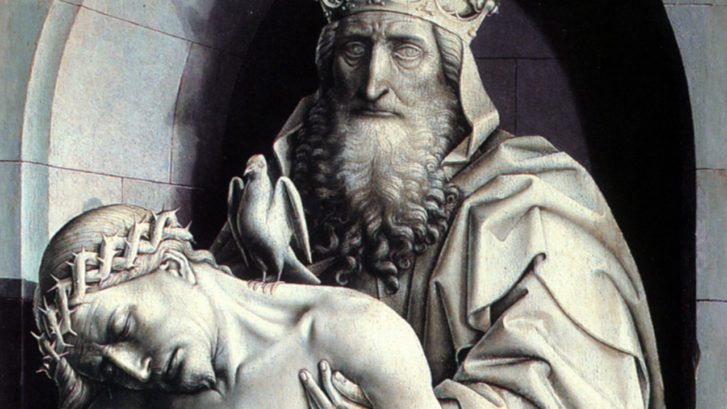
Detail of The Fl malle Panels #1 framed print by Robert Campin (1375-1444)
God is Relationship
To be a whole person, we must have a relationship with our God. We humans do not like being out of relationship with those around us or our God. Think of the worst moments of your life, when you were rejected by someone, when you were cut off from family and friends. Perhaps you felt betrayed by a friend, or you felt isolated. We do not even like to go to the movies or out to dinner by ourselves, do we? Why is solitary confinement such a horrible form of punishment? We human beings are in desperate need for union.
Rejection is such an intolerable hurt because we need to be connected. The question is why, why this existential driving need for union? Why are the best moments when unions occur, and the worst when it is absent? The answer simply and profoundly is today’s feast.
We are made in the image and likeness of God, and God is communion, is relationship, and therefore so are we. Humans strive for union with God and with each other. We reach out for companionship. Every hug or embrace gives indirect testimony to the Trinity.
THE WORD THIS WEEK invites you to check out the Catholic AI assistant (located at the bottom right-hand corner), a homily preparation resource you can use to clarify or develop the insights and themes of Fr. Warren’s homily.
────── ⋆⋅☆⋅⋆ ──────
Fr. Jagodensky, S.D.S.
Most Holy Trinity (Year C)
Homily Excerpt
God owns the place. Jesus Christ is behind the desk answering the phones and registering guests and the Holy Spirit?
The Holy Spirit cleans all the rooms. She has the master key along with her cart full of stuff to replace the stuff that we either use or the stuff we stuff away in our suitcases. Is their soap really better than the soap in your home? Or is it just the feeling that you can get away with it?
The Holy Spirit attempts to clear the leaves from the pool so your kids can swim in its non-heated pool. The Holy Spirit makes your bed, switches towels, checks your minibar supply, and somehow scents your room with a universal scent that makes every motel room smell the same.
Today we celebrate the third person of the Trinity, the last person of the Trinity. I wouldn’t say I like that phrase. There is no “third.” Each Person of our Triune God has specific responsibilities to inform, reform, celebrate and better our lives. This weekend honors the motel’s housekeeper.
You may attempt to put that “Do Not Disturb” sign on the door, but please rest assured that this motel is here to serve you…sometimes, whether you like it or not.
That’s the job of a motel housekeeper, the one we used to call “Ghost” because it sounded scary, but the job description hasn’t changed one iota.
Please note that the provided video clips serve as additional resources to complement the homily. They may not have a direct correlation with the contributor’s original content. They aim to inspire preachers to enrich their own homilies, drawing ideas and insights from both the written material and the visual content explored.