August 17, 2025
August 17, 2025


Doctrinal Messages and Pastoral Suggestions
Homily Notes



“The scandal of truth” could be the title of our reflection on today’s liturgy. The truth proclaimed by the prophet Jeremiah scandalizes his contemporaries (first reading). Jesus’ words on the fire of judgment, on baptism in the blood of the Cross and on the sword that divides, also scandalize his listeners, because they did not correspond to the listeners’ expectations. And aren’t people often scandalized by divine teaching when it resorts to correction and punishment?
© 2000 Dicastery for the Clergy A | B | C
VIEW 2025 NOTES – Father Gaetano Piccolo (SI)

CATHOLIC NEWS SERVICE (3:07) – Pope Leo XIV sent a video message to the Supreme Convention of the Knights of Columbus.

THE LIVESTREAM allows viewers to witness the Pope’s addresses during Papal Audiences, as well as other Vatican events and news.
Sunday’s
Core Themes
The notes ground “this abstract theme”THE SCANDAL OF TRUTH” in concrete biblical examples, showing a pattern of divine revelation being met with human scandal.
1 The Scandal of Jeremiah: Jeremiah’s life is presented as the archetypal example of the scandal of truth. He was a gentle man called to a harsh mission. His message of impending destruction for Jerusalem was interpreted not as a divine warning but as a treacherous act of pessimism. His suffering—being thrown into a muddy well—was a direct consequence of his fidelity to a truth that was politically and socially unacceptable. His eventual vindication, though it came through the very destruction he prophesied, shows that God’s truth ultimately prevails.
2 The Scandal of Jesus Christ: Jesus intensifies this theme. His words are not just unpleasant; they are “wounding.” He speaks of “fire of judgment,” a “baptism” of suffering and blood, and a “sword” of division. This message was a profound scandal to the Jews, who expected a political messiah to bring worldly peace and power. The ultimate scandal, the Cross, was a symbol of shame and failure. Jesus’s life and death demonstrate that bearing witness to the truth, particularly the truth about redemption and the radical nature of the Kingdom of God, can lead to persecution and condemnation.
3 The Scandal of God: This theme addresses the deepest level of human questioning: the problem of evil. The notes speak of the scandal that God allows suffering and martyrdom to occur. This is a scandal to human reason, which struggles to reconcile a good and powerful God with the existence of pain and evil. The notes powerfully propose that the answer to this “scandal” is not a philosophical argument but a person: Jesus Christ. By looking at his Cross, we see that God himself entered into suffering. By looking at his Resurrection and enthronement, we see that suffering is not the end; it is the path to glory.nd confidence.
Doctrinal Messages
The Scandal of Jeremiah

Jeremiah was a sensitive and tranquil man by nature. He loved beauty, and by divine vocation had to preach destruction and horrendous massacres. He loved tranquility and quiet, and found himself totally involved in the risky and unfortunate events in Jerusalem and in the kingdom of Judah.
The God who had seduced him induced him to say unpleasant and unexpected things, and to undertake symbolic actions that aroused indignation and adversity. His words and actions scandalized the inhabitants of Jerusalem and Judah. And “to scandalize” meant, to those who listened to him, that he was not seeking the welfare of the people but their ruin, that he was a pessimist and a spoilsport who disheartened the soldiers and the people.
However, Jeremiah knows that he is telling the truth, a truth that he has not invented himself but that he has heard in the intimacy of his conscience as the Word of God.
The scandal of truth will make Jeremiah suffer (he will be put into a storage-well full of mud to die there forgotten and abandoned by all). But it does not matter, for he knows that God will not abandon him (he will save him by means of an Ethiopian, a pagan), and that God’s truth which he has conveyed will prevail and triumph. And so it was. Jerusalem was taken and destroyed by the army of Babylon, and most of the population was deported to and enslaved in the land of the winners.


Infographics on this page have been added by THE WORD THIS WEEK using AI generative tools (i.e. Chart.js and Tailwind CSS). They may be copied for personal use or for any non-profit ministry. Graphics may not be sold or used for personal financial gain.
The Scandal of Jeremiah
“The Scandal of Jeremiah” from the Dicastery for Clergy notes can be connected to the Catholic Catechism in several ways, particularly concerning the nature of prophecy, the suffering of the righteous, and the importance of truth, even when it is difficult to hear.
- Prophecy and the Divine Vocation (CCC 742-744): The excerpt describes Jeremiah’s divine vocation, noting that God “seduced him” to preach destruction. This aligns with the Catechism’s understanding of prophecy as a special charism and a divine call. The prophets, like Jeremiah, are instruments through whom God speaks to His people, often calling them back to the covenant and warning them of the consequences of their sin. Jeremiah’s message, though harsh, was not his own invention but “the Word of God,” a truth he heard “in the intimacy of his conscience.” The Catechism affirms that the prophets’ role is to “awaken the faith and conversion of the people of God.”
- The Scandal of Truth (CCC 2470, 2473, 2475): The excerpt explicitly mentions the “scandal of truth” that Jeremiah’s message provoked. The Catechism defines scandal as “an attitude or behavior which leads another to do evil.” In this case, the scandal is not a sin on Jeremiah’s part, but a reaction from those who reject the truth he speaks. They are “scandalized” because they find his message of destruction and ruin to be contrary to their own desires and expectations. The Catechism teaches that “No one is bound to be a witness to himself, but to the truth.” Jeremiah suffers because he is a witness to God’s truth, and this suffering is a consequence of others’ rejection of that truth. This connects to the Catechism’s teaching on the martyrdom of those who bear witness to the truth.
- The Suffering of the Righteous (CCC 618, 1505): Jeremiah’s suffering—being put in a muddy well to die—is a direct consequence of his fidelity to God’s word. The excerpt notes that “he knows that God will not abandon him.” This theme of the suffering righteous person who trusts in God’s ultimate vindication is central to Christian faith and is reflected in the Catechism. It teaches that Christ’s suffering and death were the ultimate example of the righteous one suffering for the sake of truth and for the salvation of humanity. The Catechism also speaks of the “redemptive value of suffering” in the lives of Christians, who are called to unite their own sufferings with Christ’s. Jeremiah’s suffering, like that of the martyrs, is a testament to the power of faith and the ultimate triumph of God’s plan.
- God’s Providence and the Triumph of His Word (CCC 302, 307): The excerpt concludes by affirming that God’s truth, conveyed by Jeremiah, “will prevail and triumph.” This is a powerful statement about God’s providence. The Catechism teaches that “Divine Providence consists of the dispositions by which God guides his creation toward the perfection he has planned for it.” Even in the midst of suffering and destruction (the fall of Jerusalem), God’s ultimate plan is being fulfilled. The fact that an “Ethiopian, a pagan,” saves Jeremiah from the well further illustrates God’s mysterious ways and His use of unexpected instruments to accomplish His will. The Catechism affirms that God’s plan “is not frustrated by the evil of creatures, but rather, as St. Augustine teaches, from it he draws greater good.”
In summary, the story of Jeremiah’s scandal connects to the Catechism’s teachings on prophecy, the nature of truth, the suffering of the righteous, and God’s providential care. Jeremiah’s unwavering fidelity to God’s word in the face of rejection and suffering serves as a powerful Old Testament parallel to the life of Christ and the call for all Christians to be faithful witnesses to the truth, no matter the cost.
The Scandal of Jeremiah
Part 1: The Inner Conflict of Jeremiah
- Initial prompt: The text describes Jeremiah as “sensitive and tranquil by nature” and a lover of “beauty.” How does this description contrast with the mission God gives him: to “preach destruction and horrendous massacres”?
- Follow-up questions:
- What kind of internal struggle do you imagine Jeremiah faced?
- Have you ever felt a conflict between who you are and what you felt you had to do? How does Jeremiah’s experience resonate with or differ from your own?
- The text says he “found himself totally involved in the risky and unfortunate events in Jerusalem.” What does this suggest about the nature of a prophetic calling? Is it something one chooses, or something one is chosen for?
Part 2: The Scandal of Truth
- Initial prompt: Jeremiah’s words and actions are described as “scandalizing” the people of Jerusalem and Judah. What does the text say “to scandalize” meant to them?
- Follow-up questions:
- Why would his message—that disaster was coming—be seen as “not seeking the welfare of the people”?
- The people saw him as a “pessimist and a spoilsport.” How do we often react to difficult or unwelcome truths today? Can you think of examples where a messenger of bad news is blamed for the news itself?
- The text states Jeremiah “knows that he is telling the truth, a truth that he has not invented himself but that he has heard in the intimacy of his conscience as the Word of God.” What is the significance of this distinction? How does it empower him to endure the public opposition?
Part 3: Suffering, Salvation, and Triumph
- Initial prompt: The discussion of Jeremiah’s suffering is stark: he is “put into a storage-well full of mud to die there forgotten and abandoned by all.” The text immediately follows this with the phrase, “But it does not matter…” Why does it not matter to Jeremiah?
- Follow-up questions:
- What does the text suggest is the source of his strength and endurance? (Hint: “he knows that God will not abandon him…”)
- Jeremiah is saved by an Ethiopian, a “pagan.” What might be the theological significance of a non-Jew being the instrument of his salvation? What does this say about God’s reach and the nature of who is used for His purposes?
- The text concludes that “God’s truth which he has conveyed will prevail and triumph.” In what way did Jeremiah’s truth triumph, and what was the ultimate outcome for Jerusalem and its people?
- How does the story of Jeremiah challenge the idea that a prophet’s success is measured by popular acceptance or a comfortable life? What, then, defines the success of a prophet?
Concluding Thoughts
- Final questions for reflection: What is the enduring lesson of Jeremiah’s story for us today? What does it teach us about the nature of truth, the cost of speaking it, and the ultimate source of hope and endurance?
The Scandal of Jesus Christ
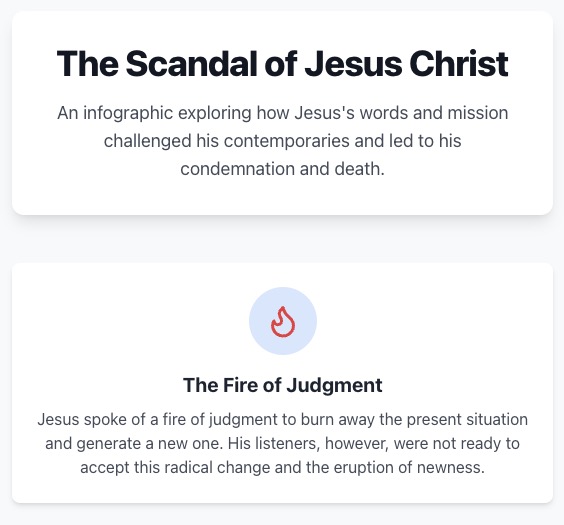
Jesus addresses his contemporaries with wounding and scandalous words. He talks about the fire of judgment, capable of burning and destroying the present situation to generate a new one, but his listeners are not ready to accept the radical change or the eruption of newness.
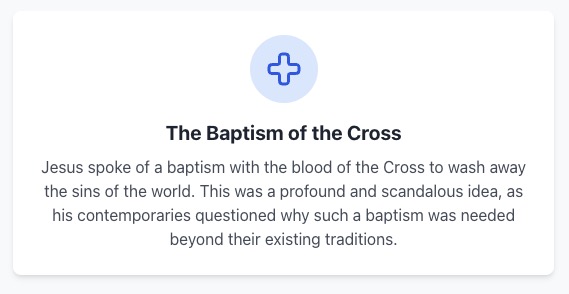
Jesus talks about baptism with reference to the blood of the Cross, in which he will have to be baptized to wash away the sins of the world which he has taken upon himself. But what is the need for this baptism? Isn’t John’s baptism sufficient, or that of the Essenes? The Cross is a scandal for the Jews, Paul will remind us in the first Letter to the Corinthians.
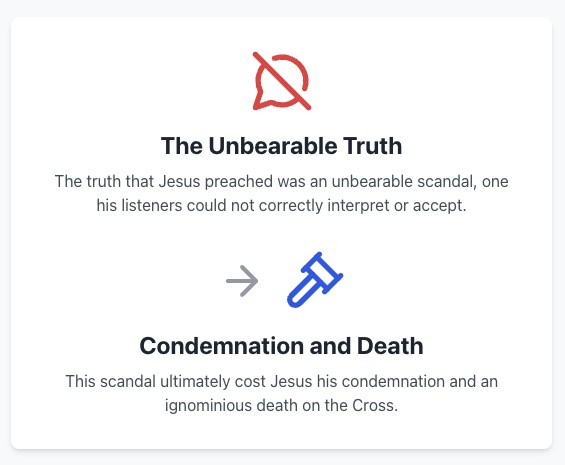
Jesus clearly says that he has not come to bring peace on earth, but the sword that divides men: with Christ or against Christ, with no possibility of being neutral. This sword of division greatly scandalized the Jews. They do not know how to interpret correctly the three signs that Jesus offers his contemporaries, and they are scandalized! The truth that Jesus Christ preaches to them is an unbearable scandal, a scandal that cost Jesus Christ his condemnation and an ignominious death on the Cross.

Infographics on this page have been added by THE WORD THIS WEEK using AI generative tools (i.e. Chart.js and Tailwind CSS). They may be copied for personal use or for any non-profit ministry. Graphics may not be sold or used for personal financial gain.
The Scandal of Jesus Christ
“The Scandal of Jesus Christ” can be connected to the Catholic Catechism in the following ways, drawing parallels between Jesus’s life and teachings and the Church’s doctrinal explanations.
- The Radical Nature of Jesus’s Teaching and the Eruption of Newness (CCC 521, 581-582): The excerpt notes that Jesus’s words were “wounding and scandalous” because his listeners were not ready for “the radical change or the eruption of newness.” This directly relates to the Catechism’s explanation of Jesus’s mission. The Catechism teaches that Jesus’s preaching of the Kingdom of God was a call to a total conversion of heart and a new way of living that went beyond the letter of the Law. Jesus did not come to abolish the Law but to fulfill it in a new and radical way. This newness was often misunderstood and rejected, as the Catechism explains that the religious authorities of Jesus’s time “were scandalized by his miracles of healing on the sabbath.”
- The Scandal of the Cross (CCC 616, 1229): The excerpt explicitly states that “The Cross is a scandal for the Jews, Paul will remind us in the first Letter to the Corinthians.” This is a central theme in Christian theology and is clearly articulated in the Catechism. The Catechism teaches that the Cross, a symbol of suffering and humiliation, was a stumbling block for the Jewish people who expected a conquering messiah. For the Gentiles, it was foolishness. However, for Christians, the Cross is the ultimate sign of God’s love and the source of salvation. The Catechism affirms that “It is a scandal to human reason, but it is the power of God and the wisdom of God.”
- Baptism in Blood (CCC 1260, 1215): The excerpt mentions Jesus’s reference to being “baptized with reference to the blood of the Cross.” This connects to the Catechism’s teaching on baptism. While the sacrament of Baptism cleanses us from original sin and incorporates us into the Body of Christ, the Catechism also speaks of a “baptism of blood.” This refers to those who are martyred for Christ without having been baptized with water. Their death is considered a form of baptism. Jesus’s own “baptism” on the cross, through which he shed his blood, is the ultimate fulfillment of all baptism, as it is the source of all grace and the very means by which all of humanity is redeemed.
- Division and the “Sword” of Truth (CCC 181, 150): The excerpt notes that Jesus came to bring “not peace on earth, but the sword that divides men: with Christ or against Christ.” This “sword” of division is not a call to violence but a metaphor for the radical choice demanded by the Gospel. The Catechism teaches that faith requires a total commitment and a choice. It is a “personal act—the free response of the human person to the initiative of God who reveals himself.” This choice inevitably creates a division between those who accept the truth of Christ and those who reject it. The Catechism explains that this division can even occur within families. The scandal, in this case, is not an evil act by Jesus, but a reaction of those who are unwilling to make this difficult choice.
- Condemnation and Ignominious Death (CCC 599, 602): The excerpt concludes by stating that the “unbearable scandal” of Jesus’s truth “cost Jesus Christ his condemnation and an ignominious death on the Cross.” The Catechism addresses the question of who is responsible for Jesus’s death. It explains that all sinners are responsible, as our sins are what led to his crucifixion. The Catechism emphasizes that “the Church does not hesitate to charge with the gravest responsibility for the torments inflicted upon Jesus those Christians who fall again into sin.” This is a powerful reminder that the scandal of the Cross is an ongoing reality, and our own sinfulness contributes to it.
The Scandal of Jesus Christ
Part 1: The Wounding and Scandalous Words
- Initial prompt: The text begins by stating Jesus uses “wounding and scandalous words.” What specific examples does the text provide for this claim?
- Follow-up questions:
- Why would Jesus’s talk of a “fire of judgment” be so difficult for his listeners to accept? What kind of “radical change” or “eruption of newness” do you think he was referring to?
- The passage mentions that Jesus’s listeners were “not ready” for this change. What does this suggest about the human tendency to resist disruption, even when it might be for the better?
- Can you think of examples in our own time where a message of radical change is met with resistance or even hostility?
Part 2: The Scandal of the Cross and Baptism
- Initial prompt: The passage highlights two interconnected scandals: Jesus’s talk of “baptism with reference to the blood of the Cross” and the Cross itself being a “scandal for the Jews.” Why was the Cross such a stumbling block?
- Follow-up questions:
- The text asks, “what is the need for this baptism?” It then contrasts Jesus’s baptism with John’s and that of the Essenes. What is the fundamental difference between these forms of baptism, and why would Jesus’s be so much more offensive or unnecessary-seeming to his contemporaries?
- Paul, in 1 Corinthians, calls the Cross a “stumbling block to Jews and foolishness to Gentiles.” Based on the text, why do you think it was so scandalous specifically to the Jews? (Consider their expectations for a Messiah).
- The Cross, for many, is the ultimate symbol of love and sacrifice. How do you reconcile this with the idea that it was originally an “ignominious death” and a “scandal”?
Part 3: The Scandal of Division
- Initial prompt: The text quotes Jesus: “he has not come to bring peace on earth, but the sword that divides men.” How does this statement challenge the common perception of Jesus as a bringer of peace and unity?
- Follow-up questions:
- The passage describes this as a division of “with Christ or against Christ, with no possibility of being neutral.” What does this statement demand of a person? Why would this lack of neutrality be so scandalous and difficult for people to accept?
- The text says the Jews “do not know how to interpret correctly the three signs that Jesus offers his contemporaries, and they are scandalized!” What might these “three signs” be, and why would a misunderstanding of them lead to scandal rather than understanding?
- In what ways do we still see this “sword of division” at work in the world today, both inside and outside of religious contexts?
Concluding Thoughts
Final prompt for reflection: The text concludes that the truth Jesus preached was an “unbearable scandal” that led to his condemnation and death. What does this suggest about the nature of truth itself? Is genuine, transformative truth always met with resistance and difficulty? What is the enduring message of “The Scandal of Jesus Christ”?f suffering into a source of merit and glory for God.
The Scandal of God
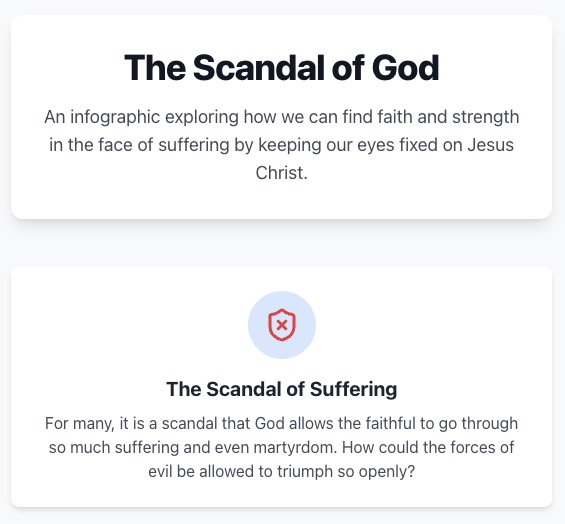
Not only Jeremiah, not only Jesus, but God himself may cause a scandal. The community to whom the Letter to the Hebrews was addressed might have thought that it was a scandal that God should allow them to go through so much suffering.
They might also have been presented the scandal of martyrdom, the shedding of their own blood. How could God have allowed the forces of evil to intervene in such a manifest way?
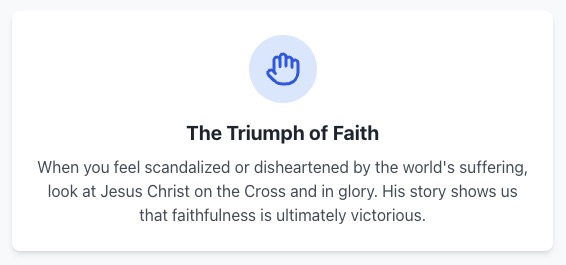
It is for this reason that the author of the Letter invites the people to keep their eyes fixed on Jesus, who leads them in their faith and brings it to perfection. He endured the Cross, disregarding the shame of it, and has taken his seat at the right of God’s throne. In more colloquial language, we might say, “Are you scandalized? Look at Jesus Christ on the Cross! Are you disheartened by this prospect? Look at Jesus Christ sitting at the right of God’s throne!” In the light of Christ, your scandal will become a witness of faith and glory.

Infographics on this page have been added by THE WORD THIS WEEK using AI generative tools (i.e. Chart.js and Tailwind CSS). They may be copied for personal use or for any non-profit ministry. Graphics may not be sold or used for personal financial gain.
The Scandal of God
“The Scandal of God” can be connected to the Catechism of the Catholic Church by examining the themes of suffering, divine providence, the example of Christ, and the ultimate triumph of faith.
The Scandal of Suffering and the Mystery of Providence (CCC 307-313)
The excerpt highlights the profound scandal that arises when God allows His people to suffer, even to the point of martyrdom. This connects to the Catechism’s discussion of Divine Providence, which teaches that God’s plan unfolds in ways that may be mysterious and difficult for us to understand. The Catechism acknowledges that this mystery includes the reality of evil and suffering in the world. It states that “the question of evil is a central one in the human drama, and it is a scandal to human reason.” The faithful, like the community in the Letter to the Hebrews, are called to trust in God’s plan even when it seems to permit great suffering. This suffering can be a scandal—a stumbling block—to faith, making people question God’s goodness or power.
The Cross as the Answer to the Scandal (CCC 618)
The author of the Letter to the Hebrews offers the ultimate solution to the scandal of suffering: “keep their eyes fixed on Jesus, who leads them in their faith and brings it to perfection.” This is a core teaching of the Catechism. The Catechism states that Christ’s own suffering and death are the definitive answers to the problem of evil. Jesus’s Passion was the ultimate act of obedience and love, transforming a sign of shame and defeat (the cross) into a symbol of victory and salvation. By looking at Jesus on the Cross, we see that God did not remain distant from our suffering; He entered into it completely. The Catechism teaches that “By his redemptive suffering, Christ has given a new meaning to the suffering of his disciples.”
The Promise of Glory and the Witness of Faith (CCC 1816, 2473)
The excerpt’s final message is one of hope: “your scandal will become a witness of faith and glory.” This connects to the Catechism’s teachings on hope and martyrdom. The community’s suffering, rather than being a sign of God’s abandonment, can be transformed into a powerful testimony to their faith. The Catechism defines martyrdom as the “supreme witness given to the truth of the faith,” a witness that imitates Christ’s own death. By “looking at Jesus Christ sitting at the right of God’s throne,” the faithful are reminded of the ultimate end of their suffering: a share in Christ’s glory. This promise of a future with God provides the strength to endure present trials and transforms the “scandal” of suffering into a source of merit and glory for God.
The Scandal of God
Part 1: The Scandal of Suffering
- Initial prompt: The text suggests that the community addressed in the Letter to the Hebrews might have been “scandalized” that God would allow them to go through so much suffering. What does this reveal about the common human expectation of what a relationship with God should look like?
- Follow-up questions:
- Have you ever felt a sense of scandal or disillusionment with God because of personal suffering or the suffering you’ve witnessed in the world?
- The text implies that people might have expected God to prevent their suffering. What is the source of this expectation, and how does it often clash with the reality of the human experience?
- Can you think of other instances in the Bible or in history where people expressed a similar “scandal” with God’s perceived inaction in the face of injustice or pain?
Part 2: The Scandal of Martyrdom
- Initial prompt: The text specifically mentions the “scandal of martyrdom” and asks, “How could God have allowed the forces of evil to intervene in such a manifest way?” What is particularly scandalous about martyrdom compared to other forms of suffering?
- Follow-up questions:
- Martyrdom represents the ultimate sacrifice for one’s faith. Why would someone who gives their life for God still feel “scandalized” that God allowed it to happen?
- How does the existence of “forces of evil” challenging a believer’s life and faith present a profound theological problem? How might this challenge one’s understanding of God’s power or goodness?
- What might the community have been expecting God to do in the face of these “forces of evil” that He did not do?
Part 3: The Response to the Scandal: Fixing Our Eyes on Jesus
- Initial prompt: The author of Hebrews offers a powerful solution to this scandal: “keep their eyes fixed on Jesus.” How does looking at Jesus’s life and death address the questions raised by the scandal of suffering and martyrdom?
- Follow-up questions:
- The text notes that Jesus “endured the Cross, disregarding the shame of it.” Why is it significant that he “disregarded the shame”? What does this tell us about the nature of his endurance?
- The second half of the solution is to look at Jesus “sitting at the right of God’s throne.” What does this image of Jesus’s exaltation and triumph offer to someone who is suffering or facing persecution?
- The concluding quote uses colloquial language: “Are you scandalized? Look at Jesus Christ on the Cross! Are you disheartened by this prospect? Look at Jesus Christ sitting at the right of God’s throne.” What is the powerful, two-part message being conveyed here?
Concluding Thoughts
- Final questions for reflection: The text connects the “scandal of God” directly to the “scandal of the Cross.” How does the story of Jesus transform the idea of suffering from a sign of God’s absence or weakness into a potential source of strength, hope, and ultimate victory? What is the ultimate message of the Letter to the Hebrews on this issue?
Pastoral Suggestions
Scandalizing will Get Something Across
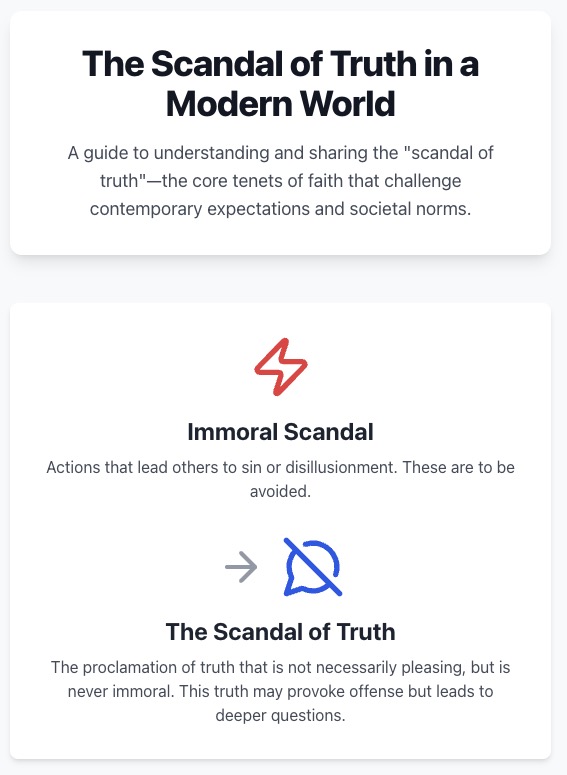
I am not recommending immoral scandal, like scandalizing children with evil actions or actions that they do not have the ability to judge. I am proposing the scandal of truth, and truth may not please. It may be more or less appropriate, but it will never be labeled as immoral.
I propose that we repeat many times this scandal of truth, so that this repetition may generate at least a question, an incentive, a step forward in the effort to know it.
Indeed, isn’t there a whole set of truths that scandalize many people today?
- For example, the truth of one unique Savior of Humankind, our Lord Jesus Christ, the center and fulcrum of history and the cosmos.
- There is the truth of one unique Church, founded by Christ, which subsists in the Catholic Church, or
- the truth of one unique Creator of the universe and of human beings.
- We have the truth of a triune God, actively engaged in the history of human beings and their destiny; or
- the truth of a priestly people, without any distinction based on sex, but of a priestly ministry, to which God calls only men.
- So many truths: that of marriage, constituted exclusively by the stable union between a man and a woman, or
- that of the universal destiny of all the goods of the earth, etc.
These truths are a scandal to many ears in our society. Rather than keeping them to ourselves, let’s talk about them, let’s tell them now and again, in different ways, with the simplicity and conviction that truth itself entails. Let us speak about them in public and in private: priests, educators, religion teachers, catechists, theologians and bishops. Let us scandalize our society with the fundamental truths of Christian faith and morality!


Infographics on this page have been added by THE WORD THIS WEEK using AI generative tools (i.e. Chart.js and Tailwind CSS). They may be copied for personal use or for any non-profit ministry. Graphics may not be sold or used for personal financial gain.
Scandalizing will Get Something Across
“Scandalizing Will Get Something Across” directly connects to the Catechism of the Catholic Church by emphasizing the duty to proclaim the fullness of Christian truth, even when it is difficult for people to accept. This section focuses on the scandal of truth as a necessary tool for evangelization, contrasting it with immoral scandal.
The Distinction Between Immoral and Necessary Scandal
The author of the notes is careful to distinguish between different types of scandal. Immoral scandal, as described in the excerpt, involves “evil actions” that lead others, especially the vulnerable, into sin. The Catechism explicitly condemns this.
- CCC 2284-2287 defines scandal as an “attitude or behavior which leads another to do evil.” The Catechism warns against leading others into sin and calls it a “grave offense” when done deliberately, particularly to children or those in positions of authority. The excerpt’s rejection of this type of scandal aligns perfectly with the Catechism’s teaching that we must not intentionally lead others astray.
Conversely, the notes propose the scandal of truth, which is the opposite of immoral scandal. This “scandal” is the uncomfortable reaction people have when faced with a truth they are unwilling to accept. This type of “scandal” is not a sin; rather, it’s a necessary part of proclaiming the Gospel.
The Duty to Proclaim Scandalous Truths
The core of the excerpt is a call to boldly proclaim the “fundamental truths of Christian faith and morality,” even when they are a “scandal to many ears.” The Catechism provides a firm foundation for this duty to evangelize and teach.
- CCC 2471-2473 speak about the obligation to bear witness to the truth. It says that we are called to be witnesses to the Gospel in our words and actions. Proclaiming the truth is an act of love and a necessary part of our mission.
- CCC 849-856 discuss the Church’s missionary mandate. The Catechism states that “the Church on earth is by her nature missionary” and that all members of the faithful are called to participate in this mission. This mandate includes proclaiming the truths that the author of the notes mentions, such as Jesus Christ as the unique Savior (CCC 430-455) and the Church as the unique instrument of salvation (CCC 811, 816).
- CCC 2210 speaks about the truth of marriage. The Catechism defines marriage as “the stable union between a man and a woman,” a teaching that the notes mention as a truth that is scandalous to many in modern society. Proclaiming this truth, as with the others, is not scandalous in a moral sense but a witness to what the Church teaches as a divine reality.
The author’s call to “repeat many times this scandal of truth” so that it may “generate at least a question” echoes the Catechism’s understanding of evangelization. It’s often a process of patient, repeated witness that plants a seed of faith, even if it initially causes discomfort. The goal is not to offend but to love others enough to offer them the full truth of the Gospel, which ultimately leads to salvation.
Scandalizing will Get Something Across
Part 1: Defining “The Scandal of Truth”
- Initial prompt: The author makes a critical distinction between “immoral scandal” and “the scandal of truth.” How does the text define the latter, and what is its purpose?
- Follow-up questions:
- Why does the author insist that “truth may not please” but “will never be labeled as immoral”? What does this imply about the relationship between truth and popular opinion?
- The author suggests that repeating “the scandal of truth” can “generate at least a question, an incentive, a step forward in the effort to know it.” What is the logic behind this claim? Do you agree that a shocking or challenging truth is more likely to be engaged with than a comfortable one?
- Can you think of other contexts (outside of religion) where a difficult or unpopular truth, when spoken, has provoked a necessary conversation or change?
Part 2: The Specifics of Scandalous Truths
- Initial prompt: The text lists several specific “truths” that it claims are scandalous to many people today. What are a few of the examples provided, and why do you think they are considered scandalous in our current society?
- Follow-up questions:
- Choose one of the truths listed (e.g., the unique salvific role of Jesus, the nature of the Church, the unique Creator, the nature of marriage, the all-male priesthood). Why might this particular belief be seen as exclusive, intolerant, or otherwise problematic by many people today?
- The text frames these beliefs as “fundamental truths of Christian faith and morality.” How does framing them this way—rather than as opinions or traditions—change the nature of the conversation?
- Is it possible for a truth to be both “fundamental” to one group and deeply offensive or even harmful to another? How should that tension be navigated?
Part 3: The Call to Action
- Initial prompt: The passage issues a strong call to action: “Let us scandalize our society with the fundamental truths of Christian faith and morality!” Who does the author specifically call upon to do this, and what is the prescribed method?
- Follow-up questions:
- The author urges people to “talk about them, let’s tell them now and again, in different ways, with the simplicity and conviction that truth itself entails.” What does “simplicity and conviction” mean in this context? How might one speak a scandalous truth without being perceived as aggressive, self-righteous, or hateful?
- The passage suggests speaking these truths in “public and in private.” What are the potential challenges and rewards of doing so in each of these settings?
- Based on your own experiences, do you think this approach is more likely to create dialogue or division? What factors might determine the outcome?
Concluding Thoughts
- Final question for reflection: The text advocates for a proactive and somewhat confrontational approach to proclaiming Christian truths. What is the potential benefit of this strategy? What are the potential pitfalls? Ultimately, what responsibility does a believer have to “scandalize” with truth, and where does that responsibility end?
The Truth Will Set You Free

In a social environment in which truth seems to be the cause of slavery and bondage, because both the nature of truth and the human ability for it are ignored or scorned, we Christians are convinced that truth in itself, especially the truth of our faith, sets us free.
Actually, all truth contributes to building the person and the Christian in more specific identity and personality. And it is clear that the more we identify with our human and Christian identity, the better and more fully we will experience the true freedom of being what we are meant to be, according to our nature, to what is written in the great book of God’s revelation. The person is not free to be what he wishes: he is free to be the truth of his being.
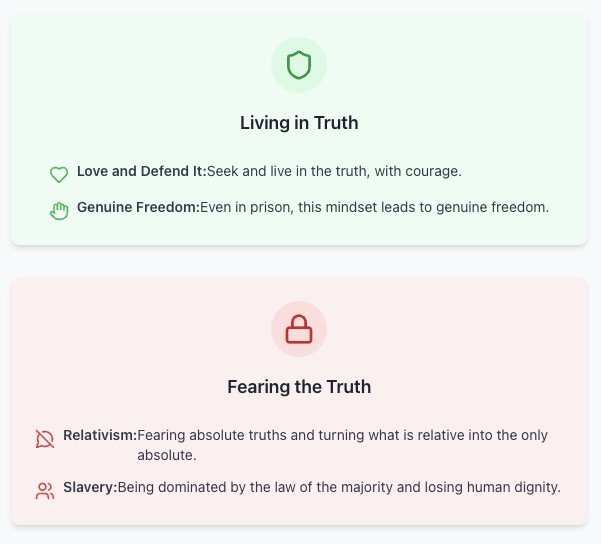
Freedom is not an absolute value, it must be related to truth, which in itself attracts and conquers us. Where there is truth there is freedom, and where truth is lacking, there is necessarily some form of slavery. Are we seeking the truth? Do we live in truth? Do we love truth? Do we defend the truth? Then we may say that we are genuinely free, even if we are closed within the four walls of a prison cell or we are considered “useless material” by society around us.
Are we perhaps afraid of the truth, of its conquering power? Yes, in a relative world, perhaps we are afraid of absolute truths. However, if everything is relative, aren’t we turning what is relative into the only absolute? Ultimately, to be afraid of the truth is to be afraid to be one’s self. It means letting one’s self be dominated by the absolute law of the majority, losing human dignity. Truth will set you free. Have no doubts. This is the experience of the great.

Infographics on this page have been added by THE WORD THIS WEEK using AI generative tools (i.e. Chart.js and Tailwind CSS). They may be copied for personal use or for any non-profit ministry. Graphics may not be sold or used for personal financial gain.
The Truth Will Set You Free
The excerpt “The Truth Will Set You Free” aligns with the Catechism of the Catholic Church by exploring the fundamental relationship between truth, freedom, and human dignity. It challenges a modern view of freedom as an absolute, advocating for a freedom that is rooted in and perfected by truth.
The Nature of Truth and Freedom (CCC 1731, 1733)
The notes begin by contrasting the modern idea that truth causes bondage with the Christian conviction that “truth in itself… sets us free.” The Catechism affirms this connection directly.
- CCC 1731 states, “Freedom is the power, rooted in reason and will, to act or not to act… in order to perform deliberate actions on one’s own responsibility. By free will one shapes one’s own life.” However, the Catechism immediately qualifies this by saying, “Freedom attains its perfection when directed toward God, the sovereign Good.”
- CCC 1733 further clarifies that “the more one does what is good, the freer one becomes.” This directly supports the notes’ claim that “the person is not free to be what he wishes: he is free to be the truth of his being.” Authentic freedom is not about unrestrained choice but about choosing what is good and true, which is what we were created for.
The excerpt’s assertion that “the more we identify with our human and Christian identity, the better and more fully we will experience the true freedom of being what we are meant to be” is a perfect reflection of the Catechism’s teaching that true freedom is found in conforming one’s life to God’s will.
The Christian’s Relationship to Truth (CCC 2465-2470)
The author asks, “Are we seeking the truth? Do we live in truth? Do we love truth?” These questions are central to the Christian life as presented in the Catechism.
- CCC 2465 states, “The Old Testament attests that God is the source of all truth. His Word is truth.” Jesus Christ, as the Word of God, is the ultimate manifestation of this truth.
- CCC 2466 says, “In Jesus Christ, the whole of God’s truth is made manifest.” The Christian is called to a life of truth because God is truth. The notes’ phrase, “what is written in the great book of God’s revelation,” is a clear reference to this.
- CCC 2470 directly connects truth to witness, stating, “Man tends naturally toward the truth. He is obliged to honor and bear witness to it.” This is a defense of the notes’ call to “defend the truth.”
Freedom from Relativism and the Law of the Majority (CCC 1740)
The excerpt warns against being dominated by “the absolute law of the majority” and the fear of “absolute truths” in a “relative world.” This speaks to the danger of relativism, a concept the Catechism implicitly rejects by teaching that moral truth is objective and unchanging.
- CCC 1740 states, “Man’s freedom is limited and fallible. In fact, it often falls short of its purpose.” It goes on to say that human freedom needs to be redeemed by Christ and guided by the Holy Spirit. This highlights the Church’s perspective that human freedom, left to its own devices, can lead to sin and the loss of dignity—the very “slavery” the notes describe. By submitting our freedom to objective truth, we avoid the tyranny of subjective opinions and the “absolute law of the majority.”
The conclusion that “to be afraid of the truth is to be afraid to be one’s self” and that this results in “losing human dignity” is a powerful summary of the Catechism’s teaching on the nature of the person. We are created in the image of God, and to deny the truths of our nature is to deny God and, ultimately, ourselves. True freedom is not the freedom from truth, but the freedom to live the truth.
The Truth Will Set You Free
Part 1: Redefining Freedom
- Initial prompt: The text begins by stating that in our society, “truth seems to be the cause of slavery and bondage.” How is this modern perception of truth different from the one the author is proposing?
- Follow-up questions:
- The passage says, “The person is not free to be what he wishes: he is free to be the truth of his being.” What is the fundamental difference between these two ideas of freedom? Can you think of examples of each in our world today?
- The author argues that freedom is not an “absolute value” but “must be related to truth.” What does this mean in practice? How does a person’s understanding of truth inform their understanding of freedom?
- The text suggests that “all truth contributes to building the person.” How can understanding truths—both secular and spiritual—help a person develop a more specific identity and personality?
Part 2: The Dangers of Relativism
- Initial prompt: The passage claims that “where truth is lacking, there is necessarily some form of slavery.” What are some of the “forms of slavery” that the author might be referring to?
- Follow-up questions:
- The text asks, “if everything is relative, aren’t we turning what is relative into the only absolute?” What is the author’s critique of a completely relativistic worldview here? Do you agree with this assessment?
- The author also suggests that “to be afraid of the truth is to be afraid to be one’s self.” Why would a fear of absolute truth equate to a fear of one’s own being?
- The passage warns against “letting one’s self be dominated by the absolute law of the majority.” How does the concept of truth as a fixed, external reality protect against this kind of social pressure?
Part 3: The Power of Truth
- Initial prompt: The text offers a powerful claim: “Then we may say that we are genuinely free, even if we are closed within the four walls of a prison cell.” How can a person be physically unfree yet “genuinely free”?
- Follow-up questions:
- What does it mean to “love truth” or “defend the truth” in our daily lives? What is the role of personal conviction in living out this kind of freedom?
- The passage ends with the statement, “This is the experience of the great.” Who are some of the “great” figures, both religious and secular, who have exemplified this kind of freedom through their commitment to truth, even at great personal cost?
- How does the phrase “The truth will set you free,” which is a direct quote from Jesus, challenge the listener to consider the source and nature of the truth being discussed?
Concluding Thoughts
Final questions for reflection: The text presents a stark choice between a freedom defined by truth and a freedom defined by self-will, which it labels as a form of slavery. What is the most compelling argument the author makes for the connection between truth and freedom? What are the biggest challenges in living out this kind of freedom in our world today?