August 10, 2025
August 10, 2025


Doctrinal Messages and Pastoral Suggestions
Homily Notes

Waiting faithfully and watchfully. This is the summary of the main content of today’s liturgy, the attitude of Abraham and Sarah, and of all those who died waiting for the promise made by God (second reading). This is the attitude of the descendants of the patriarchs, who wait with confidence, in the midst of hard work, for the night of deliverance (first reading). This is the attitude of the Christian in this world, engaged in his everyday tasks, staying awake for his Master’s return (Gospel).
© 2000 Dicastery for the Clergy A | B | C
VIEW 2025 NOTES – Father Gaetano Piccolo (SI)

EWTN (2:27) – Many people today feel isolated, misunderstood, and unheard. In this moving reflection, Pope Leo XIV speaks directly in English to all who are hurting, reminding us that Jesus still heals, restores, and opens our hearts to hope.

THE LIVESTREAM allows viewers to witness the Pope’s addresses during Papal Audiences, as well as other Vatican events and news. It is part of the Vatican Media Center’s efforts to share the latest updates on Pope Leo XIV, the Holy See, and the Church worldwide.
Sunday’s
Core Themes
Faithful and Watchful Waiting: This is the central, overarching theme. It’s not a passive or anxious waiting, but an active, confident, and hopeful anticipation of God’s promises. It is the attitude exemplified by Abraham, the Israelites, and the Christian faithful.
The Nature of God’s Promises: The text distinguishes between two types of promises and their fulfillment:
- Historical Promises: These are promises that are fulfilled within human history, though often over long periods. Examples include Abraham’s promise of a son (Isaac) and the Israelites’ promise of deliverance from slavery. This theme highlights God’s faithfulness and the often-lengthy timeline of salvation history.
- Meta-Historical Promises: These are promises that transcend earthly history and point toward an eternal reality. The ultimate promise is the “heavenly home” or the Kingdom of God. This theme shifts the focus from earthly rewards to eternal life and divine judgment.
Active Engagement in the Present: Waiting is not an excuse for idleness. The text emphasizes that our faith is lived out in the here and now, in our “down-to-earth reality.”
- Forward-Looking Eyes: This powerful metaphor suggests that the Christian lives in the present while always having an eye on the future. Our daily tasks and struggles are not meaningless; they are the fertile ground where we live out our hope for eternity. A present that is “closed” dies, while one that is “open” and hopeful flourishes.
The Necessity of Watchfulness: This theme, drawn directly from the Gospel, highlights the unpredictability of the future and the need to be constantly prepared.
- Watchfulness as a Vital Need: Watchfulness is presented not as an optional attitude, but as a “vital need” for a prudent person. It is what allows us to “master events, rather than being mastered by them.” It is the attitude that ensures we preserve our faith, hope, and charity until the end.
- The Contrast of Faithful and Unfaithful Servants: The Gospel provides a clear illustration of this theme. The faithful, watchful servant is ready and prepared, while the unfaithful servant misuses his power and indulges in sin, demonstrating a complete lack of readiness for his master’s return.
Hope and Confidence over Fear: The theme of waiting is tempered by a message of reassurance. The Gospel’s phrase, “Do not be afraid, little flock,” serves as a reminder that the Christian’s waiting is rooted in a loving God who has already promised them the Kingdom. This shifts the emotional tone of the waiting from one of anxiety to one of joyful anticipation and confidence.
Doctrinal Messages
The Historical Wait

God is a faithful God, and his promises are fulfilled. However, his promises are not seen immediately, in the present, but are expected for the future. We can say that the history of salvation is the history of hopes and of the expectation of the Jews and Christians. Abraham is the symbol of hope, as is shown in the Letter to the Hebrews (second reading). At first he lives in the hope and expectation of a son, and God fulfills these hopes by giving him Isaac, in spite of the fact that Sarah, his wife, is past the age and sterile.
Then he waits in the expectation and hope of a land and of numerous descendants. God will fulfill that hope too, but not during Abraham’s earthly existence. In this way, in Abraham the chain of hopes and expectations of the patriarchs and of the People of Israel is inaugurated. After several centuries, in the 13th century BC, God fulfilled the promise of the land with Joshua. Many centuries after that, with Jesus Christ, God fulfilled the promise of descendants, as it is only in Jesus that, “All the people of the earth will be blessed.”
The Book of Wisdom mentions another divine promise: deliverance from slavery, “That night was forewarned to our Fathers” (cf Gn 15:13-14; 46:3-4). God fulfilled this promise in an equally glorious and powerful way that famous night when the Egyptians remained in the dark while the Israelites were preceded by a column of fire which lit up their path, that night that was tragic for the Egyptians because all of their first-borns died, while for the Israelites there was deliverance and joy.
Not only does God fulfill his promise, but he also overcomes evil, and with love he attracts and calls the chosen ones to him. He is not only a faithful God, but also a loving Father.
© 2000 Dicastery for the Clergy A | B | C
Infographics on this page have been added by THE WORD THIS WEEK using AI generative tools (i.e. Chart.js and Tailwind CSS). They may be copied for personal use or for any non-profit ministry. Graphics may not be sold or used for personal financial gain.
The Historical Wait: God’s Promises and Fulfillment
This Sunday’s Dicastery Notes for Clergy articulates the theme of God’s faithfulness and the fulfillment of His promises, often after a period of waiting. The Catechism affirms this understanding of salvation history as a progressive unfolding of God’s plan.
- God’s Faithfulness and Fulfilled Promises:
- Essay Point: “God is a faithful God, and his promises are fulfilled. However, his promises are not seen immediately, in the present, but are expected for the future. We can say that the history of salvation is the history of hopes and of the expectation of the Jews and Christians.”
- CCC Connection: The Catechism emphasizes God’s fidelity and the progressive nature of Revelation, which culminates in Christ.
- CCC 50-53 (God Reveals His “Plan of Loving Kindness”): These paragraphs speak of God revealing Himself and His plan gradually over time, preparing humanity for the definitive Revelation in Jesus Christ. “By patiently educating man, by slow stages, God prepared him to welcome the transcendence and mystery of the Revelation that was to come.”
- CCC 65 (Christ – the Fullness of Revelation): “The Son is his Father’s definitive Word; so there will be no further Revelation after him.” This implies that all prior promises find their ultimate meaning and fulfillment in Christ.
- CCC 108 (The Unity of the Old and New Testaments): “The Christian economy, therefore, as the new and definitive Covenant, will never pass away; and no new public revelation is to be expected before the glorious manifestation of our Lord Jesus Christ.” This underscores the continuity and fulfillment of promises across the Old and New Testaments.
- Abraham: The Symbol of Hope and Expectation:
- Essay Point: “Abraham is the symbol of hope… At first he lives in the hope and expectation of a son, and God fulfills these hopes by giving him Isaac… Then he waits in the expectation and hope of a land and of numerous descendants.”
- CCC Connection: Abraham is presented as the model of faith and obedience, whose trust in God’s promises, even when seemingly impossible, is foundational to salvation history.
- CCC 144-146 (The Obedience of Faith – Abraham): These paragraphs highlight Abraham as the prime example of “the obedience of faith.” “By faith, Abraham obeyed when he was called to go out to a place which he was to receive as an inheritance; and he went out, not knowing where he was to go.” (CCC 145, citing Heb 11:8). It explicitly mentions Sarah conceiving “the son of the promise” by faith (CCC 145) and connects Abraham’s faith to the definition in Hebrews 11:1: “Faith is the assurance of things hoped for, the conviction of things not seen.” (CCC 146).
- CCC 72 (God’s Covenant with Abraham): “God chose Abraham and made a covenant with him and his descendants. By the covenant God formed his people and revealed his law to them through Moses. Through the prophets, he prepared them to accept the salvation destined for all humanity.” This directly addresses the promise of descendants and the formation of a people.
- Fulfillment of Promises in History and in Christ:
- Essay Point: “God will fulfill that hope too, but not during Abraham’s earthly existence. In this way, in Abraham the chain of hopes and expectations of the patriarchs and of the People of Israel is inaugurated. After several centuries, in the 13th century BC, God fulfilled the promise of the land with Joshua. Many centuries after that, with Jesus Christ, God fulfilled the promise of descendants, as it is only in Jesus that, “All the people of the earth will be blessed.””
- CCC Connection: The Catechism explains how the Old Covenant prepared for and found its ultimate fulfillment in Christ.
- CCC 64 (The Economy of the Old Testament): “The economy of the Old Testament was deliberately so oriented that it should prepare for and declare in prophecy the coming of Christ, redeemer of all men.” This supports the idea of a long chain of expectations leading to Jesus.
- CCC 527-528 (Jesus’ Incorporation into Abraham’s Descendants and the Epiphany): CCC 527 notes Jesus’ circumcision as “the sign of his incorporation into Abraham’s descendants, into the people of the covenant.” CCC 528 speaks of the Epiphany as the manifestation of Jesus as “Saviour of the world” and that “the full number of the nations” now takes its “place in the family of the patriarchs,” directly connecting to the promise that “all the people of the earth will be blessed” through Abraham’s descendant.
- Deliverance from Slavery (Exodus):
- Essay Point: “The Book of Wisdom mentions another divine promise: deliverance from slavery… God fulfilled this promise in an equally glorious and powerful way that famous night when the Egyptians remained in the dark while the Israelites were preceded by a column of fire… that night that was tragic for the Egyptians… while for the Israelites there was deliverance and joy.”
- CCC Connection: The Exodus is a pivotal event in salvation history, a powerful demonstration of God’s saving power, and a prefiguration of Christian Baptism.
- CCC 62 (The Covenant with Noah and the Preparation for the Covenant with Abraham): While not explicitly about Exodus, it sets the stage for God’s continuous saving acts.
- CCC 1221 (Prefigurations of Baptism – The Flood and the Exodus): “From the time of the Old Covenant, water, clean and life-giving, has been a sign of the life God gives. The Church has seen in Noah’s ark a prefiguring of salvation by Baptism, for by it ‘a few, that is, eight persons, were saved through water.’ If the waters of the great flood symbolize death and the end of the old world, they also prefigure the mystery of salvation. As the ark ‘floated on the waters, bearing the eight persons who were saved,’ so too the Church, ‘by the wood of the cross, is saved from the waters of death.’ The passage through the Red Sea, liberation of Israel from the slavery of Egypt, is a prefiguration of liberation wrought by Baptism.” This directly links the Exodus event to its deeper theological meaning for Christians.
- God Overcomes Evil and is a Loving Father:
- Essay Point: “Not only does God fulfill his promise, but he also overcomes evil, and with love he attracts and calls the chosen ones to him. He is not only a faithful God, but also a loving Father.”
- CCC Connection: The Catechism consistently portrays God as a loving, provident Father who triumphs over evil.
- CCC 238-239 (God as Father): “By calling God ‘Father,’ the language of faith indicates two main things: that God is the first origin of everything and transcendent authority; and that he is at the same time goodness and loving care for all his children.” (CCC 239). It also mentions God’s “parental tenderness.”
- CCC 309-314 (God’s Providence and the Problem of Evil): These paragraphs discuss how God, in His infinite power and goodness, permits evil but ultimately brings good out of it. “God is in no way, directly or indirectly, the cause of moral evil. He permits it, however, because he respects the freedom of his creatures and, mysteriously, knows how to derive good from it.” (CCC 311). This reinforces the idea that God “overcomes evil” in His plan.
The Meta-Historical Wait
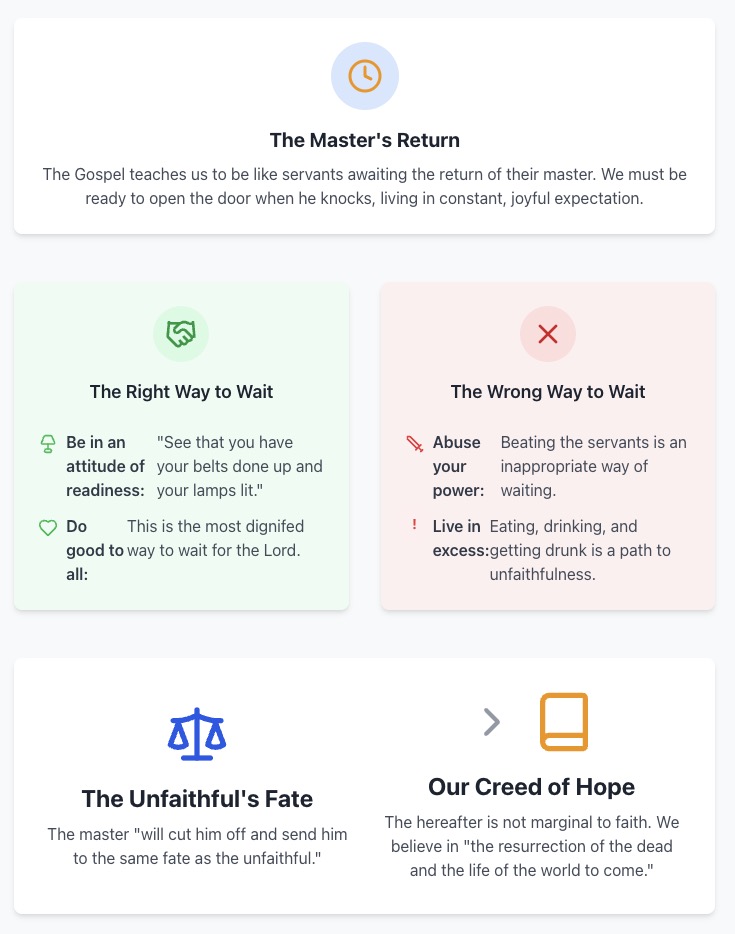
In the Letter to the Hebrews, the patriarchs and the great figures of the People of Israel are portrayed as looking for a homeland. The author of the Letter interprets this quest not in a historical, but in a meta-historical way: “They aspire to a better home, that is, the heavenly home.” God himself, who was faithful by fulfilling his promises in history, will be faithful in the hereafter of history.
The Gospel especially tells us about this meta-historical expectation and hope, by using the image of the master, whose return the servants must await in order to open the door when he knocks. From his very birth, man has been waiting for his Master in some way.
As Christians, we must wait without fear, with joy, because “it has pleased the Father to give you the Kingdom,” and God, our Father, will fulfill our expectations. We must wait in an attitude of readiness at all times: “See that you have your belts done up and your lamps lit.”
Equally, the wait must be a watchful one, for the Lord will come “like a burglar,” when you least expect him. The best way to wait is certainly by doing good to all and by maintaining a dignified conduct. Taking advantage of one’s power by beating the servants, eating and drinking and getting drunk, is an inappropriate way of waiting for the Lord. This is why the Gospel says to us, “The master will cut him off and send him to the same fate as the unfaithful.”
The hereafter, and God’s judgment which this reality implies, may seem mysterious to us, inaccessible to our intelligence, but it is not marginal to the Christian faith. Rather, it is one of the elements constituting our creed: “We look for the resurrection of the dead and the life of the world to come.” We live by hope, but all of the history of salvation has shown us, century after century, that the hope placed in God will not disappoint us
© 2000 Dicastery for the Clergy A | B | C

Infographics on this page have been added by THE WORD THIS WEEK using AI generative tools (i.e. Chart.js and Tailwind CSS). They may be copied for personal use or for any non-profit ministry. Graphics may not be sold or used for personal financial gain.
The Meta-Historical Wait, Hope, and Vigilance in the Catechism
The notes on the meta-historical wait and watchfulness beautifully summarize core aspects of Christian life as taught in the Catechism of the Catholic Church. The themes of hope, the Second Coming of Christ, and the Last Judgment are interwoven throughout the Church’s doctrine.
1. The Theological Virtue of Hope
The notes describe the patriarchs’ quest for a heavenly home and the conviction that “the hope placed in God will not disappoint us.” The Catechism defines this very concept as the theological virtue of hope.
- CCC 1817 states that hope is “the theological virtue by which we desire the kingdom of heaven and eternal life as our happiness, placing our trust in Christ’s promises…” This aligns perfectly with the notes, framing our “meta-historical expectation” as the foundation of Christian hope.
- CCC 1818 adds that hope “keeps man from discouragement; it sustains him during times of abandonment” and “is preserved from selfishness and led to the happiness that flows from charity.” This reinforces the joy and lack of fear mentioned in the notes.
2. Waiting and Watching for Christ’s Return
The image of the servant waiting for the master is a powerful biblical metaphor for Christian vigilance. The notes’ emphasis on being “ready at all times” and on the Lord coming “like a burglar” is a direct reflection of the Catechism’s teaching on the Second Coming of Christ (also known as the Parousia).
- CCC 673 explicitly addresses this theme, stating that Christ’s coming in glory is “imminent,” but that we do not know the “times or seasons.” This unpredictability is precisely why watchfulness is essential.
- The Catechism further notes that we must be ready because this eschatological coming “could be accomplished at any moment.” The call to have our “belts done up and your lamps lit” is a timeless symbol of this readiness.
3. Dignified Conduct and the Last Judgment
The notes warn against an “inappropriate way of waiting for the Lord” and mention the judgment that awaits the unfaithful. This directly relates to the Catechism’s teaching on the Last Judgment and the importance of our actions in this life.
- CCC 678 describes this judgment, stating that “the conduct of each one and the secrets of hearts will be brought to light.” The Catechism emphasizes that our “attitude to our neighbor will disclose acceptance or refusal of grace and divine love,” which is why “doing good to all and… maintaining a dignified conduct” is the best way to wait.
- The notes’ warning that “the master will cut him off and send him to the same fate as the unfaithful” is a powerful reminder of the eternal consequences of rejecting God’s love and living a life contrary to charity.
4. The Creed and Our Ultimate Hope
The notes conclude by citing a fundamental part of the Nicene Creed: “We look for the resurrection of the dead and the life of the world to come.” This confirms that our faith is rooted in this future reality, and the Catechism elaborates on this point.
- CCC 1042 confirms that “at the end of time, the Kingdom of God will come in its fullness.” This resurrection and new life are the definitive fulfillment of God’s plan and the ultimate reward for the faithful. The hope we place in God is a certainty because it is a promise tied to God’s fidelity throughout the history of salvation.
Pastoral Suggestions
Looking at the Present with Forward-looking Eyes
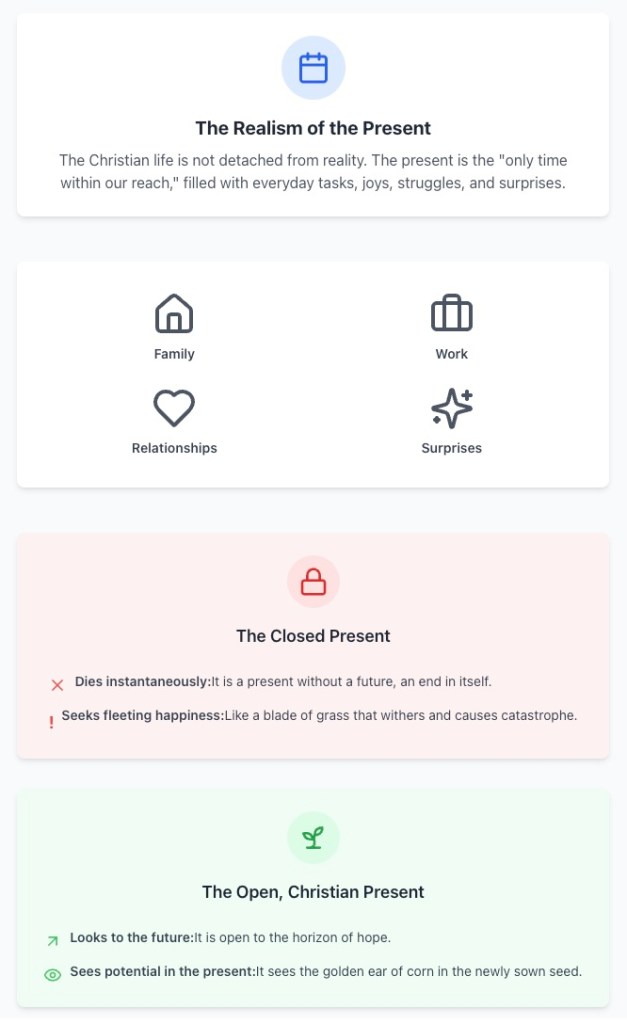
The Christian is not a utopian being, a dreamer cut off from the present down-to-earth reality. Christianity lives the realism of the present, with the small everyday tasks, with the small or large projects, with the struggle for the life and survival of many human beings, with the crime news in the papers or on television, with the little surprises that knock on our door every now and then.
Actually, life is either lived in the present or it is not lived at all. The present is the only time within our reach, for the past has already faded and the future does not yet have a substance of its own. The present is
- the land on which I tread,
- the family in which I live,
- the girl-friend whom I love,
- the sick mother,
- the restless son,
- the office where I work,
- the parish I walk past each day,
- the blood test I’ve had or
- the new car that I have just bought.
Our gaze must be fixed on this present; we must not escape it; we must accept it in all of its reality, whether it be sad or pleasing. We must not be afraid of the present, we must look at it in the face, with strength.
However, the present does not exist in a water-tight compartment. By its very nature, it is open to the future that step by step, inexorably becomes the present. We cannot forget about this future in our present everyday life. Hence, we must look at the present with forward-looking eyes. The future is the horizon of the present, it is hope.
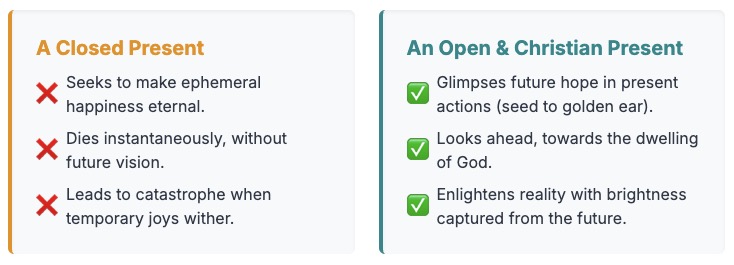
A present that is closed dies instantaneously. An open present already glimpses the golden ear of corn in the seed that was just sown in the earth. A closed present seeks to make the blade of grass, of ephemeral happiness, eternal, but this grass withers away, causing catastrophe. An open and Christian present looks ahead, it looks forward and forward until it enters the very dwelling of God. May your eyes enlighten the present reality with the brightness that they have captured looking to the future.
© 2000 Dicastery for the Clergy A | B | C
Infographics on this page have been added by THE WORD THIS WEEK using AI generative tools (i.e. Chart.js and Tailwind CSS). They may be copied for personal use or for any non-profit ministry. Graphics may not be sold or used for personal financial gain.
1. The Virtue of Hope as a Forward-Looking Vision
The Catechism defines hope not as mere optimism, but as a supernatural gift from God.
- CCC 1817 states that hope is “the theological virtue by which we desire the kingdom of heaven and eternal life as our happiness, placing our trust in Christ’s promises…” This aligns perfectly with the homily’s idea that our gaze must be fixed on the present while being open to the “horizon of the present, it is hope.” This hope is not for a better job or a new car, but for the ultimate happiness of eternal life.
- CCC 1818 explains that hope “purifies [man’s hopes] so as to order them to the Kingdom of heaven” and “keeps man from discouragement.” This directly supports the homily’s call to look at the present “with strength,” rather than with fear, and to find meaning in our struggles by orienting them toward God’s ultimate promise.
2. The Significance of the Present
The Dicastery Notes for the clergy emphasizes that “the present is the only time within our reach,” which is a foundational concept in the spiritual tradition of the Church. This idea is reflected in the writings of many saints, such as St. Thérèse of Lisieux and St. Padre Pio, who teach the holiness of the present moment. God meets us here, in the daily reality of our lives, from the office where we work to the family in which we live. The Catechism affirms that grace—the life of God—is a gift of the present moment, helping us to sanctify our daily actions and responsibilities.
3. The Integration of Present Actions and Future Hope
This is where the connection is most profound. The note’s warning against an “ephemeral happiness” that withers away is a call to integrate our earthly lives with our eternal destiny. The Catechism addresses this dynamic head-on.
- CCC 1049 states: “Far from diminishing our concern to develop this earth, the expectancy of a new earth should spur us on… That is why, although we must be careful to distinguish earthly progress clearly from the increase of the kingdom of Christ, such progress is of vital concern to the kingdom of God, insofar as it can contribute to the better ordering of human society.”
This paragraph beautifully reconciles the two concepts, confirming that the work we do in the present—building our families, working for justice, living with dignity—is not separate from our final hope. Instead, it is the very “body of a new human family” that is being prepared for the world to come. Our “open present” is truly the foundation upon which the “new earth” will be built.
Watchfulness is Not an Option

The future of each person is unpredictable. The weather man may give us a forecast for tomorrow’s weather, but there is the risk that he may be wrong. The economist may forecast the level of inflation in the country for the month of May or for the year 2003 with a certain degree of precision.
But the history of human beings is impossible to predict, because it is a history of freedom. Who can tell what people will do tomorrow? Who can foresee God’s plans for the immediate or distant future? The unpredictability of the future calls for watchfulness. The prudent and sensible person does not consider a watchful attitude as something that is merely possible, as one among many other options. Watchfulness is the best option.
We must be watchful so that we can finish the last page of the book of our life with a happy ending, and preserve the integrity of our faith, hope and charity, “when he will come.”
Watchfulness is not an option, it is a vital need.
- We must be watchful so that the future does not take us by surprise.
- We must be watchful in order to master events, rather than being mastered by them.
- We must be watchful to make sure that we never lose peace, not even in the face of the most terrible trials and adversities. Actually, those who are watchful have already looked the future in the eyes, and are ready to face it with grace and determination.
- We must be watchful so as to discover God’s writing in the pages of history, to discover the action of the Spirit within us, within people.


Infographics on this page have been added by THE WORD THIS WEEK using AI generative tools (i.e. Chart.js and Tailwind CSS). They may be copied for personal use or for any non-profit ministry. Graphics may not be sold or used for personal financial gain.
The Virtue of Prudence and the Call to Watchfulness
The central message of this Sunday’s readings—that watchfulness is not an option but a vital need—is a beautiful distillation of key Catholic teachings. It primarily connects with the theological virtue of hope, but also with the cardinal virtue of prudence and the eschatological call to be ready for Christ’s return.
1. Watchfulness and the Virtue of Prudence
The Catechism defines prudence as the “charioteer of the virtues” and “right reason in action.” This virtue is at the heart of the homily’s message about mastering events and preserving peace.
- CCC 1806 states: “Prudence is the virtue that disposes practical reason to discern our true good in every circumstance and to choose the right means of achieving it.” It is described as being “careful in discerning things, so as not to be surprised by deceit or trickery.”
- This aligns directly with the homily’s call to be “prudent and sensible” and to cultivate a watchful attitude so that we are not “mastered by [events]” but are instead ready to “face it with grace and determination.” A prudent person, by definition, is watchful.
2. The Unpredictability of the Future and the Second Coming
The future is “impossible to predict” because it is a “history of freedom” and God’s plans are unknown. The Catechism affirms this unpredictability in the context of Christ’s return.
- CCC 673 explicitly states that Christ’s coming in glory is “imminent,” but that “it is not for you to know times or seasons which the Father has fixed by his own authority.”
- This teaches that we should live in a state of constant readiness, as a watchful attitude is the only logical and faithful response to a future that could unfold at any moment. The Catechism calls this time “a time of waiting and watching” (CCC 672).
3. Discerning God’s Action Through the Holy Spirit
The final point is to be watchful in order to “discover God’s writing in the pages of history, to discover the action of the Spirit within us.” This is a fundamental role of the Holy Spirit.
- CCC 1831 teaches that the gifts of the Holy Spirit, such as counsel and knowledge, “make the faithful docile in readily obeying divine inspirations.” The Holy Spirit helps us to “discern what is good, pleasing, and perfect” (CCC 1831, quoting Romans 12:2).
- This directly connects watchfulness with a sensitivity to the Holy Spirit’s guidance. To be watchful is to be attentive to the Spirit’s subtle promptings, allowing us to see God’s hand at work in the world and in our own lives, just as the homily suggests.
In summary, the Catechism provides a robust theological foundation for any homily that speaks about watchfulness, framing it as a necessary virtue that prepares us for Christ’s return, helps us navigate our lives with grace, and allows us to cooperate with the Holy Spirit’s work.