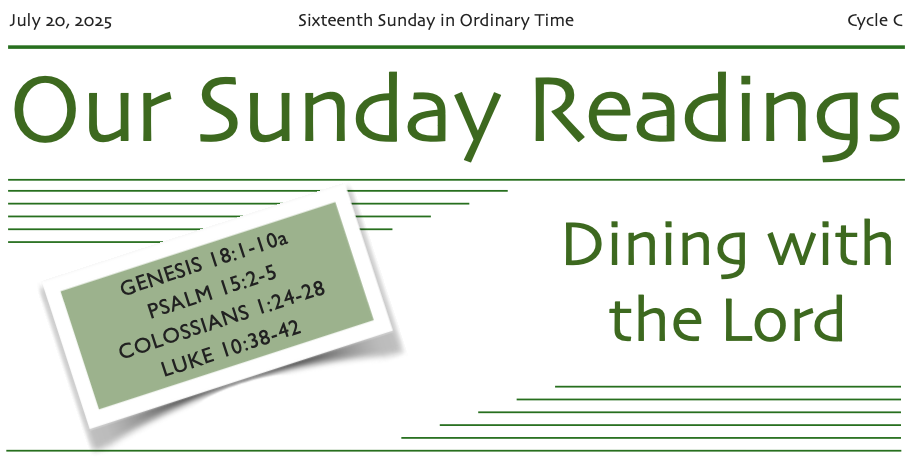
July 20, 2025
July 20, 2025


Intro to Mass Readings for Sunday
Intro to Mass Readings for Sunday


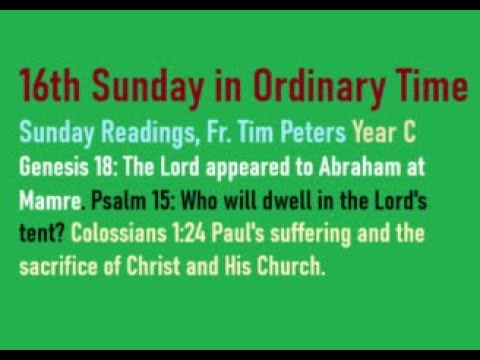
16th Sunday of Year C
Genesis 18:1-10a
Genesis 18:1-10a
POP-UP Video | NAB w/ Notes | LECTIONARY
Click graphic to view intro to reading

Abraham Welcomes
the Lord
Outline of Word-Sunday Essay
by Larry Broding

EXCERPT: As a gracious host, Abraham prepared and served a gourmet meal. [18:6-8] In return, the leader promised Abraham and his wife Sarah a son. Abraham who graciously gave the meal received a gift that was so much greater. He had an heir, one who could help manage the family flocks and the family trade, one who could take care of Abraham and Sarah in their old age, one who could carry on the family name and the family memory.
Who gave him this promise? The Lord [18:1] and his two companions: His “goodness and kindness” (from Psalm 23:6), His “light and truth” (Psalm 43:3), and His “justice and judgment” (Psalm 97:2). (The pairs of divine qualities are given human form by Hebrews; Christians see the wanderers as the three persons of the Trinity.) In other words, God in his fullness gave Abraham the promise of a son. As God promised, so it happened.
Abraham did not hesitate to welcome strangers. And through his welcome, Abraham received the Lord and his promise.
How can we be gracious to others and open to the Lord?
Fr. Tim Peters
FIRST READING

Fr. Peters teaches at Saint John’s Seminary in Camarillo, CA.
Fr. Francis Martin
THE WORD PROCLAIMED

- Kieren O’Mahony OSA
- Fr. Conley Bertrand
- Fr. George Corrigan OFM
- Fr. Thibodeau
- St. Charles Borromeo
- Edriann Ezell
- Vince Contreras
- Bp. John P. Dolan
- Fr. Eamon Tobin
- Carmelite Lectio Divina
Featured Commentary

16th Sunday of Year C
Genesis 18:1-10a recounts the story of Abraham’s encounter with three mysterious visitors, one of whom is revealed as the Lord. In this passage, Abraham exhibits extraordinary hospitality and respect towards the strangers, a virtue highly valued in both the ancient world and modern Roman Catholic theology.
In the Roman Catholic tradition, the virtue of hospitality is derived from the idea of welcoming Christ in the stranger, as mentioned in Matthew 25:35: “For I was hungry and you gave me food, I was thirsty and you gave me drink, a stranger and you welcomed me.” Thus, Abraham’s hospitality towards the strangers can be seen as an exemplary model of Christian charity.

For contemporary Catholics, the application of this message is clear: we are called to practice hospitality and kindness towards others, especially those who are marginalized or in need. This can be expressed through various acts, such as feeding the hungry, providing shelter for the homeless, or welcoming immigrants and refugees. By doing so, we not only follow in Abraham’s footsteps but also live out the Gospel message of loving our neighbors as ourselves (Mark 12:31).
Furthermore, the passage highlights the importance of maintaining faith in God’s promises. Despite his old age and the apparent impossibility of having a child with Sarah, Abraham trusts in God’s assurance that they will have a son. This trust mirrors the Catholic concept of faith, which the Catechism describes as “the theological virtue by which we believe in God and believe all that he has said and revealed to us” (Catechism of the Catholic Church, 1814). Thus, Abraham serves as a model of unwavering faith and trust in God’s divine plan, an example that remains relevant for modern-day Catholics.
Clipart by Fr. Richard Lonsdale

16th Sunday of Year C
Colossians 1:24-28
Colossians 1:24-28
POP-UP Video | NAB w/ Notes | LECTIONARY
Click graphic to view intro to reading
Suffering for the Gospel
Outline of Word-Sunday Essay
by Larry Broding
EXCERPT: Christ began his ministry and made it full on the cross. The mystery of salvation was now made clear. Paul continued that ministry. But, Christ would complete it on the Last Day. This would be the Day when all people would receive their final destiny. Believers would be made whole, body and soul. And they would be made complete as full mature members in the Body of Christ.
Like Paul, we have suffered and will suffer in life. But, will we use our suffering to partake in the ministry of Christ? Are we willing to extend ourselves to others, to bring them the Good News, and help make Christ present in their lives? This is the challenge of Christian living. This is the challenge Paul placed before us with his example.
Where does suffering fit into the meaning of your life? How do you suffer for the Gospel and the good of others?
Fr. Tim Peters
SECOND READING
Fr. Peters teaches at Saint John’s Seminary in Camarillo, CA.
Fr. Francis Martin
THE WORD PROCLAIMED
- Kieren O’Mahony OSA
- Fr. Conley Bertrand
- Fr. George Corrigan OFM
- Fr. Thibodeau
- St. Charles Borromeo
- Edriann Ezell
- Vince Contreras
- Bp. John P. Dolan
- Fr. Eamon Tobin
- Carmelite Lectio Divina
Featured Commentary
16th Sunday of Year C
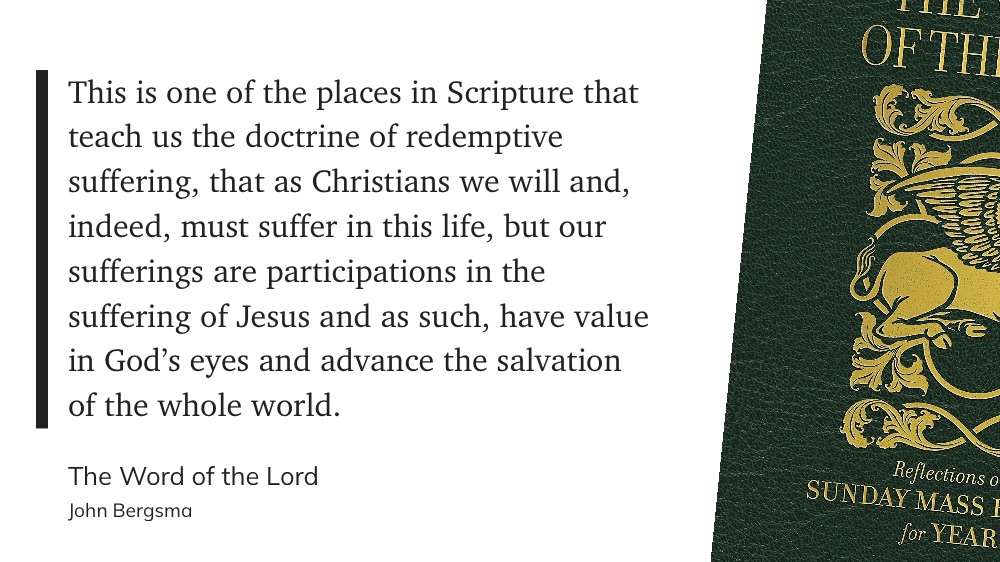
Colossians 1:24-28 speaks of St. Paul’s understanding of his own role in Christ’s mission and emphasizes the importance of making Christ present in our lives. St. Paul asserts that he “makes up in his own sufferings what is lacking in the sufferings of Christ for the sake of the Church” (Colossians 1:24), an idea rooted in Catholic theology.
The Church teaches that Christ’s sacrifice is sufficient for our salvation, but our participation in his sufferings through uniting our own with his can benefit the entire Church, including the souls in purgatory. St. Paul demonstrates a willingness to suffer for the sake of the gospel, an attitude Catholics today are called to imitate.

St. Paul’s words also address the role of the Church and its members in bringing Christ to the world. He mentions “Christ in you, the hope of glory” (Colossians 1:27), highlighting the indwelling presence of Christ within each believer. This presence is the hope and foundation of the Church, the Body of Christ, with each member having a unique role to play (Romans 12:4-5).
In today’s context, Catholics are called to live out this reality by actively participating in the mission of the Church to proclaim the gospel and bring Christ’s presence to the world. This can be done through various means, such as evangelization, acts of charity, and building strong communities that reflect Christ’s love. By doing so, Catholics can, like St. Paul, contribute to the growth and maturity of the Body of Christ.
Colossians 1:24-28 ultimately encourages Catholics to embrace their call to participate in Christ’s mission and make his presence visible in the world. Through the examples of St. Paul and the teachings of the Church, contemporary Catholics can be inspired to fulfill this call with faithfulness and perseverance.
Clipart by Fr. Richard Lonsdale

16th Sunday of Year C
Luke 10:38-42
Luke 10:38-42
POP-UP Video | NAB w/ Notes | LECTIONARY
Click graphic to view intro to reading
The Good Portion
Outline of Word-Sunday Essay
by Larry Broding
EXCERPT: Jesus did not reject the need for serving others. Helping guests is the sign of a gracious host. What Jesus did insist upon was balance. There is a time to prepare for guests and there is a time to socialize with them. There is a time to serve and a time to listen.
When we welcome the Lord, we should prepare for the welcome with prayer but be ready to hear the Lord at every moment. On the one hand, we cannot reduce our spiritual life to prayer. If we do, prayer becomes our speech to God: a list of our needs, wants, and desires. And we do not hear his voice, his call, his word.
On the other hand, we cannot simply go about our business without prayer, hoping the Lord will surprise us. We might not hear his voice. So, we need to prepare our hearts with prayer but have open hearts to hear the Lord.
Like a gracious host, let us prepare to welcome the Lord. Pray for the gift of an open heart this week.
Fr. Tim Peters
GOSPEL

Fr. Peters teaches at Saint John’s Seminary in Camarillo, CA.
Hector Molina

Fr. Francis Martin
THE WORD PROCLAIMED
- Kieren O’Mahony OSA
- Fr. Conley Bertrand
- Fr. George Corrigan OFM
- Fr. Thibodeau
- St. Charles Borromeo
- Edriann Ezell
- Vince Contreras
- Bp. John P. Dolan
- Fr. Eamon Tobin
- Carmelite Lectio Divina
Featured Commentary

16th Sunday of Year C
The Gospel passage of Luke 10:38-42 narrates the story of Jesus’ visit to the home of Martha and Mary, where Martha busies herself with serving while Mary sits at Jesus’ feet, listening to his teachings. This passage highlights the importance of balancing service and contemplation in the life of a disciple, a concept deeply rooted in Roman Catholic theology.
Catholic tradition emphasizes the value of both active service (expressed by Martha) and quiet contemplation (exemplified by Mary). The Church teaches that these two aspects are complementary and necessary for spiritual growth and genuine discipleship. As Pope Benedict XVI noted, “Martha and Mary are the two faces of love for God and neighbor: service to the point of self-sacrifice and contemplative love.” (General Audience, September 15, 2010)

In the modern-day context, Catholics are called to strike a balance between these two dimensions of faith. On one hand, we are called to serve others and engage actively in social and charitable work (Matthew 25:35-40). On the other hand, Catholics are also encouraged to deepen their relationship with Christ through prayer, reflection, and contemplation (Luke 6:12).
The story of Martha and Mary serves as a reminder that while our acts of service are essential, it is equally important to dedicate time for quiet prayer and listening to God. As we navigate the demands of contemporary life, let us embrace this holistic vision of discipleship, nurturing both our active and contemplative sides in the pursuit of true spiritual fulfillment.
Clipart by Fr. Richard Lonsdale

Fr. Conley Bertrand
16th Sunday of Year C

Cycle C (PDFs)
📖 Old Testament (43 pp.)
📖 Epistles (87 pp.)
📖 Gospels (182 pp.)
📖 Daily Gospels (208 pp.)
SOURCE: Come, Lord Jesus
Fr. George Corrigan, OFM
16th Sunday of Year C

Fr. Thibodeau
Bible Study Notes
Small Group Discussion Guide


Bp. John P. Dolan
Fr. Tobin
Carmelite Reflections and Prayers
Lectio Divina

90-page PDF with reflections and prayers for each day of the month
Lectio Divina JULY 2025 (PDF)
Lectio Divina JULY 2025 [Mobi]
Lectio Divina JULY 2025 [ePub]
______________
“Lectio divina is an authentic source of Christian spirituality recommended by our Rule. We therefore practise it every day, so that we may develop a deep and genuine love for it, and so that we may grow in the surpassing knowledge of Christ. In this way we shall put into practice the Apostle Paul’s commandment, which is mentioned in our Rule: “The sword of the Spirit, too, which is the word of God, is to dwell abundantly in your mouth and in your hearts; and whatever things you have to do, let them be done in the word of the Lord.” (Carmelite Constitutions (2019), n. 85.)
Source: Carmelites
FIRST READING | SECOND READING | GOSPEL