

31st Sunday of Year B
November 3, 2024
Holy See
NEW FEATURE: The AI Assistant at the bottom right corner
has been specifically trained for this website.

HOLY SEE
Scroll down the page to read papal homilies from Pope Francis and Benedict XVI.

SOURCE: Vatican News – English

30th Sunday of Year B
Christian Love

“You must love the Lord your God.” This is the message of today’s liturgy and the essence of Christian love. This is the greatest commandment of all (the first is love your God and the second is love your neighbor), Jesus tells us in the Gospel. In the first reading, the people of Israel confess their faith in the one and only God and, on the basis of that faith, they profess their complete and exclusive love for Yahweh. Jesus Christ, our High Priest, practices what he preaches by offering himself to the Father for the salvation of all humanity, interceding for us in heaven.
P. Antonio Izqeuirdo, L.C., Copyright © Dicastery for the Clergy
30th Sunday of Year B
Doctrinal Messages
Jesus’ answer to the scribe who asked him which of the 613 commandments that existed at the time was the first and most important is taken from the Old Testament. The first part is taken from Deuteronomy, which corresponds to the first reading of this Sunday; the second is taken from the book of Leviticus, and refers to love for one’s neighbor (19:18). The novelty of Christian love does not lie in the contents, which are already known and have already been revealed by God. The novelty lies in the indissoluble union between both commandments, which produces a single commandment: "There is no commandment [observe the singular form] greater than these." Love for God and love for one’s neighbor are not two steeds running on their own in the stadium of life. Rather, they are yoked to the same carriage on which the human person travels through history on his journey towards his destiny in eternity. In order for one to be Christian, these two loves must be able to constitute a single inseparable love. This Christian love is also new because in it are summarized and structured all of the other precepts existing in the Jewish world, as well as all the commandments, laws and precepts of Christian existence in each moment of history. The bond of love is the bond of perfection. And from this love all precepts take on the very beauty and perfection of love. The evangelical text ends by saying, "After that no one dared to question him any more." This is to indicate that the answer has hit the nail on the head, and that any other question is superfluous. We Christians discover this new love in Christ’s Cross, where our High Priest offers himself as the victim of love to the Father for the love of sinners (second reading).
P. Antonio Izqeuirdo, L.C., Copyright © Dicastery for the Clergy
Responding to Jesus’ words, the scribe replies, "To love him with all your heart, with all your understanding and strength, and to love your neighbor as yourself, this is far more important than any burnt offering or sacrifice" (Gospel). A new worship seems to insinuate itself in these words, a worship in which burnt offerings and sacrifices have no value in and of themselves but only as the expression of love and only as a predisposition to love, both for God and one’s neighbor, or better yet, to God in one’s neighbor and to one’s neighbor in God. In this sense, it does not matter if the Temple in Jerusalem disappears, or if it is destroyed, because wherever there is true love - the new love - the new worship will be able to continue, in which animals will not be the sacrifices (bulls and billygoats), but the human person in the inner depth of his being. This new worship does not need many priests (in the Temple in Jerusalem hundreds of priests would exercise their office each day); it needs only one Priest, Jesus Christ, the High and Eternal Priest before the Father who has come to redeem men. The priests of the new covenant do not increase the number; rather, they extend in time the only priesthood, which is that of Jesus Christ. In paraphrasing St Augustine, we could say that the new temple in spirit and truth also requires a new worship in spirit and truth; the new worship calls for a new heart, which sings a new song with its lips, but especially with its life
P. Antonio Izqeuirdo, L.C., Copyright © Dicastery for the Clergy
30th Sunday of Year B
Pastoral Suggestions
The vertical beam, the love for God, and the horizontal beam, the love for one’s neighbor, are joined together forever in Christ’s Cross. There is no cross without the coming together of the two beams. There is no Christian love without the union of both loves in the single mystery of the Cross. This statement is important because there is a great temptation to separate what Jesus Christ has united forever: the temptation of loving God in such an exclusive way that we forget about men; or the temptation of loving human beings in such an exclusive way that we forget about God. Unless this temptation is overcome, it will lead to rather detrimental consequences. For example, one leaves prayer to the side because "giving oneself to others and activities for others are already forms of prayer." Or we can end up thinking that we have achieved such perfection in our love for God that we allow ourselves to speak poorly about our neighbor with a clear conscience. Since it is much more difficult to keep these two loves united than to separate them, we must be very careful about our attitudes towards God and towards our brothers and sisters. If at the end of each day every Christian were to examine his conscience in relation to this new love, striving to progress in love day by day, the way in which we experience Christianity would improve for a lot of us. The most significant aspect of these two loves, vertical and horizontal, is that they should constitute a cross and not a comfortable armchair. The experience and life of Jesus Christ tell us eloquently that Christian love, taken to its final consequences, ends in a cross. From this cross, love opens up in all directions: it becomes universal.
P. Antonio Izqeuirdo, L.C., Copyright © Dicastery for the Clergy
The love of Jesus Christ for the Father and for human beings to the ultimate consequence of the Cross and Resurrection is renewed hour after hour at each altar upon which the Eucharist is celebrated. The vertical and horizontal love of Jesus, his universal love, is not part of the past, but runs through history hour after hour and day after day until the end of time. The Eucharist is the redeeming love of Jesus made eternal, beyond the historical conditions of his Passion and Death. Under the guise of the sacrament, the Eucharist repeats his passion of love in the heart of history. In this light, it is possible to understand two urgent pastoral requirements: 1) A generalized and ongoing catechesis, from children to adults, on the richness of meaning and the wonderful fruits of the Eucharist. Those who succeed in discovering the depth of Jesus Christ’s love in the Eucharist will surely fall in love with it. 2) The emerging awareness in the conscience of Christians that the Eucharist of Jesus is inseparable from the Eucharist of Christians. In other words, Jesus Christ’s love for God and for human beings in the Eucharist is an unavoidable imperative in order for the Christian to base his entire life on the single precept of the love for God and for his neighbor. Because of the dynamic action of grace, taking part in the Eucharist brings with it becoming the Eucharist.
P. Antonio Izqeuirdo, L.C., Copyright © Dicastery for the Clergy

Catechism of
the Catholic Church
Cross-References
30th Sunday of Year B

Pope Francis
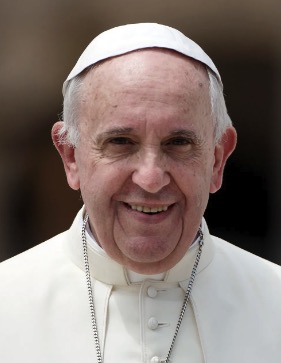

Hear O Israel
4 November 2018 | Saint Peter’s Square
At the heart of this Sunday’s Gospel passage (cf. Mk 12:28b-34), there is the commandment of love: love of God and love of neighbour. A scribe asks Jesus: “Which commandment is the first of all?” (v. 28). He responds by quoting the profession of faith with which every Israelite opens and closes his day, and begins with the words “Hear O Israel: The Lord our God is one Lord” (Deut 6:4). In this manner Israel safeguards its faith in the fundamental reality of its whole creed: only one Lord exists and that Lord is ‘ours’ in the sense that he is bound to us by an indissoluble pact; he loved us, loves us, and will love us for ever. It is from this source, this love of God, that the twofold commandment comes to us: “you shall love the Lord your God with all your heart, and with all your soul, and with all your mind, and with all your strength…. You shall love your neighbour as yourself” (Mk 12:30-31).
In choosing these two Words addressed by God to his people and by putting them together, Jesus taught once and for all that love for God and love for neighbour are inseparable; moreover, they sustain one another. Even if set in a sequence, they are two sides of a single coin: experienced together they are a believer’s strength! To love God is to live of him and for him, for what he is and for what he does. Our God is unmitigated giving; he is unlimited forgiveness; he is a relationship that promotes and fosters. Therefore, to love God means to invest our energies each day to be his assistants in the unmitigated service of our neighbour, in trying to forgive without limitations, and in cultivating relationships of communion and fraternity.
Mark the Evangelist does not bother to specify who the neighbour is, because a neighbour is a person whom I meet on the journey, in my days. It is not a matter of pre-selecting my neighbour: this is not Christian. I think my neighbour is the one I have chosen ahead of time: no, this is not Christian, it is pagan; but it is about having eyes to see and a heart to want what is good for him or her. If we practice seeing with Jesus’ gaze, we will always be listening and be close to those in need. Of course our neighbour’s needs require effective responses, but even beforehand they require sharing. With one look we can say that the hungry need not just a bowl of soup, but also a smile, to be listened to and also a prayer, perhaps said together. Today’s Gospel passage invites us all to be projected not only toward the needs of our poorest brothers and sisters, but above all to be attentive to their need for fraternal closeness, for a meaning to life, and for tenderness. This challenges our Christian communities: it means avoiding the risk of being communities that have many initiatives but few relationships; the risk of being community ‘service stations’ but with little company, in the full and Christian sense of this term.
God, who is love, created us to love and so that we can love others while remaining united with him. It would be misleading to claim to love our neighbour without loving God; and it would also be deceptive to claim to love God without loving our neighbour. The two dimensions of love, for God and for neighbour, in their unity characterize the disciple of Christ. May the Virgin Mary help us to welcome and bear witness in everyday life to this luminous lesson.
Faith as a Journey of Illumination
4 November 2012 | Saint Peter’s Square
This Sunday’s Gospel (Mk 12:28-34) offers us Jesus’ teaching on the greatest commandment, the commandment of love, which is two-fold: love of God and love of neighbour. The Saints, who we have recently celebrated together in a single solemn Feast are precisely those who, trusting in God’s grace, tried to live according to this fundamental law. In fact, those who live a profound relationship with God, just as a child becomes capable of loving, starting from a good relationship with his mother and father, may put the commandment of love fully into practice. St John of Avila, who I recently proclaimed a Doctor of the Church, writes at the beginning of his Treatise on the Love of God: “the cause”, he says, “that mostly pushes our hearts to love of God is considering deeply the love that He had for us…. This, beyond any benefit, pushes the heart to love; because he who gives something of benefit to another, gives him something he possesses; but he who loves, gives himself with everything he has, until he has nothing left to give” (n. 1). Before being a command — love is not a command — it is a gift, a reality that God allows us to know and experience, so that, like a seed, it can also germinate within us and develop throughout our life.
If the love of God has planted deep roots in a person, then he is able to love even those who do not deserve it, as God does us. Fathers and mothers do not love their children only when they deserve love; they always love them, though of course, they make them understand when they are wrong. We learn from God to seek only what is good and never what is evil. We learn to look at each other not only with our eyes, but with the eyes of God, which is the gaze of Jesus Christ. A gaze that begins in the heart and does not stop at the surface, that goes beyond appearances and manages to capture the deepest aspirations of the other: waiting to be heard, for caring attention, in a word: love. But the opposite is also true: that by opening myself to another, just as he or she is, by reaching out, by making myself available, I am also opening myself to know God, to feel that he is there and is good. Love of God and love of neighbour are inseparable and are mutually related. Jesus did not invent one or the other but revealed that they are essentially a single commandment and did so not only through the Word, but especially with his testimony: the person of Jesus and his whole Mystery embody the unity of love of God and neighbour, like the two arms of the Cross, vertical and horizontal. In the Eucharist he gives us this two-fold love, giving himself, because, nourished by this Bread, we love one another as he has loved us.
 Highlight text or double-click a paragraph anywhere on the site to ADD TO NOTES. You can also click ASK AI to copy your selection to the clipboard with a command prompt, ready for you to paste manually into the chat above.