Liturgy, Liturgy Notes, Catholic Liturgy Planning Resources, Sunday Mass Preparation for Ministers / Presiders, Catholic Lectionary Homily and Liturgy Prep
Liturgy Notes, Liturgy Planner, Sunday Prep, Planning for Mass
October 25, 2026
Oct 18 | Today | Oct 25 | Nov 1 | Nov 8






PETITIONS
October 25, 2026
The Church
Governments and Salvation of the World
Those Burdened by Adversity
Local Parish / Faith Community
THE WORD
IN SONGS
THIS WEEK


ONE WORD
MANY CHARISMS
Sunday Lectionary Perspectives Across Religious Traditions


Jeff Cavins

Ascension Press (2017)
Jeff Cavins’ core message is that true love of God is demonstrated by caring for others—especially the marginalized—so we must extend God’s love to every person we encounter in work, home, and community.
Archdiocese of Brisbane
30th Sunday of Year A

Archdiocese of Brisbane (2026)
Deacon Chad Hargrave's central message is that love for God and neighbor—rooted in God’s compassionate nature—underpins all Scripture, law, and the universe, and should guide us to interpret the Bible mercifully and serve the vulnerable rather than justify violence or prejudice.

Archdiocese of Brisbane (2023)
Fr Jason Middleton's core message is that Love is a freely given, reciprocal gift that cannot be forced—God and Jesus invite us to love Him and one another, but true love must be chosen, not compelled.
Bishop John Dolan
30th Sunday of Year A
Diocese of Phoenix (2026)
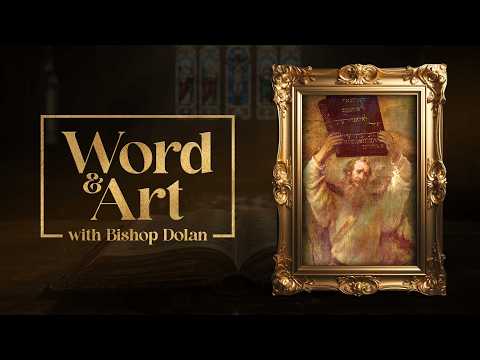
Bishop John Dolan explores Rembrandt’s Moses Smashing the Tablets of the Law. Rather than debating where the Ten Commandments belong in public, Bishop Dolan reminds us that God's law belongs on our minds, lips, hearts, and—above all—in our daily actions. True evangelization means living out the greatest commandment to love God and neighbor, becoming a visible sign of Christ's love.
Fr. Aidan Rooney, C.M.
30th Sunday of Year A

St. John's University (2026)
Fr. Rooney CM urges us to turn inward during the season’s quiet, examine our own hopes and priorities, and transform that self‑reflection into concrete love for our neighbors—especially the vulnerable and marginalized—by turning personal faith into actionable service for all.

St. John's University (2023)
Fr. Rooney CM reminds us that love means actively caring for all neighbors—especially migrants, refugees, and strangers—by confronting the sin‑created borders that treat people as problems and embracing them with compassionate, gospel‑rooted compassion.
Catholic Women Preach
30th Sunday of Year A

Catholic Women Preach (2026)
Kelly Swan urges us to confront fear and injustice—especially toward vulnerable, undocumented students—by turning to the Holy Spirit, embracing love for God and neighbor, and finding simple, clear guidance for our true calling amid a broken, oppressive world.

Catholic Women Preach (2023)
Marielena Hincapié urges us to celebrate All Saints’ Day by recognizing that true joy comes from sharing Christ’s suffering and holiness—honoring everyday saints, embracing sacrifice for justice, and following Jesus’ example of prayer, love, and hope.
Bishop James Golka
30th Sunday of Year A

Diocese of Colorado Springs (2023)
Bishop Golka's core message is that true religion—especially Christianity— is a divine encounter that calls us to love God completely and love our neighbor, viewing God’s law not as a rigid checklist but as a gracious guide that animates and gives purpose to our lives in Christ.
Know Before You Go
30th Sunday of Year A
Coming Soon!
Dominican Friars (2026)
TBD

Dominican Friars (2023)
Joe Trout, OP breaks open the readings for the Thirtieth Sunday in Ordinary Time, suggesting that we look to the example of the saints to find real answers to the difficult question of how to love our neighbor in a confusing and broken world. True love—rooted in loving God first—calls us to protect and care for the vulnerable.
Catholic Women Preach (202o)
Fr. James Marchionda OP breaks open the Sunday readings, reminding us that the God of Restoration needs us to hear the cry of the poor. God calls us to respond with compassion and restoration, following the example of Jesus in uplifting those who are marginalized and in distress.
1-Minute Homily
30th Sunday of Year A

The Jesuit Post (2023)
Love God fully as your unshakable foundation, and then you’ll naturally love and serve others, letting every step be guided by His wisdom.
Cardinal Luis Tagle
30th Sunday of Year A
Jescom TV (2023)
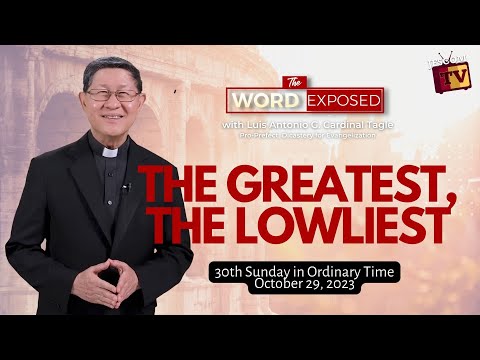
True worship of God is expressed by loving Him completely and caring compassionately for the vulnerable—widows, orphans, the poor, migrants and strangers—through humble, self‑sacrificial service that fulfills the greatest commandment.
SOLT Liturgy Prep
30th Sunday of Year A

SOLT (2023)
Father Brady's core message is that Jesus teaches the single, all‑encompassing command: love God wholly—with heart, mind, and soul—and let that love naturally extend to loving your neighbor as yourself.
The Word on the Word
30th Sunday of Year A

EWTN (2023)
Love is a conscious, all‑encompassing choice to follow God—giving Him our whole heart, soul, and mind, seeking continual communion through prayer, sacraments, and Christ‑like service to others, and expressing that love by caring for the people He placed in our lives.
Liturgy Notes

Courtesy of The Sunday Mass—2023 Cycle A



30th Sunday of Year A

Call to Action for a Just Society
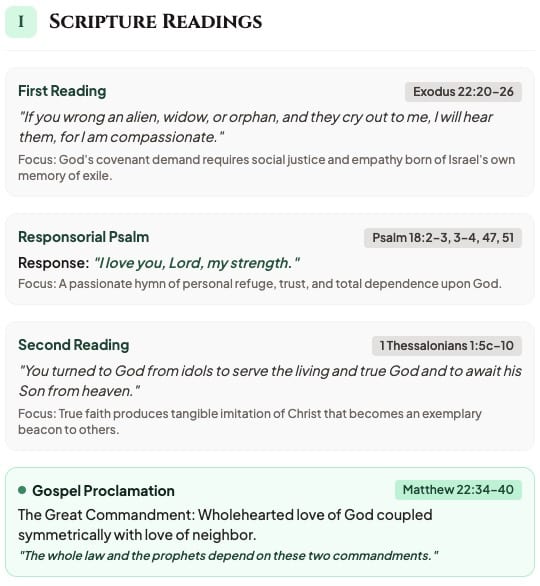
What do you think might happen if you stood up in the halls of Congress and proclaimed today’s first reading? No doubt you would quickly be removed from the room. Would members of our ruling bodies respond to the commands of God recorded in Exodus?
Maybe we should also consider what might happen in your parish assembly when this text is proclaimed this weekend. Will your hearers recognize that God’s commands apply today just as much as they did when this passage was written?
God tells the Israelites not to “molest or oppress” the aliens in their midst. The reason is significant: They were once aliens themselves, so they should recognize aliens as people like themselves who deserve to be treated with kindness and justice. Does not the same principle apply to most of us who live in North America? Only Native Americans can claim not to have alien heritage, though even their ancient ancestors came to these lands from elsewhere. How can we claim that “this is our country” alone and that everyone else should go back where they came from?
God also commands justice and care for the widow and the orphan. In ancient times, these two groups had no means of support. “Widows and orphans” came to represent all the marginalized in society, and this command of God leads directly to the social justice teachings of the Catholic Church. Jesus’ own example of care for the outcasts of society also calls us to heed God’s commands to love all people, especially those in need.
Full Series: Cycle A Resources
Next Sunday, November 1, 2026 is the Feast of All Saints. Monday is All Souls’ Day, not an obligation day, but still a good day to encourage people to gather and pray for those who have gone before us. What Mass schedule would allow the largest number of people to celebrate both days? Remember that there are multiple choices for readings (Lectionary #668) on All Souls’ Day, so let the lectors and musicians know which ones will be used.

SAINT JOSEPH STUDIOS (12:45) - A brief overview of the historical and scriptural basis for All Saints and All Souls days. This video also briefly summarizes Church teaching on the reality of the Communion of Saints, which includes those in heaven, those on earth, and those "under the earth" (purgatory).
Entrance Song

Response & Acclaim
Response & Acclaim



Presentation & Preparation
Presentation and Preparation
30th Sunday of Year A

Communion
Communion
30th Sunday of Year A

Sending Forth
Sending Forth
30th Sunday of Year A

Many and One (Steve Angrisano, Sarah Hart and Dwight Liles)

Liturgy Blog is a weekly liturgy planning resource for musicians, liturgists, homilists, youth groups, faith sharing groups, and all who look to the liturgical readings for inspiration and nourishment. Join Ken Canedo as he breaks open the Scripture and suggests tracks from the Spirit & Song contemporary repertoire.
Exodus 22:20-26

2026 video courtesy of Lector with Lisa

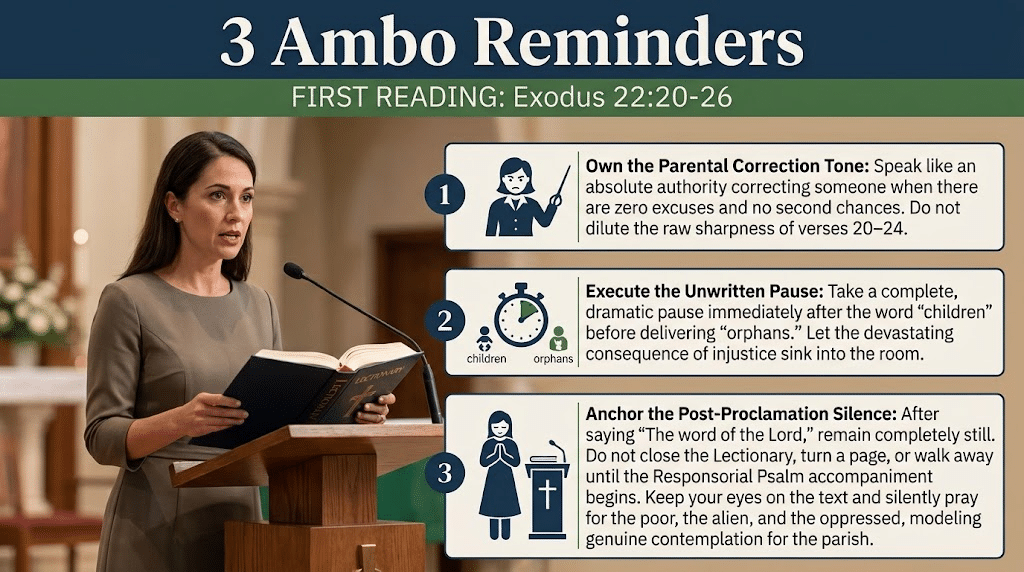
CORE CONCEPT OVER STORY: This is not a gentle narrative; it is divine legislation delivered with absolute, uncompromising correction.
OVERARCHING PACING: Deliberately measured, weighted, and direct. Zero rush.
VOCAL EMOTIONAL PROFILE: Serious, intense parental authority—firm correction with no options or choices—shifting only at the very end to deep covenantal warmth and tenderness.
1st Reading—Delivery Blueprint
Text Segment | Vocal Tone | Pacing & Ambo Actions |
"Thus says the LORD:" | Authoritative, grounded, unyielding. | Stand tall. Lock eyes with the center of the assembly before speaking. Plant your feet firmly. |
"You shall not molest or oppress an alien," | Dead serious, forceful correction. | Slow down significantly. Pronounce every syllable cleanly; let the force of the command hit immediately. |
"for you were once aliens yourselves in the land of Egypt." | Sharp, piercing reminder; "Do you not recall this?" tone. | Direct eye contact across the congregation. Deliver with a pointed "hello—remember where you came from" emphasis. |
"You shall not wrong any widow or orphan." | Firm, protective, zero-tolerance. | Short, deliberate pause before the sentence. Deliver with strict, no-nonsense authority. |
"If ever you wrong them and they cry out to me," | Warning tone; deliberate, conditional intensity ("If you ever..."). | Lean slightly into the text. Build subtle vocal tension on "cry out to me." |
"I will surely hear their cry." | Implacable, solemn promise. | Drop vocal pitch slightly for gravity. Make direct eye contact on "surely hear." |
"My wrath will flare up; I will kill you with the sword;" | Searing, righteous, intense. | Give weight to "flare up." Speak each word with deliberate, chilling clarity. |
"then your own wives will be widows and your children..." | Heavy, sobering reality. | Build to the severe consequence; do not rush through the family impact. |
[Mandatory Breath Pause] | Silence. | Deliberate long pause here. Even with no printed comma, insert a distinct pause after "children" to let the weight register. |
"...orphans." | Final, resonant thud. | Deliver as a standalone dropped hammer. Let the silence hang for 2 beats. |
"If you lend money to one of your poor neighbors among my people," | Shift to instructional yet stern command; personal emphasis on "my people." | Fresh breath. Look up slightly. Stress "poor neighbors" and emphasize "my people" (God claiming ownership). |
"you shall not act like an extortioner toward him by demanding interest from him." | Disdainful of predatory behavior (think cruel pawnshop, not routine banking). | Steady, firm pace. Hit "extortioner" with audible moral disapproval. |
"If you take your neighbor's cloak as a pledge," | Grounded, practical scenario. | Moderate pace. Treat "cloak" with tangible weight (their only warm wrap for sleeping). |
"you shall return it to him before sunset;" | Clear, non-negotiable deadline. | Emphasize "before sunset." Clear, measured cadence. |
"for this cloak of his is the only covering he has for his body." | Urgent, exposing the sheer human vulnerability. | Slow pace down. Stress "only covering." |
"What else has he to sleep in?" | Incredulous, demanding rhetorical question. | Look directly up at the assembly. Allow the question to hang unanswered for 2 seconds. |
"If he cries out to me, I will hear him;" | Reassuring divine guarantee. | Steady, lower volume, resolute certainty. |
"for I am compassionate." | Total vocal shift: Deep, warm, tender, covenantal love. | Slow down fully. Soften timbre completely. Radiate God's protective heart for the weak and vulnerable. |
[The Reflection Silence] | Total silence. | Mandatory 3–4 second pause. Do not move hands or reach for the book. Let the community absorb the shift. |
"The word of the Lord." | Strong, resonant, unwavering conviction. | Return to full vocal strength. Match the authoritative weight carried throughout the reading. |
- Commit to One Color Early: Decide before you approach the ambo whether your opening is roaring majesty or protective warmth; do not muddle the two in the first four lines.
- Use the Couplets to Divide the Room: On the parallel phrases ("Jacob" / "Israel", "rising" / "setting"), share the proclamation intentionally by anchoring one phrase to the left side and the matching phrase to the right side of the congregation.
- Stand Immovable on the Climax: The double declaration ("I am the Lord and there is no other") requires zero physical animation. Let stillness, low pitch, and broad tempo project complete theological certainty.
Exodus 22:20-26
Greg Warnusz


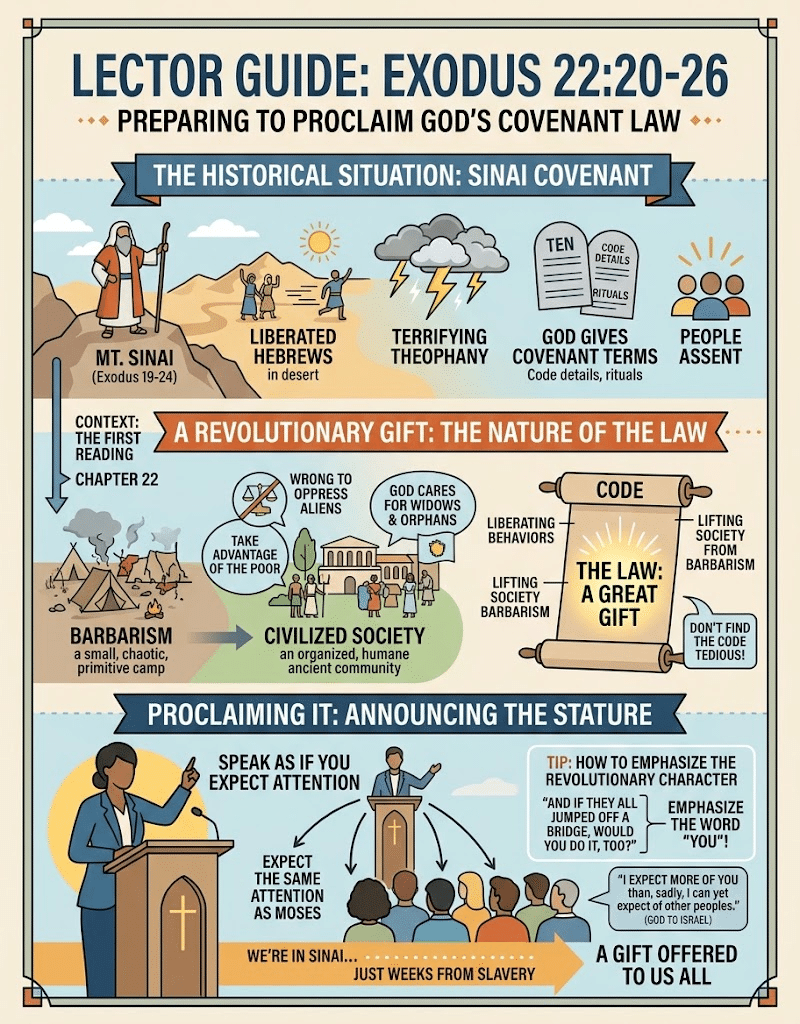
Proclaiming It: When Moses spoke these words the first time, he really got people's attention. When you proclaim them again, speak as if you expect the same, because you appreciate the stature of the Law you are announcing.
You might do this if you want to emphasize the revolutionary character of the Law, as described above: Emphasize the word you every time it occurs. Think of how you would address a child who wants to do something foolish because "all the other kids are doing it." "And if they all jumped off a bridge, would you do it, too?" When God spoke the Law, Israel should have heard implied "I expect more of you than, sadly, I can yet expect of other peoples." (There would come a time, of course, when God's favor, and high expectations, would be shown to extend to all peoples, but we're not there yet. We're only in the Sinai a few weeks out of slavery.)
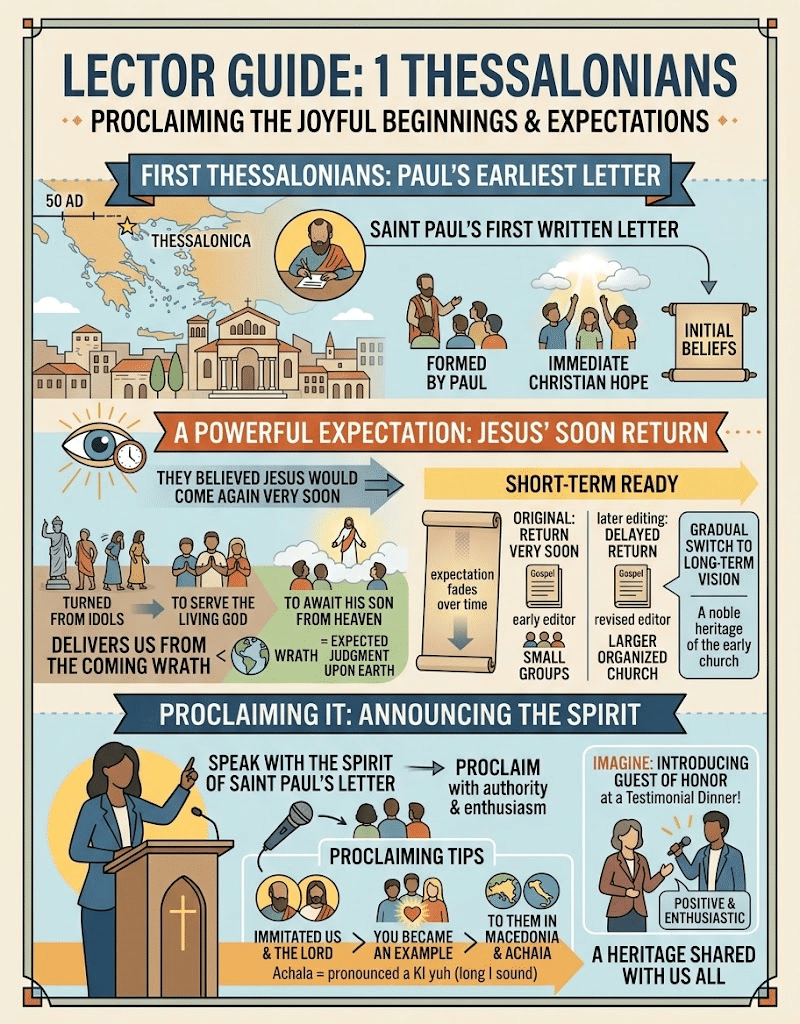
1 Thess 1:5c-10

2026 video courtesy of Lector with Lisa
CORE CONCEPT OVER STORY: This is not abstract ancient correspondence; it is a glowing, deeply personal letter of praise, gratitude, and holy pride.
OVERARCHING PACING: Deliberate, relaxed, and spacious. Zero rush—let every commendation breathe.
VOCAL EMOTIONAL PROFILE: Warm, affectionate, and congratulatory—radiating genuine pride in the assembly, swelling into reverent adoration for the living God, and finishing with ringing, triumphant strength.
2nd Reading—Delivery Blueprint
Text Segment | Vocal Tone | Pacing & Ambo Actions |
"Brothers and sisters: You know what sort of people we were among you for your sake." | Warm, intimate, relational. | Begin with relaxed, direct eye contact across the assembly. Invite them into an affectionate shared memory. |
"And you became imitators of us and of the Lord," | Commending, openly proud. | Steady, unhurried pace. Let the compliment land directly on the congregation. |
"receiving the word in great affliction," | Sober, acknowledging real hardship. | Drop volume and pitch slightly. Honor the weight of their struggle without dragging down momentum. |
"with joy from the Holy Spirit," | Uplifted, bright, radiant. | Noticeable vocal lift. Warm smile in the tone to contrast the affliction with divine joy. |
"so that you became a model for all the believers in Macedonia and in Achaia." | High praise; like introducing the guest of honor. | Emphasize model. Pronounce Achaia cleanly: uh-KAY-uh (long I sound: ah-KAI-yuh). Sweep gaze outward. |
"For from you the word of the Lord has sounded forth" | Resonant, expansive, heraldic. | Give full vocal breadth to "sounded forth"—make it feel broad, echoing, and dynamic. |
"not only in Macedonia and in Achaia," | Measured, rhythmic rhythm. | Repeat the clean pronunciation (ah-KAI-yuh). Keep pace steady and deliberate. |
"but in every place your faith in God has gone forth," | Expansive admiration. | Broaden tone on "every place." Look up and connect with the back rows. |
"so that we have no need to say anything." | Delightful, admiring humor; "You made our job easy." | Relaxed, conversational inflection. Deliver with an appreciative nod toward the listeners. |
"For they themselves openly declare about us what sort of reception we had among you," | Confirmatory, testifying to good fruit. | Clear, medium pace. Ground the sentence with confidence in their authentic welcome. |
"and how you turned to God from idols" | Decisive, stark contrast. | Emphasize the clean break—from empty idols to truth. Firm, grounded inflection. |
"to serve the living and true God" | Vocal shift: Deep tenderness, love, and adoration. | Slow down significantly. Infuse rich warmth and personal devotion into the voice. |
"and to await his Son from heaven," | Expectant, glowing anticipation. | Build quiet excitement into the cadence; look upward slightly or out with bright eyes. |
"whom he raised from the dead, Jesus," | Solemn reverence, central anchor. | Full, steady breath before Jesus. Let His name ring out clearly with deliberate pause. |
"who delivers us from the coming wrath." | Triumphant, resolute, unwavering strength. | Deliver with full vocal power and absolute authority. Stand firm and upright. |
[The Reflection Silence] | Total silence. | Mandatory 3–4 second pause. Remain still. Let the joyful triumph settle over the room. |
"The word of the Lord." | Strong, grounded gratitude. | Look directly into the eyes of the assembly as you speak, remaining in place to receive their response. |
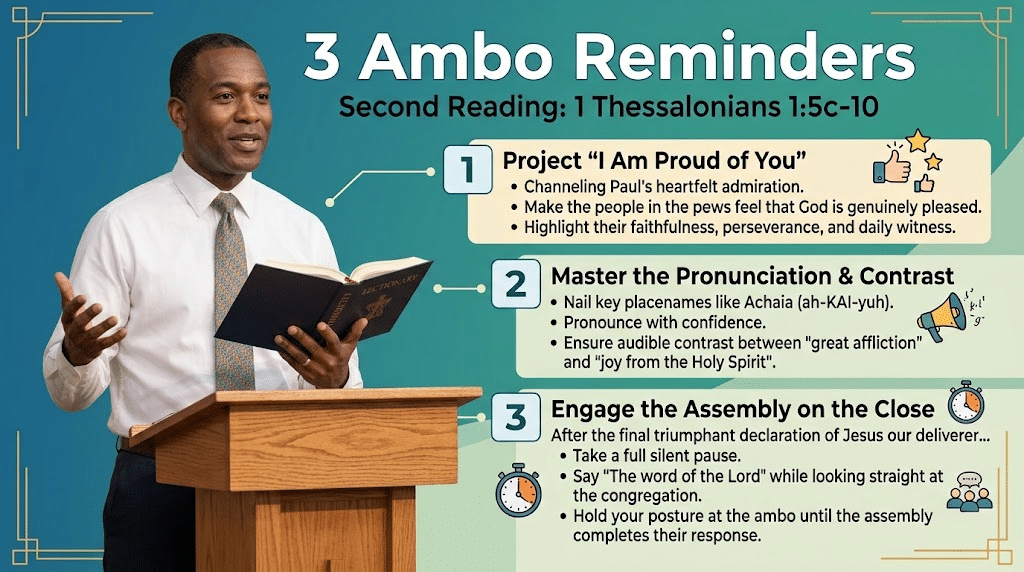
- Own the Congregation as Your Thessalonica: Do not treat this as a postcard from antiquity. Look at the faces in the pews and speak this thanksgiving directly to them as brothers and sisters chosen and loved by God.
- Use the "Look Down, Collect, Look Up" Rhythm: Do not read down into the page. Dip your eyes to capture each distinct clause, raise your eyes fully to deliver it straight to the people, and let the silence between phrases pace the reading.
- Stand Still Until the Alleluia: After proclaiming "The word of the Lord" and receiving the congregation's response, do not rush to move. Step back half a pace, remain still, and absorb the proclamation with the assembly until the Gospel Acclamation music begins. Then close the Lectionary, adjust the book for the priest, and depart gracefully.
1 Thess 1:5c-10
Greg Warnusz

Proclaiming It: Achaia, what is modern Greece, is pronounced a KI yuh, with a long I sound in the second syllable. To decide what inflections to give the pronouns, notice this: the Thessalonians imitated Paul and the Lord, then the Macedonians and Achaians imitated the Thessalonians. That there are three parties ("us," "you," and "them, the Macedonians and Achaians," should be clear to those listening to your proclamation. It might help you capture the spirit of Paul's letter if you imagined yourself introducing the guest of honor at a testimonial dinner. How positive and enthusiastic would you want to sound?
 Highlight text or double-click a paragraph anywhere on the site to ADD TO NOTES. You can also click ASK AI to copy your selection to the clipboard with a command prompt, ready for you to paste manually into the chat above.