Free clip art, comics, graphics for bulletins, web pages, presentations, etc. for 6th Sunday of Sirach 15:15-20 1 Corinthians 2:6-10 Matthew 5:17-37

Clip art, comics, Bulletin Inserts for Sunday

Clip art, comics, Bulletin Inserts for Sunday

Clip art, comics, Bulletin Inserts for Sunday

Clip art, comics, Bulletin Inserts for Sunday

February 15, 2026

February 15, 2026

6th Sunday of Year A

FR. LONSDALE'S CLIPARTSUNDAY GRINSBULLETIN INSERTS

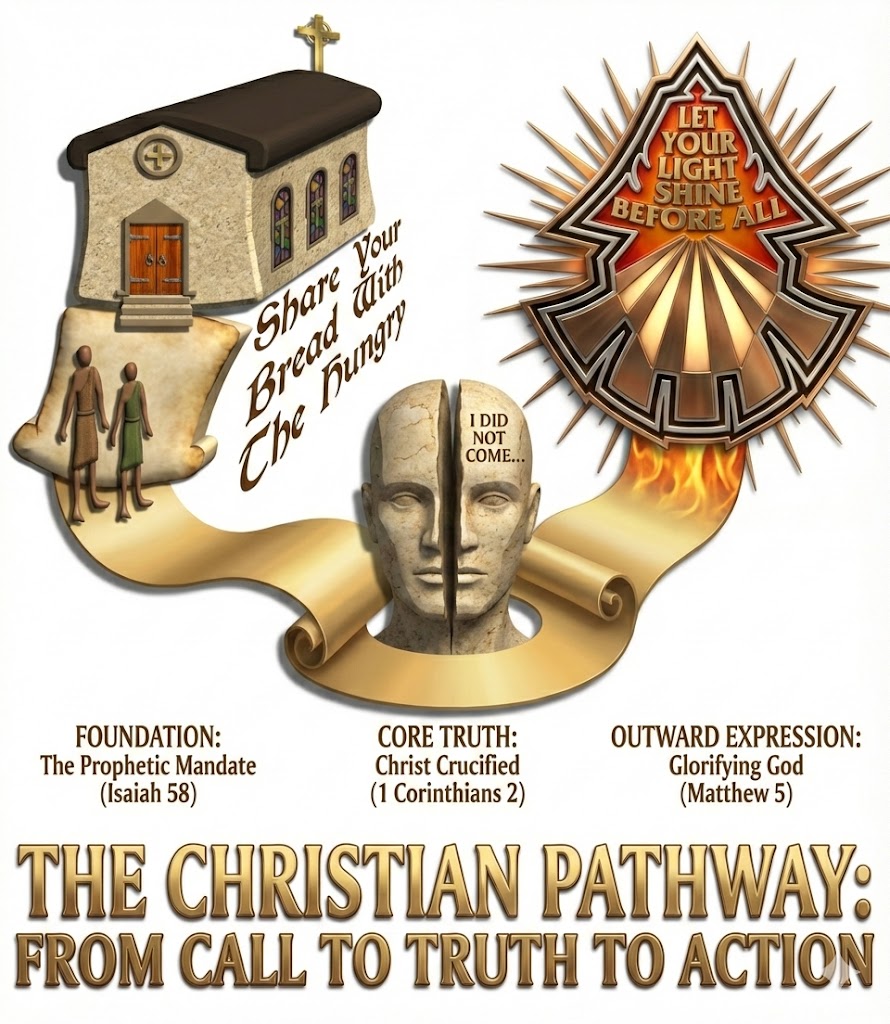
Using provided gif, reimagine it by colorizing it and making it 3-D so image pops out, keep the white background.

Give a detailed art and theology analysis of the image connecting it ############/

First Reading

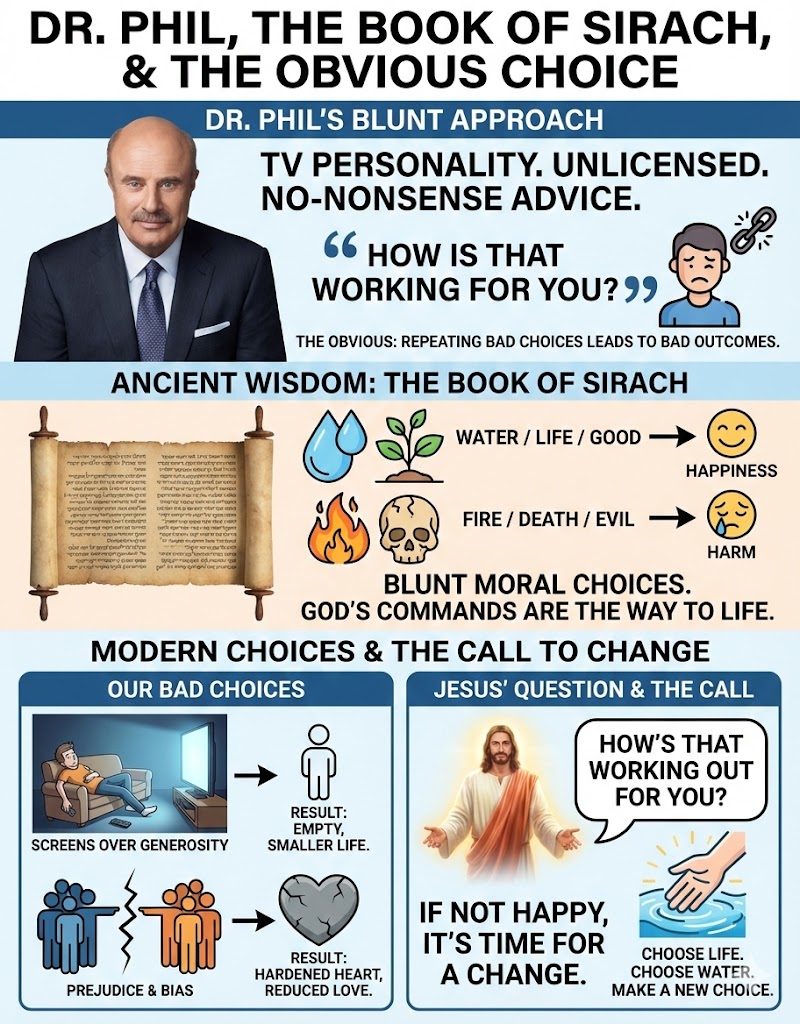
Sirach 15:15-20

CLICK HERE FOR A MORE DETAILED ANALYSIS

I. The Theological Context: The True Fast

To understand the image, one must first understand the scripture it references. Isaiah 58 is a profound critique of empty ritualism. The Israelite community is fasting and praying, yet complaining that God does not see their piety. God responds through the prophet, condemning their fasting as hypocritical because on the same days they fast, they exploit their workers and engage in strife.

God declares that the "fast" He chooses is not merely abstaining from food, but abstaining from wickedness and actively engaging in compassion. Verses 7-10 are the climax of this demand:

"Is it not to share your bread with the hungry, and bring the homeless poor into your house; when you see the naked, to cover him, and not to hide yourself from your own flesh?" (Isaiah 58:7, ESV)

The passage promises that only when these acts of justice are performed will God’s favor return: "Then shall your light break forth like the dawn, and your healing shall spring up quickly" (v.8).

The provided image is a visual representation of this "true fast."

II. Artistic and Theological Analysis of the Visual Elements

The image is composed of three main symbolic elements: The Scroll, the Church Building, and the Human Figures. Their spatial relationship is key to the theological message.

1. The Scroll: The Foundational Mandate

  • Artistic Element: The scroll is rendered as aged parchment, suggesting ancient authority and timeless wisdom. It unfurls beneath the church, acting as the foundation upon which the entire scene rests. The text on the scroll is explicit: "Share Your Bread With The Hungry."
  • Theological Connection (Isaiah 58:7, 10): The scroll represents the Word of God, specifically the prophetic moral law. The text is a direct paraphrase of the first clause of Isaiah 58:7 ("Is it not to share your bread with the hungry?") and verse 10 ("if you offer your food to the hungry"). By placing this command on the foundational scroll, the artist asserts that the entire Judeo-Christian faith tradition is grounded not just in theological dogmas, but in the ethical imperative to care for the vulnerable.

2. The Church Building: Institutional Worship

  • Artistic Element: The church is a sturdy, stone structure with stained glass windows and a golden Celtic cross on the roof. It is centrally located and elevated, sitting directly on top of the unfurling scroll.
  • Theological Connection (The Tension of Isaiah 58): The building represents institutionalized religion—the place of rituals, prayers, and "fasting" that Isaiah’s audience was performing.
    • The Critique: There is a slight visual tension here. The heavy stone building is sitting on the fragile parchment. This visually echoes Isaiah's critique: religious institutions can sometimes become heavy burdens that obscure or even crush the very prophetic message they are meant to uphold.
    • The Ideal: Simultaneously, the image presents the ideal: The Church must be built upon the foundation of the scriptural mandate for justice. If the church is removed from the scroll (the command to share bread), it has no foundation. The image argues that authentic worship (the building) is inseparable from active charity (the text on the scroll).

3. The Figures: The Embodiment of Need

  • Artistic Element: Two stylized figures stand on the bottom left edge of the scroll. They are simple, dark-skinned, and dressed in rough, burlap-like garments. They appear to be an adult and a child, looking up toward the church.
  • Theological Connection (Isaiah 58:7): These figures are direct representations of the categories mentioned in the text: the "hungry," the "homeless poor," and the "naked." Isaiah 58:7 ends with the powerful phrase, "...and not to hide yourself from your own flesh." These figures represent humanity stripped bare of pretense—they are "our own flesh." Their gaze toward the church is a silent interrogation: Will the institution on the hill fulfill the command inscribed on the foundation beneath its feet? They are waiting for the "true fast" to begin.

III. Implicit Theology: Light and Darkness

The lighting in the 3D rendering also carries theological weight connected to the scripture.

  • The Promise of Light: Isaiah 58:8 and 10 are filled with imagery of light overcoming darkness as a reward for obedience.
    • "Then shall your light break forth like the dawn..." (v.8)
    • "...then shall your light rise in the darkness and your gloom be as the noonday." (v.10)
  • Visual Realization: The image is brightly lit from the front-left, casting distinct shadows behind the church and the figures. The bright, clean white background suggests the potential for this divine light. The image captures the moment of decision: If the command on the scroll is obeyed, the "gloom" of empty ritual will be replaced by the "noonday" sun of God's favor. The light is currently shining on the command, highlighting it for the viewer to see.

The image reminds the viewer that a church building that stands tall but ignores the hungry figures at its base is, according to Isaiah, merely engaging in a hollow performance. True faith is manifested in sharing bread.The prophetic Word (the scroll) is the foundation. The ethical demand to care for the poor (the figures and text) is the essential prerequisite for true religion. The institutional Church holds a place of prominence, but its legitimacy rests entirely on its adherence to the scroll beneath it.


Second Reading

1 Corinthians 2:6-10

CLICK HERE FOR A MORE DETAILED ANALYSIS

1. The Left Profile: Human Wisdom as Fragile and Empty

  • Artistic Element: The left half of the human profile is rendered as aged, textured parchment or paper. This material is inherently fragile, temporal, and susceptible to decay.
  • Content: Within this parchment section, several words are cut out in a decorative font: "WISDOM," "IDOLATRY," "WITCHCRAFT," "PHILOSOPHY," and "SCIENCE". The fact that these words are cut-outs rather than printed ink suggests emptiness; they are voids within the human mind rather than substance.
  • Theological Connection (1 Cor 2:1, 4-5): This section visualizes what Paul rejects. He writes that he did not come with "lofty speech or wisdom" (v.1) or "plausible words of wisdom" (v.4), so that faith would not rest in "the wisdom of men" (v.5). The image groups high intellectual pursuits ("PHILOSOPHY," "SCIENCE," "WISDOM") with spiritual errors ("IDOLATRY," "WITCHCRAFT"). Theologically, this asserts that any system of reliance—whether intellectual or pagan—that operates independently of God's revelation is ultimately empty and fragile, like old paper.

2. The Right Profile: The Cross as Solid Reality

  • Artistic Element: In sharp contrast to the parchment, the right half of the profile is rendered as solid, textured stone. Stone conveys permanence, unshakeable strength, and endurance.
  • Content: Carved into this stone is a bas-relief of Jesus Christ on the cross, complete with the "INRI" sign above his head. Unlike the empty cut-outs on the left, this figure has substance, depth, and dimension.
  • Theological Connection (1 Cor 2:2-3): This stone section embodies Paul's singular declaration: "For I decided to know nothing among you except Jesus Christ and him crucified" (v.2). While the Corinthians sought impressive rhetoric, Paul presented a stumbling block—a crucified Messiah. The artwork presents this not as an abstract concept, but as a hard, undeniable, and foundational reality carved in stone. This is the "demonstration of the Spirit and of power" (v.4) that supersedes human eloquence.

3. The Textual Foundation

Theological Connection: This text serves as the explicit caption for the visual metaphor above. It summarizes Paul's posture in 1 Corinthians 2:1-5, rejecting the "sublimity of words" (human rhetorical flourishing) in favor of the simple, yet profound, proclamation of the crucifixion.

Artistic Element: Below the split profile, large, rough-textured metallic letters spell out a direct reference to the scripture: "I DID NOT COME WITH SUBLIMITY OF WORDS I CAME WITH JESUS AND HIM CRUCIFIED". The heavy, industrial aesthetic of the text gives it a sense of weight and finality.

The image uses the visual language of material contrast to interpret 1 Corinthians 2:1-5. It suggests that the “wisdom of men”—encompassing philosophy, science, and alternative spiritualities—is merely a fragile parchment containing empty concepts. Conversely, the message of “Jesus Christ and him crucified” is presented as the solid rock of divine reality. The artwork visually argues that true faith must rest on the permanent foundation of the cross, rather than the temporal emptiness of human intellect.


Gospel

Graphic with the message 'LET YOUR LIGHT SHINE BEFORE ALL' in a stylized font, surrounded by a layered design in black and white.

Matthew 5:17-37

CLICK HERE FOR A MORE DETAILED ANALYSIS

eI. The Artistic Composition: A Visual Imperative

The image is a 3D rendered emblem that functions as a visual command. Its metallic texture, raised elements, and fiery color palette combine to create a sense of urgency, authority, and durability.

  • Structure and Materiality: The object is shaped like a stylized arrowhead or a shield pointing upward. It is rendered with high-quality metallic textures—polished bronze, silver, and gold—giving it a sense of weight, permanence, and value. The 3D effect, complete with realistic shadowing against the white background, makes the emblem appear to "pop out," signifying that the message it carries is not static but active and intrusive in reality.
  • The Typography: The central text, "LET YOUR LIGHT SHINE BEFORE ALL," is rendered in raised, golden capital letters. By sculpting the words out of precious metal, the artist elevates the text from a mere sentence to a solid, undeniable commandment.
  • The Element of Light: The image utilizes two distinct forms of light. The upper section behind the text is a glowing, fiery gradient of deep orange and red, resembling intense heat or a furnace. The lower section features radiating rays of alternating polished gold and darker bronze, simulating light bursting outward and upward from a source.

II. Theological Connection to Matthew 5:13-16

The emblem is a direct artistic interpretation of Jesus’ teaching in the Sermon on the Mount, specifically focusing on the metaphor of light in Matthew 5:14-16.

1. The Command to Be Visible (Matthew 5:14-15)

Jesus states, "You are the light of the world. A city set on a hill cannot be hidden. Nor do people light a lamp and put it under a basket, but on a stand, and it gives light to all in the house."

  • Visual Connection: The emblem visually rejects the idea of a "hidden" faith. The intense fiery background and the golden radiating rays in the lower half symbolize a light that is impossible to ignore. Just as a city on a hill or a lamp on a stand is obvious, this emblem is designed to stand out aggressively from its background. The radiating lines depict light that is actively pushing back darkness, moving outward "before all".

2. The Nature of the Light: Zeal and Purity

While the text speaks generally of "light," the art interprets the quality of that light.

  • Visual Connection: The light is not rendered as a gentle, soft glow. It is fiery, metallic, and intense. The gold and bronze suggest purity and testing by fire. Theologically, this implies that the "good works" mentioned in verse 16 are driven by a passionate zeal for God and are refined in nature. It connects to the preceding beatitudes—this is the light of those who are persecuted for righteousness' sake, yet still shine fiercely.

3. The Ultimate Purpose: Glory to the Father (Matthew 5:16)

The culminating verse of the passage is the crucial caveat: "...so that they may see your good works and give glory to your Father who is in heaven."

Theological Interpretation: This upward trajectory is vital. The emblem directs attention to the command to shine, but its structure ensures the focus does not remain on the human actor. The light shines outward for humanity to see, but the design points upward, visually articulating that the ultimate goal of this shining is not human recognition, but the glorification of the Father in heaven.

Visual Connection: The entire composition of the emblem is oriented upward. The arrowhead shape peaks at the top, and the radiating rays at the bottom serve as leading lines drawing the viewer's eye up through the text and toward the apex.

This 3D metallic emblem visualizes Matthew 5:13-16 as an urgent command. Its fiery background and golden radiating rays reject hidden faith, embodying the call to visible “good works”. The upward-pointing structure ensures this shining light directs glory ultimately to the Father in heaven.

SOURCES: Clip art on the left is from Father Richard Lonsdale © 2000. AI enhanced colorized reimagined clip art of Father Lonsdale’s original images are on the right. To copy the clipart images, click with your right mouse button and use “save picture (or image) as…” To view a complete list of clipart images and commentaries: Lonsdale Commentaries and Clipart
BEDTIME BATTLE
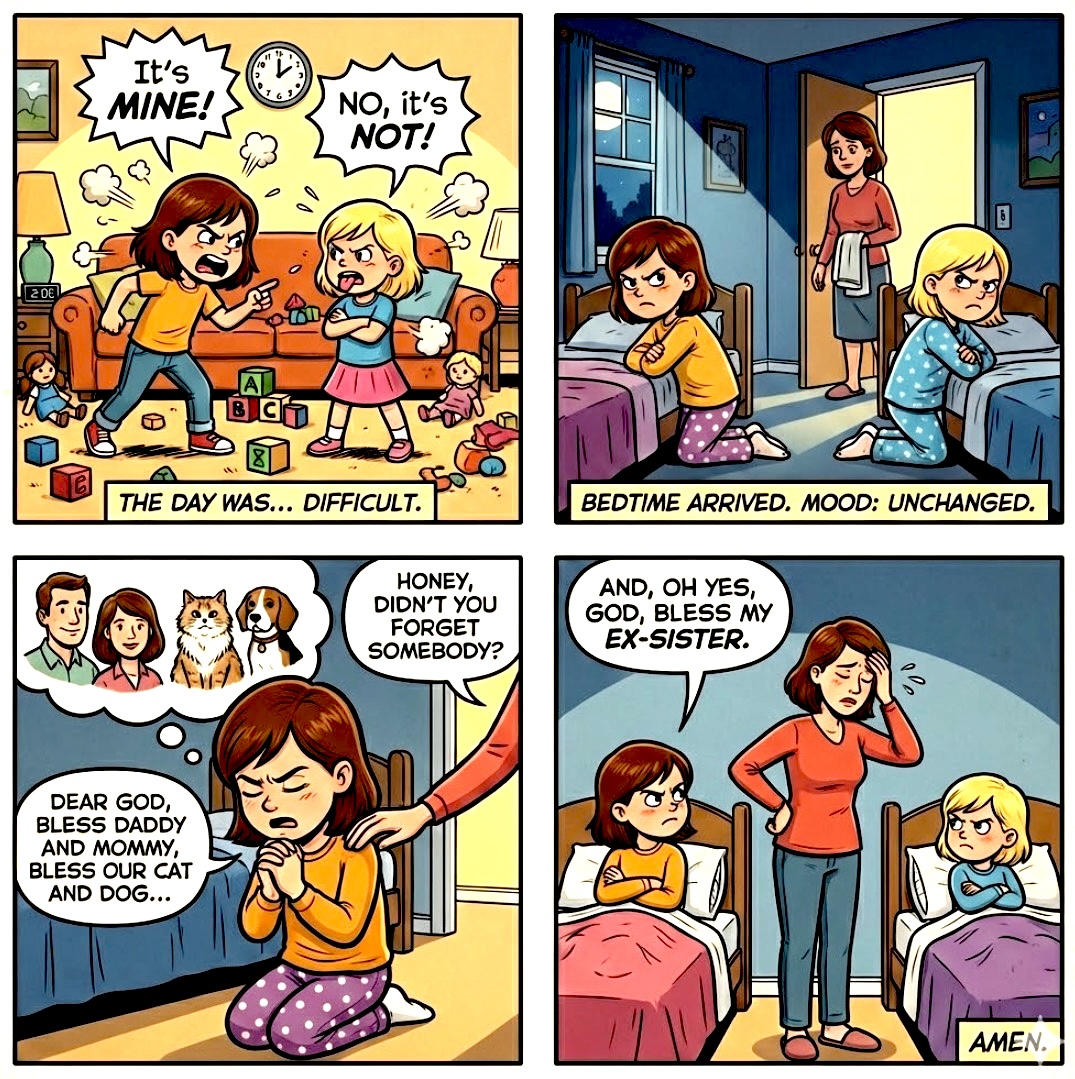
A comic strip depicting two young girls fighting over a toy in a messy living room, showcasing sibling conflict.
TEXT VERSION

Two sisters spent the day fighting. That evening they prepared for bed, still mad at each other. As usual, each knelt by the side of her bed for their prayers. “Dear God,” the 8-year-old began, “Bless Daddy and Mommy, bless our cat and dog.” Then she stopped. Her mother gently prodded, “Didn’t you forget somebody?” She glared across the bed at her 6-year-old sister and added, “And, oh yes, God, bless my ex-sister.” [Pulpit Resource (Jan-Mar 1992), p. 14.]


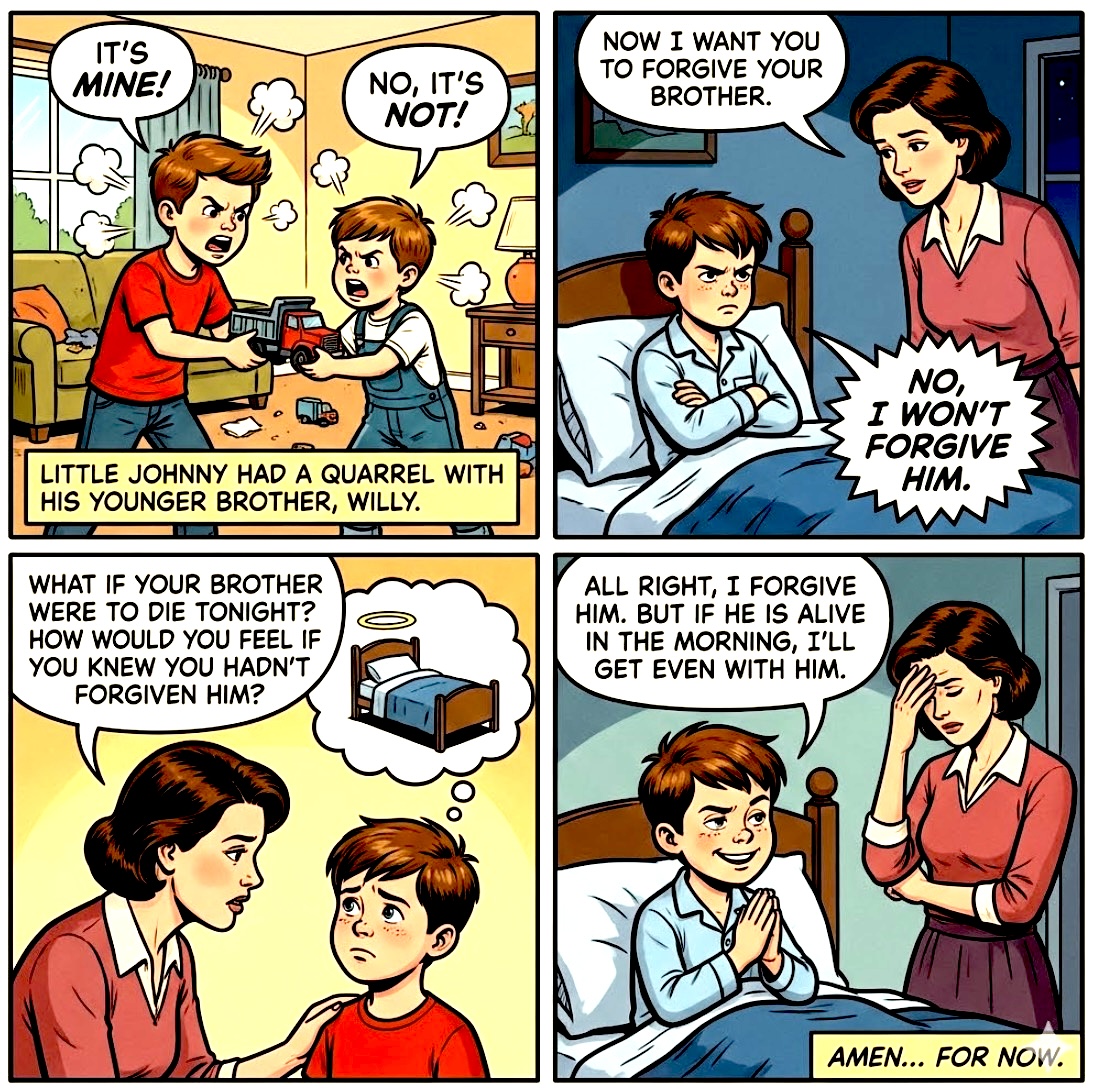
BROTHERLY FORGIVENESS

A comic strip depicting a quarrel between two brothers, Johnny and Willy, over a toy. The mother encourages Johnny to forgive Willy, but Johnny initially refuses. In a reflective moment, the mother poses a hypothetical situation about Willy's potential death, prompting Johnny to reconsider. Ultimately, he agrees to forgive Willy but hints at a plan for revenge, concluding with a humorous 'Amen' from both.
TEXT VERSION

The Over-Seasoned Christian: "Sometimes we try so hard to be the salt of the earth that we become more like a shaker that was left open—just making everyone around us thirsty for something better

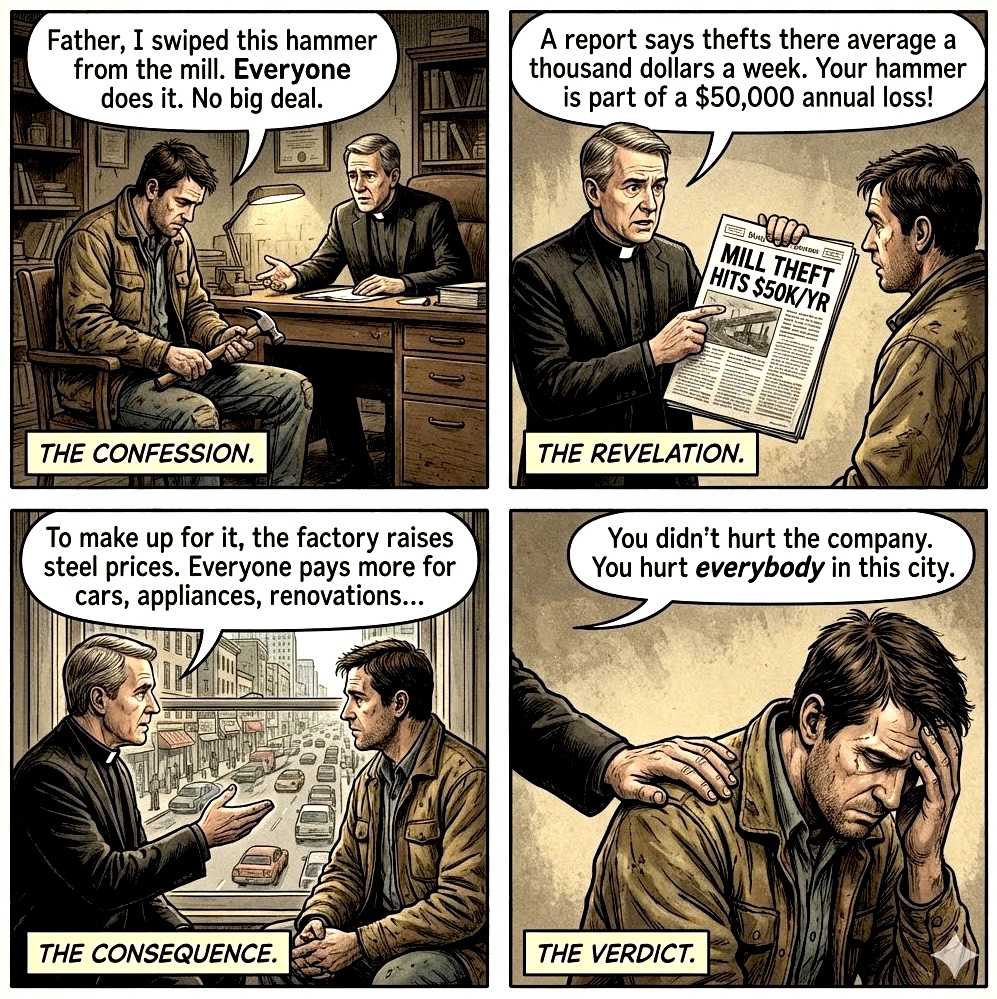
A HEAVY VERDICT

A comic strip showing a conversation between a man and a priest in an office. The man confesses to taking a hammer from the mill, claiming everyone does it. The priest discusses the financial impact of theft on the community, emphasizing the broader consequences of his actions.
TEXT VERSION

Stealing a hammer is no big deal? A man confessed to his pastor that he stole something, a hammer, from the steel mill where he worked. Everybody was doing it, he said. No big deal. His pastor, though, told him about a report in the newspapers that thefts at this particular mill averaged out to a thousand dollars a week. His hammer along with what others were taking was costing the company over $50,000 a year. “To make up for that loss,” his pastor noted, “the factory raises the price of steel. Consequently, everyone who buys a car, purchases an appliance, remodels his house, etc., has to pay the price for your hammer. You didn’t hurt the company,” his pastor assured him, “you hurt everybody in this city” [B.A. Botkin, ed., A Treasury of American Anecdotes (New York: Galahad Books), pp. 205-206).] — And that’s true. We hurt the entire society when integrity is not maintained. It pays to be a person of integrity.


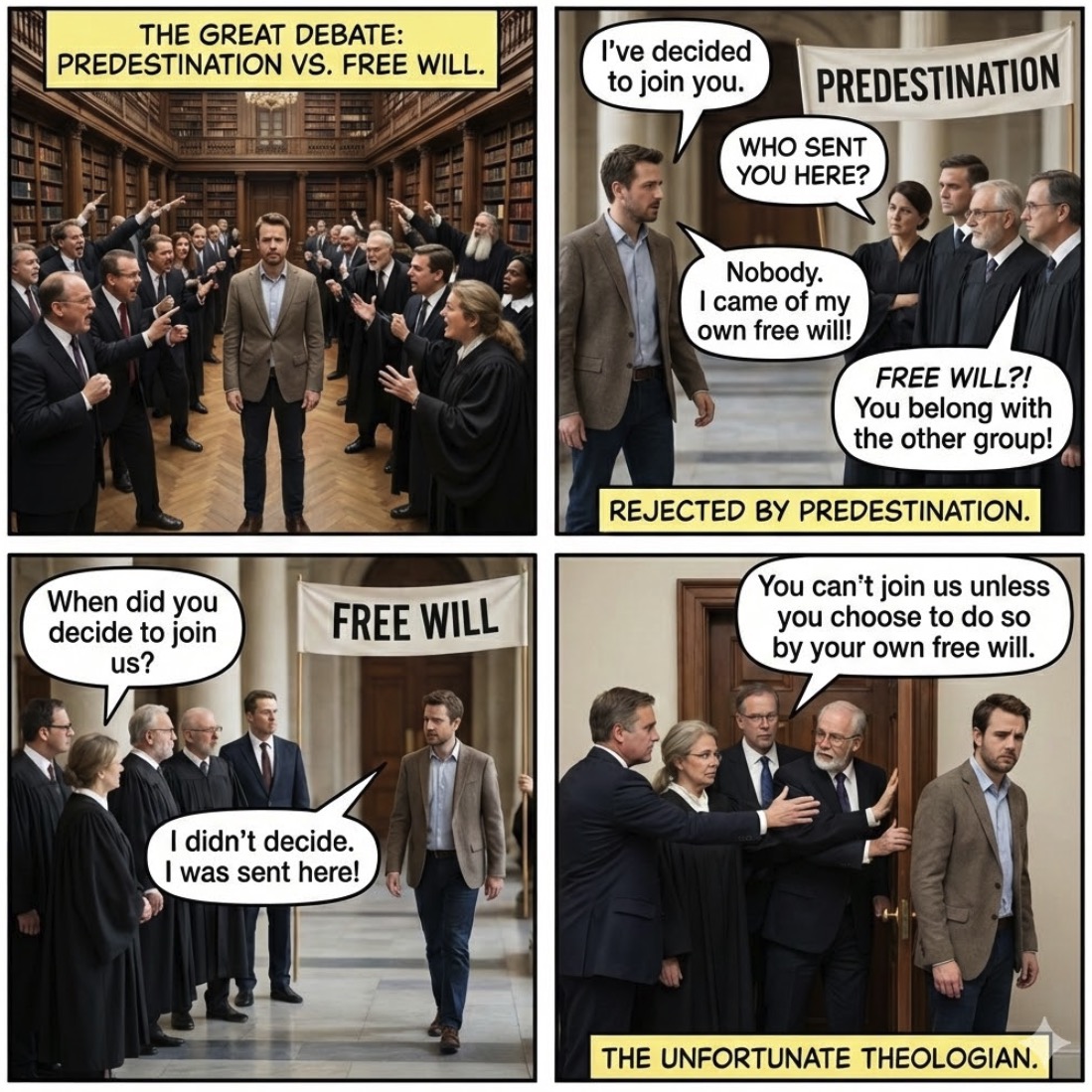
THE GREAT DEBATE

Screenshot
TEXT VERSION

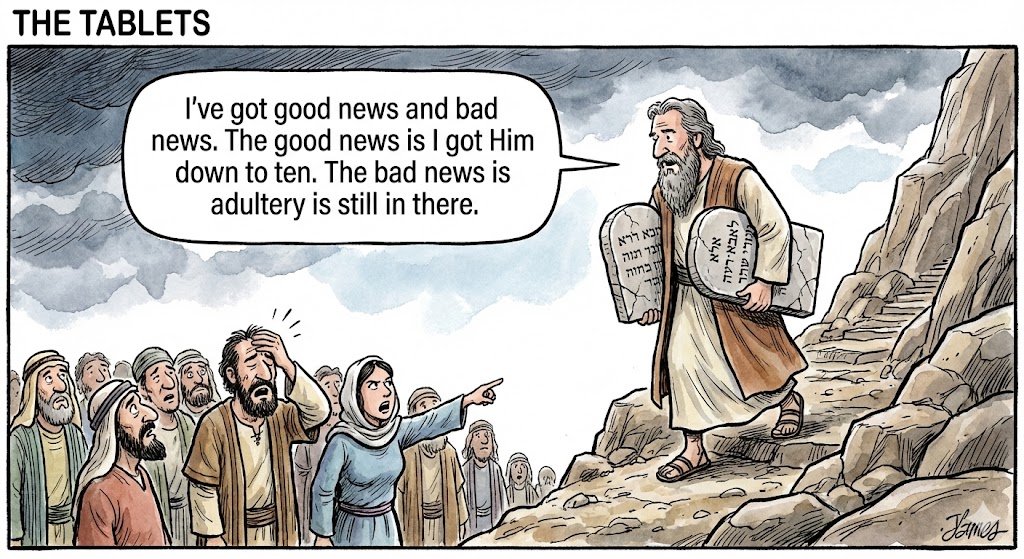
Excluded from both groups: An amusing anecdote relates the experience of a group of theologians who were debating predestination and free will.  Their arguing escalated to the point that the group divided into two factions. But one theologian was undecided as to which group he favored; finally, he decided to side with those who believed in predestination. When he came to join them, they asked, “Who sent you here?” “Nobody”, he replied, “I came of my own free will!” “Free will?!” they shouted. “You belong with the other group.” When he turned and tried to join the proponents of free will, they inquired, “When did you decide to join us?” “I didn’t decide,” the theologian responded. “I was sent here!” At this, the group shut him out saying, “You can’t join us unless you choose to do so by your own free will.” — In the end, the theologian was excluded from both groups. A similar debate concerning human free will forms the backdrop for today’s first reading from Jesus Ben Sirach. (Patricia Datchuck Sánchez) 


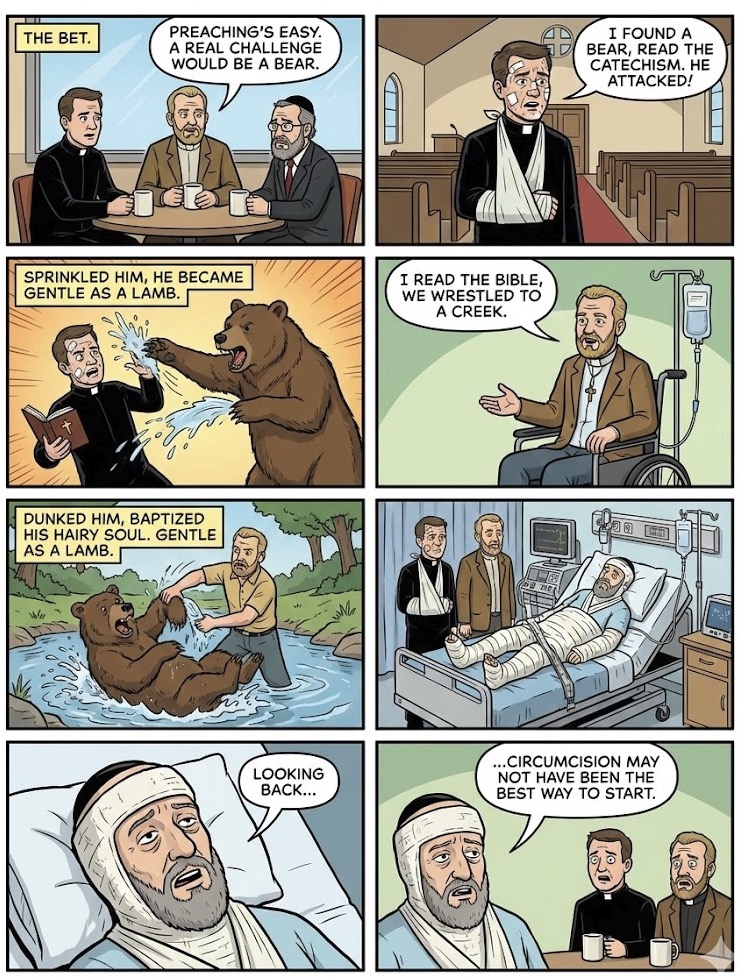
BAPTISM: Catholic, Baptist, Jewish

TEXT VERSION

A Catholic Priest, a Baptist Preacher and a Rabbi were sitting around drinking coffee. Someone made the comment that preaching to people isn’t really all that hard, a real challenge would be to preach to a bear. One thing led to another, and they decided that each would find a bear and attempt to convert it to their religion. Seven days later, they all came together to discuss their experiences.

Father Flannery, who had his arm in a sling and had various bandages on his body and limbs, went first. ‘Well,’ he said, ‘I went into the woods to find me a bear. And when I found him, I began to read to him from the Catechism. Well, that bear came after me and began to slap me around. So I quickly grabbed my holy water, sprinkled him and, Holy Mary Mother of God, he became as gentle as a lamb.’

Reverend Billy Bob the Baptist spoke next. He was in a wheelchair and had an IV drip. ‘I went out and found me a bear. And then I began to read to my bear from the Bible! But that bear came after me. We wrestled down one hill, until we came to a creek. So, I quickly dunked him and baptized his hairy soul. And just like you said, he became as gentle as a lamb.

The Priest and the Reverend both looked down at the Rabbi, who was lying in a hospital bed. He was in a body cast and traction with IV’s and monitors running in and out of him. The Rabbi looked up and said: “Looking back on it, circumcision may not have been the best way to start? 

SOURCE: Comic panels were created using AI based on anecdotes/jokes found at Father Tony’s Homilies. Permission is given for them to be freely copied in any publication for non-commercial use.

Free Clip Art

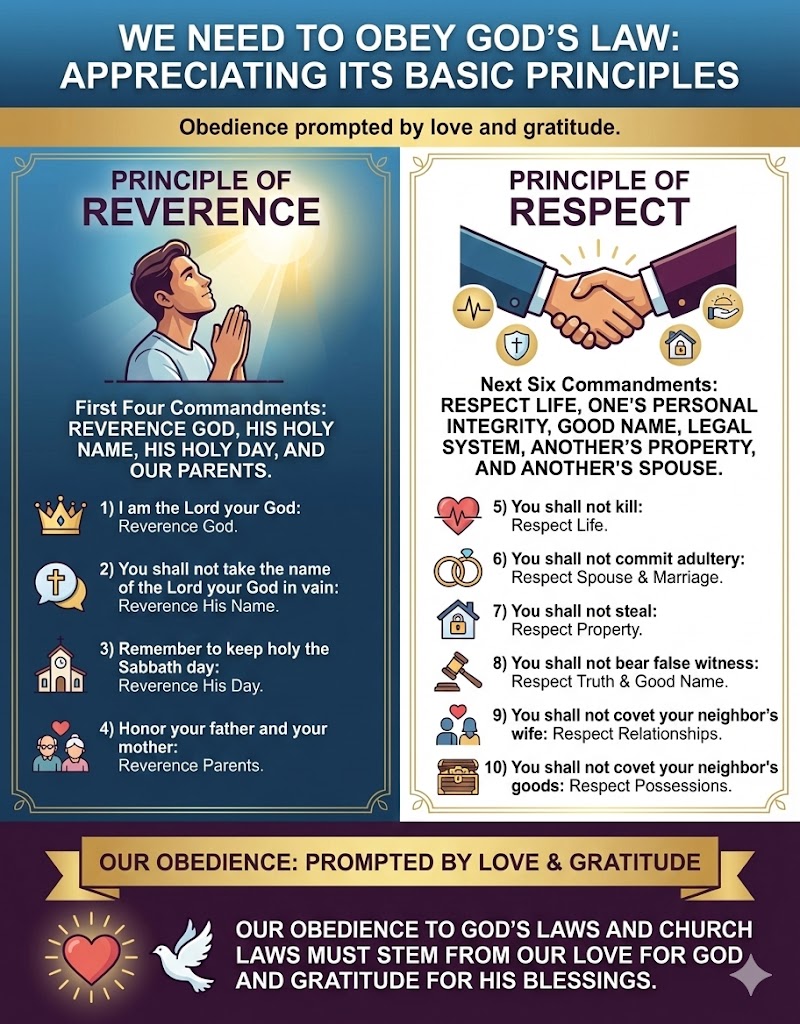
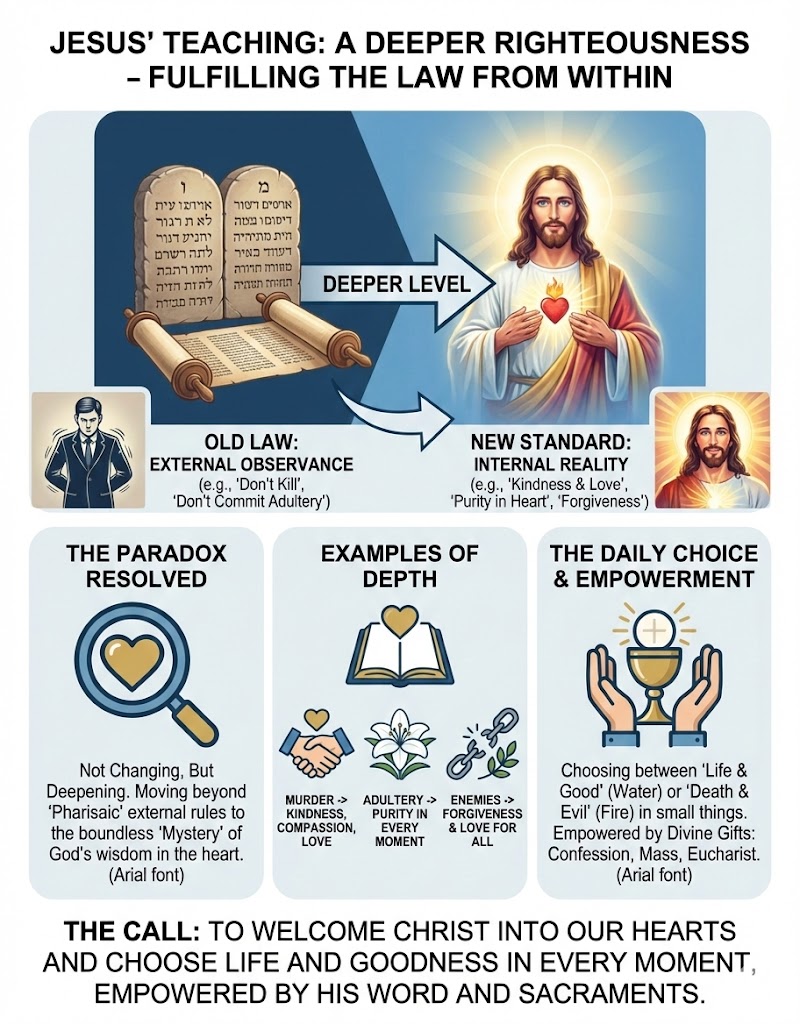
TWTW bulletin inserts on this page were created using Nano Banana and Gemini AI 3.0 Pro. Permission is granted to non-profits to copy, paste them in their publications and websites. Please credit TWTW website.

Free Clip Art