Bishop Barron, Word on Fire
October 25, 2026


30th Sunday of Year A
- 2023 SERMON
- 2026 SERMON

Friends, the Books of Moses teach that the three types of Israelite law—liturgical law, ritual law, and moral law—shape and direct God’s people toward holiness and purity. While the liturgical laws have been carried over and the ritual laws largely set aside, the moral laws remain unchanged, for they represent those great abiding intuitions by which our lives should be structured.
Click Graphic to Enlarge
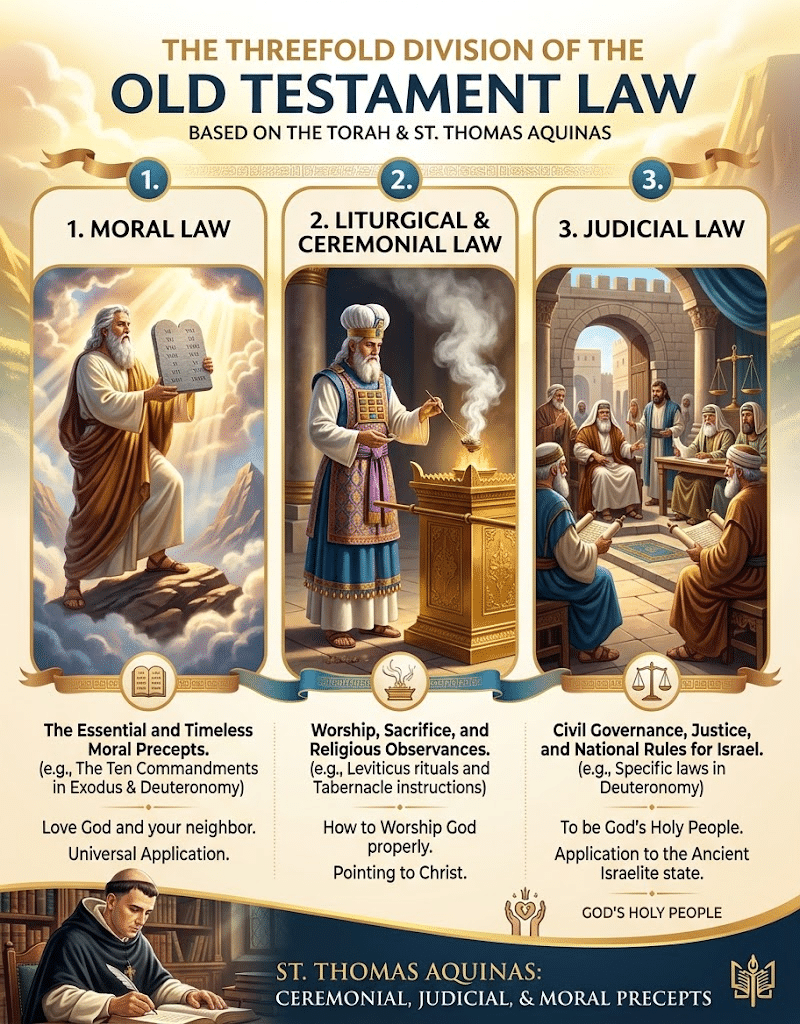
The Threefold Division of the Old Testament Law
Peace be with you. Friends, our first reading contains a wonderful passage on the moral law that God gave to Israel. If you look through the Torah—the first five books of the Old Testament—you will find that Israel is structured according to three types of law: liturgical law, ritual law, and moral law. They are to worship God properly, they are to live in a ritually pure way, and they are to be morally upright. In those three ways, they become God’s holy people.
Look in the Book of Leviticus, for example, and you see page upon page about ritual purity. You will find the moral law sprinkled throughout, particularly in Exodus and Deuteronomy. Liturgical law is prominent as well: Exodus, Leviticus, and Numbers all contain liturgical legislation.
St. Thomas Aquinas was deeply interested in this issue. In the Summa Theologiae, he examines these legal precepts of the Old Testament, categorizing them in his typically pithy way as the ceremonial, judicial, and moral precepts of the Old Law. Our reading today concerns the moral law, but we must situate it within the context of the other two.
Click Graphic to Enlarge
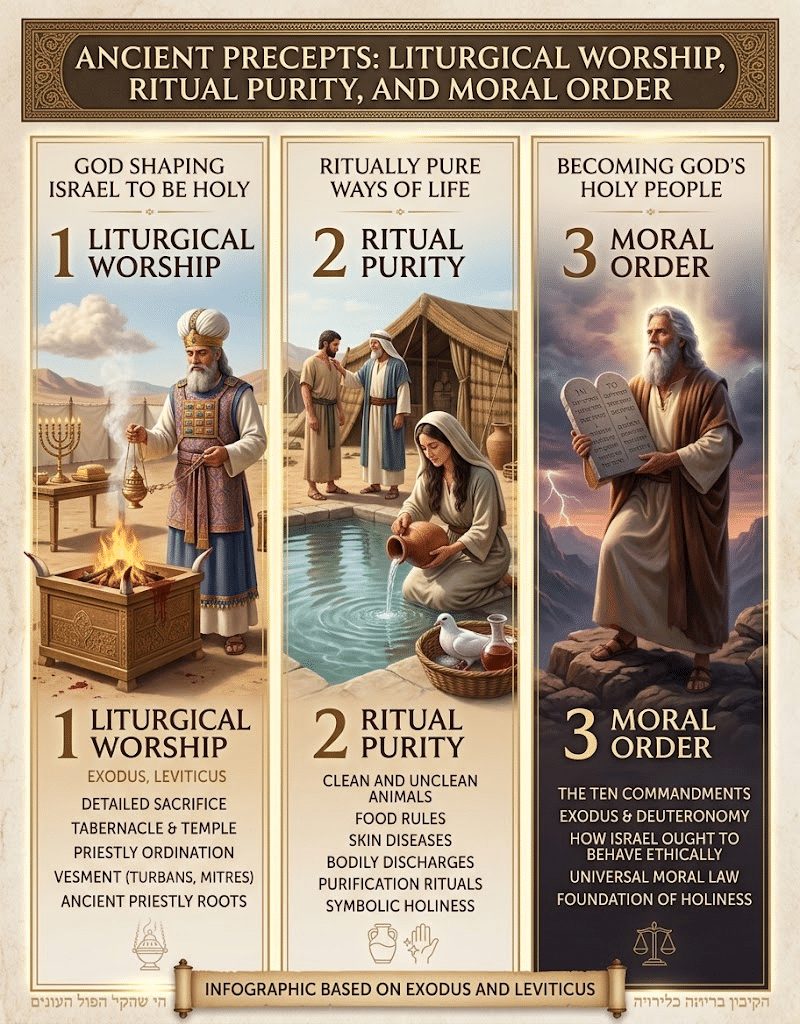
Liturgical Worship, Ritual Purity, and Moral Order
First, consider liturgical law. God wants Israel to worship Him in a particular way; He wants their worship to be correct. Not that God needs our worship—God does not need anything—but rather, it is a way of shaping Israel so that it becomes holy and attuned to God. In Exodus and Leviticus especially, there is extensive instruction concerning sacrifice: the tabernacle (which eventually develops into the temple), the priests and their vestments (including turbans, tunics, and mitres), and the manner of priestly ordination. As a priest, I find that section of the Bible fascinating, because the ritual ordination I received many years ago traces its roots back to the Old Testament. You read about the blood and the altars where sacrifice was offered, and the burning of incense—all the ways Israel’s liturgical life was structured.
Next, regarding the ritual law: opening the Book of Leviticus reveals dozens of pages concerning clean and unclean animals, detailing which animals may be eaten and which may not. You read about diseases of the skin that make one ritually unclean, as well as various bodily discharges, along with the precise rituals required to recover purity.
Finally, we encounter the moral law, which is perhaps most familiar to us. Look in the Book of Exodus to the Ten Commandments, which are reiterated with slight variations in the Book of Deuteronomy and applied throughout Leviticus. Across these texts, moral prescriptions outline how the people of Israel ought to behave ethically.

Click Graphic to Enlarge
Fulfillment, Abrogation, and Endurance in the New Covenant
This raises an essential question for believers today: What has happened to all this Old Testament law? Do we simply abide by it? Has it all been abrogated? What is the status of these laws now?
Look first at the liturgical law. As a Catholic bishop, I see how the Catholic Church has preserved so much of ancient Israel’s liturgical life: tabernacle, temple, altar, sacrifice, incense, priesthood, mitres, vestments, and ordination. All of that was taken up into the Church and given a fresh, definitive focus in Jesus Christ. Christ is the true sacrificial Lamb; the Cross of Jesus is the true altar; Christ Himself is the true High Priest who offers the sacrifice; and the pleasing incense is the offering ascending from Calvary to the Father. All of this carries over into the Catholic priesthood, which participates directly in the priesthood of Christ. Thus, Israel’s liturgical law has been sublimated and given fresh expression in Catholicism.
Regarding the ritual law—the regulations concerning clean and unclean foods or ritual exclusions—much of that has been abrogated and suppressed in Christianity, as seen in the New Testament itself. Jesus declared that it is what comes out of a person that defiles them, not what enters, thereby declaring all foods clean. For a first-century Jew, that was revolutionary. We see this continued in the Acts of the Apostles when St. Peter receives the vision of a sheet descending with clean and unclean animals, and God commands him: “Slaughter and eat.” Though Peter initially resists, the voice repeats the command three times. Furthermore, St. Paul insists that we are justified not by works of the law—such as circumcision—but through faith in Christ. In these ways, the ritual law was set aside.
This brings us to the moral law. St. Thomas Aquinas teaches that the moral law remains fully in force from ancient times, through Christ, and into the life of the Church. The moral teaching of Israel endures across the centuries because it articulates the foundational, abiding principles by which human life must be ethically ordered.
Click Graphic to Enlarge
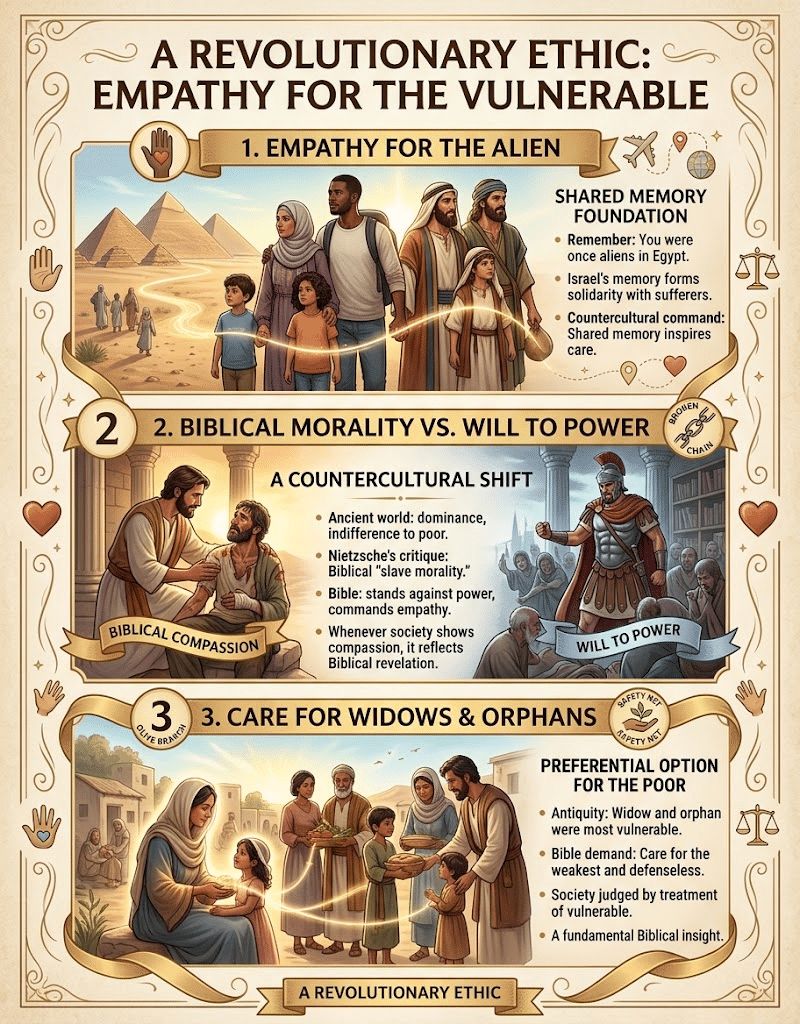
A Revolutionary Ethic of Empathy for the Vulnerable
Listen to what the passage says, noticing not only its relevance to our time, but also how countercultural and surprising this teaching remains:
“You shall not molest or oppress an alien, for you were once aliens yourselves in the land of Egypt.”
Here we find not only a moral injunction against oppressing the alien, but something deeper: empathy grounded in shared memory. Israel is told to remember its own oppression in Egypt and use that memory as the basis for solidarity with those who suffer now.
We often take this principle for granted because Western civilization has been profoundly shaped by the Bible. Yet in the ancient world, this was extraordinary. In texts like The Iliad and The Odyssey, ancient societies celebrated the dominance of the powerful, viewing the poor and oppressed with indifference or contempt. Friedrich Nietzsche later critiqued biblical morality on these very grounds, calling it a “slave morality” and attempting to revive the classical will to power. The Bible stands directly against that view, commanding empathy for the suffering. Whenever society is at its best in showing compassion to the outsider, it reflects this biblical revelation surging into human consciousness.
The passage continues:
“You shall not wrong any widow or orphan.”
In antiquity, widows and orphans were the most vulnerable members of society, lacking institutional support or social safety nets. Unless extended family took them in, they faced destitution. The biblical command demands what we now call a preferential option for the poor, the forgotten, and the marginalized. Rather than exulting in self-sufficiency, we are commanded to direct our care toward the weakest and most defenseless. The conviction that a society is judged by how it treats its most vulnerable members is a fundamentally biblical insight.
Click Graphic to Enlarge
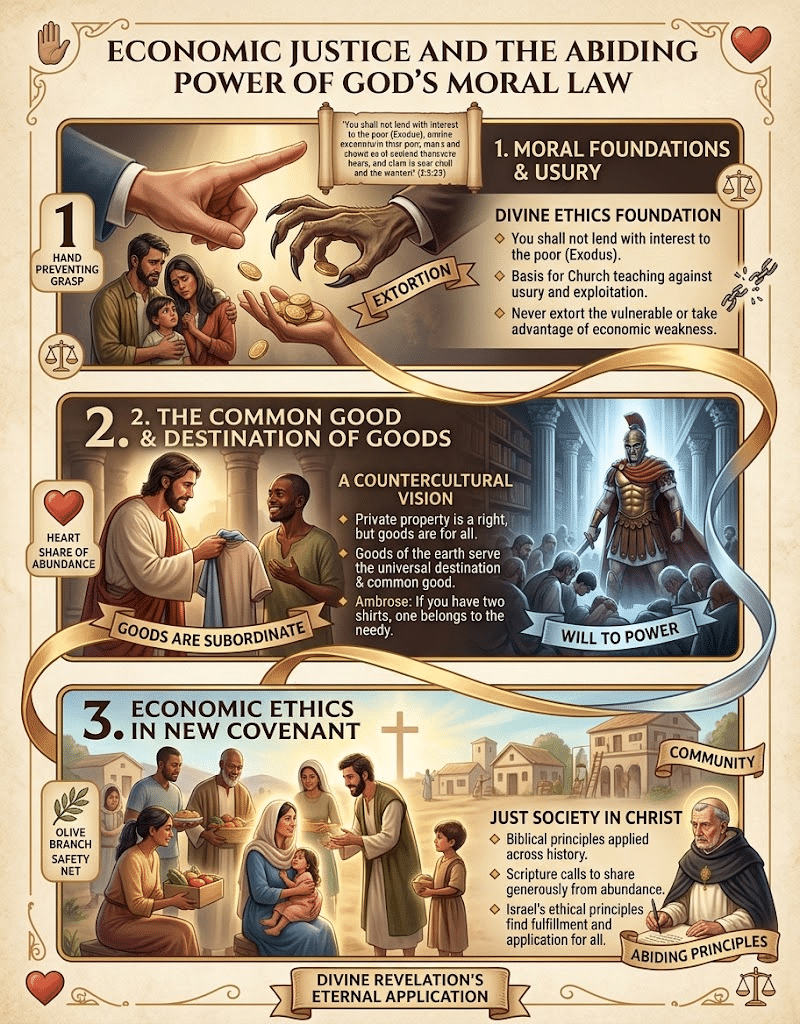
Economic Justice and the Abiding Power of God’s Moral Law
Finally, the passage addresses economic ethics:
“If you lend money to one of your poor neighbors among my people, you shall not act like an extortioner toward him by demanding interest.”
This command forms the foundation for the Church’s longstanding tradition against usury and financial exploitation. The Church continues to teach that one must never extort the vulnerable or take advantage of their economic weakness.
As St. Thomas Aquinas, St. Ambrose of Milan, and modern papal encyclicals affirm: while private property is a legitimate right, the goods of the earth are subordinate to the universal destination of goods and the common good. St. Ambrose famously observed that if you have two shirts in your closet, one belongs to you, and the other belongs to the person who has none. Scripture calls us not to exploit our neighbor’s economic distress, but to share generously from our abundance.
This vision was not widely accepted in the classical world, nor is it widely practiced today—it originates from divine revelation. Israel’s ceremonial laws find their sublimated fulfillment in the liturgical life of the Church; the ritual laws were fulfilled and set aside in Christ; but the moral law endures. Open your Bibles to the Book of Exodus, reflect upon this passage, and let the radical nature of this perennial moral teaching take root in your heart as it continues to form God’s holy people. God bless you.

Coming Soon

Click Graphic to Enlarge
Coming Soon!
….
Click Graphic to Enlarge
Coming Soon!
….
Click Graphic to Enlarge
Coming Soon!
….
Click Graphic to Enlarge
Coming Soon!
….
Click Graphic to Enlarge
Coming Soon!
….
YouTube transcript edited for readability by removing fillers, stumbles, and false starts while strictly preserving the homily’s original cadence and theological accuracy. Infographics and discussion questions are independently produced by TWTW and have no affiliation with Word on Fire.
 Highlight text or double-click a paragraph anywhere on the site to ADD TO NOTES. You can also click ASK AI to copy your selection to the clipboard with a command prompt, ready for you to paste manually into the chat above.