
Sunday
Readings

In Brief
- 1st Reading: Elijah flees Jezebel; God provides, guiding him to Horeb.
- 2nd Reading: Paul urges love, forgiveness; imitate God and Christ’s example.
- Gospel: Jesus, the living bread, offers eternal life, surpassing manna’s sustenance.


Bible Study
Food for the Journey
Supernatural Food

In the First Reading, the prophet Elijah did not suffer a crisis of faith but a crisis of expectation after he triumphed over the false prophets of Baal. He expected that the victory God helped him win against the pagan priests and their false god would result in repentance and turning back to the one true God for the people of the Northern Kingdom of Israel and their king. When national repentance did not occur, Elijah believed he had failed God and his people. God responded to his prophet's grief by giving him supernatural food for his journey to receive a spiritual renewal in a private revelation of the divine at Yahweh's "holy mountain."
Michal E Hunt, Copyright © 2014; revised 2023 Agape Bible Study; used with permission. The clipart is from the archive of Father Richard Lonsdale © 2000. The clipart may be freely reproduced in any non-profit publication.
Be Imitators of God

In our Second Reading, St. Paul reminds the Christians of Ephesus that God the Holy Spirit has "sealed" us "for the day of redemption" in the Sacrament of Baptism. Submitting to Christian Baptism is an act of faith necessary for our salvation in which the Christian dies to sin and experiences a resurrection to a new life in Christ Jesus (see Mt 16:16; Eph 1:13 and 2 Cor 1:22). However, baptized Christians can "grieve the Holy Spirit" when they do not live in the image of Christ in their new life but instead exhibit traits of the old, sinful life. When we receive the sacred meal of the Eucharist, in imitation of Christ, we surrender our lives to God, and He gives us "food for the journey" through this life so we can arrive at His "holy mountain" in Heaven.
Michal E Hunt, Copyright © 2014; revised 2023 Agape Bible Study; used with permission; The clipart is from the archive of Father Richard Lonsdale © 2000. The clipart may be freely reproduced in any non-profit publication.
Jesus, the Living Bread

In the Gospel reading, Jesus used the symbolism of bread, which was the "staff of life" for the people of His time. He revealed that we need His glorified, resurrected flesh and blood as the "food" that nourishes and sustains us on our journey through life (Jn 6:54) as He testified, saying, "I AM the bread of life" (Jn 6:35).
Jesus promised that a person who possessed His glorified life would not die the death of alienation from God. Therefore, we can have confidence in what Jesus promised when He said: "I am the living bread that came down from Heaven ... whoever eats this bread will live forever" (Jn 6:51). The "living bread" is Christ's gift to us in the New Covenant sacred meal of the Eucharist that replaced the Old Covenant sacred meal of the Toda (Lev 6:15, 19b-20; Lk 22:20). Thus, the Old Covenant communion meal of the Toda that reestablished peace with God foreshadowed the supernatural gift of Christ in the New Covenant sacred meal of the Eucharist (from the Greek word eucharistia, meaning "thanksgiving").
When we come forward to the altar in a state of grace to receive Christ in the Eucharist, we offer Him our lives. Then He touches us like the angel of God touched Elijah in the First Reading. He commands us to "taste and see the goodness of the Lord" (Psalm response) by taking and eating His supernatural, glorified flesh, given for the life of the world (Mt 26:26). The gift of His life in the Eucharist comes with the command from the closing words of the Mass, to arise and "go forth," continuing the journey we began in the Sacrament of Baptism: "to love and serve the Lord." Like Elijah, we must continue our mission until our earthly journey ends and we receive our private revelation of God in the heavenly Kingdom.
Michal E Hunt, Copyright © 2014; revised 2023 Agape Bible Study; used with permission. The clipart is from the archive of Father Richard Lonsdale © 2000. The clipart may be freely reproduced in any non-profit publication.

- According to St. Paul (in verses 18-19, omitted from Sunday’s 2nd reading), what causes the mental futility, darkened understanding, and alienation of our pagan society? To what types of behavior does it lead? What might be the effects of the change he proposes in the last three verses of our 2nd reading?
- What does the crowd ask Jesus to do in order that they may believe in him (verse 30)? How does Jesus use the crowd’s interest in food to illustrate what he wants them to understand?
- What are the similarities and the differences between the manna (see Exodus 16) and the Bread of Life (verse 35)?
- Why, primarily, were the crowds interested in the signs Jesus performed (John 2:23-24, 6:2)?
- Is seeking Jesus always commendable? Do we seek Jesus for himself, or for what he can do for us (see CCC 305)?
- Jesus claims to be the true bread from heaven and that all who come to him will never know hunger or thirst. What does it mean to “come to Jesus” (verse 35; CCC 2830, 1817)?
- Are there areas in your life that are (or would be) difficult to give up control of to God?
SOURCE: SundayScriptureStudy.com / used with permission
Popular Video
Series
JEFF CAVINS

The Bible Timeline®: The Story of Salvation
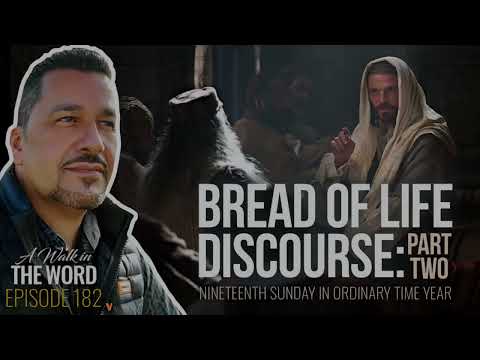
Catholics believe in the transformation of bread into the body and blood of Jesus through the Eucharist, and that embracing this belief can bring about radical change in one’s life.

Archived
Masses
Fast forward through the video to check out Music, Lector readings, Homily, and Prayers of the Faithful.
National Shrine Mass
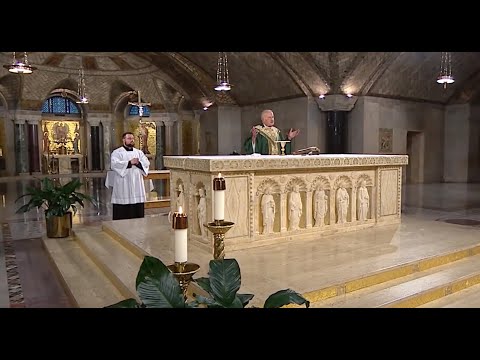
Celebrant & Homilist: Msgr. Kevin Hart
Choir: Basilica of the National Shrine of the Immaculate Conception Choir Cantor & Organist, Washington, D.C.
LECTOR NOTES by Greg Warnusz
Children

SOURCE: Ministry to Children
CHILDREN’S SERMONS (Sermon Writer)
John 6:35, 41-51 We Need It (Edstrom)
John 6:35, 41-51 Believe (Edstrom)
 Highlight text or double-click a paragraph anywhere on the site to ADD TO NOTES. You can also click ASK AI to copy your selection to the clipboard with a command prompt, ready for you to paste manually into the chat above.