


SUNDAY READING
OUTLINES



La Dolce Vita
(1Kgs.19:4-8; Eph.4:30-5:2; Jn.6:41-51)
La Dolce Vita – ‘The sweet life.’ Have you ever seen that movie?
It was made in 1960 by Frederico Fellini. In the opening scenes, a statue of Jesus is carried by helicopter across Rome, first over some old Roman ruins, and then over a big new construction site.
At one point it’s carried above some beautiful bikini-clad women sunbaking on a rooftop, and they wonder where Jesus is going.
Then we see the helicopter lowering the statue onto St Peter’s Square. As the statue comes down, the camera zooms in for a close-up of Jesus with his arms extended, and He’s safely delivered to the Pope in the Vatican.
Fr. Andrew Ricci
PODCAST: As we continue to hear the “Bread of Life” discourse from the sixth chapter of the Gospel of John, we reflect on how our spiritual health is renewed by the frequent and worthy reception of Holy Communion. We are what we eat!
Fr. Austin Fleming

Who doesn’t love focaccia bread?
Who doesn’t love focaccia bread? Maybe you’ve had the focaccia bread at Paparazzi or another Italian restaurant. It’s delicious! The Italian word focaccia means “hearth bread” and it’s derived from the Latin word for hearth which is focus. The hearth, the center of the home, its focus, is the place where this simple bread was first baked by placing flattened balls of dough right in the hot ashes. The outside of these hearth cakes would burn from contact with hot ash and so the cake, the bread, needed to brushed of its ashen coating and broken open, to give up its delicious and nourishing center.
Dominican Blackfriars


We’re in the middle of the series of Sundays when this discourse is proclaimed. I think one of the difficulties with preaching about it week after week is that the discourse itself is a kind of carefully prepared sermon.
Fr. Charles E. Irvin
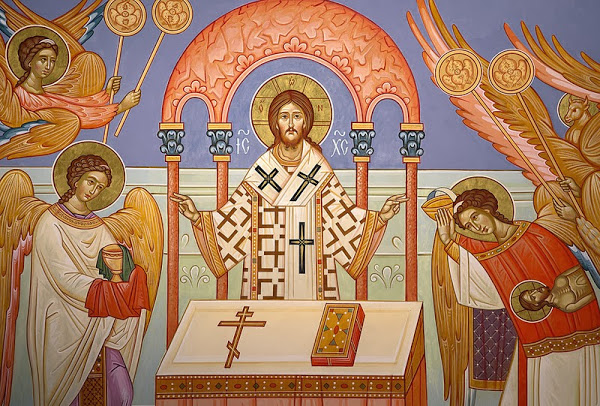
Know-It-Alls

Recently I received an e-mail telling me about cactus plants, a topic that had not in the past provoked much interest on my part. After all, I pictured them to be gawkish and unattractive, although I have seen some cacti that appeared to have surrealistic heads and arms resembling human forms that exercised my imagination. Nevertheless, I read on.
Fr. Leon Ngandu, SVD
Fr. Leon Ngandu, SVD
“The Bread that I will Give is my Flesh for the Life of the World.”
EXCERPT: In the first reading, Elijah is depressed because Queen Jezebel has promised to kill him. In fear, Elijah is fleeing to save his life. He is heading to the mountain Horeb, where he will meet with God. This trip will take him about forty days and forty nights. In our text, he is only on his first day in the desert and is very hungry and exhausted. Beneath a solitary bush, Elijah complains and prays for his death. God provides him with food and water, which strengthen and enable him to pursue his journey to Horeb, the mountain of God. Like Elijah, we, too, are on our earthly journey to heaven.
Fr. George Smiga
The Responsibility of the Eucharist

It is often said that it is better to give than to receive, but it is usually more difficult to receive than to give. The person who gives is in charge, independent, and has the satisfaction of helping and supporting another. The person who receives is in a different situation. The one who receives becomes indebted to the person who gives.
Fr. Anthony Ekpunobi, C.M.

The question before us is; Do we really believe in Jesus Christ, the living bread which has come down from heaven for the life of the world? Like the Jews, do we have reservations in our hearts as to the reality of the Eucharist? Jesus is aware of the confusion that this teaching will cause among his followers hence he made it clear that; No one can come to me unless he is drawn by the Father who sent me, and I will raise him up at the last day.
Msgr. Joseph Pellegrino

Eat My Flesh, Drink My Blood

Cannibals. Atheists. Atheists and cannibals. Those two charges were made against the Christians in the Roman Empire of the first three centuries AD. First of all, they were charged with being atheists. This seems shocking, particularly when we read how the early Christians were so so spiritual, so devoted to God. How could anyone call them atheists?
Msgr. Charles Pope
Believe What Jesus Says
This Sunday’s Gospel opens with His Jewish listeners grumbling because He claims to have come from Heaven. Throughout the Gospel Jesus stands firm in His call to faith; He teaches them of the necessity of faith, its origins, and its fruits. Let’s look at what the Lord teaches in five stages.
I. The Focus of Faith
II. The Font of Faith
III. The Functioning of Faith
IV. The Fruit of Faith
V. The Food of Faith
Bishop John Louis

Beloved, like Elijah who made a long journey to the mount of God, we are all making a long journey to heaven, the true mount of God. As he was strengthened by food to reach his destination, so the bread of heaven strengthens us to journey to heaven. Whereas he was fed by an angel, we are fed by the Lord Jesus Himself, the bread of heaven.
Fr. Michael Chua

The first reading gives us this poignant story of an angel of the Lord providing strength and encouragement in the form of a meal to the prophet Elijah, who is languishing in despair and on the verge of suicide. Think of it as a spiritual “Happy Meal.” This physical sustenance, which is also spiritual in nature, prefigures the Eucharist.
Fr. Vincent Hawkswell
Relying on Christ’s own words, the Catholic Church has always held that the bread and wine brought to the priest in the offertory procession are changed into Christ’s body and blood “by the action of Christ and the power of the Holy Spirit” when, at the consecration of the Mass, an ordained priest says over them the words Jesus said: “This is my body…. This is my blood.”
Fr. Tommy Lane
Church of the Eucharist

The Eucharist is at the center of the Church (§3). The Church was born at Pentecost but a decisive moment in the shaping of the Church was the institution of the Eucharist in the Upper Room during the Last Supper (§5). What more could Jesus have done for us? In the Eucharist, Jesus shows a love that goes to the end and knows no measure (§11).
Fr. John Kavanaugh, S.J.
Sustained

Our contemporary struggle with belief in the real presence of Jesus in the Eucharist is a quarrel over transcendence. Only the here is real. Only the now is actual. Only the observable is knowable. Only perishables can sustain us. The immediate feeling. The experience at hand. The pain pressing. The pleasure welcome. Our problem is not just believing that God could inhabit bread. It is believing that God could inhabit us.
Bishop Frank Schuster
Remedy for Times of Despair
The question we are left with this week is the same question we had last week and the week before as we make our journey through the 6th chapter of the Gospel of Saint John: What do you hunger for most in this life? What do you hunger for most? Is it for food that perishes or for food that endures for eternal life? We all know that at times our answer to that question can be really lousy.

Your friend has not returned your call for three days. You know they are going through a difficult time, but now you are worried. Finally, you go to their house, but they do not come when you knock. You use the hidden key to enter the house, where you call your friends name. You are greeted with a muffled sob from the bedroom. You enter; the room is dark.
