Catechism of the Catholic Church
Catechism of the Catholic Church
Catechism of the Catholic Church
Catechism of the Catholic Church
February 8, 2026
February 8, 2026
5th Sunday of Year A



Central Idea: Light of the world
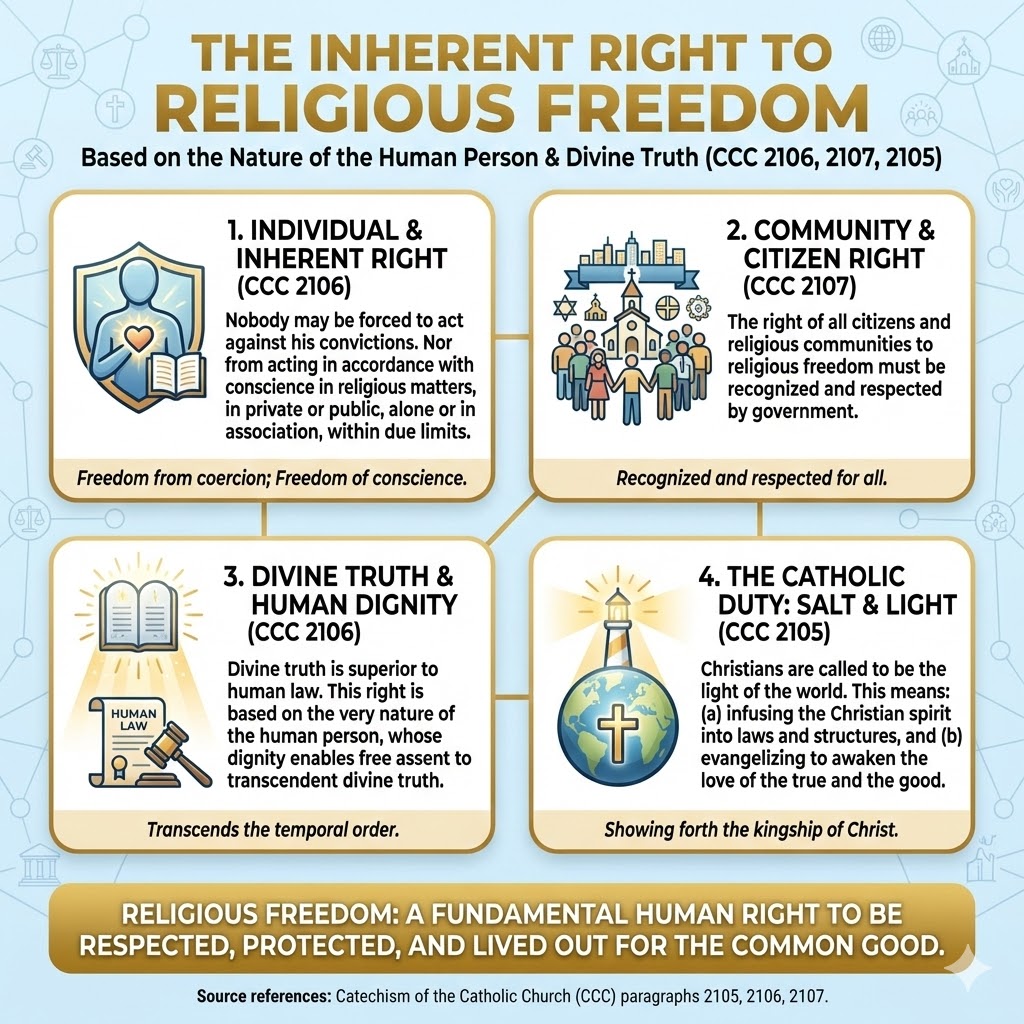
Doctrine: Christ’s The right to religious freedom and the social duty of Catholics
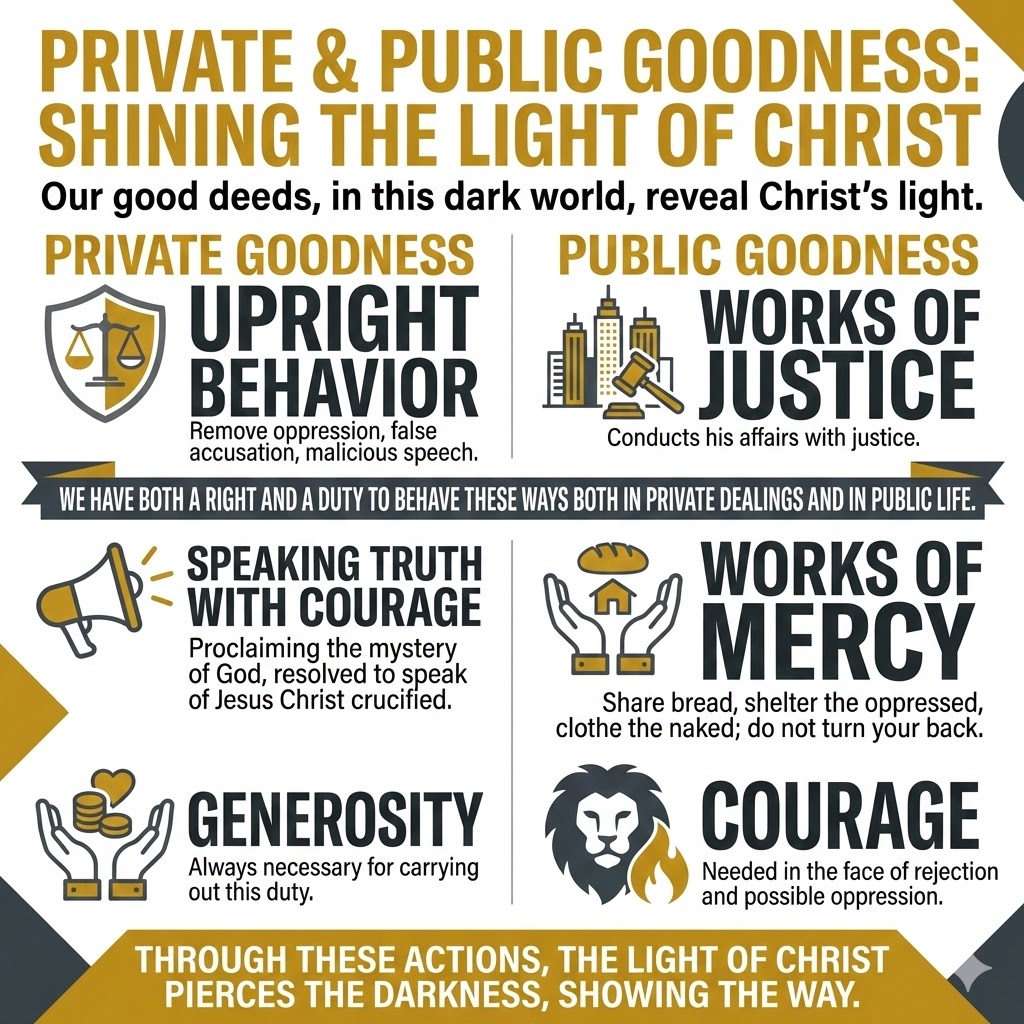
Practical application: Private and public goodness
The Infographics below were created using content from Kevin Aldrich’s webpage.

The topics in the tabs at the top of the page are themes and paragraphs contained in the Catechism of the Catholic Church that resonate with the biblical readings for this Sunday’s readings. The paragraphs were chosen either because they cite or allude to the specific readings, or because they treat topics found in the readings. The infographics and short essays in this section of TWTW are intended to help integrate the word of God, the faith of the Church, the moral demands of the Gospel, and their personal and liturgical spirituality.
CENTRAL IDEA
5th Sunday of Year A
DOCTRINE
5th Sunday of Year A
PRACTICAL APPLICATION
5th Sunday of Year A

FIRST READING
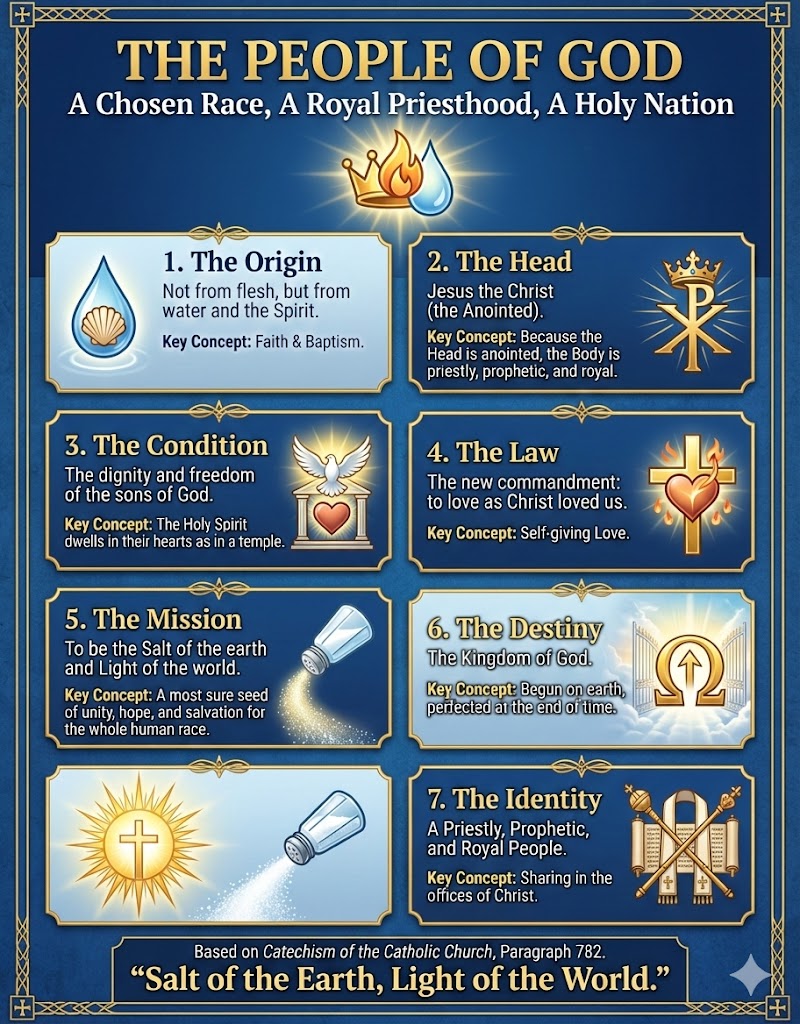
The Catechism defines the identity of the People of God as a priestly, prophetic, and royal nation with a clear mission: to be the “salt of the earth and light of the world.” This theological calling, rooted in our Baptism and Christ as our Head, finds its practical blueprint in the reading from Isaiah 58:7-10.
The Catechism states that our law is the “new commandment” of self-giving love. Isaiah translates this abstract principle into concrete action, defining true worship not as empty ritual, but as tangible charity: sharing your bread with the hungry, sheltering the homeless, and clothing the naked. This is how we exercise our “royal” duty to care for the vulnerable and our “priestly” role of offering spiritual sacrifices.
When the People of God live out this condition of having the Holy Spirit in their hearts by removing oppression and acting with justice, the promise of Isaiah is realized: “Then your light shall break forth like the dawn.” Our mission to be a source of hope and salvation is fulfilled only when our light shines through deeds of mercy, dispelling the darkness of the world’s suffering.
SECOND READING
The Catechism defines the People of God as a “royal priesthood” and a “holy nation” commissioned to be the “salt of the earth and light of the world.” This high calling, however, is not achieved through human strength or capability. St. Paul’s message in 1 Corinthians 2:1-5 provides the essential posture for fulfilling this mission: reliance solely on God’s power rather than human eloquence.
The Catechism emphasizes that our origin is “not from flesh, but from water and the Spirit,” and our condition is as temples of the Holy Spirit. Paul mirrors this truth, stating that his own ministry relied not on the “persuasive words of wisdom,” but on a “demonstration of Spirit and power.” To effectively be light in the world does not require dazzling rhetoric; it requires grounding our entire identity in our Head, “Jesus Christ, and him crucified.”
Therefore, our “prophetic” and “royal” dignity is paradoxical. It is not found in worldly impressiveness, but in humility. By surrendering human wisdom and allowing the Holy Spirit to work through our weakness, our lives become authentic “salt,” offering a faith that rests not on human potential, but on the power of God.
GOSPEL
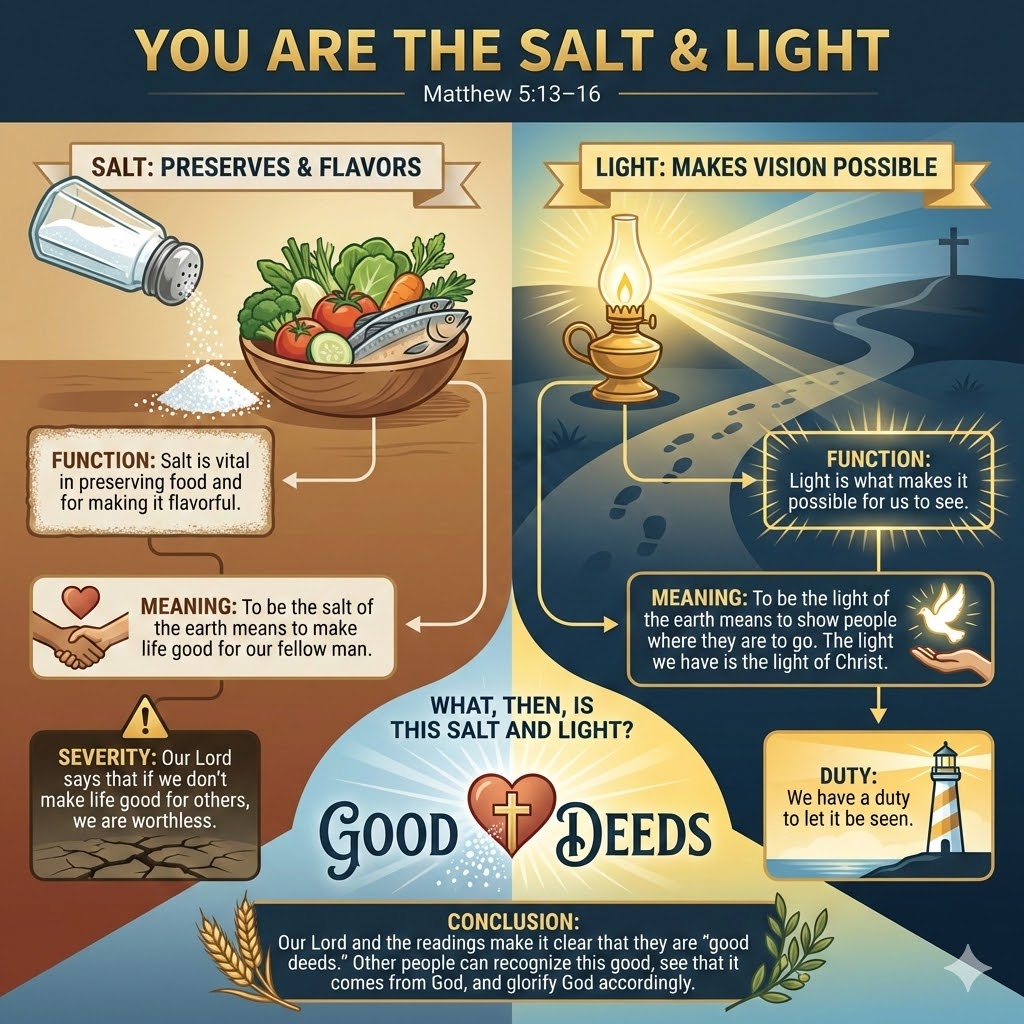
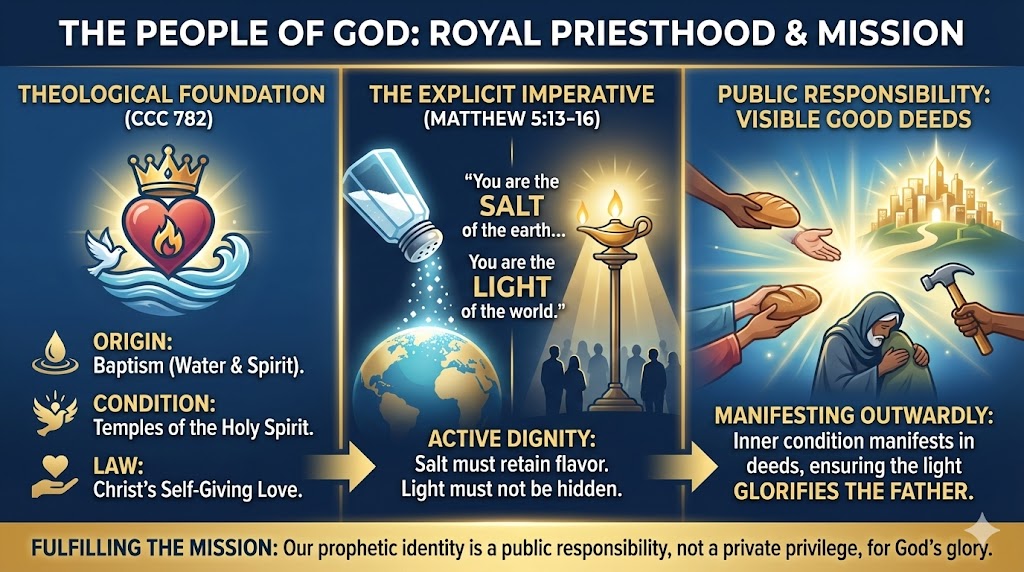
The Catechism’s paragraph 782 provides the theological architecture for the People of God, defining our identity as a “royal priesthood” rooted in Baptism and empowered by the Holy Spirit. This identity finds its explicit imperative in Matthew 5:13-16, which is directly cited in the infographic’s “Mission” panel and footer.
Jesus declares that this People is the “salt of the earth” and “light of the world.” The infographic explains how we possess this capacity: through our “Origin” in water and Spirit and by adopting Christ’s “Law” of self-giving love. Matthew’s Gospel warns that this inherent dignity must be active; salt must retain flavor, and light must not be hidden under a basket. Our “Prophetic” identity isn’t a private privilege but a public responsibility. We fulfill our mission only when our inner “Condition” as temples of the Spirit manifests outwardly in good deeds, ensuring that the light we radiate ultimately glorifies the Father.

FIRST READING
The Catechism’s teaching on “Love for the Poor” (CCC 2443-2449) finds its prophetic foundation in Isaiah 58:7-10. Both texts rigorously define true righteousness not through empty ritual, but through concrete action on behalf of the vulnerable.
CCC 2447 explicitly lists the corporal works of mercy as essential charitable actions for neighborly necessities. This list is a direct mirror of Isaiah’s divine command to “share your bread with the hungry, bring the homeless poor into your house, [and] when you see the naked, to cover him.”
Furthermore, CCC 2443 notes that “God blesses those who come to the aid of the poor.” Isaiah articulates this blessing powerfully: when one satisfies the needs of the afflicted, “then shall your light rise in the darkness.” Both sources teach that authentic faith is inseparable from justice and active solidarity with the marginalized, identifying service to the poor as the definitive manifestation of God’s light in the world.
SECOND READING
The Catechism’s emphasis on concrete “works of mercy” (CCC 2447) provides the tangible framework for understanding St. Paul’s assertion in 1 Corinthians 2:1-5. Paul explicitly rejects reliance on “lofty words or wisdom” for missionary witness, insisting instead on a “demonstration of Spirit and power” so that faith may rest on God rather than human eloquence.
CCC 2443-2449 clarifies that this authentic spiritual “demonstration” is found not in impressive rhetoric, but in active solidarity with the poor. To the world, serving the hungry, naked, and imprisoned often appears as “weakness” or foolishness. Yet, the Catechism teaches that identifying with the marginalized is precisely where we encounter Christ himself (CCC 2449).
Therefore, the “Love for the Poor” mandated by the Catechism is the true alternative to worldly wisdom. By performing these humble works, Christians provide visible proof that their faith rests not on human persuasiveness, but on the transformative power of the Holy Spirit acting through love. This is the ultimate proclamation of “Jesus Christ, and him crucified.”
GOSPEL
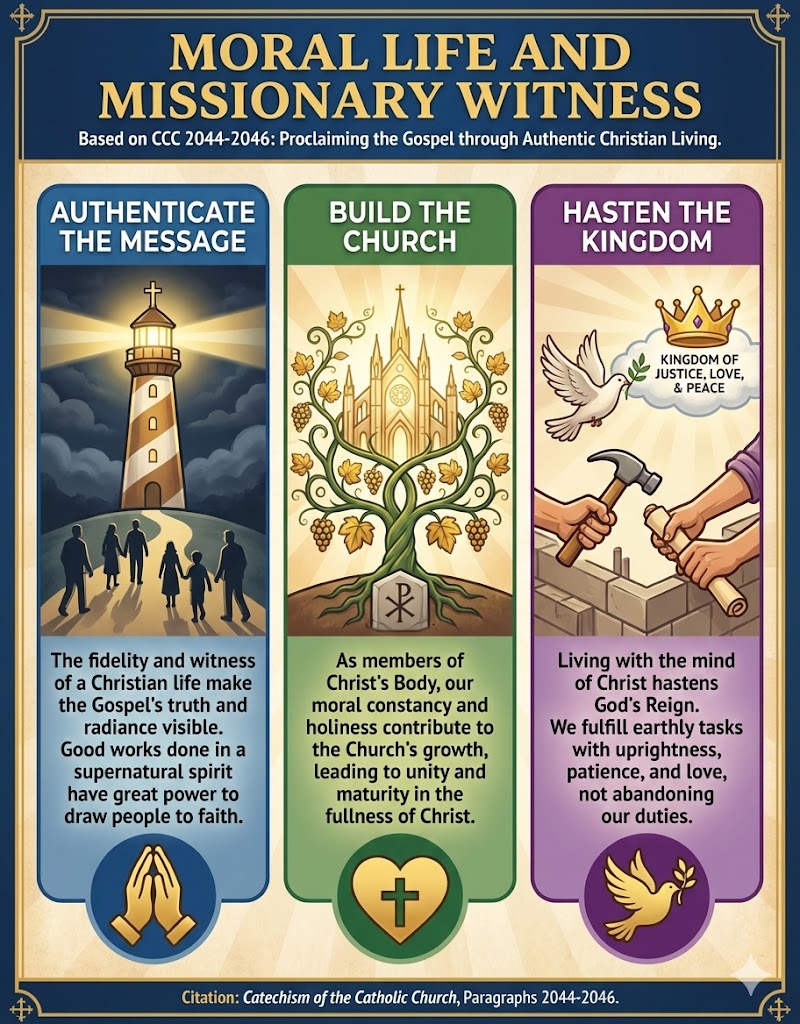
The Catechism establishes that proclaiming the Gospel requires the “fidelity of the baptized” to authenticate its truth (CCC 2044). In Matthew 5:13-16, Jesus uses the metaphors of salt and light to mandate this exact fidelity as essential for mission.
CCC 2044 asserts that for the message of salvation to show its “radiance before men,” it must be witnessed visibly. Jesus parallels this directly, commanding that our light must shine so others “may see your good deeds and glorify your heavenly Father.” The moral “constancy of their convictions” that builds the Church (CCC 2045) is the necessary “flavor” of the salt; without it, Christians become useless to the mission.
Furthermore, CCC 2046 explains that we hasten the Kingdom by fulfilling ordinary “earthly tasks” with the mind of Christ. This is how we refuse to hide our lamp under a bushel basket. By integrating Gospel morality into daily life, Christians become a visible “city set on a mountain,” offering an undeniable witness that draws the world to God.


FIRST READING
The Catechism defines the identity of the “People of God” as a priestly, prophetic, and royal nation with a clear mission: to be the “salt of the earth and light of the world.” This theological calling, rooted in our Baptism and Christ as our Head, finds its practical blueprint in the reading from Isaiah 58:7-10.
The Catechism states that our law is the “new commandment” of self-giving love. Isaiah translates this abstract principle into concrete action, defining true worship not as empty ritual, but as tangible charity: sharing your bread with the hungry, sheltering the homeless, and clothing the naked. This is how we exercise our “royal” duty to care for the vulnerable and our “priestly” role of offering spiritual sacrifices.
When the People of God live out this condition of having the Holy Spirit in their hearts by removing oppression and acting with justice, the promise of Isaiah is realized: “Then your light shall break forth like the dawn.” Our mission to be a source of hope and salvation is fulfilled only when our light shines through deeds of mercy, dispelling the darkness of the world’s suffering.
SECOND READING
The Catechism’s emphasis on concrete “works of mercy” (CCC 2447) provides the tangible framework for understanding St. Paul’s assertion in 1 Corinthians 2:1-5. Paul explicitly rejects reliance on “lofty words or wisdom” for missionary witness, insisting instead on a “demonstration of Spirit and power” so that faith may rest on God rather than human eloquence.
CCC 2443-2449 clarifies that this authentic spiritual “demonstration” is found not in impressive rhetoric, but in active solidarity with the poor. To the world, serving the hungry, naked, and imprisoned often appears as “weakness” or foolishness. Yet, the Catechism teaches that identifying with the marginalized is precisely where we encounter Christ himself (CCC 2449).
Therefore, the “Love for the Poor” mandated by the Catechism is the true alternative to worldly wisdom. By performing these humble works, Christians provide visible proof that their faith rests not on human persuasiveness, but on the transformative power of the Holy Spirit acting through love. This is the ultimate proclamation of “Jesus Christ, and him crucified.”
GOSPEL
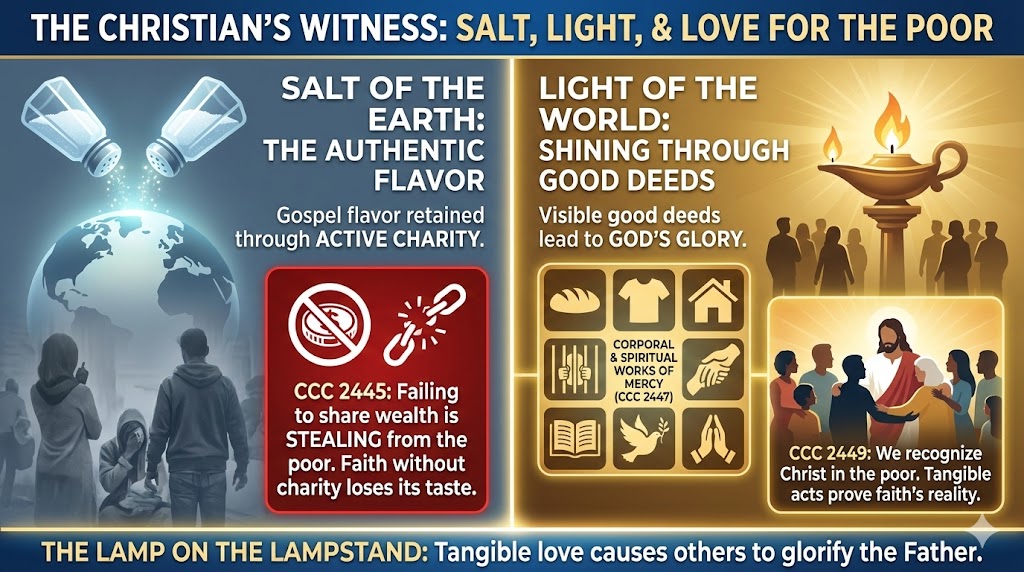
In Matthew 5:13-16, Jesus commands His disciples to be the “salt of the earth” and the “light of the world,” insisting that their light shine before others through visible “good deeds” that lead to God’s glory. The Catechism’s teaching on “Love for the Poor” (CCC 2443-2449) provides the concrete definition of these essential good deeds.
For Christians to retain their distinct “saltiness”—the authentic flavor of the Gospel—they cannot ignore those in need. CCC 2445 warns that failing to share wealth is stealing from the poor; a faith without this active charity has lost its taste.
Furthermore, the “light” meant to shine before the world is illuminated through the Corporal and Spiritual Works of Mercy listed in CCC 2447. By feeding hungry bodies and comforting afflicted souls, believers do more than humanitarian work; they recognize Christ in the poor (CCC 2449). These tangible acts of love are the visible lamp on the lampstand, proving the reality of the faith and causing others to glorify the Father.