Commentary ✨

⬅️  ➡️

DECEMBER 8, 2024

DECEMBER 8, 2024

FEATURED—TBD

A Symbol of Renewal and Hope

✨ The reopening of Notre Dame after the fire can be seen as a powerful symbol of renewal and hope, resonating with this Sunday’s readings. In Baruch 5:1-9, there’s a theme of restoration and God’s promise to lead His people back to glory. Similarly, Philippians 1:4-6, 8-11 speaks of growth and completion in Christ. The Gospel from Luke 3:1-6 calls for preparation and transformation. Notre Dame’s restoration mirrors these themes, reminding us of resilience and the renewal of faith.

SCROLL TO READ MORE

YouTube player
France’s President Emmanuel Macron conducts a televised tour to mark the cathedral’s imminent re-opening on December 7, 2024.


Sunday Readings Commentary

Sunday Readings Commentary

  • VIDEO SERIES
  • HIGHLIGHT
    CARDS
  • CATECHISM
  • PRO-LIFE
  • CHURCH FATHERS
  • LIVES OF THE
    SAINTS
UPCOMING SUNDAYS

⬇️ A Walk in the Word

Hector
Molina

Repentance and restoration stand at the forefront of John the Baptist’s ministry, as he prepares the way for Christ’s arrival and the spiritual renewal of God’s people amidst the challenges of corrupt leadership.

YouTube player
DETAILED SUMMARY w/ TIMESTAMPS ✨

SECOND SUNDAY OF ADVENT YEAR C: JOHN THE BAPTIST: HERALD OF THE NEW EXODUS

  • John the Baptist's call for repentance and his role in heralding a new Exodus emphasize the importance of humility and preparation for Christ's Nativity and second coming during Advent.
  • 00:00 John the Baptist's call for repentance in the wilderness fulfills Isaiah's prophecy, highlighting the corrupt leadership of Tiberius Caesar and Herod Antipas, who ultimately beheaded him for denouncing immorality.
    • John the Baptist proclaims a baptism of repentance in the wilderness, fulfilling Isaiah's prophecy and preparing the way for the Lord's salvation.
    • The discussion focuses on the corrupt leadership during the time of Tiberius Caesar, highlighting his reign from 14 AD to 37 AD and its significance in the context of St. Luke's narrative.
    • Tiberius Caesar and Pontius Pilate were both depicted as corrupt and morally bankrupt leaders, with Pilate showing little regard for the Jewish population during his governance.
    • Herod Antipas, the tetrarch of Galilee from 4 BC to 39 AD, is distinct from his father Herod the Great, who was responsible for the massacre of the innocents.
    • Herod Antipas arrested and beheaded John the Baptist for denouncing his adulterous marriage to Herodias, his brother's wife, and this same Herod later presided over Jesus' trial.
  • 06:41 John the Baptist's ministry heralds a new Exodus, emphasizing his pivotal role in Salvation history amidst the corruption of contemporary rulers.
    • Luke mentions both Annas and Caiaphas as co-high priests to highlight the corrupt consolidation of power within their family in the religious and political landscape of the time.
    • The excerpt highlights the corruption and wickedness of key figures in power during the era, including Tiberius Caesar, Pontius Pilate, Herod Antipas, and the high priests Annas and Caiaphas, portraying them as a cast of villains.
    • John the Baptist's preaching marks a significant historical moment in Judea, highlighting the end of its sovereignty under various kings and high priests, as emphasized by the Evangelist Luke.
    • John the Baptist, as the last prophet and herald of the Messiah, emerges in a significant historical context marked by rulers, emphasizing his pivotal role in Salvation history during the Advent season.
    • John the Baptist's ministry in the wilderness and the Jordan River symbolizes the new Exodus, echoing the Israelites' journey from Egypt to the Promised Land.
    • John the Baptist embodies the prophetic tradition of the new Exodus, as highlighted in the readings from Isaiah and Baruch.
  • 14:41 John the Baptist heralds a new Exodus by preaching in the wilderness, symbolizing the unification of the 12 tribes and the fulfillment of hope for a new Jerusalem.
    • Moses liberated the Israelites from Egyptian captivity, leading them to the promised land and establishing a kingdom that eventually split into the northern and southern kingdoms, with the northern tribes being conquered and scattered by Assyria in 722 BC.
    • The scattering occurred in 722 BC.
    • The Babylonian captivity ended when Cyrus the Persian allowed the Jews to return to Jerusalem, while the Northern tribes remained dispersed, highlighting the fulfillment of hope expressed in Psalm 126.
    • The new Exodus prophesied by figures like Isaiah involves the gathering and unification of the 12 tribes in a new Jerusalem, representing a new age of Salvation.
    • John the Baptist's choice to preach and baptize in the wilderness near the Jordan River symbolizes his role as the herald of a new Exodus, connecting his message to the Israelites' journey into the promised land.
  • 20:22 John the Baptist heralds a new Exodus by preaching repentance and personal conversion to prepare the way for the Lord amidst the people's sin and infidelity.
    • A new Exodus is necessary due to the people's sin and infidelity, which led to their conquest by foreign nations as a form of divine chastisement.
    • John the Baptist, in the wilderness, preaches repentance for the forgiveness of sins as a pathway to healing and restoration, embodying the new Exodus prophesied in Isaiah.
    • John the Baptist calls for the preparation of the Lord's way by straightening the crooked paths caused by the people's sins.
    • John the Baptist calls for personal conversion by addressing the pride, sinfulness, and obstacles in our hearts to prepare the way for the Lord.
  • 24:56 Embrace humility and repentance this Advent to prepare for Christ's Nativity, echoing John the Baptist's call for a new Exodus and reconciliation with God's grace.
    • To welcome the Lord's grace into our lives, we must embrace humility and repentance, despite modern reluctance to acknowledge these concepts.
    • John the Baptist and Jesus both emphasized the call to repentance as essential for embracing God's grace, a message that has persisted in the Church for 2,000 years despite attempts to dilute it.
    • This Advent season calls for repentance and preparation of our hearts for the Lord, echoing John the Baptist's message and the promise of a new Exodus through Jesus' commissioning of the apostles to spread the gospel.
    • Jesus calls all sinners, as exiles, to return through repentance, leading them from bondage to the freedom of the Kingdom of God, as foretold by the prophets and embodied by John the Baptist.
    • Advent is a time for reconciliation and repentance, encouraging us to embrace God's grace and prepare for the joyful celebration of Christ's Nativity.
    • The reading from Baruch, a lesser-known prophet and scribe of Jeremiah, presents a prophecy of comfort and restoration related to the new Exodus, illustrated through the poignant image of a mourning mother.
  • 32:38 Jerusalem rejoices as God promises restoration and a new Exodus, embodying joy and hope for Israel and the Church during Advent.
    • Jerusalem is called to rejoice as God promises the return of all His people from exile, symbolizing hope and restoration for the entire nation.
    • God promises to restore Israel, bringing them back in glory and leveling the land for their safe return, echoing the new Exodus imagery from Isaiah.
    • God will lead Israel and the Church with joy, mercy, and righteousness, embodying the essence of the Advent season and the promise of a new Exodus.
    • Psalm 126 expresses the joy of the exiles returning to Zion, highlighting the theme of joy characteristic of the Advent season.
    • The theme of joy is emphasized in both the psalm and St. Paul's letter to the Philippians.
    • Understanding the passage requires considering verse three, which emphasizes gratitude for the partnership in the gospel and confidence in God's work being completed in believers by the day of Jesus Christ.
  • 40:09 The video highlights the importance of preparing for Christ's second coming through joy, repentance, and the prophetic role of John the Baptist in heralding a new Exodus.
    • The message emphasizes the significance of the day of the Lord, or parusia, highlighting the anticipation of Christ's second coming and the importance of love, knowledge, and righteousness in preparation for it.
    • The readings emphasize joy, particularly in St. Paul's letter to the Philippians, which highlights the theme of rejoicing and the hope for perseverance in faith and holiness.
    • Preparation for the Lord's coming requires repentance, conversion, and self-examination through confession to receive grace and mercy.
    • God prepared for the coming of Christ over centuries through prophets, fulfilling the promise of a new Exodus and awakening a universal expectation, not just among Israelites.
    • John the Baptist, as the last prophet, prepares the way for Christ by preaching, baptizing, and bearing witness to Him as the Lamb of God who takes away the sin of the world.
    • The podcast encourages listeners to engage with the content by liking, commenting, subscribing, and considering financial support through Patreon or a one-time donation.
  • 47:53 Thank you to the community of patrons for their support, and may God's blessings continue to enrich you until we meet again.

⬇️ Encountering the Word

Jeff
Cavins

Embracing the spirit of self-reflection, the Advent season invites individuals to turn away from destructive behaviors and pursue spiritual renewal through repentance and confession, readying themselves for the Lord’s coming.

YouTube player
DETAILED SUMMARY w/ TIMESTAMPS ✨
  • 00:00 John the Baptist calls people in the wilderness to prepare their hearts for the coming of the Lord during Advent.
  • 01:01 A call to prepare for the Lord's coming by leveling obstacles and making paths straight for all to witness God's salvation.
  • 01:26 Embracing the baptism of repentance means turning away from what harms us and choosing a better path.
  • 01:55 Embrace the journey of returning to the true path during the Second Sunday of Advent.
  • 01:55 Advent calls for self-reflection and repentance, urging us to examine our hearts and turn back to God through confession.
  • 02:41 Embrace the Advent season by seeking confession to experience a heartfelt change and prepare your spirit for the Lord's coming.

⬇️ Hearers of the Word

Kieren J.
O’Mahony

Prominently featured in biblical narratives, the themes of repentance, hope, and transformation underscore the significance of preparing for God’s salvation while highlighting the value of fostering faith-based communities and partnerships.

YouTube player
DETAILED SUMMARY w/ TIMESTAMPS ✨
  • 00:00 John the Baptist's call for repentance in the desert fulfills prophecy and prepares humanity to witness God's salvation.
  • 03:53 The Roman Empire expanded under various rulers from 44 BC to 117 AD, marked by Tiberius's legacy and Pilate's controversial governance in Judea.
    • The Roman Empire expanded significantly from Julius Caesar's death in 44 BC to Trajan's reign in 117 AD, with Tiberius as a reclusive ruler who conquered various regions and left a substantial legacy, while Pontius Pilate, known for his cruelty and insensitivity, faced scrutiny for his actions in Judea.
    • Caligula ordered his suicide in 39, while Herod Antipas reigned from 4 BC to AD 39 and Herod Philip from 4 BC to AD 37, with their territories represented in different colors on the map.
  • 06:52 John the Baptist fulfills prophetic tradition by preparing the way for the Lord, while the Baruch reading highlights Jewish experiences under Greek rule.
    • Luke chapter 3 connects John the Baptist to the prophetic tradition, emphasizing his role as a voice in the wilderness preparing the way for the Lord, with adjustments made to the original Isaiah text to reflect his ministry context.
    • The first reading for the second Sunday of Advent comes from the deuterocanonical book of Baruch, likely written during the Greek period, reflecting Jewish interactions with their overlords.
  • 09:39 Jerusalem is called to embrace God's glory and justice, as He promises to restore and guide His people with joy and peace.
  • 11:55 Hope and transformation are central themes in Psalm 126, highlighting the joy of the Israelites' return to Zion and encouraging perseverance through current struggles.
    • Psalm 126, a post-exilic psalm of ascents, reflects on the joy and marvels experienced by the Israelites upon their return to Zion after bondage.
    • The message emphasizes hope and transformation, drawing parallels between past exiles and present struggles, encouraging perseverance through sorrow towards eventual joy.
  • 15:05 Paul's letter to the Philippians emphasizes gratitude for their growth in love and discernment amidst his imprisonment, highlighting their strong partnership in the gospel.
    • A map of Greece highlights the via ignacia, connecting Italy, Greece, and Asia Minor, with references to historical sites in Philippi and the reading from Philippians 1:4-6, 8-11.
    • The speaker expresses gratitude and confidence in the community's growth in love and discernment through their shared partnership in the gospel.
    • Paul's letter to the Philippians, likely written from Ephesus in the mid-50s, reflects his deep connection to the community amid news of his imprisonment and their support through Epaphroditus.
  • 19:12 Paul sends Epaphroditus to the Philippians to address their concerns and highlight joy in partnership amid challenges.
    • Paul plans to send Epaphroditus with a letter to the Philippians addressing their concerns about his illness, while also outlining the structure and rhetorical elements of the letter.
    • Philippians expresses joy in partnership despite external and internal pressures and challenges faced by Paul and the community.
  • 22:14 Paul prays for his community's growth and unity while the second Sunday of Advent highlights joy and the call to reflect on God's salvation.
    • Paul expresses his deep affection and hope for the growth and unity of his community, praying for their discernment and righteousness despite their challenges.
    • The second Sunday of Advent emphasizes joy and the assurance of God's salvation, urging engagement with this gift through reflection and prayer.

⬇️ Catholic Sunday Scriptures in Context

Fr. Paul
Galetto, OSA

Emphasizing spiritual growth and divine redemption, the second Sunday of Advent delves into the universal nature of salvation as showcased in the book of Baruch, Paul’s letter to the Philippians, and the vital role of John the Baptist in preparing for Christ’s coming. This Sunday serves as a reminder to remain steadfast in our faith and hope.

YouTube player
DETAILED SUMMARY w/ TIMESTAMPS ✨
  • 00:00 The second Sunday of Advent highlights the disputed origins of the book of Baruch, which is absent from the Old Testament in Jewish and Protestant Bibles.
  • 00:39 The book, named after Jeremiah's secretary, likely addresses the destruction of Jerusalem in 70 AD rather than the return from Babylon in 587, despite its Greek origins.
  • 01:11 Jerusalem is called to shed its mourning and embrace God's glory, restoring hope and peace after its destruction.
  • 01:43 God brings joy to Israel through His glory, as Paul expresses gratitude and shares in the Philippians' struggles in his letter from prison.
  • 02:18 Paul writes to the Philippian church, sharing in their suffering and joy while encouraging their love to grow and remain pure for the day of Christ.
  • 03:08 Your sacrifices will deepen your connection to Jesus' arrival.
  • 03:11 John the Baptist prepares the way for Jesus, emphasizing that salvation is for all humanity, not just the Jewish people.
  • Summary for: https://youtu.be/XQ3IcoFV71g by Noiz — Download YouTube Subtitles

⬇️ Mass Readings Explained

Brant
Pitre

Notable as a prophetic figure, John the Baptist urges repentance and signifies a new exodus through his baptisms in the Jordan River, paving the way for Jesus and the life-changing message of the gospel.

YouTube player
DETAILED SUMMARY w/ TIMESTAMPS ✨
  • 00:00 John the Baptist, a prophetic figure in the wilderness, calls for repentance and prepares the way for Jesus, emphasizing the transformative baptism of the Holy Spirit.
  • 01:34 The term "gospel" originates from the Greek word "euangelion," meaning "good news," and signifies the start of the message about Jesus Christ.
  • 02:43 John the Baptist serves not only as the forerunner of Jesus but also as a prophet heralding the anticipated new exodus for the Jewish people.
  • 04:06 John the Baptist's wilderness baptisms symbolize a new exodus, echoing the Israelites' journey from Egypt to the promised land.
  • 05:00 John the Baptist chose to baptize in the Jordan River, symbolizing a new exodus and offering a baptism of repentance for the forgiveness of sins, rather than using the traditional mikvah pools in Jerusalem.
  • 05:52 The first exodus concluded with the Israelites crossing the Jordan River into the promised land, as detailed in Joshua 3:14-17.
  • 06:25 The miraculous crossing of the Jordan River by the Israelites, led by priests carrying the Ark of the Covenant, symbolizes a pivotal moment in their journey to the Promised Land.
  • 07:22 John the Baptist announces the arrival of the new exodus by baptizing people in the Jordan River, symbolizing a divine path through the wilderness akin to Moses' time.

⬇️ The Word Proclaimed

Fr. Francis
Martin

The historical context of Jesus’ incarnation and John the Baptist’s call for genuine repentance underscore the fulfillment of God’s promises and the transformative power of faith in preparation for the Messiah’s arrival.

YouTube player
DETAILED SUMMARY w/ TIMESTAMPS ✨
  • 00:00 Luke's gospel for the 2nd Sunday of Advent highlights the historical context of Jesus' incarnation by detailing specific dates and rulers to emphasize God's fulfillment of promises.
  • 02:52 John the Baptist's condemnation of Herod's immoral marriage led to his arrest, highlighting the prophet's role in guiding the people away from sin in preparation for Jesus' arrival.
  • 04:11 The word of God reached John the Baptist in the desert around 28-29 AD, raising questions about his possible connections to the Qumran community.
  • 05:41 John the Baptist urges genuine repentance and commitment to God for true belonging to Israel, attracting many to his baptism in the Jordan.
    • John the Baptist calls all people to repentance and emphasizes that true belonging to Israel requires a genuine commitment to God, not just ethnic heritage.
    • John the Baptist preached in the desert near the Jordan, drawing many devout people seeking conversion through baptism.
  • 07:54 John the Baptist emphasizes his role in preparing for the one who will baptize with the Holy Spirit, fulfilling God's promise of pouring out the Spirit as seen in the Old Testament.
  • 09:30 The Apostles' powerful preaching led to 3,000 conversions, highlighting the transformative power of God's word and the significance of baptism for repentance as foretold in Isaiah's message of consolation.
  • 11:02 A promise of consolation and the coming of the Messiah is offered to those in exile, emphasizing the importance of faith across generations.
  • 11:55 God uses challenges to prepare us for the Messiah's arrival, highlighting the universal significance of His salvation.
    • God prepares us through challenges and suffering for the coming of the Messiah, assuring that all humanity will witness His salvation.
    • Salvation through the birth of the divine son from the Jewish people is meant for the whole world, emphasizing the need for preparation for his coming.


⬇️ The Gospel of Luke

AI SYNOPSIS ✨

AI SUMMARY

Main Ideas &
Key Details

Revisiting the historical context, the commentary elucidates the political dynamics during the transition from Augustus to Tiberius Caesar's reign in the Roman Empire around AD 28-29. Despite the relatively tranquil Roman and Jewish relations in Israel, prominent figures such as Pontius Pilate, Herod Antipas, Philip, and Lysanias held significant political positions in the region, shaping the socio-political fabric of the time. This backdrop provides valuable context for comprehending the biblical narrative, particularly considering the crucial roles played by Pilate and Herod in Jesus' trial.

Elaborating on the religious landscape during John the Baptist's ministry, the commentary emphasizes the influential roles of Jewish high priests Annas and Caiaphas. Although the Roman authorities exerted significant control over the high priesthood, including the selection and removal of priests, both Annas and Caiaphas retained prominent positions within the Jewish community. Their continued engagement in religious affairs resulted in their recognition as part of the "chief priests" mentioned in subsequent accounts, highlighting their importance within the broader context of the religious climate during that time..

Presenting the emergence of John the Baptist as a prophet during a crucial historical era, the text aligns his role with the tradition of Old Testament prophets who communicated God's word. Residing in the desert by the Jordan River, John likely had contact with the Qumran community due to its close proximity. His ministry focused on proclaiming a baptism of repentance for sin forgiveness, distinguishing him as "the Baptist" and shaping the spiritual landscape of the time.

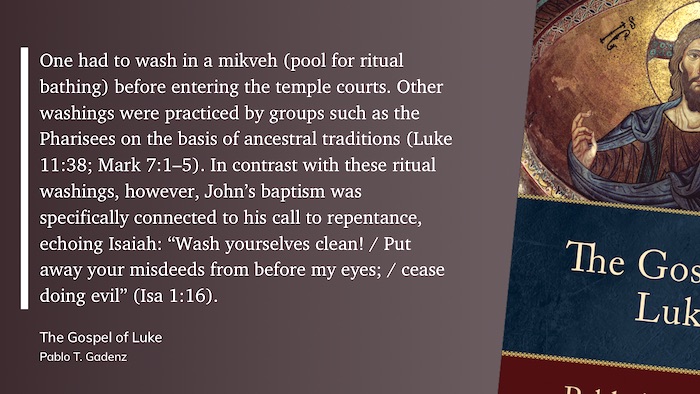
Emphasizing the contrast between the Jewish ritual washings and immersions for purification and the act of baptism introduced by John the Baptist, the text highlights that while the former was performed repeatedly, baptism was a one-time event signifying repentance and turning away from sin. John's ministry accentuated the significance of repentance in preparing people for Jesus' mission to call for repentance and grant forgiveness. Consequently, baptism became a crucial element of Jesus' mission and the early Church's message, as demonstrated in the book of Acts.

Noting that all four Gospels reference Isaiah 40:3 in portraying John the Baptist's mission, with Zechariah's canticle alluding to the same passage as well, the text depicts John as a prophetic figure in the desert. His twofold purpose entails preparing the way of the Lord and making straight his paths, which in the context of the Gospels relates to John's role in preparing the way for Jesus, who is acknowledged as the Lord.

The Gospel of Luke broadens the quotation from Isaiah, underscoring God's universal plan of salvation through Jesus, as conveyed by the phrase "all flesh shall see it," which encompasses both Jews and Gentiles. This reference to Isaiah's prophecy signifies a profound societal transformation, aligning with other prominent themes found in Luke's Gospel. As such, this quotation is essential for comprehending not only John's ministry but also God's grand design for salvation.
BIBLICAL BACKGROUND

Jewish Groups and
Leaders

The commentary provides an excellent introduction to Jewish Groups and Leaders during the first century held significant influence over religious and political aspects of society.

The Sanhedrin

Led by high priests, they served as the supreme judicial council, handling internal Jewish affairs and interacting with Roman authorities. Composed of the high priest, former high priests, elders, and scribes, the Sanhedrin included members from various influential parties.

The Sadducees

Primarily composed of chief priests and elders, they denied the resurrection of the dead and only accepted doctrines found in the five books of Moses. They were often wealthy and part of the Jerusalem aristocracy.

The scribes

They were largely associated with the Pharisees, who accepted both the written law and oral traditions, placing great emphasis on ritual purity and strict adherence to religious laws.

The Essenes

Mentioned by the historian Josephus, they were a more ascetic group that participated only partially in temple sacrifices due to their concerns with ritual purity and perceived corruption of the Jerusalem priesthood. Though not explicitly mentioned in the New Testament, the Essenes had various communities, possibly including one in Jerusalem.

BIBLICAL BACKGROUND

Isaiah’s New Exodus Fulfilled in Luke-Acts

Luke's quotation from Isaiah 40:3-5 holds a significant place in understanding both John's and Jesus' mission. This passage reveals God's plan for Israel's restoration from exile, illustrated through images from Israel's foundational event, the exodus. Even though the Jewish people had returned from Babylonian captivity, the messianic restoration remained incomplete. The Israelites eagerly awaited God's intervention to restore the Davidic kingdom, unite the twelve tribes, and end foreign oppression.

Luke's Gospel presents Jesus' mission as the fulfillment of prophecies that foretold Israel's restoration as a new exodus. For instance, the "way of the Lord" becomes a metaphor for the discipleship journey in Luke's travel narrative. In the book of Acts, Luke portrays the Church community—comprised of Jews and Gentiles—as "the Way."

Jesus' transfiguration and Last Supper demonstrate his role in accomplishing the new exodus and instituting a new covenant, mirroring God's actions after the original exodus. Luke's writings depict how God's salvation extends to "all flesh," encompassing both Jews and Gentiles. Through Jesus' mission, God's redemptive plan unfolds as a transformative journey toward restoration and unity for God's people.

Eager to delve further into the readings. Simply copy and paste a sentence or two into our AI Chat Bot, allowing our Catholic Assistant to provide you with additional context, connections, and insights from a variety of approved sources.

Baker
Academic

Gadenz, Pablo T.. The Gospel of Luke The Catholic Commentary on Sacred ScriptureGrand Rapids, MI: Baker Academic, 2008.


⬇️ The Word of the Lord

AI SYNOPSIS ✨

MAIN IDEAS AND
KEY POINTS

1ST READING

Notwithstanding its non-canonical status in Rabbinic Judaism and absence of an extant Hebrew version, the Book of Baruch holds significant importance within early Christian tradition. This collection of four religious texts, connected to Jeremiah's literary heritage, emphasizes key themes such as Israel's need to abstain from idolatry, remain steadfast in their commitment to God's covenant, and anticipate the realization of His promises following their exile. These writings have garnered strong support for their canonical status from early Church Fathers, who valued their spiritual insights and guidance for the early Christian community.

Exploring the pivotal role of worship in the covenant bond between God and His people, the Book of Baruch dedicates three of its four sections to liturgical matters. These include a prayer for the former Temple site, the return of Jerusalem's children to worship, and a strong condemnation of idolatry. Baruch 1:1-3:8 underscores the Temple's destruction, accentuating worship's importance in preserving the divine-human relationship. The story also portrays the Israelites' divinely orchestrated journey to Jerusalem on a specially prepared highway, symbolizing their favored position and God's guidance.

2ND READING

With its focus on the significance of joy and rejoicing during Advent, St. Paul's "Epistle of Joy" to the Philippians is an apt reading for this season. Drawing encouragement from Philippians 4:4, Christians are reminded to "Rejoice in the Lord always" as they partake in spiritual disciplines like prayer, fasting, and almsgiving. By engaging in these practices, believers can cultivate greater love, deepen their understanding of faith, and strengthen their discernment. Additionally, these actions help Christians resist the self-indulgence and materialism often associated with the holiday season, allowing them to concentrate on spiritual growth and purity in anticipation of celebrating the birth of Christ at Christmas.
AI SUMMARY

GOSPEL COMMENTARY

Embodying the spirit of transformation foretold in Isaiah's prophecy, John the Baptist is introduced in the Gospel of Luke. By shifting focus from physical infrastructure to spiritual restoration, John utilizes repentance through baptism as a means to bridge the gap between God and humanity created by sin.

X-raying the Israelites' predicament reveals their spiritual separation from God, caused by sin, as their core issue, surpassing concerns about physical pathways. Many Israelites opted to reside outside their homeland despite the Roman Empire's infrastructure. John the Baptist recognized this spiritual divide and offered repentance through baptism—a metaphorical "road" to reconnect with God.

Offering a symbolic take on spiritual growth, the road construction metaphor showcases key elements needed for renewal. Filling valleys signifies hope and rejuvenation granted to those who feel forgotten or undeserving of God's grace. During Advent, Christians are encouraged to strengthen faith, acknowledge life's impermanence, and look to Jesus for salvation.

Detailing the significance of humility and repentance, the metaphor of mountains being leveled underscores the importance of self-reflection and spiritual transformation for those exhibiting strength and arrogance. In order to embrace God's salvation, individuals must embark on an inward journey of examination and amendment, acknowledging their imperfections and diligently working towards personal growth and improvement.

Unraveling the convoluted and rugged pathways, the metaphor of winding roads sheds light on the intricacies and distortions within the human soul, resulting from the influence of sin. In this context, the sacrament of confession acts as a conduit for individuals to voice their truth, tackle their internal struggles, and actively pursue self-improvement.

Summoning believers to ready their hearts for God's advent, the Church accentuates the paramount significance of spiritual growth and introspection during this period. By cultivating faith, hope, humility, and engaging in confession, Christians can foster a profound communion with God, rectifying their spiritual trajectories and nurturing an environment that warmly embraces divine presence within their lives.

Emmaus
Road

Bergsma, John. The Word of the Lord: Reflections on the Sunday Mass Readings for Year B. Steubenville, OH: Emmaus Road Publishing, 2020.


⬇️ Preaching Justice

John Knox
Press

Allen, Ronald J., Dale P. Andrews, and Dawn Ottoni-Wilhelm, eds. Preaching God’s Transforming Justice: A Lectionary Commentary, Year B. Louisville, KY: Westminster John Knox Press, 2013.

⬇️ The Word Made Flesh

Theology of the Body Institute

West, Christopher. Word Made Flesh: A Companion to the Sunday Readings (Cycle B). Pennsburg, PA: Theology of the Body Institute Press, 2021.


⬇️ Ignatius Catholic Study Bible

Ignatius Press

Hahn, Scott. The Ignatius Catholic Study Bible New Testament (Ignatius Press), 2010.

⬇️ Africa Bible Commentary

Zondervan

Adeyemo, Tokunboh, ed. Africa Bible Commentary. Grand Rapids, MI: Zondervan, 2010.

write a roman numeral outline with bullet points that gives a breakdown of xxxxxxxxxxxx in the NAB bible. Give a title. Do not use alphabet notations. Outline should be a summary of the text and not be preaching points.
Give specific Catholic doctrines related to themes found in xxxxxxxx telling how each is connected

DOCTRINAL
INSIGHTS
IN BRIEF

Prophetic Mission of the Church: Luke 3:2 presents John the Baptist as a prophet chosen by God to proclaim His word. This highlights the Catholic belief in the prophetic mission of the Church (CCC 785), which calls for the continuation of God’s Word’s proclamation in each generation. The Church carries on the prophetic ministry of John the Baptist and other prophets, proclaiming the Kingdom of God and calling people to conversion.

Baptism and Repentance: In Luke 3:3, John the Baptist calls people to a baptism of repentance for the forgiveness of sins. This connects to the Catholic doctrine on Baptism (CCC 1213) as the sacrament of regeneration through water and the Holy Spirit, which forgives sins and confers new life in Christ. The Catholic Church teaches that Baptism is the gateway to the life of grace and the necessary foundation for receiving other sacraments (CCC 1213).

Divine Pedagogy and Gradual Revelation: Luke 3:4 references the words of the prophet Isaiah, connecting John the Baptist’s mission to the Old Testament prophecies. This emphasizes the Catholic understanding of divine pedagogy (CCC 53), as God reveals Himself gradually throughout salvation history, culminating in the person of Jesus Christ.

Conversion and Spiritual Renewal: The imagery of leveling obstacles and clearing impediments in Luke 3:5 can be related to the Catholic doctrine of conversion (CCC 1427). Conversion entails turning away from sin and turning towards God, seeking unity with Him and His will. The verse underscores the importance of ongoing spiritual renewal and transformation to deepen one’s relationship with Christ.

Universal Call to Salvation: Luke 3:6 proclaims that all people will see the salvation of God, echoing the Catholic teaching on the universal call to salvation (CCC 851). The Church believes that God’s redemptive plan extends to all humanity, and it is her mission to proclaim the Gospel to all nations, making disciples of all peoples (CCC 2104).

Verse by verse commentary using NAB translations of xxxxxxxxxxx relating text to Catholic catechism. Please format a commentary for xxxxxxxxxxxx using the following structure: Verse [insert verse number]: “Insert the text of the verse here” Commentary: Insert the commentary for the respective verse here with paragraph citations from catholic catechism when appropriate. NEXT STEP Relate CCC xxxxxxxxxxxxxxxxxxxx to scripture verse XXXXXXXXXXXX.
Intro to Catechism

READING 1 | READING 2 | GOSPEL | COMMENTARY

Lk 3:1-6

Verse 1: 'In the fifteenth year of the reign of Tiberius Caesar, when Pontius Pilate was governor of Judea, and Herod was tetrarch of Galilee, and his brother Philip tetrarch of the region of Ituraea and Trachonitis, and Lysanias was tetrarch of Abilene'

Commentary: The mention of various rulers and authorities in this verse sets the historical context for the ministry of John the Baptist. It reflects the political landscape at that time when different regions were under the rule of different leaders. This verse highlights the importance of understanding the temporal context of biblical events to interpret them correctly (CCC 109).

Though there isn't a direct connection between Luke 3:1 and CCC 109, we can draw an indirect link by considering the broader context of God's plan for humanity's salvation.

Luke 3:1 sets the historical context for the appearance of John the Baptist and the beginning of Jesus' ministry. This verse highlights a specific point in time when God's salvation plan started to unfold visibly through Jesus' public ministry.

CCC 109 refers to God's call to Abram (Abraham), which marks the beginning of God's intervention in human history to gather scattered humanity and bless all nations through Abraham's offspring. This blessing is later fulfilled in Jesus Christ, who is a descendant of Abraham and the Savior of all humankind.

Verse 2: 'during the high priesthood of Annas and Caiaphas, the word of God came to John the son of Zechariah in the desert.'

Commentary: The reference to Annas and Caiaphas, who were high priests during that period, indicates the religious setting alongside the political landscape. It shows that divine revelation comes to individuals in specific historical and religious contexts, emphasizing the intersection of God's will with human history (CCC 53).

This verse also highlights the Catholic belief in the prophetic mission of the Church (CCC 785), which emphasizes the importance of continuing the proclamation of God's Word in each generation. According to CCC 785, the Church has a prophetic role in the world today, just as prophets like John the Baptist did in the past. This mission involves calling people to conversion, announcing the Gospel message, and working towards the Kingdom of God's full realization. The Church carries on the prophetic ministry of John the Baptist and other prophets, serving as a witness to the truth of God's Word and calling people to live according to His divine will.

Verse 3: 'He went throughout [the] whole region of the Jordan, proclaiming a baptism of repentance for the forgiveness of sins,'

Commentary: John is the forerunner who prepares the way for the coming of the Lord Jesus Christ (CCC 523). John the Baptist's ministry of calling people to repentance and offering baptism for the forgiveness of sins foreshadows the sacrament of baptism in the Catholic Church. Baptism is the sacrament through which sins are forgiven, and the baptized are incorporated into the body of Christ, marking the beginning of their Christian journey (CCC 1213).

According to CCC 53, divine pedagogy involves a process where God communicates Himself to humankind step by step, guiding people towards the fullness of revelation in Jesus Christ. John the Baptist, as the forerunner of Christ, plays a crucial role in this process by preparing people's hearts and minds for the coming of the Messiah.

Verse 4: 'as it is written in the book of the words of the prophet Isaiah: 'A voice of one crying out in the desert: 'Prepare the way of the Lord, make straight his paths.'

Commentary: The citation from the prophet Isaiah emphasizes the continuity between the Old Testament prophecies and the arrival of John the Baptist as the precursor to Christ. The Catholic Catechism highlights the fulfillment of the Old Testament in the New Testament, illustrating the unity of God's salvific plan throughout salvation history (CCC 122). John the Baptist's role as the one who prepares the way for the Lord demonstrates the connection between the prophecies of the Old Testament and the realization of God's plan in the New Testament, ultimately leading to the incarnation of Jesus Christ, the Son of God made man.

Verse 5: 'Every valley shall be filled, and every mountain and hill shall be made low. The winding roads shall be made straight, and the rough ways made smooth,'

Commentary: This verse echoes the imagery of preparation and conversion, symbolizing the leveling of obstacles and the clearing of impediments for the coming of the Lord. It underscores the call for repentance and transformation in preparation for encountering Christ, mirroring the Catholic teaching on the necessity of conversion and spiritual renewal (CCC 2091).

The verse emphasizes that everyone must undergo a spiritual change to welcome Christ into their lives fully. The metaphors used highlight that, through repentance and the forgiveness of sins, the baptized will experience a spiritual leveling of social, economic, or personal barriers. This message aligns with CCC 2091, which teaches that conversion entails turning away from sin and turning towards God, seeking unity with Him and His will.

In Luke 3:5, the metaphors used to portray physical alterations to the landscape represent the spiritual changes that take place within individuals as they prepare themselves for the coming of the Messiah. The transformation of valleys, mountains, hills, and roads symbolizes the need for people to undergo spiritual renewal, overcoming obstacles, and humbling themselves before God. This change of heart and spirit, akin to the conversion process, aligns with CCC 1427, emphasizing the importance of repentance, the forgiveness of sins, and the interior transformation that occurs when one embraces God's salvific plan.

Verse 6: 'and all flesh shall see the salvation of God.'

Commentary: John the Baptist's declaration highlights the fact that God's salvation is not limited to a particular group or nation but extends to all people. This message resonates with the Catholic understanding of the Church's responsibility to proclaim the Gospel to every individual, as emphasized in CCC 2104. The Church, as the sacrament of salvation, has the mission to reach all nations, bringing them into communion with God through Christ.

First Reading

READING 1 | READING 2 | GOSPEL | COMMENTARY

NOT AVAILABLE
ON MOBILE DEVICES

Bar 5:1-9

No need to fill out form. Scroll down and look for YELLOW highlights.
Search Engine created by Jeff PinyanOW highlights.

READING 1 | READING 2 | GOSPEL | COMMENTARY

Courtesy of Catholic Cross Reference Online

Second Reading

READING 1 | READING 2 | GOSPEL | COMMENTARY

NOT AVAILABLE
ON MOBILE DEVICES

Phil 1:4-6, 8-11

No need to fill out form. Scroll down and look for YELLOW highlights.
Search Engine created by Jeff Pinyan

READING 1 | READING 2 | GOSPEL | COMMENTARY

Courtesy of Catholic Cross Reference Online

Gospel Reading

READING 1 | READING 2 | GOSPEL | COMMENTARY

NOT AVAILABLE
ON MOBILE DEVICES

Lk 3:1-6

No need to fill out form. Scroll down and look for YELLOW highlights.
Search Engine created by Jeff Pinyan

READING 1 | READING 2 | GOSPEL | COMMENTARY

Courtesy of Catholic Cross Reference Online

Gospel Commentary

Write a verse by verse commentary on xxxxxxxxxxxx using New American Bible (NAB) which connect passage to PRO LIFE issues (abortion, death penalty, ecology environment, pornography, etc) from a Catholic perspective. Commentary should be written from a culture of life vs. cultur of death perspective.

PREACHING ON
ABORTION

by Frank Pavone

God has “begun a good work” in each of us (2nd Reading) when he called us, through faith and baptism, to live in Christ and to be “filled with the fruit of righteousness.” Advent is meant to accomplish growth in this fruit in our lives. By that growth, we then work together to “prepare the way of the Lord” (Gospel), whom the First Reading makes clear is a God of Justice. “Every valley shall be filled” – the valleys where people languish because their rights are trampled, their dignity forgotten, and their lives thrown onto the outskirts of society. “Every mountain and hill shall be made low” – the mountains of pride whereby we think our own choices determine what is right and wrong, rather than submitting our choices to the truth that became visible when Christ was born.

This is a time of year when prayers and thoughts of “peace on earth” come naturally into our lives. The first reading speaks of “the peace of justice.” Peace does not simply mean that wars stop. Peace means that nobody is so victimized that a war is the only way to defend them. Peace comes only when justice is restored.

The Advent journey of God’s people is a journey of fighting for the God-given rights of every human being – from the unborn child to the prisoner on death row. Getting engaged in the work of justice, in the light of Christ, is the way to celebrate Advent and prepare the world for Christmas.

SOURCE: Priests for Life
YouTube player

SOURCE: Priests for Life


Generate a comprehensive verse-by-verse commentary on xxxxxxxxxxxx using the New American Bible translation. Integrate pro-life themes such as the sanctity of life from womb to tomb, encompassing topics like abortion, death penalty, euthanasia, pornography, environmental stewardship, and respect for human dignity. Draw connections to the contrast between a culture of life and a culture of death when relevant.

THE WORD THIS WEEK

Sunday Pro-Life Insights

FIRST READING ✨

FIRST READING

Baruch 5:1-9

Verse 1: "Jerusalem, take off your robe of mourning and misery; put on the splendor of glory from God forever:"

Commentary: The call for Jerusalem to remove garments of mourning and wear the splendor of God's glory symbolizes a transition from sorrow to joy, signifying the sanctity of life and the transformative power of God's grace. This imagery invites reflection on the inherent dignity of every individual, urging a shift from despair to hope in a culture that respects life in all its forms.

In our daily lives, we often encounter various challenges and struggles that may cause us to feel despondent or overwhelmed. However, just as Jerusalem is called to exchange garments of mourning for the splendor of God's glory, we too are invited to embrace hope and joy in the face of adversity.

This transformation can be achieved by actively cultivating a mindset that values and respects the inherent dignity of every person, including ourselves. By fostering empathy, compassion, and understanding, we contribute to a culture that cherishes life in all its stages, from conception to natural death.

Additionally, embracing God's grace in our lives can help us navigate difficult times and recognize the beauty in the world around us. Engaging in prayer, meditation, or spiritual practices can offer solace and strength, enabling us to approach each day with a renewed sense of purpose and optimism.

Verse 2: "wrapped in the cloak of justice from God, bear on your head the mitre that displays the glory of the eternal name."

Commentary: Being clothed in the mantle of God's justice and adorned with the mitre of His eternal glory signifies the importance of righteousness and reverence for the sacredness of life. This imagery underscores the value of upholding justice, mercy, and compassion in fostering a culture of life that honors the dignity and worth of every human being.

Verse 3: "For God will show all the earth your splendor:"

Commentary: The promise that God will reveal Jerusalem's splendor to all the earth reinforces the universal nature of God's redemptive plan for humanity. This verse emphasizes the interconnectedness of life and the importance of bearing witness to the sanctity of life as a beacon of God's glory to the world.

Verse 4: "you will be named by God forever the peace of justice, the glory of God's worship."

Commentary: Being named the "peace of justice" and the "glory of God's worship" highlights the significance of promoting peace, justice, and reverence for God in every aspect of life. This verse underscores the intrinsic link between peace and justice, emphasizing the principles of dignity, respect, and harmony in fostering a culture of life that upholds the sanctity of human existence.

Verse 5: "Up, Jerusalem! stand upon the heights; look to the east and see your children gathered from the east and the west at the word of the Holy One, rejoicing that they are remembered by God."

Commentary: The imagery of Jerusalem standing tall and witnessing the gathering of her children symbolizes the unity and communion of all people under God's loving care. This verse underscores the sanctity of life from conception to natural death, reflecting God's inclusive love and provision for all His children across boundaries and divisions.

Verse 6: "Led away on foot by their enemies they left you: but God will bring them back to you borne aloft in glory as on royal thrones."

Commentary: The imagery of God bringing back the exiles in glory and honor signifies the restoration and redemption of those who have suffered and been oppressed. This verse emphasizes the divine promise of dignity, deliverance, and restoration, highlighting the sanctity of life and the hope of renewal in God's kingdom.

Verse 7: "For God has commanded that every lofty mountain be made low, and that the age-old depths and gorges be filled to level ground, that Israel may advance secure in the glory of God."

Commentary: The leveling of mountains and filling of gorges symbolizes the removal of obstacles and restoration of balance, reflecting God's transformative power in creating a harmonious and just society. This imagery underscores the importance of addressing challenges and disparities that threaten human dignity and emphasizes the need for environmental stewardship to preserve God's creation for future generations.

Verse 8: "The forests and every fragrant tree have overshadowed Israel at God's command;"

Commentary: The imagery of forests and fragrant trees overshadowing Israel at God's command symbolizes God's provision and protection over His people. This verse underscores the importance of environmental stewardship and respect for creation, highlighting the interconnectedness of life and the responsibility to care for God's natural gifts with reverence and gratitude.

Verse 9: "for God is leading Israel in joy by the light of his glory, with his mercy and justice for company."

Commentary: The depiction of God leading Israel in joy, surrounded by the light of His glory, mercy, and justice, underscores the guiding principles of a culture of life. This verse emphasizes the values of joy, mercy, and justice as essential components in promoting human dignity, compassion, and righteousness in society, fostering a culture that upholds the sanctity of life from womb to tomb.

SECOND READING ✨

SECOND READING

Philippians 1:4-6, 8-11

Verse 4: "always offering prayer with joy in my every prayer for you all,"

Commentary: Paul's joyful prayers for the Philippians reflect a deep sense of care and concern for their well-being. This attitude of prayerful intercession underscores the value of each individual's life and the importance of nurturing relationships rooted in love and compassion. The sanctity of life is affirmed through the act of prayer, recognizing the inherent dignity of every person and the interconnectedness of humanity in the context of a culture of life.

Verse 5: "in view of your participation in the gospel from the first day until now."

Commentary: The Philippians' active engagement in spreading the gospel demonstrates their commitment to promoting life-affirming messages of hope, redemption, and love. Their participation in sharing the Good News highlights the transformative power of faith in fostering a culture of life that upholds the sanctity of every individual from conception to natural death. By partnering in the gospel's mission, believers advocate for justice, mercy, and respect for human dignity in a world plagued by threats to life such as abortion, euthanasia, and other forms of injustice.

Verse 6: "For I am confident of this very thing, that He who began a good work in you will perfect it until the day of Christ Jesus."

Commentary: Paul's confidence in God's continuous work within the Philippians reflects a profound trust in the transformative power of divine grace. This assurance of God's ongoing work in individuals reinforces the belief in the inherent goodness and worth of every life, emphasizing the potential for growth, redemption, and renewal. The concept of God perfecting His work in believers until the day of Christ Jesus underscores the trajectory towards spiritual maturity and the fulfillment of God's plan for each person's life, highlighting the sacredness of human existence in the broader context of a culture of life.

Verse 8: "For God is my witness, how I long for you all with the affection of Christ Jesus."

Commentary: Paul's deep longing for the Philippians, rooted in the affection of Christ Jesus, exemplifies the profound love and compassion that form the foundation of a culture of life. The love modeled after Christ's selfless sacrifice emphasizes the value of sacrificial service, empathy, and solidarity in upholding human dignity and promoting the well-being of others. This expression of heartfelt longing for fellow believers underscores the interconnectedness of the Christian community in fostering a culture that cherishes and uplifts the sanctity of life.

Verse 9: "And this I pray, that your love may abound still more and more in real knowledge and all discernment,"

Commentary: Paul's prayer for the Philippians to abound in love, knowledge, and discernment reflects a holistic approach to promoting a culture of life. The emphasis on love as the foundation of all virtues underscores the importance of compassion, empathy, and respect in nurturing relationships and addressing societal issues related to the sanctity of life. The call for an increase in knowledge and discernment highlights the value of informed decision-making, ethical reflection, and a commitment to upholding human dignity in all aspects of life, from social justice to environmental stewardship.

GOSPEL ✨

GOSPEL

Luke 3:1-6

Verse 1: "In the fifteenth year of the reign of Tiberius Caesar, when Pontius Pilate was governor of Judea, and Herod was tetrarch of Galilee, and his brother Philip tetrarch of the region of Ituraea and Trachonitis, and Lysanias was tetrarch of Abilene."

Commentary: The mention of various rulers and authorities during John the Baptist's time sets the historical context for his ministry. The juxtaposition of political leaders highlights the diverse societal structures and the impact of governing powers on individuals' lives. This verse invites reflection on the importance of leadership in upholding the sanctity of human life from conception to natural death, in alignment with a culture of life.

THE SUPREME COURT and presidential appointment of justices serves as a reminder of the significant influence that political leaders and governing powers can have on the lives of individuals. The decisions made by those in positions of authority, such as Supreme Court justices, can directly impact the protection and promotion of human life from conception to natural death.

The appointment of Supreme Court justices by the President plays a crucial role in shaping the legal landscape and, consequently, the culture of life within society. By selecting individuals who share a commitment to upholding the sanctity of life, the President can help ensure that legal decisions and interpretations align with a culture of life, defending the inherent dignity and worth of every individual.

In this sense, the historical context presented in Verse 1 emphasizes the importance of conscientious leadership in creating an environment that cherishes and safeguards human life. It also highlights the responsibility that comes with power and authority, as the decisions made by those in leadership positions can have profound and lasting effects on the lives of citizens.

Verse 2: "During the high priesthood of Annas and Caiaphas, the word of God came to John the son of Zechariah in the desert."

Commentary: John's call to ministry during the high priesthood of Annas and Caiaphas underscores the divine commissioning of individuals to speak out for the vulnerable and marginalized.

THE DESERT setting symbolizes a place of solitude and spiritual preparation, emphasizing the importance of prayer and discernment in addressing critical issues like abortion, euthanasia, and other threats to human dignity. This imagery reminds us that moments of isolation and introspection can serve as opportunities for personal growth and transformation. Individuals struggling with decisions about abortion or battling addiction to pornography, have lives characterized by feelings of isolation, confusion, and despair. These struggles, often marked by a sense of moral and spiritual wilderness, call for a deeper exploration of one's conscience and values.

Individuals facing the difficult decision of whether to have an abortion may experience a desert-like journey of fear, anxiety, and uncertainty. Similarly, individuals struggling with pornography addiction may find themselves in a moral and emotional wasteland, grappling with feelings of guilt, shame, and isolation. In both cases, seeking guidance and support from spiritual leaders, counselors, and loved ones can help bring clarity and healing, just as John received the word of God in the desert.

Verse 3: "He went throughout [the] whole region of the Jordan, proclaiming a baptism of repentance for the forgiveness of sins,"

Commentary: John's proclamation of repentance and forgiveness aligns with the pro-life principles of reconciliation and redemption. The call to repentance extends to all, emphasizing the intrinsic value of every individual and the potential for transformation and healing. The baptism of repentance serves as a symbol of renewal and restoration, highlighting the need to address sins such as abortion, euthanasia, and other forms of injustice that undermine the sanctity of life. John's message challenges a culture of death by offering a pathway to reconciliation and restoration.

CONFESSION, also known as the Sacrament of Reconciliation, provides a powerful connection to John's proclamation of repentance and forgiveness in Verse 3. This sacrament offers a sacred space for individuals to confront their sins, seek forgiveness, and experience the transformative power of God's mercy.

In the context of pro-life issues, the Sacrament of Confession invites individuals to examine their actions and attitudes regarding the sanctity of life. By acknowledging and confessing sins such as participating in or supporting abortion, promoting euthanasia, or engaging in actions that objectify or exploit others (such as pornography), individuals can take an essential step towards reconciliation and healing.

Furthermore, the Sacrament of Confession challenges the prevailing culture of death by emphasizing the redemptive power of repentance and forgiveness. This sacrament encourages individuals to embrace a culture of life, recognizing the intrinsic value and worth of every human being, from conception to natural death. By seeking forgiveness for actions that undermine the sanctity of life and committing to upholding the dignity of every individual, we can foster a society that values compassion, empathy, and justice.

Verse 4: "as it is written in the book of the words of the prophet Isaiah: 'A voice of one crying out in the desert: 'Prepare the way of the Lord, make straight his paths.'"

Commentary: The prophetic words of Isaiah, echoed by John the Baptist, emphasize the preparation and readiness required to welcome the Lord. This preparation entails creating a society that upholds the sanctity of life in all its forms, fostering an environment where human dignity is respected, and justice prevails.

Making straight paths for the Lord involves actively advocating for life-affirming policies, combating injustices like the death penalty and exploitation, and promoting environmental stewardship to protect God's creation and safeguard the future for generations.

A MULTI-FACETED COMMITMENT to upholding the sanctity of life in "making straight paths for the Lord" involves:

Advocacy for Life-Affirming Policies: Championing policies that respect and protect human life, such as measures that provide support for expectant mothers, improve access to healthcare, and promote ethical alternatives to abortion, help create a society that values the intrinsic worth and dignity of every individual. This advocacy extends to opposing policies that violate the sanctity of life, such as the death penalty or assisted suicide.

Combating Exploitation and Injustices: Standing against all forms of exploitation, including human trafficking, forced labor, and sexual exploitation, is essential in defending the inherent value and dignity of every human being. This commitment requires denouncing harmful practices, supporting victims, and collaborating with organizations and policymakers to enact effective measures against exploitation.

Promoting Environmental Stewardship: Recognizing the interconnectedness of all life and our responsibility as stewards of God's creation, it is crucial to promote sustainable practices that protect the environment. This includes reducing waste, conserving natural resources, and advocating for policies that address climate change and environmental degradation.

Fostering a Culture of Life: Beyond policy and advocacy, promoting a culture of life involves embracing compassion, empathy, and respect in our daily interactions. This entails recognizing the dignity of every individual, regardless of their background or circumstances, and offering support to those in need. By embodying these values and promoting a consistent ethic of life, we can challenge the prevailing culture of death and create a society that cherishes and protects all life.

Verse 5: "Every valley shall be filled, and every mountain and hill shall be made low. The winding roads shall be made straight, and the rough ways made smooth,"

Commentary: The imagery of valleys being filled and mountains made low symbolizes a leveling of societal disparities and injustices that devalue human life. It calls for the elimination of obstacles that hinder the full flourishing of individuals and communities, advocating for equity and dignity for all. Straightening winding roads and smoothing rough ways represent a call to address systemic issues that perpetuate a culture of death, promoting a culture of life characterized by compassion, justice, and respect for the sanctity of every human being.

Verse 6: "and all flesh shall see the salvation of God.

Commentary: The universal promise of salvation offered by God extends to all humanity, emphasizing the inherent worth and dignity of every individual. This verse underscores the inclusive nature of God's redemptive plan, highlighting the call to protect and preserve life from conception to natural death. The vision of all flesh witnessing God's salvation invites reflection on the role of every person in promoting a culture of life, where respect for human dignity, from the unborn to the elderly, guides actions and decisions. Embracing this vision challenges the societal norms that promote a culture of death through practices like abortion, euthanasia, and disregard for the sanctity of human life. By seeing and embracing the salvation of God, individuals are called to be agents of compassion, justice, and reverence for life in all its forms.

CHURCH FATHERS SCRIPTURE
SEARCH

FIRST READING (2)
SECOND READING (8)
GOSPEL (28)

This tool created by Jeff Pinyan uses the CCEL Early Church Fathers digital edition of the Philip Schaff collection.

A Modern Translation of

Catena Aurea

The Catena Aurea, which means “Golden Chain” in Latin, is a comprehensive biblical commentary comb is a 13th-century biblical commentary compiled by St. Thomas Aquinas. This anthology features insights from over eighty Church Fathers on the four Gospels.

SOURCE: Fr. Don worked with AI generative technology to create this modern translation, outline and study notes, enhancing accessibility and comprehension of the text for contemporary audiences.

Task: Rewrite the provided text as if each Church Father is speaking directly, translating sentence by sentence into modern, contemporary English. Preserve the meaning of each sentence while expressing it in a way that is easy to understand for a present-day audience. Do not summarize or paraphrase) the text, but rather maintain the original structure and sequence of ideas. Ensure that each Church Father’s unique perspective is accurately conveyed. STEP TWO: break up the text with section titles giving short summary of each church father. keep original structure and line of thought
xxxxxxxxxxxxxx.
write a 200-300 word summary of text using the original section break titles as an organizer/structure of the essay

IN BRIEF

The Historical Context of John the Baptist’s Ministry

Gregory: The timing of John’s preaching, under Tiberius Caesar’s reign, reflects the intended unity of all nations under one rule, encompassing Gentiles and Jews.

Greek Expositor: Tiberius succeeded Augustus, reigning for 15 years, setting the stage for John’s ministry.

Origen: Prophecies for Jews and the Gospel for all are marked by Tiberius Caesar’s global influence, encompassing salvation for both groups.

Gregory: The division of the Jewish kingdom amid betrayal fulfills prophetic warnings.

Bede: Political dynamics, including Pilate’s governance and Augustus’ fragmentation of the Jewish kingdom, influence the landscape during John’s preaching.

Gregory: Luke’s mention of High Priests Annas and Caiaphas reflects the dual roles of Christ as King and Priest.

John the Baptist as God’s Prophet

Ambrose: The initiation of God’s work through His Word to John heralds the Church’s spiritual genesis.

Chrysostom: The divine command given to John signifies his prophetic role.

Theophylact: John’s seclusion in the wilderness fosters an unbiased testimony about Jesus.

Gregory of Nyssa: John’s spiritual seclusion mirrors Elijah’s detachment to avoid worldly influence.

Ambrose: Symbolic parallels between the wilderness and the fruitful Church reveal the transformative power of God’s Word.

Luke 3:1-2

The Historical Context of John the Baptist’s Ministry

GREGORY: The time when the Savior’s messenger started preaching is clearly marked by naming the Roman ruler and the Jewish leaders. Here’s how it goes: “In the 15th year of Tiberius Caesar’s rule, when Pontius Pilate was governor of Judea, and Herod was ruler of Galilee.” John came to preach about the one who would save some Jews and many non-Jews. So, the timing of his preaching is shown by mentioning both the non-Jewish king and the Jewish rulers. Since all nations would be brought together under one rule, it’s fitting that one man is described as ruling the Roman state, which is why it says, “the reign of Tiberius Caesar.”

GREEK EXPOSITOR: After Emperor Augustus died (the guy who gave Roman rulers the name “Augustus”), Tiberius took over the throne. So now, 15 years after Tiberius started ruling, this is the timeline we’re looking at.

ORIGEN: In prophecies meant just for the Jews, only the Jewish kingdom is mentioned, like in the book of Isaiah, which talks about the time of certain Jewish kings. But the Gospel is meant for the whole world, so it makes sense that it mentions Tiberius Caesar, who seemed like the ruler of the world. If only non-Jews were going to be saved, talking about Tiberius would be enough. But because Jews needed to believe too, the Gospel also talks about Jewish rulers, like Pontius Pilate, the governor of Judea, and Herod, the local ruler.

GREGORY: The Jews were going to be punished for their betrayal, so their kingdom was divided into smaller parts under different leaders. This fulfills the prophecy that a divided kingdom is doomed.

BEDE: Pilate was sent to govern the Jews 12 years after Tiberius became ruler, and Pilate stayed there for 10 years, until Tiberius’ death. Herod, Philip, and Lysanias were the sons of the Herod who ruled when Jesus was born. Another brother, Archelaus, ruled for 10 years after Herod died. The Jews accused Archelaus before Augustus, and he died in exile. To weaken the Jewish kingdom, Augustus divided it into smaller parts ruled by different leaders.

GREGORY: John preached about Jesus, who would be both King and Priest. So, Luke mentions not only the rulers but also the High Priests at that time: Annas and Caiaphas.

BEDE: Both Annas and Caiaphas were High Priests when John started preaching. Annas held the position that year, and Caiaphas was High Priest during the year Jesus was crucified. Three others served as High Priest in between, but Luke mentions Annas and Caiaphas because of their connection to Jesus’ death. At that time, the Roman government controlled who became High Priest. According to Josephus, a historian, Valerius Gratus removed Annas and appointed Ismael, then replaced him with Eleazar. After a year, Eleazar was removed, and Simon, Caiaphas’ son, became High Priest, followed by Joseph, also called Caiaphas. All this happened within four years, covering the time Jesus taught.

John the Baptist as God’s Prophet

AMBROSE: God’s Son begins His work through His servant John. It’s fitting that Luke says, “The word of the Lord came to John,” because the Church should start with God’s Word, not man’s. Luke only says this one thing to show that John was a prophet. He doesn’t need to add anything else, because those filled with God’s Word don’t rely on their own judgment. By saying this, Luke says everything. Matthew and Mark, however, show John was a prophet by describing his clothes, belt, and food.

CHRYSOSTOM: The “word of God” here means a commandment, because John didn’t start preaching on his own. God told him to do it.

THEOPHYLACT: John was hidden in the wilderness until he started preaching so people wouldn’t think his testimony about Jesus was biased because of their close relationship since childhood. That’s why he later said, “I didn’t know him” (John 1:33).

GREGORY OF NYSSA: John was like Elijah, living away from people, always thinking about spiritual things, to avoid mistakes caused by wrong ideas from our senses. He was so filled with God’s grace that he had more favor than the prophets, and he was always pure and free from natural desires.

AMBROSE: The wilderness can also represent the Church, which started as barren but now produces fruit for us through God’s word.

Q&A: Check for Understanding ✨
✅ ✅ ✅ Use Group Question Creator

Q. How does understanding the historical context of John the Baptist's ministry enhance our comprehension of his role in preparing the way for Jesus?

A. Understanding the historical context helps us see the challenges John faced and the urgency of his message in a world under Roman rule and Jewish expectation of a Messiah. Knowing this backdrop illuminates the significance of his call to repentance and the prophetic tradition he fulfilled.

Q. In what ways does the mention of Roman and Jewish rulers during John’s ministry indicate the broad scope of his message?

A. By mentioning rulers like Tiberius Caesar and Pontius Pilate, the text shows how John's ministry was significant both to the Jewish people and the wider Roman world, symbolizing that his message of repentance was for all nations.

Q. What is the significance of John the Baptist's association with both Jewish and non-Jewish leaders?

A. This association highlights the universality of the Gospel. John's message was intended to bridge the gap between Jews and Gentiles, preparing all humanity for the salvation Jesus would bring.

Q. Why might it have been important for Luke to include Annas and Caiaphas when mentioning the rulers at the time of John’s ministry?

A. Including these high priests emphasizes the religious climate of the time and connects John’s prophetic work to the broader religious and political dynamics that would later play a role in Jesus’ trial and crucifixion.

Q. How does the political division of the Jewish kingdom at the time of John’s preaching fulfill prophecies and set the stage for the coming of Jesus?

A. The division of the Jewish kingdom can be seen as a fulfillment of prophecies regarding a divided and weakened kingdom, emphasizing the need for a unifying spiritual leader like Jesus.

Q. What does John's lifestyle in the wilderness symbolize about the nature of his ministry and message?

A. John's lifestyle symbolizes a call to simplicity, repentance, and spiritual focus, away from worldly distractions, reflecting his devotion to God and the purity of his prophetic message.

Q. How does John the Baptist’s avoidance of familial bias by staying in the wilderness until his ministry began relate to the integrity of his testimony about Jesus?

A. By remaining separate from Jesus and living in isolation, John was able to deliver an impartial testimony about Jesus' divine nature, thus maintaining the objectivity and authenticity of his message.

Q. Why is it important that John the Baptist’s ministry begins with the "word of the Lord" coming to him, rather than John's own initiative?

A. This emphasizes John’s role as a true prophet, whose authority and message are rooted in divine command rather than personal ambition, underscoring the divine endorsement of his mission.

Q. How do the descriptions provided by other Gospel writers, such as John’s clothing and food, contribute to our understanding of his prophetic role and identity?

A. These descriptions align John with the prophets of old, particularly Elijah, symbolizing his role as a genuine prophet and highlighting his ascetic lifestyle as part of his dedication to his mission.

Q. How can the wilderness, as both a literal and symbolic setting for John’s ministry, reflect the growth of the Church from barrenness to fruitfulness?

A. The wilderness symbolizes a place of initial isolation and barrenness, mirroring the Church's humble beginnings. Over time, through the "fertilizing" power of God's word and John's message, the Church becomes fruitful and abundant in spiritual growth and influence.

break up the following text with section titles keep original structure and line of thought

IN BRIEF

John’s Preaching and the Role of the Word

In discussing the commencement of John the Baptist’s ministry, Ambrose emphasizes the significance of the ‘Word’ preceding the ‘voice,’ underscoring the internal transformation brought about before the external proclamation. Origen’s interpretation of the Jordan River as a symbol of divine descent highlights John’s choice of location for baptism, reflecting the concept of humility and repentance.

The Limitations of John’s Baptism

Gregory addresses the practical aspect of John’s baptism, noting its essential role in the actual forgiveness of sins, while Chrysostom delves into the theological implications, emphasizing the preparatory nature of John’s baptism. The idea of repentance as a prerequisite for the reception of grace is a central theme in Luke’s reference to the remission of sins.

Baptism as a Symbol and the Law

Ambrose draws a parallel between John and the Law, stressing the Law’s role in pointing out sin but lacking the power to absolve it. Gregory Nazianzen explores the symbolic dimensions of various forms of baptism, acknowledging the imperfection of John’s baptism in contrast to the ultimate perfection found in Jesus’ baptism.

John the Baptist: The Voice in the Wilderness

Ambrose and Gregory illuminate John’s identity as the precursor, symbolizing the voice that heralds the coming of the Word. Gregory elaborates on John’s call to prepare the way for the Lord, emphasizing the importance of spiritual readiness through righteous living and pure intentions.

Preparing Our Hearts for the Lord

Origen emphasizes the significance of inner spiritual preparation as essential for receiving the Lord. Basil encourages following the path of righteousness set by predecessors, while Chrysostom clarifies John’s unique role as the forerunner preparing the way for Christ.

The Role of the Holy Spirit and Good Works

Cyril of Alexandria and Origen delve into the transformative power of the Holy Spirit, which facilitates the fulfillment of God’s divine plan through good works and spiritual fortitude. Gregory of Nyssa symbolically interprets valleys and mountains, emphasizing humility and the exaltation brought about by the Spirit’s influence.

Gentiles, Jews, and God’s Salvation

Gregory, Chrysostom, and Gregory of Nyssa discuss the universal salvation offered through faith in Christ, highlighting the equality of opportunity for all to receive God’s grace. Cyril of Alexandria elaborates on the salvation envisaged for all humanity, transcending distinctions and emphasizing the inclusive nature of God’s redemptive plan.

Luke 3:3-6

John’s Preaching and the Role of the Word

AMBROSE: First, the Word works inside us, then comes the voice. So, after the Word came to John, he went around Jordan preaching.

ORIGEN: “Jordan” means “descending.” It’s like a river of healing water coming down from God. John preached around Jordan, so people could quickly get to the river, humble themselves, and be baptized to show they were sorry for their sins.

The Limitations of John’s Baptism

GREGORY: It’s clear that John didn’t just talk about baptism but actually baptized people. However, his baptism couldn’t forgive sins.

CHRYSOSTOM: Since Jesus hadn’t yet sacrificed himself and the Holy Spirit hadn’t come, John’s baptism couldn’t actually forgive sins. So, what does Luke mean by “remission of sins”? Well, the Jews didn’t understand how bad their sins were, and this caused them problems. John came to help them see their sins and want to change. This prepared them to receive forgiveness. So, when Luke talks about baptism for the remission of sins, he means that repentance got people ready to believe in Christ and receive pardon. Without repentance, asking for grace would have been useless.

GREGORY: John preached about a baptism that could take away sins, even though his own baptism couldn’t do that. Just like Jesus came before John’s preaching, the baptism that could forgive sins came before John’s baptism.

Baptism as a Symbol and the Law

AMBROSE: Some people say John represents the Law, because the Law could point out sin but couldn’t forgive it.

Different Kinds of Baptism

GREGORY NAZIANZEN: Let’s talk about different kinds of baptism. Moses baptized people with water, a cloud, and the sea, but these were symbolic baptisms. John’s baptism was for the forgiveness of sins, but it wasn’t entirely spiritual because the Holy Spirit wasn’t involved. Jesus’ baptism, with the Spirit, is the perfect baptism. There’s also baptism by martyrdom, like Christ’s, which is even better because it can’t be ruined by sin. Another baptism is the constant repentance we do in our lives, like when David cried tears of sorrow every night.

John the Baptist: The Voice in the Wilderness

The prophet Isaiah said, “A voice cries out in the wilderness, ‘Prepare the way of the Lord.'”

John as the Forerunner of Jesus

AMBROSE: John is called a “voice” because, like a voice comes before words, John came before Jesus, the Word of God.

GREGORY: John preached in the desert, telling people to get ready for the Lord. When people teach about faith and good works, they’re getting people’s hearts ready for the Lord to come in. John told people to make straight paths for God by living good lives and having pure thoughts.

Preparing Our Hearts for the Lord

ORIGEN: We need to prepare a place in our hearts for the Lord by living good lives. Our hearts can be big enough for God’s truth if we make them clean.

BASIL: The path we need to follow is the path that good people before us have already walked on.

CHRYSOSTOM: Telling people to prepare for the Lord was John’s job as the forerunner, not the King’s job. That’s why John is called “the voice.”

The Role of the Holy Spirit and Good Works

CYRIL OF ALEXANDRIA: You might ask, “How can we prepare the way for the Lord when there are so many things that make it hard to live a good life?” The prophecy answers, “Every valley will be filled, every mountain and hill will be made low.” This means that difficult paths will become easy. When Jesus came and sent the Holy Spirit, people’s hearts were filled with good works, making it easy to follow God’s way.

ORIGEN: If you have the fruits of the Holy Spirit, you won’t be a valley anymore, but a mountain of God.

GREGORY OF NYSSA: Valleys represent a humble life of doing good, like the Bible says, “The valleys will be filled with corn.”

Symbolism of Mountains and Hills

CHRYSOSTOM: Mountains represent proud and arrogant people, whom Christ humbled. Hills are reckless people who are proud and hopeless, like a hill that doesn’t grow anything.

ORIGEN: Or the mountains and hills could be evil powers that were defeated when Jesus came.

BASIL: Hills are like mountains, but not as tall. So, evil powers have the same goal but differ in how bad they are.

Gentiles, Jews, and God’s Salvation

GREGORY: The valleys are filled, and the mountains and hills are brought low, because Gentiles receive grace through faith in Christ, but Jews lost their pride because of their sin.

CHRYSOSTOM: This means the hard rules of the law become easy through faith, like saying, “No more struggles, but grace and forgiveness make an easy way to salvation.”

GREGORY OF NYSSA: Fill the valleys and bring down the mountains and hills to show that living a good life is not about doing too little or too much, but finding a balance.

GREGORY: Crooked places are made straight when people stop being unfair and start being just. Rough ways become smooth when God’s grace makes cruel people gentle.

CHRYSOSTOM: The virtue and knowledge of the Gospel will spread all over the world, making people gentle and kind. Everyone, not just Jews, will see God’s salvation.

CYRIL OF ALEXANDRIA: The salvation of God means the salvation that comes from the Father, who sent His Son to save us. “Flesh” here means all people.

GREGORY: Or, all people can’t see God’s salvation in Christ in this life. The prophet looks ahead to Judgment Day when everyone, good and bad, will see God.

Q&A: Check for Understanding ✨
✅ ✅ ✅

Q. How does the idea that "the Word works inside us, then comes the voice" relate to our daily lives as Christians?

A. This reflects that transformation starts internally with the Word influencing our hearts and minds, which then impels us to witness and act outwardly in faith and practice.

Q. In what ways does the symbol of Jordan as "descending" water represent humility and repentance in our spiritual journeys?

A. Similar to descending into the water for baptism, it represents letting go of pride, humbling ourselves before God, and acknowledging our need for His grace and forgiveness.

Q. Why might John’s baptism have been important even though it couldn’t forgive sins?

A. John's baptism emphasized the recognition of sin and the importance of repentance, preparing hearts to receive Jesus' message and the true forgiveness He would offer.

Q. How can reflecting on the limitations of John’s baptism help us better appreciate the significance of Jesus’ baptism?

A. Understanding the limitations highlights the transformative power and completeness of the baptism through Jesus, which involves the Holy Spirit and offers genuine forgiveness and new life.

Q. What lessons can we draw from the different kinds of baptism mentioned, like Moses', John's, Jesus', and the baptism of repentance?

A. These highlight evolving understanding and depth in relationship with God—from symbolic gestures to transformative inner changes and lifelong repentance that signifies ongoing growth in faith.

Q. How can we "prepare the way of the Lord" in our own lives today?

A. We prepare by living righteous lives, purifying our thoughts, and seeking to embody Christ's teachings, thus making our hearts receptive to His presence and guidance.

Q. What role does the Holy Spirit play in helping us stay committed to good works and living a Christ-centered life?

A. The Holy Spirit empowers us, guides us in truth, and strengthens us to bear fruits that align with God's will, transforming challenging paths into attainable journeys of faith.

Q. How can we interpret the symbolism of mountains, hills, and valleys in our personal spiritual growth?

A. Mountains and hills represent obstacles like pride and arrogance. Spiritual growth involves overcoming these by fostering humility (valleys) and allowing God's grace to transform us.

Q. What does it mean for all "flesh" or people to see the "salvation of God," both in personal faith practice and in the broader context of Christian mission?

A. It signifies the universality of salvation through Christ, encouraging us to share the Gospel with everyone and live in a way that reflects God's inclusive love and grace.

Q. How do we balance avoiding doing too little or too much in our spiritual lives as Gregory of Nyssa suggests?

A. By seeking spiritual maturity through prayer, reflection, and community, we strive for moderation, ensuring our faith is actively lived out in meaningful and sustainable ways.

This Week—December 9-14

Give examples from the lives of the saints and quotes related to how Catholic saints lived and interpreted xxxxxxxxxxxxxxxxxxxxx

DECEMBER 13

St. Lucy

Each week THE WORD THIS WEEK will feature a saint for the upcoming Sunday and relate the Sunday readings to the life of that saint.


LESSONS FROM THE SAINTS

FIRST READING
Baruch 5:1-9

St. Catherine of Siena: In her letter to Pope Gregory XI, St. Catherine urges the pope to take action and restore unity in the Church, saying “Take courage, then, Father; answer God who calls you, and let the garments of Jerusalem be put away, that is, the negligence, the lukewarmness, the ignorance in which she is plunged…” Her call to action resonates with the message in Baruch to take off the garment of sorrow and put on the robe of justice.

St. Thomas Aquinas: Reflecting on the wisdom of the saints, St. Thomas Aquinas once said, “The saints’ words always retain their value because they are born of wisdom.” This statement aligns with the theme of Baruch, which urges readers to walk in the way of the Lord and draw wisdom from divine teachings.

SECOND READING
Phil 1:4-6, 8-11

St. Ignatius of Loyola: St. Ignatius’ life was marked by a deep love for God, aligning with Paul’s message of love abounding in knowledge and insight. In his Spiritual Exercises, Ignatius wrote, “Love ought to manifest itself in deeds rather than in words.”

St. John Vianney: As a devoted parish priest, St. John Vianney exemplified the prayer of Paul in Philippians, that the love of the faithful “may increase ever more and more in knowledge and every kind of perception.”

GOSPEL
Lk 3:1-6

St. Catherine Labouré: Known for her visions of St. Vincent de Paul and the Miraculous Medal, St. Catherine Labouré exemplified the spirit of repentance emphasized by John the Baptist. Her life demonstrates the transformative power of faith and humility in response to God’s call.

St. John the Baptist: As the central figure in this Gospel passage, St. John the Baptist lived out the message of preparing the way of the Lord through his preaching and baptizing. He serves as a model of humility and devotion, saying of Jesus, “He must increase; I must decrease.”

YouTube player

SOURCE: Pope’s Worldwide Prayer Network – USA

relate XXXXXXXXXXXXXXXXXXXXXXXX to the following Transcript

Sunday’s Readings

Through the Lens of Saints
FIRST READING ✨

Baruch 5:1-9

The First Reading speaks of taking off the garment of sorrow and affliction, and putting on the robe of God's righteousness and justice.

St. Lucy's restoration of her sight can be seen as a symbolic manifestation of this, as she was freed from her physical affliction and given new life through the power of God.

Her commitment to her faith aligns with the message in Baruch, which encourages readers to walk in the way of the Lord and practice justice.

SECOND READING ✨

Philippians 1:4-6, 8-11

The Second Reading emphasize the importance of growing in faith and love for God, and the power of God to bring good out of every situation.

St. Lucy's unwavering faith and miraculous healing serve as a testament to this message, demonstrating the transformative power of faith and the presence of God even in times of suffering.

GOSPEL ✨

Luke 3:1-6

The Gospel calls for repentance and preparation for the coming of Christ.

St. Lucy's story, with her steadfast commitment to her faith even in the face of persecution, aligns with this theme, serving as a reminder of the importance of remaining faithful to God and his promises.

Children Illustration

Above graphic can be used separately from the Kids Bulletin provided that source is acknowledged and credited.