Commentary Intro to Mass Readings for Sunday
CommentaryIntro to Mass Readings for Sunday
November 16, 2025
November 16, 2025
33rd Sunday in Ordinary Time (C)


Click to enlarge

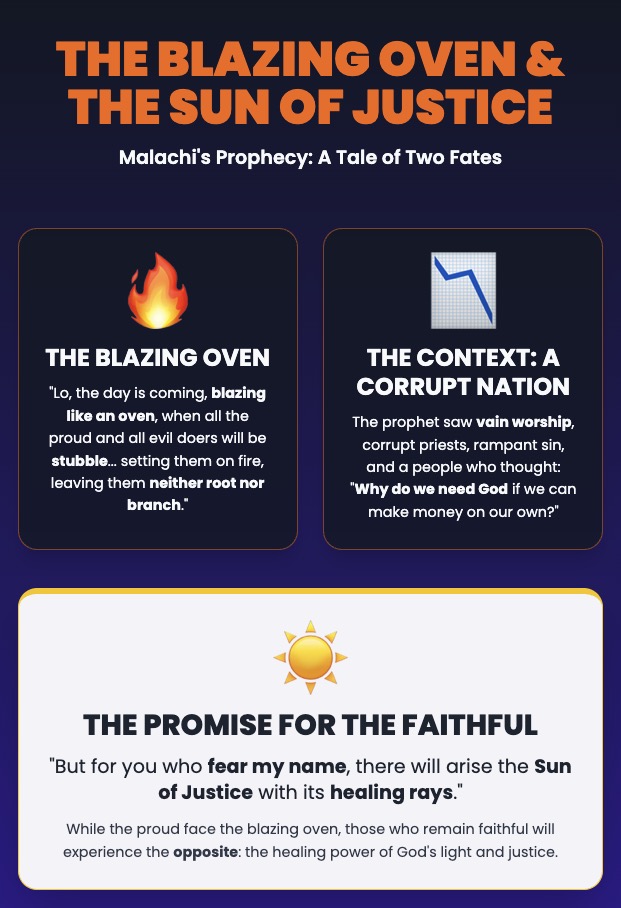
The Coming Wrath
by Larry Broding

Have you ever called out to God for the bad times to end? What happened? How do you look forward to the coming of the Lord?

Deep Dives
Click on timestamp links to watch different sections of the video.


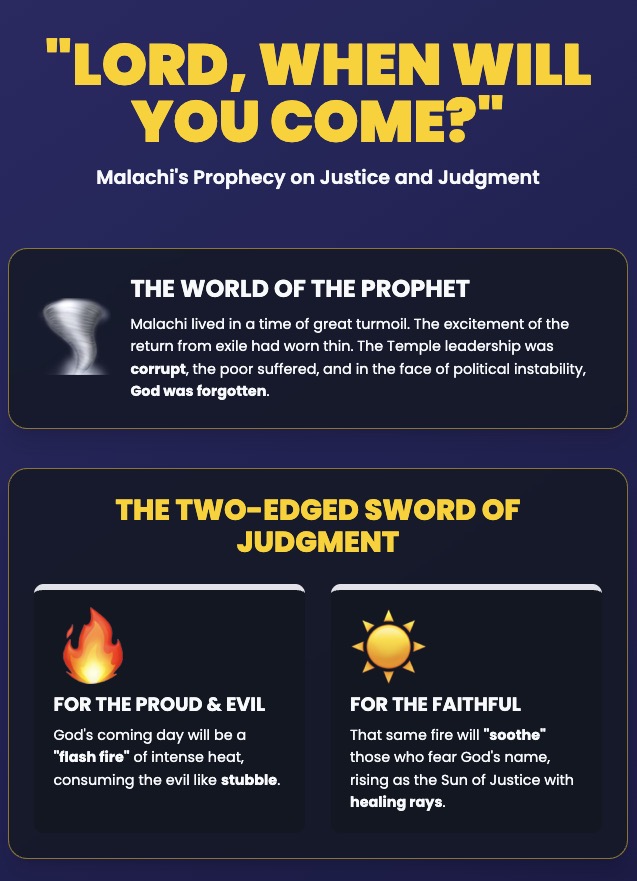
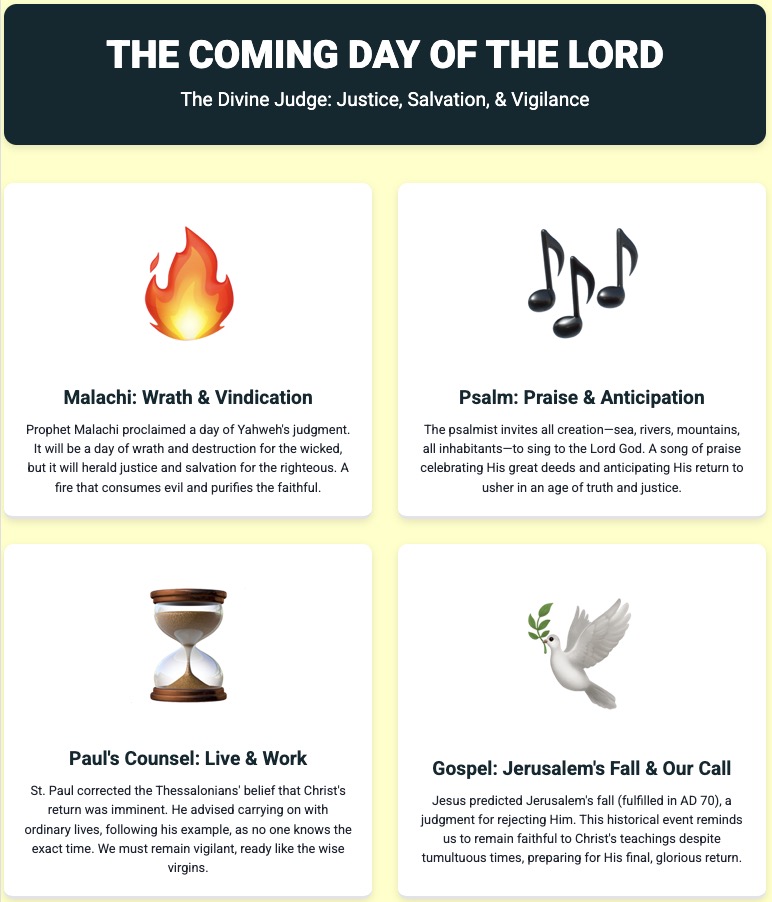
God will bring judgment and justice, but those who revere Him and open themselves to His love and healing, particularly through Jesus Christ, will receive mercy, healing, and ultimately eternal union with Him.
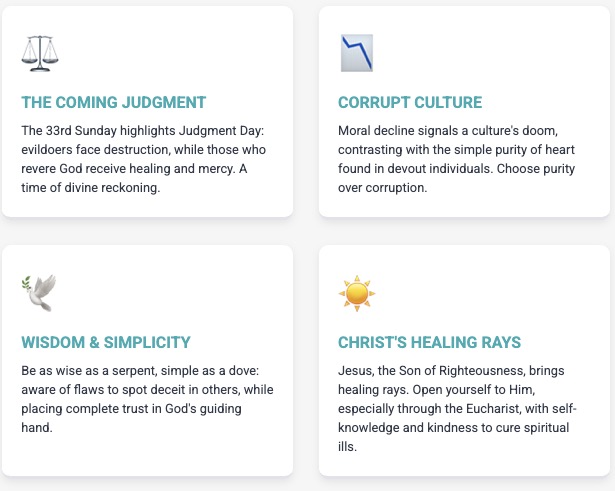
- 00:00 The readings for the 33rd Sunday highlight the impending judgment day, where evildoers will face destruction, while those who revere God will receive healing and mercy.
- 02:54 The culture is corrupt and doomed for destruction, as evident from its moral decline, unlike the simplicity and purity of heart of some devout individuals.
- 04:15 Being wise as a serpent and simple as a dove means being aware of one’s own flaws and weaknesses to spot deceit in others while trusting in God.
- 06:02 Jesus Christ, the Son of Righteousness, brings healing rays that can cure emotional and spiritual disorders, especially through the Eucharist, when we open ourselves to Him with self-knowledge and kindness.
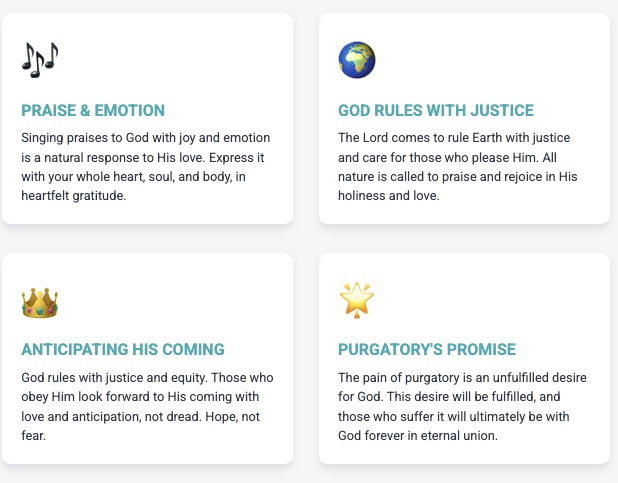
- 07:24 Singing praises to God with joy and emotion is a natural response to experiencing His love and should be expressed with our whole heart, soul, and body.
- 08:25 The Lord comes to rule the Earth with justice, caring for and loving those who try to please Him, and the psalm calls on all of nature to praise and rejoice in His holiness and love.
- 10:25 God will rule the Earth with justice and equity, and those who obey Him look forward to His coming with love and anticipation, rather than dread.
- 12:02 The pain of purgatory is an unfulfilled desire to be with God, but it will be fulfilled, and those who suffer it will ultimately be with God forever.

Click to enlarge
The Limits of Charity
by Larry Broding
How do you give to others in need? Do you pray for wisdom when you contribute your time, energy, and money in charitable work? How has that prayer helped you?


Deep Dives
Click on timestamp links to watch different sections of the video.


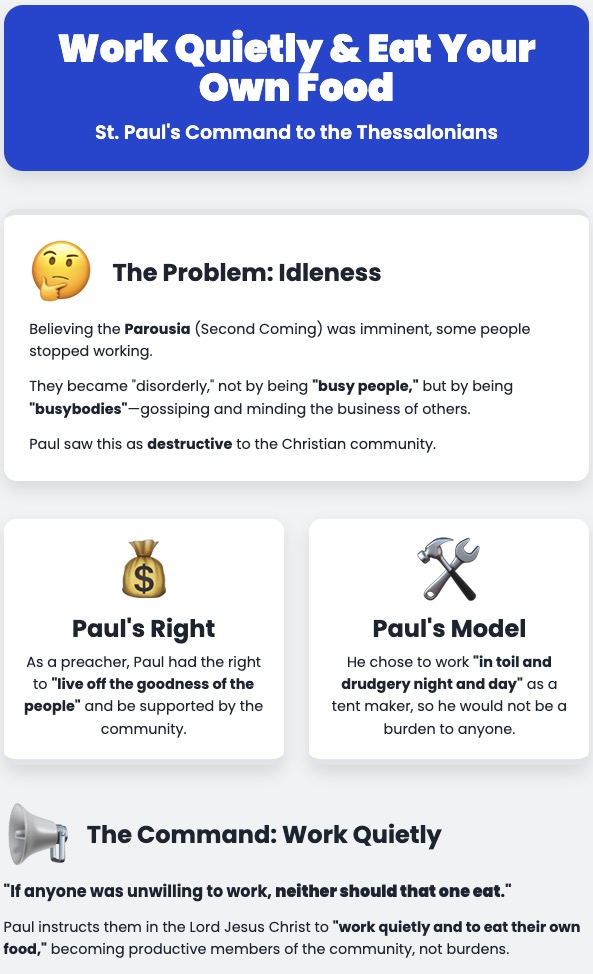
Christians have a responsibility to live a life of self-sufficiency, hard work, and responsibility, while also showing love and kindness to those in need, rather than being idle or expecting others to support them.
- 00:00 Paul advises the Thessalonians to imitate him and work hard to support themselves, just as he did while preaching the gospel, to avoid being a burden to others.
- 02:18 Paul gave an example of a strong work ethic by working at night and day to support himself, so that he wouldn’t burden others and to show them a model to imitate.
- 03:51 Those unwilling to work should not expect to eat, as we aim to set a model for self-sufficiency and responsibility.
- 05:31 Life in Washington DC is hectic, with people constantly rushing to and fro, often for the sake of making a living.
- 06:19 Supporting one’s family and helping the poor is essential, while idleness and meddling in others’ affairs undermine the Christian example of love and responsibility.
- 08:30 Helping the poor is a fundamental Christian duty, and those who have more should share their excess with others in need.
- 10:25 A kind look and respectful response can change someone’s life, and people have a responsibility to help those in need, rather than waiting idly for the Lord’s return.
- 11:55 A priest shares an experience where he encourages a struggling alcoholic by highlighting his positive actions, such as treating others with dignity and kindness, despite his own personal struggles.



Click to enlarge
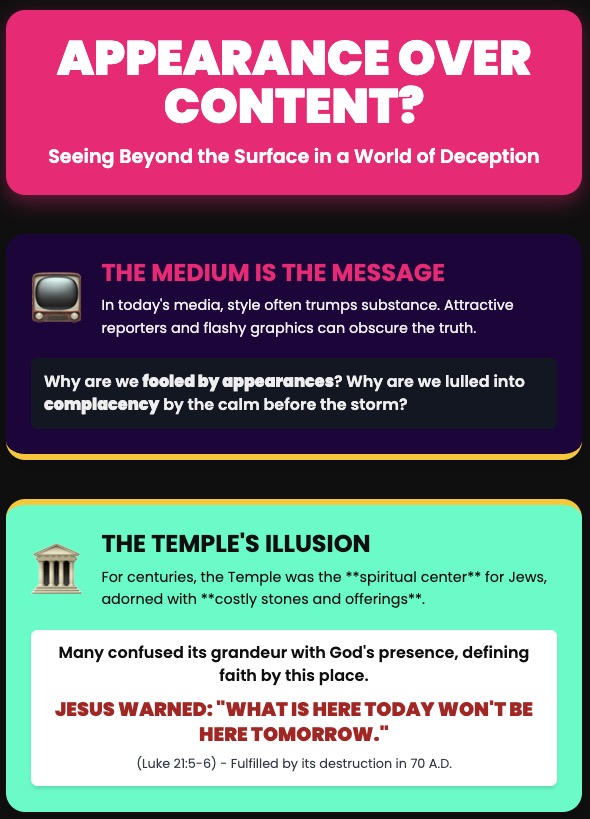
How important are appearances to others? How important are appearances to you? Pray this week for the strength to see clearly. Look at the world at large, or at your world. Try to see beyond the troubles and look for God’s will. Trust your prayer will be answered.

Deep Dives
Click on timestamp links to watch different sections of the video.


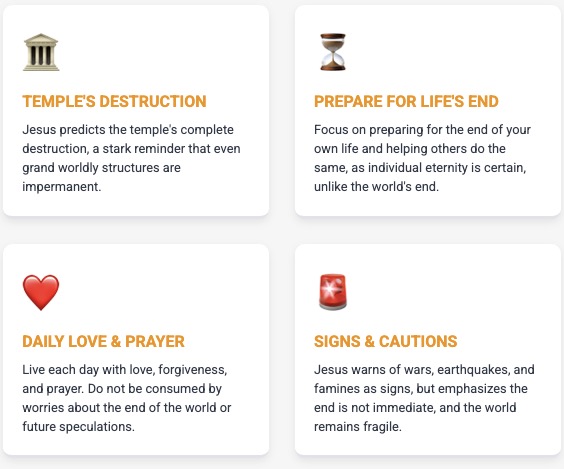
Christians should focus on living a life of love, forgiveness, and prayer, and prioritize securing their soul for eternity, rather than worrying about the end of the world or being distracted by worldly desires.
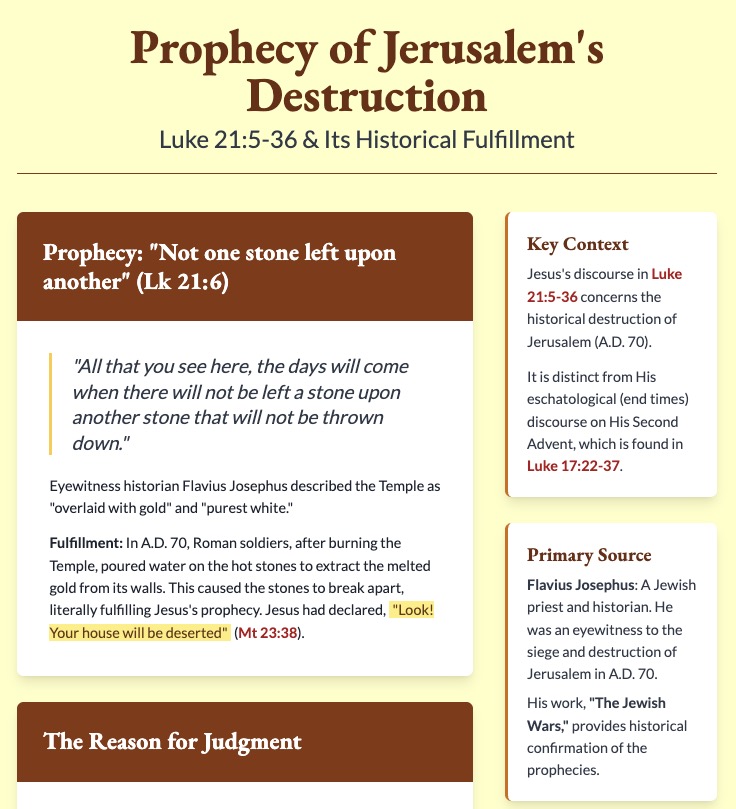
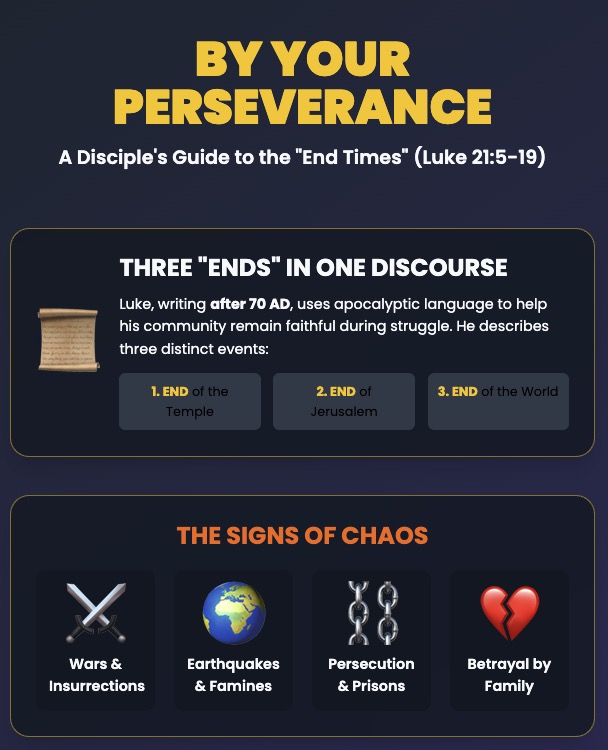
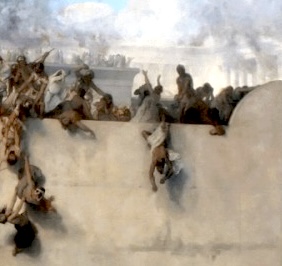
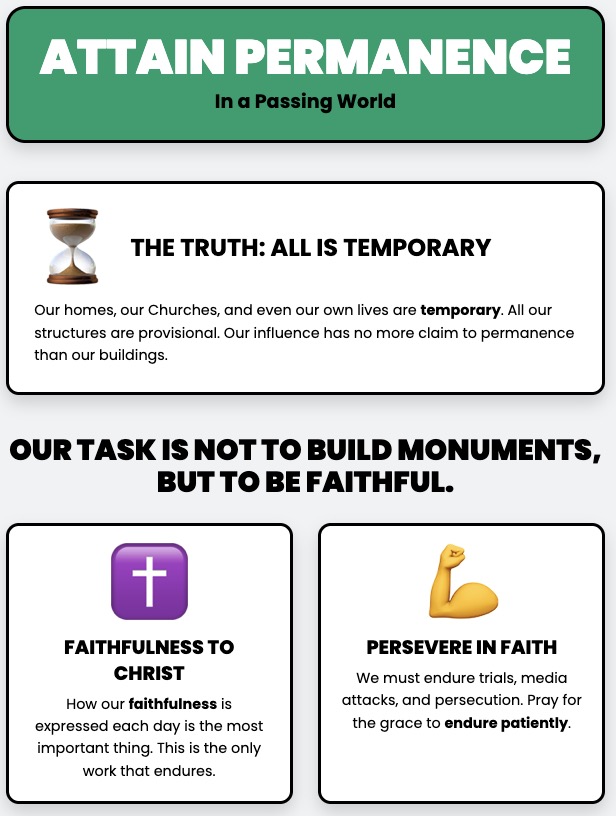
- 00:00 Jesus predicts the destruction of the temple, saying that not one stone will be left on top of another, in response to comments about the temple’s beauty and costly adornments.
- 01:20 Be prepared for the end of your own life and help others do the same, as the world’s end is uncertain, but its signs, such as division, violence, and addiction to power and money, are already present.
- 03:26 Focus on living each day with love, forgiveness, and prayer, rather than worrying about the end of the world or speculating about the future.
- 04:24 Jesus warns that signs like wars, earthquakes, and famines will occur before the end, which will not happen immediately, and cautions that the world is fragile and could end suddenly.
- 05:49 Many people are enslaved by their desires for money and pleasure, driven by misguided beliefs perpetuated by media, rather than being inherently bad individuals.
- 06:40 Jesus warns of persecution, but promises wisdom and salvation through perseverance.
- Reality is not always what we experience, as illustrated by a cartoon where a father tells his son they cannot change the channel because their current situation is reality.
- Persecution and hardships will come, but Jesus will give wisdom to bear witness, and perseverance will ultimately lead to salvation.
- 09:07 A simple act of kindness, such as offering prayer and a small amount of money, can make a significant difference in someone’s life while also protecting the giver from potential exploitation.
- 09:59 Focus on securing your soul for eternity by persevering and spreading Christ’s love, especially to those in need.
- Persevere and don’t get settled in this world, focusing on securing your soul for when your life ends, either through the end of the world or your own death.
- As life and earthly things are temporary, we must focus on spreading Christ’s love to help others, particularly those in great need, to soften their hearts and ultimately be saved.




Diocese of Phoenix
33rd Sunday of Year C

Christ in Our Neighborhood
Bishop John Dolan
This program aims to foster deeper relationships with Christ through weekly Scripture study and prayer in small faith communities. It was introduced in December 2022

More Discussion Guides
Fr. Thibodeau
Bible Study Notes
Bp. John P. Dolan
Fr. Tobin
Fr. Conley Bertrand
33rd Sunday of Year C
Cycle C (PDFs)
📖 Old Testament (43 pp.)
📖 Epistles (87 pp.)
📖 Gospels (182 pp.)
📖 Daily Gospels (208 pp.)
SOURCE: Come, Lord Jesus
Carmelite Reflections and Prayers
Lectio Divina
85-page PDF with reflections and prayers for each day of the month
Lectio Divina NOVEMBER 2025 (PDF)
Lectio Divina NOVEMBER 2025 [ePub]
______________
“Lectio divina is an authentic source of Christian spirituality recommended by our Rule. We therefore practise it every day, so that we may develop a deep and genuine love for it, and so that we may grow in the surpassing knowledge of Christ. In this way we shall put into practice the Apostle Paul’s commandment, which is mentioned in our Rule: “The sword of the Spirit, too, which is the word of God, is to dwell abundantly in your mouth and in your hearts; and whatever things you have to do, let them be done in the word of the Lord.” (Carmelite Constitutions (2019), n. 85.)
Source: Carmelites
Lk 21:5-19: Signs of the End and the Coming Persecution
Luke 21:5-8
Classic Translation
5. And as some spake of the temple, how it was adorned with goodly stones and gifts, he said,
6. As for these things which ye behold, the days will come, in the which there shall not be left one stone upon another, that shall not be thrown down.
7. And they asked him, saying, Master, but when shall these things be? and what sign will there be when these things shall come to pass?
8. And he said, Take heed that ye be not deceived: for many shall come in my name, saying, I am Christ; and the time draweth near: go ye not therefore after them.
EUSEBIUS. How beautiful was every thing relating to the structure of the temple, history informs us, and there are yet preserved remains of it, enough to instruct us in what was once the character of the buildings. But our Lord proclaimed to those that were wondering at the building of the temple, that there should not be left in it one stone upon another. For it was meet that that place, because of the presumption of its worshippers, should suffer every kind of desolation.
BEDE. For it was ordained by the dispensation of God that the city itself and the temple should be overthrown, lest perhaps some one yet a child in the faith, while wrapt in astonishment at the rites of the sacrifices, should be carried away by the mere sight of the various beauties.
AMBROSE. It was spoken then of the temple made with hands, that it should be overthrown. For there is nothing made with hands which age does not impair, or violence throw down, or fire burn. Yet there is also another temple, that is, the synagogue, whose ancient building falls to pieces as the Church rises. There is also a temple in every one, which falls when faith is lacking, and above all when any one falsely shields himself under the name of Christ, that so he may rebel against his inward inclinations.
CYRIL OF ALEXANDRIA. Now His disciples did not at all perceive the force of His words, but supposed they were spoken of the end of the world. Therefore asked they Him, saying, Master, but when shall these things be? and what sign, &c.
AMBROSE. Matthew adds a third question, that both the time of the destruction of the temple, and the sign of His coming, and the end of the world, might be inquired into by the disciples. But our Lord being asked when the destruction of the temple should be, and what the sign of His coming, instructs them as to the signs, but does not mind to inform them as to the time. It follows, Take heed that ye be not deceived.
ATHANASIUS. (Orat. 1. cont. Arian.) For since we have received, delivered unto us by God, graces and doctrines which are above man, (as, for example, the rule of a heavenly life, power against evil spirits, the adoption and the knowledge of the Father and the Word, the gift of the Holy Spirit,) our adversary the devil goeth about seeking to steal from us the seed of the word which has been sown. But the Lord, shutting up in us His teaching as His own precious gift, warns us, lest we be deceived. And one very great gift He gives us, the word of God, that not only we be not led away by what appears, but even if there is ought lying concealed, by the grace of God we may discern it. For seeing that the devil is the hateful inventor of evil, what he himself is he conceals, but craftily assumes a name desirable to all; just as if a man wishing to get into his power some children not His own, should in the absence of the parents counterfeit their looks, and lead away the children who were longing for them. In every heresy then the devil says in disguise, “I am Christ, and with me there is truth.” And so it follows, For many shall come in my name, saying, I am Christ; and the time draweth near.
CYRIL OF ALEXANDRIA. For before His descent from heaven, there shall come some to whom we must not give place. For the Only-begotten Son of God, when He came to save the world, wished to be in secret, that He might bear the cross for us. But His second coming shall not be in secret, but terrible and open. For He shall descend in the glory of God the Father, with the Angels attending Him, to judge the world in righteousness. Therefore He concludes, Go ye not therefore after them.
TITUS BOSTRENSIS. Or perhaps He docs not speak of false Christs coming before the end of the world, but of those who existed in the Apostles’ time.
BEDE. For there were many leaders when the destruction of Jerusalem was at hand, who declared themselves to be Christ, and that the time of deliverance was drawing nigh. Many heresiarchs also in the Church have preached that the day of the Lord is at hand, whom the Apostles condemn. (2 Thess. 2:2.) Many Antichrists also came in Christ’s name, of whom the first was Simon Magus, who said, This man is the great power of God. (Acts 8:10.)
33rd Sunday of Year C
Contemporary Adaptation

EUSEBIUS. History informs us how beautiful the temple was, and we still have ruins that prove its magnificence. But our Lord proclaimed to those who were marveling at it that not one stone would be left on another. It was fitting that this place, which had become a source of arrogant presumption for its worshippers, should be utterly desolated.
BEDE. The destruction of the temple was part of God’s divine plan, lest any new Christian, still a child in the faith, should be so wrapped in astonishment at the rituals and sacrifices that they would be carried away by the mere sight of its various beauties, mistaking the shadow for the substance.

AMBROSE. It was spoken of the temple made with hands that it would be overthrown. For there is nothing made with hands which time does not weaken, violence throw down, or fire burn. Yet there is also another temple: the synagogue, or the Old Covenant, whose ancient structure falls to pieces as the Church rises. There is also a temple in every one of us, which collapses when faith is lacking. This happens, above all, when anyone falsely shields himself under the name of Christ so that he may rebel against his own inward conscience and justify his sins.
CYRIL OF ALEXANDRIA. His disciples did not at all grasp the force of His words. They heard “the temple will be destroyed” and immediately supposed He was speaking of the end of the entire world. Therefore, they asked Him, “Master, but when will these things be? and what sign…”
AMBROSE. Matthew’s Gospel adds a third question, showing the disciples wanted to know the time of the temple’s destruction, the sign of His coming, and the end of the world. But our Lord, being asked when the destruction would be, instructs them on the signs of His coming but does not give them the time. And His very first warning is this: “See that you are not led astray.”
ATHANASIUS. We have received doctrines and graces from God that are far above man—the gift of a heavenly life, power against evil spirits, adoption as children, and the gift of the Holy Spirit. Our adversary, the devil, goes about seeking to steal this seed of the Word that has been sown in us. But the Lord, protecting His teaching in us as a precious gift, warns us lest we be deceived. He gives us the Word of God so that we may discern the truth. For the devil, the hateful inventor of evil, conceals what he truly is and craftily assumes a name that is desirable to all. He is like a man who, in the absence of the parents, counterfeits their appearance to lead away the children who are longing for them. In every heresy, the devil says in disguise, “I am Christ, and with me there is truth.” And so it follows, “For many shall come in my name, saying, I am Christ; and the time draweth near.”
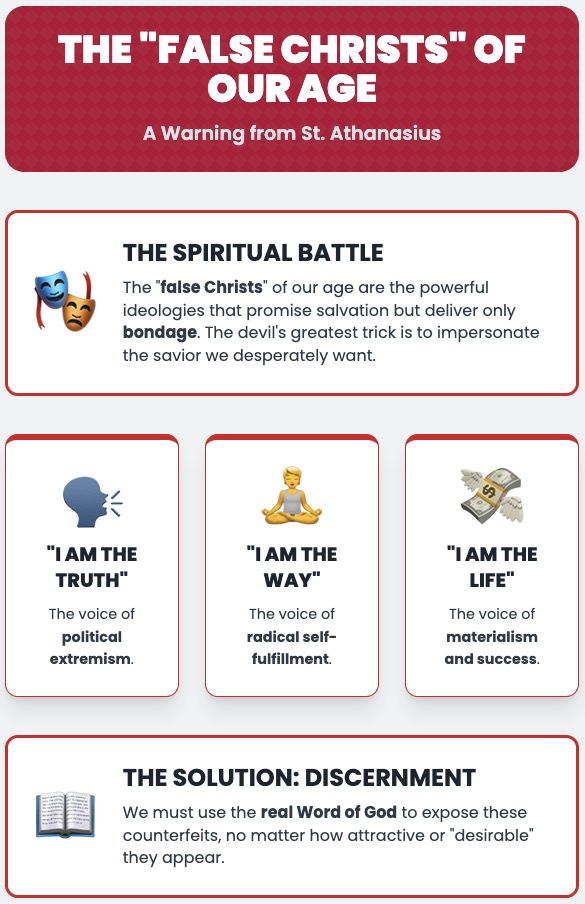
CYRIL OF ALEXANDRIA. There will be those who come before His final return, but we must not give them any attention. For the Only-begotten Son of God, when He first came to save the world, wished to be in secret, that He might bear the cross for us. But His second coming shall not be in secret. It will be terrible and open. He shall descend in the glory of God the Father, with the Angels attending Him, to judge the world in righteousness. Therefore, Jesus concludes, “Do not go after them.”
TITUS BOSTRENSIS. Or perhaps Jesus is not speaking only of the false Christs who will come before the end of the world, but also of those who were already popping up in the Apostles’ own time.
BEDE. Yes, history confirms this. Many leaders appeared when the destruction of Jerusalem was at hand, declaring themselves to be Christ. Many heretics in the Church have also preached that “the day of the Lord is at hand,” whom the Apostles had to condemn. And many “Antichrists” came in Christ’s name, of whom the very first was Simon Magus in the Book of Acts, who claimed, “This man is the great power of God.”
Luke 21:9-11
Classic Translation
9. But when ye shall hear of wars and commotions, be not terrified: for these things must first come to pass; but the end is not by and by.
10. Then said he unto them, Nation shall rise against nation, and kingdom against kingdom:
11. And great earthquakes shall be in divers places, and famines, and pestilences; and fearful sights and great signs shall there be from heaven.
GREGORY. (in Hom. 35. in Evang.) God denounces the woes that shall forerun the destruction of the world, that so they may the less disturb when they come, as having been foreknown. For darts strike the less which are foreseen. And so He says, But when ye shall hear of wars and commotions, &c. Wars refer to the enemy, commotions to citizens. To shew us then that we shall be troubled from within and without, He asserts that the one we suffer from the enemy, the other from our own brethren.
AMBROSE. But of the heavenly words none are greater witnesses than we, upon whom the ends of the world have come. What wars and what rumours of wars have we received!
GREGORY. But that the end will not immediately follow these evils which come first, it is added, These things must first come to pass; but the end is not yet, &c. For the last tribulation is preceded by many tribulations, because many evils must come first, that they may await that evil which has no end. It follows, Then said he unto them, Nation shall rise against nation, &c. For it must needs be that we should suffer some things from heaven, some from earth, some from the elements, and some from men. Here then are signified the confusions of men. It follows, And great earthquakes shall be in divers places. This relates to the wrath from above.
CHRYSOSTOM. (Hom. 11. in Acta.) For an earthquake is at one time a sign of wrath, as when our Lord was crucified the earth shook; but at another time it is a token of God’s providence, as when the Apostles were praying, the place was moved where they were assembled. It follows, and pestilence.
GREGORY. (in Hom. 35.) Look at the vicissitudes of bodies. And famine. Observe the barrenness of the ground. And fearful sights and great signs there shall be from heaven. Behold the variableness of the climate, which must be ascribed to those storms which by no means regard the order of the seasons. For the things which come in fixed order are not signs. For every thing that we receive for the use of life we pervert to the service of sin, but all those things which we have bent to a wicked use, are turned to the instruments of our punishment.
AMBROSE. The ruin of the world then is preceded by certain of the world’s calamities, such as famine, pestilence, and persecution.
THEOPHYLACT. Now some have wished to place the fulfilment of these things not only at the future consummation of all things, but at the time also of the taking of Jerusalem. For when the Author of peace was killed, then justly arose among the Jews wars and sedition, But from wars proceed pestilence and famine, the former indeed produced by the air infected with dead bodies, the latter through the lands remaining uncultivated. Josephus also relates the most intolerable distresses to have occurred from famine; and at the time of Claudius Cæsar there was a severe famine, as we read in the Acts, (Acts 11:28.) and many terrible events happened, forboding, as Josephus says, the destruction of Jerusalem.
CHRYSOSTOM. But He says, that the end of the city shall not come immediately, that is, the taking of Jerusalem, but there shall be many battles first.
BEDE. The Apostles are also exhorted not to be alarmed by these forerunners, nor to desert Jerusalem and Judæa. But the kingdom against kingdom, and the pestilence of those whose word creepeth as a cancer, and the famine of hearing the word of God, and the shaking of the whole earth, and the separation from the true faith, may be explained also in the heretics, who contending one with another bring victory to the Church.
AMBROSE. There are also other wars which the Christian wages, the struggles of different lusts, and the conflicts of the will; and domestic foes are far more dangerous than foreign.
33rd Sunday of Year C
Contemporary Adaptation
GREGORY. God tells us about the terrible things that will happen before the end of the world so that when they come, they will disturb us less. For darts that are foreseen strike with less force. And so He says, “When you hear of wars and commotions, do not be terrified.” Wars refer to our external enemies; commotions refer to our fellow citizens. He tells us this so we understand that we will be troubled from without and from within.
AMBROSE. Of these heavenly words, none are greater witnesses than we, upon whom the ends of the world have come. What wars, and what rumors of wars, have we not received!
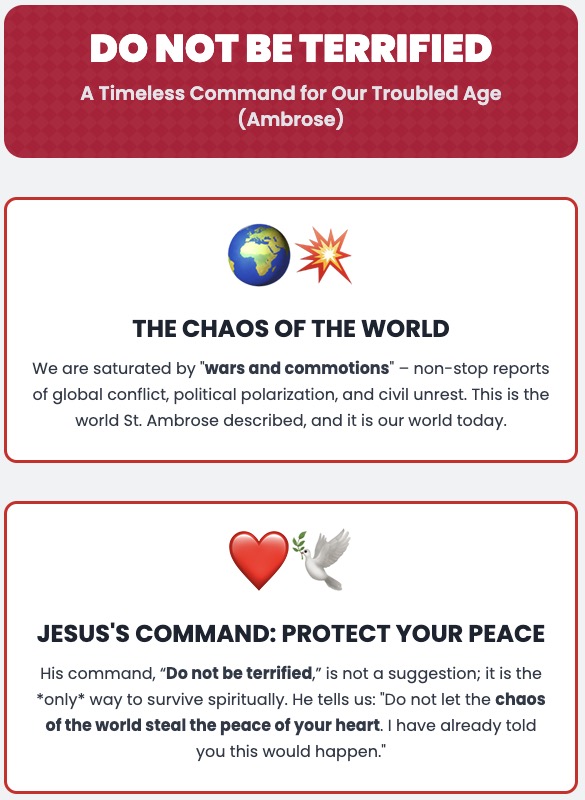
GREGORY. But He adds, “these things must first come to pass; but the end is not by and by,” to show us that the end will not immediately follow these first evils. The final, great tribulation is preceded by many smaller tribulations, because many evils must come first before we face that evil which has no end. He said, “Nation shall rise against nation.” This signifies the confusions of men. He continued, “And great earthquakes shall be in divers places.” This relates to the wrath from above.
CHRYSOSTOM. An earthquake can be a sign of wrath, as when our Lord was crucified and the earth shook. But it can also be a token of God’s providence, as when the Apostles were praying and the place where they were assembled was moved.
GREGORY. He mentions famine—observe the barrenness of the ground. He mentions pestilence—look at the diseases that plague our bodies. He mentions terrors and great signs from heaven—behold the variableness of the climate, the storms which do not follow their proper seasons. For the things that come in their fixed order are not signs. But here is the key: every thing that we receive for the use of life, we pervert to the service of sin. Therefore, all those things which we have bent to a wicked use are turned into the instruments of our punishment.

AMBROSE. The ruin of the world, then, is preceded by certain of the world’s own calamities: famine, pestilence, and persecution.
THEOPHYLACT. Now, some have wished to place the fulfillment of these things not only at the final end of the world, but also at the time of the taking of Jerusalem (in 70 AD). For when the Author of peace was killed, it was just that wars and seditions should rise among the Jews. And from wars come pestilence (from the air infected by dead bodies) and famine (from the lands being uncultivated). The historian Josephus also relates that many terrible events happened, foreboding the destruction of Jerusalem.
CHRYSOSTOM. But Jesus says that the end of the city shall not come immediately; there will be many battles first.
BEDE. We can also explain these things spiritually as signs of heresy. “Kingdom against kingdom” can be heretics fighting one another, which (ironically) brings victory to the Church. “Pestilence” can be the “cancer” of false doctrine. The “famine” can be a famine of hearing the true Word of God. The “shaking of the earth” can be the separation of many from the true faith.
AMBROSE. There are also other wars which the Christian wages every day: the struggles of different lusts and the conflicts of the will. Truly, our domestic foes—the enemies inside our own hearts—are far more dangerous than any foreign ones.

Luke 21:12–19
Classic Translation
12. But before all these, they shall lay their hands on you, and persecute you, delivering you up to the synagogues, and into prisons, being brought before kings and rulers for my name’s sake.
13. And it shall turn to you for a testimony.
14. Settle it therefore in your hearts, not to meditate before what ye shall answer:
15. For I will give you a mouth and wisdom, which all your adversaries shall not be able to gainsay nor resist.
16. And ye shall be betrayed both by parents, and brethren, and kinsfolks, and friends; and some of you shall they cause to be put to death.
17. And ye shall be hated of all men for my name’s sake.
18. But there shall not an hair of your head perish.
19. In your patience possess ye your souls.
GREGORY. (Hom. 35. in Evang.) Because the things which have been prophesied of arise not from the injustice of the inflictor of them, but from the deserts of the world which suffers them, the deeds or wicked men are foretold; as it is said, But before all these things, they shall lay their hands upon you: as if He says, First the hearts of men, afterwards the elements, shall be disturbed, that when the order of things is thrown into confusion, it may be plain from what retribution it arises. For although the end of the world depends upon its own appointed course, yet finding some more corrupt than others who shall rightly be overwhelmed in its fall, our Lord makes them known.
CYRIL OF ALEXANDRIA. Or He says this, because before that Jerusalem should be taken by the Romans, the disciples, having suffered persecution from the Jews, were imprisoned and brought before rulers; Paul was sent to Rome to Cæsar, and stood before Festus and Agrippa.
It follows, And it shall turn to you for a testimony. In the Greek it is εἰς μαρτύριον, that is, for the glory of martyrdom.
GREGORY. (ut sup.) Or, for a testimony, that is, against those who by persecuting you bring death upon themselves, or living do not imitate you, or themselves becoming hardened perish without excuse, from whom the elect take example that they may live. But as hearing so many terrible things the hearts of men may be troubled, He therefore adds for their consolation, Settle it therefore in your hearts, &c.
THEOPHYLACT. For because they were foolish and inexperienced, the Lord tells them this, that they might not be confounded when about to give account to the wise. And He adds the cause, For I will give you a mouth and wisdom, which all your adversaries shall not be able to gainsay or resist. As if He said, Ye shall forthwith receive of me eloquence and wisdom, so that all your adversaries, were they gathered together in one, shall not be able to resist you, neither in wisdom, that is, the power of the understanding, nor in eloquence, that is, excellence of speech, for many men have often wisdom in their mind, but being easily provoked to their great disturbance, mar the whole when their time of speaking comes, But not such were the Apostles, for in both these gifts they were highly favoured.
GREGORY. (ut sup.) As if the Lord said to His disciples, “Be not afraid, go forward to the battle, it is I that fight; you utter the words, I am He that speaketh.”
AMBROSE. Now in one place Christ speaks in His disciples, as here; in another, the Father; (Mat. 16:17) in another the Spirit of the Father speaketh. (Mat. 10:20.) These do not differ but agree together, In that one speaketh, three speak, for the voice of the Trinity is one.
THEOPHYLACT. Having in what has gone before dispelled the fear of inexperience, He goes on to warn them of another very certain event, which might agitate their minds, lest falling suddenly upon them, it should dismay them; for it follows, And ye shall be betrayed both by parents, and brethren, and kinsfolk, and some of you shall they cause to be put to death.
GREGORY. (ut sup.) We are the more galled by the persecutions we suffer from those of whose dispositions we made sure, because together with the bodily pain, we are tormented by the bitter pangs of lost affection.
GREGORY OF NYSSA. But let us consider the state of things at that time. While all men were suspected, kinsfolk were divided against one another, each differing from the other in religion; the gentile son stood up the betrayer of his believing parents, and of his believing son the unbelieving father became the determined accuser; no age was spared in the persecution of the faith; women were unprotected even by the natural weakness of their sex.
THEOPHYLACT. To all this He adds the hatred which they shall meet with from all men.
GREGORY. (ut sup.) But because of the hard things foretold concerning the affliction of death, there immediately follows a consolation, concerning the joy of the resurrection, when it is said, But there shall not an hair of your head perish. As though He said to the martyrs, Why fear ye for the perishing of that which when cut, pains, when that can not perish in you, which when cut gives no pain?
BEDE. Or else, There shall not perish a hair of the head of our Lord’s Apostles, because not only the noble deeds and words of the Saints, but even the slightest thought shall meet with its deserving reward.
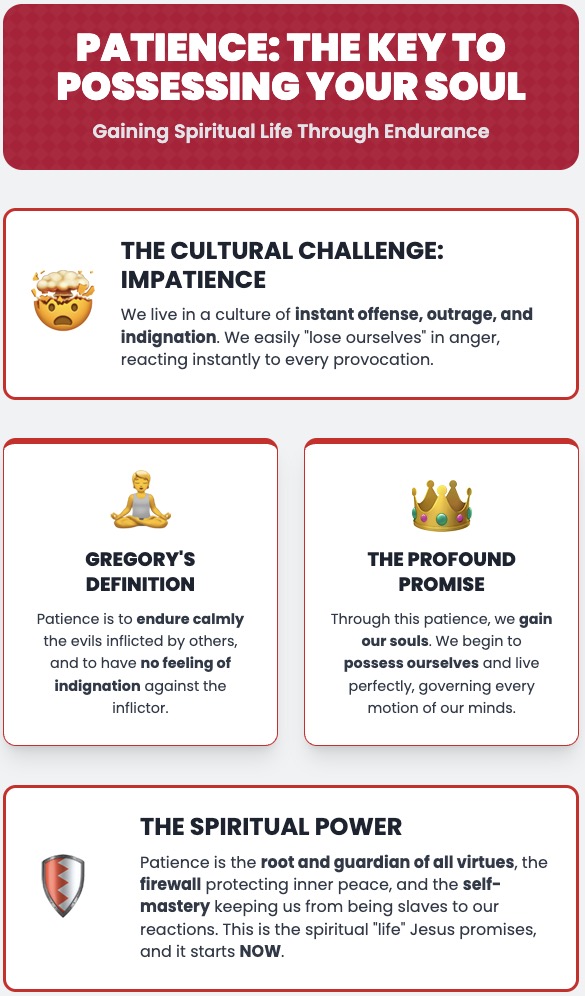
GREGORY. (Mor. 5. c. 16.) He who preserves patience in adversity, is thereby rendered proof against all affliction, and so by conquering himself, he gains the government of himself; as it follows, In your patience shall ye possess your souls. For what is it to possess your souls, but to live perfectly in all things, and sitting as it were upon the citadel of virtue to hold in subjection every motion of the mind?
GREGORY. (Hom. 35. in Ev.) By patience then we possess our souls, because when we are said to govern ourselves, we begin to possess that very thing which we are. But for this reason, the possession of the soul is laid in the virtue of patience, because patience is the root and guardian of all virtues. Now patience is to endure calmly the evils which are inflicted by others, and also to have no feeling of indignation against him who inflicts them.
33rd Sunday of Year C
Contemporary Adaptation
GREGORY. Because these terrible things (wars, plagues, etc.) are foretold, they do not arise from the injustice of the one inflicting them, but from the deserts of the world which suffers them. Our Lord foretells the wicked deeds of men: “But before all these things, they will lay their hands on you.” It is as if He is saying: First, the hearts of men will be disturbed (with persecution and betrayal), and afterward the elements themselves (with earthquakes and famines). He shows us this order so that when the world is thrown into confusion, it will be perfectly clear from what retribution this chaos arises.
CYRIL OF ALEXANDRIA. Or, He says this because before Jerusalem was finally taken by the Romans, the disciples had already suffered great persecution from the Jews. They were imprisoned and brought before rulers, just as Paul was sent to Rome to stand before Festus, Agrippa, and Caesar himself.
GREGORY. This persecution, Jesus says, “shall turn to you for a testimony.” What does this mean? It is a testimony against those who, by persecuting you, bring eternal death upon themselves. It is a testimony against those who, while they live, see your faith but refuse to imitate you. They become hardened and perish without excuse, while the elect see your example and are inspired to live.
THEOPHYLACT. But since the disciples were uneducated, foolish, and inexperienced men, the Lord adds a great consolation so that they might not be confounded when forced to give an account of their faith to the wise and powerful. And this is the cause of their confidence: “For I will give you a mouth and wisdom, which all your adversaries shall not be able to gainsay or resist.” He is saying, “You will immediately receive from Me both eloquence and wisdom, so that all your enemies, even if they gathered together in one place, could not withstand you—neither in the power of your understanding (wisdom) nor in the excellence of your speech (eloquence).”
GREGORY. It is as if the Lord said to His disciples, “Do not be afraid. Go forward to the battle. It is I who fight. You utter the words; I am He that speaks.”

AMBROSE. Now, in one place, Christ speaks in His disciples, as He does here. In another, the Father speaks (as in Matthew 16:17). In another, it is the Spirit of the Father (Matthew 10:20). These do not differ but agree. In that One speaks, Three speak, for the voice of the Trinity is one.
THEOPHYLACT. Having calmed their fear of inexperience, He now warns them of another event, one that could truly agitate their minds, lest it dismay them by its suddenness: “And ye shall be betrayed both by parents, and brethren, and kinsfolks, and friends; and some of you shall they cause to be put to death.”
GREGORY. We are always the most galled by the persecutions we suffer from those we were so sure of. In those moments, we are tormented not only by the bodily pain, but by the bitter pangs of lost affection.
GREGORY OF NYSSA. But let us consider the state of things at that time! Kinsfolk were divided against one another, each differing in religion. The pagan son stood up as the betrayer of his believing parents; the unbelieving father became the accuser of his believing son. No age was spared.

GREGORY. But because He foretold such hard things concerning death, He immediately follows with a consolation concerning the joy of the resurrection: “But there shall not an hair of your head perish.” It is as if He said to the martyrs, “Why do you fear the perishing of that which causes you pain when it is cut (your body), when that which cannot perish in you (your soul, your very identity) gives you no pain when it is cut (like a hair)?”
BEDE. Or, we can see it this way: “Not a hair of your head” shall perish, because not only the noble deeds and words of the Saints, but even the slightest thought or smallest good intention shall meet with its deserving reward.
GREGORY. He who preserves patience in adversity is thereby rendered indestructible against all affliction. By conquering himself, he gains the government of himself. As it follows, “In your patience possess ye your souls.” For what is it to “possess your souls”? It is to live perfectly in all things, and, sitting as it were upon the citadel of virtue, to hold in subjection every motion of the mind.
- Ordained in 1967
- Started the “Scriptural Homilies” ministry in 2003 while serving as a chaplain
- Applied scientific methodology to homily ministry+ Reached hundreds of priests and Deacons through word-of-mouth, eventually reaching the Vatican Radio website and four other websites
- Distributed weekly homilies to nearly 3000 priests and Deacons via direct email
- His commentary and reflections were posted on the Vatican News website for several years.
Sunday and Daily Homily Resources
- Eight Minute Homily
- Introduction
- Scripture Summaries
- Exegesis
- Life Messages
- Homily Starter Anecdotes
- Jokes of the Week
Fr. Tony’s
Jokes of the
Week
After finishing his homily on the Judgment Day, the preacher started the prayer of mercy. “Oh Lord,” he began. “One of these days we are going to wake up, and it’s going to be DARK everywhere! Deliver us, O Lord.”
“Lord, have mercy on us!” responded the congregation.
The preacher continued: “Then we are going to pick up the telephone and call Washington, and they are going to say, ‘It’s DARK over here too!’”
“Lord, have mercy on us!” responded the congregation.”
Then we’re going to pick up the phone and call London, and they are going to say, ‘It’s DARK over here!’
“Lord, have mercy on us!” responded the congregation.
“Again, we’re going to pick up the phone and call Moscow, and they are going to say, ‘It’s DARK over here too!”
“Lord, have mercy on us!” responded the congregation.”
“Then we’re going to pick up the phone…. At this juncture, the church treasurer, who had also been caught up in the fervor of the preacher’s prayer, cried out uncontrollably: “Lord, Lord! What a PHONE BILL!”



LIFE MESSAGE #1
LIFE MESSAGE #2

Scroll to Read More