

Commentary for the 34th Sunday of Year B Christ the King

NEED HELP?
GET ANSWERS
FROM AI
THE WORD THIS WEEK "AI "Catholic Assistant" Chat Bot has been specifically trained for this website
🔵 STEP ONE

CLICK ON THE BLUE ICON at the bottom right corner of screen
🔵 STEP TWO
TYPE YOUR QUESTION that is related to the content on the page
— OR —
COPY AND PASTE any text on the page to generate a more in-depth look of the topic
🔵 STEP THREE
ASK FOLLOW-UP QUESTIONS if necessary
FOR BEST RESULTS:
Refresh chatbot when switching to a different Sunday of year.
Questions asked to and answered by the AI Chat from this Sunday's COMMENTARY Page....
Why is their a cross and crown for the featured image?
The cross and crown together symbolize the paradox of Christ's kingship. The cross represents Jesus' suffering, sacrifice, and the ultimate act of love through His crucifixion. It is a symbol of humility and redemption. The crown signifies His victory over sin and death, His resurrection, and His eternal reign as King. Together, they illustrate that Jesus' path to kingship was through the cross, highlighting the Christian belief that true glory and authority come through self-giving love and sacrifice.
While the notion of an earthly empire often entails colonization and subjugation, how is Jesus’ kingdom different?
Jesus' kingdom is fundamentally different from earthly empires. In John 18:36, Jesus states, "My kingdom is not of this world," emphasizing its spiritual nature. Unlike earthly kingdoms, which often rely on power and domination, Jesus' kingdom is based on love, truth, and service. It is a kingdom of justice, peace, and self-sacrifice, where the greatest are those who serve others. Jesus' reign is not about territorial control but transforming hearts and lives, inviting all to participate in His eternal kingdom.
Tell me more
Jesus' kingdom is characterized by its spiritual and eternal nature, contrasting with temporal earthly empires. It is rooted in love, humility, and service, as exemplified by Jesus' life and teachings. He calls His followers to serve others, embodying the values of compassion and selflessness. His kingdom is inclusive, welcoming all who seek truth and righteousness. It transcends cultural and national boundaries, uniting believers in a shared mission to spread the Gospel and live out the values of justice, peace, and love.
How can Jesus’ assertion that His kingdom is not of this world can be interpreted as the acknowledgement of the transcendent nature of the Self?
Jesus' assertion that His kingdom is not of this world highlights the transcendent nature of His mission and identity. It suggests that true fulfillment and identity are found beyond earthly concerns and material existence. By aligning with Jesus' teachings, believers are invited to transcend worldly limitations and embrace a higher calling rooted in spiritual values. This perspective encourages individuals to seek their true selves in relationship with God, emphasizing eternal truths over temporal pursuits, and aligning with the divine purpose.
How can the ego be a king like Jesus?
In Christian spirituality, the ego is often seen as the self-centered aspect of human nature that seeks power and control. To be a king like Jesus, the ego must be transformed through humility, love, and service. Jesus exemplified leadership through self-sacrifice and serving others, prioritizing the needs of others over His own. By embracing these values, the ego can be aligned with Christ-like virtues, leading not through dominance but through compassion, justice, and a commitment to the well-being of others.
What does it mean to be humble
To be humble means to have an accurate understanding of oneself, recognizing both strengths and limitations. It involves acknowledging one's dependence on God and the need for His grace. Humility is not self-deprecation but rather an honest assessment of oneself, leading to openness to learning and growth. It encourages putting others before oneself, serving without seeking recognition, and valuing others' contributions. Humility fosters genuine relationships and aligns with the Christian call to love and serve others selflessly.

ASK YOUR OWN QUESTIONS BY CLICKING ON THE AI CHAT ICON AT THE BOTTOM RIGHT CORNER OF THIS PAGE
Outlines of the
Readings
and Dominion ✨
Daniel 7:13-14

I. The Son of Man's Glorious Arrival
- "One like a son of man coming, on the clouds of heaven" (Dn 7:13)
- Significance of the Son of Man
- The coming on the clouds of heaven
II. Universal Authority and Everlasting Reign
- "All peoples, nations, and languages serve him" (Dn 7:14)
- Christ's dominion over all peoples
- The unity of diverse cultures under his rule
- "His dominion is an everlasting dominion that shall not be taken away" (Dn 7:14)
- The eternal nature of Christ's kingship
- Assurance and hope for believers
Clipart by Fr. Richard Lonsdale
Revelation 1:5-8

I. A Kingdom of Priests
- "Jesus Christ ... has made us into a kingdom, priests for his God and Father" (Rv 1:5-6)
- Jesus Christ's establishment of his kingdom
- The calling of believers as priests
- Our role in serving God and fostering unity
II. The Awaited Return of Christ
- "Behold, he is coming amid the clouds" (Rv 1:7)
- The anticipation of Christ's return
- Significance for the faithful
III. The Testimony of the Alpha and Omega
- "I am the Alpha and the Omega ... the one who is, who was, and who is to come" (Rv 1:8)
- Christ's eternal presence
- Divine authority and power
- Assurance of his continued presence in the lives of believers
Clipart by Fr. Richard Lonsdale
John 18:33b-37

I. The Question of Christ's Kingship
- "Are you the King of the Jews?" (Jn 18:33)
- The inquiry into Jesus' authority
- Implications of his response
II. The Nature of Christ's Kingdom
- "My kingdom does not belong to this world" (Jn 18:36)
- Contrast between earthly and heavenly realms
- The spiritual foundation of his kingdom
III. Christ's Testimony to Truth
- "For this I was born ... to give testimony to the truth" (Jn 18:37)
- Christ's purpose and mission
- The importance of truth in his teachings
- His example for believers to follow
Clipart by Fr. Richard Lonsdale
Roman Catholic
Commentators


SOURCE: Hearers of the Word
- 00:00 Christ the King Sunday highlights John 18:33-38, emphasizing salvation amidst the historical context of the feast's establishment to combat secularism.
- 02:27 Jesus tells Pilate His kingdom is not of this world and came to testify to the truth, while Pilate finds no fault in Him but the crowd demands Barabbas' release.
- Jesus explains to Pilate that His kingdom is not of this world and that He came to testify to the truth.
- Pilate questions the Jewish leaders about their accusations against Jesus, revealing their inability to execute him and fulfilling Jesus' prophecy about his death.
- Jesus explains to Pilate that his kingdom is not of this world and emphasizes his purpose of testifying to the truth, while Pilate finds no reason to accuse him and offers to release him, but the crowd chooses Barabbas instead.
- 06:00 Pilate, despite finding Jesus innocent, succumbs to pressure from Jewish leaders and hands him over for crucifixion.
- Pilate presents Jesus, who is mocked and beaten, declaring he finds no reason to accuse him, but the Jewish leaders demand his crucifixion.
- Pilate, fearing the Jewish leaders' influence and their claim of loyalty to Caesar, ultimately handed Jesus over to be crucified despite recognizing his innocence.
- 08:48 Jesus' trial before Pilate, set in Herod's fortress, highlights themes of kingship and power, differing in presentation across the gospels.
- The trial of Jesus likely took place in Herod's fortress, now known as the Citadel of David, which was an important location in ancient Jerusalem.
- The trial of Jesus before Pilate is presented differently in the synoptic gospels compared to the fourth gospel, with Mark providing a concise account and Matthew adding additional details such as Judas's betrayal and Pilate's wife's dream.
- John's gospel presents a dramatic sequence of scenes during Jesus' trial, emphasizing themes of kingship and power through a structured movement between outside and inside settings.
- 12:50 Jesus is recognized as the King of Israel in the Gospel of John, culminating in Pilate's questioning of his identity amid tensions with Jewish leaders.
- The fourth gospel shifts focus from Jesus proclaiming the kingdom of God to the early church recognizing Jesus as king, highlighted in John 3 and John 18.
- Jesus is recognized as the King of Israel throughout the Gospel of John, particularly during significant events like the bread of life discourse and his entry into Jerusalem.
- Pilate questions Jesus about being the king of the Jews, highlighting the tension between the Jewish leaders' accusations and Jesus' identity as presented in John's Gospel.
- 16:49 Jesus asserts His kingdom is not of this world, emphasizing His role as the revealer of truth amidst Pilate's inquiries about identity and truth.
- Jesus explains that His kingdom is not of this world and that He came to testify to the truth, prompting Pilate's inquiry about the nature of truth.
- Jesus clarifies that His kingdom is not of this world, highlighting the dual nature of "world" in John's gospel as both a place of salvation and a realm of evil forces.
- Pilate's question about Jesus' origin highlights the ongoing theme of truth and identity in the Gospel of John, emphasizing Jesus as the revealer of truth.
- 20:20 Jesus, the rejected Messiah, embodies a paradoxical kingship that challenges human understanding of power and wisdom.
- 22:06 The passage emphasizes the significance of Christ's sacrificial love and calls for humility and service among believers as they conclude the liturgical year and prepare for Advent.

- CATHOLIC CATECHISM
- CHURCH
FATHERS - PRO-LIFE PERSPECTIVE
- JUNGIAN PERSPECTIVE
Roman Catholic
Doctrine
Kingdom of God: The Catholic Church teaches that the Kingdom of God is present in the world and is continually being established through the Church. Jesus’ proclamation of his kingdom in the passage is connected to this doctrine, highlighting the spiritual nature of his kingship.
Truth and Authority: Catholic doctrine emphasizes the importance of truth and authority, particularly in matters of faith and morals. Jesus’ assertion that he came into the world to testify to the truth aligns with the belief that the Catholic Church possesses the fullness of truth through its teachings and authority guided by the Holy Spirit.
Eschatology: The Catholic Church’s teachings on eschatology, or the study of the end times and the Last Judgment, are connected to Jesus’ proclamation of his kingdom in John 18:33b-37. This passage foreshadows the ultimate reign of Christ at the end of time when he will come again in glory to judge the living and the dead.
Salvation: The Catholic doctrine of Salvation teaches that Jesus Christ, as the Son of God and the savior of humanity, offers salvation to all who believe in him. Jesus’ statement in John 18:33b-37 about his role as a king who came to testify to the truth is connected to the Catholic belief that through his sacrifice and resurrection, he has redeemed humanity and offers the gift of salvation to all who accept him as Lord and Savior.
Incarnation: The Catholic Church teaches the doctrine of the Incarnation, which holds that Jesus Christ, the Son of God, took on human flesh and became fully human while retaining his divine nature. In John 18:33b-37, Jesus’ proclamation of his kingship and his role as a witness to the truth reflects the belief in the mystery of the Incarnation, highlighting the divinity and humanity of Jesus Christ.
Catholic Catechism
34th Sunday of Year B
READING 1 | READING 2 | GOSPEL | COMMENTARY
John 18:33b-37
Verse by verse commentary w/ catechism connections
complied by THE WORD THIS WEEK Catholic Assistant

Verse Jn 18:33b: "Are you the King of the Jews?"
Commentary: Pilate questions Jesus about his identity as the King of the Jews. This reflects the expectations of a Messiah who would rule over an earthly kingdom (CCC 439).
Verse Jn 18:34: "Jesus answered, "Do you say this on your own or have others told you about me?""
Commentary: Jesus responds to Pilate by posing a question that reveals the true source of Pilate’s inquiry. Jesus is not denying His kingship but seeking to understand Pilate’s motives (CCC 599).
TIP: Copy and paste any of the catechism paragraph references into the CATHOLIC ASSISTANT bot in the lower right corner of the screen to learn more.
Verse Jn 18:35: "Pilate answered, "I am not a Jew, am I? Your own nation and the chief priests handed you over to me. What have you done?""
Commentary: Pilate’s response reveals his indifference and misunderstanding of Jesus’ kingship. He is more concerned with maintaining order than the truth of who Jesus is (CCC 595).
Verse Jn 18:36: "Jesus answered, "My kingdom does not belong to this world. If my kingdom did belong to this world, my attendants [would] be fighting to keep me from being handed over to the Jews. But as it is, my kingdom is not here.""
Commentary: Jesus explains that His kingdom is not earthly but spiritual, challenging Pilate’s understanding of kingship (CCC 538, 2816). He emphasizes that if His kingdom were earthly, His followers would have fought to prevent His arrest (CCC 240, 2419).
Verse Jn 18:37: "So Pilate said to him, "Then you are a king?" Jesus answered, "You say I am a king.* For this I was born and for this I came into the world, to testify to the truth. Everyone who belongs to the truth listens to my voice.""
Commentary: Jesus affirms His kingship, stating that He came to bear witness to the truth. Pilate struggles to grasp this spiritual understanding of kingship. Jesus clarifies that His followers are those who seek and live by the truth He reveals (CCC 556, 2466).
Notable Quotes
Augustine of Hippo: “When Pilate asks, ‘Are you the king of the Jews?’ it is as if he were saying in his heart, ‘I have no fear of the King of the Jews, whose realm is earthly; but if He is the King of another kingdom, I know not what I should do for the safety of my own.'” (Tractate on John, 115)
St. Augustine: “He who sent me is truthful; so that my testimony is valid” (John 18:37). Augustine emphasizes the importance of Jesus’ testimony to the truth as a validation of his divine mission and authority. St. Augustine, Commentary on the Gospel of John, 116.
Chrysostom: “By saying ‘My kingdom is not of this world,’ He both assails the worldly tumults and puts the right thoughts into Pilate. For the right to marvel at Him belongs to those who have understanding; nor is it of weak soul to be sovereign over the earth.” (Homily on the Gospel of John, 84)
Ambrose of Milan: “This kingdom is a spiritual kingdom: His teaching therefore instructs not only through the miracles, but also by avoiding light vanity; for all might seek to be of this king, and follow Him to a life more excellent.” (Exposition of the Gospel of Luke, 10.134)
St. Jerome: “He who was crucified is King over all creatures” (Daniel 7:13-14). Jerome highlights the exalted and universal kingship of Jesus Christ, as prophesied in the book of Daniel. (St. Jerome, Commentary on Daniel, Book 7.)
St. Irenaeus: “He loves us and has freed us from our sins by his blood” (Revelation 1:5-8). Irenaeus expresses the profound love of Christ and the redemption he offers through his sacrificial death, as described in the book of Revelation. (St. Irenaeus, Against Heresies, Book 5, Chapter 1.)
Church Fathers
34th Sunday of Year B
READING 1 (40) | READING 2 (42) | GOSPEL (25)
John 18:33b-37
Verse by verse commentary w/ catechism connections
complied by THE WORD THIS WEEK Catholic Assistant
John 18:33b-37 offers profound theological insights that have been expounded upon by many Church Fathers. This passage recounts the conversation between Pontius Pilate and Jesus, revealing deep truths about the nature of Christ’s kingship and His kingdom. Below is a commentary that reflects the style and thought of the Church Fathers.
“Are You the King of the Jews?”
This question by Pilate, as recorded in John 18:33b, opens the passage. Church Fathers like Origen and Augustine contemplate Pilate’s inquiry, suggesting that Pilate’s question reflects a worldly misunderstanding of Jesus’ kingship. Origen interprets this as an interrogation not just of political interest but a theological probing into Jesus’ true identity. Pilate asks this physically, unaware of the spiritual implications, yet he unwittingly touches upon a profound truth.
The Nature of Christ’s Kingdom
Jesus’ response in this passage, explaining His kingdom is not of this world, is extensively analyzed by the Fathers. Augustine points out the contrast between earthly kingdoms and the heavenly kingdom. Jesus’ kingdom doesn’t emulate the temporal kingdoms of man, driven by power and borders, but it is a spiritual reign over the hearts of believers. Augustine emphasizes that Christ’s kingdom comes in truth and love, conquering by conversion rather than force.
“If My kingdom were of this world, My servants would fight”
This part of the dialogue as highlighted by Chrysostom underscores the distinction between coercive power and persuasion. Chrysostom suggests that the true strength of Christ’s kingdom is not warfare but the willing acceptance of His sovereignty by the faithful. The Church Father highlights how this teaches Christians to rely not on worldly might but on divine wisdom and moral transformation.
The Testimony of Truth
In John 18:37, when Jesus proclaims that He was born and came into the world to testify to the truth, the Church Fathers see a declaration of His mission. Cyril of Alexandria highlights that this testimony is not merely verbal but is manifest through Christ’s life, miracles, and ultimately, His sacrificial death and resurrection. Jerome suggests this underscores the essence of Jesus’ teachings and His role as the revealer of divine truth, calling all whom God has given ears to hear it.
Everyone on the side of truth listens to Me
This affirmation by Jesus separates His followers from the world, marking them as those who recognize and respond to divine truth. Athanasius notes that this call to truth is an invitation to a spiritual awakening, distinguishing those aligned with God’s will. This alignment requires receptivity to Christ’s teachings and a life committed to embodying these truths.
From the
National Director of Priests for Life
Two ways of approaching the theme of the sanctity of life on the Feast of Christ the King are to approach it in the light of Christ’s dominion over human life, and in the light of his victory over sin and death.
Christ’s Kingship is all about his dominion. All of today’s readings reflect that. The ultimate question in the debate over abortion and euthanasia is a debate about dominion. It’s not so much a question of when human life begins or ends, but a question of to whom it belongs. The only answer in the light of the Word of God and the Kingship of Christ is that human life belongs to God – not only because he made it, but because he redeemed it in Christ. Dr. James McMahon was an abortionist in Southern California and performed partial-birth abortions. When asked by the American Medical Association news how he justified doing it, he admitted that the baby was a child, but then said there was a more important question, “Who owns the child? It’s got to be the mother,” he explained. This idea that some people own others, though rejected long ago in the slavery debate, resurfaces in the abortion debate, and flatly contradicts the Kingship of Christ and the dominion he exercises over human life.
He is King also because he has conquered the power of evil. The Alpha and the Omega lives and reigns before all other life came to be, and after all death will be destroyed. He holds the keys of death and has robbed it of its power. In the light of that victory, we who work to build the Culture of Life are really proclaiming a Kingdom that has already been established in place of the kingdom of death. That vanquished kingdom still echoes through the land – through evils like abortion – but no longer has the final word. Our culture can be delivered from its power because Christ has already accomplished that delivery – we simply have to announce and apply it, through the many facets of the ministry of the Church and the pro-life movement.
This Kingship over evil manifests itself in us when, despite powerful temptations (such as those that afflict a person tempted to abort a child), we can and do choose what is right and good – we always have the power to choose life, no matter what the circumstances.
SOURCE: Priests for Life
Pro-Life Perspective
34th Sunday of Year B
33b Pilate said to Jesus, “Are you the king of the Jews?”
Commentary: The confrontation between Jesus and Pilate highlights the contrast between earthly power and the Kingdom of God. This passage reminds us of the need to prioritize Christ’s values over the pursuit of worldly power and material gain, which is a significant aspect of the culture of life.
34 Jesus answered, “Do you say this on your own or have others told you about me?”
Commentary: Jesus’ response to Pilate encourages us to seek the truth independently and not merely rely on the opinions of others. In promoting a culture of life, it is important to critically examine our stance on life issues such as abortion, death penalty, ecology, and pornography through a lens of faith and compassion.
35 Pilate answered, “I am not a Jew, am I? Your own nation and the chief priests handed you over to me. What have you done?”
Commentary: This verse reflects the tendency of people to shift blame and avoid responsibility. In today’s world, there is a need to address the culture of death by recognizing our own roles in harming life and the environment. We must take ownership of our actions and strive for positive change.
36 Jesus answered, “My kingdom does not belong to this world. If my kingdom did belong to this world, my attendants [would] be fighting to keep me from being handed over to the Jews. But as it is, my kingdom is not here.”
Commentary: The concept of the Kingdom of God not belonging to this world reminds us that our primary focus should be on promoting Christ’s values, which include respect for life in all forms. By embracing a culture of life, we prioritize the inherent dignity of every human being, as well as care for the environment.
37 So Pilate said to him, “Then you are a king?” Jesus answered, “You say I am a king. For this I was born and for this I came into the world, to testify to the truth. Everyone who belongs to the truth listens to my voice.”
Commentary: In this exchange, Jesus asserts His mission to testify to the truth. This truth encompasses the sacredness of life, from conception to natural death, as well as care for the Earth. Embracing a culture of life requires us to listen to Christ’s voice and respond with love, compassion, and respect for all creation.
FIRST
READING
Daniel 7:13-14
In Daniel 7:13-14, the vision of one like a son of man coming with the clouds of heaven to receive dominion, glory, and a kingdom symbolizes the archetype of the integrated self and the pursuit of wholeness. This imagery reflects the journey towards individuation, a key concept in Jungian psychology, where one strives to reconcile and integrate all aspects of the psyche to achieve a sense of unity and purpose.
SECOND
READING
Revelation 1:5-8
Revelation 1:5-8, with its depiction of Jesus Christ as the faithful witness, the ruler of the kings of the earth, and the Alpha and Omega, emphasizes Christ’s redemptive power, authority, and eternal nature. From a Jungian perspective, Christ represents the archetype of the divine hero who overcomes suffering and death, offering a model for individuals to confront their own challenges, face their shadows, and transcend their limitations in the pursuit of higher meaning and purpose.
Jungian Perspective
34th Sunday of Year B
The passage delves into the concept of Jesus as the “king of kings” and “ruler of the kings of the earth,” drawing from both Old and New Testament references. The title “king of kings” was used in the past by powerful emperors like Ar-ta-xerx′es of Persia, to signify dominion over various kingdoms and their rulers. Similarly, when the book of Revelation refers to Jesus as the “king of kings,” it signifies His divine authority over earthly rulers and kingdoms, including the kingdom of God, or “empire of God.”
While the notion of an empire often entails colonization and subjugation, Jesus’ empire is different. His dominion is established through peaceful conversion rather than force, and its nature and origin are heavenly, transcending earthly empires. The passage suggests that modern interpretations sometimes overlook or misunderstand the intended meaning and significance of Jesus’ title, and it encourages a deeper understanding of His divine kingship.
John 18:33b-37 sheds light on the concept of individuation and the integration of one’s shadow. In this passage, Jesus converses with Pilate about the nature of His kingdom and the truth He embodies.
Jesus’ assertion that His kingdom is not of this world can be interpreted as the acknowledgement of the transcendent nature of the Self, the ultimate goal of Jungian individuation. This process involves the integration of unconscious aspects of the psyche into consciousness, leading to personal growth and self-realization. As Peterson emphasizes, the confrontation with one’s shadow, or the dark aspects of one’s personality, is crucial for this process.
In the passage, Pilate questions Jesus about His claim to be a king, symbolizing the challenge of integrating the shadow and embracing the potential for power and authority within oneself. Jesus’ response reflects the transformative nature of this process, as He points out that His followers do not fight to prevent Him from being handed over to the authorities, indicating a non-violent and introspective approach to personal growth.
Moreover, Jesus’ statement that He came to bear witness to the truth highlights the importance of aligning oneself with the higher principles and values that guide one’s life. Peterson’s emphasis on personal responsibility and the pursuit of meaning in life resonates with this idea, as both Jung and Peterson encourage individuals to seek the truth and embrace the hero’s journey of self-discovery and transformation.
In summary, from a Jungian and Peterson perspective, John 18:33b-37 illustrates the process of individuation and shadow integration, as Jesus’ conversation with Pilate demonstrates the importance of truth, self-realization, and embracing one’s divine potential.
REFERENCES
CATHOLIC
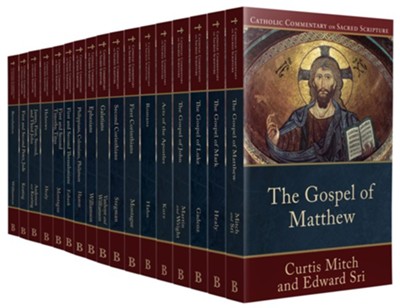
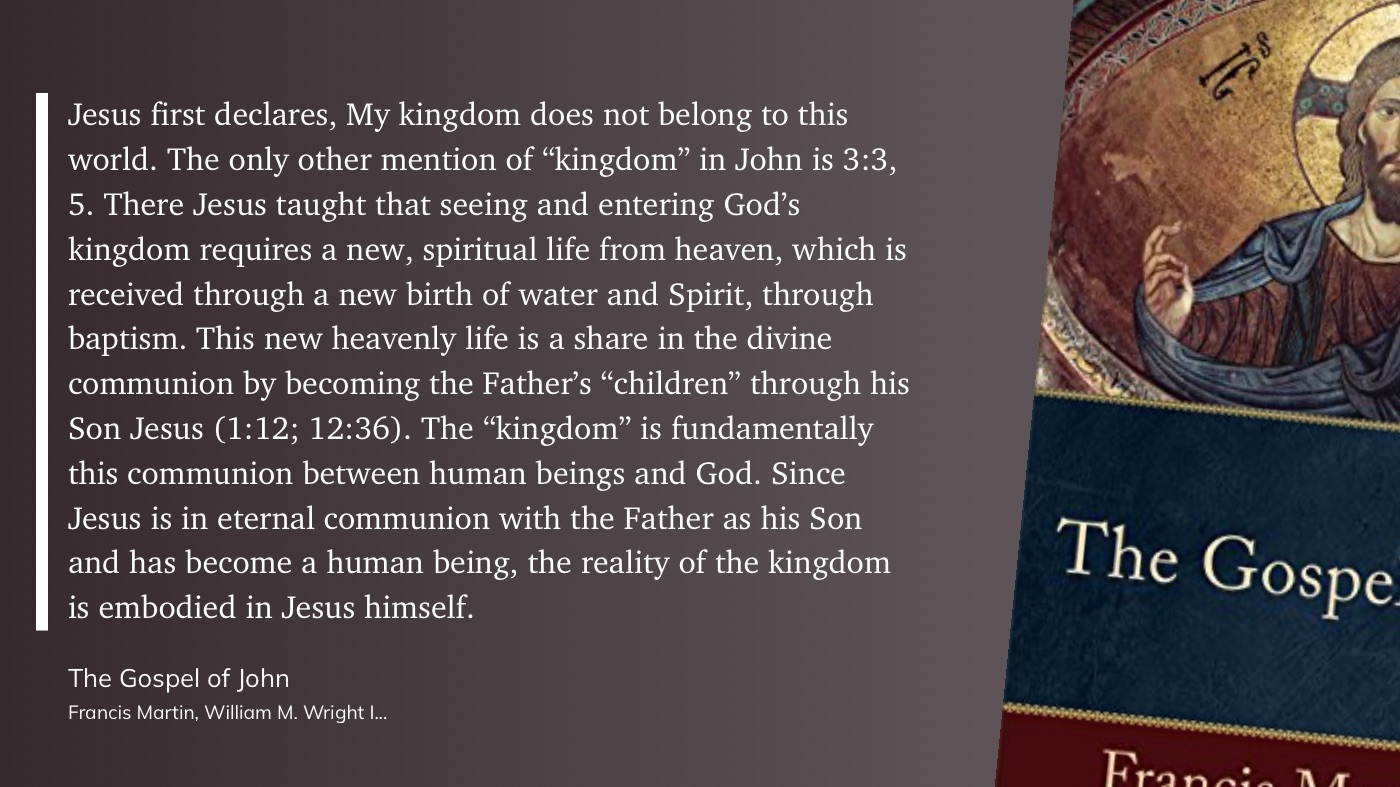
Martin, Francis; Wright, William M. IV. The Gospel of John. The Catholic Commentary on Sacred Scripture. Grand Rapids, MI: Baker Academic, 2008.
Bergsma, John. The Word of the Lord: Reflections on the Sunday Mass Readings for Year B. Steubenville, OH: Emmaus Road Publishing, 2020.
Durken, Daniel, ed. New Collegeville Bible Commentary: One-Volume Hardcover Edition. Collegeville, MN: Liturgical Press, 2017.
West, Christopher. Word Made Flesh: A Companion to the Sunday Readings (Cycle B). Pennsburg, PA: Theology of the Body Institute Press, 2021.
PRESBYTERIAN / WIDER CHRISTIAN COMMUNITY
Allen, Ronald J., Dale P. Andrews, and Dawn Ottoni-Wilhelm, eds. Preaching God’s Transforming Justice: A Lectionary Commentary, Year B. Louisville, KY: Westminster John Knox Press, 2013.
Kelley, Jessica Miller, ed. A Preacher’s Guide to Lectionary Sermon Series: Thematic Plans for Years A, B, and C. Louisville, KY: Westminster John Knox Press, 2016.
EVANGELICAL / WIDER CHRISTIAN COMMUNITY
Adeyemo, Tokunboh, ed. Africa Bible Commentary. Grand Rapids, MI: Zondervan, 2010.
Arterburn, Stephen, and David Stoop, eds. The Life Recovery Bible: NLT Second Edition. Tyndale House Publishers
Commentary Excerpts
The CC on Sacred Scripture
Click on card to view full screen.
Outline of Main Points:
I. Introduction
A. Setting: Pilate summons Jesus in the praetorium
B. Pilate’s question about Jesus being the King of the Jews
II. The Concept of Kingship in John’s Gospel
A. Significance of the title “king” for Jesus in John
B. Jesus’ unique presentation of his messianic kingship through biblical images
C. Roman perspective on Jewish messianism and kingship
III. Jesus’ Response to Pilate
A. Pilate’s initial question regarding Jesus’ kingship
B. Jesus’ counterquestion to Pilate about the nature of kingship
C. Jesus’ declaration: “My kingdom does not belong to this world”
IV. Pilate’s Misunderstanding
A. Pilate’s confusion regarding Jesus’ kingship
B. Jesus clarifies the nature of his kingship as heavenly, not earthly
C. St. Augustine’s insight on Jesus’ response
V. Conclusion
A. Pilate’s continued struggle to grasp Jesus’ concept of kingship
B. The distinction between earthly and heavenly kingship in Jesus’ response
Eager to delve further into the readings. Simply copy and paste a sentence or two into our AI Chat Bot, allowing our Catholic Assistant to provide you with additional context, connections, and insights from a variety of approved sources.
The Word of the Lord

Click on card to view full screen.
Outline of Main Points:
I. Introduction
- Overview of the dialogue between Jesus and Pilate (John 18:33-38a)
- Recognition of its significance in biblical and world literature
II. The Kingdom of Christ and Its Visible Manifestation
- The kingdom of Jesus is not of this world (John 18:36)
- Distinction between being “not of this world” and “not in this world”
- The Catholic Church as the visible manifestation of Christ’s kingdom
III. External Features of the Catholic Church
- Impressive characteristics: size, history, and influence
- Over a billion members and two thousand years of history
- Major cultural driver in the world, shaping various institutions and concepts
IV. Visible Manifestations of Christ’s Kingdom
- Examples of the Catholic Church’s impact on society
- Hospitals, universities, and human rights concepts
- Western social liberalism’s connection to Catholic charity
- Distinction between visible manifestations and the heart of Christ’s kingdom
V. The Heart of Christ’s Kingdom
- Focus on the Church Triumphant (saints in heaven)
- The Church Militant (believers on earth) striving for the next world
- The heart of the Church is the Kingdom, connected to the Church Triumphant
Eager to delve further into the readings. Simply copy and paste a sentence or two into our AI Chat Bot, allowing our Catholic Assistant to provide you with additional context, connections, and insights from a variety of approved sources.
New Collegeville
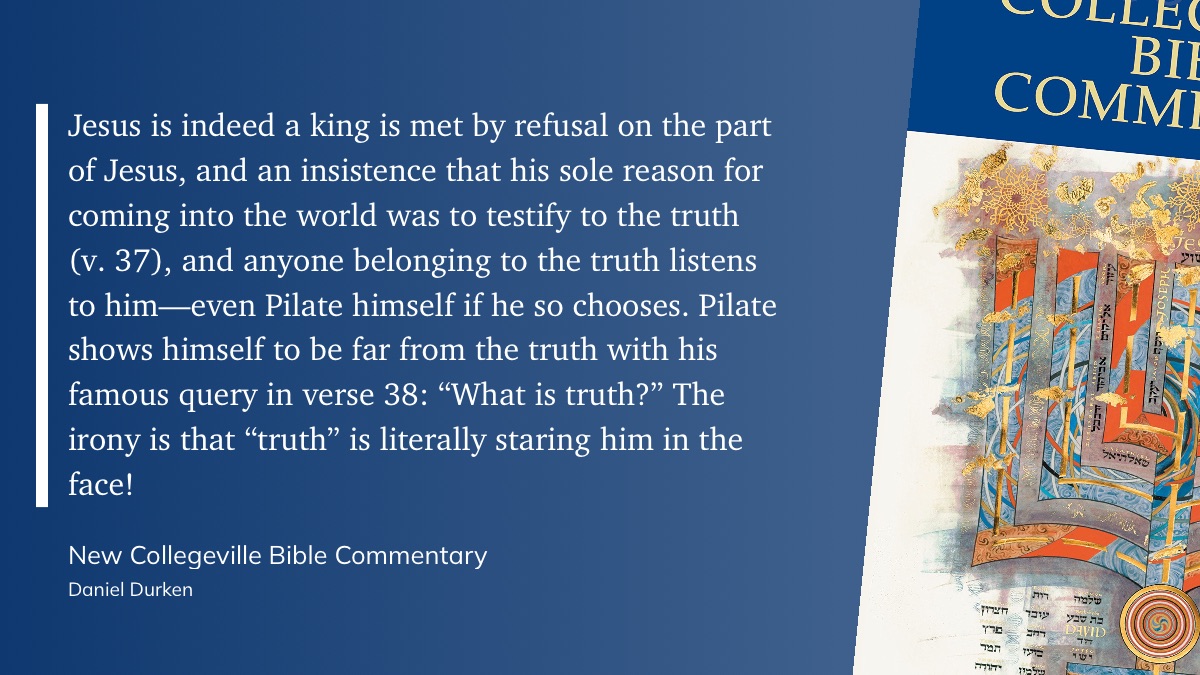
Click on card to view full screen.
Outline of Main Points:
Durken, Daniel. New Collegeville Bible Commentary: One Volume Hardcover Edition (pp. 2881-2882). Liturgical Press.
I. Introduction
- Context: Private interrogation of Jesus by Pilate in the praetorium (John 18:33-38a)
- Focus: Examination of the religious and political accusations against Jesus
II. The Charge: King of the Jews (v. 33)
- First mention of the charge, with a basis in previous events (1:49; 12:13)
- Pilate’s question: “Are you the King of the Jews?”
III. Jesus’ Response: Questioning Pilate’s Source (v. 34)
- Jesus’ counter-question: “Do you ask this on your own, or did others tell you about me?”
- Shifts the responsibility of the charges back to the Jewish authorities
IV. Jesus’ Explanation: A Kingdom Not of This World (vv. 35-36)
- Pilate’s follow-up question: “What have you done?”
- Jesus’ clarification:
- His kingdom is not of this world
- Its origin, values, and methods are from God, not the world
- Rejection of force and violence
V. Testifying to the Truth (vv. 37-38)
- Pilate’s conclusion: “So you are a king?”
- Jesus’ insistence:
- He came to testify to the truth
- Those who belong to the truth listen to him
- Pilate’s famous question: “What is truth?”
- Irony: Truth is personified in Jesus, standing right before him
VI. Conclusion
Jesus as a witness to the truth, offering listeners a chance to hear and respond
Importance of recognizing the divine origin and purpose of Jesus’ kingdom
Eager to delve further into the readings. Simply copy and paste a sentence or two into our AI Chat Bot, allowing our Catholic Assistant to provide you with additional context, connections, and insights from a variety of approved sources.
Preaching Justice
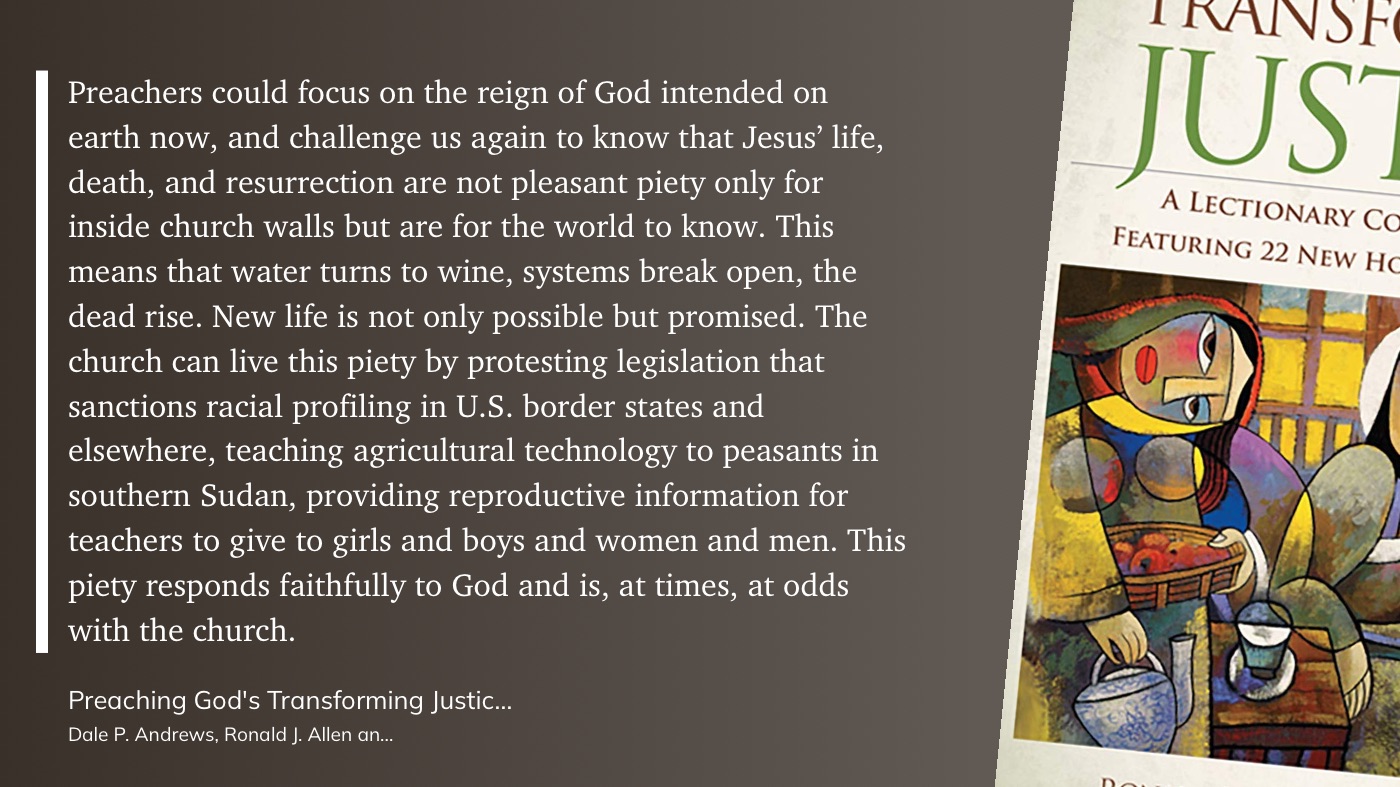
Click on card to view full screen.
Outline of Main Points:
Andrews, Dale P.; Ronald J. Allen and Dawn Ottoni-W. Preaching God’s Transforming Justice: A Lectionary Commentary, Year B (pp. 498-500). Presbyterian Publishing Corporation
I. Introduction
A. Contrasting timelines of events for Jesus’ arrest and death in John and the Synoptic Gospels
B. Significance of the timing of Jesus’ death in relation to Passover
II. Symbolism in John’s Account
A. Jesus portrayed as a sacrificial lamb in John’s narrative
B. Opposition to Jesus from both Roman and Jewish authorities
C. Pilate’s questioning about Jesus’ kingship
III. Jesus’ Response to Pilate
A. Jesus’ declaration about the origin of his dominion
B. Interpretation of Jesus’ words regarding his kingship and reign
C. Emphasis on the importance of acting on God’s reign on earth
IV. Preaching and Application
A. Encouraging action to bring God’s reign to earth
B. Challenging the church to live out the principles of Jesus’ life and teachings
C. Addressing issues within the church and ensuring alignment with God’s intentions
V. Conclusion
A. The theological implications of understanding the origin of God’s reign
B. The significance of repentance and alignment with God’s intentions
C. The enduring support of God for Jesus and the Jewish community throughout history
Eager to delve further into the readings. Simply copy and paste a sentence or two into our AI Chat Bot, allowing our Catholic Assistant to provide you with additional context, connections, and insights from a variety of approved sources.
Word Made Flesh
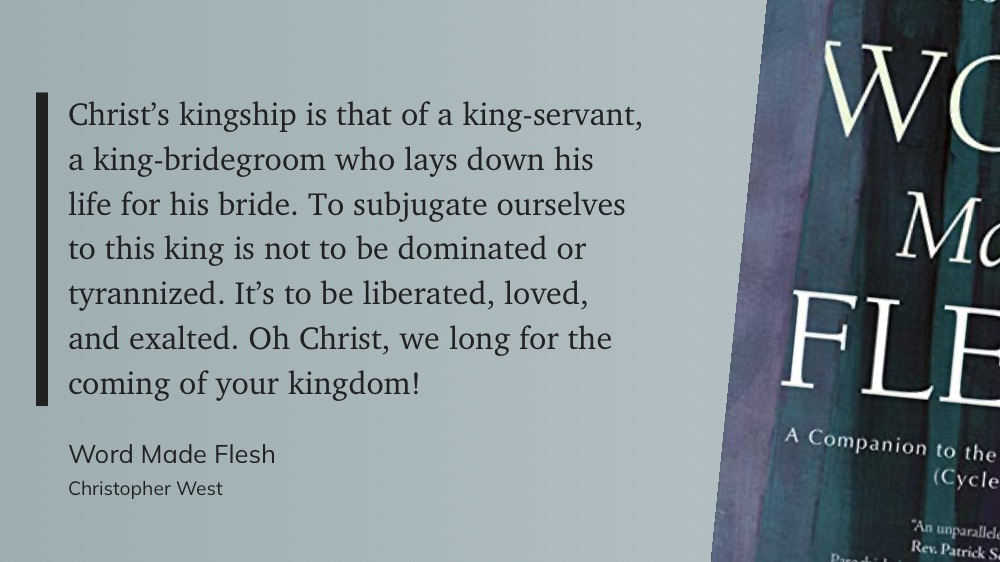
Click on card to view full screen.
Outline of Main Points
West, Christopher. Word Made Flesh: A Companion to the Sunday Readings (Cycle B) . Ave Maria Press.
I. Introduction
A. The significance of the Solemnity of Christ the King on the last Sunday in Ordinary Time
B. Jesus’ declaration to Pilate about the nature of his kingdom
II. The Otherworldliness of Christ’s Kingship
A. Understanding Christ’s kingship beyond worldly terms
B. Jesus’ teachings on servant leadership and humility
C. The paradox of Christ as a king-servant and king-bridegroom
III. Embracing Christ’s Kingship
A. The transformative nature of submitting to Christ’s kingship
B. Liberation, love, and exaltation through surrender to Christ
C. Reflecting on the selfless service and sacrifice of Christ
IV. Longing for the Coming Kingdom
A. The anticipation and yearning for the establishment of Christ’s kingdom
B. Embracing the values of Christ’s kingdom in the present day
C. Prayers for the realization of Christ’s kingdom on earth
V. Conclusion
A. Emphasizing the loving and liberating essence of submitting to Christ’s kingship
B. The call to emulate Christ’s servant leadership and sacrificial love
C. Hope and anticipation for the f
Eager to delve further into the readings. Simply copy and paste a sentence or two into our AI Chat Bot, allowing our Catholic Assistant to provide you with additional context, connections, and insights from a variety of approved sources.
Life Recovery Bible
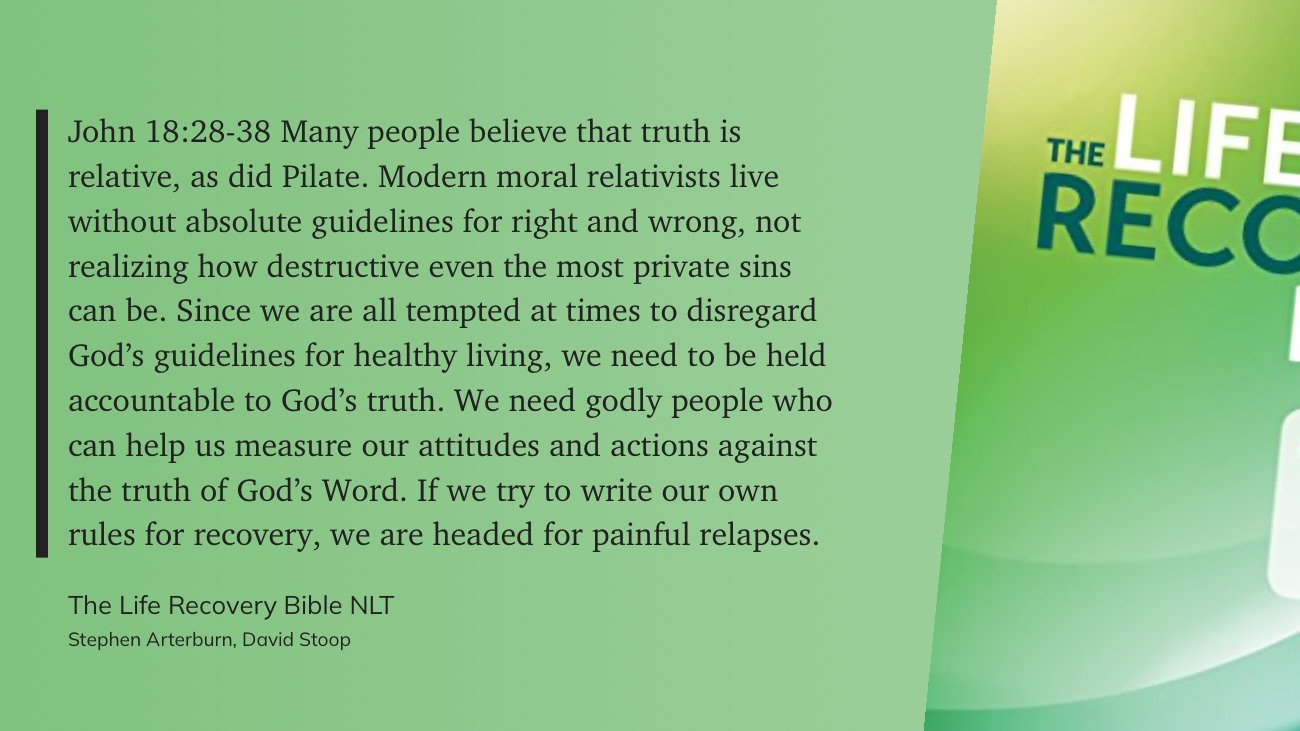
Click on card to view full screen.
The Twelve Steps
TIP: Copy and paste any of these steps into the CATHOLIC ASSISTANT bot in the lower right corner of the screen to make connections to the Sunday readings for this week.
STEP 1: We admitted we were powerless over alcohol—that our lives had become unmanageable.
STEP 2: Came to believe that a Power greater than ourselves could restore us to sanity.
STEP 3: Made a decision to turn our will and our lives over to the care of God as we understood Him.
STEP 4: Made a searching and fearless moral inventory of ourselves.
STEP 5: Admitted to God, to ourselves, and to another human being the exact nature of our wrongs.
STEP 6: Were entirely ready to have God remove all these defects of character.
STEP 7: Humbly asked Him to remove our shortcomings.
STEP 8: Made a list of all persons we had harmed, and became willing to make amends to them all.
STEP 9: Made direct amends to such people wherever possible, except when to do so would injure them or others.
STEP 10: Continued to take personal inventory and when we were wrong promptly admitted it.
STEP 11: Sought through prayer and meditation to improve our conscious contact with God as we understood Him, praying only for knowledge of His will for us and the power to carry that out.
STEP 12: Having had a spiritual awakening as the result of these steps, we tried to carry this message to alcoholics, and to practice these principles in all our affairs.
Eager to delve further into the readings. Simply copy and paste a sentence or two into our AI Chat Bot, allowing our Catholic Assistant to provide you with additional context, connections, and insights from a variety of approved sources.
Lectionary Sermon Series

Click on card to view full screen.
Outline of Main Points:
Westminster John Knox Press. A Preacher’s Guide to Lectionary Sermon Series – Volume 1: Thematic Plans for Years A, B, and C (pp. 163-164). Presbyterian Publishing Corporation.
I. Significance of the Day
A. Last day of the Christian year before Advent
B. Observance of Reign of Christ Sunday
C. Affirming the rule and reign of Christ as Lord and King of all creation
II. Paradoxical Dichotomy
A. Anticipation of the return of Jesus Christ
B. Acknowledgment of the present rule and reign of Christ
C. Living in the tension between future expectations and present responsibilities
III. Living in Expectation and Responsibility
A. Hope for the establishment of God’s kingdom through Christ
B. Engaging in the work of Christ in the present moment
C. Balancing future focus with active participation in the present
IV. Avoiding Misinterpretation of Revelation
A. Revelation as a call to action, not just a predictive text
B. Motivation for the church to address world crises
C. Church’s role as agents of love, healing, hope, and justice
V. Comfort and Encouragement for Disciples
A. The context of persecution in which Revelation was written
B. Endurance, perseverance, and hope as themes in Revelation
C. Revelation as a word of comfort for disciples facing trials and challenges
VI. Call to Perseverance and Witness
A. Comparison between the persecuted church and Roman persecutors
B. Embracing self-sacrificial love over self-made power
C. The relevance of Revelation’s message for today’s church and Christians
Eager to delve further into the readings. Simply copy and paste a sentence or two into our AI Chat Bot, allowing our Catholic Assistant to provide you with additional context, connections, and insights from a variety of approved sources.
Africa Bible Commentary
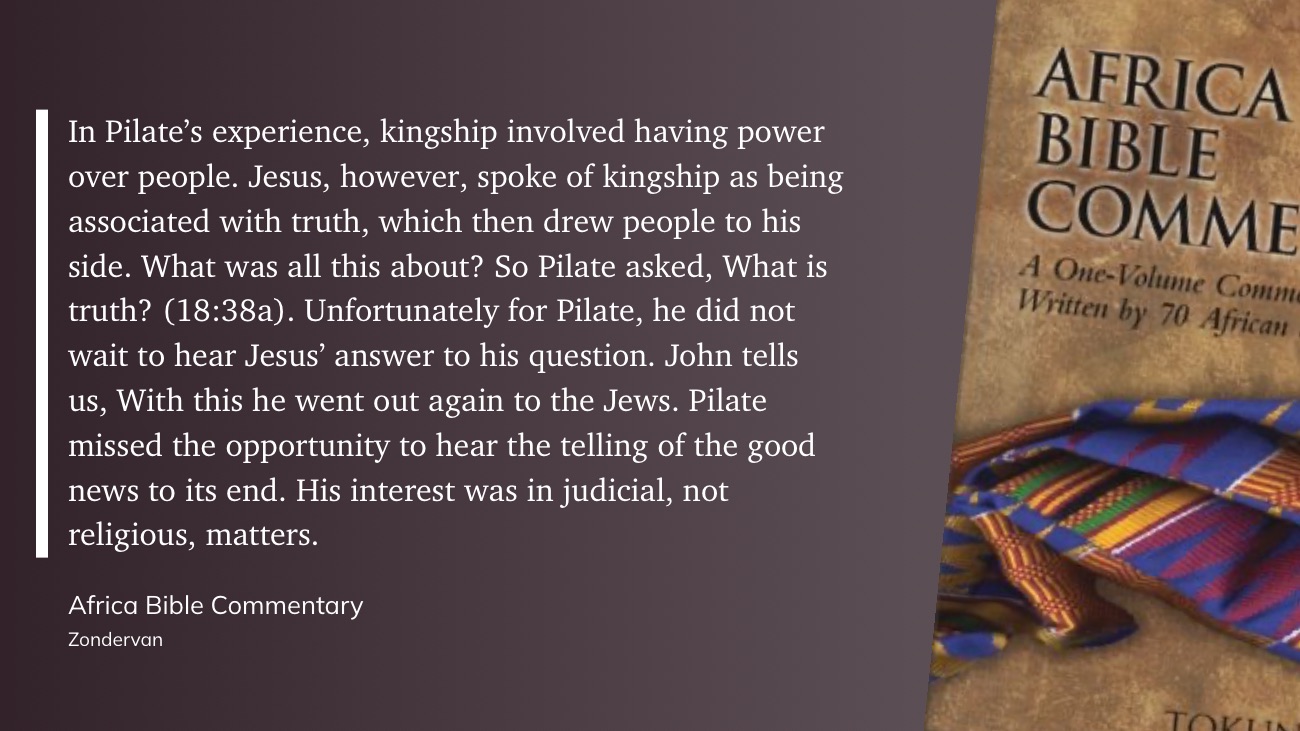
Click on card to view full screen.
Outline of Main Points:
Africa Bible Commentary: A One-Volume Commentary Written by 70 African Scholars (pp. 1315-1316). Zondervan Academic.
I. Jesus’ Roman Trial
A. Trial before Pilate and appearance before Herod Antipas
B. Pilate as the key player in the trial
II. Lack of Clear Charges and Fair Trial
A. Difficulty in finding a crime to accuse Jesus of committing
B. Lack of interest in a fair trial from Jesus’ accusers
III. Pilate’s Interrogation
A. Pilate’s inquiry about Jesus being the king of the Jews
B. Twisting of Jesus’ actions and words to support the charge of rebellion
IV. Jesus’ Response to Pilate
A. Clarification about the nature of his kingdom
B. Emphasis on his kingdom not being of this world
C. Explanation of his role as king and testimony to the truth
V. Question of Jesus’ Kingship
A. Pilate’s attempt to understand Jesus’ kingship
B. Jesus confirming his kingship and purpose as testifying to the truth
C. The alignment of truth and Jesus’ message
VI. Conclusion
A. The unique nature of Jesus’ kingship and kingdom
B. The challenges and complexities of the Roman trial of Jesus
C. Jesus’ steadfast commitment to truth amidst the trial proceedings
Eager to delve further into the readings. Simply copy and paste a sentence or two into our AI Chat Bot, allowing our Catholic Assistant to provide you with additional context, connections, and insights from a variety of approved sources.
Key Gospel
Words
Cross References
John 18:33: In this verse, Pilate questions Jesus about being the King of the Jews, while in John 19:3, Pilate again asks Jesus if he is a king, emphasizing the recurring question of Jesus’ identity. Mark 15:2 and Luke 23:3 also share this account, while Matthew 27:11 highlights Jesus standing before Pilate.
John 18:37: This verse expands on Jesus explaining his purpose as a king, whereas John 18:33 and John 19:3 depict Pilate’s questioning of Jesus. John 8:47 elaborates on the concept of truth, which Jesus emphasizes in his response to Pilate in John 18:37.
Related verses:
1 John 4:6: This verse elaborates on the theme of truth and the role of the Spirit in recognizing truth.
1 John 3:19: It emphasizes the importance of actions reflecting one’s belief and connection to God’s love.
1 John 3:14: This verse highlights the idea of love as an expression of genuine faith and a reflection of truth.
1 John 5:20: It emphasizes understanding and knowing the true God, which resonates with Jesus’ mission in John 18:37.
1 Peter 1:22: The idea of loving one another earnestly, based on sincere faith, connects to the themes of love and truth found in the related verses.
1 Timothy 6:13: This verse emphasizes the idea of truth and keeping the commandment without spot or blame until the appearing of our Lord Jesus Christ, reflecting the theme of Jesus’ divine identity in John 18:33-37.