



SOURCE: Hearers of the Word

- 00:00 Mark 13:24-32 discusses apocalyptic themes amid crises, emphasizing that death and destruction are not God's ultimate message, while reflecting on historical and contemporary struggles.
- Mark 13:24-32 presents an unsettling apocalyptic discourse that reflects on historical and contemporary crises, including war and climate change.
- The sun, currently halfway through its 10 billion-year lifespan, will begin dying in about 2 billion years by expanding into a red giant and then condensing into a white dwarf.
- Mark 13 emphasizes that death and destruction are not the ultimate message from God, reflecting the community's struggles and offering a blend of eschatology, apocalyptic themes, farewell discourse, and exhortation during a time of crisis.
- 05:00 Jesus predicts the temple's destruction and explains that cosmic signs will precede the coming of the Son of Man, emphasizing the uncertainty of timing.
- Jesus, from the Mount of Olives, predicts the destruction of the temple while contrasting its grandeur with the rest of Jerusalem in Mark 13.
- Mark's gospel addresses the disciples' questions about the timing and signs of the coming of the Son of Man, leading to a discussion of both non-signs and the actual sign.
- Mark 13:24-32 outlines that current events are not signs of the imminent end, cosmic signs will precede the second coming of the Son of Man, and parables illustrate the tension between knowing and not knowing.
- 09:11 Mark's Gospel reflects a chaotic Roman Empire era with earthquakes, military defeats, Christian persecution, and the siege of Jerusalem.
- Mark's Gospel was likely written during a tumultuous period in the Roman Empire, marked by significant events such as earthquakes, military defeats, the persecution of Christians, and the rise of Vespasian and Titus amid the siege of Jerusalem.
- The contemporary coloring of the triumph of Titus panel highlights Jewish sacred objects, including the menorah and temple artifacts.
- 12:01 After great suffering, the Son of Man will return in glory to gather the elect, with cosmic signs preceding this unknown event.
- After great suffering, the Son of Man will return in glory, gathering the elect while no one knows the exact time of this event.
- The passage highlights cosmic signs, the second coming, and the gathering of the elect, drawing authority from earlier Hebrew Bible predictions that have been fulfilled, similar to recent events like earthquakes and persecution.
- 14:47 Biblical prophecies depict cosmic darkness as a sign of divine judgment, intertwined with promises of salvation and restoration for those who seek the Lord.
- Biblical prophecies in Isaiah and Ezekiel describe cosmic darkness and the obliteration of celestial bodies as symbols of divine judgment and power.
- The prophet Joel describes God's judgment on Israel and the subsequent restoration of the land and people after a locust plague, highlighting the chaos and cosmic disturbances that accompany this event.
- Predictions of cosmic destruction in the scriptures are ultimately intertwined with promises of salvation and refuge for those who call on the Lord.
- 19:21 Jesus, as the "son of man," embodies both humanity and divine authority, linking to Daniel's vision and central to Christian worship.
- Daniel's vision of the "son of man" in chapter 7 is crucial for understanding Jesus' role and authority in the New Testament.
- The title "son of man" signifies an ordinary human being with a profound role in salvation, drawing connections to Daniel and Deuteronomy, ultimately portraying Jesus as the central figure of Christian worship.
- 22:00 The fig tree signifies imminent signs of Jesus' return, emphasizing the enduring nature of God's words while highlighting the uncertainty of timing and the need for vigilance.
- The fig tree symbolizes the signs of the times, indicating that the fulfillment of Jesus' words and the coming of the Son of Man are imminent.
- The statement that "this generation will not pass away until all these things have taken place" raises doubts as the first disciples died before witnessing the return of the Son of Man, highlighting the tension between Jesus' promises and their fulfillment.
- Heaven and earth will pass away, but God's words endure, and no one knows the timing of the coming of the Son of Man, so remain vigilant.
- 25:42 Stay vigilant for the unexpected return of the Lord, recognizing the signs of Jesus' second coming as a fulfillment of God's promises and a source of hope for believers.
- Stay vigilant and prepared for the unpredictable and inevitable return of the Lord, as it will come unexpectedly like a thief in the night.
- Stay alert and aware of the signs of the second coming of Jesus, which signifies the completion of God's creation and offers hope through light and life.
- God's promises are affirmed through Christ, providing reassurance and strength for believers as they await the return of the Son of Man.
Outlines of the Readings
The Resurrection of the Dead and the Promise of Eternal Life in Daniel 12:1-3
33rd Sunday of Year B

I. The Time of Distress (Daniel 12:1)
- Michael, the great prince, arises during a time of unprecedented distress.
- The reference to the "book" signifies the listing of all individuals in the heavenly records.
- Many people will be delivered from the time of distress, indicating divine protection and salvation.
II. The Resurrection and Eternal Life (Daniel 12:2)
- Those who sleep in the dust of the earth represent the deceased.
- The mention of "awake" symbolizes the resurrection of the dead at the end of times.
- The promise of "everlasting life" and "shame and everlasting contempt" points to divine judgment and separation between the righteous and wicked.
III. The Wise Will Shine (Daniel 12:3)
- The "wise" are those who lead many to righteousness through their teachings and example.
- The reference to shining like the stars alludes to the eternal glory and reward for the righteous in God's kingdom.
- The promise of eternal reward serves as an encouragement for perseverance and faithfulness in the face of challenges and persecution.
Clipart by Fr. Richard Lonsdale
The Perfect Sacrifice of Christ and the Assurance of Salvation in Hebrews 10:11-14, 18
33rd Sunday of Year B

I. The Contrast Between Old and New (Hebrews 10:11-12)
- Under the old covenant, the high priest stood daily, offering sacrifices that could never fully atone for sin.
- In contrast, Christ, as the eternal high priest, offered a single sacrifice for all time, securing redemption and eternal salvation.
II. The Ultimate Sacrifice (Hebrews 10:13-14)
- Christ's obedient offering of Himself as a sacrifice sanctifies and perfects believers for all time.
- Through His sacrifice, Christ has conquered sin and its power, rendering further sacrifices unnecessary.
III. No More Offering for Sin (Hebrews 10:18)
- The one offering of Christ has removed the barrier of sin, establishing a new covenant based on grace.
- There is no longer a need for any other offering, as Christ's sacrifice provides full forgiveness and reconciliation with God.
- This emphasizes the sufficiency and finality of Christ's work on the cross.
Clipart by Fr. Richard Lonsdale
The Signs of the End Times and the Coming of the Son of Man in Mark 13:24-32
33rd Sunday of Year B

I. Cosmic Disturbances and the Darkening of Heavenly Bodies (Mark 13:24-25)
- The coming of the end times will be marked by significant cosmic disturbances.
- The sun, moon, and stars will be affected, symbolizing the upheaval and transformation of the current order.
II. The Coming of the Son of Man (Mark 13:26-27)
- After the cosmic disturbances, the Son of Man will come in glory and power.
- Angels will be sent to gather the elect from all corners of the earth and heaven.
III. The Parable of the Fig Tree (Mark 13:28-31)
- The lesson of the fig tree illustrates the signs of the approaching end times.
- Just as the fig tree's new leaves signal the coming of summer, so too will the signs of the end times indicate the nearness of Christ's return.
- This emphasizes the importance of being watchful and discerning in recognizing the signs of the times.
IV. The Uncertainty of the Hour and the Call to Watchfulness (Mark 13:32)
- No one knows the precise hour or day of Christ's return, not even the angels or the Son.
- Only the Father knows the appointed time, calling believers to remain vigilant and prepared for Christ's coming.
Clipart by Fr. Richard Lonsdale
Insights
“They will see ‘the Son of Man
coming in the clouds’
with great power and glory,
and then he will send out the angels
and gather his elect from the four winds…”
Mark 13:26-27a



- CATHOLIC CATECHISM
- CHURCH
FATHERS - PRO-LIFE
PERSPECTIVE - JUNGIAN
PERSPECTIVE
CATHOLIC
DOCTRINAL
INSIGHTS
Eschatology: The study of the end times, including the Second Coming of Christ and the final judgment. It relates to the passage’s focus on the signs of the end times and Jesus’ return.
Parousia: The belief in the Second Coming of Christ, during which he will judge the living and the dead and establish God’s Kingdom on earth. This connects directly with Mark 13:24-32, as the passage describes Jesus’ return in glory.
The Final Judgment: The Catholic belief that at the end of time, God will judge all humanity based on their faith and deeds. The passage reinforces the message of being prepared for this judgment.
The Resurrection of the Body: The doctrine teaches that at the end of time, all bodies will be raised and reunited with their souls. It is connected to Mark 13:26-27, which describes how the Son of Man will gather the elect from the ends of the earth to the ends of the heavens.
Christian Hope: The virtue of hope directs our focus towards the promise of eternal life with God and the final establishment of God’s Kingdom. The passage’s message about the coming of the Son of Man highlights this Christian hope.
Providence: The belief in God’s loving care for all creation. This connects to Mark 13:28-31, which tells the parable of the fig tree and emphasizes the need to be attentive and trust in God’s providential plan.
The Universal Call to Holiness: The Church teaches that all the faithful are called to live a life of holiness and be ready for the coming of Christ. This relates to Mark 13:32, which underlines the importance of remaining watchful and ready for the unknown hour when the Son of Man will come.
Catholic Catechism
33rd Sunday of Year B
READING 1 | READING 2 | GOSPEL | COMMENTARY
Mark 13:24-32
Verse by verse commentary w/ catechism connections
complied by THE WORD THIS WEEK Catholic Assistant
Verse 26: "And then they will see ‘the Son of Man coming in the clouds’ with great power and glory."
Commentary: This verse points to the return of Christ and the final judgment. Catholics believe in the Second Coming and the importance of being prepared through faith and good works (CCC 673-674).
Together, these passages remind us of the importance of living in a state of preparedness, fostering unity, and praying for the fulfillment of God's plan for all humanity.
TIP: Copy and paste any of the catechism paragraph (for example, CCC 673-674) references into the CATHOLIC ASSISTANT bot in the lower right corner of the screen to learn more.
Verse 27: "And then he will send out the angels and gather [his] elect from the four winds, from the end of the earth to the end of the sky."
Commentary: Angels gathering the elect signify God's divine intervention and the gathering of the faithful at the end of time. This aligns with the Catholic belief in the communion of saints and the Church's role in salvation (CCC 956).

Verse 28: "Learn a lesson from the fig tree. When its branch becomes tender and sprouts leaves, you know that summer is near."
Commentary: The fig tree symbolizes the signs of the times, calling Catholics to be vigilant and recognize the presence of God's kingdom on earth (CCC 541).
Verse 29: "In the same way, when you see these things happening, know that he is near, at the gates."
Commentary: This verse emphasizes the importance of staying spiritually alert and discerning God's presence in our lives. Catholics are encouraged to develop a habit of prayer and attentiveness to God's will (CCC 2659).
Verse 30: "Amen, I say to you, this generation will not pass away until all these things have taken place."
Commentary: The endurance of the generation highlights the ongoing nature of salvation history. Catholics believe in the continuous presence of Christ in the Church and the importance of living out their faith in the world (CCC 787).
Verse 31: "Heaven and earth will pass away, but my words will not pass away."
Commentary: This verse underscores the eternal nature of Christ's teachings and their centrality to the Christian life. Catholics are called to adhere to the Gospel and integrate its teachings into their daily lives (CCC 2057).
Verse 32: "But of that day or hour, no one knows, neither the angels in heaven, nor the Son, but only the Father."
Commentary: The uncertainty of the day or hour encourages Catholics to live in a state of constant readiness and spiritual vigilance. This aligns with the Church's teaching on the importance of ongoing conversion and preparedness for the final judgment (CCC 1037).
NOTABLE
QUOTES
Origen: “We must suppose that the sun, moon, and stars, mentioned here are not heavenly bodies, but signify the rulers and leaders of earthly nations” (Commentary on Matthew, 79).
St. Augustine: “The Lord will come to judge with the heavenly light, for the light of the sun and moon will not then be needed” (Expositions on the Psalms, 67.34).
Cyril of Jerusalem: “He shall come openly, as the Divine Scripture says, in the glory of His Father, with the holy angels” (Catechetical Lectures, 15.4).
Tertullian: “We ought not to be ready merely for some things, but for all things; for no one knoweth what may come to pass in time” (On Patience, 10).
St. Thomas Aquinas: “This may be understood to mean either the generation of the Jews, who shall not pass away till all these things have been fulfilled, or the generation of the faithful, which shall remain until the end of the world” (Commentary on Matthew, 13).
St. Augustine: “Since we cannot know the hour, let us be ready every hour” (Sermons, 13.7).
St. Origen: “The Word of the Lord remains forever, because he who has taken up his abode in our heart by faith does not leave us” (Commentary on Matthew, 88).
St. Augustine: “For we say this world will pass away, but the Word of the Lord will not pass away” (Expositions on the Psalms, 58.18).
St. Cyril of Jerusalem: “Let us then look forward to the Second Coming of Christ, and not regard death as a calamity, but as a change to a better life” (Catechetical Lectures, 22.2).
Church Fathers
33rd Sunday of Year B
READING 1 (31) | READING 2 (9) | GOSPEL (41)
Mark 13:24-32
Verse by verse commentary w/ catechism connections
complied by THE WORD THIS WEEK Catholic Assistant
Mark 13:24-32 presents an eschatological discourse of Jesus, a passage rich in prophetic imagery and theological significance. In this passage, Jesus speaks of cosmic disturbances, the coming of the Son of Man, and the need for vigilance—a message that resonates deeply with the early Church Fathers’ teachings.
Mark 13:24: In this verse, the Gospel speaks of the cosmic disturbances that will precede the coming of the Son of Man. The early Church Fathers often interpreted these celestial events as symbolic of a world in transformation, indicating the definitive end of the old order. The sun, the moon, and the stars, which govern the temporal, will cease to shine, symbolizing that earthly powers and worldly knowledge will fade away before the dawning of the eternal Kingdom.
Mark 13:25: The falling of the stars from the sky can be likened to the fall of angels or rulers, as celestial bodies often represented angelic or spiritual powers. Church Fathers like Augustine would suggest that these events invite the faithful to detach from earthly matters and prepare their hearts for the divine reality that is at hand.
Mark 13:26: The Son of Man coming in the clouds with great power and glory signifies the manifestation of Christ’s kingship and divine authority. Early commentators such as Cyril of Jerusalem emphasized the public and unmistakable nature of Christ’s return, contrasting it with His first coming in humility. The clouds signify the presence of God, reminiscent of Old Testament theophanies and a sign of divine judgment.
Mark 13:27: The gathering of the elect from the four winds represents the universality of the Gospel and the ingathering of all believers into the new creation. This is a time of consolation and fulfilling promise, where the faithful are brought into their eternal reward. Church Fathers like Gregory the Great would view this gathering as the culmination of God’s redemptive plan, bringing unity and peace to those who have persevered in faith.
Mark 13:28: The parable of the fig tree serves as an illustration of discernment and readiness. Just as one can predict the coming of summer by observing the signs on the fig tree, so should believers be attentive to the signs of Christ’s return. Early Christian writers such as Tertullian would exhort believers to live in constant spiritual preparedness, encouraged that the signs are part of God’s providential plan.
Mark 13:29: Here Jesus assures His followers that when they see these signs, they should know that His coming is near. The assurance given by Aquinas and others highlights God’s desire to strengthen the hope and faith of the believers, ensuring that their labor is not in vain, and that His promises are unfailing.
Mark 13:30: The phrase “this generation will not pass away” has been the subject of much contemplation among the Church Fathers. Some, like Chrysostom, interpreted “generation” as the Jewish people, ominously foreshadowing the impending judgment upon Jerusalem, while others saw it as the idea that those alive at the time of these signs would witness the fulfillment of Christ’s prophecy.
Mark 13:31: The durability of Christ’s words, contrasted with the temporary nature of heaven and earth, emphasizes the authority and eternal truth of His teachings. The Fathers, including Origen, often reflected on the divine authority in Christ’s declarations, exhorting believers to find solace and stability in His word amidst the transitory nature of the physical world.
Mark 13:32: Finally, this verse underscores the mystery of the eschaton. The ignorance of the day and hour by all but the Father highlights the theme of divine mystery. Augustine suggests that this should cultivate humility and vigilance among believers, fostering trust in God’s perfect timing rather than yielding to speculation.
Church Fathers, in their commentaries, urge the faithful to remain steadfast and attentive to Christ’s teachings, to embody a life of watchfulness and prayer, and to place their hope in the eternal promises of God, as articulated in the Scriptures.
FROM THE
NATIONAL
DIRECTOR OF PRIESTS FOR LIFE
We have arrived at a time of the Church year when the readings speak of the Second Coming of Christ. This is a theme, of course, that is echoed in every Mass: “We proclaim your death…until you come again; …As we await the blessed hope and the coming of our Savior, Jesus Christ; …As we look forward to his second coming, we offer you in thanksgiving this holy and living sacrifice…”
In some gospel passages, the teaching about the effects of Christ’s passion, death, and resurrection is interspersed with teaching about his second coming. These are two critical moments of salvation history: in the one, the power of sin and death are overthrown at their roots; in the other, the victory is brought to its culmination and full manifestation. Both of these moments are described with apocalyptic language and imagery from Old Testament passages such as today’s first reading from Daniel. What is being conveyed here is the destruction of one kingdom and the inauguration of another. This, of course, is what Christ came to do. His kingdom is among us, thanks to his death and resurrection, made present again to us in every Mass. That kingdom, as the liturgy tells us, is “A kingdom of truth and life, a kingdom of holiness and grace, a kingdom of justice, love, and peace” (Preface of Christ the King).
We live now in the “in between” time, when the kingdom of Christ has been inaugurated on earth, but not yet brought to its full manifestation. The power of sin and death – revealed in evils such as abortion – has been destroyed at its roots. Yet we still struggle, in and through Christ, to bring about a Culture of Life. We must bear witness to the truth, life, holiness, grace, justice, love, and peace that characterize the kingdom. The apocalyptic language of the readings should inspire in us both the awareness of how awesome a struggle this is, and the confidence in the final victory – a victory marked by the triumph of life. “Many of those who sleep in the dust of the earth shall awake” (First reading). Life has the last word. “Now he waits until his enemies are made his footstool” (Second reading) – and the last enemy to be destroyed will be death itself.
Mercy also has the last word, as the second reading likewise conveys – mercy that reaches even to those who have taken life by abortion and similar sins.
SOURCE: Priests for Life
Pro-Life Perspectives
33rd Sunday of Year B
24 “But in those days after that tribulation the sun will be darkened, and the moon will not give its light, 25 and the stars will be falling from the sky, and the powers in the heavens will be shaken.”
Commentary: The tribulation mentioned here symbolizes the challenges faced by those upholding the culture of life amidst a prevailing culture of death. The darkness and chaos described mirror the turmoil experienced by the faithful as they stand against the tides of societal norms that perpetuate abortion, the death penalty, and the neglect of ecological preservation.
26 “And then they will see ‘the Son of Man coming in the clouds’ with great power and glory.”
Commentary: This verse offers hope for those who adhere to the culture of life by proclaiming that Jesus Christ will ultimately bring justice and victory. Amidst the darkness, we are called to remain steadfast in our commitment to protecting life, including standing up for unborn children and advocating for the protection of our environment.
27 “And then he will send out the angels and gather [his] elect from the four winds, from the end of the earth to the end of the sky.”
Commentary: The gathering of the elect signifies the importance of unity among those who believe in the sanctity of life. Together, we can resist the prevailing attitudes and behaviors that degrade human dignity, such as the widespread consumption of pornography and the disregard for environmental health.
28 “Learn a lesson from the fig tree. When its branch becomes tender and sprouts leaves, you know that summer is near. 29 In the same way, when you see these things happening, know that he is near, at the gates.”
Commentary: The analogy of the fig tree urges us to be watchful of the signs of our times and recognize the urgency of our responsibility to stand up for life. By working tirelessly to promote the culture of life, we strive to create a world that cherishes all life, from the unborn to the elderly, and even the natural world that sustains us.
30 “Amen, I say to you, this generation will not pass away until all these things have taken place.”
Commentary: Jesus’ words here remind us that our efforts to cultivate a culture of life are not in vain. By dedicating ourselves to defending human dignity and preserving the sanctity of creation, we actively participate in the ongoing work of Christ and ensure that future generations will inherit a world that values life.
31 “Heaven and earth will pass away, but my words will not pass away.”
Commentary: This verse emphasizes the enduring nature of Christ’s teachings, which include the sanctity of life and the importance of caring for the environment. By focusing on the eternal value of our actions, we can remain steadfast in our commitment to promoting the culture of life despite opposition.
32 “But of that day or hour, no one knows, neither the angels in heaven, nor the Son, but only the Father.”
Commentary: In conclusion, we are called to be vigilant and work tirelessly for the culture of life, even without knowing when the ultimate victory of good over evil will occur. By fostering a society that respects life, from conception to natural death, and cherishes the environment, we ensure that our actions are aligned with the will of God and the teachings of Christ.
1st READING
Dn 12:1-3:
In Daniel’s vision, the archetypal imagery of the heavenly host signifies the transformative power of faith and perseverance in the face of adversity. From a Jungian perspective, the emergence of Michael, the great prince, can be seen as the manifestation of the Self archetype, representing the ultimate goal of psychological integration. Peterson might interpret this passage as an invitation to confront the darkness within and embrace the hero’s journey towards spiritual growth. Like Mk 13:24-32, this passage highlights the need to endure tribulations and remain steadfast in faith, emphasizing the power of inner transformation.
2nd READING
Heb 10:11-14, 18
The singular sacrifice of Christ, as described in the Epistle to the Hebrews, embodies the archetypal hero who willingly confronts suffering for the greater good. Jungian psychology and Peterson’s teachings both emphasize the importance of embracing personal sacrifice and responsibility to foster spiritual growth and psychological integration. This passage also highlights the transformative power of forgiveness, which resonates with Jung’s concept of integrating the shadow self. In connection with Mk 13:24-32, both texts stress the significance of faith in overcoming darkness and achieving spiritual transformation.
Jungian Perspective
33rd Sunday of Year B
Mark 13:24-32 offers a powerful message about the transformation and turmoil that precedes the coming of the Son of Man. From a Jungian perspective, this passage can be seen as a metaphor for the psychological process of individuation and the growth that comes from facing one’s inner darkness.
In Jungian psychology, the “Son of Man” can represent the archetype of the Self, the complete and integrated psyche that one strives to attain through the process of individuation. The darkening of the sun and moon, the falling stars, and the shaking of the heavens can symbolize the upheaval and chaos that often accompany personal growth and the confrontation with one’s shadow self.
Jordan Peterson, who often incorporates Jungian concepts into his teachings, emphasizes the importance of confronting one’s fears and taking responsibility for one’s life. In the context of Mark 13:24-32, this can be seen as a call to face the darkness within ourselves and embrace the transformative power of the individuation process.
In verse 27 where angels are gathering the elect, this can represent the integration of various psychological aspects, leading to wholeness and a deeper sense of purpose. This aligns with Peterson’s view that embracing different aspects of oneself is crucial for personal growth and psychological well-being.
The passage’s focus on the fig tree (v. 28) can be interpreted as a symbol of the individual’s potential for growth and fruition, reminding us that even in times of darkness and uncertainty, there is hope for renewal and transformation. Peterson’s emphasis on personal responsibility and self-improvement aligns with this message, encouraging individuals to take charge of their lives and strive for growth and development.
In conclusion, Mark 13:24-32, when viewed through a Jungian lens and the teachings of Jordan Peterson, serves as a powerful reminder of the importance of facing our inner darkness and embracing the transformative process of individuation in order to achieve a more integrated and fulfilling life.
REFERENCES
CATHOLIC
Healy, Mary. The Gospel of Mark. The Catholic Commentary on Sacred Scripture. Grand Rapids, MI: Baker Academic, 2008.
Bergsma, John. The Word of the Lord: Reflections on the Sunday Mass Readings for Year B. Steubenville, OH: Emmaus Road Publishing, 2020.
Durken, Daniel, ed. New Collegeville Bible Commentary: One-Volume Hardcover Edition. Collegeville, MN: Liturgical Press, 2017.
West, Christopher. Word Made Flesh: A Companion to the Sunday Readings (Cycle B). Pennsburg, PA: Theology of the Body Institute Press, 2021.
PRESBYTERIAN / WIDER CHRISTIAN COMMUNITY
Allen, Ronald J., Dale P. Andrews, and Dawn Ottoni-Wilhelm, eds. Preaching God’s Transforming Justice: A Lectionary Commentary, Year B. Louisville, KY: Westminster John Knox Press, 2013.
Kelley, Jessica Miller, ed. A Preacher’s Guide to Lectionary Sermon Series: Thematic Plans for Years A, B, and C. Louisville, KY: Westminster John Knox Press, 2016.
EVANGELICAL / WIDER CHRISTIAN COMMUNITY
Adeyemo, Tokunboh, ed. Africa Bible Commentary. Grand Rapids, MI: Zondervan, 2010.
Arterburn, Stephen, and David Stoop, eds. The Life Recovery Bible: NLT Second Edition. Tyndale House Publishers
Commentary Excerpts
The Catholic Commentary
on Sacred Scripture

Click on card to view full screen.
Outline of Main Points:
The Cosmic Upheaval as a Sign of God’s Judgment
– Jesus’ depiction of cosmic disturbances symbolizes God’s judgment.
– Sun and moon darkened, stars falling, heavenly powers shaken.
– Symbolic application to the fall of Jerusalem and the temple.
– The temple as a microcosm of the universe for the Jews.
– Its destruction seen as a cosmic cataclysm.
The Fulfillment of Prophecy in Historical Events
– The disaster of AD 70 as a historical calamity.
– The Roman siege and destruction of Jerusalem and the temple.
– The devastating impact on the Jewish people, fulfilling Jesus’ words.
– Continuation of prophecy through Jesus’ crucifixion.
– Mark’s view of the temple prefiguring Jesus himself.
– Jesus’ death signifying a transition to a new age of salvation.
The Dual Meaning of Jesus’ Teachings
– The end-time tribulations begin with Jesus’ passion.
– The image of Jesus as the Son of Man coming with glory.
– Jesus’ ascension as part of God’s plan leading to ultimate victory.
– The culmination in the end of the world and final redemption.
– Imagery pointing to the end of the universe and creation’s renewal.
The Role of God’s Elect and the Proclamation of the Gospel
– Gathering of God’s chosen remnant through the messengers.
– Jesus referring to apostles spreading the gospel worldwide.
– Angels gathering the righteous at the end of time.
– Fulfillment of the promise to regather Israel under God’s reign.
Conclusion:
– Jesus’ teachings link near and distant events, illustrating a prophetic narrative of divine judgment and redemption.
– The destruction of Jerusalem was a temporal fulfillment, but the real essence lies in the spiritual and eternal redemption Jesus promises.
– The imagery of cosmic upheaval not only testified to historical realities but points us to a future hope of Christ’s return in glory.
– The lesson of the fig tree encourages believers to perceive the signs of the times and remain faithful, as God’s word is the enduring truth from the beginning to the end.
Eager to delve further into the readings. Simply copy and paste a sentence or two into our AI Chat Bot, allowing our Catholic Assistant to provide you with additional context, connections, and insights from a variety of approved sources.
The Word of the Lord

Click on card to view full screen.
Outline of Main Points:
The Context of Jesus’s Prophecy
– The puzzling statement: “this generation will not pass away until all these things have taken place.”
– Historical fulfillment: Temple destroyed in AD 70.
The Old Testament Background: Isaiah’s Vision of New Creation
– Thematic connection: Destruction and renewal of the Temple.
– Key passages in Isaiah linking new creation with Jerusalem and the Temple: Isaiah 11:6–9; 30:23–26; 51:3–6; 65:17–25; 66:22–23.
The Symbolism of the Temple
– The Temple as a microcosm of creation.
– Significance of the Temple representing both the universe and the Garden of Eden.
The New Testament Fulfillment in Christ
– Jesus as the New Adam and the new creation.
– The Resurrection as the creation of a new Temple.
– References in the New Testament: Matthew, John, 1 Corinthians, and Revelation.
Contemporary Implications and Caution
– The typology of the destruction of the Jerusalem Temple as a sign for end times.
– The Church’s caution against predicting the end times.
– The importance of personal readiness and reconciliation with God.
Sub Points:
Historical Events:
– Josephus’s records of ominous phenomena during Jerusalem’s destruction.
– The role of the Temple in Isaiah’s vision of the new creation.
Theological Interpretations:
– Microcosm and macrotemple.
– New Testament view of Jesus as the embodiment of the new creation.
Practical Reflections:
– Lessons from past apocalyptic interpretations.
– Personal accountability and the urgency of repentance.
Eager to delve further into the readings. Simply copy and paste a sentence or two into our AI Chat Bot, allowing our Catholic Assistant to provide you with additional context, connections, and insights from a variety of approved sources.
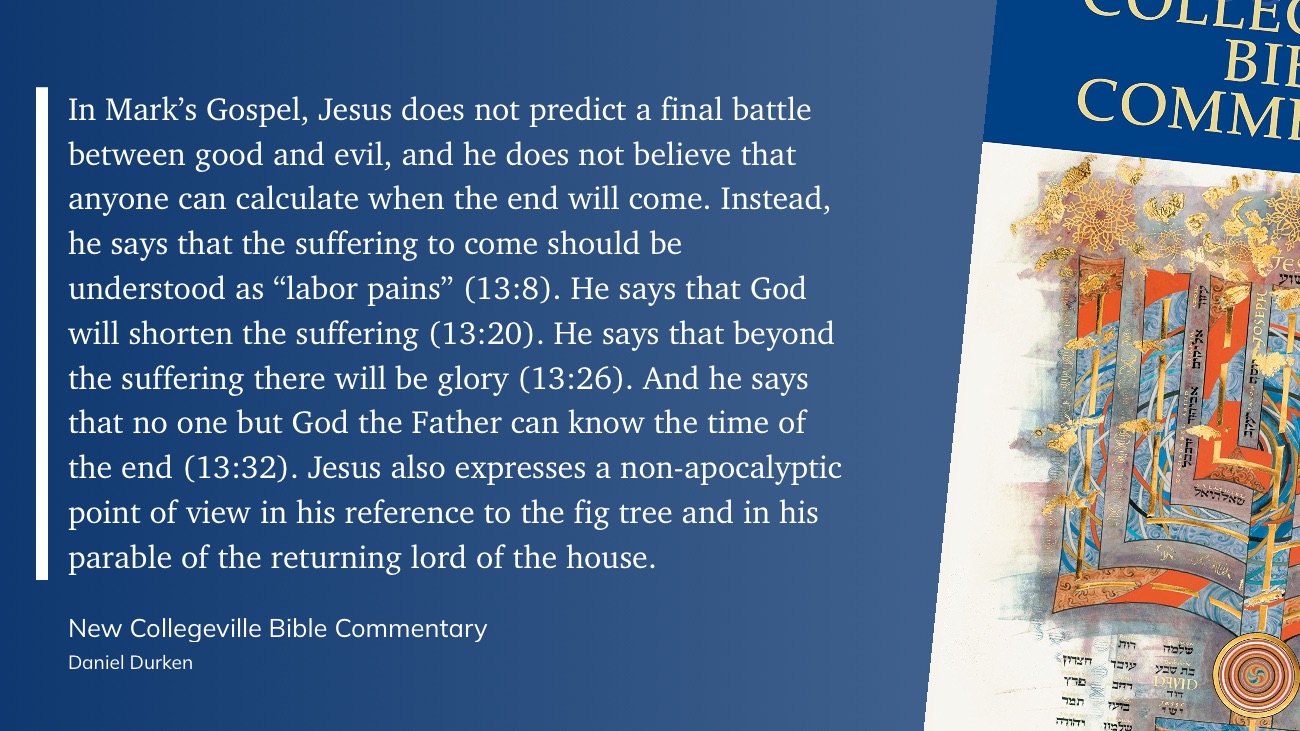
New Collegeville Bible Commentary
Click on card to view full screen.
Outline of Main Points:
Apocalyptic Imagery in Mark
– Discuss traditional apocalyptic warnings and imagery used by Jesus.
– Flee to the mountains, not turning back (13:14-16).
– Lament for those pregnant “in those days” (13:17).
– Pray it does not happen in winter (13:18).
– Tribulation unlike any other, referring to Daniel 12:1 (13:19).
The Abomination of Desolation
– Reference to Daniel’s prophecy (Daniel 12:11).
– Historical context of Antiochus’s sacrilege in the Temple.
– Connection to Roman sacrilege in Mark’s time.
– Jesus’ use of the term and the emphasis on written prophecy (13:14).
Jesus’ Unique Perspective on Apocalyptic Themes
– Labor pains as the beginning (13:8b).
– Contrast with traditional battles of good versus evil.
– God’s mercy in shortening the days of tribulation (13:20).
– Promise of future glory and gathering of the elect (13:26-27).
Parables and Their Teachings
– Use of parables to contrast apocalyptic themes.
– The parable of the sower and its reversal implications.
– The fig tree as a symbol of renewal (13:28-31).
Jesus’ Non-Apocalyptic Views
– The timing of the end known only to God the Father (13:32).
– Reference to the fig tree as a symbol of hope and restoration.
– Connection to the cursed and restored fig tree episodes in Mark 11 (11:12-14, 11:20-23).
Eager to delve further into the readings. Simply copy and paste a sentence or two into our AI Chat Bot, allowing our Catholic Assistant to provide you with additional context, connections, and insights from a variety of approved sources.
Preaching God’s
Transforming Justice

Click on card to view full screen.
Outline of Main Points:
Understanding the Context of Daniel
– The book of Daniel appears sparingly in the lectionary, with readings in Year B and on All Saints’ Day.
– Daniel is considered the most apocalyptic book of the Hebrew Bible.
– The narrative is set during the Babylonian exile but was likely written during the Maccabean revolt.
The Significance of Daniel 12:1–3
– Positioned after vivid apocalyptic visions, this passage diverges from end-time speculations.
– Offers a message of hope, emphasizing the resurrection.
Sub Points:
Historical Background
– Babylonian Exile context: 540-530 BCE.
– Written during Maccabean revolt, between the taking and rededication of the Jerusalem temple.
Apocalyptic Imagery and Hope
– Connection to Christian roots in apocalyptic imagery.
– Message not about speculative signs but about assurance of resurrection.
Resurrection as Social Transformation
– Resurrection is integral to the new social order God establishes.
– Represents God’s faithfulness to the suffering who held firm in faith.
Relevance to Modern Preaching
– Encouragement for preaching on social justice and transformation.
– Suffering experienced as believers is not without hope.
– Endurance is strengthened by hope in the resurrection.
Eager to delve further into the readings. Simply copy and paste a sentence or two into our AI Chat Bot, allowing our Catholic Assistant to provide you with additional context, connections, and insights from a variety of approved sources.
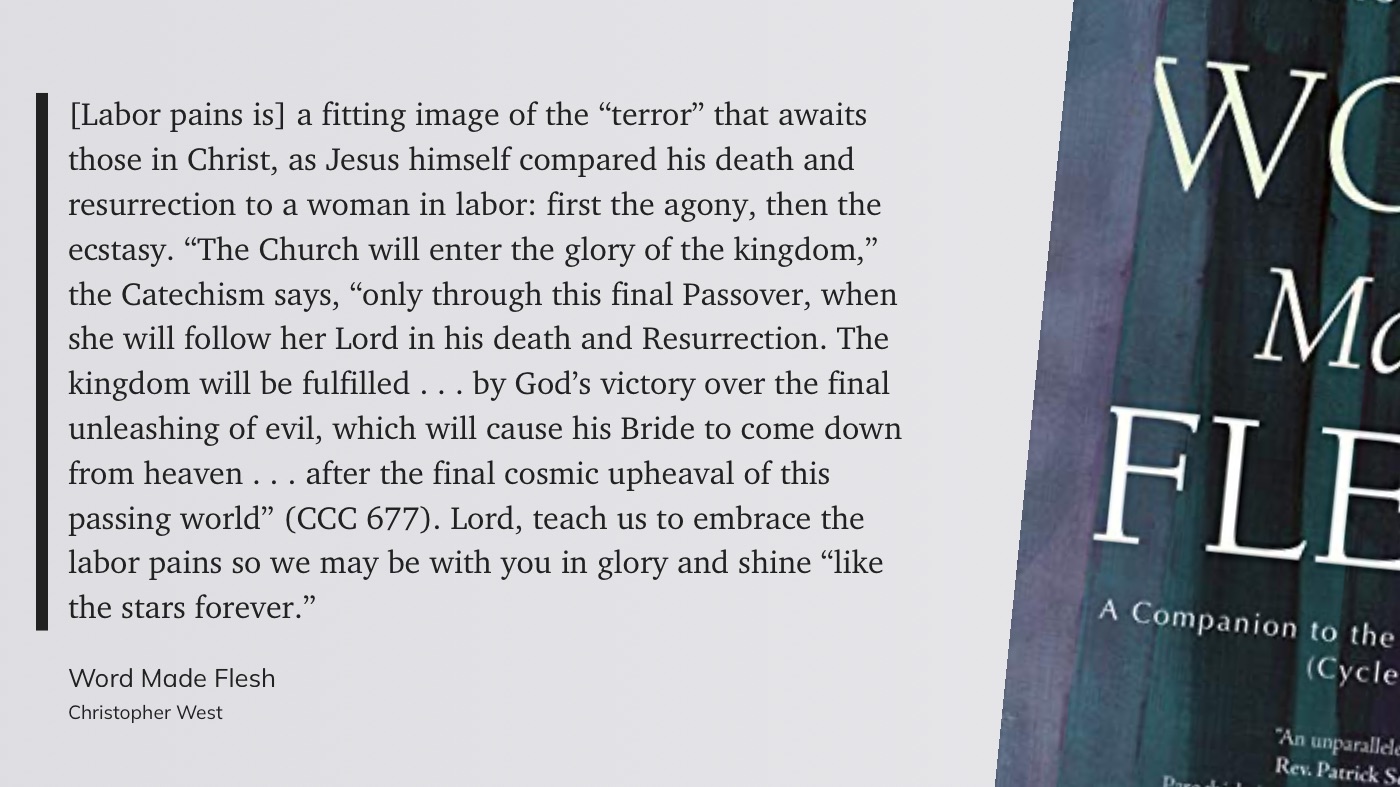
Word Made Flesh
Click on card to view full screen.
<Outline of Main Points
The Expectation of the Church
– Ever since Christ ascended to heaven, the Church embodies patient waiting and eager longing for the return of the Bridegroom.
– As stated in the Catechism, the Church longs to be united with Christ in the glory of heaven, where eternal joy with the Beloved awaits (CCC 1821).
The Cry of Hope
– We express our eager expectation for Christ’s return with the prayer “thy kingdom come.”
– This prayer aligns with the call from the Spirit and the Bride, “Come, Lord Jesus” (CCC 2817; Rev 22:20).
– It is a cry of desire and hope for the consummation of the marriage of the Lamb.
The Object of Our Desire
– It is natural to desire fullness of life, love, and happiness—recognizing where we place our hope is crucial.
– Christian hope is the virtue that desires the kingdom of heaven and eternal life as true happiness, grounded in Christ’s promises (CCC 1817).
Eager to delve further into the readings. Simply copy and paste a sentence or two into our AI Chat Bot, allowing our Catholic Assistant to provide you with additional context, connections, and insights from a variety of approved sources.
Life Recovery Bible
Click on card to view full screen.
The Twelve Steps
TIP: Copy and paste any of these steps into the CATHOLIC ASSISTANT bot in the lower right corner of the screen to make connections to the Sunday readings for this week.
STEP 1: We admitted we were powerless over alcohol—that our lives had become unmanageable.
STEP 2: Came to believe that a Power greater than ourselves could restore us to sanity.
STEP 3: Made a decision to turn our will and our lives over to the care of God as we understood Him.
STEP 4: Made a searching and fearless moral inventory of ourselves.
STEP 5: Admitted to God, to ourselves, and to another human being the exact nature of our wrongs.
STEP 6: Were entirely ready to have God remove all these defects of character.
STEP 7: Humbly asked Him to remove our shortcomings.
STEP 8: Made a list of all persons we had harmed, and became willing to make amends to them all.
STEP 9: Made direct amends to such people wherever possible, except when to do so would injure them or others.
STEP 10: Continued to take personal inventory and when we were wrong promptly admitted it.
STEP 11: Sought through prayer and meditation to improve our conscious contact with God as we understood Him, praying only for knowledge of His will for us and the power to carry that out.
STEP 12: Having had a spiritual awakening as the result of these steps, we tried to carry this message to alcoholics, and to practice these principles in all our affairs.
Eager to delve further into the readings. Simply copy and paste a sentence or two into our AI Chat Bot, allowing our Catholic Assistant to provide you with additional context, connections, and insights from a variety of approved sources.
A Preacher’s Guide
to Lectionary Sermon Series
Click on card to view full screen.
Outline of Main Points:
The Foundation of Gratitude
– Acknowledge the profound offering God has made through Jesus Christ.
– Recognize that gratitude stems from understanding God’s generous grace.
– Salvation through Christ perfects us in love eternally.
– The Holy Spirit writes a new covenant on our hearts, assuring forgiveness of sins.
Expressing Gratitude Through Generosity
– Our gratitude motivates generous giving to God.
– Salvation and the Holy Spirit’s presence inspire irrepressible generosity.
The Communal Aspect of God’s Work
– The work of God extends beyond the individual to the communal.
– Jesus, as our high priest, presides over “the house of God,” symbolizing our family in Christ.
Sub Points:
Provoking Each Other to Good Deeds
– Growth in faith thrives within a challenging Christian community.
– The concept dismisses the notion of being “spiritual but not religious.”
Gathering Together
– Celebrates the power of physically joining together.
– Isolation breeds selfishness; strength lies in congregational worship and discipleship.
Encouraging One Another
– Nurture and uplift those who are struggling, despite differences.
– Requires risk, vulnerability, and persistence in offering encouragement and fellowship.
Eager to delve further into the readings. Simply copy and paste a sentence or two into our AI Chat Bot, allowing our Catholic Assistant to provide you with additional context, connections, and insights from a variety of approved sources.
Africa Bible Commentary

Click on card to view full screen.
Outline of Main Points:
The Context of the Discourse
– Jesus’ prediction of the temple’s destruction (Mark 13:1-2)
– Disciples’ questions about the timing and signs (Mark 13:3-4)
Beginning Signs of the End Times
– Impostors claiming to represent Jesus (Mark 13:5-6)
– Human-origin calamities: wars and rumors of wars (Mark 13:7-8a)
– Natural calamities: earthquakes and famines (Mark 13:8b)
– Assurance amidst chaos: these are only the beginnings of birth pains (Mark 13:8c)
The Coming Persecution
– Persecution of the apostles and spread of the gospel (Acts 4:5-7, 5:27-29)
– Persecution’s broader implications: family divisions and hatred (Mark 13:12-13)
– Promise to those who stand firm: Salvation and vindication (Mark 13:13)
Destruction of the Temple and the Abomination
– The “abomination that causes desolation” as prophecy fulfillment (Mark 13:14)
– Historical context: Antiochus IV and the desecration of the temple
– Advice to flee and focus on survival over material possessions (Mark 13:15-16)
The Great Tribulation
– Description of unprecedented distress (Mark 13:19)
– Religious counterfeits and deceivers (Mark 13:21-22)
– Assurance given to the elect: knowledge and understanding (Mark 13:23)
The Second Coming of Christ
– Cosmic disturbances preluding the Lord’s return (Mark 13:24-25)
– The Lord’s return in power and glory (Mark 13:26)
– Gathering of the elect across the earth (Mark 13:27)
The Call to Vigilance
– Lesson from the fig tree: detecting signals of the times (Mark 13:28-29)
– Meaning of “this generation” and fulfillment of prophecy (Mark 13:30)
– Certainty and truth of Jesus’ words (Mark 13:31)
Final Exhortation: Stay Alert
– Unknown timing of the second coming (Mark 13:32)
– Illustration of vigilance: servants ready for the master’s return (Mark 13:34-36)
Eager to delve further into the readings. Simply copy and paste a sentence or two into our AI Chat Bot, allowing our Catholic Assistant to provide you with additional context, connections, and insights from a variety of approved sources.
CROSS-REFERENCE
VERSES
There are several cross-reference verses for Mark 13:24-32 that provide additional context and insight into the themes of the end times and the return of Jesus:
Isaiah 13:9-13: This Old Testament passage speaks of a day of judgment when the sun, moon, and stars will be darkened, providing a prophetic backdrop for Jesus’ teachings in Mark 13.
Matthew 24:29-35: This passage from the Gospel of Matthew offers a parallel account of Jesus’ teaching on the signs of the end times and the need for watchfulness.
Luke 21:25-28: In the Gospel of Luke, Jesus also speaks about the cosmic signs that will precede his return and the importance of being prepared.
1 Thessalonians 5:1-11: This section of Paul’s letter to the Thessalonians discusses the suddenness of the Day of the Lord and the need for believers to remain alert and sober.
2 Peter 3:8-13: This passage emphasizes the unexpected nature of the end times and encourages Christians to live holy lives in anticipation of the coming of the Lord.
Revelation 6:12-17: This portion of the Book of Revelation describes the cosmic disturbances that will accompany the opening of the sixth seal, echoing the imagery found in Mark 13:24-25.