

32nd Sunday of Year B
November 10, 2024
NEW FEATURE: The AI Assistant at the bottom right corner
has been specifically trained for this website.


True generosity is demonstrated through selfless sacrifice, as exemplified by the widow who gives her last two coins to God despite her poverty.
32nd Sunday of Year B

- 00:00 The widow's offering of her last two coins exemplifies true generosity, as she gives everything she has to God despite her poverty.
- 00:57 A widow's humble offering of two small coins stands in stark contrast to the lavish wealth surrounding the temple.
- 01:02 The temple in 1st century Jerusalem served as both a religious and economic hub, central to the city's wealth and treasury.
- 01:26 A widow's humble offering, though small in amount, exemplifies true generosity by giving all she had, teaching that quality of sacrifice matters more than quantity.
- 02:07 True offerings to God require total self-giving, exemplified by the widow's sacrificial act despite her dire circumstances.
32nd Sunday of Year B

Key Teachings of Jesus
Q: What was the significance of the poor widow's offering?
A: Jesus used the poor widow's offering of her last two coins to teach that giving everything you have to God is the true offering, even if it's quantitatively less than others' contributions.
Q: How wealthy was the First Century Temple in Jerusalem?
A: The First Century Temple was extremely wealthy, covered in gold, with numerous priests, serving as the economic center of Jerusalem and housing the city's treasury.
Contrasts in Giving
Q: How did Jesus compare the widow's offering to that of the rich?
A: Jesus highlighted that the widow gave all she had out of her poverty, while the rich put in more money out of their abundance, emphasizing the quality of the offering over its quantity.
Q: What does Jesus teach about true offerings to God?
A: Jesus teaches that a true offering to God involves giving everything, loving God with one's whole life, without remainder, and holding nothing back.
Historical Context
Q: What was the social status of widows in First Century society?
A: A widow in First Century society who was totally on her own could be in a state of utter destitution and poverty, especially if she had no family to care for her.
Q: Why was the Temple significant beyond religious purposes?
A: The Temple served as the cultic, sacrificial, and religious center, but also as the economic hub of Jerusalem, as there were no banks in the First Century A.D.
32nd Sunday of Year B
Giving and Sacrifice
Q: What makes an offering truly meaningful to God?
A: A truly meaningful offering to God involves giving everything, not just a portion, as exemplified by the poor widow who gave her last two coins, her whole living, in contrast to the wealthy who gave out of their abundance.
Q: How can one demonstrate genuine love for God through giving?
A: Genuine love for God is demonstrated by giving without remainder, holding nothing back, as illustrated by the widow's offering of her entire livelihood despite her extreme poverty.
Spiritual Lessons
Q: What does the widow's offering teach about material wealth versus spiritual wealth?
A: The widow's offering teaches that spiritual wealth far exceeds material wealth, as her small donation of two coins was deemed by Jesus to be qualitatively greater than the large sums given by the wealthy.
Q: How does Jesus use the widow's offering to critique societal values?
A: Jesus uses the widow's offering to critique societal values by contrasting the interior charity and love for God of the poor widow with the wealth, prestige, and external desires for praise of the scribes.
Faith in Action
Q: What does the widow's offering reveal about faith and risk-taking?
A: The widow's offering reveals that true faith involves bold acts that may put one at risk, as she potentially faced utter destitution by giving her last two coins, possibly without family support.
Q: How does the widow's action relate to the first commandment?
A: The widow's action exemplifies the first commandment to love God with all your soul, which Jesus interprets as loving God with your whole life, without remainder, mirroring the widow's complete self-giving.
32nd Sunday of Year B
Religious Practices
Q: Is it ethical for religious institutions to accept donations from the poor?
A: The video suggests it's acceptable and even praiseworthy for the poor to donate to wealthy religious institutions, as exemplified by Jesus commending the widow who gave her last two coins to the wealthy First Century Temple.
Q: Should religious buildings be extravagantly decorated?
A: The video describes the First Century Temple as being covered in gold and extremely wealthy, implying that such opulence in religious buildings was considered normal and acceptable in Jesus' time.
Challenging Traditional Interpretations
Q: Does quantity matter more than quality in religious offerings?
A: According to Jesus' teaching in the video, the poor widow's small offering was qualitatively more valuable than the larger contributions of the rich, because she gave "everything she had".
Q: Are some commandments more important than others?
A: The video suggests a hierarchy in the Ten Commandments, with the first three being summarized by the Shema prayer, and the second commandment connecting the remaining seven.
Religious Practices
Q: Is it right to encourage extreme self-sacrifice in the name of faith?
A: The video portrays the widow's action of giving her last two coins as putting herself into "utter destitution and poverty", yet presents this as a positive example of faith and devotion.
Q: Should religious institutions serve as economic centers?
A: The video describes the First Century Temple as the "economic center" of Jerusalem, housing the treasury and being the focal point around which the city's economy revolved.

Jesus condemns the hypocrisy of religious leaders who exploit the vulnerable while praising the selfless generosity of a poor widow, emphasizing that true giving comes from the heart rather than wealth.

- 00:00 In Mark 12:38-44, Jesus condemns the hypocritical scribes exploiting widows while praising a poor widow for her selfless, total offering.
- Mark 12:38-44 contrasts the condemnation of scribes who exploit widows with the example of a poor widow who selflessly gives all she has.
- Priests often enjoy the perks of power and honor, which can lead to vanity and hypocrisy, contradicting Jesus' teachings on true Christian discipleship.
- 02:51 Jesus warns against the hypocrisy of the scribes and highlights the sacrificial giving of a poor widow, emphasizing that true generosity comes from the heart, not wealth.
- 04:39 Mark 12:38-44 critiques religious leaders for their failings, contrasting them with a widow's offering to highlight themes of authority and care for the vulnerable.
- Mark 12:38-44 critiques religious leaders, particularly the scribes, within a structured narrative that highlights their shortcomings in relation to widows and the broader themes of the chapter.
- The widow's offering contrasts with the religious leaders, framing the apocalyptic discourse and transitioning into the controversies surrounding Jesus' authority.
- 06:56 Jesus warns the crowd about the hypocrisy of the scribes, who seek honor and respect while exploiting the vulnerable and will face severe judgment.
- 08:31 Jesus condemns the hypocrisy of the powerful who seek prestige while neglecting the vulnerable, contrasting their actions with the care mandated in the Old Testament.
- Wearing long robes and seeking respect and the best seats indicate a desire for prestige and honor.
- Jesus critiques the greed and hypocrisy of the powerful, highlighting the neglect of widows and orphans, which starkly contrasts with Old Testament teachings that emphasize their care and concern.
- 11:04 Corrupt leadership is condemned in both Jesus' teachings and Ezekiel, highlighting the destructive nature of those in power who exploit and harm others.
- 12:47 Religious leaders' corruption and hypocrisy, condemned by Jesus, reflect a broader moral failure in society.
- Religious leaders have failed to uphold moral distinctions, leading to corruption, exploitation, and false prophecies among the people.
- Jesus' condemnation of some scribes aligns with the Jewish tradition, as reflected in the Psalms of Solomon, which express disdain for hypocrites and their greed.
- 15:02 Jesus contrasts the sacrificial giving of a poor widow with the greed of religious leaders, emphasizing true discipleship and the importance of genuine love for God and neighbor.
- Jesus highlights the contrast between the wealthy giving from their surplus and the poor widow who donates all she has, emphasizing the value of sacrificial giving.
- The passage contrasts the widow's selfless giving with the exploitation by religious authorities, highlighting a critique of their greed and the importance of genuine love for God and neighbor.
- Spiritual leaders must resist temptations of power and position, as true discipleship and service are essential for genuine leadership in the Christian tradition.
- Discipleship is essential for Christian leadership, emphasizing personal responsibility and trust in God rather than pointing to others or the past.
Leadership and Discipleship
Q: What is Jesus' core teaching on Christian leadership?
A: Jesus teaches that true Christian leadership is rooted in servanthood, where the great become servants and the first become slaves, as outlined in Mark 10:42-45.
Q: How does Jesus contrast true discipleship with the behavior of scribes?
A: Jesus warns against scribes who devour widows' houses and pray long for appearance, emphasizing that true discipleship involves selfless service rather than seeking prestige and honor.
Giving and Sacrifice
Q: What lesson does Jesus draw from the widow's offering?
A: Jesus highlights the contrast between those who give from abundance and the poor who give everything, praising the widow who contributed two small coins worth a penny as giving more than the rich.
Spiritual Leadership Pitfalls
Q: What dangers does Jesus warn spiritual leaders about?
A: Jesus cautions against the temptations of power and position, criticizing the symbiotic relationship between priests and wealthy farmers that can lead to vanity, hypocrisy, and distortion of true spiritual leadership.
True Discipleship
Q: How does Jesus define true discipleship?
A: Jesus describes true discipleship as service and giving one's life as a ransom for many, establishing this as the foundation for Christian leadership.
Religious Hypocrisy
Q: What specific behaviors of religious leaders does Jesus criticize?
A: Jesus condemns scribes who seek honor in public, take the best seats in synagogues, and enjoy places of honor at banquets while exploiting vulnerable widows.
Leadership and Discipleship
Q: How does Jesus define true Christian leadership?
A: Jesus teaches that true Christian leadership is rooted in servanthood, stating in Mark 10:42-45 that those who wish to be great must be servants of all, with the Son of Man setting the example by coming to serve and give his life as a ransom for many.
Q: What warning does Jesus give about corrupt spiritual leaders?
A: Jesus warns against scribes who devour widows' houses, say long prayers for appearance, and receive greater condemnation, as they prioritize their own status over serving others, contradicting Jesus' teaching on Christian discipleship.
Financial Stewardship
Q: How does Jesus view the widow's offering compared to the rich?
A: Jesus observes that a poor widow's two small coins, given from her poverty, are worth more than the large sums from the rich, as they give from their surplus which is hardly felt.
Critique of Religious Institutions
Q: What critique does Jesus make of the religious establishment?
A: Jesus criticizes the symbiotic relationship between priests and the powerful, where priests are put on a pedestal and enjoy perks, but risk vanity, hypocrisy, and distortion of their true purpose.
Biblical Context
Q: How does Jesus' teaching align with Old Testament critiques of leadership?
A: Jesus' teaching on the kingdom of God in Mark echoes critiques found in Ezekiel 22:1-31 and Psalms of Solomon 4:19-22, condemning leaders who devour the poor, take treasure, make widows, and profane God's holy things.
Personal Application
Q: What practical lesson can modern Christians draw from Jesus' teachings on leadership?
A: Christians should prioritize serving others over seeking status or power, recognizing that true greatness in God's kingdom comes through humility and sacrificial service, not through outward displays of piety or wealth.
Controversial Leadership Practices
Q: Did Jesus endorse the widow's extreme sacrifice?
A: Jesus' praise of the poor widow who gave "everything she had to live on" is a contentious topic among commentators, with some questioning if this extreme sacrifice should be seen as an example to follow.
Q: Are religious leaders inherently corrupt?
A: Jesus' severe critique of scribes and other religious authorities for their vanity, greed, and hypocrisy suggests a systemic problem in religious leadership of his time.
Wealth and Spirituality
Q: Does wealth hinder true devotion?
A: The contrast between the rich giving from their abundance and the poor widow giving her last coins implies that material wealth may impede genuine spiritual commitment.
Q: Is the temple treasury system exploitative?
A: Jesus' observation of the temple treasury and the widow's offering raises questions about whether the religious financial system was taking advantage of the most vulnerable.
Christian Leadership Model
Q: Should spiritual leaders avoid public prayer?
A: Jesus' condemnation of scribes who "say long prayers for appearance" challenges the practice of public displays of piety by religious leaders.
Q: Is servant leadership the only acceptable Christian model?
A: Jesus' teaching that the "Son of Man came not to be served but to serve" presents a radical reversal of traditional leadership hierarchies, potentially challenging all other leadership models in Christian contexts.
REFERENCES
CATHOLIC
Healy, Mary. The Gospel of Mark. The Catholic Commentary on Sacred Scripture. Grand Rapids, MI: Baker Academic, 2008.
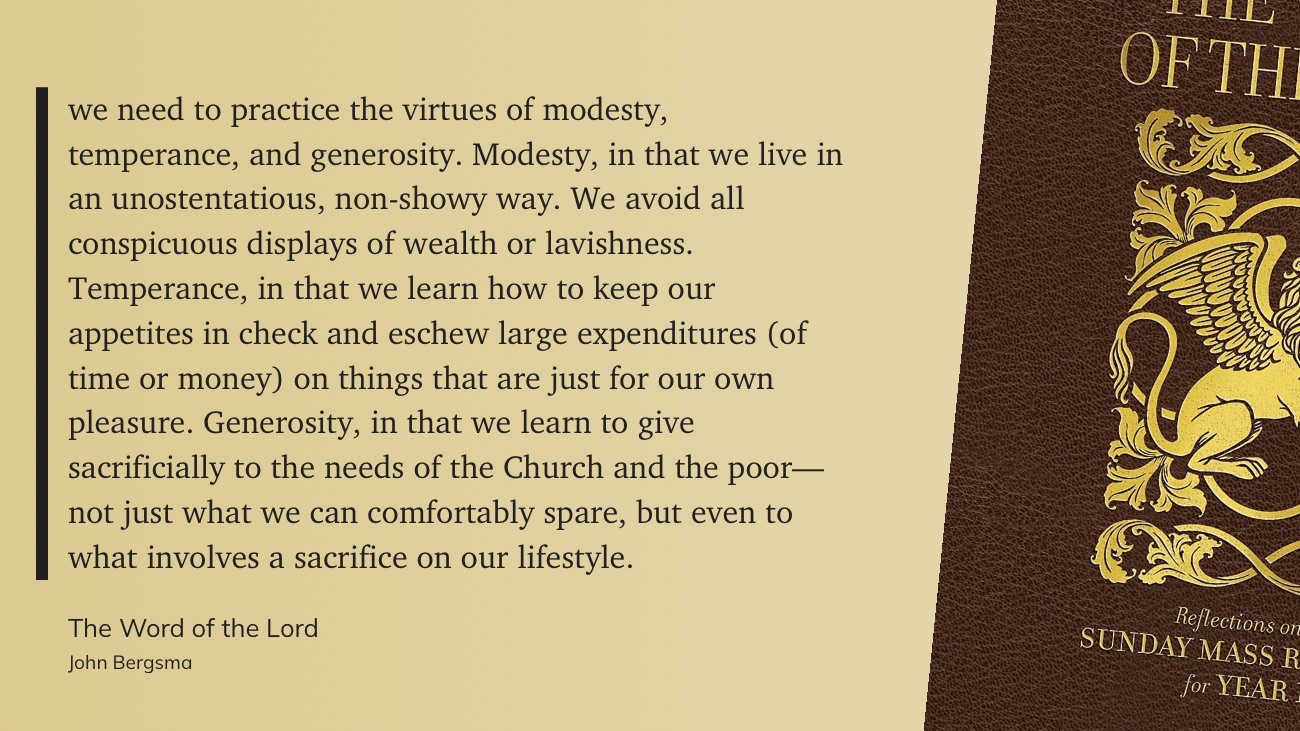
Bergsma, John. The Word of the Lord: Reflections on the Sunday Mass Readings for Year B. Steubenville, OH: Emmaus Road Publishing, 2020.
Durken, Daniel, ed. New Collegeville Bible Commentary: One-Volume Hardcover Edition. Collegeville, MN: Liturgical Press, 2017.
JUSTICE
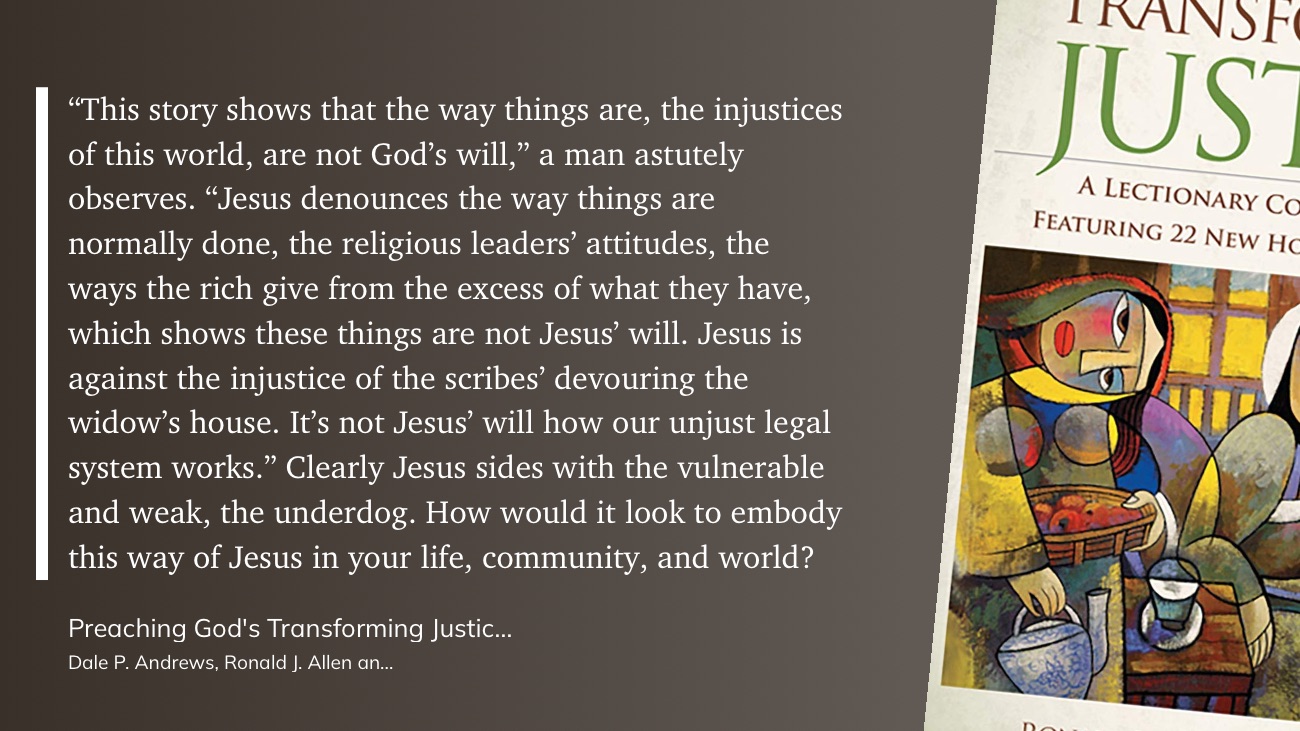
Allen, Ronald J., Dale P. Andrews, and Dawn Ottoni-Wilhelm, eds. Preaching God’s Transforming Justice: A Lectionary Commentary, Year B. Louisville, KY: Westminster John Knox Press, 2013.
THEOLOGY OF THE BODY
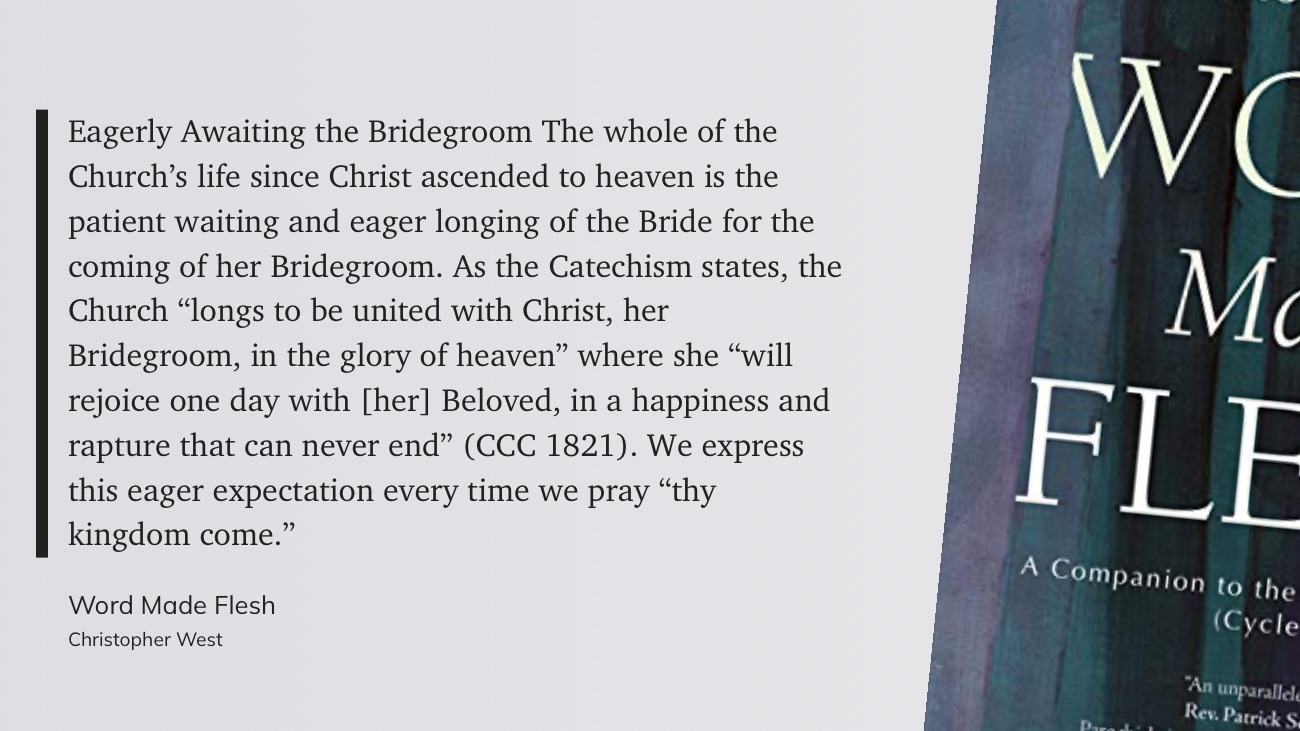
West, Christopher. Word Made Flesh: A Companion to the Sunday Readings (Cycle B). Pennsburg, PA: Theology of the Body Institute Press, 2021.
ADDICTION & RECOVERY
Arterburn, Stephen, and David Stoop, eds. The Life Recovery Bible: NLT Second Edition. Pennsburg, PA: Theology of the Body Institute Press, 2021.
THEMATIC
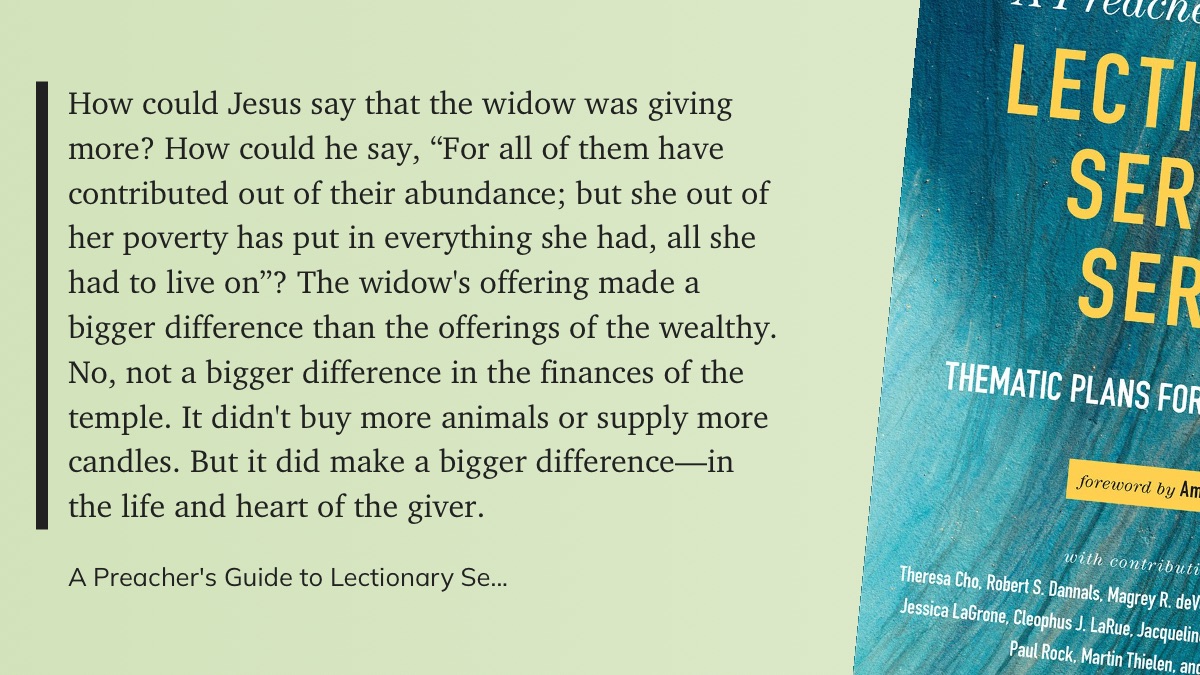
Kelley, Jessica Miller, ed. A Preacher’s Guide to Lectionary Sermon Series: Thematic Plans for Years A, B, and C. Louisville, KY: Westminster John Knox Press, 2016.
AFRICA
Adeyemo, Tokunboh, ed. Africa Bible Commentary. Grand Rapids, MI: Zondervan, 2010.
Commentary Highlights




Click on card to view full screen.
New Collegeville Bible Commentary
32nd Sunday of Year B
Main Points:
1. The Contrast Between the Rich and the Poor in the Temple
– Mark concludes with a contrast between those who exploit the Temple for profit and those who give all they have.
– Highlights the ongoing theme of wealth versus poverty in Mark’s Gospel.
2. Jesus’ Critique of the Scribes
– Jesus denounces the scribes using their religion for self-aggrandizement.
– The scribes seek seats of honor, similar to the request of James and John (Mark 10:37).
– Jesus teaches that true greatness is in servitude (Mark 10:44).
3. The Greed of Temple Authorities
– The scribes profit from the needs of poor widows (Mark 12:40).
– Jesus describes their actions as devouring “the house of widows.”
– Their greed is contrasted with the nurturing habits of Jesus.
4. The Significance of the Poor Widow’s Offering
– Clarifies Jesus’ anger at the profiteering money changers (Mark 11:15-17).
– Jesus’ anger is directed at those exploiting Temple funds, not the money itself.
– Praises the widow for her total contribution, showing her devotion and self-giving.
5. The Widow’s Offering as a Fulfillment of Jesus’ Teachings
– Echoes Jesus’ instruction to the rich man to sell all (Mark 10:21).
– The widow embodies the commandment to love God with all one is (Mark 12:30).
Conclusion:
– Reflect on the true meaning of devotion and selflessness exemplified by the poor widow.
– Consider the implications of Jesus’ teachings on wealth, power, and humility in our lives today.
– Challenge to emulate the widow’s wholehearted dedication to God in our daily actions.
PREVIOUS | NEXT
- CATHOLIC CATECHISM
- CHURCH FATHERS
- DEVOTIONAL
PERSPECTIVE - ECOLOGICAL
PERSPECTIVE - JUNGIAN
PERSPECTIVE

DOCTRINAL INSIGHTS
Social Justice: The Church emphasizes the importance of caring for the poor and vulnerable, denouncing the exploitation of the weak, as seen in the scribes’ behavior.
Charity: The widow’s offering exemplifies the virtue of charity, encouraging selfless giving and love for others, especially those in need.
Preferential Option for the Poor: Catholic social teaching prioritizes the needs of the poor and marginalized, in line with Jesus’ criticism of the scribes and praise for the widow.
The Universal Call to Holiness: The Church teaches that all believers are called to grow in holiness, which includes avoiding hypocrisy and cultivating genuine faith, as highlighted in Jesus’ critique of the scribes.
Authentic Worship: The passage warns against superficial worship and encourages sincere devotion to God, rooted in love and charity towards others.
Stewardship: The story of the poor widow emphasizes the value of giving sacrificially and responsibly managing the resources God has entrusted to us.

Catholic Catechism
32nd Sunday of Year B
Verse 38: “In the course of his teaching he said, “Beware of the scribes, who like to go around in long robes and accept greetings in the marketplaces,”
Commentary: Jesus warns his followers about the scribes who seek honor and recognition through their appearance and public displays. This relates to the Catholic doctrine of humility, which encourages a focus on inner spirituality rather than external appearances (CCC 2540).
TIP: Copy and paste any of the catechism paragraph (for example, CCC 2540) references into the CATHOLIC ASSISTANT bot in the lower right corner of the screen to learn more.
Verse 39: “seats of honor in synagogues, and places of honor at banquets.”
Commentary: The scribes’ desire for positions of honor further highlights their focus on worldly recognition. Catholics are called to prioritize the Kingdom of God over earthly ambitions, seeking to serve rather than be served (CCC 2535).
Verse 40: “They devour the houses of widows and, as a pretext, recite lengthy prayers. They will receive a very severe condemnation.”
Commentary: Jesus condemns the scribes’ exploitation of the vulnerable, which goes against Catholic teachings on social justice and the preferential option for the poor (CCC 2448). The scribes’ actions also contradict the true purpose of prayer, which is to deepen one’s relationship with God, not to impress others (CCC 2559).
Verse 41: “He sat down opposite the treasury and observed how the crowd put money into the treasury. Many rich people put in large sums.”
Commentary: The scene at the temple treasury invites reflection on the relationship between material wealth and spiritual life. Catholics are called to practice responsible stewardship of their resources and to remember that their true treasure is in heaven (CCC 2407-2408).
Verse 42: “A poor widow also came and put in two small coins worth a few cents.”
Commentary: The widow’s offering highlights the importance of giving from one’s poverty, as emphasized in Catholic teachings on almsgiving (CCC 2462). Her generosity serves as a reminder that the value of a gift lies not in its monetary worth, but in the spirit of love and self-sacrifice with which it is given.
Verse 43: “Calling his disciples to himself, he said to them, “Amen, I say to you, this poor widow put in more than all the other contributors to the treasury.”
Commentary: Jesus praises the widow’s offering as an example of genuine generosity. This echoes Catholic teachings on the universal call to holiness, which emphasizes that the path to holiness is not limited by one’s social or economic status (CCC 2013).
Verse 44: “For they have all contributed from their surplus wealth, but she, from her poverty, has contributed all she had, her whole livelihood.””
Commentary: The widow’s sacrificial giving reflects the ultimate sacrifice of Jesus on the cross, which serves as the foundation of the sacrament of the Eucharist (CCC 610). Catholics are called to offer their lives as a living sacrifice, united with Christ’s offering on the cross (CCC 618).
NOTABLE QUOTES
St. Augustine: “They did not inwardly please God by their long prayers, but outwardly sought to please men by a show of religious service” (Expositions on the Psalms, 95.3).
St. Chrysostom: “This He said, showing that it was not for the sake of the widows they were doing these things, but to be glorified by them” (Homilies on the Gospel of Saint Matthew, 65).
Gregory the Great: “It is as if He had openly said, The scribes and Pharisees sit in Moses’ seat; not so I. For I, who hold them not in my heart, do not sit down in their seat” (Homilies on the Gospel, 37).
St. Ambrose: “She [the widow] puts in two small coins, which are worth a farthing, that you may understand that it is not the amount but the intention that pleases God” (Exposition of the Christian Faith, 3.8.74).
St. Jerome: “For her to give her whole living was more than to give a small part, and the reward is greater in proportion to the mind and will of the giver, not to the size of the gift” (Commentary on Mark, 12.44).
St. Bede: “The two coins are the substance of her living, which she had not another to bring, but she brought her whole life; for what is the life of man but the blood, that is, the coin of his substance?” (Homilies on the Gospel, 2.11).
Church Fathers
32nd Sunday of Year B
Mark 12:38-44: In this passage, Jesus offers both a warning and a lesson through the actions of the scribes and the poor widow. The Church Fathers have much to say about these juxtaposed narratives, as they reveal deep truths about humility, righteousness, and generosity.
Verses 38-40: In these verses, Jesus cautions against the behaviors and attitudes of the scribes. The Church Fathers often emphasize Jesus’ warning as a critique of hypocrisy and a caution against the pernicious habit of seeking honor and recognition from others rather than from God. According to St. Augustine, these scribes were seeking the glory of men and indulging in outward shows of piety, while inwardly they were empty. Augustine warns that their long prayers are a mere veneer without the true desire to please God.
St. Chrysostom elaborates on the scribes’ love of positions of honor, such as the “best seats in the synagogues” and “places of honor at feasts.” He explains that they desired public admiration rather than the glory which comes from God, highlighting that they exploit the vulnerable such as widows, under the guise of religious service. This reveals the danger of using a position of religious authority for self-serving ends, which is vehemently condemned by other Church Fathers, including Gregory the Great.
Verses 41-44: In contrast, Jesus observes the offering of the poor widow. The Church Fathers see this as an exemplar of true faith and charity. While the wealthy give out of abundance, the widow gives out of her poverty. St. Ambrose critiques the wealthy donors whose giving, devoid of sacrifice, stands in stark contrast to the widow’s offering, which is full of sincerity and devotion.
St. Jerome considers the widow’s act as a true measure of generosity, noting that God values the heart’s intention over the magnitude of the gift. The widow’s small coins, fractionally worth, are elevated in divine estimation because they represent all she had to live on, showcasing her complete trust and dependence on God.
The commentary of St. Bede emphasizes the widow’s profound faith and submission to God’s will. Her offering is not only material but a symbolic act of giving her whole self to God’s service. Such giving, Bede notes, typifies the kind of discipleship that God esteems: one that offers not merely from surplus but from the depths of one’s life and faith.
The Church Fathers consistently draw parallels between this narrative and the broader call to Christian discipleship, underscoring the themes of humility, genuine love for God, and authentic charitable action. In sum, the passage serves as a perennial reminder to eschew religious ostentation and embrace humble service marked by sincere devotion.
WHAT YOU CAN DO
Practice humility: Catholics are encouraged to imitate Christ’s humility and avoid seeking attention or public praise for their good deeds. Instead, they should perform acts of charity quietly and humbly, focusing on pleasing God rather than impressing others.
Embrace simplicity: The widow’s offering reminds Catholics to value simplicity and detachment from material possessions. By living simply, they can become more generous in sharing their resources with those in need.
Promote social justice: This passage challenges Catholics to stand up against those who exploit or take advantage of the vulnerable. They should actively support social justice initiatives that protect the poor and marginalized.
Practice sacrificial giving: Catholics are called to give sacrificially, not just from their surplus. This could involve donating a significant portion of their income to charitable causes or volunteering time and talents to serve others.
Foster sincerity: This passage encourages Catholics to cultivate a genuine and transparent faith. They should avoid any form of religious hypocrisy and strive to live authentically, with their actions reflecting their inner beliefs.
Practice self-reflection: This passage invites Catholics to engage in regular self-examination, reflecting on their motivations and actions. They should strive to identify and overcome any tendencies towards pride or self-serving behavior.
Everyday Life
32nd Sunday of Year B
Mark 12:38-44 – Devotional Commentary
In this profound passage from the Gospel of Mark, Jesus offers a poignant critique of the religious leaders and an inspiring commendation of a poor widow’s offering. This narrative invites us to examine our own hearts and motivations in our spiritual practices.
Warning Against Pride and Pretense (Mark 12:38-40)
Jesus begins by cautioning His disciples to beware of the scribes. These religious leaders, respected in society, are described as wearing long robes and seeking public recognition. They desire greetings in marketplaces and the best seats in synagogues, along with places of honor at banquets. However, beneath their veneer of piety lies a troubling reality—they “devour widows’ houses” and make lengthy prayers for show.
This admonition challenges us to reflect on our motivations for religious actions. Are they a means to glorify God or to seek attention and admiration from others? Jesus condemns hypocrisy and exploitation, highlighting that God’s judgment is stricter for those who misuse their religious authority for personal gain.
The Widow’s Offering (Mark 12:41-44)
Following His denunciation of the scribes, Jesus observes a scene at the temple treasury with His disciples. Wealthy individuals are depositing large sums, but amidst them, a poor widow contributes two small coins, worth only a fraction of a penny. Despite her humble offering, Jesus declares that she has given more than all the others.
The widow’s act is monumental not because of the monetary value but due to the sacrificial nature of her gift. She gives “all she had to live on,” embodying total trust and surrender to God. Her offering becomes a profound symbol of true devotion and faith, contrasting sharply with the scribes’ empty religiosity.
Lessons for Today
The juxtaposition of the scribes and the widow invites readers to assess the sincerity of their faith. It challenges believers to prioritize inner spirituality over external displays. Jesus elevates the widow’s seemingly insignificant act, reminding us that God values the heart’s intent more than material abundance.
As we consider this passage, we are encouraged to emulate the widow’s heart of sacrificial giving, to trust God with everything—even when resources seem scarce. This scripture also calls us to be vigilant against the pride and self-serving tendencies that can infiltrate religious practices.
In our daily walk with God, may we seek authenticity, aligning our actions with a heart fully devoted to Him, and generously offering our lives in humble service, just as the widow did.
LAUDATE SI’
On the critique of consumerism and the pursuit of material wealth:“The current global situation engenders a feeling of instability and uncertainty, which in turn becomes ‘a seedbed for collective selfishness’. When people become self-centred and self-enclosed, their greed increases. The emptier a person’s heart is, the more he or she needs things to buy, own and consume. It becomes almost impossible to accept the limits imposed by reality.” (Laudato Si’, no. 209)
On the importance of prioritizing the common good and caring for the vulnerable:“We are faced not with two separate crises, one environmental and the other social, but rather with one complex crisis which is both social and environmental. Strategies for a solution demand an integrated approach to combating poverty, restoring dignity to the excluded, and at the same time protecting nature.” (Laudato Si’, no. 139)
On the need for a radical change in mindset and the value of humility:“An authentic humanity, calling for a new synthesis, seems to dwell in the midst of our technological culture, almost unnoticed, like a mist seeping gently beneath a closed door. Will the promise last, in spite of everything, with all that is authentic rising up in stubborn resistance?” (Laudato Si’, no. 112)
On the interconnected nature of creation and the need for integral ecology:“Nature cannot be regarded as something separate from ourselves or as a mere setting in which we live. We are part of nature, included in it and thus in constant interaction with it.” (Laudato Si’, no. 139)
An Ecological Perspective
32nd Sunday of Year B
In this passage from Mark 12:38-44, we see Jesus offering a critique of the religious leaders and a commendation of a poor widow. This segment of the Gospel presents a rich tapestry of spiritual and ecological insights, inviting us to reflect on the relationship between human society and the natural world.
The Warning Against the Scribes: Jesus begins by warning his disciples about the scribes, who love to walk around in long robes and seek public respect and honor. This critique reflects a disconnect from humility and an excessive focus on external appearances and material status. From an ecological perspective, such behavior can be likened to an unsustainable way of life that prioritizes personal gain over community well-being and environmental stewardship. This lifestyle fosters environmental degradation as it often leads to exploitation and overconsumption of resources to maintain appearances.
Consequences of Exploitative Practices: Jesus highlights the scribes’ exploitation when he says they “devour widows’ houses.” This phrase not only critiques social injustice but also serves as a metaphor for humanity’s exploitative relationship with the Earth. Just as the scribes consume the resources and dignity of vulnerable individuals, so too does an unsustainable economy consume the planet’s natural resources, often leaving devastation in its wake. In ecological terms, this passage calls for a re-evaluation of how human systems can prey on both people and the environment.
The Poor Widow’s Offering: In contrast to the wealthy scribes, Jesus observes a poor widow who gives two small copper coins, all she has. Despite her poverty, she offers everything, embodying a spirit of sacrificial giving and deep trust in God’s provision. Ecologically, the widow represents an alignment with an economy of enoughness, where rather than accumulating more than needed, there is a sustainable use of resources and sharing with the community. Her actions resonate with the principles of ecological stewardship, where minimal and thoughtful use of resources are prioritized.
Radical Generosity and Ecological Sustainability: The widow’s offering challenges cultural norms by emphasizing the value of intention and sacrifice over quantity. This aligns with ecological values that advocate for reducing consumption and valuing quality and sustainability over sheer volume or display of resources. Her act of giving mirrors the eco-feminist notion of care and interconnectedness, where life is not about dominating or consuming, but about nurturing and sustaining communities and ecosystems.
Invitation to Transformative Practices: Overall, this passage invites believers to critically assess their own lives and the societal systems they participate in. It calls for a transformative approach that aligns with principles of social justice and ecological sustainability. By living in a manner that respects and uplifts both humanity and the Earth, individuals can foster a world where justice and creation care are deeply intertwined. The widow’s example serves as a model for living in harmony and balance, urging us toward a future where spiritual values, justice, and ecological health are in profound unity.
1 Kgs 17:10-16:
This passage highlights the archetypal theme of the hero’s journey, as Elijah, guided by divine wisdom, embarks on a transformative quest. From a Jungian perspective, the widow’s selfless act of generosity represents an integration of the nurturing mother archetype. Peterson might view this narrative as an illustration of the power of individual responsibility and faith in overcoming adversity. While not directly related to Mark 12:38-44, both passages emphasize the significance of genuine generosity and humility.
Heb 9:24-28:
The Epistle to the Hebrews underscores the archetypal image of Christ as the ultimate high priest, who offers himself as a sacrifice to transcend the limitations of the earthly realm. Jungian psychology and Peterson’s teachings both emphasize the transformative power of self-sacrifice in the journey towards individuation. This passage also relates to Mark 12:38-44, as it contrasts Christ’s genuine sacrifice with the insincere actions of the scribes, highlighting the importance of authentic spirituality and humility.
Jungian Psychological Perspective
32nd Sunday of Year B
In Mark 12:38-44, we witness a profound contrast between the religious leaders who seek honor and recognition, and the humble widow who gives her all without expecting anything in return. From a Jungian perspective, this narrative taps into the deep psychological archetypes of the ego and the Self, providing insights into the nature of spiritual growth and development.
The scribes in the passage embody the inflated ego, striving for external validation and admiration. This behavior stems from an unbalanced psychological state where the ego dominates the individual’s psyche. Jungian psychology warns against such an over-identification with the ego, as it prevents one from connecting with their true Self and pursuing genuine individuation.
On the other hand, the widow represents the archetype of the Self, displaying humility and sacrifice. By giving away her last two coins, she transcends the limitations of her ego, embracing a deeper spiritual reality that connects her to the divine. This act of self-sacrifice is not born out of a desire for recognition but from a sincere connection to her true Self and an understanding of her place in the greater cosmic order.
In the context of spiritual growth, the widow’s actions exemplify the transformative power of self-sacrifice. By releasing attachments to material possessions and ego-driven desires, she achieves a higher state of spiritual awareness and unity with the divine. This process is akin to the Jungian concept of individuation, where the individual integrates both conscious and unconscious aspects of their psyche to attain wholeness.
Furthermore, the widow’s actions challenge societal norms and expectations, highlighting the importance of questioning conventional wisdom in the pursuit of spiritual growth. By subverting the established hierarchy that favors the wealthy and powerful, she embodies the potential for psychological and spiritual transformation through the exploration of one’s inner world.
CROSS-REFERENCE
VERSES
Here are several cross-reference verses for Mark 12:38-44 that provide additional context and insight into the themes of hypocrisy, generosity, and true devotion:
Luke 11:43: “Woe to you Pharisees, because you love the most important seats in the synagogues and respectful greetings in the marketplaces.”
Luke 14:7-11: Jesus teaches a parable about humility and seeking honor from God rather than from people.
Luke 20:46-47: Jesus warns against the scribes who seek honor and status but fail to practice what they preach.
Matthew 6:1-4: Jesus teaches about practicing righteousness without seeking attention or praise from others.
Matthew 23:1-12: Jesus criticizes the scribes and Pharisees for their hypocrisy and self-exaltation.
1 Timothy 6:17-19: This passage encourages generosity and a proper perspective on wealth, as it advises the rich to be rich in good deeds and store up treasure in heaven.
James 1:27: This verse emphasizes the importance of caring for widows and orphans in their distress, reflecting the value of the poor widow’s offering in Mark 12:41-44.