12th Sunday of Year B

June 23, 2024

HOMILIESCONNECTIONSHOLY SEEFR TONY

Living the
Word

DOWNLOAD THIS WEEK’S PDF

PDF was created by Fr Frank Bird sm, a Marist priest to help young adults hear and live the message of Jesus. 

Sunday
Lectionary

Connections

Using AI to Generate Connections for Sunday Preaching and Pastoral Counseling

Write a 400 word essay that give specific examples of how key points from XXXXXXXXXX can be utilized in pastoral counseling sessions within a Roman Catholic parish setting. Quote verses from the New American Bible. Give Examples from contemporary life.

Pastoral Counseling

FR. DON: The readings this week provide valuable insights that can be applied in pastoral counseling sessions. We’ll be looking at this from a Roman Catholic perspective.
FIRST READING

FR. DON: In Job 38:1, God addresses Job from out of a storm, challenging his assumptions and understanding. In the first reading God speaks to Job from a storm. It serves as a poignant reminder for Catholics to recognize the boundaries of human understanding and to accept that God's ways often transcend our grasp. It cautions against spiritual pride and encourages us to approach our faith with humility, remaining open to divine guidance.

TONYA: Yeah, that is something I struggle with at times. I mean I respect and value the teachings of esteemed theologians like Thomas Aquinas and, of course, the Bible where I find invaluable insights into life's most challenging questions. But the written word cannot fully encompass the infinite nature of God.

FR. DON: Indeed, Tonya. The passage emphasizes the limitations to human knowledge and invites us to embrace the mystery of the divine with trust and awe. We do this by prayer. I will say more about this later, when we look at the Gospel Reading.  God’s ways are not always comprehensible to us, but He remains sovereign and in control.

FR. DON: The first reading in verses 8-11 also describes the majesty of creation, with God asking,

“Who shut within doors the sea, when it burst forth from the womb; when I made the clouds its garment and thick darkness its swaddling bands?” (Job 38:8-9).

TONYA: Water? Swaddling bands? These bring up images of the sacrament of baptism.

FR. DON: Just as God contained the sea within doors and clothed it with clouds and darkness, so too does the sacrament of baptism involve a transformative containment and clothing of the soul. In baptism, the waters of new life wash over the individual, marking a spiritual rebirth as they are welcomed into the family of God.

  • The sea bursting forth from the womb can be seen as a parallel to the emergence of the baptized individual from the baptismal waters, now born anew in the Spirit.
  • The clouds and darkness that cloak the sea serve as a reminder of the protection and grace bestowed upon the newly baptized, who are now clothed in Christ and shielded from the forces of sin and darkness.

TONYA: What a beautiful and profound interpretation of the divine creative act!

FR. DON: In contemporary life, the first reading can be especially relevant when counseling individuals dealing with grief, loss, or uncertainty. For example, a parishioner may be struggling to come to terms with the loss of a loved one, questioning why God allowed such pain and sorrow in their life. A priest might draw upon these verses to remind the individual of God’s mysterious ways, emphasizing that while we may not always understand His plan, we can trust in His divine wisdom and love.viduals dealing with grief, loss, or uncertainty. For example, a parishioner may be struggling to come to terms with the loss of a loved one, questioning why God allowed such pain and sorrow in their life. A priest might draw upon Job 38:1-11 to remind the individual of God's mysterious ways, emphasizing that while we may not always understand His plan, we can trust in His divine wisdom and love.

SECOND READING

FR. DON: The SECOND READING also offers valuable wisdom that can be applied in pastoral counseling.. This section of Scripture emphasizes the transformative power of faith and the love of Christ, which are central themes in Christian counseling.

FR. DON: One key verse in this passage is 2 Corinthians 5:14, which states,

“The love of Christ impels us, once we have come to the conviction that one died for all; therefore, all have died.”

FR. DON: The phrase "The love of Christ impels us" reminds individuals of the selfless love demonstrated by Jesus, who died for the sake of humanity. This can inspire people to emulate that love in their relationships and interactions with others, encouraging acts of kindness, empathy, and compassion.

The  verse  also highlights the importance of conviction in one's faith journey, noting that "one died for all." A counselor can use this passage to stress the value of being firmly grounded in one's beliefs and the significance of accepting and internalizing the message of salvation.

The statement "all have died" suggests a collective experience, illustrating that, as Christians, we are all united in the body of Christ. This can help individuals recognize their shared experiences and struggles, promoting a sense of community and support within the counseling environment.

Additionally, 2 Corinthians 5:17 declares,

“So whoever is in Christ is a new creation: the old things have passed away; behold, new things have come.”

The phrase "whoever is in Christ is a new creation" emphasizes the opportunity for renewal and change that comes with accepting Christ. Counselors can use this passage to inspire clients who are working on personal growth and seeking to overcome past patterns or behaviors.

TONYA: This verse could help a person struggling with feelings of guilt and shame due to past mistakes. "Tthe old things have passed away"  emphasizes the love and forgiveness offered by Christ. This can free individuals from the burdens of their past.

FR. DON: The verse also emphasizes the arrival of "new things," symbolizing hope and fresh starts. This can be applied to various aspects of life, such as starting a new relationship, embarking on a new career path, or embracing a new phase in one's spiritual journey.

Lastly, the focus on being "in Christ" highlights the importance of finding one's identity in Him. Counselors can use this passage to discuss the significance of living a Christ-centered life and drawing strength and guidance from one's faith.

GOSPEL

FR. DON: Now, let's take a look at the GOSPEL Reading for this Sunday. Mark 4:35-41, where Jesus calms the storm, illustrates the power of faith in overcoming fear and uncertainty, emphasizing the importance of trust in God during turbulent times. One key point from this passage is the question posed by Jesus,

“Why are you terrified? Do you not yet have faith?” (Mark 4:40).

The question directly addresses feelings of fear and uncertainty, which many individuals may struggle with. Counselors can use this verse to open a dialogue about the client's fears and concerns, and explore how faith in God can provide comfort and reassurance.

Let's consider an example: Suppose a client, Sarah, is struggling with low self-esteem and feels discouraged about her ability to succeed in her career. She feels overwhelmed by the challenges she faces and has begun to doubt her skills and potential. In this situation, a counselor could introduce Mark 4:40 as a way to encourage Sarah to reflect on her faith and trust in God's plan for her life. The counselor might ask Sarah to consider Jesus' question, "Do you not yet have faith?" and use this as an opportunity to discuss the importance of trusting in God's guidance and provision. Together, they could explore the ways in which Sarah's faith can provide her with the strength and resilience she needs to overcome her self-doubt.

To help Sarah apply this passage to her life, the counselor might suggest the following steps:

  • Reflection: Sarah could spend time reflecting on her faith journey and identifying areas where she may need to strengthen her trust in God.
  • Affirmations: Sarah could create a list of affirmations based on her faith and abilities, drawing inspiration from Mark 4:40 to remind herself that with faith, she can overcome her doubts and challenges.
  • Prayer and support: The counselor could encourage Sarah to seek support from her faith community, engage in prayer, and meditate on Scripture to deepen her connection with God and her trust in His plan for her life.

Another essential aspect of this passage is the depiction of Jesus calming the stormy sea:

“He woke up, rebuked the wind, and said to the sea, ‘Quiet! Be still!'” (Mark 4:39).

This image underscores God’s dominion over chaos, providing hope to individuals experiencing turmoil in their lives. For instance, someone navigating tumultuous relationships or battling addiction can draw inspiration from this verse, recognizing that God can bring peace to even the most turbulent circumstances.

TONYA: In a world rife with uncertainty and stress, these messages remain as relevant as ever. By integrating them into pastoral counseling sessions, individuals can be empowered to confront their challenges with faith and resilience.

For example, consider a person grappling with fear and anxiety due to the what they might hear on the evening news. Encouraging them to reflect on Jesus’ question in Mark 4:40 can inspire them to deepen their trust in God, fostering a sense of peace amidst the storm of uncertainty.

FR. DON: Jesus' command, "Quiet! Be still!" showcases the importance of setting boundaries and taking control of one's environment. This passage can be used to encourage clients to assert themselves in situations where they may feel overwhelmed or out of control. The image of the calm sea after Jesus' intervention can serve as a powerful visual aid for clients seeking inner peace and tranquility. A counselor could use this passage to guide clients through mindfulness exercises, helping them to quiet their racing thoughts and find stillness within.

Let's consider an example: Suppose a client named Tom is experiencing high levels of stress and anxiety in his personal and professional life. Tom feels like his life is spiraling out of control, and he is unsure how to regain a sense of balance. In this case, a counselor might introduce Mark 4:39 to illustrate the power of faith in overcoming chaos and worry. The counselor could use Jesus' command to the storm as a metaphor for Tom's situation, encouraging him to envision himself rebuking his anxieties and taking control of his circumstances.

Moreover, to help Tom apply this verse to his life, the counselor might suggest that Tom arrive at church before Mass 10-15 minutes early. Spending time in prayer before the Blessed Sacrament can bring a sense of peace and stillness to our lives. In the quietness of the church, we can focus on God's presence and allow Him to calm the storms within us. The sea's obedience to Jesus' command can also be seen as a metaphor for our own obedience and trust in God.

As we pray, we can surrender our will to God and trust that He will guide us through the storms of life. Spending time in prayer before the Blessed Sacrament is a powerful way to experience intimate communion with God, just as the disciples experienced the power of Jesus' presence during the storm. In the silence of the church, we can deepen our relationship with God and receive His healing grace.

ADDICTION AND RECOVERYTOPICS FOR TEENSTOPICS FOR ADULTS

LifeTeen.com
This website offers a resource called “Ascend – A Companion to the Sunday Mass Readings.” It includes scripture citations, reflections, journal questions, and challenges to help teens engage with the readings.

Emmaus Journey
Provides a free small-group Bible study on the Sunday Mass readings, with discussion materials based on the Scripture passages.

Sunday Connection
This website feature helps teens prepare for the Sunday readings at Mass, offering insights and information on the readings.

Catholic Teen Books
This website features engaging and relatable reads for teens, tweens, and young adults, with Catholic characters and themes.

Small Group
Discussion

  1. Have you ever faced a situation that made you feel like you were in a ‘sinking boat’? What helped you keep hope during that time?

    Example: Losing a close friend might make someone feel like they’re in a sinking boat. They can find hope by remembering other supportive friends and family who are still there for them.
  2. How do you think Jesus’ reaction to the storm could apply to the pressures and anxieties teens face in school or social situations?

    Example: Just as Jesus calmed the storm, teens can find peace by praying for guidance and strength when facing social challenges, like bullying or fitting in.
  3. When have you witnessed God’s power in your life or the lives of those around you?

    Example: Someone might witness God’s power when their family overcomes financial struggles after praying for support.
  4. How might developing a deeper trust in God help you navigate future challenges?

    Example: By deepening their relationship with God through prayer and reading the Bible, teens can gain confidence in facing challenges, knowing they’re supported and loved unconditionally.

“Lord,” Susan whispered, “I invite your calming presence into my life right now. I need your peace, your guidance, and your strength to navigate through this storm.”

As she spoke, Susan felt a subtle shift in the atmosphere, as though the weight of her burdens had been lifted ever so slightly. With each inhale, she visualized the presence of God entering her being, and with each exhale, she released the tension and anxiety that had built up within her.

Susan could almost hear the gentle whisper of God’s voice reassuring her. “I am with you, Susan. You are not alone in this.”

With renewed confidence and trust, she opened her eyes and looked at the screen of her laptop again. She knew that God’s calming presence would remain with her, providing the peace she needed to tackle each task with grace and determination.

Small Group
Discussion

  1. In what areas of your life do you feel like you’re in a ‘storm’ and need God’s calming presence? How can you invite God into those situations?

    Example: An adult may struggle with work-related stress and can invite God’s calming presence through daily prayer for guidance and peace.
  2. How can Jesus’ response to the disciples’ fears serve as a model for addressing anxieties in your personal relationships or career?

    Example: When facing difficulties in marriage, one can find inspiration in Jesus’ empathy and seek to understand their partner’s fears, working together to address them.
  3. What experiences have deepened your understanding of God’s power and authority? How have these experiences shaped your faith?

    Example: Experiencing the birth of a child can reveal God’s power and deepen faith by demonstrating the incredible gift of life and unconditional love.
  4. How can you demonstrate faith and courage when facing seemingly insurmountable challenges in your life?

    Example: Confronting a serious illness with faith-inspired determination to fight and trust in God’s plan can showcase courage in difficult circumstances.
  5. What steps can you take to further cultivate a trust in God that withstands life’s storms?

    Example: Joining a Bible study group or participating in spiritual retreats can help adults develop a deeper understanding and trust in God’s love and guidance.

Sunday
Lectionary
Connections

Using AI to Generate Connections for Sunday Preaching and Pastoral Counseling

12th Sunday of Year B

Television and Movies

FIRST READING: THE TREE OF LIFE
YouTube player

The Cosmic Connection

Relating Job 38:1, 8-11 to 'The Tree of Life

Terrence Malick's "The Tree of Life" is a poignant exploration of human existence and the divine, much like the powerful verses found in Job 38:1, 8-11. The film delves into the complex relationship between a father and his sons, set against the backdrop of cosmic creation and earthly struggles.

In Job 38:1, God questions Job from the heart of a whirlwind, inviting him to consider the vast mysteries of creation. Similarly, "The Tree of Life" grapples with existential questions, examining the intricate interplay between the natural world, human emotion, and divine presence. The film's breathtaking visuals depict the birth of the universe, echoing the awe-inspiring imagery found in the biblical passage.

Job 38:8-11 highlights God's sovereign control over the seas and the skies, a theme mirrored in the film's portrayal of nature's raw power and beauty. The characters grapple with forces beyond their control, from the turbulence of family dynamics to the cosmic dance of creation itself. Through these struggles, they seek understanding and connection, much like Job's search for meaning amidst suffering.

Both "The Tree of Life" and Job 38:1, 8-11 invite us to contemplate our place within the grand tapestry of existence. They remind us of the interconnectedness between humans, nature, and the divine, challenging us to embrace life's complexity and find solace in the knowledge that we are part of a greater cosmic story.

SECOND READING: A BEAUTIFUL DAY IN THE NEIGHBORHOOD
YouTube player

The Transformative Power of Love

'A Beautiful Day in the Neighborhood' and 2 Corinthians 5:14-17"

"A Beautiful Day in the Neighborhood" showcases the life and wisdom of television icon Fred Rogers, mirroring the message of reconciliation and love found in 2 Corinthians 5:14-17. In the film, journalist Lloyd Vogel reluctantly embarks on a journey of personal transformation, led by Mr. Rogers' gentle guidance and genuine care.

2 Corinthians 5:14 reminds us that "the love of Christ compels us." Mr. Rogers exemplifies this, exhibiting Christ-like love as he invests time and emotional energy in helping Lloyd navigate unresolved anger and grief. Through this relationship, Lloyd learns the power of forgiveness and vulnerability, experiencing reconciliation with his estranged father.

Verse 17 proclaims, "The old has gone, the new is here!" Lloyd's personal growth mirrors this message, as he leaves behind resentment and learns to embrace empathy and love. This transformation allows Lloyd to become a more present husband and father, symbolizing a new creation both in himself and his relationships.

The film teaches us that true connection and understanding transcend surface-level interactions, a theme emphasized in 2 Corinthians 5:16: "So from now on we regard no one from a worldly point of view." Mr. Rogers looks beyond Lloyd's hardened exterior, providing a safe space for emotional exploration and growth.

Ultimately, both "A Beautiful Day in the Neighborhood" and 2 Corinthians 5:14-17 underscore the profound impact that love and reconciliation can have on our lives and relationships. They remind us of the importance of investing in others with compassion, understanding, and patience, serving as powerful reminders of the transformative power of love.

GOSPEL: INSIDE OUT
YouTube player

The Storm Within

A Reflection on Mark 4:35-41 and the Film 'Inside Out'

Pixar's "Inside Out" brilliantly portrays the emotional world within a young girl named Riley, echoing the tempestuous journey faced by Jesus and His disciples in Mark 4:35-41. As Jesus and His followers encounter a furious storm on the Sea of Galilee, Riley faces emotional turmoil when her family relocates to a new city, forcing her to navigate feelings of fear, sadness, and anger.

In Mark 4:38, Jesus sleeps peacefully amidst the chaos, symbolizing God's unwavering peace and control. Similarly, "Inside Out" introduces Joy, a character who tirelessly works to maintain Riley's happiness. However, when Joy is separated from the central control panel, the other emotions must step up and embrace their roles in Riley's life. Just as Jesus demonstrates authority over the storm, Riley learns to acknowledge and express her fear, sadness, and anger healthily.

Through the tumultuous circumstances, Riley develops a deeper understanding of her emotional landscape, paralleling the disciples' learning experience with Jesus. Mark 4:40 asks, "Why are you so afraid? Do you still have no faith?" Jesus prompts self-reflection and spiritual growth in the disciples. In "Inside Out," Riley grows emotionally, recognizing that sadness is essential in appreciating true joy.

As Jesus comforts His followers, saying, "Quiet! Be still!" (Mark 4:39), Riley eventually finds balance in her emotions, discovering inner peace amidst life's storms. Both narratives remind us to trust in a higher power, acknowledge our emotions, and remember that there is always light at the end of the storm.

Jesus Film
(1979)
YouTube player
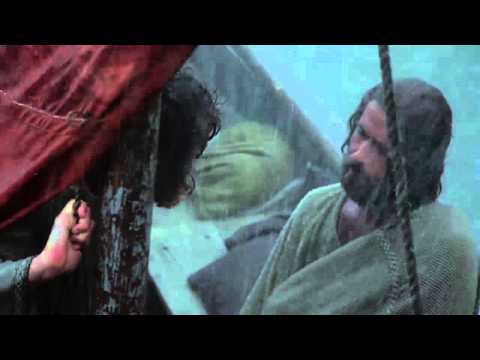
JESUS CALMS THE STORM (1:58) – This docudrama on the life of Jesus Christ is based on the Gospel of Luke. The Jesus film has been translated into more than 2,000 languages since its 1979 release. It remains the most translated and viewed film in history. To watch the full movie, click here!

Sunday
Lectionary
Connections

Using AI to Generate Connections for Sunday Preaching and Pastoral Counseling

12th Sunday of Year B

Light-Hearted Inspiration

FIRST READING: GOD'S GOT YOUR BOAT

Jb 38:1, 8-11

Ever feel like your life is a bit chaotic, like an ocean in the middle of a storm? Job 38:1, 8-11 reminds us that even when things are wild and unpredictable, God's got the reins. He's like the ultimate wave-tamer, and he’s on our side!

So when the storms of life start swirling around you, remember this: God's got your boat, and He knows exactly where you need to go. Let Him guide you, trust in His power, and just enjoy the ride. Who knows, you might even learn to surf those waves with a smile on your face!

Trust God's plan, embrace the adventure, and don't forget to pack your spiritual sunscreen—that's faith, hope, and love (and maybe a sense of humor, too)!

SECOND READING: A PAIR OF JEANS

2 Cor 5:14-17

Imagine this: You’re a pair of jeans. You’ve been worn for years, and you’ve got stains, rips, and maybe even some holes. But guess what? God is the ultimate fashion designer. He sees your potential and turns you into a dazzling, tailor-made outfit, designed specifically for His glory.

That’s what 2 Corinthians 5:14-17 is all about! It’s a divine makeover—out with the old, in with the new. And it’s all because of Christ’s love and sacrifice.

So go ahead, strut your new creation outfit on the runway of life. It might not always be easy, but with God’s guidance, you’ll shine bright and make a difference in the world.

GOSPEL: FISHERMEN COMEDIANS

Mk 4:35-41

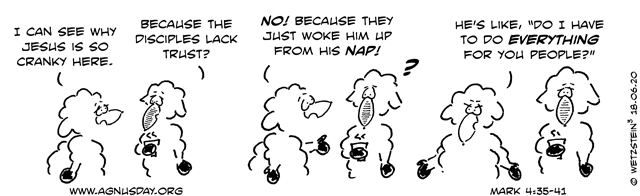
When Jesus calmed the storm on the Sea of Galilee, the disciples were completely awestruck. One of them turned to another and said, "I knew he was good with the bread and fish, but this is off the scales!"

Another disciple chimed in, "Well, he's really made quite a splash now, hasn't he?"

After a moment of silence, a third disciple added, "Guys, I think it's time to update our job descriptions—'fishermen' just doesn't cut it anymore!"

James Wetzstein
Valparaiso University

Sunday
Lectionary
Connections

Using AI to Generate Connections for Sunday Preaching and Pastoral Counseling

12th Sunday of Year B

Catholic Prayers

FIRST READING: LORD, STILLER OF THE STORM

Loving Father, in Job 38:1, 8-11 we are reminded of Your mighty power over the seas and skies, and that even the most turbulent storms obey Your command.

In the moments when the winds of life blow fiercely and the waves crash down upon us, help us, O Lord, to fix our gaze upon You, our guiding star.

Grant us the grace to embrace these storms as opportunities for growth, trusting that You are always with us.

Bless us with the serenity to accept the things we cannot change, the courage to change the things we can, and the wisdom to know the difference.

Through the intercession of our Blessed Mother, Mary, Star of the Sea, may we navigate the tides of life and find refuge in the harbor of Your loving embrace.

We ask this through Christ our Lord.

Amen.

SECOND READING: TRANSFORMING LOVE

Loving Father, we thank You for the gift of transformation through Your Son, Jesus Christ.

As we reflect on 2 Corinthians 5:14-17, we recognize that we are no longer bound by our old selves but are made new through Your boundless love and mercy.

May Your Spirit guide us to live in this newness, acting as ambassadors of reconciliation in a world that so desperately needs Your healing touch.

Through the intercession of St. Paul, the apostle who reminded us of Your redeeming love, may we embrace the call to see others through Your eyes—loving unconditionally, forgiving wholeheartedly, and rejoicing in the knowledge that we are all one in Christ.

May our transformed lives be a testament to Your never-ending love.

We ask this through Christ our Lord.

Amen.

GOSPEL: CALM IN THE STORM

O Most Loving Father,

We come to You in prayer, reflecting on the storm at sea as recounted in Mark 4:35-41. We are reminded of the power of faith in moments of distress.

Just as the disciples cried out to Your Son in fear, we too find ourselves seeking refuge from the storms that ravage our lives. Grant us the strength to persevere through these trials.

Help us, like the disciples, to turn to You in times of fear and doubt, trusting in Your ability to calm the seas and provide us with peace.

Amen.

Ann Osdieck

Poetry read
by ARIA
an auto
generated
LLM voice

12th Sunday of Year B

Gospel Prayer Poem

Then he asked them, “Why are you terrified?
Do you not have faith?”

Mark 4:35-41

Raging waves of discord break all around us
and squalls whine through our lives.
We call, out of sinking boats,
“We are going down!
Jesus, save
  us!”
O
calm
our storms.
“Quiet! Be still,”
we long to hear you say!
Give us faith to know that in
sunny days or climate crisis, wars,
or homelessness, or housed and fed well,
you never leave our boats. Make our life holy,
Lord of wind and sea.

MORE PRAYER POEMS

Copyright © 2024, Anne M. Osdieck. All rights reserved. Permission is hereby granted to reproduce for personal or parish use.

SOURCE: Sunday Website