Deacon’s Digest, FREE resource bulletin
Deacon’s Digest, FREE resource bulletin
November 30, 2025
November 30, 2025
First Sunday of Advent (Year A)


The Sentinel’s Service
1st Sunday of Advent (A)
Advent begins not with a gentle lullaby, but with a jolt. Jesus urges us to “stay awake,” not in a state of anxious fear, but in a spirit of alert and hopeful preparation. He points to the days of Noah, not to condemn the people for their sinfulness, but to highlight their spiritual slumber. They were “eating and drinking, marrying and giving in marriage”—they were consumed by the ordinary, and in their absorption, they missed the extraordinary. They were not watching.
The deacon’s ministry is, in its essence, a ministry of this very watchfulness. By his ordination, the deacon is configured to Christ the Servant, the one who is “in your midst as one who serves” (Luke 22:27). This service demands a profound spiritual attentiveness. The deacon is called to stand at the threshold, at the “door of the Church and the world,” and to be the parish’s sentinel, attentive to Christ’s threefold coming: in history, in mystery, and in majesty.
Reflection continues below the infographic
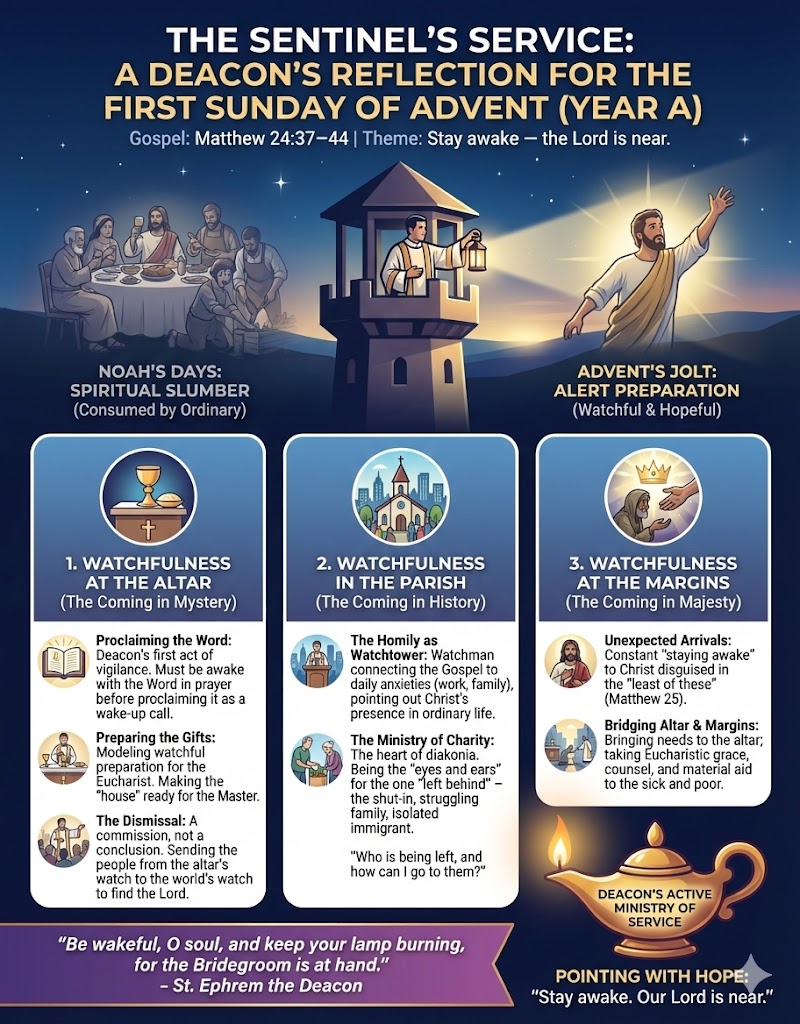
Watchfulness at the Altar
The Coming in Mystery
In the liturgy, the deacon’s role is uniquely positioned at this “door.” He stands at the threshold between the sanctuary and the nave, connecting the action at the altar with the life of the people.
• Proclaiming the Word: It is the deacon who, by ancient tradition, proclaims the Gospel. This is his first act of vigilance. He must first “stay awake” with the Word in his own prayer before he can proclaim it as a wake-up call to the assembly.
• Preparing the Gifts: When the deacon prepares the altar, he is modeling the “watchful” preparation for the Lord’s coming in the Eucharist. He is making the “house” ready for the Master. Each step of this sacred ritual mirrors the diligent care one would take in preparing their home for a highly anticipated and cherished guest. The chalice, the paten, the linens—each piece serves as a tangible reminder of the sacredness of the Eucharistic celebration.
• The Dismissal: His final liturgical act is the dismissal: “Go in peace, glorifying the Lord by your life.” This is not a conclusion; it is a commission. It is the sentinel sending the people out from their watch at the altar to their watch in the world, charging them to find the Lord they just received.
Watchfulness in the Parish
The Coming in History
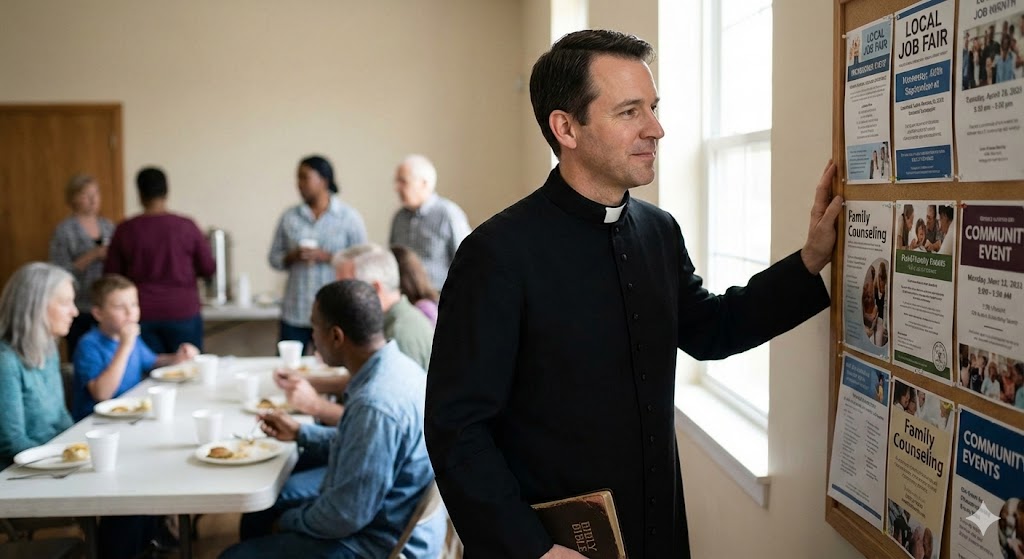
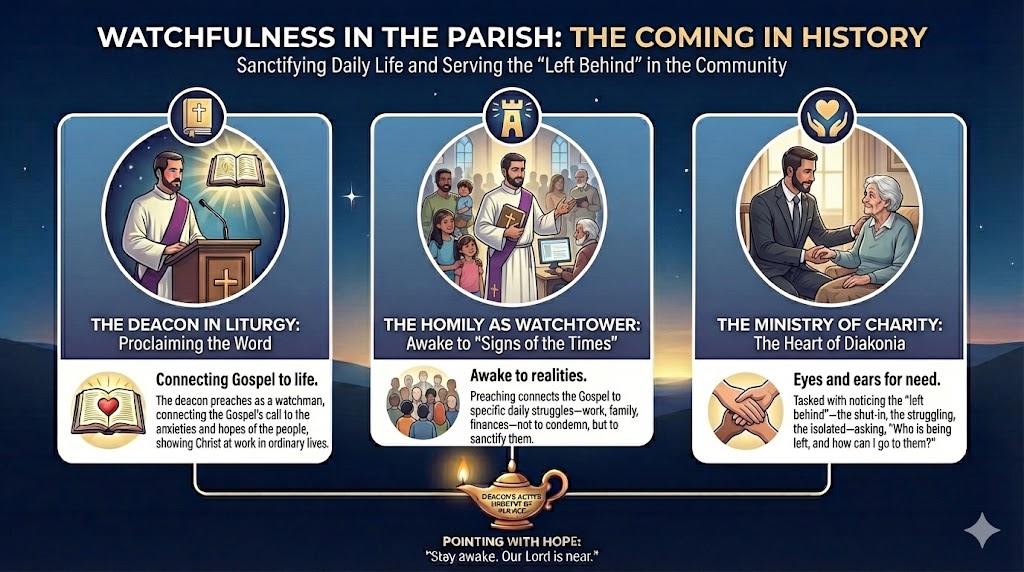
The “days of Noah” are our days. The parish is filled with people rightly absorbed in the “eating and drinking” of daily life: work deadlines, school runs, mortgage payments, and family struggles. The deacon’s ministry is to be awake to these realities, not to condemn them, but to sanctify them.
• The Homily as Watchtower: When the deacon preaches, he is the watchman on the tower. He must be awake to the “signs of the times” within his own community. His preaching must connect the Gospel’s call to the specific anxieties and hopes of his people, pointing out where Christ is already at work in their ordinary lives.
• The Ministry of Charity: This is the heart of diakonia. The deacon must be the parish’s “eyes and ears” for need. While the people are busy with their lives, the deacon is tasked with noticing the shut-in who hasn’t been seen in weeks, the family struggling after a job loss, the new immigrant feeling isolated, the caregiver at the point of burnout. The Gospel’s “one will be taken, one will be left” is, for the deacon, a call to active charity: “Who is being left, and how can I, on behalf of this parish, go to them?”
Watchfulness at the Margins
The Coming in Majesty
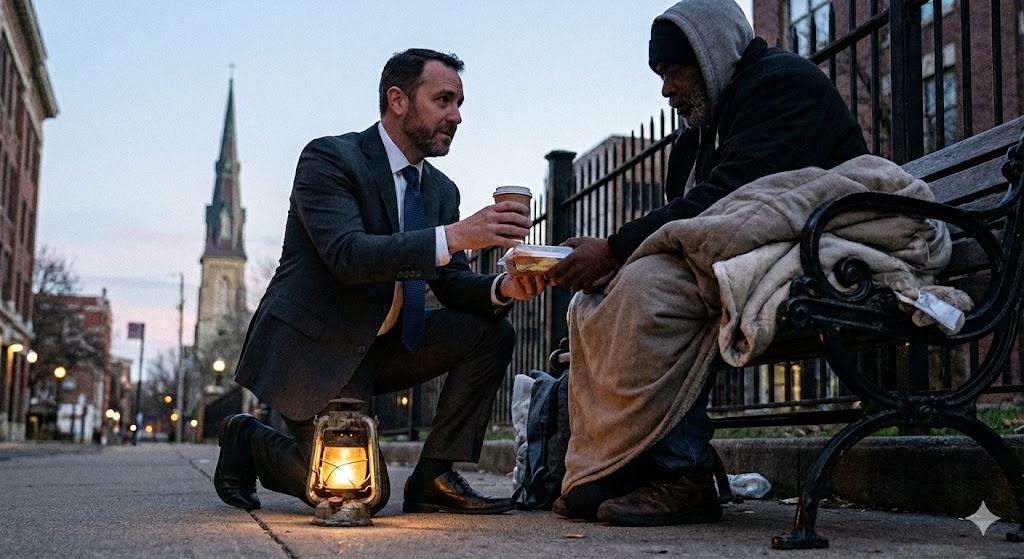
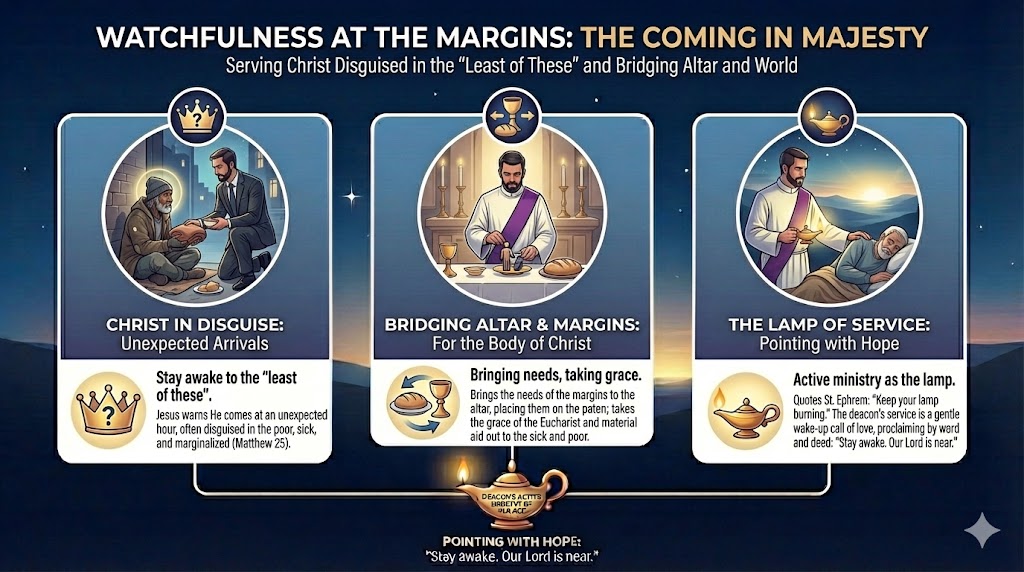
Jesus warns that the Son of Man will come at an “hour you do not expect.” He often comes disguised. The deacon’s service is a constant “staying awake” to the unexpected arrivals of Christ in the “least of these” (Matthew 25).
His watchfulness is not for his own sake, but for the sake of the Body of Christ. He brings the needs of the margins to the altar, placing them upon the paten with the bread. And he takes the grace of the altar out to the margins, bringing the Eucharist to the sick, counsel to the troubled, and material aid to the poor.
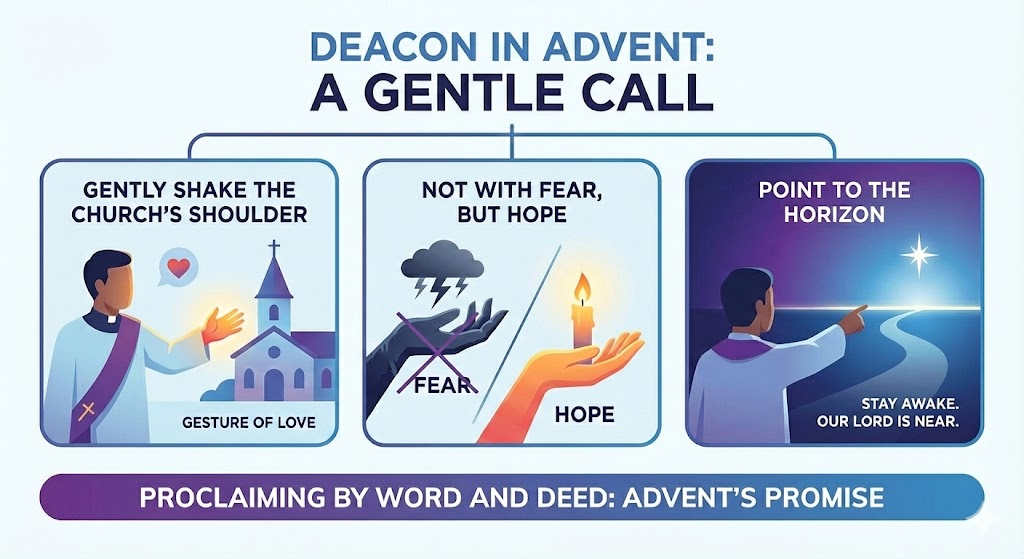
As St. Ephrem the Deacon wrote, “Be wakeful, O soul, and keep your lamp burning, for the Bridegroom is at hand.” For the deacon, that “lamp” is his active ministry of service. To serve as a deacon in Advent is to gently shake the Church’s shoulder, not with a word of fear, but with a gesture of love, and to point with hope to the horizon, proclaiming by word and deed: “Stay awake. Our Lord is near.”
SECTION ONE: The Altar

The Text & Scripture Connection
From the Text: “The deacon’s role is uniquely positioned at this ‘door.’ He stands at the threshold between the sanctuary and the nave… Proclaiming the Word… Preparing the Gifts… The Dismissal.”
- Isaiah 2:3: “Come, let us climb the Lord’s mountain, to the house of the God of Jacob, that he may instruct us in his ways, and we may walk in his paths.”
- Romans 13:12: “The night is advanced, the day is at hand. Let us then throw off the works of darkness and put on the armor of light.”
Deep Dive: The Liturgical Sentinel
The text describes the liturgy as the training ground for the Deacon’s watchfulness.
- Proclamation as Armor: Before reading the Gospel, the Deacon asks for a blessing to proclaim largely. In Romans, Paul speaks of the “armor of light.” The Gospel Book is that armor. The Deacon must read the news of the world (darkness) all week, but on Sunday, he puts on the “light” to wake the people up.
- Preparation as Housekeeping: Preparing the altar is linked to the “Master of the House” returning. It is an act of domestic anticipation.
- Dismissal as Commission: The text calls the dismissal a “charge.” It relates to Isaiah’s command to “walk in the light of the Lord” after leaving the mountain.
Contemporary Examples for Discussion
- The Distracted Lector vs. The Watchful Deacon: In a world of TikTok attention spans, we often listen to scripture while thinking about lunch.
- Example: How does the Deacon’s physical posture during the Gospel procession signal, “Stop scrolling, something life-altering is about to happen”?
- The “Go in Peace” Reality Check:
- Example: Imagine a parishioner who is dreading a Monday morning meeting with a hostile boss. How does the Deacon’s dismissal change from a “Have a nice day” into a strategic command: “Go into that hostile meeting and bring Christ’s peace there”?
Discussion Questions
- The text says the Deacon must “stay awake with the Word” in private prayer before proclaiming it publicly. What are the practical obstacles to this in a busy clergyman’s life?
- For the Laity: If the Deacon is the “door” connecting the altar to the nave, do you feel that connection? How can the Deacon make the “Preparation of the Gifts” feel more like preparing a wedding feast and less like setting a dinner table?
SECTION TWO: The Parish
The Text & Scripture Connection
From the Text: “The ‘days of Noah’ are our days… The deacon’s ministry is to be awake to these realities, not to condemn them, but to sanctify them… The Homily as Watchtower… The Ministry of Charity.”
- Matthew 24:37-38: “For as it was in the days of Noah, so it will be at the coming of the Son of Man. In those days… they were eating and drinking, marrying and giving in marriage…”
Deep Dive: Sanctifying the “Days of Noah”
Jesus creates a stark image in Matthew 24: people are so absorbed in the routine that they miss the reality. The text argues that the Deacon doesn’t tell people to stop living (eating, working, marrying), but to be awake within those activities.
The “One Taken, One Left” is reinterpreted here not as a rapture event, but as a Charity Audit. Who has been left behind by the economy, by society, or by the parish community?
Contemporary Examples for Discussion
- Modern “Eating and Drinking”:
- Example: The “Days of Noah” today look like families drowning in travel sports schedules, parents working two “gig economy” jobs to pay rent, or the obsession with 24-hour news cycles.
- The Deacon’s Role: He doesn’t preach, “Sports are bad.” He preaches, “Where is God in the bleachers? Are you witnessing to the other parents, or just complaining about the referee?”
- The “Left Behind” in the Digital Age:
- Example: The shut-in who doesn’t have a smartphone and can’t access the parish livestream. They have been “left behind” by technology. The Deacon is the one who notices they haven’t been seen and physically goes to them.
- Example: The young adult facing burnout and “quiet quitting.” They are physically present at Mass but spiritually “left behind” in despair.
Discussion Questions
- The text calls the homily a “Watchtower.” How is this different from a homily that is a “Lecture”? What specific “signs of the times” in your local neighborhood (not global politics, but local reality) need to be addressed from the pulpit?
- The Charity Audit: In your specific parish, who is the “one left behind” right now? Is it the elderly? The new immigrant populations? The divorced? How does the Deacon identify them?
SECTION THREE: The Margins
The Text & Scripture Connection
From the Text: “The Son of Man will come at an ‘hour you do not expect.’ He often comes disguised… The deacon’s service is a constant ‘staying awake’ to the unexpected arrivals of Christ in the ‘least of these’…”
- Matthew 24:44: “So too, you also must be prepared, for at an hour you do not expect, the Son of Man will come.”
- Romans 13:11: “It is the hour now for you to awake from sleep.”
Deep Dive: The Paten and the Pavement
The text offers a profound image: The Deacon brings the needs of the margins to the paten (at the altar) and takes the grace of the altar to the margins. This completes the cycle of Romans 13—throwing off darkness (needs/suffering) and putting on the armor of light (Eucharist/Grace).
St. Ephrem is quoted regarding the “Lamp.” In Matthew 25 (The Ten Virgins), the lamp requires oil. For the Deacon, the oil is service. Without active service to the poor, the Deacon’s lamp goes out, and he cannot signal the Bridegroom’s arrival.
Contemporary Examples for Discussion
- The Disguised Christ:
- Example: The “thief in the night” isn’t always a catastrophe; sometimes it’s an inconvenience. It’s the person who stops the Deacon in the grocery store asking for money when the Deacon is in a rush.
- The Watchful Response: The sleeping Christian sees a nuisance. The watchful Deacon sees an “unexpected arrival of Christ.”
- Shaking the Shoulder:
- Example: The text says the Deacon “gently shakes the Church’s shoulder.”
- Application: When a parish becomes too comfortable, focusing only on internal politics or beautification, the Deacon brings in the reality of the local homeless shelter or the crisis pregnancy center. He “shakes” the finance council awake to the reality of the poor.
Discussion Questions
- The text says the Deacon “takes the grace of the altar out to the margins.” What is the specific “grace” your community needs right now? Is it hope? Material food? Companionship?
- Personal Reflection: Romans 13 warns against “rivalry and jealousy.” How does focusing on the “least of these” (the margins) help cure a parish of internal rivalry and jealousy?
Closing Activity: The Sentinel’s Prayer
Leader: Let us close by reflecting on the “Commission” mentioned in the text.
All: Lord Jesus, You have told us to stay awake, for we do not know the day or the hour. Grant your Deacons, and all of us who serve, the grace of the Sentinel. May we be alert at the Altar, reverent before the Mystery. May we be alert in the Parish, recognizing the anxieties of your people. May we be alert at the Margins, finding You in the disguise of the poor. Help us to put on the armor of light, that we may wake the world with the joy of Your coming. Amen.
Action Item: This week, identify one person who has been “left behind” in your circle (socially, familiarly, or economically) and make one concrete gesture to bring them back into the fold.
Infographics on the WORD THIS WEEK website are created using Nano Banana Pro with Gemini 3.0. They may be copied for personal use or for use in any non-profit ministry. Please show your support by promoting the website. AI generated infographics may contain typos. Deacon Peter actively fulfills his vocation in the Diocese of Broken Bay, Australia, contributing to the spiritual well-being of his parish. His homilies are posted each week in the TWTW homily section.