


Fr. Tony Kadavil is a retired Catholic priest and popular online homilist known for his scriptural reflections and pastoral ministry. His homilies open with an anecdote. He then connects it to the Sunday readings. He concludes with a practical takeaway message.
RELATED
PAGES



VIDEO (14:35) – For the first time in 70 years, archaeologists have uncovered new areas of ancient Pompeii. With exclusive access to the dig, see how the latest artifacts and DNA science are changing history and discover the real stories of what happened to the unfortunate souls who didn’t escape the city gates.
33rd Sunday of Year A
The Buried Thief of Pompeii: Caught in the Ash
In 79 AD, the volcano Vesuvius, which rises just off the Bay of Naples, Italy, erupted violently and totally destroyed Pompeii, a city of 20,000 population. Much of the city was excavated in the nineteenth century, but archeologists are still uncovering certain neighborhoods. Sometimes the volcanic ash simply buried victims alive. Their bones have long since turned to dust, but the ash in many cases formed a firm mold around them at the moment of death; and by filling the mold with plaster, the excavators can obtain perfect images of those who died in the anguish of the disaster. In 1949 the archeologists reproduced a startling cast of one of the Pompeian victims. He lay face-down as if death had taken him completely unawares. In one hand was a small crowbar. In the other, clasped tight in his fist, were several gold coins. To all appearances he was a thief who had taken advantage of the confusion of others to break into a building and rob the owner.
This haunting image gives urgent weight to Saint Paul’s warning: “You are not in the dark, brothers, that the day should catch you off guard, like a thief” (1 Thessalonians 5:4). The tragedy of the Pompeian plunderer was not merely that death arrived suddenly, but that his heart was asleep to eternal realities. He was captivated by darkness, betting his life on material gain while the mountain trembled above him.
For the Christian, spiritual vigilance is the exact opposite of that thief’s posture. While the world scrambles in panic or clings desperately to fading treasures, believers are called to walk as children of the light. We do not place our confidence in gold that tarnishes or walls that crumble. Instead, we live awake, investing our time, our energy, and our God-given gifts into the Kingdom of God. When the Day of the Lord arrives—unexpected and decisive—it will not overtake the faithful like a thief in the night, because their hands will not be clenched around worldly dust, but open in faithful service to the Master.

VIDEO (3:48) – Ivan Lester McGuire Skydiving Accident – Forgotten Parachute
33rd Sunday of Year A
When God Calls Us
Past the Margins
Every great map in human history ends at a boundary—a blank edge where certainty gives way to the unknown, where ancient cartographers once warned, “Here be monsters.” We find comfort inside the margins. The drawn lines represent predictability, safety, and control. Yet the story of the Gospel, like the story of human exploration, is not forged by remaining within well-charted borders.
When Columbus set sail, his calculations were profoundly flawed. Magellan embarked on his voyage with charts that failed to grasp the vast emptiness of the Pacific. Lewis and Clark pushed westward toward a mythical Northwest Passage, armed with geographic assumptions that dissolved the moment they confronted the Rockies. Every one of them stepped off the edge of flawed, inadequate maps. They were easily dismissed as reckless fools by those who preferred the shelter of the harbor. Yet by willingly plunging past the known margins, they redrew the contours of the earth.
All these explorers had at least one thing in common. They accepted the risks, plunged into unknown territories and changed the world. It is precisely because of their risk-taking that the map of the planet was re-drawn and the dreams of future generations were re-shaped. Those without the vision, without the courage to take risks, are quick to label others as crazy, crackpots, fools and failures.
In the Parable of the Talents, Jesus issues a piercing challenge to our instinct for self-preservation. The third servant did not fail because he lacked resources; he failed because he refused to step outside his comfort zone. Paralyzed by fear and an obsessive need for safety, he buried the treasure in familiar dirt. He treated the Master’s gift as a liability to protect rather than a mission to venture.
Discipleship was never meant to be a safe custody arrangement. Grace is not an heirloom to be preserved in bubble wrap; it is holy capital meant to be risked for the Kingdom. The Master does not condemn the third servant for bad investments, but for a refusal to invest at all—for mistaking safe paralysis for faithfulness.
When God calls us past the margins, our own human understanding will always feel incomplete. We never have all the data, the path ahead is rarely paved, and the world will inevitably label such radical generosity and trust as foolish. Yet true Christian courage is not the absence of uncertainty; it is the holy audacity to set sail anyway, anchored not in our flawed charts, but in the faithful Providence of the Master who bids us go.

VIDEO (4:44) – From getting struck by lightning or meteorite, to getting into a car or plane crash, we shall dive into the infrequently talked about topics and compare the chances of dying from these unfortunate events.
33rd Sunday of Year A
Safety for an Hour, Life for Eternity
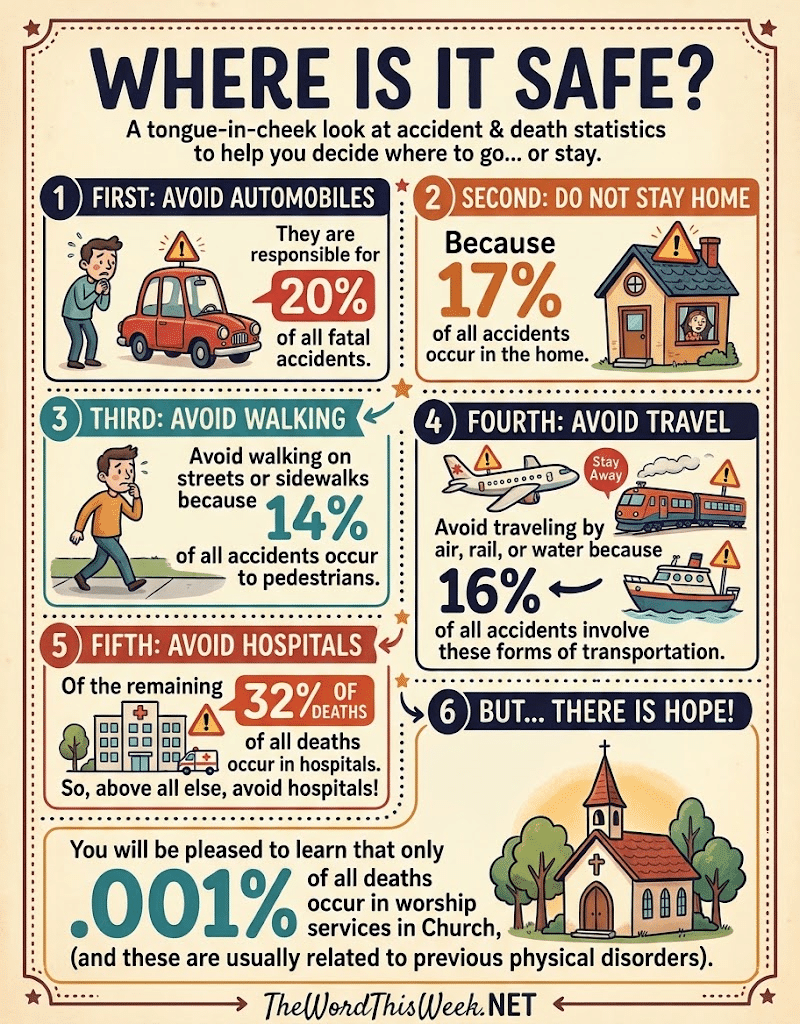
While the statistics bring an easy smile, the underlying truth hits far deeper than a piece of pulpit humor. We spend our entire lives managing earthly risk—buckling seatbelts, buying insurance policies, installing home security, and fretting over mortality tables. Yet in our relentless drive to protect the fragile shell of mortal life, it is remarkably easy to neglect the soul.
Sitting in a church pew or opening the Scriptures may keep us safe from road hazards and hospital corridors for an hour, but Christ does not summon us into the sanctuary simply to dodge physical statistics. He gathers us to anchor us in eternal reality. The world can preserve our health for a season, but only the Gospel preserves our soul forever. When Scripture speaks of life and death, it looks past the actuarial tables straight into eternity: “Do not fear those who kill the body but cannot kill the soul” (Mt 10:28).
Gathering for worship and steeping ourselves in the Word does far more than lower our earthly risk profile. It dismantles the illusion that true security comes from self-preservation. In the end, reading your Bible and gathering around the altar truly will save your life—not merely by keeping you safely off the highway on a Sunday morning, but by rooting your heart in the one sanctuary that outlasts the grave: the unfailing mercy and grace of God.
More Anecdotes
Using One’s Talents
Booker T. Washington started life as a slave. At the age of sixteen, he walked almost five hundred miles from his slave home to Hampton Institute in Virginia. When he got there, he was told that classes were already filled. But that didn’t stop him.
He took a job at the school doing menial jobs: sweeping floors and making beds and anything they wanted just so he could be around the environment of learning. He did these jobs so well that the faculty found room for him as a student.
He worked his way up at the school and became a famous teacher, the first black faculty member at Hampton Institute. He became a writer and the author of Up from Slavery. He was a popular public speaker, and he eventually founded Tuskegee Institute in Alabama, where he brought George Washington Carver to teach and do all his research which changed and improved farming techniques.
Booker T. Washington made the effort to use his God-given talents, and we all gained from it.
Buried Talent
Niccolò Paganini (1782–1840) was an Italian violinist, violist, guitarist, and composer. He was one of the most celebrated violin virtuosi of his time, and left his mark as one of the pillars of modern violin technique. His Caprice No. 24 in A minor, Op. 1, is among the best known of his compositions, and has served as an inspiration for many prominent composers.
Yet he willed his violin to the city of his birth, Genoa, Italy, with the condition that the violin never again be played.
What a pity! The absence of use and handling resulted in the decay of the wood used in the instrument. A violin that is constantly used can be preserved and, in some cases, even grow richer in tone for hundreds of years. Paganini’s wish had resulted in the crumbling of his precious violin in its case.
“If Only I Had Her Looks”
There is a story of a thirty-eight-year-old scrubwoman who would go to the movies and sigh, “If only I had her looks.” She would listen to a singer and moan, “If only I had her voice.”
Then one day someone gave her a copy of the book, The Magic of Believing. She stopped comparing herself with actresses and singers. She stopped crying about what she didn’t have and started concentrating on what she did have. She took inventory of herself and remembered that in high school she had had a reputation for being the funniest girl around. She began to turn her liabilities into assets.
When she was at the top of her career, Phyllis Diller made over $1 million a year. In the 1960s that was a great deal of money. She wasn’t good-looking and she had a scratchy voice, but she could make people laugh.
Maybe God is saying something like that to us through today’s parable of the talents. Maybe when we complain that we wish we had more—if only we were like someone other than ourselves, if only—He says to us: “Use the gifts I have given you! Stop crying about what you do not have and start concentrating on what you do have. Use the gifts that God has given you.”
“Where Is the Piccolo?”
Sir Michael Costa, the celebrated conductor of the 19th century, was holding a rehearsal. As the mighty chorus rang out accompanied by scores of instruments, the musician playing the piccolo—a little pint-sized flute—thinking perhaps that his contribution would not be missed amid so much music, stopped playing.
Suddenly, the great leader stopped and cried out, “Where is the piccolo?”
The sound of that one small instrument was necessary to the harmony, and the Master Conductor missed it when it dropped out.
To the Conductor there are no insignificant instruments in an orchestra. Sometimes the smallest and seemingly least important one can make the greatest contribution, even if it doesn’t seem to make that big a difference.
Like the piccolo player in Sir Michael’s orchestra, we often in our own sovereignty decide that our contribution is not significant. But the Conductor immediately notices. From our perspective, our contribution may be small, but from His, it is crucial. For all piccolos who won’t play, or at least aren’t playing, Jesus has something to say: “Use the gifts that God has given you.”
“Do You Want a Chance to Change the World?”
Steve Jobs is the man who founded the enormously successful company called Apple Computer. Jobs decided that Mr. John Sculley was the man he needed to help him fulfill his dream of building a completely different kind of computer company, one which would make computers available to every person in the world.
However, Mr. Sculley was comfortably and safely entrenched as president of the PepsiCo Corporation, the makers of the soft drink Pepsi. In this position, John Sculley had obtained everything that a man could want: power, prestige, public recognition, an enormous salary, and a secure future.
The thought of a career change requiring a move to the West Coast frightened him. He was concerned about losing pensions and deferred compensation and the adjustment to living in California—in other words, “the pragmatic stuff that preoccupies the middle-aged.” He says, “I was overly concerned with what would happen next week and the week after next.”
John Sculley knew that he was safe and happy at PepsiCo. But he also knew that he had grown to dislike the competitive nature of the business. He also knew how bored he was.
Steve Jobs at Apple Computer sensed this. And so, he finally confronted his new friend with this pointed question. He said to John, “Do you want to spend the rest of your life selling sugared water or do you want a chance to change the world?”
That question penetrated deep into the heart and mind of John Sculley. It changed the course of his life. He therefore went to Apple Computer and helped it to grow into one of the most successful corporations in the world. Mr. Sculley’s life was changed because he took the risk and decided to invest in himself and others, and to grow. [John Sculley, Odyssey (New York: Harper & Row, 1987), p. 90.]
Talents: Use Them or Lose Them
There was an American businessman by the name of Wilson. He was tired of the Great Depression, rising taxes, and increasing crime, and in 1940 he sold his home and business and moved to an island in the South Pacific to get away from it all. Balmy and ringed with beautiful beaches, it was a paradise. Sounds like the perfect setting, doesn’t it?
You know the name of the island? Iwo Jima!
For those too young to recall, Iwo Jima was an island where the fiercest fighting between American forces and the Japanese took place in the Second World War.
There is no escape from living: you have to use your talent or lose it.
“What We Are About Is Faithfulness”
Back in the 1940s Clarence Jordan founded a farm in Americus, Georgia, and called it Koinonia Farm. Koinonia was a community of poor whites and blacks who cooperated in earning a living.
The integrated status of the community bothered many local citizens. They tried everything possible to wreck Koinonia. They boycotted its farm products, and slashed the workers’ tires when they came to town.
Finally, in 1954, the Ku Klux Klan decided to get rid of Koinonia Farm. One night they came and burned every building except Dr. Jordan’s home. They chased off all of the families except for the Jordans and one black family.
The next day a local newspaper reporter came to the farm to see what remained. The rubble was still smoldering. But Clarence Jordan was busy planting and hoeing.
With a haughty spirit, the reporter said to Dr. Jordan, “Well, you got two of those PhDs and you’ve put fourteen years into this farm, and there’s nothing left to show for it. Just how successful do you think you’ve been?”
Clarence stopped hoeing, turned toward the reporter with his penetrating eyes, and said quietly but firmly, “Sir, I don’t think you understand us Christians. What we are about is not success; what we are about is faithfulness.”
In order to be faithful, we must be willing to take risks for that One who dared to march into the very jaws of Hell for us.
Earl Fitz Was a Doer
According to an article in Christianity Today, Earl Fitz is 81 years young and he has been the mayor of Iowa Falls, Iowa four times. But that’s the easy part.
In Earl’s mid-fifties he left his teaching job and began a new career selling Bibles. Earl bought 10,000 Bibles from a publisher getting out of Bible sales and sold them all. Today, Earl is the founder and president of Riverside Book and Bible House, which sold $33 million worth of books last year. He has succeeded with a lot of hard work and a commitment to get Bibles into the homes of America.
Earl began a new career when most are preparing for retirement. He wasn’t ready to buy into that classic American line, “I’ve done my time, I owe myself some easy livin’.” And he’s going strong nearly thirty years later. [Christianity Today (August 17, 1987), p. 14ff.]
I believe Jesus loves the Earl Fitzes of this world. That is the lesson of the parable of the talents.
LVA: The Result of Using One’s Talents
Ruth Colvin was shocked at her hometown’s illiteracy rate. So, she decided that God would have her do something about it.
“I felt strongly motivated by the Parable of the Talents,” she says. “We’re responsible for making good use of the knowledge we’re given.”
So Ruth, a teacher, set up a makeshift office in her suburban basement, filing important matters in an old refrigerator, and launched Literacy Volunteers of America in 1962.
Today, LVA has helped 90,000 people learn to read thanks to a grandmotherly woman who saw a need and put her talents to work meeting it. [Today’s Christian Woman (January/February 1987), p. 23.] Life is a gift. We live in a wonderful world of opportunity.
Use the Gift of Your Vote
One voter in each precinct in the United States can determine the next President of the United States.
In 1948 just one additional vote in each precinct would have elected Thomas Dewey as President. In 1960 one vote in each precinct in Illinois would have elected Richard Nixon as President.
Thomas Jefferson was elected President by one vote in the Electoral College. So was John Quincy Adams. Rutherford B. Hayes was elected President by one vote. One vote gave statehood to California, Idaho, Oregon, Texas, and Washington. The Draft Act of World War II passed the House by one vote.
Your one vote is important, and a spiritual gift is just like a vote. You either use it or you lose it.
One-Note Opera
Charles L. Allen once told about a composer named Gioachino Rossini who would go out to small villages in Italy that could not afford an opera, and he would write an opera which the people of that village could perform.
One summer, he auditioned all of the talent in a small village, and the only woman who could possibly be a leading lady was limited to only one good note. It was a middle B-flat.
Rossini was not discouraged; he went right ahead and wrote an opera in which the leading lady had only that one note to sing. But he surrounded that middle B-flat with such beautiful harmony that when she sang her one note, it was like an angel from heaven.
That is what happens when we offer our meager gifts to God.
“But the Recruiting Office Is on the Other Side of the Street!”
The French Army was having a campaign to recruit paratroopers. On one of the busiest streets in Paris they placed their poster. It read like this:
“Young Men! Join the parachutist forces of France. It is more dangerous to cross this street than to jump with a parachute.”
The poster was a great success until someone scribbled this message at the bottom:
“I would gladly join, but the recruiting office is on the other side of the street!” [Eric W. Johnson, A Treasury of Humor (New York: Ivy Books, 1994), p. 187.]
I doubt that many potential parachutists were deterred by having to cross the street, but there are also many people who would never parachute no matter how safe it was. The very idea turns their knees to jelly. They don’t want to take any risk in life, just like the lazy servant in Jesus’ parable.
“Do You Like the House?”
J. Wallace Hamilton, in his book What About Tomorrow?, tells the story of a wealthy builder. He called in his top assistant manager and said, “I am going away for a while. While I am gone, I want you to oversee the building of my home. I am going to be retiring in a few years, I have these wonderful plans and excellent parcels of land by the lake, and I want you to oversee the building of our home.”
As the owner left on his journey, the assistant said to himself, “He lives in luxury and has done very little for me. When he retires, what will I have?”
So the assistant used every opportunity to feather his own nest. He hired an untrustworthy builder, used inferior products, and hired cut-rate workmen. When the house was completed, it looked fine on the outside, but its deficiencies in workmanship and materials would soon show as the test of time came. It was not a job “well done.”
When the wealthy builder came back, he said, “Do you like the house?”
The assistant manager replied, “Yes, I do.”
The wealthy builder then asked, “Is this house beautiful?”
“It certainly is,” the assistant manager replied.
“Great,” said the wealthy builder, “because it is my gift to you. The house is yours.”
Each of us lives in the house we are building each day. Where are you in this story tonight?
“If You Are Lonely or Have a Problem, Call Me”
Tony Campolo told of meeting a woman who is confined to a wheelchair. Although Nancy had a physical disability, she developed a unique ministry to people who are lonely and hurting.
Nancy ran ads in the personals section of the newspaper that read: “If you are lonely or have a problem call me. I am in a wheelchair and seldom get out. We can share our problems with each other. Just call. I’d love to talk.”
From that simple ad, the results were truly amazing. Nancy received at least thirty calls each week from persons who needed someone to talk to and listen to their pain. She spent most of her day comforting and counseling people, becoming someone for hundreds of hurting individuals to lean on.
Campolo asked her how she became paralyzed. Nancy’s answer surprised, even shocked him.
“By trying to commit suicide,” she said. “I was living alone. I had no friends. I hated my job, and I was constantly depressed.”
Nancy had decided to jump from the window of her apartment to end it all. Instead of being killed, she ended up in the hospital paralyzed from the waist down.
While she was in the hospital, Nancy said, “Jesus appeared to me and told me that I’d had a healthy body and a crippled soul, but from then on I would have a crippled body and a healthy soul. I gave my life to Christ right there and then. When I got out of the hospital, I tried to think of how a woman like me in a wheelchair could do some good, and I came up with the idea of putting the ad in the newspaper.” [Wake Up America! Tony Campolo (San Francisco: HarperSanFrancisco, 1991), pp. 87-88.]
Nancy did not have some of the opportunities you and I have, but she made maximum use of the opportunities she did have. She is among the blessed of this world. Today’s Gospel challenges us to show gratitude to God by making use of the talents which God has given to us.
There Are Actually Seven Forms of Intelligence
There is a psychologist at Harvard named Howard Gardner who revolutionized the study of intelligence. He noted that we had been studying I.Q. all wrong, measuring only one or two forms of intelligence on standard tests.
Gardner proposed that there are actually multiple intelligences:
- Some people are gifted with linguistic intelligence; these are our writers and poets.
- Others have logical-mathematical intelligence; they make good accountants and scientists.
- Some are gifted spatially; these are our artists and architects.
- Some are gifted kinesthetically, possessing bodies that are unusually graceful and coordinated; these are our athletes and dancers.
- Others are gifted interpersonally, knowing instinctively how to relate to the people around them; these are our counselors, teachers, and communicators.
- Some are gifted intrapersonally in their ability to reflect within; these are our philosophers and wise thinkers.
- Still others are gifted musically.
Here is the important point: Gardner observed that people score high in different configurations across these forms of intelligence. All of us are gifted in our own way, and many of us are gifted in ways we rarely acknowledge.
Many people go through life thinking they lack ability simply because their particular form of intelligence wasn’t prioritized in a conventional classroom. All of us have what we need to succeed, and God has created us differently so that different callings are fulfilled in this world. The real tragedy is when we fail to appreciate and invest the gifts we have been given.
Give It Your Best Shot!
Tom Dempsey was born without a right hand and with only half a right foot. Yet Tom went to school and played football, eventually playing on a junior college team in California where he began placekicking. He became so effective that he was signed by the New Orleans Saints.
On November 8, 1970, the Saints were trailing Detroit 17–16 with only two seconds left on the clock. They had the ball on the Detroit 45-yard line. New Orleans coach J. D. Roberts tapped Tom on the shoulder and said, “Go out there and give it your best shot!”
The holder set the ball down eight yards behind the line of scrimmage instead of seven to give Dempsey a split second more time to get the kick off. That put the ball 63 yards from the uprights.
The rest of the story is history. Tom’s half-foot made solid contact. Dempsey later recalled: “I couldn’t follow the ball that far. But I saw the official’s arms go up, and I can’t describe how great I felt.” The Saints won 19–17, and Dempsey shattered the NFL field-goal record by seven yards.
What does this story have to do with today’s Scripture readings—especially Jesus’ point in the Gospel? (Mark Link S. J., quoted by Fr. Botelho)
Sharing the Best You Have
Mother Teresa of Calcutta was once summoned to court on charges of converting children to the Catholic faith.
When she stood in the dock, the judge asked her if the charges were true. She asked for a baby to be brought to her.
Holding the child in her arms, she said, “This child I picked up from the dustbin; I do not know to what religion this child belongs or what language it speaks. I give this child my love, my time, my care, my food… but the best thing that I have in my life is my faith in Jesus Christ. Can’t I give this child the best I have in my life?”
The case was promptly dismissed in favor of Mother Teresa. (John Rose in John’s Sunday Homilies; quoted by Fr. Botelho)
Wasted Talent
It is rare that someone is simply born an accomplished athlete, writer, or painter, but Paul came very close to being an exception. He was a natural football star. He knew he possessed gifts far beyond the kids around him, and it came as no surprise when, at fifteen, he was signed by a top professional club.
He had only just celebrated his sixteenth birthday when he was selected for the first team. He made an immediate impact, shooting almost overnight from obscurity to national fame. Within two years he was the club’s leading scorer and playing for his country. To the fans he was a hero; to the media, a celebrity. He married a model, drove a luxury car, and had everything a young athlete could dream of.
However, things soon began to unravel. Rumors that he was drinking heavily proved to be well-founded. His play deteriorated, his personal life disintegrated, and his wife left him. Paul’s glittering career came to a premature, tragic end. He was ultimately remembered as much for how he squandered a rare gift as for what he accomplished with it.
It is dangerous when a talent surges overnight without the character to support it. Far better that it should grow quietly and steadily, like a seed maturing into a tree, developing the inner depth and discipline needed to sustain it. (Flor McCarthy in New Sunday and Holy Day Liturgies; quoted by Fr. Botelho)
Staying Awake
In his autobiography, Report to Greco, Nikos Kazantzakis recounts a conversation he once had with an old monk. As a young man visiting a monastery, Kazantzakis was deeply intrigued by a famed ascetic named Father Makarios. Yet the monk’s austere lifestyle stirred mixed emotions—he was attracted to the spiritual romance of it, but repelled by its severe cost.
Kazantzakis asked him: “Yours is a hard life, Father. I too want to be saved. Is there no other way?”
“More agreeable?”
“More human, Father.”
“One, only one,” the monk answered.
“What is that?”
“Ascent. To climb a series of steps. From the full stomach to hunger, from the slaked throat to thirst, from joy to suffering. God sits at the summit of hunger, thirst, and suffering; the devil sits at the summit of the comfortable life. Choose.”
“I am still young,” Kazantzakis replied. “The world is nice. I have time to choose.”
Reaching out, the old monk touched his knee and said: “Wake up, my child. Wake up before death wakes you up.”
Kazantzakis shuddered: “I am still young.”
“Death loves the young,” the old man warned. “Life is like a lighted candle, easily extinguished. Take care—wake up! Wake up before death wakes you up!”
This sense of urgency runs throughout the Gospels. Jesus continually calls us to wake up, to stay vigilant, and to remain alert to eternal reality. (Fr. Ron Rolheiser, Center for Liturgy)
“That Was the Happiest Moment of My Life”
It has been said that our true birthplace is the moment we awaken to our gifts. Often, it takes someone else to recognize what is buried within us. Just as the sun draws fragrant flowers out of the hidden soil, certain people find their calling in unfolding the gifts God has planted in others.
The Russian novelist Fyodor Dostoevsky was only twenty when he wrote his first book, Poor Folk. The foremost literary critic of the era, Vissarion Belinsky, read the young author’s manuscript and told him: “You have a great gift. Take good care of this gift, and you will become a great writer.” Dostoevsky was overwhelmed by the critic’s encouragement, later writing, “That was the happiest moment of my life.”
Belinsky’s affirmation launched Dostoevsky on his life’s work. He spent the rest of his years expressing the depth of that gift through his writing.
One of our deepest human needs is to express what God has placed inside us. When gifts remain undiscovered or buried, life remains unfulfilled. As seen in the Parable of the Talents, cultivating our gifts requires discipline, patience, and courage. The tragedy of the third servant was not a lack of opportunity or a harsh master—it was his own refusal to try. Life is God’s gift to us; what we do with that life is our gift back to God. (Flor McCarthy in New Sunday & Holy Day Liturgies)
“Today You Have Proved to Me That There Is a God in Heaven!”
The legendary violinist Yehudi Menuhin was only seven years old when he performed Mendelssohn’s Violin Concerto in public. By age ten, his recital at London’s Royal Albert Hall was so astonishing that Albert Einstein, who was in attendance, reportedly whispered to the young prodigy: “Today you have proved to me that there is a God in Heaven!”
When we witness a gift developed with such devotion, we catch a glimpse of the Divine—a foretaste of heavenly beauty. God entrusts us with gifts not to keep them hidden, but to reflect His glory and bless the world before our time runs out. (Francis Gonsalves in Sunday Seeds for Daily Deeds)
The Man Who Did Not Bury His Talent
Antonio Stradivari was born in Cremona, Italy, in 1644. Because his voice was high and squeaky, he was rejected by the Cremona Boys’ Choir. When he tried violin lessons, the neighbors complained so bitterly that his parents made him stop. His friends teased him because his only real knack seemed to be carving wood.
Yet Antonio still longed to make music. At twenty-two, he apprenticed himself to the renowned violin maker Niccolò Amati. Under his mentor’s guidance, Antonio’s carving skills flourished into master craftsmanship. By thirty-six, he had opened his own shop.
Working with extraordinary patience and fidelity until his death at age ninety-three, Stradivari crafted over 1,500 violins, each bearing his distinctive label: Antonius Stradivarius Cremonensis Faciebat Anno… Today, they remain the most sought-after instruments in the world.
Antonio could not sing, play, or preach, but he dedicated the one ability he had to the craft of music. His life remains an enduring rebuke to anyone tempted to bury their single talent out of fear or comparison.
“Michelangelo, Talent Is Cheap; Dedication Is Costly!”
Bertoldo di Giovanni is a name few people recognize today, yet he was a pupil of Donatello and the master who trained Michelangelo.
Michelangelo was only fourteen years old when he entered Bertoldo’s studio, but his extraordinary natural gift was immediately obvious. Bertoldo was wise enough to know that prodigies are often tempted to coast on natural ability rather than endure the grueling work of mastery.
One day, Bertoldo walked into the workshop and found Michelangelo casually playing around with a trivial piece of sculpture far beneath his ability. Bertoldo picked up a hammer, marched across the room, and smashed the work into pieces, delivering an unforgettable rebuke: “Michelangelo, talent is cheap; dedication is costly!” (Gary Inrig, A Call to Excellence)
America’s Got Talent and the Original Talent
America’s Got Talent is part of a widespread television phenomenon dedicated to discovering hidden, everyday ability—ferreting out the rare gem of stardom from among ordinary contenders.
Yet the very concept of identifying a person’s unique “talent” finds its cultural origin in Jesus’ parable in Matthew 25. In the ancient world, however, a talent was not an innate skill; it was a unit of weight used for gold, silver, and precious metals. While estimates vary, a single talent represented the largest standard weight in commerce—an enormous sum of wealth equivalent to thousands of days of ordinary labor.
When the master in the Gospel entrusts his servants with talents, he is not handing them pocket change. He is entrusting them with an immense, weighty treasure and watching to see whether they possess the courage to put it to work.
Caught Off-Guard
In 79 AD, Mount Vesuvius erupted catastrophically, burying the Roman city of Pompeii under feet of volcanic ash. While the bodies of the victims decomposed over the centuries, the compacted ash preserved the exact hollows where they fell. By filling these voids with plaster, archaeologists have been able to recover vivid, heartbreaking molds of their final moments.
In 1949, excavators uncovered the cast of a man who died face-down, caught entirely unaware by the falling debris. In one hand he clutched a small pry bar; in the other, clenched tight against his chest, were stolen gold coins. He was evidently a thief who had used the terror and chaos of the eruption to loot a home, only to be overtaken by the disaster itself. The gold he died clutching was utterly useless.
His sudden end serves as a striking visual of St. Paul’s warning in 1 Thessalonians 5:4: “You are not in the dark, brothers, that the day should catch you off guard, like a thief.” (Father Robert F. McNamara)
SOURCE: Fr. Tony’s Homilies

33rd Sunday of Year A
Faithful to the End
The clipart is from the archive of Father Richard Lonsdale © 2000. It may be freely reproduced in any non-profit publication.
This penultimate Sunday of the liturgical year reminds us not only of the end of the liturgical year but also of the end of all things and of the preparations we need to make to reach Heaven. The main theme of the three readings is an invitation to live in such a way that we make the best use of the talents God has given us, so that at the hour of our death Our Lord will say: “Well done, my good and faithful servant!… Come and share the joy of your master” Mt 25: 21).
Prov 31:10-13,19-20, 30-31

The first reading suggests that we should be as diligent and industrious as a loyal and faithful wife, in the use of our God-given gifts and talents with “the fear of the Lord.” Unlike the one-talent man, she takes her gifts and “brings forth good, not evil”; she “reaches her hands to the poor and extends her arms to the needy.”
The book of Proverbs is the best place to find practical advice about life. This first reading describes a good and faithful woman – a gracious wife and mother – who does all her household duties faithfully and efficiently and finds time to reach out a helping hand to the poor and the needy. Unlike the “wicked, lazy servant” in the Gospel, this faithful and loving wife works diligently to bring good to others and is judged praiseworthy for increasing the quality of life within and around her. Since she practices love for both God and neighbor it has pleased God to say: “Her value is far beyond a pearl” (v 10). This reading suggests that we should be as diligent and industrious as a loyal and faithful wife in the use of our God-given gifts. Unlike the one-talent man, she takes her gifts and “brings forth good, not evil” (v 12); she “reaches her hands to the poor and extends her arms to the needy” (v 20). The author of Proverbs believes everyone should be creatively and lovingly active. Writing against a cultural background which stressed the exploits of men, the Sacred Author sees the “worthy wife” (v 10), as a dynamic, ingenious individual. Hence, the ideal Old Testament woman is no empty-headed sex object but a model held up for imitation by both women and men.
1 Thess 5:1-6
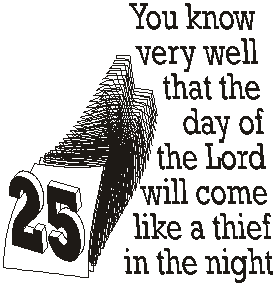
In the second reading, Paul advises us to keep awake and be sober, encouraging and building each other up as we wait for the “Day of the Lord.” He challenges the Thessalonians to turn fear of the Lord into positive, constructive and life-affirming action.
When the Thessalonians first accepted the Christian Faith, they thought that their imitation of Jesus’ death and Resurrection would be a short-term experience. Everyone, including Paul, was certain that Jesus’ Second Coming was very near. As time went on without that Coming, the Thessalonian Church seethed with rumors about its exact date. People were more concerned with “times and seasons” of Christ’s second coming than with living their Faith. Paul assured his readers that it was foolish to worry about the “day of the Lord” (v 2). Instead of expecting an imminent Parousia, Christians should always “stay alert and sober,” (v 6), doing their duties faithfully. “We belong neither to darkness nor to night; therefore, let us not be asleep like the rest, but awake and sober!”(vv 5-6). Paul means that our wholehearted dedication to the responsibilities of Christian living will earn for us the Lord’s praise at the Final Judgment. Paul reminds us that the children of light are destined not for wrath but for salvation when the Lord comes. He warns us that the Day of the Lord will come “like a thief in the night” (v 4), when we least expect it. Thus, we should keep awake and be sober, encouraging and building each other up as we wait for the “Day of the Lord.” Only those who live each day to the fullest will be ready when Jesus’ special Day arrives.
Matthew 25:14-30
Today’s Gospel challenges us to ask the questions: Are we using our talents and gifts primarily to serve God? Are we doing everything we can to carry out God’s will? The parable of the talents challenges us to do something positive, constructive and life-affirming with our talents here and now.
The context: The parable is set in the last of Jesus’ five great discourses — this one focusing on Jesus’ eschatological teaching. The three parables in the twenty-fifth chapter of Matthew (The Wise and Foolish Virgins, The Talents, The Last Judgment) are about the end times, the end of the world, and the end (intent, purpose, and upshot) of our lives. Matthew’s account provided good advice to the early Christian community as to how they are to behave in this period following Jesus’ Resurrection and Ascension while they await his imminent second coming. Whatever had been given to them — money, talent, opportunity — was meant to bear fruit for the glory of God and the salvation of souls. The same is true for all of us. Perhaps, Jesus was condemning the Jewish religious authorities. They were like the third servant, so carefully bent on preserving in its purity the tradition with which they had been entrusted that they lost their openness for new things and refused to accept Jesus’ message. In the early community the parable was allegorized. The master was equated with Christ, his departure with the ascension, and his delayed return with the delay of the Parousia or the “second coming.”
The story: A very rich person, about to set off on a journey, entrusted very large sums of money (talents) to three of his slave servants, each according to his personal ability: five, two, and one. A talent was worth between five and six thousand denarii — or about 15 years’ wages for a simple day laborer. Even one talent could be worth more than a laborer would earn in a lifetime. The rich man freely bestowed responsibility and a chance for unsupervised action on all three slaves. These amounts were enormous to these slaves who had nothing and earned nothing. Through skillful trading and investing, the slave with the five talents managed to make five more — doubling his master’s money. The slave with the two talents did the same. The third slave buried his talent in the ground. He was afraid to take the risk, afraid of the consequences of losing all the money, and afraid of the master’s reaction if he did. On the day of accounting, the master rewarded the two clever slaves (“Come, share your master’s joy” vv 21, 23), but punished the third slave whom he called “wicked and slothful” (v. 26). He took the third slave’s talent and gave it to the first slave. Clearly the master did not want security — but initiative. He exposed the third slave’s explanation as a mere excuse for irresponsibility and laziness. Even the most timid person could at least have invested the one talent with bankers and gained the interest from it, the master pointed out (v 27).
The four lessons taught by Jesus through the parable.
1) God gives each person different gifts for his or her intended uses. Everything is gift, and everything is meant to be given back in service of love for the Lord. We are only asked to make full use of what we have been uniquely given and to use our talents for the benefit of the community as a whole. The human family is charged with preserving the beauty, diversity, and integrity of nature as well as fostering its productivity.
(2) The better our work the greater our responsibility. God gives more responsibilities to those who make the best use of their God-given talents.
(3) The lazy and the unproductive will be punished. Even the person with only one talent has something to offer to others. If he fails to do some positive good work, he will lose what he has. If he tries and fails, he will meet compassion and forgiveness.
(4) God blesses generous sharers and punishes the selfish hoarders. Those who share generously the gifts they have been given are likely to find themselves constantly and immeasurably enriched, while those who jealously and selfishly preserve, out of fear, what they have been given, will lose it. In short, the parable outlines the result of abundant, grace-filled stewardship of God’s resources. A person who does not refuse a gift of the Lord’s receives it and consequently has more. The trustworthiness of the profitable servants ensures their share in the “joy of the Lord.” because the wealth of life and talent given them has been invested to bear fruit in labors of faith, hope, and charity.
The challenge given by the parable: Take the risk for Christ. God, who risked everything in the person of Jesus Christ for the sake of our salvation, expects us to do more than simply cling to safety. Hence, Jesus is encouraging his followers not to be afraid but, trusting in his help, to take chances in using their talents for the glory of God and for the salvation of their neighbors. Overwhelmed by the fear of being eternally condemned to Hell, many of us identify ourselves with the servant who quickly buried the talent he received from his master. Our concern with our eternal salvation is so intense that we concentrate only on the possibility of loss and become afraid to risk extending love to others in our spiritual life. We presume that forming relationships is always risky, and showing love to another might mean having to change our actions to meet the needs of that other. There’s always a danger we might “do the wrong thing” and lose the grace we have. The parable teaches us that a “take-no-chances” policy is not Christian.
The object lesson: Our lame excuses invite punishment: The third servant decided to avoid risk-taking and showed too much caution with money. His excuse was that, after all, he had not been given explicit orders about how to do his investing. Besides, any type of business is risky and the master might hold him accountable for any loss. He probably knew as well the long-standing rabbinic teaching that anyone who buries money that has been put into his care is no longer liable for its safety. Through this description of a lazy servant Jesus teaches us that that there is no “safe” position in life. Christian living is strenuous business involving occasional risk-taking. God expects us to use our every talent for personal growth, community service, and religious witness. Hence, this parable reminds us of the terrible punishments which lie in store for those who do not produce new spiritual wealth from the talents God has placed in their stewardship. “While the parable of the wise and foolish virgins shows that “good intentions are not enough,” and the last judgment story reminds us to care for the poor and needy, this parable of the talents describes the “terrible punishments which lie in store for those who do not produce new wealth from the talents God has placed in their stewardship.” (Letter by the Lay Commission on Catholic Social Teaching and the U.S. Economy).
The clipart is from the archive of Father Richard Lonsdale © 2000. It may be freely reproduced in any non-profit publication.

33rd Sunday of Year A
Recognizing and Serving
Through Everyday Gifts
Focus: Acknowledging that everyone has received unique, practical talents and looking to everyday vocations as models of service.
Some of us are clearly very gifted with valuable abilities, but there is no one, absolutely no one, who can say he has been gifted with nothing. We may be especially talented in teaching children or cooking meals or repairing homes or programming computers. So, we should ask ourselves how we are using our particular gifts in the service of our Christian community and the wider society. Why not follow the example of people who use their God-given talents the best way possible, like, for instance, nursing assistants who take great pride in keeping their patients clean and comfortable, or carpenters who gain enormous satisfaction from building quality homes, or teachers who find joy in the discoveries of the classroom, or attorneys who keep the goal of justice at the very center of their practices?
The following reflection and discussion questions were expanded with AI assistance, drawing from Fr. Tony Kadavil’s original teaching above.
None of these examples are glamorous in the eyes of a culture obsessed with status, celebrity, or wealth. Yet each reflects the divine dignity of faithful, everyday work. When a trade, a profession, or a simple domestic task is performed with integrity and love, it is transformed from mere labor into an act of worship. God does not measure our lives by the magnitude of our platform, but by the fidelity with which we steward what has been placed directly into our hands.
The real danger lies in the quiet trap of comparison—measuring our one or two talents against someone else’s five, deciding our offering is insignificant, and choosing indifference instead. But the body of Christ was never intended to be an assembly of identical parts. The quiet diligence of someone maintaining a building, the patience of a parent consoling a child, and the honesty of an ethical businessperson are just as essential to building the Kingdom as the most visible leaders. When we stop waiting for a grander calling and begin sanctifying the daily routines right in front of us, our ordinary abilities become holy instruments of grace.
- Sanctifying Daily Labor: How can you intentionally shift your perspective on your daily routine—whether in professional work, household chores, or family care—from mere obligation into an intentional act of worship and service?
- Dismantling the Comparison Trap: When do you find yourself comparing your gifts, visible impact, or life circumstances to those of others, and how does that comparison hinder you from appreciating the unique talents God has entrusted to you?
- Valuing the Unseen: Reflecting on the unsung roles in your daily life and parish (like cleaning, maintenance, patient listening, or logistical support), how can you better honor and practice these quiet forms of faithful stewardship this week?

33rd Sunday of Year A
Abundance, Generosity, and
Active Parish Mission
Focus: Taking bold risks to share creative, pastoral, and educational gifts directly within the faith community and its outreach ministries.
God calls us to live in a world of abundance by taking risks and being generous. In addition to our homes and families, the best place to do this is in our parish. This means that we should be always willing to share our abilities in creative worship in the Church and innovative educational events in the Sunday school. We can fulfill needs we will find right in our parish: feeding the hungry, visiting the sick or the elderly, housing the homeless, and welcoming strangers in our midst. We need to make the bold assumption that there’s going to be a demand for every one of our talents in our parish community. We should step out, with confidence, believing that every God-given gift we have is going to be exceedingly useful and fruitful!
The following reflection and discussion questions were expanded with AI assistance, drawing from Fr. Tony Kadavil’s original teaching above.
Too often, we hold back because we convince ourselves that our contribution is too small, that someone else is better qualified, or that the church only needs traditional roles like reading at the ambo or singing in the choir. Yet the vitality of a parish does not depend on a select few doing everything; it flourishes when ordinary believers dare to bring their distinct skills into the light. Whether your background is in organizing logistics, crafting welcoming spaces, mentoring young people, or simply listening patiently to someone carrying grief, there is a hollow space in the community until that gift is offered.
Stepping out in this way requires moving past the illusion of scarcity—the fear that our time, energy, or peace will be drained. Generosity within the body of Christ does not deplete us; it connects us. When we take the initiative to launch a new outreach, step into an unfamiliar ministry, or meet a neighbor in need, we shift the parish from being just a place we attend on Sunday into a living sanctuary of grace. Trust the nudge to get involved: when offered with an open heart, no act of service is ever wasted, and no talent is too modest to become the catalyst for someone else’s encounter with God.
- Confronting Hesitation and Scarcity: What self-limiting beliefs or fears of scarcity—such as feeling unqualified, lacking enough time, or assuming someone else will step up—most often keep you from offering your time and skills to your parish community?
- Identifying the Untapped Gift: Beyond visible roles in the liturgy, what natural skill, profession, or personal passion do you possess (e.g., hospitality, administration, building, mentoring, active listening) that could fill a quiet, unmet need in your parish?
- Moving from Attendance to Encounter: When has stepping outside your comfort zone to serve others actually energized or connected you rather than draining you, and how might that experience encourage you to take a new initiative today?

33rd Sunday of Year A
Putting Faith to Work:
The Danger of the Buried Talent
Focus: Viewing faith itself as an entrusted talent that must be actively invested and shared rather than preserved through fearful inaction.
All of us in the Church today have received at least one talent. We have received the gift of Faith. Our responsibility as men and women of Faith is not just to preserve and “keep” the Faith. We need to work with it. We need to offer it to the men and women of our times. Unless we do this, we stand in danger of losing the Faith just as the third servant lost his talent. The way to preserve the Faith, or any other talent that God has given us, is to put it to work and make it bear fruit.
The following reflection and discussion questions were expanded with AI assistance, drawing from Fr. Tony Kadavil’s original teaching above.
To bury our faith out of fear is to misunderstand the character of the Master who entrusted it to us. The third servant acted out of a paralyzing anxiety, seeing God as harsh and exacting, and so he opted for the false security of self-preservation. But faith is not a museum piece to be locked in a vault, polished in secret, or guarded against the messiness of the world. By its very nature, faith is dynamic—a living seed that only realizes its purpose when it is planted in the soil of daily life, exposed to the elements, and allowed to die to itself so that it might yield an abundant harvest.
When we step out in faith—reaching out to the alienated, forgiving an old injury, speaking a word of Christian hope in a cynical workplace, or offering selfless service in our parish—we take holy risks. It is precisely in those moments of vulnerability that faith ceases to be an abstract concept and becomes an encounter with the living Christ. The paradox of the Gospel remains absolute: what we cling to out of fear will wither and slip through our fingers, but what we spend freely in love and service multiplies beyond measure. If we want our faith to endure, we must risk giving it away.
- Uncovering the Buried Talents: Where in your daily life—at home, in your workplace, or in your relationships—are you tempted to keep your faith safe, quiet, or “buried” out of fear, self-doubt, or the desire to avoid conflict?
- Reframing the Master: The third servant’s paralysis came from viewing his master as harsh and exacting rather than generous and trusting. How does your own image of God shape the way you live your faith: do you act out of anxious self-preservation, or out of freedom and gratitude?
- Taking Holy Risks: What is one concrete, “holy risk” the Lord might be inviting you to take this week—such as offering forgiveness, reaching out to someone isolated, or committing your time to an active parish ministry—to allow your faith to be spent and multiplied?
 Highlight text or double-click a paragraph anywhere on the site to ADD TO NOTES. You can also click ASK AI to copy your selection to the clipboard with a command prompt, ready for you to paste manually into the chat above.