July 13, 2025
July 13, 2025


Homilies
Homilies
- Bp. Barron
- FR. RUTTIG
- 2-Min Homily
- MSGR. Hahn
- Fr. LANGEH
BISHOP
BARRON

15th Sunday of Year C


FR. KEVIN
RUTTIG

15th Sunday of Year C


TWO MINUTE
HOMILY

15th Sunday of Year C


MSGR. PETER
HAHN
15th Sunday of Year C


FR. JUDE
LANGEH, CMF

Deacon Greg’s blog has garnered some 20 million readers from around the world since its inception in 2007.
15th Sunday of Year C
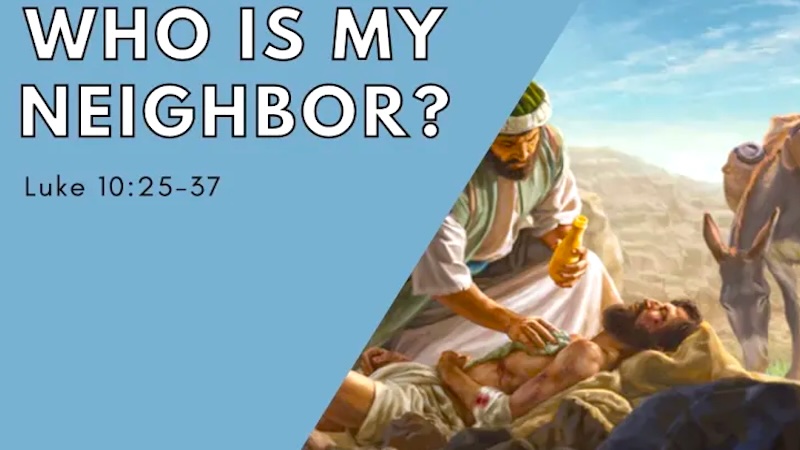
Who is My Neighbor?
This discussion guide has been generated by the WORD THIS WEEK'S Catholic AI Assistant based on Deacon Greg's homily.

1. Expanding the Definition of Neighbor
- How does Jesus challenge the conventional understanding of "neighbor"?
- Reflect on the examples given:
- The elderly woman in your building
- The homeless individual on public transport
- The global perspective, such as the child in Ethiopia or the family in Ukraine
- Discuss the statement: "Our neighborhood is the world." What implications does this have for how we live our lives?
2. Unexpected Heroes
- Who were the Samaritans in Jesus’s time, and why was this parable shocking?
- In today's society, who might represent the "Samaritans" (those who are despised or marginalized)?
- Consider modern professions and individuals often disrespected - politicians, lawyers, journalists. Can these be "Good Samaritans"?
- Reflect on the story of Saint Mark Ji Tianxiang. How does his life illustrate goodness in unexpected people?
3. The Call to Action: "Go and Do Likewise"
- Why are these four words of Jesus considered challenging?
- Reflect on the personal responsibility to engage and act in kindness.
- Discuss the metaphor of the road between Jerusalem and Jericho as our life journey.
- Evaluate how you are participating in binding "one another’s wounds" in life.
- How does the Gospel suggest we should act instead of being indifferent or dismissive?
Homily Excerpt
2022 HOMILY— It sounds like such a simple, obvious question. Who is my neighbor? If you think you know, this Gospel says: think again.
This may be one of the most familiar parables in scripture with a title that has become a part of our language. Everyone knows what you mean by a “a good Samaritan.” Just the other day, I heard a reporter use the phrase to describe strangers helping victims after the tragedy at the parade in Highland Park, Illinois.
But we tend to forget: this story is revolutionary. It is shocking. It turns our expectations upside down. You think you know who your neighbor is? Pull up a chair. Jesus has a story for you. And it offers three lessons for us here and now…
15th Sunday of Year C
So Many Questions
This discussion guide has been generated by the WORD THIS WEEK'S Catholic AI Assistant based on Deacon Peter's homily.
1. The Art of Questioning
- Jesus asks 307 questions across the Gospels. Consider why this method might be effective.
- Reflect on the significance of Jesus' first and last recorded questions.
- Why might Jesus respond to questions with more questions? How does this style affect the learning process?
2. Teaching Through Parables
- Discuss why stories and parables were vital in an era where literacy was rare.
- How do parables challenge the listeners to think and discover truths independently?
3. Questions as a Persuasive Tool
- Reflect on the role of questions in persuasion, similar to the methods used in a courtroom.
- How can questions foster community and mutual understanding?
4. Jesus’ Objective in Questioning
- Jesus, as the Son of God, had the answers. Why do you think he chose not to provide them directly?
- By asking questions, how does Jesus encourage growth, understanding, and liberation from traditional thinking?
5. Application in Life: The Lawyer’s Encounter
- Analyze the dialogue between Jesus and the lawyer in Luke 10:25-37.
- Why do you think Jesus chose the parable of The Good Samaritan to answer the lawyer's questions?
- What does this story reveal about societal norms and challenges to ingrained beliefs?
Reflective Questions:
- How do Jesus' questions reveal hidden truths and challenge preconceived notions?
- How can we incorporate Jesus’ method of questioning in our daily life and spiritual journey?
- Consider what personal questions Jesus might be asking you today. What insights or changes might these questions lead to?
Conclusion:
Reflect on T.S. Eliot's idea of being prepared for the questioning Jesus. Consider how embracing this method of inquiry can lead to a deeper understanding and transformation in your own life.
Closing Thought:
Jesus' use of questions is not meant to confound but to open hearts and minds. Engage in thoughtful consideration and discussion, allowing the questions to guide you towards new insights and life changes.
Homily Excerpt

Have you ever noticed how often Jesus asks questions? Across the four Gospels, he asks 307 of them.
His first recorded words are a question: ‘Did you not know that I must be about my Father’s business?’ (Lk.2:49). And in Matthew, his last words on the Cross are a question, too: ‘My God, my God, why have you abandoned me?’ (Mt.27:46).
Jesus even replies to questions with questions, and rarely gives straight answers. In his book Jesus is the Question, Martin Copenhaver says that of the 183 questions Jesus is asked, he only answers 8 directly. [i] Why?
Some might argue that it’s a cultural trait, because Jesus was Jewish, and some Jewish people seem to like answering questions with questions.

Three Good Samaritans
This discussion guide has been generated by the WORD THIS WEEK'S Catholic AI Assistant based on Deacon Peter's homily.
Opening Question:
- How do you personally define "neighbor"? Does your definition align more with those around you or extend beyond, perhaps to animals and the land?
Parable of the Good Samaritan (Luke 10:25-37):
- In the parable, a lawyer asks Jesus, "Who is my neighbor?" Why do you think Jesus chooses to respond with a story rather than a direct answer?
- Discuss the actions of the Jewish priest and the Levite. Why might they have chosen not to help the man?
- The Samaritan not only helps but goes out of his way to care for the injured man. Why is this significant given the cultural context between Jews and Samaritans?
Insight from Richard Rohr:
- Reflect on Richard Rohr's perspective that the Jewish men were not necessarily bad but had other priorities. How can cultural or legal expectations sometimes prevent us from showing compassion?
Old Testament Connection (2 Chronicles 28):
- Discuss the story of the prophet Oded and the Israelite army. How does this Old Testament story parallel the Good Samaritan parable?
Example of St. Vincent de Paul:
- Consider the life and work of St. Vincent de Paul. How did he embody the spirit of the Good Samaritan in his ministry?
- Reflect on the statement 'The poor are our masters… they are the suffering members of Christ.' What does this mean to you?
Modern Application:
- How can we incorporate the spirit of the Good Samaritan in our daily lives? Are there barriers, like cultural expectations or personal biases, that we need to overcome?
- What tangible steps can you take in your community to help those in need?
Concluding Thoughts:
- Reflect on the phrase "compassion isn’t just feeling sorry or praying for someone who is suffering. Compassion is actively doing something to help them." How do you interpret this in the context of your faith and actions?
Closing Prayer/Reflection:
- Spend a few moments considering who your neighbor is and how you can extend kindness and compassion to them in the coming week.
Homily Excerpt

Someone who was greatly influenced by the courage and compassion of the Good Samaritan was the French priest, St Vincent de Paul (1581–1660).
He was ordained at the age of 19 and for the next 60 years he dedicated himself to serving the sick and destitute in the villages and towns of France, visiting them and giving them food, clothing, shelter and spiritual care.
Like Mother Teresa, he recognised Jesus in the poor and he liked to say that ‘The poor are our masters… they are the suffering members of Christ.’
────── ⋆⋅☆⋅⋆ ──────
Fr. Austin Fleming
15th Sunday of Year C
Moses Command to Love God and our Neighbor
Homily Excerpt
2016 HOMILY — After all the violence we’ve witnessed in the past month, the past year, the past decade, what does it mean to preach the gospel of the Prince of Peace? The truth of the ancient scriptures is attested to in today’s first scripture, written some 7 centuries before the time of Jesus.
Recall the words we heard from Moses’ lips. It’s not hard to imagine Moses weeping and pleading over the streets of Dallas, St. Paul, Baton Rouge and Orlando with those same ancient words: “If only you would heed the voice of the Lord, your God and keep his commandments and statutes that are written in the book of the law when you return to the Lord, your God with all your heart and all your soul…
Like you, I feel powerless over the wanton carnage that plays over and over again in the media. Powerless! But…
- I am not powerless over my own thoughts.
- I am not powerless over my own heart.
- I am not powerless over my own feelings…
- I am not powerless over letting go whatever it might be that keeps me from loving God with all my heart and loving my neighbor as myself.
────── ⋆⋅☆⋅⋆ ──────

15th Sunday of Year C

Homily Excerpt

Fifteenth Sunday of the Year. Fr Lawrence Lew invites us to see every human being as a work of art.
‘Christ Jesus is the image [eikon] of the unseen God’ (Col 1:15). So in him, as St John of Damascus says, the invisible things of God, his mysteries, have been made visible. Thus ‘when he who is pure spirit … takes on the form of a servant and a body of flesh, then you may draw his likeness, and show it to anyone who is willing to contemplate it.’ With these words, St John Damascene makes his famed apologia for the veneration of icons. However, in his major work, The Fount of Knowledge, St John also advances the argument that since human beings rightly show reverence to each other because we are made in God’s image and likeness, so it is likewise right to venerate painted icons of Christ, Our Lady and the saints. So the reverence that we should show to other human beings, because each person is created as an icon, an image, a sacred likeness of God, is foundational to the veneration of sacred art.

Homily Excerpt
Fifteenth Sunday of the Year. Fr Benedict Jonak offers an ancient yet fresh interpretation of the parable of the Good Samaritan.
There is a lot that happens in today’s world, a lot that we do as the Church, that finds its inspiration in the parable of the Good Samaritan.
There are many Catholics, for example, who are directly involved in the plight of refugees, or bring relief to people trapped in war zones. Of course we are all involved in these works through spiritual and financial support, as the Church remains the largest provider of humanitarian aid world wide.
The parable of the Good Samaritan lies at the heart of what we as Christians do to bring help and relief to others, also to those who are not people of the faith. But this parable says more that this. It gives us an insight into the mind of God, so to speak, because it speaks first about God and his Christ.
This is, in fact, how the Fathers of the Church interpret it in the first place. The man, who was lying by the road, wounded, is Adam. Or if you like, the whole humanity. He was wounded, because his free will was damaged by the fall, and he could no longer set his heart on God.
Neither the priest or the Levite could help him. They stand for the Prophets and the Law.
It was God himself, who in Christ took on the human nature, and rescued the fallen man, washed his wounds and bound them, and entrusted him to the care of his own community, that of the Church, that the community might continue caring for him with his Sacraments, until the day of his return.
────── ⋆⋅☆⋅⋆ ──────
Fr. Jude Siciliano, O.P.

15th Sunday of Year C
Homily Excerpt
Compassion
MINI REFLECTION — The Samaritan would have known from his own experience what it felt like to be “beaten up” and left behind. His was a member of a despised group, an outsider to the religious and national thinking of the Jew. Which may have stirred him to respond to the victim by the side of the road. He knew what it was like to be victimized.
So, we ask ourselves:
- Can we remember an experience of being left out, treated as an outsider?
- Does that experience make us more aware and sensitive to the plight of outsiders these days?
- Who are these outsiders?
────── ⋆⋅☆⋅⋆ ──────
Fr. Charles E. Irvin
15th Sunday of Year C


Of all of the teachings of Jesus the parable of the Good Samaritan is undoubtedly the most famous, known to Christians and non-Christians alike. His parable is, of course, about responsibility, about caring for others no matter whom or what they may be. Today, however, I want to pay attention to some other responsibilities we have. Responsibility and caring for our neighbors is not enough even though the definition of “neighbor” is boundless. So what might be those other responsibilities?
Strange as it may seem at first glance, we ought to take a look at how we can be responsible for ourselves. I say strange because we hear so much about our selfishness, our self-centeredness, and selfish consumerism that is gobbling up our world’s resources and damaging our environment. We must remember, however, that Jesus told us to love our neighbor as we love ourselves. So it is important to realize that how we treat ourselves influences how we love others. How can we respect others if we don’t respect ourselves? We cannot give what we don’t have. We must love our neighbors as we love ourselves.
This discussion guide has been generated by the WORD THIS WEEK’S Catholic AI Assistant based on Fr. Irvin’s homily.
1. Introduction to the Parable
– How does the parable of the Good Samaritan influence both Christians and non-Christians alike?
– Discuss the concept of “neighbor” as introduced by Jesus. How is it portrayed as a boundless term in the parable?
2. Responsibility Towards Ourselves
– Reflect on the idea that caring for others requires first caring for oneself. Why is self-respect crucial in respecting others?
– Analyze the balance between self-care and the potential pitfalls of selfishness and consumerism.
3. Inner Self and Spiritual Responsibility
– Explore the speaker’s perspective on responsibility towards the spiritual self. How vital is spiritual reflection in daily life?
– Discuss the potential consequences of neglecting inner spiritual needs in favor of material pursuits.
4. Expressing Emotions and Mental Health
– Why is expressing emotions important according to the sermon, and how might repression lead to broader issues?
– Discuss the societal impacts of repressed emotions. Consider linking this to issues such as teenage distress.
5. Responsibility to Friends and Community
– How does the Good Samaritan parable illustrate not just temporary help but a deeper, ongoing commitment to others?
– Discuss the importance of time and attention over superficial gestures in nurturing friendships.
6. Relationship with God
– In what ways can individuals offer more than just “crumbs” of attention to their relationship with God?
– Reflect on the idea that a mature faith involves deliberate reflection and prayer rather than being self-centered.
7. Embracing Change and Growth
– How can attitudes towards change impact one’s ability to care for themselves and others?
– Analyze the quote by Mark Twain mentioned in the sermon. Discuss how fear can immobilize us and how we might overcome it.
8. Conclusion: Self and Divine Responsibility
– Discuss the idea that self-care is a form of giving back to God who has gifted us our lives.
– What kind of person do we aspire to be both in our current lives and in facing God?
Reflection Questions
– How can the concepts of self-care and responsibility be applied in your daily life?
– What changes are you willing to make to ensure you are not leaving any part of yourself at the “side of the road”?
Application Activity
– Identify specific areas in your life where you can improve self-care or deepen your responsibility to others and to God. Consider practical steps for implementation.
────── ⋆⋅☆⋅⋆ ──────
Fr. George Smiga
15th Sunday of Year C

2004 HOMILY – Every once in awhile it is valuable to take a parable and turn it upside down. This is particularly true of today’s parable of the Good Samaritan, because the meaning of this parable is so well known that it is almost a cliché: we are to act like the Good Samaritan and help others who are in need. The parable has even influenced the English Language. If you were to stop and help someone fix a flat tire, that person could likely call you a “Good Samaritan.” We have “Good Samaritan laws” that penalize people who do not help others in certain circumstances. Now there is nothing wrong with reading this parable as an invitation for us to help those in need. But if any parable needed a new twist or a different perspective, it would be this one.
So how can we read the parable differently? We can do so by changing the character in the parable with whom we identify. Instead of seeing ourselves as the character who gives (that is the Samaritan) we can see ourselves as the character who receives (the man who fell in with the robbers). This radically changes the meaning of the parable. Instead of inviting us to give to others, the parable shows us how God gives to us, how salvation comes to us, how the kingdom enters our lives. We can even change the name of the parable. Instead of calling it the parable of “The Good Samaritan,” we can call it the parable of “The Man in the Ditch.” We can ask how is that man saved? How does life come to him?
This discussion guide has been generated by the WORD THIS WEEK’S Catholic AI Assistant based on Fr. Smiga’s homily.
1. Reflecting on Perspective
– How does your understanding of the parable change when you identify with the man in the ditch instead of the Samaritan?
– Why do you think Jesus chose a Samaritan to be the one who helps the man in the ditch?
2. God’s Surprising Presence
– Can you recall a time when you experienced God’s presence in an unexpected way? Share your experience with the group.
– The parable suggests that God’s help can come from unexpected sources. How can this change your perception of where to look for help or blessings in your life?
3. The Nature of God’s Gifts
– Discuss examples from your life where you have received something significant that you did not earn or deserve.
– How do these experiences of unearned gifts influence how you understand the concept of grace?
4. Radical Openness
– What does it mean to have a “radical openness” to God’s will?
– How can adopting a stance of openness to God’s surprises affect your daily decisions and outlook on life?
5. Limiting God’s Activity
– In what ways do we tend to limit our expectations of God’s actions in our lives?
– How can we actively work to break down these limitations and remain open to the unexpected generosity of God?
Practical Application
– Spend a moment each morning this week saying, “Lord, here I am. Surprise me with more than I deserve.” Reflect on any changes or surprises you experience throughout the week.
– Identify someone in your life who may represent an unexpected source of blessing or support. Reach out and explore the potential for surprise and growth in that relationship.
────── ⋆⋅☆⋅⋆ ──────
15th Sunday of Year C

People of Life
EXCERPT: Today’s readings provide a powerful foundation for preaching on the call of God’s people to be the People of Life and to take concrete action to defend the lives of the unborn.
As Moses said, the law of God “is not too mysterious and remote.” Often people complicate the Church’s pro-life teaching unnecessarily. In reality, it is simple. We are called to love people, not kill them. “Love your neighbor as yourself,” as the Gospel indicates. It seems that the scholar of the law thought the teachings were “too mysterious and remote.”
But they are not. “Love your neighbor” does not have distinctions, limitations, or exclusions. It includes our unborn neighbors. And to love them “as yourself” means first to recognize them as a person like yourself. The “pro-choice” mindset is, ultimately, just another form of prejudice, this time directed at the people still in the womb.
────── ⋆⋅☆⋅⋆ ──────
15th Sunday of Year C

Living the Law of Love
Homily Excerpt

It is said that as a young priest, Karol Wojtyla, the future Pope John Paul II, developed a style as a confessor and counselor that challenged people to look within themselves. They had the truth. They had to recognize it and live it. There was no hiding what choices had to be made behind some written law somewhere or other. They and we know what is right. We have to act on our consciences.
Certainly, there is no written law detailing what to do if we come across someone in dire need of our help. There is no written law that says that we have to stop our car and see why a four year old is walking alongside a busy road, all alone. There is no written law that says that the old man in the walker should have someone help him with his garbage barrels, but we know in our hearts what we need to be doing and what we need to be avoiding.
────── ⋆⋅☆⋅⋆ ──────
15th Sunday of Year C
Love Lightens Every Load

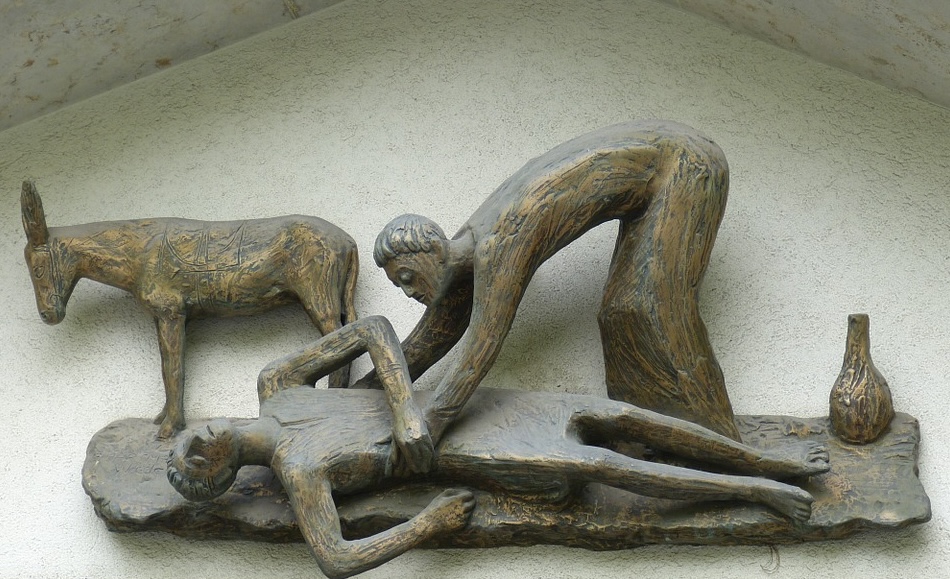
One could easily reduce this Sunday’s Gospel to trite moral advice such as this: Help people in trouble; be kind to strangers. While these are certainly good thoughts, I would argue that it is about far deeper things than human kindness or ethics. This is a Gospel about the transformative power of God’s love and our need to receive it. It is not a Gospel that can be understood as a demand of the flesh.
Let’s look at the Gospel in three stages.
I. The Radical Requirements of Love
II. The Reductionism that Resists Love
III. The Response that Reflects Love
────── ⋆⋅☆⋅⋆ ──────
Fr. Michael Chua
15th Sunday of Year C
Homily Excerpt

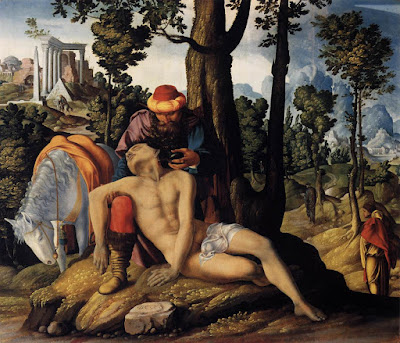
The parable of the Good Samaritan is not just merely an exemplary story of doing good beyond the call of duty, it is a summary of salvation history, beginning with the Fall of Adam and continuing through the founding of the Church even until the Second Coming of our Saviour and the Day of Judgment. The Good Samaritan was no mere hypothetical straw man. Jesus Christ is the Good Samaritan. Just like the Samaritan in the eyes of the Jews, our Lord was hated, and yet He came to us and found us in our hopeless condition and wounded by the diabolical powers of sin. Rather than judgment, He showed us mercy. Yes, it is Jesus Christ who enters this world in mercy and love, to bring healing and to carry us to the Church (“the inn”) and His Father’s house; healing our wounds through His precious blood and by paying the price for our redemption through His death, and lifting us to the Father in His resurrection, and promising to return one day to make good what is still lacking in us.

Homily Excerpt
The punchline of the parable of the Good Samaritan is found both at the beginning, as well as the end of today’s passage, and it is not the Lord who delivers it but instead a nameless onlooker, an expert of the Jewish Law. The “lawyer” begins this whole dialogue with this question: “Master, what must I do to inherit eternal life?” The perennial question posed by this man is indeed a question for which humanity has often sought an answer.
It is not enough to know how we should live but the weightier question would be how do we live forever. This loaded question indeed shows that this lawyer has some insight into the teaching of Christ Jesus. For he understands that the promise and inheritance which Jesus speaks of is not just the Promised Land, as his ancestors would have believed, but rather unending life, and he wants to make sure he gets his share of this reward.
Homily Excerpt
Whenever an anecdotal story is shared, it begs the question: “what’s the moral of the story?” Most homilies on the parable of the Good Samaritan would most likely attempt to provide the answer to this question and it would often sound like this: “do good to others, even those who are not your friends.” If it was only that simple, this would be the end of my homily. But the truth is that there is more than meets the eye in this most familiar parable of our Lord.
The context of our Lord telling this parable is that it serves as an answer given to a question posed by a lawyer, not to be confused with modern advocates and solicitors. The lawyer here is also known as a scribe, an academician or scholar, who has devoted his life to studying the Mosaic Law in order to provide a correct interpretation and application of the Law to the daily lives of fellow Jews. The question he poses is not just a valid question but one of utmost importance because it has to do with our ultimate purpose in life: “Master, what must I do to inherit eternal life?”

15th Sunday of Year C
Those by the Roadside Today
A group that I fear is being left lying by the side of the road more and more is the souls in purgatory because we don’t want to think about purgatory anymore. We have bought into the belief that we go straight to heaven when we die, even though we are not saints. It is not that God is cruel and imposes purgatory on us; when you go from a dark room into bright sunlight you are temporarily blinded, and we believe it is similar when we die. Unless we are really and truly saints, we are not ready for the light of heaven, and purgatory is the opportunity to allow ourselves to be purified to be ready to see God (see Exod 33:20; 1 Tim 6:16). Praying for the souls in purgatory is a great thing to do for them.
Fifteenth Sunday
- Those by the roadside today 2022
- Jesus is Your Good Samaritan 2019
- The Good Samaritan: thinking purified by Jesus 2010
- Father Damien of Molokai was a Good Samaritan
- The Good Samaritan: the Medicine of Love
Related Homilies: love of neighbor
- Seeing Jesus in others
- If anyone wants to be first he must be servant of all
- Today’s Gospel in the context of Luke 2007
- stories about helping others
- stories about seeing God in others
────── ⋆⋅☆⋅⋆ ──────
15th Sunday of Year C
Homily Excerpt
Love does not look like succumbing to prejudice or fear either. Love is work, and at times, very hard work. Don’t get me wrong, this does not mean that we are necessarily called to give out handouts wherever we go, but it might mean that we have the moral courage to call first responders if someone is truly having an emergency or perhaps find a way to volunteer or support organizations that are professionally trained to provide assistance to people in their time of need like Catholic Community Services, Catholic Relief Service or our St. Vincent de Paul society, the list goes on. It is a helpful reminder to be thoughtful of others in our community, around the country and world when disaster strikes. We can say to ourselves that we are generous to those in need. But honestly, are we? It is an important question to ask ourselves.
Please note that the provided video clips serve as additional resources to complement the homily. They may not have a direct correlation with the contributor’s original content. They aim to inspire preachers to enrich their own homilies, drawing ideas and insights from both the written material and the visual content explored.