August 3, 2025
August 3, 2025


Homilies
Homilies
- Bp. Barron
- 2-Min Homily
- FR. RUTTIG
- MSGR. Hahn
- Fr. LANGEH
BISHOP
BARRON

18th Sunday of Year C

This discussion guide has been generated by GOOGLE'S AI Gemini 2.5 Flash LLM.
I. The Problem of Attachment & Lessons from Ecclesiastes:
- The speaker states that clinging to worldly goods (wealth, power, pleasure, honor) leads to dissatisfaction and an addictive cycle [00:12, 07:49]. Do you agree with this assessment? Can you think of examples from your own life or observed in others?
- The Book of Ecclesiastes, attributed to King Solomon, describes worldly possessions as "vanity of vanities" – fleeting like wind or bubbles [01:12, 02:07]. What does "vanity of vanities" mean to you in this context?
- How does the idea of "detachment" differ from a rejection of worldly things [03:49, 04:14]?
II. Jesus' Teaching on Greed & The Rich Fool:
- Jesus warns against "all forms of greed," stating that "life does not consist of possessions" [06:27, 07:00]. What are some subtle forms of greed that might be overlooked in everyday life?
- In the parable of the rich fool, what was the man's fundamental mistake [08:32, 09:19]? How does this parable illustrate the futility of accumulating wealth without spiritual richness?
- How might someone today be considered a "rich fool" in a spiritual sense?
III. Saint Paul's Perspective & The True Treasure:
- Saint Paul advises seeking "what is above, where Christ is," rather than focusing on earthly things [10:23, 10:41]. How can we practically apply this advice in a world that often emphasizes material success?
- Cardinal George is quoted as saying, "The only thing you take with you into the life to come is what you've given away on earth" [12:26]. What does this statement imply about the true value of love and generosity [13:00]?
- How can we shift our focus from "building bigger barns" (accumulating worldly things) to "building up treasure in heaven" through detachment and generosity [13:27, 13:35]?
IV. Personal Reflection:
What is one practical step you can take this week to live out the principles of detachment and generosity discussed in this video?


This discussion guide has been generated by GOOGLE'S AI Gemini 2.5 Flash LLM.
1. The Fleetingness of Worldly Pleasures (00:00:29 - 00:06:50)
- Bishop Barron begins by referencing the George Harrison song, "All Things Must Pass." What is your initial reaction to the idea that "all things must pass"?
- Bishop Barron connects this idea to the biblical Book of Ecclesiastes and the Hebrew word "hebel," meaning wind or bubble [04:33]. How does this understanding of "vanity" change your perspective on the things you value?
- Think of the examples Bishop Barron gives: a beautiful sunset, a delicious meal, a great conversation [02:41]. Why is it important to recognize the fleeting nature of these good things?
2. The Spiritual Solution: Detachment (00:07:17 - 00:09:50)
- Bishop Barron introduces St. Paul's letter to the Colossians: "If you were raised with Christ, seek what is above." [07:17] What does it mean to "seek what is above" in your daily life?
- The sermon clarifies that detachment is not about disdaining the world, but about not clinging to it [08:34]. What are some things in your life that you might be clinging to too tightly?
- How can one appreciate the good things of this world (a good meal, a conversation) and then "let go" of them, as Bishop Barron suggests?
3. The Danger of Clinging: The Parable of the Rich Fool (00:10:42 - 00:12:45)
- Bishop Barron uses the parable of the rich fool to illustrate the dangers of clinging to worldly possessions. What is the central folly of the rich man in this parable?
- In today's world, what are the modern equivalents of the "bigger barns" the rich man wanted to build?
- How does the rich man's story provide a stark warning about our priorities and where we place our ultimate hope?
4. The Things That Last Forever (00:12:50 - 00:13:28)
- Based on this discussion, what is one tangible step you can take to practice greater detachment and focus on what truly lasts?
- Bishop Barron concludes with Cardinal George's quote: "The only things we take with us into heaven are the things we've given away on earth" [12:50]. How does this quote reframe your understanding of what is truly valuable?
- The sermon ends with the emphasis on faith, hope, and love as the things that last forever. Why is love considered the greatest of these?
TWO MINUTE
HOMILY
18th Sunday of Year C

This discussion guide has been generated by GOOGLE'S AI Gemini 2.5 Flash LLM.
I. Introduction & The Fleeting Nature of Worldly Glory:
- Fr. Iheme uses the Latin phrase "Sikh transit gloria mundi" (Thus passes the glory of the world) [00:16]. What does this phrase mean to you? Can you think of examples of worldly glories (beauty, fame, authority) that have faded?
- How does the idea that "worldly things are never enough" [00:00] resonate with your own experiences or observations? Do you see this desire for "more" in both the rich and the poor, as Fr. Iheme suggests [00:38]?
II. The Emptiness of Possessions & God's Goodness:
- Fr. Iheme states that "even wealth, health, inheritance, and possessions cannot ultimately satisfy" [00:54]. Why do you think this is the case?
- What is the significance of the Latin phrase "Amohabindi habendo cretchit" (The joy of heaven is increased by heaven) [00:45] in this context? How does it contrast with the pursuit of earthly things?
- What does Fr. Iheme mean when he says that "God's goodness is everlasting and not vain" [01:05]?
III. Finding True Fulfillment in Jesus:
- Fr. Iheme encourages listeners to "set their hearts on things that give life and meaning" [01:20]. What are some examples of things that give true life and meaning beyond worldly possessions?
- The central message of the homily is to "let Jesus be in everything you do or desire" [01:35]. What does this look like in daily life?
- How can focusing on Jesus help us navigate the "labors and restlessness" of life [01:20]?
IV. Personal Reflection:
What is one practical step you can take to "let Jesus be in everything you do or desire"?se points further, or perhaps create a different type of resource based on this video?
What was the most impactful message or insight you gained from this homily?
Are there areas in your life where you might be seeking fulfillment in worldly things that are ultimately unsatisfying?

This discussion guide has been generated by GOOGLE'S AI Gemini 2.5 Flash LLM.
I. Opening Prayer (Optional)
- Begin with a brief prayer for the grace to find our security not in worldly possessions, but in Jesus Christ.
II. Introduction: The Parable and a Personal Anecdote
- Deacon Paul Jensen's two-minute homily uses a parable about two feuding brothers and a rich farmer, along with a personal anecdote about his son's "security blanket" (a favorite pillow), to pose the central question, "What is our security blanket?" [00:00, 01:17].
- Discussion Questions:
- What is the "security blanket" from your own childhood or personal life that you can remember?
- How does Deacon Paul's comparison of his son's pillow to the rich farmer's possessions help to illustrate the homily's main point?
- The rich farmer found security in his possessions [00:36]. What are some things in modern life that people tend to hold onto for security?
III. The Finite Nature of Life and True Security
- The homily emphasizes that life is finite and "does not consist of an abundance of possessions" [01:03]. It challenges us to consider what we hold onto for security and provides a direct answer: Jesus is what life consists of [01:10].
- Discussion Questions:
- Why is it so easy to forget that "life does not consist of an abundance of possessions"?
- How does the certainty of our finite lives (our mortality) change our perspective on what we pursue and what we hold dear?
- The homily's answer to what life consists of is "Jesus" [01:10]. What does it mean for Jesus to be our ultimate security and the substance of our lives?
IV. Personal Reflection and Application
- Discussion Questions:
- What is the "security blanket" in your own life that you might be clutching too tightly, distracting you from trusting in Jesus?
- How can you actively and intentionally shift your trust from a worldly security blanket to the security found in Jesus?
- What is one practical step you can take this week to live as if Jesus, not your possessions or worldly comforts, is your true security?
V. Closing Prayer (Optional)
Conclude with a prayer for the grace to release our grip on earthly security blankets and to hold fast to Jesus, our true hope and security.
FR. KEVIN
RUTTIG
18th Sunday of Year C

This discussion guide has been generated by GOOGLE'S AI Gemini 2.5 Flash LLM.
CI. The Story of the Beggar and the Emperor:
- What was your initial reaction to the beggar's simple request to fill his bowl [00:53]?
- Why do you think the emperor was so confident he could fulfill the beggar's desire [00:26, 00:33]?
- What did the disappearance of the treasures signify to you [01:14, 02:01]?
- How did you feel when the beggar revealed the bowl was "made of human desire" [02:21, 02:46]?
II. The Nature of Human Desire:
- The video states that people "constantly desire one thing after another, and once obtained, the desire shifts to something new, leaving a feeling of emptiness" [02:55, 03:07]. Do you agree with this observation about human nature? Can you think of examples in your own life or in society that illustrate this?
- Why do external possessions fail to fill this "bowl of desire" [03:57]?
- What does it mean to "possess oneself" as a path to "possessing God" [03:57, 04:08]?
III. Insights from Other Perspectives:
- The video quotes Jesus and psychologist Erich Fromm on greed and the endless effort to satisfy needs [04:45, 05:00]. How do these perspectives align with the message of the Islamic tale?
- Are there other philosophical or spiritual traditions you know of that discuss the nature of desire and fulfillment?
IV. Finding True Fulfillment:
What was the most significant takeaway from this video for you?
The speaker concludes that trying to fill the bowl with external things leads to frustration [05:20]. What are some common ways people try to fill their "bowl of desire" with external things?
What does it mean to "embrace the emptiness of the bowl" to find "fullness" and "behold God" [06:10, 06:51]?
What practical steps can someone take to shift their focus from external desires to internal fulfillment?

This discussion guide has been generated by GOOGLE'S AI Gemini 2.5 Flash LLM.
1. Reflect on the "Shifting Sands" Metaphor
- How does the metaphor of the shifting sands in East Africa illustrate the power of small, individual actions working together?
- The video suggests that if one grain of sand refuses to move, the entire dune's progression is thwarted. How can this be applied to a community or a group of people working towards a common goal?
- What are some "grains of sand" in our own lives (i.e., small actions, decisions, or resources) that we might be holding onto selfishly?
2. Analyze the Parable of the Rich Fool
- How does the video's interpretation of the rich fool's story contrast with the "shifting sands"? What does it mean for the man and his mound of grain to remain "unmoved" [04:43]?
- How can we, in our own lives, avoid being like the rich fool? What does it look like to be "driven by the spirit of God" [04:50] to an act of generosity?
- What are some modern-day "barns" that people build to hoard their resources or achievements?
3. Explore Examples of Selfless Giving
- The video highlights St. Francis of Assisi, Mahatma Gandhi, and Archbishop Óscar Romero. What common thread connects their actions and teachings?
- Gandhi's act of throwing his second shoe off the train is a small but powerful example of giving. How can we find similar "small" opportunities for generosity in our daily lives?
- Archbishop Romero's quote, "we can't do everything," but we are liberated to "do it very well" [07:24], can be a powerful message. How can this idea empower individuals who feel overwhelmed by the needs of the world?
4. Final Reflections and Call to Action
What is the call to action you will leave your audience with? How can they start their own "shifting sands" movement in their community, one act of kindness at a time?
The video concludes by stating that "the power to change the world lies in 'giving all we have'" [08:11]. What does it mean to "give all we have"? Is it only about money and possessions?
What is the one main point you want to convey about the power of giving and selflessness?
MSGR. PETER
HAHN
18th Sunday of Year C

This discussion guide has been generated by GOOGLE'S AI Gemini 2.5 Flash LLM.
I. Introduction & Initial Reflections:
- What was your initial reaction to Fr. Hahn's opening statement about secularism and materialism?
- Have you observed a "growing trend of voices in society seeking to eliminate God from public discourse" as mentioned by Fr. Hahn [00:09, 00:19]? If so, where have you seen this?
II. The Vanity of Worldly Things & The Role of Sin:
- Fr. Hahn references the Book of Ecclesiastes, stating that confining human experience to earthly life alone is "utter and absolute futility" [00:49, 01:18]. How does this resonate with your own experiences or observations?
- He questions the lasting value of popular culture (movies, music, fashion) in the context of eternity [01:31, 01:54]. Do you agree or disagree with this perspective? Why?
- According to Fr. Hahn, how does sin contribute to people neglecting their eternal destiny [02:08, 02:18]?
- What does he mean by "concupiscence" [02:25, 02:36], and how does it relate to our tendency towards sin?
III. Correction, Discipline, and the Parable of the Rich Fool:
- Fr. Hahn emphasizes the need for "constant correction, discipline, prayer, fasting, and almsgiving" [02:43, 02:53]. How do these practices help us in our spiritual lives?
- He laments the lack of discipline in modern society [03:04, 03:17]. Do you see a connection between a lack of discipline and disrespect/lawlessness in society?
- In the parable of the rich fool, what was the rich man's main error [03:34, 04:09]? What lesson can we learn from his mistake?
- How does this parable illustrate the danger of self-absorption and forgetting God [04:20]?
IV. Focusing on "What is Above" & Eternal Realities:
- Fr. Hahn quotes St. Paul: "think of what is above, not of what is of Earth" [05:00]. What practical steps can we take to apply this teaching in our daily lives?
- He states that earning a living and recreation, while necessary, can lose their value and become "spiritually dangerous" if we lose sight of God [05:08, 05:23]. How can we balance our worldly responsibilities with our spiritual focus?
- The homily calls for a return to "traditional ideals and the timeless wisdom of faith" [05:33, 05:45]. What "timeless wisdom" do you find most valuable in your own life?
- What does Fr. Hahn identify as the "only real and lasting realities" [06:04]? How can we prioritize these in our lives?
V. Concluding Thoughts:
What further questions does this homily raise for you?
What was the most impactful message or insight you gained from this homily?
How might this homily influence your perspective on your own priorities and pursuits?

This discussion guide has been generated by GOOGLE'S AI Gemini 2.5 Flash LLM.
I. The Importance of Planning & Eternal Perspective:
- Fr. Hahn states that while planning for work, family, health, and the future is good, the "most important plan is for eternity" [00:01, 00:42]. How much emphasis do you place on planning for your earthly life versus your eternal life?
- What is the stark warning presented by the Parable of the Rich Fool [00:54, 01:23]? How does it challenge our modern understanding of success and security?
II. Critiquing Materialism & Seeking What is Above:
- How does materialism and secularism "corrupt" our culture, according to Fr. Hahn [01:43]? Can you see evidence of this in society today?
- What does the phrase "vanity of vanities, all things are vanity" from Ecclesiastes mean in the context of our worldly pursuits [02:10]?
- St. Paul advises us to "seek what is above, think of what is above, not of what is of Earth" [02:52, 02:59]. What does this mean in practical terms for your daily life?
III. The Role of Prayer, Sacraments, and Balancing Life:
- Why does Fr. Hahn emphasize the need for "daily prayer, the grace of the sacraments, and the wisdom of faith" to correct our focus [03:09, 03:34]?
- How can our "understanding and will be disordered" due to original sin?
- Fr. Hahn acknowledges that worldly duties like earning a living and caring for family are good, but they "lose value and can become destructive if God is lost sight of" [03:48, 04:13]. How do you strive to balance your worldly responsibilities with your spiritual life?
IV. Finding Meaning & The Ultimate Goal:
What is one concrete step you can take this week to better align your daily actions with your eternal destiny?
How do "all things of this world" take on "infinite meaning and value" when connected to God, His call, and His love [05:12]? Can you think of an example of this in your own life?
What does it mean to strive to hear "welcome good and faithful servant" on our last day [05:48, 06:03]?

This discussion guide has been generated by GOOGLE'S AI Gemini 2.5 Flash LLM.
I. The Lord's Prayer: More Than Just Words:
- Fr. Hahn notes the risk of the Our Father becoming "rote and inattentive" when prayed thousands of times [00:10, 00:19]. Have you ever experienced this? How can we make our prayer more intentional?
- How does the Gospel account of Jesus teaching the prayer to his disciples [00:32] highlight its importance?
II. Prayer as a Gift and Relationship with God:
- The homily describes daily prayer as a "wondrous gift from God, an invitation to participate in the relationship of the Father, Son, and Holy Spirit" [00:43, 00:51]. What does it mean to you that prayer is an "invitation"?
- How does baptism establish us as "children of God" who can call God "Father" [01:12]? What impact does this understanding have on your prayer life?
III. Petitions in the Lord's Prayer: Deeper Meanings:
- Daily Bread: Beyond physical sustenance, what does "daily bread" signify in a Eucharistic sense [01:41, 02:02]? How does this petition encourage us to focus on the present moment [02:10, 02:21]?
- Forgiveness of Sins: Why is acknowledging our sins and seeking forgiveness vital for spiritual growth [02:30, 02:45]? What is the significance of the qualification: "as we forgive others" [03:00]? How does God's mercy inspire us to extend mercy to others [03:10, 03:20]?
- Deliverance from the Final Test: What do you understand by "the final test or temptation" that we pray not to be subjected to [03:28, 03:37]?
IV. The Efficacy and Nature of Prayer:
- Fr. Hahn states that prayer is "efficacious" and an "opportunity to grow in God's life" [03:47, 03:54]. What examples are given to illustrate the power of prayer [04:03, 04:23]?
- How does intercessory prayer change us and deepen our union with God, rather than changing God's plan [04:30, 05:14]?
- How does prayer prompt "deeper conversion" [05:24]?
V. God's Forgiveness and Call to Prayer:
What is one way you can commit to deepening your daily prayer life after hearing this homily?
Saint Paul's words about God forgiving transgressions by nailing them to the cross [05:29, 05:37] offer what message of hope?
The homily concludes with an encouragement to "accept the gift of prayer and spend more time each day with God" [05:57, 06:15]. What prevents us from spending more time in prayer?

This discussion guide has been generated by GOOGLE'S AI Gemini 2.5 Flash LLM.
Theme:
FR. JUDE
LANGEH, CMF

18th Sunday of Year C

This discussion guide has been generated by GOOGLE'S AI Gemini 2.5 Flash LLM.
I. The Societal Drive for Wealth & Its Dangers:
- The speaker observes a prevalent societal drive for "quick money and wealth" that leads people to "neglect God" [00:25]. Do you see this trend in society today? Where?
- How do advertisements for lotteries, gambling, and other "get-rich-quick schemes" contribute to this materialism [00:49]?
- In what ways does the desire for the latest and most expensive items cause God to "take a backseat" in people's lives [01:21]?
II. Insights from Scripture & True Happiness:
- The Book of Ecclesiastes refers to such pursuits as "vanity" or "worthlessness" [02:03]. What does "vanity" mean in this context?
- How does Jesus' parable of the rich fool [02:26] serve as a warning about accumulating wealth without a spiritual foundation?
- The video states that "true happiness is found in a life hidden with Christ in God" [02:44]. What does this phrase mean to you?
III. "Banking with God" & Overcoming Idolatry:
- The Hebrew word "hebel" (vanity) signifies something "transitory and empty" [02:53]. How does this understanding influence your perspective on worldly possessions?
- What does it mean to "bank with God" [03:36]? How is investing one's life in God "more valuable than gold"?
- The speaker suggests that equating wealth with God is a form of "idolatry," violating the first commandment [04:43]. How can the pursuit of wealth become an idol in someone's life?
IV. Wisdom from Church Doctors & Call to Prayer:
What is one practical step you can take to shift your focus from material pursuits to a deeper relationship with God?
The video shares maxims from Church doctors, including "the glory of God is a fully alive human" and "a Christian's time belongs to God" [05:46]. How do these maxims challenge or affirm your current priorities?
The video concludes with a prayer for help to "seek God above riches and for material blessings to draw people closer to God" [06:48]. How can material blessings be used to draw people closer to God rather than away from Him?
Deacon Greg’s blog has garnered some 20 million readers from around the world since its inception in 2007.
18th Sunday of Year C

Teach Us to Number
Our Days Aright
This discussion guide has been generated by the WORD THIS WEEK'S Catholic AI Assistant based on Deacon Greg's homily.
Theme: This guide explores Deacon Kandra's homily, which challenges us to reflect on our priorities, particularly our relationship with material possessions, and to seek true richness in what truly matters to God, rather than focusing on fleeting earthly treasures.
Opening Prayer: Leader: Heavenly Father, we thank you for the gift of life and for the wisdom found in your Word. As we discuss these important reflections on what truly matters, open our hearts to your truth. Help us to discern your will for our lives and to invest our time and talents in ways that build your Kingdom. We ask this through Christ our Lord. Amen.
I. The "Rich Fool" and Modern Indulgences
Deacon Kandra begins by contrasting the rich man in the Gospel (Luke 12:13-21) with modern desires for material possessions, using the example of the "latest iPhone."
- What was your initial reaction to Jesus calling the rich man a "fool"?
- Deacon Kandra draws a parallel between the rich man's desire for more barns and our modern desire for the "latest" gadgets or possessions. How do you see this comparison playing out in your own life or in society today?
- What is the danger, as presented in the homily, of focusing excessively on accumulating earthly possessions?
II. Being "Rich in What Matters to God"
The homily emphasizes that the issue isn't owning things, but where our hearts are. It shifts the focus from material wealth to spiritual richness.
- Deacon Kandra states that "the question for all of us is not what we have, but what we do with what we have." What does this distinction mean for you personally?
- What do you think it means to be "rich in what matters to God"? What are some examples of such spiritual riches?
- The homily reminds us of previous Gospel teachings: "Be bearers of peace. Love God. Love your neighbor. Pay attention to the Lord." How do these foundational teachings guide us toward being "rich in what matters to God"?
III. Numbering Our Days Aright – A Call to Wisdom
The title of the homily, "Teach Us To Number Our Days Aright," comes from Psalm 90 and speaks to the brevity of life and the importance of living wisely.
- The psalm asks God to "Teach us to number our days aright, that we may gain wisdom of heart." What does it mean to "number our days aright"? Why is this important for gaining "wisdom of heart"?
- Deacon Kandra suggests that our "ultimate purpose in life" is to live generously and selflessly. How does the awareness of our mortality encourage us to live more generously now?
- In what ways can we practically shift our focus from accumulating material things to investing in spiritual growth and selfless love?
IV. Personal Reflection and Application
- Reflecting on this homily, what is one area in your life where you might be tempted to build "bigger barns" for yourself, rather than being "rich in what matters to God"?
- What is one specific action you can take this week to live more intentionally, valuing people and spiritual growth over material possessions?
- How can you apply the wisdom of Psalm 90 – to "number your days aright" – in your daily decisions and priorities?
Concluding Prayer: Leader: Loving God, we thank you for the gift of this homily and for reminding us that our true treasure is found in you alone. Help us to detach our hearts from worldly possessions and to fix our gaze on what is eternal. Grant us the wisdom to number our days aright, that we may live each moment for your glory and for the good of our neighbor. We ask this through Christ our Lord. Amen.
Homily Excerpt
2007 HOMILY— Back in the 1947, newspaper publisher William Randolph Hearst bought an estate in Beverly Hills for the then-astounding sum of 120-thousand dollars. Hearst only lived there four years before he died.
A variety of other people have owned it since then, and it has acquired a colorful history. John F. Kennedy spent his honeymoon there, and it’s been used as the setting for a number of movies.
Well, last month, the Los Angeles Times reported that this property is now for sale.
If anyone here is interested, the asking price is 165 million dollars. [Update: it went back on the market in 2014 for just 135 million.]
At one time, it was officially the most expensive residential property listing in America.
It has three acres, four houses, a security cottage, a ballroom, a library, three swimming pools and 29 bathrooms. I have no idea what you do with 29 bathrooms, unless you’re running a hotel.
You hear about places like that, and wonder what it must be like to live that kind of life.
And then you hear today’s gospel.
18th Sunday of Year C

Greed
This discussion guide has been generated by the WORD THIS WEEK'S Catholic AI Assistant based on Deacon Peter's homily.
Theme: This guide explores Deacon Peter's homily, which vividly contrasts the destructive nature of greed with the profound joy found in sharing and generosity, drawing insights from the parable of the rich fool and everyday examples.
Opening Prayer: Leader: Loving God, you call us to share your abundance and to live with generous hearts. Free us from the grip of greed and self-centeredness. Open our eyes to see the needs of others and fill us with your Spirit, that we may find true joy in giving. We ask this through Christ our Lord. Amen.
I. The Nature and Impact of Greed
Deacon Peter begins by using the example of Liberace to illustrate extravagance and then delves into how greed operates in our lives.
- Deacon Peter uses Liberace as an example. What comes to mind for you when you think of "greed" or "extravagant spending"? Can you think of other modern examples?
- The homily lists several negative impacts of greed: it "consumes people," "clouds their vision," "destroys their peace and gratitude," "corrupts behavior," and "causes conflict." Which of these impacts do you find most evident in society or in personal experience?
- How does greed "cloud our vision" and "destroy our peace and gratitude"? Can you share an example of how this might happen?
II. The Parable of the Rich Man: A Cautionary Tale
The homily uses the parable of the rich man who hoards his harvest (Luke 12:13-21) to illustrate the spiritual emptiness of greed.
- The rich man in the parable says, "What shall I do, for I have nowhere to store my crops?" What does this question reveal about his mindset? What was he missing in his perspective?
- Deacon Peter highlights how the rich man's greed leads to "selfishness, spiritual emptiness, and a lack of consideration for time and mortality." How does focusing solely on accumulation blind us to our own mortality and spiritual needs?
- The homily implies that the rich man's problem wasn't having a good harvest, but his response to it. What was the "foolish" aspect of his plan, according to Jesus? What could he have done differently?
III. The Circle of Joy vs. The Dead-End of Greed
The homily concludes with a story that illustrates the "circle of joy" found in sharing, contrasting it with the "dead-end of greed."
- Deacon Peter uses a story to illustrate the "circle of joy." Without giving away the ending, what do you think the "circle of joy" might look like in practice? How does it differ from a life driven by greed?
- What does it mean for greed to be a "dead-end"? In what ways does it lead to an unfulfilling or isolated existence?
- Can you recall a time in your life when you experienced the "circle of joy" through sharing or generosity? What did that feel like?
IV. Personal Reflection and Application
- This homily challenges us to examine our own relationship with possessions and wealth. In what areas of your life might you be tempted by greed, even subtly?
- What is one practical way you can choose the "circle of joy" over the "dead-end of greed" this week? This could involve sharing resources, time, or talents.
- How can we, as individuals and as a community, cultivate a spirit of generosity and gratitude that counters the pervasive influence of greed in our world?
Concluding Prayer: Leader: Generous God, you have blessed us with so much. Forgive us when our hearts are drawn to greed and self-interest. Teach us to be good stewards of your gifts and to find our deepest joy in sharing with others. Transform us into instruments of your love, that we may build up your Kingdom here on earth. We ask this through Christ our Lord. Amen. Sources
Homily Excerpt

Do you remember the American entertainer Liberace? It was he who coined the term ‘Laughing all the way to the bank.’
For a while Liberace was the world’s highest paid performer. At his height, he spent five million dollars a year, a huge sum in those days. When he died in 1987, he left behind eight warehouses full of things that couldn’t fit into any of his five fully furnished homes.
Surely this is greed: craving something you like, when you really don’t need it.
In the movie Wall Street, Gordon Gekko says that greed is good. ‘Greed works,’ he says. ‘Greed clarifies, it cuts through and captures the essence of the evolutionary spirit…’
Someone once argued that without greed, we’d all still be living in caves. But greed is also one of the seven deadly sins. It consumes people. It clouds our vision, it destroys our sense of peace and gratitude, it corrupts our behaviour and it causes conflict and division.
Greed is about getting more of what you want, in a world where there’s never enough for everyone. Whether it’s money, power, possessions, pleasure or anything else you think is good, greed is about getting it all for yourself.

Lagom Living
This discussion guide has been generated by the WORD THIS WEEK'S Catholic AI Assistant based on Deacon Peter's homily.
I. Opening Prayer (Optional)
- A brief prayer for guidance and openness to the Holy Spirit during the discussion.
II. Introduction: The Concept of "Lagom"
- Deacon Peter introduces "Lagom" as a Swedish concept meaning "just the right amount" or striving for balance and moderation.
- Discussion Questions:
- What are your initial thoughts on the concept of "Lagom"?
- Can you think of any examples in your own life or in society where "Lagom" might be a beneficial principle?
- How does the idea of "just enough" contrast with the prevailing cultural messages we often receive about acquiring more?
III. Greed vs. "Lagom"
- The homily contrasts "Lagom" with greed, defined as craving something unnecessary and wanting more even when resources are limited.
- Discussion Questions:
- How does Deacon Peter define greed? How does this definition resonate with you?
- In what ways do you see greed manifesting in today's world? (e.g., consumerism, accumulation of wealth, power struggles).
- Deacon Peter mentions that Jesus frequently addressed concerns about money and wealth. What are some of your own reflections on this aspect of Jesus' teachings?
IV. The Parable of the Rich Fool (Luke 12:13-21)
- Deacon Peter focuses on the parable where a rich man builds bigger barns for his harvest, intending to live a life of pleasure, but is called a "fool" by Jesus because he forgets God and his finite life.
- Discussion Questions:
- What key message do you take away from the parable of the rich fool as presented in the homily?
- Why do you think Jesus calls the rich man a "fool"? What was his fundamental error?
- The homily states that the story is not against wealth itself, but against being selfish with it. How can one discern the line between responsible stewardship and selfish accumulation?
- How might this parable challenge our own priorities and perceptions of success?
V. The Dangers of Material Accumulation
- Deacon Peter includes an insight from Michael Casey, stating that wanting more for oneself often denies it to others, and that greed is never truly satisfied. The homily concludes with a story emphasizing spiritual wealth.
- Discussion Questions:
- "Wanting more for oneself often denies it to others." How does this statement impact your understanding of material possessions and their distribution?
- Why do you think greed is described as something that is "never truly satisfied"?
- Deacon Peter points towards heaven and asks, "How much do you have in that direction?" What does this question prompt you to reflect on regarding your own life?
- How can we cultivate an attitude of contentment and generosity in a world that often encourages endless striving for more?
VI. Personal Application and Closing
- Discussion Questions:
- What is one personal takeaway or action step you are considering after reflecting on this homily?
- How can we encourage a "Lagom" approach in our communities and in the wider world?
VII. Closing Prayer (Optional)
A prayer reflecting on the themes of generosity, detachment from material things, and seeking spiritual wealth.
Homily Excerpt

There’s always something interesting to learn from other cultures. The Swedes, for example, have a very sensible concept they call Lagom.
Lagom basically means ‘just the right amount.’ It means knowing when enough is enough, and aiming for balance and moderation rather than constantly seeking more.
It’s the contented feeling you get when you have everything you need to be comfortable, including somewhere to live, something to eat, enough money and friends to get by, and being happy with that (Prov.30:8-9).
The idea of Lagom apparently comes from the Vikings, and from the expression ‘Lagom är bäst’, which means ‘The right amount is best.’ The Vikings used to pass mead around in a bowl or horn and each person had a sip, making sure everyone got their fair share.
────── ⋆⋅☆⋅⋆ ──────
Fr. Austin Fleming
18th Sunday of Year C

Vacation
Homily Excerpt
2019 HOMILY — A lot of folks have a tight grip around their vacation time: they think , It’s mine, I’ve earned it, I deserve it. I’m gonna do what I want. We want so badly to be on vacation. But if it’s just about us and what we want, if it’s just about storing up treasure for ourselves, we’re left disappointed like the rich man in Jesus’ story. What sounds like a good plan, might ultimately be foolish and unsatisfying.
And let me be clear: I’m not suggesting we shouldn’t have vacation or get some rest or take a break. Of course we should! We all should take a break. Even God took a vacation day after creating the world! And there’s the heart of the matter: how do invite God to be part of our vacation? How do we move from thinking: “This is MY plan for MY family for MY vacation.” to asking: “God what’s YOUR plan for the family YOU’ve given me during this time YOU’ve given us?”
What does it mean to be rich in what matters to God, and in in particular, what does it mean to be rich in what matters to God while you’re on vacation? Do we think of vacation as something we’ve earned, time and money we’ve stored up for our personal enjoyment? “Eat, drink and be merry!” Or do we look at vacation as a gift, a gift from God, entrusted to us to use well and wisely ?
────── ⋆⋅☆⋅⋆ ──────

18th Sunday of Year C
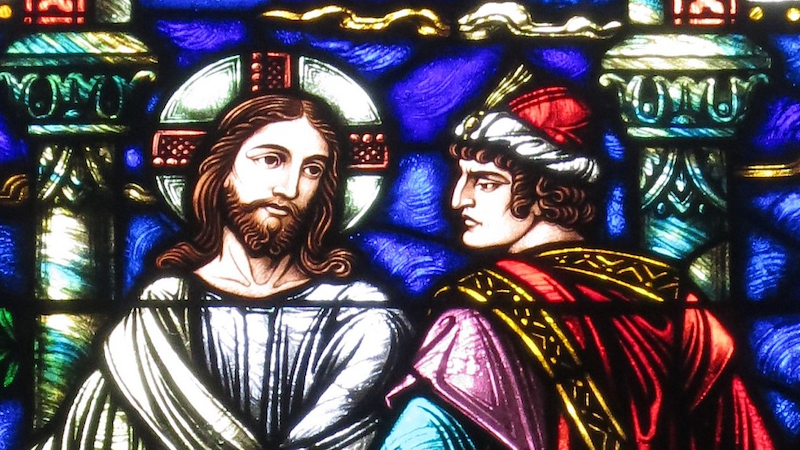
Image: Cathedral Church of Saint Patrick (Charlotte, North Carolina) – stained glass, Christ and the rich young man (detail).
Homily Excerpt

Eighteenth Sunday of the Year. Fr Gregory Murphy finds an answer to Ecclesiastes in the teachings of Christ.
Is the author of our first reading a pessimist or a realist? ‘Vanity of vanities, all is vanity’ might suggest the former: that all our efforts are in the end unstable and futile – a breath of wind blowing dust around. The title he gives himself is anonymous: either a person who calls or convokes an assembly (hence the name ‘Ecclesiasticus’ from the Greek version), or perhaps one who assembles sayings (a harmless drudge). The opening title identifying him as ‘son of David, king in Jerusalem’ (Solomon), is a literary device, as most Wisdom literature in the Bible was ascribed to the legendarily wise Solomon. At any rate he has tried, and wearied, of various ways to happiness, from the pursuit of wisdom to sensual pleasure and found all of this profitless. He accepts God as Creator, ruler and goal of human destiny but derives little comfort from that: God and God’s ways being in his view unknowable. This may reflect the collapse of the old certainties following the Exile, when the book was likely composed. Yet his uncomfortable faith may strike a chord with ourselves in an increasingly disordered and violent world: many of our certainties have been challenged by the recent pandemic, by the outbreaks of war, and by extreme climactic conditions driven by human activity. We, too, might search for God in all of this.
Homily Excerpt
Eighteenth Sunday of the Year. Fr Euan Marley thinks we are a good idea.
There was a time when we were not: this gives us no concern – why then should it trouble us that a time will come when we shall cease to be?’ (William Hazlitt, On the Fear of Death)
Mark Twain puts it more bluntly, saying in his autobiography that ‘annihilation has no terrors for me, because I have already tried it before I was born’. We hear various versions of this, and at least Hazlitt has the grace to apply it to all people and not, egocentrically, just to himself. If we are concerned with ceasing to exist, surely it should matter to us that it is not just ourselves, but (if we are committed to a purely materialistic view of the mind) to every possible form of mind? Everything material will dissipate and then there would be no mind, no thought, no point in the mindless shapeless matter which for a moment has unaccountably become aware of its own being, in a tiny part of the great universe. Then again, in speaking in the plural, Hazlitt takes a lot upon himself to speak for all people. Many would not feel convinced by his argument. If all forms of understanding were to vanish then the material might still exist but it would not be true that it existed. This is because, to quote Aquinas in his treatise on truth, without intellect, the idea of truth would in no way remain. ‘Nullo modo ratio veritatis remaneret’ (De Veritate 1.2). Truth is a relationship between the mind and that which is. So, no minds, no truth.
────── ⋆⋅☆⋅⋆ ──────
Fr. Jude Siciliano, O.P.

18th Sunday of Year C
Homily Excerpt
When Life Collapses
Today’s Gospel parable is unique. It is one of the few in which God appears as a character and even speaks. That alone should make us pause. God is speaking—so we must listen carefully…
Just when we are lulled into comfort and admiration for this successful man, the parable turns. A verdict is delivered—harsh and sudden. God speaks: “You fool, this very night your life will be demanded of you. And the things you have prepared—to whom will they belong?”
Note: It doesn’t say that God takes his life. Who will? A jealous relative? One of the poor peasants longing for a better future? Riches attract envy—and sometimes worse. Think of Ebenezer Scrooge in A Christmas Carol, who dies and is stripped of everything by those who once served him.
What matters is this: In the midst of comfort and self-congratulation, the man’s life utterly collapses. All is lost.
Why? What caused his downfall?
────── ⋆⋅☆⋅⋆ ──────
Fr. Charles E. Irvin
18th Sunday of Year C


In today’s first reading taken from the Book of Wisdom the word vanity is applied to everything that is not directed toward God, everything that is directed toward the things of this world.
Vanity of vanities, says Qoheleth, vanity of vanities! All things are vanity! Here is one who has labored with wisdom and knowledge and skill, and yet to another who has not labored over it, he must leave property. This also is vanity and a great misfortune. For what profit comes to man from all the toil and anxiety of heart with which he has labored under the sun? All his days sorrow and grief are his occupation; even at night his mind is not at rest. This also is vanity.
That’s practical advice. How many sleepless nights have we spent tossing and turning with worries and concerns that either have not come to pass or which we eventually realize were ultimately worthless?
This discussion guide has been generated by the WORD THIS WEEK’S Catholic AI Assistant based on Fr. Irvin’s homily.
Theme: This guide explores Fr. Charles Irvin’s homily, which delves into the multifaceted meaning of “vanity” – from arrogance to worthlessness – and challenges us to shift our focus from fleeting worldly pursuits to cultivating spiritual richness that truly matters in God’s eyes.
Opening Prayer: Leader: Loving God, you remind us that life’s true treasures are not found in what we possess but in who we are in you. Free our hearts from the allure of vanity and guide us toward the lasting riches of your Kingdom. Grant us the wisdom to discern what truly has eternal value. We ask this through Christ our Lord. Amen.
I. Understanding “Vanity”
Fr. Irvin begins by exploring the word “vain” and its various meanings, from arrogance to something worthless or without lasting value. He emphasizes that anything not directed towards God is ultimately vanity.
- How do you typically understand the word “vanity”? How does Fr. Irvin’s explanation of “vain” as something “worthless” or “efforts that yield no lasting value” expand your understanding?
- The homily states that “anything not directed towards God is vanity.” What does this mean for our daily activities, work, or pursuits? Does this statement challenge or affirm your perspective on your own life’s priorities?
- Can you think of common examples in today’s society where efforts might be considered “vain” because they lack a God-centered direction or lasting value?
II. The Fleeting Nature of Worldly “Wealth”
Fr. Irvin highlights that worldly measures of value—like popularity, wealth, or physical appearance—are fleeting and ultimately rendered valueless by death.
- The homily lists common worldly pursuits like popularity, wealth, or physical appearance. Why are these ultimately considered “vanity” when viewed from an eternal perspective?
- How does the reality of death, as mentioned in the homily, put into perspective our attachment to material possessions and worldly achievements?
- Have you ever experienced a moment or situation that clearly demonstrated the fleeting nature of worldly successes or possessions? Share if comfortable.
III. Cultivating Spiritual Richness
Instead of pursuing worldly vanity, Fr. Irvin encourages us to strive for spiritual richness and to be “rich in God’s eyes.”
- What does it mean to be “rich in God’s eyes”? What attitudes, characteristics, or actions would contribute to this kind of richness?
- The homily challenges the “false piety” of considering oneself worthless, asserting that God desires us to utilize the gifts He has given us. How can we balance humility with recognizing and using our God-given talents for His glory?
- Fr. Irvin advises prioritizing what is “intrinsic and eternal—our spiritual state and the love we share—over extrinsic worldly possessions.” What are some practical ways we can live out this prioritization in our daily lives?
IV. Personal Reflection and Application
- Considering the homily, what is one area of your life where you might be tempted to invest too heavily in what is “vain” or fleeting?
- What is one concrete step you can take this week to cultivate a more “spiritually rich” attitude or action?
- How can we, as a community of faith, support each other in seeking true, lasting value in God rather than succumbing to the vanities of the world?
Concluding Prayer: Leader: Gracious God, we thank you for the wisdom of your Word, which guides us away from vanity and towards true abundance in you. Help us to fix our hearts on heavenly treasures and to use our gifts to serve you and our neighbor. May our lives reflect your eternal love and bring glory to your name. We ask this through Christ our Lord. Amen.
────── ⋆⋅☆⋅⋆ ──────
Fr. George Smiga
18th Sunday of Year C

UPDATE: The dismantling plan of the ‘De Hef’ bridge proved to be unnecessary; the masts of the KORU (Bezo’s yacht) were stepped when the vessel was moored downstream of the bridge in the Rotterdam Harbor.

2022 HOMILY – Jeff Bezos, the founder of Amazon, is building himself a $500 million yacht. He is building it in the port of Rotterdam in the Netherlands. It will be the largest personal vessel in the world. But there is a problem. When the boat is completed, it will be too tall to pass under one of the bridges in the harbor and make it to the sea. Bezos has asked the City Council of Rotterdam to allow him to tear down the bridge, sail his boat past where it stood, and then rebuild it. He is willing to pay for all of this. When news of this plan became public, the citizens of Rotterdam were outraged, so much so that the plan to tear down and rebuild the bridge was withdrawn. Mr. Bezos will have to find another way of getting his yacht to the ocean. As one enraged citizen said, “Perhaps this will show Mr. Bezos that there are some things that even an insane amount of money cannot buy.”
Now whether Mr. Bezos learns that lesson remains to be seen. But it is a lesson that another rich man, the one in today’s gospel, needed to hear. This rich man had more grain than he could use, so he decided to build bigger barns in which to store it. God was not pleased with the rich man’s decision. It is important for us to understand why. After all, one could make the case that the extra grain was earned by honest labor. It was the property of the rich man, and should he not be able to do what he wished with his own property? (This is what is often said of Jeff Bezos.)
This discussion guide has been generated by the WORD THIS WEEK’S Catholic AI Assistant based on Fr. Smiga’s homily.
Theme: This guide explores the homily’s central message about economic inequality and the Christian responsibility to share from abundance, contrasting the worldly view of wealth accumulation with God’s perspective on stewardship and care for the poor.
Opening Prayer: Leader: Gracious God, you are the source of all blessings, and you call us to be good stewards of your gifts. Open our hearts and minds to understand your perspective on wealth and poverty. Inspire us to live generously and to work for a world where all your children have what they need. We ask this through Christ our Lord. Amen.
I. The Rich Man and Jeff Bezos: A Modern Parallel
The homily begins by drawing a parallel between the rich man in the Gospel and the story of Jeff Bezos’s yacht, both facing challenges related to immense wealth.
- What was your initial reaction to the story of Jeff Bezos and his yacht in Rotterdam? What does the citizen’s quote, “Perhaps this will show Mr. Bezos that there are some things that even an insane amount of money cannot buy,” say about our society’s view of wealth?
- The homily states that people often argue that the rich man’s (or Bezos’s) wealth was earned honestly and is their property to do with as they wish. How common is this perspective today? What are its strengths and weaknesses?
- The homily says, “But the gospel presents us with a different perspective. It presents us with God’s perspective.” What immediate differences do you notice between the “worldly perspective” and “God’s perspective” on wealth?
II. God’s Perspective: Sharing vs. Storing
The core of the homily emphasizes that from God’s perspective, abundance is a call to share, not just to store or keep.
- According to the homily, what is God’s challenge when we have “more grain than we need” or “more wealth than a person can use”?
- The homily cites the statistic of 860 million people living in poverty. How does this reality highlight the urgency of the Gospel’s message about sharing?
- Why do you think “God is not pleased with a world in which so many have so little and a select few have more than they would ever be able to use”? What does this tell us about God’s justice and mercy?
III. Christian Commitment to Economic Justice
The homily calls Christians to be committed to reversing economic inequalities and to advocate for policies that serve those in need.
- As Christians, how are we called to “reverse the economic inequalities of our world”? What does this commitment look like in practice, beyond individual charity?
- What kind of “economic policies that are sensitive to those who lack food, education and health care” might the homily be referring to? Why is advocating for such policies a Christian responsibility?
- The homily asks, “Do I own more than I really need?” This is a challenging question. How do we honestly assess what we “really need” versus what we “want”?
IV. Living Generously in Abundance
The homily clarifies that wealth itself is not wrong, but our willingness to share is paramount.
- “There is nothing wrong with wealth. There is nothing wrong with eating and drinking and being merry.” How does this statement balance the homily’s critique of hoarding wealth?
- “But in a world where so many struggle to survive, we must be willing to share from our abundance. That is what matters to God.” What does “sharing from our abundance” mean for you personally?
- What are some practical ways we can cultivate a spirit of sharing and generosity in our lives, even if we don’t consider ourselves “wealthy” by global standards?
V. Personal Reflection and Application
- After hearing this homily, what is one new insight or challenge it presents for you regarding wealth, possessions, or economic justice?
- What is one specific action you might take this week, inspired by this homily, to live more aligned with God’s perspective on sharing from abundance?
- How can we, as a community, better support efforts to address economic inequality and ensure that God’s perspective on sharing becomes a greater reality in our world?
Concluding Prayer: Leader: Loving God, we thank you for the abundance you have poured into our lives. Forgive us for our attachments to material things and for our slowness to share. Open our eyes to the needs of our brothers and sisters, and fill our hearts with generous love. Guide us to be wise stewards of your gifts, working always for justice and compassion. We ask this through Christ our Lord. Amen.
────── ⋆⋅☆⋅⋆ ──────
18th Sunday of Year C

Giving Ourselves Away so that Others May Live
Homily Excerpt
What matters to God is that we become like him, that we “put on the new self, which is being renewed …in the image of its Creator.” What matters is that we do what he does, that is, that we give ourselves away in love. The opening prayers of today’s mass call God our “origin” and declare, “Our life is your gift.” What we have received as a gift, we must give as a gift, and through our God-like generosity, be the origin of life in others.
The dynamic traced in today’s Gospel, whereby we see fulfillment in earthly possessions and fail to see the lesson of the first reading that all earthly things pass away, is what contributes so powerfully to the Culture of Death…
As the Gospel indicates, judgment can come at any moment; our opportunity to give life to others can cease at any moment. “To whom will all this piled-up wealth of yours go?” In the Culture of Life, we are secure at every moment in knowing that we simply seek to give ourselves away, that others may live.
────── ⋆⋅☆⋅⋆ ──────
18th Sunday of Year C

Success
Homily Excerpt

What is a successful life? Is a person’s life successful if he or she is making a good salary? There’s a story about a grandmother who pulled out pictures of her three grandchildren, all under two, and showed them to a friend saying, “That one’s the rich doctor, that one’s the rich lawyer and that one’s the chairman of the board of a large corporation.” Is success predicated on salary? That is the way that most people calculate success. But are they correct?
How about marriage? What makes a marriage successful? Is a marriage successful because a woman and a man have been together for twenty, thirty, forty, or fifty years and have avoided both divorce and homicide? Marriage anniversaries are important, but do they point to the success of a marriage or only to its longevity?
────── ⋆⋅☆⋅⋆ ──────
18th Sunday of Year C

You Can’t Take it with You, But You Can Send it on Ahead!
Homily Excerpt
The Gospel today is not merely a warning against greed, it is an instruction on income and wealth given by Jesus to help us root out greed. As the Gospel opens the problem of greed is presented, and then a prescribed perspective about wealth is offered. Lets take a look at both parts of this gospel.
I. The Problem that is Portrayed
II. The Perspective that is Prescribed
- The INITIATION of Wealth
- The INCONVENIENCE of wealth
- The ILLUSION of wealth
- The INSUFFICIENCY of wealth
- The INSTRUCTION about wealth

────── ⋆⋅☆⋅⋆ ──────
Fr. Michael Chua
18th Sunday of Year C

Homily Excerpt

So what is the real purpose and meaning of life? Is it to make a lot of money and be successful? Is it to marry and raise a family? Is it to obtain lots of material possessions – fancy car, big house, a fat bank account? Is it to make lots of friends, be popular and socialise? But, is that all? Is there no greater meaning or purpose to this amazing gift of life? For some, maybe these sources of meaning and purpose are enough—even if they don’t quite fulfill. Why? Because there is something very deep within us that says there is more to life than any of these, that there is something very great and meaningful that we are here for. But what is that purpose?
Sigmund Freud said it bluntly, and he is right: “… only religion can answer the question of the purpose of life.” The Second Vatican Council also expressed something similar in the first paragraph of its Declaration on the Relation of the Church to Non-Christian Religions (Nostra Aetate): “Men expect from the various religions answers to the unsolved riddles of the human condition, which today, even as in former times, deeply stir the hearts of men: What is man? What is the meaning, the aim of our life? What is moral good, what is sin? Whence suffering and what purpose does it serve? Which is the road to true happiness? What are death, judgment and retribution after death? What, finally, is that ultimate inexpressible mystery which encompasses our existence: whence do we come, and where are we going?” This Sunday’s first reading from Ecclesiastes also seeks to find an answer to these fundamental questions.
Homily Excerpt
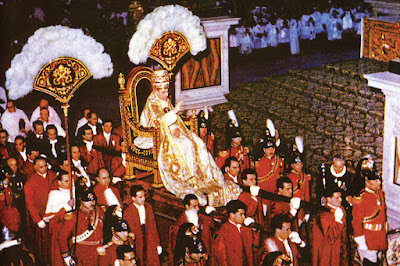
As foolish men surround themselves with trophies of their achievements and build monuments in honour of their conquests, wise rulers throughout history have often taken care to surround themselves with salutary reminders of their own frailty and the transitory nature of power. The Pope is no different. There is a Latin expression that was once spoken at the coronation of Popes, “Sic transit gloria mundi”, which means, “Thus passes the glory of the world.” The last Pope to have heard it would be Pope St John XXIII.
As the new pontiff was carried around St. Peter’s Basilica, sitting in his sedia gestatoria, his portable throne, the procession with all its pomp and pageantry, would stop in three different places. At each stop, the priest, holding a burning flax, would chant to the pope “Pater Sancte, sic transit gloria mundi!,” “Holy Father, thus passes the glory of the world,” reminding him—and the rest of the Church—of the transitory nature of worldly honour and glory. So that amidst all the pomp owed to the dignity of their sacred office, the Supreme Pontiffs might not forget the humble origins of the papacy in the Galilean fisherman, who betrayed Christ out of fear of the washerwoman. Everything in this life passes away — only God remains (as St Teresa reminds us in her prayer), and because of this reason, only He is worth struggling towards.
So, my dear brothers and sisters, heed the words of St Paul: “Let your thoughts be on heavenly things, not on the things that are on the earth, because you have died, and now the life you have is hidden with Christ in God.”
Homily Excerpt
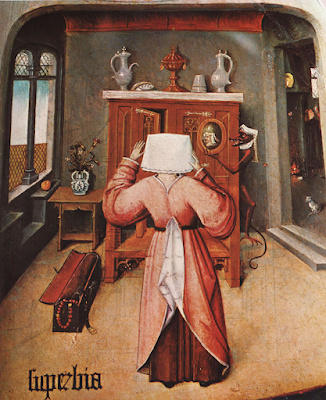
St Thomas Aquinas teaches that the real end for which man is made is to be reunited with the goodness of God through virtuous behaviour as well as the use of reason in order to know and love God above all. In the words of St Augustine, “that is our final good, which is loved for its own sake, and all other things for the sake of it.” St Ignatius Loyola in setting out the First Principle and Foundation in his Spiritual Exercises writes, “The human person is created to praise, reverence, and serve God Our Lord, and by doing so, to save his or her soul. All other things on the face of the earth are created for human beings in order to help them pursue the end for which they are created. It follows from this that one must use other created things, in so far as they help towards one’s end, and free oneself from them, in so far as they are obstacles to one’s end.” Thus, the riches of this life are only potentially good. Their goodness is actualised when they serve the greater good – the glory of God and love of neighbour.
The irony we face is that many people would prefer to love the means rather than the end. Man need not just love bad things in order to be condemned to hell. As the old adage teaches us, “The road to hell is lined with good intentions.” Man can pervert his ultimate end by loving seemingly good things, which seem to bring happiness, and mistake these things for the actual, infinite source of happiness – God. Whenever we choose the lesser goods over the greater Good, whenever we convert the means into the end, whenever our vision is obscured to see beyond what lies immediately before us, then we are in trouble. Everything comes down to the choice: do we choose these things as a means to the end, or do we choose them as a substitute for the end?
18th Sunday of Year C
Those who have God and Our Lady in their Lives have Everything
Homily Excerpt
We can see that in the book from which our first reading today is taken—the book of Ecclesiastes, or Qoheleth as it is also called. Qoheleth simply means “Preacher.” A well-known part of his book elsewhere (chapter 3) says there is a time for everything: there is a time to be born, a time to die, a time for tears, a time to laugh. Qoheleth could be seen as somewhat pessimistic because for him everything happens at a time that is fixed and decided. For that reason, Qoheleth finds life meaningless. Why? Because everyone must die. That is why he says repeatedly in the book, and as we heard today, “Vanity of vanities.” (Eccl/Qoh 1:2) He was struggling with the meaning of life because he lived a couple of centuries before Jesus and did not know about Jesus. Even though Qoheleth did not know, he was really searching for Jesus. What is translated as “vanity” in our Bibles, in the original Hebrew is really “mist/fog/breath.” Qoheleth finds life misty and foggy because he does not know Jesus.
Eighteenth Sunday
Those who have God and Our Lady in their lives have everything 2022
────── ⋆⋅☆⋅⋆ ──────
18th Sunday of Year C
Homily Excerpt
I love the book of Ecclesiastes. Some call it the book of Quoheleth, after the main character of Ecclesiastes. Quoheleth means assembly person or Church man. Because of the references from Quoheleth as having been a king and rich beyond reckoning, tradition has linked Quoheleth with King Solomon, the son of David and the wisest and richest king of Israel.
Bishop Barron has an interesting take on this guy in a homily from a number of years back. This weekend, I am essentially going to paraphrase it for you. He began with the observation that most of us know someone like Quoheleth. He comes across like a grumpy old neighbor on his worst, cynical day. Quoheleth sees the world through a very jaundiced eye. “Vanity of Vanities”, says Quoheleth, “all things are vanity.” He is cynical, he is sardonic, and he sounds almost desperate. Everything he has done, everything he has learned, everything he has accomplished, he sees as vain. He writes that he spent his life chasing after wisdom and discovered that it was like chasing after the wind. Now King Solomon was considered to be the wisest of the kings of Israel. Here, he is almost like a Socrates figure. He is essentially saying wisdom consists in knowing you know nothing. Have you heard the saying, there is nothing new under the sun? Well, that saying comes from Quoheleth in the book of Ecclesiastes.
Please note that the provided video clips serve as additional resources to complement the homily. They may not have a direct correlation with the contributor’s original content. They aim to inspire preachers to enrich their own homilies, drawing ideas and insights from both the written material and the visual content explored.