August 10, 2025
August 10, 2025


Homilies
Homilies
- Bp. Barron
- 2-Min Homily
- FR. RUTTIG
- MSGR. Hahn
- Fr. LANGEH
BISHOP
BARRON

19th Sunday of Year C

This discussion guide has been generated by GOOGLE'S AI Gemini 2.5 Flash LLM.
I. Opening Prayer (Optional)
- Begin with a prayer for courage to answer God's call to adventure and to live a life of faith.
II. Introduction: The Universal Hero's Journey Archetype
- Bishop Barron introduces the concept of the "hero's journey" as a universal pattern found in myths, literature, and popular culture (e.g., Star Wars, superhero movies) [00:47].
- He explains Jordan Peterson's description of this journey: starting from comfort, being summoned to adventure, venturing into the unknown (terra incognita), facing obstacles, and establishing new ground for others [01:25]. Bilbo Baggins from The Hobbit is given as an example [02:29].
- Discussion Questions:
- What are some examples of the "hero's journey" that you recognize from stories, movies, or even real life?
- How does Peterson's description of the journey (comfort -> call -> unknown -> obstacles -> new ground) resonate with your understanding of significant life changes or challenges?
- Have you ever experienced a "call to adventure" in your own life, big or small, that led you out of your comfort zone?
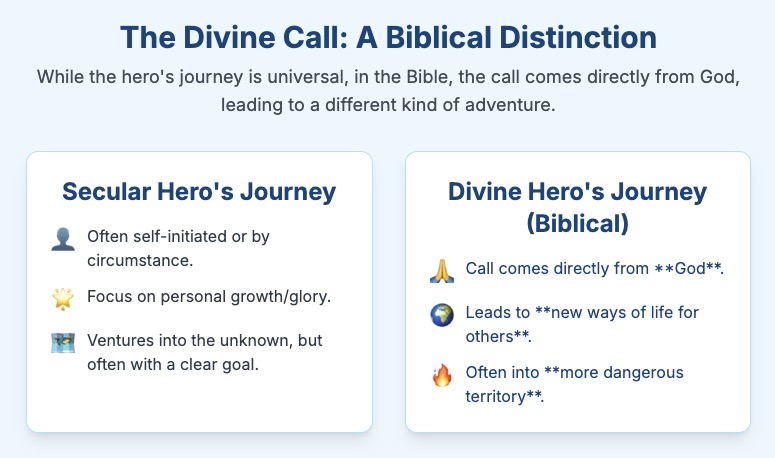
III. The Hero's Journey in the Bible: A Divine Call
- Bishop Barron posits that the Bible is filled with examples of the hero's journey, with the key distinction that the call comes directly from God [03:34]. This divine calling leads individuals into more dangerous territory, making new ways of life possible for others [04:03].
- Discussion Questions:
- How does the idea of a divine call to adventure change the nature of the hero's journey compared to secular narratives?
- Can you think of other biblical figures, besides those mentioned later, whose stories fit the pattern of a divinely initiated hero's journey?
- What does it mean for individuals to make "new ways of life possible for others" through their response to God's call?
IV. Faith as Trust and Confidence: Abraham as the Paradigm
- The homily focuses on the Letter to the Hebrews (chapter 11) to redefine "faith" not as blind acceptance, but as trust and confidence in God – a willingness to follow Him into the unknown [04:28, 05:24].
- Abraham's story is presented as the quintessential hero's journey of faith: he obeyed God's call to leave his familiar home without knowing where he was going, trusting in God's promise, which led to a "holy people" [06:11, 08:15].
- Discussion Questions:
- How does Bishop Barron's definition of biblical faith as "trust and confidence" differ from common misconceptions of faith?
- Reflect on Abraham's journey. What aspects of his story most exemplify "trust and confidence" in the unknown?
- How can we cultivate this kind of radical trust in God in our own lives, especially when the path ahead is unclear?

V. God's Own Hero's Journey and Our Imitation of It
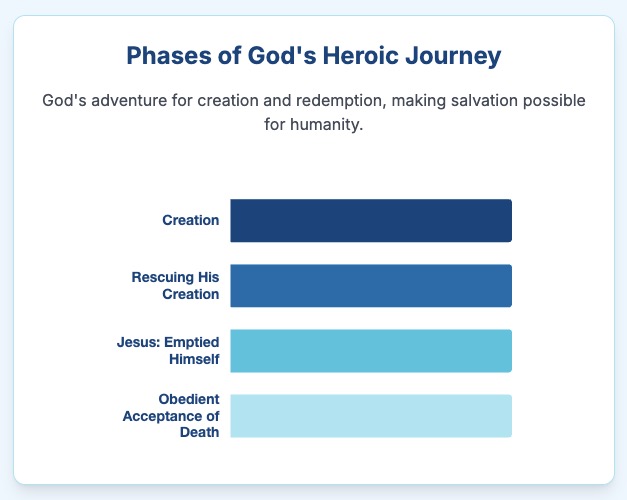
- Bishop Barron concludes by suggesting that God Himself undertakes a hero's journey [10:39]. Despite being perfectly satisfied, God undertook the adventure of creation and then the "great adventure of rescuing his creation" after it fell into sin [10:52].
- This is supremely exemplified by Jesus, who "emptied himself" and obediently accepted death on a cross, opening "the space of salvation" for humanity [11:13]. Our human faith is an imitation of God's willingness to embark on this heroic journey [12:35].
- Discussion Questions:
- How does the idea of God undertaking a "hero's journey" (creation, redemption through Jesus) deepen your understanding of God's nature and love?
- What does it mean that Jesus "emptied himself" and opened "the space of salvation" for humanity?
- In what ways can our own lives of faith be seen as an "imitation of God's willingness to embark on this heroic journey"?
VI. Personal Reflection and Application
- Discussion Questions:
- What specific "call to adventure" might God be inviting you to respond to in your life right now?
- How can you actively cultivate more trust and confidence in God to follow Him into the unknown?
- What obstacles or fears might be preventing you from embarking on your own "hero's journey" of faith?
VII. Closing Prayer (Optional)
Conclude with a prayer for courage, trust, and openness to God's adventurous call in our lives, following the example of Christ.

This discussion guide has been generated by GOOGLE'S AI Gemini 2.5 Flash LLM.
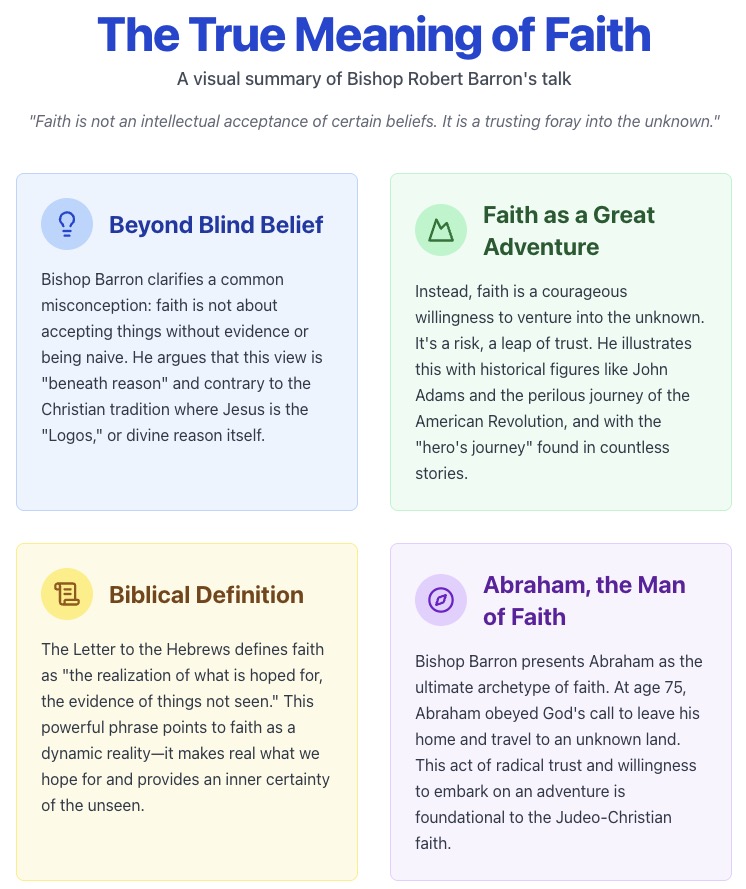
Introduction: This video features Bishop Barron discussing the true meaning of faith, contrasting it with common misconceptions. He emphasizes that faith isn't blind belief or superstition, but rather a courageous willingness to venture into the unknown, trusting in a divine calling.
Part 1: Understanding Misconceptions of Faith
- Bishop Barron refutes the idea that faith is a blind belief or superstition, stating it's beneath reason. [00:20]
- Discussion Questions:
- How do you typically define faith?
- What are some common misunderstandings about faith that you have encountered?
- Do you agree or disagree with Bishop Barron's assertion that faith is not a blind belief? Why?
Part 2: Faith as a Risk and Adventure
- Bishop Barron uses examples like John Adams and the American Revolution, as well as the "hero's journey" in popular culture, to illustrate faith as a courageous venture into the unknown. [02:10, 06:08]
- Discussion Questions:
- How do the examples of John Adams and the hero's journey help to redefine faith as an adventure?
- Can you think of other historical or fictional characters who demonstrate this kind of faith?
- In what ways might living a life of faith be considered an "adventure" today?
Part 3: Biblical Examples and the Call to Adventure
- What does it mean to you to "go to the heights" or "always greater" in your own life of faith?
- The video references the Letter to the Hebrews, which defines faith as "the realization of what is hoped for, the evidence of things not seen." [09:29]
- Abraham is presented as the prime biblical example of faith, as he left his home for an unknown land. [10:17]
- Bishop Barron concludes by urging listeners to embrace an adventurous spirit, citing mottos like "Semper Altius" and "Verso l'alto." [12:36]
Discussion Questions:
- What does the definition of faith from the Letter to the Hebrews mean to you?
- How does the story of Abraham embody the idea of faith as an adventure?
Infographics on this page have been added by THE WORD THIS WEEK using AI generative tools (i.e. Chart.js and Tailwind CSS). They may be copied for personal use or for any non-profit ministry. Graphics may not be sold or used for personal financial gain.
TWO MINUTE
HOMILY
19th Sunday of Year C

This discussion guide has been generated by GOOGLE'S AI Gemini 2.5 Flash LLM.
I. Opening Prayer (Optional)
- Begin with a brief prayer for the grace to live prepared for our encounter with God and to trust in His presence.
II. Introduction: The Importance of Being Prepared
- Fr. Dan Ryan's homily emphasizes the central theme of being prepared to meet God at the end of one's life, likening it to the scout motto of "Be Prepared" [00:00].
- Discussion Questions:
- What does "being prepared" for the end of life mean to you, both practically and spiritually?
- How does the analogy of the "scout motto" help illustrate the importance of readiness in our spiritual lives?
- What aspects of life often make it challenging to maintain a sense of preparedness for our ultimate encounter with God?
III. "Do Not Be Afraid" and Trust in God
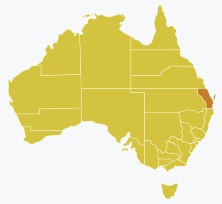
- Despite the call to be prepared for death, the homily stresses that there is no need to be afraid. Jesus frequently urges people not to fear, encouraging trust in God's presence both in life and eternity [00:23].
- Fr. Ryan references Saint Mary MacKillop as an example of someone who deeply trusted in God through all life's challenges, even when she was excommunicated [00:49].
- Discussion Questions:
- Why do you think Jesus so frequently tells us "Do not be afraid"? What fears might hold us back from fully trusting God in life and facing our mortality?
- How does the example of Saint Mary MacKillop inspire you to trust in God even amidst significant challenges or suffering?
- In what situations do you find it most difficult to trust in God's presence and guidance?
IV. Living Daily Life Closely to Christ
- The homily encourages living daily life to the best of one's ability, staying close to Christ through prayer and actions, with the ultimate goal of being prepared to meet Christ and live with Him for eternity [01:23, 01:38].
- Discussion Questions:
- What does it mean to "live daily life closely to Christ" through prayer and actions? Can you share some practical ways you try to do this?
- How does living closely to Christ transform our perspective on everyday tasks and challenges?
- How does maintaining a focus on meeting Christ and living with Him for eternity influence your current choices and priorities?
V. Personal Reflection and Application
- Discussion Questions:
- What is one key takeaway or insight from Fr. Dan Ryan's homily that particularly resonated with you?
- What is one practical step you can take this week to live more prepared to meet God?
- How can you deepen your trust in God and overcome any fears related to the future or the end of life?
VI. Closing Prayer (Optional)
Conclude with a prayer for the grace to live each day in readiness and trust, always striving to remain close to Christ.g?

This discussion guide has been generated by GOOGLE'S AI Gemini 2.5 Flash LLM.
Introduction: Fr. Rony invites us to reflect on two powerful themes: faith and readiness. He draws insights from the readings, highlighting God's faithfulness and our call to trust Him and be prepared for His Kingdom.
I. Reflecting on Faith
- From the First Reading (Wisdom):
- Fr. Rony states, "In the first reading from Wisdom, we are reminded of how the people of Israel were saved because they trusted in God's promise. Even before they saw the outcome, they acted in faith, believing that God would deliver them."
- Discussion Questions:
- Can you recall a time in your life when you had to trust God's promise without seeing the immediate outcome? What was that experience like?
- How does the example of the Israelites in the Book of Wisdom inspire your own journey of faith?
- From the Second Reading (Hebrews):
- Fr. Rony quotes, "Faith is the assurance of things hoped for, the conviction of things not seen." He then highlights Abraham, "who left everything behind, simply trusting God's word. He didn’t know where he was going, but he believed."
- Discussion Questions:
- What does the definition of faith from Hebrews 11:1 ("assurance of things hoped for, the conviction of things not seen") mean to you personally?
- How does Abraham's journey resonate with your own experience of trusting God without full understanding? Share an example if you feel comfortable.
- How can we cultivate a deeper sense of trust in God's word, especially when faced with uncertainties?
II. Embracing Readiness with Faith, Not Fear
- From the Gospel (Luke):
- Jesus reassures us, "Do not be afraid, little flock, for your Father is pleased to give you the Kingdom." Fr. Rony notes this as "a whisper of hope" in a world filled with "uncertainty, climate crises, wars, economic instability, and the loneliness of many."
- Discussion Questions:
- In what ways do current global or personal uncertainties cause you to feel afraid?
- How does Jesus' assurance, "Do not be afraid, little flock, for your Father is pleased to give you the Kingdom," offer comfort or challenge you in these situations?
- What does it mean to "be ready, not with fear, but with faith" in your daily life?
III. Living with Urgency and Love
- Called to Action:
- Fr. Rony encourages us "To live generously, to love confidently, to stay awake to the needs of people around us. Because the kingdom is not just coming, it is already breaking in, through every act of kindness, every choice to forgive, every moment we choose hope over despair." He reminds us that "God has given each one of us gifts, time, talents, faith, and we are called to use them well."
- Discussion Questions:
- What are some practical ways we can "live generously" and "love confidently" in our communities or families?
- How can we be more "awake to the needs of people around us" in a world that can feel overwhelming?
- Can you identify moments when "the kingdom is already breaking in" through acts of kindness, forgiveness, or choosing hope?
- What gifts (time, talents, faith) do you feel God has given you, and how are you called to use them well for the Kingdom?
Conclusion and Personal Reflection:
- How will you strive to "store up treasures in heaven" through your actions and choices?
- Fr. Rony ends with challenging questions: "Are we storing up treasures in heaven? Are we living with the urgency of love, faith, generosity, and watchfulness?"
- Discussion Questions:
- What is one concrete step you can take this week to "walk with faith like Abraham, trust like the Israelites, and stay ready like the faithful servants"?
- Discussion Questions:
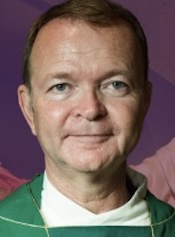
FR. KEVIN
RUTTIG
19th Sunday of Year C

This discussion guide has been generated by GOOGLE'S AI Gemini 2.5 Flash LLM.
I. Opening Prayer (Optional)
- Begin with a brief prayer for safety, vigilance, and trust in God's providence amidst life's uncertainties.
II. Introduction: An Unexpected Home Invasion
- Fr. Ruttig recounts a personal experience as a young priest where intruders attempted to break into his home late at night [00:00, 00:18].
- Discussion Questions:
- What was your initial reaction to hearing about the speaker's home invasion experience?
- The intruders took specific actions (cutting locks, unscrewing lights, cutting phone lines) [01:01]. What does this suggest about their intent?
- How does such an unexpected and unsettling event highlight the vulnerability of our lives and the unpredictability of the future?
III. Confrontation and the Nature of the Threat
- Fr. Ruttig and his friend discovered the intruders and a confrontation occurred, leading the intruders to flee and drop their tools [01:44]. Detectives later determined it was not a robbery but a "planned hit" [03:00].
- Discussion Questions:
- What emotions might the speaker and his friend have experienced during the confrontation?
- How does the revelation that it was a "planned hit" (rather than just a robbery) change the nature of the threat?
- Have you ever experienced a sudden, unexpected threat or danger that forced you to confront the fragility of life?
IV. Reflection on Preparedness: Jesus' Words
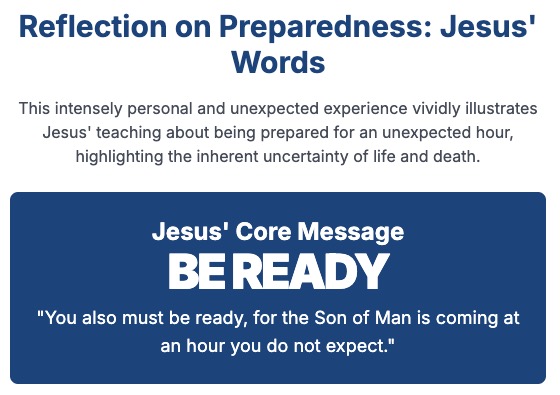
- Fr. Ruttig connects this intensely personal and unexpected experience to Jesus' words about being prepared for an unexpected hour [03:18], emphasizing the uncertainty of life and death [03:49].
- Discussion Questions:
- How does a traumatic event like a home invasion provide a vivid illustration of Jesus' teaching about being prepared for an unexpected moment?
- What does it mean, in a spiritual sense, to be "prepared for an unexpected hour" in your life?
- How does acknowledging the "uncertainty of life and death" influence your daily choices and priorities?
V. Broader Implications of Preparedness
- While the homily uses a dramatic example, the principle of spiritual preparedness applies to all aspects of life.
- Discussion Questions:
- Beyond physical safety, what are other "unexpected hours" or transitions in life (e.g., job loss, illness, sudden changes in relationships) for which we need to be spiritually prepared?
- What spiritual habits or practices can help us cultivate a state of readiness to meet life's challenges, and ultimately, to meet God?
- How can a constant, quiet trust in God help us navigate the unpredictable nature of our existence?

VI. Personal Application and Closing
- Discussion Questions:
- What is one key insight or challenge you gained from hearing this personal story and its spiritual reflection?
- What is one practical step you can take this week to live more intentionally, remembering the "unexpected hour"?
- How can you deepen your trust in God's presence and guidance, knowing that life can change in an instant?
VII. Closing Prayer (Optional)
Conclude with a prayer for vigilance, trust, and the grace to live each moment in God's presence, prepared for whatever comes.s can someone take to shift their focus from external desires to internal fulfillment?


This discussion guide has been generated by GOOGLE'S AI Gemini 2.5 Flash LLM.
This homily by Fr. Ruttig explores the theme of surprise as a central element of our relationship with God and with others. Using a series of unexpected anecdotes, he encourages us to be prepared for the surprising ways God works in our lives and to respond with our own surprising generosity.
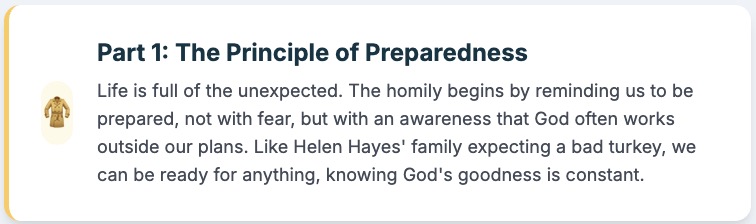
- The homily begins with the story of Helen Hayes and her family preparing for a poorly cooked turkey, as well as a reflection on being prepared for God's coming. [00:00:00 - 00:01:30]
- Discussion Questions:
- What does it mean to be "prepared" for God? Does this idea resonate with you?
- Can you recall a time when you were prepared for a disappointment but were pleasantly surprised instead?

- Fr. Ruttig suggests that many of God's greatest gifts arrive as surprises, and even unpleasant surprises can lead to something good. [00:01:42 - 00:02:30]
- Discussion Questions:
- Think about a major change in your life—a new job, a new relationship, or a move. At the time, did it feel like a good or bad surprise? How do you view that surprise now, in hindsight?
- Why do you think God often works through the unexpected rather than through a predictable, straightforward path?
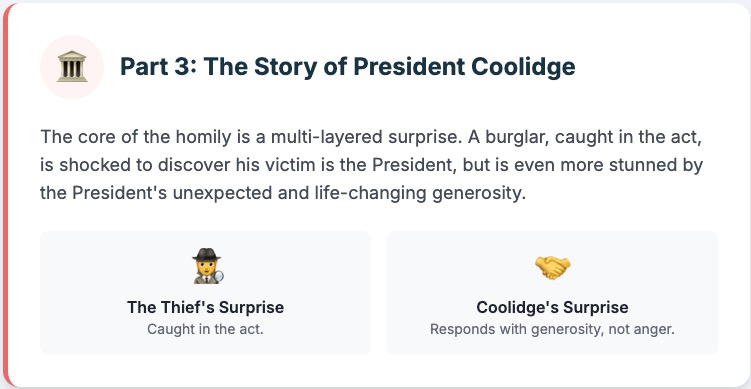
- The core of the homily is the story of a cat burglar entering President Coolidge's hotel room and Coolidge's shocking act of generosity. [00:03:10 - 00:05:33]
- Discussion Questions:
- What part of the story surprised you the most? The thief's actions? Coolidge's reaction? The repayment?
- Why do you think Coolidge chose to show generosity instead of calling for help or showing anger?
- How does this story connect to the idea of God's generosity towards us?
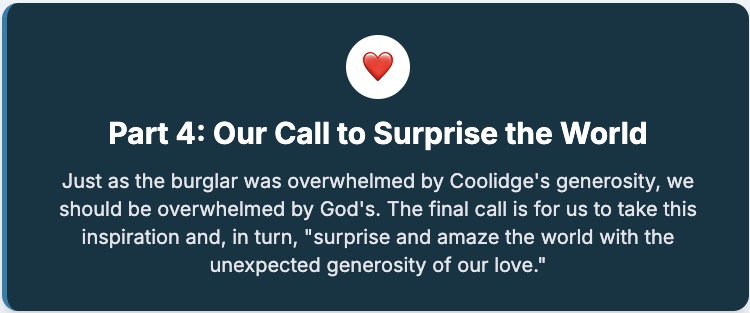
- How can reflecting on God's surprises help us to be less fearful and more open to the changes in our own lives?
- The homily concludes with a call to action: to be "overwhelmed by God's generosity" and, in turn, to "surprise and amaze the world with the unexpected generosity of our love." [00:06:15 - 00:07:20]
Discussion Questions:
- What is one small, surprising act of generosity you could offer to someone this week?
- In a world that can be cynical or jaded, what does it mean to "surprise and amaze" others with our love?
MSGR. PETER
HAHN
19th Sunday of Year C

This discussion guide has been generated by GOOGLE'S AI Gemini 2.5 Flash LLM.
I. Opening Prayer (Optional)
- Begin with a brief prayer for a deeper understanding of the gift of faith and the grace to live it responsibly.
II. Introduction: The Gift of Faith
- Fr. Hahn's homily centers on the "gift of faith" [00:30], emphasizing its importance as it unites individuals to God and His plan [00:47]. He references the definition from the Letter to the Hebrews: "the realization of what is hoped for and evidence of things not seen" [01:07].
- Discussion Questions:
- How do you understand faith as a "gift"? What does it mean to you that faith "unites individuals to God and His plan"?
- What does the definition of faith as "the realization of what is hoped for and evidence of things not seen" mean in your own life? Can you think of examples where you've experienced this?
- How does this understanding of faith differ from simply believing in something without evidence?
III. Abraham: An Example of Trust in God's Wisdom
- Fr. Hahn presents Abraham as a prime example of faith [01:30], highlighting his obedience and perseverance even when faced with the incomprehensible, such as offering his son Isaac [01:47].
- The homily stresses that true comfort and consolation come from trusting in God's mind and heart, rather than our own limited understanding [02:41].
- Discussion Questions:
- What aspects of Abraham's story, particularly his willingness to offer Isaac, demonstrate profound trust and obedience in God?
- When have you found it challenging to trust in God's wisdom or plan, especially when it seemed "incomprehensible" to your own understanding?
- How can we cultivate a deeper trust in God's mind and heart, especially during times of uncertainty or suffering?
IV. The Responsibility Accompanying Faith
- Fr. Hahn emphasizes that "much is required of those to whom much has been entrusted" [03:25], particularly for those brought into the "fullness of faith in the Catholic Church" [04:00].
- He warns against becoming complacent or indifferent, stating that those who do not act in accordance with God's will face severe consequences [04:29, 04:54].
- Discussion Questions:
- What responsibilities do you believe accompany the gift of faith? How does this apply to individuals, and to the Church as a whole?
- What does "complacency" or "indifference" in faith look like in daily life? How can we recognize and guard against it?
- The homily mentions "severe consequences" for those who do not act in accordance with God's will. How do you understand these consequences, both in this life and the next?
V. The Gospel's Dual Nature: Comfort and Affliction
- Fr. Hahn concludes by affirming the saying that the Gospel "will comfort the afflicted but it will also afflict the comfortable" [05:24, 05:30]. He urges listeners to let their faith sustain them in trials and draw them out of complacency [05:38].
- Discussion Questions:
- In what ways has the Gospel "comforted the afflicted" in your own life or in the lives of others you know?
- How has the Gospel "afflicted the comfortable" in your life? What challenges or calls to change has it presented?
- How can we allow our faith to both sustain us through difficulties and challenge us to grow out of complacency?
VI. Personal Reflection and Application
- Discussion Questions:
- What is one key takeaway or insight from Fr. Hahn's homily that particularly resonated with you?
- In what area of your life do you feel called to deepen your trust in God's wisdom, even when things are incomprehensible?
- What is one practical step you can take this week to live more responsibly as a recipient of the gift of faith, avoiding complacency?
VII. Closing Prayer (Optional)
Conclude with a prayer for unwavering faith, trusting in God's plan, and for the grace to live out our responsibilities as His disciples.his homily influence your perspective on your own priorities and pursuits?

This discussion guide has been generated by GOOGLE'S AI Gemini 2.5 Flash LLM.
I. Opening Prayer (Optional)
- Begin with a brief prayer for wisdom to understand evil through the lens of faith, and for courage to live out our responsibilities.
II. Introduction: Secular Analysis vs. Spiritual Understanding of Tragedy
- Fr. Hahn begins by critiquing secular discussions of tragedies (like mass shootings), noting their lack of spiritual dimension, and the absence of terms like "sin," "evil," or "God" [00:40]. He argues that secular approaches cannot fully answer questions of evil.

CBS EVENING NEWS (01:13) - All over America six years ago, people prayed for the neighbors we lost in El Paso and in Dayton. And for the families we left behind.
- Discussion Questions:
- When tragic events occur in the world, what are some common secular explanations or analyses you hear?
- Why do you think Fr. Hahn suggests that these secular approaches cannot fully explain or answer questions of evil?
- What is the danger of discussing tragedy and evil without a spiritual dimension or reference to God?
III. Faith as the True Answer and Its Power
- Fr. Hahn asserts that true understanding of evil can only be found in faith, God's plan, and adherence to moral law (e.g., the Ten Commandments) [01:10].
- He defines faith (referencing Hebrews) as "the realization of what is hoped for and evidence of things not seen" [02:04], highlighting Abraham as an example of acting on faith without seeing promises fulfilled [02:50].
- Discussion Questions:
- How does "faith, God's plan, and adherence to moral law" provide a "true answer" to questions of evil that secular approaches miss?
- Reflect on the definition of faith: "the realization of what is hoped for and evidence of things not seen." How does this definition empower us to navigate difficult times?
- How does Abraham's story illustrate the power of faith to act even when the outcome or fulfillment is not yet visible?
IV. The Tragedy of Abandoning God and the Responsibility of Faith
- Fr. Hahn suggests that a greater tragedy than violence itself is the "hubris" of a culture that relies solely on intellect and policies, having abandoned trust in God [03:45].
- He stresses the great responsibility of those who have received the "immeasurable gift" of faith and the "fullness of truth in the Catholic Church" [04:47]. He warns against complacency, drawing parallels to disobedient servants [05:46].
- Discussion Questions:
- What does "cultural hubris" look like when addressing societal problems, particularly in its abandonment of trust in God?
- If faith is an "immeasurable gift," what "great responsibility" does this gift entail for us as individuals and as the Church?
- How does "complacency" manifest in our faith lives, especially when we feel secure or believe we have all the answers? What are the dangers of such complacency?
V. Faith for Proper Perspective and Rest in Christ
- Ultimately, faith helps maintain a proper perspective on life's events, ensuring that one's "treasure" remains in Christ so that hearts can find rest in Him, especially during times of sadness and tragedy [06:03]. He encourages growth in faith to avoid punishment and receive blessings [06:54].
- Discussion Questions:
- How does faith help us to maintain a "proper perspective" when confronted with confusing or tragic events?
- What does it mean to have our "treasure" in Christ so that our "hearts can find rest in Him" amidst sadness and tragedy?
- How does growing in faith lead to both avoiding "punishment" and receiving "blessings" (in a spiritual sense)?
VI. Personal Reflection and Application
- Discussion Questions:
- What is one specific challenge or call to action you received from Fr. Hahn's homily regarding your understanding of evil or your commitment to faith?
- In what areas of your life are you tempted to rely solely on your own intellect or worldly solutions, rather than trusting in God's plan?
- What is one practical step you can take this week to deepen your faith and live more responsibly as a disciple of Christ?
VII. Closing Prayer (Optional)
Conclude with a prayer for unwavering faith in the face of life's difficulties, for wisdom to discern God's will, and for the grace to find true rest in Christ.

This discussion guide has been generated by GOOGLE'S AI Gemini 2.5 Flash LLM.
I. The Lord's Prayer: More Than Just Words:
- Fr. Hahn notes the risk of the Our Father becoming "rote and inattentive" when prayed thousands of times [00:10, 00:19]. Have you ever experienced this? How can we make our prayer more intentional?
- How does the Gospel account of Jesus teaching the prayer to his disciples [00:32] highlight its importance?
II. Prayer as a Gift and Relationship with God:
- The homily describes daily prayer as a "wondrous gift from God, an invitation to participate in the relationship of the Father, Son, and Holy Spirit" [00:43, 00:51]. What does it mean to you that prayer is an "invitation"?
- How does baptism establish us as "children of God" who can call God "Father" [01:12]? What impact does this understanding have on your prayer life?
III. Petitions in the Lord's Prayer: Deeper Meanings:
- Daily Bread: Beyond physical sustenance, what does "daily bread" signify in a Eucharistic sense [01:41, 02:02]? How does this petition encourage us to focus on the present moment [02:10, 02:21]?
- Forgiveness of Sins: Why is acknowledging our sins and seeking forgiveness vital for spiritual growth [02:30, 02:45]? What is the significance of the qualification: "as we forgive others" [03:00]? How does God's mercy inspire us to extend mercy to others [03:10, 03:20]?
- Deliverance from the Final Test: What do you understand by "the final test or temptation" that we pray not to be subjected to [03:28, 03:37]?
IV. The Efficacy and Nature of Prayer:
- Fr. Hahn states that prayer is "efficacious" and an "opportunity to grow in God's life" [03:47, 03:54]. What examples are given to illustrate the power of prayer [04:03, 04:23]?
- How does intercessory prayer change us and deepen our union with God, rather than changing God's plan [04:30, 05:14]?
- How does prayer prompt "deeper conversion" [05:24]?
V. God's Forgiveness and Call to Prayer:
What is one way you can commit to deepening your daily prayer life after hearing this homily?
Saint Paul's words about God forgiving transgressions by nailing them to the cross [05:29, 05:37] offer what message of hope?
The homily concludes with an encouragement to "accept the gift of prayer and spend more time each day with God" [05:57, 06:15]. What prevents us from spending more time in prayer?

This discussion guide has been generated by GOOGLE'S AI Gemini 2.5 Flash LLM.
Theme:
FR. JUDE
LANGEH, CMF

19th Sunday of Year C

This discussion guide has been generated by GOOGLE'S AI Gemini 2.5 Flash LLM.
I. Opening Prayer (Optional)
- Begin with a brief prayer for an increase in faith and the grace to remain steadfast in belief.
II. Introduction: Defining Faith
- Fr. Jude Thaddeus Langeh Basebang's homily focuses on the meaning and importance of faith, defining it as a theological virtue given by God's grace and an obligation flowing from the first commandment. It involves believing in God and all that He has revealed and the Church proposes [00:25, 00:50].
- Discussion Questions:
- How does the homily's definition of faith as a "theological virtue" and an "obligation" resonate with you?
- What does it mean to "believe in God and all that God has revealed and the Church proposes"?
- How does understanding faith as a "gift" of God's grace influence your perspective on it?
III. Biblical Foundations and Examples of Faith
- The homily references the Letter to the Hebrews (Chapter 11), emphasizing that faith guarantees blessings and proves unseen realities [01:59]. It also mentions the Book of Wisdom and the Gospel, affirming that those who belong to Jesus need not fear [03:12].
- Abraham is highlighted as a prime example of faith, obeying God by leaving his past behind for an unknown future without fear [02:51].
- Discussion Questions:
- How does the concept that faith "guarantees blessings and proves unseen realities" give you hope or conviction? Can you think of personal examples?
- What lesson can we draw from Abraham's willingness to leave his past and step into an unknown future solely based on God's command?
- How does the Gospel's message that "those who belong to Jesus need not fear" bring comfort in times of uncertainty?
IV. Tests of Faith and Building a Solid Foundation
- The video stresses that faith will be tested, citing Abraham and Sarah's faith when the promise of children seemed impossible [04:15]. It encourages patience and not running from one church or miracle worker to another when faith is challenged [04:42].
- Christians are encouraged to build their faith on a "solid rock," rooted and built up in Jesus Christ, remaining firm in their belief [05:25].
- Discussion Questions:
- How have you experienced your faith being "tested" in your life? What were those challenges?
- Why is it important to cultivate patience and avoid "running from one church or miracle worker to another" when our faith is challenged?
- What does it mean practically to "build your faith on a 'solid rock,' rooted and built up in Jesus Christ"? How can we ensure our faith remains firm?
V. Remaining Firm in Belief and Prayer for Increase
- The homily concludes with a prayer to increase faith and help believers to never waver [06:09].
- Discussion Questions:
- Why is it essential for our faith to "never waver," especially in a world that often challenges belief?
- What role does prayer play in increasing our faith and helping us remain steadfast?
- What is one specific way you can pray for an increase in faith this week, for yourself or for others?
VI. Personal Reflection and Application
- Discussion Questions:
- What is the most significant takeaway from Fr. Jude Thaddeus Langeh Basebang's homily for your personal faith journey?
- In what area of your life do you feel called to demonstrate greater faith and trust in God's unseen realities?
- What is one practical step you can take to strengthen your faith and build it more firmly on Christ this week?
VII. Closing Prayer (Optional)
Conclude with a prayer for enduring faith, for courage in trials, and for the grace to live as true disciples rooted in Jesus Christ.ssings be used to draw people closer to God rather than away from Him?
Papal Homilies
19th Sunday of Year C
Francis Homily Excerpt
11 August 2019 – Saint Peter’s Square
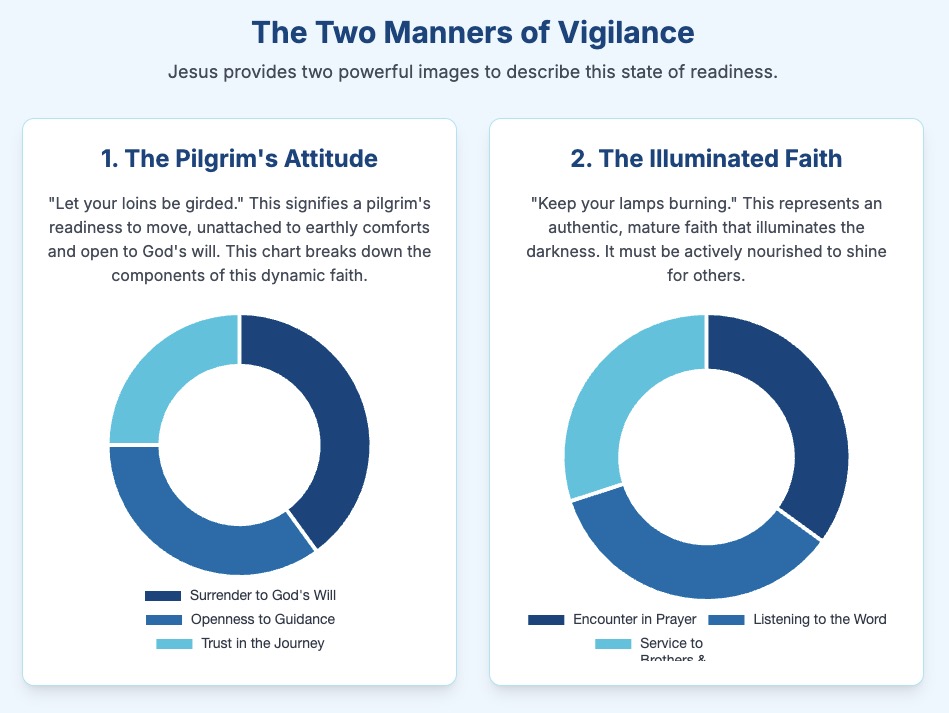
In today’s Gospel passage (cf. Lk 12:32-48), Jesus calls his disciples to be continually vigilant. Why? In order to understand God’s transition in one’s life because God continually passes through life. And he indicates the manners in which to live this vigilance properly: “Let your loins be girded and your lamps burning” (v. 35) This is the way. First and foremost, “the loins girded”, an image that evokes the attitude of the pilgrim, ready to set out on a journey. It is a case of not putting down roots in comfortable and reassuring dwellings but rather to

Benedict XVI Homily Excerpt
8 August 2010 | Castel Gandolfo
In this Sunday’s Gospel passage Jesus continues his teaching to the disciples on the value of the person in God’s eyes and on the futility of mundane worries. This does not mean doing nothing. Indeed, on hearing Jesus’ reassuring invitation: “Fear not, little flock, for it is your Father’s good pleasure to give you the kingdom” (Lk 12: 32), our hearts open up to a hope which illumines and animates real life. We have the certainty that “the Gospel is not merely a communication of things that can be known it is one that makes things happen and is life-changing. The dark door of time, of the future, has been thrown open.
Infographics on this page have been added by THE WORD THIS WEEK using AI generative tools (i.e. Chart.js and Tailwind CSS). They may be copied for personal use or for any non-profit ministry. Graphics may not be sold or used for personal financial gain.
────── ⋆⋅☆⋅⋆ ──────
Deacon Peter McCulloch
19th Sunday of Year C

Heeding the Signs
This discussion guide has been generated by the WORD THIS WEEK'S Catholic AI Assistant based on Deacon Peter's homily.
I. Opening Prayer (Optional)
- Begin with a brief prayer for open eyes, hearts, and minds to recognize God's signs and to prepare for His coming.
II. Introduction: Lessons from Pompeii and the Importance of Signs
- Deacon Peter's homily opens with the historical example of Pompeii, where people ignored warning signs from Mt. Vesuvius, leading to their destruction. He emphasizes the ubiquitous nature and crucial role of signs in recognizing danger and preparing for future events.
- Discussion Questions:
- What is your initial reaction to the story of Pompeii and its connection to "heeding signs"?
- Can you think of other historical or personal examples where ignoring "warning signs" led to negative consequences?
- What are some common "signs" in our modern world (spiritual, social, environmental, etc.) that we might be prone to ignore?

III. Biblical Warnings: Preparing for the Lord's Return
- The homily connects the idea of heeding signs to John the Baptist's call to "prepare the way of the Lord" and Jesus's warning in Luke's Gospel to "stand ready." This readiness refers not only to Jesus's second coming but also to an individual's death and meeting with Christ.
- Discussion Questions:
- What does "prepare the way of the Lord" mean to you in a practical sense for your daily life?
- How does the homily's emphasis on preparing for individual death as a meeting with Christ influence your understanding of readiness?
- Despite the serious message, Deacon Peter reassures the "little flock" that Jesus cares for them. How do we balance this reassurance with the call to vigilant preparation?
IV. Denzel Washington's Perspective: Putting God First
- The homily incorporates the views of American actor Denzel Washington, who speaks about spiritual warfare, having a spiritual anchor, and the importance of "putting God first" as the source of success and protection. He warns that material success is fleeting.
- Discussion Questions:
- How does Denzel Washington's testimony about spiritual warfare and the importance of a "spiritual anchor" resonate with your own experience or beliefs?
- What does "Put God first" mean in the context of material success and professional life? How can this principle protect us from the fleeting nature of worldly achievements?
- Washington states that "you cannot take wealth beyond death." How does this truth impact your perspective on accumulating possessions or striving for worldly recognition?
V. The Faithful Servant and Ongoing Preparation
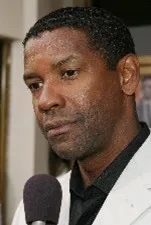
- Deacon Peter likens Denzel Washington to the faithful servant in the Gospel, ready for his master's return. The homily concludes by urging readers to open their eyes, hearts, and minds to prepare themselves, just as there are many warning signs in the world today that should not be ignored.
- Discussion Questions:
- What qualities of a "faithful servant" are highlighted in the homily, both through the Gospel and Denzel Washington's example?
- https://cbn.com/news/news/spiritual-warfare-denzel-washington-pinpoints-key-warning-sign-last-daysHow can we actively "open our eyes, hearts, and minds" to the spiritual "warning signs" in the world around us and within ourselves?
- What does it mean to live a life that is consistently "ready" for the Lord's return, both individually and universally?

VI. Personal Reflection and Application
- Discussion Questions:
- What is one specific "sign" in your life or in the world that you feel God is calling you to heed more closely?
- How can you more effectively "put God first" in your daily decisions and priorities?
- What is one practical step you can take this week to live more intentionally, preparing for your ultimate meeting with Christ?
VII. Closing Prayer (Optional)
Conclude with a prayer for discernment, for unwavering faith, and for the grace to live as vigilant and faithful servants.
Homily Excerpt

Life began as normal in Pompeii on August 24, 79AD. Children played, parents went to market and the rich soaked in thermal baths.
Then at lunchtime, Mt Vesuvius erupted, spewing out huge amounts of hot ash, molten rock and poisonous gas. The city was destroyed and some 16,000 people perished.
The sad thing is that they had all been warned. They knew this was an active volcano, for it had erupted 16 years earlier and they were still repairing the damage. The earth had been rumbling and shaking for days, and there was plenty of smoke. But they chose to ignore these signs.
Signs are important. They warn us of danger and help us prepare for what’s coming. They’re also everywhere: on beaches, roads and train stations. Traffic lights turn orange before going red, and many products have ‘use-by’ dates.

ASCENSION PRESENTS (2:53) – After his final climb, Bl. Pier Giorgio Frassati wrote a simple phrase on a photograph: “Verso L’Alto.” It means “to the heights,” and is has come to encapsulate his outlook on life—and the outlook we can all have.
To the Heights!

Closing Prayer
Lord Jesus, we thank you for the gift of this time together. We ask you to bless us with the strength and courage of Blessed Pier Giorgio Frassati. May we be bold in our charity, joyful in our faith, and always ready to serve you. Help us to shed what weighs us down and to keep our eyes fixed on you, our true and eternal treasure. Amen.
Homily Excerpt
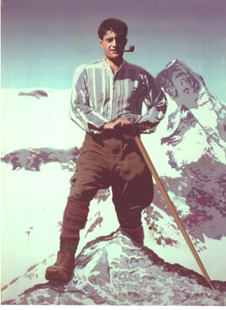
Mountain climbing is more than just trying to reach the summit. It’s also a test of your planning and perseverance.
Fitness and practice are important, too, as is carrying only what you need. It’s also critical to stay focussed on the goal, especially when the going gets tough.
Mountain climbing is a good metaphor for life because we’re all ascending towards something. But here’s the question: what are we climbing towards?
Next month, on September 7, Pope Leo XIV will be canonising Blessed Pier Giorgio Frassati, who was a mountaineer, both literally and spiritually. He was born in Turin, Italy, in 1901.
────── ⋆⋅☆⋅⋆ ──────

19th Sunday of Year C
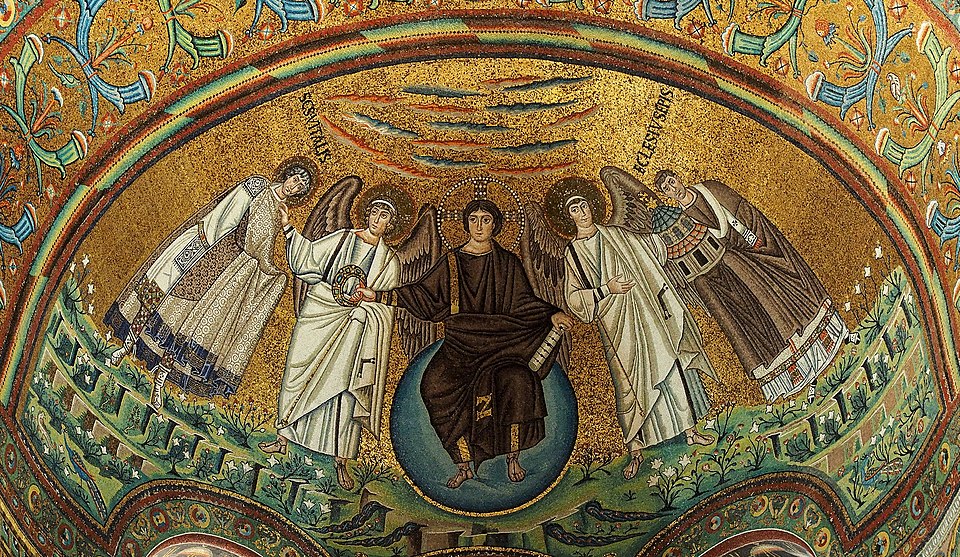
Image: Basilica of San Vitale (Ravenna)
Homily Excerpt

Nineteenth Sunday of the Year. Fr Aidan Nichols preaches on the virtue of hope.
Be like men who are waiting for their master to come home from the marriage feast so that they may open to him at once when he comes and knocks.’ These words are an encouragement by our Lord to practise the virtue of hope.
Not just any kind of hope, of course. There is such a thing as natural hopefulness where we dispose ourselves to be positive about the future: not yearning uselessly for the past where it has been good, not overborne by it where it has been bad, and neither frightened by the present nor complacent about it. That is certainly a very useful attitude to have in life. But it is one that, if are lucky enough to have it, we have taken up ‘off our own bat’, as we say, and it has in view no particular object other than our general welfare.
And that means, then, that it is not, in fact, the hope of the return from the marriage-feast. It is not theological hope. Some people may raise their eyebrows at this. Do Dominicans have to bring theology into absolutely everything? I’m afraid they do. Like the objectors, they live in a God-centred creation where divine action has already laid out the plan of human salvation. Part of living realistically has simply got to be taking full account of that.

This discussion guide has been generated by the WORD THIS WEEK'S Catholic AI Assistant based on the Dominican Blackfriar homily.
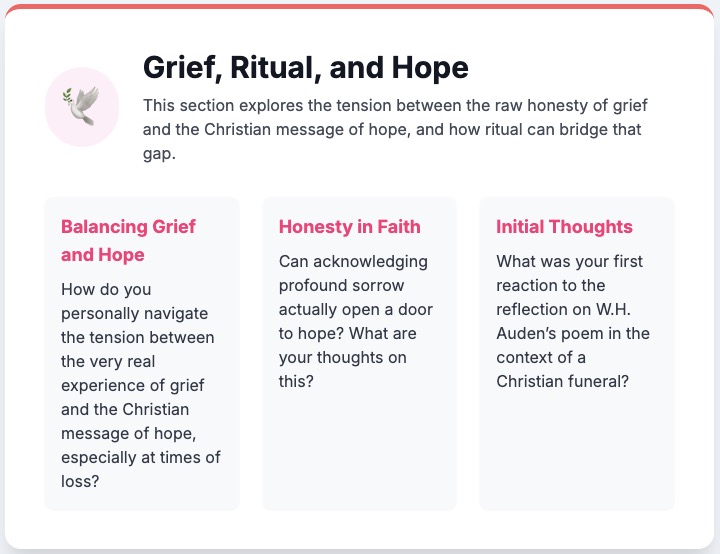
1. Grief, Ritual, and Hope
Father Rocks begins by reflecting on W.H. Auden's poem "Funeral Blues" and its frequent use at funeral services. He questions whether such a stark expression of grief, though honest, truly aligns with the emphasis on Christian hope in a funeral liturgy.
2. The Foundation of Christian Hope
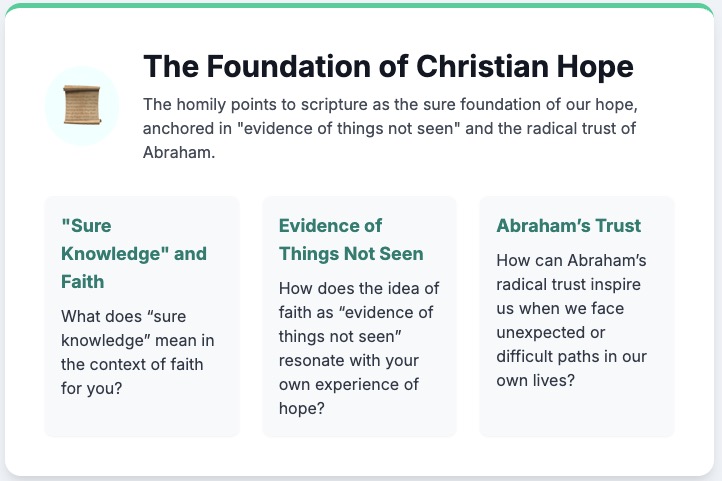
The homily points to the scriptures proclaimed on Sunday (Wisdom and Hebrews) as speaking of ritual and the inheritance of faith. It highlights that "Faith is the realisation of what is hoped for, and evidence of things not seen," and Abraham's example of trusting God even in the face of death.
3. Jesus, Sacrifice, and Our Daily Lives
Father Rocks connects Jesus' parables about preparing for the eternal banquet to his supreme sacrifice on the Cross. He notes that "clocks stopped on Good Friday" and that in "rubric and ritual, we 'do this in memory.'" He then challenges us: "we waste time fretting about so many things – is it because we are afraid to hope in case we are disappointed?"

Homily Excerpt
Nineteenth Sunday of the Year. Fr David Rocks finds hope in the face of mortality.
W.H. Auden’s most quoted poetry includes among it the short poem often entitled Funeral Blues. I’ve lost count of the number of funeral services during which it has been read. Thoughtfully crafted, the poet describes the funeral ritual about to take place before describing in stark tones the experience of grief being endured.
For me, this poem often didn’t sit well in the context of a liturgy for Christian burial or cremation. Faced with the grief that is inevitable on the death of those we love, should not our funeral liturgy emphasise and celebrate our Christian hope? There has been much reflection on hope as we have moved through this Jubilee Year 2025, and so I was moved to reflect on Auden’s poem once again, particularly in the context of the scripture proclaimed this Sunday.
────── ⋆⋅☆⋅⋆ ──────
Fr. Austin Fleming
19th Sunday of Year C
Where Your Treasure is, There will Your Heart Be…
This discussion guide has been generated by the WORD THIS WEEK'S Catholic AI Assistant based on Fr. Austin's homily.
I. Opening Prayer (Optional)
- Begin with a brief prayer for a discerning heart, that we may truly know where our treasure lies and align our lives with eternal worth.
II. Introduction: Funeral Remembrances and True Legacy
- The homily opens by discussing the practice of words of remembrance at funeral Masses and what truly makes for the most impactful remembrances: highlights of the deceased's faith and the gifts they gave to others, rather than material possessions.
- Discussion Questions:
- The homily states that the most impactful funeral remembrances focus on a loved one's "faith and the gifts they gave to others." What kind of memories or actions do you hope people will remember about you at your funeral?
- How does the idea of speaking at a funeral Mass, with its time limits and focus, shape your thoughts on what truly matters in a person's life?
- What is the difference between leaving behind "tangible things and memories" versus "spiritual treasures"?

III. The Nature of Spiritual Treasure
- The homily emphasizes that spiritual treasures, such as respect, honesty, prayerfulness, selflessness, kindness, and showing God's care for the world, are what truly make for the best remembrances at funerals.
- Discussion Questions:
- What are some of the "spiritual treasures" listed in the homily that you strive to cultivate in your own life?
- How do actions like showing respect, honesty, or selflessness reflect "God's care for the world" through our lives?
- Can you share an example of someone whose "spiritual treasures" left a lasting positive impact on you?
IV. Where is Your Heart? Examining Our Treasures
- The homily challenges listeners to consider if these kinds of memories (spiritual treasures) will apply to them and asks what they truly treasure by examining how they spend their time, attention, and resources, particularly in caring for the poor and needy.
- Discussion Questions:
- How does the quote "Where your treasure is, there also will your heart be" challenge you to examine your own priorities?
- In what ways do you currently spend your time, attention, and resources? What do these patterns reveal about what you truly "treasure"?
- The homily specifically mentions "caring for the poor and needy." How does our compassion and action for those in need reflect where our heart and treasure truly lie?
V. The Lord's Table: A Source of True Worth
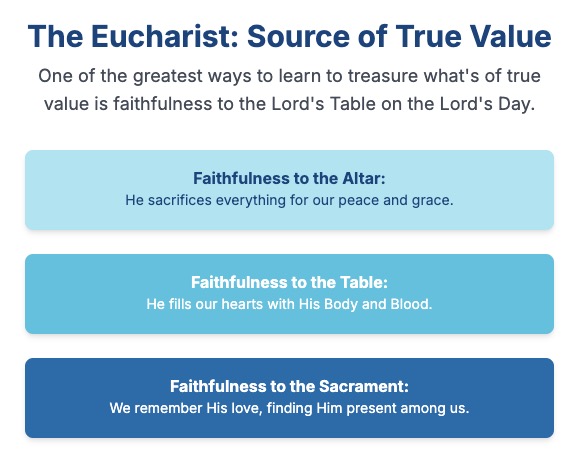
- The homily concludes by suggesting that faithfulness to the Lord's Table on the Lord's Day, where Christ's sacrifice and presence are remembered in the Eucharist, is a key way to learn to value what is of true spiritual worth.
- Discussion Questions:
- How does regular participation in the Eucharist (the Lord's Table) help us to "learn to value what is of true spiritual worth"?
- In what ways does remembering Christ's sacrifice and presence in the Eucharist shape our understanding of love, selflessness, and spiritual treasure?
- How can attending Mass on the Lord's Day serve as a weekly re-calibration of our priorities and a reminder of where our ultimate treasure should be?
VI. Personal Reflection and Application
- Discussion Questions:
- What is one specific "spiritual treasure" you want to intentionally cultivate more deeply in your life starting this week?
- How will you examine your use of time, attention, and resources to better reflect what you truly believe is valuable?
- What is one way you can live more in light of the legacy you wish to leave, focusing on spiritual rather than material wealth?
VII. Closing Prayer (Optional)
- Conclude with a prayer for a heart fixed on heavenly treasures, for generosity, and for a life lived in humble service to God and neighbor.
Homily Excerpt

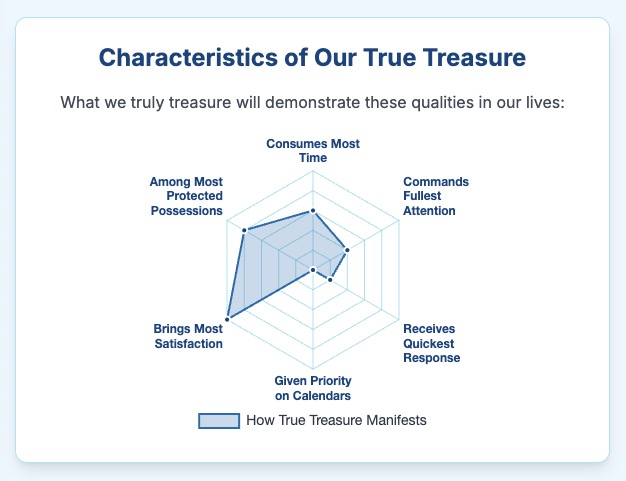
2010 HOMILY — Jesus reminds us that, “Where your treasure is, there also will your heart be.” What do we treasure, you and I? Not what do we wish we treasured, but what do we actually treasure. Shouldn’t it be fair to assume that what we really treasure would:
- consume most of our time?
- command our fullest attention?
- receive our quickest response?
- be given priority on our calendars and schedules?
- bring us the most satisfaction?
- be among our most protected possessions?
If we answer those questions, we might discover what our treasure truly is and where our hearts are. Will we be surprised by our answers? And if we are, what will we do about it? There’s a good chance that should Lord come at an hour we do not expect, our wills and insurance policies will be in order. But what will you and I have planned with the Lord with regards to a kind of spiritual life insurance? When the Lord comes, what “treasure” will he find us holding tight?
Infographics on this page have been added by THE WORD THIS WEEK using AI generative tools (i.e. Chart.js and Tailwind CSS). They may be copied for personal use or for any non-profit ministry. Graphics may not be sold or used for personal financial gain.
────── ⋆⋅☆⋅⋆ ──────
Fr. Jude Siciliano, O.P.

19th Sunday of Year C

Homily Excerpt
For a few days this week our television here at the priory has been giving us trouble. I mentioned to someone after Mass today that we haven’t been able to watch the evening news. He said, “I can’t watch the local and world news these days, it is so upsetting and sad!” I think the same, but I feel somewhat obliged to watch the news, despite the anger and sadness it stirs up in me.
Jesus tells his “little flock” not to be afraid any longer. I want to say, “Are you kidding! Have you seen the latest news about: the cutbacks for the poor; global warming; the wars in the East; violence on our streets; disease, homelessness, hunger etc.?” Maybe we should not get our television fixed; who wants to learn about the justifiable fears so many of our world experience?
Luke spells it out: we are to put first what matters to God. Fear should not be a distraction that draws us away from the work Jesus has given us to do as his disciples. Nor is it to hinder us from hearing and believing His assurance of God’s tender and attentive care for us. While we usually put our confidence in “money bags,” of one kind or another, purses and stock portfolios will wear out, Jesus warns. Instead, our priority is not to the attractions of the world, but to the gift of God’s very self in Jesus, “… For your Father is pleased to give you the kingdom.”
Infographics on this page have been added by THE WORD THIS WEEK using AI generative tools (i.e. Chart.js and Tailwind CSS). They may be copied for personal use or for any non-profit ministry. Graphics may not be sold or used for personal financial gain.
────── ⋆⋅☆⋅⋆ ──────
Fr. Charles E. Irvin
19th Sunday of Year C

Today’s scripture readings put that question to us. What does the future hold in store for us? What awaits us when we die? Is what is awaiting us when we die determined by what we did or didn’t do in this life? These are the big questions we face today and in all of the days of our lives.
Jesus talked with His disciples (and we are His disciples) about the future, telling them they were to face it not with fear but with hope and in a spirit of positive expectancy. He spoke to them in terms of making investments, investments in their future. “Sell what you have,” He told them, and buy into the sort of retirement plan I am offering you, a never-failing treasure with my Father and with me in heaven. “Wherever your treasure lies,” Jesus told us, “there you heart will be.” Stated the other way around he’s telling us: “Wherever your heart is, there will your treasure be found.”
This discussion guide has been generated by the WORD THIS WEEK’S Catholic AI Assistant based on Fr. Irvin’s homily.
I. Opening Prayer (Optional)
- Begin with a brief prayer for an increase in faith and the grace to invest in God’s eternal treasure.
II. Introduction: Facing the Future with Hope
- Fr. Charles Irvin’s homily for the 19th Sunday in Ordinary Time focuses on faith and what awaits us in the future, especially after death. He discusses Jesus’s teaching to His disciples about facing the future with hope and positive expectancy, making “investments” in a never-failing treasure with God in heaven.
- Discussion Questions:
- What are your initial thoughts when considering the “future,” particularly the future beyond this life?
- What does it mean to face the future with “hope and positive expectancy” in a spiritual sense?
- How does the idea of making “investments” in a “never-failing treasure with God in heaven” resonate with you? How does it challenge worldly notions of investment?
III. Faith vs. Secularism: An Inherent Human Quality
- The homily contrasts living by faith with secularist viewpoints that encourage reliance only on what can be perceived and controlled, arguing that secularism often portrays people of faith as foolish or dangerous. Fr. Irvin challenges the idea that one can live without faith, providing examples from everyday life and historical leaders to demonstrate that faith is an inherent part of human existence, even in scientific endeavors.
- Discussion Questions:
- How do you observe secularism portraying people of faith today? Do you agree with Fr. Irvin’s assessment that it often labels them as “foolish or dangerous”?
- Fr. Irvin argues that “no one lives without faith.” Can you think of examples from your own daily life where you exercise faith, even in non-religious contexts (e.g., driving, relationships, scientific trust)?
- How does understanding faith as an “inherent part of human existence” (not exclusive to religion) broaden your perspective on its importance?
IV. Faith in Daily Living and Life’s Big Choices
- The homily emphasizes that faith is not exclusive to religion but is integral to daily living, from simple acts like buying a computer to profound life choices like marriage, raising children, and facing death.
- Discussion Questions:
- How is faith integral to seemingly simple daily acts, as suggested by Fr. Irvin?
- How does faith play a role in significant life choices such as marriage, raising children, or facing personal loss and death?
- Can you share an example from your own life where faith guided you through a difficult or uncertain decision?
V. God’s Faith in Humanity and Our Freedom
- Fr. Irvin concludes by highlighting God’s immense act of faith in humanity, granting individuals the freedom to choose His love and work with Him to bring the world to completion. He finds comfort in God’s trust and high hopes for us.
- Discussion Questions:
- What does it mean to consider “God’s immense act of faith in humanity”? How does this perspective change your understanding of your relationship with God?
- How does the freedom to choose God’s love and work with Him relate to our “investments” in heavenly treasure?
- How does finding “comfort in God’s trust and high hopes for us” inspire you to live your faith more fully?
VI. Personal Application and Closing
- Discussion Questions:
- What is one key insight or challenge from Fr. Irvin’s homily that particularly resonated with you?
- In what areas of your life do you feel called to demonstrate greater faith, especially in the face of uncertainty?
- What is one practical step you can take this week to make a more conscious “investment” in your spiritual treasure with God in heaven?
VII. Closing Prayer (Optional)
Conclude with a prayer for strong faith, for hope in the future, and for the grace to choose God’s love in every aspect of our lives.
────── ⋆⋅☆⋅⋆ ──────
Fr. George Smiga
19th Sunday of Year C
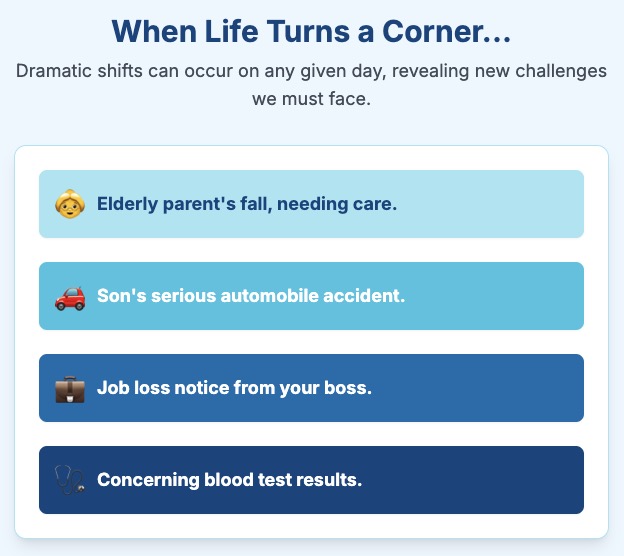

2022 HOMILY – On any given day life can change dramatically. It is like turning a corner and suddenly being able to see, “Oh, that’s what I am going to have to face. This is how my life will run for the next few weeks or months or years.” And Jesus tells us that we should be prepared. But how do we prepare for an hour we do not expect? How do we make ourselves ready for changes that we cannot anticipate? We prepare by living our relationship with God today. We do not know what the future will bring, but Jesus does. When life hands us a difficult turn, we do not want to be alone. When we turn a corner and see what we must face, we want Jesus at our side. The best way to have Jesus at our side then is to make sure that we are a part of Jesus’ life now.
This discussion guide has been generated by the WORD THIS WEEK’S Catholic AI Assistant based on Fr. Smiga’s homily.
I. Opening Prayer (Optional)
- Begin with a brief prayer for the grace to live faithfully each day and to trust in God’s presence through all of life’s uncertainties.
II. Introduction: Life’s Sudden Turns
- Fr. Smiga begins by highlighting Jesus’ command to “be prepared for an hour we do not expect,” interpreting this as a call to be ready for the “sudden turns of life.” He provides vivid examples of unexpected challenges that dramatically change life’s course.
- Discussion Questions:
- What is your initial reaction to the idea of “sudden turns of life” that we cannot anticipate?
- Fr. Smiga gives examples like an elderly parent’s fall, a son’s accident, job loss, or a concerning medical diagnosis. Have you or someone you know experienced a sudden, dramatic change that fits this description? How did it impact life?
- How does the saying, “Nobody can tell what the day will bring,” become particularly poignant when thinking about these dramatic shifts?
III. Preparing for the Unpredictable: Living Our Relationship with God Today
- The core question posed by Fr. Smiga is: “How do we prepare for an hour we do not expect? How do we make ourselves ready for changes that we cannot anticipate?” His answer is: “We prepare by living our relationship with God today.” He emphasizes the desire for Jesus to be at our side during difficult times.
- Discussion Questions:
- Why is “living our relationship with God today” the best way to prepare for an unexpected future?
- How does knowing that “Jesus does” know what the future holds bring comfort?
- When facing a difficult turn in life, why is it crucial “not to be alone” and to “want Jesus at our side”? How does one foster this sense of Jesus’ presence?
IV. Practical Ways to Live Our Faith Today
- Fr. Smiga outlines concrete actions for living our faith today:
- Praying and being thankful for blessings (family, work, abilities), recognizing God’s graciousness and generosity.
- Praying for others (blessing loved ones, healing the sick, curtailing violence and hatred).
- Committing to act on behalf of justice, supporting the poor, and protecting the oppressed in Jesus’ name.
- Discussion Questions:
- How does cultivating “thankfulness” for what we have deepen our understanding of God’s “graciousness and generosity”?
- What impact do you think prayer for others (loved ones, the sick, an end to violence) has, both on those prayed for and on the one praying?
- How does actively seeking justice, supporting the poor, and protecting the oppressed, “in Jesus’ name,” prepare us for future trials?
V. Readiness for the Heavy Trial: Knowing Jesus Already
- The homily concludes by stating that by living a life of faith today, praying and acting as those who belong to Jesus, “Then, when the day comes that we must face a heavy trial, we will not have to introduce ourselves to Jesus and explain to him who we are.” We will be ready “because Jesus will already be standing at our side.”
- Discussion Questions:
- What does it mean not to “have to introduce ourselves to Jesus and explain to him who we are” when a heavy trial comes?
- How does a consistent life of faith build confidence and peace in the face of suffering or uncertainty?
- Reflect on the final image: “when the knock comes at the door or the phone rings in the middle of the night, we will be ready, because Jesus will already be standing at our side.” How does this image inspire you?
VI. Personal Application and Closing
- Discussion Questions:
- What is one specific “sudden turn of life” that you feel called to prepare for more intentionally through your faith?
- Which of Fr. Smiga’s suggestions for living our faith today (thankfulness, prayer for others, acts of justice) do you feel called to strengthen in your life this week?
- How can you deepen your daily relationship with Jesus so that you are confident He will be at your side no matter what unexpected challenges arise?
VII. Closing Prayer (Optional)
Conclude with a prayer for persistent faith, for the courage to act justly, and for the comfort of Jesus’ constant presence in our lives.
Infographics on this page have been added by THE WORD THIS WEEK using AI generative tools (i.e. Chart.js and Tailwind CSS). They may be copied for personal use or for any non-profit ministry. Graphics may not be sold or used for personal financial gain.
────── ⋆⋅☆⋅⋆ ──────
19th Sunday of Year C

God’s Oath
Homily Excerpt
God swore an oath to Abraham; he swore an oath to us in Christ. He sets us free from error, sin, and death through the cross and resurrection of Christ – a cross and resurrection in which we share. Every one of the sacraments, in fact, is an oath (which is what the word “sacramentum” means). When, for example, our sins are forgiven in the Sacrament of Penance, God gives us his oath that we are forgiven, and also that his grace is with us to resist temptation in the future. When we are confirmed, the oath of God is that the power of the Holy Spirit will enable us to bear witness to Christ and stand faithful to his truth in every circumstance of our interaction with a sometimes hostile world. In the Sacrament of Marriage, the spouses are not the only ones making oaths. God makes an oath, that he will provide every ounce of grace and strength they will need to be faithful.
────── ⋆⋅☆⋅⋆ ──────
19th Sunday of Year C

Responding to Faith
Homily Excerpt

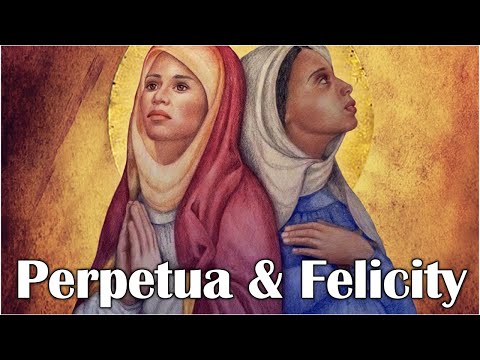
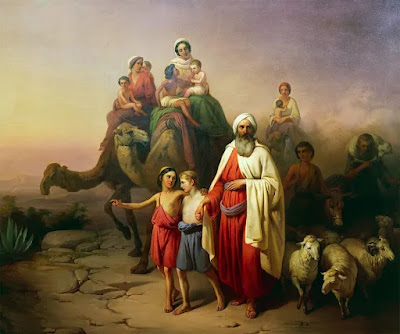
Today’s readings speak about faith and our response to faith. They begin with Abraham, the Father of Faith. Abraham was a prosperous man of his time, living in Ur, located in the fertile area between the Tigris and Euphrates River. He became convinced that God was calling him, directing him. He had faith that God would care for him. He trusted in God to build his offspring into a nation, even though he had no children by his wife, Sarah. Abraham was a man of faith. He had faith in God, and he had faith that what God was asking him to do would be for the good of others, his offspring, and myriads and myriads of people, more numerous than the sands of the shore. Because of Abraham’s faith, God’s Son, the Savior, would come through these people. When in Genesis 24, Abraham sent his servant to Ur to find a wife for his son, Isaac, Abraham made it clear that the servant was never to take Isaac himself back to Ur. There would be no turning back…
I want to once more tell you the story of two young girls, just ordinary girls of their time, who were so full of faith…
────── ⋆⋅☆⋅⋆ ──────
19th Sunday of Year C

Recipe for Readiness
Homily Excerpt
While Jesus begins by saying that we ought not to fear (for the Father wants to grant us His Kingdom), He also warns that being free of fear is contingent upon embracing and following the plan that He sets forth for our life.
Let’s look at this plan and see how we can forsake fear by becoming and remaining ready. Jesus gives us five specific things to do that will help to ready us for the time when the Lord calls us. It is not an exhaustive list, for no single passage of Scripture is the whole of Scripture, but these are some very practical and specific things to reflect upon and do.
I. Reassess your wealth
II. Ready yourself to work
III. Read the Word
IV. Remain watchful
V. Reflect on your reward

────── ⋆⋅☆⋅⋆ ──────
Fr. Michael Chua
19th Sunday of Year C

Homily Excerpt
I don’t know anybody who thinks that the end of world is a good thing; but actually, I know a few good people who want the end of the world to happen. I’m going to make a public confession – I’m one of them. Whenever someone presents me with a litany of problems, problems beyond my capacity to resolve, I would just utter the ancient Aramaic prayer, “Maranatha” – “Come O Lord!” (Please come!) For many, the end times may seem dreadfully frightening but for me, and indeed for the Church and as it should be for every Christian, an immensely desirable event, when Christ will come in glory to vindicate the innocent and punish the wicked, put an end to suffering, pain, turmoil, violence and evil and finally, set things right.
The end of the world is Good News. That’s right. You didn’t hear me wrong and it was no slip of the tongue on my part. In today’s Gospel our Lord gives us the promise of the end of the world specifically as a consolation and not as a cause for anxiety: “There is no need to be afraid, little flock, for it has pleased your Father to give you the kingdom.” This is certainly the case for those who have been faithful, as the Master in the parable will be seen rewarding the faithful servants on his return. But for the others, who did not anticipate the Master’s return, then his coming would certainly be a dread moment of judgment and punishment.

Homily Excerpt
Today’s Gospel has two parts – the first is a set of prescriptions concerning material wealth and the second, is a set of short parables about vigilance and stewardship. The first part makes a good transition from last week’s reading where our Lord told the parable of the Rich Fool, emphasising the futility of hoarding earthly treasures. In contrast to the Rich Fool who hoarded his wealth and refused to share it with others, we are told in today’s passage to share it with others through almsgiving. Instead of accumulating earthly wealth, almsgiving is storing up “treasure that will not fail you, in heaven where no thief can reach it and no moth destroy it.” Here’s the irony of true worth, the more we give away, the more enriched we become. The Lord then sums up His teaching on trusting God’s providence rather than earthly wealth with this saying: “For where your treasure is, there will your heart be also.”
The topic abruptly changes as the Lord now instructs His disciples with parables based on eschatological themes concerning the master’s coming: the vigilance required of servants awaiting their master; a household owner not knowing what time the thief comes and finally a steward’s duties during his master’s absence. Is our Lord referring to His passion, death and resurrection or is He referring to His second coming at the end of this age? The text is deliberately ambivalent and could very well be taken to refer to both events.
This discussion guide has been generated by the WORD THIS WEEK'S Catholic AI Assistant based on Fr. Chua's homily.

Opening Questions
- Fr. Chua begins with the song "I Can See Clearly Now" by Johnny Nash. What does that song or its lyrics mean to you? Can you recall a time in your life when the "rain" stopped and you had a moment of clarity?
- The homily describes how faith gave biblical figures a "piercing vision" to overcome obstacles. Who are some people in your own life—past or present—whose faith has been a source of inspiration for you?
The Treasure of Faith
- Fr. Chua connects the heroes of the Old Testament to Jesus's call to "sell your possessions and give alms" and "get yourselves purses that do not wear out." Why is it so difficult to let go of our earthly treasures and focus on heavenly ones?
- The homily states that our "ultimate destination and true home" is heaven. How does holding this belief change the way you live your daily life? How does it affect your perspective on suffering or hardship?
- Fr. Chua says that having a vision of heaven "does not mean that we should just sit on our hands and do nothing." What are some practical ways we can actively work toward the Kingdom of God in our daily lives?
Dressed for Action
- The homily mentions two metaphors from the Gospel: being "dressed for action" and having our "lamps lit." What do these two metaphors mean to you in a practical sense?
- Fr. Chua says, "Christian discipleship is a call to action, not a license to loiter on your sofa." In what ways can we be tempted to "loiter" in our faith?
- The homily warns against being caught "off guard" and promises a reward for the vigilant servant and a warning for the unfaithful one. What keeps you vigilant and active in your faith, and what are some things that might cause you to become complacent?
A Journey into Joy
- How can we, as a community, help one another on this journey of faith, so that our hope becomes "believable" to others?ugh Christ our Lord. Amen.
- Fr. Chua concludes by describing our lives as a pilgrimage, a "journey into joy." How do you view your own spiritual journey? Is it a straight path, or does it have twists and turns?
- The homily ends with the hymn "Abide with Me." What parts of that hymn or its message resonate with you? How does the image of Christ's cross shining through the gloom bring you hope?
Homily Excerpt
One of my favourite feel-good go-to songs when I need an emotional uplift is that classic 70s song by Johnny Nash, “I can see clearly now.” For those of you millennials, Gen Z’s and Alphas who do not know what I’m talking about, here are the lyrics: “I can see clearly now, the rain is gone. I can see all obstacles in my way. Gone are the dark clouds that had me blind. It’s gonna’ be a bright (bright), bright (bright), sunshiny day”.
I love the lyrics. Here is a person who has known the wet rainy days of life, when the sun is obscured by the dark clouds of pain, misery and loss. When the “hard rain” is pouring down all around, it’s easy to miss the beauty around you, the opportunities open to you. But everything changes when the rain stops. And there is a certainty that the rain will stop no matter how long we may have to endure it. We have arrived at a moment of clarity. Now that the rain is gone, the fog has dissipated, we can finally see the obstacles preventing us from the goals and dreams we have been pursuing without success.
This is what the faithful men and women of the Bible experienced, and the testimony of their faith is what we heard in the second reading taken from the letter to the Hebrews. It is through the piercing vision of faith that they were able to hope beyond hope, to keep on moving despite all the obstacles and setbacks, to persevere in spite of failure, and to reach their goals and beyond.
19th Sunday of Year C
We Go to Jesus and
He Feeds Us
Homily Excerpt
One of the ways we are ready for the time when Jesus will call us is by making prayer an important part of every day. Some are called to do this in a special way: the monks in monasteries and the nuns in cloistered convents—for example, the Cistercians, the Benedictines, the Poor Clares, and the Carmelites, among others, all of whom are no more than about 90 minutes from here. Five or seven times each day they gather in their chapel for community prayer as well as Mass. Each time they gather for prayer, their prayer consists of singing three psalms, following by a reading from Sacred Scripture and other prayers. Some of these monasteries around the world livestream their chapels so others can join them online in these moments of prayer. If you are ever organizing a day out or a tour, perhaps you might consider visiting one of these monasteries or cloistered convents to join in their prayer or Mass.
Nineteenth Sunday
Deacon Greg’s blog has garnered some 20 million readers from around the world since its inception in 2007.
19th Sunday of Year C

PBS NEWSHOUR (06:16) – The baseball world mourned the loss of the Hall of Fame sportscaster Vin Scully, who died at the age of 94 in 2022. He called games for the Los Angeles Dodgers for 67 years, the longest tenure any broadcaster has had with a professional team.
This Isn’t the Only Stop
on the Train
This discussion guide has been generated by the WORD THIS WEEK'S Catholic AI Assistant based on Deacon Greg's homily.
I. Opening Prayer (Optional)
- Begin with a brief prayer for wisdom to understand life's true destination and the grace to prepare for it.
II. Introduction: Vin Scully and the Enduring Perspective
- Deacon Greg Kandra's homily uses the life and faith of legendary sports announcer Vin Scully, particularly his encounter with Pope Pius XII and his famous quote, "This isn't the only stop on the train," to emphasize the importance of investing in spiritual treasures rather than worldly possessions.
- Discussion Questions:
- What is your immediate reaction to the quote, "This isn't the only stop on the train," in the context of life and faith?
- How does the example of a public figure like Vin Scully, known for his professional achievements, help to illustrate the importance of deep personal faith?
- What does the homily suggest about the difference between worldly success and true fulfillment?
III. Scully's Faith and the Gospel Message
- The homily highlights Scully's deep faith, which sustained him through personal tragedies, and his belief in serving others ("being 'with them'"). It connects these life lessons to the Gospel message of storing up treasure in heaven.
- Discussion Questions:
- How did Vin Scully's faith apparently sustain him through personal tragedies? Can you recall times when your faith sustained you through difficulties?
- What does "being 'with them'" (serving others) mean in a practical sense in your daily life? How does this align with the Gospel's call to love our neighbor?
- What are some concrete ways we can "store up treasure in heaven" through actions of mercy, forgiveness, patience, and prayer, as suggested by the homily?
IV. Life as a Journey, Not a Destination
- The core message of the homily is that life on Earth is not the final destination. Individuals should live in expectation of what is to come, sustained by faith, and preparing for their ultimate judgment.
- Discussion Questions:
- How does viewing life as a "train" with multiple "stops" change your perspective on challenges, setbacks, or even successes?
- What does it mean to "live in expectation of what is to come"? How does this hope influence how we live today?
- In what ways can our daily lives become a preparation for our "ultimate judgment"?
V. Investing in the Eternal
- The homily contrasts investing in "worldly possessions" with investing in "spiritual treasures."
- Discussion Questions:
- What are some of the "worldly possessions" or pursuits that often distract us from spiritual investment?
- How does prioritizing "spiritual treasures" lead to a more meaningful and lasting sense of purpose?
- Can you identify specific ways you can re-evaluate your investments (time, energy, resources) to align more with eternal values?
VI. Personal Reflection and Application
- Discussion Questions:
- What is one key takeaway or insight from Deacon Kandra's homily that particularly resonated with you?
- In what areas of your life are you most tempted to view this earthly life as the "only stop on the train"?
- What is one practical step you can take this week to live more intentionally, remembering that "this isn't the only stop on the train," and preparing for your ultimate destination?
VII. Closing Prayer (Optional)
- Conclude with a prayer for persistent faith, for the wisdom to discern true treasure, and for the grace to live each day in joyful expectation of God's eternal Kingdom.
Homily Excerpt
2022 HOMILY— He was known as “the voice of summer” — Vincent Edward Scully, Vin Scully, simply the greatest sports announcer of all time...
But we also lost someone who announced more than just hits, runs and errors. In his way, Vin Scully also announced the Good News. And he understood, deeply, the point of this Gospel we just heard. “Where your treasure is, there also will your heart be.” The question before us this day: Where is our treasure?
────── ⋆⋅☆⋅⋆ ──────
19th Sunday of Year C
Homily Excerpt
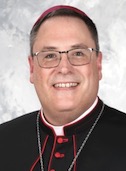
The culture in which we live seems to encourage vacating more often than recreating in my opinion. After a hard day at work or school the temptation might be to return home, open that bottle of wine or beer after beer, and sit in front of the television for hours or, if you are younger, play video games into the middle of the night, or mindlessly surfing the web and going to sites that are simply not good for anybody, like pornography sites. Why do people go to pornography sites? At the root of it, I think the idea of going to pornography sites is to vacate, escape, self-medicate, and forget. I think all addictions start out that way, alcohol, drugs, sex, gambling, the list goes on. We live in a society that encourages these addictions. Our society demands so much of people, it piles on so many responsibilities and expectations, and then sells us a million ways to vacate. It can turn into a vicious cycle which we could identify as funny if it weren’t so tragic. People work to make money so that they can afford the things, activities, and addictions that help them to forget about work, which of course puts them into deeper debt, ironically causing them even more work! Welcome to America folks.
Please note that the provided video clips serve as additional resources to complement the homily. They may not have a direct correlation with the contributor’s original content. They aim to inspire preachers to enrich their own homilies, drawing ideas and insights from both the written material and the visual content explored.