August 24, 2025
August 24, 2025


Deacon Greg’s blog has garnered some 20 million readers from around the world since its inception in 2007.
Infographics were generated using Google Gemini 2.5 AI tools (w/ Chart.js and Tailwind CSS). Feel free to use them in any non-profit ministry. A Link or shoutout to THE WORD THIS WEEK would be greatly appreciated. —Fr. Don.
21st Sunday of Year C

NBC SPORTS (01:37) – Simone Biles’ final balance beam routine of 2016 Rio Olympics
Walking the Balance Beam

Key Themes & Scripture
- The Balance Beam of Faith: The core metaphor that a Catholic Christian's life is a performance on a narrow path that requires discipline, practice, and precision.
- The Urgency of Jesus's Message: Jesus's warnings in Luke's Gospel are presented as an urgent, "last chance" message as he journeys to Jerusalem.
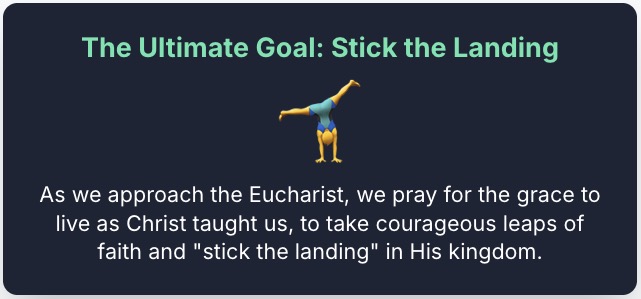
- Grace: The Power to Succeed: The homily emphasizes that grace from the sacraments makes the difficult Christian life "do-able," enabling us to take "leaps of faith" and "stick the landing."
- The Narrow Gate as Christ: Jesus is not just the gate; he is the way, the balance beam itself. We stay on the beam by following his teachings.
- The Gospel in Our Hands: The homily uses St. Teresa of Calcutta's words to remind us that our faith is not abstract. It is a call to action, and our love and care for others is a direct reflection of our love for Christ.
- Scripture: The homily is based on Luke 13:22-30 (the narrow gate) and quotes John 14:6 ("I am the way and the truth and the life") and Matthew 25:40 ("Whatever you did to the least of these, you did to me").

Discussion Questions
- Deacon Greg Kandra's homily compares our Christian life to a performance on a balance beam. How does this metaphor resonate with your own experience of faith? What makes this a compelling image for you?
- The homily states that Jesus's warnings have an "urgency." How does this urgency affect your approach to your faith? Does it feel frightening or motivating?
- What is a specific "leap of faith" you feel called to take in your life right now? What kind of practice or discipline do you think you need to "stick the landing"?
- The homily asks a series of challenging questions, such as, "Do we care for the forgotten, neglected, abused, marginalized?" Which of these questions do you find most difficult to answer honestly, and why?
- The homilist uses St. Teresa of Calcutta's example to show that the Gospel is in our hands. What is one practical way you can live with the "Gospel in your hand" this week?
- The homily states that grace makes the impossible possible. Can you share a time in your life when you felt that God's grace helped you do something you couldn't have done on your own?
Discussion guides and Infographics on this page have been created using AI generative tools (i.e. GOOGLE'S AI Gemini 2.5 Flash LLM, Chart.js and Tailwind CSS). They are free to use for any non-profit ministry. THE WORD THIS WEEK kindly requests that you show your appreciation by sharing a link to the website.
Homily Excerpt
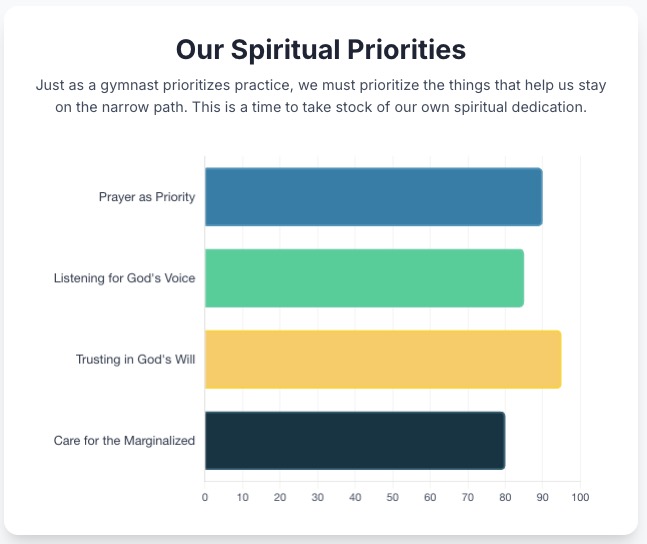
2016 HOMILY— Every gymnast will tell you that you that the balance beam demands time, practice, sacrifice. The narrow gate, the narrow beam, asks more. The narrow way of the Catholic Christian calls us to stand straighter and try harder. With this Gospel before us, this Sunday is a good time to take stock.
────── ⋆⋅☆⋅⋆ ──────
Deacon Peter McCulloch
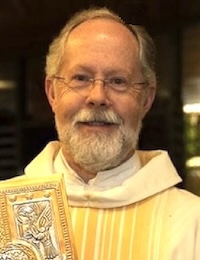
Deacon of the
Diocese of Broken Bay, Australia
Infographics were generated using Google Gemini 2.5 AI tools (w/ Chart.js and Tailwind CSS). Feel free to use them in any non-profit ministry. A Link or shoutout to THE WORD THIS WEEK would be greatly appreciated. —Fr. Don.
21st Sunday of Year C

The Butterfly
Suffering Is Not God's Punishment: Deacon Peter's homily
begins by clarifying a common misconception: God doesn't make us suffer. The text emphasizes that God is love and that while He allows suffering, He does so for a purpose, not to punish.

Choosing Our Response to Suffering: Using Victor Frankl's story, Deacon Peter challenges the congregation to see suffering not as a defeat, but as an opportunity. We may not be able to control our circumstances, but we can always choose our response, finding meaning and purpose in our pain.
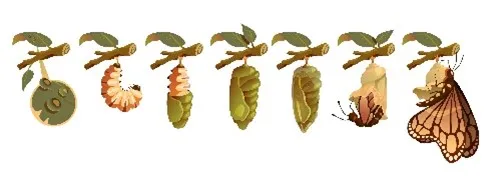
Finding Meaning in Union with Christ: Deacon Peter's homily concludes by offering Jesus as the ultimate model for us to follow. By uniting our suffering with His, we can find meaning, hope, and healing. The analogy of the butterfly's struggle to escape its cocoon is a powerful visual to illustrate that suffering is a necessary and natural part of life that strengthens us for the journey ahead.

Small Group Discussion Questions
- Understanding Your Pain: How does categorizing suffering into "from self," "for self," and "for others" help you understand your own experiences of pain in a new way?
- Suffering as a Warning: Can you think of a time when the pain from a bad habit or a poor choice was a warning from God that it was time to change your behavior?
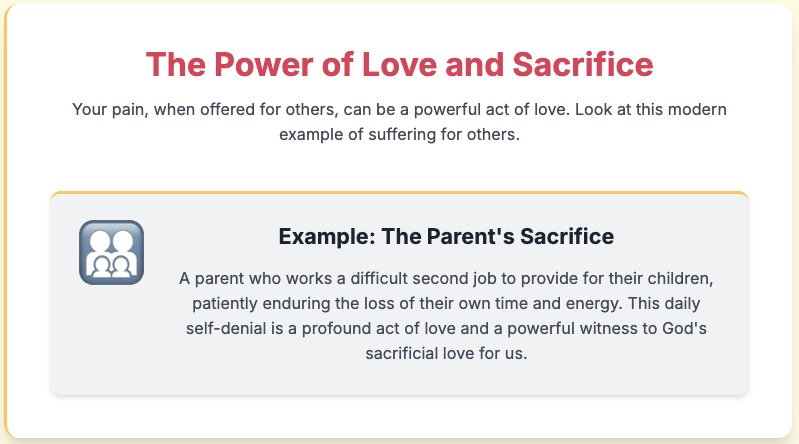
- The Path of Love: The homily states that "suffering for others" is the highest form of suffering. What does this mean to you, and what is a practical example of how you can offer up a small sacrifice for others this week?
Questions for Preachers
- How can I use the three categories of suffering to help my congregation understand their own experiences of pain?
- What is a specific, modern-day example of "suffering for others" that can inspire the faithful to see their sacrifices as acts of love?
- How can I speak honestly about the reality of suffering without causing fear, while still challenging the congregation to embrace it as a path to holiness?
- How can I connect the stories of Victor Frankl and the butterfly to the cross of Christ, showing that even in the most profound suffering, there is meaning and hope?
The goal is to deliver a message that is both realistic about the struggles of the Christian life and deeply encouraging about the power of grace and the promise of eternal life.
Discussion guides and Infographics on this page have been created using AI generative tools (i.e. GOOGLE'S AI Gemini 2.5 Flash LLM, Chart.js and Tailwind CSS). They are free to use for any non-profit ministry. THE WORD THIS WEEK kindly requests that you show your appreciation by sharing a link to the website.
Homily Excerpt

In her book Nudging Conversions, Carrie Gress identifies three kinds of suffering.
- Suffering from Self, because it’s caused by sin.
- Suffering for Self, and she compares it to purgatory.
- Suffering for Others. It’s close to heaven, she says, for it comes from genuinely loving and sacrificing ourselves for others. This is how Jesus loves.
Butterflies begin life tightly wrapped up in a cocoon. Then, when the time comes, they struggle to escape. Some people think it’s nice to relieve their suffering, by helping them get out. But that’s a mistake.
When butterflies wriggle and struggle out of their cocoon, their movements release a chemical that’s pumped into their wings. This fluid strengthens their muscles and helps their wings expand.
If butterflies don’t struggle like this, they quickly die.

MOVIE TRAILER (1:57) – THE SECRET GARDEN (1993)
The Secret Garden
Part 1: The Story and the Metaphor
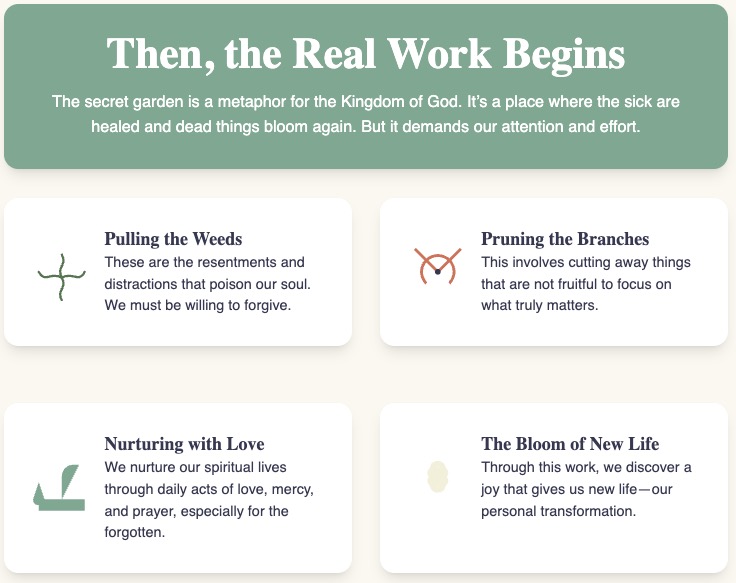
The homily begins with the story of The Secret Garden, where a neglected, hidden garden is brought back to life, and in the process, heals the children who tend to it.
- Were you familiar with the story of The Secret Garden before this homily? What aspects of the story—the lonely girl, the hidden key, the forgotten garden, the healing power of work—stood out to you most?
- Deacon Peter uses the secret garden as a metaphor for the Kingdom of God. What did you find powerful or insightful about this comparison? In what ways is God's Kingdom sometimes "hidden," "locked," or "forgotten" in our world today?
- The homily says that as Mary Lennox cared for the garden, "something else starts to blossom: her heart." Have you ever experienced a time when doing hard, selfless work for someone or something else changed you for the better?
Part 2: The Narrow Door (Luke 13:22-30)
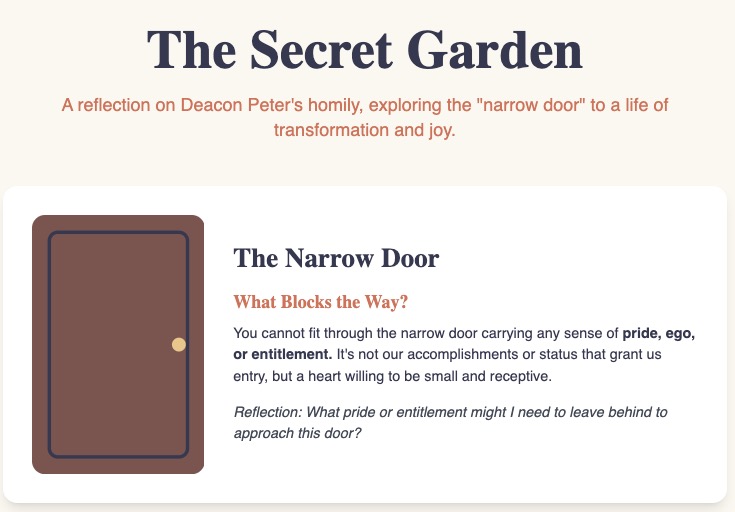
Jesus speaks of a "narrow door" and urges us to "try our best to enter it." Deacon Peter connects this to the door of the secret garden.
- The homily states, "You cannot fit through that door carrying any sense of pride, ego or entitlement." What do these things look like in our daily lives? Can you share an example of a time when letting go of pride or ego was necessary to move forward?
- Jesus redirects the question from "Will many be saved?" to the personal challenge of entering the narrow door. Deacon Peter lists several "better questions" to ask ourselves:
- Am I willing to change to fit through that narrow door?
- Am I willing to forgive, to let go of the resentment that poisons my soul?
- Will I drop the distractions that block me from truly loving God and my family?
- Am I humble enough to accept help and to apologise when I’m wrong?
- Will I reach out to those who are forgotten and unloved?
- The work in the garden—digging, pruning, tending—was hard. The homily suggests our spiritual life is the same. What are the spiritual equivalents of "pulling weeds" and "pruning branches" in our lives?
Part 3: Shaking Off Complacency
The homily warns against the comfortable assumption that because we are "good people" or know about Jesus, our salvation is guaranteed.
- Jesus says, "the last will be first, and the first will be last." He also notes that people will come from "east and west, from north and south" to enter the Kingdom. How does this challenge our assumptions about who is "in" and who is "out"?
- Why do you think the idea of "I'm a good person, so I'm set" is so dangerous to our spiritual growth? How does the "narrow door" call us to a daily, active faith rather than a passive one?
Part 4: Our "Yes" is the Key
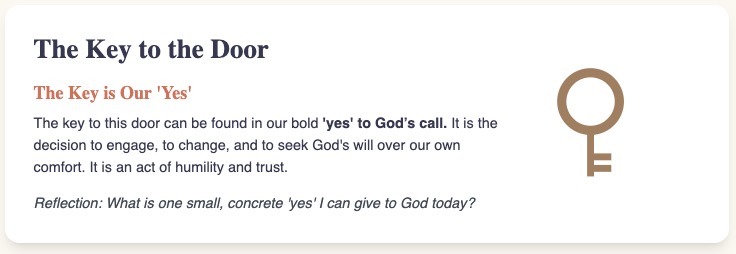
The homily concludes that the "key to this door can be found in our bold ‘yes’ to God’s call."
- Mary first had to find the key, then the door, before she could even begin the work. What is the first step for us in seeking the "narrow door" in our own lives?
- What does a "bold 'yes' to God" look like for you this week? It doesn't have to be a monumental act. What is one small, concrete way you can "unlock the door" and "tend the garden" in your life, your family, or your community?
Discussion guides and Infographics on this page have been created using AI generative tools (i.e. GOOGLE'S AI Gemini 2.5 Flash LLM, Chart.js and Tailwind CSS). They are free to use for any non-profit ministry. THE WORD THIS WEEK kindly requests that you show your appreciation by sharing a link to the website.
Homily Excerpt

This secret garden is a fine metaphor for the Kingdom of God. It’s a very special place where the sick are healed, dead things bloom again, and joy returns.
Unfortunately, it’s hidden and forgotten by too many people today. They’ve forgotten it because they believe it’s no longer important. ‘We’re going to heaven anyway,’ they think, ‘so why should we bother?’
Or they might think ‘we’re good people, so heaven must surely be ours.’
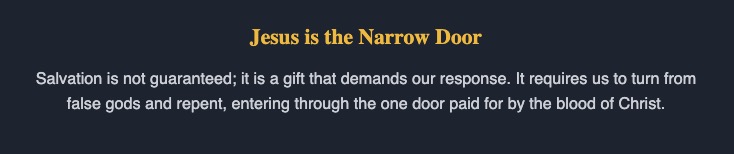
Jesus is trying to shake us out of this complacency. In John 10:9, Jesus tells us that he is the door, and today he says this door is narrow and not everyone will enter it.
────── ⋆⋅☆⋅⋆ ──────

Dominican Friars
of England & Wales,
Scotland
Infographics were generated using Google Gemini 2.5 AI tools (w/ Chart.js and Tailwind CSS). Feel free to use them in any non-profit ministry. A Link or shoutout to THE WORD THIS WEEK would be greatly appreciated. —Fr. Don.
21st Sunday of Year C

Initial Reflections and Gospel Context
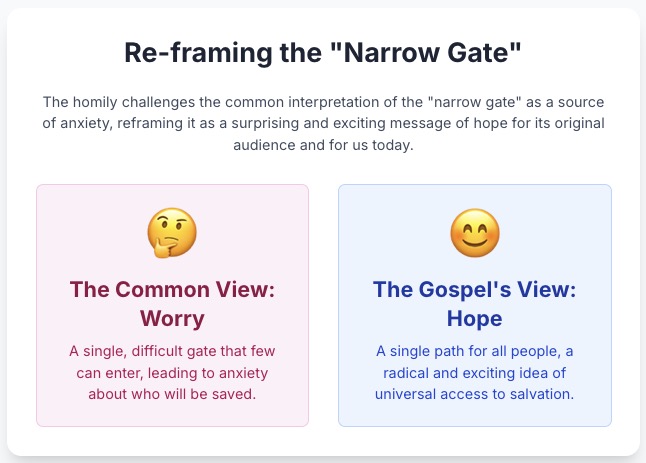
- Opening Question: What was your first reaction to the title, "A Gate in Many Places," and the article's core argument that the narrow gate is encouraging, not worrying?
- Connecting to the Gospel: Read aloud Luke 13:22-30. How does the passage's tone and message compare to the article's interpretation?
- The Original Audience: The author notes that Jesus’s audience would have found the idea of a single gate for all kinds of people "very surprising and exciting." Why do you think this would have been the case? How does this historical context change your understanding of the passage?
Deconstructing the "Narrow Gate"
- The Two Key Points: The author identifies two crucial points about the narrow gate:
- There is a sure path to salvation.
- Entry can be tricky.
- Discuss these two points. Do they seem contradictory? How does the article reconcile them?
- Personal Application: How does the idea of "squeezing through the narrow door" resonate with your own spiritual journey? What are the "difficulties" or "different paths" that the author mentions?
- Free Will: The article states that some people "misuse the gift of our freedom." What does this mean in the context of salvation? How does it relate to the master's "discretion" to admit people?
The "Gate in Many Places" and the Eucharist
- The Abstract Image: Ryan introduces a unique understanding of the gate: "a gate that’s not tied or limited to one place." What does this image mean to you? How is this different from our usual understanding of gates?
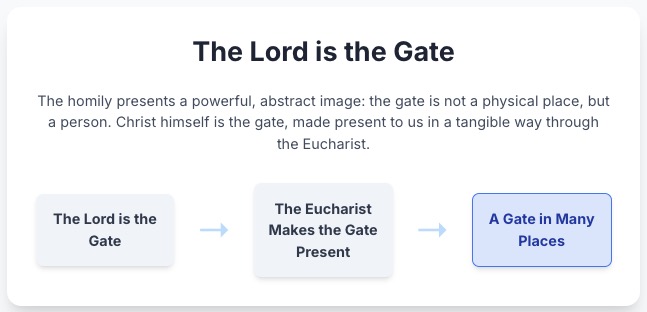
- The Lord as the Gate: The author makes the powerful statement, "Indeed the Lord is the gate." He then connects this to the Eucharist, quoting St. Thomas Aquinas.
- What does it mean to say that the Lord is the gate?
- How does the celebration of the Mass make the "gate" present in "many places"?
- What is the significance of the Eucharist being this "gate"?
- Increased Access: The author argues that a gate available in many places "will have a much broader range of access." How does this idea increase your sense of hope regarding salvation?
Conclusion and Call to Action
- Focus on Discipleship: The final paragraph shifts the focus from worrying about "who or how many people will be saved" to focusing on our own "discipleship."
- What does "discipleship" look like in your daily life?
- How does focusing on your own actions, rather than the fate of others, change your perspective on this topic?
- Gratitude: The author concludes by saying, "let’s be grateful just how firmly the odds are stacked in our favour."
- Do you feel that the odds are "stacked in your favour"? Why or why not?
- What in this article makes you feel a sense of gratitude and hope?
- Closing Prayer/Reflection: Take a moment to reflect on the readings and the discussion. How can the image of "the Lord as the gate" be a source of encouragement and a guide for your life this week?
Discussion guides and Infographics on this page have been created using AI generative tools (i.e. GOOGLE'S AI Gemini 2.5 Flash LLM, Chart.js and Tailwind CSS). They are free to use for any non-profit ministry. THE WORD THIS WEEK kindly requests that you show your appreciation by sharing a link to the website.
Homily Excerpt

Twenty-First Sunday of the Year. Fr Dominic Ryan suggests that the image of the narrow gate is encouraging, not worrying.
We tend to think of gates as tied to or limited by particular places: Gate A is at point B and leads to place C. That’s fine and fits with our experience but it’s not quite what Our Lord is getting at. To understand we have to imagine a gate that’s not tied or limited to one place. Gate A is at point B, D, E, and so on but always leads to one and the same place, C. In principle this gate is available at any place where the Lord is: here in Blackfriars Oxford, up the road at the Oratory, and anywhere else where Mass is being celebrated. Indeed the Lord is the gate, present at Mass through the mode of substance, as St Thomas put it, but leading to heaven where again the Lord is present, this time through the mode of quantity.
Part 1: The Setting and the Question
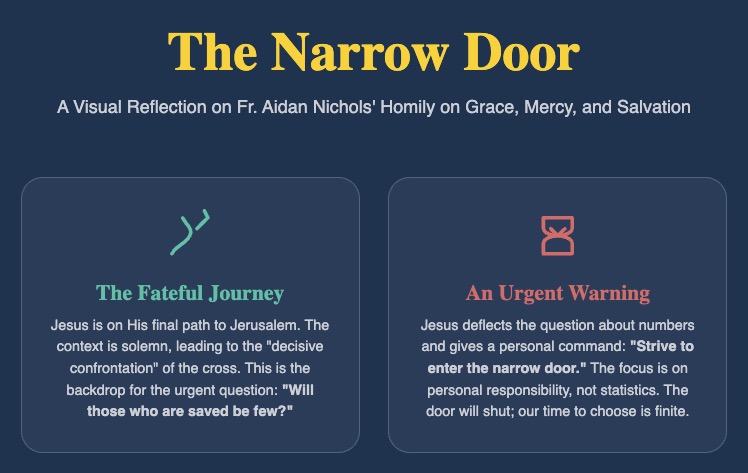
The homily begins by establishing the solemn context of the Gospel: Jesus is on his final, fateful journey to Jerusalem.
- Fr. Nichols emphasizes that for St. Luke, this journey is not just a trip, but the path to the "decisive confrontation" that will bring about our redemption. How does knowing this context change the way you hear the question, "Lord, will those who are saved be few?"
- Why do you think this question was "not far from the hearts, if not the minds, of all the disciples"? What might they have been observing that would lead them to believe that very few people would ultimately be saved?
Part 2: The Unanswered Question and the Urgent Warning
Jesus redirects the questioner away from a number and toward a personal, urgent task.
- Instead of answering "how many," Jesus says, "Strive to enter through the narrow door." What is the difference between these two focuses? Why is Jesus' redirection a more loving and helpful response?
- The homily points out the excuse of those left outside: "We ate and drank in your presence, and you taught in our streets." This suggests a casual, surface-level acquaintance with Jesus. What does a "surface-level" faith look like today? How can we move from being an "interested onlooker" to a true disciple?
- What does the image of the "householder" eventually shutting the door tell us about the nature of our lives and the opportunity for salvation?
Part 3: The Great Reversal
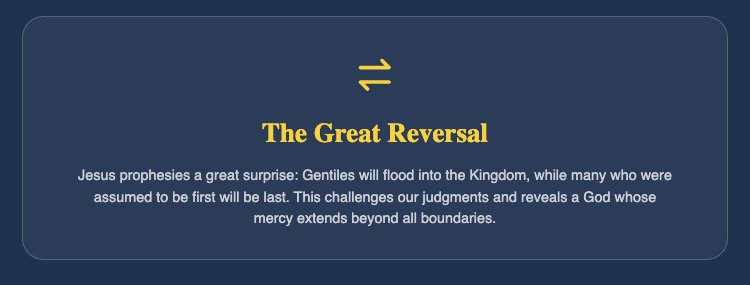
Jesus predicts that many Gentiles will enter the kingdom, while some who seemed to be "first" will be "last."
- This was a shocking statement for its original audience. What assumptions does it challenge? What does it reveal about the scope and nature of God's mercy?
- Fr. Nichols notes the "subtle rider" Jesus adds: "Some who are last will be first, and some who were first will be last." This implies surprises on Judgment Day. How should this reality affect the way we view ourselves and others? Does it guard us from presumption on the one hand, and despair on the other?
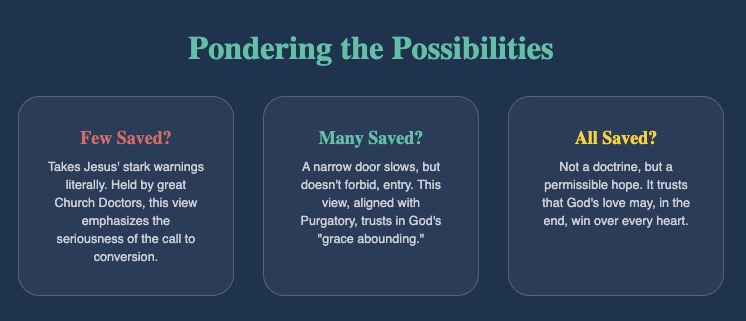
Part 4: Pondering the Possibilities
The homily explores three theological possibilities regarding the number of the saved that the Church has considered over the centuries.
- Few will be saved: This view was held by "some of the greatest of the Church's doctors." While it may seem harsh to modern ears, what in the Gospels (like the "narrow door") supports this interpretation?
- Many will be saved: Fr. Nichols suggests that a narrow door "slows down entry" but doesn't necessarily prevent it, connecting this to the doctrine of Purgatory. How does the idea of Purgatory help reconcile the image of the narrow door with the idea of God's immense mercy?
- All will be saved (Universalism): The homily notes that the Church does not allow this to be taught as public doctrine but "permits us to hope it may be true." What is the difference between a formal doctrine and a permissible hope? Why is this distinction important for our faith?
- Which of these three possibilities do you find most compelling, and why? How do you reconcile the seemingly contradictory scriptural themes of the "narrow door" and "grace abounding"?
Discussion guides and Infographics on this page have been created using AI generative tools (i.e. GOOGLE'S AI Gemini 2.5 Flash LLM, Chart.js and Tailwind CSS). They are free to use for any non-profit ministry. THE WORD THIS WEEK kindly requests that you show your appreciation by sharing a link to the website.
Homily Excerpt
Twenty-First Sunday of the Year. Fr Aidan Nichols ponders on the number of those who will be saved.
Today’s Gospel of the ‘narrow door’ raises some difficult issues concerning grace, election, predestination and the number of the saved – especially the last question, with which the Gospel opens.
Jesus is on his way to Jerusalem. For the evangelist Luke, Jesus only made one journey to Jerusalem truly worth recording, and that was in the year of his death, the last Passovertide he was to spend on earth, the moment of decisive confrontation with the religious and political authorities, a confrontation that was to be the instrument of the redemption itself. When St Luke speaks of the Lord as ‘going up’ to Jerusalem, he is looking ahead to the definitive ‘going up’ of the Ascension when Christ will through his Passion and Death enter on his reign as Lord of history. This is the context where someone asks him, ‘Lord, will those who are saved be few?’ No doubt the question was not far from the hearts, if not the minds, of all the disciples. Short of a moral miracle, the total of those actually laying hold on the salvation Jesus was offering them must surely have seemed very few indeed.
────── ⋆⋅☆⋅⋆ ──────
Fr. Austin Fleming
Priest of the
Archdiocese of
Boston
Infographics were generated using Google Gemini 2.5 AI tools (w/ Chart.js and Tailwind CSS). Feel free to use them in any non-profit ministry. A Link or shoutout to THE WORD THIS WEEK would be greatly appreciated. —Fr. Don.
21st Sunday of Year C
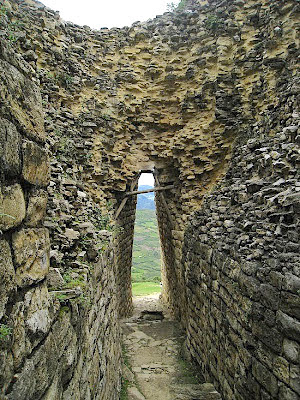
The Narrow Gate
Homily Summary
In the final homily of his "How to Vacation" series, Fr. Fleming tackles the profound question from Luke's Gospel: "Lord, will only a few people be saved?" He reframes our understanding of salvation, explaining that it is not just about the end of our lives, but about inviting God into our hearts every day. The homily uses Isaiah's prophecy to highlight a key theme: God wants to save everyone, not just a chosen few. The door is wide open for all people.

However, Jesus also speaks of a "narrow gate." Fr. Fleming explains that this is not meant to be a terrifying or judgmental image, but a practical one. The gate is narrow because we often try to bring too much baggage with us—our attachments to money, status, and bad habits. The homily encourages us to strive to unburden ourselves, to let go of what weighs us down, so that we can pass through the gate to a place of lasting peace. The ultimate point of the gospel is not judgment, but a loving invitation from the "Gatekeeper," Jesus, who desires a relationship with each one of us.

Key Themes & Scripture
- Vacation as a Time for Reflection: The homily uses the context of vacation as an opportunity to address life's big questions, particularly those related to our spiritual journey.
- Universal Salvation: Based on Isaiah's prophecy and Jesus's words in Luke, the homily argues that God desires salvation for all people—not just for those who consider themselves "the chosen."
- The Narrow Gate: This is reframed not as a source of worry, but as a practical challenge. The gate is narrow because of the burdens we carry that impede our progress toward God.
- The Invitation of the Gatekeeper: The homily emphasizes that Jesus is the "Gatekeeper," who lovingly invites and welcomes everyone to have a relationship with him.
- Unpacking Our Baggage: A central metaphor and call to action is to unburden ourselves of the things that don't bring us lasting peace so that we can fit through the gate.

Discussion Questions
- The homily concludes with a call to "sit by" the narrow gate for a while. What does this mean to you, and how can you do that in the rhythm of your day-to-day life?ear the burdens our faith may lay on us. We ask this in your holy name. Amen.
- The homily says we all tend to "over-pack" in our spiritual lives. What are some of the "burdens" or "excess baggage" in your life that you find yourself carrying, even though you know they don't bring you peace?
- Fr. Fleming states that "God wants all of us to be with him." How does this idea change your perspective on the question of salvation? What are some of the things that make it difficult for people to believe this?
- The homily suggests that the narrow gate is not a judgmental image, but an invitation. How can we, as a community, make this message of the narrow gate feel more inviting to others?
- Fr. Fleming uses the analogy of running a race. What are some of the obstacles that you face in your daily life that feel like they are "impeding" your progress toward God?
- What does it mean to you to "strive" to enter the narrow gate? What practical actions can we take this week to "unburden" ourselves and strive for the path that leads to peace?
Discussion guides and Infographics on this page have been created using AI generative tools (i.e. GOOGLE'S AI Gemini 2.5 Flash LLM, Chart.js and Tailwind CSS). They are free to use for any non-profit ministry. THE WORD THIS WEEK kindly requests that you show your appreciation by sharing a link to the website.
Homily Excerpt
2019 HOMILY — Being saved isn’t just about what happens at the end of our lives! Being saved is learning to recognize how God is in my life TODAY, whether I’m on vacation or off vacation: 24/7/365. And what do I need to be “saved from?”
- I need to be saved from sin.
- I need to be saved from anything or anyone or any problem or any burden that comes between me and the peace I want, the peace that GOD wants me to have in my life;
- I need to be saved from anything or anyone that keeps me from becoming the person I was created to be, from loving the people entrusted to my care, from making the most of my gifts and talents, from becoming a person at peace with others, at peace with God — and at peace with myself.
────── ⋆⋅☆⋅⋆ ──────
Fr. Jude Siciliano, O.P.

Fr. Jude Siciliano, OP
USA Southern Province
Infographics were generated using Google Gemini 2.5 AI tools (w/ Chart.js and Tailwind CSS). Feel free to use them in any non-profit ministry. A Link or shoutout to THE WORD THIS WEEK would be greatly appreciated. —Fr. Don.
21st Sunday of Year C
The Narrow Gate of Love
Discussion Questions
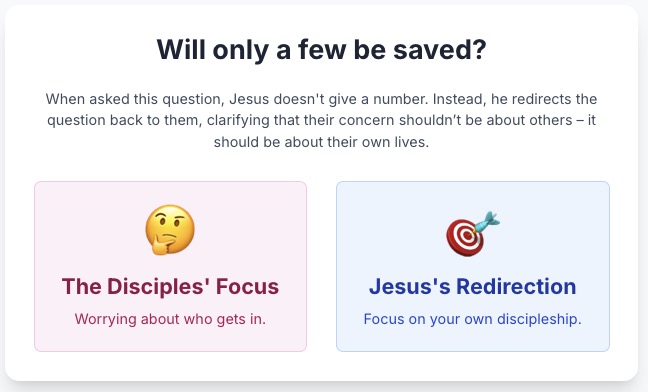
- Fr. Jude Siciliano, O.P. doesn't give a number when asked if only a few will be saved. Instead, he redirects the question. How does this redirection challenge your own assumptions about faith and salvation?
- Fr. Jude states that mere "membership and proximity" to Jesus do not guarantee entry. What are some ways in your own life that you might rely on proximity to your faith instead of authentic action?
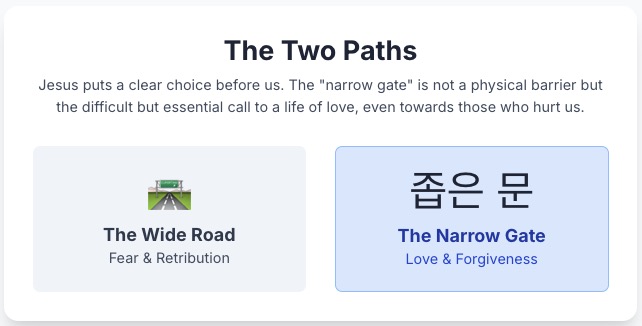
- Fr. Jude suggests that the "narrow gate" is the difficult call to love even those who hurt us. What makes this a "narrow" path?
- Jesus puts the choice before us: the narrow gate of love or the wide road of fear and retribution. Can you think of a time when you had to make a choice between these two roads? What was the outcome?
- How does the idea that God has "flung [the narrow gate] wide open" change your perspective on its meaning? What in this homily gives you a sense of gratitude and hope?
- Fr. Jude concludes that peace is stronger than violence. How have you seen this truth revealed in your own life or in the world around you?
Discussion guides and Infographics on this page have been created using AI generative tools (i.e. GOOGLE'S AI Gemini 2.5 Flash LLM, Chart.js and Tailwind CSS). They are free to use for any non-profit ministry. THE WORD THIS WEEK kindly requests that you show your appreciation by sharing a link to the website.
Homily Excerpt
When the disciples ask if only a few will be saved, Jesus doesn’t give a number. Instead, he redirects the question back to them. Their concern shouldn’t be about others – it should be about their own lives. Membership and proximity to Jesus – eating with him, hearing his teachings – do not guarantee entry into God’s kingdom.
In effect, Jesus says, “If you think you are first, you may find yourselves last.” And, “You’ll be surprised who will enter through the narrow gate.”
At this point in the Gospel, Jesus is on the road to Jerusalem. “He passed through towns and villages…” We know how this journey ends. We know that God will overcome evil – not by force or destruction, but through the cross of Christ. Through suffering and seeming defeat, Jesus’ love and fidelity to God reconcile and save the world.
Perhaps the “narrow gate” Jesus speaks of – the one he tells us to strive to enter – is the difficult but essential call to continue loving, even those who hurt or repel us. That’s what Jesus did. So what of the future? In a way, it has already been decided: Peace is stronger than violence.
Jesus puts the question before us: Will we choose the narrow gate of love, or the wide road of fear and retribution?
…God has entered our world through the narrow gate of love – and has flung it wide open for us to enter, too.
Discussion guides and Infographics on this page have been created using AI generative tools (i.e. AI Gemini Pro, Chart.js and Tailwind CSS). They are free to use for any non-profit ministry. THE WORD THIS WEEK kindly requests that you show your appreciation by sharing a link to the website.
────── ⋆⋅☆⋅⋆ ──────
Fr. Jude Langeh, CMF

Infographics were generated using Google Gemini 2.5 AI tools (w/ Chart.js and Tailwind CSS). Feel free to use them in any non-profit ministry. A Link or shoutout to THE WORD THIS WEEK would be greatly appreciated. —Fr. Don.
21st Sunday of Year C


Key Themes & Scripture
- Salvation: Quantity vs. Quality: The homily contrasts the idea of a fixed number of saved people with God's desire for salvation for all nations.
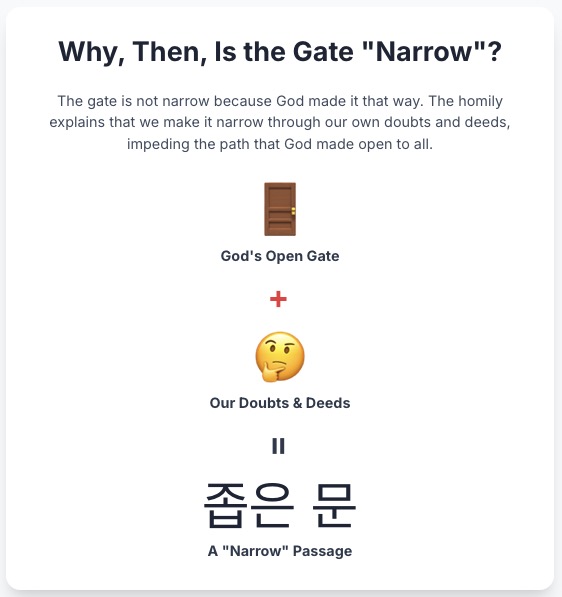
- The Narrow Gate: This is reframed as a consequence of our own choices, not a limitation imposed by God.
- Suffering as Training: The homily connects the difficulty of the Christian life to the idea that suffering is a part of God's loving discipline for us as His children (Hebrews 12).
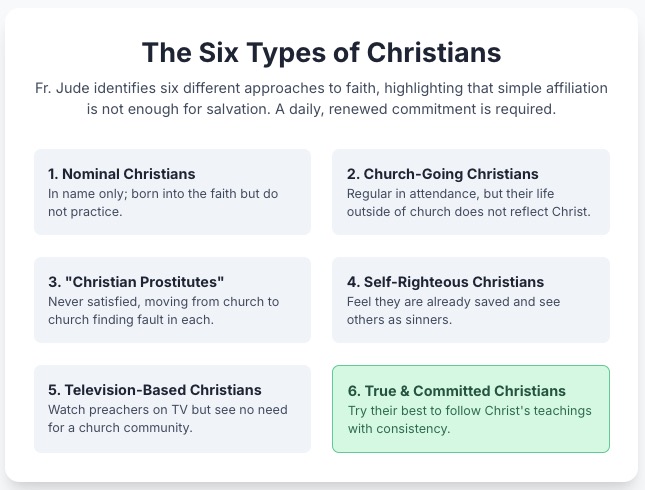
- The Six Types of Christians: A clear breakdown of different approaches to living out one's faith, from the complacent to the committed.
- Daily Commitment: The need for a consistent, day-to-day renewal of our commitment to God, as a simple affiliation or routine is not enough for salvation.
Discussion Questions
- Fr. Jude Langeh, CMF says that "it is consoling to hear that everyone has the chance" to be saved. How does this message of universal invitation change your perspective on the idea of the "narrow gate"?
- The homily presents six types of Christians. Which one do you most identify with right now, and which one do you aspire to be?
- Fr. Jude says that being a true Christian is not easy and that the gate is "so narrow." What are some of the actions or commitments in your own life that you find make this gate feel particularly narrow?
- The homily discusses suffering as a part of our training. How does this perspective help you cope with the difficulties you face in your spiritual life?
- Fr. Jude notes that it is possible to go to church and receive the sacraments and still not be saved. What are some of the ways we can ensure our commitment is a daily one, and not just a weekly or occasional one?
- The homily concludes with the idea that we make the gate narrow through our own "doubts and deeds." What are some of the specific doubts or deeds in your life that you feel are narrowing your path to God?
Access guide and infographics by clicking on banner
────── ⋆⋅☆⋅⋆ ──────
Fr. Charles E. Irvin

Priest of the
Diocese of Lansing
(1933 – 2021)
Infographics were generated using Google Gemini 2.5 AI tools (w/ Chart.js and Tailwind CSS). Feel free to use them in any non-profit ministry. A Link or shoutout to THE WORD THIS WEEK would be greatly appreciated. —Fr. Don.
21st Sunday of Year C
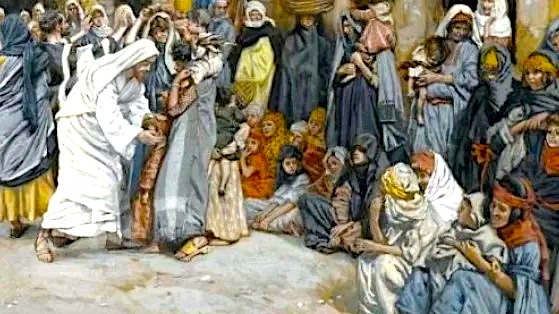
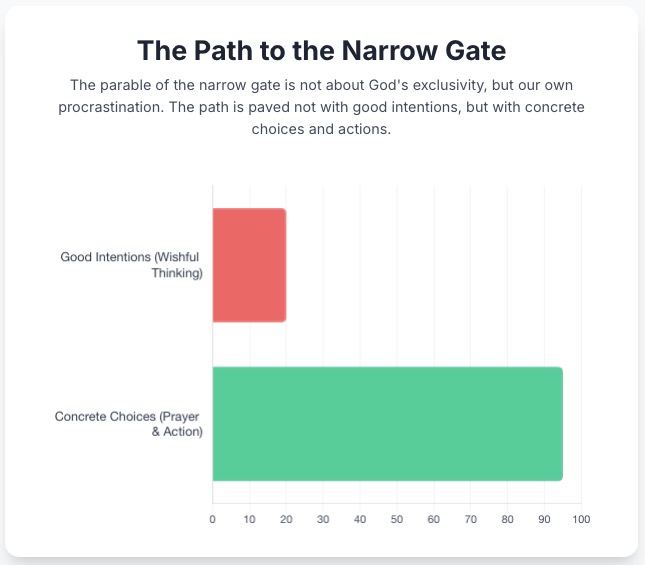
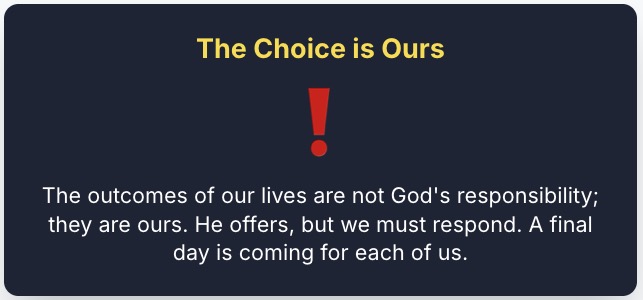
God has showered you and me with limitless gifts. The outcomes of our lives are not His responsibility, they are ours. Everyone is called to be the best at knowing and loving; only a few actually reach that goal. Everyone is called to share life with God; few make the choice. And we must remember that the choice IS ours! God offers – we respond, and nothing happens unless and until we respond.
All around us doors are slamming shut… and we hardly notice; our eyes and our hearts being so filled as they are with the glitter and clutter of this world. But we also live in a world of open doors. Every sunset is followed by a sunrise. The sun will rise tomorrow morning and God will gift you with another day of opportunities. But while we are hopeful for tomorrow, we must remember that one day the sun will rise on our last day here on earth. When that day arrives, we will never have another day of opportunities to love and learn in our lives. A final day is coming to you and to me just as sure as I’m standing here in front of you.
Homily Summary
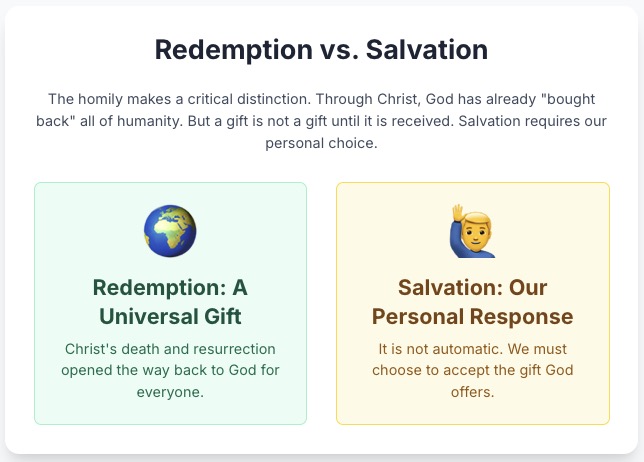
In this homily, Fr. Irvin addresses the common misconception that everyone will be saved simply because God desires it. He clarifies a critical distinction: everyone has been redeemed by Christ’s death, but salvation requires our personal response. A gift, he explains, is not a gift until it is received. Using the parable of the narrow gate, the homily warns against a life of missed opportunities and procrastination, emphasizing that with each passing day, doors to love, to learn, and to grow in faith are closing. He argues that the harshness of Jesus’s words is not a sign of a cruel God, but of a loving realist who wants us to see the urgency of our choices. Fr. Irvin’s homily concludes by reminding us that while God has chosen to redeem all of humanity, our salvation is a choice we must make, and the responsibility for our response rests with us alone.
Key Themes & Scripture
- Redemption vs. Salvation: The core message distinguishes between Christ’s act of redeeming all people and our individual choice to accept salvation.
- The Parable of the Narrow Gate: Jesus’s words are not about good manners but about the urgency of our decisions in a world of closing doors.
- The Reality of Missed Opportunities: The homily reflects on the pain of lost chances and the fleeting nature of time, using the metaphor of a door that silently clicks shut on each passing day.
- Our Responsibility: The homilist places the responsibility for the outcome of our lives squarely on our shoulders, emphasizing that God offers and we must respond.
- The Path to Peace: True peace and a life with God are not paved with good intentions but with intentional choices and a commitment to action.
Discussion Questions
- Fr. Irvin makes a key distinction between redemption and salvation. How does this distinction change your understanding of God’s role and our role in our spiritual lives?
- Fr. Irvin uses the metaphor of “doors closing” on missed opportunities to love and grow. What are some of the closed doors in your life that you regret, and what new opportunities are open to you today?
- Fr. Irvin states that the most difficult subject to master is oneself. In what ways have you found yourself to be your own greatest obstacle?
- Fr. Irvin discusses the temptation to be a “people pleaser” and to avoid conflict, calling this a form of “illusory peace.” When have you found yourself choosing to be silent to avoid conflict, and what was the consequence?
- Jesus’s teaching that “many are called but few are chosen” is described as a harsh but realistic truth. How can we embrace this reality without falling into despair or self-righteousness?
- Fr. Irvin concludes with a reminder that our final day is coming. How does this awareness impact your priorities for this week?
Discussion guides and Infographics on this page have been created using AI generative tools (i.e. GOOGLE’S AI Gemini 2.5 Flash LLM, Chart.js and Tailwind CSS). They are free to use for any non-profit ministry. THE WORD THIS WEEK kindly requests that you show your appreciation by sharing a link to the website.
────── ⋆⋅☆⋅⋆ ──────
Fr. George Smiga

Homiletic Professor
at St. Mary Seminary
Infographics were generated using Google Gemini 2.5 AI tools (w/ Chart.js and Tailwind CSS). Feel free to use them in any non-profit ministry. A Link or shoutout to THE WORD THIS WEEK would be greatly appreciated. —Fr. Don.
21st Sunday of Year C
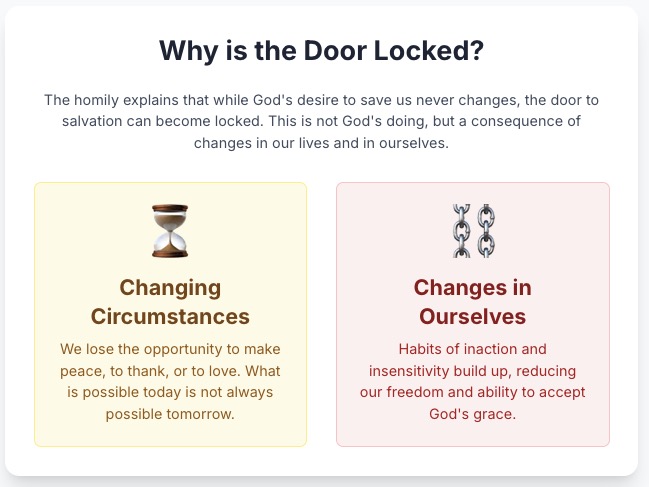
2004 HOMILY – Well this is a difficult passage. What does it mean when the Gospel tells us that we will come and knock upon the door of eternal life and find that it is locked? What does it mean that we will come seeking to enter in and be told that we are rejected? I thought that God was always willing to welcome us in. I thought that there would always be an open door when we came and knocked. Even a few chapters earlier in Luke’s Gospel Jesus says this very thing. “Ask and you shall receive. Knock and it shall be opened to you.” So what does this passage mean that tells us that when we try to enter, we will be refused. When we seek come in, the door will be locked.
Homily Summary
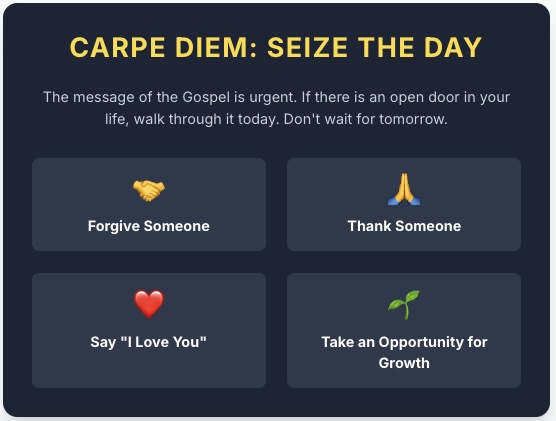
In this homily, Fr. Smiga grapples with the challenging Gospel images of the narrow gate and the locked door. He asserts that while God’s desire is to save everyone, salvation is a two-way street that requires our participation. He explains that the door can be locked for two reasons: due to changing circumstances (e.g., losing the opportunity to make peace with a loved one) or because of changes in ourselves (e.g., forming habits that reduce our freedom and ability to accept grace). The homily introduces the Latin phrase carpe diem, “seize the day,” as a call to action, urging us to make the choices for growth, love, and forgiveness now, before our opportunities are gone.
In a second reflection, the homily deepens this understanding by presenting the two images as representing two essential needs:
- The Narrow Gate: This image points to the need for personal responsibility. Using the example of the small door at the Church of the Nativity, the homily explains that we cannot stumble into God’s kingdom by accident; we must make a conscious, purposeful choice to enter on our own merit.
- The Locked Door: This image points to the need for adequate knowledge. The homily explains that those who are locked out are surprised because they presumed their actions were enough. They lacked a deep understanding of what was truly required. This is why faith formation is a life-long process, and what we learn as a child is not sufficient for the challenges we face as adults. The homily concludes with a call to prioritize our faith formation, highlighting that having sufficient knowledge is a personal responsibility.
Key Themes & Scripture
- Salvation as a Two-Way Street: God is always willing to save us, but our circumstances and our own decisions can prevent us from accepting His grace.
- The Locked Door: This is not a punishment from God, but a consequence of lost opportunities and self-made habits that diminish our desire to enter.
- Personal Responsibility: The “narrow gate” requires a conscious and purposeful choice to enter the kingdom on our own merits.
- Adequate Knowledge: The “closed door” is a warning against presuming we know what is required of us in our faith. We must commit to lifelong learning to meet new challenges.
- Carpe Diem: The call to “seize the day” and act on opportunities for love, forgiveness, and growth before it’s too late.
- Scripture: The homily is based on Luke 13:22-30 and also references the Church of the Nativity and the prophet Jeremiah.
Discussion Questions
- Fr. Smiga contrasts a loving God who offers an open door with the possibility that the door can be locked. What are some examples of how changing circumstances or your own decisions have made a spiritual door feel locked to you?
- The homily uses the phrase carpe diem to urge us to act today. What is one specific thing you feel called to do today—in your relationships, in your faith, or for your personal growth—that you might otherwise put off until tomorrow?
- The small door of the Church of the Nativity requires a person to “bow” to enter. How does this physical action serve as a metaphor for the personal responsibility required to walk through the narrow gate?
- The homily argues that what we learned as children is not sufficient for the challenges of adult faith. What are some of the new challenges in your life that require you to deepen your knowledge of the faith?
- Fr. Smiga mentions that those who are locked out are surprised because they “presumed” they knew what was required. What are some of the common assumptions we make about faith that might lead us to a false sense of security?
- The homily concludes that our salvation is not God’s responsibility, but ours. How does this shift in perspective empower you, and what are some of the challenges you foresee in taking on that responsibility?
Discussion guides and Infographics on this page have been created using AI generative tools (i.e. GOOGLE’S AI Gemini 2.5 Flash LLM, Chart.js and Tailwind CSS). They are free to use for any non-profit ministry. THE WORD THIS WEEK kindly requests that you show your appreciation by sharing a link to the website.
────── ⋆⋅☆⋅⋆ ──────
Frank Pavone, Director
Infographics were generated using Google Gemini 2.5 AI tools (w/ Chart.js and Tailwind CSS). Feel free to use them in any non-profit ministry. A Link or shoutout to THE WORD THIS WEEK would be greatly appreciated. —Fr. Don.
21st Sunday of Year C

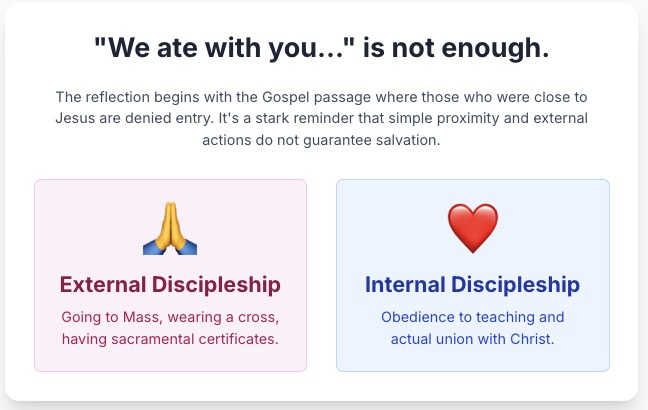
Internal vs. External Discipleship
Key Themes & Scripture
- External vs. Internal Discipleship: The homily contrasts the superficial actions of going to Mass or wearing religious symbols with the necessary internal obedience and a true union with Christ.
- Belief vs. Action: It is not enough to "believe" that something is right or wrong. Our convictions must be reflected in our behavior.
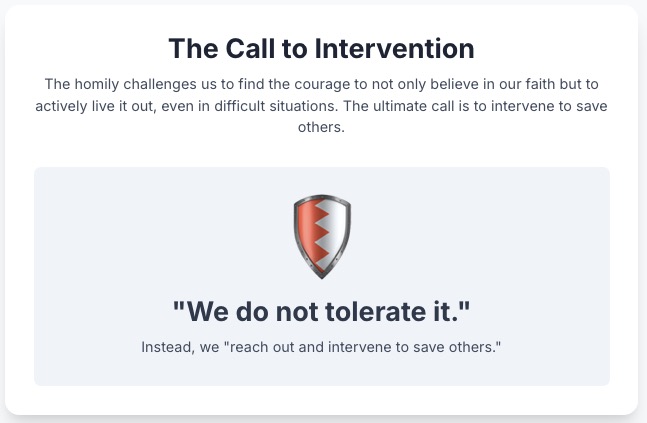
- A Pro-Life Stance that Intervenes: The reflection argues that a truly pro-life position means more than just personal opposition to abortion; it requires us to intervene on behalf of those being aborted.
- The Challenging Gospel: The homily is based on Luke 13:22-30, where Jesus's words reveal that even those who were close to him can be denied entry into the kingdom.
Discussion Questions
- Pavone states that "eating and drinking with the Lord" and "hearing him teach" are not enough for salvation. What are some of the ways we might be tempted to rely on our external faith—like going to church or wearing a cross—instead of cultivating a genuine, internal obedience?
- The reflection makes a clear distinction between an attitudinal opposition and a behavioral opposition to abortion. What are some concrete examples of what it means to move from one to the other?
- Pavone says that a true pro-life stance means we do not "tolerate" abortion. What does this mean to you, and what are some of the practical ways we can refuse to tolerate it without being hateful or judgmental?
- The reflection's central message is about the need to act on our beliefs. In what other areas of your faith do you feel called to move from a passive belief to an active, behavioral response?
- What are some of the fears or difficulties that might hold someone back from actively intervening in a situation they know is wrong? How can we overcome these obstacles?
- The homily challenges us to find the courage to live out our beliefs publicly. What is one practical way you can live with greater behavioral opposition to injustice in your own community this week?

Discussion guides and Infographics on this page have been created using AI generative tools (i.e. GOOGLE'S AI Gemini 2.5 Flash LLM, Chart.js and Tailwind CSS). They are free to use for any non-profit ministry. THE WORD THIS WEEK kindly requests that you show your appreciation by sharing a link to the website.
Reflection Excerpt
We are destined, in this life, to be divided from at least some people, and today’s readings urge us to be divided for the right reasons. Prejudice continues to raise walls between people. That is the division that happens all too naturally, and the conflict between the culture of life and the culture of death is largely a problem of prejudice against the unborn, the elderly, and the disabled. None of the reasons offered for abortion would be tolerated as reasons to kill the born; it is only because the victims are unborn that they become victims. Similarly, none of the reasons for killing the less functional people would be tolerated as reasons to kill the functioning; hence again, prejudice is revealed as the real problem.
────── ⋆⋅☆⋅⋆ ──────

Priest of the Diocese
of St. Petersburg,
Florida
Infographics were generated using Google Gemini 2.5 AI tools (w/ Chart.js and Tailwind CSS). Feel free to use them in any non-profit ministry. A Link or shoutout to THE WORD THIS WEEK would be greatly appreciated. —Fr. Don.
21st Sunday of Year C

Embracing Our Christianity
Key Themes & Scripture
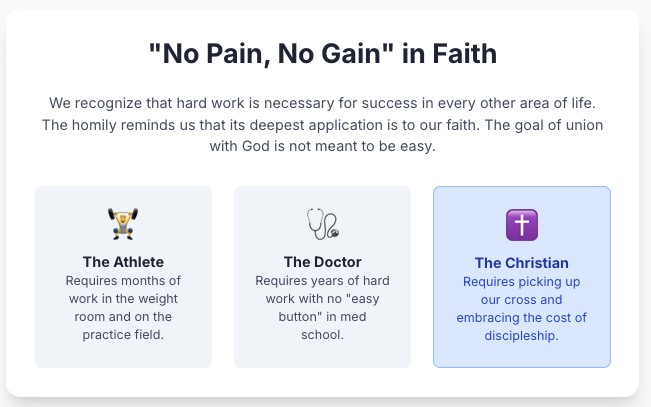
- The Cost of Discipleship: The Christian life is not easy or a "fun" option; it demands hard work and sacrifice, just as any worthwhile endeavor does.
- The Narrow Gate: This is the path of courage, discipline, and a willingness to stand for truth even when the world rejects you.
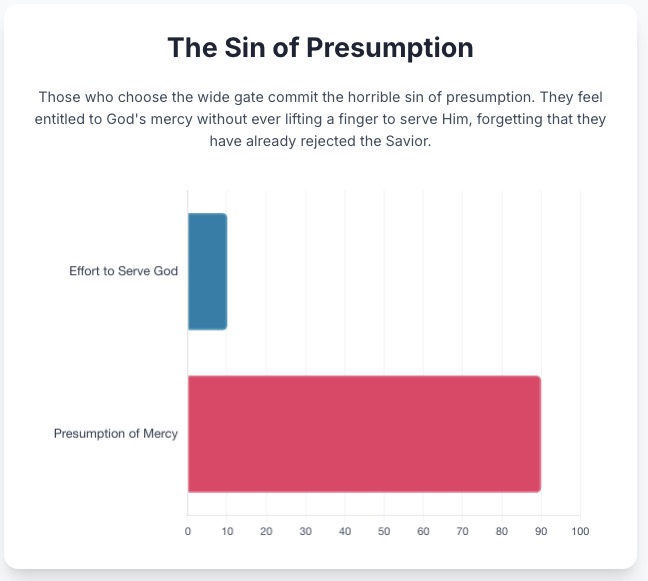
- The Wide Gate and Presumption: The wide gate is the path of convenience, complacency, and the sin of presumption, where we assume God will save us despite our own rejection of him.
- Sacrifice as a Source of Joy: The homily re-frames sacrifice not as a burden, but as a source of deep joy and meaning.
- "No Pain, No Gain" in Faith: A powerful analogy that connects the hard work required in sports, academics, and other areas of life to the hard work required for union with God.
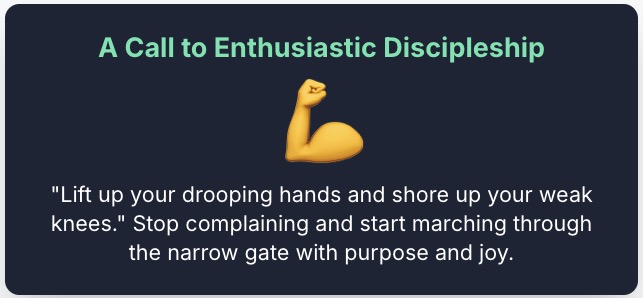
- Scripture: The homily draws on the Letter to the Hebrews ("Lift up your drooping hands...") and the parable of the narrow gate from Luke's Gospel.
Discussion Questions
- The homily starts by mimicking the complaints of the early Christians. When do you find yourself complaining about the cost of being a Christian in today's world?
- The homilist contrasts the "narrow gate" of sacrifice with the "wide gate" of the "everybody's doing it" crowd. What are some specific examples in your life where you feel you are being called to walk through the narrow gate?
- The homily says that the core sin of those who choose the wide gate is presumption—assuming God will save them despite their choices. How can we guard against this in our own lives?
- The homily asserts that those who sacrifice for others always feel that they "got so much more out of that than [they] gave." Can you share a time when you experienced this truth?
- The homily uses the phrase "no pain, no gain" in the context of sports and academics and applies it to Christianity. Do you agree that this maxim is applicable to faith? Why or why not?
- The homily concludes with a call to have "high-stepping, marching" knees. What does this mean to you, and what is one concrete way you can respond to this call with enthusiasm this week?
Discussion guides and Infographics on this page have been created using AI generative tools (i.e. GOOGLE'S AI Gemini 2.5 Flash LLM, Chart.js and Tailwind CSS). They are free to use for any non-profit ministry. THE WORD THIS WEEK kindly requests that you show your appreciation by sharing a link to the website.
Homily Excerpt
We are Catholics. We are Christians in Christianity’s purest form. We have purpose and meaning and beauty in our lives. We have Jesus Christ. And He has us. Our arms cannot be drooping. They need to be raised high in praising the One who calls us. Our knees should not be knocking. They need to be high stepping, marching through that narrow gate to our God. Then, when it comes time for the final Banquet of the Lord, when our lives come to an end, we will find ourselves inside, united to Jesus at the feast of Love that is Eternal Union with God.
────── ⋆⋅☆⋅⋆ ──────
Priest of the
Archdiocese of
Washington D.C.
Infographics were generated using Google Gemini 2.5 AI tools (w/ Chart.js and Tailwind CSS). Feel free to use them in any non-profit ministry. A Link or shoutout to THE WORD THIS WEEK would be greatly appreciated. —Fr. Don.
21st Sunday of Year C

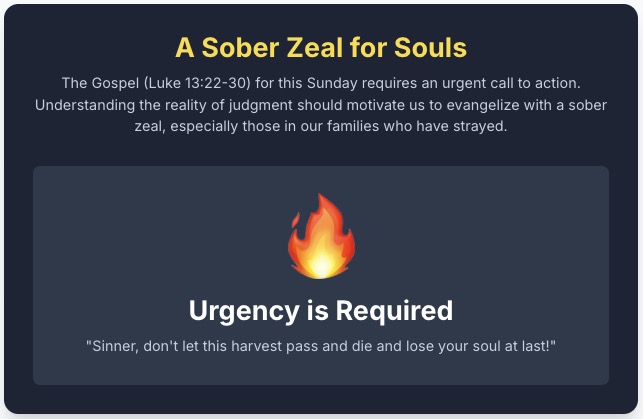
The Lord demands from us a sober and biblical zeal for souls, rooted in the comprehension that we humans tend to stray and that we mysteriously do not seem to want what God offers. Being sober helps us to be urgent, and urgency makes us evangelical enough to go to those we love and say to them, “Sinner don’t let this harvest pass and die and lose your soul at last!”
Sober and Serious about Salvation
Key Themes & Scripture
- The Reality of Judgment: Msgr. Pope challenges the modern tendency to "refashion" a more palatable God and ignore the clear biblical teachings on judgment and hell. Jesus's warnings about the "narrow gate" and the "many" who will not be strong enough are a sober truth.
- The Divine Desire: Despite the warnings, the homily affirms that God's desire is to save all. The resistance to salvation comes from us, not from God.
- Sober Zeal for Souls: The homily ends with a call to develop a sense of urgency about our own salvation and to evangelize others with a sober, biblical zeal, especially those in our families who have strayed from the Church.
Discussion Questions
- Msgr. Pope argues against the idea of universalism, saying it's an "unbiblical way of thinking." How do you feel about this sober and serious approach to salvation? Does it challenge your comfort or encourage your resolve?
- Msgr. Pope claims that a "refashioning" of God is often due to a refusal to deal with the truth. What are some ways you see this happening today, either in our culture or in your own spiritual life?
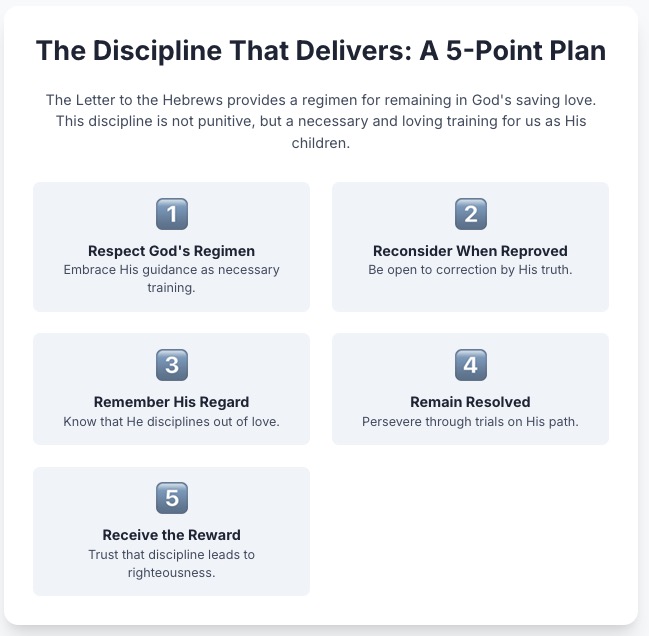
- The homily presents five points about God's discipline. Which of these points do you find most challenging to accept? Which do you find most encouraging?
- The homily asks us to look at our children and grandchildren and not "take lightly" the fact that they may be away from the church. How can we approach this with a "sober and biblical zeal" without becoming judgmental or alienating?
- What are some of the "paths that lead away from heaven" that the homily mentions—such as wealth, preoccupation with the world, or lack of forgiveness—that you find most difficult to navigate?
- The homily suggests that many are not "strong enough" to make the journey to heaven. What do you believe are the necessary steps to become spiritually "strong enough" to embrace the discipline that delivers?
Discussion guides and Infographics on this page have been created using AI generative tools (i.e. GOOGLE'S AI Gemini 2.5 Flash LLM, Chart.js and Tailwind CSS). They are free to use for any non-profit ministry. THE WORD THIS WEEK kindly requests that you show your appreciation by sharing a link to the website.
Homily Excerpt
In the readings this Sunday, the Lord describes a danger: our tendency to make light of judgment and not be sober that one day we must account for our actions. In the first reading (from Isaiah), the Lord sets forth His desire to save us, but we must understand that our will, our assent, is essential to our salvation. In the second reading (from the Letter to the Hebrews), God sets forth a plan whereby, having accepting Jesus, we can make a daily walk with Him in a kind of delivering discipline. Let’s take a detailed look at the readings, hear their urgent warnings, and soberly lay hold of the solutions offered.
I. The Danger that is Described
II. The Divine Desire
III. The Discipline that Delivers
────── ⋆⋅☆⋅⋆ ──────
Fr. Michael Chua
Priest of the Archdiocese
of Kuala Lumpur,
Malaysia
Infographics were generated using Google Gemini 2.5 AI tools (w/ Chart.js and Tailwind CSS). Feel free to use them in any non-profit ministry. A Link or shoutout to THE WORD THIS WEEK would be greatly appreciated. —Fr. Don.
21st Sunday of Year C

Key Themes & Scripture
- "Catholicism Lite": The homily critiques the popular idea of a lighter, easier Christianity with fewer rules and demands, arguing that this leads to substandard Christians who are entitled and self-serving.
- The Narrow Door: This is not a restrictive barrier designed to keep people out, but a practical challenge for people who are unwilling to let go of their spiritual baggage and make radical changes in their lives.
- The Meaning of
Agonizomai: The homily unpacks the Greek word for "try," explaining that it implies an "agonizing, intense, purposeful striving or struggle," like an athlete or a soldier. - Suffering as Discipline: The homily reframes suffering not as punishment, but as a loving father's discipline, a necessary tool for formation that helps us grow spiritually.
- Truth vs. Feelings: The homily makes a strong case that while empathy is important, the eternal salvation of souls must take precedence over protecting people's temporary feelings.
- Scripture: The homily is based on Luke 13:22-30 (the narrow door) and references 2 Timothy 4:1-7 (itching ears), 1 Corinthians 9:25 (the striving athlete), 1 Timothy 6:12 (fighting the good fight), and Hebrews 12:5-7 (God’s loving discipline).
Discussion Questions
- Fr. Chua says that the argument for a "Catholicism Lite" often comes from "well-meaning Catholics." What makes this argument so appealing, and what in this homily challenges you to think differently?
- The Greek word
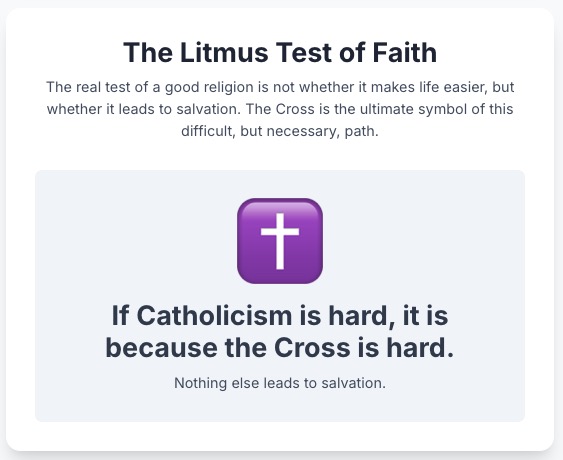
agonizomaiimplies a strenuous effort for salvation. What does this "agonizing struggle" look like in your daily life? - The homily asserts that if Catholicism is hard, it is because the Cross is hard. How does looking at the Cross change your perspective on the demands of your faith?
- The homily reframes suffering as a loving parent's discipline. What is the difference between seeing suffering as a punishment and seeing it as a necessary training for spiritual growth?
- Fr. Chua argues that when it comes down to protecting feelings and defending the truth, we must choose the latter for the good of the person. What is your reaction to this statement, and what makes this so difficult in today's culture?
- The homily concludes with the idea of "raising the threshold" for discipleship. What is one practical way you can raise the bar for your own spiritual life this week?
Discussion guides and Infographics on this page have been created using AI generative tools (i.e. GOOGLE'S AI Gemini 2.5 Flash LLM, Chart.js and Tailwind CSS). They are free to use for any non-profit ministry. THE WORD THIS WEEK kindly requests that you show your appreciation by sharing a link to the website.
Homily Excerpt
The most common complaint against Catholicism is that it makes life too difficult, that it over-complicates Christianity and that it has too many rules and restrictions. “If Jesus was here,” so the argument goes, “He would just simplify things and dispense with all these small minded rules. Jesus would never make it so hard for people to enter!” What I find ironical is that these complaints generally do not come from non-Catholics, but they are the constant gripe of many well-meaning Catholics who sincerely believe that more people would flock to Church and less would choose to leave, if we just keep things to the basics, to the bare minimum – soften our approach, lessen the demands, relax the rules, grant greater accessibility to the sacraments. Yes, this argument is so appealing because it proposes a lighter, easier Christianity – “Catholicism Lite.”
Key Themes & Scripture
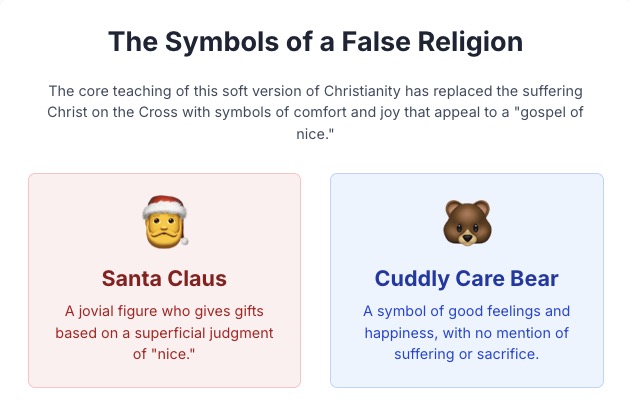
- The Gospel of Niceness: The homily defines this as a false religion centered on being "good, nice, and fair," where the ultimate goal is personal happiness and "feeling good about oneself."
- The Sin of Presumption: The homilist identifies the belief that everyone goes to heaven as a dangerous form of presumption, not a biblical truth.
- The Two Paths: The homily contrasts the broad, easy path of hedonism and convenience with the narrow, hard path of discipleship that leads to salvation.
- The Cross as the Litmus Test: The Cross is presented as the ultimate symbol of a demanding faith. The homily argues that if salvation were meant to be easy, Jesus would not have had to suffer and die.
Agonizomai: The Struggle for Salvation: The Greek word for "try" is used to emphasize that the Christian life is not a passive journey but an intense, purposeful struggle akin to an athlete competing for a prize.- Truth vs. Feelings: A core message is that true love and charity do not make excuses for sin or hide inconvenient truths; they lovingly guide people toward the difficult path of salvation.

Discussion Questions
- Fr. Chua argues that the "gospel of niceness" has become indiscernible from the real thing in some Christian cultures. What are some of the ways you have seen this play out?
- The homily lists four core beliefs of "Moralistic Therapeutic Deism." Which of these do you find yourself most tempted to believe, and why?
- The homily suggests that a "Catholicism Lite" approach often leads to substandard Christians. What do you think are the essential sacrifices or demands that make for an "authentic" and robust Christian life?
- The Greek word
agonizomaiimplies a spiritual battle. What does this "agonizing struggle" look like in your daily life? - Fr. Chua says that it is not love to let people follow an erroneous path that leads to destruction. What makes it so difficult to speak a challenging truth to someone you love?
- The homily concludes with a call to "raise the threshold" for discipleship. What is one concrete way you can raise the bar for your own spiritual life this week?
Discussion guides and Infographics on this page have been created using AI generative tools (i.e. GOOGLE'S AI Gemini 2.5 Flash LLM, Chart.js and Tailwind CSS). They are free to use for any non-profit ministry. THE WORD THIS WEEK kindly requests that you show your appreciation by sharing a link to the website.
Homily Excerpt
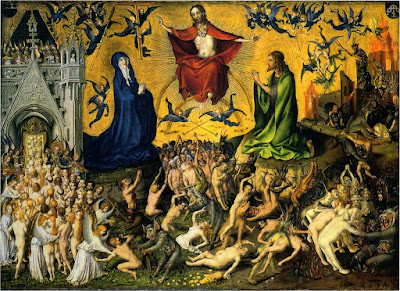
We complain when canon law or liturgical rubrics are cited or implemented. In such a religious system, the following words and concepts are taboo and have been expunged from our vocabulary – sin, moral evil, and of course, “hell!” A God who is the personification of niceness will never tolerate hell! Never!
Here are some core beliefs of this new politically correct religion:
- God wants people to be good, nice, and fair to each other.
- The central goal of life is to be happy and to feel good about oneself.
- God is not involved in my life except when I need God to resolve a problem.
- Since no one is really bad, and sin doesn’t really exist, everyone gets to go to heaven.
Part 1: Popular Beliefs and Misconceptions
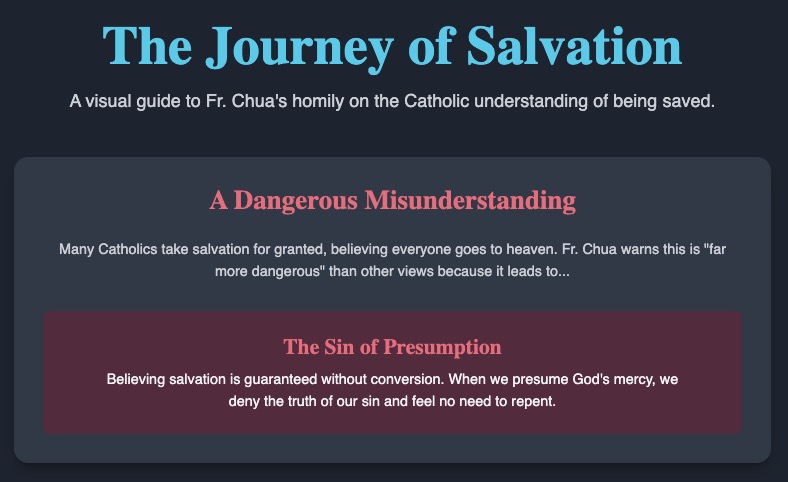
Fr. Chua begins by contrasting popular Catholic and Protestant views on salvation, noting that many Catholics take heaven for granted.
- Before hearing this homily, what were your own thoughts on the question, "Will there be only a few saved?" Does the idea of everyone going to heaven feel more common or comfortable in our culture today?
- Fr. Chua suggests that many Catholics are unprepared when asked, "Have you been saved?" Why do you think this is? Is salvation something you think about often?
- Which idea does the homily say is "far more dangerous": the Protestant view of being "saved once and for all," or the common Catholic misunderstanding of "universal salvation"? Why?
Part 2: The Sin of Presumption
A central theme is the danger of presumption—believing salvation is guaranteed regardless of how we live.
- The Catechism (CCC 2092) describes two kinds of presumption: presuming on our own abilities, or presuming on God's mercy "without conversion." Which of these two do you think is more common today? Can you think of examples?
- Fr. Chua states that when people are presumptuous, "they are living in denial of the truth. And because they are living in denial, they will not repent." How does the belief that "everyone gets to heaven anyway" remove the need for repentance and conversion in a person's life?

Part 3: The Shipwreck Analogy
Fr. Chua uses a powerful analogy of being shipwrecked to explain the Catholic understanding of salvation as a journey.
- In this analogy, what do the following elements represent?
- The shipwreck/drowning:
- Being rescued by Jesus:
- The ship (the Church):
- The safe harbor (heaven):
- For Catholics, being rescued onto the ship (Baptism) is "just the first step." What does this analogy teach us about the role of free will in our salvation? How does the possibility of "jumping overboard" illustrate this?
- If we do "jump overboard" through sin, what is the "lifeboat" God sends to rescue us again? How does this highlight the importance of the Sacraments in the journey of salvation?

Part 4: The Four Certainties
While we don't know the final statistics of heaven, Fr. Chua outlines four things Jesus reveals with certainty.
- Hell is real: The homily says the "denial of hell leads ultimately to the trivialising of heaven." How does a healthy understanding of hell give us a greater appreciation for the gift of heaven?
- Life is a series of choices: We are either on the narrow path or the broad one. What are some daily choices we make that either draw us closer to God or lead us farther away?
- There is an urgency: The "corridor of opportunity will not always be opened." How can we cultivate a sense of spiritual urgency without falling into anxiety or fear?
- Salvation is the top priority: The "salvation of souls is the supreme law." How does this principle challenge our modern priorities of wealth, career, health, and popularity?
Discussion guides and Infographics on this page have been created using AI generative tools (i.e. GOOGLE'S AI Gemini 2.5 Flash LLM, Chart.js and Tailwind CSS). They are free to use for any non-profit ministry. THE WORD THIS WEEK kindly requests that you show your appreciation by sharing a link to the website.
Homily Excerpt
When Protestants ask Catholics if they have been saved, the question would most likely be met with a stunned look on the part of the Catholic or an admission that he has never thought about this before. This comes as good news to the Protestant as he can now confidently proselytise the Catholic and ensure that the latter is saved by becoming a Bible believing, faith professing Protestant Christian. For many Protestants, one becomes a Christian by merely making a confession of faith in Jesus as Saviour and Lord. Baptism comes later but isn’t necessary for our salvation. I guess the reason why most Catholics are not prepared with an answer to that question is that salvation or rather, heaven, is something they often take for granted. Why worry about this moot issue when we can all get to heaven?
Priest of the
Diocese of Cloyne,
Ireland
Infographics were generated using Google Gemini 2.5 AI tools (w/ Chart.js and Tailwind CSS). Feel free to use them in any non-profit ministry. A Link or shoutout to THE WORD THIS WEEK would be greatly appreciated. —Fr. Don.
21st Sunday of Year C
Jesus is the Gate to Heaven
Key Themes & Scripture
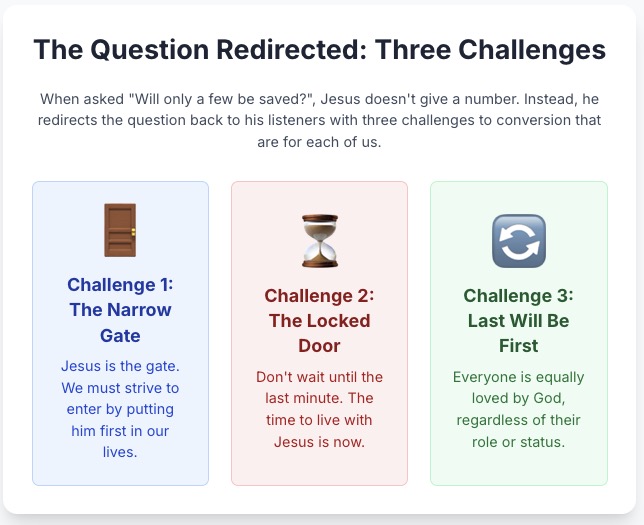
- Redirection of the Question: The homily shifts the focus from worrying about the salvation of others to a call for personal discipleship.
- Jesus is the Gate: The "narrow gate" is not a physical barrier but a person—Jesus himself. We enter by making him the central focus of our lives.
- Love as the Key: Our acts of love, mercy, and forgiveness of others are what open the gate to heaven.
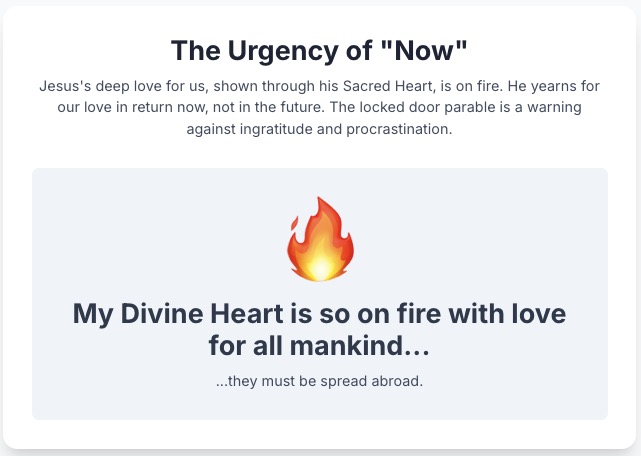
- The Urgency of "Now": The locked door parable and the message of the Sacred Heart emphasize that the time to live with Jesus is today, not at the end of our lives.
- Equality in God's Love: The teaching that "some first will be last" is a reminder that God loves everyone equally, regardless of their social standing or perceived importance.
Discussion Questions
- Jesus doesn't give a number when asked if only a few will be saved. Instead, he redirects the question back to them. How does this redirection challenge your own assumptions about faith and salvation?
- The homily states that Jesus is the "narrow gate" and the "way." What does it mean for you, personally, to put Jesus first in your life and to live as if he is your only path to heaven?
- The homily says that our kindness, love, and mercy for others "conquer evil" and "open the gate to heaven." Can you think of a time when you saw this truth revealed in your own life or in the world around you?
- Jesus's apparitions to St. Margaret Mary revealed his immense pain over the "ingratitude" he receives. What are some of the ways you might be unintentionally rejecting his love, and how can you console him by responding to his love more fully?
- The homily emphasizes the urgency of living with Jesus now and not waiting until the last minute. What is one specific thing you feel called to do today—in your relationships, in your faith, or for your personal growth—that you might otherwise put off until tomorrow?
- The teaching that "some last will be first" can be surprising. How does the homily's explanation that everyone is equally loved by God change your perspective on this statement?
Discussion guides and Infographics on this page have been created using AI generative tools (i.e. GOOGLE'S AI Gemini 2.5 Flash LLM, Chart.js and Tailwind CSS). They are free to use for any non-profit ministry. THE WORD THIS WEEK kindly requests that you show your appreciation by sharing a link to the website.
Homily Excerpt
What is this narrow gate and how do we enter through it? In John 10, Jesus tells us twice that he is the gate (John 10:7, 9). Also, in John 14:6 we hear Jesus say, “I am the way and the truth and the life. No one comes to the Father except through me.” We get to heaven by following Jesus, putting him first in our lives, praying to him every day. Three weeks ago, our first reading described life as “vanity of vanities.” (Eccl/Qoh 1:2) That was a description of life without Jesus. Everything except Jesus is vanity of vanities because everything passes. Only Jesus is the narrow gate to the next life. The way to salvation, the way to heaven is Jesus. He is the gate, he is the way, no one comes to the Father except through him.
Twenty-First Sunday (Year C)
Jesus is the gate to heaven 2022
Related Homilies: Choose Jesus the Narrow Door 2013
Today’s Gospel in the context of Luke (gathering of nations) 2007
Stories: on the Last Becoming First

────── ⋆⋅☆⋅⋆ ──────
Auxiliary Bishop of
Archdiocese of
Seattle
Infographics were generated using Google Gemini 2.5 AI tools (w/ Chart.js and Tailwind CSS). Feel free to use them in any non-profit ministry. A Link or shoutout to THE WORD THIS WEEK would be greatly appreciated. —Fr. Don.
21st Sunday of Year C


Key Themes & Scripture
- The Universality of Divine Punishment in Scripture: The homily points out that the theme of divine punishment is not a peripheral idea but is found from the beginning (Adam and Eve, Babel, Noah's Ark) to the end of the Bible (Revelation).
- Contrasting Theological Views: The homilist briefly outlines the differences between the teachings of Luther, Calvin, and the Catholic Church on predestination and salvation.
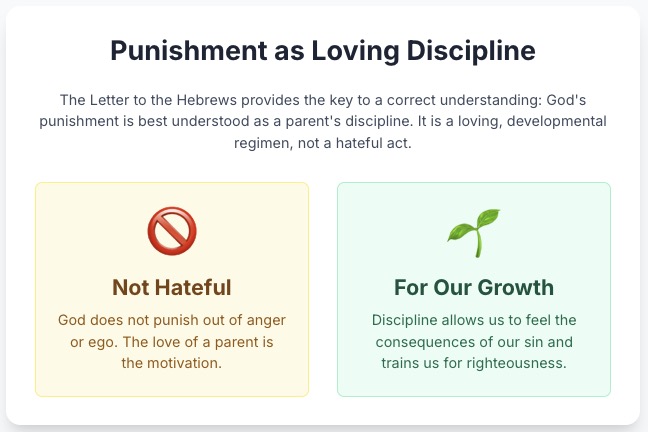
- Punishment as Loving Discipline: The core message re-frames divine punishment as God's loving discipline, akin to a parent's desire to train their child for a good life. This is the central argument drawn from the Letter to the Hebrews.
- Love as the Motivation: The homily emphasizes that the motivation for God's discipline is not anger or hate, but love.
- Suffering as a Catalyst for Change: The homilist challenges listeners to consider their own suffering and pain as a means for God to allow them to "feel the results of our sinfulness, so that we might turn around."
- Scripture: The homily is based on Hebrews 12:5-7, Genesis, Exodus, the story of Jonah, and 1 Corinthians.
Discussion Questions
- The homily says that the theme of divine punishment is one of the most "controversial and unpopular" topics in Christianity. What is your initial reaction to this topic, and why do you think it is so unpopular today?
- The homilist suggests that a parent who lets a child "run wild without consequence" is a bad parent. How does this analogy help you understand God’s discipline in a new way?
- The homily challenges us to consider if some of our suffering is God's way of allowing us to "feel the results of our sinfulness." Is this a difficult idea to accept? Can you share a time when you experienced a negative consequence that helped you turn away from a sinful path?
- What is the difference between interpreting a personal tragedy as God's punishment and interpreting it as God's discipline? Why is this distinction so important?
- The homilist concludes with a final question: "Can we see some of our sufferings and pains as God’s way of allowing us to feel the results of our sinfulness, so that we might turn around and take that steep and narrow road to the joy God has prepared for us?" What would a positive response to this look like in your life?
Discussion guides and Infographics on this page have been created using AI generative tools (i.e. GOOGLE'S AI Gemini 2.5 Flash LLM, Chart.js and Tailwind CSS). They are free to use for any non-profit ministry. THE WORD THIS WEEK kindly requests that you show your appreciation by sharing a link to the website.
Homily Excerpt
Divine punishment ought not to be understood as God hating us somehow. No. Divine punishment, properly understood, is rather a function of God’s love for us. Sacred Scripture refers to God like a mother or a father reproving his children. Jesus challenges us to call God, Abba, which is best interpreted as daddy rather than father.
Listen to Hebrews again,
“God treats you as children. For what child is there whom his father does not discipline. At the time, all discipline seems a cause not for joy but for pain, yet later, it brings peace and justice to those trained by it.”
My friends, does God at times discipline us, make us feel the consequences of our sinfulness, so that we might change our sinful ways, and return to him? Yes. What is the motivation for God’s discipline? Love! The love of a parent for his or her child! Not anger, love!
So is Luther right in saying that after the fall God predestined most for hell? No. Is Calvin right in saying even before the fall God predestined most for hell? No.
Discussion guides and Infographics on this page have been created using AI generative tools (i.e. AI Gemini Pro, Chart.js and Tailwind CSS). They are free to use for any non-profit ministry. THE WORD THIS WEEK kindly requests that you show your appreciation by sharing a link to the website.
Video clips from YouTube which are added serve to complement the homily. They may not have a direct correlation with the contributor’s original content, however. Instead, they aim to inspire preachers to enrich their own homilies, drawing ideas and insights from both the written material and the visual content explored.