August 24, 2025
August 24, 2025


Intro to Mass Readings for Sunday
Intro to Mass Readings for Sunday
Scroll to bottom of page to view Catholic Infographics

21st Sunday of Year C
Isaiah 66:18-21
Isaiah 66:18-21
POP-UP Video | NAB w/ Notes | LECTIONARY
Click graphic to view intro to reading
Fr. Galetto introduces the first reading, which comes from the last chapter of the book of Isaiah, a section known as “Trito-Isaiah.” This passage was written after the Jewish people had returned to Jerusalem from their captivity in Babylon and predicts the city’s restoration.

Connecting to the Gospel: Fr. Galetto explicitly connects this reading to the gospel, noting that Isaiah’s prophecy of a universal appeal of salvation foreshadows Jesus’s message that “people will come from the east, and the west, from the north, and the south” to recline at table in the kingdom of God.
A Universal Message: The core message is that Jerusalem will become a place where all nations, not just the Jewish people, will gather. God’s offer of salvation is universal and extends to “nations of every language.”
Reaching the Known World: The prophet Isaiah names specific locations to show the global reach of this prophecy, from colonies in Spain (Tarshish) and countries in Africa (Put and Lud) to regions on the Black Sea coast (Mosul, Tubal, and Javan). This includes people who have “never heard of my fame or seen my glory.”
The New Offering: The commentary highlights a significant shift in the nature of worship. Instead of bringing traditional offerings of grain or animals, the people themselves will be the offering. Their actions and behavior will serve as the sacrifice to the Lord.
Breaking Exclusive Boundaries: A revolutionary aspect of the prophecy is that people from these other nations, once considered outsiders, will be chosen to serve as priests and Levites. This means that one no longer had to belong to an exclusive class to hold these positions.
Clipart by Fr. Richard Lonsdale

Who Truly Knows
The Mind of God?
by Larry Broding

Larry Broding’s commentary explains the historical context of the Isaiah passage. He notes that when the prophecy was written, Jerusalem was a desolate city, “a shell of its former glory,” with the people feeling weary and despondent after returning from the Babylonian Exile. The morale was low, and God seemed distant.
The commentary highlights how this prophecy was meant to shake the people out of their despair by revealing a new and expansive plan from God:
Trusting God’s Plan: Broding concludes that this message serves as a reminder that God’s plan often operates outside of our expectations and timetables. When God seems distant, we are called not just to acknowledge His existence, but to trust in His surprising and powerful plan for us and to grow in faith.
Restored Glory: Jerusalem’s glory would be restored not just for the sake of the city, but because it would become a sign of God’s glory for all the world.
Universal Worship: The passage predicts that people from all over—both rich and poor—would come to Jerusalem to worship God, bringing their own offerings and demonstrating a faith similar to the Israelites.
Inclusion of Foreigners: In a radical shift, God would even appoint foreigners as priests, signifying that they, too, were part of God’s chosen people. These outsiders would be instrumental in spreading God’s glory to the ends of the earth.
How has God surprised you this week? How have his blessings challenged you to faith?

Isaiah’s Prophecy Fulfilled: The Universal Mission of the Church
The book of Isaiah, particularly chapter 66, offers a profound glimpse into God’s universal plan for salvation. Written for a people returning from exile, this prophecy must have been shocking, as it directly challenged their deeply held beliefs about who was considered “chosen” by God. The exiles were focused on rebuilding their nation and reclaiming their identity, but Isaiah revealed that God’s love was far grander than their limited worldview. This passage, a cornerstone for understanding the early Church, declares that God will “gather nations of every language” and that “all your brethren from all the nations” will be brought to Jerusalem (Isaiah 66:18, 20). It is a radical message of inclusion that sets the stage for the new and eternal covenant in Christ.
Within Catholic theology, this prophecy serves as a powerful prefiguration of the Church’s universal, or “Catholic,” nature. The vision of a restored Israel that includes outsiders is fulfilled in Christ’s own mission. Jesus’s Great Commission—to “go and make disciples of all nations” (Matthew 28:19)—is the definitive action that brings Isaiah’s prophecy to life. The most astounding part of the prophecy is God’s declaration that he will even take some of these non-Jewish peoples “as priests and Levites” (Isaiah 66:21). This directly foreshadows the universal priesthood of believers established in Baptism and the specific ministerial priesthood open to all worthy men, regardless of their ethnic origin. This passage teaches us that God’s plan was never exclusive; it was always meant to embrace all of humanity.
For contemporary Catholics, Isaiah’s words are a continuous call to action. The prophecy challenges us to move beyond a narrow, self-centered understanding of faith and to embrace our identity as a global family. The “nations of every language” are not a distant concept but a vibrant reality in our parishes and dioceses today. We live out this prophecy by actively welcoming immigrants, refugees, and people from diverse backgrounds into our communities, recognizing them as our brethren. It also inspires our support for missionary work, bringing the Gospel to “distant coastlands that have never heard of my fame” (Isaiah 66:19). Isaiah’s prophecy reminds us that we are called to be a light for all nations, not just our own, and that our evangelization efforts are part of a divine plan that began centuries ago.
Reflection Questions

- Isaiah’s prophecy is a prefiguration of the Church’s “Catholic” nature. In what ways do you see this universal call reflected in your own parish or diocese?
- How does the idea that non-Jews could become “priests and Levites” parallel the universal priesthood of believers we receive in Baptism?

- What would have been so shocking for Isaiah’s audience to hear that God wanted to gather “nations of every language”?
- How does this prophecy challenge any narrow, self-centered understanding of faith we might still hold today?
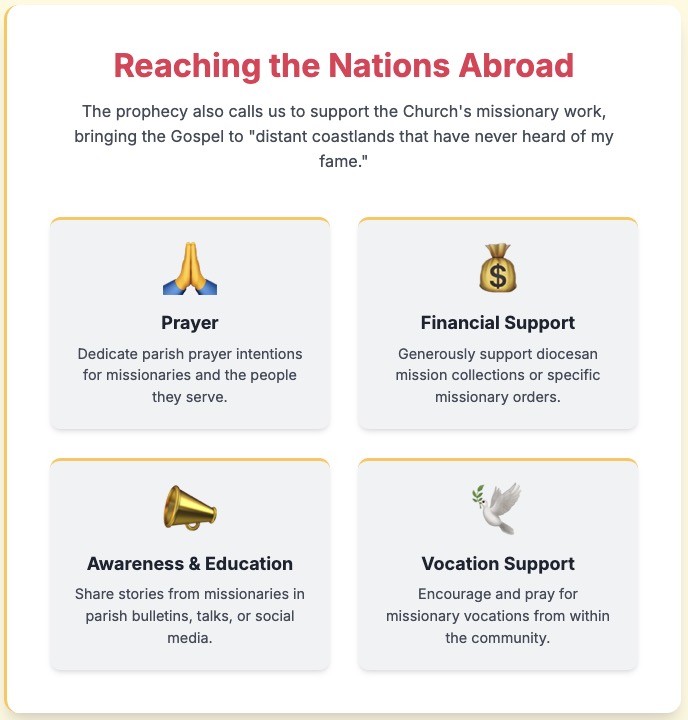

- We live out this prophecy by welcoming immigrants and refugees. What are some practical ways a parish community can be more welcoming to people from diverse backgrounds?
- How can we support missionary work, bringing the Gospel to “distant coastlands that have never heard of my fame,” as Isaiah prophesied?
THE WORD THIS WEEK’S Catholic Infographics were created using AI generative tools (i.e. Chart.js and Tailwind CSS. Content may be copied for personal use or for use in any non-profit ministry.
Scroll to bottom of page to view Catholic Infographics
21st Sunday of Year C
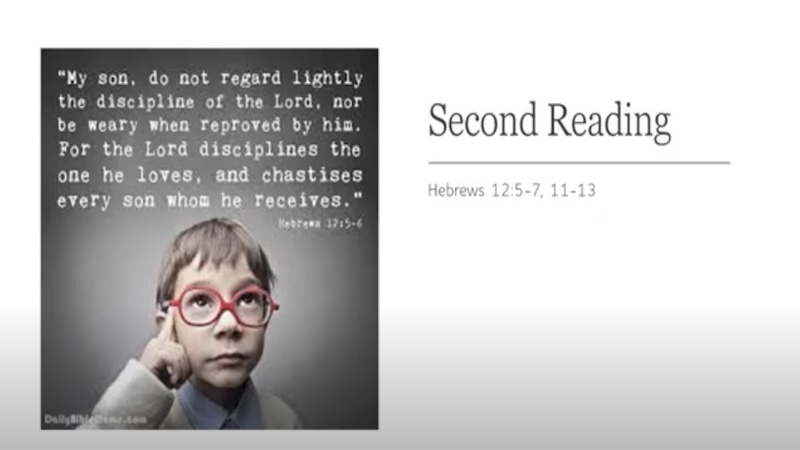
Hebrews 12:5-7, 11-13
Hebrews 12:5-7, 11-13
POP-UP Video | NAB w/ Notes | LECTIONARY
Click graphic to view intro to reading
Fr. Galetto explains that the author of this letter continues an “athletic metaphor” from a previous week’s reading about a race. The author uses the concept of being “trained by it” to describe how discipline strengthens believers and makes them whole.

The Meaning of “Discipline”: Fr. Galetto clarifies that the Greek word for discipline, paideia, means “instruction” or “pedagogy.” It is not just about punishment but about a process of training that helps people persevere and strengthens their faith. This training is what makes their “drooping hands” and “weak knees” strong and their faith whole.
Persecution as Discipline: The main point of this passage, according to Fr. Galetto, is to offer an explanation for the persecutions the early Christians were enduring. The author of Hebrews quotes from the book of Proverbs, suggesting that God allows persecution as a form of discipline for those He loves, treating them as His children.
A Sign of Being God’s Children: The author’s argument is that enduring these trials is a sign that they are truly God’s children. Fr. Galetto acknowledges that this argument may seem to “pale a little bit” compared to Paul’s view that persecution highlights those who live the gospel, but he explains the author’s contention that God uses this “discipline” for the good of His followers.
Clipart by Fr. Richard Lonsdale
Tough Love
by Larry Broding
Larry Broding’s commentary explores the concept of discipline in the Letter to the Hebrews through the analogy of a parent-child relationship. He notes the different ways “tough love” is expressed in various societies, from corporal punishment to allowing a child to face natural consequences.
Personal Growth and Community: Broding concludes that while the “tough love” analogy might be debated, everyone can agree that life is sometimes unfair. These moments, when we question “Why me, God?!”, are opportunities for personal resolve and seeking support from others. These difficult times, though not enjoyable, can be seen as “growth moments” that ultimately bring us closer to God and to fellow believers.
Discipline and “Tough Love”: Broding suggests that the author of Hebrews uses this “tough love” parenting analogy to explain the struggles Christians endure. The struggles are not necessarily intense persecution but are the difficulties of daily life that lead to spiritual growth.
Spiritual Maturity: According to the commentary, the struggles of a Christian’s life are akin to the maturity that parental discipline brings. Through life’s unfairness and injustices, a person learns to make better decisions and live a peaceful life.
When have you experienced God’s “tough love?” How has God brought you closer to him during the rough patches in your life?

God’s Loving Discipline: A Catholic Perspective on Suffering
By quoting from the book of Proverbs, the author of Hebrews establishes that God’s discipline is a parental act: “My son, do not disdain the discipline of the Lord… for whom the Lord loves he disciplines” (Hebrews 12:5-6). This is a foundational theological point for the Church. It teaches us that suffering, when endured with Christ, is a form of spiritual pruning meant to purify and strengthen us. God does not simply punish; rather, he corrects us out of a loving desire for our perfection
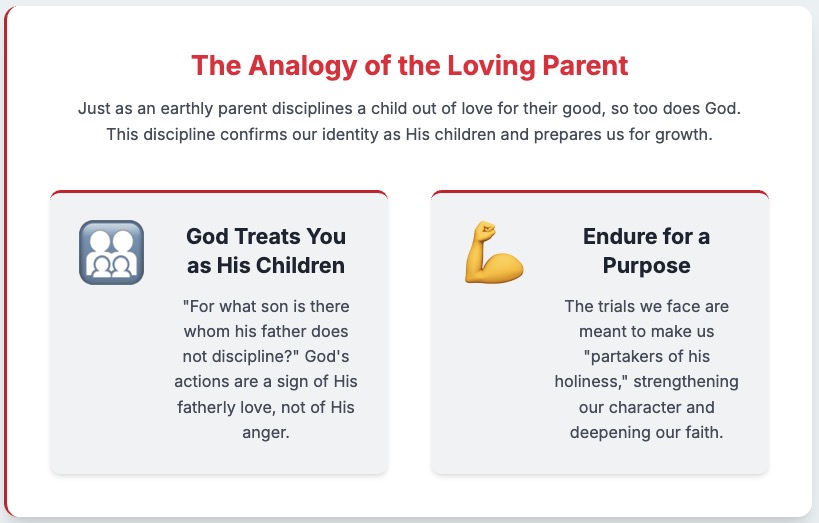
In the Catholic theological tradition, this passage is often understood through the lens of sanctifying grace. The grace we receive in Baptism and the sacraments gives us the strength to accept God’s discipline, transforming it from a source of despair into an opportunity for holiness. We are not expected to endure suffering on our own; the grace of God works within us, giving us the fortitude to persevere. The suffering itself is not good, but God can bring good out of it, just as a parent’s correction brings about a child’s maturity. This is the “peaceful fruit of righteousness” (Hebrews 12:11) that the author promises. Ultimately, our trials are meant to make us “partakers of his holiness” (Hebrews 12:10), a grace that prepares us for our eternal union with God.
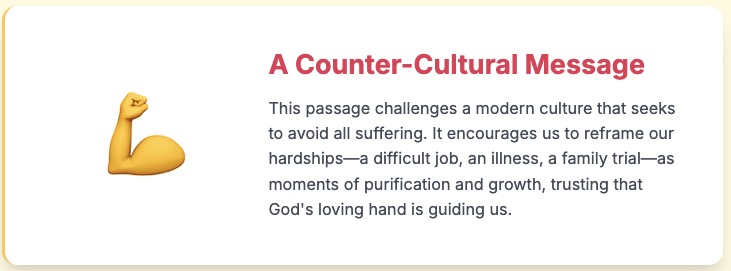
For contemporary Catholics, this passage offers a powerful antidote to a culture that seeks to avoid all forms of suffering. Hebrews 12 challenges us to reframe our hardships. A difficult job, a persistent illness, or a trial in our family life can be a source of purification and spiritual growth. The homilist can encourage the faithful to see these struggles not as a punishment from an angry God, but as a sign that God is actively working in their lives to conform them more closely to Christ. When we are tempted to grow weary, our faith rooted in this passage gives us a reason to persevere. It reminds us to “strengthen our drooping hands and our weak knees” (Hebrews 12:12), trusting that God’s loving hand is guiding us toward holiness and lasting peace.
Reflection Questions
- The Letter to the Hebrews reinterprets suffering as “discipline.” How is God’s discipline different from punishment in your own life?
- Can you think of a time when a difficult job, illness, or family trial, which felt like a burden, later became a source of spiritual growth?
- Hebrews 12 challenges our modern tendency to avoid suffering. How can we, as contemporary Catholics, embrace a more honest and realistic view of suffering in our lives and in the lives of others?
- The essay mentions that sanctifying grace gives us the strength to accept God’s discipline. What does it mean for you to endure suffering “with Christ” rather than on your own?
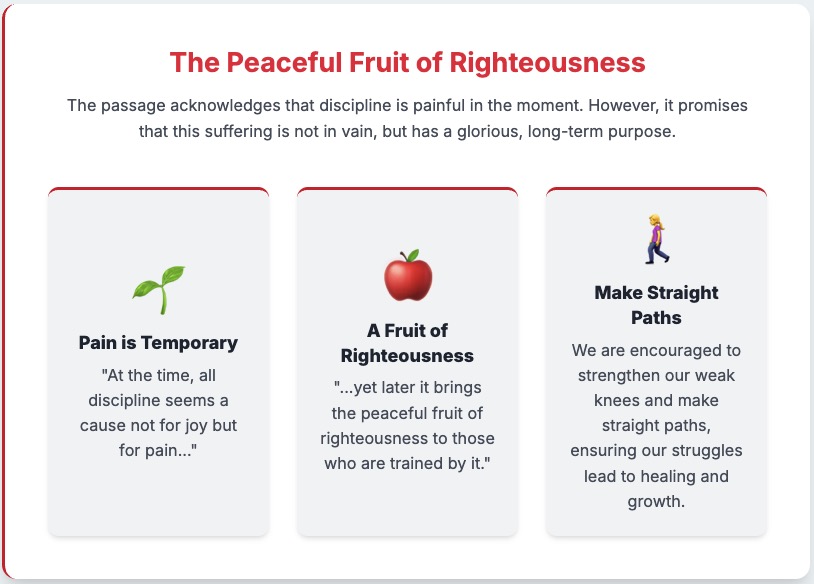
- How does the promise of the “peaceful fruit of righteousness” change your perspective on enduring hardship?
- How can this passage help a homilist speak to a congregation that is struggling with very real and painful hardships?
THE WORD THIS WEEK’S Catholic Infographics were created using AI generative tools (i.e. Chart.js and Tailwind CSS. Content may be copied for personal use or for use in any non-profit ministry.
Scroll to bottom of page to view Catholic Infographics

21st Sunday of Year C
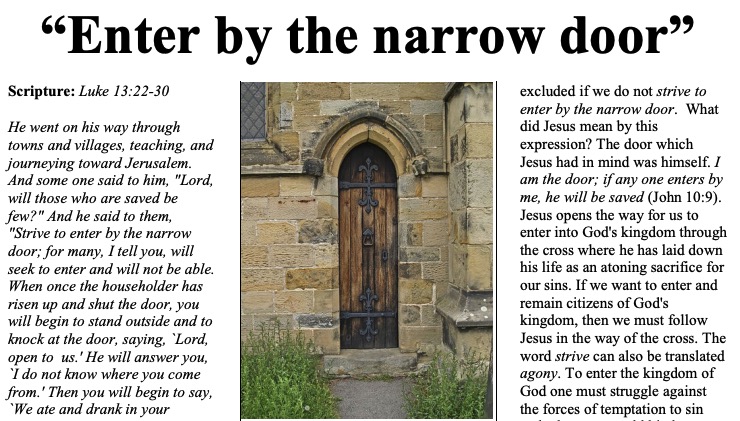
Luke 13:22-30
Luke 13:22-30
POP-UP Video | NAB w/ Notes | LECTIONARY
Click graphic to view intro to reading
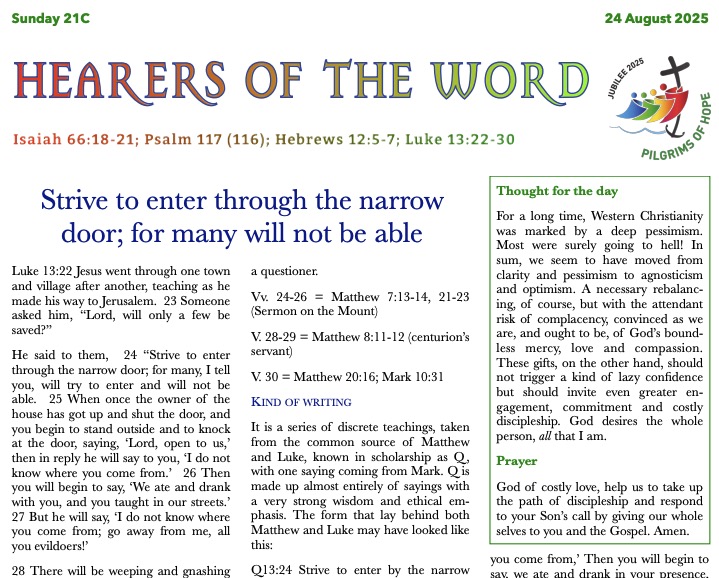
Fr. Galetto begins by explaining the context of the Gospel. Jesus is making his way to Jerusalem when someone asks him, “Lord, will only a few people be saved?” This was a common question at the time, and Fr. Galetto points out that Jesus does not answer with a number but with a call to action—he focuses on the process of salvation.

Universal Salvation (and a Warning): Fr. Galetto connects this reading back to the prophecy in the first reading, noting that when Jesus says people will come from the “east, and the west, from the north, and the south,” he is affirming the universal appeal of salvation for all people. However, he also provides a warning in the last line of the gospel: “some are last, who will be first, and some are first, who will be last.” This means that being a part of the “chosen people” or even being a Christian does not guarantee salvation. We must not presume salvation but actively live out the gospel.
The Narrow Door: Jesus’s answer, “Strive to enter through the narrow gate,” is interpreted as a call to struggle and effort. The Greek word used, agonismay, is an athletic term, suggesting that one must be “strong enough” to enter. This “narrow door” is linked to the concept of repentance, which requires asking for and giving forgiveness.
Deeds, Not Just Words: Jesus challenges the idea that simply being in his presence (“We ate and drank in your company”) is enough for salvation. The key question is whether they listened to his teachings and put them into practice. Listening is not enough; one must “hear the word of the Lord and do it.”
Clipart by Fr. Richard Lonsdale
Religion and Faith
by Larry Broding
Larry Broding’s commentary focuses on Jesus’s response to the question of who will be saved. He explains that the questioner likely wanted Jesus to confirm that the Jewish people, as God’s “Chosen People,” would be saved. However, Jesus shifts the focus from the number of people saved to the identity of those who would be saved.
Relationship vs. Activity: The commentary concludes by challenging readers to consider their own religious thinking. It asks whether being religious is about performing specific activities (like going to Mass or praying) or about having a personal relationship with God. While religious activities are valuable tools to help us focus on God, they are not an end in themselves.
Beyond Religious Motions: Broding states that Jesus uses the parable of party crashers to make a clear point: simply being religious by habit or association is not enough. The people in the parable claim a connection to the master of the house, but are turned away because they are not true disciples. This illustrates that “going through the religious motions,” such as attending services or praying, is not a substitute for a genuine relationship with God.
The Last Shall Be First: Jesus emphasizes that God will call people who one would least expect to have a faith relationship. These individuals, who may not be conventionally “religious,” will come from different races, cultures, and countries. Because they put their trust in God, they will truly please Him. The commentary highlights the paradox that those who are “last” in the eyes of the world will be “first” in the Kingdom of God, while those who are merely “first” by religious convention may be “last.”
What church practices help you grow closer to God? Which hinder that growth? Why do you think some help and some don’t?

The Catholic Call to Strive in Luke’s Gospel
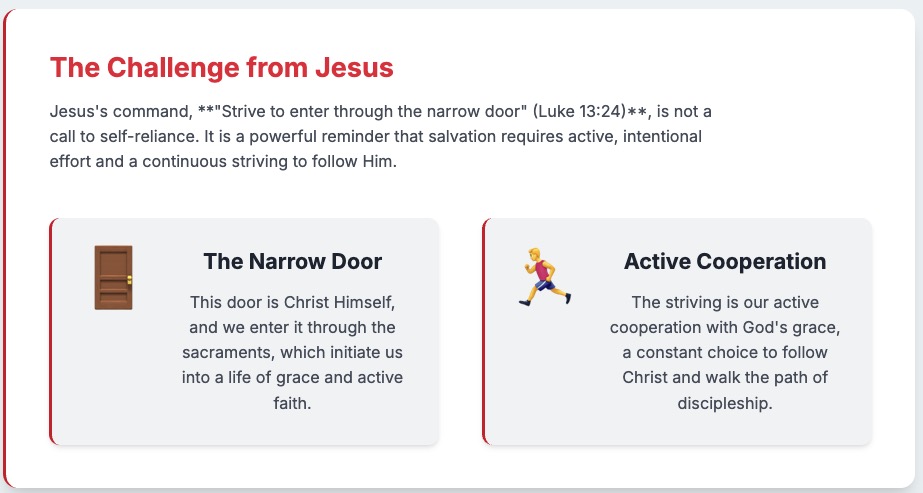
The Gospel of Luke presents Jesus on his “fateful way to Jerusalem,” where he responds to a pivotal question: “Lord, will only a few people be saved?” (Luke 13:23). His response is not a simple yes or no, but a powerful command: “Strive to enter through the narrow door” (Luke 13:24). This command stands in stark contrast to the common assumption that salvation is a passive state or a guaranteed inheritance. Instead, Jesus makes it clear that eternal life requires an active, intentional effort—a continual striving. This message is at the heart of Christian discipleship and serves as a foundational teaching on the relationship between human freedom and divine grace.
In Catholic theology, this passage is understood through the lens of both grace and free will. The “striving” Jesus speaks of is not a form of Pelagianism, which would suggest we can earn salvation through our own efforts alone. Rather, it is an active cooperation with God’s grace, which is freely given to all. The “narrow door” is Christ himself, and we enter it through the sacraments, particularly Baptism, which initiates us into a life of grace. This life, however, requires a constant choice to follow Christ, to “make every effort” (Hebrews 4:11) to be in relationship with Him. The passage is a reminder that while God’s mercy is infinite, our response must be deliberate and unwavering. It is the journey of the faithful, who, in their freedom, choose to walk the path of the Cross with Christ.
For contemporary Catholics, this message is a powerful antidote to a culture of complacency. We can be tempted to believe that simply being a “good person” or a baptized Catholic is enough. However, Jesus’s words challenge us to a more radical commitment. Our striving is evident in the daily choices we make: whether to serve the poor, forgive a neighbor, or endure a personal trial with faith. A modern-day application might be seen in a Catholic who works to defend human life, a teacher who brings Christ’s light into their classroom, or a parent who strives to raise their children in the faith amidst a secular world. Luke’s Gospel reminds us that our faith is not a passive assurance of salvation, but a dynamic and lifelong invitation to a life of active discipleship. Our efforts are not in vain, for they are sanctified by the grace that empowers us to pass through the narrow door into the Kingdom of God.
Reflection Questions
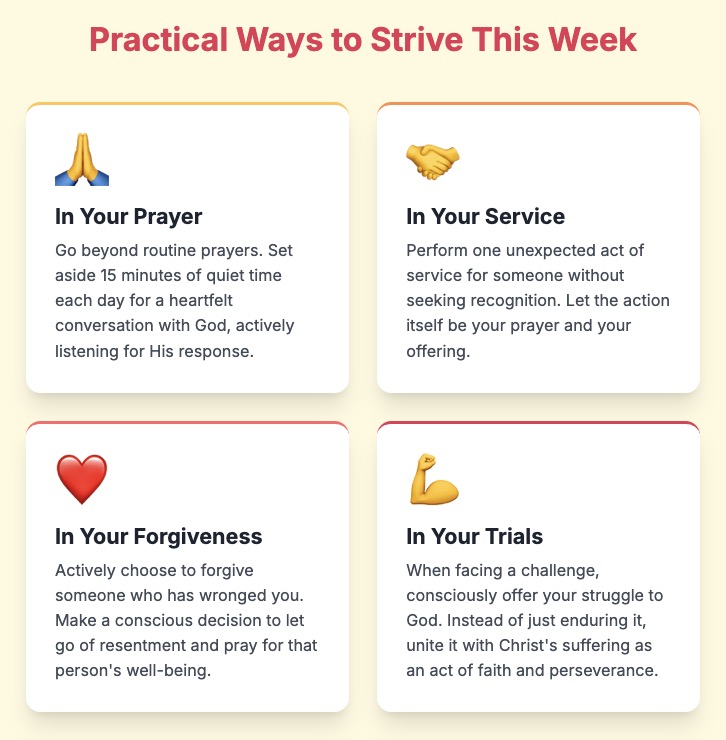
- Jesus’s command to “strive” stands in contrast to the idea of a passive faith. What does this “striving” look like in your daily life?
- How does the image of the “narrow door” change your understanding of a Christian life?
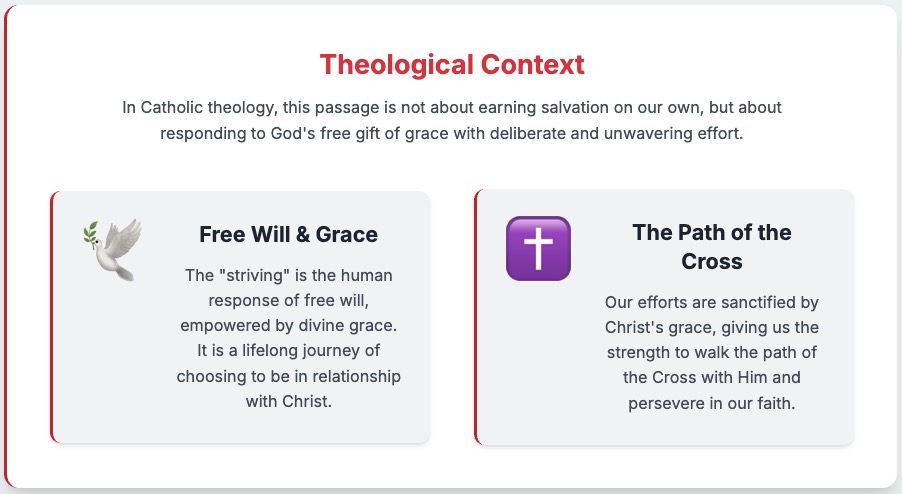
- Striving is an “active cooperation with God’s grace.” What does it mean for you to actively cooperate with grace?
- How does this understanding of grace and free will challenge the idea that we can earn our salvation on our own?
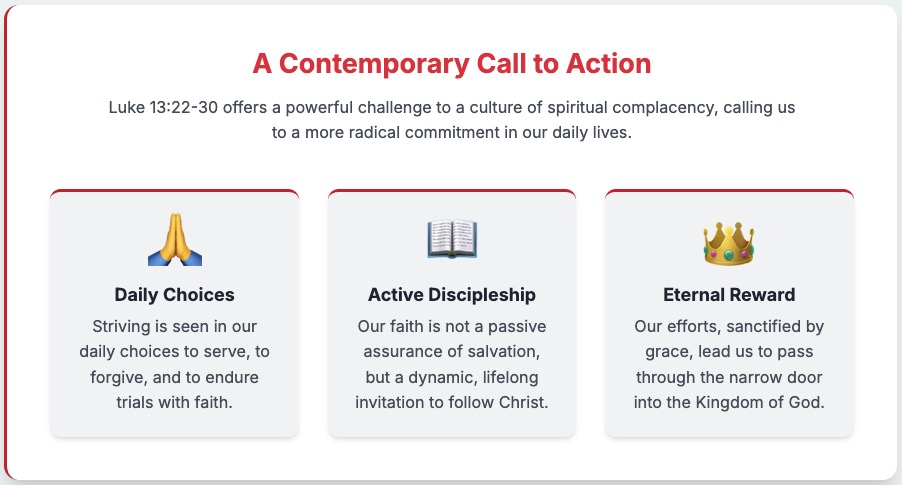
- This message is an antidote to spiritual complacency. What are some of the modern-day “sins of omission” that can prevent us from striving?
- How can a person who is striving to live a holy life be a witness to Christ in today’s world?
- What is one way this passage inspires you to be a more active and intentional disciple of Christ this week?
THE WORD THIS WEEK’S Catholic Infographics were created using AI generative tools (i.e. Chart.js and Tailwind CSS. Content may be copied for personal use or for use in any non-profit ministry.

Fr. Conley Bertrand
21st Sunday of Year C
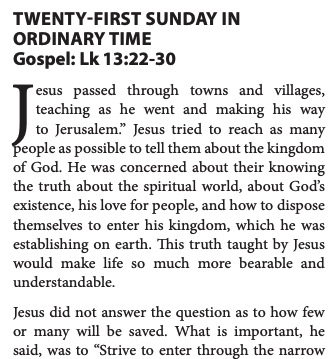
Cycle C (PDFs)
📖 Old Testament (43 pp.)
📖 Epistles (87 pp.)
📖 Gospels (182 pp.)
📖 Daily Gospels (208 pp.)
SOURCE: Come, Lord Jesus
Fr. George Corrigan, OFM
21st Sunday of Year C
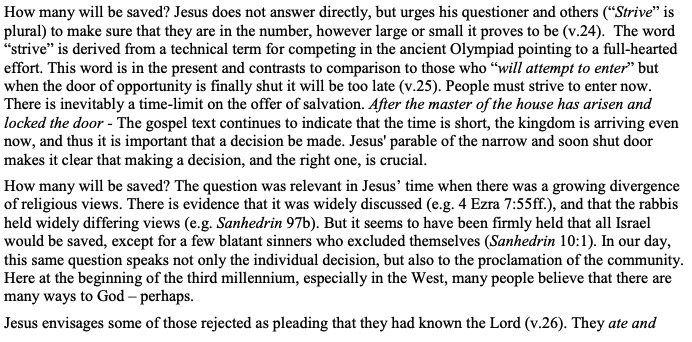
Fr. Thibodeau
Bible Study Notes
Small Group Discussion Guides


Bp. John P. Dolan
Fr. Tobin
Carmelite Reflections and Prayers
Lectio Divina
90-page PDF with reflections and prayers for each day of the month
Lectio Divina AUGUST 2025 (PDF)
Lectio Divina AUGUST 2025 [Mobi]
Lectio Divina AUGUST 2025 [ePub]
______________
“Lectio divina is an authentic source of Christian spirituality recommended by our Rule. We therefore practise it every day, so that we may develop a deep and genuine love for it, and so that we may grow in the surpassing knowledge of Christ. In this way we shall put into practice the Apostle Paul’s commandment, which is mentioned in our Rule: “The sword of the Spirit, too, which is the word of God, is to dwell abundantly in your mouth and in your hearts; and whatever things you have to do, let them be done in the word of the Lord.” (Carmelite Constitutions (2019), n. 85.)
Source: Carmelites
CATHOLIC BIBLE STUDY VIDEO SERIES
Fr. Tim Peters
FIRST/SECOND READINGS

GOSPEL READING

Fr. Peters teaches at Saint John’s Seminary in Camarillo, CA.
FIRST READING | SECOND READING | GOSPEL