August 24, 2025
August 24, 2025


w/ Guided Reflection Questions & Infographics
Homilies
Homilies
Video Homilies, Reflection Questions, Free Sunday Bulletin Graphics, Sunday Readings
Video Homilies, Reflection Questions, Free Sunday Bulletin Graphics, SUnday Readings
- BISHOP Barron
- 2-Min Homily
- FR. RUTTIG
- MSGR. Hahn
BISHOP
BARRON

TIP: Begin playing the video and, as you listen to it, explore the infographics and reflection questions.
Infographics were generated using Google Gemini AI tools (Chart.js and Tailwind CSS). Feel free to use them in any non-profit ministry. A LINK or shoutout toTHE WORD THIS WEEK would be greatly appreciated. .
21st Sunday of Year C


This discussion guide has been generated by GOOGLE’S AI Gemini 2.5 Flash LLM.
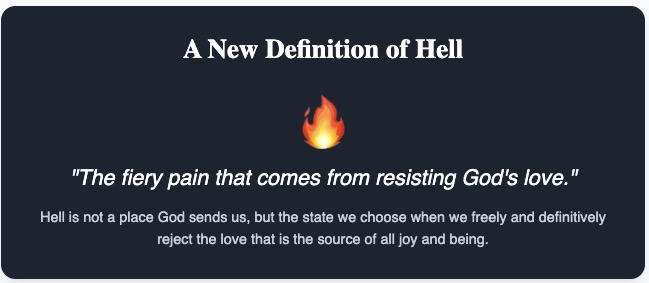
Bishop Barron begins by acknowledging the intense debate around the question, “How many will be saved?” He clarifies that hell is a real possibility, flowing from the truths that God is love and we are free.
- Why do you think the question of who will be saved brings up such “strong feelings” and “vehemence” among people? What were your own assumptions about this topic before listening to the homily?
- Bishop Barron defines hell as the “fiery pain that comes from resisting God’s love.” How does this definition change your understanding of what hell is?
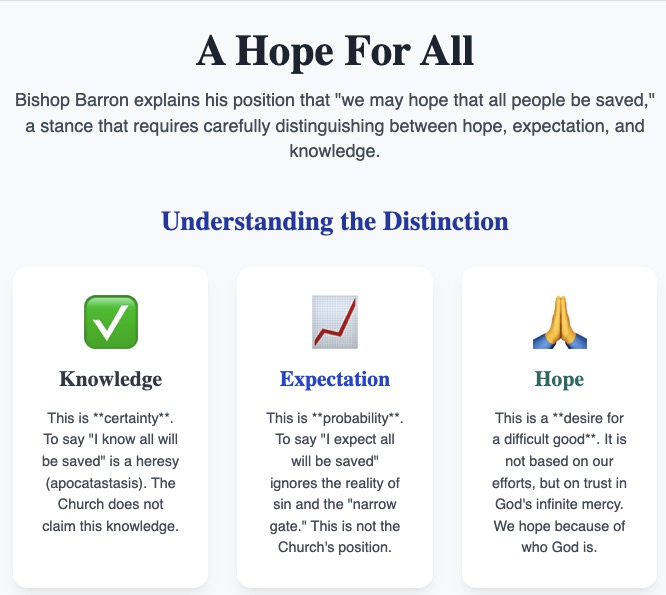
Bishop Barron explains his position that “we may hope that all people be saved,” carefully distinguishing this from knowledge or expectation.
- What is the difference between hoping all will be saved, expecting all will be saved, and knowing all will be saved? Why is this distinction so important?
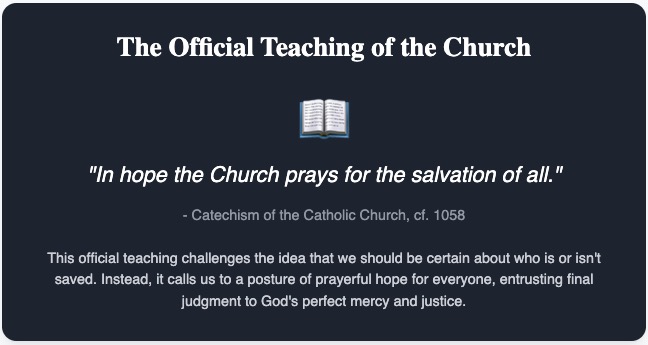
- The homily quotes the Catechism: “In hope the Church prays for the salvation of all.” How does this official teaching of the Church challenge the idea that we should be certain about who is or isn’t saved?
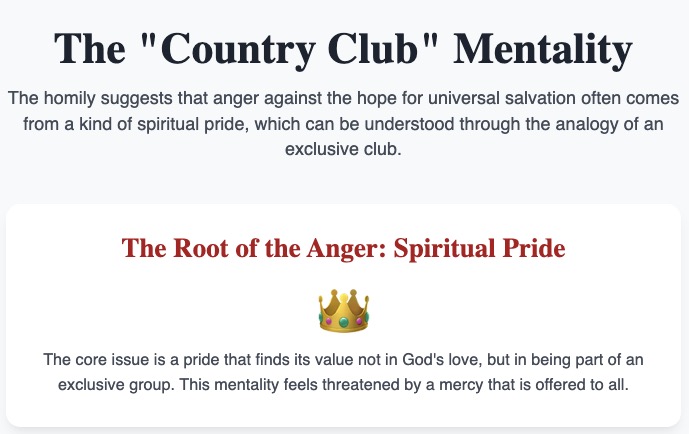
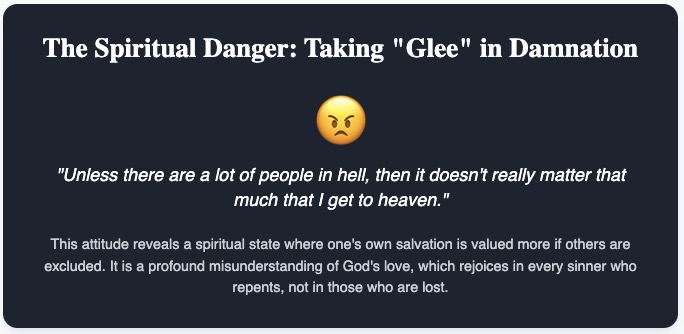
The homily suggests that much of the anger against the hope for universal salvation comes from a kind of spiritual pride.
- Bishop Barron uses the analogy of a “country club.” What does he mean by this? How can our faith sometimes feel more exclusive than inclusive?
- Why do you think some people seem to take “glee” in the idea that many people will be in hell? What does this attitude reveal about our own spiritual state?

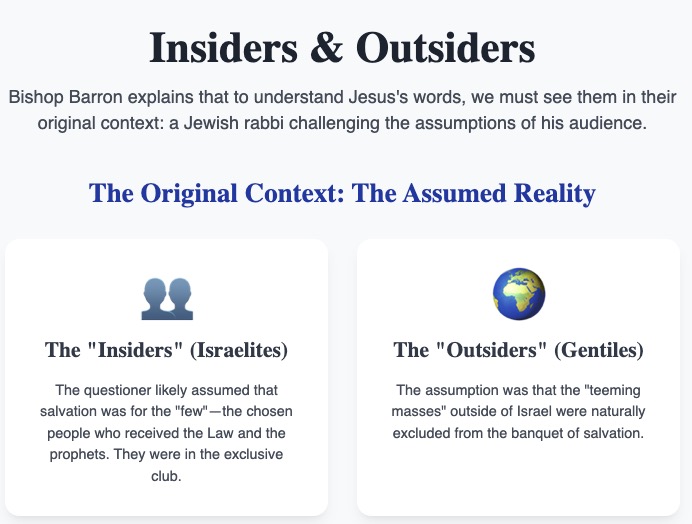
Bishop Barron places the Gospel back in its original context: a Jewish rabbi speaking to a Jewish audience.
- How does understanding the “insider” (Israelite) versus “outsider” (Gentile) dynamic change your reading of Jesus’s words?
- Jesus warns that some “insiders” who ate and drank in his company will be cast out, while “outsiders” from east, west, north, and south will take their place. Who might be the “insiders” and “outsiders” in the Church today?

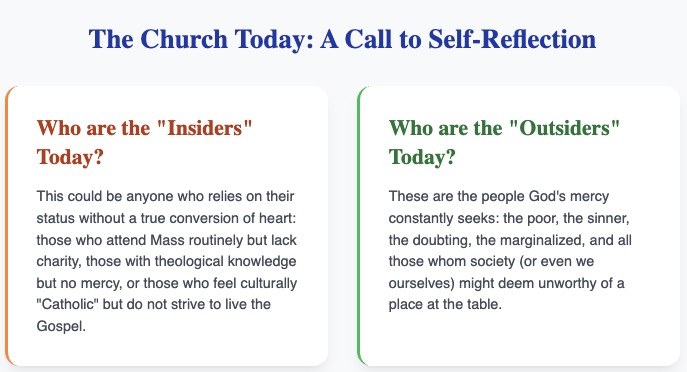

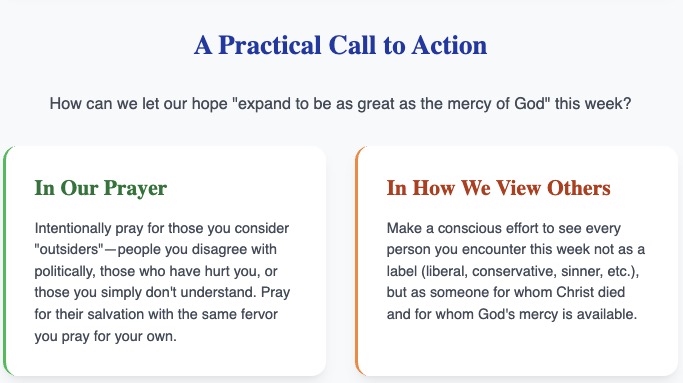
The homily concludes with a call to expand our spiritual imagination to match the immense generosity of God’s mercy.
- How does Jesus’s response in the Gospel challenge the human instinct to create exclusive groups?
- What is one practical way you can let your hope “expand to be as great as the mercy of God” in your prayer life or in how you view others this week?

Access guide and infographics by clicking on banner

This discussion guide has been generated by GOOGLE’S AI Gemini 2.5 Flash LLM.
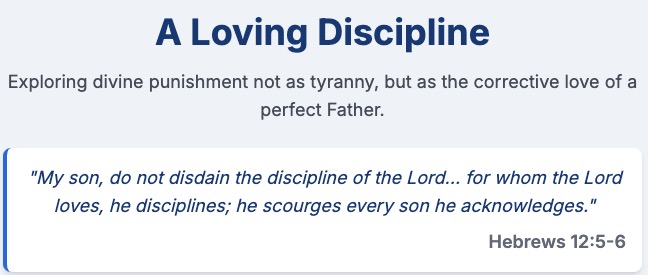
- The speaker suggests that modern spirituality often presents a “one-sided view of God” that focuses only on love and compassion, avoiding the topic of punishment. Have you found this to be true in your own experience? Why do you think the idea of God punishing people has become unpopular or uncomfortable?
- The sermon defines love as “willing the good of the other,” which can sometimes feel “harsh and dreadful.” How does this definition challenge or expand your understanding of God’s love?
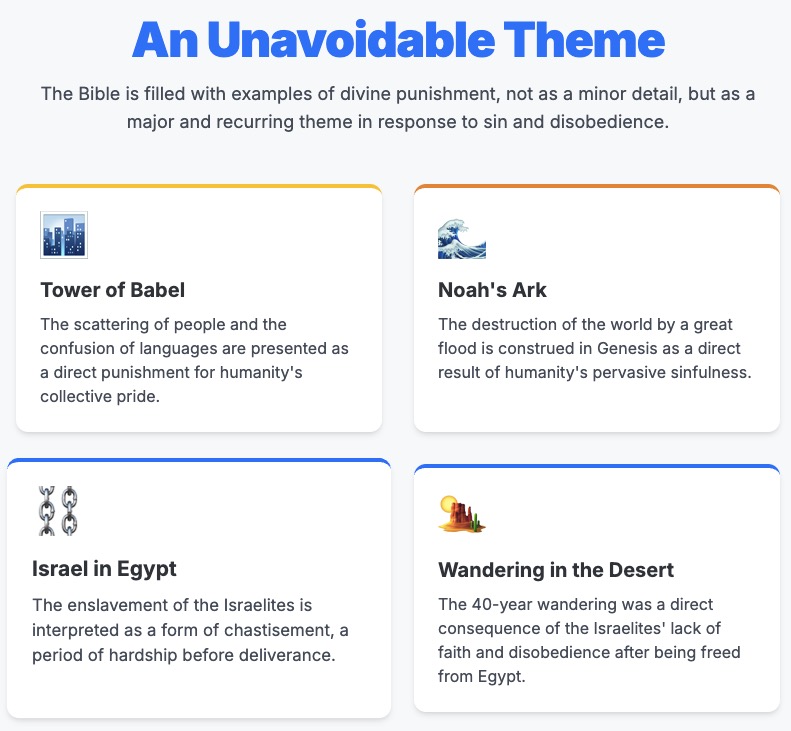
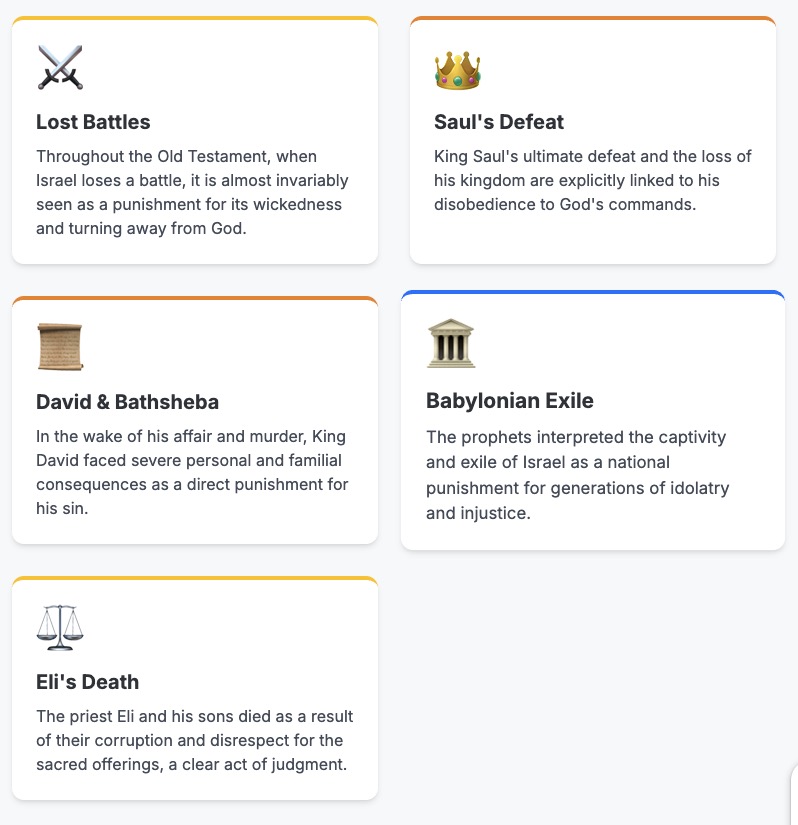
- Were you surprised by the number of biblical examples of divine punishment (from the Tower of Babel to Ananias and Sapphira)? How does seeing this as a major biblical theme, rather than an obscure idea, affect your perspective?


- The speaker explains that the word discipline comes from the Latin word discere, meaning “to learn.” How does shifting your thinking from “punishment” to “discipline” (a learning process) change how you view difficult life events?
- The sermon uses a series of analogies for parental discipline that increase in intensity:
- A toddler in timeout.
- A principal punishing a student after a snowball fight.
- A parent taking away a teenager’s car keys.
- A parent using “tough love” with an adult child battling addiction.
- The story of Jonah being swallowed by the great fish is presented as a kind of “divine timeout.” Can you think of a time when your own freedom was restricted in a way that forced you to stop, reconsider your path, and get back on track?


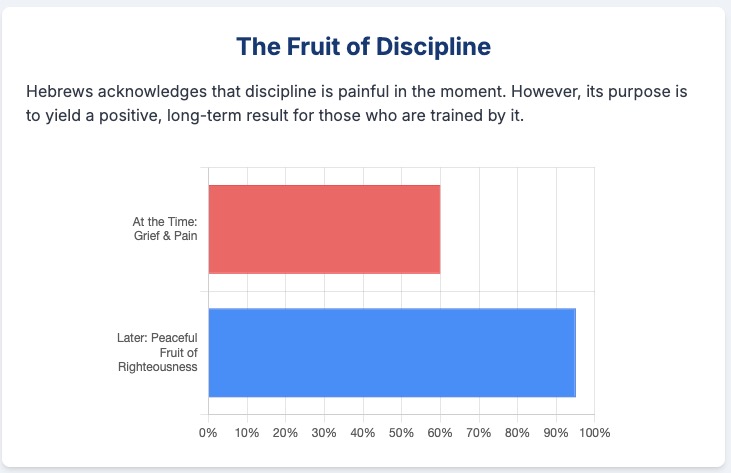
- The guide from Hebrews says, “At the time, all discipline seems a cause not for joy but for pain, yet later it brings the peaceful fruit of righteousness to those who are trained by it.”
- Can you recall an instance of discipline in your life (from a parent, teacher, or mentor) that was painful in the moment but for which you are now grateful? What did you learn?
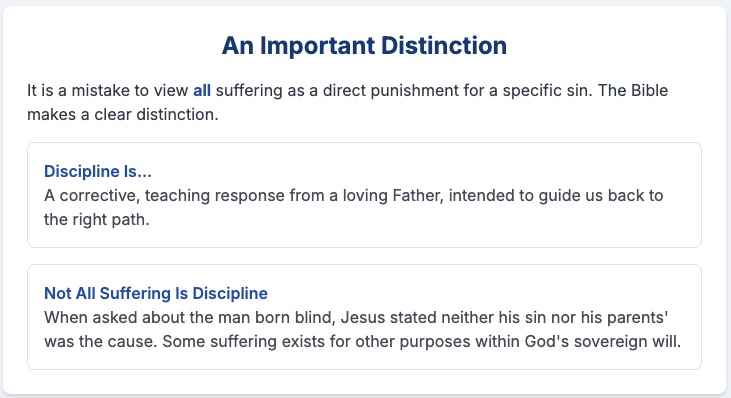
- The speaker is careful to note that not all suffering should be interpreted as divine discipline, referencing Jesus’ words about the man born blind. Why is this an important distinction to make? What are the dangers of seeing every negative event as a direct punishment from God?
- How can we approach our own trials with a heart that is open to what God might be trying to teach us, without falling into guilt or assuming we are always being punished for a specific sin?
This discussion guide has been generated by GOOGLE’S AI Gemini 2.5 Flash LLM.
TWO MINUTE
HOMILY
TIP: Begin playing the video and, as you listen to it, explore the infographics and reflection questions.
Infographics were generated using Google Gemini AI tools (Chart.js and Tailwind CSS). Feel free to use them in any non-profit ministry. A LINK or shoutout toTHE WORD THIS WEEK would be greatly appreciated. .
21st Sunday of Year C

This discussion guide has been generated by GOOGLE’S AI Gemini 2.5 Flash LLM.
Key Themes
The Reason for Our Striving: Some of Jesus’s teachings are difficult to accept, but we do so for a reason: the promise of eternal life. The homily can remind the faithful that our striving is not a burden but an act of love, rooted in the knowledge that Jesus has “the words of eternal life.” This eternal life begins here on earth, and our perseverance will be rewarded in heaven.
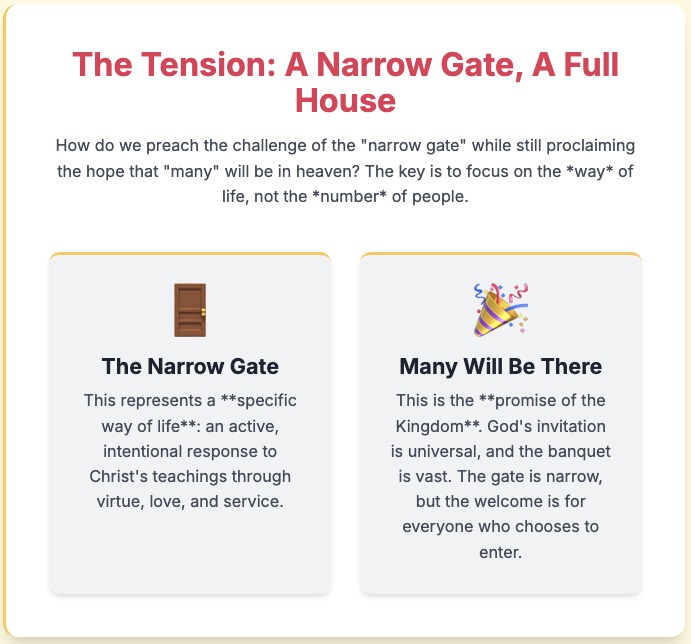
The Narrow Gate and the Promise of the Kingdom: Jesus’s words about the narrow gate can sound restrictive, but the Gospel promises that many will be there. The homily can explain that the “narrow gate” is not about a limited number of people being saved, but about the specific way of life that leads to the everlasting happiness of heaven. This way of life is a direct, active response to Christ’s teachings.
Discipleship as a Positive Choice: The call to discipleship is a clear line in the sand, dividing those who are earth-minded from those who recognize a deeper purpose. Being a disciple means making a positive choice to live a life of virtue, love our neighbor, and serve those in need. This homily point can encourage the congregation to see their faith as a dynamic choice rather than a passive identity.
Discussion Questions
- How can I address the tension between the “narrow gate” and the promise that “many” will be in heaven without minimizing the challenge of discipleship?
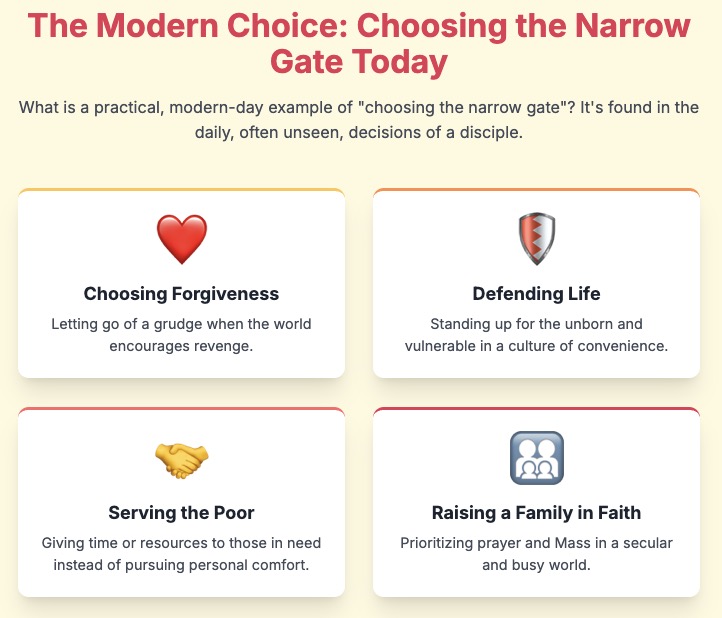
- What is a practical, modern-day example of “choosing the narrow gate”?
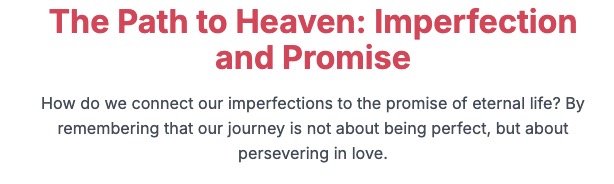
- How can I connect the “imperfections” we have to put up with in ourselves and others to the promise of eternal life?
The goal is to speak to the congregation with a tone of encouragement, reminding them of the joy and purpose that come from actively choosing to follow Christ.

Access guide and infographics by clicking on banner

This discussion guide has been generated by GOOGLE’S AI Gemini 2.5 Flash LLM.
Introduction (Setting the Stage):
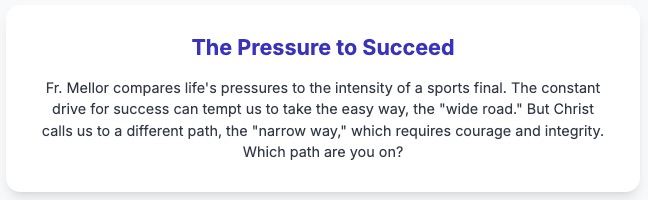
- Fr. Anthony begins by drawing a parallel between the pressures in sports and the pressures in our daily lives [00:29]. Can you relate to this? What are some of the “noble ideals” in your life that can sometimes be corrupted by distractions or the desire for success?
- The homily mentions the “desire for success and the temptation to follow the crowd” [00:20]. In what areas of your life do you feel the strongest pressure to conform?
The Allure of the “Wide Road”:
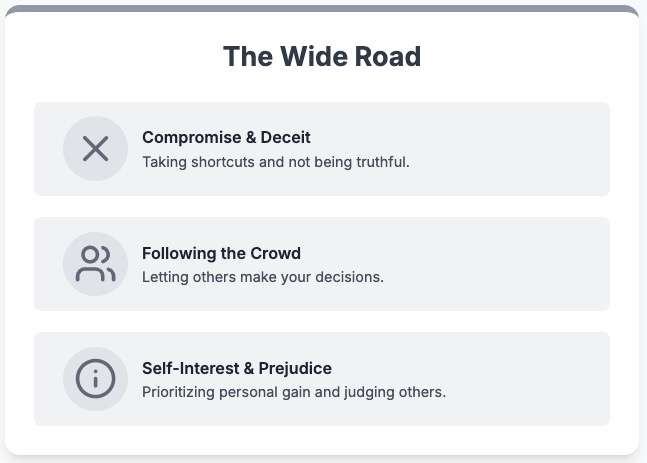
- Jesus speaks of a “wide road” that is easy to travel but can lead to compromise [01:15]. What does this “wide road” look like in our world today? What are some examples of how societal pressures can lead to a compromise of our values?
- Think about a time you chose the “easy way” out of a situation. What was the outcome? How did it make you feel?
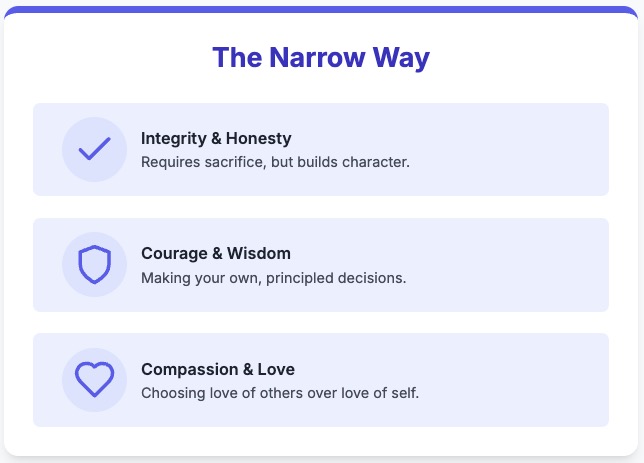
Choosing the “Narrow Way”:
- The “narrow way” requires “sacrifice, wisdom, and courage” [01:04]. Why do you think these three qualities are essential for living a life of integrity? Which of these do you find most challenging to cultivate in your own life?
- Fr. Anthony lists several ethical choices that define the “narrow way”: honesty over deceit, courtesy over gruffness, acceptance over prejudice, compassion over self-interest, and love of others over self-love [01:25].
- Which of these choices resonates with you the most right now?
- Can you share an example of a time you witnessed someone making one of these “narrow way” choices? How did it impact you?
Christ’s Companionship:
- The homily reminds us that while the “narrow way” can be lonely, it is the path that Christ walked, and He promises to walk it with us [01:52].
- How does this promise of Christ’s companionship make you feel about the challenges of the “narrow way”?
- In what practical ways can we invite Christ to “walk with us” on our daily journey?
Conclusion (Personal Application):
- What is one concrete step you can take this week to more intentionally choose the “narrow way” in a specific area of your life?
- How can this group support one another in striving to live a life of greater integrity and faith?
Access guide and infographics by clicking on banner
FR. KEVIN
RUTTIG
TIP: Begin playing the video and, as you listen to it, explore the infographics and reflection questions.
Infographics were generated using Google Gemini AI tools (Chart.js and Tailwind CSS). Feel free to use them in any non-profit ministry. A LINK or shoutout toTHE WORD THIS WEEK would be greatly appreciated. .
21st Sunday of Year C

This discussion guide has been generated by GOOGLE’S AI Gemini 2.5 Flash LLM.
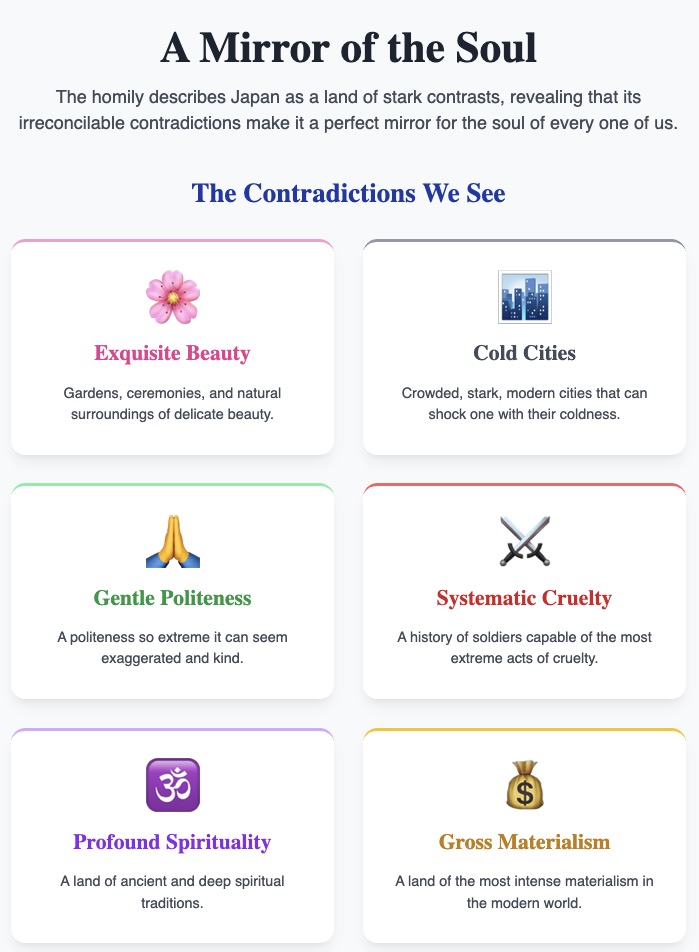
The homily begins by describing Japan as a land of “stark contrasts and seemingly irreconcilable contradictions”—exquisite beauty and cold cities, gentle politeness and systematic cruelty, profound spirituality and gross materialism. It concludes, “In short, it is the perfect mirror of the soul of every one of us.”
- Which of the contradictions mentioned in the homily resonates most with your own inner life?
- Why do you think the human soul is often a place of “hot and cold, dark and light”?
- How can recognizing these contradictions within ourselves be a starting point for a more honest spiritual life?
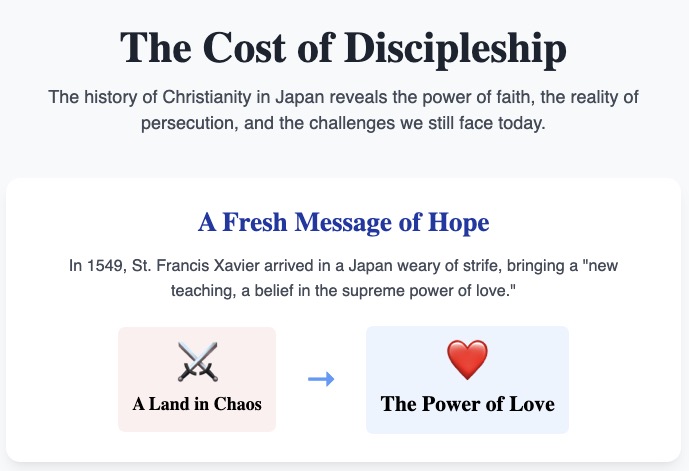
Fr. Kevin tells the history of Christianity in Japan: its enthusiastic welcome by a people “hungry for a fresh message of spirituality and hope,” followed by centuries of brutal persecution and martyrdom.
- St. Francis Xavier brought a “new teaching, a belief in the supreme power of love.” What makes the Christian message of love feel “fresh” and powerful, both then and now?
- The Japanese Christians refused to abandon their faith, even in the face of torture and death. What does their example teach us about the cost of discipleship?
- In our own lives, what are the modern “persecutions” (social pressure, ridicule, indifference) that might tempt us to hide or abandon our faith?

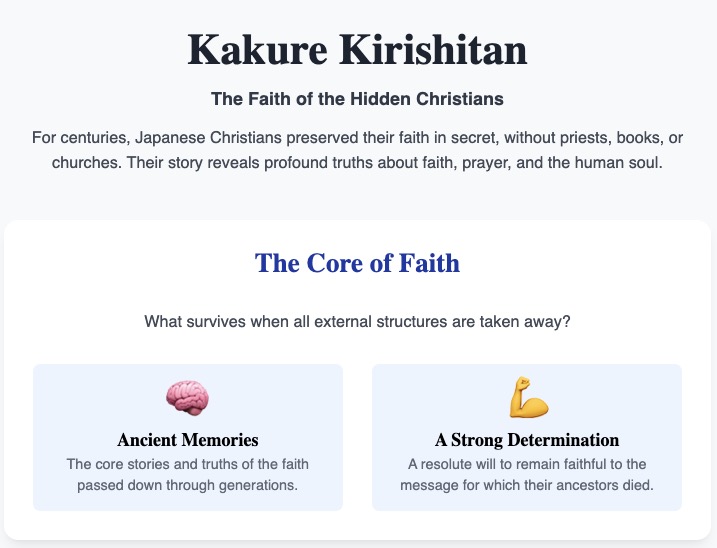
For centuries, groups of Japanese Christians went into hiding, preserving the faith without priests, books, or churches. They disguised their faith in the symbols of other religions and passed it down through generations.
- The hidden Christians had only “ancient memories and a strong determination to remain faithful.” What do you think is the core of the Christian faith that can survive even when all the external structures (churches, catechisms, priests) are taken away?
- Their prayers became a mixture of languages, “completely unintelligible to anyone but God.” What does this suggest about the nature of prayer and God’s ability to understand the heart, even when our words fail?
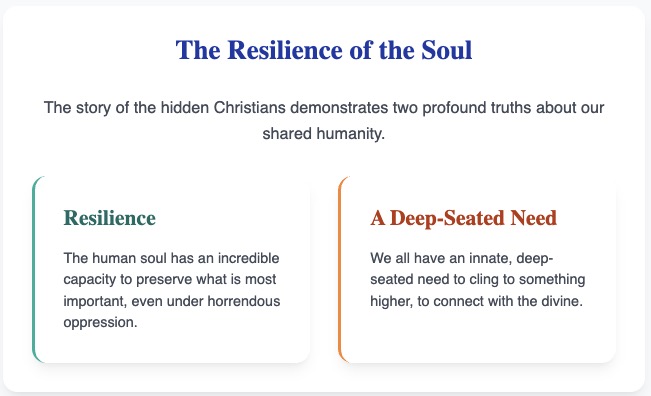
- How does the story of the hidden Christians demonstrate the “resilience of the human soul” and our “deep-seated need to cling to something higher”?

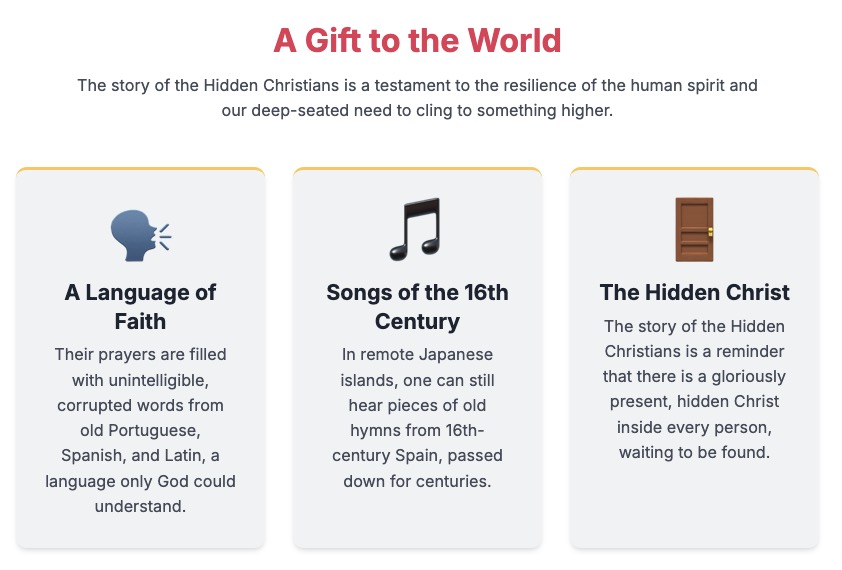
The homily concludes by universalizing the story. The encounter with the divine is always disruptive. God enters each person through a “secret door,” and “inside every person born is a hidden Christian… a gloriously present hidden Christ.”
- What does it mean to you that God enters your soul through a “secret door… a door different in each soul”?
- How does the idea of a “hidden Christ” being present inside every person change the way you might view strangers, or even those you find difficult to love?
- What are the layers of “confusion… fear… pretending and denying and running” in your own life that might be covering up the “gloriously present hidden Christ” within you?
Access guide and infographics by clicking on banner

This discussion guide has been generated by GOOGLE’S AI Gemini 2.5 Flash LLM.
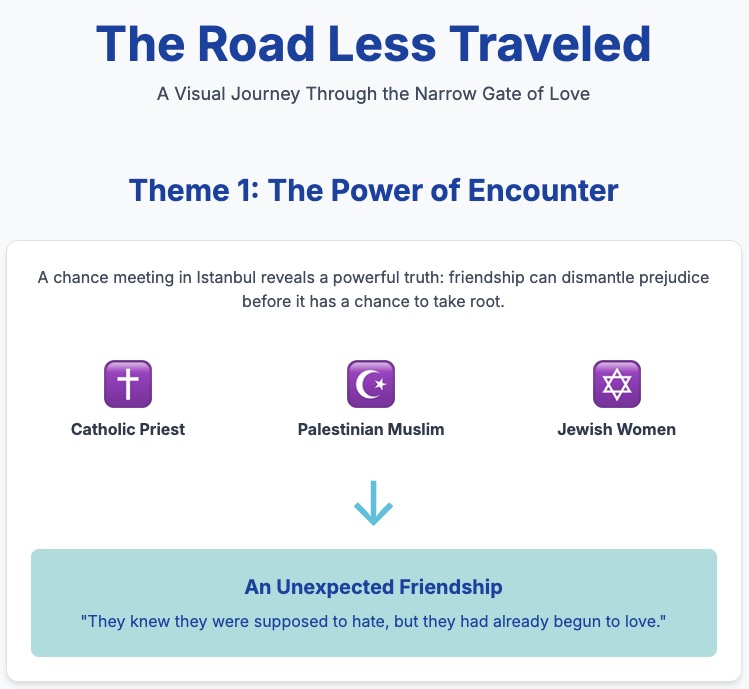
The homily begins with a compelling story set in Istanbul, where a chance encounter at a dinner table brings together a Catholic priest, a Palestinian Muslim man, and three Jewish-American women. Their initial assumptions are dismantled as they form a bond of friendship before knowing each other’s identities.
Key Quote: “We had all become friends because the prejudice had not gotten to us first… They knew they were supposed to hate, but they had already begun to love.”
Reflection Questions:
- What was your reaction to the story of the dinner in Istanbul? Have you ever had an experience where a personal encounter changed your preconceived notion of a person or a group of people?
- Fr. Ruttig says, “We have enormous power to change people’s attitudes.” How did the priest and his friend Ali use their “power” in this situation? How can we do the same in our daily lives?
- Why do you think it’s often easier to “hate” or distrust from a distance? What is it about face-to-face human connection that breaks down barriers?
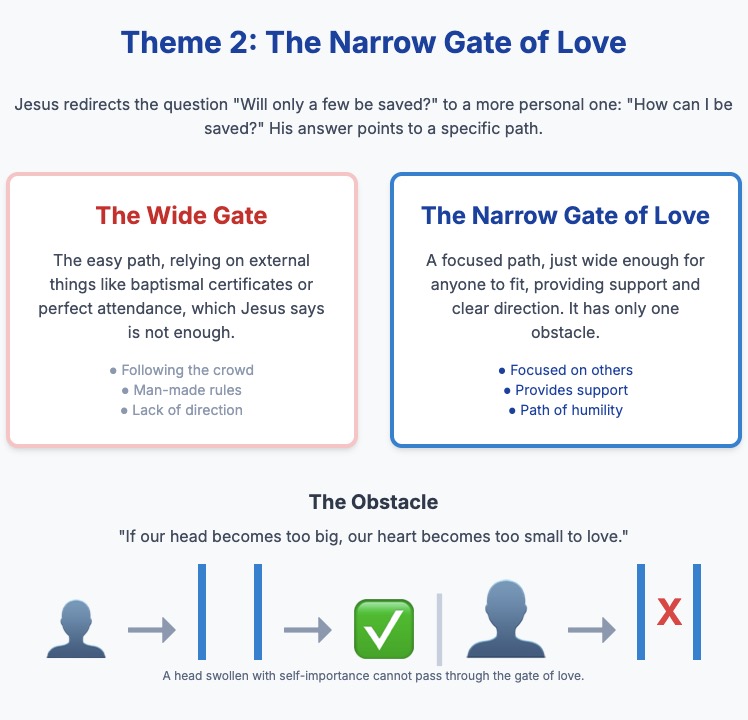
Fr. Ruttig connects the story to the Gospel, where Jesus is asked, “Lord, will only a few people be saved?” Jesus redirects this “trick question” about numbers and exclusion to a personal question: “How can I be saved?” The answer is to enter through the narrow gate.
Key Idea: “The narrow gate is the gate of love… Everyone [can fit through] except those whose heads have grown too big to pass through, too big with their own self-importance so that they do not see anyone else in need. If our head becomes too big, our heart becomes too small to love.”
Reflection Questions:
- Why is the question “Will only a few be saved?” a “trick question”? What is the underlying assumption behind it?
- Fr. Ruttig describes the narrow gate of love as something that provides support, unlike a wide gate where you can wander. How does this image of love as a focused, supportive path resonate with you?
- What does it look like in practical, everyday terms for someone’s “head to have grown too big” with self-importance? What are the warning signs in our own lives?
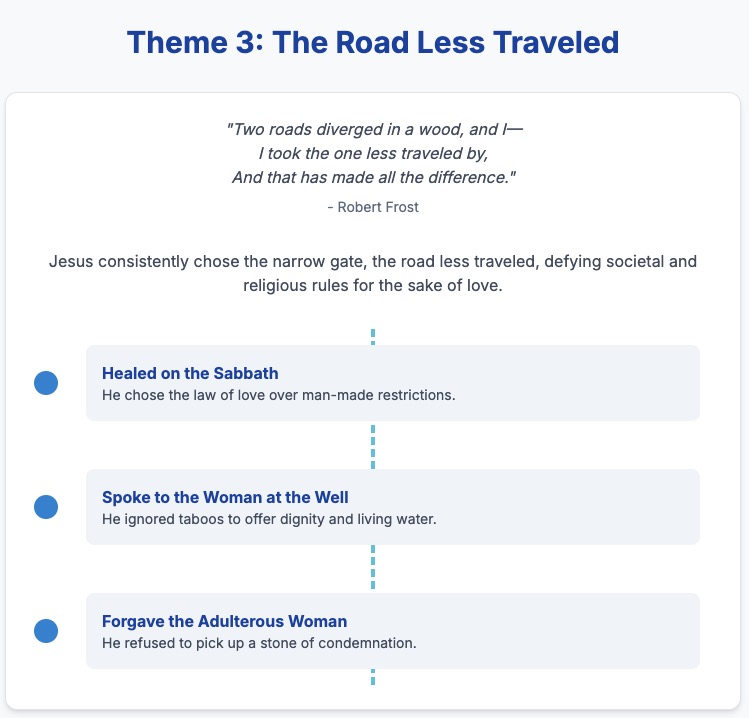
Using Robert Frost’s famous poem, the homily frames the Christian life as a choice to take “the one less traveled by.” This is the path Jesus walked—a path of radical love that often went against the rules and taboos of society and religion.
Key Quote: “Jesus always took the road less traveled. Jesus always took the narrow gate of love… Perhaps the road of our life will lead us to places where everyone around us is judging, belittling, hating, casting out. If we take the road less traveled… we will also refuse to pick up that stone.”
Reflection Questions:
- Fr. Ruttig gives several examples of Jesus taking the “road less traveled” (healing on the Sabbath, talking to the woman at the well, forgiving the woman caught in adultery). Which of these examples challenges you the most?
- When have you felt the pressure to “follow the crowd” when your conscience or faith was telling you to do something different? What makes taking the “road less traveled” so difficult?
- The poem ends with the line, “And that has made all the difference.” How has choosing the path of love, even when difficult, made a difference in your life or in the life of someone you know?
MSGR. PETER
HAHN
TIP: Begin playing the video and, as you listen to it, explore the infographics and reflection questions.
Infographics were generated using Google Gemini AI tools (Chart.js and Tailwind CSS). Feel free to use them in any non-profit ministry. A LINK or shoutout toTHE WORD THIS WEEK would be greatly appreciated. .
21st Sunday of Year C

This discussion guide has been generated by GOOGLE’S AI Gemini 2.5 Flash LLM.
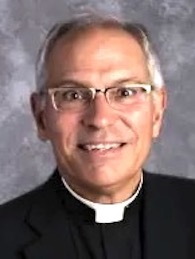
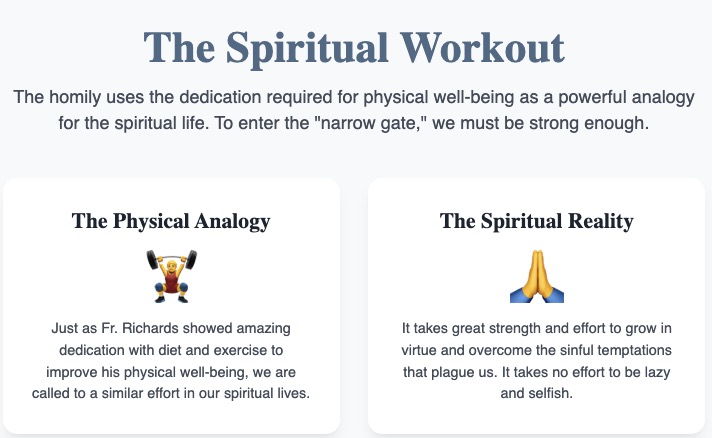
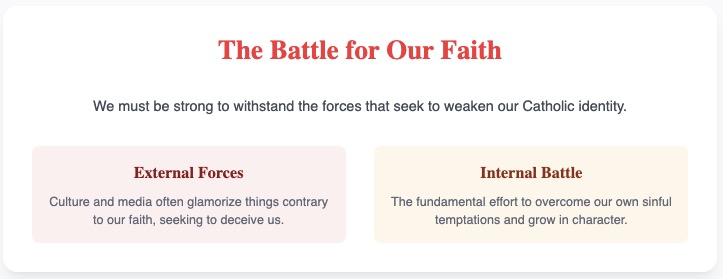
The homily begins with Msgr. Hahn speaking about another priest’s dedication to his physical well-being as an analogy for the spiritual life. The core message is: “Strive to enter through the narrow gate, for many… will not be strong enough.”
- What did the story of this priest’s 20-pound weight loss illustrate to you about the connection between dedication and results?
- The homily says we need to be spiritually “strong” to live our Catholic faith today. What are some of the forces in our culture or media that “seek to deceive us” or make living the faith feel “unnatural or extreme”?
- Besides outside forces, the homily mentions the “interior spiritual battle” against sinful temptations. It says, “It takes great strength and effort to grow in virtue… It takes no effort to be lazy and selfish.” In what area of your life do you feel the pull to be “lazy and selfish” the most?
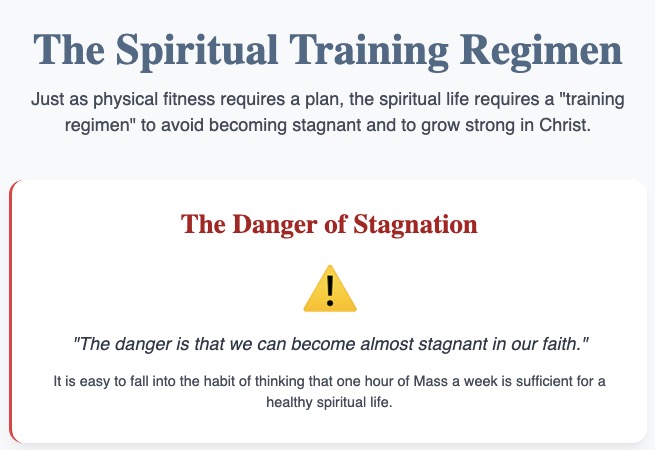
Just as physical fitness requires a training plan, the spiritual life requires a “training regimen” to avoid becoming stagnant.
- The homily asks, “How dedicated are we to that task?” and lists several spiritual exercises. Which of the following practices is most present in your life right now? Which is most absent?
- Daily dedicated prayer (10-15 minutes, twice a day)
- Spiritual reading
- Praying the Rosary
- Eucharistic Adoration
- Fasting
- Frequent Confession
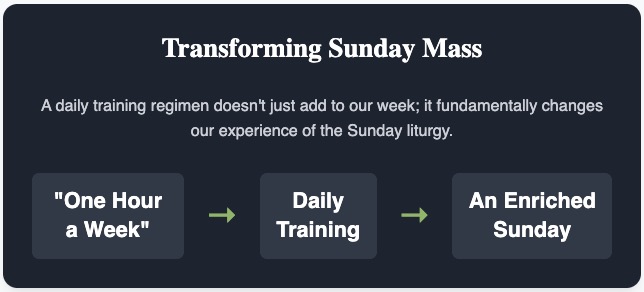
- The homily warns against the danger of thinking “this one hour a week [at Mass] is sufficient.” Why is it so easy to fall into this habit? How does a daily “training regimen” change our experience of Sunday Mass?

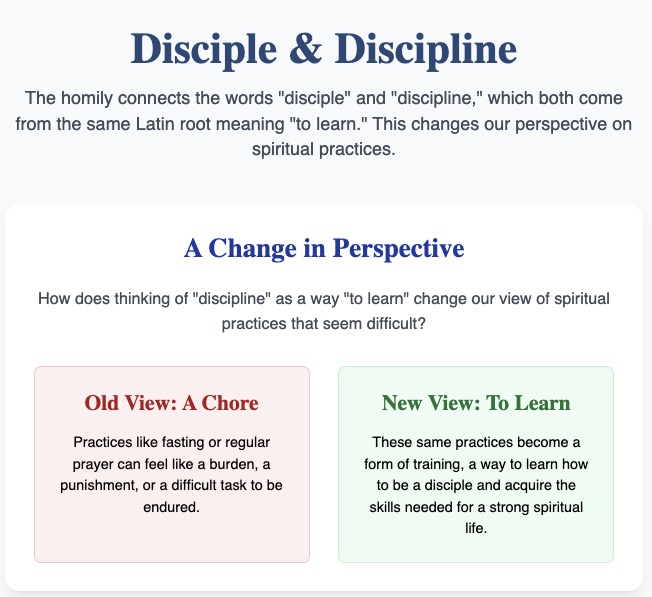
The second reading connects the words “disciple” and “discipline,” which come from the same Latin root word meaning “to learn.”
- How does thinking of “discipline” as a way “to learn” change your perspective on spiritual practices that might seem difficult, like fasting or regular prayer?
- The homily speaks of a “good diet of spiritual practices.” If your spiritual life were a diet, what would be its main food group right now? What healthy food might be missing?
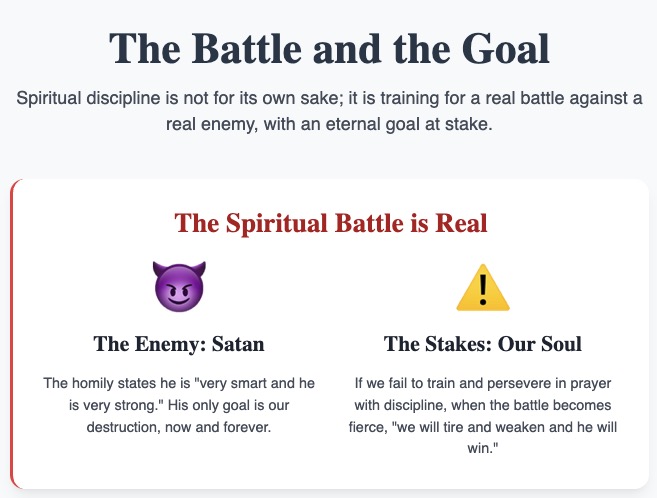
The guide makes it clear that this spiritual discipline is not for its own sake; it is training for a real battle against a real enemy, with an eternal goal at stake.
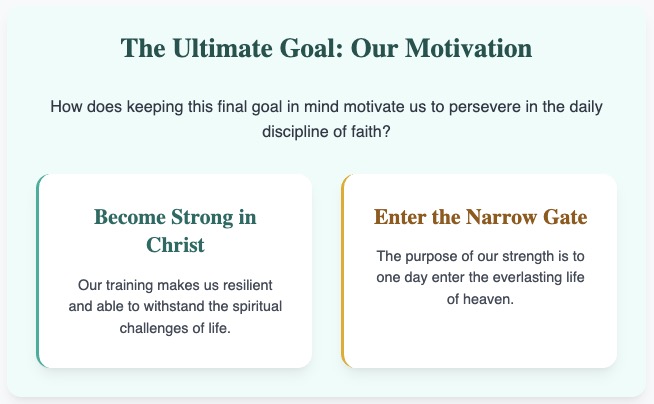
The ultimate goal of this “spiritual workout” is to become “strong in Christ” and one day “enter that narrow gate to the everlasting life of heaven.” How does keeping this final goal in mind motivate you to persevere in the daily discipline of faith?
The homily states that Satan is “very smart and he is very strong,” and if we fail to train, “he will win.” Does this language feel overly dramatic, or does it resonate with your own experience of temptation and spiritual struggle?

Access guide and infographics by clicking on banner

This discussion guide has been generated by GOOGLE’S AI Gemini 2.5 Flash LLM.
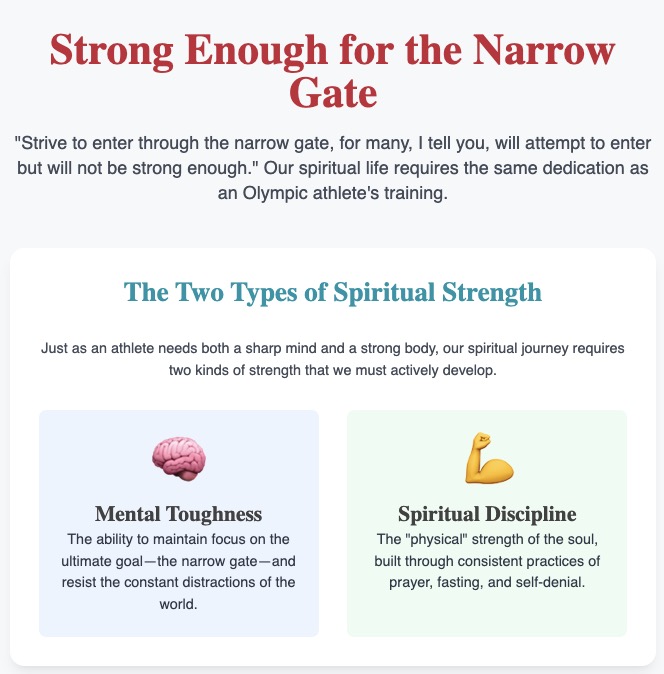
The homily begins by using the analogy of Olympic athletes to illustrate the need for both mental and physical strength to achieve a goal. This is then applied to our spiritual life.
- The homily says that to enter the narrow gate, we must be “strong enough.” What does spiritual “strength” mean to you? How is it different from worldly strength?
- The homily identifies two types of spiritual strength: mental toughness (focus) and “physical” spiritual strength (discipline). Which of these two do you find more challenging to develop in your own life?

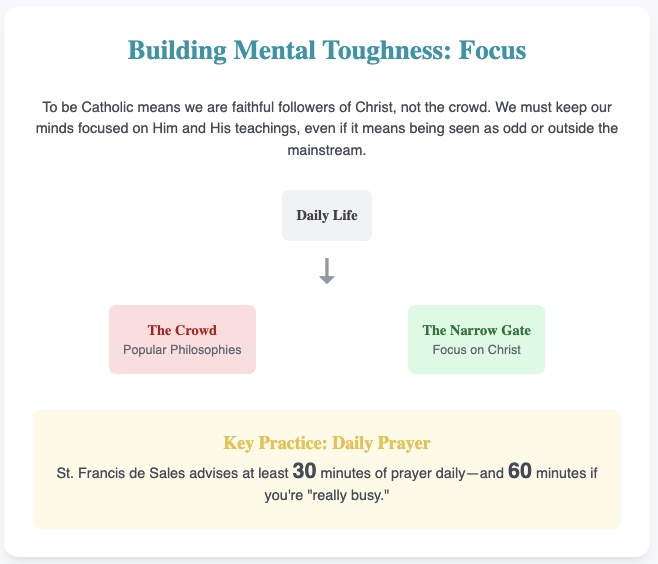
This section emphasizes the need to keep our focus on our eternal destination and avoid the many distractions of the world.
- The homily states, “The only thing that matters for us is the Judgment that awaits each of us at our death.” How does keeping this “narrow gate” in focus change your perspective on daily worries, successes, and failures?
- We are warned not to “just follow the crowd” or the popular philosophies of our culture. What is one popular idea in our culture today that directly contradicts the teachings of Christ and His Church?
- St. Francis de Sales said we need at least a half-hour of prayer each day, and an hour if we are “really busy.” How does this advice challenge our modern excuses about not having enough time to pray?
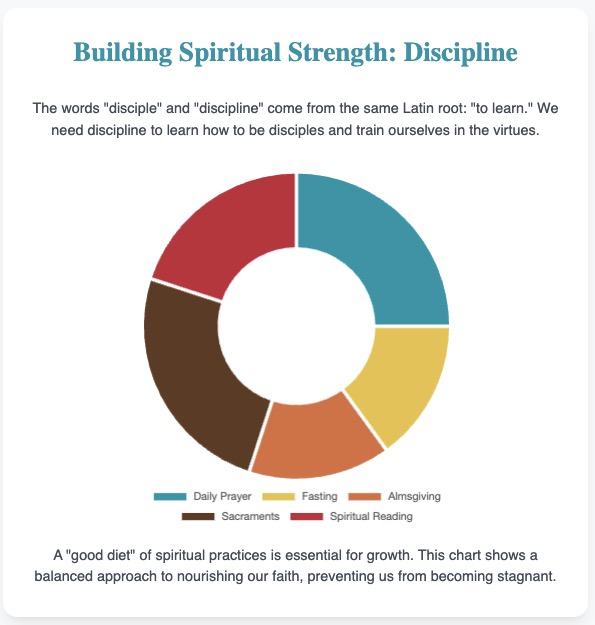
The homily connects the word “disciple” to “discipline,” explaining that we must train ourselves in the virtues to become stronger in our faith.
- How does thinking of spiritual discipline as a way “to learn” (the root of the word) change your view of practices like fasting, self-denial, or learning about the faith?
- The homily lists several training practices: fasting, prayer, and almsgiving (doing good). If your spiritual life were a workout plan, which of these exercises gets the most attention? Which is most often neglected?

The guide makes it clear that this spiritual training is not for its own sake; it is preparation for a real spiritual battle against a strong enemy, with an eternal goal at stake.
- The homily states that Satan is “very smart and he is very strong” and that if we fail to train, “he will win.” Does this language of a spiritual “battle” feel overly dramatic, or does it resonate with your own experience of temptation and struggle?
- The homily contrasts the “foolish” who grow lazy and are locked out with those who have “garnered strength” to enter the gate. How does keeping the final goal of heaven in mind motivate you to persevere in the daily discipline of faith, even when it’s difficult?

Access guide and infographics by clicking on banner

This discussion guide has been generated by GOOGLE’S AI Gemini 2.5 Flash LLM.
Access guide and infographics by clicking on banner

This discussion guide has been generated by GOOGLE’S AI Gemini 2.5 Flash LLM.
Theme:
Access guide and infographics by clicking on banner