September 7, 2025
September 7, 2025


Homilies
Homilies
Deacon Greg’s blog has garnered some 20 million readers from around the world since its inception in 2007.
23rd Sunday of Year C

ABC NEWS (04:10) – On September 1, 2019 Hurricane Dorian devastated the Bahamas.
Letting Go

The reflection questions and infographics featured in this section have been created with the help of Google Gemini 2.5 AI tools, using Chart.js and Tailwind CSS. THE WORD THIS WEEK is happy to offer these resources to any non-profit ministry for use, and kindly request that you provide credit to the website and the respective contributors whose content is illustrated.
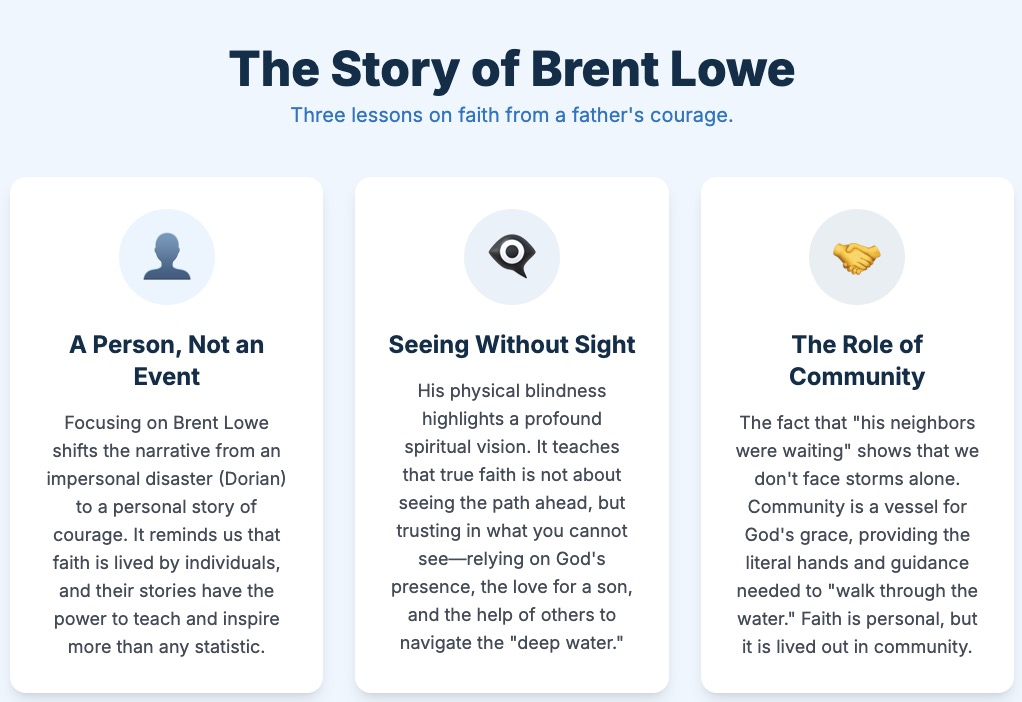
Part I: The Story of Brent Lowe
Deacon Kandra's homily is anchored in the powerful, real-life story of a father's love and courage.
- Deacon Kandra says the name we should remember from the storm is not Dorian, but Brent Lowe. Why do you think he begins the homily this way? What is the impact of focusing on a person instead of an event?
- Brent Lowe is blind, yet he navigated chin-deep floodwaters while carrying his disabled son. What does his physical blindness teach us about a different kind of "seeing" or faith?
- The homily mentions that "his neighbors were waiting for him." What role does community play in our ability to face our own storms and "walk through the water"?
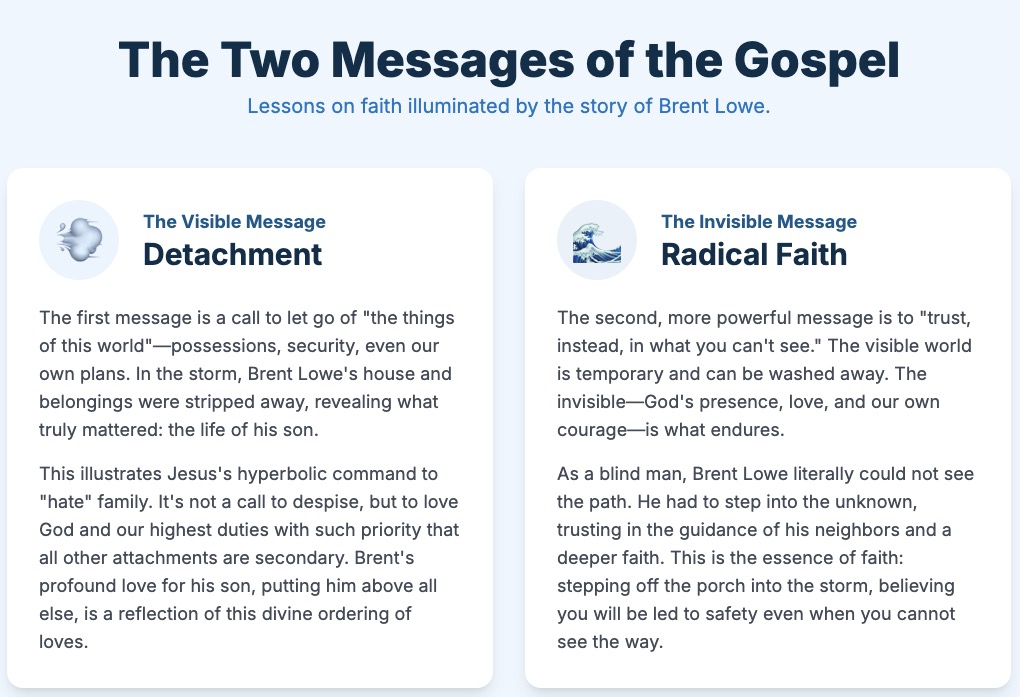
Part II: The Two Messages of the Gospel
Deacon Kandra connects Brent Lowe’s experience to two key messages from the Gospel reading.
- The first message is about detachment: letting go of possessions, relationships, and "the things of this world." How does Brent Lowe’s story perfectly illustrate this? In that moment, what was the only thing that truly mattered?
- The second, "implicit," message is: "Don't put your faith in what you can see. Trust, instead, in what you can't." Why does Deacon Kandra call this the more powerful message? Can you think of a time when you had to trust something you couldn't see?
- Jesus uses the hyperbole of "hating" one's family. In light of Brent Lowe's profound love for his son, how do we understand Jesus's challenging words about detachment?
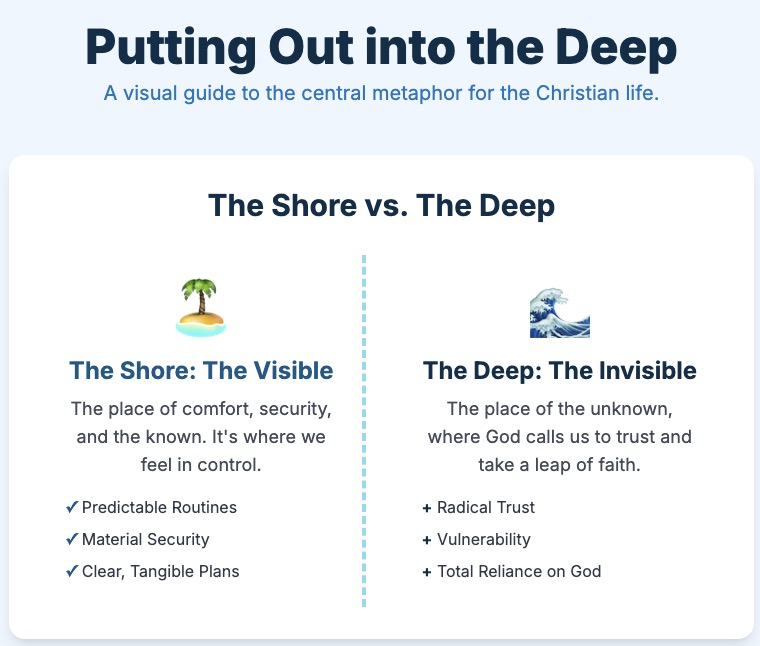


Part III: Putting Out into the Deep
This section explores the central metaphor for the Christian life presented in the homily.
- Deacon Kandra equates "Put out into the deep" with "Step off your porch and into the storm." What is the "shore" in your life—the place of comfort, security, and the visible? What might be the "deep" where God is calling you to go?
- What holds us back from taking that "leap of faith"? What are the fears or attachments that keep us from pushing away from the shore?
- The homily says this path means "going where there are no guarantees." How does this contrast with what the modern world often tells us to seek (security, guarantees, a clear plan)?

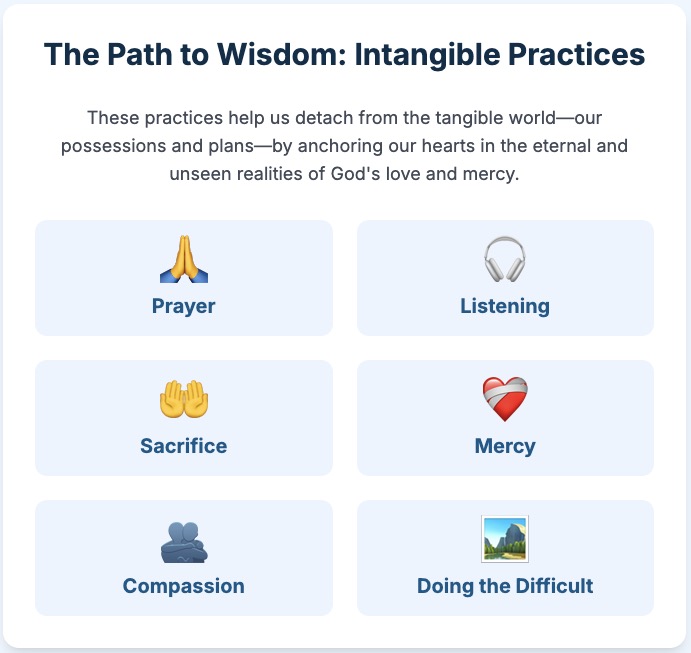
Part IV: Gaining Wisdom of Heart
The homily concludes with practical advice on how to cultivate the courage needed for this journey.
- The psalmist prays, "Teach us to number our days aright, that we may gain wisdom of heart." Deacon Kandra says this means knowing "what is important. What matters. What lasts." What are some of the things he lists that help us gain this wisdom (prayer, listening, sacrifice, mercy, etc.)?
- How do these intangible practices (like prayer and listening) help us to let go of tangible things (like possessions or our own plans)?
- The final image is of receiving Communion. How is this act an expression of "reaching out in hope" and trusting in the unseen, as the homily suggests?
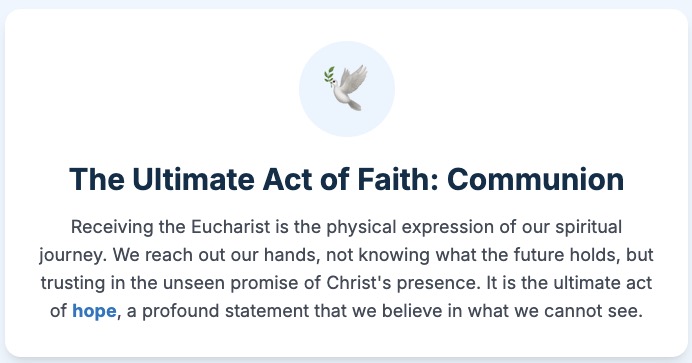
Personal Reflection & Call to Action
(Leader): Let’s take a few moments of silence to reflect on how God is speaking to us through this message.
- Deacon Kandra asks us to have the courage "to carry what God gives us." What is the burden, responsibility, or person God has given you to carry through a storm right now?
- What is one tangible thing, attachment, or fear that is holding you back from "putting out into the deep"? What is one small step you can take this week to begin to let it go?
- Who in your life needs you to be their "neighbor" waiting in the storm to help them get to safety?

2019 HOMILY— If we remember one name from the storm this week, it should NOT be Dorian.
The name we should remember is Brent Lowe. Brent Lowe is a 49-year-old father in the Bahamas. Until a few days ago, he lived in a simple cement house on one of the islands. Then Hurricane Dorian hit [September 1, 2019]. Mr. Lowe soon had company. As homes were demolished, desperate neighbors and relatives sought shelter with him… Mr. Lowe was one of the last to leave, and for good reason. Brent Lowe is blind…
────── ⋆⋅☆⋅⋆ ──────
Deacon Peter McCulloch
23rd Sunday of Year C

GOOD CATHOLIC (5:52) – Margaret Clitherow, the “Pearl of York,” was a devoted Catholic who prioritized her faith above all else. Despite her love for her family, she remained committed to her religious beliefs, even in the face of persecution.
Shining Armour
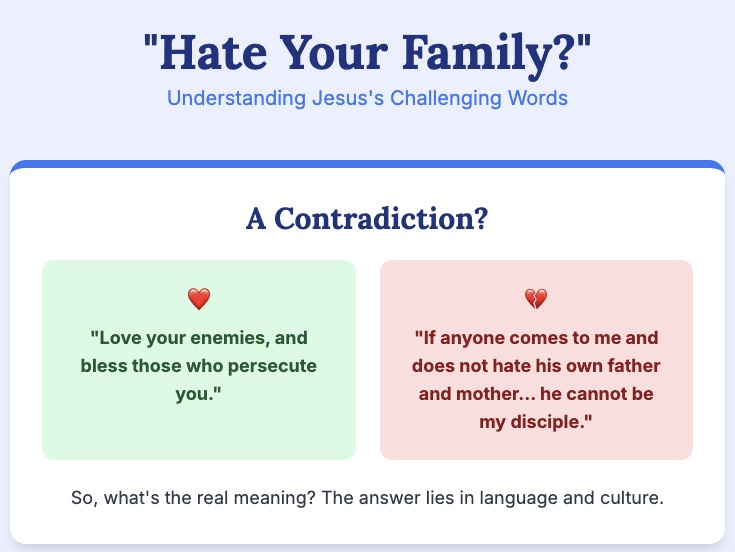
The reflection questions and infographics featured in this section have been created with the help of Google Gemini 2.5 AI tools, using Chart.js and Tailwind CSS. THE WORD THIS WEEK is happy to offer these resources to any non-profit ministry for use, and kindly request that you provide credit to the website and the respective contributors whose content is illustrated.
Part I: Understanding Jesus's Wake-Up Call
Deacon Peter's homily begins by tackling one of Jesus's most challenging statements.
- What was your initial reaction to reading that Jesus tells us to "hate" our family? Had you heard this passage before?
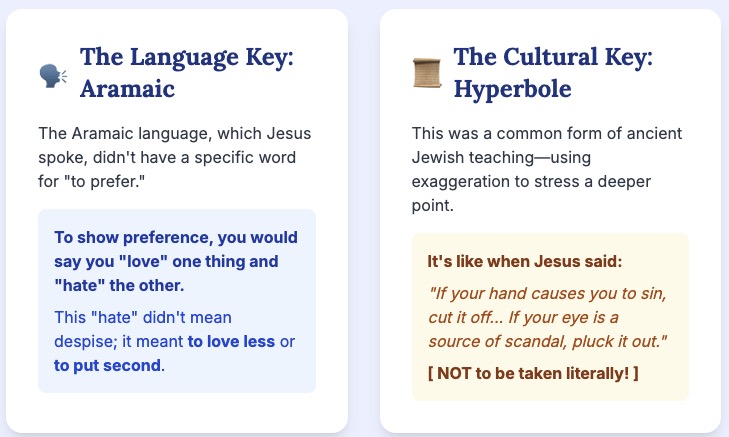
- The homily explains this is about language—Aramaic not having a word for "prefer"—and culture—using non-literal exaggeration to make a deeper point. How does this context change your understanding of Jesus's words?
- The core message is to "put God first." What are some modern, everyday pressures that make it difficult to truly put God first?

Part II: The Witness of St. Margaret Clitherow
Deacon Peter next explores the life of someone who lived this radical call.
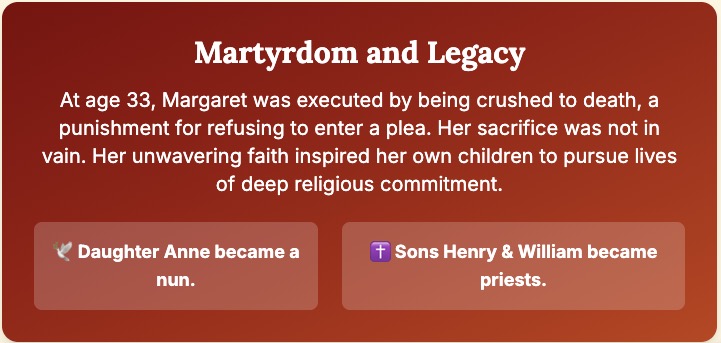
- St. Margaret Clitherow’s faith influenced "every aspect of her life." She broke the law to hide priests, run a Catholic school, and refused to attend mandatory services. What does her story teach about the practical, and sometimes dangerous, implications of putting God first?
- Despite the risks, Margaret's husband supported her actions. Her children also grew up to serve the Church. How can one person's radical faith, even when it leads to suffering, become a source of strength and inspiration for their family?
- Margaret was "deeply moved by those who willingly suffered and died for their faith." How does the witness of martyrs and saints encourage us in our own, smaller daily struggles?
Part III: The Knight in Shining Armour
Deacon Peter uses a literary example to introduce the metaphor of spiritual battle.
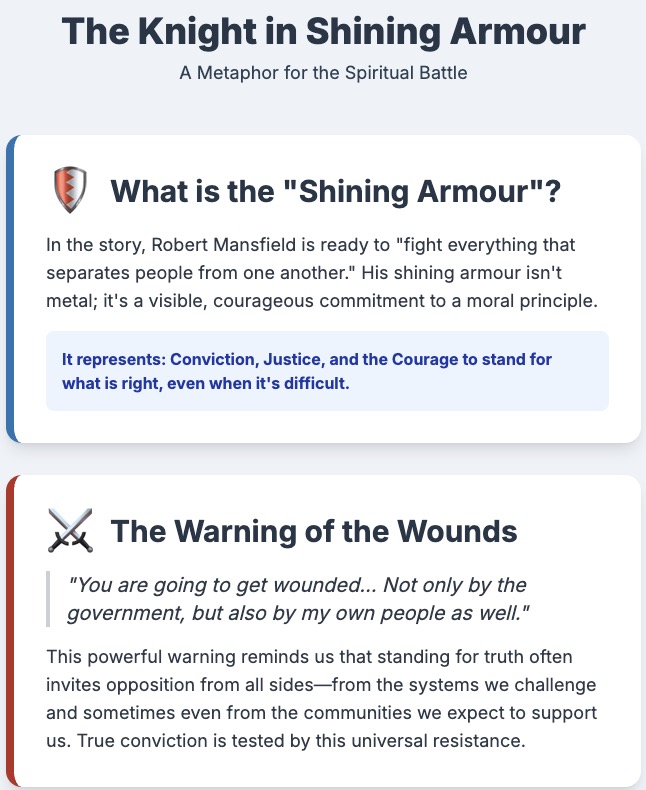
- In the story from Cry, the Beloved Country, Robert Mansfield resigns his job to "fight everything that separates people from one another." What does his "shining armour" represent?
- Emmanuel Nene warns Mansfield, "You are going to get wounded... Not only by the government, but also by my own people as well." Why is it that when we stand up for something true and good, we can face opposition from all sides, even from those we expect to be allies?
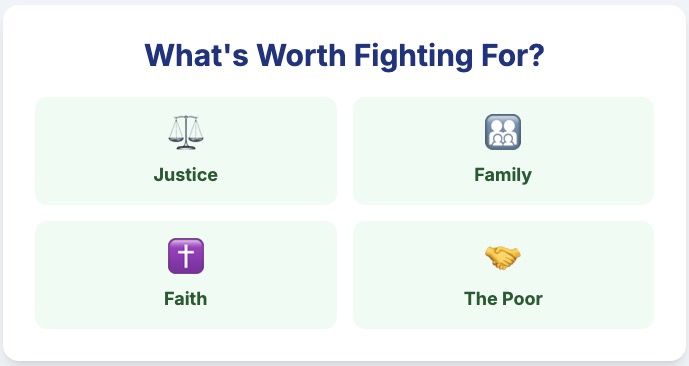
- Nene’s final quote is haunting: "When I get up there... the Big Judge will say to me, 'Where are your wounds?' and if I say, 'I haven’t any', he’ll say 'Was there nothing to fight for?'" What does this question imply about the purpose of a Christian life?
Part IV: Our Wounds, Our Fight
The homily concludes by turning these powerful questions to us.
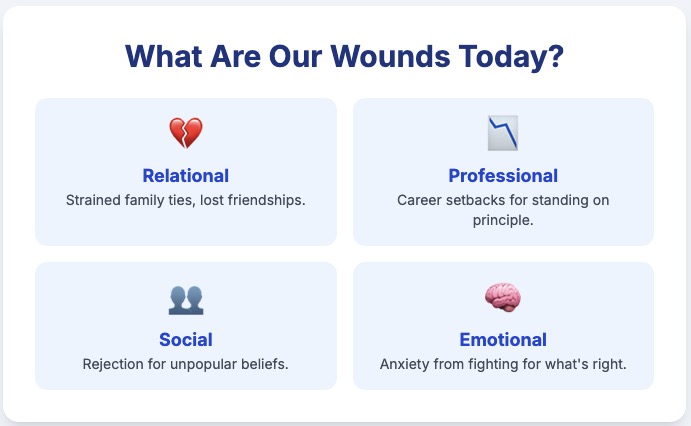
- What might "wounds" look like for a Christian today? (Consider social, professional, relational, or emotional wounds).
- What are the things in our world, our community, or our own lives that are "worth fighting for"?
- Take a moment to silently reflect on the homily's final questions. If you were to answer them today, what would you say?
- "When you get to heaven and God asks to see your wounds, what will you show him?"
- "And what will you say you fought for?"

‘Love your enemies,’ Jesus says, ‘and bless those who persecute you.’ So why today is he telling us to hate our family?
It’s because Jesus’ language, Aramaic, didn’t have a word for prefer. The Jesuit author Brendan Byrne says that in Aramaic, if you preferred one thing over another, you’d say you ‘loved’ one thing, but ‘hated’ the other. But this doesn’t mean ‘hate’ as we mean it today. It means putting God first and loving other things less.

CATHOLIC ONLINE (2:58) – St. Gemma Galgani, also known as the Flower of Lucca, was an Italian mystic born on March 12, 1878.
The Flower of Lucca

The reflection questions and infographics featured in this section have been created with the help of Google Gemini 2.5 AI tools, using Chart.js and Tailwind CSS. THE WORD THIS WEEK is happy to offer these resources to any non-profit ministry for use, and kindly request that you provide credit to the website and the respective contributors whose content is illustrated.
Part 1: Understanding the Cost of Discipleship
The homily is grounded in Jesus's words from the Gospel of Luke (14:25-33), where he tells the crowds to be prepared to give up everything to follow him.
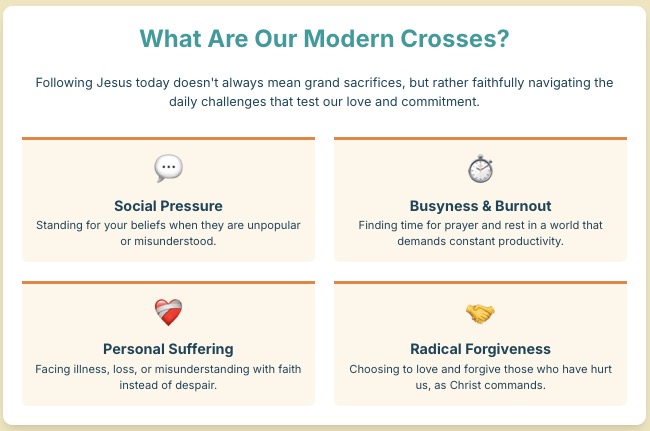
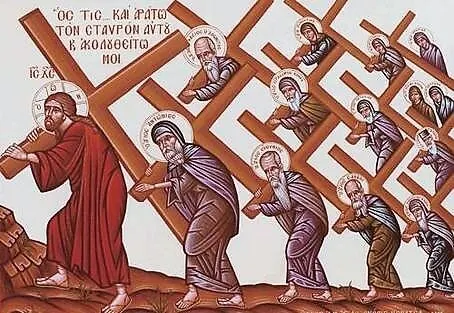
- Jesus says one must carry a Cross to be his disciple. What do you think this means in a practical, day-to-day sense for Christians living in the 21st century?
- The homily emphasizes that "feelings aren’t enough. We need to understand what discipleship means." Why is it important to know the "cost" before committing to something? How does this apply to the life of faith?
- Jesus's language about "hating" family and one's own life can be shocking. How do you interpret this command in light of the Christian call to love?
Part 2: The Example of St. Gemma
St. Gemma's life is presented as a powerful illustration of discipleship. She faced immense suffering from a young age.
- The homily makes a distinction: "St. Gemma Galgani didn’t seek suffering, but she accepted it when it came." Why is this distinction important? What is the difference between seeking out hardship and faithfully accepting the crosses that life brings?
- Gemma faced not only physical illness and personal loss but also ridicule and disbelief from others. Which of her many trials do you think would have been the most difficult to bear? Why?
- How did St. Gemma link her own suffering with that of Jesus on the Cross? What does this teach us about the purpose or meaning of suffering in a Christian context?
Part 3: Suffering as an Invitation to Love
A central theme of the homily is the idea that trials can be reframed as opportunities to deepen one's love for God.
- St. Gemma is quoted as saying, "It’s true, Jesus, that I am suffering, but I’m not afraid. Because I am suffering for you, I am happy." What does this statement reveal about her perspective? How can love change our experience of pain?
- The homily suggests St. Gemma saw her trials "not as punishments, but as invitations to love." Have you ever experienced a difficult situation that, in hindsight, became an opportunity for spiritual growth or a deeper connection with God?
- Discuss the phrase, "love makes even the Cross beautiful." What does this mean to you? Do you find it to be true?
Part 4: Living It Out Today
The homily concludes by encouraging us to let St. Gemma accompany us on our journey and to stay faithful "even when the going gets tough."
- What are some of the modern "crosses" that might come from loving and following Jesus in today's world?
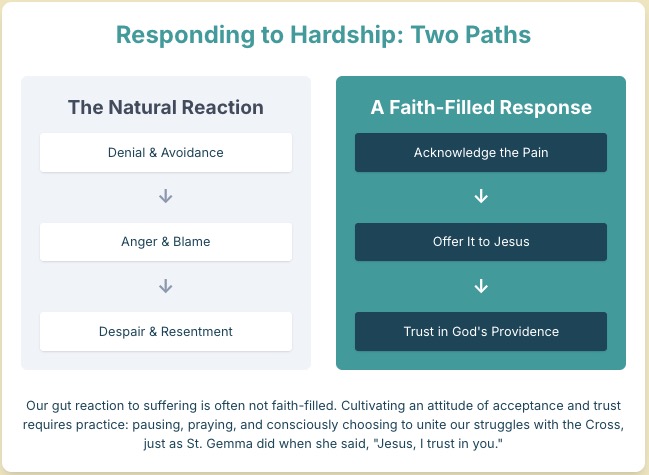
- When faced with hardship—illness, loss, or misunderstanding—our natural reaction is often not as faith-filled as St. Gemma's. What practical steps can we take to cultivate an attitude of acceptance and trust, like when she said, "Jesus, I trust in you"?
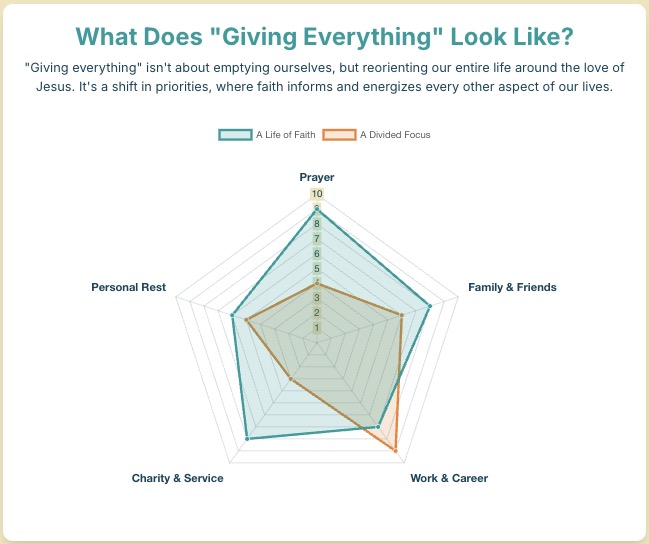
- The homily says St. Gemma was willing to give everything in return for Jesus's love. What does "giving everything" look like for you in your current state of life?
Discussion guides and Infographics on this page have been created using AI generative tools (i.e. GOOGLE'S AI Gemini 2.5 Flash LLM, Chart.js and Tailwind CSS). They are free to use for any non-profit ministry. THE WORD THIS WEEK kindly requests that you show your appreciation by sharing a link to the website.

Through our baptism we are all called to follow Christ. Jesus says this means we must carry our Cross, but it doesn’t mean we have to look for suffering. We simply have to accept whatever might come from loving him.
St. Gemma Galgani didn’t seek suffering, but she accepted it when it came. When she was forced to leave school, she offered it to Jesus. When people disbelieved her, she offered it to Jesus. And when pain wracked her body, she kissed the crucifix and said, ‘Jesus, I trust in you.’
In today’s Gospel, Jesus says that anyone planning something new must know the cost beforehand. In other words, feelings aren’t enough. We need to understand what discipleship means.
────── ⋆⋅☆⋅⋆ ──────
Fr. Jude Langeh, CMF

23rd Sunday of Year C

The reflection questions and infographics featured in this section have been created with the help of Google Gemini 2.5 AI tools, using Chart.js and Tailwind CSS. THE WORD THIS WEEK is happy to offer these resources to any non-profit ministry for use, and kindly request that you provide credit to the website and the respective contributors whose content is illustrated.
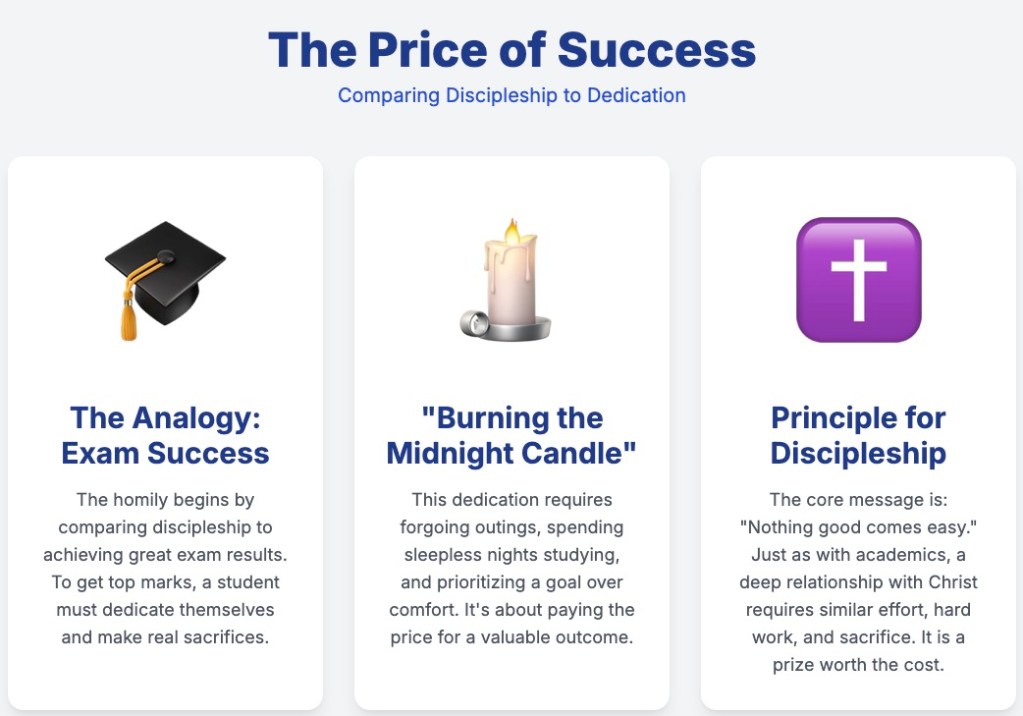
The Price of Success
The homily begins by comparing discipleship to the hard work needed to achieve great exam results.
- What is the opening analogy the priest uses to introduce the cost of discipleship? What specific sacrifices does he mention are needed for academic success (sleepless nights, forgoing outings, etc.)?
- How is "burning the midnight candle" for an exam similar to the effort required to be a follower of Christ? In what ways is it different?
- The homily states, "Nothing good comes easy." Do you agree with this statement in both a worldly sense and a spiritual sense? Why or why not?
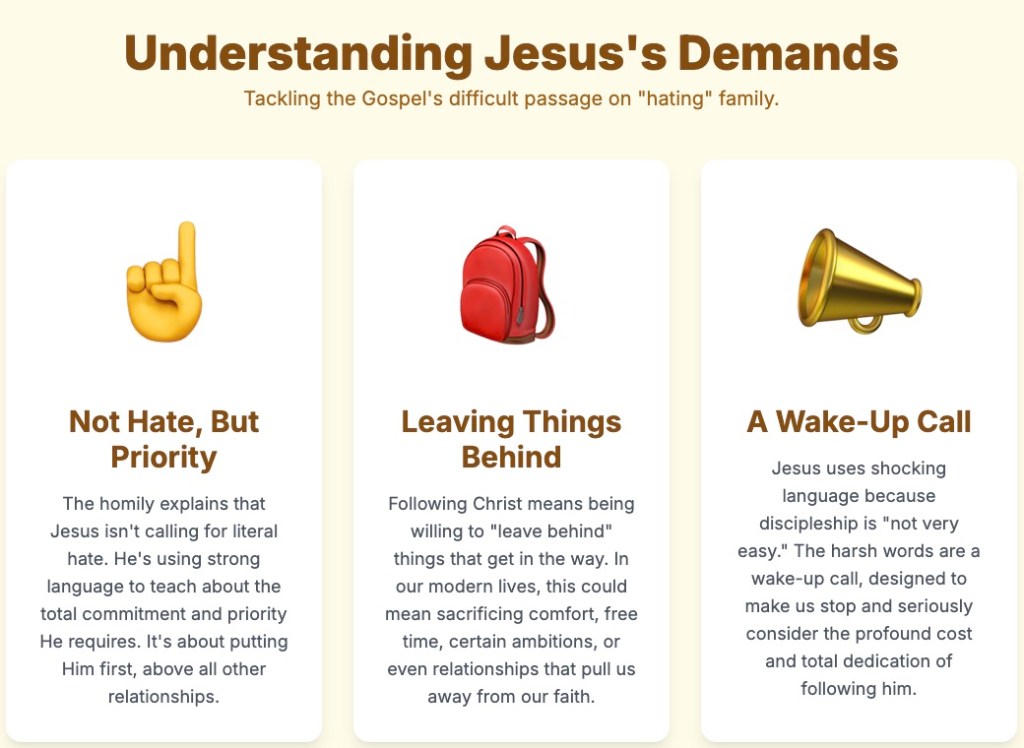
Understanding Jesus's Demands
This section tackles the difficult Gospel passage about "hating" one's family.
- How does the priest explain Jesus's words about "hating" father, mother, spouse, and children? What does he say Jesus is really telling us?
- Instead of literal hate, the homily speaks of "the things we have to leave behind, the sacrifice we have to make." What are some modern things that people might have to "leave behind" or sacrifice to prioritize their faith?
- Following Christ is described as "not very easy." Why do you think Jesus uses such strong, shocking language to make his point about the cost?
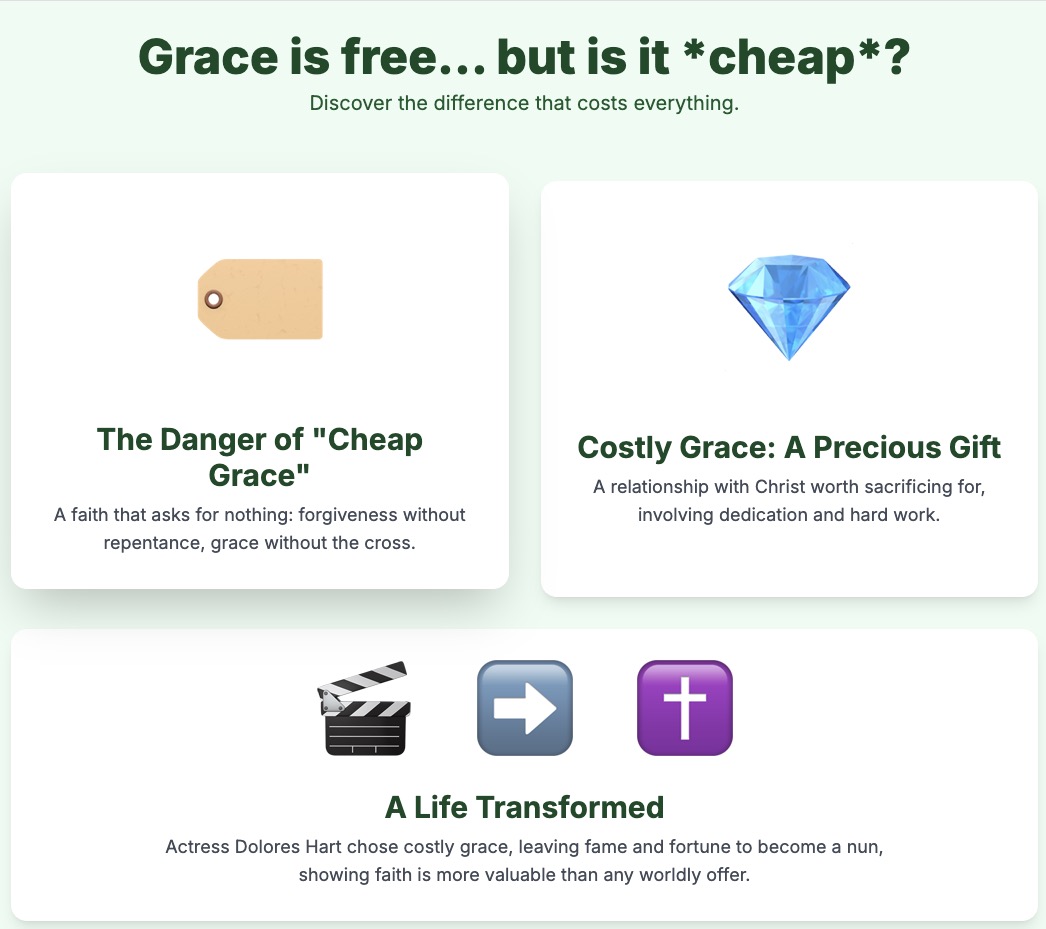
Avoiding "Cheap Grace"
The homily introduces Dietrich Bonhoeffer's concept of "cheap grace" as something to be avoided.
- What is "cheap grace"? The priest lists several examples. Let's discuss a few:
- What is "forgiveness without requiring repentance"?
- What is "grace without discipleship"?
- What does "grace without the cross" mean to you?
- Why do you think the idea of "cheap grace" is so tempting in our modern culture?
- The homily contrasts this with the stories of Dolores Hart (the actress). What does her life choice teach us about the value of a faith that is not cheap?

Everyday Sacrifices
The conclusion brings the high cost of discipleship into our daily lives.
- What everyday example of sacrifice does the priest give (related to Sunday mornings)? What are some other small, weekly sacrifices a person might make for their faith?
- The homily promises that "there is no dedication, there is no hard work, there is no sacrifice without a reward." What is the ultimate reward for Christian discipleship?
- The final prayer is that we might "forego our times, our comfort, our free time to find time to be with Christ." How can we begin to see this not as a loss, but as a gain?
Access guide and infographics by clicking on banner
────── ⋆⋅☆⋅⋆ ──────

23rd Sunday of Year C


The reflection questions and infographics featured in this section have been created with the help of Google Gemini 2.5 AI tools, using Chart.js and Tailwind CSS. THE WORD THIS WEEK is happy to offer these resources to any non-profit ministry for use, and kindly request that you provide credit to the website and the respective contributors whose content is illustrated.
Part I: Prudence, Budgets, and Human Cost
The homily begins with the worldly virtue of counting the cost, from construction projects to the tragedy of war.
- Fr. Earl starts by discussing budgeting for projects like building a church or fighting a war. What is his point about how these "budgets" (of money or of lives) often compare to the final cost?
- Have you ever started a project (a home renovation, a new job, a relationship) where the "cost" turned out to be much higher than you anticipated? What was that experience like?
- The homily draws a grim parallel between financial accounting and "counting the human cost of war." Why do you think he uses this stark comparison to introduce the Gospel message?
Part II: The Price of Discipleship
This section connects the idea of budgeting to what Christ asks of his followers.
- According to the homily, what cost is Christ encouraging us to count?
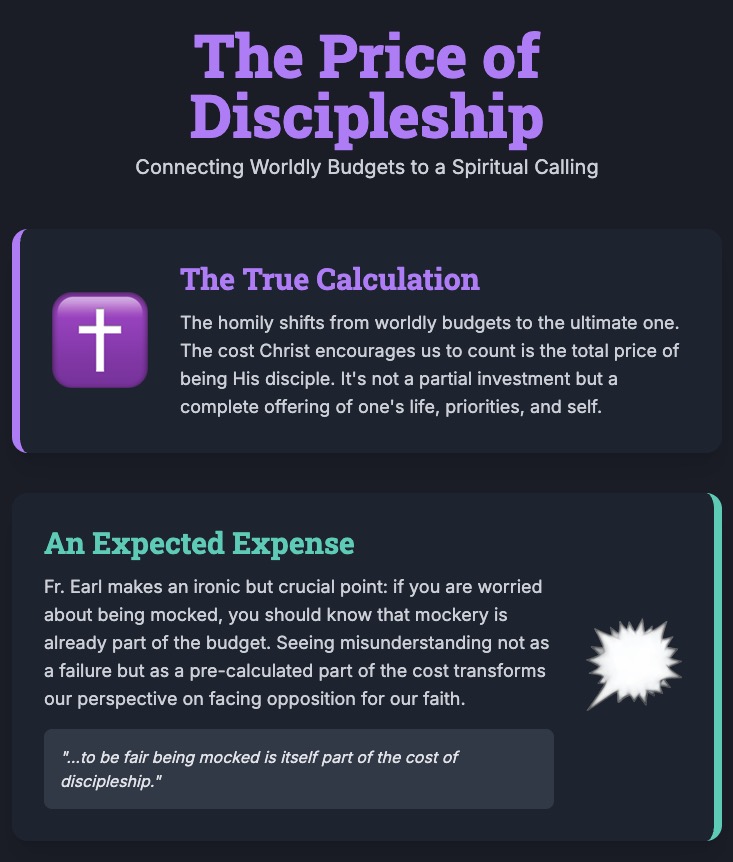
- Fr. Earl makes a somewhat ironic point: "to be fair being mocked is itself part of the cost of discipleship." Have you ever felt mocked or misunderstood for your faith? How does seeing this as "part of the cost" change your perspective?
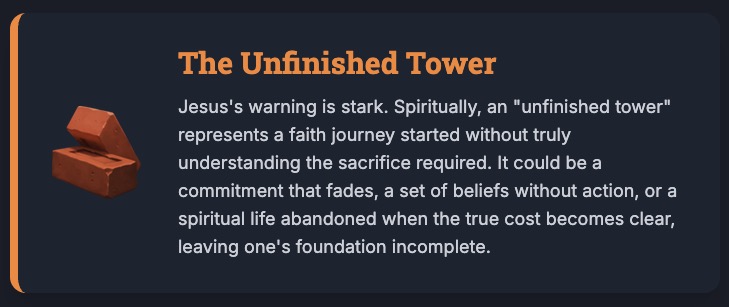
- Jesus warns that if we don't calculate the cost, we may start something we cannot finish. In spiritual terms, what might an "unfinished tower" look like in a person's life?
Part III: The Prayer of St. Ignatius
Here, the guide explores the apparent contradiction between "counting the cost" and giving without counting it.
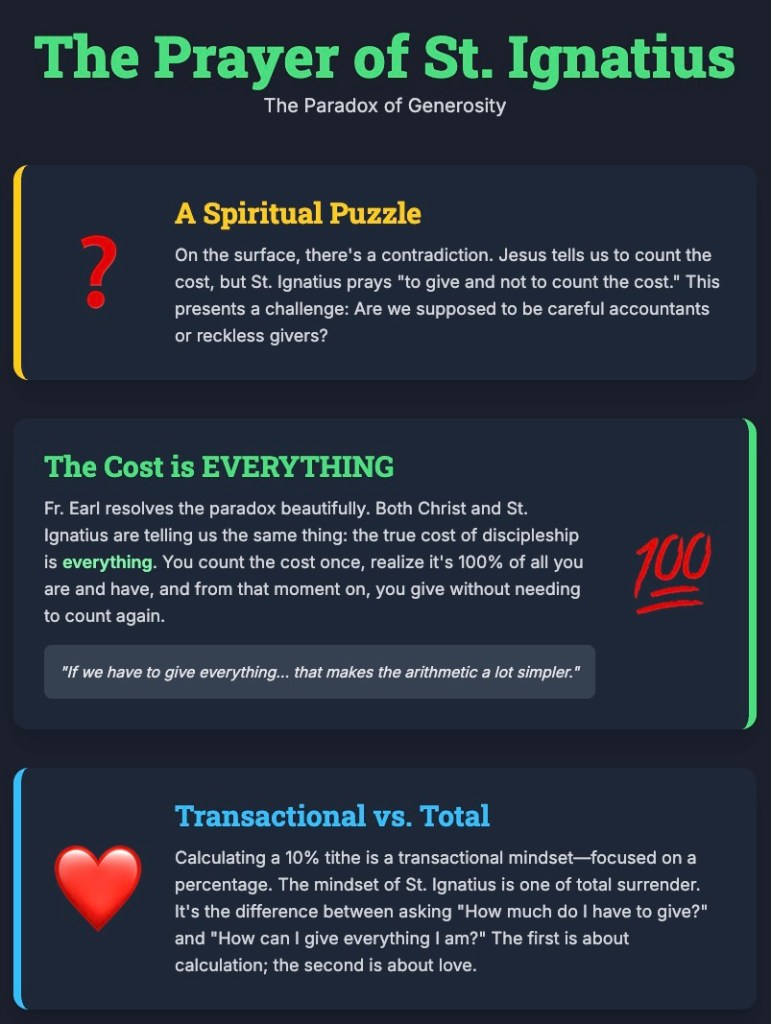
- Read the prayer of St. Ignatius aloud again. On the surface, how does "to give and not to count the cost" seem to contradict what Jesus advises in the Gospel?
- How does Fr. Earl resolve this apparent contradiction? What is the simple, if challenging, answer to how much discipleship costs?
- What is the difference between meticulously calculating a 10% tithe versus adopting a mindset where "the arithmetic is a lot simpler" because the cost is "everything"?
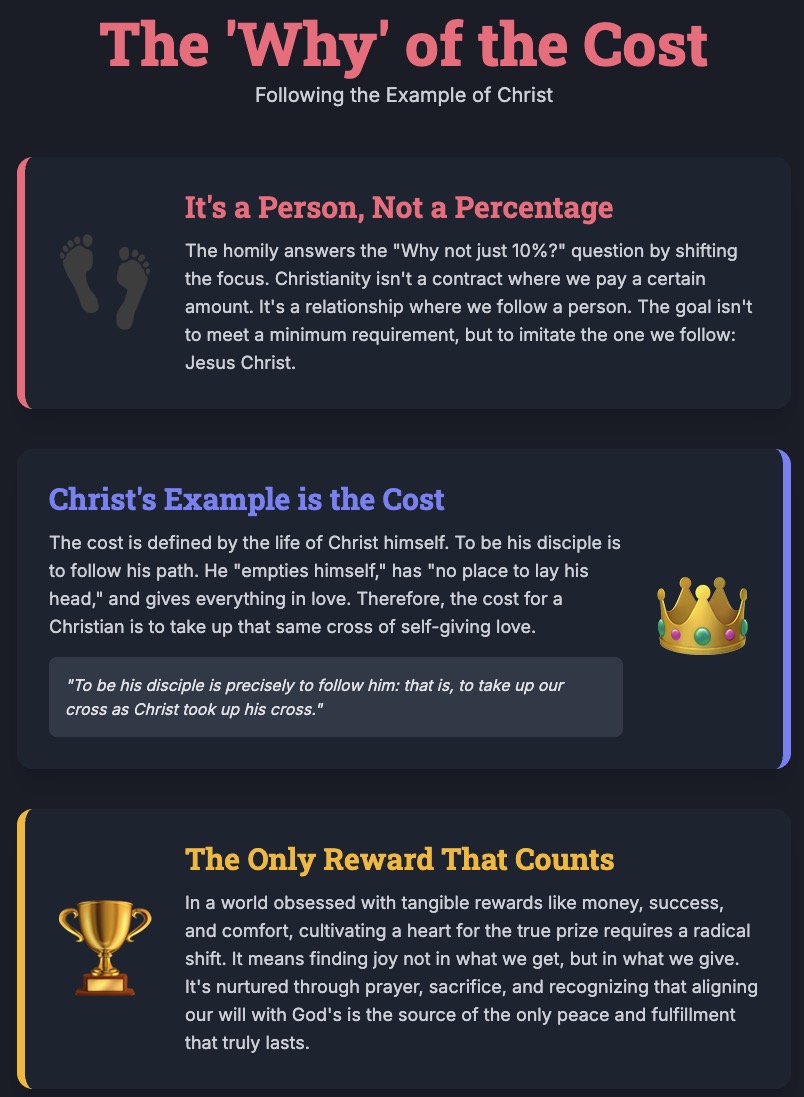
Part IV: The 'Why' of the Cost – The Example of Christ
The homily concludes by explaining why the cost is so total: it is about following a specific person.
- The homily anticipates the question, "Why can't God just let us give, say, ten percent... and let us be?" How does it answer this question?
- How does the life of Christ—who "empties himself," has "no place to lay his head," and gives himself to death—define the cost of being a Christian?
- The final line says the only reward that counts is "knowing that we do thy will." In a world that measures rewards in money, success, and comfort, how can we cultivate a heart that truly sees this as the ultimate prize?
Discussion guides and Infographics on this page have been created using AI generative tools (i.e. GOOGLE'S AI Gemini 2.5 Flash LLM, Chart.js and Tailwind CSS). They are free to use for any non-profit ministry. THE WORD THIS WEEK kindly requests that you show your appreciation by sharing a link to the website.

Twenty-third Sunday of the Year. Fr Benjamin Earl preaches about prudent budgeting and the generosity of God.
In today’s gospel passage Christ seems to be encouraging us to count the cost of being his disciple, using the images of construction and of war. If we aren’t aware of the cost of discipleship we may end up being mocked, although to be fair being mocked is itself part of the cost of discipleship.
There is a well-known prayer of St Ignatius of Loyola ‘for generosity’ which runs as follows:
Teach us, good Lord, to serve thee as thou deservest:
To give and not to count the cost;
To fight and not to heed the wounds;
To toil and not to seek for rest;
To labour and not to ask for any reward
Save that of knowing that we do thy will.
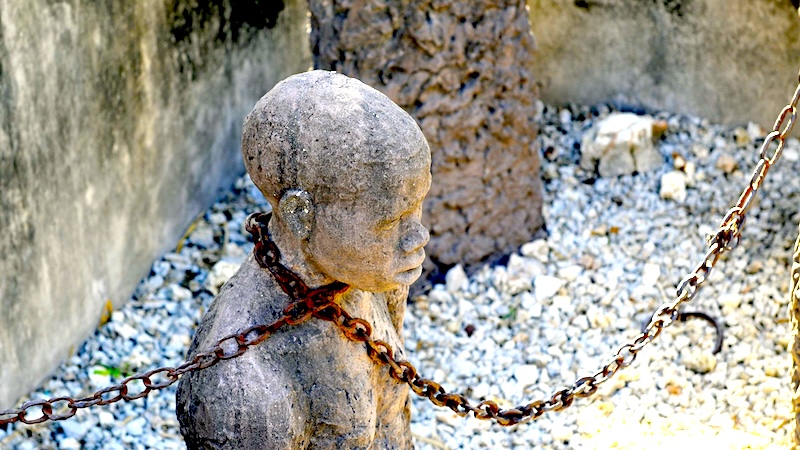
Image: ‘Stone Town Slave Trade 5’ by Son of Groucho (CC BY 2.0)

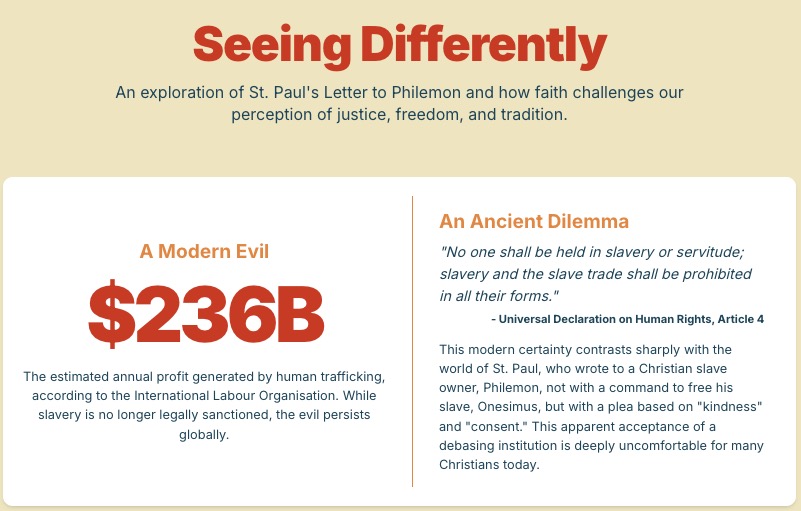
Part 1: The Uncomfortable Silence on Slavery
The author begins by contrasting the modern, universal condemnation of slavery with St. Paul's approach, noting Paul "does not insist that Philemon set Onesimus free."
- Why do you think St. Paul handles the situation with such diplomacy and deference to Philemon, the slave owner? Was this a strategic choice, a moral blind spot, or something else?
- Fr. Mullens suggests Paul is "like the man in Jesus’s parable" who assembles the right reasons but is "unable to ‘finish the work’ and draw the necessary conclusion." Do you agree with this assessment? Is Paul's failure to explicitly condemn slavery a weakness of the letter?
- How does it affect our view of scripture when we encounter passages that seem to conflict with our deeply held moral convictions?

Part 2: The Slow Progress of Tradition
Fr. Mullens argues that "the gradual unmasking of slavery as an inherently debasing institution is an example of the long and slow progress of tradition." He quotes, "How long the Gospel takes to permeate the human spirit!"
- What does Fr. Mullens mean when he says slavery "exercised a kind of deceit over the enslavers"? How do deeply ingrained social structures, even unjust ones, become normalized?
- Can you think of other examples in history where the Church's moral understanding has evolved significantly over time?
- Does this idea of a "slow progress" of tradition challenge your view of faith and morality? Does it imply that the Church can be "wrong" about a moral issue for centuries?

Part 3: A New Way of Seeing
The homily's core argument is that "the Gospel often teaches by changing our perspective." It redefines "natural" institutions like the family and slavery by creating a new, spiritual reality.
- Fr. Mullens connects Jesus's shocking command to "hate" one's family with Paul's vision for a spiritual family where a master (Philemon) and his slave (Onesimus) are now "brothers in Christ." How does this new spiritual identity completely change the dynamic between them?
- Fr. Mullens states that Paul gives Onesimus a way to see beyond his circumstances, so that he "can no longer think of himself a slave." How powerful is this "inner" or spiritual freedom if one's physical reality remains unchanged?
- History doesn't record Philemon's decision. The author presents two possibilities: freeing Onesimus or keeping him in chains. What are the theological implications of each choice, according to the article? Which outcome do you think is more powerful as a lesson?
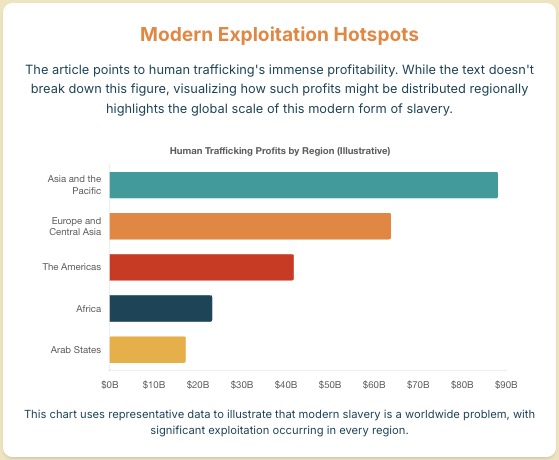
Part 4: Connecting to the Modern World
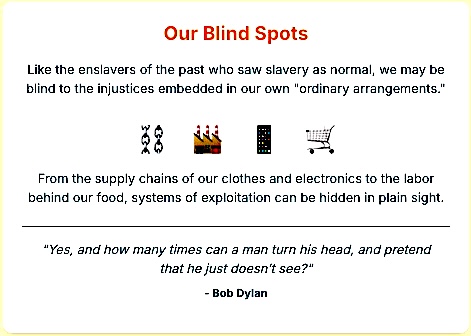
The article concludes by linking the historical blindness to slavery with modern injustices and our own potential blind spots, quoting Bob Dylan's "Blowin' in the Wind."
- The author points to the modern-day evil of human trafficking. In what ways do we, like the British investors in West Indies plantations, participate in systems of exploitation without ever meeting the people who are harmed?
- The Dylan lyrics ask, "how many times can a man turn his head, and pretend that he just doesn’t see?" What are some of the injustices in our society today that we might be pretending not to see?
- After reading this article, what does it mean to you to "see differently" as a person of faith? How can we actively try to see the world through the lens of the Gospel rather than through the lens of our culture's "ordinary arrangements"?
Twenty-Third Sunday of the Year. Fr Bede Mullens considers the difficulties raised by the Letter to Philemon..
History does not record Philemon’s final decision. If he freed Onesimus, it was all for the best. If he insisted on keeping Onesimus in chains, he was only calling down judgment on himself, by making Onesimus even more clearly the image of Paul in prison, the image of Christ crucified. How often we fail to learn except from the scars we inflict, and the Spirit of Wisdom blows unpredictably to straighten out the paths of those on earth.
────── ⋆⋅☆⋅⋆ ──────
Fr. Austin Fleming
23rd Sunday of Year C

Grown Up Security Blankets

The reflection questions and infographics featured in this section have been created with the help of Google Gemini 2.5 AI tools, using Chart.js and Tailwind CSS. THE WORD THIS WEEK is happy to offer these resources to any non-profit ministry for use, and kindly request that you provide credit to the website and the respective contributors whose content is illustrated.
Part I: The Grown-Up Security Blanket
Fr. Austin introduces a central metaphor: the attachments we carry into adulthood.
- The homily begins with the image of a child's teddy bear or blanket. What are some of the "more sophisticated and socially acceptable" security blankets the speaker says adults cling to? Can you think of any others?
- According to the text, when does a normal, healthy relationship with a person or a thing become a problematic "security blanket"? What is the difference between healthy dependence and an unhealthy one?
- Have you ever had an "adult security blanket"—a job, a position, a relationship, or a possession—that you felt you couldn't live without? What did that feel like?

Part II: Understanding Jesus's Hard Questions
This section uses the security blanket metaphor to understand a difficult Gospel passage.
- How does the idea of a teddy bear help us understand what Jesus means when he says we must "hate" our families and "renounce" all our possessions?
- The homily clarifies that Jesus is not being literal. What are the "hard questions" he is actually asking us to consider about our lives?
- The speaker poses the ultimate question: "Whose love is most vital for my existence and my happiness?" Why, according to the homily, is "God" the only correct answer?
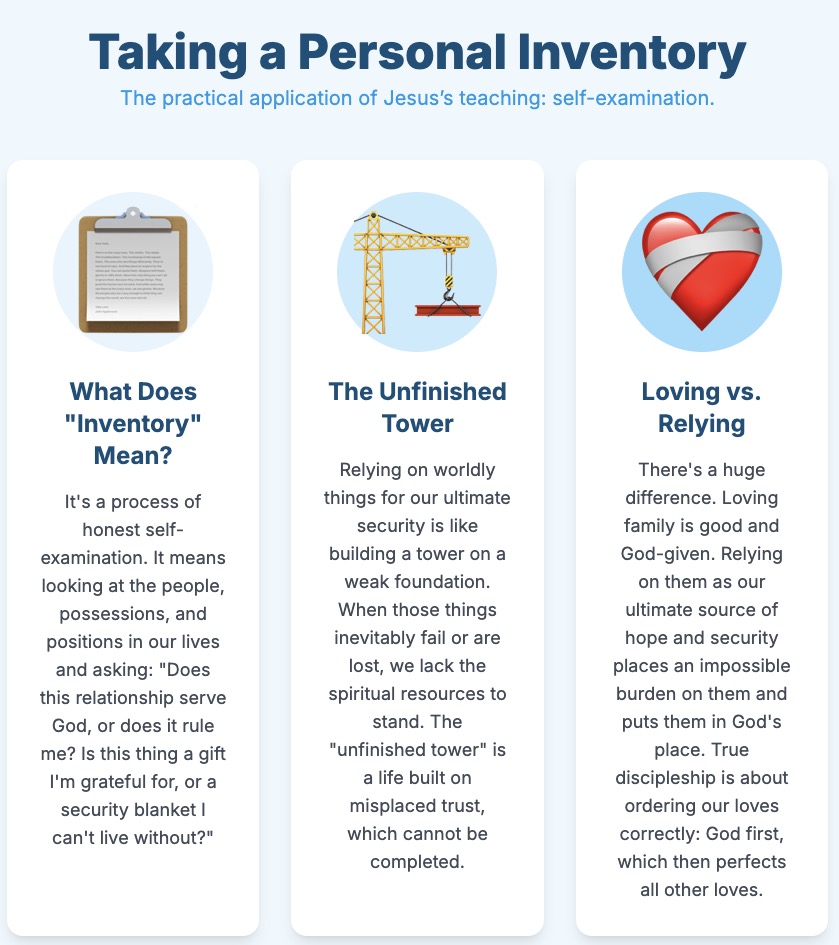
Part III: Taking a Personal Inventory
This section focuses on the practical application of Jesus’s teaching: self-examination.
- What does it mean to "take some inventory of the relationships we have with people and things in our lives"? What might that process look like?
- The homily connects putting all our trust in things or people to the man in the Gospel who starts building a tower he can't finish. What is the connection? What does the "unfinished tower" represent?
- What is the difference between loving your family dearly and relying on your family as your ultimate source of security and hope?
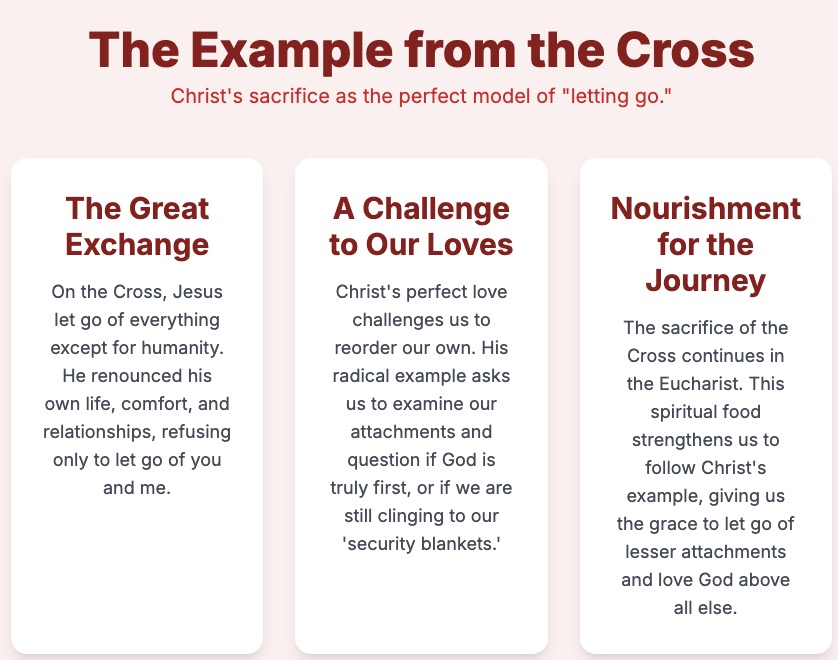
Part IV: The Example from the Cross
The homily concludes by pointing to Christ's own sacrifice as the perfect model of "letting go."
- How does the homily describe Jesus's actions on the Cross? In that moment, what did Jesus "let go of," and what was the one thing he refused to let go of?
- The speaker says Jesus "deemed us, you and me, more important than anything else in his life." How does this example of Christ's perfect love challenge the way we order our own loves and attachments?
- The final lines connect this sacrifice to the Eucharist. How does receiving Communion nourish and strengthen us to "love God: above all things and above all others"?

Personal Reflection & Call to Action
(Leader): Let’s take a moment of silence to reflect on our own security blankets.
- Think honestly about your life right now. What is your "teddy bear"? Is it a person, a possession, a job, a substance, or a status?
- What is one small, concrete step you can take this week to intentionally place more of your trust in God and a little less in that "security blanket"?
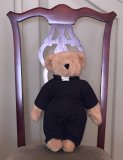
2016 HOMILY — I think we’re all familiar with some child who can’t go anywhere, especially to bed, without a particular favorite blanket or teddy bear… I don’t have a blanky – at least not any more. But just for full disclosure: I do have a teddy bear! As you can see, he’s sporting a Roman collar like my own. However, whether or not I need his company to fall asleep at night is something known only to him, to me and – God!
But while your blanky or teddy may be long gone, isn’t true that as we grow older — we latch on to other things. And many of us cling to and depend on our adult “security blankets” at least as tightly as our children clutch their own.
────── ⋆⋅☆⋅⋆ ──────
Fr. Jude Siciliano, O.P.

23rd Sunday of Year C
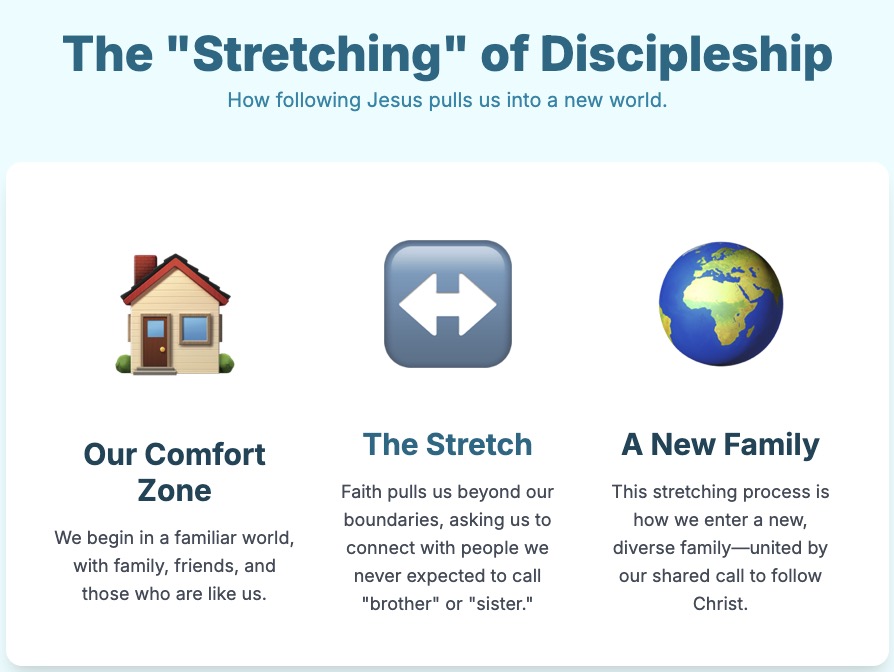
Finding the Rescources to Live Out Our Faith

The reflection questions and infographics featured in this section have been created with the help of Google Gemini 2.5 AI tools, using Chart.js and Tailwind CSS. THE WORD THIS WEEK is happy to offer these resources to any non-profit ministry for use, and kindly request that you provide credit to the website and the respective contributors whose content is illustrated.
Part I: The Shock of the Gospel
The reflection begins by acknowledging how jarring and counter-intuitive this Gospel sounds to modern ears.
- Fr. Siciliano says he's tempted to "apologize" for the Gospel. Why does he describe it as a "turn-off"? What specific examples does he give of modern values (caring for parents, strengthening marriage) that seem to directly contradict Jesus's words?
- Have you ever had a similar "first impression" of a scripture passage, where it seemed harsh, confusing, or completely removed from your life? How did you react?
- The reflection asks: "Do we know anyone who has [renounced all possessions]? And if they have, who is paying their rent, feeding them, and covering their health insurance?" What is the point of these practical questions?
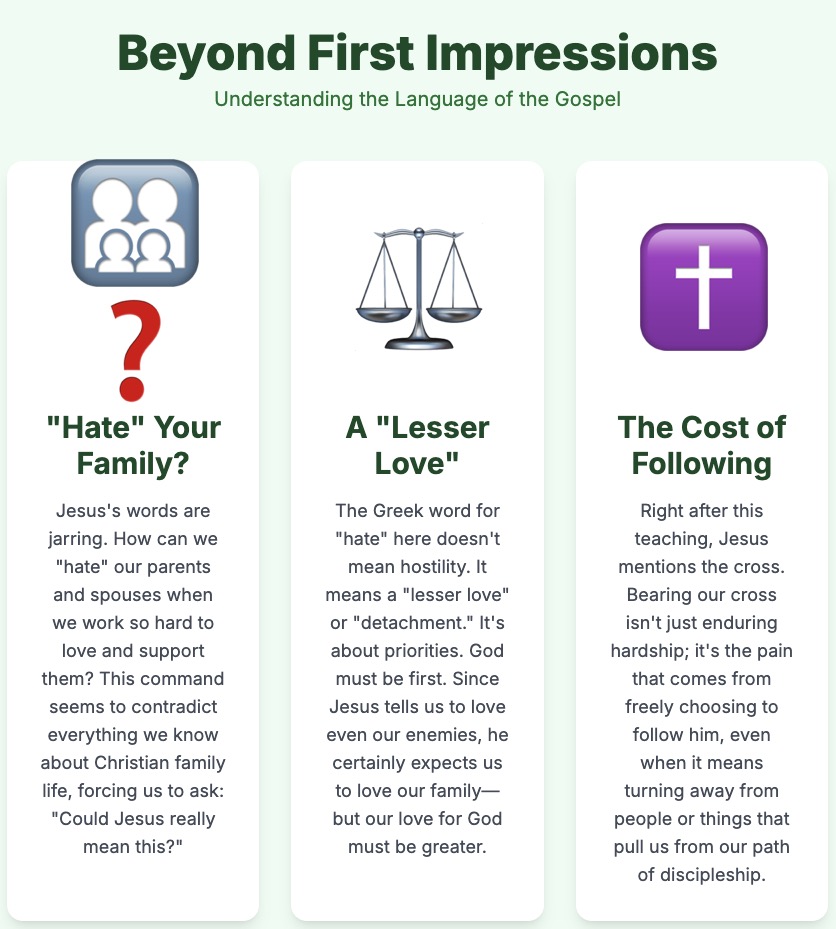
Part II: Beyond First Impressions – Understanding the Language
This section explores the context needed to understand Jesus’s challenging words.
- According to the reflection, what is the meaning of the Greek word translated as "hate"? How does understanding it as a "lesser love" or "detachment" change the message?
- Fr. Siciliano connects the call to "hate" with the call to bear the cross. What does he say "bearing the cross" means in this context? It's not just about life's hardships, but what?
- Even with this new understanding, the reflection insists that Jesus is still placing "real demands" on us. What does it mean that our most precious ties must become "secondary"?
Part III: The New Family
The reflection presents the core of Jesus's message: the formation of a new family united by faith.
- What is the "new family" Jesus came to create? What is the bond that unites its members, if not blood?
- The reflection uses the story of a prison volunteer who felt "stretched." What does that word mean in the context of discipleship? In what ways have you felt your faith "stretch" you beyond your comfort zone?
- The volunteer eventually came to call the inmates "my brothers." What does this story teach us about who belongs in our "new family" in Christ?
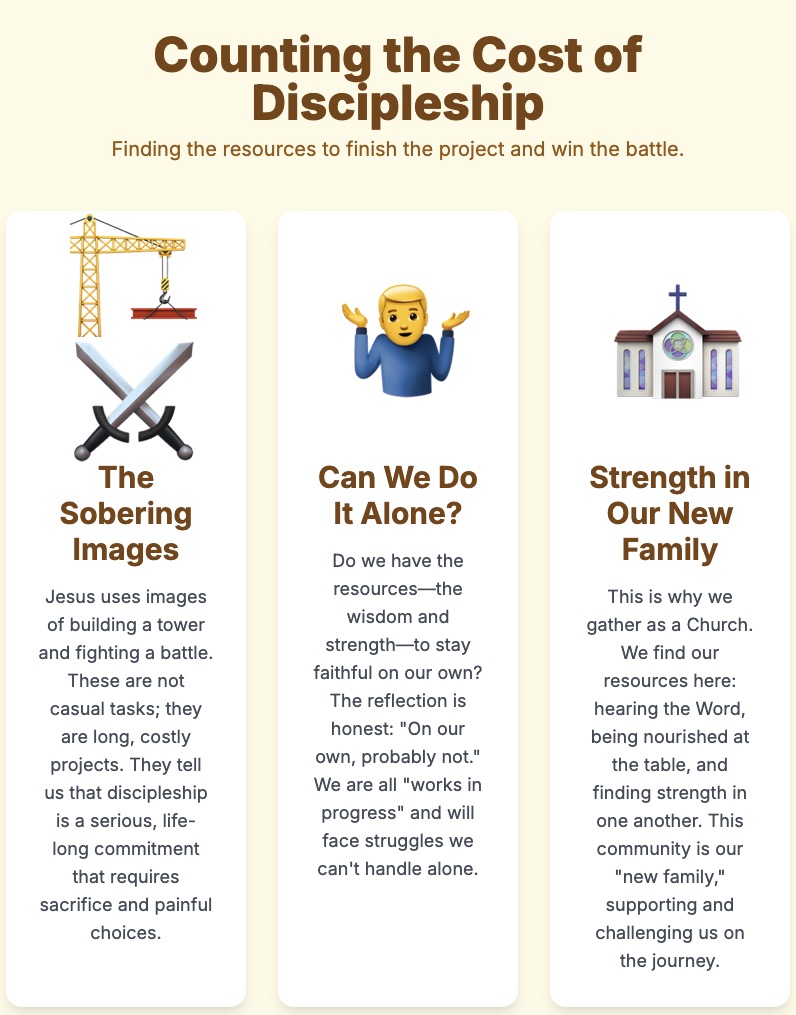
Part IV: Counting the Cost and Finding Our Strength
The conclusion focuses on the seriousness of discipleship and where we find the resources to live it out.
- Jesus uses the images of building a tower and a king going to battle. What do these "sobering" images tell us about the commitment required to be a disciple?
- The reflection states, "On our own, probably not," when asking if we have the resources to stay faithful. Where, then, do we find the strength, wisdom, and nourishment needed for this journey?
- The final line says, "Look around—this is our new family... That stretches us, doesn’t it?" How does seeing your parish community as your "new family"—with all its differences in politics, wealth, and background—both challenge you and support you?
Jesus compares discipleship to building a tower—are you prepared to finish the project? Or, to a king going into battle—do you have the resources to succeed? Both images—building and battle—are sobering. Building suggests a long process, often unfinished, like our own discipleship. We are still “under construction,” works in progress… Do we have the resources to stay faithful, to endure the consequences of our choices? On our own, probably not. None of us has enough wisdom or strength. And that is why we gather here, week after week: to hear the Word, to be nourished at the table, to find strength in one another. Look around—this is our new family. We may differ in politics, wealth, or background, but here we are, called sisters and brothers in Christ. That stretches us, doesn’t it? Just as Jesus said it would, when he invited us to make him the first priority in our lives.
────── ⋆⋅☆⋅⋆ ──────
Fr. Charles E. Irvin
23rd Sunday of Year C
Competing Voices
The reflection questions and infographics featured in this section have been created with the help of Google Gemini 2.5 AI tools, using Chart.js and Tailwind CSS. THE WORD THIS WEEK is happy to offer these resources to any non-profit ministry for use, and kindly request that you provide credit to the website and the respective contributors whose content is illustrated.
Part I: Understanding the "Extreme Language" of Jesus
The homily begins by addressing the shocking word "hate" and why Jesus uses it.
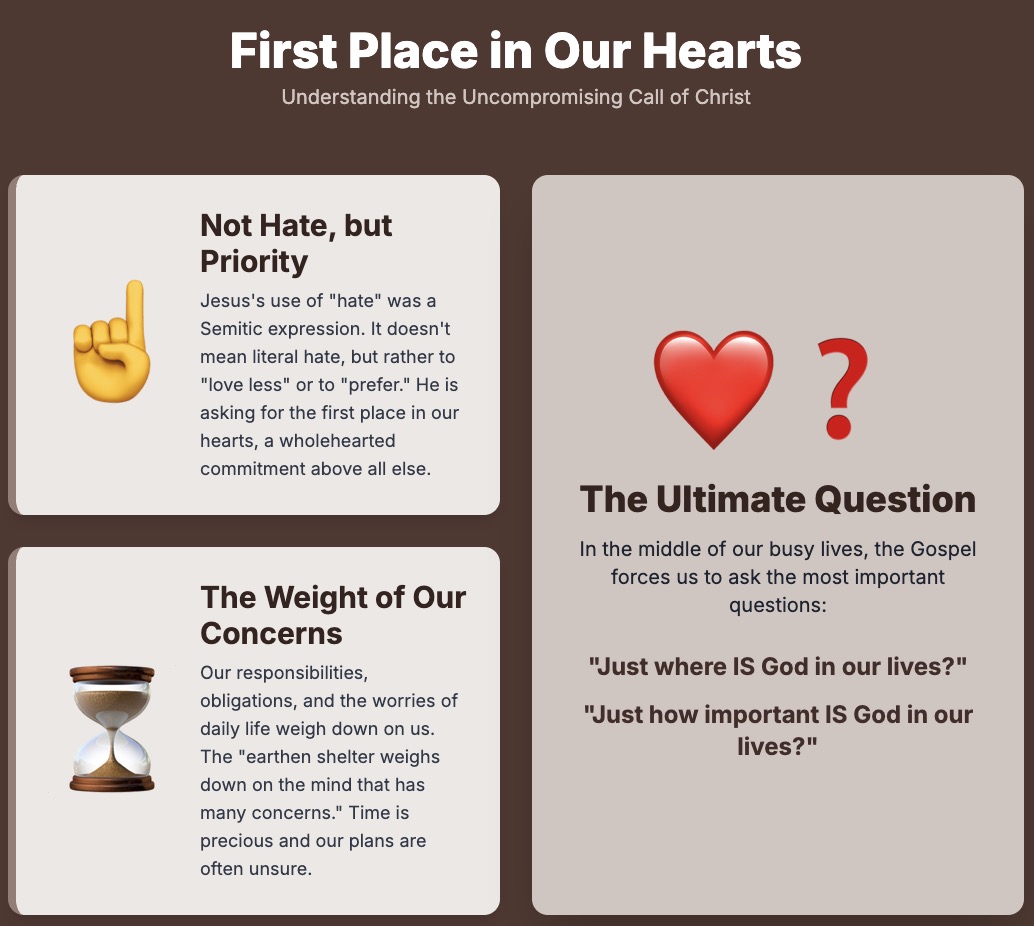
- Fr. irvin clarifies that the word "hate" in the language Jesus spoke was a Semitic expression meaning something closer to "prefer" or "love less." How does this explanation change your initial reaction to the Gospel passage?
- Jesus isn't asking us to abandon our families, but to give him "first place in our hearts." What does giving God "first place" look like in the middle of a busy week filled with family and work responsibilities?
- Why do you think Jesus chose to use such "extreme language"? What effect does it have, and why does the priest say it was so "people would not forget what He is asking"?
Part II: Towers, Kings, and Counting the Cost
This section explores the two parables Jesus uses to illustrate the seriousness of discipleship.
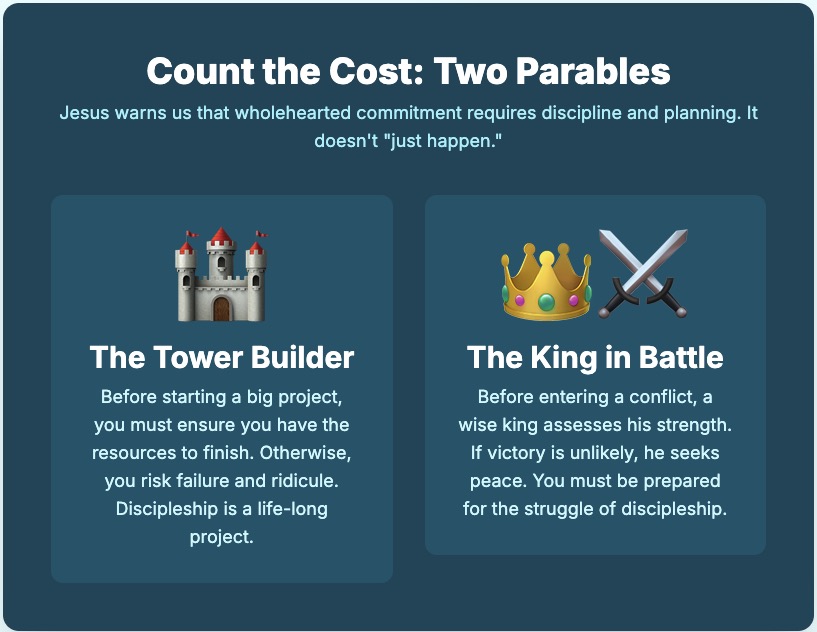
- Jesus gives the examples of a person building a tower and a king going to war. What is the common message in both of these stories? What do they teach us about the commitment required to be a disciple?
- The homily states that discipleship "doesn’t 'just happen'," but takes "discipline and planning." What kind of practical planning is needed to maintain a life of faith in our modern world?
- Fr. Irvin asks a series of powerful personal questions: "What are the things I am clinging to? What are the things I cannot let go of? And why?" What attachments (possessions, status, comfort, relationships) in your own life make it difficult to give God first place?

Part III: Competing Voices and True Happiness
The homily contrasts the world's promises with the Gospel's offer of lasting happiness.
- What are some of the "many voices in our surrounding world" that try to tell us what is important? How do they compete with the voice of the Gospel?
- Fr. Irvin makes a distinction between what the world offers as "mere pleasure" and what the Gospel offers as "lasting happiness." How would you describe the difference between the two?
- A good education, the homily suggests, teaches us "critical judgment." How can we apply critical judgment to the messages we receive from culture, advertising, and social media?
Part IV: The "How" of Belief
Fr. Irvin's conclusion focuses not on if we believe, but on how we live out that belief.
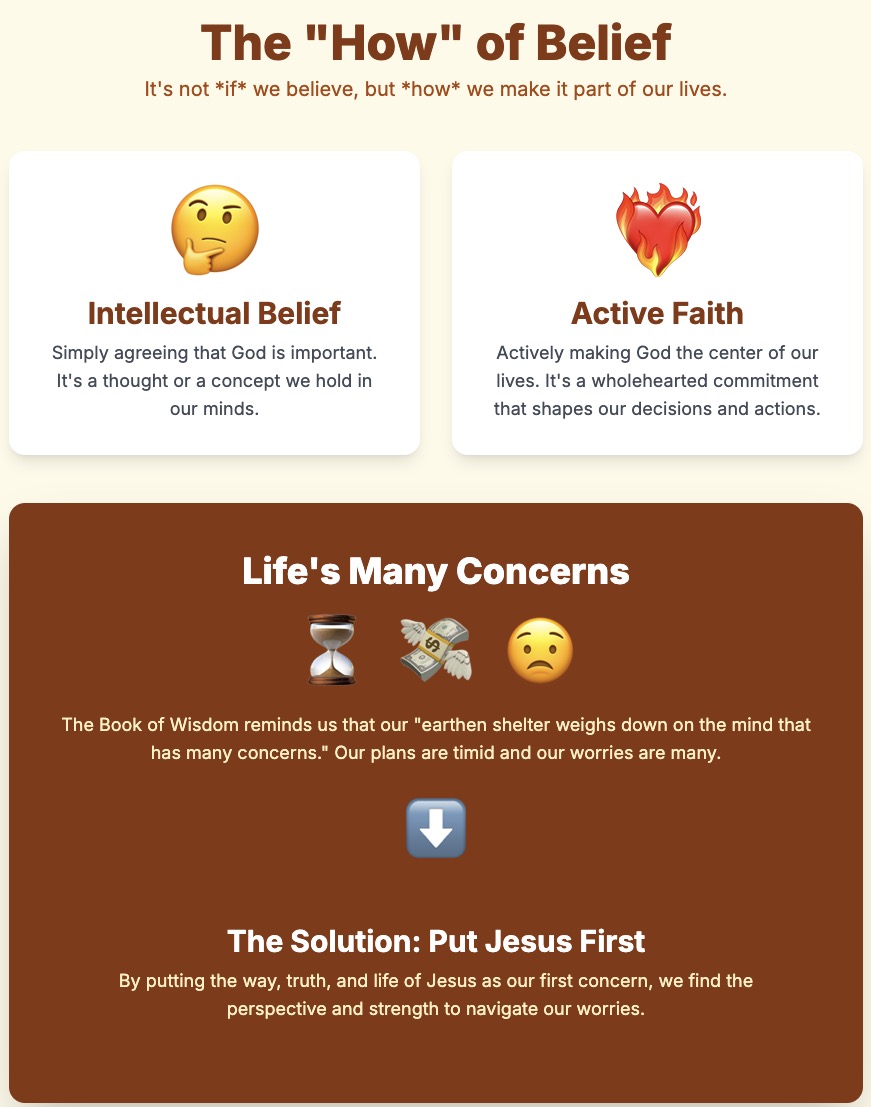
- The homily says, "It’s not whether we believe that [God matters], it’s how we believe that, how we make it a part of our lives." What is the difference between simply agreeing that God is important and actively making him the center of your life?
- The reading from the Book of Wisdom is quoted again: "...the earthen shelter weighs down on the mind that has many concerns." How does putting Jesus first help us deal with the many legitimate concerns and anxieties of daily life?
- The final message is that "Being close to Jesus will give us the power to deal with whatever life sends our way." Have you ever experienced this to be true in your own life? Share an example if you are comfortable.

Many voices in our surrounding world attempt to tell us what is important and what is not. Many of those voices tell us to set God aside or, even worse, abandon believing in God. Each one of those many voices, all of them competing between each other and trying to dominate, present what they claim to be of the greatest importance. We need to exercise critical judgment. Are they offering mere pleasure? Or are they offering us lasting happiness?
A good education gives us a lot of facts and information. It should also give us the skill to make critical judgments, to differentiate between what is merely superficial and what is of substance. That is what today’s Gospel account is all about. It is challenging us to see things in context and to place things in proper perspective.
────── ⋆⋅☆⋅⋆ ──────
Fr. George Smiga
23rd Sunday of Year C
Philemon
The reflection questions and infographics featured in this section have been created with the help of Google Gemini 2.5 AI tools, using Chart.js and Tailwind CSS. THE WORD THIS WEEK is happy to offer these resources to any non-profit ministry for use, and kindly request that you provide credit to the website and the respective contributors whose content is illustrated.
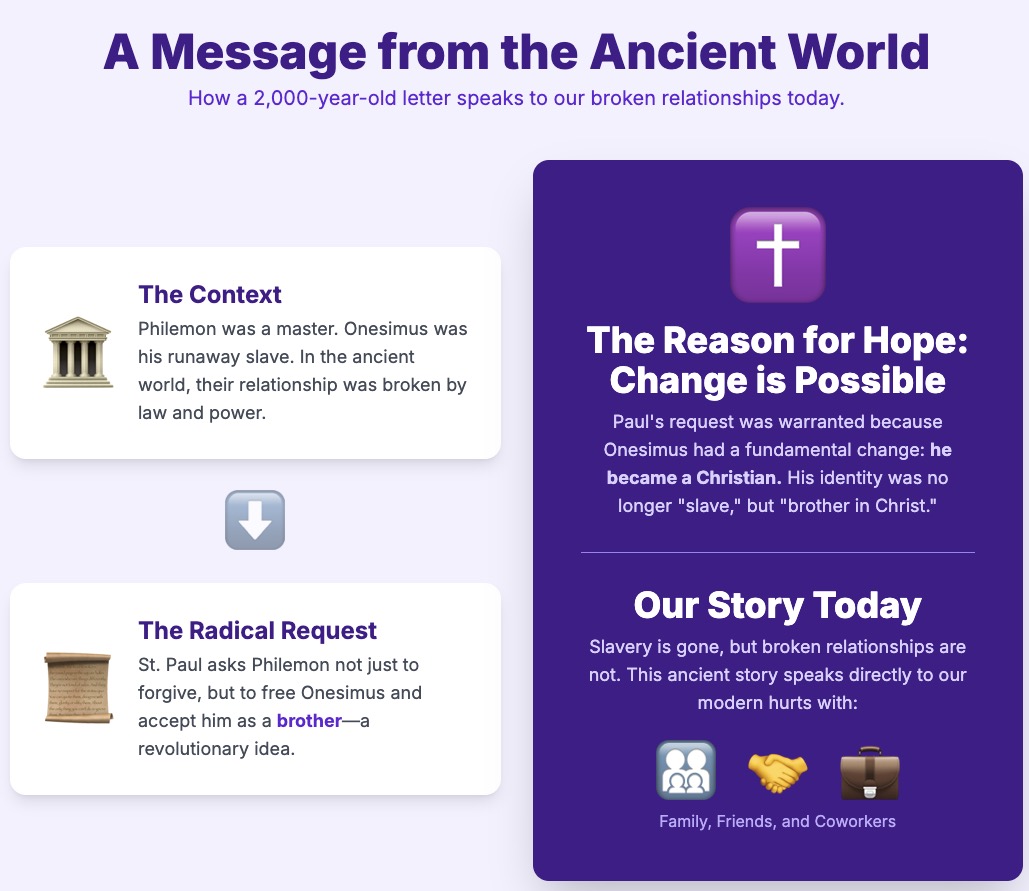
Part I: A Message from the Ancient World
The homily begins by explaining the historical context of Paul's shortest letter.
- Fr. Smiga explains the relationship between Philemon (a slave owner) and Onesimus (his runaway slave). Why was Paul’s request for Philemon to forgive, free, and accept Onesimus as a "brother" so significant and radical for that time?
- What was the reason Paul felt this request was warranted? What fundamental change had occurred in Onesimus?
- The homily says, "Although slavery is no longer an accepted part of our world, broken relationships are." How does this ancient story about a master and a slave speak directly to our modern experiences with family, friends, and coworkers?
Part II: The Possibility of Change
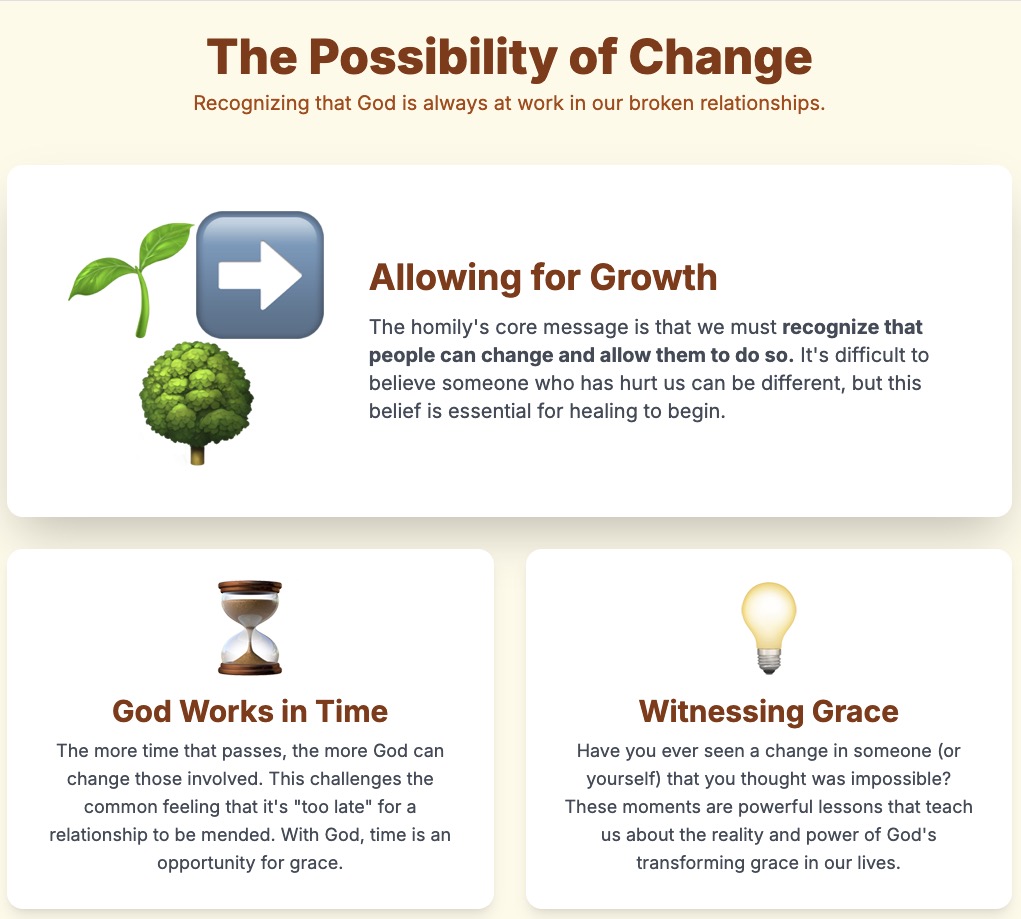
This section explores the core message of the homily: recognizing that God is always at work.
- The homily states that if we find ourselves in a broken relationship, we must "recognize that people can change, and we must allow them to do so." Why is it sometimes so difficult to believe that someone who has hurt us can genuinely change?
- Fr. Smiga encourages us to consider how long a relationship has been broken, suggesting that the more time that passes, the more God is able to change those involved. How does this idea challenge the common feeling that "too much time has passed" for things to be fixed?
- Have you ever witnessed a significant, positive change in someone (or yourself) that you didn't think was possible? What did that experience teach you about God's grace?
Part III: How God Changes Us
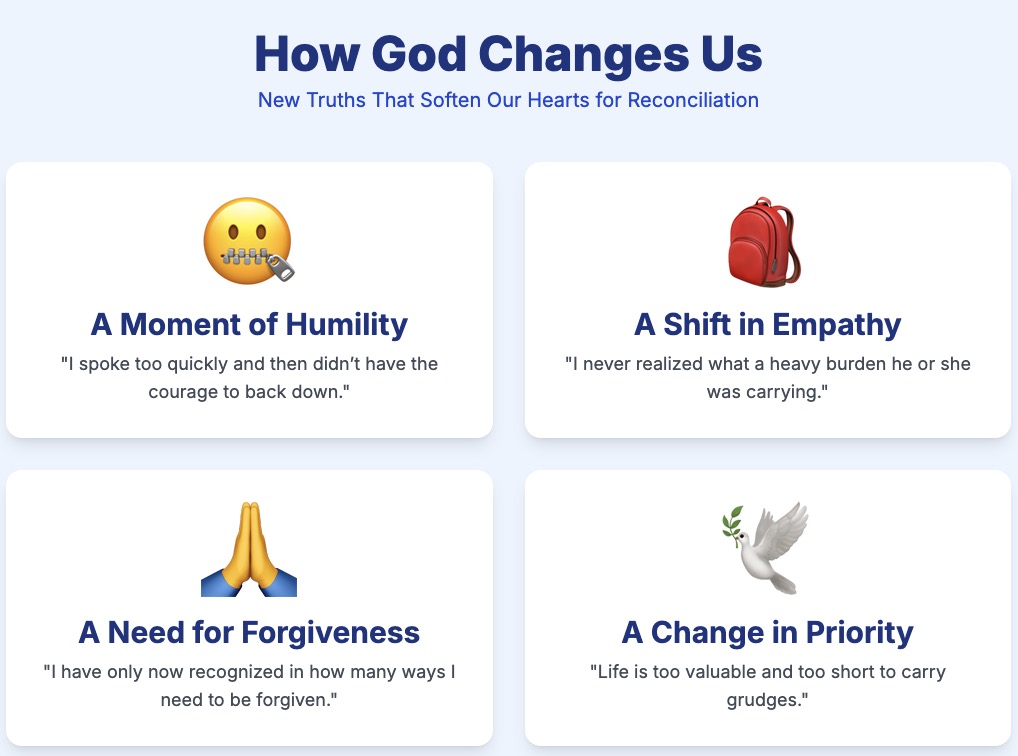
The homily lists specific "new truths" God can lead us to see, which soften our hearts for reconciliation.
- Let's discuss some of the examples of "new truths" the priest gives. Have you ever come to realize one of these?
- "I spoke too quickly and then didn’t have the courage to back down."
- "I never realized what a heavy burden he or she was carrying."
- "I have only now recognized in how many ways I need to be forgiven."
- "Life is too valuable and too short to carry grudges."
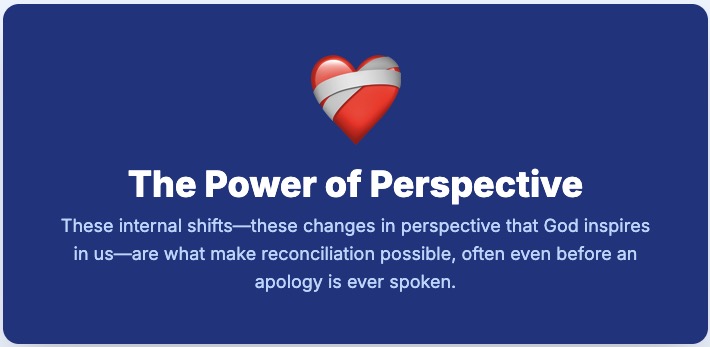
- How do these internal shifts—these changes in perspective—make reconciliation more likely, even before anyone has apologized?

Part IV: Conclusion
The conclusion calls us to apply this lesson directly to our own lives.
- Paul asked Philemon to "look again" at his relationship with Onesimus. The homily says the letter asks us to do the same. What keeps us from being willing to "look again" at a broken relationship with fresh eyes?
- Fr. Smiga says, "We might be convinced that we could never forgive or be forgiven, but God always remains active." Why is it important to hold onto this hope, even when a situation seems impossible?
- The homily ends with a powerful comparison: "If Philemon was able to forgive his slave, how much more can we, with God’s grace, forgive a parent, a child, or a friend." How does putting our own struggles in this perspective challenge us?

2022 HOMILY – God can change us in many ways. God can lead us to see new truths:
“I spoke to quickly and then didn’t have the courage to back down. I never realized what a heavy burden he or she was carrying. I completely misread the situation in which the rupture took place. I have only now recognized in how many ways I need to be forgiven. I can see now that life is too valuable and too short to carry grudges.” If any of those truths begin to soften those on either side of the relationship, reconciliation becomes more likely.
Paul wrote to Philemon to ask him to look again at his relationship with Onesimus and to realize how much had changed. The letter to Philemon asks us to do the same. We might be convinced that we could never forgive or be forgiven, but God always remains active. If Philemon was able to forgive his slave, how much more can we, with God’s grace, forgive a parent, a child, or a friend.
────── ⋆⋅☆⋅⋆ ──────
────── ⋆⋅☆⋅⋆ ──────
23rd Sunday of Year C

The Letter to Philemon and the New Way

Many times people reduce this letter to a discussion of Paul’s view of slavery. It really has little to do with slavery, even though the subject of the letter, Onessimus, was a slave who had run away from his master Philemon. Now, as soon as you or I hear that Philemon was a Christian with a slave, we immediately question whether or not Philemon was really a Christian. That’s because the word slave calls up in us the pictures of the poor African and Native Americans who were kidnaped from their homelands, or whose parents or ancestors were. Slavery as we have sadly experienced it in the history of our country involved beatings and tortures, separating parents from their children, and husbands and wives from each other, as well as other atrocities, basically treating the slaves as animals. Slavery like that did exist in the Roman empire, but it was mostly confined to the galleys and mines. Christians could not own that type of slave. But there were also many slaves with quite a different status in society. Some of these slaves were pedagogues, teachers, or servants. These slaves could have their own families. They could work side jobs, save up money and even purchase their own freedom.
────── ⋆⋅☆⋅⋆ ──────
23rd Sunday of Year C
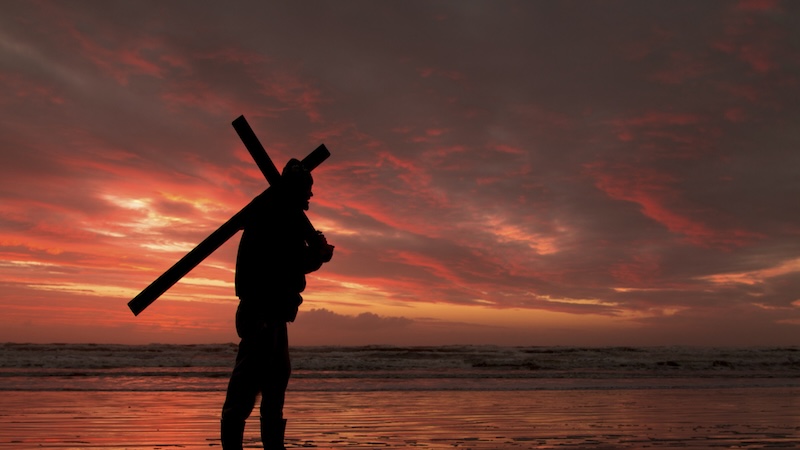
Four Depictions of Discipleship
In Sunday’s Gospel, Jesus defines four demands of discipleship. Let’s look at them one by one.
I. The CONTEXT of discipleshi
II. The CENTRALITY of discipleship
III. The CROSS of discipleship
IV. The COST of discipleship
────── ⋆⋅☆⋅⋆ ──────
Fr. Michael Chua
23rd Sunday of Year C
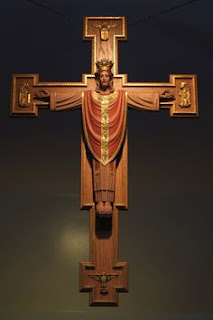

St John of the Cross in his monumental spiritual treatise, the Ascent of Mount Carmel, notes that it makes little difference whether the leg of a bird is tied with a strong rope or with the tiniest thread. If anything is holding it, it cannot fly. Flight to God cannot occur till all attachments that cause us to resist the call of grace are broken, however apparently insignificant they may appear. This single-minded whole-hearted commitment to God and to doing God’s will is what gives that special flavour to the life of a disciple of Christ. If this is lost, the life of the one who might claim to be a disciple loses all value.
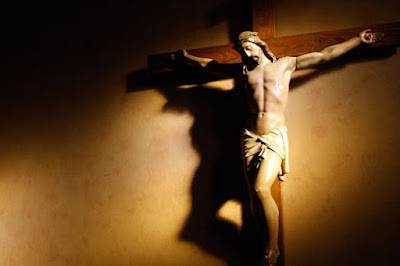
Our Lord doesn’t want a large number of disciples who are only half-way committed to Him. He’s looking for followers who are “all-in,” dedicated to Him through prayer and discipleship. Quality matters more than quantity. Such is the wisdom and the logic of the cross.
St. Teresa of Avila once complained about the hardships that Christians face, and she heard the Lord say, “Teresa, whom the Lord loves, He chastises. This is how I treat all my friends.” Ever the witty thinker, she responded, “No wonder you have so few friends!” So, if you are experiencing suffering, hardship and persecution for Christ, or have few friends because of the Christian values you hold, do not despair. Remember: we are counted among the Lord’s friends. So, learn to take up your cross and learn its logic, and you will be assured of a wisdom and a reward that is beyond this world.
When Protestants ask Catholics if they have been saved, the question would most likely be met with a stunned look on the part of the Catholic or an admission that he has never thought about this before. This comes as good news to the Protestant as he can now confidently proselytise the Catholic and ensure that the latter is saved by becoming a Bible believing, faith professing Protestant Christian. For many Protestants, one becomes a Christian by merely making a confession of faith in Jesus as Saviour and Lord. Baptism comes later but isn’t necessary for our salvation. I guess the reason why most Catholics are not prepared with an answer to that question is that salvation or rather, heaven, is something they often take for granted. Why worry about this moot issue when we can all get to heaven?
23rd Sunday of Year C
What does God Want Me to do with My Life
“What does God want me to do with my life?” is a question we hear on this campus. “Who can know God’s counsel or who can conceive what the Lord intends?” asks the first reading (Wis 9:13). The reading concludes that God sent wisdom and “thus were the paths of those on earth made straight.” (Wis 9:18) That wisdom sent by God is Jesus. Jesus is the Wisdom of God, the Revelation of God. So now when we want to know God’s counsel or conceive what the Lord intends— to use the words of the first reading—listen to the words of Jesus. God has not left us in the dark. When we have to discern, we have the Wisdom of God in Jesus to guide us.
────── ⋆⋅☆⋅⋆ ──────
23rd Sunday of Year C
Of all the Sunday Gospel readings we encounter during the three-year cycle, this can be a very tricky one to preach on. Jesus says, “If anyone comes to me without hating his father and mother, wife and children, brothers and sisters, and even his own life, he cannot be my disciple.” This is the same Jesus who spoke about love of God and neighbor. He even told us to love our enemies. Now we have a commandment to hate those who are closest to us. What gives? Jesus also challenges us, “…anyone of you who does not renounce all his possessions cannot be my disciple.” I like possessions. Any of you like possessions?
The reflection questions and infographics featured in this section have been created with the help of Google Gemini 2.5 AI tools, using Chart.js and Tailwind CSS. THE WORD THIS WEEK is happy to offer these resources to any non-profit ministry for use, and kindly request that you provide credit to the website and the respective contributors whose content is illustrated.