September 7, 2025
September 7, 2025


w/ Guided Reflection Questions & Infographics
Homilies
Homilies

BISHOP ROBERT BARRON (14:05) – Friends, for this Twenty-Third Sunday of Ordinary Time (2025), we’re reading from the fourteenth chapter of Luke—and it is very serious spiritual business.
Video Homilies, Reflection Questions, Free Sunday Bulletin Graphics, Sunday Readings
Video Homilies, Reflection Questions, Free Sunday Bulletin Graphics, SUnday Readings
- Bp. Barron
- FR. RUTTIG
- MSGR. Hahn
- FR. Plant
- MR. PAVONE
BISHOP
BARRON

TIP: To make the most of this resource, start the video and allow it to play as you explore the infographics and reflection questions provided on the page. This approach will facilitate a more comprehensive understanding and engagement with Bishop Barron’s homily.
23rd Sunday of Year C


Click on infographics to enlarge them
Discussion Questions
The Crowd and the Claim
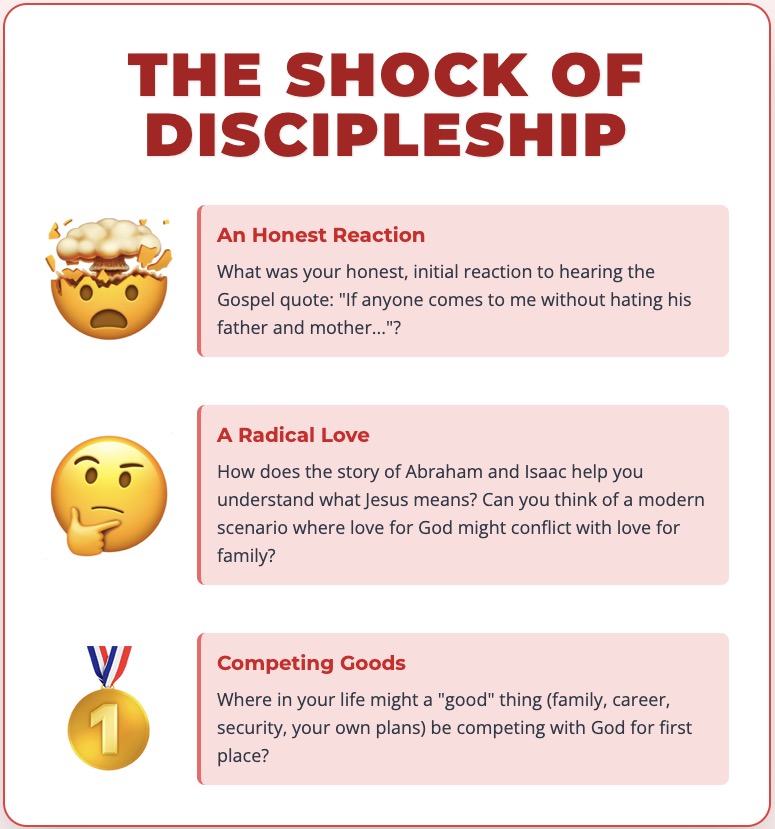
- The sermon contrasts the “great crowds” following a “fascinating, charismatic figure” with the harsh reality of Jesus’s message. In what ways does our modern culture often treat Jesus like a “pop star” or a “guru” while ignoring his more difficult teachings?
- The speaker argues that the demand to be loved more than family is a clear affirmation of Jesus’s divinity, asking the “ontological question: ‘Who do you think you are?'” Why is it that only God could make such a claim? What would we think if any other historical or religious figure said this?
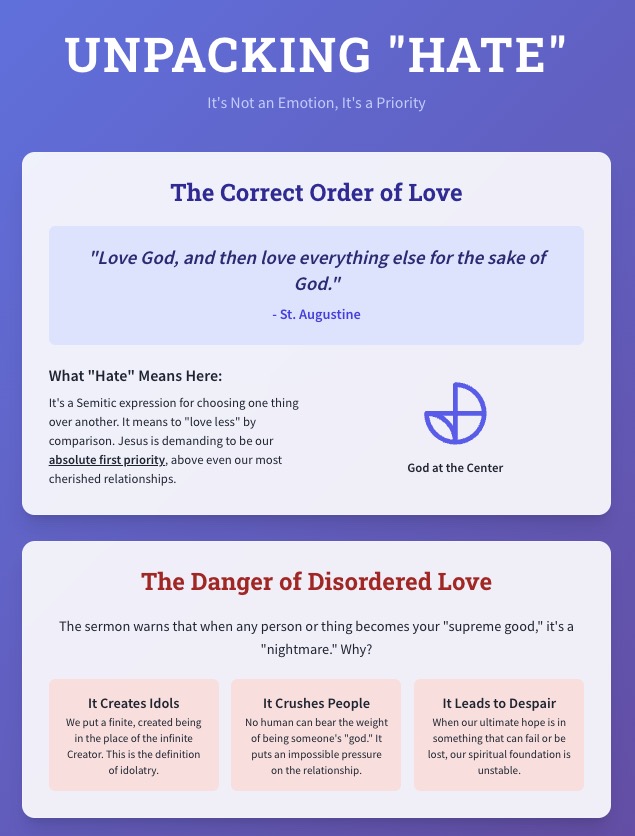
Unpacking “Hate”
- The sermon explains that “hate” in this context is not about psychological emotion, but about priority. St. Augustine is quoted: “Love God, and then love everything else for the sake of God.” How does this quote help clarify Jesus’s command? Can you put this idea into your own words?
- The speaker warns that when a person—even a mother, father, or child—becomes the “supreme good” in your life, “that’s a nightmare.” Why would he use such a strong word? What are the dangers of putting any created thing or person in the place of God?
- The examples of St. Francis of Assisi and St. Thomas Aquinas are used. How do their stories of breaking with their families illustrate the principle of “hating” family for the sake of Christ? Does this seem extreme to you, or necessary?
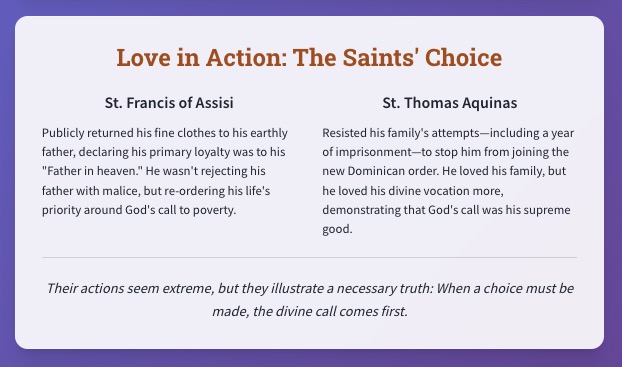

Part 3: Hating Your Own Life & Carrying the Cross
- The guide says the command to “hate your own life” still takes his breath away. He defines it as a “metanoia,” a turning around where your life no longer revolves around you, but around Christ.
- What does a life that revolves around “me and mine and I” look like in day-to-day practice?
- What does a life that “revolves around Christ” look like? What practical changes would that require in a person’s schedule, finances, relationships, and priorities?
- The sermon reminds us that for the first-century audience, “carrying your cross” was not a metaphor for minor burdens. It meant public execution, humiliation, and total self-renunciation. How does remembering the literal meaning of the cross change your understanding of the phrase “carry your cross”?
- The speaker concludes that for “fair-weather fans,” these words are a test. What is the difference between being a “fan” of Jesus and being a “disciple” of Jesus?

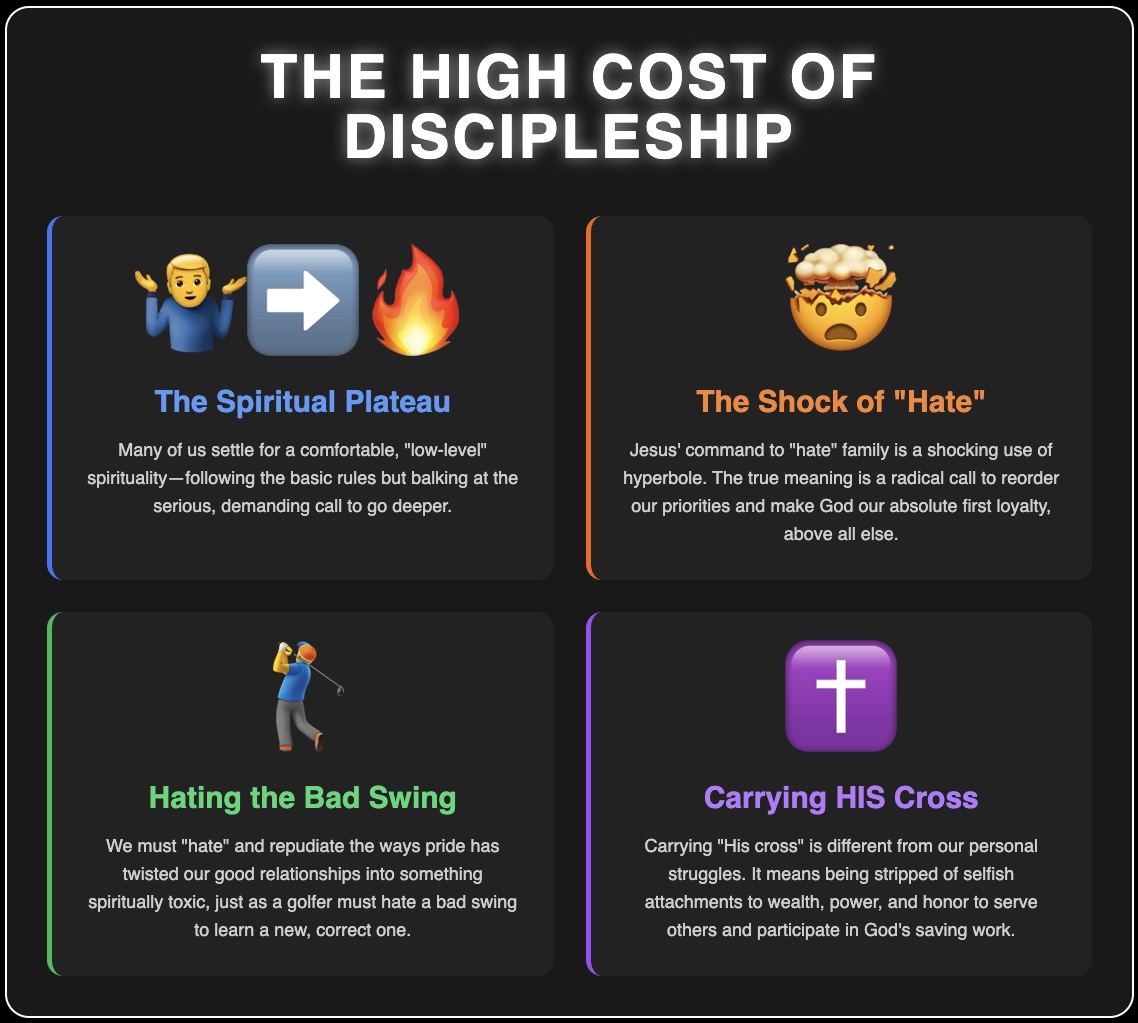
Click on infographics to enlarge them
Discussion Questions
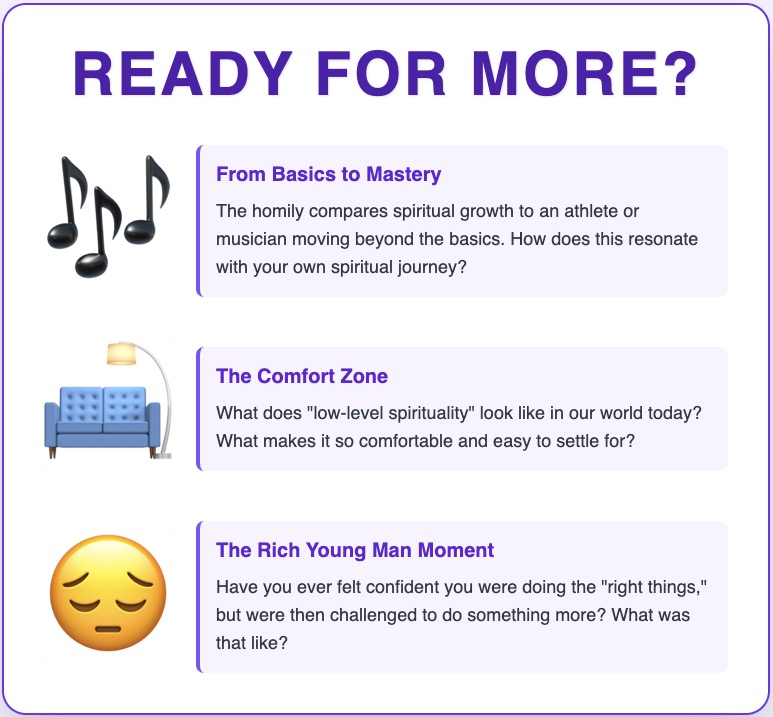


Reflection Questions and Infographics were generated using Google Gemini 2.5 AI tools (w/ Chart.js and Tailwind CSS). Feel free to use them in any non-profit ministry. A Link or shoutout to THE WORD THIS WEEK would be greatly appreciated.
FR. KEVIN
RUTTIG
TIP: To make the most of this resource, start the video and allow it to play as you explore the infographics and reflection questions provided on the page. This approach will facilitate a more comprehensive understanding and engagement with Father Ruttig’s homily.
23rd Sunday of Year C


Click on infographics to enlarge them
The Story and its Symbol
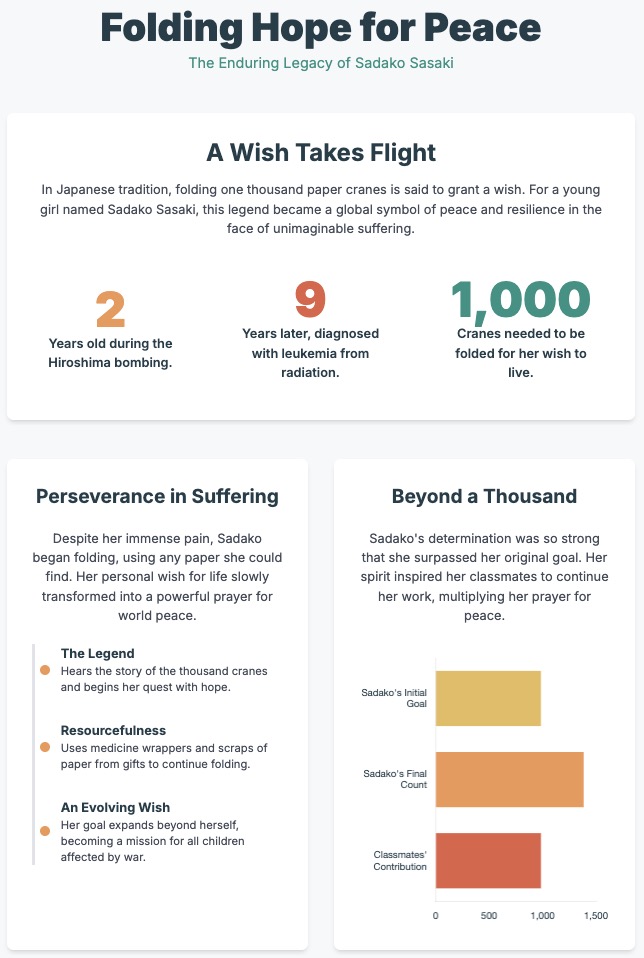
- The Symbol of the Crane: Before Sadako’s story, what did the tradition of one thousand paper cranes represent in Japanese culture? How did Sadako’s journey transform or deepen the meaning of this symbol for the world?
- Perseverance in Suffering: Fr. Ruttig vividly describes Sadako’s determination, using “medicine wrappers” and begging for scraps of paper. What does her perseverance in the face of immense pain and fear teach us about the nature of hope?
- An Evolving Wish: Sadako begins folding cranes with a wish for her own life, but her mission continues even after she reaches her goal of 1,000. What do you believe her wish evolved into? Why was it so important for her to keep counting?
Part B: Counting the Cost
- A Haunting Contrast: Fr. Ruttig creates a stark contrast between “counting cranes” and “counting the cost of war.” He says, “count to ten million and new faces of haunting hidden despair still continue to appear.” What are some of the visible and invisible costs of conflict that he asks us to consider?
- An Urgent Plea: The inscription at the base of the monument reads, “This is our cry. This is our prayer for building peace in this world.” Why do you think peace is described as something that must be “built”? What does that imply about our role?
- The Insanity of War: The homily references the “insane suicide of the planet” and the killing of one group for the “power and profit of a third group.” How does Sadako’s innocent, personal story serve as a powerful judgment on the impersonal and calculated nature of war?

Our Call to Action
- Continuing the Count: The story emphasizes that after Sadako’s death, her classmates, and then the world, “took up the count.” What does it mean for us, today, to “continue the count” and participate in her dream for peace?
- Folding Our Own Cranes: What are the “paper cranes” we can fold in our own lives? What are some small, tangible actions that, when done with intention, contribute to building a culture of peace in our families, workplaces, and communities?
- Daring to Dream: The homily ends with a challenge: “Dare to dream of a world without fear.” In a world often filled with news of conflict and division, how can we cultivate and protect this dream? What gives you hope that such a world is possible?
Closing Reflection
Challenge for the Week: Take a few minutes this week to learn how to fold an origami paper crane (many tutorials are available online). As you fold it, pray for a specific person, region, or situation in the world that is in need of peace. Place the crane somewhere you will see it as a reminder of your prayer.

Click on infographics to enlarge them
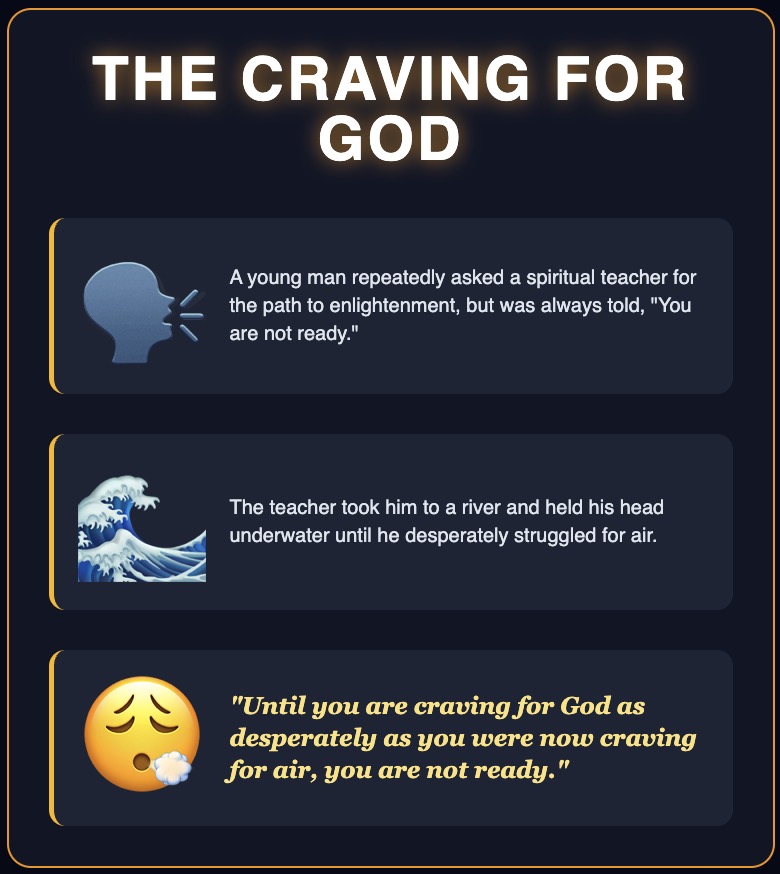
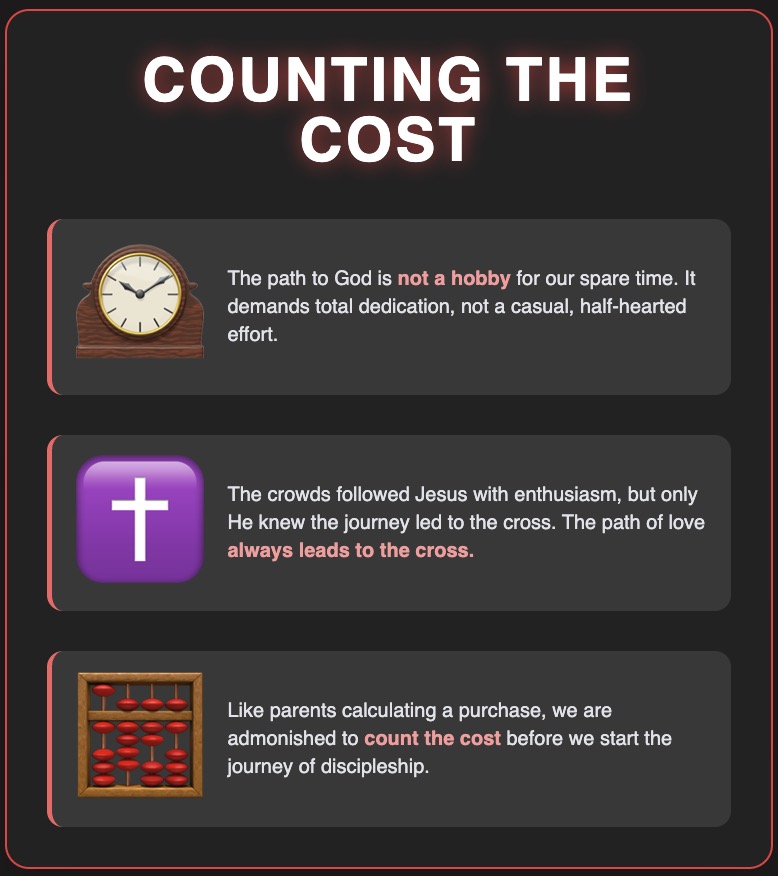
The Craving for God
Core Idea: The journey to God is not a casual hobby or something done in our spare time. It requires a deep, all-consuming desire, as essential as the air we breathe.
Key Moment from the Homily:
“The old teacher replied, ‘Until you are craving for God as desperately as you were now craving for air, you are not ready.'”
Discussion Questions:
- What was your initial reaction to the story of the teacher holding the young man’s head under water? How does this intense image challenge your own approach to faith?
- The homilist says we sometimes treat God “as one of our many hobbies.” In what ways, big or small, do you see this tendency in your own life or in the world around you?
- What does it practically mean to “crave God”? What habits or changes in perspective could help cultivate a deeper desire for God in our daily lives?
The Cost of Committed Love
Core Idea: True, committed love—whether in marriage, parenting, or our relationship with God—is not free. It has a significant cost that involves sacrifice, tears, and putting others’ needs before our own.
Key Moments from the Homily:
“The path of love always leads to the cross.” “Those of you who have been married for a long time know exactly what that is. Committed love has a cost. It costs an awful lot of sacrifice.” “Anger can be extremely expensive.”
Discussion Questions:
- The homilist applies the principle of “counting the cost” to marriage, parenting, and even managing anger. Which of these examples resonated most with you and your own life experiences?
- Think about a significant relationship in your life. What has been the “cost” of maintaining that love? What sacrifices has it required?
- The homilist tells the story of the woman who calculated the “cost of remaining angry.” Why is holding onto anger so “expensive”? What does it cost us in our relationships and our own peace of mind?
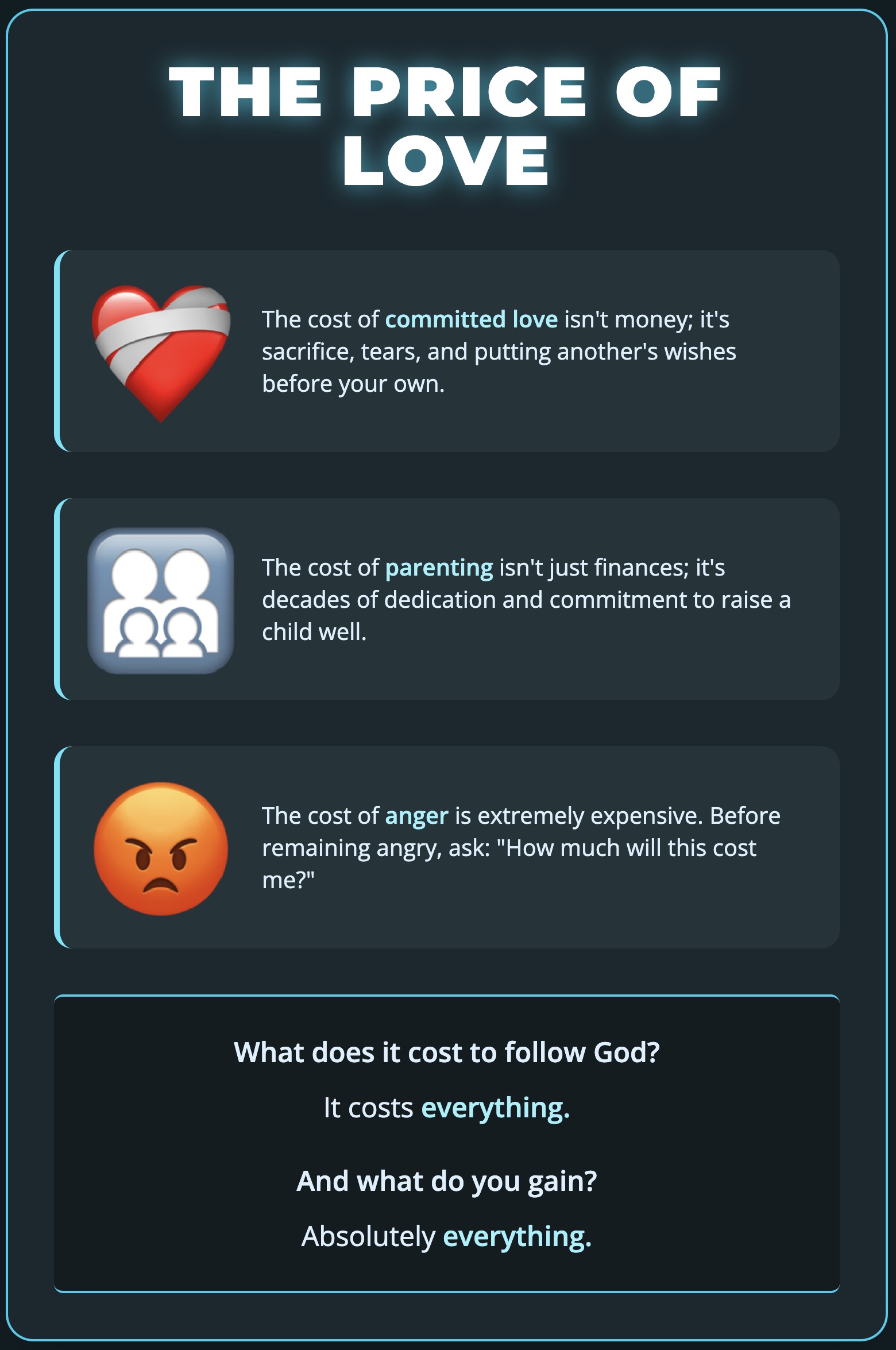
The Final Calculation
Core Idea: To truly follow the way of Christ—the way of love—will cost us everything. This “cost” is not a loss but a complete transformation of our lives and priorities.
Key Moments from the Homily:
“What will it cost me to embrace the way of love, the way of God? It will cost me everything because everything I have will become completely different, completely transformed.” “It has cost me everything but I have gained everything. Absolutely everything.”
Discussion Questions:
- What do you think the homilist means when he says embracing the way of love will “cost me everything”? Is he talking about money and possessions, or something deeper?
- The homily ends with a powerful paradox: losing everything to gain everything. What do you think is the “everything” that we gain? How have you experienced glimpses of this gain in your own life?
- The crowds followed Jesus with “momentary enthusiasm,” but Jesus knew that wasn’t enough to sustain them on the journey to the cross. What is the difference between enthusiasm for faith and the deep commitment that Jesus asks for? How can we move from one to the other?
Reflection Questions and Infographics were generated using Google Gemini 2.5 AI tools (w/ Chart.js and Tailwind CSS). Feel free to use them in any non-profit ministry. A Link or shoutout to THE WORD THIS WEEK would be greatly appreciated.
MSGR. PETER
HAHN
TIP: To make the most of this resource, start the video and allow it to play as you explore the infographics and reflection questions provided on the page. This approach will facilitate a more comprehensive understanding and engagement with Monsignor Hahn’s homily.
23rd Sunday of Year C

Click on infographics to enlarge them
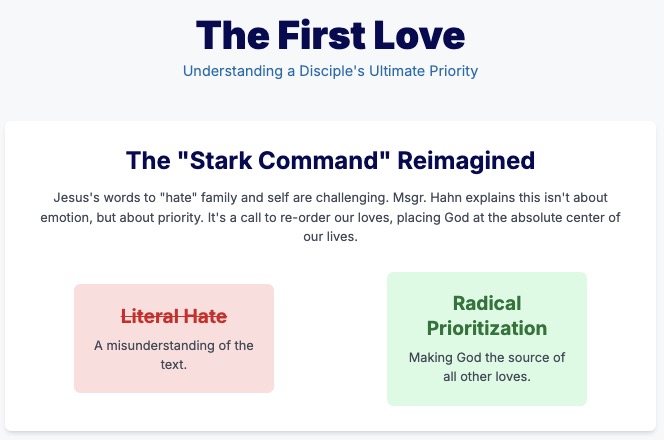
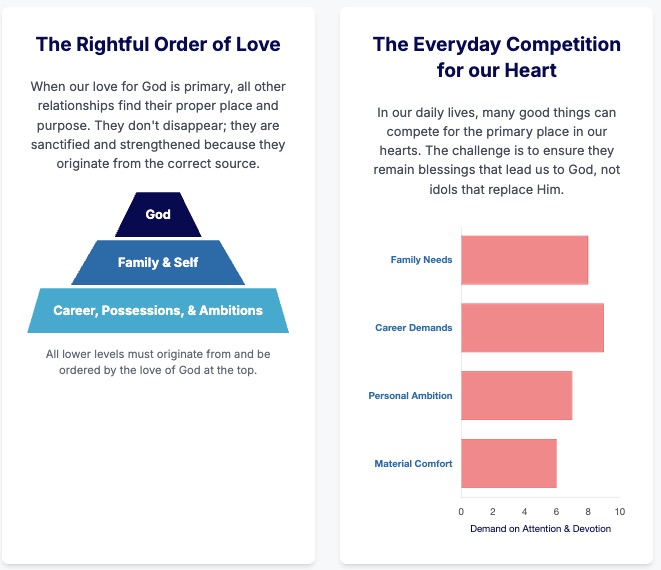
The “Stark Command” – Loving God First
- Msgr. Hahn addresses Jesus’s “stark and nearly overwhelming” words about hating one’s family and life to be a disciple. He interprets this not as literal hate, but as a call to make our love for God the “absolute first love, from which all other relationships originate.” Does this explanation help you understand this difficult passage?
- In what practical, everyday ways can our other loves (for family, career, possessions, or even ourselves) compete with our love for God? How can we ensure God remains our first priority?


What it Means to “Let Go and Let God”
- The homily connects the phrase “let go and let God” to our participation in the Eucharist, where we offer our hopes, worries, and talents to Him. Outside of Mass, what does “letting go” look like in your daily life?
- What are some specific worries, plans, or possessions that you find it difficult to entrust completely to God’s care? What makes it hard to “let go” of them?
- Msgr. Hahn asks if our presence at Mass is a genuine declaration that Jesus is most important, or if it is sometimes just an obligation or habit. How can we make our participation in the Mass a more conscious act of “letting go and letting God”?


Part C: Embracing the Cross and God’s Wisdom
- The homily reminds us that discipleship involves “renouncing possessions and embracing crosses.” What do you think a “cross” looks like for a Christian living in the world today? How is “taking up a cross” different from simply enduring a hardship that comes our way?
- Msgr. Hahn references the Book of Wisdom, saying our human deliberations are “timid and unsure.” Can you think of a time when the path of Christian wisdom (e.g., forgiveness, self-sacrifice, radical honesty) seemed foolish or counter-intuitive from a worldly perspective?
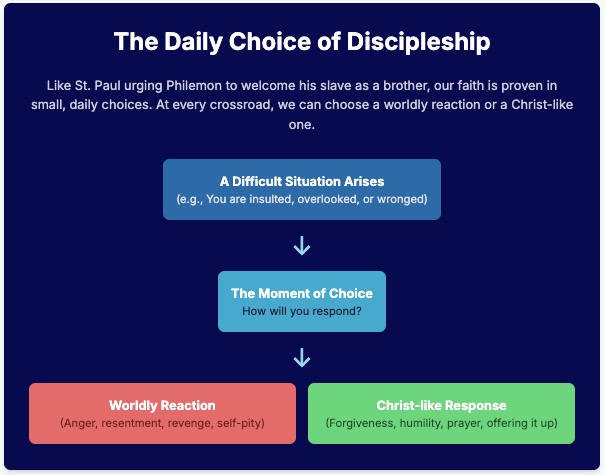
- The example of St. Paul asking Philemon to welcome his slave back as a brother is a powerful one. It shows that following Christ is expressed in daily choices. What is a recent “daily choice” where you felt a pull between a worldly reaction and a Christ-like one?


This discussion guide has been generated by GOOGLE’S AI Gemini 2.5 Flash LLM.
The homily begins by framing our entire life of faith as a series of invitations from God and our responses to them.
- The homily states that in all our relationships, there is an “invitation” and a “response.” Can you think of a recent example in your own life (with family, friends, or God) where you either gave or received an invitation? What was the response?
- God’s first and most fundamental invitation is the gift of life itself. How does viewing your existence as a personal invitation from God change your perspective on your daily life?
- The homily says the Gospel’s examples of banquets are “symbolic of all the ways that God will enter into our lives.” Besides formal prayer or Mass, in what unexpected situations or circumstances have you felt an “invitation” from God recently?
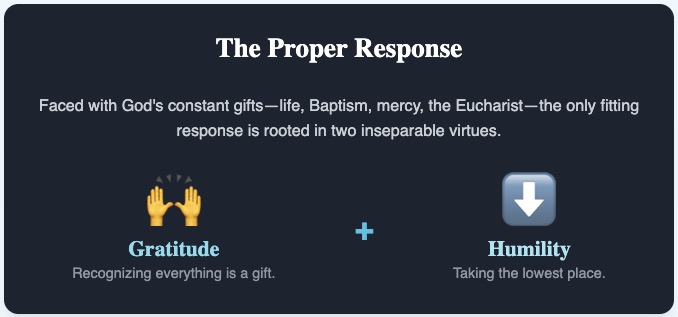
The homily teaches that the only fitting response to God’s constant gifts—Baptism, mercy, the Eucharist—is “total gratitude and humility.”
- Why is it so easy to forget that “everything we have is his gift to us”? What things in our culture make it difficult to maintain this awareness?
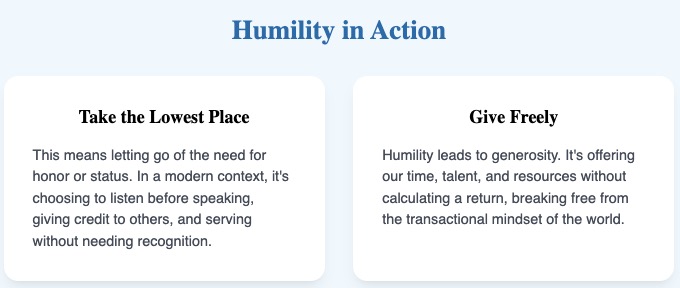
- Jesus’s advice is to “go to the lowest place.” What does taking the “lowest place” look like in a modern context, such as at work, in the family, or on social media?
- The homily connects humility to generosity, calling us to give “freely again without regard for what we might receive in return.” Why is it so difficult to be generous without expecting some form of repayment or recognition?
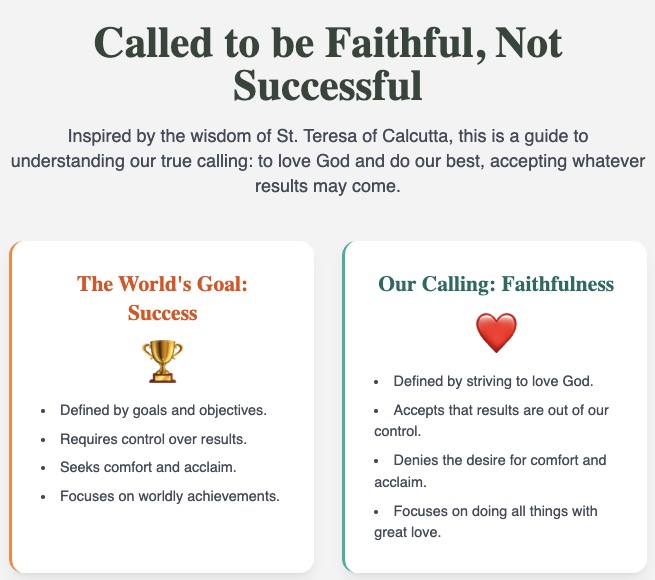
The homily uses the life of Mother Teresa as a concrete example of living out this humble, generous response.
- Mother Teresa’s motto was to do “small things with great love.” What is a “small thing” in your own life that you could try to do with “great love” this week?
- The homily mentions that Mother Teresa experienced a period of spiritual “darkness” and a feeling of separation from God, yet she persevered. How does her example challenge the idea that a holy life is always filled with good feelings and consolations?
- Reflect on Mother Teresa’s famous quote: “We are called to be faithful, not successful.” What is the difference between these two things? In what areas of your life do you tend to worry more about being successful than being faithful?
The Ultimate Goal
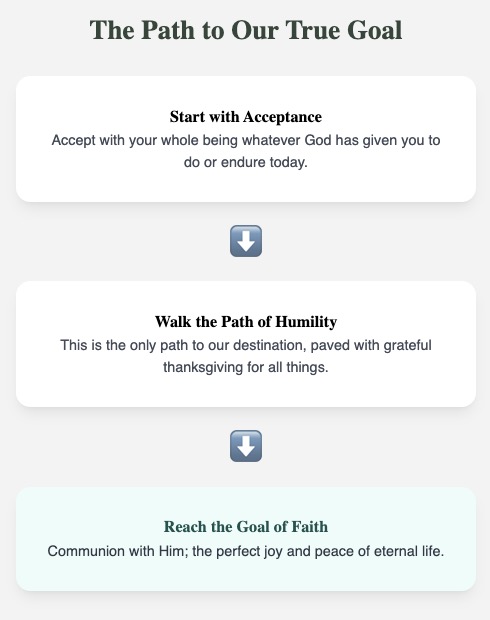
The homily concludes by reminding us that our goal is “communion with him” and that the only way to reach it is through the “path of humility.”
- How does remembering our final goal—eternal life with God—help us to endure difficulties or times of darkness, as Mother Teresa did?
- The homily encourages us to accept “whatever God has given us to do or to endure today.” How does this mindset differ from trying to control every outcome in our lives?
- What is one practical step you can take to be more “faithful” in your daily calling, letting go of the need for a specific, “successful” result?

This discussion guide has been generated by GOOGLE'S AI Gemini 2.5 Flash LLM.
Opening Prayer
Gracious God, we thank you for the gift of your Word and for the wisdom shared in this homily. As we reflect on the challenging path of faith, give us the grace to persevere. Help us to keep our eyes fixed on Jesus, our true source of peace, even amid the struggles and divisions we face. We ask this in your name. Amen.
Homily Summary
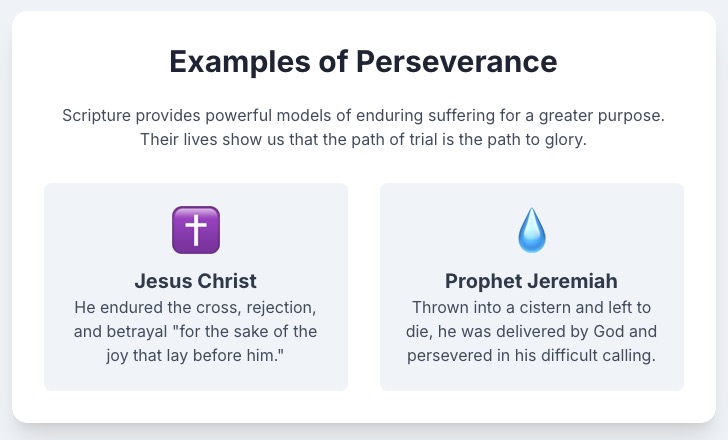
In this homily, Msgr. Hahn explores the perplexing words of Jesus, who states he has come to bring not peace, but division. He resolves this apparent contradiction by drawing a crucial distinction between the goal of our Christian journey—eternal peace with Christ—and the journey itself, which is a path of trial, struggle, and suffering. He emphasizes that the path to peace is not an easy one. By examining the life of Jesus, the prophet Jeremiah, and the words of the Letter to the Hebrews, Msgr. Hahn stresses the need for perseverance and the dangers of seeking a path of "complacency or compromise." The homily ultimately calls us to embrace the work of the cross, running the race of faith so that we may one day receive Christ's greatest gift of eternal life and peace.

Key Themes & Scripture
- Peace as the Goal, Division as the Path: The homily's central message is that while Christ is the Prince of Peace and his ultimate gift is eternal peace, the journey to that peace is full of hardship and division.
- The Grace of Perseverance: We are called to "persevere in running the race that lies before us," just as Jesus did, to reach the joy that lies ahead.
- The Work of the Cross: A call to embrace suffering and difficulty as a means of being united with Christ and his passion, rather than seeking an easy, comfortable faith.
- The Dangers of Compromise: The homily warns against the temptation to take a path of "complacency or compromise" and to fail to proclaim the truths of our faith, even to loved ones.
- Scripture: The homily draws on the Gospel reading about Christ bringing division, the Letter to the Hebrews urging us to persevere and keep our eyes on Jesus, and the story of the prophet Jeremiah as an example of faithfulness amid suffering.
Discussion Questions
- Msgr. Hahn calls Jesus's words about bringing division "some of the most perplexing in all of sacred scripture." How do you reconcile Jesus as the "Prince of Peace" with this idea of him bringing division?
- The homily distinguishes between the goal of peace and the journey of division. Can you think of a time in your life when you experienced this firsthand—when a difficult choice for your faith ultimately led to a deeper sense of peace?
- We are urged to "persevere in running the race that lies before us." What does this "race" look like in your life right now, and what are some of the struggles that make you feel weary?
- Msgr. Hahn warns against the temptation to take a path of "complacency or compromise." In what areas of your life are you most tempted to take the easy path instead of embracing the "work of the cross"?
- The homily specifically mentions the difficulty of proclaiming the truths of our faith "even to family or loved ones." What makes this so challenging, and what do you think it means to do so with both conviction and love?
- How does focusing on the ultimate "joy that lay before him," as Jesus did, change your perspective on the sufferings and struggles you face in your daily life?
Closing Prayer
Lord Jesus, you endured the cross for the joy that lay before you. We pray for your strength and your perseverance. Sustain us in the race of faith, and help us to never grow weary of doing your work. May we embrace the struggles of this life so that we may one day share in the eternal peace you have promised us. Amen.
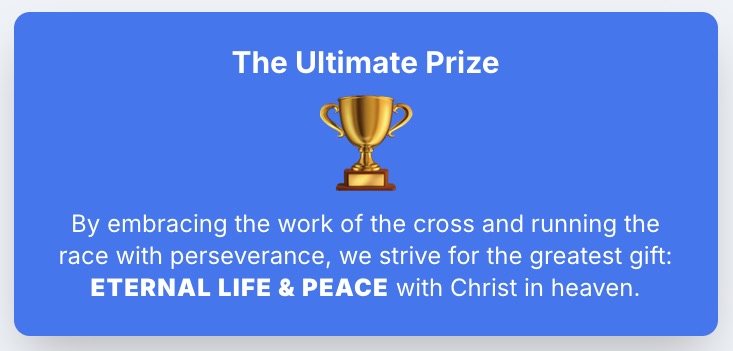
Access guide and infographics by clicking on banner

This discussion guide has been generated by GOOGLE'S AI Gemini 2.5 Flash LLM.
Theme:
Reflection Questions and Infographics were generated using Google Gemini 2.5 AI tools (w/ Chart.js and Tailwind CSS). Feel free to use them in any non-profit ministry. A Link or shoutout to THE WORD THIS WEEK would be greatly appreciated.
FR. GEOFFREY
PLANT

TIP: To make the most of this resource, start the video and allow it to play as you explore the infographics and reflection questions provided on the page. This approach will facilitate a more comprehensive understanding and engagement with Father Plant’s homily.
23rd Sunday of Year C

Take Up Your Cross
and Follow Me
HOMILY TEXT (PDF)
The homily begins by addressing Jesus’ “hard sayings” about prioritizing him above all else, even family. Jesus’ journey to Jerusalem is marked by an urgency to share these truths with the crowds.
Discussion Questions:
- The homily describes Jesus’ call to discipleship as “all-consuming.” What does that phrase mean to you in a practical, day-to-day sense? Where do you feel the tension between your commitment to Christ and other important commitments in your life (family, career, personal goals)?
- Jesus’ words about “hating” family are explained not as literal hate, but as a radical reordering of priorities and loves. Have you ever experienced a situation where your faith required you to make a choice that was misunderstood by or created distance with loved ones?
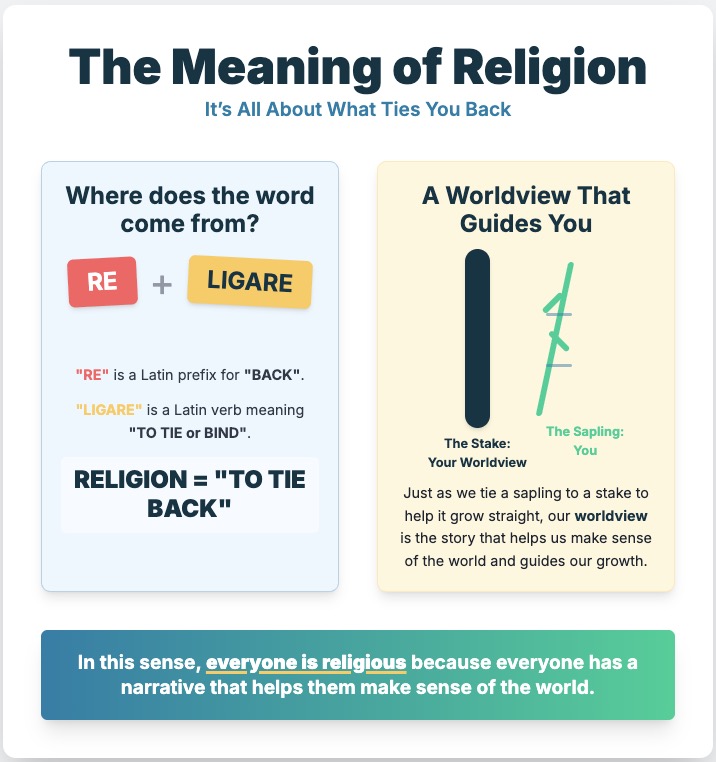
Click on infographics to enlarge them
Understanding Religion and Worship
The homily provides a deeper definition of “religion” and “worship,” moving beyond simple dictionary definitions. Religion is presented as our “ultimate concern” (Paul Tillich) and worship as the act of ascribing ultimate worth
Discussion Questions:
- The speaker suggests everyone is “religious” in the sense that everyone has a worldview or “stake” that helps them make sense of the world. What is the primary “stake” or worldview that grounds your life? How does it influence your decisions and actions?
- Idolatry is defined as ascribing “ultimate worth” to anything other than God. What are some modern “idols” that people (even Christians) are tempted to give ultimate worth to? (e.g., security, success, relationships, political ideologies). How can we keep God as our true “ultimate concern”?

Counting the Cost
Using the parables of the tower builder and the king going to war, Jesus urges his followers to be realistic about the commitment required for discipleship. This leads to the concept of “costly grace” versus “cheap grace.”
Discussion Questions:
- Dietrich Bonhoeffer’s distinction between “cheap grace” (grace without discipleship) and “costly grace” (grace that demands we follow Christ) is a central point. Can you think of examples of how “cheap grace” is promoted or lived out in our culture today? What does “costly grace” look like in your own life right now?
- The homily emphasizes taking up our own cross daily. What does your personal “cross” look like in this season of your life? What deliberate sacrifices are you being called to make to follow Jesus more closely?
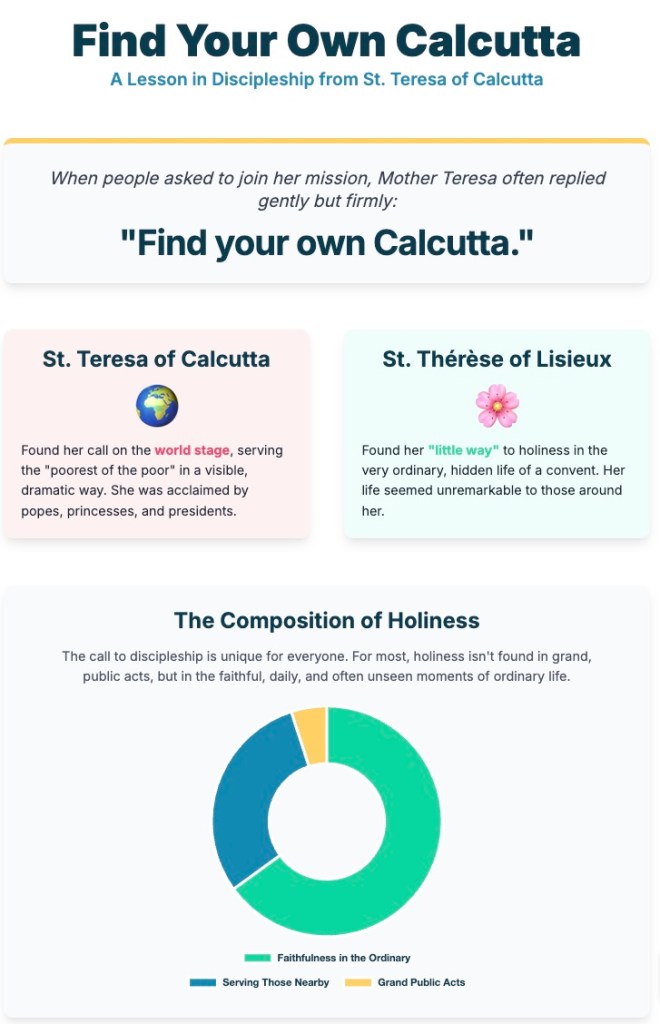
Finding Your Own Calcutta
The guide concludes with the stories of Eric Liddell and two very different saints, St. Thérèse of Lisieux and St. Teresa of Calcutta. The key lesson is to find holiness not necessarily by doing extraordinary things, but by being faithful in the ordinary circumstances of our lives.
Discussion Questions:
- Mother Teresa’s advice was to “Find your own Calcutta.” What does this mean to you? What is your “Calcutta”—the specific, personal mission field in your family, workplace, or community where you are called to serve and find God?
- The contrast between St. Thérèse’s “little way” of ordinary things and Mother Teresa’s work on the world stage is striking. Which path to holiness do you relate to more? How does this encourage you to see God’s presence and calling in your own seemingly “unremarkable” life?
Reflection Questions and Infographics were generated using Google Gemini 2.5 AI tools (w/ Chart.js and Tailwind CSS). Feel free to use them in any non-profit ministry. A Link or shoutout to THE WORD THIS WEEK would be greatly appreciated.
MR. FRANK
PAVONE
TIP: To make the most of this resource, start the video and allow it to play as you explore the infographics and reflection questions provided on the page. This approach will facilitate a more comprehensive understanding and engagement with Frank Pavone’s reflection.
23rd Sunday of Year C

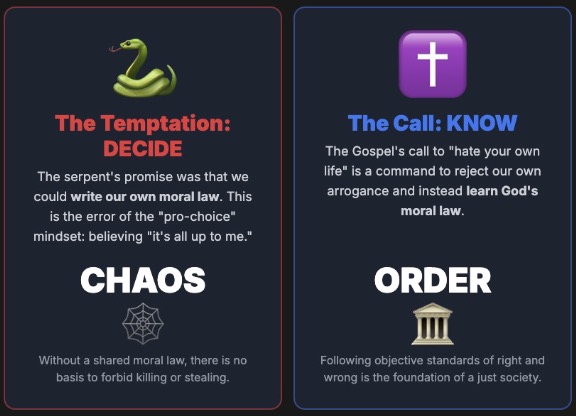
“You Will Be Like Gods”
The Original Temptation and the Foundation of Chaos
Click on infographics to enlarge them
Meaning of “Hating Life”
Frank Pavone interprets this phrase as a direct challenge to the temptation of original sin.
- According to the homily, what is the core temptation that the call to “hate… even his own life” is meant to counteract? How does this connect back to the serpent’s promise in the Garden of Eden: “You will be like gods”?
- The text makes a distinction between knowing good and evil and deciding good and evil. What is the difference? Why is the desire to decide for ourselves what is right and wrong called the “error of the ‘pro-choice’ mindset”?
- The homily argues that without “standards of right and wrong that apply to everyone,” we have no basis to tell people not to kill or steal. Do you agree? Why is a shared moral law essential for a just society?
Prudence, the Gospel, and Chastity
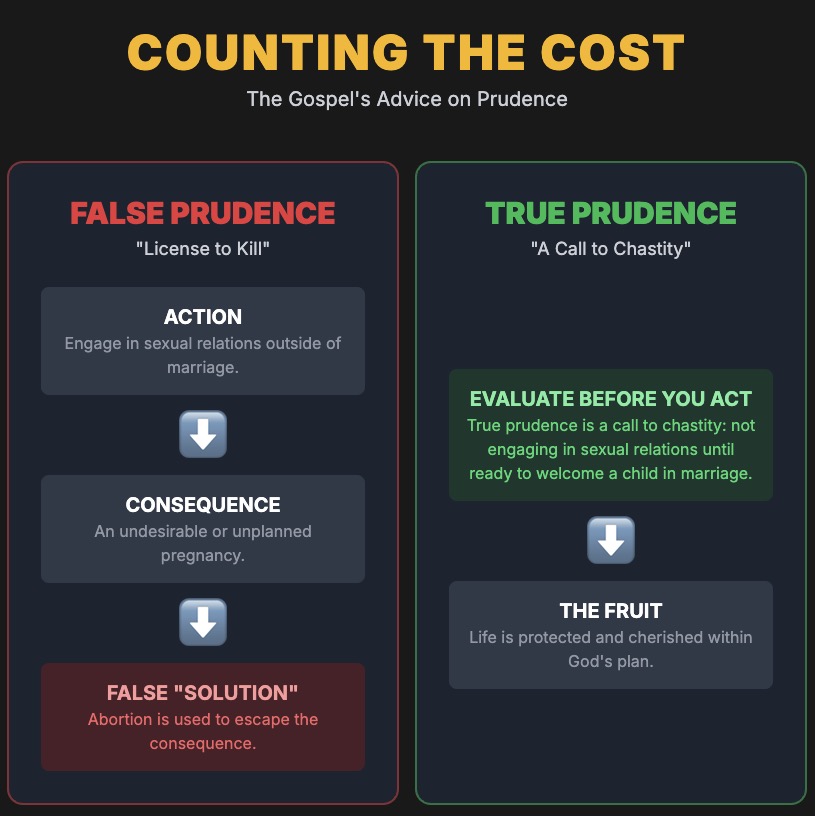
This section re-frames the Gospel’s parables of “counting the cost” in the context of sexual morality.
- How does the homily say the temptation to abort is sometimes framed using the Gospel’s own language of “counting the cost”?
- The text argues that “prudence does not give license to kill” to escape undesirable consequences. Instead, what does it say true prudence calls us to do before we act?
- In this interpretation, the Gospel’s lesson on counting the cost becomes a “call to chastity.” What does it mean to evaluate the consequences of sexual relations before engaging in them? How does this connect to being ready to “welcome a child in the context of marriage”?

Trusting God’s Plan
The conclusion connects the message to the first reading and the theme of trusting in a wisdom greater than our own.
- The first reading says, “Unsure are our plans.” How does this ancient wisdom apply to the modern situation of an unplanned pregnancy that seems to “throw life’s plans out of control”?
- The homily describes its message as a “life-saving” call to “total trust in the God who knows more than we do.” What does it mean to have “total trust” when facing a life-altering challenge?
- How does this call to renounce our “own understanding” and trust in God directly counter the original temptation to decide good and evil for ourselves?
Reflection Questions and Infographics were generated using Google Gemini 2.5 AI tools (w/ Chart.js and Tailwind CSS). Feel free to use them in any non-profit ministry. A Link or shoutout to THE WORD THIS WEEK would be greatly appreciated.