
Basilica of the National Shrine
4th Sunday of Year B

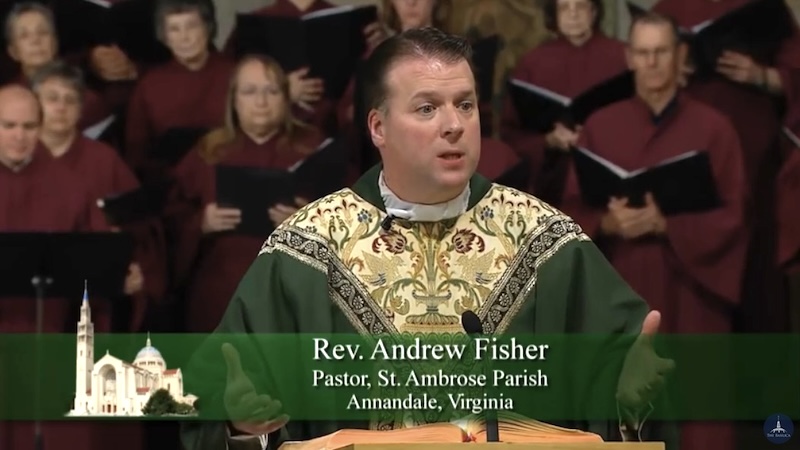
Jesus as the Fulfillment of God’s Promises
In Fr. Fisher’s homily, he reflects on the reading from the Old Testament where the people of Israel are moved to tears as Moses is on his deathbed. Moses, who had led them out of slavery in Egypt and brought them to the edge of the promised land, is about to leave them. Fr. Fisher emphasizes how Moses promises that God will send someone even greater than him.
Fr. Fisher connects this promise to the Gospel reading, where Jesus is teaching and a man possessed by sin and Satan is brought to Him. Just as Moses set the people free from Pharaoh’s slavery, Jesus sets this man free from the bondage of sin and Satan. Fr. Fisher highlights that Moses’ actions were preparation for Jesus, who has come to show us the way to heaven and to lead all His disciples to the eternal promised land.
Fr. Fisher emphasizes that all the events and people mentioned in the Old Testament ultimately point to Jesus Christ. He emphasizes the blessedness of experiencing God’s love through daily prayers, scripture reading, sacraments, and especially through the Eucharist. He encourages the listeners to live every day knowing that they are following Christ on the journey to the promised land, the eternal Kingdom of the Father.
Homiletic Pastoral Review
4th Sunday of Year B

True Authority

In a world which struggles with authority, as people of faith, we know that Christ is the true model of authority. Calling for us to have faith in him, he reveals God’s message of salvation directly and proves it by his great act of love on the cross. We share in that authority as spiritual experts when we grow in our own knowledge of God and share it with that same selfless love.
Fr. Joseph Scolaro is a priest of the Diocese of Rockville Centre, New York.
Authority in Theological Matters
In his homily, Fr. Trummer discusses the issue of authority in theological matters. He states that most disagreements in theological matters come down to the question of who or what has the final word when something about God or His will for us is unclear. He criticizes the Protestant Reformers’ notion of “sola Scriptura” (Scripture alone), arguing that when everyone believes they have equal access to God’s revelation and do not need anyone else, chaos ensues.
Fr. Christopher Trummer is a priest of the Diocese of Springfield in Illinois.
Association of Catholic Priests
4th Sunday of Year B

The Authority that Liberates
Jesus was recognized as someone who taught with authority. The word ‘authority’ has received a rather negative press in recent times. Various ‘authority figures’ have been criticized, often with good reason. Yet, in Jesus people experienced an authority that they found attractive, an authority that, in the words of the gospel, left them so astonished that they started asking each other what it all meant.
Fr. Charles E. Irvin
4th Sunday of Year B

Fr. Jim Chern
4th Sunday of Year B
No Homily Available
Dominican Blackfriars
4th Sunday of Year B

Fourth Sunday in Ordinary Time (B) | Archbishop Malcolm McMahon OP reflects on the challenge of teaching with authority in a world that is sceptical of authority.
Bishop Robert Barron
4th Sunday of Year B


Surrender to the Holy One
TRANSCRIPT: ”Friends, we continue our reading of the magnificent Gospel of Mark, and the scene for today is terrific, but the church gives us as the first reading a passage from Deuteronomy, and it’s very important that we get this right I think because we’re meant to read the gospel passage in light of this passage. Anyway, even if you’re a reader of the Book of Deuteronomy, there’s a very good chance you’re going to just plow right past this. But the passage that we’re looking at today is of signal importance.
Listen now, it’s Moses speaking to the people
before they enter the promised land.
He says, “A prophet like me, will the Lord your God
raise up for you from among your own kin;
to him, you shall listen.”
Now, why was that passage so intriguing to ancient Israel?
Well, because of who spoke it,
Moses.
There’s no figure in the Old Testament
more important than Moses.
The only possible rival might be King David,
but Moses is the one who combines in his person
the offices of priest, prophet, and king.
He’s the leader and liberator of his people
who led them from slavery to the promised land.
He’s the one to whom God gave the law.
He’s the embodiment of Israel.
He’s the greatest leader.
He’s the one indeed who went up Mount Sinai
and spoke to God face to face.
I mean, who could be greater than Moses?
If you’re looking from a human standpoint,
what figure could possibly be greater than Moses,
which begs the question,
why would this man have said,
again, listen,
“A prophet like me,
will the Lord your God raise up for you.
To him, you shall listen.”
Well, wait a minute.
I thought we should listen to you, Moses.
You gave us the law.
Now, in fact, as I’ve said to you before,
in ancient Israel, a rabbi
would claim his authority from his teacher.
I learned this from rabbi so-and-so
who learned it from rabbi so-and-so
who learned it from his teacher and from his teacher
all the way back where to Mount Sinai,
to Moses, who heard it from God.
That’s how you would’ve defined your authority
by tracing it back all the way to Moses,
who was the supreme authority.
Okay.
But there’s this little weird thread,
and it’s in the Old Testament.
It’s right here in Deuteronomy 18.
It’s this little weird thread
that this greatest supreme figure of Israelite history
says,
“Hey, there’s one coming. He’s like me,
but clearly by implication he’s greater than I am
because listen to him when he comes.”
I mean, why wouldn’t Moses have simply said,
“Well, look, I received all this from God,
so listen to me up and down the ages.”
Which indeed Israel did for centuries and centuries
still do to this day,
a faithful Jew,
but why wouldn’t he have just said,
listen to me up and down the ages.
No, mysteriously someone’s coming
who my implication is greater than I,
and he’s the one you should listen to.
Now, listen to this next passage from Deuteronomy.
“I will raise up for them a prophet like yourself
says the Lord,
entrusting my own message to his lips
so that he may instruct them at my bidding.”
Again, keep in mind Moses who saw God face to face,
who received the law,
who brought the 10 commandments down Mount Sinai,
who’s the criterion for Israelite life.
There’s someone coming after him
who’s greater, and God will entrust his own message
to that one’s lips.
If Moses is speaking what God told him,
it seems as though this one
is going to speak God’s own words.
Now, as I say, this passage fascinated ancient Israel
because they weren’t quite sure what to do with it,
what to make of it.
What could Moses possibly mean here?
It haunted the mind of Israel.
Okay.
Keep all of that in mind
as we turn to the gospel passage from Mark.
“Then they came…”
We’re in chapter one of Mark, still, by the way,
at the very beginning of the gospel.
“Then they came to Capernaum, and on the Sabbath,
Jesus entered the synagogue and taught.”
Fair enough.
That’s what any Jewish male could do,
could claim the prerogative
of reading the scripture and commenting upon it.
Nothing dramatic there,
but then listen.
“The people were astonished at his teaching
for he taught them as one having authority
and not as the scribes.”
Now, the scribes, so the teachers of Israel
working in the temple and their disciples elsewhere,
how do scribes do their work?
Well, they claim the authority of their teachers
who claim their teacher’s authority
and theirs all the way back to Moses.
They didn’t speak with their own authority.
They spoke on the authority of others going back to Moses.
Why were they astonished by Jesus teaching?
Not just because he was saying new things.
It was the manner of his teaching.
I would love the Greek word here for authority
is “exousia.”
“Ousia” means substance in Greek.
To speak “exousia” is to speak
out of your own substance.
There’s one coming after me as a prophet like me, Moses said,
I who saw God face to face.
I who gave you the law,
but there’s one coming after me
who’s going to speak with his own lips
the very word of God.
See, everybody, that’s what they saw.
That’s what this gospel is about.
Yes, the content of Jesus teaching,
and I’ve talked about it all the time,
and it’s wonderful and beautiful in every way,
but before we even get to the content of it,
attend to the authority with which it was conveyed.
That’s what astonished them.
Now, as this scene goes on,
what we see is the power
of this authoritative word.
Listen,
“In their synagogue was a man with an unclean spirit.
He cried out,
‘What do you have to do with us Jesus of Nazareth?
Have you come to destroy us?
I know who you are, the holy one of God.'”
There’s a lot packed in there.
Where’s the first demon that Jesus confronts in the first gospel?
In church.
So church people listening to me right now,
lest we think,
“oh, we’re kind of above the fray”.
Devils love to hang out in churches.
They always have.
They always have.
They love dividing, causing trouble
and dissension within the church.
Don’t be surprised
that some of the greatest work being done by the dark powers
take place within churches.
Again, that’s maybe sermon for another day,
but in their synagogue was the man with unclean spirit.
“What do you have to do with us?”
That’s beautiful too, isn’t it?
Single person, but he speaks in the plural.
“What do you have to do with us?”
It’s a splintered self.
It’s the self divided.
See, if you’re not centered on God,
then your whole being splinters apart.
Now fellow sinners, you know exactly what I’m talking about
because all of us sinners, we feel this.
The disintegration of the self.
That’s this man.
“What do you want of us Jesus of Nazareth.
Have you come to destroy us?”
I love, see, by implication.
Yes, yes, I have.
That’s why I’ve come.
That’s why I’ve come.
I’m not messing around with just nice new
moral or spiritual teachings.
No, no, I’ve come to destroy you.
The holy one of God has come to destroy the powers
that stand to thwart God’s purpose,
but this is now the line that I think
we’re meant to reflect on
because it’s right in line with everything else here.
“I know who you are,”
says the dark spirit.
“The holy one of God.”
See, at this stage of the game,
no one really knows who he is.
He’s this Jewish fellow from Nazareth,
and he’s preaching and he’s starting to heal people.
Well, he must be some prophetic figure.
He’s a bearer of God’s presence.
They’re trying to figure him out.
The devil knows.
The devil knows exactly who he is,
and what the devil knows is
he’s the one predicted
by Moses himself in Deuteronomy 18.
There’s one coming who’s not just another Moses,
not just another Jeremiah, not just another Ezekiel,
not just another Isaiah.
There’s one coming who is, listen to him,
the holy one of God.
By the way, it’s interesting
that the devil knows who he is.
Very often.
It’s the resistance in us
that has the clearest sense of who Christ is.
You know what I’m driving at.
Is find that point in you that’s resisting.
That’s the point in you that really understands
what Christ is asking of you.
You know what I’m saying?
If Jesus ask us for something kind of easy,
all right, but when he’s asking something difficult,
it’s our resistance
that’s going to identify him properly.
So that’s interesting.
“Jesus rebuked him and said,
‘Quiet, come out of him.’ The unclean spirit
convulsed him with a loud cry, came out of him
and all were amazed and said, ‘what is this?
A new teaching with authority.
He commands even the unclean spirits and they obey him.'”
That’s the power now of Christ.
God’s word made the universe.
God speaks and things come to be.
Lazarus come out and he comes out,
the dead man.
Little girl get up and the dead girl gets up.
My son, your sins are forgiven and they are forgiven.
What Jesus says is.
Now, that’s not true of mere prophets.
That’s not true of mere bearers of religious truth.
I mean, heck, I could say things all day
that might be religiously true,
but I can’t make things happen by my speech.
Jesus does.
“Be quiet, come out of him,
and with that, he comes out of him.”
Look, everybody, if we surrender to him,
the one whom Moses predicted in Deuteronomy,
if we surrender to him, the holy one of God,
if we make him the center of our lives,
if we listen to him,
we’re going to find a similar power.
We’re going to find a similar authority.
We can find our lives transformed.
The ultimate point of this little passage,
it’s not, oh, isn’t that fascinating
what happened long ago? No.
The point is, now we got to make a decision.
Are we with him or not?
Are we following him or not?
He’s the one.
He’s the one who is the very word of God.
He’s the holy one of God.
We have to follow him.
and God bless you.
TRANSCRIPT:
“Friends, we continue our reading of the magnificent Gospel of Mark,
and the scene for today is terrific,
but the church gives us as the first reading
a passage from Deuteronomy,
and it’s very important that we get this right I think because
we’re meant to read the gospel passage
in light of this passage.
Anyway, even if you’re a reader of the Book of Deuteronomy,
there’s a very good chance you’re going to just plow right past this.
But the passage that we’re looking at today is of
signal importance.
Listen now, it’s Moses speaking to the people
before they enter the promised land.
He says,
“A prophet like me, will the Lord your God
raise up for you from among your own kin;
to him, you shall listen.”
Now, why was that passage so intriguing to ancient Israel?
Well, because of who spoke it,
Moses.
There’s no figure in the Old Testament
more important than Moses.
The only possible rival might be King David,
but Moses is the one who combines in his person
the offices of priest, prophet, and king.
He’s the leader and liberator of his people
who led them from slavery to the promised land.
He’s the one to whom God gave the law.
He’s the embodiment of Israel.
He’s the greatest leader.
He’s the one indeed who went up Mount Sinai
and spoke to God face to face.
I mean, who could be greater than Moses?
If you’re looking from a human standpoint,
what figure could possibly be greater than Moses,
which begs the question,
why would this man have said,
again, listen,
“A prophet like me,
will the Lord your God raise up for you.
To him, you shall listen.”
Well, wait a minute.
I thought we should listen to you, Moses.
You gave us the law.
Now, in fact, as I’ve said to you before,
in ancient Israel, a rabbi
would claim his authority from his teacher.
I learned this from rabbi so-and-so
who learned it from rabbi so-and-so
who learned it from his teacher and from his teacher
all the way back where to Mount Sinai,
to Moses, who heard it from God.
That’s how you would’ve defined your authority
by tracing it back all the way to Moses,
who was the supreme authority.
Okay.
But there’s this little weird thread,
and it’s in the Old Testament.
It’s right here in Deuteronomy 18.
It’s this little weird thread
that this greatest supreme figure of Israelite history
says, “Hey, there’s one coming. He’s like me,
but clearly by implication he’s greater than I am
because listen to him when he comes.”
I mean, why wouldn’t Moses have simply said,
“Well, look, I received all this from God,
so listen to me up and down the ages.”
Which indeed Israel did for centuries and centuries
still do to this day,
a faithful Jew,
but why wouldn’t he have just said,
listen to me up and down the ages.
No, mysteriously someone’s coming
who my implication is greater than I,
and he’s the one you should listen to.
Now, listen to this next passage from Deuteronomy.
“I will raise up for them a prophet like yourself
says the Lord,
entrusting my own message to his lips
so that he may instruct them at my bidding.”
Again, keep in mind Moses who saw God face to face,
who received the law,
who brought the 10 commandments down Mount Sinai,
who’s the criterion for Israelite life.
There’s someone coming after him
who’s greater, and God will entrust his own message
to that one’s lips.
If Moses is speaking what God told him,
it seems as though this one
is going to speak God’s own words.
Now, as I say, this passage fascinated ancient Israel
because they weren’t quite sure what to do with it,
what to make of it.
What could Moses possibly mean here?
It haunted the mind of Israel.
Okay.
Keep all of that in mind
as we turn to the gospel passage from Mark.
“Then they came…”
We’re in chapter one of Mark, still, by the way,
at the very beginning of the gospel.
“Then they came to Capernaum, and on the Sabbath,
Jesus entered the synagogue and taught.”
Fair enough.
That’s what any Jewish male could do,
could claim the prerogative
of reading the scripture and commenting upon it.
Nothing dramatic there,
but then listen.
“The people were astonished at his teaching
for he taught them as one having authority
and not as the scribes.”
Now, the scribes, so the teachers of Israel
working in the temple and their disciples elsewhere,
how do scribes do their work?
Well, they claim the authority of their teachers
who claim their teacher’s authority
and theirs all the way back to Moses.
They didn’t speak with their own authority.
They spoke on the authority of others going back to Moses.
Why were they astonished by Jesus teaching?
Not just because he was saying new things.
It was the manner of his teaching.
I would love the Greek word here for authority
is “exousia.”
“Ousia” means substance in Greek.
To speak “exousia” is to speak
out of your own substance.
There’s one coming after me as a prophet like me, Moses said,
I who saw God face to face.
I who gave you the law,
but there’s one coming after me
who’s going to speak with his own lips
the very word of God.
See, everybody, that’s what they saw.
That’s what this gospel is about.
Yes, the content of Jesus teaching,
and I’ve talked about it all the time,
and it’s wonderful and beautiful in every way,
but before we even get to the content of it,
attend to the authority with which it was conveyed.
That’s what astonished them.
Now, as this scene goes on,
what we see is the power
of this authoritative word.
Listen,
“In their synagogue was a man with an unclean spirit.
He cried out,
‘What do you have to do with us Jesus of Nazareth?
Have you come to destroy us?
I know who you are, the holy one of God.'”
There’s a lot packed in there.
Where’s the first demon that Jesus confronts in the first gospel?
In church.
So church people listening to me right now,
lest we think,
“oh, we’re kind of above the fray”.
Devils love to hang out in churches.
They always have.
They always have.
They love dividing, causing trouble
and dissension within the church.
Don’t be surprised
that some of the greatest work being done by the dark powers
take place within churches.
Again, that’s maybe sermon for another day,
but in their synagogue was the man with unclean spirit.
“What do you have to do with us?”
That’s beautiful too, isn’t it?
Single person, but he speaks in the plural.
“What do you have to do with us?”
It’s a splintered self.
It’s the self divided.
See, if you’re not centered on God,
then your whole being splinters apart.
Now fellow sinners, you know exactly what I’m talking about
because all of us sinners, we feel this.
The disintegration of the self.
That’s this man.
“What do you want of us Jesus of Nazareth.
Have you come to destroy us?”
I love, see, by implication.
Yes, yes, I have.
That’s why I’ve come.
That’s why I’ve come.
I’m not messing around with just nice new
moral or spiritual teachings.
No, no, I’ve come to destroy you.
The holy one of God has come to destroy the powers
that stand to thwart God’s purpose,
but this is now the line that I think
we’re meant to reflect on
because it’s right in line with everything else here.
“I know who you are,”
says the dark spirit.
“The holy one of God.”
See, at this stage of the game,
no one really knows who he is.
He’s this Jewish fellow from Nazareth,
and he’s preaching and he’s starting to heal people.
Well, he must be some prophetic figure.
He’s a bearer of God’s presence.
They’re trying to figure him out.
The devil knows.
The devil knows exactly who he is,
and what the devil knows is
he’s the one predicted
by Moses himself in Deuteronomy 18.
There’s one coming who’s not just another Moses,
not just another Jeremiah, not just another Ezekiel,
not just another Isaiah.
There’s one coming who is, listen to him,
the holy one of God.
By the way, it’s interesting
that the devil knows who he is.
Very often.
It’s the resistance in us
that has the clearest sense of who Christ is.
You know what I’m driving at.
Is find that point in you that’s resisting.
That’s the point in you that really understands
what Christ is asking of you.
You know what I’m saying?
If Jesus ask us for something kind of easy,
all right, but when he’s asking something difficult,
it’s our resistance
that’s going to identify him properly.
So that’s interesting.
“Jesus rebuked him and said,
‘Quiet, come out of him.’ The unclean spirit
convulsed him with a loud cry, came out of him
and all were amazed and said, ‘what is this?
A new teaching with authority.
He commands even the unclean spirits and they obey him.'”
That’s the power now of Christ.
God’s word made the universe.
God speaks and things come to be.
Lazarus come out and he comes out,
the dead man.
Little girl get up and the dead girl gets up.
My son, your sins are forgiven and they are forgiven.
What Jesus says is.
Now, that’s not true of mere prophets.
That’s not true of mere bearers of religious truth.
I mean, heck, I could say things all day
that might be religiously true,
but I can’t make things happen by my speech.
Jesus does.
“Be quiet, come out of him,
and with that, he comes out of him.”
Look, everybody, if we surrender to him,
the one whom Moses predicted in Deuteronomy,
if we surrender to him, the holy one of God,
if we make him the center of our lives,
if we listen to him,
we’re going to find a similar power.
We’re going to find a similar authority.
We can find our lives transformed.
The ultimate point of this little passage,
it’s not, oh, isn’t that fascinating
what happened long ago? No.
The point is, now we got to make a decision.
Are we with him or not?
Are we following him or not?
He’s the one.
He’s the one who is the very word of God.
He’s the holy one of God.
We have to follow him.
and God bless you.
Fr. Austin Fleming
4th Sunday of Year B


By whose Authority?
We live in a culture often suspicious of any authority outside, beyond the personal authority of the self. Over the past 50 years, we’ve moved from upholding and respecting religious, political and institutional authority as beyond questioning to a reverence of the self as the primary arbiter of truth and morality. Certainly religion, the political establishment and our institutions have given us more than enough reason to question their authority. But what if any system of checks and balances do you and I employ or submit to in order to monitor our own personal authority? Does anything or anyone serve to warn us when our personal authority begins to serve not God or a higher good but instead our own self-interest and weaknesses?
Fr. Joe Jagodensky, SDS
4th Sunday of Year B

Ssstuttering Moses
You heard Moses tell us today, [He] “spoke to all the people, saying: ‘A prophet like me will the Lord, your God, raise up for you from among your own kin; to him, you shall listen.’” Listening to Moses, however, may take a while. Why? Because Moses had a ssstuttering problem. Simple words passing his lips in machine gun time. Pour guy. Charlton Heston stuttering? How long would that Cecile B. DeMille movie have been? So, Moses got his brother Aaron to speak for him to make the film a little bit shorter.
Fr. George Smiga
4th Sunday of Year B

Demons in Holy Places
The Gospel situates the unclean spirit in the synagogue to teach us something about evil. Sometimes we think that evil can be limited to only certain places, that unclean spirits can be restricted to the graveyard, the deep woods, or where thieves gather. Sometimes we imagine that if we are very good people, if we love and act with justice, if we have faith in God, then we can keep evil away from where we are. This Gospel warns us that such thinking is naïve. If an unclean spirit can shout out in a holy synagogue and in the presence of Jesus the Messiah, then evil can appear anywhere. Evil in the form of sickness, anxiety, even in natural disasters seems to have the ability to move freely throughout the world. It attacks people indiscriminately: the rich and the poor, the moral and the immoral, those who believe in God and those who do not. Evil seems to have access to every place and person.
Fr. Anthony Ekpunobi, C.M.
4th Sunday of Year B

Msgr. Joseph Pellegrino
4th Sunday of Year B

Teaching with Authority

Many times our papers report religious scandals. Charismatic TV preachers, Roman Catholic bishops and priests, caught acting in the immoral ways. The message that they had been delivering from their pulpits for years was true. Many people were moved to come closer to God. Many people confronted their own demons and took steps to draw closer to Christ. But then the scandal hit the papers. The message of the preacher that had moved them was still true, but now it has lost much of its impact. The one who delivered it was not true to his own words. As a result his credibility, his authority was terribly damaged if not totally destroyed.

Fr. Michael Chua
4th Sunday of Year B

Fr. Tom Lynch
4th Sunday of Year B

Clergy E-Notes
“…if the family is the sanctuary of life, the place where life is conceived and cared for, it is a horrendous contradiction when it becomes a place where life is rejected and destroyed. So great is the value of a human life, and so inalienable the right to life of an innocent child growing in the mother’s womb, that no alleged right to one’s own body can justify a decision to terminate that life, which is an end in itself and which can never be considered the “property” of another human being.”
— Pope Francis
Bishop Anthony B. Taylor
4th Sunday of Year B
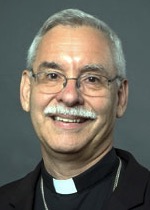
The Authority of Jesus
Today’s Gospel speaks of the authority of Jesus. “The people were spellbound by his teaching because he taught with authority and not like the scribes.” Obviously Jesus did not carry a gun, wield a club or command an army.
So what was the nature of his authority? Where did it come from, what was behind it and what can we learn from it for our own lives?
1.) The first thing about the authority of Jesus is that it was rooted in TRUTH. He quietly and simply told people the eternal truth about life. There was nothing frantic about it. He did not argue or seek to prove his point. He simply stated his case and let it stand.
4th Sunday of Year B


The Authority in the name of Jesus
Jesus spoke with authority. He was not like the scribes and Pharisees. A statement carries authority according to two aspects: who is speaking and what is being said. Jesus had both. Jesus spoke with authority. What He said was true. He also had authority because of Who He was. He was the Son of God, the Messiah of God, and the Eternal One who became man on Christmas.
4th Sunday of Year B
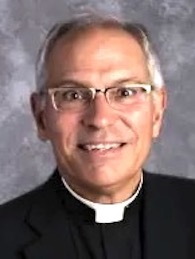

Freedom from Anxiety
In his 2015 homily, Fr. Hahn focuses on the second reading from St. Paul’s first letter to the Corinthians and explores the idea of living in this world but not being of this world. He discusses how married individuals, as well as priests and other vocations, can easily become distracted and anxious about many things. Fr. Hahn emphasizes that the answer to finding freedom and peace from these anxieties is simple – it is found in Christ. Jesus, the perfect prophet, came to guide and teach us, and he established the Church to continue his prophetic mission. Fr. Hahn explains that as priests, it is an honor and privilege to share the saving truth of Christ with the congregation each week. He also addresses the temptation to ignore the teachings of the Church and to search for answers elsewhere. Fr. Hahn asserts that true healing and peace can only be found in Christ and his teachings, and he encourages parishioners to focus on his love and strive to experience it more fully each day. He concludes by emphasizing the importance of adhering to the word of Christ and following his teachings in order to be free from anxieties and filled with grace and peace.
Fr. Phil Bloom
4th Sunday of Year B

Liberation from Addiction
Bottom line: Jesus freed Dostoevsky from the unclean spirit of gambling. He can also free us from addiction.
In today’s Gospel we hear about a man tormented by an unclean spirit which causes uncontrollable outbursts. At first glance, it seems like we are entering strange world, far removed from our own. Nevertheless, when we think about it, it may not be as distant as it first appears. We often read in the newspaper about fellow humans who act under some inexplicable compulsion, who do things almost unimaginable. Moreover, we know people who appear quite ordinary, yet who are gripped by self-destructive addictions. Indeed, most of us have that kind of experience, at least during some stage of our lives. We may not identify it as an “unclean spirit,” but we find ourselves in the thrall of some power which seems beyond our control. And it is not uncommon for people with great mental abilities to fall victim to some irrational compulsion.
Fr. Vincent Hawkswell
4th Sunday of Year B
Fr. Tommy Lane
4th Sunday of Year B

There is Still a Bit of the Devil in Us! Jesus Must Increase
Once when I was on retreat in a monastery in Ireland, I greeted one of the monks, “How are you, Father?” He replied, “There is still a bit of the devil in me!” It sounds funny but it expresses a truth about all of us, “there is still a bit of the devil in us” because we have not yet overcome our attachment to sin. “There is still a bit of the devil in me!” would certainly be true of the man with the unclean spirit in the Gospel today (Mark 1:21-28). Perhaps no one would have suspected much was amiss with the man. He was in the synagogue on the Sabbath, so he was obeying the Torah. Perhaps to outward appearances at least everything was in order. But inside he needed healing. Likewise, none of us is yet the holy person we are called to be.
Fr. John Kavanaugh, S.J.
4th Sunday of Year B

A Thimbleful of Love
Certainly an unmarried person devoted to God will have more time for service of others, especially on an emergency basis, and also have more time for quiet and isolated prayer. All mothers and fathers I have ever known, immersed in the demands of labor and family, have in some way sighed for the time to do such things.
But the crucially operative word is “devoted to God.” If that is not there, all the “worryless” free time in the world will not yield a thimbleful of love. And as Paul has written elsewhere, with “devotedness to God” even the most ordinary experiences of parenting, family, and spousal love can be astounding revelations of God’s grace and intimacy in our lives.
Bishop Frank Schuster
4th Sunday of Year B
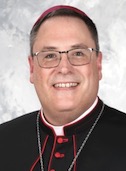
Surrender to God
St. Paul tells us in our second reading, “Brothers and sisters, I should like you to be free of anxieties.” That really made me laugh. I think the one thing that perhaps unites the entire country and world right now is, in fact, anxiety. These times are hard which make other opportunities for anxiety even harder, stuff like family struggles, perhaps other health issues that we or a loved one may be dealing with, our employment situation, stock market concerns, or the grief of losing a loved one, the list goes on and on. St. Paul is telling us this Sunday. “I should like you to be free of anxiety”. I think a knee-jerk response could be,“Well, easy enough for him to say! What did St. Paul ever have to deal with?”That is when we realize that we would do very well to listen to him…. because he was no stranger to tough times.
Fr. Michael Cummins
4th Sunday of Year B
The Authority of Christ
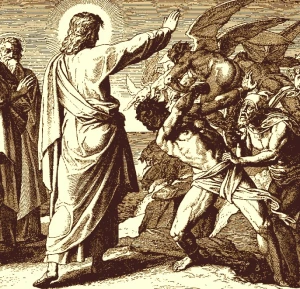
In today’s gospel (Mk. 1:21-28) there are two groups that encounter and witness this unique authority of Christ. The first are the people gathered in the synagogue, “The people were astonished at his teaching, for he taught them as one having authority and not as the scribes.” The second “group” is the unclean spirit, “What have you to do us, Jesus of Nazareth? Have you come to destroy us? I know who you are – the Holy One of God!” These immediate reactions – the astonishment of the people, the fear of the unclean spirit – testify to the unique authority of Christ.
It is helpful to remember that the word “authority” has its roots in a Latin word meaning, “to make grow.” From this we can realize that one of the marks of true authority is that it is not in competition with others. True authority does not need to suppress the other for its own sake and purposes. This type of non-competitive authority can only come from Christ who is not just one other being among other beings but rather being itself. “I am…”, says Jesus.
