August 24, 2025
August 24, 2025


Doctrinal Messages, Pastoral Suggestions & Papal Homilies
Homily Notes



The texts of today’s liturgy move between two extremes: on the one hand, the universal call to salvation, on the other, the great commitment on the basis of freedom. The Book of Isaiah (first reading) ends by making reference to the saving will of Yahweh for all peoples and languages. The Gospel, in turn, indicates to us that the door to enter the Kingdom is narrow and that only those who try hardest will succeed. The Lord accompanies us in this effort of freedom; he accompanies us with his paternal teachings, which are not devoid of corrections, though this is not the only form of divine teaching.
© 2000 Dicastery for the Clergy A | B | C
VIEW 2025 NOTES – Father Gaetano Piccolo (SI)
Featured Video
11 August 2025 | Catholic News Service

CATHOLIC NEWS SERVICE (1:22) – The first 100 days is a milestone borrowed from politics as a way to glimpse the tone and priorities of a new leader. Pope Leo XIV, elected May 8, will reach that point on August 16.
No “Limited Number”
25 August 2019 – Saint Peter’s Square
This discussion guide has been generated by GOOGLE'S AI Gemini 2.5 Flash LLM.
Key Themes for Reflection
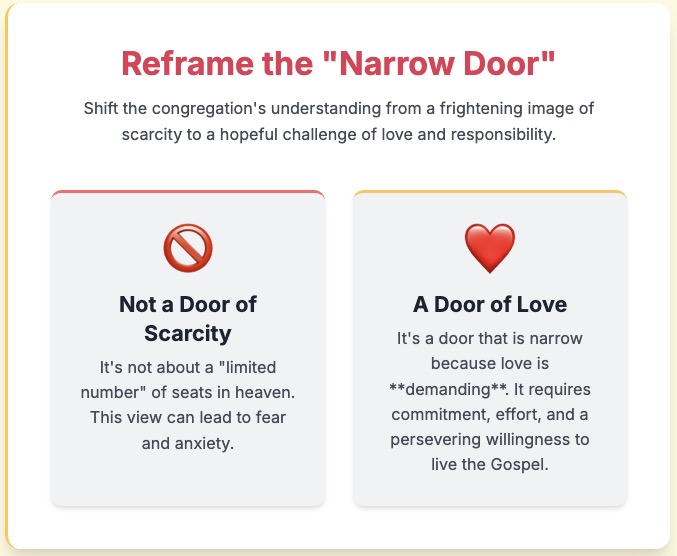
- The Question of Quantity vs. Quality: Pope Francis emphasizes that Jesus's response to "will only a few people be saved?" shifts the focus from numbers to personal responsibility. The homily can explain that the question is not about a limited number of seats in heaven, but about the right way to live here and now.
- The Narrow Door is Love: The homily clarifies that the "narrow doorway" is demanding because it is the way of love. It requires commitment and "effort," a determined and persevering willingness to live according to the Gospel by loving God and neighbor.
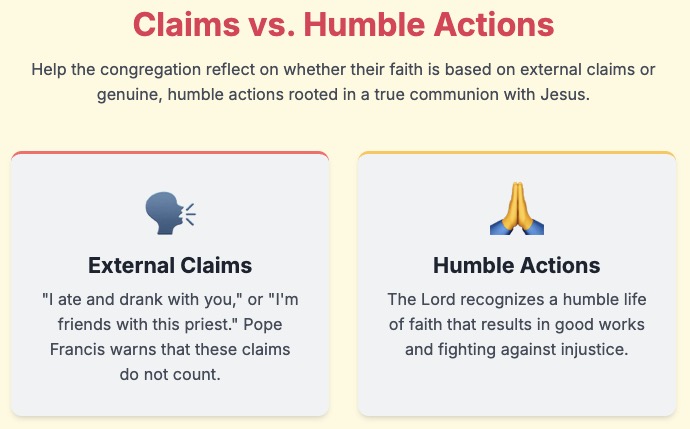
- Communion vs. Claims: Pope Francis warns against a faith based on external claims, such as saying "I ate and drank with you" or being friends with Church leaders. The homily can emphasize that what truly matters is a humble life of faith and good works, rooted in a true, interior communion with Jesus.
Homily Preparation Questions
- How can I reframe the congregation’s understanding of the "narrow door" from a frightening image of scarcity to a hopeful challenge of love and responsibility?
- Pope Francis says that "claims do not count." How can I help my congregation reflect on their own lives to identify areas where they may be relying on external claims rather than humble actions?
- What is a modern example of "loving God and neighbor" that is "uncomfortable" and requires daily effort?
- How can I connect the practices of prayer, receiving the sacraments, and reading Scripture to the "good fight of the faith" and not just a routine?

Homily Excerpt
“Strive to enter by the narrow door; for many, I tell you, will seek to enter and will not be able” (v. 24).
With these words, Jesus makes it clear that it is not a matter of numbers, there is no “limited number” in Paradise! Rather, it is a case of taking the right way from now, and this right way is for everyone, but it is narrow. This is the problem. Jesus does not want to give us false hopes by saying: “Yes, do not worry, it is easy, there is a beautiful highway with a large gate at the end ….”. He does not say this. He tells us things as they truly are: the doorway is narrow. In what sense? In the sense that, in order to save oneself, one has to love God and neighbour, and this is uncomfortable! It is a “narrow doorway” because it is demanding. Love is always demanding. It requires commitment, indeed, “effort”, that is, a determined and persevering willingness to live according to the Gospel. Saint Paul calls it “the good fight of the faith” (1 Tim 6:12). It takes a daily, all-day effort to love God and neighbour.
The Narrow Door
26 August 2007 | Castel Gandolfo

This discussion guide has been generated by GOOGLE'S AI Gemini 2.5 Flash LLM.

Key Themes for Reflection
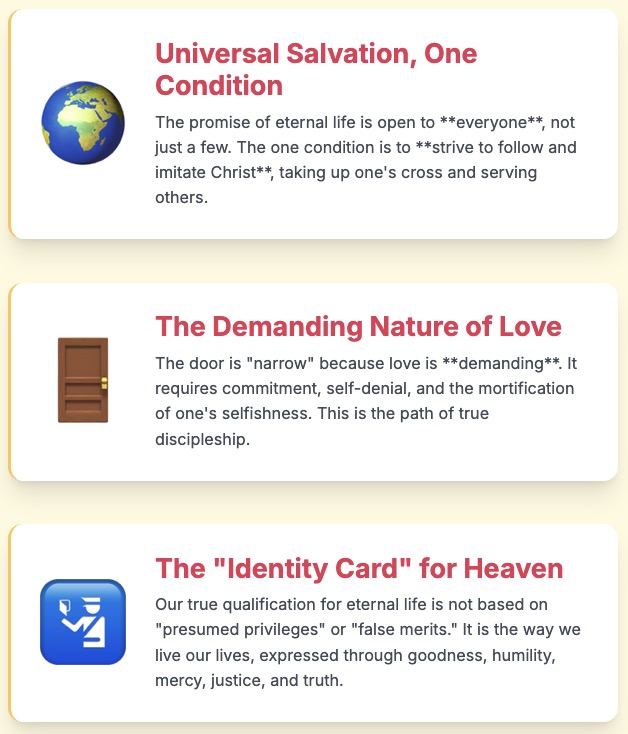
- Universal Salvation, One Condition: Pope Benedict XVI clarifies that salvation is universal and open to everyone, not just a few. However, it comes with a single condition: striving to follow and imitate Christ, taking up one's cross, and devoting one's life to serving others.
- The Demanding Nature of the Narrow Door: The "narrow door" is demanding because it requires commitment, self-denial, and the mortification of one's selfishness. It is a constant choice to live a life of love, which is never easy.
- The "Identity Card" for Heaven: The Pope warns against a faith based on external claims, such as saying, "We ate and drank in your presence." He says that our true "identity card" for heaven is a humble life of good actions, expressed through goodness of heart, humility, mercy, and a commitment to justice and truth.
Homily Preparation Questions
- How can I reframe the congregation's understanding of the "narrow door" from a frightening image of scarcity to a hopeful challenge of love and responsibility?
- What is a modern example of a "demanding" act of love for God and neighbor that requires commitment and self-denial?
- How can I help my congregation reflect on their own "identity card" for heaven, prompting them to move beyond external claims to a focus on humble actions and a good life?
- How can I connect the sacrifice of the Cross to the daily "self-denial and the mortification of one's selfishness" that is required to enter the narrow door?
The goal is to deliver a message that is both realistic about the struggles of the Christian life and deeply encouraging about the power of grace and the promise of eternal life.
Homily Excerpt
On his last journey to Jerusalem someone asked him: “Lord, will those who are saved be few?” And Jesus answered: “Strive to enter by the narrow door; for many, I tell you, will seek to enter and will not be able” (Lk 13: 23-24). What does this “narrow door” mean? Why do many not succeed in entering through it? Is it a way reserved for only a few of the chosen?
Indeed, at close examination this way of reasoning by those who were conversing with Jesus is always timely: the temptation to interpret religious practice as a source of privileges or security is always lying in wait. Actually, Christ’s message goes in exactly the opposite direction: everyone may enter life, but the door is “narrow” for all. We are not privileged. The passage to eternal life is open to all, but it is “narrow” because it is demanding: it requires commitment, self-denial and the mortification of one’s selfishness.
Sunday’s
Core Themes
Universal Call to Salvation
God desires all people to be saved, a core truth of divine revelation. As the universal Father, He extends this call without exception, regardless of background, status, or appearance. The prophet Isaiah’s vision of all nations coming to Jerusalem highlights this all-encompassing invitation. While Christian faith is presented as the surest way, the homily also acknowledges that God offers many paths to salvation, including non-Christian religions, ethics, and conscience. Each individual’s journey is unique, but the call remains the same for everyone.
Freedom of Commitment
While God’s call to salvation is universal, a person’s free commitment is essential. The path to salvation is a narrow door that requires us to shed the burdens of things that hold us back. It is not enough to simply have a religious experience; salvation depends on our actions—the works of salvation—that demonstrate our faith. Those who are saved will be the “valiant and generous people” from all corners of the earth who make the effort to succeed, showing that salvation is an intentional act of free will.
Admiring the Teaching of God
God’s teaching for our salvation is like a father’s love for his children. This includes correction and, at times, punishment, which are intended for our own good, not to cause harm. Just as a loving father guides, corrects, and watches over his children, God, through His providence, watches over us and sometimes uses correction to guide us through the narrow door of salvation. Instead of feeling like victims, we should appreciate God’s teaching and trust that all of His actions come from a place of fatherly love.
Salvation: God’s initiative and Our Task
Salvation is a beautiful partnership between God’s saving initiative and our personal task. God offers salvation, but we must freely choose to accept it. His initiative provides the security and certainty of salvation, while our task requires us to use our freedom to unite with His will. To give up our role is to abandon our eternal destiny. This profound dynamic between divine love and human free will should move us from complaints to action and hope. Applying this to our daily lives transforms our every deed and brings us closer to God.
- The Universal Call to Salvation
- The Freedom of Commitment
- Admiring the Teaching of God
- Salvation: God’s initiative and Our Task
Doctrinal Messages
The Universal Call to Salvation

The universal destiny of salvation was not discovered by the Second Vatican Council, but is contained within the very essence of the Word and Revelation of God: “God wants all to be saved.”
In the text of the first reading, in a wonderful vision, Isaiah sees the men of all nations coming to Jerusalem, the city of salvation, almost in the form of a liturgical procession, using the most varied means and bringing offerings to God. God has called and continues to call all, with no exceptions, because God is the Lord and Father of all.
Can God call some of his children to salvation and not others? It would be absurd and not worthy of his divine fatherhood! Where there is a difference is in the means that God offers his children for their salvation.
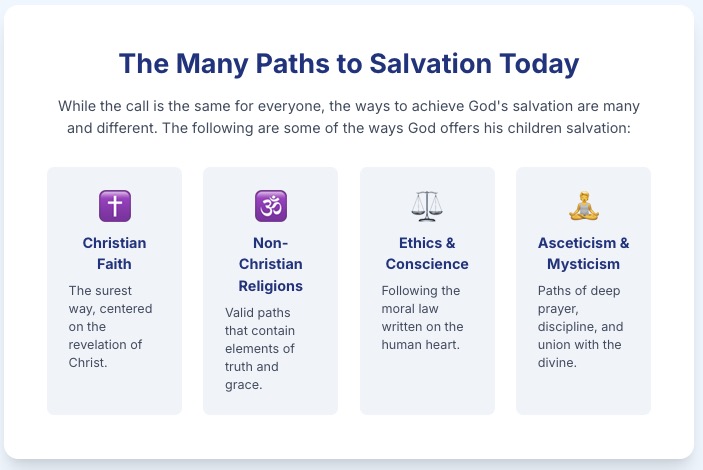
The text in Isaiah mentions that they will come to Jerusalem on horses, in chariots, in litters, on mules and on camels. In other words, the ways to achieve God’s salvation, symbolized in Jerusalem, are many and different.
Today, the surest way is the Christian faith, although there is also the way of non-Christian religions. There is the way of ethics and conscience. There is the way of asceticism and mystical theology, etc.
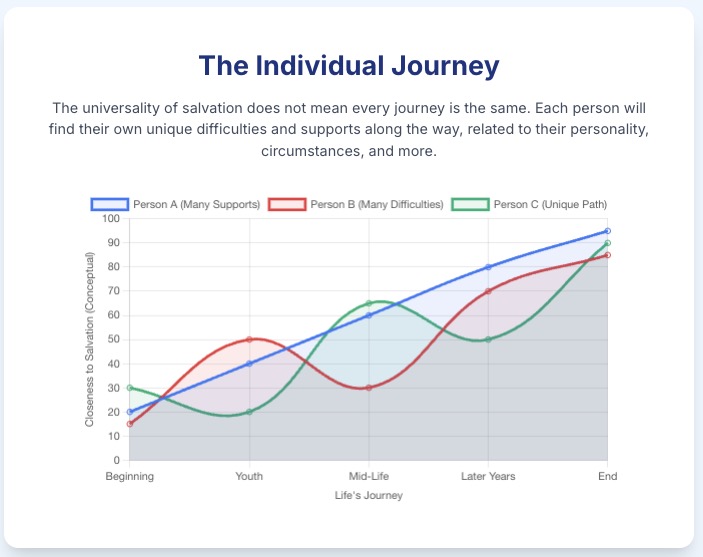
On the other hand, the universality of salvation does not allow for any exceptions on the grounds of peoples, languages, eras, social classes or professional categories, personality (sociable, withdrawn, euphoric…), appearance (handsome or ugly, proportionate or disproportionate…), physiology (strong or weak, fat or thin…), etc. Everyone receives the call in the same way, but every human being will find his own difficulties and support on the way to salvation, which are at least partly related to appearance, personality, etc. What shall we do before this universal offer?
© 2000 Dicastery for the Clergy A | B | C
Infographics on this page have been added by THE WORD THIS WEEK using AI generative tools (i.e. Chart.js and Tailwind CSS). They may be copied for personal use or for any non-profit ministry. Graphics may not be sold or used for personal financial gain.
The text’s central idea, “God wants all to be saved,” is a foundational tenet of Catholic teaching. The Catechism affirms this in paragraph 1821, stating: “God predestines no one to go to hell; for this, a willful turning away from God (a mortal sin) is necessary, and persistence in it until the end.” This aligns perfectly with the dicastery note’s point that God wills all to be saved and that sin is the problem, not God’s plan.
The Many Paths to Salvation
The dicastery note mentions that the “surest way is the Christian faith,” but also acknowledges “the way of non-Christian religions” and “the way of ethics and conscience.” The Catechism echoes this in paragraph 847, which teaches that those who, through no fault of their own, do not know the Gospel of Christ or his Church but sincerely seek God and, moved by grace, try to do his will as they know it through the dictates of their conscience, may also attain eternal salvation.
The Role of Freedom
The dicastery notes emphasizes that salvation is not a passive event but a process involving our free will. The Catechism confirms this in paragraph 1730, stating that God has given us the gift of freedom, and in paragraph 1731, it says that “Freedom is the power, rooted in reason and will, to act or not to act, to do this or that, and so to perform deliberate actions on one’s own responsibility.” This aligns with the text’s assertion that we have the “task of salvation” and that our decisions matter.
The key takeaway is that the universal call to salvation is an essential part of the Catholic faith, as is the understanding that God’s loving call requires our free, conscious response.
Key Themes
- The Universal Call: God’s call to salvation is for everyone, without exception, as He is the Father of all.
- Varied Paths to Salvation: The ways that God offers salvation are many and different, including various faiths, ethics, and our own conscience.
- The Individual Journey: While everyone is called, each person’s journey will be unique, with their own specific difficulties and supports.
- The Divine Fatherhood: The dicastery notes asserts that it is essential to God’s nature as a loving Father that He offers salvation to all of His children.
Discussion Questions
- The dicastery notes calls it “absurd” to think that God would call some of His children to salvation and not others. How does this perspective change your understanding of God’s love and justice?
- The dicastery notes mentions several different “ways to achieve God’s salvation,” including non-Christian religions and ethics. How does this idea challenge or confirm your own understanding of salvation?
- The dicastery notes states that each human being will find their “own difficulties and support on the way to salvation.” What are some of the personal challenges you have faced on your spiritual journey?
- The dicastery notes concludes with a question: “What shall we do before this universal offer?” What does a personal response to this universal call look like in your life?
Doctrinal Messages
The Freedom of Commitment
On one occasion, someone asked Jesus, “Lord, are there only a few who are saved?” We know that everyone is called to salvation, but will everyone really be saved? In his answer, by using an imaginative and symbolic language, he tries to inculcate three fundamental truths in our heads:
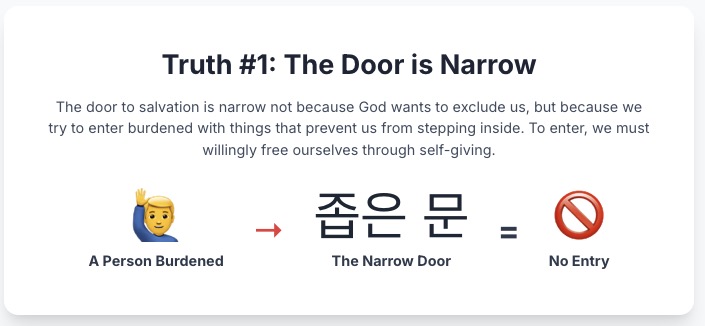
1) the door to enter the Kingdom of God, the Kingdom of salvation, is a narrow door. The door of the call is opened by God and he opens it to all, but the door of the response depends on human freedom, and not everyone is willing to enter that door, especially knowing that it is narrow. Jesus even tells us that there will be many who will try to enter the door but who will not succeed. Why? Because they try to go in burdened with many things that prevent them from stepping inside. Wanting to go in implies wanting to free oneself, and doing it for real. Without this will of self-giving and without this freedom of commitment, one cannot go through the door of salvation.
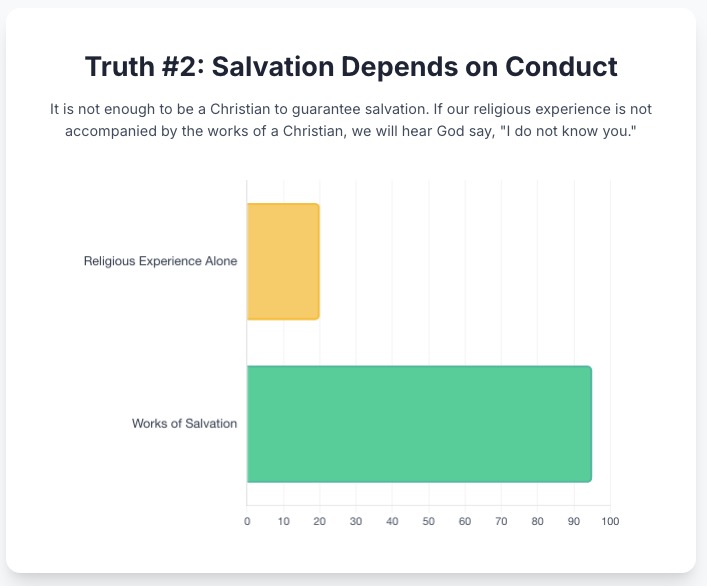
2) Obtaining salvation does not depend upon religion or religious experience, or even mystical experience, but on one’s conduct, on the works of salvation. It is not enough to be a Christian to guarantee salvation, because if we do not do the works of a Christian, we will hear God’s voice say to us “I do not know you, I do not know where you come from.” It is not religious experience (having eaten and drunk in his presence) that causes salvation. If it is not accompanied by works that spring from such an experience, God will be forced to answer, “I tell you that I do not know where you are from. Get away from me, you workers of iniquity.”

3) Those who are saved will come not from one place only, but from all villages and from all the corners of the world. “They will come from east to west, from north to south, and they will sit at the table in the Kingdom of God.” In all the corners of the earth there will be valiant and generous people who wish to enter the narrow door and who will do everything they can to succeed.
© 2000 Dicastery for the Clergy A | B | C
Infographics on this page have been added by THE WORD THIS WEEK using AI generative tools (i.e. Chart.js and Tailwind CSS). They may be copied for personal use or for any non-profit ministry. Graphics may not be sold or used for personal financial gain.
Freedom and the Narrow Door
The text’s first point, which states that God’s call is for all but that our response depends on human freedom, is a key tenet of Catholic teaching. The Catechism affirms this in paragraph 1731: “Freedom is the power, rooted in reason and will, to act or not to act…By free will one shapes one’s own life.” The idea that the door is “narrow” because of our “burdens” and lack of “self-giving” is also supported by paragraph 1739, which warns that “the more one does what is good, the freer one becomes. There is no true freedom except in the service of what is good and just.”
Faith and Works
The second truth—that salvation requires works of salvation and not just a religious experience—is a fundamental Catholic belief. The Catechism addresses this in paragraph 1815: “Faith is a free gift from God and is accessible to all who seek it. But faith without works is dead.” This directly connects to the text’s warning that God may say, “I do not know you” to those who only claim to have known him. It’s not enough to be a Christian in name; our actions must reflect our faith.
The Universality of Salvation
The third point, which states that people will be saved from “all corners of the world,” is confirmed by the Catechism’s teaching on the universality of God’s saving will. Paragraph 847 states: “Those who, through no fault of their own, do not know the Gospel of Christ or his Church, but who nevertheless seek God with a sincere heart, and, moved by grace, try in their actions to do his will as they know it through the dictates of their conscience—those too may achieve eternal salvation.” This supports the text’s assertion that “valiant and generous people” exist everywhere and that God’s call is for all.
Key Themes
- The Narrow Door of Self-Giving: The door is narrow because of the burdens we carry. To enter, we must willingly free ourselves and embrace a life of self-giving.
- The Necessity of Works: Our actions and conduct are essential for salvation. Religious experience is not enough if it is not accompanied by works that flow from that experience.
- The Universality of Salvation: God’s call is for all people, from every nation and corner of the world. Salvation is not a secret reserved for a select few.
Discussion Questions
- The reflection concludes that there are “valiant and generous people who wish to enter the narrow door source of merit and glory for God.
- The text states that the door is narrow because of the “many things” that burden us. What are some of those burdens in your own life that you feel might be preventing you from stepping inside?
- The reflection makes a clear distinction between religious experience and the “works of salvation.” What does it mean to you to live a life where your faith is not just something you feel, but something you actively do?
- The text warns that God might say, “I do not know you, I do not know where you come from.” How does this phrase challenge your personal understanding of your relationship with Jesus?
- Jesus says that people will come from all corners of the world to be saved. What does this truth mean to you, and how does it affect your perspective on people from different backgrounds or beliefs?
Pastoral Suggestions
Admiring the Teaching of God

Among other things, the Bible is the book of God’s teaching for the salvation of human beings. God as a teacher is symbolized by the figure of the father. In other words, divine teaching is guided by the special love of a father for his children.
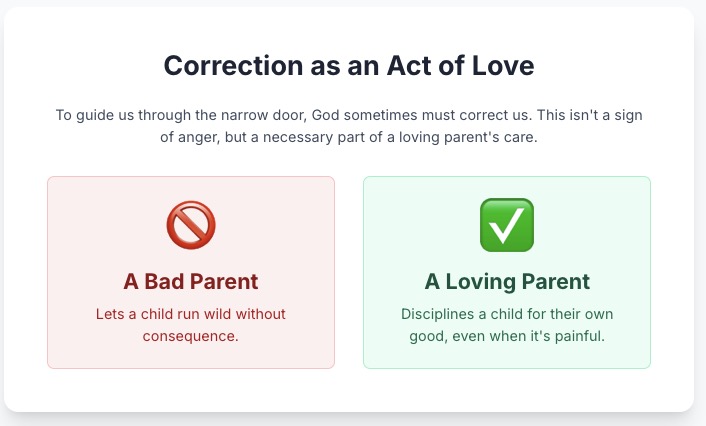
The text of the second reading underscores an aspect of this teaching: correction. Is there a father who at some point has not been forced to correct his children? Sometimes correction may mean punishment, which teaches something. Although the child cries and stamps his feet, he knows that the correction or punishment is for his own good, and that they come from a father who loves him with all his heart.
To guide people through the narrow door of salvation, God is sometimes compelled to resort to correction and punishment. In this way too, he is showing us his fatherly love. Rather than complaining, getting angry with God, considering themselves as victims, people need to admire the wonderful teaching on God’s part, who with his providence is constantly watching over our life, follows closely all our steps and, whenever necessary, resorts to correction for our own good.
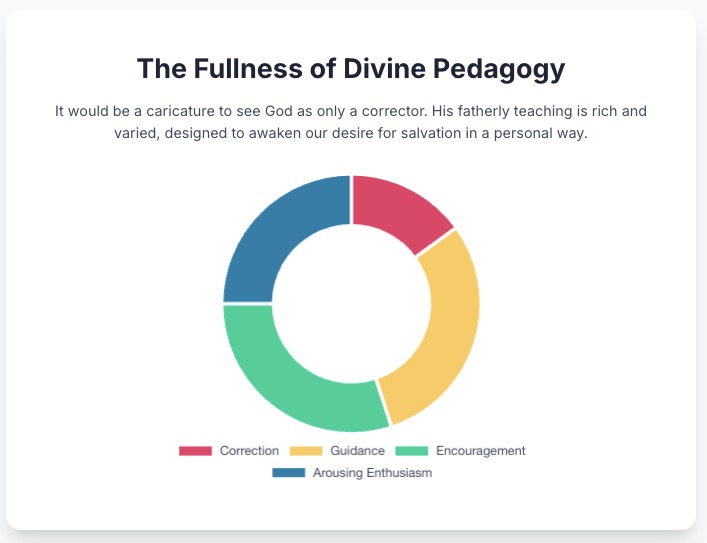
However, it is evident that a father cannot be reduced to a mere corrector. It would be a caricature of fatherly teaching and care! The father guides, encourages, arouses the enthusiasm of his children by the ways of truth and good. The same applies to divine pedagogy, which places within our reach numerous ways to awaken in us the profound desire for salvation, and guides us along the path that leads to it. And he does this in an absolutely personal way, because God is not a mass educator, but the educator of his children.

© 2000 Dicastery for the Clergy A | B | C
Infographics on this page have been added by THE WORD THIS WEEK using AI generative tools (i.e. Chart.js and Tailwind CSS). They may be copied for personal use or for any non-profit ministry. Graphics may not be sold or used for personal financial gain.
God as a Loving Father and Teacher
The core idea that God’s teaching is guided by a father’s special love for his children is a fundamental Catholic truth. The Catechism affirms this in paragraph 239, which states, “God is called ‘Father’…God’s fatherly tenderness can also be expressed by the image of motherhood.” This fatherly love is the basis for what the text calls “divine pedagogy,” a term the Catechism uses to describe God’s loving education of humanity.
Correction as a Sign of Love
The text’s assertion that divine correction and punishment are not signs of anger but rather a function of love is directly supported by the Catechism. Paragraph 229, for instance, speaks of how God “manifests his fatherly power by the care he takes of us,” while paragraph 1821 clarifies that “God predestines no one to go to hell; for this, a willful turning away from God… is necessary.” This aligns with the text’s idea that God’s discipline is for our own good, a loving response to our sinfulness, not a pre-determined punishment.
The Fullness of Divine Care
The reflection’s point that God cannot be reduced to a “mere corrector” but also guides and encourages us is also found in the Catechism. It describes the Holy Spirit as the “Teacher who brings us into the fullness of the truth” (paragraph 729). This supports the text’s final point that God’s personal pedagogy places within our reach “numerous ways to awaken in us the profound desire for salvation.” God is not just correcting us; he is actively and personally drawing us to himself.
Key Themes
- God as a Teacher and Father: God’s teaching is an act of love, guided by the special care of a father for his children.
- Correction as an Act of Love: Divine correction and punishment are not signs of hatred but are necessary for our own good and spiritual development.
- The Call to Admire God’s Providence: We are challenged to move beyond seeing ourselves as victims and instead admire God’s active care and guidance in our lives.
- The Fullness of Divine Pedagogy: God’s fatherly teaching is a caricature if it is reduced to only correction. It also includes encouragement, enthusiasm, and guidance toward salvation.
Discussion Questions
- The text states that a child, even while crying, “knows that the correction or punishment is for his own good.” Do you agree with this statement? How does this idea help you understand God’s correction in your life?
- The text says we should “admire the wonderful teaching on God’s part” rather than complain. What is the difference between complaining about your struggles and seeing them as an opportunity for correction?
- The text uses the phrase “a father cannot be reduced to a mere corrector.” How do you experience the other aspects of God’s fatherly teaching—his guidance, encouragement, and enthusiasm—in your life?
- The text says that God guides us in an “absolutely personal way.” What does this personal relationship with God look like to you, and what are some ways you can be more open to it?
Pastoral Suggestions
Salvation: God’s Initiative and Our Task

It is impossible for us to save ourselves: God is the one who saves us. But God does not impose salvation, he offers it. God does not spare us the task of accepting it, thus being saved. It is not we who take the initiative of salvation, but God.
However, it is not God who has the task of salvation, for this is our task. Initiative and task! What a lovely combination between a father who madly loves his children and his children who are concerned with behaving as such! If, in the impossible hypothesis that God decided to forgo his initiative to save us, he would be giving up his love as a Father, and his eternal plan on the destiny of human beings.
If we were to give up our task of salvation, on the one hand, we would be giving up our condition as fallen human beings and, on the other, our eternal end and destiny. God’s initiative pours security into our heart, and the certainty of salvation. The task of salvation makes us put our freedom at stake and decide to use it in union with divine initiative. All this is wonderful, but often we live our life without thinking about these things very much, perhaps overwhelmed by daily events.
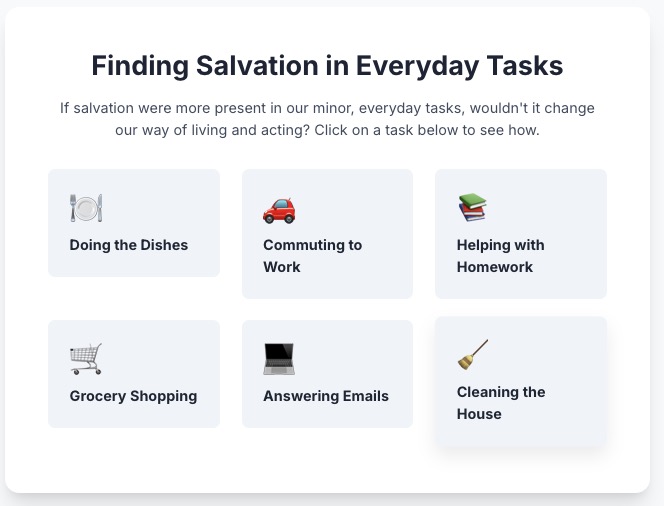
Sunday is a good day to think about all this, to stop on our daily path and think about how much life and eternity are worth. If salvation were more present in our minor everyday tasks, wouldn’t it change our way of living and acting? This is not the time for complaints! It is the time for action and hope.

© 2000 Dicastery for the Clergy A | B | C
Infographics on this page have been added by THE WORD THIS WEEK using AI generative tools (i.e. Chart.js and Tailwind CSS). They may be copied for personal use or for any non-profit ministry. Graphics may not be sold or used for personal financial gain.
God as a Loving Father and Teacher
The core idea that God’s teaching is guided by a father’s special love for his children is a fundamental Catholic truth. The Catechism affirms this in paragraph 239, which states, “God is called ‘Father’…God’s fatherly tenderness can also be expressed by the image of motherhood.” This fatherly love is the basis for what the text calls “divine pedagogy,” a term the Catechism uses to describe God’s loving education of humanity.
Correction as a Sign of Love
The text’s assertion that divine correction and punishment are not signs of anger but rather a function of love is directly supported by the Catechism. Paragraph 229, for instance, speaks of how God “manifests his fatherly power by the care he takes of us,” while paragraph 1821 clarifies that “God predestines no one to go to hell; for this, a willful turning away from God… is necessary.” This aligns with the text’s idea that God’s discipline is for our own good, a loving response to our sinfulness, not a pre-determined punishment.
The Fullness of Divine Care
The reflection’s point that God cannot be reduced to a “mere corrector” but also guides and encourages us is also found in the Catechism. It describes the Holy Spirit as the “Teacher who brings us into the fullness of the truth” (paragraph 729). This supports the text’s final point that God’s personal pedagogy places within our reach “numerous ways to awaken in us the profound desire for salvation.” God is not just correcting us; he is actively and personally drawing us to himself.
Key Themes
- God’s Initiative vs. Our Task: The core message distinguishes between God’s loving initiative to save all and our essential task of accepting that salvation. Salvation is not a unilateral action but a partnership.
- The Value of Free Will: The reflection highlights that our freedom is a gift that allows us to respond to God’s love. If we were to give up our task of salvation, we would be giving up our eternal destiny.
- The Urgency of “Now”: The reflection encourages us to use Sunday as a time to pause and reflect on how much life and eternity are worth, and to bring the reality of salvation into our daily lives and minor tasks.
- A Call to Action: The reflection ends with a direct appeal for action and hope, reminding us that we should be concerned with living as God’s children and not with making complaints.
Discussion Questions
- The reflection says there is a “lovely combination” between God’s initiative and our task in salvation. What does this partnership look like in your life? Can you think of a time when you felt both God’s love and the need for your own action?
- The reflection states that “if we were to give up our task of salvation, on the one hand, we would be giving up our condition as fallen human beings and, on the other, our eternal end and destiny.” What does this statement mean to you, and what makes it difficult for people to accept their task of salvation?
- The reflection encourages us to think about how our lives would change if “salvation were more present in our minor everyday tasks.” What is one small, everyday task you can do this week with salvation in mind?
- The reflection contrasts the feeling of being “overwhelmed by daily events” with thinking about life and eternity. How can we make time and space in our busy lives to stop and reflect on these bigger questions?
- The reflection concludes by saying, “This is not the time for complaints! It is the time for action and hope.” What is one concrete action you feel called to take this week to live with more hope?